Policy Lab Care Choices prototyping report [accessible version]
Published 29 January 2026

© Crown copyright 2026
This publication is licensed under the terms of the Open Government Licence v3.0 except where otherwise stated. To view this licence, visit nationalarchives.gov.uk/doc/open-government-licence/version/3 or write to the Information Policy Team, The National Archives, Kew, London TW9 4DU, or email: psi@nationalarchives.gov.uk.
Where we have identified any third party copyright information you will need to obtain permission from the copyright holders concerned.
This publication is available at https://www.gov.uk/government/publications/carers-employment-digital-discovery-and-care-choices-reports/policy-lab-care-choices-prototyping-report-accessible-version
Commissioner: DWP Human-Centred Design Science and policy leads
Policy Lab team: Sanjan Sabherwal, Pina Sadar, Ben Peppiatt, Eliza Collin
October 2025
Executive summary
This is the accessible version of the prototyping report for the collaboration between the Department for Work and Pensions (DWP) and Policy Lab on the Care Choices project. The work took place between December 2021 and March 2022. The original report was prepared as a slide deck. This version can be found in Carers’ Employment Digital Discovery and Care Choices reports.
We would like to thank the many stakeholders who were instrumental in developing, refining, and testing the prototypes in this report. In particular we would like to thank the many carers who participated, as well as Tower Hamlets Carers Centre and the Civil Service Carers Network.
This report provides a summary of key findings. It also introduces an overview of the prototypes, which were developed and tested as part of the project.
While the insights contained were gathered in 2022, they may still prove useful to those developing information for carers. The context of caring, carers’ information needs, and the fuller scope of possible solutions available today should be considered when reading the insights in this report.
The DWP partnered with Policy Lab to address the following challenge:
How can we better enable working people to build knowledge and understanding needed to make timely, informed choices about their role in meeting an adult friend or relative’s care needs?
By taking a design approach, this project re-engaged a community of practice – a community of organisations and experts involved in providing information to carers. Co-design workshops and prototype testing led to the identification of 4 interventions responding to the above challenge. More on methodology can be found in Section 2.
The 4 interventions were:
- Awareness-raising campaigns utilising touchpoints across the system, encouraging pro-active choices, and signposting people to relevant resources
- Sharing real experiences to help potential carers synthesise information and make decisions through multimedia channels like podcasts and supporting real human interaction where possible
- Conversation support tools with concise and relevant advice. This could be through physical materials like prompt cards or using digital technologies like targeted advertising or chatbots
- Information navigation improvements tailoring content for users on existing websites and better signposting from trusted sites
Prototypes (Section 4) for each of these interventions were developed in collaboration with the Social Design Institute, The University of the Arts London. They were tested and iterated with carers and the Community of Practice. Section 4 contains detailed feedback on each prototype, including how they were iterated, what risks and opportunities were considered, and suggested actions for government to progress the ideas.
A set of design principles (Section 5) emerged which can be applied to other interventions for potential carers.
Policy Lab set out suggestions on how a community of practice (Section 6) comprising organisations and experts could play a vital role in the further development and delivery of these ideas.
Policy Lab
Policy Lab is a multidisciplinary team working openly and collaboratively across government, bringing expertise in policy, ethnography, systems thinking, futures, and design.
We support the public sector to achieve better policy outcomes by partnering on innovative projects, leading and demonstrating best practice, and delivering training.
Since 2014, we have partnered with policy teams on over 170 projects, working with 7,000 public servants across central and local government departments and agencies, as well as internationally.
Policy Lab is a multi-award winning, and one of the world’s longest-standing government Labs dedicated to policy innovation.
Our projects test new approaches which bring lived experience and experimentation into policymaking. We share our new tools and techniques openly on our blog and the Open Policy Making Toolkit to encourage system-wide transformation.
Find out more about Policy Lab.
1. Introduction
1.1 Context
The Department for Work and Pensions (DWP), Department for Health and Social Care (DHSC), Department for Business and Trade (DBT) and Office for Equality and Opportunity (OEO) have undertaken extensive behavioural research which highlighted that, despite wanting to continue working, many carers reach a point where they feel employment is not compatible with caring. The research also found that choices around care are often made hastily in response to urgent situations, and that information for carers is fragmented and inadequate, with information for ‘potential carers’ (that is, working people making decisions about work and care) being particularly poor.
This work was conducted as part of the Care Choices project. Learn more about the broader project in the report ‘Supporting working people to make informed choices about work and care’ in Carers’ Employment Digital Discovery and Care Choices reports.
1.2 Challenge statement
The DWP wanted to understand more about how potential carers can be supported to navigate the currently very fragmented information landscape and convoluted choice architecture as well as making the landscape easier to navigate through better signposting between sources.
Our challenge statement:
How can we better enable working people to build knowledge and understanding needed to make timely, informed choices about their role in meeting an adult friend or relative’s care needs?
Focus on ‘potential carers’ – those facing early decisions about work and the care needs of a friend or family member.
These individuals often do not identify with the language of ‘care’ and therefore struggle to unlock support and recognise options that are available to them.
Through an initial evidence discovery exercise and discussion, we built upon the notion of informed decision-making and also acknowledged sense-making as an important part of the decision-making process.
To make informed decisions, potential carers need to make sense of their own situation, the options available to them and the implications that would come with certain decisions.
1.3 Community of Practice
The significant number of stakeholders that provide services and resources to potential carers calls for a systemic approach to our challenge. Actors include those across central and local government, health and social care services, carer-focused and condition-specific charities, employers, and financial and legal services.
DWP had previously engaged a community of practice with the representatives of the different stakeholder groups to come together to better understand the challenge, the current ecosystem and what improvements could be made. When dealing with a complex and intersectional problem, collaboration is vital to enact meaningful change.
One of the aims for this project was to re-engage this community. Its involvement provided a wealth of knowledge and expertise. Through this project we also were able to co-create the working practices necessary for taking a systems-wide approach to the challenge going forward.
1.4 Desired outcomes
The potential solutions explored in this project look to encourage behaviours to improve the following short-term outcomes. They are also expected to have knock on effects for more longer-term impact, such as improved mental health of carers or a reduced pensions gap.
1.4.1 Short-term outcomes: indicators of informed decision making
- potential Carers make more timely, informed choices about work and care
- have constructive conversations with family, the cared-for, and employers
- making active, early decisions using information about how to meet care needs
- consider rights and entitlements, options and long-term implications
- know where to go to get information
- consider own needs in deciding care arrangements
- feel able to make an informed choice to adapt care when needed
- make decisions collectively with other potential carers
- have greater awareness of caring, its implications and valuing information
1.4.2 Intermediate Outcomes
- more sustainable care arrangements
- fewer carers feel like they have no choice but to give up work to care
- awareness of options means gender biases impact decisions less, and carer gender imbalance reduced
- more people remain in work especially women
- care needs better met over the long term
1.4.3 Long-term impacts
- improved health of care recipients
- improved mental and physical health of carers
- improved workforce efficiency/productivity
- reduced gender pay and pensions gap
- increased saving for retirement
- less benefit expenditure
1.5 Information needs
Below is a condensed list of information needs identified by research and the Community of Practice. A fuller list is available in Appendix B of the report: Supporting potential carers to make more informed decisions about work and care in Carers’ Employment Digital Discovery and Care Choices reports.
As a potential carer, to make an informed decision, I need:
- to consider my own needs as well as those of others, and to have information that does not cause feelings of guilt I might experience around doing this
- signposting that uses language and terms I recognise and relate to so that I understand it is relevant to me
- actively served information that is accurate, up-to-date and reflects my current options (bearing in mind the system of support and services changes frequently at both the national and local level)
- accurate, up-to-date information about the needs of the person who requires care, now and over time
- an understanding of what caring activities will need to be performed in order to meet those needs (early on in my journey)
- information that is neutral, balanced and presents a full range of possible short- and long-term outcomes (including not doing any direct caring) so that I feel empowered to reach the decision that is right for me and don’t feel directed down a particular path by it
- information and practical advice about how to negotiate with others
- advice on how to advocate for myself and the person with care needs
- options offered to me by my current employer that would help me to combine work and any caring activities I take on and the legal rights and entitlements of carers in the workplace
- help to understand the long-term financial implications of my care choices and the financial support available
2. Methodology
2.1 UAL collaboration
Policy Lab and DWP partnered with the Social Design Institute at University of the Arts London (UAL) to prototype new policy ideas. UAL funded 2 design graduates, Jada Bruney and Jessie Zhang to join the project managed by the Policy Lab. An additional student project was also organised by David Preston, at Central Saint Martins, UAL which brought radical, more speculative thinking to the challenge area.
Find further information about the Design and Policy Network - funded by the Arts and Humanities Research Council .
2.2 What prototyping is
A prototype is a quick and basic realisation of an idea.
Developing a full-scale solution is time consuming, expensive and impossible to get right straight away. Prototyping allows us to share an idea and rapidly learn how it may or may not work to better understand a problem and the needs of users to inform a further iteration towards a solution.
Our prototypes were not intended to be perfect. Instead, they were used as conversation starters to learn more about the experiences of carers and pave the path for future steps.
Figure 1: Analytical and design problem-solving approaches
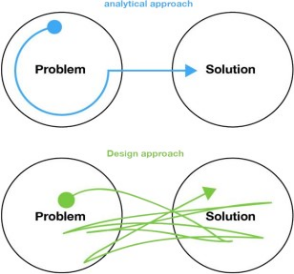
Figure 1 shows an image contrasting ‘analytical’ and ‘design’ problem-solving approaches. Under the ‘analytical approach’, a direct arrow from the problem to the solution illustrates a direct problem-solving approach in which solutions are deduced or inferred linearly from the problem, with no feedback or iteration. Under the ‘design approach’, the route of the arrow bounces back and forth between ‘Problem’ and ‘Solution’ several times, illustrating design’s more ad hoc and iterative approach to learning about problems by testing solutions, which helps designers to learn more about what will best address problem situations less suited to deductive problem-solving approaches.
2.3 Policy Lab approach
Policy Lab ran a series of workshops with the Community of Practice to develop potential solutions, designing prototypes to mock up possible interventions which were then tested with carers.
Prototypes were iteratively developed throughout:
- ideation workshops with the Community of Practice
- prototyping by Policy Lab and UAL designers – Jada Bruney and Jessie Zhang
- testing the prototypes with focus groups of carers
2.4 Participants
Policy Lab engaged a range of internal and external stakeholders through Community of Practice workshops, focus groups and expert interviews. During the project timeframe, we were unable to engage carers within 12 months of them learning of a friend or relatives’ care needs, so instead we engaged established carers who recalled their experiences retrospectively. We held:
-
3 workshops with the Community of Practice: 20 to 30 internal and external stakeholders from academia, government and NGOsa along with carers from Tower Hamlets Carers Centre
-
user testing focus groups with 7 carers from Tower Hamlets Carers Centre, DWP and DfE carers networks
-
interviews with 4 professionals from charities and carers’ networks and a working carer from Tower Hamlets Carers Centre
2.5 Project process: 4+ months, 4 workshops, 60+ participants
2.5.1 Diagnosis – December 2021
Challenge setting session with internal stakeholders (DWP, OEO, DBT, DHSC) to understand and define the problem
2.5.2 Discovery – January 2022
A ‘sprint’ workshop unpacking barriers for accessing information and making decisions to exploring creative solutions with 30 plus experts from across government, non-governmental sectors, academia and carers.
2.5.3 Development – January to February 2022
Policy Lab and University of the Arts London designers develop prototypes based on sprint ideas.
2.5.4 Testing – early March 2022
Testing prototypes with internal and external stakeholders through a Community of Practice workshop.
2.5.5 Iteration and user testing – March 2022
Further iteration of prototypes and testing them further through 3 user testing focus groups and expert interviews.
2.5.6 Presenting outputs and next steps – March to April 2022
Presenting the outputs to internal external workshop through a Community of Practice workshop and defining next steps.
2.6 Methodology strengths and limitations
2.6.1 Methodology strengths
- gathering additional insights into barriers and opportunities related to potential carers and carers information provision choice architecture
- using prototyping to rapidly test a range of ideas and quickly identify what could be developed further as well as any missing functionality
- an engaging approach with interactive workshops which resulted in high participant satisfaction
- reinforcing a cohesive stakeholder Community of Practice and defining high principles for future engagement of the group
2.6.2 Methodology limitations
- participants for user testing were only recruited through 2 routes ( Tower Hamlets Carers Centre and Civil Service carers’ networks)
- user testing was conducted with a limited number of people and further testing will be required
- testing was done with established carers (that is, those who had been providing care for more than 12 months), rather than the target group of potential carers: those at the very earliest stages of making decisions about work and care
- some areas of interest like employment are very complex and more time is needed to unpack them to design meaningful prototypes
2.7 Stakeholders’ feedback on the design approach
[I liked] how the same issues and challenges were viewed differently, depending on a person’s expertise. For example, how the designers took away our contributions and turned those into prototypes - sometimes the original messaging / intention was changed. But the iterative nature of the process meant there was further chance to comment and contribute. I really liked that.
– Participant feedback
I thought the balance of time between presentations and discussion was spot on. Not always the case in consultation events! I really liked the iterative nature of the work, so we could see where our ideas were incorporated and developed.
– Participant feedback
3. Challenge questions
3.1 Challenge-setting workshops
We ran 2 challenge-setting workshops, one internally with DWP, DHSC, OEO and DBT colleagues and one externally with the Community of Practice. The aim of the sessions was to review the existing evidence and translate it into clear challenge statements to focus the prototyping stage of the project.
3.2 Evidence discovery
We translated the existing evidence into digestible evidence cards which we shared in the challenge setting workshops as an evidence discovery. The evidence cards used are included in Annex 7.
An evidence discovery is designed to be a more visual and non-hierarchical experience of information, enabling multiple people to view and contribute to an issue simultaneously. It is an opportunity to review what we already know, add additional evidence, and identify gaps in knowledge.
You can read a report discussing the evidence base in greater detail in a report titled ‘Supporting working people to make informed decisions about work and care’ in Carers’ Digital Discovery and Care Choices reports.
3.3 Challenge questions
During the initial challenge-setting session with internal stakeholders, participants explored a range of evidence around barriers and opportunities.
Based on these insights and subsequent discussions, 7 challenge questions were synthesised and grouped into 3 themes becoming the focus for the Community of Practice ideation workshop.
3.3.1 Outreach and communication
1. How can we enable potential carers who do not recognise themselves in the language of ‘care/carers’ to find and use the information they need?
2. How can we proactively identify and serve people with information about care choices, and combining care and work, using existing touchpoints and relationships?
3.3.2 Decision making
1. How can we enable potential carers to give their own needs due weight when making decisions about work and care?
2. How can we help people consider long-term implications of caring in their early choices?
3. How can we help people to weigh up a wide range of relevant information, including their options, needs and values from multiple sources to come to an informed decision?
3.3.3 Supporting collaborative decision making
1. How can interactions between potential carers and their employers be improved to support informed decision-making?
2. How can we support more collaborative decision-making about care, for potential carers to access support from others?
4. Prototypes
This section provides an overview of the prototypes that were developed by Policy Lab and UAL designers and tested with the Community of Practice and carers.
4.1 Prototype strands
Working with the DWP’s Human-Centred Design Science team and UAL graduate designers, Policy Lab synthesised the ideas generated from the idea sprint workshop and clustered them into 5 strands related the challenge statements. These served as a basis for the development of Policy Lab and UAL’s prototypes.
4.1.1 Strand 1: Raising awareness
To explore the outreach and communication challenge theme, a raising awareness strand would explore ideas for a communication campaign to encourage potential carers to seek support.
4.1.2 Strand 2: Information navigation
To explore the decision making challenge theme, one strand – information navigation - would explore a range of tools for helping potential carers navigate the complex information landscape.
4.1.3 Strand 3: Sharing real experiences
One strand – sharing real experiences – bridged issues relating to both outreach and communication as well as the decision-making challenge themes. This strand would explore ideas for a communication campaign to connect with potential carers, helping them make sense of their situation and encouraging them to seek support.
4.1.4 Strand 4: Conversation support
One strand exploring ways to address the supporting collaborative decision-making challenge theme would focus on conversation support. This strand sought to develop tools and guidance for having challenging conversations around planning and managing care options.
4.1.5 Strand 5: Supporting employers and employees
A second strand addressed the supporting collaborative decision-making challenge theme: supporting employers and employees.
This strand reflected on the interactions between working carers and their employers and how they can better serve the needs of potential carers.
4.2 Strand 1: Raising awareness
Ideas for communication campaigns to connect with potential carers, and encourage them to seek support.
4.2.1 Initial thinking: barriers to address and initial hypotheses to explore
Through testing, the proposed solutions and assumed outcomes were changed as reflected in later suggestions.
Table 1: Barriers to informed decision making, proposed solutions and assumed outcomes
| Barriers to informed decision making | Proposed solutions | Assumed outcomes |
|---|---|---|
| Many potential carers initially do not identify as carers and can take many years to recognise their activities in the language of care the term. | Avoid using the language of care or caring in campaign messaging. Identify touch points to proactively engage with potential carers. | More potential carers will recognise themselves within the language of care earlier and engage with information sooner. |
| Information is fragmented and overwhelming. | Create a concise and memorable advice campaign (like ‘FAST’ for strokes) to support decision making. | Potential carers will consider a range of options and the long-term implications of caring. |
| Potential carers often give more weight to the needs of the person with care needs and feel guilt when doing so. | Through messaging, align the needs of the potential carer with those of the person with care needs. | Potential carers see value in considering their own well-being as important to provide the best care possible. |
| Making decisions about care can be emotionally challenging and stressful. | Use messaging and visual tone that is reassuring and calm. | Potential carers will feel less stress and more able to make decisions. |
4.2.2 Advice campaign
Initially we explored communications that sought to deliver a few key points of advice to potential carers, taking inspiration from the FAST acronym for identifying someone who is having a stroke. This prototype was shared with the Community of Practice. The figures below show initial sketched prototype ideas.
Figure 2: Think about THEM to help you help them
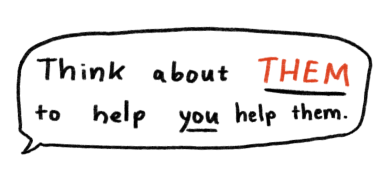
Figure 2 shows a sketched speech bubble. The text in the bubble reads “Think about THEM to help you help them.” “Them” and “you” are underlined.
Figure 3: THEM acronym campaign idea sketch
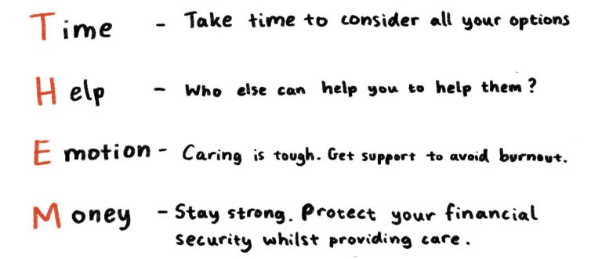
Figure 3 shows a sketched idea for an advice campaign around the acronym “THEM”. The 4 letters each stand for a word, with supplementary text following. T: Time - Take time to consider all your options. H: Help - Who else can help you to help them? E: Emotion - Caring is tough. Get support to avoid burnout. M: Money - Stay strong. Protect your financial security while providing care.
Insights from community of practice stakeholders:
-
There was support for the approach of asking who is looking after you whilst you are looking after someone else but others felt that potential carers may not feel this messaging is aimed at them, and that it felt more targeted at those already caring.
-
The amount of advice was considered information overload at an early stage, and due to the diversity and complexity of care situations, risked becoming ambiguous or unclear.
-
There were concerns about the othering of overstating THEM as an acronym, it was felt that this could feed into existing stigma around caring.
-
It was also raised that messaging needs to make it clear that carers have choices about what – if any – kinds of caring to do.
Key Challenges:
-
The nuances and variations of care situations makes it difficult for a generic campaign to engage the diverse mixture of potential carers.
-
Not everyone has the luxury of time to process their need when becoming a carer. In health and social care situations there are assumptions that you have to make immediate decisions.
-
Potential carers will not necessarily understand the pressure or guilt of caring at the stage that they have not started caring or haven’t realised they are a carer.
Suggestions:
Due to the limitations of an advice campaign, it was advised that it would be more appropriate to focus on signposting people to a care specific service, an expert resource or appropriate professional.
4.2.3 Call to action campaign
We moved from the advice campaign to a more straightforward call to action campaign. We tested a range of different visual and messaging options. These prototypes were shared in one user testing session before being tweaked slightly for 2 more sessions.
The figures below show 5 further sketched ideas for a call-to-action campaign.
Figure 4: Call to action option 1
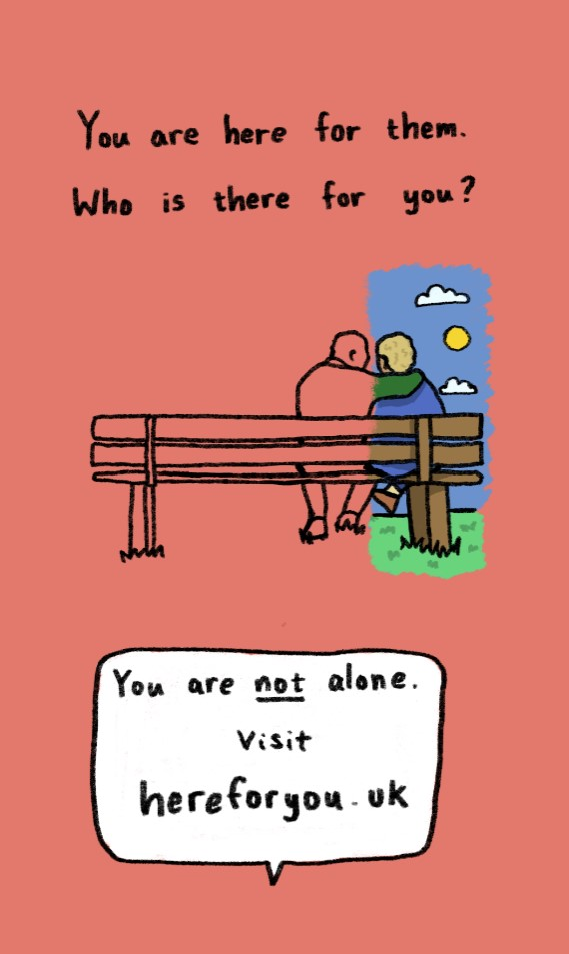
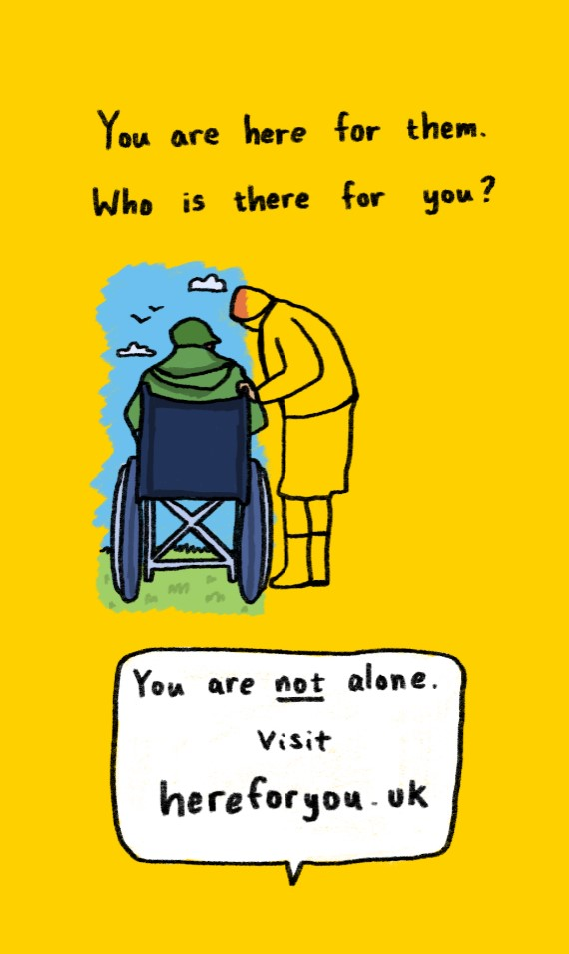
Figure 4 shows 2 sketched call to action campaign ideas. Heading text at the top of both images reads “You are here for them. Who is there for you?” Underneath the text in the top image is a sketch of a bench with 2 people sat on it. The person on the left has their arm around the shoulder of the other. The people are contrasted as only the person on the right and the space around them is coloured in, while the person on the left and the rest of the bench is a colourless sketch outline, depicting a contrast of attention and visibility between the 2 people. The second image shows a similar concept. Underneath the heading text is an image of 2 people. One is in a wheelchair, and the other is standing next to them resting their arm on the back of the wheelchair. The figures are contrasted as only the person in the wheelchair and space around them is coloured in, while the figure on the left is a colourless sketch outline, depicting a contrast of attention and visibility between the 2. At the bottom of both images is a speech bubble that reads “You are not alone. Visit hereforeyou.uk”
Figure 5: Call to action option 2

Figure 5 shows a speech bubble that reads “What’s best for you is best for them.”
Figure 6: Call to action option 3

Figure 6 shows a speech bubble that reads “If someone needs you, what do you need?”
Figure 7: Call to action option 4
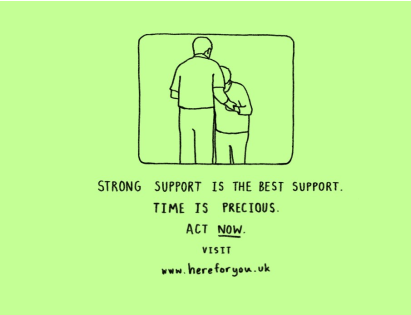
Figure 7 shows an artist’s awareness campaign sketch. The image features a central sketch of one person supporting another with their balance. The text below the image reads: “Strong support is the best support. Time is precious. Act now. Visit www.hereforyou.uk”
Figure 8: Call to action option 5
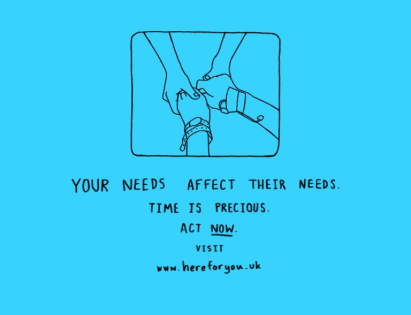
Figure 8 shows an artist’s awareness campaign sketch. The image features a central sketch of 2 sets of joined hands holding each other, illustrating a theme of support and personal connection. The text below the image reads: “Your needs affect their needs. Time is precious. Act now. Visit www.hereforyou.uk”
Insights from user testing
Option 1 was liked by participants.
Option one - I like visuals on that. As carers you are looking after everybody so I do connect with that.
– Carer – as part of user testing
A key criticism was that the messaging across the options was confusing; a potential carer would not necessarily know it was for them, and the ‘offer’ was unclear.
One suggestion was to communicate to potential carers that they need to act before their health deteriorates. Another view was that the term ‘crisis’ was problematic, suggesting that if in a crisis space you might be in denial.
Another suggestion was that the imagery showed predominantly older people and felt more like an advert for bereavement rather than caring. This aligned with previous feedback from the Community of Practice to acknowledge the diversity and complexity of care situations.
Suggestions:
-
Within the current system, the language of care and caring, whilst not to be used in the headline, needs to be acknowledged in some way to help unlock the support and services available. Ideally identification as a carer should not be a prerequisite for receiving support, but this requires significant system change.
-
The call to action needs to be clear and signpost to a specific location. Where should we be signposting potential carers to?
-
It is important to represent the diversity of care situations.
4.2.4 Call to action campaign development
Building upon important feedback from the first user testing session, the copy on the call-to-action posters was developed. Additionally, the option showing care for a younger person was included in line with feedback we had received.
We also introduced a range of signposting options to ask the question of where we should be directing potential carers for further information.
The figures below show how call-to-action campaign ideas were developed further.
Figure 9: Call to action options 1 and 2 for the final 2 user testing sessions
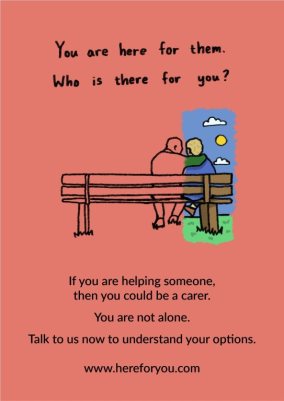
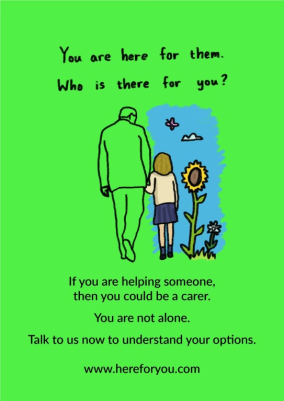
Figure 9 shows 2 sketched call-to-action campaign ideas. Text at the top of both reads “You are here for them. Who is there for you?”. Underneath the text in the top image is a sketch of a bench with 2 figures sat on it (as in figure 4). The figure on the left has their arm around the shoulder of the one on the right. The figures are contrasted as only the figure on the right and space around them is coloured in, while the figure on the left is a colourless sketch outline, depicting a contrast of attention and visibility between the 2 figures. Underneath the text in the second image is a sketch of a person holding hands and walking with a child. The figures are contrasted as only the child and space around them is coloured in, while the figure on the left is a colourless sketch outline, depicting a contrast of attention and visibility between the 2 figures. Below both sketches in the images, text reads: “If you are helping someone, then you could be a carer. You are not alone. Talk to us now to understand your options. Www.hereforyou.com”
Figure 10: Call to action option 3 used in the final 2 user testing sessions
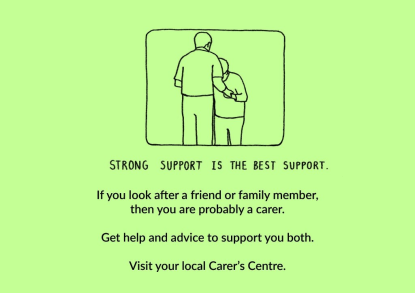
Figure 10 shows an artist’s sketch of an awareness campaign. The image features a central sketch of one person supporting another with their balance. The text below the image reads: “Strong support is the best support. If you look after a friend or family member, then you are probably a carer. Get help and advice to support you both. Visit your local Carer’s Centre.”
Figure 11: Call to action option 4 used in the final 2 user testing sessions
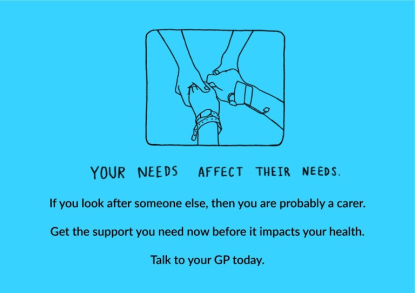
Figure 11 shows artist’s sketch of an awareness campaign. The image features a central sketch of 2 sets of joined hands holding each other, illustrating a theme of support and personal connection. The text below the image reads: “If you look after someone else, then you are probably a carer. Get the support you need now before it impacts your health. Talk to your GP today.”
Insights from user testing
Participants responded positively to:
- the inclusion of the image of caring for a young person in Option 1. We heard that those who care for children and partners are slower to identify as carers than those caring for the elderly, and that there can be stigma around parents identifying as carers for their children as it is just seen as parental responsibility
- positioning the needs of the carer alongside those of the person with care needs. One carer commented: “If you don’t look after yourself, who will look after the people you’re caring for?
- the drawing style and handwritten typography with appreciation that it felt “nice and friendly”
Key Challenges around inclusion were raised by various participants. The red and green used in option 1 images presents legibility issues for people with colour-blindness. Handwritten typography presents problems for neurodiversity inclusivity such as for people with autism (Note – all copy was handwritten but this was updated between user testing sessions 3 and 4).
Suggestions:
-
Further emphasis on representing a rich diversity of care needs and carer identities is important to reach as many people as possible.
-
Complex and emotional decisions often need to be made quickly so there is a need to balance urgency and reassurance.
-
Be mindful of inclusivity when making design decisions.
In terms of signposting, we learnt that the benefit of being signposted to a website was that it was an “unthreatening” ask for potential carers and could be accessed on their own terms.
Key Challenges:
-
Discussing carer needs with a GP was dependent on the relationship and how proactive that GP was in engaging with potential carers.
-
Care Centres are helpful spaces but potentially intimidating environments for people at the early stage of their journey. If you were uncertain about being a carer, you might not feel confident asking for help. It was also highlighted that they can be difficult to access for working carers as many are only open from 9 to 5.
-
Some care situations can be met with stigma or are challenging to discuss, such as supporting someone with severe mental health problems or substance misuse. Caring for someone with autism was raised as challenging as the condition is often dismissed as just bad behaviour and/or poor parenting.
-
There are limitations to a national awareness campaign with support services varying across different localities.
Carers centres are very helpful but I would not walk in [at an early stage], it would scare me.
– Carer – via user testing
Suggestions:
-
Consideration needs to be given to how a potential carer can be guided through information because it is often overwhelming.
-
A nationwide campaign would need to signpost toward more local sources of information to be helpful.
-
Develop a greater understanding of varying levels of stigma surrounding certain conditions/illnesses and care situations (this was also highlighted as an evidence gap during challenge-setting workshops).
4.2.5 Utilising key touchpoints
We heard from the Community of Practice workshop that printed materials can sometimes struggle to connect and that face-to-face interactions work best so we developed thinking to try to combine the 2.
In our user testing we shared a prototype of a prescription bag showing a call-to-action message that encouraged the potential carer to ask the pharmacist about support for carers.
We asked participants what other touchpoints would work for engaging potential carers.
The figure below shows the image of a prescription bag displaying the call-to-action campaign.
Figure 12: Prescription bag displaying a call-to-action campaign

Figure 12 shows an image of a person in a white coat holding a pharmacy prescription bag. The prescription bag features an artist’s sketch of 2 sets of hands held together supporting each other. Text on the bag reads: “Your needs affect their needs. If you look after someone else, then you are probably a carer. Ask your pharmacist about support for carers.”
Insights from user testing:
Participants responded positively to the idea and suggested the following touchpoints for engaging potential carers:
- banks when managing someone else’s finances
- supermarkets, online shopping pop-ups or leaflets with deliveries when organising another’s shopping
- schools or public playgrounds
- hospitals were raised as moments where more effort should be made to signpost potential carers to information and support. An equivalent of a Family Meeting focused on a carer’s needs was suggested as an idea to better support potential carers along with embedding condition-specific specialists in hospitals (for example, someone from the Stroke Association) to offer specific advice
- GP surgeries were also considered important, especially at moments of diagnosis, with a need to focus more on the needs of the potential carer
More experienced carers were mentioned by some as helpful. One carer suggested adding a digital signature or badge to the end of emails to act as a conversation starter in the workplace.
Suggestions:
- Combining campaigns with physical and in-person touchpoints could be more impactful.
- Co-locate carers’ services in healthcare settings to create more space and time for conversations about carer needs.
- Help potential carers connect with active carers to harness collective wisdom of those with experience.
Insights from community of practice:
Key Challenges:
- Resources and capacity will vary across signposting contacts. It is important to understand limitations and capabilities - “who can actually pick up the phone?”
- Filtering to the right organisation (local, national, condition specific, specialities of information, and so on). How do you provide the right option for different users?
- GP surgeries can be quite disparate groups to work with. For more strategic work, it is better to work through primary care networks (groups of GP practices) which take a more system based, population management approach than many GPs surgeries do.
- There can be resistance from GPs to top-down direction.
- There can be a lot of resistance from GPs to do anything apart from getting elected care access back up to where it was previously.
Measures of success could include:
- reducing the time it takes for people to identify as a carer (the average is 2 years according to research by Carers UK). However, the wider goal should be to remove the prerequisite of identification to access information
- an increase in proactive sharing of information amongst localised networks such as community WhatsApp groups
Suggestions:
- Coordinate closely with signposting contacts to make the best use of their resources and capacity.
- Adopt an area-based approach within a system and evolve solutions for working in different areas (for example, rural and urban).
- Work through primary care networks.
Allow for localised adaptation of tools and processes to increase ownership and encourage adoption. - Identify trade associations and business umbrella organisations as touchpoints for employers.
- Use survey data to identify gaps in carer identification to better target campaigns.
4.2.6 Summary of suggestions
Signposting:
- Focus campaigns on a clear call to action that signposts to a care specific service – an expert resource or appropriate professional.
- Any service needs to offer a signposting mechanisms toward more local sources of information to be helpful.
- Information is overwhelming and making sense of a care situation is challenging, so consideration needs to be given to how a potential carer can be guided through.
Challenge: With limited time for decision making, how much can a potential carer’s sensemaking be handled sensitively?
- Coordinate closely with signposting contacts to make the best use of their resources and capacity
Touchpoints:
- Combining campaigns with in-person touch points could be more impactful. Allow for localised adaptation of tools and processes to increase ownership and encourage adoption.
- Co-locate carers’ services in healthcare settings to create more space and time for conversations about carer needs and signpost to information.
- Work strategically through primary care networks.
- Help active carers identify potential carers to harness their collective wisdom.
- Identify trade associations and business umbrella organisations as touchpoints for employers.
Language and messaging:
- Avoid using only the language of ‘care’ and ‘caring’ in headlines to engage those who do not yet identify as carers.
- However, within the current system, the terminology does need to be acknowledged in some way to help unlock the support and services available. Ideally, systemic efforts should be made to make this not so.
- It is important to represent the diversity of care situations to reach as many people as possible. Evidence gaps in understanding differing norms, expectations and roles across genders and different socio-economic and cultural groups was highlighted during challenge setting workshops.
Design principles:
- Be mindful of inclusivity when making aesthetic design decisions. An engagement with inclusive design principles is important for ongoing work.
- Complex and emotional decisions often need to be made quickly so there is a need to balance urgency and reassurance. As such, developing language and messaging requires expertise in copywriting to achieve a productive balance.
Strategic targeting:
- Adopt an area-based approach within a system and evolve solutions for working in different areas (for example, rural and urban).
Trade off: Permitting localised agency over messaging and touchpoints will encourage ownership but reduce centralised control over communications.
- Use survey data to identify gaps in carer identification to better target campaigns.
What could be done next?
- Focus on utilising touchpoints, for example to identify potential carers to test other prototypes with (for example, podcasts and digital tools).
- Identify areas across key regional variables to target for more specific testing.
- Prioritise touchpoints to focus on (pharmacies, supermarkets, banks, GP surgeries, schools…) including digital touchpoints (such as online supermarkets and loyalty cards).
- Work with communication experts and local stakeholders to further develop prototypes.
- Plan and run location specific trials across the key touchpoints with a focus on engaging potential carers.
Further questions to explore
- Which touchpoints are most effective for reaching potential carers?
- What opportunities and challenges do different touch points offer? What is their willingness to work with Government?
- What language, messaging and visuals best help potential carers seek support?
- How do approaches need to differ across different regions?
- What data is there on geographic differences in care needs and provision?
4.3 Strand 2: Information navigation
A range of digital experiences were explored helping potential carers navigate a complex information landscape
4.3.1 Initial thinking: barriers to address and initial hypotheses to explore through user testing
Through testing, the proposed solutions and assumed outcomes were changed as reflected in the suggestions.
Table 2: Barriers to informed decision making, proposed solutions and assumed outcomes
| Barriers to informed decision making | Proposed solutions | Assumed outcomes |
|---|---|---|
| Many potential carers do not know where to access information and can be overwhelmed by the amount available. | Use staggered onboarding to quickly identify gaps in knowledge and signpost to further reading. | It will be easier for potential carers to locate the information that they specifically need and become better prepared to make decisions around care. |
| Many potential carers are time pressured and have difficulty locating useful information at a time which works for them. | Break down information into small, task-focused sections. | Gaps in knowledge can be filled quickly with easily digestible tasks, successfully improving knowledge. |
| Care journeys are all different. Potential carers need information that is relevant to their specific situations and point in their journey. | Tailoring information to current level and appetite through an information navigation tool that is constantly calibrating to the users’ needs. | Ensures information is always relevant to the care journey which saves time and results in more focused and mindful decision making, hopefully reducing stress and burnout. |
| A potential carer’s wellbeing can become low priority when caring for a loved one. This can have a detrimental effect on the health of the potential carer as well as the person with care needs. | Prompts for the user to consider their own needs and keep a long-term perspective during decision making. | Potential carers will have a better understanding of the caring landscape and what they can expect on their journey. They will be able to make better long-term decisions which will benefit their wellbeing resulting in better care given. |
4.3.2 Visual progress tracking
This is the first prototype we showed the Community of Practice that proposed using progress tracking to allow potential carers track their journey through information and show them where they had paid the most and least attention.
Figure 13: An example progress tracker
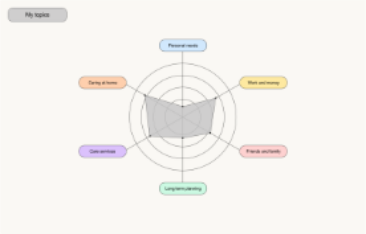
Figure 13 shows a prototype radar chart (also known as a spider chart or star plot) illustrating how someone might view an interface within a caring information source that helps the user to visualise the relative amount of progress they have made through different topics such as their personal needs, caring at home, work and money, friends and family, care services and long term planning.
Figure 14: An example personalised progress tracker
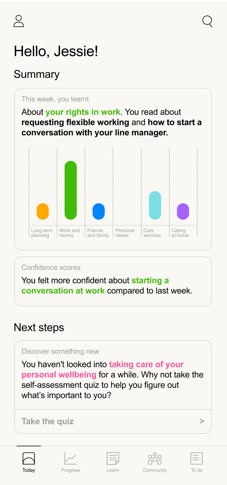
Figure 14 shows an alternative prototype of how progress through an information system might be visually presented to users. The screenshot of the personalised app reads “Hello, Jessie!” before displaying a bar graph depicting relative progress through different topics about caring. Below the bar graph, text reads “Confidence scores: You felt more confident about starting a conversation at work compared to last week. Next steps: discover something new: You haven’t looked into taking care of your personal wellbeing for a while. Why not take the self-assessment quiz to help you figure out what’s important to you?”
Insights from community of practice workshop:
Engaging with information as a potential carer can be overwhelming. If highlighting areas of low engagement, you need to break down the problem into small actionable tasks - the NHS “5 Ways of Wellbeing” was highlighted as a good example of action orientated information.
An overly complex digital app could put off people who just need to get a task done. Progress tracking could be demotivating and risks putting off potential carers. If you put the onus on the potential carer to know what information they need there is a risk being limited to the world that they can perceive.
Suggestions:
- Tools need to help potential carers look beyond what they know. Information tailoring must start by learning the users’ particular needs and contain feedback loops to continuously adjust the content.
- Information should be task focused and delivered piece by piece in response to needs.
- Frame onboarding processes as a self-assessment tool rather than progress tracking.
4.3.3 Testing digital experiences
We reframed our approach based on initial feedback gathered from carers on 3 different digital experiences. To ensure our learning supported DWP digital, we focussed less on details about any specific app. Instead, we asked wider questions about user needs and preferences for digital interaction. These were:
A. A customisable app or website that responds to carers’ information needs.
B. A GOV.UK page that signposts carers to key information.
C. Utilising social media platforms to create peer to peer networks for sharing information.
Customisable app
The customisable app was explored further. Focusing on a less direct approach to assess information needs and prompt toward less familiar information and follow up actions.
1. Users sign up and create a profile so that progress can be saved and tracked.
2. The app asks some starter questions to allow the user to self-assess their information confidence for important topics such as health, care activities, work, money and well-being.
3. The app then provides a visual representation of the users’ confidence for these topics.
4. The user can click on a topic to explore suggested information resources to learn more about this area.
5. After reading, users can save resources for later and is asked again to self-assess their information confidence levels.
6. In response to these answers, users are served with options for further reading.
GOV.UK signposting
Please note that this hypothetical testing of GOV.UK signposting was conducted prior to the creation of signposting on the Job Help pages for carers.
We explored whether signposting from GOV.UK could direct users to key information. Signposting could follow Government Digital Standards (GDS) without providing a specific service. We shared an example of GOV.UK signposting for COVID-19 to test the format with carers.
Hypothetically, key services could be presented at the top of the page (this could be a link to a Carer’s Assessment or to find your local Carers Centre) and contain links to relevant information, listed by topic and clearly titled.
Social media platforms
We proposed utilising familiar social media platforms (such as Facebook) to create peer to peer networks for sharing information. Platforms offer the ability to join up with thousands of people and share insights instantly.
For example, Mobilise offer a Facebook community specifically for carers. Carers UK hosts an online community for carers. Community Facebook group where residents can share questions and information about the area were also tested with users.
Summary of insights from user testing with carers
Customisable app:
-
The effectiveness of any app would rely on its intuitiveness and ability to be up to date and relevant.
-
Information for potential carers is very overwhelming. Delivering key information first would be preferable.
-
Many potential carers are hidden, and it would be challenging to make sure that any app reaches them.
-
An app would work for some but not all. Many carers already use apps for other services, for example online banking, ordering an Uber, shopping online. However, an app would not work for those who lack digital or literacy skills.
GOV.UK signposting
-
Whilst not excited by it, participants trust GOV.UK.
-
For many carers, GOV.UK, a Local Authority website or NHS online would be their first port of call, making these good spaces to signpost to other resources or digital products.
-
The simplicity of design was welcomed. Information can be overwhelming for potential carer so a ‘less is more’ approach was deemed important.
Social Media platforms
The carers we spoke with highlighted these benefits:
-
The systems are well designed and intuitive to use.
-
Facebook groups can be useful for getting local information from carers in the same area.
They also raised these problems:
-
Social media is a palace for subjective opinions and could become a source of false information.
-
Facebook is a place where people retreat from caring and it should be protected as such.
-
Lots of groups on Facebook are national and not local which may not offer the in depth support you might need.
4.3.4 Summary of Suggestions: consider various aspects of making a digital tool accessible, tailor information and make online content reliable
Consider digital capabilities
-
Any digital intervention requires a hybrid approach (a combination of digital engagement and human contact points, for example phone/video calls) due to a variety of preferences for engagement.
-
Combine digital tools with human support to help those who struggle with technology.
-
Information should be delivered in digestible formats as task-focused and actionable.
-
Information can be overwhelming for potential carer so a ‘less is more’ approach was deemed important.
Challenge: A digital tool is only useful if it reaches the potential carers who need it.
- Digital tools need to be proactively served to the people who need them.
Trade-off: Social media platforms can be used as spaces for retreat from caring.
Tailoring information
-
Tools need to help potential carers look beyond what they know. Information tailoring has to start by learning of the users’ particular needs.
-
Tailored advice requires feedback loops for continual recalibration to stay up to date and relevant to user needs.
-
Frame onboarding processes as self-assessment tools rather than progress tracking to avoid creating demotivating experience.
Development challenges
-
Apps can be time consuming, expensive and complex to design. If funding runs out then you risk not being able to continue development.
-
Testing tools with potential carers requires care as the tool cannot risk breaking when they are doing something critical.
Online credibility
-
For many potential carers, GOV.UK or a Local Authority website would be their first port of call, making it a good signposting hub.
-
Social media can easily spread false information so moderation is necessary to ensure credibility.
What could be done next?
-
A more in-depth mapping and assessment of the digital tools available, developing an understanding of resource demands and risks.
-
Develop prototype GOV.UK signposting to a range of digital services, help lines and in-person services.
- Discuss this and a range of existing options with potential carers as well as other apps and digital services that they use regularly.
-
Convene a working group within the Community of Practice around digital navigation to discuss how Government and GOV.UK can support their existing work.
- Within the working group, co-develop a set of principles with potential carers in mind.
Further questions to explore:
-
Which existing tools are most effective for engaging potential carers?
-
How can Government best support existing tools and services?
-
What could GOV.UK signposting look like and how effective can it be for supporting potential carers?
4.4 Strand 3: Sharing real experiences
Integrating stories to make the sense-making experience more human, helping potential carers to identify with others and feel less isolated when exploring options.
4.4.1 Initial thinking: barriers to address and initial hypotheses for exploration
Through testing, the proposed solutions and assumed outcomes were changed as reflected in the suggestions.
Table 3: Barriers to informed decision making, proposed solutions and assumed outcomes
| Barriers to informed decision making | Proposed solutions | Assumed outcomes |
|---|---|---|
| Lots of written information can make it hard for potential carers to engage with and digest. Potential carers have limited time to engage with information. | Offer a range of multimedia sources of information including video and podcasts. | Multimedia sources cater to different ways of learning making it easier for more people to engage with information. Audio information can be engaged with whilst doing other things saving time. Saving time and alleviating stress. |
| Many potential carers do not recognise themselves in the language of care. | Position a wide variety of care experiences from a diverse range of voices alongside information. | Seeing a diversity of experiences makes it easier for potential carers to recognise themselves within the language of care. |
| Potential carers find it difficult to consider the long-term implications of care and give little weight to their own needs. | Show accounts of real carers discussing their experiences and the long-term implications of caring, emphasising the importance of considering your own needs as a carer. | Potential cares are more likely to engage with advice from people who have lived experience. |
| Potential carers are often struggling with stress and burnout. | Use real voices and human faces to deliver important information. | The human experience makes potential carers feel less isolated and reduces feelings of stress. |
| Having conversations around sharing care activities can be challenging. | Make podcast/video segments easily shareable. | Friends and family are more likely to watch or listen to content and engage more with the human quality, becoming more open to helping. |
4.4.2 Carers podcast
Listening has unique benefits over other forms of informational engagement. A prototype that we explored was a carers podcast. Podcasts are an episodic series of audio files that users can download to their phones or computers and listen to at a time of their choosing. They are normally done in a conversational, informal way. A key advantage is that carers can listen whilst doing other activities.
4.4.3 Peer-to-peer support
By sharing experiences and advice, carers may feel more empowered to take decisions and feel less alone in their situation. Another aspect of podcasting, and about sharing stories more generally, is that stories can humanise caring.
The informal nature of podcasting could also render challenging topics less daunting; be it talking about accessing financial benefits or addressing the subject of bereavement for example.
4.4.4 Integrating lived experience
We also developed a prototype for how written information and multimedia content could be displayed together using 2 complementary scrolling channels. In this way, information can be shown alongside a diverse range of stories and accounts from real life carers.
Figure 15: Parallel scrolling channels
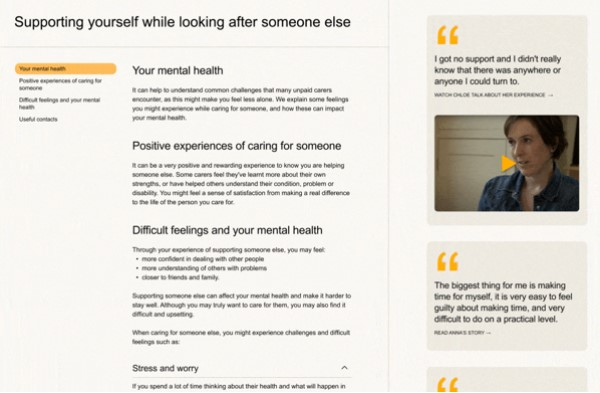
Figure 15 shows an image demonstrating parallel channels of information on a webpage that may be scrolled independently to provide different kinds of information, while enabling a user the option to scroll through either.
4.4.5 Insights from community of practice workshop
Utilising multimedia accounts of lived experience was received positively by many in the group. We heard that:
-
Caring is often an isolating experience. Learning from real people can help potential carers realise they are not alone in their experiences. Knowing that there are others going through similar experiences is powerful.
-
Audiovisual media can help information be processed more easily and be more inclusive.
-
Caring decisions can be value-laden and emotional, so it is important to hear lived experience stories. It’s easier to ‘get’ where a person is coming from via voice, than by text.…it allows for hearing the emotion in stories which is a key element to decision making that might not come through via text. Peer to peer support works well.
-
It’s easier to continue doing other tasks whilst listening. Listening could happen whilst waiting for a carers appointment you can be listening to advice on preparation for the conversation, resulting in a more robust assessment.
Suggestions:
- Combining information with multimedia lived experience accounts is a powerful way to tackle the loneliness of caring.
-
Multimedia experiences of information can improve processing.
- Strategically position content in key touchpoints to best help potential carers at opportune moments.
Key challenges raised by the community of practice included:
-
It is important to represent a diversity of lived experience and conditions to reach as many potential carers as possible.
-
Do not to duplicate work that already exists. Mobilise has thousands of carers on its network and shares real stories.
-
Podcasts are a saturated market and potential carers may not find the podcast or take the time to listen.
-
Long podcasts may not be suitable for everyone, as they can be difficult to digest and people may not remember the content.
-
Producing content is time consuming.
-
Content can quickly become out of date. Some content can be generic and time-spanning. But there is some content that would need to be updated which is a real commitment.
-
The DWP brand might not be considered entertaining.
-
Podcasts may only be suitable for certain demographics or users. Suggesting that alternative means of sharing stories should be considered.
Suggestions:
-
Aim to represent a rich diversity of caring lived experience.
-
Engage with channels that have the target audience on it will be key, for example Money box audience.
- Learn from those already exploring podcasting in this space.
-
If developing podcasts, do so in a range of languages to reach more people.
-
Supplement podcasts with key summaries of information.
- Test and understand what length and format of podcast works well for users. Snippets of interviews discussing specific topics or issues.
Podcast topics carers suggested would be valuable to hear discussed at the outset of a caring journey:
-
What is care? Who is a carer?
-
Acknowledging that you are a carer
-
Available support and how to access
-
Financial advice/benefits
-
Joining a local carers centre
-
How to apply for benefits
-
Health networks and accessing support
-
The importance of respite
-
Dealing with Local Authorities
-
Setting up power of attorney, appointeeship
-
Other legal information; will, trusteeship, inheritance packs, probate
-
Avoiding bad habits and negative behaviours (for example, substance misuse)
-
Loneliness, social isolation, tunnel vision, exercise
-
The importance of finding and joining relevant charities
Further insights from user testing
-
Podcasting was popular amongst carers we shared it with, even if they did not already listen to podcasts.
-
Stories are crucial, hearing how someone has tackled the same challenges and their experience.
-
We heard that it is important to balance serious information with humour.
-
Peer support was highlighted as hugely important for connecting on a human level. Care centres can be difficult to access for working people. Condition-specific support charities were seen as helpful.
-
Time to listen was raised as an issue, with some care situations making it difficult to find peaceful moments to listen.
-
“What is available in Coventry is very different to what is available in Birmingham.”
-
It is important that information is localised so there is a question about how helpful a podcast can be if it talks to a national audience.
-
One carer questioned whether the complexity of care topics would be challenging to communicate via a podcast and would instead need to be seen visibility, for example using a flow chart.
Suggestions
-
Utilise storytelling.
-
Balance information with humour and entertainment.
-
Connect stories to associated peer support groups.
-
Keep content short and focused - snippets of interviews discussing specific topics or issues.
-
Produce region specific content.
-
Supplement podcasts with visual materials if possible to represent complex information or processes.
4.4.6 Summary of suggestions: humanise the narratives around caring, make most of existing channels, improve accessibility of content and keep it useful.
Suggestions related to making it human:
-
Utilise storytelling - combine information with multimedia lived experience accounts is a powerful way to mitigate the loneliness of caring.
-
Aim to represent a rich diversity of carers lived experiences.
-
Balance information with humour and entertainment.
-
Connect stories to relevant peer support groups.
Partnerships
-
Learn from those already exploring podcasting in this space.
-
Engage with channels that have the target audience on it will be key, for example Money box audience.
Capabilities
-
Multimedia experiences can improve information processing.
-
Develop stories in a range of languages to reach more people.
Keep it useful
-
Produce region specific content.
-
Strategically position content in key touchpoints to best help potential carers at opportune moments.
-
Keep content short and focused - snippets of interviews discussing specific topics or issues.
-
Supplement podcasts with key summaries of information and visual materials to represent complex information or processes.
What could be done next?
-
Identify a range of partners to learn more about and support the development of a podcast series aimed at potential carers - this could be the Community of Practice.
-
Ask potential carers which of the topics identified through our conversations with carers are of highest priority to them.
-
Develop content, both audio and visual, about the key topics of interest. Create a working group to co-create the messaging and identify a diverse range of people with caring experience to review the content.
-
Test and iterate content with potential carers.
Further questions to explore:
-
What is the optimum length for podcast/video content?
-
How can the content be best organised and accessed?
-
How should multimedia content be combined with other information sources?
-
How can we engage and even entertain potential carers in this content whilst remaining trustworthy and credible?
-
Where should potential carers be signposted to?
-
Who is best placed to deliver this content (capability and public face)?
-
How would potential carers find the content?
- How can we measure the effectiveness of
-
multimedia engagement?
- How can we help potential carers remember what was in the podcast and pull out relevant information?
4.5 Strand 4: Conversation support
This strand explored tools and guidance for having effective conversations around planning, managing, and sharing care, designed to be accessible at critical moments, helping potential carers advocate for their needs.
4.5.1 initial thinking: barriers to address and initial hypotheses for exploration
Through testing, the proposed solutions and assumed outcomes were changed as reflected in the suggestions at the end of this section.
Table 4: Barriers to informed decision making, proposed solutions and assumed outcomes
| Barriers to informed decision making | Proposed solutions | Assumed outcomes |
|---|---|---|
| Time pressure – it is difficult to find time when collaborative conversations can happen. | A text messaging chatbot could help potential carers access the information that they need for their specific conversation more quickly and effectively. Advice shared via concise, bullet points for ease of use. | Potential carers can easily access information in moments of down time such as transit. Targeted and concise advice can be easily read through. Potential carers are empowered to engage with advice and have better conversations as a result. |
| A difficult family situation and challenges in resolving conflicting views make it difficult to explore care options and compromises for sharing care. Cultural norms or roles defined early on can limit sharing of care activities. | Conversation advice delivered in compact and easy to access takeaways (for example as text messages or wallet size cards) for use in moments of conversation. | Potential carers can easily access advice when most needed, resulting in focused and constructive conversations and better sharing of care. In the moment prompts support self advocacy, useful for those working against cultural or social pressure. |
| Stress and burnout - conversations about care are difficult for all those involved. | Having easily accessible advice, or advice that is positioned in strategic locations where potential carers visit and needs advice, such as waiting rooms. | Potential carers access advice in high stress situations where their capability to remember key points or self-advocate is usually hindered, resulting in a conversation that works better for them. |
4.5.2 Conversation tools
In the first Community of Practice workshop, we initially shared prototypes of tools for facilitating conversations, but the feedback was that they were too formal and would feel forced.
It was clear from the discussion that people wanted advice rather than direction. So we developed ideas with this focus for our user testing sessions.
Chatbot: Conversation advice
These ideas were gathered in 2022, before GPT models became popular. The capabilities of chatbots are vastly different today.
A chatbot messaging service designed to help potential carers find tailored advice for their conversation needs. The bot would ask you questions about who you are having the conversation with, the topic of conversation and the attitude of the person you are having the conversation with (are they frustrated, forgetful, proud, optimistic? and so on).
Based upon the answers given, tailored advice would be delivered in a concise format (via text message or email) to be easily accessed at the point in which it is needed, either on the way to having conversations, waiting for appointments or as prompts during conversations.
Figure 16: What a care chatbot was imagined as looking like on a phone
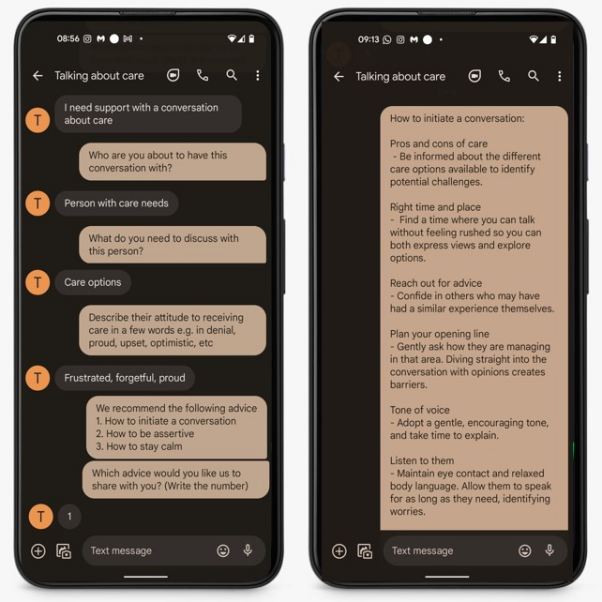
Figure 16 shows screenshots of a chat app on a phone screen, displaying a conversation between a user and a chatbot. The chatbot asks questions about the persons’ care situation before providing detailed tips about how to initiate a conversation about caring.
4.5.3 Advice cards
A less technological alternative could be advice cards shared in strategic locations such as Carer Centres, GP surgeries or hospitals.
On one side there is a description of a challenging conversation, and on the other, points of advice. Cards are pocket sized so can be taken away and re-read at opportune moments.
Figure 17: Example advice cards
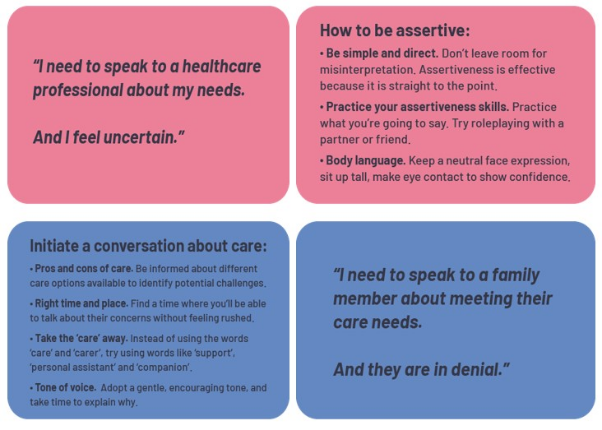
Figure 17 shows 4 example advice cards that read:
1. “I need to speak to a healthcare professional about my needs. And I feel uncertain.”
2. “How to be assertive:
- Be simple and direct. Don’t leave room for misinterpretation. Assertiveness is effective because it is straight to the point.”
3. “Initiate a conversation about care:
- pros and cons of care. be informed about different care options available to identify potential challenges
- right time and place. Find a time where you’ll be able to talk about their concerns without feeling rushed
- take the ‘care’ away. Instead of using the words ‘care’ and ‘carer’, try using words like ‘support’, ‘personal assistant’ and companion’
- tone of voice. Adopt a gentle, encouraging tone and take time to explain why
- practice your assertiveness skills/ Practice what you’re going to say. Try roleplaying with a partner or friend
- body language. Keep a neutral face expression, sit up tall, make eye contact to show confidence”
4. “I need to speak to a family member about meeting their care needs. And they are in denial.”
4.5.4 Insights from user testing
Carers responded positively to the conversation support tools, finding them useful. One reflection was that making short prompt lists was already a useful practice that they did for themselves.
There was some resistance to the idea of a chatbot, with a preference for real human contact. However, it was acknowledged that such a personalised service might require too much human resource to implement.
WhatsApp was suggested as a potential alternative. With just the act of chatting being beneficial even if you don’t get the answer you need. The same participant commented on how many people have now become confident with video calls and this can be done from home or in transit.
It’d be good to have some sense of a teammate throughout it, so that you’re not on your own, something that’s constantly there, that you can check in with, offering social things, practical advice - something you have to fall back on, so you’re not just on your own.
– Working carer (via user testing)
Suggestions:
-
deliver advice in a condensed and easily accessible format that can be used during conversations
-
prioritise real human contact as much as possible. Potential carers respond positively to social contact
-
if using an automated system such as a chatbot, make this explicit and obvious from the outset to not confuse or frustrate the user
Which care conversations most require support?
We used the below image prompt to ask carers about challenging conversations they had to deal with in their early stages of caring and the conversations they wished they had had.
Figure 18: Prompt used to ask about care conversations

Figure 18 shows 4 images of different types of relationship and conversation a potential carer may have. Text over each image reads: “Sharing care with family or friends”, “negotiating with employers”, “discussing options with the person with care needs” and “speaking with professionals”.
Insights from user testing included:
-
Conversations about exploring care options with the person with care needs were raised as particularly difficult.
-
Carers cited elderly parents wanting to maintain independence or not ask for support to avoid being seen as a “burden” or to be making a “fuss”. Discussing the prospect of moving into a care home was considered particularly problematic.
-
Speaking with professionals (such as GPs, Occupational Therapists, District Nurses or Professional Carers) was said to be important and carries the potential for shifting potential carers’ opinions or direction of travel, and signposting to further information.
-
One participant wished they had received support earlier on to raise the conversation about being offered a social worker.
-
A significant challenge raised, was the limited time available for these conversations. Coupled with the emotional trauma experienced in these moments, we heard that it was important that potential carers were well prepared.
-
When asking about experience navigating conversations with employers, one suggestion was that potential carers need support and advice to self-advocate and make a business case for their employers to support them. They said that ultimately, an employer’s motivation is to run a business, and that potential carers needed help to speak this language.
Suggestions:
-
It is important to find ways to change the narratives and reduce stigma around seeking professional help (especially amongst the ageing).
- Provide tips for “soft ways” to initiate difficult conversations.
-
Conversations with professionals are of utmost importance but tend to be time-limited.
- Provide potential carers with the support and language to self-advocate in the workplace.
Insights from the community of practice included:
-
Employers for Carers have a toolbox which includes prompts for conversations.
-
Consider who could be trusted in delivering a chatbot (Vodafone has developed a successful chatbot) and who could provide a reliable source of information.
Key challenges raised by the community of practice included:
-
Difficult to get the technology to work and ask the right questions. If the technology does not work, there is a risk users will feel trapped in the technology.
-
Requires a lot of investment upfront to get right, specifically good insights research to talk to those not yet identifying as carers.
-
Users may feel dissatisfied with a chatbot instead of a real person, especially if coming from government.
-
Care situations are unique and specific so generic conversation guidance may not capture the necessary nuance to be helpful.
-
Digital resources will not work for everyone.
-
Hard to create a meaningful connection through a chatbot and the experience could be dehumanising. Chatbots work better with facts rather than emotions.
Suggestions:
-
Connect with and learn from developers of successful chatbots and organisations or knowledge champions to develop advice.
-
Explore, promote and adapt existing resources.
-
Co-design conversation tools with the target audience to ensure that they are applicable.
-
Utilise human contacts if possible. Could the responses be provided by a community instead?
-
Provide a clear exit option to talk to a real person if the technology fails.
4.5.5 Summary of suggestions: work with carers and other professionals to help develop tools for rendering difficult conversation easier; and recognise that chatbots cannot replace human-to-human interactions
Conversation advice:
-
Deliver advice in a condensed and easily accessible format that can be used during conversations.
-
It is important to change the narratives around accessing professional help.
- Provide tips for “soft ways” to initiate difficult conversations.
-
Conversations with professionals are of utmost importance but they have limited time available.
-
Provide potential carers with the support and language to self-advocate in the workplace.
-
Connect with and learn from organisations or knowledge champions to develop advice.
-
Explore, promote and adapt existing resources.
- Co-design conversation tools with the target audience to ensure that they are applicable.
Automated technology (chatbot):
Note – these reflections were made in 2022.
- Difficult to get the technology to work and may not be appropriate for potential carers - chatbots are better equipped to deal with facts, not emotions. Will likely require significant investment upfront to get the offering right.
- Connect with and learn from developers of successful chatbots.
- If using an automated system, make this explicit and obvious from the outset to not confuse or frustrate the user.
- Provide a clear exit option to talk to a real person if the technology fails.
- Prioritise real human contact as much as possible. Look to use the caring community to provide support.
What could be done next?
-
Interview chatbot developers to understand the opportunities and limitations of the technology.
-
Develop new prototypes that are less technology dependent (such as a FAQs) and run further user testing with carers and potential carers.
-
Interview potential carers to understand their situation. Combine these insights with what we have heard from carers to prioritise which types of conversations to begin testing with.
-
In depth review of the conversation tools available. What advice exists?
-
Reach out to a range of knowledge experts to gather advice and assess quality of advice available.
-
Convene a working group within the Community of Practice to co create advice with potential carers and carers.
Further questions to explore:
For potential carers:
-
What conversations about care are you finding most challenging?
-
What advice do you want?
For carers and Community of Practice:
- Is there feasibility in a more community driven response to this challenge?
For chatbot developers:
-
Is the technology suitable for this challenge?
-
What does the technology require to make it successful? What are the risks and challenges?
4.6 Strand 5: Supporting employers
Reflections on the interactions between working carers and their employers, including how workplace culture and policies can better serve the needs of potential carers.
4.6.1 Workplace culture
Tools and approaches are needed to facilitate a positive shift in culture and “get the idea of being a carer into people’s minds before it happens”.
Numbers and stories are particularly powerful - you cannot ignore the large numbers of employees who are and will be engaged in caring activities (1 in 4). At the same time, stories help us step into carers’ shoes and understand what it is like to combine work and care.
A quick retweet or a post on LinkedIn or media case studies are really powerful when a working carer talks about their experience – be it a struggle or when they are really supported.
– Charity representative
4.6.2 Providing support
Employers need to be supported to recognise, understand and support potential working carers’ practical and emotional needs.
It’s about wellbeing but also practical needs, for example unlocking financial benefits or amending their contract.
Returning to nurturing a positive working culture, it’s important that employers encourage ‘a culture of sharing’ personal experiences and challenges which helps line manager and senior staff support potential carers’ needs.
Some carers have recognised a positive trend in new companies and with younger staff who might be more attuned to mental health needs and a culture of sharing. But more needs to be done and this needs to be applied across the board and not just a few progressive employers.
Staff training, senior champions and awareness raising campaigns can all be helpful to increase support.
Data on employed carers wellbeing was highlighted as an evidence gap during our challenge setting workshops and it was suggested that there was unpublished DWP data that could be made available.
New generations and millennials, new companies are in touch with employee wellbeing support and are encouraging a culture of sharing. 45 and above people don’t want to consider it as much.
– Working carer (via interview)
4.6.3 Empowering employees
More needs to be done to empower working potential carers to understand the implications of their decisions. For example, taking a career break or opting for part-time work will have implications for their career and retirement.
It’s also important to support carers to become stronger advocates for themselves in the workplace. As discussed in the conversation support strand, guidance on how to speak a language that employers will respond to can make conversations more productive. This quote is one example of how reframing your ask as an action plan can land well with an employer.
How do you sell it to your employer? If you go and say ‘look I really want to keep my job but I’ve got my caring responsibilities, this is a plan I’ve come up which means I can still deliver what you need and I’m still here when you need me to be’, then you will get a far better response from your employer.
– Head of carers’ network (via interview)
4.6.4 Workplace policies and tools
Robust workplace policies and tools are crucial for working carers, and employers need to be helped to design them and implement them. This can really make it much easier for employers to embed them.
The Carer Passport has been pointed out by several people we’ve spoken to as an effective tool for supporting carers in the workplace.
Specifying the factors affecting whether carers stay in work was highlighted as an evidence gap during challenge setting workshops and would be important to understand to implement meaningful workplace policy. Additionally, it was raised that there is a need for more data and information specifically relating to the self-employed and SMEs.
A lot of employers and line managers are lazy and can lack courage. If you give them frameworks, options and ways of behaving, then it becomes a default - it means that they have to think about it less.
– Head of carers network (via interview)
Figure 19: Carer passport guide

Figure 19 shows the front cover of a Department of Health Carer Passport guide.
4.6.5 Employment-specific user needs
Our research has identified these employment-specific user needs for both employees and employers: As a potential carer, to make an informed decision about combining work and care, I need:
- to have awareness of caring and my employer’s policies before needs emerge
- to ideally feel that carers are valued in the workforce. Failing this, I need guidance to advocate my potential value
- to understand the professional and financial implications of any decisions that I consider
- an emotionally intelligent line manager to support my decision making
As a line manager, to support a potential carer to make an informed decision about combining work and care, I need:
- robust and clear company policies to give me the legitimacy to provide support
- training and guidance to be more emotionally intelligent and nurture a culture of sharing amongst my team
- guidance for identifying potential carers within my team
4.6.6 Undeveloped and untested ideas
Ideas that were considered for this strand but not realised as prototypes or tested with users due to lack of time to engage the necessary stakeholders.
Workplace Culture
-
When including questions tailored for the identification of carers in anonymous employee satisfaction surveys, use language to connect with those who do not see themselves as carers and if participants do identify, create a signpost mechanism to connect with more information.
-
An email signature that carers can adopt to help raise awareness with colleagues. Build statutory rights into existing childcare offers/support.
-
Focus on raising awareness/ training amongst key professional groups as well as employers so there is a consistent offer.
Valuing carers:
- Engage with influential advocates for supporting carers in the workforce to incentivise employers.
Providing support:
- Develop guidance for employers to create a culture of sharing and support.
Empowering employees
-
Company-adapted checklists which quickly and clearly show what flexible working options are available to an employee to focus the conversation about needs and available support.
-
Advice for employers on the implications of their decisions. For all flexible working options, signpost to further information including video accounts from carers who have adopted the change, career and financial experts to advise on the potential implications and legal experts to remind of employment rights.
-
Create a template email for employees to send to HR/Employers, making it easy as possible for potential carers to engage their employers.
-
Write up a list of questions for employees to ask employers about company policy.
Workplace policies and tools
- Include in an employee’s contract a commitment to an annual review to support early identification of potential carers, and clearly state the support available for carers to remain in work.
4.6.7 What could be done next?
-
Consider which other strands in this report could be applicable to the employment space - for example podcasting and conversation support tools.
-
Work with key partners such as Employers for Carers (Carers UK) to co-design how advice and conversation support for employers and line managers can be made as usable in conversations as possible.
-
Convene a working group representing the diversity of employers to discuss how to incentivise supporting carers amongst the business community.
-
Interview a diverse range of businesses to better understand best practice for creating a workplace culture that is best suited to proactively identify potential carers.
Further questions to explore:
-
What is best practice for a potential carer supportive workplace culture? What does a culture of sharing look and feel like in practice?
-
How can we influence culture change across the system, from small to large enterprises?
-
How can advice be as accessible and usable as possible?
-
How can we better support working carers in their decision making for what options of combining work and care will be best for their situation?
5. Design principles
This section summarises key findings that are broadly applicable across information sources.
5.1 Utilise touchpoints
-
Strategically utilise touchpoints that potential carers regularly encounter as a point of engagement (such as pharmacies).
-
Strategically deliver concise and accessible advice at opportune moments (such as waiting rooms) to support potential carer decision making.
User need: As a potential carer, I need to easily access key information to best advocate for my own needs.
- Create more time for conversations about carer needs during healthcare appointments for people with care needs.
User need: As a potential carer, I need space and time with professionals to make sense of my situation and understand my options.
5.2 Make it human
-
Promote real human contact as much as possible. Combining interventions with in-person touch points is more impactful.
-
Combine information with multimedia accounts from carers’ real experiences (for example podcasts and videos).
User need: As a potential carer, I need to hear from real experiences to help make sense of my own situation and feel less isolated.
5.3 Localise
-
Any nationwide initiative needs to offer mechanisms to signpost to more local information and services to be helpful. Coordinate closely with partners to make the best use of their resources and capacity.
-
Allow for localised adaptation of interventions to increase ownership and encourage adoption.
Challenge/trade-off: Permitting localised agency over messaging and touchpoints will encourage ownership but reduce centralised quality control.
User need suggestion: As a potential carer, to make an informed decision, I need to access local support services as soon as possible.
5.4 Hybrid approach
-
Adopt a hybrid approach (a combination of digital engagement and human contact points, for example phone/video calls) to cater to a variety of preferences for engagement, individual capabilities and busy schedules, for example digital, automated, written, phone and in-person.
-
Making sense of a care situation can be overwhelming and challenging, so careful consideration needs to be given to how a potential carer are guided through information and interactions to ensure ongoing engagement.
User need: As a potential carer, to make an informed decision, I need to be guided through information at a pace that is appropriate to my capabilities.
Challenge/trade-off: With limited time for decision making, how much can a potential carer’s sensemaking be handled sensitively when urgency of action is vital?
5.5 Language and messaging
- Avoid using the language of care and caring to engage those who do not yet associate as carers but acknowledge the terminology in some way to unlock the support and services available.
User need: As a potential carer, to make an informed decision, I need to be empowered to use the terminology of care to engage with support
- It is important to represent a diversity of care situations to reach as many people as possible.
User need: As a potential carer, to make an informed decision, I need to hear from a diverse range of care experiences to make sense of my situation
- Information should be delivered in digestible formats as task-focused and actionable.
User need: As a potential carer, I need relevant information that is digestible and ends with task-focussed suggestions of what to do next.
6. Community of practice
This section outlines a value proposition for a community of practice approach to the caring information challenge, suggestions for areas of focus and future steps.
6.1 About community of practice
Community of Practice (CoP) refers to a group of people who share a common concern, a set of problems, or an interest in a topic and who come together to fulfil both individual and group goals. Communities of Practice often focus on sharing best practices and creating new knowledge to advance a domain of professional practice.
As the Care Choices project progresses, the CoP could serve as a helpful vehicle for gaining knowledge, feedback and expertise from a diverse group of academics, charity professionals, businesses and officials who are working in the sector. At the same time, the process of sharing information and experiences within the group enable members to learn from each other and develop their own or their organisation’s approaches to care services, taking into account the latest evidence.
Throughout the project, we have been exploring and testing whether a CoP approach is a productive governance structure for this policy area.
Our engagement with the CoP has been positive and it has shown that a proactive group of experts from different fields can add significant value to policy and idea development. This is particularly true for the carers’ sector, given its fragmentation, with a plethora of organisations, academics, informal groups and internal stakeholders. The existence of a CoP enables individuals from various parts of the ecosystem to come together to contribute in a time-limited but intensive manner and creates better alignment of efforts making for more meaningful change.
We see the CoP’s key benefits to be:
- create new ideas of policies and services as part of the Care Choices project and more broadly
- prevent ‘reinvention of the wheel’ by sharing best practices that already exist in the sector
- provide instant feedback on any new policies, services or ideas;
- Support the formation of new partnerships and ensure a joined-up approach on systemic issues such as the language and information-provision of caring
It might be interesting too to broaden it out in terms of, if we can raise one or two common issues we may have, for example the common care gap, and ensure we achieve consistent messaging about that across the group. It would be of huge value, in getting incremental improvements in terms of consistency of language and approach.
– Community of practice member
6.2 Governance of a community of practice
The first stage of the Care Choices project aimed to energise and galvanise the existing group of practitioners and experts with the goal of ensuring the group continued to engage with DWP in the later stages of the project. During this stage, the group was very much facilitated by DWP and Policy Lab who organised, determined and led the activities.
For the CoP to be truly participant-led, it is important to devolve and distribute authority and make sure participants play an active role in the running of the group. A more collaborative governance method could motivate participants and ensure that the content is tailored to group members.
We ran a survey amongst the existing group members, which attracted eight responses. Four people said that they would be interested in contributing to a CoP newsletter, three volunteered to present to the group, one said that they would be interested in chairing a meeting and another participant expressed interest in leading a working group.
Although we had a small sample, there is some evidence that group members are interested in taking a more active role within the CoP. This suggests that a community of practice could at least in part be led by member organisations.
6.3 Engaging the community of practice
Etienne Wenger, the educational theorist who initially outlined the concept of CoPs, suggested a 7-step approach to keeping CoPs engaged and effective:
1. Design the community to evolve naturally. Encouraging new members and giving opportunities to different participants to take the lead could ensure the CoP grows and evolves organically and covers topics of its own choosing.
2. Create opportunities for open dialogue within and with outside perspectives. While the members and their knowledge are the CoP’s most valuable resource, it is also beneficial to look outside of the CoP to understand the different possibilities for achieving their learning goals.
3. Welcome and allow different levels of participation. When surveyed, the existing members expressed different degrees of interest in being engaged in the running of the group. Allowing participants to chair meetings, lead working groups or present to the group is important, whilst allowing for a more passive participation is also key.
4. Develop both public and private community spaces. Half the surveyed participants said that they would be interested in writing a newsletter for the rest of the group. Launching a newsletter - or considering alternative ways of utilising online tools, such as forums and mailing lists - could keep the group engaged beyond physical meetings.
5. Focus on the value of the community. CoP should create opportunities for participants to explicitly discuss the value and productivity of their participation in the group. Periodic surveys or open discussions could ensure that members have an opportunity to reflect on the added value of the group.
6. Combine familiarity and excitement. When surveying participants, all eight of them said that they liked interactive workshops as well as innovation, design thinking and prototyping. Promoting opportunities for the group to explore familiar topics in a different way can keep the group engaged and energised.
7. Find and nurture a regular rhythm for the community. When asked about the frequency of engagement, 5 out of 8 surveyed participants said that once a quarter would work best for them. Two said that they would like to meet once every 2 months, and one participant said that 2 to 3 times a year would be sufficient.
6.4 Risks and challenges
There are multiple challenges of running a CoP, some of which were flagged by participants themselves:
-
Membership challenge: getting the membership right is key to making this CoP work. It is important to reflect on who else should be invited to the group to burst the bubble of ‘usual suspects’ and ensure diverse and relevant voices.
-
Sustainability challenge: it can be difficult to keep a group engaged for a prolonged period of time, not least because some members of the group will inevitably leave. Having frequent meetings and regular communication is one key approach to mitigate the risk of this CoP breaking down.
-
Organisational challenge: Catering for different levels of participation is important, however it’s challenging to coordinate the group and to delegate different responsibilities and tasks. Having a designated person to oversee the management of the group might be needed for it to run smoothly.
-
Knowledge management challenge: It is important to establish the system for capturing, disseminating and storing intel from this CoP and ensuring it is built into government services and policies.
In principle a forum which wrestles with some of this stuff is a good thing. Problem is people change and move on, have different areas of responsibility – and in some sense you always need to keep the work fresh and live, if only that everyone has it in their sights.
– Community of Practice member
6.5 Areas of focus for a community of practice
We asked the group about their vision for future phases of a CoP. Some of their suggestions included:
- carrying on the existing work on finding solutions for addressing information provision for potential carers
- “Seeing solutions from the initial three workshops delivered, promoted and embedded”
- “It would be good to update on ideas discussed at the workshop on 31 March 2022, for example testing, proposed next steps, and so on”
- “Putting some ideas into practice to test them out further. These could include, for example, testing a new communication about getting financial information and support if you are working and caring (for example about potential costs of arranging care in the home or residential care). And/or, for example, testing a new route such as using a specific consumer channel, or trade association, to reach people who are working and caring.”
- “Reviewing progress of the implementation of the work.”
- “[Inviting] feedback from potential carers and evaluation of any potential carer initiatives that are introduced.”
- exploring availability and visibility of information, or signposting information
- mapping the system, capabilities of the stakeholders and opportunities for intervention/change
- bringing together “carer-facing” activities with “organisation/profession-facing” initiatives to form a holistic and collaborative approach backed by data that is capable of recognising and underpinning improvement grounded in the perspective of potential carers
- learning from research and evaluations and exploring how it can inform policy and practice
6.6 Future steps
In light of our engagement with the Community of Practice throughout the project and what we heard from the Community of Practice members themselves, the following steps could be considered in any future activity:
-
Promoting engagement and participation: Communities of Practice are evolving and living entities, and it is vital that they are continuously engaged and motivated. Approaches that can be helpful for keeping a group active and engaged include: providing effective facilitation and considering techniques for encouraging active involvement; holding meetings regularly (without prolonged pauses); forming working sub-groups; delegating specific tasks (such as chairing meetings); explore the option of online/email engagement between meetings; and inviting external speakers.
-
Utilising collective knowledge and experience: We have experienced the power of collective intelligence held within the Community of Practice. It is important to explore different ways for utilising a group’s wealth of experience to inform the future steps of any policy/service decisions. Circulating surveys, using the meetings for testing ideas and seeking direct suggestions for suitable contacts are just some of the potential approaches for making the most of the group’s knowledge and experience.
-
Promoting joint approaches and common language: Our work illustrates that the current information and service landscape is highly fragmented. Using the Community of Practice for agreeing on common approaches and language could streamline carers’ navigation of the system. For instance, organising sessions focusing on different organisations’ best practices or having specific working groups to delve into certain issues could help promote common approaches across the board.
-
Capture learnings: We have observed that Communities of Practice change rapidly - people leave organisations, new services pop up and the focus shifts. It will be therefore important to explore different mechanisms for effectively capturing the learnings of the group. Keeping a shared online folder for all members, recording sessions, circulating short meeting minutes and keeping a database of best practices could help ensure that knowledge is shared effectively.
7. Annex: evidence cards
This section lists statements that were written on evidence cards used during challenge setting workshops in 2022. These cards were intended to give readers an understanding of the evidence base the project work was drawing on at the time. You can view the cards as they appeared in the workshop, in the slide deck version of this report in Carers’ Employment Digital Discovery and Care Choices reports.
The evidence cards were built from evidence about the care information problem at that time. As such, some statistics quoted in the present tense may be inaccurate or out of date.
You can read DWP’s report discussing the evidence base in greater detail in a report titled ‘Supporting working people to make informed decisions about work and care’ in Carers’ Employment Digital Discovery and Care Choices reports.
Some evidence cards include findings derived from qualitative research with carers conducted for DWP by Ipsos with carers in 2018 to 2019
7.1 Evidence cards: potential carer persona cards
- People aged 18 and above, with a particular focus on those aged around 45 to State Pension Age (SPa) who are currently in work and facing decisions about work and care.
-
Those who are making initial decisions about their role in meeting someone else’s care themselves, and how to combine work and care.
-
People who are facing decisions about their role in meeting the care needs of another adult (for example a parent, partner or adult child) rather than those who are caring for a disabled child aged under 18.
- Specifically working people in England, recognising the fact that many of the relevant policy areas are devolved and as a result the services and support available for carers may differ significantly.
-
There is no such thing as a ‘primary potential carer’ in the way that there might be a ‘primary carer’. There are only a range of potential carers in different circumstances all facing decisions about what course of action best balances their needs with those of the cared-for and other potential carers.
-
Two-thirds (65%) of UK adults had provided informal care at some point between 1991 and 2018. This proportion rises to 7 in 10 (70%) for women.
-
Around half of adult carers combine care with either full or part-time work (49% of female and 52% of male carers).
-
Women are almost 8 times more likely to become economically inactive in order to care for their home and family, and are at greatest risk of dropping out of work to care between the ages of 40 and 64.
- Even if people do not give up work altogether, they often reduce their hours which can substantially limit wage progression, or turn down opportunities for promotion in order to accommodate their caring activities.
7.2 Evidence cards: identifying as a carer
-
Most information and support is targeted at ‘carers’. Many people providing care however, often do not think of themselves as carers, meaning that support aimed at carers can be invisible to them.
-
91% of carers said they missed out on financial or practical support (or both) as a result of not identifying as a carer (Carers UK, 2016)
-
Carers UK (2016) has found that the majority of “carers” take years to own the term
-
People unfamiliar with what caring entails may not recognise their situation as one that presents decisions which can be supported by information.
-
“I didn’t see myself as a carer, so it’s almost impossible to look for things to help you with your situation.” – Female, London Focus Group, Ipsos MORI research
-
‘Care’ can be assumed to apply to professional or paid cares or include only certain activities such as physical care, rather than others such as shopping, managing finances from a distance, or providing company and emotional support.
- Outreach workers working with black and ethnic minority communities have found that the unfamiliarity of both the word and the concept of “carer” has presented particular difficulties for local initiatives aimed at supporting minority carers (Griffiths, 1992)
-
“daughter, son, wife, husband…” Potential carers report that they see themselves as ‘looking after a family member/friend’ rather than ‘caring’ or being a ‘carer’.
- “When people say to me, “You’re his carer”, I say, “no, I’m not, I’m his wife.”… We married because we loved each other… He would do a lot more for me if he could, I know he would” Female, London Focus Group, Ipsos MORI research
7.3 Evidence cards: capabilities, mindsets and emotions
-
Some potential carers understandably repot being reluctant to find out their friend or relative’s full prognosis or likely trajectory of their care needs.
-
Focus on the cared-for’s urgent needs can prevent people from considering their own, or from seeing their situation as one with choices available.
-
Feelings of guilt when considering personal needs and values alongside the needs of the cared-for is a commonly reported experience among carers.
-
Information that acknowledges the challenges of caring and encourages people to factor their personal needs into decisions may help alleviate feelings of guilt.
-
Being proactive is challenging, and some do not seek support until crisis hits.
-
Prolonged stress causes burnout, adversely affecting decision-making.
-
Lack of digital capability - 11.9 million people in the UK (22% of the UK population) lacked basic digital skills, such as the ability to open web browsers and find internet pages.
-
Family members and friends often willingly make sacrifices to help. They can feel it is their duty to do what they can and that they have no choice but to begin providing care.
-
Decisions are complex, emotive and can involve choosing between deeply-held values that will often require trade-offs.
7.4 Evidence cards: circumstance and social connections
-
Time pressure can limit ability and motivation to explore options. Existing commitments (such as paid work or child care) limits capacity to explore options and consider long term implications.
-
Potential carers with more money may be more willing to take time off work or consider paying for support to manage work and care, but this can also be a barrier to seeking info about state-funded support.
7.5 Evidence cards: care roles
- Roles such as that of a ‘primary carer’ can fix perceptions of whose ‘responsibility’ the care is and prevent more sustainable, shared arrangements being sought.
I feel frustrated. Because she lives close to me, I’m the default carer, seven days a week. There wasn’t a proper discussion about sharing the load.
– Male, Nottingham interview, Ipsos MORI research
7.6 Evidence cards: work situation
-
Workplaces vary greatly in how flexibly people are able to work and in how effectively employers support potential carers.
-
In 2015, only a third of employers (34%) had a formal, written policy or an informal, verbal policy in place to support carers in the workplace.
-
Rigid job structures limiting the ability to adapt where, when and how staff work can make fitting work schedules with care especially challenging.
-
A supportive line manager, colleagues, carer networks and HR policies can act as important touchpoints signposting to helpful information.
-
Fear of repercussions from taking time away from work or being viewed as less reliable due to personal commitments can be a barrier too these constructive conversations between managers and staff.
7.7 Evidence cards: development and urgency of care needs
-
When a diagnosis is terminal, spending what remaining time you have with the care-recipient can become first priority, side-lining other considerations.
-
Thinking long term can also be particularly challenging if care needs emerge suddenly, or if a condition’s prognosis is uncertain
I’ve just been putting out each fire as it lights up. I haven’t had time to think that far into the future about help.
– Female, Nottingham interview, Ipsos MORI interview
-
When the onset of care needs is sudden, relatives and friends may be more likely to mobilise support collaboratively in response to a clear emergency and then remain involved over the long-term, sharing care activities between them.
-
In cases of more gradually increasing needs, participants more often reported that they felt the division of care among family was imbalanced. Needs can slowly increase, ratcheting-up demands on time and energy without prompting individuals to seek help from others until it’s too late.
7.8 Evidence cards: cultural
-
Social norms around taking on care activities are stronger for women and can be more prescriptive within some communities than others.
-
Deep-seated, historical and cultural expectations about where ‘responsibility’ lies within society or families to provide care may be continuing too influence decisions.
-
Norms are often transmitted and reinforced through information.
7.9 Evidence cards: the scale and complexity of the social care system
-
Providing accurate, comprehensive information about the complex and ever changing system of support can be challenging for information providers.
-
Some participants in the Ipsos MORI research found local authority websites to be inconsistent, hard to navigate, or to contain out of date information, adding to confusion about what support was available.
-
Those unfamiliar with caring do not know where to start looking for information about their situation, and can feel overwhelmed by the task of trying to identify relevant information from a complex range of sources.
7.10 Evidence cards: the use of language
-
Online information often talks of combining work and care as something individuals ‘juggle’ or ‘struggle with’ (Ipsos MORI, 2018). Such terms frame the situation as unstable and unsustainable, and may give the impression that it is inevitable that carers will have to stop work at some point. It is preferable to use neutral terms (for example ‘combining’) or positive terms (for example ‘achieving a balance’).
-
Use of strong, value-laden terms such as “duties” or “responsibilities” signals that there is a (moral) obligation to care in a specific way. This can induce feelings of guilt in the reader, and make them less likely to consider their own needs and explore alternative care arrangements.
-
It is preferable to use neutral terms and expressions such as “care activities”, “providing care”, “looking after someone” or “supporting a friend or relative”.
7.11 Evidence cards: the framing of choices
- When information has been designed primarily for already established carers, without considering the distinct needs and options available to potential carers, this can narrow the range of options a potential carer believes they have available to them.
I can remember so many of the conversations [with the GP] were about my mother’s condition. Looking back, there wasn’t nearly enough focus on who was going to be providing the care for her.
– Female, Nottingham interview, Ipsos MORI research
-
Much information assumes a ‘primary carer’ model of care, (where one person takes on the majority of care activities) and does not present options still open to people at early stages of their journey (for example, self-funded care or discussing options with family and friends).
-
Much information assume a ‘primary carer’ model of care, (where one person takes on the majority of the care activities) and does not present options still open to people at early stages of their journey (for example, self-funded care or discussing options with family or friends).