Annex 6: Arts investment around the world: policy, place and philanthropy
Updated 26 March 2026
Applies to England

© Crown copyright 2026
This publication is licensed under the terms of the Open Government Licence v3.0 except where otherwise stated. To view this licence, visit nationalarchives.gov.uk/doc/open-government-licence/version/3 or write to the Information Policy Team, The National Archives, Kew, London TW9 4DU, or email: psi@nationalarchives.gov.uk.
Where we have identified any third party copyright information you will need to obtain permission from the copyright holders concerned.
This publication is available at https://www.gov.uk/government/publications/arts-council-england-an-independent-review-by-baroness-margaret-hodge/annex-6-arts-investment-around-the-world-policy-place-and-philanthropy
Produced for the Department for Culture, Media and Sport by Erskine Analysis, May 2025.
Author: Eliza Easton
About this paper
This study analyses international approaches to arts funding, to provide context on how public funding models compare to that of the UK. Specifically, it examines how policy impacts the cultural funding structures in France, Germany, the United States, Canada and Korea.
The intention is its findings will contribute to the Department for Culture, Media and Sport (DCMS) evidence base, specifically informing the ongoing Review of Arts Council England.
In this paper we:
-
Consider the mechanisms and structures of public arts funding at national, regional, and local levels. We focus on those areas of cultural funding that are comparable to the funding delivered by Arts Council England (e.g. investment in artists and non-profit organisations) rather than, for example, broader investment in the creative industries, or creative higher education.
-
Investigate the role of the government in incentivising private and philanthropic contributions towards arts and cultural organisations.
-
Highlight best practices that could be adapted to the UK context.
This paper was reviewed by experts on four of the countries highlighted. We are incredibly grateful to the following individuals:
-
Thomas Perrin - associate professor of regional planning and urbanism, attaché for academic and scientific cooperation in the French Embassy to Slovakia,
-
Laura Callanan - Founding Partner, Upstart Co-Lab,
-
Rupert Oliver Allen - Economist, Cultural Affairs, Department of Canadian Heritage,
-
Dr Hye-Kyung Lee - Professor of Cultural Policy at King’s College London.
Executive summary and insights for policymakers
This paper explores how public arts funding operates internationally, drawing lessons from five countries – France, Germany, the United States, Canada and Korea – to inform the ongoing review of Arts Council England (ACE) and the work of the Department for Culture, Media and Sport (DCMS). It primarily focuses on two central questions: how other nations structure and deliver cultural funding, and how they incentivise private and philanthropic support.
Summary of approaches
| Country | Model of Arts Funding | Population Coverage[footnote 1] | Key Features | Devolved Funding Flow |
|---|---|---|---|---|
| France | Centralised with structured devolution overseen by the Ministry of Culture. No arm’s length body equivalent to Arts Council England. | 66.7 million. | Strong central leadership; extensive regional delivery via DRACs; tax reliefs (Aillagon Law) drive growth in philanthropic giving; regional co-investment in initiatives like FRACs. | The Ministry of Culture allocates funds to regional DRACs, which co-fund projects with local governments. Regional and municipal governments also invest directly. |
| Germany | Highly federalised; Länder lead on policy and spending. No arm’s length national arts body. | 84.1 million. | Länder/municipalities fund 80% of cultural provision; the federal government plays a strategic role, particularly in Berlin and through cultural policy coordination; innovative social protection schemes for artists. | Länder and municipalities provide core funding; federal support flows to nationally significant institutions and via intermediaries (e.g. German Federal Cultural Foundation). Kultur-MK supports co-ordination of intergovernmental collaboration. |
| USA | Local/state dominant funding with federal strategic support via arm’s length body, National Endowment for the Arts (NEA). Strong philanthropic incentives and culture. | 347.3 million (state populations range from 0.6 million to 39.4 million. 11 states have larger populations than the South East of England).[footnote 2] | Over 4,500 local arts agencies; 40% of NEA funding passed to states; theatre/film tax incentives; extensive private donations supported by favourable AGI/capital gains rules. In May 2025, President Donald Trump proposed eliminating funding for the NEA from 2026. | State Arts Agencies (SAAs) receive NEA and state funds, and regrant locally. Local Arts Agencies (LAAs) implement policy on the ground. Complex ecosystem of federal, state and local interaction. |
| Canada | Mixed model with a balance of federal and provincial roles. Arm’s length federal funding via Canada Council. | 40.1 million. | Canada Council and Department of Canadian Heritage fund nationally; major regional disparities; permanent matched endowment scheme; strong philanthropic tax reliefs. | Federal government supports Canada Council and national institutions; provinces fund via their own arts councils; municipalities contribute cash and in-kind support. Regional divergence is significant. |
| South Korea | Centralised with emerging regional infrastructure. Arts Council Korea (ARKO) is an arm’s length body with political oversight. | 51.7 million. | National and lottery-based funding channelled via ARKO; national government supports cultural vouchers, artist insurance and job schemes; public-private funding via Mecenat Association. | Central funds channelled to ARKO, which collaborates with 17 regional arts foundations. Regional officers being introduced to help coordinate delivery. |
| England | Mixed model underpinned by local authority funding and national investment through an arm’s length body, Arts Council England (ACE). | 57.1 million (in 2022). | National funding channelled through ACE; decline over last decade in local authority capacity; philanthropic giving concentrated in London. | DCMS provides grant-in-aid and lottery funds to ACE. ACE allocates directly to organisations and programmes, with strategic investment in priority places. Local authorities fund at their discretion, with significant variation. |
Key findings
Full references are provided in the main text
1. Many international models of cultural funding combine national leadership with meaningful devolution.
However, in the countries examined in this paper, cultural devolution does not occur in isolation. Instead, countries with higher levels of overall devolution - such as Germany and Canada - are also those that allocate the majority of public cultural investment at sub-national levels. This is because, as in any other area of policy, the delivery of cultural spend requires appropriate expertise, resource and leadership (for example, in Germany in 2023 46% of government expenditure was made by the 16 states, or Länder, and underlying municipalities). Even in these more decentralised systems, federal funding still plays a strategic role by supporting nationally significant institutions and projects.
Devolved systems can also encourage, rather than discourage, regional divergence in cultural spending. In Canada, for example, the Canadian Arts Council (the Canada Council) may be attempting to rebalance its own funding, but because of the different approach taken by the different regions, cultural spend remains highly uneven across the country. In Germany, devolution has not resulted in reduced support for the capital. On the contrary, Berlin’s annual culture budget exceeds the Mayor of London’s cultural budget and the budget for Arts Council England combined.
Critically, the effective delivery of devolved cultural funding requires sufficient capacity. In France, where cultural funding has been increasingly devolved since the 1980s, 2,400 people are employed to manage its implementation (c. 9,500 people are employed in the cultural ministry as a whole)[footnote 3]. England’s population is smaller than that of France (c.56.5m vs. 65.5m in March 2021)[footnote 4] so the equivalent in the UK would be c.2,070 people managing devolved arts funding. In the United States, every State has an arts agency, and there are around 4,500 more local arts agencies operating in cities, towns, counties, and regions.
2. Centralised investment can support regional access.
France demonstrates that central funding does not have to always be focussed on the capital: many of its nationally funded museums and cultural institutions are located outside of Paris. This raises the question as to whether more regionally based, nationally significant organisations could be funded directly from the centre in the UK.
3. Cultural representation flows both ways.
Germany’s approach to its capital city offers a useful counterpoint to the English approach to devolving culture. Berlin receives additional federal funding not in spite of, but because of its status as a national showcase (e.g. It includes funding for institutions like the Stiftung Preußischer Kulturbesitz (Prussian Cultural Heritage Foundation), museums like the Deutsches Historisches Museum, and memorials like the Memorial to the Murdered Jews of Europe). This suggests that cultural devolution can partly involve redefining the capital’s role to ensure it reflects and supports a diverse national culture. One approach to cultural devolution might therefore be to task and resource organisations based in the capital to actively represent and collaborate with communities and organisations across the country.
In Korea, the Arts Council (ARKO) sees it as a key part of its role to create opportunities for showcasing work from across the country, not just nationally but internationally. In the UK, the equivalent might be ensuring that organisations from across the UK are given access to prominent global platforms as part of a future cultural devolution strategy.
4. Formal infrastructure for collaboration between tiers of government matters.
Having core staff on the ground is essential for delivering devolved funding, but international case studies suggest that mechanisms for coordination between different levels of government can also be valuable. In Germany, Kultur-MK, and in France, the Fédération Nationale des Collectivités Territoriales pour la Culture (FNCC), provide structured frameworks that allow regional governments to advocate for and align on cultural policy.
5. Private giving plays a larger role in countries with stronger tax incentives and permanent match funding.
Philanthropic giving is significantly higher in the US and Canada than in the UK, largely due to more generous tax reliefs for individuals and corporations. Sector specific initiatives can also be effective: in Canada, a permanent matched funding scheme for the arts has driven CA$883 million in endowment growth since 2001. By contrast, while the UK offers relatively generous incentives, they are less advantageous for high-net-worth donors - at least during their lifetime. The UK’s own matched funding initiative for the arts, Catalyst, was time-limited, which may have constrained the development of long-term giving.
International examples also suggest that boosting philanthropic giving inevitably comes at some cost to the taxpayer - albeit that the benefit can often offset that cost. These costs may include the resources required for extensive fundraising efforts run by the state - as seen in Korea - or generous tax reliefs, such as those under France’s Aillagon Law (which encourages corporate philanthropy). While the latter has spurred record levels of corporate philanthropy, including in the arts, it has remained a source of controversy.
6. Regional balance in philanthropy matters.
Whilst not aiming to promote philanthropic giving in particular areas, France’s Aillagon Law has helped decentralise philanthropy, with 60% of new foundations now located outside Paris. This demonstrates that national policy can influence not just the level of giving, but also its geographic distribution. It also suggests that shifting the donation landscape doesn’t necessarily require region-specific matched funding, and that corporate incentives can also have this effect.
7. Supporting resilience means going beyond fundraising
Both Canada and Korea embed philanthropy within broader strategies to build organisational capacity, improve governance, and support workforce development. These countries recognise that long-term sustainability depends not only on income diversification but also on strengthening institutions themselves.
Canada supports organisational development and business planning through the Federally-run Canada Cultural Investment Fund (which supports business development, incentivises endowments and supports organisations in dire straits), while Korea’s ARKO works on fair pay, HR support, and rights education, as well as managing a long term fundraising campaign. This suggests it is possible to look beyond fundraising to fund systems that build institutional resilience – especially for small and mid-scale organisations. The Canada Cultural Investment Fund, in particular, offers a compelling model.
France
With thanks to Thomas Perrin - associate professor of regional planning and urbanism, attaché for academic and scientific cooperation in the French Embassy to Slovakia
Overview
The State played a significant role in French cultural policy long before the installation of the Republic.[footnote 5] However, its role was formalised through creation of the Fine Arts Secretariat in the 19th century, followed by the establishment of a Ministry specifically dedicated to cultural affairs in July 1959.[footnote 6]
From this point the state has facilitated both a strong central and - from the early 1980s - increasingly devolved cultural offer.[footnote 7]
-
The most recent national budget included €0.4bn for museums, €0.8bn for the creation, production and distribution of live performance and €0.2bn for support for the creation, production and dissemination of visual arts.[footnote 8] This includes funds which will be distributed by regional intermediaries. The Ministry of Culture’s budget as a whole in 2024 was €5bn, which also included heritage, press and media, and books and cultural industries (by comparison, the Departmental Expenditure Limit for DCMS – which has a broader remit – was £2.4 billion for 2024–25.).[footnote 9]
-
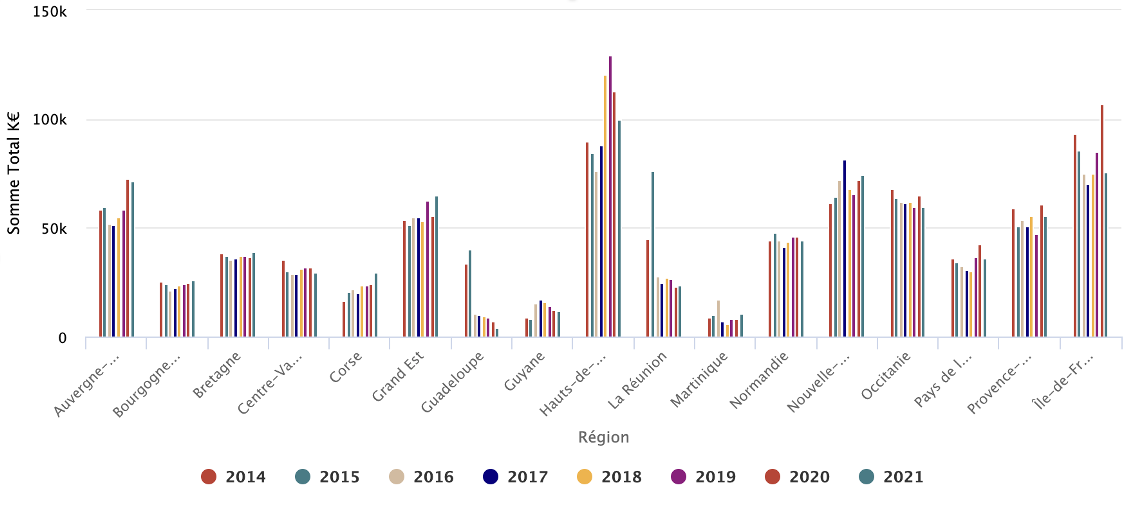
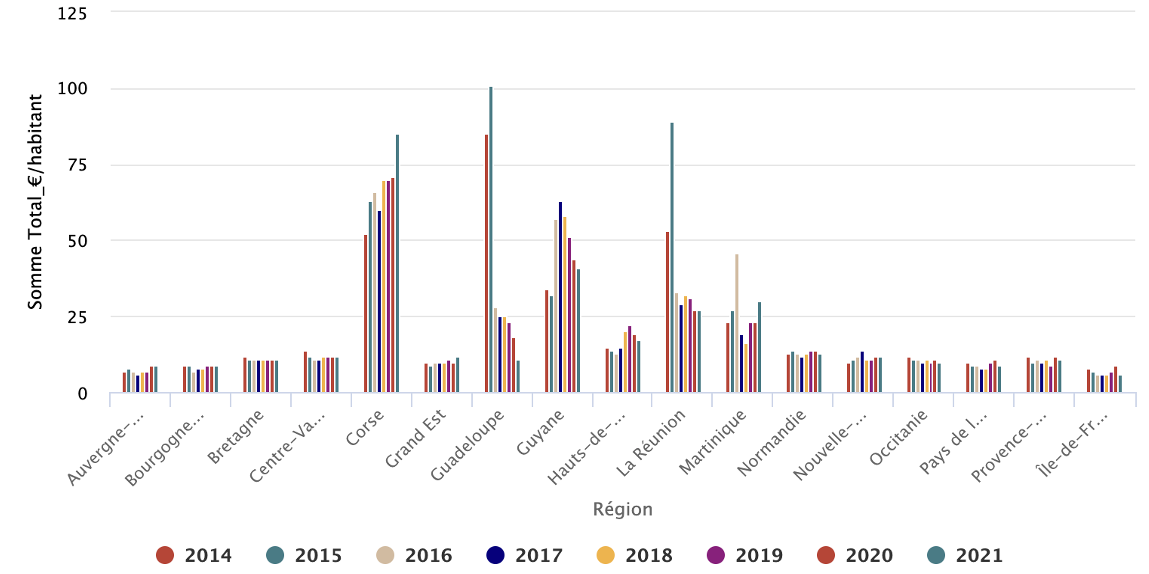
Whilst figures for 2025 are not yet available, regional governments directly invested €0.7bn into culture in 2021. (Fig 1).
Fig 1: Dépenses Culturelles Des Régions - total and per person[footnote 10]
The French state has also looked to increase philanthropic giving through an innovative, although at times controversial, policy called the Aillagon Law. Between 2005 and 2023, this policy led to:
-
An increase in the number of people making individual philanthropic donations from 1.3m to 5.4m
-
An increase in the number of businesses sponsoring charities from 12,000 to 105,400.[footnote 11]
Specifically, since 2008, 450 new cultural foundations and 565 cultural endowments have been founded.[footnote 12]
There has also been a growth in sponsorship outside of Paris over this period - with 60% of foundations and endowment funds now being based outside of the capital.[footnote 13]
State (National) funding
Most state funding for arts and culture in France is delivered directly through the Ministry of Culture and Communication, rather than through an arm’s length body. However, as explored in the next section, a significant portion of this funding is channelled to regional offices external to the ministry itself, known as Directions régionales des affaires culturelles (DRACs).
The Ministry directly funds a network of 61 national museums, which house works of art and other items of cultural, scientific or technical significance belonging to the State.[footnote 14] Other ministries support museums in their areas of expertise - for example, the Ministry of the Armed Forces supports the Army Museum, Air and Space Museum and the National Maritime Museum.[footnote 15]
These national museums are spread across France - although the majority are based in Paris and the Île-de-France. They charge for entrance but are free for priority audiences: under 18s, 18-25 year olds from EU countries, art history students, disabled people and job seekers, as well as educators, press, members of the International Council of Museums and those who work for the Ministry of Culture.[footnote 16] Access to the permanent collections of the Louvre is free on the first Friday of the month after 6 p.m., while access to the collections of other national museums is free on the first Sunday of each month.[footnote 17]
Alongside providing direct funding to museums, the national Government also supports the creation, production and distribution of live performance (€0.8bn in 2025). This includes direct funding to:
-
5 national theatres which are public establishments under the supervision of the Ministry of Culture.[footnote 18]
-
38 National Drama Centres (CDNs) spread across the country, committed to bringing theatre to the widest possible audience.[footnote 19] Contracts for these are normally given by the Ministry for Culture for a period of four years and can be renewed twice for three-year periods.[footnote 20]
-
A network of c.75 multidisciplinary performing arts organisations across France and its territories. The majority of these are in medium-sized towns with 50,000 to 200,000 inhabitants.[footnote 21]
Additional support is provided to regional and national opera houses and contemporary dance centres, as well as through project grants (for example grants to support new productions, individual artists, or international working).[footnote 22] Individual grants are decided by advisory committees.[footnote 23]
State support for the visual, or plastic, arts (€0.2bn in 2025) includes:
-
Funding for Le Centre National des Arts Plastiques (CNAP), an organisation founded to support and promote artistic creation in the visual arts, including photography, sound and digital works, graphic arts and applied arts.[footnote 24]
-
Support for Contemporary Arts Centres which are subsidised - in part - by the state through its regional intermediaries (the Direction régionale des Affaires culturelles (DRACs)).[footnote 25]
The French arts sector receives little specific support from French state lotteries (which return money to the state more generally)[footnote 26], with the exception of the Loto du Patrimoine which was established in 2017 to support heritage initiatives and has since raised nearly €155 million to help restore 950 sites.[footnote 27]
Regional funding
France is a decentralised State. The country comprises different types of autonomous territorial authorities that have their own directly elected assemblies and governments, including regional councils, departmental councils and municipal councils.[footnote 28] They are not answerable to the State and are independent of one another.[footnote 29]
Devolved funding to regional authorities and French Territories is made available through Direction Régionale des Affaires Culturelles (DRACs), which enable the national coordination of local cultural policymaking. DRACs are regional offices of the Ministry, operating under the authority of the central state rather than the autonomous regional governments, though they are expected to work in close collaboration with them. There is a DRAC office based in each French region and the equivalent - Directorates of Cultural Affairs (DACs) - in international French territories.[footnote 30] In total there are 2,400 people employed by the state to manage the decentralised services of the Ministry of Culture (c. 9,500 people are employed in the cultural ministry as a whole).[footnote 31]
In addition, several regions have their own Regional Contemporary Art Funds (Fonds Régional d’Art Contemporain, or FRAC), co-funded by the DRAC and the autonomous regional authorities. These were established by the Ministry of Culture in 1982, and there are now 23 across the country.[footnote 32] Each FRAC is responsible for collecting, preserving, and exhibiting contemporary artworks. In 2018 - the most recent year for which data is available - the FRACs organised 667 exhibitions and 3,559 artistic and cultural education activities.[footnote 33] These were often delivered in partnership with public and private institutions, reaching a combined audience of 1.5 million people.[footnote 34]
Another important player in the devolved cultural landscape of France is the Fédération Nationale des Collectivités Territoriales pour la Culture (FNCC). Set up in 1960, this is a membership-based network of officials who advocate for culture. It represents over 400 members, including local authorities and inter-municipal organisations to whom it offers cultural policy training, as well as helping to make the voice of local government be heard at the national level, and encouraging the greater integration of culture into public policy.[footnote 35]
Government approach to philanthropy
France’s Aillagon Law, introduced in 2003 by then Culture Minister Jean-Jacques Aillagon, encourages corporate philanthropy, including to the arts, by offering a 60% tax relief on donations, for donations up to €2 million and a 40% tax reduction for any portion exceeding this amount.[footnote 36] This relief is capped at €20,000 or 0.5% of a company’s annual turnover (whichever is higher).
Since its implementation, the volume of corporate patronage has grown significantly. From 2005-2023 there has been:
-
An increase in the number of people making individual donations from 1.3m to 5.4m
-
An increase in the number of businesses sponsoring charities from 12,000 to 105,400.[footnote 37]
In 2022 - the most recent year for which figures are available - individual donations totalled €5.4 billion, a 2.3-fold increase since 2006. Corporate giving reached €3.8 billion, having grown 2.7 times since 2010.[footnote 38]
Although data for individual types of giving, or singular organisations, is not comprehensively published, we know that the impact on arts and cultural organisations has been significant as an investigation in 2017 showed that the Louvre was generating €12 million annually through the Aillagon Law, while the Palace of Versailles raised €10 million and the Centre Pompidou €5 million.[footnote 39] In addition, we know that since 2008, 450 new cultural foundations and 565 cultural endowments have been founded.[footnote 40]
Whilst the success of the Aillagon Law is notable, critics have argued that these generous tax breaks shift the financial burden of donations onto taxpayers.[footnote 41]
Germany
Overview
Germany has one of the highest levels of decentralisation in the EU: in 2023 46% of government expenditure was made by the 16 states, or Länder, and underlying municipalities.[footnote 42]
According to the German Constitution, the promotion of culture is not the responsibility of the national government but of these states, who also oversee work that happens at a municipal/local authority level.[footnote 43] Each Land has cultural sovereignty (Kulturhoheit), which means in theory they hold total responsibility for their cultural policy - although the Länder do work together on specific initiatives with the Federal Government, as well as with one another.[footnote 44] For context, in 2020, the municipalities and Länder together provided roughly 80% of cultural spend.[footnote 45]
Both federal and state support for the German arts are backed by substantial public spending commitments. In 2021, total public expenditure on culture reached €14.9 billion.[footnote 46] This included:
-
€4.56bn for theatre and music
-
€1.76 for libraries and archives
-
€2.73 for museums, collections and exhibitions.[footnote 47]
This public funding, alongside private support and patronage, helps to support an impressive cultural ecosystem of organisations across Germany including c.140 city and state theatres, 200 private theatres, 129 professional orchestras and more than 7000 museums and exhibition halls.[footnote 48]
Federal (National) funding
Whilst the basis of the German approach to policy - and particularly to culture - is to prioritise the independence of its regions, the Federal Government continues to play a number of important roles in German cultural policy and funding.
The Federal Government is responsible for:
-
Ensuring that there is an appropriate legal framework in place to promote culture and media through legislation (particularly the legal underpinning of individual artistic freedom).[footnote 49]
-
Funding cultural institutions and projects of national importance (e.g. through providing majority funding for the Stiftung Preußischer Kulturbesitz based in Berlin).
-
Ensuring that the nation as a whole is represented by the cultural organisations and activities in Berlin.
-
Acting as a partner for Federal states and local authorities, including by providing direct financial support.[footnote 50]
In addition, the Federal Government funds the German Federal Cultural Foundation, which supports contemporary artistic productions and awards funding to thematic areas which fall under the artistic and cultural funding responsibilities of the German federal government.[footnote 51] The German Federal Cultural Foundation does not grant operational funding to institutions – only project funding.[footnote 52] The use of an intermediary of this type is unusual in Germany.
The Federal Government also supports individual artists through two innovative mechanisms:
-
Through the Artists’ Social Insurance Act (KSVG), which provides self-employed artists with statutory health and pension insurance.[footnote 53] Self-employed artists (like employees) only have to pay half of their social security contributions. Through the KSVG, the other half is financed by a federal subsidy (20%) and by the artists' social security contribution (30%) given by companies that use artistic and journalistic services.[footnote 54] To access these benefits, artists have to demonstrate that they meet the government’s definition of artist (which includes those creating or teaching music, performing arts or visual arts, alongside writers and journalists, or those that teach writing and journalism) by providing evidence of their professional activity – such as current client contracts, statements of account, invoices, and bank statements – alongside other supporting documents, including promotional materials, proof of artistic or journalistic training, and certificates of membership in relevant professional organisations.[footnote 55]
-
By providing ‘fee floors’ as a funding condition of the Federal Government Commissioner for Culture and the Media (BKM). Since 1st July 2024, the Commissioner has linked its cultural funding to required minimum fees for artists and creatives. This requirement applies to all institutions and projects that are at least half funded by the BKM. The minimum fees are determined from recommendations made by the professional associations for artists and creatives.[footnote 56]
From the 1970s onwards the Federal Government has also been essential in promoting the idea of cultural democracy - “Kultur für alle”. Many federal or city-level initiatives (e.g. free museum Sundays in Berlin[footnote 57] and other subsidised ticket programmes[footnote 58]) alongside the national introduction of the Kulturpass - a one-off €100 budget for those turning 18 to spend on cultural activities[footnote 59] - are a response to this national push for greater inclusivity.
In 1998 the Federal Government created the role of Federal Government Commissioner for Cultural Affairs and the Media, which is now the [Federal Government Commissioner for Culture and the Media](https://www.culturalpolicies.net/database/search-by-country/country-profile/category/(https:/www.bundesregierung.de/breg-%20de/bundesregierung/bundeskanzleramt/%20staatsministerin-fuer-kultur-und-medien) (the equivalent of junior ministerial roles).[footnote 60] This provided stronger national-level representation for the challenges facing the cultural sector.
Regional funding
All of the 16 federal states have their own Parliaments, and have Parliamentary Committees that deal with cultural affairs and Ministries responsible for culture (although in most states it is combined with other policy areas like education or science).[footnote 61] Most German cultural institutions, including the largest ones, are state-run - although new models of ownership and funding are emerging.[footnote 62]
Article 106 of Germany’s constitution stipulates the government level that is entitled to receive the revenue from each type of tax. Most tax revenue goes to the Federal Government, but the German Länder and local authorities are also entitled to significant amounts of financial resources derived from the collection of taxes which helps to fund this cultural activity.[footnote 63]
As the capital, Berlin (which is both one of the 16 states and a municipality) has a particularly high commitment to culture. The Berlin Senate Department for Culture and Europe allocates around €600 million annually to cultural funding - more than the combined annual budgets of Arts Council England for the National Portfolio (£458.5m per annum) and the Mayor of London’s culture programme (£18.7m in 2024-25).[footnote 64] Roughly 95% percent of this total is distributed to seventy long-term recipients in the form of institutional funding, and around 5% of the budget is allocated as individual grants and project funding.[footnote 65] In accordance with state budgetary regulations funding is dispensed in the form of grants and subsidies.[footnote 66] Only public-interest projects and institutions operating on a not-for-profit basis are eligible to receive funding.[footnote 67]
Some Federal funding is made available to Länder (and sometimes only to specific Länder) - for example from 2002 to 2019 the New Länder Fund provided support to 343 projects in Länder that had been part of East Germany to support the process of reunification.[footnote 68]
To strengthen the voice of federal states at the national level, in 2019 the Länder established the Independent Conference of Ministers of Culture (Kultur-MK).[footnote 69] This body addresses cultural policy issues of supra-regional significance, aiming to develop unified positions and advocate shared interests to the Federal Government. Hamburg’s Senator (the equivalent of a Minister or Deputy Mayor) for Culture and Media, Carsten Brosda, served as the first chair, with the position rotating according to the Minister Presidents' Conference rotation model.[footnote 70]
In cities and districts, cultural affairs (e.g. cultural programmes and public institutions) are typically overseen by designated Cultural Commissioners (Kulturdezernenten).[footnote 71] Additionally, municipalities, independent cities, and districts have elected representatives, such as municipal or district councils, who can form cultural committees.[footnote 72]
Government approach to philanthropy
The German Government primarily encourages individual philanthropy through income tax deductions. Individuals can deduct up to 20% of their pre-tax income for donations made to recognised nonprofits. Charities face minimal administrative burdens, as donors only need receipts for donations over €250, and no formal interaction with the tax office is required.[footnote 73] Donor surveys indicate that over a third (37%) of taxpayers donate in this way.[footnote 74] A similar scheme exists for corporate donations.[footnote 75] Unlike the UK’s system, which boosts the donation to the charity through Gift Aid, Germany’s benefit is realised by the donor themselves in the form of a tax saving.
Germany offers particular incentives which encourage the development of foundations: a taxpayer can deduct up to €1 million (spread over up to 10 years) for a donation made to establish or grow the endowment of a charitable foundation.[footnote 76] In addition, there are a number of tax exemptions for charities and foundations themselves, including on any passive earnings from asset management or from earnings aimed at achieving their core charitable objectives.[footnote 77]
The UK sees a higher overall volume of charitable donations than Germany, both in absolute terms and relative to the size of its economy.[footnote 78] However, corporate giving is particularly prevalent in Germany, with companies giving 43% of fundraised income – as much as donations from private individuals (23%) and foundations (20%) combined.[footnote 79] Many of the largest companies in Germany, like Volkswagen, BMW and Siemens, have their own philanthropic foundations.[footnote 80] As in the UK, German philanthropic donations are also collected in the form of a state lottery (making up 13% of overall donations).[footnote 81]
USA
With thanks to Laura Callanan - Founding Partner, Upstart Co-Lab
Overview
Public arts funding in the United States is distributed through a multi-layered system involving federal, state, and local governments. Public funds are supplemented by a particularly buoyant private philanthropy sector which - alongside a lower overall tax rate for top earners in the US when compared to the UK - is incentivised by a number of policies that support private giving.[footnote 82]
In the fiscal year 2023, federal, state, and local funding for the arts totalled $2.28 billion for an aggregate per capita investment of $6.83.[footnote 83] This included:
-
$207 million in appropriations for the National Endowment for the Arts.
-
$971 million to State Arts Agencies (SAAs) from the states and jurisdictions, and the federal government
-
$1.1 billion in funds to Local Arts Agencies (LAAs) from states, local and federal funds.[footnote 84]
Philanthropic donations to the arts far exceed public funding. In 2023, total philanthropic giving to arts and culture reached $25.26 billion, accounting for 4.53% of the year’s total donations of $557.16 billion.[footnote 85] The arts are a popular and growing area of philanthropy, with donations increasing by 6.6% from 2022 to 2023, compared to an overall giving increase of just 1.9%.[footnote 86]
Alongside trusts and foundations, individuals also give more in the US. A seminal paper produced by the Charities Aid Foundation in 2016 showed that (of the 24 countries considered) the US topped the charts in terms of charitable giving by individuals at 1.44% of GDP, compared to 0.54% for the UK, which had the fourth highest proportion of giving across all countries measured.[footnote 87]
Federal (National) funding
Federal funding for the arts is spearheaded by the National Endowment for the Arts (NEA), an independent federal agency established in 1965 *“that is the largest funder of the arts and arts education in communities nationwide and a catalyst of public and private support for the arts”.[footnote 88]
The NEA operates as an arm’s-length organisation: it is funded annually by Congress but makes grant decisions through peer review panels and the National Council on the Arts. The NEA’s primary activities include grantmaking to non-profit arts organisations, public arts agencies and organisations, colleges and universities, federally recognised tribal communities or tribes, and individual writers and translators.[footnote 89]
Grant applications are reviewed by panels of arts experts and individuals from across the country. All grants must be matched one-to-one by non-federal sources, except for individual grants to writers and translators.[footnote 90] This means an organisation that receives (for example) $20,000 from the NEA must provide at least $20,000 in additional support from other sources. On average, each NEA dollar generates about $9 in matching support from state, local, and private sources.[footnote 91]
Each year, Congress sets a budget for the NEA. The Biden-Harris Administration’s President’s Budget for Fiscal Year 2025 included $210.1 million for the National Endowment for the Arts.[footnote 92]
Notably, at this time, 40% of NEA program funds are distributed to state and regional arts agencies by law. The NEA’s Partnership Agreements fund the state arts agencies in 56 states and jurisdictions and six regional arts organisations. This so-called ‘state formula’ is supposed to guarantee that a predictable portion of the tax dollars invested annually in the arts by the federal government will go to each state.
The remaining funds are awarded through competitive grants directly to non-profit arts organisations (and, in limited cases, to individuals) across all 50 states and US territories.
In May 2025, as part of his Discretionary Budget Request, President Donald Trump proposed eliminating funding for several agencies from 2026, including the National Endowment for the Arts (NEA).[footnote 93]
The Federal Government also offers a tax incentive for theatre producers. Under Internal Revenue Code Section 181, producers can deduct up to $15 million of qualified production costs for live theatrical performances in the year the expenses are incurred. This provision enhances cash flow and reduces upfront tax liabilities for investors and producers. However, this deduction is set to expire at the end of 2025 unless extended by Congress.[footnote 94]
State and regional funding
Every state and most territories have a designated state arts agency (often called a State Arts Council or Commission) that administers public arts funding at the state level. These agencies are typically government entities that operate at arm’s length to ensure funding decisions reflect artistic merit and community needs rather than partisan politics. State arts agencies were established largely in the late 1960s following the creation of the NEA: in 1965, only 23 states had official arts councils, but Congress’s mandate that any state with an arts agency could receive NEA partnership funds spurred nearly every state to form one within a few years.[footnote 95]
The National Assembly of State Arts Agencies (NASAA) was created in 1968 as a nonprofit membership organisation dedicated to strengthening the nation’s 56 state and jurisdictional arts agencies.[footnote 96] They help to represent the interests of the arts agencies to the NEA, as well as supporting networking and partnership initiatives.[footnote 97]
In addition, there are around 4,500 local arts agencies operating across the nation in cities, towns, counties, and regions.[footnote 98] As detailed above, the NEA often works directly with these agencies, for example: in 2018 the NEA worked with The City of Phoenix Office of Arts and Culture in Arizona, to support a Neighborhood Arts grants program; with BreckCreate in Breckenridge, Colorado, to support pop-up art projects and large-scale installations at summertime festivals and events to animate and enhance the local environment; and with Miami-Dade County Department of Cultural Affairs in Florida, to support youth arts programs at the African Heritage Cultural Arts Center in Miami’s Liberty City neighborhood.[footnote 99]
In the US, there are also some regional tax incentives for theatrical productions (many of which also apply to film and television productions). For example, the New York City Musical and Theatrical Production Tax Credit offers a 25% tax credit on qualified production expenditures, up to $3 million per production for Broadway shows and up to $350,000 for Off-Broadway productions;[footnote 100] Illinois offers a tax credit of up to $500,000 per accredited theater production per tax year which are awarded on a first-come, first-served basis and are limited by an annual fiscal cap;[footnote 101] Maryland offers a refundable credit of 25% against state income tax for eligible production entities, with a maximum award of $2 million per theatrical production.[footnote 102]
Government approach to philanthropy
The US tax system strongly incentivises high-net-worth individuals to give. The ability to deduct 20%-60% of adjusted gross income (AGI) (and up to 100% in special cases, for example during the pandemic years) provides substantial motivation for large-scale philanthropy.[footnote 103] US donors can also avoid capital gains tax on appreciated assets when donating them to charity.[footnote 104] This makes stock and real estate donations a common tax strategy for the wealthy.
Whilst Gift Aid is widely available in the UK, individual tax relief for the wealthy is less generous. Higher-rate taxpayers (40% or 45% tax brackets) can claim back some relief, but there is no equivalent of the US full-market-value capital gains exemption or large-scale AGI deductions for the wealthy.[footnote 105]
In the US there is also no limit on estate tax charitable deductions - any portion of an estate given to charity can be tax-free, making large bequests a tax-efficient strategy for the wealthy.[footnote 106]
While, in the UK, charities are exempt from inheritance tax, the 40% tax rate is only reduced to 36% for estates leaving at least 10% to charity, which is a weaker incentive than the full US exemption.[footnote 107]
State governments also complement federal policies with their own tax incentives for charitable donations. Most states with an income tax allow a deduction for charitable contributions on state tax returns, usually mirroring the federal itemised deduction.[footnote 108]
Canada
With thanks to Rupert Oliver Allen - Economist, Cultural Affairs, Department of Canadian Heritage
Overview
Like the UK, Canada has what could be described as a ‘mixed model’ for cultural funding - meaning that non-profit arts organisations are reliant on a combination of public, private, and earned revenues.[footnote 109]
US foundations played a significant role in shaping modern Canadian cultural infrastructure. The 1951 report of the Royal Commission on National Development in the Arts, Letters and Sciences - commonly known as the Massey Commission - emphasised Canada’s reliance on these external contributions. This reliance was cited as a key reason for urging the Canadian government to take a more active role in supporting the arts. As a result, the Canada Council for the Arts was established in 1957 “to foster and promote the study and enjoyment of, and the production of works in, the arts”, taking a similar arm’s-length approach to the UK.[footnote 110]
Despite the relatively late introduction of a state vehicle for funding the arts, the Government now provides significant support to non-profit arts organisations. Expenditure on “Creativity, arts and culture” from 2024-2025 is planned to be CA$542.3m.[footnote 111]
In addition to this budget, the Government invests in the Canada Council for the Arts - and the 2024 Government budget reconfirmed an ongoing commitment to maintaining the “Doubling the budget of the Canada Council for the Arts between 2016 and 2021, with $1.1 billion in new funding for the Canada Council for the Arts since 2015-16, and $180 million ongoing”.[footnote 112] In 2024-2025, its parliamentary appropriation was CA$363.8m.[footnote 113]
National funding
At the national level, the professional arts sector receives support from a suite of programmatic support from the Canada Council for the Arts and the Department of Canadian Heritage.
The Canada Council is Canada’s public arts funder, with a mandate to foster and promote the study and enjoyment of, and the production of works in, the arts.[footnote 114] It was created in 1957, after the Canadian government received a financial windfall of CA$100 million from the estates of two Canadian millionaires, using CA$50 million of this donation to establish an endowment for the Canada Council.[footnote 115] To this day, the Council uses the interest made on this initial investment as part of its funding and, as of March 2024, the Council had CA$411m in net financial assets at their disposal.[footnote 116]
The Council’s grants, services, initiatives, prizes, and payments support artists, authors, and arts groups and organisations from Canada. This support allows them to pursue artistic expression, create works of art, and promote and disseminate arts and literature.[footnote 117]
From 2023-2024 the Council gave out CA$304.4m in grants including:
-
CA$206.8M to 1,911 arts organisations
-
CA$18.8M to 473 groups
-
CA$82.2M to 3,570 artists
-
CA$3.0M in grants outside Canada.[footnote 118]
The Council also operates the Canada Council Art Bank, which makes contemporary artwork available to a wide public across the country through three programs: corporate art rental, loans to museums and outreach. With more than 17,000 artworks by over 3,000 artists, the Art Bank has the largest collection of contemporary Canadian art anywhere.[footnote 119]
The Council has publicly acknowledged disparities in funding between certain provinces and territories and has committed to working with the arts community and other funders in those regions to address the imbalances and to better serve the arts ecosystem across Canada.[footnote 120]
Between 2023 and 2024, the three biggest regional recipients of Canada Council grant spending were Ontario, Québec and British Columbia. The distribution compared to population size was as follows: Ontario received 33.5% of the total funding (with around 39% of the population), Québec received 31.09% (with approximately 22% of the population), and British Columbia received 15.88% (with about 14% of the population).[footnote 121]
Six key strategic commitments are core to the current ambitions of the Council. By 2026 they want to provide:
-
50% or more of total funding allocated to project funding
-
20% of project funding to first-time recipients
-
CA$100M to support Indigenous arts and culture
-
CA$200M for the innovative rebuilding of the arts sector
-
CA$110M to support international activities
-
CA$74M investment in the Public Lending Right Program (which makes annual payments to creators whose works are held in Canadian public libraries).[footnote 122]
In addition to supporting the Canada Council, the Department of Canadian Heritage directly funds several national programmes that support arts and culture. These include the Canada Arts Presentation Fund (which supports arts festivals and performing arts series and received an additional CA$31 million over two years in the last budget), the Canada Arts Training Fund (which supports training institutions for artists), and the Canada Cultural Spaces Fund (which invests in cultural infrastructure and venues).[footnote 123]
The federal government also directly supports a number of national cultural institutions, which are designated as Crown Corporations. These include the:
-
National Arts Centre (which supports artists and productions across the country)
In addition the Federal Government provides ad-hoc support to specific projects - for example the latest budget included:
-
$15 million in 2024-25 for the Shaw Festival Theatre in Niagara-on-the-Lake, Ontario, which showcases plays by George Bernard Shaw and his era.
-
Additional funding (amount un-announced) to contribute to build a new museum highlighting the histories, cultures, and contributions of Canadians of diverse South Asian heritages, as well as a new Filipino cultural centre that will create a designated space for the Filipino community to come together and celebrate its culture and heritage.[footnote 125]
The Federal Government also manages the Canada Cultural Investment Fund, which supports programmes that strengthen the organisational, administrative, and financial health of arts and heritage organisations.[footnote 126] Its ‘Strategic Initiatives’ programme offers funding for collaborative projects that help organisations improve business practices and diversify revenue streams. The ‘Limited Support to Endangered Arts Organisations’ programme provides assistance in cases where a professional arts organisation is at risk of closing but has strong community support and a viable plan for restructuring or recovery.[footnote 127]
Regional funding
Provinces and territories in Canada play an important role in funding the arts, both directly and through their own arts councils or agencies which provide grants to artists, groups and arts organisations. In 2023, the Federal Government was responsible for CA$3.241billion spending on cultural services[footnote 128], whilst the consolidated provincial-territorial and local government spend on cultural services was CA$5.225 billion.[footnote 129]
However, the amount that each province supports its arts communities varies significantly. For example, during the 2023-2024 fiscal year the Conseil des arts et des lettres du Québec awarded more than $172.4 million to Quebec's arts community, awarding 1,851 individual grants across Quebec and funding 927 organisations.[footnote 130] By comparison across the same period, in Ontario, Canada’s most populous province, the Ontario Arts Council (OAC) awarded $53.3m in total grants, with grants to 2,149 individual artists and 1,043 to organisations.[footnote 131]
Municipalities are playing a growing role in supporting the arts, offering both direct funding and in-kind support - such as property tax rebates and services for festivals and events.[footnote 132] Some large cities have their own dedicated arts councils or cultural offices; for instance, the Toronto Arts Council is the City of Toronto’s arm's-length funding body for artists and arts organisations.[footnote 133] In addition to cash funding, municipalities can provide valuable in-kind support – for example, Toronto has offered property tax rebates and exemptions for some types of cultural centres and charities.[footnote 134]
Government approach to philanthropy
At last count, Canada allocated a higher percentage of its GDP to charitable giving than the UK.[footnote 135]
To promote private philanthropy, Canadian governments have introduced a range of incentives, the most important of which is their charitable tax credit system. Donations to registered charities qualify for significant tax credits. Individuals can claim credits on donations up to 75% of their net income in a year. These can also be carried forward and claimed at any time in the subsequent five years.[footnote 136] The tax credit itself is generous: the combined federal and provincial credit can refund up to 49% of the donated amount, depending on the province (the Canadian tax system is far more devolved than that of the UK).[footnote 137] In most cases, donating appreciated stocks, mutual funds or stock options means you pay no tax on the capital gains.[footnote 138]
This effectively reduces the cost of giving and is meant to stimulate higher charitable contributions. Corporations, similarly, can deduct charitable donations (up to a limit) from taxable income, providing an incentive for corporate sponsorships and gifts to the arts.
To support philanthropic giving to the arts and heritage sector in particular, the Canada Cultural Investment Fund offers a funding incentive when Canadians provide donations to professional arts organisation's endowment fund. The government provides matching funds – of up to one dollar for every dollar raised from private donors – to create endowment funds or to increase existing ones. Since its inception in 2001, the Endowment Incentives programme has provided $367 million in matching grants, leveraging private sector donations of $516 million, for a total of $883 million invested in 107 public charitable foundations, benefitting the long-term financial health of 307 professional arts organisations across Canada.[footnote 139]
This programme is similar in its approach to the UK’s Catalyst fund - a £36 million match-funding initiative that ran from 2013 to 2017 which gave heritage organisations the opportunity to build endowments and attract additional private investment into the sector.[footnote 140] However, unlike the time-limited UK scheme, the Canadian equivalent is a permanent programme.
Canada also offers a generous scheme for the donation of gifts of cultural property. If a donor gives artwork or other cultural artefacts of national importance to a public institution (such as a museum or gallery), and the item is certified as “cultural property” of outstanding significance, the donor benefits from enhanced tax provisions - a tax exemption for capital gains, and a donation tax receipt which can be used to offset up to 100% of net income for donations made during your lifetime (as opposed to the 75% offset limit for other donations).[footnote 141] For these items of particular national importance - given during a life rather than after death - this is a more generous scheme than the UK’s equivalent.
Korea
With thanks to Dr Hye-Kyung Lee - Professor of Cultural Policy at King’s College London
Overview
South Korea is best known for its support of commercial creative industries, such as K-Pop and Korean film, but the government also provides funding for non-profit arts organisations. This support comes through a mix of national funding programmes, regional grants, tax incentives for philanthropy, and public–private partnerships.
At the centre of South Korea’s cultural policy is its national arts council. First established in 1973 as the Korea Culture and Arts Foundation, it was originally primarily funded mainly through a cultural entry levy.[footnote 142] The organisation’s president was appointed by the Ministry of Culture, and much of its budget was allocated to projects directed by the Ministry.[footnote 143]
The foundation was restructured in 2005 and became Arts Council Korea (ARKO), with a mandate to manage the Culture and Arts Promotion Fund, which provided funding to various art forms including literature, visual arts, performing arts, traditional Korean arts, and interdisciplinary work.[footnote 144]
ARKO is now funded by the Korean Government through the lottery, the Ministry of Culture, Sports and Tourism and the National Sports Promotion Corporation, and is governed by a council whose members are appointed by the Ministry of Culture, Sports and Tourism.[footnote 145]
The British model of an arm’s-length arts council was a major influence in the creation of ARKO’s; an effort to decentralise control and reduce direct political involvement.[footnote 146] However, adapting this model to Korea’s different historical and political environment has not been without challenges, and ARKO is arguably much more affected by political influence than any of its UK equivalents.[footnote 147]
Korea has increasingly sought to grow philanthropic support for the arts through tax incentives, matched funding schemes, and national fundraising initiatives. Many of these efforts are relatively recent - a reflection of the country’s rapid transformation from a major recipient of Official Development Assistance (ODA) after the Korean War in 1953 to a donor nation by 1999.[footnote 148]
National funding
Within the Korean government, the Ministry of Culture, Sports and Tourism (MCST) leads on cultural funding and sets the strategic direction for cultural activity - most recently through the launch of the ‘Cultural Korea 2035’ strategy.[footnote 149] In 2019, the Ministry’s total budget stood at 5.923 trillion won, with 1.89 trillion won allocated to culture and the arts.[footnote 150]
While Arts Council Korea (ARKO) serves as the primary channel for public funding to Korea’s cultural sector, the Ministry also supports a range of additional initiatives, including:
-
Integrated cultural vouchers, which enable low-income households to access movies, performances, and exhibitions;[footnote 151]
-
A points-based cultural pass for young people, offering up to 150,000 won (approximately $112) to spend on cultural experiences;[footnote 152]
-
The organisation of flagship cultural events, such as a Lunar New Year concert featuring Korea’s leading traditional performing arts institutions, and a long-running Craft Fair, now in its 19th year.[footnote 153]
In addition, there are two important agencies which the ministry runs.
The first is the Korean Artist Welfare Foundation, which provides a range of welfare support for artists.[footnote 154] Artists certified by the foundation are eligible for extended coverage under the National Unemployment Insurance scheme.
Each year, the foundation awards an “arts creation subsidy” to over 20,000 artists - a form of bursary that supports their creative work. In addition, it helps create around 1,000 jobs annually by placing artists in commercial companies or non-profit organisations to carry out creative and collaborative projects. Other support offered by the foundation includes: subsidising national pension contributions for artists; providing hardship loans; and offering legal advice and support.
The second is the Korea Arts Management Service, which provides support and guidance to arts leaders (especially in the non-profit sector) on arts management, legal matters, incubation programmes, and assistance with exporting and showcasing work internationally.[footnote 155]
These agencies are largely shielded from the commercial pressures that Korean creative industries policy - led by the Korea Creative Content Agency (KOCCA) - is designed to address.
In addition, the department runs the Korea Arts and Culture Education Agency which was created in 2005, and helps to recruit and place arts educators in schools.
Despite these broader initiatives, ARKO remains the cornerstone of public funding for the arts in Korea. In 2019 (pre-pandemic), it received funding from multiple sources:
-
General accounting funds (via MCST): 50,000 million won
-
Lottery Fund: 105,561 million won
-
Sports Promotion Fund (via the National Sports Promotion Corporation): 100,000 million won
-
Tourism Promotion & Development Fund (via MCST): 50,000 million won.[footnote 156]
This breakdown highlights the significant role of South Korea’s state-run lottery in supporting culture and heritage. By law, 35% of the Korea Lottery Fund is allocated to statutory projects, with the remaining 65% dedicated to public services selected by the Korea Lottery Commission to support underprivileged groups. Of the statutory portion, 14% is currently earmarked for culture and heritage, while within the public services category, 3% is allocated to culture and arts projects.[footnote 157]
The most recent Arts Council Korea (ARKO) annual report, published in 2023, outlines the organisation’s current priorities, with a strong emphasis on increasing financial support for artistic creation across literature, visual arts, and performing arts. Funding figures from 2022 show significant year-on-year increases:
-
Literary creation: 4,527 million won (a 51.5% increase from 2021)
-
Visual arts creation: 4,777 million won (a 50.1% increase from 2021)
-
Performing arts development: 31,280 million won (a 7.7% increase from 2021)
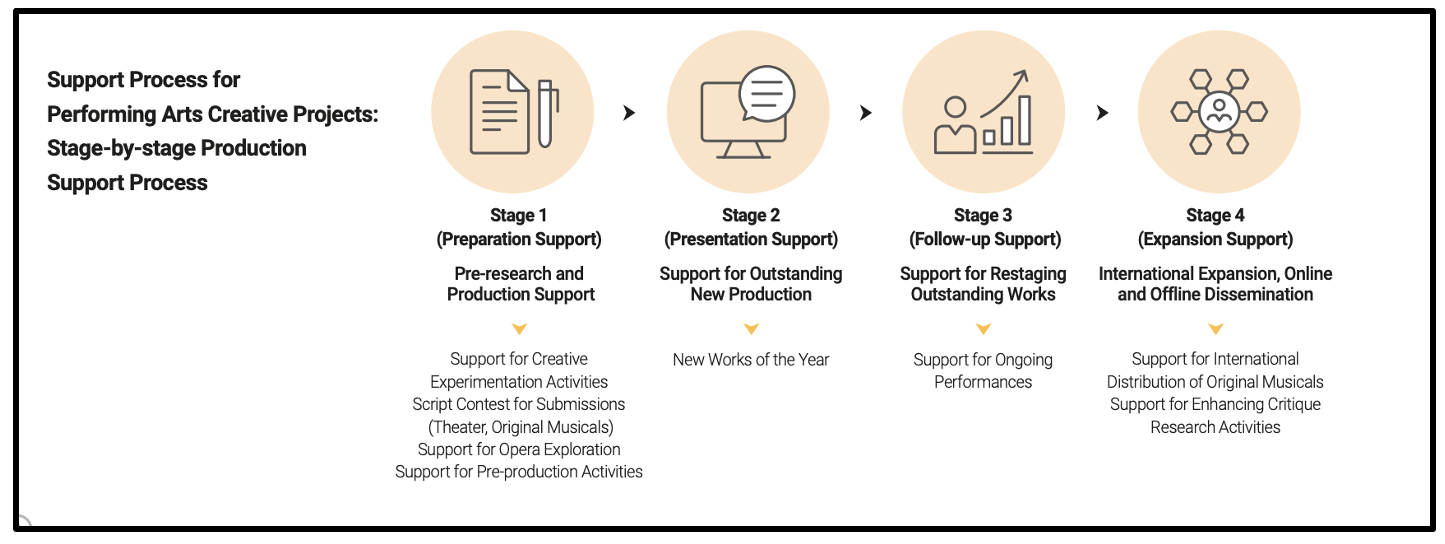
Within these areas, ARKO aims to adopt a holistic approach to support. In the case of the performing arts (see Fig. 2), for example, funding spans the full creative cycle - from early-stage research and development, to supporting key organisations across the country, to enabling international touring and cultural exchange.[footnote 158]
ARKO also directly runs their own facilities including two theatres, an archive facility, a human resource centre, an ‘artist house’ and an arts space.[footnote 159]
Fig 2. Support for the performing arts as described in the 2022 Arts Council Korea (ARKO) annual report.[footnote 160]
In addition, ARKO offers a suite of ‘wraparound’ services designed to improve working conditions and build capacity across the sector. These include:
-
Promoting creative ethics through plagiarism checks in literature and offering copyright education;
-
Protecting artists’ rights, including funding for accessibility-related costs and the enforcement of employment insurance for artists
-
Running training and networking programmes, in 2022 they ran 41 courses attended by 700 participants in 2022 to enhance the skills of stage technicians;
-
Supporting the creation of a new foundation to strengthen collaboration among emerging artists.[footnote 161]
Unlike Arts Council England, ARKO is also actively engaged in attracting cultural tourism and promoting Korean culture abroad - functions that, in the UK context, are more typically led by organisations like the British Council and Visit Britain.[footnote 162]
Regional funding
The Ministry of Culture, Sports and Tourism recently unveiled ‘Cultural Korea 2035‘, a mid- to long-term vision for cultural policy. A key aim of the strategy is to reduce regional disparities in cultural access. Measures include launching regional branches of national museums and relocating the Seoul Performing Arts Company to the Asia Culture Center in Gwangju next year.[footnote 163]
To support these initiatives, new resources are being introduced to manage regional activities. Regional cooperation officers - from bodies such as the Arts Council and the Korea Tourism Organisation - will be deployed across the country. These officers will help to coordinate policy and link central and local projects, with the aim of amplifying the impact of local cultural support organisations both nationally and internationally.[footnote 164]
This reflects a longer-term commitment by the Korean state to expand access to culture. For example, in 2019, one of ARKO’s main objectives was to address the uneven distribution of cultural opportunities, with a particular focus on boosting support for non-metropolitan regions.[footnote 165]
To this end, ARKO already collaborates with the 17 regional and metropolitan cultural and arts foundations - one in each of Korea’s provinces and metropolitan cities - which together form a committee dedicated to supporting regional culture.
Some cities and regions already have structures in place to support local arts activities. In Seoul, the Seoul Foundation for Arts and Culture (SFAC) plays a key role in promoting cultural creation and participation. SFAC supports the development and dissemination of culture and the arts, provides arts education, and enables Seoul residents to engage in cultural activities. The foundation also helps leading artists to present their work on the global stage, fosters international exchange, and strengthens the skills of professional cultural planners through residency programmes.[footnote 166]
Government approach to philanthropy
South Korea’s rapid economic transformation has led to significant changes in its philanthropic culture over a relatively short period. Following decades marked by colonisation, war, and authoritarian rule, traditional forms of philanthropy had largely faded.[footnote 167] However, from being a major recipient of Official Development Assistance (ODA) after the Korean War in 1953, South Korea had, by 1999, successfully transitioned to become an aid donor.[footnote 168]
In the arts, the Korea Mecenat Association has emerged as a key vehicle for public-private investment. Named after Gaius Maecenas, a Roman statesman known for supporting artists, the organisation is now 30 years old and includes 215 member companies that collaborate to promote arts and culture. One of its flagship initiatives is the Art Support Matching Fund, run in partnership with the Korea Culture and Arts Commission, which provides a funding match to corporate donations.[footnote 169] In 2023, domestic companies contributed a record 208.8 billion won in support for culture and the arts - the highest amount to date.[footnote 170]
ARKO also raises funds directly, primarily through its nationwide Art Tree Sponsorship campaign. This initiative encourages every citizen of the Republic of Korea to "grow one art tree" by making a donation. The goal is to expand support for culture and the arts and to foster a widespread culture of arts patronage across society.[footnote 171]
Conclusion
This paper offers a comparative analysis of arts funding models in five countries – France, Germany, the USA, Canada, and South Korea – to support the Department for Culture, Media and Sport (DCMS) in its ongoing Review of Arts Council England. It explores how each nation structures public investment in the arts, manages the balance between national and regional funding, and encourages private and philanthropic support, drawing out insights with relevance for UK policy.
While no single model provides a definitive blueprint for the future of funding in England, we suggest that the cross-national examples presented highlight a range of approaches that could inform thinking as part of the Review of Arts Council England.
-
Estimates provided for France, Germany, USA, Canada and South Korea by Worldometer. ‘Population by Country (2025)’. Accessed 6 May 2025. [http://www.worldometers.info/world-population/population-by-country/. Estimates provided for England by ‘Population Estimates for the UK, England, Wales, Scotland, and Northern Ireland - Office for National Statistics’. Accessed 14 May 2025. [https://www.ons.gov.uk/peoplepopulationandcommunity/populationandmigration/populationestimates/bulletins/annualmidyearpopulationestimates/mid2022. ↩
-
Stats America. ‘Rank List: States in Profile’. Accessed 19 May 2025. [https://www.statsamerica.org/sip/rank_list.aspx?rank_label=pop1; Polimapper. ‘UK Regions Map’. Accessed 19 May 2025. [https://polimapper.co.uk/guides-white-papers/other-administrative-and-statistical-geographies/uk-regions-map/. ↩
-
‘Projet de Loi de Finances - 2022’. République Française, September 2021. [https://www.budget.gouv.fr/files/files/plf/plf2022/PLF_2022-I.pdf. ↩
-
‘Population Estimates for the UK, England, Wales, Scotland, and Northern Ireland - Office for National Statistics’. Accessed 6 May 2025. [https://www.ons.gov.uk/peoplepopulationandcommunity/populationandmigration/populationestimates/bulletins/annualmidyearpopulationestimates/mid2022.; ‘Demography - Population at the Beginning of the Month - Metropolitan France | Insee’. Accessed 6 May 2025. [https://www.insee.fr/en/statistiques/serie/000436387. ↩
-
‘France 1.1 | Compendium of Cultural Policies & Trends’. Accessed 7 March 2025. [https://www.culturalpolicies.net/country_profile/france-1-1/. ↩
-
‘France 1.1 | Compendium of Cultural Policies & Trends’. Accessed 7 March 2025. [https://www.culturalpolicies.net/country_profile/france-1-1/. ↩
-
‘France 1.1 | Compendium of Cultural Policies & Trends’. Accessed 7 March 2025. [https://www.culturalpolicies.net/country_profile/france-1-1/. ↩
-
‘Les Dépenses Par Ministère | Budget.Gouv.Fr’. Accessed 25 February 2025. [https://www.budget.gouv.fr/budget-etat/ministere?ministere=78626&programme=80561.’Les Dépenses Par Ministère | Budget.Gouv.Fr’. Accessed 6 March 2025. [https://www.budget.gouv.fr/budget-etat/ministere?annee=212&loi_finances=47&type_budget=all&ministere=78626&programme=80498&type_donnee_budget=ae&op=To+validate. ↩
-
‘Les Dépenses Par Ministère | Budget.Gouv.Fr’. Accessed 6 May 2025. [https://www.budget.gouv.fr/budget-etat/ministere?annee=143&loi_finances=47&type_budget=all&ministere=70632&type_donnee_budget=ae&op=To+validate; ‘Autumn Budget 2024: Fixing the Foundations to Deliver Change’. House of Commons, 30 October 2024. [https://assets.publishing.service.gov.uk/media/67225b9b3ce5634f5f6ef579/Autumn_Budget_2024__print_ready_.pdf. ↩
-
€684,892,000 - Author’s analysis based on ‘Dépenses Culturelles Des Régions’. Accessed 25 February 2025. [https://data.culture.gouv.fr/explore/dataset/depenses-culturelles-des-regions_/. ↩
-
‘20 Ans de La Loi Aillagon : La Mutation Du Paysage Français Du Mécénat’, 11 December 2023. [https://www.culture.gouv.fr/actualites/20-ans-de-la-loi-aillagon-la-mutation-du-paysage-francais-du-mecenat. ↩
-
‘20 Ans de La Loi Aillagon : La Mutation Du Paysage Français Du Mécénat’, 11 December 2023. [https://www.culture.gouv.fr/actualites/20-ans-de-la-loi-aillagon-la-mutation-du-paysage-francais-du-mecenat. ↩
-
‘20 Ans de La Loi Aillagon : La Mutation Du Paysage Français Du Mécénat’, 11 December 2023. [https://www.culture.gouv.fr/actualites/20-ans-de-la-loi-aillagon-la-mutation-du-paysage-francais-du-mecenat. ↩
-
‘Les Musées Nationaux : Le Réseau Des Musées Détenteurs Des Collections Nationales’, 20 November 2024. [https://www.culture.gouv.fr/Thematiques/musees/Les-musees-en-France/Les-musees-de-France/Les-musees-nationaux-le-reseau-des-musees-detenteurs-des-collections-nationales. ↩
-
‘Les Musées Nationaux : Le Réseau Des Musées Détenteurs Des Collections Nationales’, 20 November 2024. [https://www.culture.gouv.fr/Thematiques/musees/Les-musees-en-France/Les-musees-de-France/Les-musees-nationaux-le-reseau-des-musees-detenteurs-des-collections-nationales. ↩
-
‘Les Musées Nationaux : Le Réseau Des Musées Détenteurs Des Collections Nationales’, 20 November 2024. [https://www.culture.gouv.fr/Thematiques/musees/Les-musees-en-France/Les-musees-de-France/Les-musees-nationaux-le-reseau-des-musees-detenteurs-des-collections-nationales. ↩
-
‘Les Musées Nationaux : Le Réseau Des Musées Détenteurs Des Collections Nationales’, 20 November 2024. [https://www.culture.gouv.fr/Thematiques/musees/Les-musees-en-France/Les-musees-de-France/Les-musees-nationaux-le-reseau-des-musees-detenteurs-des-collections-nationales. ↩
-
‘Le Théâtre et Les Spectacles En France’. Accessed 7 March 2025. [https://www.culture.gouv.fr/Thematiques/theatre-spectacles/Le-theatre-et-les-spectacles-en-France. ↩
-
‘Le Théâtre et Les Spectacles En France’. Accessed 7 March 2025. [https://www.culture.gouv.fr/Thematiques/theatre-spectacles/Le-theatre-et-les-spectacles-en-France. ↩
-
‘Décrets, Arrêtés, Circulaires - Textes Généraux Ministère de La Culture et de La Communication - Texte 229 Sur 434’. JOURNAL OFFICIEL DE LA RÉPUBLIQUE FRANÇAISE, mai 2017. [https://www.legifrance.gouv.fr/download/pdf?id=q7JUH89szWx_8vz2eKWIa7v4nCIjLTZHhaLG-ChnYzg. ↩
-
‘Le Théâtre et Les Spectacles En France’. Accessed 7 March 2025. [https://www.culture.gouv.fr/Thematiques/theatre-spectacles/Le-theatre-et-les-spectacles-en-France. ↩
-
‘Aide Individuelle à La Création (AIC)’, 28 February 2025. [https://www.culture.gouv.fr/catalogue-des-demarches-et-subventions/subvention/aide-individuelle-a-la-creation-aic.’Catalogue Des Démarches et Subventions’, 31 May 2025. [https://www.culture.gouv.fr/fr/catalogue-des-demarches-et-subventions. ↩
-
‘Aide Individuelle à La Création (AIC)’, 28 February 2025. [https://www.culture.gouv.fr/catalogue-des-demarches-et-subventions/subvention/aide-individuelle-a-la-creation-aic.’Catalogue Des Démarches et Subventions’, 31 May 2025. [https://www.culture.gouv.fr/fr/catalogue-des-demarches-et-subventions. ↩
-
‘Le Centre National Des Arts Plastiques’. Accessed 7 March 2025. [https://www.culture.gouv.fr/Thematiques/arts-plastiques/Les-Arts-plastiques-en-France/Le-Centre-national-des-arts-plastiques. ↩
-
‘Les Centres d’art Contemporain’. Accessed 7 March 2025. [https://www.culture.gouv.fr/Thematiques/arts-plastiques/Les-Arts-plastiques-en-France/les-centres-d-art-contemporain. ↩
-
FDJ. ‘History’. Accessed 23 March 2025. [https://www.fdjunited.com/history/. ↩
-
‘Cent Nouveaux Sites Bientôt Restaurés Grâce Au Loto Du Patrimoine | Ministère de La Culture’, 2 September 2024. [https://www.culture.gouv.fr/actualites/cent-nouveaux-sites-bientot-restaures-grace-au-loto-du-patrimoine. ↩
-
‘Chapters | Compendium of Cultural Policies & Trends’. Accessed 7 March 2025. [https://www.culturalpolicies.net/database/search-by-country/country-profile/category/. ↩
-
Ibid. ↩
-
‘Culture et Territoires’, 20 January 2025. [https://www.culture.gouv.fr/Thematiques/culture-et-territoires. ↩
-
‘Culture et Territoires’, 20 January 2025. [https://www.culture.gouv.fr/Thematiques/culture-et-territoires; ‘Projet de Loi de Finances - 2022’. République Française, September 2021. [https://www.budget.gouv.fr/files/files/plf/plf2022/PLF_2022-I.pdf. ↩
-
lesfrac.com. ‘What’s a Frac ? -‘. Accessed 7 March 2025. [https://lesfrac.com/en/tout-sur-les-frac/. ↩
-
‘Les Fonds Régionaux d’art Contemporain’. Accessed 7 March 2025. [https://www.culture.gouv.fr/Thematiques/arts-plastiques/Les-Arts-plastiques-en-France/les-fonds-regionaux-d-art-contemporain. ↩
-
‘Les Fonds Régionaux d’art Contemporain’. Accessed 7 March 2025. [https://www.culture.gouv.fr/Thematiques/arts-plastiques/Les-Arts-plastiques-en-France/les-fonds-regionaux-d-art-contemporain. ↩
-
FNCC | Fédération Nationale des Collectivités territoriales pour la Culture. ‘Dix bonnes raisons pour rejoindre la FNCC’. Accessed 7 March 2025. [https://www.fncc.fr/dix-bonnes-raison-de-rejoindre-la-fncc/. ↩
-
‘Legal and Tax Framework of Corporate Sponsorship | Ifri’. Accessed 7 March 2025. [https://www.ifri.org/en/legal-and-tax-framework-corporate-sponsorship. ↩
-
‘20 Ans de La Loi Aillagon : La Mutation Du Paysage Français Du Mécénat’, 11 December 2023. [https://www.culture.gouv.fr/actualites/20-ans-de-la-loi-aillagon-la-mutation-du-paysage-francais-du-mecenat. ↩
-
Hervé. ‘Des Français Résolument Solidaires : Leur Générosité Franchit La Barre Des 9 Milliards d’euros’. Fondation de France, 12 Décembre 2024. [https://www.fondationdefrance.org/fr/la-generosite-en-france/panorama-generosite. ↩
-
‘Government “Should Consider French Philanthropy Model” to Boost Arts Funding - Arts Professional’, 20 January 2025. [https://www.artsprofessional.co.uk/news/government-should-consider-french-philanthropy-model-to-boost-arts-funding. ↩
-
‘20 Ans de La Loi Aillagon : La Mutation Du Paysage Français Du Mécénat’, 11 December 2023. [https://www.culture.gouv.fr/actualites/20-ans-de-la-loi-aillagon-la-mutation-du-paysage-francais-du-mecenat. ↩
-
‘Government “Should Consider French Philanthropy Model” to Boost Arts Funding - Arts Professional’, 20 January 2025. [https://www.artsprofessional.co.uk/news/government-should-consider-french-philanthropy-model-to-boost-arts-funding. ↩
-
‘CoR - Germany Fiscal Powers’. Accessed 9 March 2025. [https://portal.cor.europa.eu/divisionpowers/Pages/Germany-Fiscal-Powers.aspx.Federal Statistical Office. ‘Expenditure of the Overall Public Budget 2022 and 2023’. Accessed 9 March 2025. [https://www.destatis.de/EN/Themes/Government/Public-Finance/Expenditure-Revenue-And-Financial-Balance-Of-Public-Budgets/Tables/expenditure.html. ↩
-
‘The Culture and Media Policy of the German Federal Government’. Berlin, Germany: The Press and Information Office of the Federal Government, 2012. [https://www.bundesregierung.de/resource/blob/997534/478094/19cdfdf24053a655721bf06fd83cd641/2012-10-17-im-bund-mit-der-kultur-bkm-eng-data.pdf?download=1. ↩
-
European Agency for Special Needs and Inclusive Education. ‘Legislation and Policy’. Accessed 9 March 2025. [https://www.european-agency.org/country-information/germany/legislation-and-policy. ↩
-
In 2020 Municipalities provided a budget of about €5.7 billion (39.1%) of public cultural funding, and the Länder contributed €5.6 billion (38.6%) - Blumenreich, Ulrike. ‘Germany: Short Cultural Policy Profile’. Compendium, June 2023. [https://www.culturalpolicies.net/wp-content/uploads/pdf_short/germany/Germany_short_062023.pdf#:\~:text=https%3A%2F%2Fwww,available. ↩
-
Federal Statistical Office. ‘Culture’. Accessed 11 March 2025. [https://www.destatis.de/EN/Themes/Society-Environment/Education-Research-Culture/Culture/_node.html. ↩
-
Federal Statistical Office. ‘Culture’. Accessed 11 March 2025. [https://www.destatis.de/EN/Themes/Society-Environment/Education-Research-Culture/Culture/_node.html. ↩
-
‘Theater and Orchestra Landscape’. Accessed 11 March 2025. [https://www.buehnenverein.de/de/theater-und-orchester/19.html.
miz.org. ‘Article | Professional Orchestras’. Accessed 11 March 2025. [https://miz.org/en/articles/professional-orchestras.Federal Statistical Office. ‘Museums and Number of Visits’. Accessed 11 March 2025. [https://www.destatis.de/EN/Themes/Society-Environment/Education-Research-Culture/Culture/Tables/museums-visits-supporting-institutions.html. ↩
-
Article 5 - Freedom of expression, arts and sciences.’Basic Law for the Federal Republic of Germany’. Accessed 11 March 2025. https://www.gesetze-im-internet.de/englisch_gg/englisch_gg.html. ↩
-
‘The Culture and Media Policy of the German Federal Government’. Berlin, Germany: The Press and Information Office of the Federal Government, 2012. [https://www.bundesregierung.de/resource/blob/997534/478094/19cdfdf24053a655721bf06fd83cd641/2012-10-17-im-bund-mit-der-kultur-bkm-eng-data.pdf?download=1.Ulrike Blumenreich. ‘Country Profile: Germany’. Compendium, 2022. [https://www.culturalpolicies.net/wp-content/uploads/pdf_full/germany/Full-Country-Profile_Germany2022.pdf. ↩
-
‘Homepage - Kulturstiftung Des Bundes’. Accessed 11 March 2025. [https://www.kulturstiftung-des-bundes.de/en/index.html. ↩
-
‘Funding Guidelines of the German Federal Cultural Foundation - Kulturstiftung Des Bundes’. Accessed 12 March 2025. [https://www.kulturstiftung-des-bundes.de/en/about_the_foundation/general_funding_guidelines.html. ↩
-
Webseite des Bundesministerium für Arbeit und Soziales. ‘BMAS - Social Insurance’, 17 March 2023. [https://www.bmas.de/EN/Social-Affairs/Social-insurance/social-insurance.html. ↩
-
Webseite des Bundesministerium für Arbeit und Soziales. ‘BMAS - Social Insurance’, 17 March 2023. [https://www.bmas.de/EN/Social-Affairs/Social-insurance/social-insurance.html. ↩
-
‘Register for Social Insurance for Self-Employed Artists or Journalists’. Accessed 6 May 2025. [https://service.rlp.de/en/detail?areaId=&pstGroupId=&pstCatId=247228766&pstId=287697807. ↩
-
kreativkultur.berlin. ‘Kreativkultur.Berlin – Resource Center’. Accessed 13 March 2025. [https://www.kreativkultur.berlin/en/resource-center/honoraruntergrenzen/. ↩
-
Museums Sunday Berlin. ‘About Museum Sunday Berlin’. Accessed 11 March 2025. [https://www.museumssonntag.berlin/en/about. ↩
-
‘KULTUR FÜR ALLE Stuttgart’, 9 January 2025. [https://kultur-fuer-alle.net/. ↩
-
‘The Kulturpass for Germany and Europe: Minister of State for Culture Claudia Roth’, 22 February 2024. [https://www.deutschland.de/en/topic/culture/the-kulturpass-for-germany-and-europe-minister-of-state-for-culture-claudia-roth. ↩
-
‘The Culture and Media Policy of the German Federal Government’. Berlin, Germany: The Press and Information Office of the Federal Government, 2012. [https://www.bundesregierung.de/resource/blob/997534/478094/19cdfdf24053a655721bf06fd83cd641/2012-10-17-im-bund-mit-der-kultur-bkm-eng-data.pdf?download=1. ↩
-
‘Chapters | Compendium of Cultural Policies & Trends’. Accessed 12 March 2025. [https://www.culturalpolicies.net/database/search-by-country/country-profile/category/. ↩
-
Ulrike Blumenreich. ‘Country Profile: Germany’. Compendium, 2022. [https://www.culturalpolicies.net/wp-content/uploads/pdf_full/germany/Full-Country-Profile_Germany2022.pdf. ↩
-
‘What Are Taxes and What Are They Used For?’ Federal Ministry of Finance, German Government, July 2024. [https://www.bundesfinanzministerium.de/Content/EN/Standardartikel/Press_Room/Publications/Brochures/what-are-taxes-and-what-are-tey-used-for.pdf?__blob=publicationFile&v=2#:\~:text=Most%20tax%20revenue%20goes%20to,the%20col%2D%20lection%20of%20taxes. ↩
-
‘Cultural Funding in Berlin’, 2 April 2024. [https://www.berlin.de/sen/kultur/en/funding/.’Arts Council England. ‘How We Invest Public Money’. Accessed 7 April 2025. [https://www.artscouncil.org.uk/how-we-invest-public-money.
Culture Budget’. Accessed 13 March 2025. [https://www.london.gov.uk/who-we-are/what-london-assembly-does/questions-mayor/find-an-answer/culture-budget. ↩
-
‘Cultural Funding in Berlin’, 2 April 2024. [https://www.berlin.de/sen/kultur/en/funding/. ↩
-
‘Cultural Funding in Berlin’, 2 April 2024. [https://www.berlin.de/sen/kultur/en/funding/. ↩
-
‘Cultural Funding in Berlin’, 2 April 2024. [https://www.berlin.de/sen/kultur/en/funding/. ↩
-
‘Fund to Strengthen Citizen Involvement in the Culture of the New German Länder’. Accessed 11 March 2025. [https://www.kulturstiftung-des-bundes.de/en/programmes_projects/heritage_and_education/detail/fonds_neue_laender.html. ↩
-
Ulrike Blumenreich. ‘Country Profile: Germany’. Compendium, 2022. [https://www.culturalpolicies.net/wp-content/uploads/pdf_full/germany/Full-Country-Profile_Germany2022.pdf; Kulturstiftung der Länder. ‘Cultural Foundation of the German Federal States - Kulturstiftung’. Accessed 12 March 2025. [https://www.kulturstiftung.de/cultural-foundation-of-the-german-federal-states/. ↩
-
Ulrike Blumenreich. ‘Country Profile: Germany’. Compendium, 2022. [https://www.culturalpolicies.net/wp-content/uploads/pdf_full/germany/Full-Country-Profile_Germany2022.pdf. ↩
-
Ulrike Blumenreich. ‘Country Profile: Germany’. Compendium, 2022. [https://www.culturalpolicies.net/wp-content/uploads/pdf_full/germany/Full-Country-Profile_Germany2022.pdf. ↩
-
Ulrike Blumenreich. ‘Country Profile: Germany’. Compendium, 2022. [https://www.culturalpolicies.net/wp-content/uploads/pdf_full/germany/Full-Country-Profile_Germany2022.pdf. ↩
-
‘Tax Incentives for Charitable Giving in Europe’. European Fundraising Association, 2018. [https://efa-net.eu/wp-content/uploads/2018/12/EFA-Tax-Survey-Report-Dec-2018.pdf#:\~:text=%C3%93%20European%20Fundraising%20Association%202018,indicate%20that%20over%20a%20third. ↩
-
‘Tax Incentives for Charitable Giving in Europe’. European Fundraising Association, 2018. [https://efa-net.eu/wp-content/uploads/2018/12/EFA-Tax-Survey-Report-Dec-2018.pdf#:\~:text=%C3%93%20European%20Fundraising%20Association%202018,indicate%20that%20over%20a%20third. ↩
-
‘Tax Incentives for Charitable Giving in Europe’. European Fundraising Association, 2018. [https://efa-net.eu/wp-content/uploads/2018/12/EFA-Tax-Survey-Report-Dec-2018.pdf#:\~:text=%C3%93%20European%20Fundraising%20Association%202018,indicate%20that%20over%20a%20third. ↩
-
Council on Foundations. ‘Nonprofit Law in Germany’, 24 November 2013. [https://cof.org/content/nonprofit-law-germany. ↩
-
Council on Foundations. ‘Nonprofit Law in Germany’, 24 November 2013. [https://cof.org/content/nonprofit-law-germany. ↩
-
‘New Study Reveals Charitable Giving Trends in 6 European Nations’, 7 July 2021. [https://efa-net.eu/news/new-study-reveals-charitable-giving-trends-in-6-european-nations. ↩
-
‘New Study Reveals Charitable Giving Trends in 6 European Nations’, 7 July 2021. [https://efa-net.eu/news/new-study-reveals-charitable-giving-trends-in-6-european-nations. ↩
-
‘About Us | VolkswagenStiftung’. Accessed 20 March 2025. [https://www.volkswagenstiftung.de/en/foundation/about-us. Siemens Stiftung. ‘Siemens Stiftung at a Glance’. Accessed 20 March 2025. [https://www.siemens-stiftung.org/en/foundation/at-a-glance/.’Our Funding and Investments’. Accessed 20 March 2025. [https://bmw-foundation.org/about-us/our-funding-investments. ↩
-
‘New Study Reveals Charitable Giving Trends in 6 European Nations’, 7 July 2021. [https://efa-net.eu/news/new-study-reveals-charitable-giving-trends-in-6-european-nations. ↩
-
BBC News. ‘Trump Taxes: A “fundamentally Unfair” System?’ 13 October 2020, sec. Business. [https://www.bbc.com/news/business-54364904. ↩
-
Steven Lawrence, Mohja Rhoads, Nakyung Rhee, and Ryan Stubbs. ‘Grantmakers in the Arts: Annual Arts Funding Snapshot’. Grantmakers in the Arts, 2024. [https://www.giarts.org/sites/default/files/2024/GIA%20Arts%20Funding%20Snapshot%202024.pdf. ↩
-
Steven Lawrence, Mohja Rhoads, Nakyung Rhee, and Ryan Stubbs. ‘Grantmakers in the Arts: Annual Arts Funding Snapshot’. Grantmakers in the Arts, 2024. [https://www.giarts.org/sites/default/files/2024/GIA%20Arts%20Funding%20Snapshot%202024.pdf. ↩
-
Brueckman, Fiona. ‘5 Takeaways and Next Steps from the Giving USA 2024 Report | Giving USA’, 2 July 2024. [https://givingusa.org/5-takeaways-and-next-steps-from-the-giving-usa-2024-report/.; Carlson, Karina. ‘Giving USA 2024 Report Insights’. BWF, 25 June 2024. [https://www.bwf.com/giving-usa-2024-report-insights/. ↩
-
Brueckman, Fiona. ‘5 Takeaways and Next Steps from the Giving USA 2024 Report | Giving USA’, 2 July 2024. [https://givingusa.org/5-takeaways-and-next-steps-from-the-giving-usa-2024-report/. ↩
-
‘Gross Domestic Philanthropy: An International Analysis of GDP, Tax and Giving’. Charities Aid Foundation, January 2016. [https://www.cafonline.org/docs/default-source/about-us-policy-and-campaigns/gross-domestic-philanthropy-feb-2016.pdf. ↩
-
‘What Is the NEA?’ Accessed 28 February 2025. [https://www.arts.gov/about/what-is-the-nea. ↩
-
‘What Is the NEA? | National Endowment for the Arts’. Accessed 7 March 2025. [https://www.arts.gov/about/what-is-the-nea. ↩
-
‘What Is the NEA?’ Accessed 28 February 2025. [https://www.arts.gov/about/what-is-the-nea. ↩
-
Ekelund, Robert. ‘How the NEA’s Measly Millions Keep America’s Museums Alive’. The Conversation, 28 February 2017. [http://theconversation.com/how-the-neas-measly-millions-keep-americas-museums-alive-71964. ↩
-
‘Statement by the National Endowment for the Arts on the President’s Fiscal Year 2025 Budget’, 11 March 2024. [https://www.arts.gov/news/press-releases/2024/statement-national-endowment-arts-presidents-fiscal-year-2025-budget. ↩
-
The White House. ‘The President’s FY 2026 Discretionary Budget Request’. Accessed 16 May 2025. [https://www.whitehouse.gov/omb/information-resources/budget/the-presidents-fy-2026-discretionary-budget-request/; ‘National Endowment for the Arts Sending Grant Terminations after Trump’s Proposed Budget Calls for Shuttering Agency - CBS News’, 5 May 2025. [https://www.cbsnews.com/news/national-endowment-for-the-arts-grant-terminations-trump-budget/. ↩
-
LII / Legal Information Institute. ‘26 U.S. Code § 181 - Treatment of Certain Qualified Film and Television and Live Theatrical Productions’. Accessed 16 May 2025. [https://www.law.cornell.edu/uscode/text/26/181. ↩
-
‘How the United States Funds the Arts’. Washington DC, USA: National Endowment for the Arts, 2012. [https://www.arts.gov/sites/default/files/how-the-us-funds-the-arts.pdf#:\~:text=When%2C%20in%201965%2C%20Congress%20established,1960%20and%20provided%20an%20early. ↩
-
NASAA. ‘About NASAA’. Accessed 24 March 2025. [https://nasaa-arts.org/about-nasaa/. ↩
-
‘NASAA Strategic Plan’. National Assembly of State Arts Agencies, 2017. [https://nasaa-arts.org/wp-content/uploads/2017/09/strategic-plan.pdf. ↩
-
‘Local Arts Agencies Fact Sheet’. National Endowment for the Arts, 2019. [https://www.arts.gov/sites/default/files/Locals_FactSheet_7.15.19.pdf. ↩
-
‘Local Arts Agencies Fact Sheet’. National Endowment for the Arts, 2019. [https://www.arts.gov/sites/default/files/Locals_FactSheet_7.15.19.pdf. ↩
-
‘New York City Musical and Theatrical Production Tax Credit | Empire State Development’, 28 April 2021. [https://esd.ny.gov/new-york-city-musical-and-theatrical-production-tax-credit. ↩
-
‘Live Theatre Tax Credit’. Accessed 6 May 2025. [https://dceo.illinois.gov/whyillinois/film/live-theater-tax-credit.html. ↩
-
‘Funding & Incentives Theatrical Production Tax Credit’. Accessed 6 May 2025. [https://commerce.maryland.gov/fund/theatrical-production-tax-credit?utm_source=chatgpt.com. ↩
-
‘Charitable Contribution Deductions | Internal Revenue Service’. Accessed 7 March 2025. [https://www.irs.gov/charities-non-profits/charitable-organizations/charitable-contribution-deductions. ↩
-
Entcheva, Ruja. ‘The Power of Appreciated Stock: A Guide for Philanthropy - CDP’. Center for Disaster Philanthropy, 3 November 2023. [https://disasterphilanthropy.org/blog/the-power-of-appreciated-stock-a-guide-for-philanthropy/. ↩
-
GOV.UK. ‘Tax Relief When You Donate to a Charity’. Accessed 7 March 2025. [https://www.gov.uk/donating-to-charity/donating-land-property-or-shares. ↩
-
‘Estate Taxes: Who Pays, How Much and When | U.S. Bank’, 9 September 2022. [https://www.usbank.com/content/usbank/us/en/wealth-management/financial-perspectives/trust-and-estate-planning/estate-taxes. ↩
-
GOV.UK. ‘How Inheritance Tax Works: Thresholds, Rules and Allowances’. Accessed 7 March 2025. [https://www.gov.uk/inheritance-tax. ↩
-
National Conference of State Legislatures. ‘Spreading Cheer Through Charitable Giving’. Accessed 6 March 2025. [https://www.ncsl.org/state-legislatures-news/details/spreading-cheer-through-charitable-giving. ↩
-
Dotey, Kelly Wilhelm, Paul. ‘A Balancing Act: Supporting the Arts in Canada’. The Philanthropist Journal, 28 May 2019. [https://thephilanthropist.ca/2019/05/a-balancing-act-supporting-the-arts-in-canada/. ↩
-
Dotey, Kelly Wilhelm, Paul. ‘A Balancing Act: Supporting the Arts in Canada’. The Philanthropist Journal, 28 May 2019. [https://thephilanthropist.ca/2019/05/a-balancing-act-supporting-the-arts-in-canada/.; Canada, Library and Archives. ‘Library and Archives Canada’. Accessed 20 March 2025. [https://www.collectionscanada.gc.ca/massey/h5-407-e.html.Canada Council for the Arts. ‘About the Canada Council for the Arts’. Accessed 25 March 2025. [https://canadacouncil.ca/about/public-accountability/info-source. ↩
-
Heritage, Canadian. ‘Departmental Plan 2024-25 — Canadian Heritage’, 29 February 2024. [https://www.canada.ca/en/canadian-heritage/corporate/publications/plans-reports/departmental-plan-2024-2025.html. ↩
-
Canada, Department of Finance. ‘Chapter 5: Safer, Healthier Communities | Budget 2024’, 16 April 2024. [https://budget.canada.ca/2024/report-rapport/chap5-en.html. ↩
-
‘Supplementary Estimates (B), 2024-25’. Government of Canada, 12 February 2018. [https://www.canada.ca/en/treasury-board-secretariat/services/planned-government-spending/supplementary-estimates/supplementary-estimates-b-2024-25.html. ↩
-
Canada Council for the Arts. ‘About’. Accessed 13 March 2025. [https://canadacouncil.ca/about. ↩
-
Anna Rosser Upchurch. ‘The Origins of the Art Council Movement: Philanthropy and Policy’, 2016. [https://ndl.ethernet.edu.et/bitstream/123456789/24623/1/83.pdf. ↩
-
‘2023-2024 Annual Report’. Canada Council for the Arts, 2024. [https://canadacouncil.ca/research/stats-and-stories. ↩
-
‘2023-2024 Annual Report’. Canada Council for the Arts, 2024. [https://canadacouncil.ca/research/stats-and-stories. ↩
-
‘2023-2024 Annual Report’. Canada Council for the Arts, 2024. [https://canadacouncil.ca/research/stats-and-stories. ↩
-
Home. ‘Canada Council Art Bank’. Accessed 31 March 2025. [https://artbank.ca/. ↩
-
Canada Council for the Arts. ‘Explore and Create 2023-24 Funding Results’. Accessed 23 March 2025. [https://canadacouncil.ca/research/research-library/2024/06/explore-and-create-2023-24-funding-results. ↩
-
Author’s analysis based on ‘Canada Council for the Arts Funding Overview 2023-2024’. Canada Council for the Arts, 2024. [https://canadacouncil.ca/research/data-tables.Government of Canada, Statistics Canada. ‘Population Estimates, July 1, by Economic Region, 2021 Boundaries’, 22 May 2024. [https://www150.statcan.gc.ca/t1/tbl1/en/tv.action?pid=1710015001. ↩
-
‘Canada Council for the Arts Funding Overview 2023-2024’. Canada Council for the Arts, 2024. [https://canadacouncil.ca/research/data-tables. ↩
-
‘Funding - Culture, History and Sport’. Grants and funding opportunities;service description, 24 July 2017. [https://www.canada.ca/en/canadian-heritage/services/funding.html.; Heritage, Canadian. ‘Fact Sheet – Budget 2024: Support for the Arts, Culture and Heritage – Appearance of Minister St-Onge and Deputy Minister Mondou, Main Estimates 2024-2025 (Thursday, May 30, 2024)’, 26 September 2024. [https://www.canada.ca/en/canadian-heritage/corporate/transparency/open-government/standing-committee/st-onge-pch-may-2024/fact-sheet.html.
‘Funding - Culture, History and Sport’. Grants and funding opportunities;service description, 24 July 2017. [https://www.canada.ca/en/canadian-heritage/services/funding.html ↩
-
Heritage, Canadian. ‘National Museums’. Navigation page - topic page, 11 September 2017. [https://www.canada.ca/en/services/culture/cultural-attractions/museums-galleries/national-museums.html; ‘Overview of Portfolio Organizations’, 21 November 2023. [https://www.canada.ca/en/canadian-heritage/corporate/transparency/open-government/standing-committee/pch-transition-july-2023/overview-portfolio.html. ↩
-
Canada, Department of Finance. ‘Chapter 5: Safer, Healthier Communities | Budget 2024’, 16 April 2024. [https://budget.canada.ca/2024/report-rapport/chap5-en.html. ↩
-
‘Canada Cultural Investment Fund’. Grants and funding opportunities;service description, 24 October 2017. [https://www.canada.ca/en/canadian-heritage/services/funding/cultural-investment-fund.html. ↩
-
‘Canada Cultural Investment Fund’. Grants and funding opportunities;service description, 24 October 2017. [https://www.canada.ca/en/canadian-heritage/services/funding/cultural-investment-fund.html. ↩
-
Government of Canada, Statistics Canada. ‘Canadian Classification of Functions of Government, by General Government Component’, 26 November 2014. [https://www150.statcan.gc.ca/t1/tbl1/en/tv.action?pid=1010002401. ↩
-
Government of Canada, Statistics Canada. ‘Canadian Classification of Functions of Government (CCOFOG) by Consolidated Government Component’, 30 March 2016. [https://www150.statcan.gc.ca/t1/tbl1/en/cv.action?pid=1010000501. ↩
-
Conseil des arts et des lettres du Québec. ‘Rapport Annuel de Gestion 2021-2022’. Accessed 23 March 2025. [https://www.calq.gouv.qc.ca/actualites-et-publications/rapports-annuels-de-gestion. ↩
-
‘Ontario Arts Council Annual Report’. Ontario Arts Council, 2024. [https://www.arts.on.ca/oac/media/oac/news/Ontario-Arts-Council-2023-24-Annual-Report-FINAL-s.pdf?ext=.pdf ↩
-
Dotey, Kelly Wilhelm, Paul. ‘A Balancing Act: Supporting the Arts in Canada’. The Philanthropist Journal, 28 May 2019. [https://thephilanthropist.ca/2019/05/a-balancing-act-supporting-the-arts-in-canada/. ↩
-
‘Relationship to Toronto Arts Council - Toronto Arts Foundation’. Accessed 23 March 2025. [https://torontoartsfoundation.org/about-us/relationship-to-toronto-arts-council. ↩
-
Toronto, City of. ‘Grants, Incentives & Rebates’. City of Toronto. City of Toronto, 14 July 2017. Toronto, Ontario, Canada. [https://www.toronto.ca/services-payments/grants-incentives-rebates/. ↩
-
Anoushka Kenley, Jamie O’Halloran, and Karl Wilding. ‘Mind the Giving Gap: Unleashing the Potential of UK Philanthropy’. Pro Bono Economics, December 2021. [https://civilsocietycommission.org/wp-content/uploads/2021/12/211214_STATE-OF-PHILANTHROPY_DESIGNED-FINAL.pdf#:\~:text=26%20The%20UK%20population%20is,economic%20circumstances.%20A%20more%20realistic. ↩
-
Canada Revenue Agency. ‘Line 34900 – Donations and Gifts’. Service description, 22 June 2017. [https://www.canada.ca/en/revenue-agency/services/tax/individuals/topics/about-your-tax-return/tax-return/completing-a-tax-return/deductions-credits-expenses/line-34900-donations-gifts.html. ↩
-
‘How Do Other Countries with More Fiscal Devolution Avoid Postcode Lotteries?’ Centre for Cities, 16 February 2016. [https://www.centreforcities.org/blog/how-do-other-countries-with-more-fiscal-devolution-avoid-postcode-lotteries/.; CanadaHelps - Donate to any charity in Canada. ‘Calculate Your Charitable Tax Credit!’ Accessed 24 March 2025. [https://www.canadahelps.org/en/tax-time/. ↩
-
CanadaHelps - Donate to any charity in Canada. ‘Calculate Your Charitable Tax Credit!’ Accessed 24 March 2025. [https://www.canadahelps.org/en/tax-time/. ↩
-
‘Canada Cultural Investment Fund’. Grants and funding opportunities;service description, 24 October 2017. [https://www.canada.ca/en/canadian-heritage/services/funding/cultural-investment-fund.html. ↩
-
‘Catalyst Endowments Evaluation | The National Lottery Heritage Fund’, 9 August 2014. [https://www.heritagefund.org.uk/about/insight/evaluation/catalyst-endowments-evaluation. ↩
-
Aaron Fennell. ‘Donations of Art: What to Consider When Planning for Your Collection’. Royal Bank of Canada, 2023. [https://ca.rbcwealthmanagement.com/documents/1435520/3126685/NAV0304_donations_of_art_aoda_EN_2310.pdf/4431f919-2e5e-4d9c-abb3-e61349f5fa19#:\~:text=There%20are%20tax%20incentives%20in,donor%20must%20have%20the%20following. ↩
-
Hye-Kyung Lee. ‘Progress without Consensus: “Instituting” Arts Council in Korea:’ International Journal of Cultural Policy 13, no. 3. Accessed 24 March 2025. [https://www.tandfonline.com/doi/abs/10.1080/10286632.2011.638983. ↩
-
Hye-Kyung Lee. ‘Progress without Consensus: “Instituting” Arts Council in Korea:’ International Journal of Cultural Policy 13, no. 3. Accessed 24 March 2025. [https://www.tandfonline.com/doi/abs/10.1080/10286632.2011.638983. ↩
-
Hye-Kyung Lee. ‘Progress without Consensus: “Instituting” Arts Council in Korea:’ International Journal of Cultural Policy 13, no. 3. Accessed 24 March 2025. [https://www.tandfonline.com/doi/abs/10.1080/10286632.2011.638983. ↩
-
‘Arts Council Korea Annual Report 2022’. Arts Council Korea, August 2023. [https://www.arko.or.kr/eng/about/reports.
; ‘ARTS COUNCIL KOREA | History’. Accessed 24 March 2025. [https://www.arko.or.kr/eng/about/#. ↩
-
Hye-Kyung Lee. ‘Progress without Consensus: “Instituting” Arts Council in Korea:’ International Journal of Cultural Policy 13, no. 3. Accessed 24 March 2025. [https://www.tandfonline.com/doi/abs/10.1080/10286632.2011.638983. ↩
-
Hye-Kyung Lee. ‘Progress without Consensus: “Instituting” Arts Council in Korea:’ International Journal of Cultural Policy 13, no. 3. Accessed 24 March 2025. [https://www.tandfonline.com/doi/abs/10.1080/10286632.2011.638983. ↩
-
Kim, Sung-Ju, and Yoon-Joo Jang. ‘The Estimates of Philanthropic Behavior and Attitude in South Korea: Methodological Consideration’. Journal of Philanthropy and Marketing 28, no. 2 (2023): e1780. [https://doi.org/10.1002/nvsm.1780. ↩
-
Korean Culture and Information Service (KOCIS). ‘Cultural Korea 2035 Seeks National Transition for AI Era : Korea.Net : The Official Website of the Republic of Korea’. Accessed 25 March 2025. [https://www.korea.net/NewsFocus/policies/view?articleId=267686. ↩
-
Min-sik, Yoon. ‘Culture Ministry Vows Inter-Korean Cooperation, Including Joint Olympics Participation’. The Korea Herald, 11 March 2019. [https://www.koreaherald.com/article/1941250. ↩
-
‘“Embracing Korea’s Cultural Renaissance” Opening a New Era as a Global Cultural Powerhouse’. Accessed 27 March 2025. [https://www.mcst.go.kr/english/policy/pressView.jsp?pSeq=487. ↩
-
Korean Culture and Information Service (KOCIS), ‘Youth Culture-Arts Pass Worth up to KRW 150,000 Released : Korea.Net : The Official Website of the Republic of Korea’. Accessed 27 March 2025. [https://www.korea.net/NewsFocus/Society/view?articleId=249065.The Korea Times. ‘Gov’t Introduces Cultural Voucher for Youths’, 20 March 2024. [https://www.koreatimes.co.kr/www/nation/2025/03/281_370991.html. ↩
-
‘2025 Lunar New Year Concert, Ringing in the New Year with Traditional Korean Arts’. Accessed 27 March 2025. [https://www.mcst.go.kr/english/policy/pressView.jsp?pSeq=496.’Craft Trend Fair 2024 Unveiled Extraordinary Craftwork’. Accessed 27 March 2025. [https://www.mcst.go.kr/english/policy/pressView.jsp?pSeq=489. ↩
-
‘한국예술인복지재단’. Accessed 31 March 2025. [https://www.kawf.kr/. ↩
-
예술경영지원센터. ‘예술경영지원센터’. 예술경영지원센터. Accessed 31 March 2025. [http://www.gokams.or.kr. ↩
-
‘Arts Council Korea Annual Report 2022’. Arts Council Korea, August 2023. [https://www.arko.or.kr/eng/about/reports. ↩
-
‘The Korea Lottery Commission’. Accessed 26 March 2025. [http://bokgwon.go.kr/eng/about/about01.jsp. ↩
-
‘Arts Council Korea Annual Report 2022’. Arts Council Korea, August 2023. [https://www.arko.or.kr/eng/about/reports. ↩
-
‘Arts Council Korea Annual Report 2022’. Arts Council Korea, August 2023. [https://www.arko.or.kr/eng/about/reports. ↩
-
‘Arts Council Korea Annual Report 2022’. Arts Council Korea, August 2023. [https://www.arko.or.kr/eng/about/reports. ↩
-
‘Arts Council Korea Annual Report 2022’. Arts Council Korea, August 2023. [https://www.arko.or.kr/eng/about/reports. ↩
-
‘Arts Council Korea Annual Report 2022’. Arts Council Korea, August 2023. [https://www.arko.or.kr/eng/about/reports. ↩
-
Service (KOCIS), Korean Culture and Information. ‘Cultural Korea 2035 Seeks National Transition for AI Era : Korea.Net : The Official Website of the Republic of Korea’. Accessed 25 March 2025. [https://www.korea.net/NewsFocus/policies/view?articleId=267686. ‘Press Release - Announcement of “Culture Korea 2035”, a Major Change in Cultural Policy in the Republic of Korea | Ministry of Culture, Sports and Tourism’. Accessed 27 March 2025. [https://www.mcst.go.kr/kor/s_notice/press/pressView.jsp?pSeq=21690. ↩
-
‘Press Release - Announcement of “Culture Korea 2035”, a Major Change in Cultural Policy in the Republic of Korea | Ministry of Culture, Sports and Tourism’. Accessed 27 March 2025. [https://www.mcst.go.kr/kor/s_notice/press/pressView.jsp?pSeq=21690. ↩
-
‘Arts Council Korea Annual Report 2022’. Arts Council Korea, August 2023. [https://www.arko.or.kr/eng/about/reports. ↩
-
ArtConnect. ‘Funding Opportunities for Artists in Asia [2024] | ArtConnect Magazine’. Accessed 27 March 2025. [https://www.magazine.artconnect.com/funding/asia. ↩
-
Kim, Sung-Ju, and Yoon-Joo Jang. ‘The Estimates of Philanthropic Behavior and Attitude in South Korea: Methodological Consideration’. Journal of Philanthropy and Marketing 28, no. 2 (2023): e1780. [https://doi.org/10.1002/nvsm.1780. ↩
-
Kim, Sung-Ju, and Yoon-Joo Jang. ‘The Estimates of Philanthropic Behavior and Attitude in South Korea: Methodological Consideration’. Journal of Philanthropy and Marketing 28, no. 2 (2023): e1780. [https://doi.org/10.1002/nvsm.1780. ↩
-
매일경제. ‘When a Company Sponsors an Art Organization, the Literary and Art Promotion Fund Will Also Recruit a.. - MK’, 28 February 2024. [https://www.mk.co.kr/en/culture/10952743. ‘New Mecenat Association Chair Yoon Young-Dal Stresses Arts in Corporate Culture’, 12 March 2024. [https://m.koreaherald.com/article/3346133. ↩
-
뉴시스. ‘기업 문화예술지원 2088억 역대 최대…KT&G·삼성문화재단 1위’. 뉴시스, 2 July 2024. [https://www.newsis.com/view/NISX20240702_0002794768. ↩
-
‘정기후원’. Arts Council Korea. Accessed 26 March 2025. [https://secure.donus.org/arko/pay/step1. ↩