Annex 2: Arts Council England Review - Supporting data
Updated 26 March 2026
Applies to England

© Crown copyright 2026
This publication is licensed under the terms of the Open Government Licence v3.0 except where otherwise stated. To view this licence, visit nationalarchives.gov.uk/doc/open-government-licence/version/3 or write to the Information Policy Team, The National Archives, Kew, London TW9 4DU, or email: psi@nationalarchives.gov.uk.
Where we have identified any third party copyright information you will need to obtain permission from the copyright holders concerned.
This publication is available at https://www.gov.uk/government/publications/arts-council-england-an-independent-review-by-baroness-margaret-hodge/annex-2-arts-council-england-review-supporting-data
This annex is designed to be read alongside the main chapters of the report. It provides some additional factual information that either expands or explains points made in the main report, or raises new points that further make the case.
Contents
The chapters where additional information has been provided are:
- Arts and culture matter
- A new approach to funding organisations
- A new approach to funding individuals
- The role of education
- The importance of touring
- ACE as a Development Agency
- ACE’s role supporting libraries and museums
Arts and culture matter
This section provides data to support the main report’s argument: public funding for culture is vital, and recent cuts, especially from local governments, have put the sector under severe pressure. The evidence below reinforces the need for action to tackle underfunding.
Current picture of public funding vs other European countries
This chapter in the main report sets out comparative data on the levels of public investment in the arts in the UK compared to other European countries. The data in the chart (figure 1) below shows that the UK invests significantly less in culture (as a share of its economy) compared to many European nations, and this investment has dropped faster than the average of comparable countries.
Figure 1: UK Expenditure on cultural services as a share of GDP, compared to other European countries
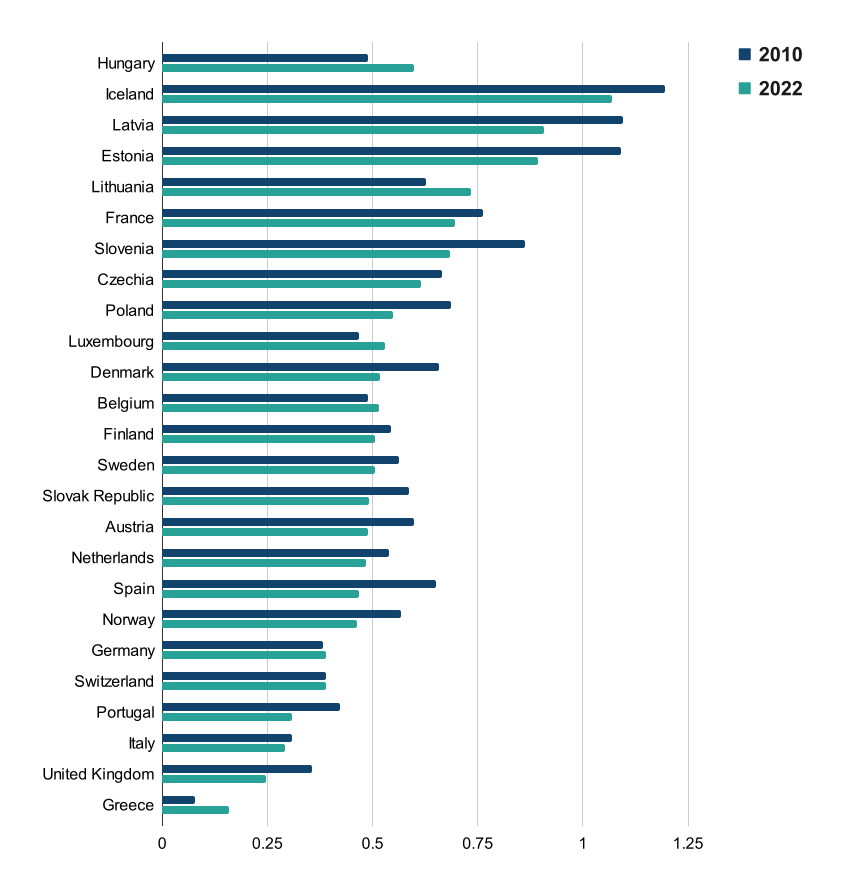
Source: OECD (UK data derived from HMT PESA Statistical Release)
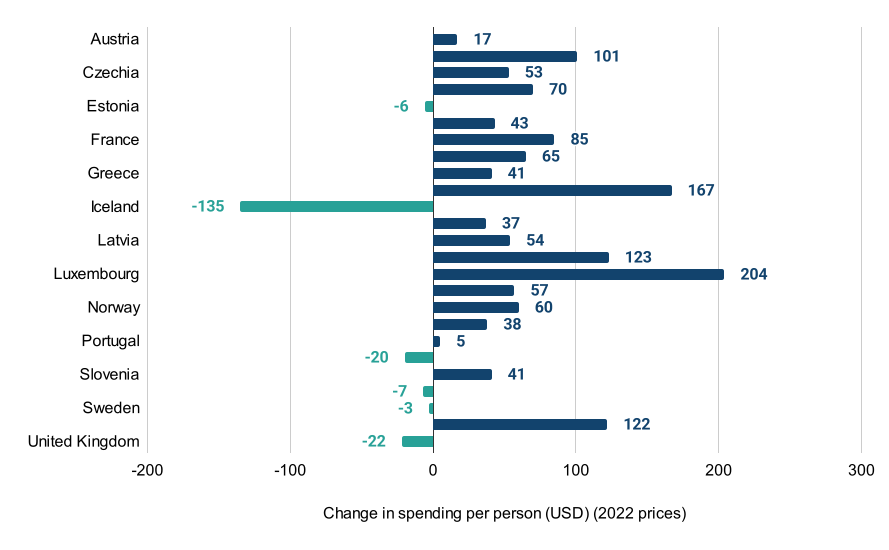
The UK was one of a small minority of countries that reduced its total culture spending per person between 2010 and 2022 (figure 2). The 13% decrease in the UK contrasts with increases of 33% in Germany, 27% in France and 40% in Belgium.
Figure 2: Change in total culture spending per person, 2010 vs 2022, selected European countries (real terms)
The impact of COVID-19 and the cost of living crisis
The financial challenges facing the cultural sector - already struggling from public funding cuts - have been worsened by the COVID-19 pandemic and the ongoing cost of living crisis, further intensifying the challenges the sector faces. The cultural sector was one of the most severely impacted by the COVID-19 pandemic - a report by the University of Sheffield found a 60% decline in output and 450k jobs (55% of the sector total) furloughed - second only to the hospitality and accommodation sector.
The pandemic changed how many people in the country engage with art and culture, often shifting to engagement in the home. Fewer people returning to venues is an ongoing challenge for the sector, impacting both audience numbers and commercial income. Many organisations have had to use up their financial reserves which are now seriously depleted.
The cost of living crisis has brought further operational challenges for both ACE and its stakeholders. UK inflation hit its highest point in 40 years in October 2022, and although it has since come down, costs continue to rise for arts and culture bodies in all areas of their operations, especially energy, as businesses are not protected by an energy price cap.
The cultural infrastructure is also in desperate need of capital investment. There was considerable investment under the last Labour Government, but inevitably boilers, lifts and roofs repaired over twenty years ago are now failing.
Local authorities have also been under great pressure. A recent report found that local authorities are now more often issued with Section 114 notices, notifying severe distress in the local authority’s finances. This is attributed to costs increasing faster than inflation, an increasing demand for services, and real-terms funding reductions since 2010/11. Some local authorities are therefore reducing funding for cultural institutions, putting greater pressure on ACE to fill this gap.
Value of culture in driving tourism
Arts and culture are crucial drivers of tourism and economic growth, strengthening the argument for public investment. The UK’s tourism economy - a vital component of the British economy and the third-largest service export - relies significantly on its globally recognised culture and heritage, attracting millions of visitors annually. The heritage sector’s direct financial impact is powerfully demonstrated by the 17.6 million international visits to heritage sites in 2023, which generated an estimated £12.5 billion in visitor spending. Cultural assets are vital for drawing people to specific locations: seven of the ten most popular paid visitor attractions in England are heritage sites. Encouraging visitors to travel beyond London is a key government priority to drive economic growth across the country.
A new approach to funding organisations
The main report sets out a new approach to the National Portfolio Investment Programme (NPIP) which includes more prominence for sectoral strategies and decisions being taken closer to the communities that will benefit.
Background to the National Portfolio Investment Programme
Before 2012, ACE used the Regular Funding Programme (RFP), which provided long-term, stable funding to around 880 organisations on a non competitive basis. This approach prioritised institutional continuity and was often focused on established cultural centres.
In 2012 ACE launched the National Portfolio Investment Programme, this was necessary due to reduced funding and the need for sector-wide reform. The NPIP was designed to introduce a rigorous, competitive application process to foster a more financially resilient, geographically widespread, and responsive cultural sector. The current NPIP cycle (2023–26) was heavily influenced by the government’s Levelling Up White Paper, which mandated a significant geographical rebalance of ACE investment. This policy redirected funds from London to historically underfunded areas in England, leading to major shifts in the National Portfolio and affecting many long-standing organisations.
Churn within the portfolio
The tables below provide figures relating to the number of National Portfolio Organisation (NPO) joiners and leavers, illustrating the sharp increase in competition and turnover, or ‘churn’.
Table 1 - NPO 2023-26 joiners and leavers
| 2023-26 applicants | Overall | Up to £249,999 | £250,000- £999,999 | £1m+ |
|---|---|---|---|---|
| Joiners | 276 | 204 | 67 | 5 |
| Staying in | 714 | 403 | 241 | 70 |
| Leavers | 82 | 62 | 19 | 1 |
| Non-joiners | 650 | 541 | 107 | 2 |
| Total | 1722 | 1207 | 437 | 78 |
Table 2 - NPO 2018-22 joiners and leavers
| 2018-22 applicants | Overall | Up to £249,999 | £250,000- £999,999 | £1m+ |
|---|---|---|---|---|
| Joiners | 187 | 157 | 28 | 2 |
| Staying in | 657 | 404 | 184 | 69 |
| Leavers | 24 | 22 | 2 | 0 |
| Non-joiners | 292 | 278 | 14 | 0 |
| Total | 1160 | 861 | 228 | 71 |
Overall, there was a substantial rise in applications between 2018-22 and 2023-26, increasing from 1,160 to 1,722. This increase was reflected across all categories. The number of returning unsuccessful applicants (‘Leavers’) increased sharply from 24 to 82, and new unsuccessful applicants (‘Non-joiners’) saw a significant increase from 292 to 650. Both the increase in applications and the growth in the number of NPOs leaving the portfolio creates and reflects instability and demonstrates the significant administrative effort required by all parties.
A multitude of funding pots
This chapter in the report recommends simplifying and reducing the number of ACE’s funding streams to make the application process easier and less bureaucratic. The table below lists just a selection of these funding streams, illustrating the number of separate ‘pots’ and the complexity applicants must navigate.
| Fund Name | Total budget £000 p.a | Aim of the fund |
|---|---|---|
| National Portfolio | 445,740 | The cultural infrastructure of England - organisations bringing creativity and culture to villages, towns and cities across the country. |
| National Lottery Project Grants | 101,750 | National Lottery Project Grants is our open access programme for arts, libraries and museums projects. The fund supports thousands of individual practitioners, community and cultural organisations |
| Place Partnerships | 13,000 | We can support specific types of projects that aim to make a step change in the cultural and creative opportunity in places through the Place Partnership Strand of Project Grants. |
| Supporting Grassroots Music | 2,000 | The Supporting Grassroots Music fund will specifically support rehearsal and recording studios, promoters, festivals, and venues for live and electronic music performance. |
| Developing Your Creative Practice | 14,400 | Supporting individual creative and cultural practitioners to focus on their development and take them to the next stage of their practice |
| Creative People and Places | 14,333 | Creative People and Places focuses on parts of the country where involvement in creativity and culture is significantly below the national average. It funds partners in local areas to empower residents to decide what kind of creative activity they want to experience on their doorstep |
| Youth Music | 9,651 | Youth Music (YM) is an external delegated distributor of National Lottery Funds for the Arts Council, making grants to organisations that provide musical learning and arts participation opportunities for 0-25 year olds who face barriers because of who they are, where they live and what they are going through. |
| V\&A Purchase Fund | 750 | The Purchase Fund uses National Lottery funds to contribute towards the acquisition of objects relating to the arts, literature and history by museums, galleries, record repositories and specialist libraries in England and Wales not funded by central government. |
| Social impact Investing | 850 (total) | This direct award reinvests repayments from the Arts Impact Fund (AIF), with a maximum of £850k. It supports Figurative, who were created from NESTA’s Arts and Culture Finance Team (ACF) who developed and delivered the AIF. It enables continued deployment of the ACF social investment funds and the development of future new social impact investment programmes |
| Transfer/Transform/ Transition | 8,245 | Three schemes to support the transition to the 23/25 National Portfolio |
| Music Hubs Investment Programme | 77,576 | A Music Hub is a partnership coordinated by a Hub Lead Organisation (HLO), responsible for supporting, delivering and enabling high quality music education for children and young people within a local area. |
| Music Hubs Capital Programme | 22,500 | funding to increase the volume, range, relevance and accessibility of musical instruments, equipment and technology in the Hub area |
| In Harmony | 450 | In Harmony uses the power of ensemble music-making to transform the lives of children and young people in disadvantaged communities. |
| National Youth Music Organisations | 525 | National Youth Music Organisations provide opportunities for thousands of young people to take part in making and enjoying music. |
| National Art & Design Saturday Club | 480 | National Saturday Club is a unique opportunity to learn new skills, discover talents, meet new people, and find out more about further education, higher education and rewarding careers. |
| Museums and Schools | 1,200 | The Museums and Schools programme aims to enhance the links between local schools and museums. |
| Museum Estates and Development Fund (MEND) | 22,600 | An open-access capital fund targeted at non-national Accredited museums and local authorities based in England to apply for funding to undertake vital infrastructure and urgent maintenance backlogs beyond the scope of day-to-day maintenance budgets. |
| Libraries Improvement Fund (LIF) | 5,000 | This fund will enable library services across England to invest in a range of projects to upgrade buildings and technology so they are better placed to respond to the changing ways people are using them. |
| Cultural Development Fund | 17,417 | The aim of the Cultural Development Fund is to level up through investment in culture. The fund will unlock local growth and productivity, increase access to excellent creativity and culture, and regenerate communities. It will achieve this through capital investment in transformative place-based creative and cultural initiatives. |
| Museum Development Fund | 3,002 | This programme focuses on building the ambition of museums in England not funded directly by the government or the Arts Council including training, programmes, small grants and networks. |
| Artsmark | 1,400 | Artsmark empowers teachers with the skills they need to embed arts, culture and creativity across the whole curriculum. |
| Delivery plan and Investment funds | 7,200 | Funds to support actions in our Delivery Plan |
| Incentivising Touring | 5,000 | Repayable grants designed to enable more mid and large-scale theatre and dance productions to tour. |
| City of culture | 4,708 | Supporting Bradford as COC2025 |
| Grassroots Music DCMS | 2,300 | The Supporting Grassroots Music fund will specifically support rehearsal and recording studios, promoters, festivals, and venues for live and electronic music performance. |
| Know your Neighbour | 4,420 | Funding designed to widen participation in volunteering and tackle loneliness in 27 disadvantaged areas across England. |
A new approach to funding individuals
The main report proposes a new National Programme for Individuals. The data in the section below reinforces how individual artists face significant financial instability, lack of workplace safety nets, and major barriers if they come from under-represented groups. This evidence further justifies the need for meaningful, long-term support.
Financial precarity and low pay
The earnings across the creative sector are low, despite the highly qualified workforce. 91% of these workers hold a Higher Education qualification, and 52% hold a post-graduate qualification, highlighting a fundamental issue where pay does not reflect the investment in training. The sector’s high rate of self-employment (32%) means most artists fundamentally lack workplace safety nets such as sick pay and pensions. This instability creates an ‘income wall’—a critical mid-career point that often forces skilled individuals to leave the sector altogether.
Disproportionate Impact on Under-represented groups
Financial instability is severely compounded for artists from under-represented backgrounds, creating a critical threat to diversity. The environment is perceived as fundamentally inequitable, with a significant percentage of freelancers - 47% - believing the sector is “not very” or “not at all” inclusive. This sentiment is heightened among the global majority and deaf/disabled freelancers. This exclusion may in part be driven by discrimination, harassment, stereotyping, and a perpetuation of social and cultural elitism. Challenges also include navigating bureaucratic systems, stigma, and a lack of support for older freelancers and those with parenting and caring responsibilities. This situation makes a career in the arts increasingly inaccessible for those without independent wealth or family support.
Working conditions, networking, and advocacy
The insecurity and unpredictability inherent in freelance work leads to a chronic lack of work-life balance, fatigue, anxiety, and despondency. This pressure has contributed to a worrying ‘burnout crisis’: nearly 80% of culture workers have considered leaving the sector due to overwork and financial pressure. Poor working conditions, discrimination, and bullying further impact mental health, making social networks and peer support crucial coping strategies. Work opportunities are largely found through personal recommendations (81%) and repeat bookings (56%), creating a significant barrier for those outside established networks. Despite these systemic challenges, 77% of freelancers intend to continue working in the sector, but only 43% would recommend it. The sector has welcomed the appointment of a DCMS Freelance Champion to focus on driving better industry practices, fairer pay, and timely contracts to ensure this vital segment has sustainable access to professional development and long-term career stability.
The role of education
This chapter of the report speaks of the importance of cultural education and the changes that have greatly weakened the offer to children in the last decade. It sets out a way forward to bring together resources from DfE and ACE with philanthropic giving from individuals, corporations, trusts and foundations to create a fund that could support the outcomes set out in the new curriculum review.
It also talks about the importance of creating a pipeline of talent, particularly from under-represented groups across the country. This annex provides additional narrative and information to support the points made in the main chapter.
Benefits of engaging with the arts
Arts and cultural engagement provide profound educational and social benefits, supporting the argument that it should be central to every child’s experience. Participation in structured creative activities boosts children’s cognitive abilities by 17% along with improved attainment in core subjects like Mathematics and English. For vulnerable young people, creative arts can provide a route to educational attainment especially for children from lower socio-economic backgrounds, with students from low-income backgrounds who participate in arts at school being three times more likely to graduate with a university degree. Furthermore, creative activity cultivates essential soft skills, enhancing a child’s empathy, critical thinking, and problem-solving abilities. Cultural education is also directly linked to improved mental health and overall wellbeing.
Arts education cuts
Arts education has been increasingly marginalised, evidenced by a fall in teaching hours for art and design, especially at Key Stage 4. There has been a marked decline in the uptake of cultural and creative subjects at GCSE and A-level since 2010, including Design Technology (68% decline), Music (40% decline), and Drama (30% decline).
Teacher recruitment has suffered severely: the vacancy rate for Art & Design teachers has more than tripled since 2010/11, for Music the rate has increased by a multiple of six, and Drama has increased by a multiple of five. Teacher recruitment in Music has fallen by a staggering 56%. Children’s opportunities to engage with culture are diminishing, as creative subjects are often relegated to extracurricular activities, usually at additional cost to parents. The number of school leaders reporting cuts to “trips to outings” has doubled between 2022 and 2023 due to costs of transportation and staff time.
The leaky pipeline
Despite the importance of the creative sector, the pathway from education into employment is difficult. Creative Arts graduates are significantly less likely to be in full-time employment (49.8% of creative arts graduates were in full-time employment 15 months after graduation) than the average graduate across all subjects. The sector’s reliance on precarious, part-time, and freelance work, combined with the high cost of entry, favours those with independent wealth. Workers from lower socio-economic backgrounds in the creative sector face a career advancement crisis, with only 26% expressing optimism about their progression. Individuals from privileged backgrounds are over twice as likely to secure creative jobs due to the sector’s hiring practices that favour certain codes of behaviour, perpetuating a progression cycle biassed against diverse talent.
The importance of touring
The chapter in the report on Touring sets out the challenges to touring and why it is vital to the arts and cultural sector. It demonstrates how a number of the recommendations throughout this report are designed to increase the amount of touring.
To mitigate investment risks and boost activity, Arts Council England launched the Incentivising Touring Scheme. This pilot offers repayable grants to producers, aiming to increase mid-to-large scale touring and enable venues to program a more diverse range of work. The scheme requires eligible tours to visit at least four independent, permanent, ticketed English venues with 500+ seats, aiming to broaden access outside inner London. Repayable grants cover up to 25% of capitalisation costs, which are only repaid after other investors recoup their outlay. This use of public funding significantly boosts investor confidence, enabling profitable productions to achieve widespread commercial and cultural reach.
ACE as a Development Agency
This chapter in the report sets out the case for a clear definition of the role of a development agency. Once defined, ACE should spend more time on its development agency function to support future challenges of the sector. It refers to a recommendation made in the last review of the Arts Council. We set out a bit more about this below.
Tailored Review
The 2017 Tailored Review of the Arts Council raised several issues regarding ACE’s role as a development agency that are still relevant today. The review highlighted a critical need for ACE to evolve its function beyond merely a funding body, advocating for a strengthened role as a dynamic development agency. It emphasised the importance of fostering local collaborations and facilitating partnerships between institutions, community groups, and local authorities. The review also recommended engaging diverse specialists, involving expertise from technology, business, community development, and social sciences, to help build capabilities across the cultural sector.
ACE’s role supporting libraries and museums
This chapter in the report talks about ACE’s role as the development agency for both libraries and museums. The information below adds context to that chapter by outlining the historical support provided to the museum sector and libraries across England, and details ACE’s current contributions.
The Museums, Libraries and Archives council (MLA) and what came before it: Libraries
The Public Libraries and Museums Act 1964 made the provision of a comprehensive and efficient public library service a statutory duty for local authorities. It formally placed the service under the superintendence of the relevant government minister, necessitating the creation of a dedicated advisory body known as the Library Advisory Council (LAC). This later evolved into the Library and Information Services Council (LISC) which served primarily as a consultative body in the 1980s, offering expert guidance to the Secretary of State on service improvement. The LISC was then merged with the Museums and Galleries Commission (MGC) in April 2000, forming the Museum and Libraries Association (MLA).
From 2000 to 2011, the MLA’s primary function with regard to libraries was to advise the Secretary of State on sector policy to support the minister in their fulfilment of their statutory duty to superintend local library services. Core library funding remained with local authorities, whilst the MLA concentrated on promoting development and innovation through programmes such as the Future Libraries Programme. This encouraged local councils to modernise services, enhance public access, especially in regards to digital accessibility. The MLA championed the wider cultural and educational role of libraries across the country.
Where libraries are now
The structure surrounding the strategic development and improvement of libraries in England is fragmented. The strategic development is primarily under the remit of the Arts Council. ACE supports the sector by administering funding initiatives, such as the Libraries Improvement Fund (LIF), that help library services upgrade buildings and technology. The Arts Council views libraries as integral to the wider cultural landscape, increasing internal resources for this work and leveraging synergies with literature and cultural initiatives through its inclusive strategy, Let’s Create. ACE also chairs the English Public Libraries Stakeholder Working Group to drive policy and development across the sector.
While ACE manages development and grants, it does not hold the purse strings for core operations; local authorities retain the statutory duty to fund and manage a “comprehensive and efficient” library service. The DCMS retains the legal duty of superintendence over this service. This arrangement was highlighted in the recent independent review by Baroness Sanderson, which noted the “fragmented structure” surrounding public libraries and suggested a further opportunity for the British Library (BL) to take on a convening role to benefit the entire public library network.
Various organisations have roles in relation to the oversight and support of libraries:
-
Local Authorities have a statutory duty to provide and manage a “comprehensive and efficient” public library service.
-
The Department for Culture, Media and Sport (DCMS) holds statutory responsibility for the public library service, which is the legal duty to “superintend and promote the improvement”.
-
The Ministry of Housing, Communities and Local Government (MHCLG) primarily influences libraries through the funding framework for local councils.
-
The British Library is the UK’s national library, and supports local libraries through partnerships that extend its resources and expertise. The BL created the Business and IP Centre (BIPC), which provides impartial business support and market intelligence to aspiring entrepreneurs , and this BIPC is part of a large network of BIPCs in libraries across the UK.
-
Libraries Connected is an independent UK charity and membership organisation that represents and supports public library services.
-
The Local Government Association (LGA) works with councils to support and improve the public library service.
The Museums, Libraries and Archives council and what came before it: Museums
The MLA was established in 2000, merging the Museums and Galleries Commission (MGC) and the Library and Information Commission. Its central mission was to foster engagement and innovation across the UK’s museums, libraries, and archives. As the national strategic agency for these cultural heritage sectors, the MLA aimed to inspire integrated, sustainable, and high-quality services to enrich public life.
ACE’s Remit: Museums
Following the abolition of the MLA, in 2010 ACE took on the responsibility of development agency for Libraries and Museums. The responsibility for archives went to The National Archives. In 2011, ACE took on responsibility for running statutory functions in relation to Acceptance in Lieu, the Government Indemnity Scheme, and the Cultural Gifts Scheme. Despite 36% of museums being forced to cut opening hours due to financial strain, the museums sector expresses positive sentiments regarding ACE’s support. The knowledgeable Museums Team and their initiatives have received commendation.
Why some museums are funded by DCMS
DCMS directly funds select National Museums (e.g., British Museum, National Gallery) for their nationally and internationally significant collections, guaranteeing their preservation and free public access. ACE acts as a strategic development agency, distributing competitive grants and portfolio funding to most other English museums to foster their development, regional excellence, and operational sustainability.
Civil Museums set up - how they are funded by local authorities
Civic Museums, vital to England’s cultural ecosystem, are local or regional institutions deeply connected to their areas. Their primary funding comes from Local Authority grants, covering essential running costs, but these discretionary budgets are vulnerable to central government cuts. This core funding is augmented by self-generated income and competitive project-based grants from ACE for capital works and development. The severity of reduction in local authority funding leaves local authority-owned civic museums vulnerable to financial instability, exacerbated by rising energy and staffing costs.