Area Cost Adjustment technical note
Published 9 February 2026
Applies to England

© Crown copyright 2026
This publication is licensed under the terms of the Open Government Licence v3.0 except where otherwise stated. To view this licence, visit nationalarchives.gov.uk/doc/open-government-licence/version/3 or write to the Information Policy Team, The National Archives, Kew, London TW9 4DU, or email: psi@nationalarchives.gov.uk.
Where we have identified any third party copyright information you will need to obtain permission from the copyright holders concerned.
This publication is available at https://www.gov.uk/government/publications/area-cost-adjustment-technical-note/area-cost-adjustment-technical-note
Introduction
The Area Cost Adjustment (ACA) is applied to the Relative Needs Formulae (RNFs) and is a tool used to measure the variation in the cost of providing services for Local Authorities (LAs) in England. The cost of providing services varies between LAs due to several internal and market factors. The ACA measures the market factors including the cost of labour, rent and accessibility within LAs.
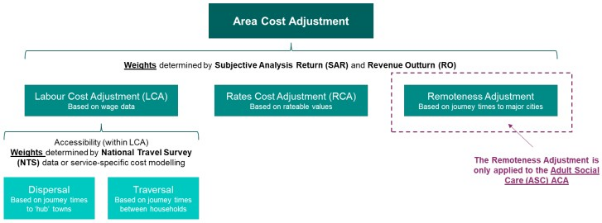
The ACA consists of the following adjustment factors:
- i. Rates Cost Adjustment (RCA) – aims to measure the difference in the cost of property rates / rents between LAs. This reflects the variation between areas in the cost of using equivalent premises due to differences in local supply and demand factors;
- ii. Labour Cost Adjustment (LCA) – aims to measure the difference in the cost of labour between LAs. This reflects the fact that authorities will need to compete with other potential employers to secure and retain suitable skilled staff;
- iii. Accessibility Adjustment – aims to measure the impact of the difference in travel time to provide services on the cost of labour. There are two measures within this adjustment - a dispersal adjustment factor (longer journeys to reach households) and a traversal adjustment factor (longer journeys between households). They are measured using journey times data and combined with the LCA, since they are measures of additional labour cost; and
- iv. Remoteness Adjustment – aims to measure the impact of separation from larger concentrations of service users. This adjustment is only applied to the Adult Social Care (ASC) ACA.
The RCA, LCA, Accessibility and Remoteness measures are calculated as indices with a mean of 1, with relatively higher cost LAs scoring above 1 and vice versa. The measures are estimated at the LA geography level so that each LA has a unique ACA index value.
Figure 1: Structure of the ACA
Methodology
Rates Cost Adjustment
Local Authorities experience different costs due to the premises that they use to deliver services, in particular because of business rates or rents. The relative costs that LAs face for using an equivalent space will vary between areas as a result of local supply and demand factors.
The RCA aims to estimate the going rate for similar properties, accounting for the effects of building characteristics known to affect valuation. To measure the going rate for similar properties, Equation 1 is used to estimate property value controlling for factors that drive differences in property value.
Equation 1: Regression Specification for the RCA
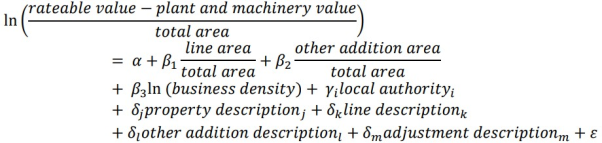
Where:

A detailed database of non-domestic property valuations from the Valuation Office Agency (VOA)[footnote 1] is the main data input to the RCA and is used to estimate all variables apart from business density. The database contains details on the rateable values and building characteristics. The 2023 version of the database is used.
The relevant area data from the VOA database with properties measured consistently in Net Internal Area (NIA) meters squared is used to estimate the area variables. The ‘total area’ of properties is estimated by summing ‘line area’, ‘other addition area’ and ‘car parking area’. The car parking area proportion is excluded from the regression to avoid potential perfect collinearity issues.
Business registrations data from the 2024 Business Census data[footnote 2] is used to estimate the business density control variable. The dataset contains information on companies registered in the UK by postcode. The dataset is filtered to include only active companies and grouped to find the count of businesses registered under each postcode. The postcode level data is then mapped to Lower Super Output Area (LSOA) geographies. The business density control variable for each LSOA is calculated by taking the business count in each LSOA as a proportion of the LSOA area (in square meters).
The regression set out in Equation 1 is estimated using the inputs generated from the VOA and Business Census data. The resulting coefficient on the ‘local authority’ variable is then used as the RCA index.
Labour Cost Adjustment
Local Authorities compete for staff with other potential employers. To secure and retain suitably skilled staff, authorities need to pay the local ‘going rate’ for labour. The relative costs that authorities face for labour will vary across authorities and reflect local living and housing costs, skills, career opportunities, population and commuting costs.
The LCA aims to estimate the going rate for similar workers, accounting for characteristics that affect staff pay. To measure the going rate for similar workers, Equation 2 is used to estimate hourly gross staff pay. To avoid comparing very different sets of workers between areas, due to differences in demographics or economic activity, controls are used to take account of differences in industry and occupation, potential experience, gender, and the public / private sector mix.
Equation 2: Regression Specification for the LCA
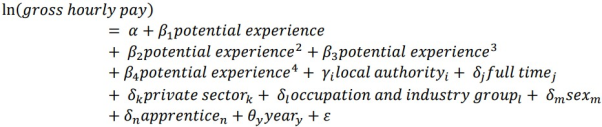
The Office for National Statistics (ONS) Annual Survey of Hours and Earnings[footnote 3]) (ASHE) is the main data input to the LCA. The ASHE provides information on earnings and paid hours worked for employees in all industries and occupations with information on several other variables.
The ASHE is updated on an annual basis by the ONS. The most recent three years of final ASHE data is used to estimate ‘smoothed’ LCA values. The smoothing approach helps to reduce year on year volatility in the dataset. The LCA is currently estimated using 2022, 2023 and 2024 final ASHE data.
The regression set out in Equation 2 is estimated using the ASHE data. The potential experience variable is estimated by subtracting 18 from the age variable provided in the ASHE data. The ‘local authority’ variable represents the authority an individual works in (as opposed to the authority an individual lives in.) The resulting coefficient on the ‘local authority’ variable is then used as the LCA index.
Journey Times Measures – Accessibility and Remoteness
Journey times data[footnote 4] is used to capture additional costs from Accessibility and Remoteness factors. Accessibility is applied to all service specific ACA values whilst Remoteness is only applied to the Adult Social Care (ASC) ACA values.
The journey times data consists of theoretical journey times calculated by modelling journeys between known sets of origins and destinations. The journey times dataset is created using information on the road network, traffic speeds and public transport timetables in England, and produces a value which represents how long that journey would take.
Accessibility
Local Authority employees can face relatively long periods where they must spend time travelling - either due to longer distances, poorer transport links, or traffic congestion. Labour productivity is therefore likely to be lower in areas with longer journey times because LAs will have to pay their staff for more hours to deliver similar services.
Two measures are applied within the LCA to account for the additional costs associated with Accessibility (i.e. differing journey times). The inclusion of these additional measures is based on the assumption that there is a time, and therefore direct staffing, cost associated with greater journey times.
Traversal aims to account for relative additional cost – in terms of employee time and therefore the pay bill – of longer journeys between households when delivering services such as waste collection. To estimate traversal, journey times from Lower Super Output Areas (LSOA, 400 to 1,200 households) to the closest LSOAs in an area totalling 10,000 people are used. The centre of LSOAs is determined by the ONS using population weights.
For each LSOA, the shortest journey times to reach a set of ‘destination’ LSOAs with a cumulative population of 10,000 people are kept. The average population weighted journey time from each LSOA to reach this set of ‘destination’ LSOAs (i.e. to reach a cumulative population of 10,000) is then calculated. The final traversal values are estimated by calculating a population weighted average journey time for each LA.
Dispersal aims to account for the relative additional cost – in terms of employee time and therefore the pay bill – of longer journeys to reach households to provide services such as social worker visits. To estimate dispersal, journey times from LSOAs to the closest “hub town” (Settlement of over 10,000 people) are used. The centre of each “hub town” is the centre of an Area of Town Centre Activity (ATCA, settlement of over 10,000 people) or a selected important place (e.g. a school or shop) in a settlement without an ACTA.
An Output Area (OA, area with an average of 129 households) is selected to represent the centre of an ‘ATCA’ based on ONS population centroid data. This is then mapped to the LSOA level, and these LSOAs are defined to be “hub towns”. For each LSOA, the shortest journey time to a “hub town” is kept. The final dispersal values are estimated by calculating a population weighted average journey time for each LA.
Where skewed accessibility values are observed, it is proposed that they should be capped.The City of London’s (CoL) traversal and dispersal values are significantly higher than the mean values for other Inner London Boroughs (ILBs). This is primarily a result of the CoL’s small population and unique characteristics. Therefore, due to the extremely high values from the CoL’s unique characteristics, their traversal and dispersal values are capped at the median values for all other ILBs.
Remoteness
Economic theory suggests that separation from major markets may, in some cases, increase the cost of service provision for LAs. Outside of larger service markets, fewer providers can sustainably operate which may reduce competition and therefore increase the cost of procuring specialised goods and services. The cost of council-run services may be higher in smaller and sparser markets due to lower economies of scale.
The Remoteness Adjustment functions as a proxy to account for separation from larger concentrations of service users and uses journey times data. The Remoteness Adjustment is only applied to the ASC ACA values.
The Remoteness Adjustment is estimated using journey times from LSOAs to the centre of the nearest ATCA in a Major Town or City (more than 75,000 residents).
To determine the centre of an ATCA in a Major Town or City, an OA is selected to represent each ATCA centre based on ONS population centroid data. OAs that represent ATCA centres in Major Towns or Cities are mapped to the LSOA level and kept as remoteness ‘destinations’. For each LSOA, the shortest journey time to reach the centre of an ATCA in a Major Town or City is kept. A population weighted average journey time is then calculated at the LA level.
Where skewed remoteness values are observed, it is proposed that they should be capped. The CoL’s remoteness values are capped at the median values for all other ILBs. This follows the same approach taken for accessibility values.
Weights
Components of the ACA are combined into a single weighted index for each funding formula, appropriate for the relevant service(s). This means that service-specific adjustments for relative differences in costs across LAs would be applied to the appropriate RNF.
Weights for the LCA, RCA and Remoteness are determined using 2 data sources:
- Revenue Outturn (RO) – RO statistics show the actual revenue spending of all local authorities in England, using the final audited financial accounts where possible. The ACA currently uses 2024/25 RO data[footnote 5]. LAs with missing returns are removed from the calculations.
- Subjective Analysis Return (SAR) – A sample of LAs in England complete the SAR to give a detailed breakdown of spending within services. The ACA currently uses 2022/23 SAR data[footnote 6].
Since data aggregated at the service level is used to calculate the weights, the final ACAs for individual authorities are not dependent directly on their RO or SAR return. The weights are specific to each service area and are the same for all LAs.
LAs record the split of their spending on each line in the RO between ‘employee costs’ and ‘running costs’. ‘Employee costs’ are assigned entirely to the LCA, while ‘running costs’ are split between elements of the ACA using the SAR data.
The RO data is used to determine overall employee cost and running cost shares for each service area following the approach below:
- RO spending lines are mapped to the relevant service area (e.g. ASC);
- For RO spending lines that are mapped to the Foundation Formula, spend needs to be split between the Upper Tier (UT) and Lower Tier (LT) Foundation Formula. For single tier LAs, spend is apportioned to LT and UT based on the proportion of Shire District or Shire County spending for each RO service line;
- A different approach is taken for RO spend lines mapped to the Fire & Rescue service area. These are combined across LA tiers into a single fire spending category;
- Employee cost shares and running cost shares can then be calculated for each service area.
2022/23 SAR part B data is used to split running costs using the following approach:
- SAR data breaks down a sample of authorities running costs for categories of spend. The relevant categories here are ‘Children Social Care’, ‘Adult Social Care’, and ‘All Other Services’;
- SAR lines are assigned to components of the ACA (LCA, RCA, Unadjusted, Split, Other);
- The cost of spending for some SAR lines is assumed to vary with one of the LCA or RCA (e.g. agency staff costs are assigned to the LCA);
- SAR lines which are assigned to Unadjusted are those that are assumed to be unaffected by any components of the ACA (e.g. energy costs are assumed not to vary geographically);
- SAR lines that are assigned to Split are affected by all components of the ACA (e.g. contracted services). For the split category, it is assumed that at least 70% of contracted costs are employee costs. This assumption is in line with the previous Review of the Area Cost Adjustment[footnote 7];
- Insurance is assigned to ‘Other’ and is split according to overall weighting derived from RO and SAR;
- The full SAR assignments are set out in Table 2
To calculate non-accessibility weightings, the SAR proportions are applied to the ‘running costs’ shares (from the RO) and combined with the employee costs shares to produce weightings for the LCA and RCA for each service area.
When the remoteness adjustment is included, weights are determined using a similar method. However, some of the SAR allocations are assigned to Remoteness instead of Unadjusted (See Table 2).
Weights for Accessibility are estimated using the National Travel Survey (NTS), for the default weight, or service specific cost modelling where data is available (for waste services and adult social care).
The default accessibility weights are estimated using the NTS data[footnote 8] and the ONS’ ASHE data[footnote 9] (2022, 2023 and 2024 final data). The default accessibility weight is estimated to be the average number of hours per year spent travelling for work by relevant workers from the NTS, as a proportion of the average paid time for relevant workers from the ONS ASHE data.
There are limitations with the NTS data employed in this estimate due to the small sample size of the data. However, when using this NTS data, travel time as a proportion of labour time for the relevant workers is estimated to be around 1.7%.
The accessibility weight for domiciliary adult social care uses service specific data – mainly travel time estimates published by the UK Homecare Association (UKHCA)[footnote 10], and expenditure data from the Adult Social Care Activity and Finance Publication[footnote 11]. This data is used to estimate travel time for domiciliary adult social care as a proportion of ASC labour costs.
The Accessibility weight for waste collection is based on data from Waste and Resources Action Programme’s (WRAP) Indicative Cost and Performance (ICP3) model of waste collection costs[footnote 12]. The WRAP data is used to estimate travel time for waste collection services. This waste collection weight is applied to the proportion of labour costs in the Foundation Formula that correspond to waste collection.
Table 1: ACA Weightings
| Service Area | LCA | RCA | Remoteness | Unadjusted | Accessibility |
|---|---|---|---|---|---|
| Adult Social Care | 67% | 1% | 2% | 30% | 3% |
| Children’s Services | 66% | 2% | - | 32% | 2% |
| Foundation Formula: Upper Tier | 50% | 7% | - | 43% | 2% |
| Foundation Formula: Lower Tier | 57% | 6% | - | 36% | 5% |
| Highways Maintenance | 49% | 7% | - | 44% | 2% |
| Fire & Rescue | 84% | 2% | - | 14% | 2% |
Final ACA Calculation
The RCA, LCA, Accessibility and Remoteness indices are combined using the ACA Weights. The full calculation is set out in Equations 3 and 4. The weights are specific to each service area, whilst the indices are specific to each LA.
ACA values excluding the Remoteness Adjustment are estimated for Children’s Services, Foundation Formula UT[footnote 13], Foundation Formula LT, Highways Maintenance, and Fire & Rescue service areas (Equation 3). The final ACA values with the Remoteness Adjustment are estimated for Adult Social Care service area (Equation 4).
Equation 3: Calculation of the final ACA excluding the Remoteness Adjustment for Local Authority ‘i’

Where:
1 = LCA Weight + RCA Weight + Unadjusted Weight
Equation 4: Calculation of the final ACA with the Remoteness Adjustment for Local Authority ‘i’

Where:
1 = LCA Weight + RCA Weight + Remoteness Weight + Unadjusted Weight
And, for both Equation 3 and 4:

Changes from the Fair Funding Review 2.0 consultation
Labour Cost Adjustment
The LCA has been updated to incorporate final 2024 ONS ASHE data. Previously, provisional 2024 ONS ASHE data was applied in the Fair Funding Review 2.0 LCA values.
The LCA regression specification has been revised to reflect the following recommendations suggested by the Institute for Fiscal Studies (IFS):[footnote 14]
- Move from log weekly earnings to log hourly earnings as the dependent variable and drop the control variable for hours worked;
- Use potential experience (age – 18) instead of age;
- Cluster standard errors at the individual level, and include year dummies in the LCA regression, to recognise that the ASHE data are a short, wide panel dataset.
Rates Cost Adjustment
The RCA has been revised to only include area values in consistent measurement units from the VOA ratings dataset[footnote 15]. The VOA data is now cleaned to retain Net Internal Area (NIA) meters squared values and to remove properties that are not measured in meters squared (e.g. measured instead by number of bedrooms).
The business density control variable in the RCA has also been updated to incorporate 2024 business census data[footnote 16].
In response to a recommendation suggested by the IFS[footnote 17], the RCA regression specification has been revised to remove one of the three area proportions (car parking area proportions) to avoid potential perfect collinearity issues.
Journey Times Measures
Accessibility and Remoteness values have moved from 2023 to 2024 ONS LA population estimates.[footnote 18] The values have also been updated to reflect updated 2022 LSOA population estimates[footnote 19] and the relevant LSOA to LA lookup.
The Fair Funding Review 2.0 service specific ACA values all applied the Remoteness Adjustment. This has been updated and now only the ASC ACA values have the Remoteness Adjustment applied. The other service specific ACA values do not apply the Remoteness Adjustment.
Weights
The ACA weights have been updated to incorporate the 2024/25 Revenue Outturn data[footnote 20] (previously applying final 2022/23 data) and the 2024 NTS data (previously applying only 2023 NTS data) [footnote 21].
Changes from the Provisional Local Government Finance Settlement 2026 to 2027
There have been no changes to the ACA since the provisional Settlement.
Data and technical definitions
Annual Survey of Hourly Earnings (ASHE) - A survey that provides information about the levels, distribution and make-up of earnings and paid hours worked for employees in all industries and occupations.
Area Cost Adjustment (ACA) - A methodological approach used to measure local variation in the cost of delivering public services across different geographic areas.
Area of Town Centre Activity (ATCA) - A settlement of over 10,000 people.
Labour Cost Adjustment (LCA) - A factor in the ACA which aims to measure the difference in the cost of labour between local authorities. See ‘Area Cost Adjustment (ACA)’
Lower Super Output Area (LSOA) - An area with 400 to 1,200 households
National Travel Survey (NTS) - A survey of households of personal travel by residents of England within Great Britain
Output Area (OA) - An area with an average of 129 households
Rates Cost Adjustment (RCA) - A factor in the ACA which aims to measure the difference in the cost of property rates / rents between local authorities. See ‘Area Cost Adjustment (ACA)’
Relative Needs Formula (RNF) - One of a series of formulas which calculates a share of relative need for each local authority for a particular service or group of services
Revenue Outturn (RO) - Outturn data of local authority revenue expenditure and financing
Subjective Analysis Return (SAR) - A survey of local government revenue and expenditure, completed by a sample of authorities in England every 3 years
SAR Assignments for ACA Weights - The SAR is used to assign weights for the different components of the ACA. As not all authorities fill in the SAR, weights are calculated using aggregated data. Sub-categories of expenditure in the SAR are subjectively assigned to either the LCA, RCA, Split, Other, Unadjusted and Remoteness.
Table 2 shows a summary of which ACA weighting each SAR component is assigned. If remoteness is in brackets, the component is assigned remoteness when the Remoteness Adjustment is included in the ACA and Unadjusted when it is excluded.
Table 2: Summary of the ACA categories given to the SAR components
| SAR Component | Weighting Assignment |
|---|---|
| 18 Repairs, Alterations and Maintenance of Buildings | RCA |
| 19 Energy Costs - Electricity, Gas and Other | Unadjusted |
| 21 Rents | RCA |
| 22 Rates | RCA |
| 23 Water Services | Unadjusted |
| 24 Fixtures & Fittings | RCA |
| 25 Cleaning and Domestic Supplies | RCA |
| 26 Grounds Maintenance Costs | RCA |
| 27 Premises Insurance | RCA |
| 28 Other Premises Related Expenditure | RCA |
| 29 TOTAL PREMISES EXPENSES (Total of lines 18 to 28) | Sub-total |
| 30 Direct Transport Costs - Vehicle Running Costs, Repair & Maintenance | Split |
| 32 Contract Hire and Operating Leases | Unadjusted (Remoteness) |
| 33 Car Allowances for Travelling Expenses | Unadjusted (Remoteness) |
| 34 Public Transport Allowances for Travelling Expenses | Unadjusted (Remoteness) |
| 35 Transport Insurance | Unadjusted (Remoteness) |
| 36 Other Transport Related Expenditure | Unadjusted (Remoteness) |
| 37 TOTAL TRANSPORT EXPENSES (Total of lines 30 to 36) | Sub-total |
| 38 Equipment, Furniture & Materials | Unadjusted (Remoteness) |
| 39 Catering | Split |
| 40 Clothing, Uniforms & Laundry | Unadjusted |
| 41 Printing, Stationery and General Office Expenses | Unadjusted |
| 42 Communications and Computing - Postage, Telephone, Computer Costs and Other | Unadjusted |
| 46 Subsistence and Conference Expenses | Unadjusted |
| 47 Subscriptions | Unadjusted |
| 48 Insurance | Other |
| 49 Schools’ Non ICT Learning Resources | Unadjusted |
| 50 Schools’ ICT Learning Resources | Unadjusted |
| 51 Exam Fees | Unadjusted |
| 52 Other Supplies and Services Expenditure | Unadjusted |
| 53 TOTAL SUPPLIES & SERVICES EXPENDITURE (Total of lines 38 to 52) | Sub-total |
| 54 Joint Authorities and Other Local Authorities | Unadjusted |
| 55 Grants to Voluntary Bodies | Unadjusted |
| 56 Private Contractors and Other Agencies - Professional Services | Split |
| 57 Private Contractors and Other Agencies - Agency Staff | LCA |
| 58 Private Contractors and Other Agencies - Other | Split |
| 59 Internal Trading Organisations | Unadjusted |
| 60 TOTAL THIRD PARTY PAYMENTS (Total of lines 54 to 59) | Sub-total |
| 61 Total Transfer Payments (Discretionary) | Unadjusted |
| 62 Expenditure on Management and Support Services | LCA |
| 68 Balancing Item | LCA |
| 63 TOTAL Part B (Total of lines 29, 37, 53, 60, 61 & 62) | Sub-total |
-
Business Census - Dataset - Geographic Data Service - The data for this research have been provided by the Geographic Data Service, a Smart Data Research UK Investment, under project ID GeoDS 2569, ES/Z504464/1 ↩
-
Employee earnings in the UK - Office for National Statistics ↩
-
Journey times data procured from Basemap Ltd. in 2019 ↩
-
Local authority revenue expenditure and financing England: 2024 to 2025 individual local authority data - outturn - GOV.UK – accessed October 2025 ↩
-
Local authority revenue expenditure and financing England: 2022 to 2023 outturn - subjective analysis return - GOV.UK ↩
-
Local Government Finance: Review of the Area Cost Adjustment, Report by Professor Robert F Elliot, David McDonald & Roy MacIver. (University of Aberdeen, 1996) ↩
-
National Travel Survey: 2023 - GOV.UK; National Travel Survey: 2024 - GOV.UK ↩
-
Employee earnings in the UK - Office for National Statistics ↩
-
The Homecare Association releases minimum price for homecare 2024/25 ↩
-
Adult Social Care Activity and Finance Report, England, 2022-23 - NHS England Digital ↩
-
WRAP provide underlying data from the ICP3 model of waste collection costs ↩
-
This ACA is also applied to the Home-to-School Transport RNF ↩
-
A technical peer review of MHCLG’s suggested approach to allocating funding between English local authorities ↩
-
Business Census - Dataset - Geographic Data Service - The data for this research have been provided by the Geographic Data Service, a Smart Data Research UK Investment, under project ID GeoDS 2569, ES/Z504464/1 ↩
-
A technical peer review of MHCLG’s suggested approach to allocating funding between English local authorities ↩
-
Population estimates for England and Wales - Office for National Statistics ↩
-
Lower layer Super Output Area population estimates (supporting information) - Office for National Statistics – accessed September 2025 ↩
-
Local authority revenue expenditure and financing England: 2024 to 2025 individual local authority data - outturn - GOV.UK – accessed October 2025 ↩
-
National Travel Survey: 2023 - GOV.UK; National Travel Survey: 2024 - GOV.UK ↩