Safety flyer to the fishing industry – Argos Georgia
Published 25 September 2026

© Crown copyright 2026
This publication is licensed under the terms of the Open Government Licence v3.0 except where otherwise stated. To view this licence, visit nationalarchives.gov.uk/doc/open-government-licence/version/3 or write to the Information Policy Team, The National Archives, Kew, London TW9 4DU, or email: psi@nationalarchives.gov.uk.
Where we have identified any third party copyright information you will need to obtain permission from the copyright holders concerned.
This publication is available at https://www.gov.uk/government/publications/are-your-vessel-operations-approved-and-practised/safety-flyer-to-the-fishing-industry-argos-georgia
1. Summary
Foundering of the longline fishing vessel Argos Georgia, approximately 190 nautical miles east of Port Stanley, Falkland Islands with the loss of 13 lives on 22 July 2024.
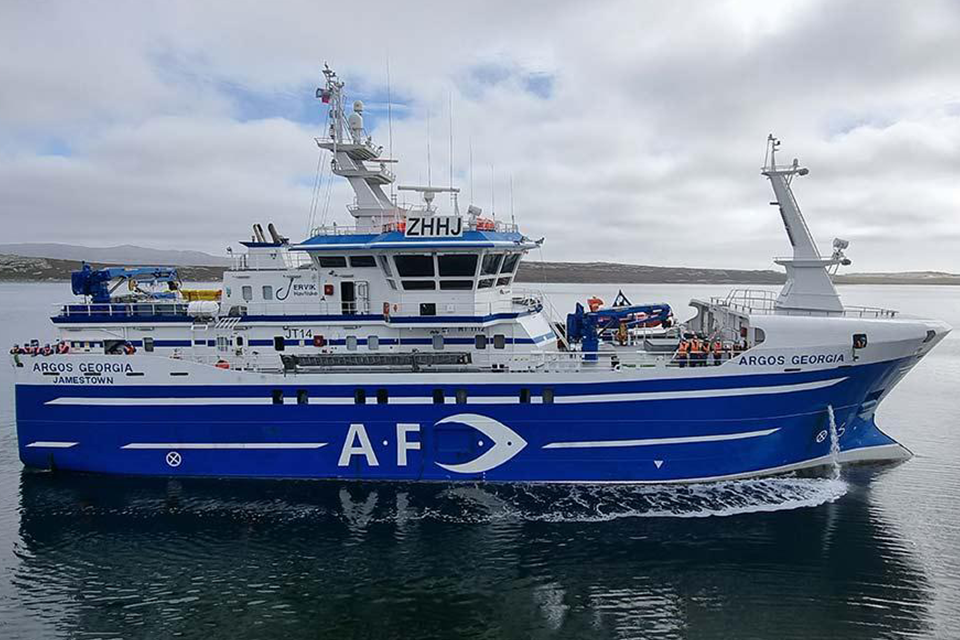
Argos Georgia (Argos Froyanes Limited)
On the evening of 22 July 2024, the St Helena registered longline fishing vessel Argos Georgia capsized and sank about 190nm east-south-east of Port Stanley, Falkland Islands. Of the 27 people on board, 13 perished and 14 survived and were recovered during the search and rescue (SAR) operation.
2. Narrative
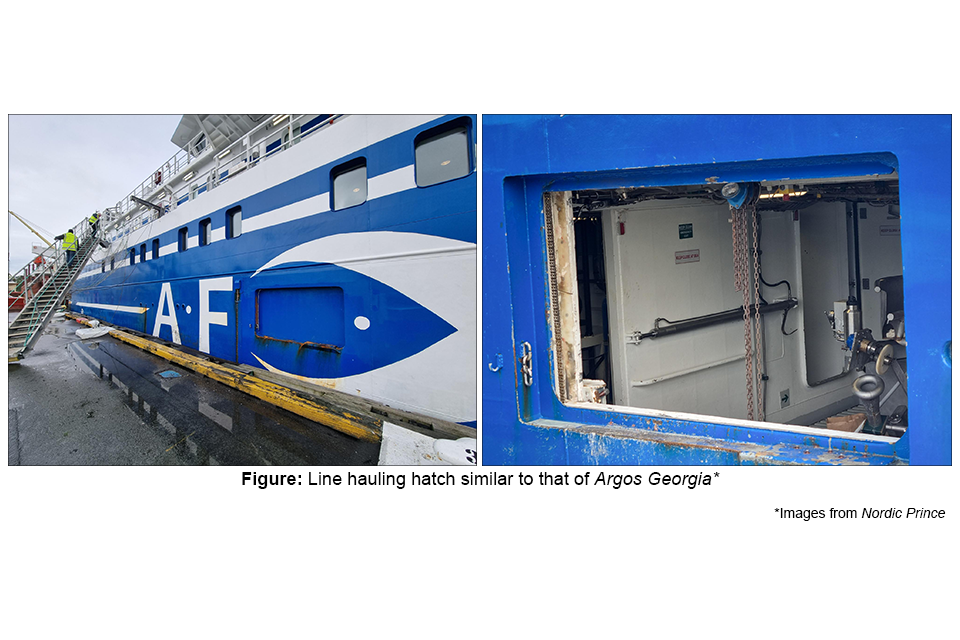
Argos Georgia was on passage to fishing grounds in rough seas near the island of South Georgia. At about 1300 on 22 July, the line hauling hatch (see figure) set in the main deck starboard side of the hull opened uncommanded. Water poured into the line hauling room and flooding progressed through the main deck compartments via weathertight doors that had been left open. The floodwater probably damaged door remote closing systems and impeded the crew’s attempts to manually shut weathertight doors. Argos Georgia soon took up an extreme list to starboard.
Crew members contacted friends on other longline fishing vessels via the WhatsApp messaging service to ask for help. Soon after, the general alarm was sounded and crew mustered on the bridge to don their immersion suits.
In the Falkland Islands, the maritime SAR authority had been made aware of the WhatsApp messages and the developing situation on board Argos Georgia but had not received a “Mayday”. By 1530, the vessel’s operator informed the SAR authority that it was declaring distress, and that the crew were preparing to abandon ship.
By 1600, Argos Georgia’s severe list of about 60° to 70° had caused the vessel to lose power, and a sister vessel issued a “Mayday Relay” on its behalf. Soon after, the captain gave the order to abandon ship. The starboard liferaft automatically released due to the list, while the port side liferaft was deployed by crew members. Two crew members were lost at sea while attempting to swim and board a liferaft. Thirteen crew eventually boarded a liferaft but several of its buoyancy tubes were punctured when the liferaft was brought closer to the vessel. They managed to transfer to the second liferaft, which then drifted away. Six other crew members boarded the badly damaged liferaft, which also drifted away. Four crew remained on board the sinking vessel.
Search and rescue aircraft arrived on scene after it became dark. The two liferafts were identified and tracked, while an attempt was made by the SAR helicopter to recover a crew member who was floating face down. The severe environmental conditions and having only 10 minutes’ duration on scene meant the rescue attempt was unsuccessful. At 1900, Argos Georgia capsized and sank.
At about 0530 on the following morning, the first of the SAR vessels arrived on scene and reported winds of 75kts and a 7m to 8m swell. More vessels arrived in the following hours. One crew member was recovered alive from the damaged liferaft, all 13 crew members were recovered alive from the intact liferaft and nine deceased crew were recovered from the water. Four remain missing, presumed dead.
3. Safety lessons
-
The line hauling hatch opened unexpectedly due to the probable failure of the hatch drive mechanism. It was not held in the closed position as the manually operated locking bolts had likely not been applied after the last closure. Internal weathertight doors were open at the time of the accident, and this had become common practice despite the requirement to keep them closed at sea stated in Argos Georgia’s stability information booklet. Review and risk assess how your vessel is operated to make sure operational practices protect your vessel from risk.
-
The line hauling hatch had unexpectedly opened before and its drive mechanism had been modified. Ensure your design equipment is safe and fit for purpose: seek design approval when carrying out changes that could significantly impact your vessel’s safety.
-
Carry out drills to prepare for unexpected events such as flooding. Practising closing watertight flaps and ventilation dampers can buy time in the event of an emergency.
-
The sending of informal distress messages delayed the SAR response by about 2 hours. Never hesitate to issue a “Mayday” in an emergency.
4. Further information
Our accident investigation report is available at: https://www.gov.uk/maib-reports/foundering-of-the-fishing-vessel-argos-georgia-with-the-loss-of-13-lives
Extract from The United Kingdom Merchant Shipping (Accident Reporting and Investigation) Regulations 2026 – Regulation 5:
The sole objective of a safety investigation into an accident under these Regulations is the prevention of future accidents through the ascertainment of its causes and circumstances. It is not the purpose of such an investigation to determine liability nor, except so far as is necessary to achieve its objective, to apportion blame.
Note:
This safety flyer is not written with litigation in mind and, pursuant to Regulation 19(1) of The Merchant Shipping (Accident Reporting and Investigation) Regulations 2026, shall be inadmissible in any judicial proceedings concerning liability unless the Chief Inspector of Marine Accidents or a court of law determine otherwise.
Marine Accident Investigation Branch
First Floor, Spring Place
105 Commercial Road
Southampton
SO15 1GH
Email iso@maib.gov.uk
Enquiries during office hours +44 (0)23 8039 5500