
Safety flyer to the fishing industry – Jacoba
Published 25 June 2026

© Crown copyright 2026
This publication is licensed under the terms of the Open Government Licence v3.0 except where otherwise stated. To view this licence, visit nationalarchives.gov.uk/doc/open-government-licence/version/3 or write to the Information Policy Team, The National Archives, Kew, London TW9 4DU, or email: psi@nationalarchives.gov.uk.
Where we have identified any third party copyright information you will need to obtain permission from the copyright holders concerned.
This publication is available at https://www.gov.uk/government/publications/are-your-crew-familiarised-with-the-vessel-and-its-hazards/safety-flyer-to-the-fishing-industry-jacoba
1. Summary
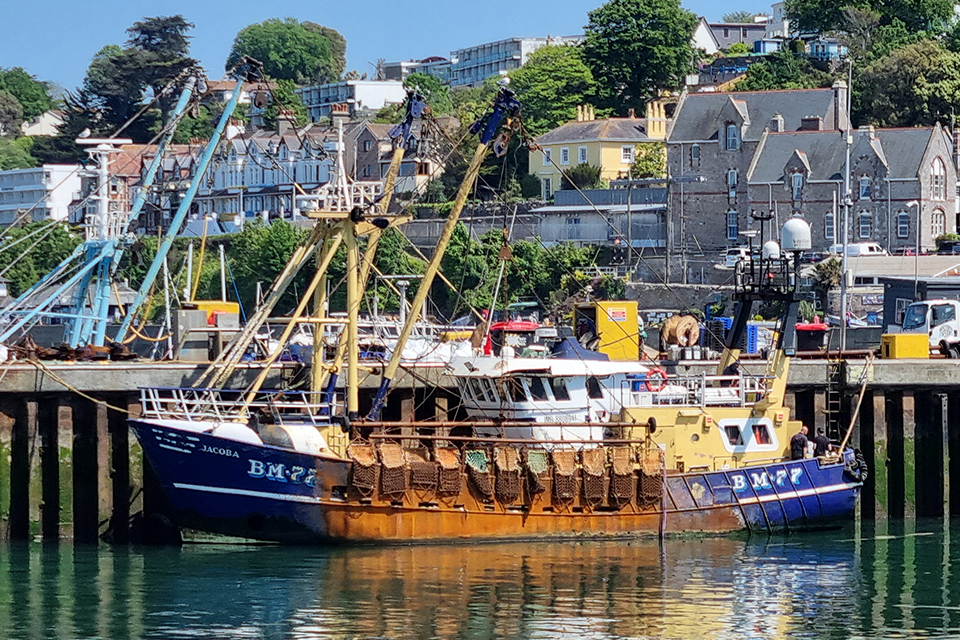
Serious injury to a crew member on board the scallop dredger Jacoba (BM77), 29 nautical miles south-south-east of Beachy Head, England on 10 May 2025.
2. Narrative
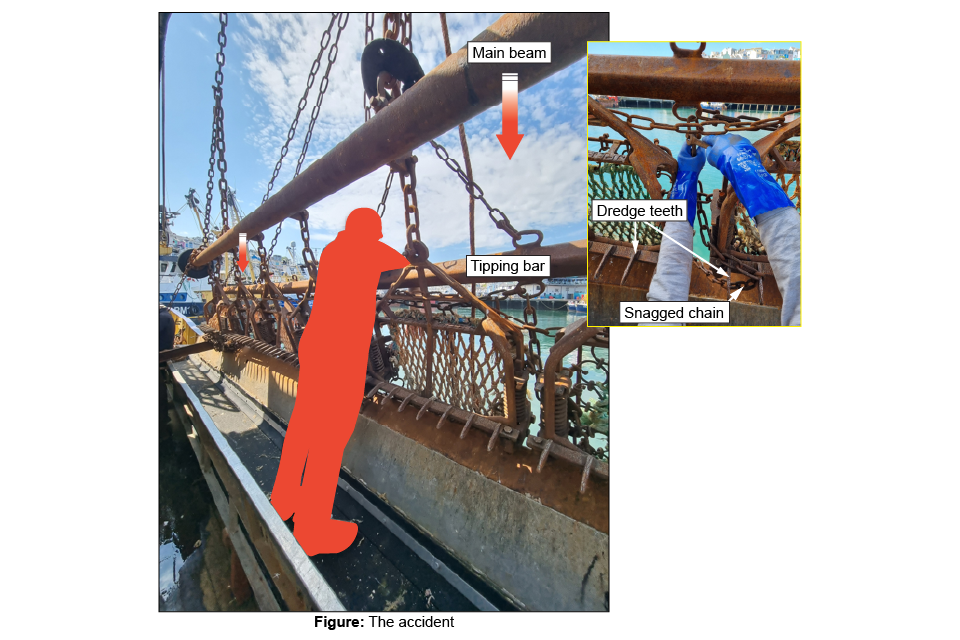
On 10 May 2025, a deckhand on the UK registered fishing vessel Jacoba was seriously injured while the vessel was dredging for scallops in the English Channel. The deckhand had been attempting to free a snagged dredge bag chain from the dredge teeth when recovering the dredges and was standing on the conveyor, positioned beneath the port side main beam. The mate then operated the winch from the wheelhouse and lowered the main beam, which struck the deckhand and crushed them against the tipping bar (see figure). The deckhand suffered multiple serious injuries and was evacuated to hospital by helicopter.
The investigation found that the accident happened because the main beam was lowered while a deckhand was positioned beneath suspended gear. The absence of documented procedures for dealing with snagged dredging gear and an incomplete understanding of the vessel’s risk assessment meant that the risks associated with this task were not fully appreciated. Unsafe working practices were therefore able to develop during routine operations.
Although some of Jacoba’s crew had previously served on commercial ships they had limited experience of fishing vessels. The absence of effective crew familiarisation combined with a lack of training specific to fishing vessels meant that the hazards of working on a scallop dredger were not fully understood. This increased reliance on informal working practices and created conditions for unsafe conduct during routine deck operations.
3. Safety lessons
-
Fishing vessels present a range of hazards specific to the fishing method and vessel layout. Experience gained on commercial ships or other fishing vessels with a different fishing method does not necessarily prepare crew for the unique hazards of a particular vessel. Thorough, vessel-specific familiarisation builds on the foundations set out in the required basic health and safety training[footnote 1] and ensures crew members understand and are prepared for the operational risks on their vessel, particularly those involving fishing gear and lifting equipment.
-
Owners and skippers should ensure all crew receive mandatory training and that on board familiarisation includes clear explanation of hazardous operations, safe working positions and agreed responses to regularly encountered problems such as snagged or fouled gear. Structured familiarisation and training specific to a vessel and its fishing method prevent informal practices or assumptions becoming accepted as routine practice, reducing the likelihood of unsafe actions that put crew at risk.
4. Further information
Our accident investigation report is available at: https://www.gov.uk/maib-reports/serious-injury-to-a-crew-member-on-board-the-scallop-dredger-jacoba-bm77
Extract from The United Kingdom Merchant Shipping (Accident Reporting and Investigation) Regulations 2026 – Regulation 5:
The sole objective of a safety investigation into an accident under these Regulations is the prevention of future accidents through the ascertainment of its causes and circumstances. It is not the purpose of such an investigation to determine liability nor, except so far as is necessary to achieve its objective, to apportion blame.
Note:
This safety flyer is not written with litigation in mind and, pursuant to Regulation 19(1) of The Merchant Shipping (Accident Reporting and Investigation) Regulations 2026, shall be inadmissible in any judicial proceedings concerning liability unless the Chief Inspector of Marine Accidents or a court of law determine otherwise.
Marine Accident Investigation Branch
First Floor, Spring Place
105 Commercial Road
Southampton
SO15 1GH
Email iso@maib.gov.uk
Enquiries during office hours +44 (0)23 8039 5500
-
Marine Guidance Note 411 (M+F) – Training and Certification Requirements for the Crew of Fishing Vessels and their Applicability to Small Commercial Vessels and Large Yachts. ↩