
Safety flyer to the fishing industry – Opportune
Published 29 January 2026

© Crown copyright 2026
This publication is licensed under the terms of the Open Government Licence v3.0 except where otherwise stated. To view this licence, visit nationalarchives.gov.uk/doc/open-government-licence/version/3 or write to the Information Policy Team, The National Archives, Kew, London TW9 4DU, or email: psi@nationalarchives.gov.uk.
Where we have identified any third party copyright information you will need to obtain permission from the copyright holders concerned.
This publication is available at https://www.gov.uk/government/publications/are-you-prepared-for-a-flood/safety-flyer-to-the-fishing-industry-opportune
1. Summary
Flooding and foundering of the stern trawler Opportune (LK 209) approximately 36 nautical miles east of Lerwick, Shetland Islands, Scotland on 24 March 2024.
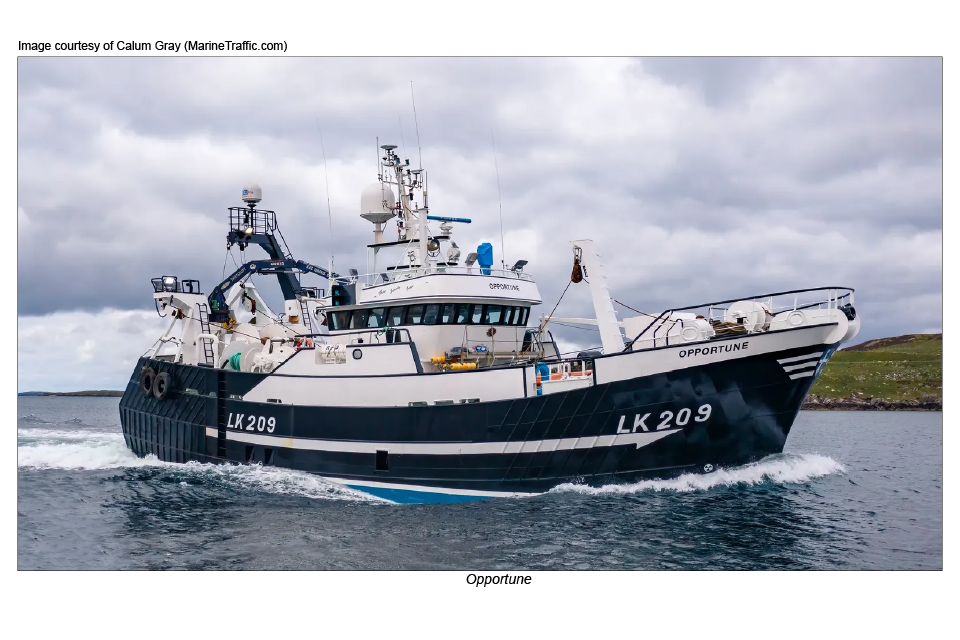
Image courtesy of Calum Gray (MarineTraffic.com)
2. Narrative
At 0530 on 24 March 2024, the UK registered stern trawler Opportune sank 36 nautical miles east of Lerwick, Shetland Islands. Scotland. The loss resulted from a flood in the engine room that could not be brought under control. Once the situation became untenable the eight crew abandoned the vessel, and it foundered shortly afterwards. The crew were all rescued unharmed.
The investigation could not identify with certainty the source of the flood, but the most likely cause was failure of the vessel’s seawater pipework, some of which might have been in place since the vessel was built in 1998. The flood could not be contained because the crew were unable to enter the engine room and start its bilge pumps, nor were they able to close the sea inlet valves. Faced with a rapidly sinking vessel, Opportune’s skipper raised the alarm and the crew abandoned ship to the liferafts in good time. UK and Norwegian coastguard helicopters later rescued the uninjured crew.
3. Safety lessons
-
Raise the alarm immediately if your vessel suffers a flood. Opportune’s skipper swiftly made a “Mayday” call on very high frequency (VHF) radio and operated the digital selective calling (DSC) distress alert to inform the authorities and other ships that the vessel was sinking. The skipper also activated Opportune’s emergency position indicating radio beacon (EPIRB). This meant that the authorities were quickly aware of the vessel’s distress and its location despite Opportune losing power a few minutes later. It also ensured that the coastguard, who did not hear all of the skipper’s voice call, were able to dispatch a lifeboat and helicopters to quickly locate and rescue the crew.
-
Every fishing vessel should have a pre-planned and well-drilled response to a flood. This should involve everybody on board knowing how to start the bilge pumps and, if necessary, close the engine room sea inlet valves. Opportune’s sea inlet valves, as with many older vessels, were located below the engine room floor plates and had to be operated using portable extension handles. It is therefore important to ensure that these valves are clearly marked and that diagrams showing their location are displayed close to the engine room entrance. Opportune’s bilge pumps could only be started from inside the engine room. The ability to operate pumps remotely means they can still be used even if access to the engine room is lost.
-
Ensure the vessel’s seawater pipework is in good condition. Opportune was 26 years old and it is likely that some of its mild steel pipework had been in place since the vessel was built. Fishing vessel owners need to have a maintenance plan for their vessel’s seawater pipework to ensure that it is routinely inspected and, if necessary, tested. The saltwater environment is very corrosive, and hot dipped galvanised pipework has a limited life, so replacement should be expected over a 20-year vessel operational life.
-
On average, over seven fishing vessels are lost every year due to flooding. Marine Guidance Note 165 (F) – Fishing Vessels: Risk of Flooding advises, among other things, to swiftly investigate bilge alarms; ensure all watertight and weathertight doors are closed when not in use; test your bilge pumps and strainers weekly; open and close the sea inlet valves every month; quickly repair leaking pipes; and test your salvage pumps weekly.
4. Further information
Our accident investigation report is available at: https://www.gov.uk/maib-reports/flooding-and-foundering-of-stern-trawler-opportune-lk-209
Extract from The United Kingdom Merchant Shipping (Accident Reporting and Investigation) Regulations 2012 – Regulation 5:
The sole objective of the investigation of an accident under the Merchant Shipping (Accident Reporting and Investigation) Regulations 2012 shall be the prevention of future accidents through the ascertainment of its causes and circumstances. It shall not be the purpose of an such investigation to determine liability nor, except so far as is necessary to achieve its objective, to apportion blame.
Note:
This safety flyer is not written with litigation in mind and, pursuant to Regulation 14(14) of the Merchant Shipping (Accident Reporting and Investigation) Regulations 2012, shall be inadmissible in any judicial proceedings whose purpose, or one of whose purposes is to attribute or apportion liability or blame.
Marine Accident Investigation Branch
First Floor, Spring Place
105 Commercial Road
Southampton
SO15 1GH
Email iso@maib.gov.uk
Enquiries during office hours +44 (0)23 8039 5500