
Safety flyer to the fishing industry – Odyssey
Published 17 December 2025

© Crown copyright 2025
This publication is licensed under the terms of the Open Government Licence v3.0 except where otherwise stated. To view this licence, visit nationalarchives.gov.uk/doc/open-government-licence/version/3 or write to the Information Policy Team, The National Archives, Kew, London TW9 4DU, or email: psi@nationalarchives.gov.uk.
Where we have identified any third party copyright information you will need to obtain permission from the copyright holders concerned.
This publication is available at https://www.gov.uk/government/publications/are-you-in-control-of-your-fishing-operations/safety-flyer-to-the-fishing-industry-odyssey
1. Summary
Capsize and foundering of the prawn trawler Odyssey (FR 70) in the North Sea, approximately 133 nautical miles south-east of Peterhead, Scotland on 29 October 2024.
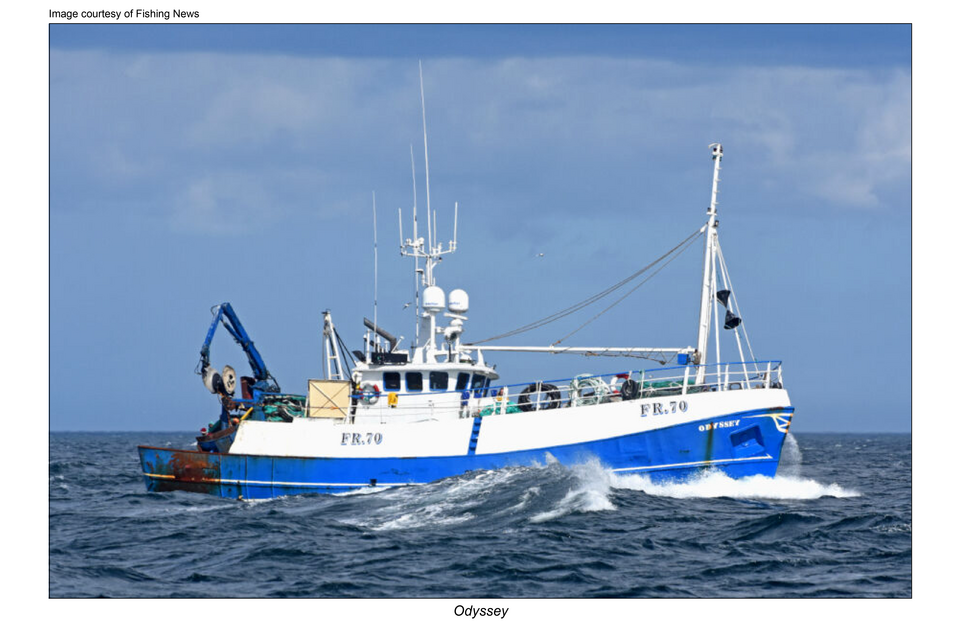
Image courtesy of Fishing News
2. Narrative
At 0530 on 29 October 2024, the twin-rig prawn trawler Odyssey capsized and foundered while in the late stages of recovering nets. The six crew abandoned the vessel into a liferaft and were rescued by a nearby fishing vessel.
At the time of the accident, five crew members were working on deck recovering and emptying the nets into the hopper and the skipper was in the wheelhouse. Noticing that the vessel felt different to normal and was developing a list to starboard, the skipper sent a member of the crew below to investigate. The crew member found that the weathertight shelter deck was flooding rapidly.
Odyssey continued to rapidly list to starboard, leaving the crew with no choice but to abandon the vessel as it capsized.
3. Safety lessons
-
Recovering fishing gear is a vulnerable time for a fishing vessel. Not only is stability reduced as weight is distributed higher on board, but the normal movements of the vessel may disguise the fact that a serious situation is unfolding. In the early stages, Odyssey’s crew mistook the developing list due to flooding as normal vessel movements during the fishing operation.
-
The investigation found it likely that the shelter deck drainage had become blocked. It is critical that shelter decks are kept free of any loose items that might interfere with drainage through tonnage valves or other water freeing arrangements. Even a partial blockage could be enough to allow water to build-up rapidly.
-
The crew regularly left the deck wash pumps running and discharged to the deck. The pumping capacity of a vessel’s deck wash pumps should not be underestimated. At the time of the accident, both pumps were discharging up to 2,100 litres of water per minute onto the shelter deck. This is equivalent to the weight of a large car every minute. The investigation calculated that it would take 16 minutes for the vessel to capsize if the water was prevented from draining away and continued to accumulate at this rate.
-
While the crew had considered flooding scenarios and practised regular drills, the risk posed by the deck wash pumps had not been considered. Skippers should take the time to assess the risk from wash water on their own vessels and ensure that adequate control measures are in place.
-
Odyssey’s shelter deck was regularly left unattended with the deck wash pumps running. Fishing vessel crews should ensure that pumps are switched off before leaving a space unattended, even if water usually drains effectively.
4. Further information
Our accident investigation report is available at: https://www.gov.uk/maib-reports/capsize-and-foundering-of-the-prawn-trawler-odyssey-fr-70
Extract from The United Kingdom Merchant Shipping (Accident Reporting and Investigation) Regulations 2012 – Regulation 5:
The sole objective of the investigation of an accident under the Merchant Shipping (Accident Reporting and Investigation) Regulations 2012 shall be the prevention of future accidents through the ascertainment of its causes and circumstances. It shall not be the purpose of an such investigation to determine liability nor, except so far as is necessary to achieve its objective, to apportion blame.
Note:
This safety flyer is not written with litigation in mind and, pursuant to Regulation 14(14) of the Merchant Shipping (Accident Reporting and Investigation) Regulations 2012, shall be inadmissible in any judicial proceedings whose purpose, or one of whose purposes is to attribute or apportion liability or blame.
Marine Accident Investigation Branch
First Floor, Spring Place
105 Commercial Road
Southampton
SO15 1GH
Email iso@maib.gov.uk
Enquiries during office hours +44 (0)23 8039 5500