Research into appraisal methods for R&D spending. Strengthening value for money assessments for R&D policies
Published 4 November 2026

© Crown copyright 2026
This publication is licensed under the terms of the Open Government Licence v3.0 except where otherwise stated. To view this licence, visit nationalarchives.gov.uk/doc/open-government-licence/version/3 or write to the Information Policy Team, The National Archives, Kew, London TW9 4DU, or email: psi@nationalarchives.gov.uk.
Where we have identified any third party copyright information you will need to obtain permission from the copyright holders concerned.
This publication is available at https://www.gov.uk/government/publications/appraisal-methods-for-research-and-development-spending/research-into-appraisal-methods-for-rd-spending-strengthening-value-for-money-assessments-for-rd-policies
Scope, aims and approach
In 2024, Lord Willetts published an independent review of the Department for Science, Innovation and Technology (DSIT) business case and approvals process, which argued that the Green Book “is not designed for science, innovation and technology programmes”. Willetts recommended that DSIT develop supplementary guidance to sit alongside the refreshed Green Book and help “interpret and apply the generic principles of the Green Book” in the R&D context.
To inform this supplementary guidance, DSIT commissioned SQW in partnership with the Innovation Research Caucus, Geoff White, Jonathan Blanchard Smith at SAMI Consulting and Jonathan Cook in December 2025 to undertake research into appraisal methods for R&D policy. This assignment included exploring how the assessment of Value for Money (VfM) could be strengthened in business cases for R&D policies, particularly where benefits are unmonetisable, unquantifiable, uncertain, intangible, diffuse, and long-term.
In this context, this report presents a suggested VfM framework for R&D policies which DSIT may wish to consider in developing the supplementary guidance. The framework provides a structured approach to integrating monetised, quantified and/or qualitative evidence in the business case and making a balanced judgement about the VfM of R&D proposals. By encouraging practitioners to justify their VfM assessment against a set of criteria and present supporting evidence with an assessment of the strength of that evidence, the rubric provides a more transparent basis for decision-makers to review and (where necessary) challenge the assessment. It also allows all elements of VfM to be assessed succinctly and consistently in one place, and ensures elements such as risk and uncertainty are explicitly covered.
In considering this framework, it is important to note that:
- It is designed to help assess the VfM of shortlisted options and present the preferred option to decision-makers within a business case. Its primary purpose is not to compare between different business cases. However, over time as case history accumulates, it may become possible to do this.
-
It is aligned with the Green Book’s definition of VfM and shows how its generic principles can be operationalised in the R&D context. Where viable, soundly based and robust benefit cost ratios (BCRs) should always be presented. However, in line with the revised Green Book, the framework provides a more holistic assessment of VfM. It can integrate a BCR where available (including where this is partial and/or has limitations) or work in the absence of a BCR. The framework may be particularly useful for R&D policies where benefits are unmonetisable, unquantifiable, uncertain, intangible and long-term and a BCR is not viable.
- It is envisaged that the rubric will be presented as a concise and consistent summary table within the business case, e.g. a one page table akin to Figure 2 below. In order to provide the holistic assessment of VfM the rubric will need to draw on all 5 cases.
- The suggested approach has been informed by a high level review of alternative approaches to VfM in the literature, [footnote 1] [footnote 2] research undertaken for the wider study, and consultations with individuals at DSIT, HMT, UKRI, Innovate UK, Office for Life Sciences, MOD, and DESNZ.[footnote 1], [footnote 2] , [footnote 3]
- The rubrics approach using the ‘4Es’ also aligns with VfM guidance from the Cabinet Office. [footnote 4] Rubrics are increasingly applied in evaluation, and feature as a new and innovative approach to VfM in DSIT’s evaluation strategy. Applying rubrics in VfM appraisals is an innovative way forward, and we found a small number of examples where this approach had been piloted in the appraisal context.
If implemented, this approach to VfM may also require a change in mindset and culture at all levels, from junior analysts developing or appraising business cases through to senior decision-makers. The rubric provides a framework through which uncertainties and risks can be consistently presented in the VfM assessment and decision-making process, alongside describing the potential implications of these for VfM, and providing assurance that they have been thought through and will be monitored and managed effectively. It also means accepting that, in some cases, a BCR is just not viable and a robust VfM assessment can still be undertaken using the rubric and by considering non-quantified factors. The VfM rubric also provides robust and transparent foundations for monitoring and evaluation (M&E) activities, informing what evidence will be needed to assess VfM thereafter.
Existing Green Book guidance and challenges in assessing VfM for R&D policies
HMT makes clear that VfM should not be appraised by a “single summary metric” like the BCR but by a “balanced judgement about the optimal use of public resources to achieve the objectives of a proposal”.[footnote 5][footnote 6] As set out in the new Green Book, this judgement should consider:
- performance against objectives and critical success factors
- monetisable and unmonetisable costs and benefits to society
- impact on public sector finances
- distribution of benefits among social groups and places
- inherent risk and uncertainty in the proposal affecting chances of success or failure[footnote 7]
HMT advises on the ways in which monetary values can be given to a wide range of costs and benefits, but it acknowledges that it may not always be possible to monetise, in which case benefits/costs should be quantified wherever possible. It advises cost benefit analysis where benefits can be monetised, or cost effectiveness analysis where benefits can be quantified only. If quantification is not possible, benefits can be described qualitatively. This broadens the basis of decision-making and is helpful for R&D policies. However, there is limited further guidance on how to structure and assess evidence in the appraisal of shortlisted options (especially where this is heavily reliant on qualitative evidence) and how to make transparent VfM judgements in this context.
Table 1 sets out key factors to consider in VfM appraisal (sourced from the Green Book’s definition of VfM) and how the distinctive features of R&D policies can present challenges when attempting to undertake an appraisal against these factors.[footnote 8]
Table 1: Critical factors in appraising VfM and issues for R&D proposals
| Green Book definition of VfM | Common R&D appraisal issues |
|---|---|
| Factor 1: Effectiveness of a proposal in achieving its objectives | R&D pathways to impact can be long, complex, and interdependent, in some cases making it difficult to specify SMART objectives (although these are still necessary), and understand how planned activities will address these, uncertainties and risks to achieving objectives, and the extent to which attribution is plausible. |
| Factor 2: Costs and benefits of the proposal, both non-monetised and monetised | Many R&D benefits can be difficult to quantify or monetise. They can be intangible, diffuse, long-term, non-linear, and characterised by high uncertainty, interdependencies, spillovers and feedback loops. This presents challenges for assessing attribution and comparing costs to monetised benefits in a BCR. Attempts to ‘force’ monetisation can result in spurious or misleading precision, driven by chains of assumptions underpinned by (in some instances) variable evidence. Narratives in business cases would benefit from greater coherence, structure and transparency, especially regarding underpinning evidence, assumptions, and uncertainties. |
| Factor 3: Impact on public sector finances | R&D proposals are likely to involve high front-loaded and potentially extended public expenditure, with costs and risks incurred long before benefits begin to materialise or other sources of finance are induced. This needs to be carefully managed in order to stay within budget allocations. R&D investments encounter sunk costs and irreversible investments. R&D policies may also need to consider innovative ways to use the investment to gain a return. |
| Factor 4: Distribution of costs and benefits across social groups and places (where relevant) | With the Green Book’s new emphasis on ‘place’, it will be necessary to ensure that all groups and places can engage in and benefit from R&D activities. The distribution of R&D outcomes, however, is difficult to assess, particularly as it may not align with the location of R&D activities. Business cases need to consider how this can be credibly assessed. |
| Factor 5: The risks and uncertainties that affect the degree of success in achieving objectives and anticipated costs and benefits | There is often a high degree of inherent risk and uncertainty regarding many R&D-related variables, especially where there is transformational potential. These can be difficult to articulate in business cases and this may leave decision makers without a clear understanding of the uncertainties and risks (upside and downside), and the implications for the likelihood or scale of potential outcomes, impacts and public finance exposure. |
Source: SQW consortium, informed by the Green Book (2026) Box 1 and scoping consultations for this study
Suggested approach to VfM assessments
The suggested VfM rubrics framework for R&D policies comprises 2 core elements:
-
Criteria: this refers to the aspects of performance against which the ‘value’ of an intervention will be assessed, and should focus on those that matter most. The criteria are grounded in the Green Book’s VfM factors (set out in Table 1) and the 4Es approach.[footnote 9] These provide a well-established and credible foundation for the key issues that decision-makers should consider. To fully capture the aspects of ‘value’ that are particularly significant in a R&D context, the proposed framework also supplements the 4Es with 2 criteria:
- the strategic value of a proposal in aligning with national priorities and promoting transformational potential (which is critical in making the case for R&D)
- the robustness of a proposal to risk and uncertainty (which aligns with the Green Book)
-
Performance standards: For each criterion, the shortlisted options[footnote 10] should be appraised against a set of ‘performance standards’. These are ‘levels’ of anticipated performance, and distinguish between poor, adequate, good and excellent. Each rating should be supported by a brief narrative to explain the reasons for and justify the assessment, provide supporting evidence and assess the strength of that evidence (high, moderate or low).
The key reasons for suggesting this approach for R&D appraisal are outlined in Figure 1, alongside potential challenges in implementing it.
Figure 1: Advantages and challenges of the rubrics approach in R&D appraisal
Advantages of the rubrics approach in R&D appraisal
- It is consistent with the Green Book (2026) definition of VfM and the critical factors that HMT identifies as central to VfM appraisal (see mapping in Table 2 below).
- It makes the criteria of VfM explicit and invites the use of appropriate evidence for each criterion, rather than ‘collapsing’ them into a composite score. This enables decision-makers to understand the contribution of each to the overall VfM assessment, and see at a glance where a business case is relatively stronger or weaker.
- It provides a more rounded, transparent and structured way of assessing value. It supports a wider view than ‘just’ monetisation, and provides a more robust structure for qualitative reasoning. This is crucial to ensure that judgements about harder-to-quantify aspects of value are made explicit, applied consistently and communicated clearly to decision-makers.
- It draws on and integrates monetised, non-monetised and qualitative evidence. Where a BCR or Cost Effectiveness Analysis (CEA) is available, these can be incorporated into the assessment. However, it can also make use of non-monetised and qualitative evidence alongside or in the absence of a BCR/CEA. The framework can also incorporate evidence from other appraisal tools and techniques, including those recommended in the Green Book.
- Providing supporting evidence and assessing the strength of that evidence helps to inform the degree of confidence in judgements made.
- It recognises that while VfM factors apply across the R&D process, their relative weight and evidential demands differ at various points, depending on where a proposal ‘sits’ in the R&D process (from basic research through to commercialisation and scaling). The framework accommodates this variation rather than imposing a uniform standard or VfM threshold across contexts.
- It provides a basis for subsequent M&E by making criteria, performance standards and evidence requirements explicit from the outset. This helps to embed M&E activities early, strengthen the connection between appraisal and later stages of the policy cycle, and support an iterative assessment of VfM during implementation.
Challenges associated with the rubrics approach in R&D appraisal
- There may be concerns about the level of subjectivity required in implementing the framework. However, the rubric provides a transparent and consistent basis for those judgements, especially when comparing options within a business case. It also requires supporting evidence to be provided to underpin judgements. If the supporting evidence is not robust, this should be flushed out by using the rubric. Arguably all VfM assessments involve some degree of subjective judgement, including when developing assumptions to underpin a BCR and in the choices of key output or outcome metrics to focus on.
- Ideally the design and implementation of the rubric should involve stakeholder engagement. This will require sufficient time, planning and resource.
- Practitioners may be reluctant to assess their proposal as ‘poor’ or ‘adequate’, especially for the preferred option (although this may be more likely for other options in a business case). However, the rubrics will challenge practitioners to consider VfM from different angles, justify their assessment against each criteria, and present supporting evidence with an assessment of the strength of that evidence. It should also prompt practitioners to consider weaknesses and how these could be addressed to optimise value. This then provides a more transparent basis for decision-makers to review and (where necessary) challenge the assessment.
- Practitioners may deem the rubrics too complex and time consuming to implement. However, given its strong alignment with the Green Book’s definition of VfM and the importance of strategic value in making the case for R&D interventions, we argue that practitioners should be considering these criteria as part of VfM assessments anyway. The rubric provides a more transparent and structured approach to this. As we discuss below, the assessment could be scaled up/down depending on the complexity of the proposal and the availability of a BCR that appropriately reflects the proposed intervention. Training may be required on the effective design and implementation of the suggested framework.
- There is a risk that the approach focuses appraiser attention on the ‘easier’ parts of the appraisal – e.g. economy and output efficiency - rather than the more critical overall effectiveness and outcome efficiency as captured by BCRs and CEA. However, below we emphasise that all components should be assessed as part of a more rounded assessment of VfM, even if some more difficult than others.
- Decision-makers may not be willing to accept this as a new approach. It would need socialising with decision-makers, and a degree of change in processes and potentially culture. However, the rubrics approach draws on widely recognised approaches in government for assessing VfM, notably the ‘4Es’, bringing credibility to the approach. The results can also be presented in a concise table (see Figure 2 below) which should provide greater structure, consistency and transparency for decision-making (compared to a long narrative).
Source: SQW consortium
How to implement the framework
The suggested VfM rubric framework for R&D policies – and proposed layout – is summarised in Figure 2. The paragraphs that follow provide guidance on how the framework could be applied in R&D business cases.[footnote 11]
Figure 2: Proposed VfM rubric framework for R&D policies
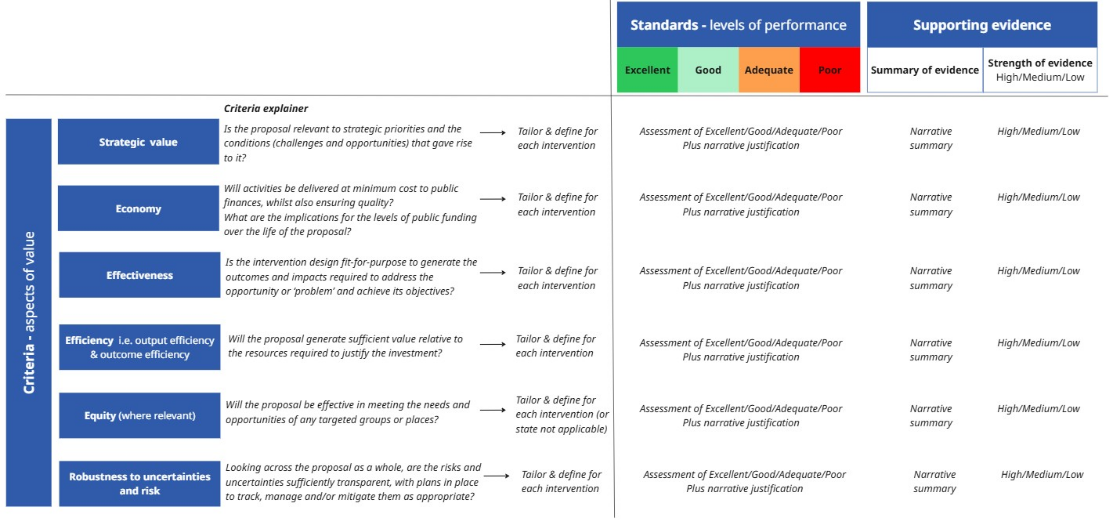
An image showing the proposed VfM rubric framework for R&D policies, setting out criteria (aspects of value, including Strategic Value, Economy, Effectiveness, Efficiency, Equity, and Robustness to uncertainty and risk), performance standards (an assessment of excellent, good, adequate, or poor with space for justifying narrative), and space for a summary of supporting evidence and an assessment of the strength of that evidence for each.
Source: SQW consortium; structure of rubric adapted from OPM/King approach
Developing VfM criteria
The VfM framework suggests 6 broad criteria:
- strategic value
- economy
- effectiveness
- efficiency (split into output efficiency and outcome efficiency)
- equity
- robustness to uncertainty and risks
These are defined in Column A of Figure 2 above.
Table 2 below provides a simplified summary of how the criteria align with the Green Book’s VfM definition. Variants on the criteria were considered but discounted. Firstly, we considered removing strategic value. However, given the nature of R&D interventions and the importance of strategic value in making the case for R&D investments, we argue this should be retained. Secondly, we considered focusing on efficiency and risks/uncertainties only, but this loses the integrity of the 4Es approach and alignment with the Green Book VfM definition.
Table 2: Alignment between the Green Book’s VfM factors and criteria
| Green Book VfM definition | Suggested criteria for the VfM rubric framework |
|---|---|
| Factor 1: Effectiveness of a proposal in achieving its objective |
Strategic value Effectiveness |
| Factor 2: Costs and benefits of the proposal, both non-monetised and monetised |
Efficiency: (i) output efficiency, i.e. the relationship between costs and outputs (ii) outcome efficiency, i.e. the relationship between costs and outcomes/impacts. |
| Factor 3: Impact on public sector finances | Economy |
| Factor 4: Distribution of costs and benefits across social groups and places (where relevant) | Equity |
| Factor 5: The risks and uncertainties that affect the degree of success in achieving objectives and anticipated costs and benefits | Robustness to uncertainty and risks |
Source: adapted from HMT and Cabinet Office
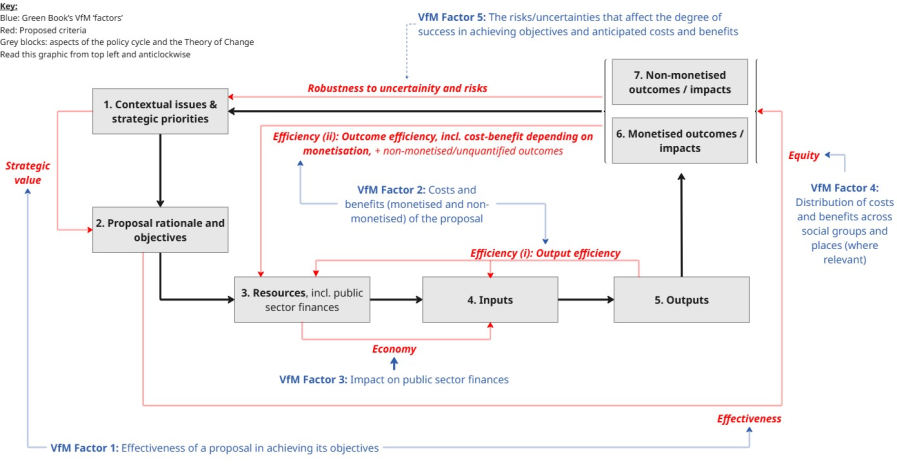
To demonstrate how the criteria also align with the policy cycle, Figure 3 then maps the suggested criteria (in red) and the Green Book’s VfM ‘factors’ (in blue) against inputs, outputs, outcomes, etc.[footnote 12]
Figure 3: Alignment of criteria with the Green Book’s VfM factors and the policy cycle
Source: adapted from HMT and Cabinet Office
Whilst the criteria provide a consistent approach to VfM assessments across business cases,[footnote 13] in practice the rubric should articulate what the criteria mean in the context of each R&D policy and its objectives on a case-by-case basis (see column B in Figure 2 above). The key question to keep in mind when appraising ‘value’ for each policy is “what really matters for a policy’s performance and VfM?” The criteria should:
- be tailored to and align closely with the intervention’s objectives and context, its Theory of Change, expectations around how value will be created by the intervention, key success factors and risks
- be as concise and clear as possible (sub-criteria can be used where necessary)
- be developed through a collaborative process (with policy teams, analysis, and wider stakeholders) to ensure common agreement on what matters and how VfM will be judged from the outset. It will also need to be an interdisciplinary endeavour, combining expertise across analyst and policy professionals.
Table 3 outlines the proposed criteria and points for practitioners to consider specifically in the R&D context when tailoring criteria for each policy. Please turn to the Green Book for more generic guidance on how to assess cost, benefits, cost-effectiveness, etc.
Table 3: Points to consider when developing tailored criteria for R&D policies
| Criteria | What do the criteria mean in the R&D context? Points to consider when designing tailored criteria |
|---|---|
|
Strategic value Is the proposal relevant to strategic priorities and the conditions (challenges and opportunities) that gave rise to it? |
• Alignment with, and potential contribution to, strategic priorities and societal challenges. • Clarity on the specific problem or opportunity, including the underpinning context and causes. • This can include the scale/magnitude of the opportunity or problem (e.g. ‘size of the prize’) and how the proposal is expected to address the underpinning the rationale (and its causes). • Strategic fit and coherence with existing ecosystems, including wider infrastructures, programmes, actors, investments, etc, particularly given the systemic interdependencies that are often critical for R&D policies. |
|
Economy Will activities be delivered at minimum cost to public finances, whilst also ensuring quality? What are the implications for the levels of public funding over the life of the proposal? |
• Resources required to deliver the proposal (e.g. including R&D facilities, equipment, staff, and external expertise), identified at an appropriate level of detail and costed realistically, with regard to both price and quality. This should include assessment of the prevailing market conditions that might affect supply or prices and in turn influence economy, and ideally be benchmarking against comparable R&D interventions. • Clarity on the availability of required specialist R&D skills, capacity, technical input, facilities, and equipment. • Whether the front-loaded nature of R&D investment has been explicitly addressed, with a clear account of how costs are phased, and how affordability is maintained across any variation. • Whether the intervention is directly levering and incentivising private investment in R&D, or is expecting to induce private investment thereafter. |
|
Effectiveness Is the intervention design fit-for-purpose to generate the outcomes and impacts required to address the opportunity or ‘problem’ and achieve its objectives? |
• Clarity on plausible contribution of the intervention against intended outcomes/impacts and objectives, given the anticipated causal pathways and the critical assumptions that underpin them. This should ensure that appropriate leading indicators are in place and will be monitored to assess if the intervention is on track (and provide early warning signals if not), especially for R&D interventions where impact pathways are uncertain and long-term. This should also consider spillovers and potential feedback loops (positive and negative). • Clarity on additionality and deadweight (plus potential displacement and substitution where relevant). • Whether systemic interdependencies are recognised and plans/mechanisms are in place to facilitate these. • Whether outcomes and impacts are likely to be sustained beyond the funding period. • Whether the R&D is likely to be robust to future needs, and whether the proposal is likely to be robust and effective in different potential future scenarios. Considering future contexts is particularly important when looking at R&D to deliver cutting edge technologies. |
|
Efficiency: i) output efficiency ii) outcome efficiency Will the proposal generate sufficient value relative to the resources required to justify the investment? |
• This could be split into: (i) Output efficiency: This refers to the ratio of resources/inputs to outputs, and should use unit cost ratios for key R&D outputs where appropriate, e.g., cost per project, cost per PhD, cost per patent, cost per clinical trial. This can be useful in the context of R&D appraisal (where outputs are easier to anticipate and pathways to outcomes/impacts are complex and long term, etc.) and to compare shortlisted options. However, it should be used with caution to avoid perverse incentives for delivery, and may not be possible for all R&D policies where outcomes are more intangible; (ii) Outcome efficiency: Where monetisation of benefits is feasible, a BCR should be presented (e.g., in later-stage R&D proposals). Break-even analysis (BEA) can also determine the minimum monetised outcomes required to break even, alongside consideration of the extent to which that is likely. Where monetisation is not feasible, CEA could be used, i.e. the ratio of quantifiable outcomes to resources/inputs. • In all cases, a qualitative assessment should also be made of whether the ‘value’ is sufficient to justify the proposal over the alternative options – including the ‘do nothing’ or ‘do the minimum’ option. This may draw, for example, on the strategic value above. • There is likely to be a hierarchy here: if there is robust evidence on outcome efficiency, this would take priority over output efficiency. The ability to assess this may vary at different points in time. Where R&D impacts are uncertain and take a long time to mature (making BCR difficult in the business case), the rubric allows for more robust/viable assessments of efficiency ratios, CEA and/or BEA to be incorporated into the VfM assessment. |
|
Equity (where relevant) Will the proposal be effective in meeting the needs and opportunities of any targeted groups or places? |
• The extent to which R&D investment, activity and outcomes are distributed across the UK, including places outside London and the South East, as well as different groups and sectors. This could consider the extent to which equitable participation in, and benefit from, R&D activity is supported across gender, ethnicity and other protected characteristics. For some proposals, equity may not be relevant to the objectives – in which case, this may be assessed as ‘not applicable’. |
|
Robustness to risks and uncertainties Looking across the proposal as a whole, are the risks and uncertainties sufficiently transparent, with plans in place to track, manage and/or mitigate them as appropriate? |
• Transparency on which risks and uncertainties matter (most) for impact and VfM, including technical, delivery, market, and wider contextual factors. This will require consideration of upside and downside risks, their likelihood and potential magnitude (including transformational potential), and the implications for VfM. The key consideration here is whether the proposal remains robust in meeting the objectives even if risks materialise. • The credibility of plans in place to monitor, mitigate and/or manage risks in relation to costs and/or benefits. This includes plans to revisit and evidence uncertain assumptions at appropriate intervals to update the VfM assessment if needed. • Clarity on whether the level of uncertainty and risk is acceptable to DSIT and why. This should also reflect on the tolerance for R&D failure (recognising that not all R&D will be a success, and failures can generate valuable learning) and what is deemed ‘acceptable’ or ‘unacceptable’ failure in this context. |
Source: SQW consortium
Developing VfM performance standards
Performance standards provide an agreed and transparent basis for making consistent judgements on the potential performance of each option against each criterion. As set out in Table 4, the framework uses a four-point scale (excellent, good, adequate and poor). As with the criteria, performance standards should be defined and tailored for each policy and context prior to making the assessment, so that the basis for judgement is transparent. They should also be clear on what is expected by what point in time. We do not advise prescribing departmental ‘thresholds’ for each performance standard as R&D interventions will vary hugely.
Table 4: Generic performance standards to assess the proposal against appraisal criteria
| Performance standard | Definition |
|---|---|
| Excellent | The proposal will exceed reasonable expectations, bearing in mind its context and with no need for improvement. |
| Good | The proposal will meet reasonable expectations. Minor improvements may be needed. |
| Adequate | The proposal will meet minimum ‘bottom line’ requirements, but significant improvements will be needed. |
| Poor | The proposal will not fulfil minimum ‘bottom line’ expectations. Major improvements would be needed. |
Source: Adapted from OPM/King (2023)
Undertaking the assessment and populating the framework
Once the criteria and standards are defined for the R&D policy in question, practitioners should take each option and:
- assign a performance rating against each criterion (see column C in Figure 2)
- provide a justification for the rating (also column C in Figure 2)
- provide supporting evidence and assess the strength of that evidence using high, moderate or low.[footnote 14] (see columns D and E in Figure 2)
With regard to the supporting evidence, this could draw (for example) on relevant evaluation evidence that is transferable to the policy and context in question, stakeholder engagement and expert judgement, demand studies, wider evidence and analysis, etc. Whilst the rubric provides a structured and transparent approach to assessing VfM, the quality of the assessment will depend on the rigour with which evidence is gathered, analysed, and interpreted. The level of analytical inputs should be proportionate, especially if being undertaken across the shortlisted options rather than just the preferred option. It should also avoid false precision and be transparent if the evidence base is limited, acknowledging where there are unknowns and/or if key assumptions are uncertain. Practitioners may decide, for example, that a BCR is poor evidence if based on questionable assumptions. In assigning performance ratings, practitioners should also consider:
- (i) which factors are absolutely essential for a proposal to be successful and deliver against the strategic objectives
- (ii) what are the key factors that would stop success, and to what extent are these at high risk of occurring
If any ratings for the preferred option are below ‘good’, assurances should be provided that (for example) further evidence will be gathered or uncertainties will be monitored closely during implementation. It will then be for decision makers to engage with the evidence, and decide if they agree with these ratings.
The framework deliberately does not involve scoring, weighting or aggregating ratings into an overall composite score for each option. This would obscure performance across the criteria and the nuances of each proposal, over-complicate the VfM process, and risk spurious quantification. A proposal may score well on economy but poorly on effectiveness, for example, and it is important that this tension is visible.
The relevance and importance of each criterion and the ease of assessment may differ in practice, depending on the policy and its contextual conditions. This could include stage of the R&D in question (and the risk profile and time horizons),[footnote 15] the level of sector/technology specificity, whether the proposal is mission or challenge-based, or the type of investment (e.g. grants, infrastructure, capabilities). Any extra weight given to particular VfM criteria would need to be transparent and justified.
An overall VfM judgement can be made once an assessment has been completed for each criterion. This should be a reasoned, balanced, and evidence-based conclusion that looks across the rubric as a whole, including the strength of supporting evidence.[footnote 16] To help reach an overall conclusion on VfM, we suggest that as a minimum, the preferred option should score at least ‘adequate’ on all criteria and at least ‘good’ on strategic value and effectiveness. DSIT may choose to raise this bar. If the preferred option scores ‘adequate’ on any criteria, this is likely to warrant further refinement of the proposal before funding is approved and/or appropriate conditions applied to funding agreements (e.g. mandating ‘checkpoint’ reviews, or tranched investment with a pilot before full roll out).
Moving forward
This is a suggested VfM framework that could apply to all R&D proposals. However, it is not intended to be applied rigidly, and there will inevitably be some tailoring of the framework to individual proposals. It may also need iteration as the business case progresses from Strategic Outline Case to Full Business Case. The suggested framework will need piloting and testing across a range of R&D policies, with lessons learned informing refinement over time. Training may be required within DSIT to support implementation of a new framework.
Annex A: Bibliography
Australian Government and Treasury (2025) Cost-Effectiveness Analysis (CEA). Available at: Cost-Effectiveness Analysis (CEA)
Barton, R., Aibinu, A.A., and Oliveros, J. (2019), The Value for Money Concept in Investment Evaluation: Deconstructing its Meaning for Better Decision Making. Project Management Journal, Vol. 50(2), pp.1–16. Available at: https://doi.org/10.1177/8756972819827102
Better Evaluation Knowledge (n.d.) Cost effectiveness analysis. Available at: https://www.betterevaluation.org/methods-approaches/methods/cost-effectiveness-analysis
Better Evaluation Knowledge (2013) Why rubrics are useful in evaluation. Available at: https://www.betterevaluation.org/blog/guest-blog-why-rubrics-are-useful-evaluations
Better Evaluation Knowledge (n.d.) Rubrics. Available at: https://www.betterevaluation.org/methods-approaches/methods/rubrics
Cabinet Office (n.d.) Value for Money Evaluation Task Force Academy. Available at: https://assets.publishing.service.gov.uk/media/67adcab62535b0468badce36/8-etf-evaluation-academy-20-value-for-money-slides.pdf
DCMS (2025) DCMS Monitoring and Evaluation Strategy 2026 to 2031. Available at: https://www.gov.uk/government/publications/dcms-monitoring-and-evaluation-strategy-2026-to-2031/dcms-monitoring-and-evaluation-strategy-2026-to-2031
DFID (2020) DFID’s approach to value for money – guidance for external partners. Available at: https://alnap.org/help-library/resources/dfids-approach-to-value-for-money–guidance-for-external-partners/
DSIT (2024) Independent review of the DSIT business case and approvals process: Final report and recommendations by the Rt Hon Lord Willetts FRS. Available at: https://assets.publishing.service.gov.uk/media/65c5ef3ccc433b0011a90ae9/independent_review_of_the_dsit_business_case_and_approvals_process.pdf
DSIT (2025) DSIT evaluation strategy. Available at: https://www.gov.uk/government/publications/dsit-evaluation-strategy/dsit-evaluation-strategy
DSIT (2025) GCRF value for money assessment. Available at: https://www.gov.uk/government/publications/global-challenges-research-fund-value-for-money-assessment
DSIT (2025) International Science Partnerships Fund (ISPF) Evaluation Framework. Available at: https://assets.publishing.service.gov.uk/media/68234c5b2b7ca0cc347e07c4/4526_ISPF_Evaluation_Framework_report_250513_A2_H2P.pdf
European Investment Bank (2023) The Economic Appraisal of Investment Projects at the EIB. 2nd Edition. Available at: https://www.eib.org/attachments/lucalli/20220169_economic_appraisal_of_investment_projects_en.pdf
Foreign, Commonwealth, and Development Office (2025) Programme Operating Framework. Available at: Programme Operating Framework October 2025
HM Government Analysis Function (2024) An Introductory Guide to Multi-Criteria Decision Analysis (MCDA). Available at: https://analysisfunction.civilservice.gov.uk/policy-store/an-introductory-guide-to-mcda/
HM Treasury (2026) The Green Book: UK Government Guidance on Appraisal. Available at: https://www.gov.uk/government/publications/the-green-book-appraisal-and-evaluation-in-central-government
Infrastructure Australia (2021) Guide to economic appraisal: Technical guide of the Assessment Framework. Available at: https://www.infrastructureaustralia.gov.au/sites/default/files/2021-07/Assessment%20Framework%202021%20Guide%20to%20economic%20appraisal.pdf
Kadom, N., Itri, J.N., Trofimova, A., Otero, H.J., and Horný, M. (2019) Cost-Effectiveness Analysis: An Overview of Key Concepts, Recommendations, Controversies, and Pitfalls. Academic Radiology, Vol. 26(4), pp.534-541. Available at: https://doi.org/10.1016/j.acra.2018.10.014
King, J. and Hurrell, A. (2024), A Guide to Evaluation of Value for Money in UK Public Services. Available at: https://www.julianking.co.nz/wp-content/uploads/2024/08/Verian-Group-Value-for-Money-Guide-August-2024.pdf
King, J. (2024) Value for money and the 5Es: designing a context specific VfM framework. Available at: https://www.julianking.co.nz/wp-content/uploads/2024/11/Value-for-Money-and-the-5Es-Julian-King.pdf
Ley Best, K., Greenfield, V.A., Bond, C.A., Edenfield, N., Hvizda, M., Jackson, J.C., Long, D., and Willcox, J. (2024) Beyond Cost-per-Unit: Economic analysis and metrics in defense decision making. Available at: https://www.rand.org/pubs/research_reports/RRA1802-2.html
Ministry of Defence (2026) JSP 507 Investment Appraisal and Evaluation Part 2: Guidance. Available at: https://assets.publishing.service.gov.uk/media/5a7c3eeae5274a2041cf2b48/JSP507_Part_2_U.pdf
National Audit Office (n.d.) About us. Available at: https://www.nao.org.uk/about-us/
National Audit Office (2022), Audit and Risk Assurance Committee effectiveness tool. Available at: https://www.nao.org.uk/wp-content/uploads/2022/05/Audit-and-risk-assurance-committee-effectiveness-tool.pdf
National Audit Office (2024) Overcoming challenges to managing risks in government: Assessment template. Available at: https://www.nao.org.uk/wp-content/uploads/2023/12/Overcoming-challenges-to-managing-risk-Assessment-template.pdf
Nesta (2013) Standards of evidence: An approach that balances the need for evidence with innovation. Available at: https://media.nesta.org.uk/documents/standards_of_evidence.pdf
OECD (n.d.) Evaluation Criteria. Available at: https://www.oecd.org/en/topics/sub-issues/development-co-operation-evaluation-and-effectiveness/evaluation-criteria.html
Oxford Policy Management and King, J. (2023). Assessing Value for Money: the Oxford Policy Management Approach (second edition). Available at: https://www.opml.co.uk/sites/default/files/2024-06/opm-value-money-vfm-approach-v2-1.pdf
Peterson, H. (2022) Cost–Benefit Analysis (CBA) or the Highway? An Alternative Road to Investigating the Value for Money of International Development Research. European Journal of Development Research. Vol. 35(2), pp.260-280. Available at: https://doi.org/10.1057/s41287-022-00565-7
SQW (2022) Evidence of what works: research and innovation (R&I) and place. Available at: https://www.ukri.org/publications/evidence-of-what-works-research-and-innovation-ri-and-place/
Vandenbulcke, B., Verhaeghe, N., Cruycke, L., Lelie, M., Simoens, S., and Putman, K. (2025) Evaluating the Cost-Effectiveness of Air Pollution Mitigation Strategies: A Systematic Review. International Journal of Environmental Research and Public Health, Vol. 22(6), pp.926. Available at: https://doi.org/10.3390/ijerph22060926
Vega-Gonzalez, L.R., and Saniger, J.M. (2010). Valuation Methodology for Technology Developed at Academic R&D Groups. Journal of Applied Research and Technology. Volume 8. pp.26-43. Available at: https://www.researchgate.net/publication/279588390_Valuation_Methodology_for_Technology_Developed_at_Academic_RD_Groups/link/55a09bf308ae032ef0546132/download?_tp=eyJjb250ZXh0Ijp7ImZpcnN0UGFnZSI6InB1YmxpY2F0aW9uIiwicGFnZSI6InB1YmxpY2F0aW9uIn19
-
Annex A provides a bibliography. This includes existing guidance from UK Government Departments, the National Audit Office, the European Investment Bank, and the European Commission Directorate-General for Research and Innovation, and wider academic and grey literature. ↩ ↩2
-
A wide range of approaches to VfM assessment were reviewed in order to identify the most appropriate framework for R&D appraisal. Others were considered. For example, Multi Criteria Decision Analysis (MCDA) was not adopted, due to the recommendation of the Green Book that this is used in the development of longlists rather than shortlists. Real Options Analysis (ROA) was also considered but was not incorporated as, while it offers a theoretically sound basis, it was not deemed a sufficiently clear fit for the appraisal context in which this framework will operate. ↩ ↩2
-
i.e. a review of alternative appraisal tools, techniques and approaches identified by DSIT (an ‘enhanced’ theory of change, size of the prize, tipping point (break-even) analysis, risk quantification, futures thinking, KPIs and portfolio approaches) and a review of international appraisal frameworks and approaches. ↩
-
The ‘4Es’ are economy, efficiency, effectiveness and equity. It also aligns with the ‘5Es’ which include cost-effectiveness as the fifth ‘E’. See here: https://assets.publishing.service.gov.uk/media/67adcab62535b0468badce36/8-etf-evaluation-academy-20-value-for-money-slides.pdf. The National Audit Office also uses 3Es to assess VfM. See here: About us - National Audit Office. ↩
-
HM Treasury (2026) The Green Book: UK Government Guidance on Appraisal. Available at: The Green Book - GOV.UK (p.4). ↩
-
The Green Book’s supplementary guidance for VfM also states that “Benefit Cost Ratios (BCRs) are important for providing an indication of the benefits and costs of a proposal, but Value for Money is always a judgement that is wider than any BCR” and that “the assessment of VfM needs to take into consideration both the monetised and unmonetisable benefits and costs”. See HM Treasury (2022) Green Book Supplementary Guidance: Value for Money. Available at: Green Book Supplementary Guidance: Value for Money - GOV.UK ↩
-
This study has used the Green Book definition of risk, which is the effect of uncertainty on outcomes, with uncertainty referring to appraisal assumptions that are not fully known. ↩
-
While existing guidance advises on how to address some areas (such as agreeing longer time horizons, applying discount rates, identifying, mitigating, and quantifying uncertainty and risk, and giving monetary values to a wide range of costs and benefits) there is still a need to address challenges specific to R&D. ↩
-
The criteria also align with the Green Book’s ‘Critical Success Factors’, i.e. ensuring the intervention meets its objectives, strategic fit, VfM, capacity and capability, affordability, and achievability. ↩
-
Including ‘do nothing’ or ‘do minimum’. ↩
-
Comprehensive guidance on developing and applying rubrics in an evaluation context is available in the OPM/King documentation, which should be consulted alongside this framework and is not replicated here. See: Oxford Policy Management (2023). Assessing Value for Money: the Oxford Policy Management Approach. Available at: https://www.opml.co.uk/sites/default/files/2024-06/opm-value-money-vfm-approach-v2-1.pdf ↩
-
Note, we opted not to structure the criteria using the Five Case Model due to concerns this would compound issues around the lack of coherence across the Five Cases. Assessing VfM requires looking across the business case as a whole. ↩
-
We do not advise prescribing departmental ‘thresholds’ or generic criteria as R&D interventions will vary hugely. ↩
-
Nesta’s ‘standards of evidence’ is often used in the evaluation context, but could be adapted and applied ex-ante: https://media.nesta.org.uk/documents/standards_of_evidence.pdf. ↩
-
The stage of R&D (i.e. from early research and proof of concept through to demonstration, commercialisation and scaling) may also inform which criteria can be most readily assessed. Appropriate methods, evidence, and level of analytical precision in a VfM assessment will vary depending on where a proposal sits in the R&D process. ↩
-
For instance, if one source of evidence strongly supports the VfM assessments on a criterion, then the performance standard may be good or excellent, but the strength of evidence as moderate because it relies on only one source. In the conclusions, a rounded view should be taken on the criteria by looking at both the performance assessment and strength of evidence. This may then prompt consideration of mitigation and management. ↩