AI Skills for Life and Work: Labour market and skills projections
Published 28 January 2026

© Crown copyright 2026
This publication is licensed under the terms of the Open Government Licence v3.0 except where otherwise stated. To view this licence, visit nationalarchives.gov.uk/doc/open-government-licence/version/3 or write to the Information Policy Team, The National Archives, Kew, London TW9 4DU, or email: psi@nationalarchives.gov.uk.
Where we have identified any third party copyright information you will need to obtain permission from the copyright holders concerned.
This publication is available at https://www.gov.uk/government/publications/ai-skills-for-life-and-work-labour-market-and-skills-projections/ai-skills-for-life-and-work-labour-market-and-skills-projections
This report was authored by Prof Derek Bosworth and Dr Jeisson Cárdenas-Rubio at the Warwick Institute for Employment Research, The University of Warwick
This research was supported by the Department for Science, Innovation and Technology (DSIT) and the R&D Science and Analysis Programme at the Department for Culture, Media and Sport (DCMS). It was developed and produced according to the research team’s hypotheses and methods between November 2023 and March 2025. Any primary research, subsequent findings or recommendations do not represent UK Government views or policy.
1. Executive summary
This report explores how advances in artificial intelligence (AI) may impact labour demand in the UK through 2035. It uses the Working Futures model[footnote 1], developed by the Institute for Employment Research, as a baseline. This model anticipates how the sectoral structure of the economy will evolve between 2020 and 2035 and what this means for employment projections. The study integrates technological trends from patent and vacancy data with these projections to estimate the potential effects of AI on different sectors and occupations.
The baseline Working Futures model research indicates that nearly all the projected 2.5 million job increases from 2020 to 2035 will be in skilled, white-collar, non-manual work. Almost 90% of net employment growth is expected in Professional (Standard Occupation Classification (SOC) Major Group 2) and Associate Professional (Major Group 3) roles. At the same time, Administrative, Secretarial (Major Group 4), and Skilled Trades (Major Group 5) jobs may decline. Mid-level jobs (that is, roles with a few years’ experience but still reporting to senior staff) are also projected to decrease, with modest growth in elementary roles (Major Group 9) and lower-skilled care work. It is important to note that even in occupations where a decline in the number of jobs is projected, replacement demand (that is, the number of openings created by people leaving the labour force) means there will still be job openings.
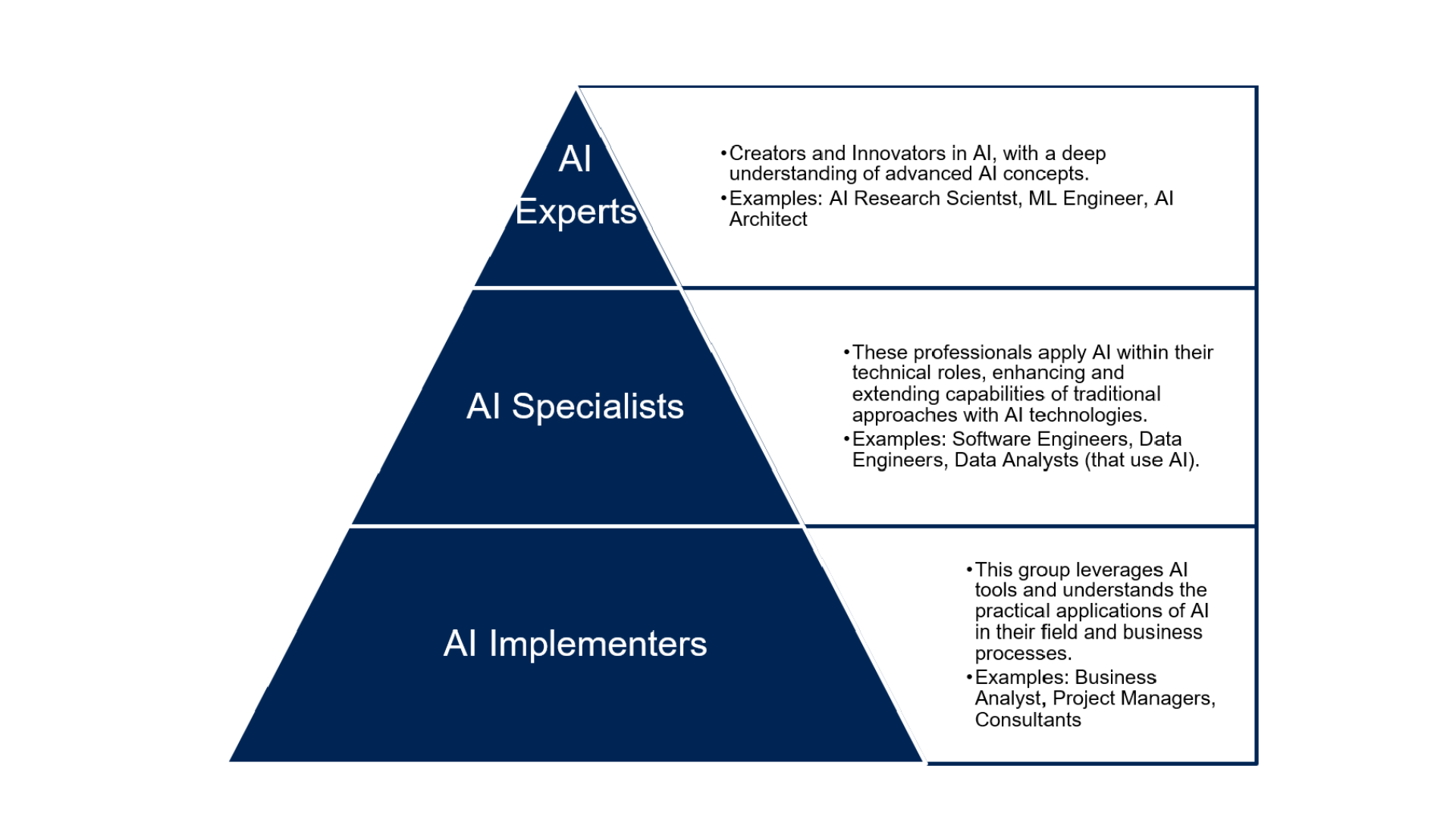
The present study analyses a specific set of AI-related occupations identified through the job vacancy analysis in Work Package 4 (WP4). The study provides detailed projections for these occupations at the four-digit Standard Occupational Classification (SOC) level. These occupations were grouped into three main categories, from smallest to largest: AI Experts, AI Specialists, and AI Implementers:
-
AI Experts: Creators and innovators in AI, with a deep understanding of advanced AI concepts.
-
AI Specialists: Professionals who apply AI within their technical roles, enhancing and extending capabilities of traditional approaches with AI technologies.
-
AI Implementers: This group leverages AI tools and understands the practical applications of AI in their field and business processes.
Building on this baseline, the present study then focuses on adjusting one of the Working Futures scenarios, the Technological Opportunities Scenario (one of four scenarios considered), which allows for both job creation and loss from technology to more directly account for AI impacts. This scenario included effects from a range of technologies like robotics but cannot fully capture recent AI developments.
1.1. Key findings
-
Jobs directly involving AI activities could rise from 158,000 in 2024 to 3.9 million by 2035 according to projections. That is about 12% of the UK workforce, which currently stands at 30.4 million (ONS as of November 2024[footnote 2]).
-
A broader group of 9.7 million people may be in AI-related occupations by 2035, but not all will be directly working with AI. This larger figure represents occupations associated with AI, such as in industries heavily adopting the technologies.
Figure 1.1: Adjusted employment projections by AI-related occupations 2024 – 2035 (thousands)
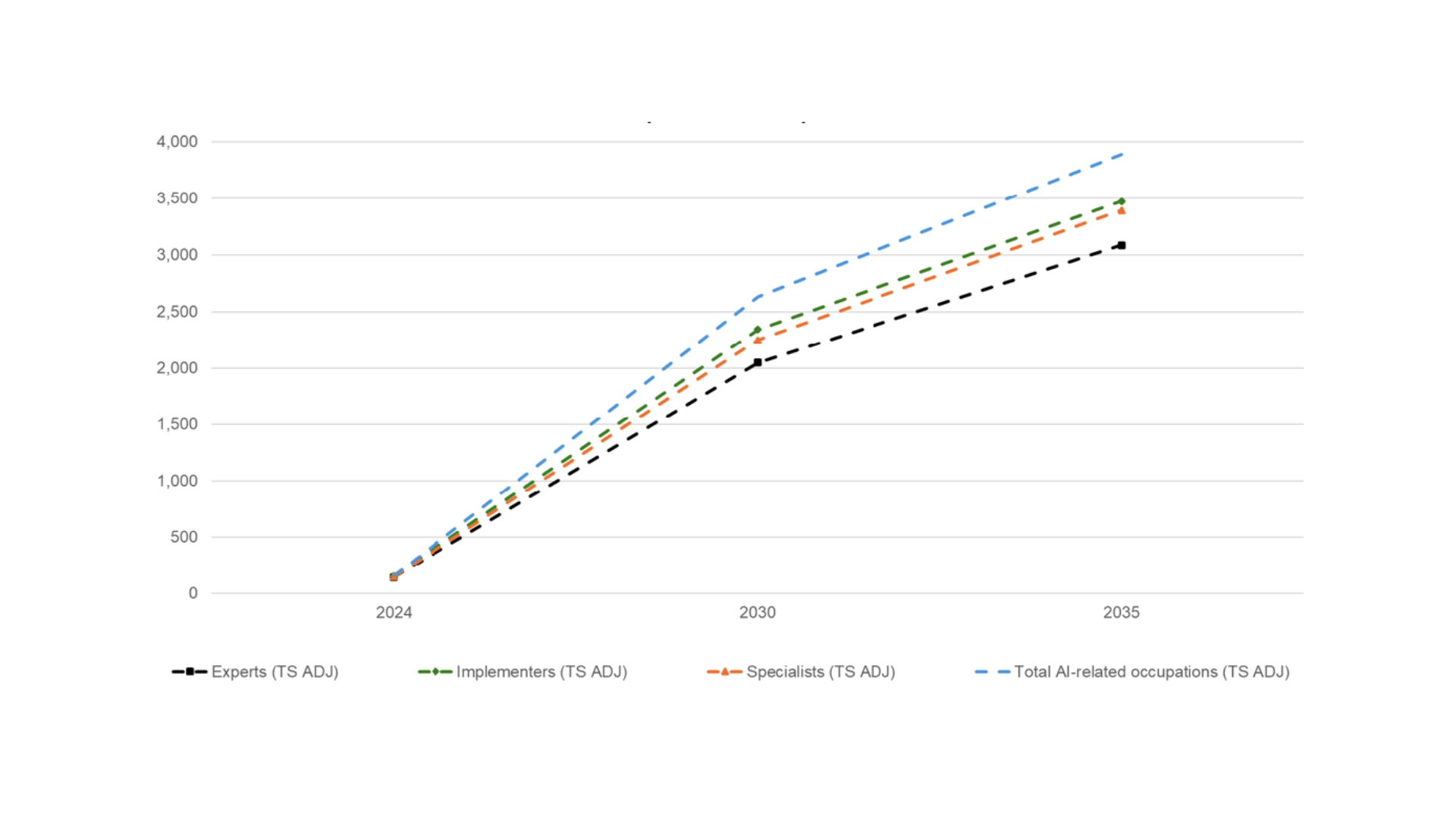
Source: IER estimates
1.2. The impact of AI using standard occupational classification (SOC) codes
This study analysed a specific set of AI-related occupational groups at the 4-digit level. Groups where AI skills requirements were likely to grow include:
-
IT professionals like programmers and software developers (SOC Group 2134), IT specialist managers (2133), and IT business analysts and systems designers (2135)
-
Research professionals (Minor Group 22), and Business and Finance roles like finance and investment analysts and advisers (2422), management consultants (2423), and business project managers (2424)
However, the model predicts potential declines in some Unit Groups like Financial Account Managers (3534), and Business Sales Executives (3552), though replacement demand will still create openings.
Since the study did not explore all occupations at a 4-digit level, and because some groups at a 2-digit level are only represented by one occupation, any findings at the 2-digit level need to be treated with some caution. However, key impacts at a 2-digit level include:
-
Higher AI related job growth is anticipated in Sub-major Groups like Science, Research, Engineering and Technology Professionals (21), Business, Media and Public Service Professionals (24), Corporate Managers and Directors (11), and Teaching and Educational Professionals (23).
-
For replacement demand, occupational groups expected to see the largest shares include Science, Research, Engineering and Technology Professionals (21), Business, Media and Public Service Professionals (24), Corporate Managers and Directors (11), and Business and Public Service Associate Professionals (35).
-
However, reductions may occur in some occupations within these groups, such as Finance Managers (35).
At a 1-digital level, the majority of AI-related employment is expected to be in professional (2) and Associate Professional (3) occupations. However, some occupations within these groups may decline.
1.3. Relationship to other WP4 reports
-
The proportion of job roles requiring AI use is expected to grow as a proportion of the overall job market. This is supported by the vacancies analysis, which highlights that around 1.7% of current job postings were related to AI, and the present study, which suggests this proportion could grow to almost 12%. The patent analysis further supports this by showing AI patents rising from 5.2% to 20.3% of total patents. Overall, AI-related skills, at both the expert, specialist and implementer levels, are likely to experience demand growth in excess of the broader economy.
-
Note: the projections in this report assume steady, consistent year-on-year growth. The vacancies analysis highlights that year-on-year trends can be affected by broader macroeconomic conditions. Though the overall trend in demand for AI skills will likely rise until 2035, specific demand for AI jobs may fluctuate year to year.
-
The importance of combining AI skills with sector-specific knowledge is a common theme. AI skills development will not be consistent between sectors. The reports emphasise that sector-specific “knowledge packages” are crucial to consider when prioritising technologies of strategic interest and designing education and training programs.
-
While the vacancy search was useful in identifying the overall number of job opportunities relating to AI, it was slightly limited in the level of detail it was able to provide about which AI skills would be needed. On the other hand, the patent data was able to provide information about the large number of keywords relating to the knowledge of skills that were linked to new developments in technology. While it is still in its infancy, this exploratory work using the rich information from the patent dataset demonstrated that it is possible to link the technological developments in AI to subsequent labour market outcomes.
1.4. Contribution to overall research questions
Table 1.1: Contribution to overall research questions
| Research question | Contribution of this work package |
|---|---|
| What AI-relevant skills are needed for life and work? | N/A |
| How may these transform as the technology develops? | AI Implementers are projected to be the largest share of AI employment, followed by Specialists and then Experts. This suggests the types of AI skills needed may shift more towards application and implementation rather than pure research and development as the technology matures. |
| To what extent does the UK have or lack these needed skills in the labour force? | The UK has around 158,000 jobs involving direct AI activities across the expert, specialist and implementer levels. This is projected to grow significantly to 3.9 million jobs, or about 12% of the current UK workforce, by 2035. As such, demand for AI skills may outstrip the development of these skills. |
| To what extent is the UK supporting people to develop future relevant AI skills? | N/A |
| Based on potential future scenarios, what should government, employers and private education and skills providers focus on to address any gaps in provision? | AI-related employment will be concentrated in professional, associate professional, corporate manager and director roles. Specific occupations likely to see strong AI job growth include IT professionals, research professionals, and business/finance roles. However, some occupations like finance managers and business sales executives may see job declines even with the growth in AI. Due to expected differences in demand between sectors, defining and developing a set of universal skills should be the focus of government-provided skills development. Skills development may struggle to keep up with AI labour demand, as training takes time to implement. Government, employers and education providers may need to collaborate to train a significant portion of the workforce in AI-related skills to meet the projected labour requirements. |
| What can the UK learn from international counterparts with regards to AI skills? | N/A |
2. Introduction
This report focuses on how advances in artificial intelligence (AI) may impact on labour demands in the period to 2035. It is exploratory in nature, applying technological trends drawn from patent and vacancy data to existing projections of occupation by sector taken from the latest “Working Futures” (WF) exercise (Wilson et al., 2022a). Working Futures offers both a baseline projection for 2035 and a set of three alternative scenarios, but none of these estimates makes direct allowance for the possible effects of AI. The present work attempts to utilise the evidence of technological advances in AI to narrow down the Working Futures projections. To the best of our knowledge, patent data have never previously been used for integrating technological information with labour market outcomes.
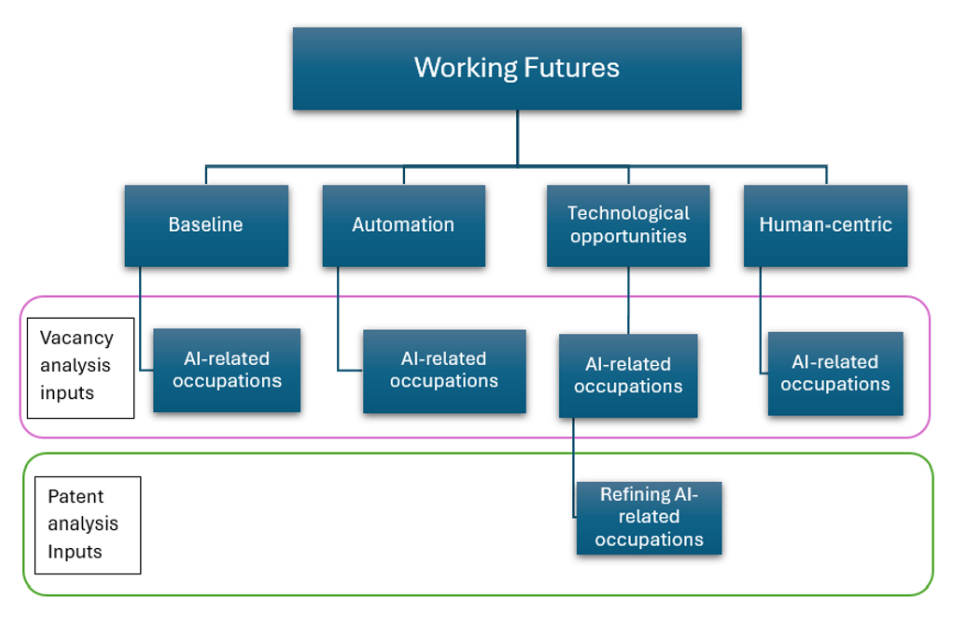
Figure 2.1 illustrates the structure of the labour market forecast model used in this report. This model is based on the Working Futures framework, a well-established and the most comprehensive approach currently available for the UK, which serves as the foundation for our analysis. The projections produced for Skills Imperative 2035: Essential Skills for Tomorrow’s Workforce are rooted in a multi-sectoral dynamic macroeconomic model alongside other quantitative modelling. These models take into account existing technological trends, the impacts of Brexit and the pandemic, labour market factors such as population growth, migration, and the current demographic structure of the workforce, as well as any changes to the policy landscape that have been implemented or announced (see Section 2 for more information). This comprehensive approach helps to anticipate how the sectoral structure of the economy will evolve between 2020 and 2035. (Wilson et al., 2022a).
As discussed in Section 2, the Working Futures model does not offer a single estimate for future labour demand. Instead, it presents multiple potential outcomes: Baseline, Automation, Technological Opportunities, and Human-Centric (as depicted in the second layer of Figure 2.1). These outcomes are designed to provide a comprehensive overview of how the labour market might change if certain major developments occur. While these projections offer a broad and useful view of potential labour market trends, they do not specifically analyse how AI and the demand for AI-related occupations might evolve in the future.
To provide a more focused analysis of the impact of AI on future labour market outcomes, elements from the patent and vacancy analysis were integrated into the Working Futures framework. This integration offers a clearer indication of the potential implications for labour demand in AI-related occupations. The present work rejected the Automation scenario “which focuses attention purely on the negative employment effects” and the effects of AI are subsumed within a range of other influences (Wilson, et al. 2024a). The present study is based around the Technological Opportunities scenario, in which “technology developments will also open up many opportunities and will create new jobs”. The potential overlap between Technological scenario and the present study concerns robotics – not all of which is AI related, but in the Working Futures framework robotics is portrayed as a job-destructive influence.
The first step involved incorporating insights from the vacancy data analysis. Specifically, the labour vacancy analysis helped narrow the labour forecast for occupations identified as AI-related in various contexts (illustrated in the second layer of Figure 2.1). The corresponding Working Futures data were processed and analysed at a 4-digit level to provide these new insights into the labour market.
While the vacancy and Working Futures insights allow for a more detailed view of the effects of AI-related occupational demands in the labour market, not everyone working in an AI-related occupation will necessarily be affected by AI. Within certain occupations, some jobs will be impacted by AI sooner, while others may remain unaffected or take longer to experience change due to the rise of AI.
To address this issue, an experimental second step of the integration process involved incorporating observed AI penetration trends (with a lag) into the projected Working Futures figures for AI-related occupations. Patent data provides significant insights into the levels and changes in AI activity over time. It was assumed that the diffusion of new technologies would generally follow the production patterns of these technologies, albeit with a delay. This approach allows for a more precise identification of the impact of AI penetration on labour market outcomes (as shown in the third layer of Figure 2.1). Due to the technical complexities of this approach, we opted to carry out the integration process under the Technological Opportunities scenario. This scenario was selected as the most plausible, as it considers both job creation and job destruction driven by the rise of technology in the labour market. The integration of patent data helps estimate the proportion of people employed in AI-related occupations who are likely to be affected by AI.
Figure 2.1: Labour market forecast model scheme
The remainder of this report is divided into five sections. Section 2 offers a brief overview of the Working Futures framework, emphasising its key assumptions and the various projections it generates. Section 3 explains how insights from vacancy data were used to conduct a more detailed analysis of AI-related occupations and describes the experimental approach employed to integrate patent and vacancy data with Working Futures projections. Section 4 presents the results of the labour market projections. Finally, Section 5 provides concluding remarks.
2.2. The skills imperative 2035 overview (working futures)
As discussed earlier, the projections in this report were developed using the “Working Futures” framework. This section outlines the assumptions, and key definitions of the Working Futures framework, as well as the different projections considered.
2.3. Baseline and alternative projections
Baseline projections have been developed for the macroeconomy, sectoral employment, and the labour force. These projections are grounded in an assessment of the most likely path the economy will take over the next 15 years, taking into account anticipated changes in macro trends and the policy landscape. Consequently, the baseline projections exclude future policy changes whose specifics are currently undefined, such as forthcoming policies aimed at assisting the UK in achieving its Net Zero carbon commitment by 2050. Thus, these projections are designed to represent a scenario with minimal disruption from potential policy and other disruptive changes.
Predicting the future with absolute certainty or precision is inherently impossible. Macro trends like the adoption of new technologies and environmental changes could lead to more profound impacts than those outlined in the Baseline projections. Furthermore, forecasting the labour market’s trajectory is particularly challenging given uncertainties surrounding EU exit and the significant disruptions caused by the Covid-19 pandemic. These uncertainties highlight the importance of exploring a variety of potential outcomes.
In response to these challenges, alternative scenarios have been developed (again, see Figure 2.1)[footnote 3]. These scenarios build on the Baseline projections by considering additional possibilities, such as accelerated technology adoption, heightened focus on green initiatives, and enhancements in education, health, and social care services. These scenarios have emerged from extensive discussions among experts participating in the Skills Imperative 2035: Essential Skills for Tomorrow’s Workforce, who have evaluated various plausible alternatives. These are as follows:
Automation
The main purpose of this scenario is illustrative - highlighting areas where jobs are most vulnerable to automation - and not intended as a realistic prediction but serves to identify the jobs most at risk. All tasks currently performed by humans that can feasibly be automated are replaced by technology. This entails significant investment in productivity-enhancing automation technologies. However, there is no intervention to mitigate the substantial job losses, resulting in high levels of technological unemployment.
Technological opportunities
This scenario also expects job losses from automation, but recognises that technology developments will also foster economic growth by creating new jobs in key areas:
-
Enhanced technology management: such as data science, engineering, and customer support for personal applications and technology solutions. Effective management of these technologies allows the UK to gain competitive advantages in core economic sectors.
-
Transition to a low-carbon economy: increased investment in renewable energy and low-carbon or zero-emissions solutions, with stronger enforcement of regulations and standards.
-
Improved education, health, and care services: providing better quality services in sectors where workers are particularly challenging to replace with technology. In education, this is crucial for the development and transformation (reskilling) of the workforce.
These developments are expected to aid economic growth by maximising technological opportunities and create a resilient, adaptable labour market.
Human-centric scenario
This scenario highlights the value of non-cognitive or “soft” skills, which are more challenging for automation to replicate and thus less prone to being replaced. Key aspects of this scenario include:
-
Prioritising non-cognitive skills: such as empathy, creativity, critical thinking, and interpersonal communication, which are difficult for technology to replicate.
-
Emphasising human services: such as education, healthcare, and social care services, ensuring high standards and accessibility.
-
Investing in technological and environmental advances: but less extensively than in the Technological Opportunities scenario, offering a more balanced approach that does not overshadow the focus on human-centric skills and services.
This approach emphasises the development and emphasis on uniquely human skills, ensuring that the workforce remains adaptable and resilient amidst technological advancements.
3. Key labour market definitions
Before discussing the results of different scenarios and their implications for AI-related occupations, it is crucial to clarify three key labour market terms.
-
Replacement demand refers to the job openings created by workers leaving the workforce, rather than by the creation of new positions. This can happen for reasons such as retirement, career changes, or other forms of workforce attrition.[footnote 4] Replacement demand can occur even if no new jobs are being created. It is a significant factor in labour market dynamics, generally far outweighing expansion demand in terms of total employment opportunities.
-
Expansion demand refers to the additional labour needed to support the growth of an industry or organisation, rather than the replacement of leavers. This growth is driven by increased demand for goods and services, technological advancements, or market expansion, resulting in the need to hire new employees, expand roles, or develop new skill sets to meet future operational needs.
-
Total requirement is the total number of job openings combining both replacement demand and expansion demand. While replacement demand is non-negative, expansion demand will be negative in contracting sectors and, in this case the total requirement (i.e. the net changes in employment between the expansion and replacement demands) can be positive or negative. The difference between replacement demand and expansion demand allows businesses to allocate resources appropriately, with a greater focus on succession planning and internal training for replacement needs, and a greater emphasis of recruitment and skill development towards new growth areas. It also channels the programs and strategies policymakers and educational institutions between the maintenance of the current workforce and the development of future skills required by evolving industries.
4. Focus on AI-related occupations
4.1. Vacancy-based projections
The Nuffield Foundation’s research program, The Skills Imperative 2035, has extensively analysed various macroeconomic variables and provided projections on the future of jobs. However, the analysis within the Working Futures framework does not specifically address the demand for AI-related occupations in the coming years. Major developments in AI, including the release of ChatGPT by OpenAI, have occurred since 2020 and are not captured in the current modelling. As a result, the Working Futures projections do not provide detailed insights into which occupations are tied to AI and how these jobs are expected to evolve in the future. To fill this gap, this report builds on the findings of The Skills Imperative by focusing specifically on the anticipated labour demand for AI-related occupations, using insights derived from the job vacancy analysis in WP4.
To achieve this, the Working Futures projections have been grouped and filtered into three main categories: Experts, Specialists, and Implementers, following the classifications identified in the job vacancy findings. Additionally, detailed projections are provided at the four-digit occupational level to offer a more granular view of the evolving labour market. This approach enables a comprehensive examination of the potential implications for workforce planning, policy development, and educational strategies that are essential for meeting the future demands of AI-related occupations. By providing these detailed insights, the report aims to guide stakeholders in adapting to the rapid advancements in AI technology and preparing for the shifts in labour demand that these technologies are likely to drive (results in Subsection 4.2).
4.2. Enhancing projections with patent data
Integrating the Working Futures projections with job vacancy data at the four-digit occupational level offers a more granular understanding of potential future demands for AI-related occupations. However, these estimates should be interpreted as representing the upper bound of potential demand because the four-digit occupational classification does not necessarily indicate that all individuals within that occupation will engage with AI-related activities. For example, mechanical engineers in one company may all be directly involved in developing or implementing AI technologies, mechanical engineers in a different setting might not interact with AI at all.
To address this limitation, the report introduces an experimental approach that integrates insights from patent analysis with workforce projections. As patents are a rich source of information about the amount of inventive activity taking place in by area of technology, it was possible to identify the relative importance of research outputs relating to developments in AI at a very detailed level. Specifically, this approach assumes that AI-patenting activity by sector will be reflected in the adoption of new technologies by those sectors with a time lag. This method provides a refined estimate of the proportion of workers in specific roles who will be linked to AI-related activities.
4.3. Operationalising the patent data
The present subsection provides a brief overview of how the data are organised and analysed – greater detail is provided in Appendix A. Patents provide information about the level of research interest in different areas of technological development. As patents are coded by a team of experts in each area of technology, it is possible to identify the numbers of patents sought each year in each given area, including AI. The codification is at such a detailed level, that it was possible to identify the level of activity in all but a very small number of the 41 areas of AI used in the patent search. It has been possible, with a number of caveats, to link the associated areas of technology with the sectors and, thereby, the occupations to which they relate.
Our analysis is not based on the premise that every new technology will be adopted, but that inventors search in areas of technology that are likely to have a practical application and that, by the law of averages, areas where search is more intensive will have a higher proportion that are adopted. As adoption lies between a minimum of zero and a maximum less than or equal to unity (where unity denotes that all potential users adopt the technology), this results in a standard (‘S-shaped) form for the diffusion of the technology over time. Likewise, a similar S-shape also occurs in terms of the level of activity in any given area of technology, as each area reaches an upper limit as it becomes harder and harder to find new advances (e.g. the area becomes “mined-out”).
Empirically, AI presents a problem as most of the associated areas of technology are currently in the earliest stages of evolution. The problem is that it is then difficult to project what the future rate of development of such areas will be, as only the exponential growth phase is observed and there is no evidence of when the growth in development will slow down (and eventually stop). However, where necessary, a number of experimental techniques have been applied to the data to ensure that the longer-term rate of development in each of the 41 areas of technology follow the S-shaped path in the longer term.
While the plan was to use this detailed information along with comparable results from the vacancy data – this proved impossible because the vacancy data were not able to yield the same level of detail as the patent data. In order to obtain results usable within the present project, therefore, these detailed results were summarised in a single AI variable – showing the overall activity in developing new AI technologies over time. Various lags were applied to allow the new developments in AI technologies to diffuse across the different sectors and the skills implications then calculated from the occupation mix of each sector at the four-digit level. The results were then applied to the Technological Opportunities scenario projections as an adjustment for the effects of AI on the Working Futures projections.
5. Results
5.1. Summary of results
-
The baseline Working Futures projections indicate that implementers are expected to constitute the largest share of AI-related employment in the UK, followed by specialists and experts, which aligns with findings from the vacancy analysis.
-
In the adjusted Technological Opportunities scenario, AI occupations are projected to see 12.4% growth from 2024-2035, with Experts increasing the most at 12.6%. Jobs directly involving AI activities could rise from 158,000 in 2024 to 3.9 million by 2035.
-
At the 4-digit SOC level, there is potential growth in roles such as programmers and software developers (2134), IT specialist managers (2133), research professionals (22), and business and finance roles like financial analysts (3534) and management consultants (2423).
-
At the 2-digit SOC level, higher AI-related job growth is anticipated in groups like Science, Research, Engineering and Technology Professionals (21), Business, Media and Public Service Professionals (24), Corporate Managers and Directors (11), and Teaching and Educational Professionals (23). However, reductions are expected in some occupations within these groups, such as Finance Managers (35).
-
Most of the AI-related employment is expected to be in Professional (2) and Associate Professional (3) occupations at the 1-digit SOC level. Some occupations within these groups may see declines, though replacement demand will still create job openings.
5.2. AI-related occupational projections based on working futures findings
Background
The Nuffield Foundation’s research program results generally indicates that nearly all of the projected 2.5 million job increase from 2020 to 2035 will be for skilled, white-collar, non-manual workers. Almost 90% of this net employment growth is expected to be in Professional and Associate professional roles. In contrast, the number of jobs in Administrative, Secretarial, and Skilled Trades is expected to decline, reflecting automation and the shift away from manufacturing. Across scenarios, mid-level jobs are projected to decline, with modest growth in elementary roles and lower-skilled care jobs.
However, replacement demand is expected to exceed net employment changes across all occupations through 2035, with notable demand even in sectors seeing declines, such as Administrative and Skilled Trades jobs.
The rest of this section provides a focused analysis on the occupations that have been identified as related to AI (see Figure 5.1). To achieve this, the Working Futures projections have been grouped into three main AI categories—Experts, Specialists, and Implementers—based on classifications from the job vacancy findings.
Figure 5.1: Taxonomy of AI roles
Source: AI Skills WP4_Vacancies paper
AI-related occupational projections
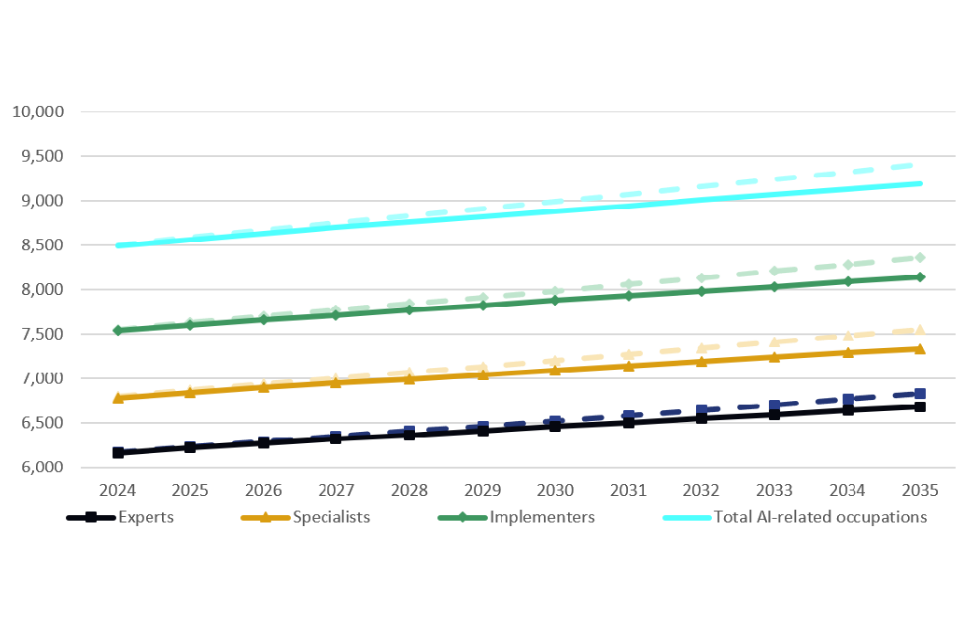
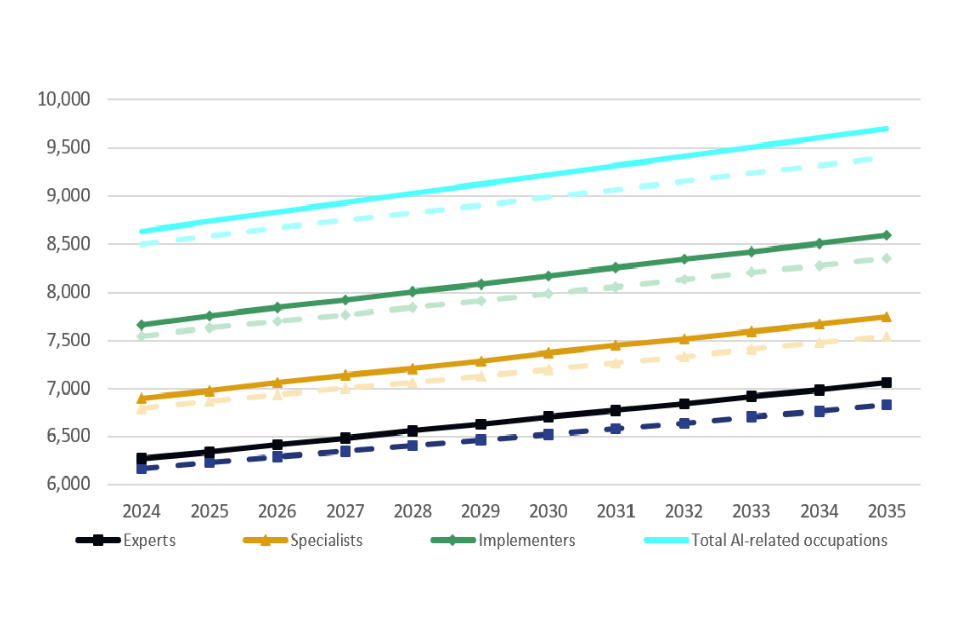
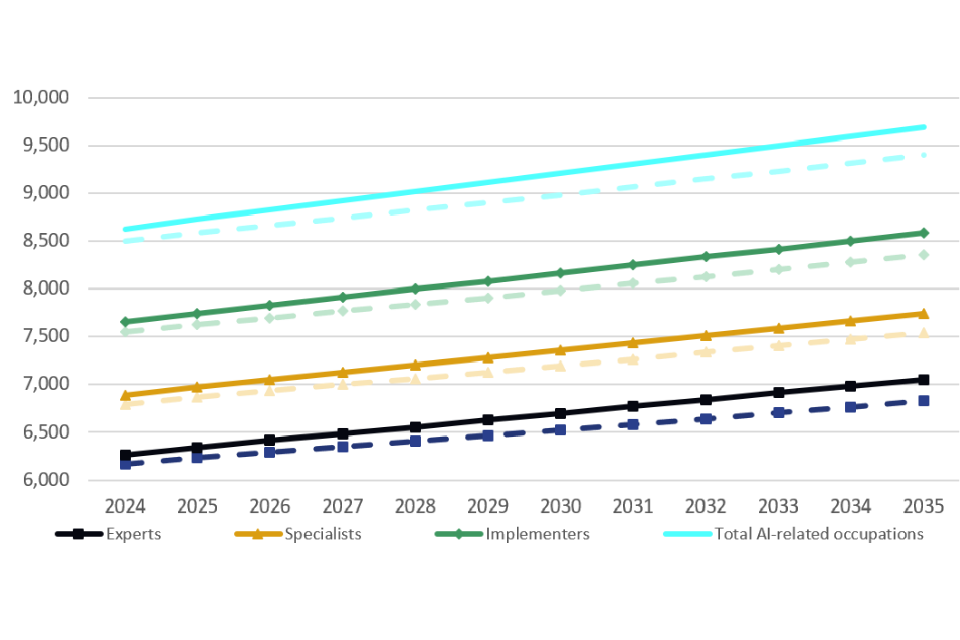
Figures 5.2, 5.3, 5.4 and 5.5 present labour market forecasts for AI-related occupations under four different scenarios: Baseline Scenario (BS), Automation Scenario (AS), Technological Opportunities Scenario (TS), and Human-Centric Scenario (HS). Each chart outlines projections for job numbers across four categories of AI-related occupations previously identified in the Job Vacancy Analysis: Experts, Specialists, Implementers[footnote 5], and the total for all AI-related occupations[footnote 6]. The dashed lines correspond to the Baseline Scenario in each chart, serving as a reference point for comparison with other scenarios.
Regardless of the scenario, Implementers are projected to hold the highest share of AI-related employment in the UK, followed by Specialists and Experts. This result aligns with the findings from the vacancy analysis, which revealed a similar distribution among these subgroups.
In the Baseline Scenario (Figure 5.2), the trend indicates a steady increase in job numbers across all AI-related occupations from 2024 to 2035. The total number of AI-related occupations shows a consistent upward trajectory, suggesting a balanced growth driven by existing economic and technological trends. Specifically, the number of Specialists is projected to increase by 11.0% from 2024 to 2035, while the number of Experts and Implementers is expected to grow by approximately 10.6%. The total grow for AI-related occupations is expected to be 10.7%. This scenario reflects a stable growth environment where the current trends continue without major disruptions.
Figure 5.2: Employment projections by AI-related occupations 2024 – 2035 (thousands) - baseline scenario - BS
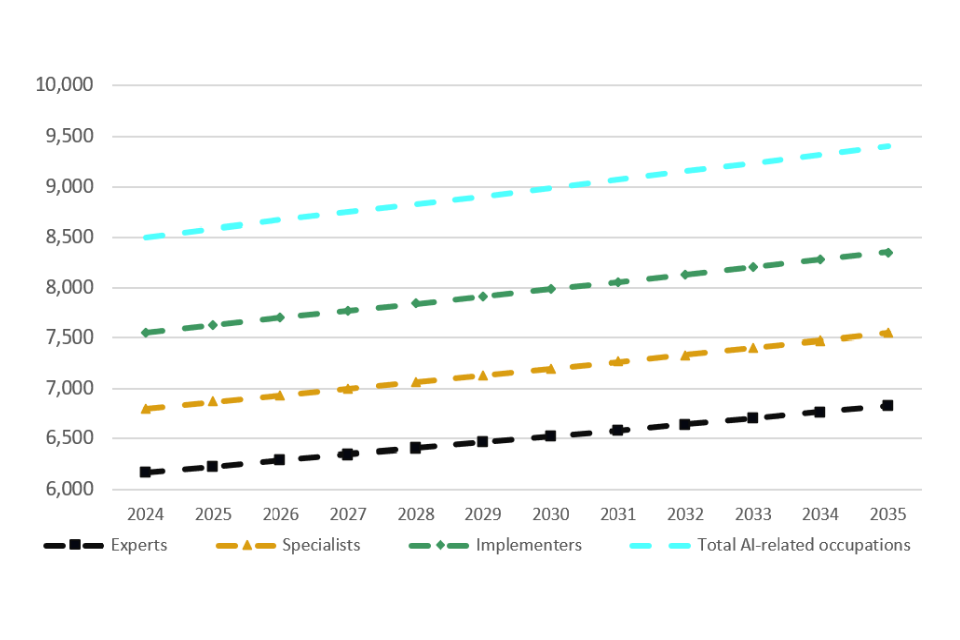
Source: IER estimates. Note: AI categories (Experts, Specialists, Implementers) overlap. The “Total AI-related occupations” accounts for any double-counting.
The Automation Scenario (Figure 5.3) presents a contrasting outlook where AI-related occupations are expected to grow, albeit at lower rates compared to the baseline scenario. Experts exhibit the highest growth rate at 8.4%, followed closely by Specialists and Implementers at approximately 8.1% and 8.0%, respectively. Overall, AI-related occupations are projected to expand by 8.2% in this scenario, which represents a 2.5 percentage point decrease compared to the Baseline Scenario. The results reflect the assumptions of the Automation scenario, which primarily emphasises the negative employment effects across all sectors. This shift underscores a significant trend towards automation, potentially impacting the growth trajectory of AI-related roles. While Specialists and Implementers also experience growth, their rates are slower compared to Experts. The notable increase in Experts suggests an economy increasingly reliant on automation technologies, driving demand for roles focused on sophisticated design, development, and oversight of AI systems. This trend reflects a broader shift towards automation-driven efficiencies and innovation across industries, requiring skilled professionals capable of deploying and integrating advanced AI technologies to enhance operational capabilities and competitiveness.
Figure 5.3: Employment projections by AI-related occupations 2024 – 2035 (thousands) - automation – AS
Source: IER estimates. Note: AI categories (Experts, Specialists, Implementers) overlap. The “Total AI-related occupations” accounts for any double-counting.
In the Technological Opportunities Scenario (Figure 5.4), the projections show the most pronounced growth across all categories, particularly for Experts (12.6%). This scenario suggests a future where technological advancements create new opportunities, leading to a surge in demand for highly skilled professionals. Implementers and Specialists also see significant growth (12.4% and 12.1%, respectively). This scenario underscores the transformative potential of technological breakthroughs in driving significant job creation within AI-related occupations, particularly for roles that require advanced expertise. Overall employment in AI-related fields is expected to increase by 12.4% in this scenario, marking a 1.7 percentage point rise compared to the Baseline Scenario. Additionally, a stronger growth in employment is anticipated within the non-market services and primary sectors, including utilities, while a slightly slower decline in employment is expected in manufacturing.
Figure 5.4: Employment projections by AI-related occupations 2024 – 2035 (thousands) - technological opportunities – TS
Source: IER estimates. Note: AI categories (Experts, Specialists, Implementers) overlap. The “Total AI-related occupations” accounts for any double-counting.
The Human-Centric (Figure 5.5) yields similar results to the Technological Opportunities Scenario. This similarity stems from the fact that, as discussed in Section 2.1, the Human-Centric scenario builds upon the Technological Opportunities framework, with the key difference being the assumption that the UK makes significant investments in high-quality education, healthcare, residential, and social care services. Given that AI-related occupations are typically less in demand in these sectors, the Human-Centric Scenario is expected to show comparable outcomes to the Technological Opportunities Scenario.
Figure 5.5: Employment projections by AI-related occupations 2024 – 2035 (thousands) - human centric – HS
Source: IER estimates. Note: AI categories (Experts, Specialists, Implementers) overlap. The “Total AI-related occupations” accounts for any double-counting.
Table 8.1 (see Section 8 ‘Appendix B’) details the projected employment levels of AI-related occupations at the 4-digit occupational level across different scenarios. By 2030 and 2035, occupations such as Secondary Education Teaching Professionals, Programmers and Software Development Professionals, and Financial Managers and Directors are anticipated to have higher employment levels. Conversely, occupations like Aerospace Engineers, Senior Officers in Fire, Ambulance, Prison, and Related Services, and Public Relations and Communications Directors are projected to have lower employment levels across all scenarios.
At a more aggregated level (SOC2020 2-digit), AI-related occupations are anticipated to concentrate relatively high employment levels in areas like Science, Research, Engineering, and Technology Professionals, followed by Business, Media, and Public Service Professionals, and Business and Public Service Associate Professionals.
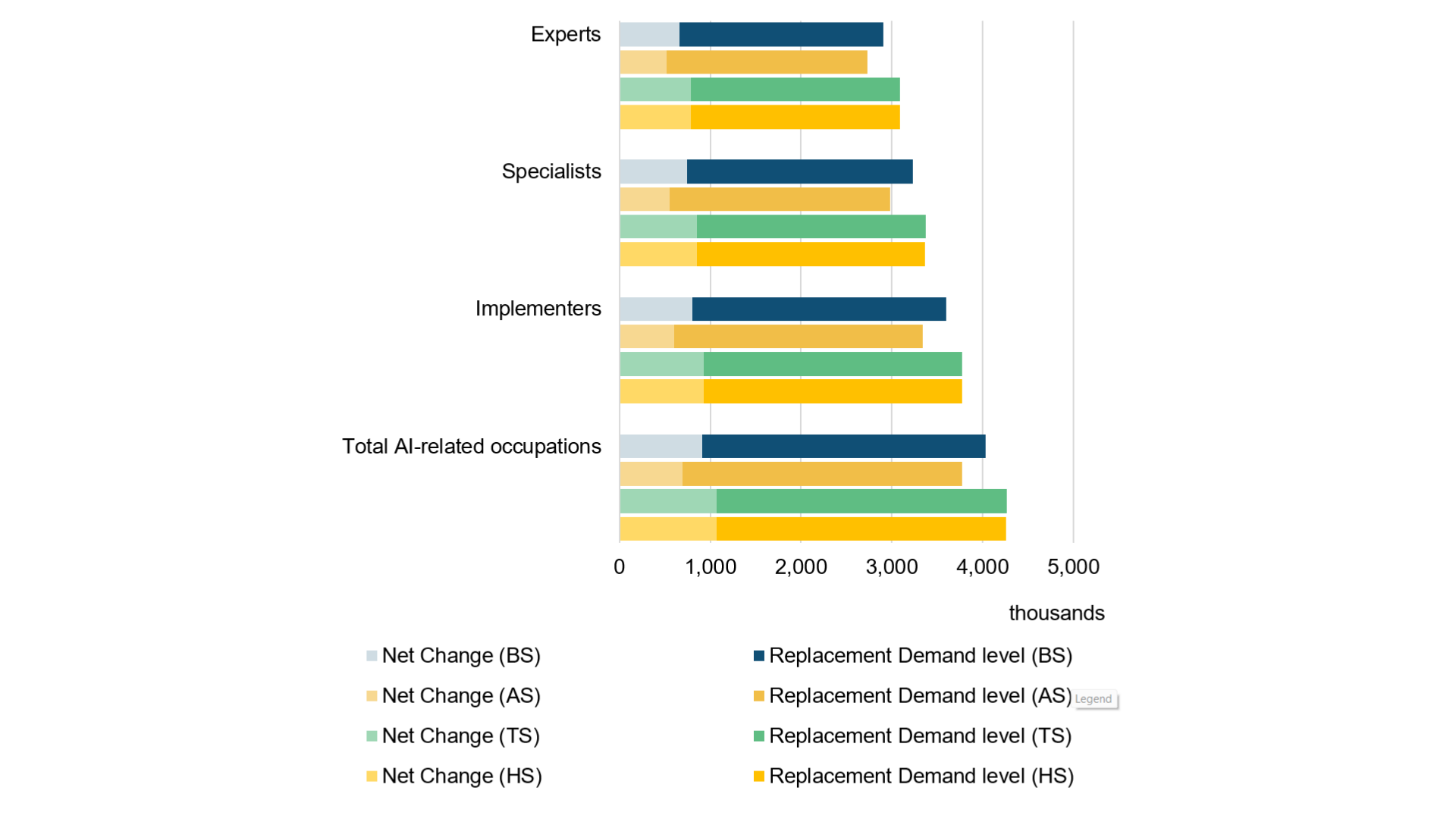
As previously mentioned, the distinction between net changes and replacement demand is vital for workforce planners and policymakers. Net changes (or total requirement change) provide a forward-looking perspective, helping stakeholders anticipate future labour demands. However, when thinking about how to adjust training and educational programs to align with emerging job requirements, it is essential to also consider replacement needs. Understanding the latter enables organisations to develop succession plans, recruit new talent, and implement retention strategies to mitigate potential skills shortages and ensure workforce sustainability. Moreover, integrating both metrics allows for a comprehensive assessment of labour market dynamics. It facilitates the identification of critical occupations facing both growth opportunities and imminent turnover challenges, thereby guiding targeted interventions and policy initiatives.
Figure 5.6 depicts the projected net changes and replacement demand levels for Experts, Specialists, Implementers, and the total for all AI-related occupations in the UK. For the total of AI-related occupations, the net change ranges from approximately 696,000 jobs in the Automation Scenario to 1,072,000 in the Technological Opportunities Scenario, with replacement demand levels rising from 3,077,000 to 3,193,000 jobs across these scenarios.
For Experts, the net change varies from around 551,000 jobs in the Automation Scenario to 853,000 in the Technological Opportunities Scenario, with replacement demand levels rising from 2,213,000 to 2,296,000. Specialists are expected to experience a net change from approximately 519,000 jobs in the Automation Scenario to 791,000 in the Technological Opportunities Scenario, with replacement demand levels going up from 2,428,000 to 2,520,000. Implementers are expected to show a net change ranging from about 600,000 jobs in the Automation Scenario to 929,000 in the Technological Opportunities Scenario, with replacement demand levels climbing from 2,740,000 to 2,841,000.
These results contrast with those for other occupations. The net change and replacement demand for AI-related occupations are considerably higher compared to other occupational groups at the 2-digit level across different scenarios. For instance, in the Technological Opportunities Scenario, Administrative occupations are projected to have a net change of about -200,000 jobs and a replacement demand of 1,500,000 jobs. Even occupational groups such as Science, Research, Engineering and Technology, and Caring Personal Service occupations, which are expected to see substantial increases in net requirements and replacement demand, do not reach the high figures observed for AI-related occupations (Wilson et al., 2022a).
Thus, these projections highlight a considerable and growing demand for AI-related occupations across all scenarios, emphasising the increasing importance of AI expertise in the job market regardless of the socioeconomic context. The government, policymakers, education and training providers, and employers may need to collaborate to train a significant portion of the workforce in AI-related skills to meet the growing industry requirements. This will involve investing in comprehensive education and training programs, creating supportive policies for the AI sector, and fostering partnerships between academia and industry to ensure that the workforce is well-prepared for the future demands of the AI-driven economy. By addressing these needs, we can maximise the benefits of AI integration and sustain economic growth while ensuring that the workforce remains competitive and adaptable.
Figure 5.6: Total requirements by AI-related occupation compared across scenarios, 2024-2035
Source: IER estimates.
Notes: Total requirements = Expansion demand (net change) + Replacement demand.
Table 8.2 (see Section 8 ‘Appendix B’) outlines the net employment requirements and replacement demands for AI-related occupations at the 4-digit SOC level from 2024 to 2035. Among these, Secondary Education Teaching Professionals, Programmers and Software Development Professionals, and Financial Managers and Directors are projected to have the highest levels of replacement demand and net employment requirements. Conversely, a few occupations are expected to see declines in net employment requirements. For example, Computer System and Equipment Installers and Servicers show decreases across all scenarios. Additionally, Sales Accounts and Business Development Managers exhibit the most considerable decline in the Automation Scenario, with some reductions also observed in the Technological Opportunities Scenario and Human-Centric scenarios.
It is important to note that even for occupations with negative net changes, there will still be numerous job openings due to replacement needs. For instance, despite the decline in employment levels for Computer System and Equipment Installers, the replacement demand remains positive, with anticipated job openings between 14,000 and 15,000.
At a more aggregated level (SOC2020 2-digit), relatively higher net requirements are anticipated in occupational groups such as Science, Research, Engineering, and Technology Professionals; Business, Media, and Public Service Professionals; Corporate Managers and Directors; and Teaching and Other Educational Professionals. Regarding replacement demand, areas like Science, Research, Engineering, and Technology Professionals; Business, Media, and Public Service Professionals; Corporate Managers and Directors; and Business and Public Service Associate Professionals are expected to account for a substantial share.
These figures suggest that despite the recent decline in demand for AI-related occupations on job portals, the overall employment outlook in the AI sector remains positive and is expected to continue expanding. As highlighted in the job vacancy analysis, this phenomenon may stem from companies increasingly relying on headhunting or upskilling existing employees rather than advertising for new positions. As discussed in the Vacancy data report, organisations seeking to fill critical specialised roles might prioritise internal talent development or engage in proactive recruitment strategies that do not result in publicly listed job postings.
5.3. Technological opportunity adjusted results
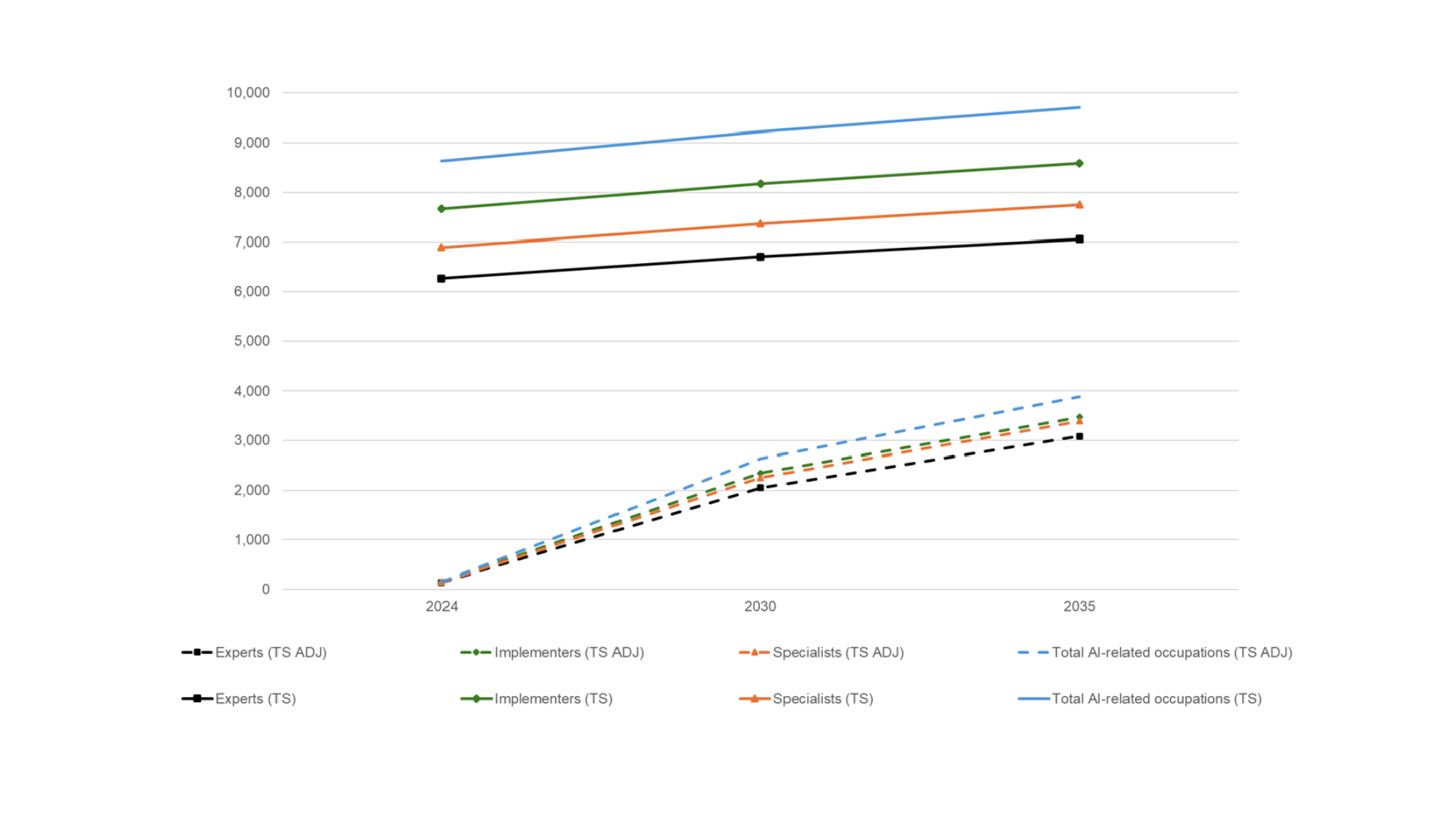
Figure 5.7 presents the projected growth of the AI-related occupations from 2024 to 2035, adjusted by the patents penetration rates by sector and occupations. Solid lines represent the unadjusted numbers (TS), and dashed lines represent the adjusted figures with the patent information (TS ADJ). Across all roles, both adjusted and unadjusted values show a steady upward trend, indicating a growing demand for AI-related occupations over time.
As highlighted in Section 3, the first estimates are of the projections of individuals in those occupations most likely to be linked with the introduction of AI. By no means all these people will be directly working on AI – the discussion returns to this subset in the next paragraph. In the unadjusted figures taken from the Working Futures- Technological Opportunities Scenario for this larger group, experts, implementers, and specialists are all expected to see gradual increases. For example, the number of individuals in AI-related expert occupations is projected to rise from around 6.3 million in 2024 to approximately 7.1 million by 2035. Implementers, represented by the green line, grow from 7.7 million in 2024 to about 8.6 million by 2035. Specialists also show a similar rise, from around 6.9 to 7.7 million within the same timeframe, suggesting a notable expansion of total employment in AI-related occupations across industries.
The second set of employment figures relate to our best estimates of the numbers of individuals in the AI-related occupations that will be directly involved in implementation, specialist and expert roles associated with the diffusion of AI. These numbers are derived from the known AI-related vacancies (relative to all vacancies) and the rates of penetration of AI (e.g. AI-patents relative to all patents) constructed from the projected patenting activity based on a five-year lag in the adoption of new AI-technologies. These adjusted figures (TS ADJ), represented by dashed lines, show a more conservative estimate but still follow a similar growth pattern. When factoring in vacancy and patent data, in 2024 the estimated number of jobs in occupations categorised as Implementers potentially involved in AI activities is around 156,000, followed by Specialists at 147,000, and Experts at 143,000. This brings the total number of jobs estimated to be involved in AI activities in 2024 to approximately 158,000.[footnote 7]
The number of jobs within Experts’ occupations involving any AI activities is expected to grow from about 143,000 in 2024 to 3 million by 2035, while adjusted Implementers increase from 156,000 to 3.4 million. Specialists see a rise from 147,000 in 2024 to 3.3 million by 2035. The total adjusted AI-related occupations increase from about 158,000 to approximately 3.9 million over the same period. Understandably the adjusted numbers are lower than the total employment in the associated occupations even by 2035, but the overall trend indicates strong growth, reflecting an ongoing increase in AI integration into different roles. Moreover, these figures refine the estimates provided by Technological Opportunities Scenario by pinpointing the potential number of jobs at the four-digit occupational level that involve AI activities.
It is worth saying a few words about the compression of the results for the three groups of skills vis a vis the unadjusted figures. The figures in the early years (e.g. 2024) will tend to be more skill intensive as the applications of AI in their various uses are still being developed and tested. Given the emergence of AI activities tends to take place quite late on in out our historical data, the changes between these groups going up to 2035 are not picked up particularly well. Yet some evidence of this effect is present in the data – in 2024 the predicted numbers of Implementers is 9% higher than that of Experts, but our predictions, which are believed to be underestimated, are for that ratio to grow to just over 13%. The differences between the different groups will crystalise as new additions to the time series data become available.
Table 8.3 (see Section 8 ‘Appendix B’) presents the projected employment levels for jobs involving AI activities at the four-digit level. The data indicates a general increase in the number of jobs requiring AI skills across all four-digit occupations. However, the rate of AI integration varies among different occupational groups. A substantial rise in AI-related jobs is anticipated from 2024 to 2030, followed by a slower but continued growth from 2030 to 2035. By 2035, IT professions such as Programmers, Software Development Professionals, IT Managers, and Information Technology Directors are expected to experience significant employment growth in AI-related roles. In contrast, occupations such as Actors, Entertainers, Presenters, Senior Officers in Fire, Ambulance, Prison, and Related Services, and Public Relations and Communications Directors are projected to see a decrease in AI-related job opportunities.[footnote 8] The explanation for the fall seems likely to be associated with the fact that the three types of AI-related skills considered are likely to carried out by individuals in other occupational groups. In the case of Actors and Entertainers, for example, they might be the work of Programmers and software development professionals (SOC 2134).
Figure 5.7: Employment projections by AI-related occupations 2024 – 2035 (thousands)
Source: IER estimates.
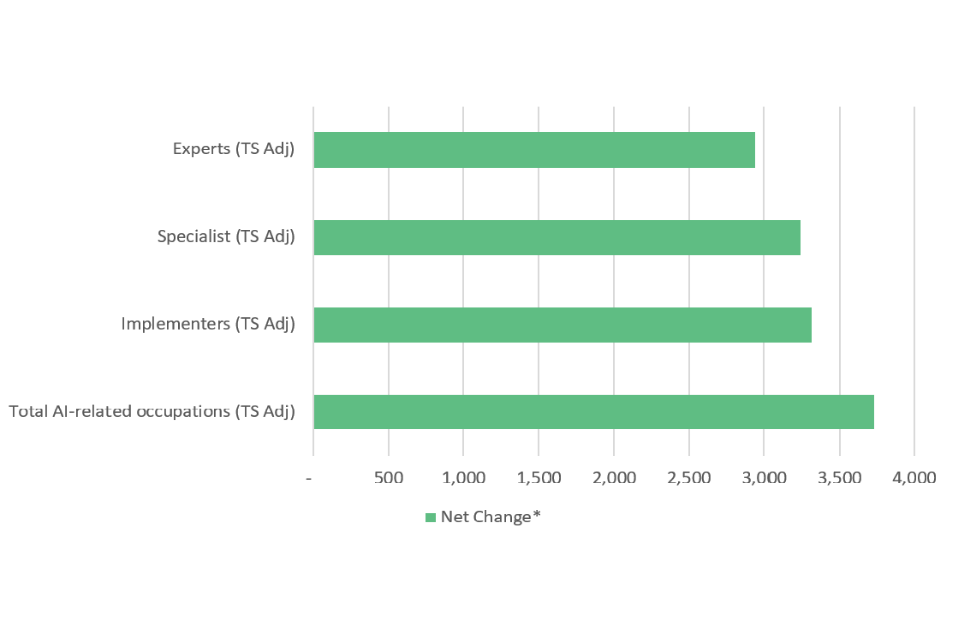
Figure 5.8 shows the projected net changes for the adjusted Technological Opportunities Scenario for Experts, Specialists, Implementers, and the total for all AI-related occupations from 2024 to 2035. It is important to note that the net changes (2024-2035) in these figures refer to the total number of jobs projected to integrate AI activities, regardless of whether the job was newly created due to AI trends or transformed by the inclusion of AI activities.[footnote 9] For Experts, the figure indicates a replacement demand of 2.9 million jobs, suggesting that 2.9 million more jobs will involve AI activities compared to 2024. Similarly, Specialists and Implementers are expected to see net increases of 3.2 million and 3.3 million jobs, respectively. In terms of replacement demand, Implementers are expected to need 1.1 million replacements, followed by Specialists (1 million) and Experts (943,000).
At the four-digit occupational level, Table 8.4 (see Section 8 ‘Appendix B’) shows that the highest net requirements are for Programmers and Software Development Professionals, with around 555,000 jobs, followed by IT Managers (200,000 jobs) and Information Technology Directors (146,000 jobs). In contrast, occupations like Actors, Entertainers, and Presenters have a lower projected increase, with around 6,000 jobs, followed by Public Relations and Communications Directors (5,000 jobs) and Senior Officers in Fire, Ambulance, Prison, and Related Services (3,000 jobs).
Figure 5.8: Total requirements by AI-related occupation in TS adjusted scenario, 2024-2035 (thousands)
Source: IER estimates.
6. Overall conclusions
This report provides a comprehensive analysis of the future labour market for AI-related occupations under four different conditions: Baseline (BS), Automation (AS), Technological Opportunities (TS), and Human-Centric (HS). Across all conditions, Implementers are projected to constitute the largest share of AI-related employment in the UK, followed by Specialists and Experts, which aligns with findings from the vacancy analysis.
Whilst including all four of the Working Future scenarios, particular attention was paid to the Technological Opportunities Scenario, which allowed for the most balanced assessment of the impact of technological developments on job creation and job destruction. The Technological Opportunities Scenario allowed for the effects of a range of technologies, but, with the possible exception of its reference to robotics, did not explicitly deal with the impact of AI. Thus, the main focus of the present research has been on adjusting the existing Technological Opportunities Scenario projections to allow for the impact of AI. This work combined statistics derived from a vacancy search with information about technological developments in AI obtained by interrogating patent data.
While the vacancy search was extremely useful in identifying the overall number of job opportunities relating to AI, it was slightly limited in the level of detail it was able to provide about which AI skills would be needed. On the other hand, the patent data was able to provide information about the large number of keywords relating to the knowledge of skills that were linked to new developments in technology. While it is still in its infancy, this exploratory work using the rich information from the patent dataset demonstrated that it is possible to link the technological developments in AI to subsequent labour market outcomes.
The present exercise analysed how the positive employment outcomes from technological opportunities may be augmented by additional labour demands arising from the development and adoption of AI. As the focus of the present work was on the additional labour demands associated with AI by four-digit occupation, it did not investigate the negative effects of AI technologies through the displacement of other occupations.
Rather than identifying particular skills, the work has attempted to summarise the results in terms of groups of individuals. Of these, the results identify the growing need for AI-skills amongst managerial occupations (managers and directors) in particular. Education and training occupations also show through amongst those where additional AI-related job opportunities will occur. While too much emphasis should not be placed on individual occupations, it is interesting that Other vocational and industrial trainers form the top ranked in terms of the rate of AI employment growth. Occupations relating to quality control and two occupations in the area of arts and culture also stand out.
Despite the fact that the original Working Futures Technological Opportunities Scenario suggested that the labour market would be broadly in equilibrium in 2035 – in the sense that the positive effects of technological opportunities broadly cancel out the negative effects – this conceals an enormous amount of “churn” in the economy. While there is always a considerable number of individuals moving between jobs in the same occupation, the new findings suggest not only a much larger movement across occupations and sectors, but also changes in the skills needed within occupations as new AI skills are needed. For example, in a number of cases (which impacts on the occupational mix of sectors) AI is the first major technology that may impact significantly on the skills mix – as is the case in Education, Legal and accounting activities, Accounting practices, etc. In such cases, all three of the “levels” of AI-skills (Implementers, Specialists and Experts) will be involved.
Although the focus has been on the positive effects of AI and little was said about the negative effects, implications of the additional AI skills needed will be demanding task for the relevant education and training institutions. While, at this stage, it is difficult to be precise about the relative importance of number of jobs within experts’ occupations directly involving AI activities vis a vis those of Specialists and Implementors, the order of magnitude of the overall change of individuals working directly with AI skills is expected to grow from 158,000 to approximately 3.9 million over the period from 2024 to 2035. It seems likely that, despite the fairly long timescale, the demands that will be placed on education and training institutions for AI-skills will be high. In addition, while our results are likely to underestimate the relative importance of Implementers compared with Specialists and Experts because of the early stage of the development of AI, tentative evidence has been provided that this change is already being observed as AI finds increasing numbers of practical applications.
References
Wilson, R, Bosworth, D, Bosworth, L, Cardenas-Rubio, J, Day, R, Patel, S, Bui, H, Lin, X, Seymour, D and Thoung, C (2022a), The Skills Imperative 2035: occupational outlook: long-run employment prospects for the UK, alternative scenarios: working paper 2b, The Skills Imperative 2035 (NFER and Nuffield Foundation), working paper no. 2b, National Foundation for Educational Research, Slough, viewed 29 Aug 2024.
Wilson, R., Bosworth, D., Bosworth, L., Cardenas-Rubio, J., Day, R., Patel, S., Bui, H., Lin, X., Seymour, D., and Thoung, C., (2022b). The Skills Imperative 2035: Occupational Outlook – Long-run employment prospects for the UK, Baseline Projections. Working Paper 2a. Slough: NFER.
7. Appendix A: Operationalising the patent data
7.1. Background
Ideally, this work would make joint use of the technology information from patents along with the results of the vacancy analysis. In practice, the vacancy search did not yield sufficiently detailed delineation of AI-related occupations and skills. Most adverts did not go beyond specifying the need for machine learning, which is generally used as a catchall for a range of AI-related skills. The technology data was more fruitful in this respect as patent specifications require detailed descriptions of the inventions, such that they can be reproduced by someone “skilled in the art” (e.g. sufficiently knowledgeable about AI). In addition, the allocation of the invention to patent classes (areas of technology) is carried out by experts within the field within the patent office.
On the other hand, there is no one-to-one concordance between areas of technology, occupations or sectors. However, patent specifications have to explain the use to which the technology is put, for example, in terms of the “practical application” of the technology. This is especially useful if there is a single technology and the use of the technology is sector-specific – e.g. surgical instruments will be primarily used by the health sector.[footnote 10] As long as the patent specification describes its application in both uses, this should be reflected in the allocation of the invention to both areas and reflected in the results.
7.2. Sectoral breakdown of technological activities
The technologies are allocated as far as possible to the principal sector to which they are associated (in much the same way that enterprises are allocated to sectors according to their principal product in ONS statistics). In general, the allocation process was more problematic for service sectors than for production sectors, such as manufacturing. In addition, certain AI advances can be thought of as “general purpose technologies”, which are not sector-specific in nature and influence the whole of the economy – other examples include electricity and IT.
The allocation of AI to sectors is at the two-digit level, corresponding to the level of disaggregation used in the Working Futures exercise – where projections are available at the level of two-digit sectors by four-digit occupations. The sectors are defined in Table 8.5 (see Section 8 ‘Appendix B’) and Table 8.6 (see Section 8 ‘Appendix B’) provides the results for the penetration rates defined as the proportion of AI-related patents within the total of all patents for each sector. As can be seen from the tables, data have been constructed for 60 two-digit sectors. In certain instances, it has not been possible to separate the results at the two-digit level, but data have been provided either for some combination of two-digit level (e.g. as in the case of sectors 36/37 and 38/39[footnote 11]) or at the one-digit level (e.g. Sections G, I, K and O[footnote 12]). In addition, data at the Section level is provided throughout, except for S, T and U[footnote 13], which form “ragbags” for special, partly non-economic production activities.
It is important to note that, as certain technologies may be relevant to more than one tow-digit sector and, in some cases to more than one Section of the classification, the sum of patents within a Section does not necessarily equal to the reported total. Or, in the case of penetration rates, the average penetration rate for the sector is not necessarily equal to the weighted sum of the two-digit penetration rates.
7.3. Interpretation of the data
The Cooperative Patent Classification (CPC) was introduced in the USA and Europe in 2013, which allowed a consistent patent series for this project to be constructed for 11 years (2013-2023). While 11 years is sufficient to provide evidence of trends over time, it should be remembered that AI was in its infancy in 2013 and is still at an evolutionary phase today. This has important implications for the interpretation of the data in the present context of using it as a precursor for the effects of technology on labour market outcomes.
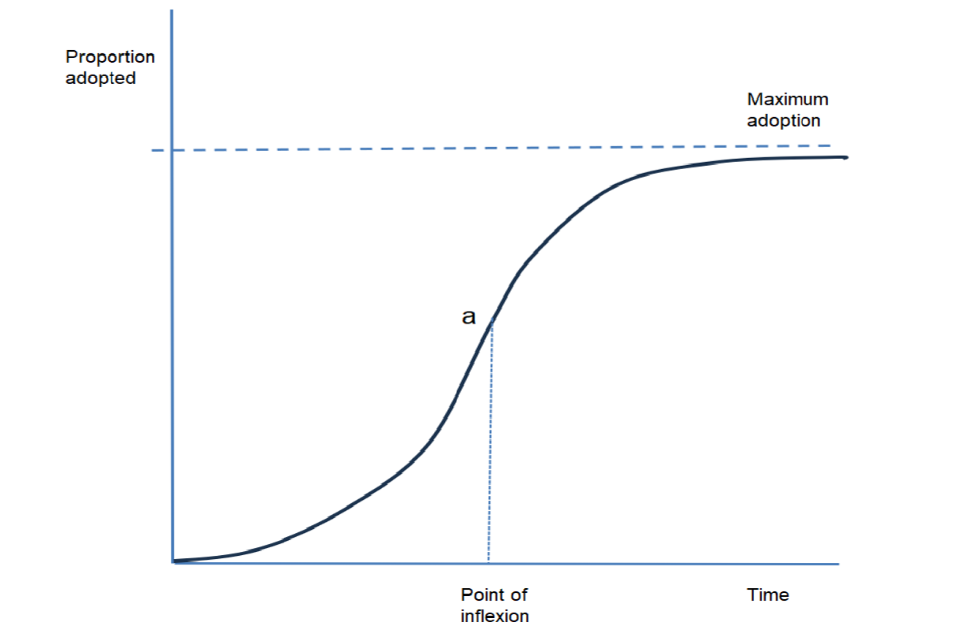
The adoption of technologies (the diffusion process) normally takes on a sigmoidal (S-shaped) pattern over time, as shown in Figure 7.1. There is normally an upper limit to this process which is less than 100% of the totality of potential adopters of the technology, generally caused by some proportion of the potential users continuing to use existing technology (in part because there are some areas of technology where AI is simply not relevant). While this curve is normally associated with the adoption of the technology in the adoption of a new product or process (e.g. driverless cars), it is also anticipated that the same pattern will emerge in the proportion of total patents that are AI-related. Indeed, evidence to this effect is already beginning to be seen in the patent data. In other words.
Figure 7.1: Adoption of a new technology
7.4. Strategy in estimating projected AI values
At this fairly early stage of the development of AI, there are few AI technologies that have reached point a in Figure 7.2 (e.g. the point at which the curve changes from an increasing positive slope to a declining positive slope – the point of inflexion). This makes it hard to identify the precise shape of the curve and, thereby, the maximum value to which it is asymptotic. Thus, if a trend line, such as a polynomial, is fitted to the “exponential” phase (e.g. below point a) and projected forward, this generally leads to projections of over the maximum value even within the projection period (e.g. up to 2035). Even fitting a linear function under these circumstances can lead to projections of over 100%.
Figure 7.2 shows the strategies adopted for the fitting of trends to each of the observed AI-penetration trends. The preferred strategy was to fit a polynomial of order three in Excel. This had a chance of working as long as some part of the curve above point a in Figure 7.2 was observed. If, under these conditions the polynomial still showed exponential growth (and the 100% limit was reached in the same way as a), then a linear trend was imposed using the last four or five years of the observed data (see the polynomial / linear case in Figure 7.2). Finally, for a number of cases – mainly those where little or no AI activity was observed (generally with adoption rates of 5% or less by 2023), then if neither of the above strategies was appropriate, a linear function (labelled linear trend in Figure 7.2) was imposed.
Figure 7.2: Alternative strategies for the fitting of trends in penetration rates

While all the projections were made to 2035, not all of these are necessarily required, insofar as new technologies enter the system with a lag. Hence, a five-year lag would mean that only projections through to 2030 would be needed to adjust labour market data for 2035.
The AI values derived from the patent data were applied to the Technological Opportunities Scenario (TS). This scenario was selected over the others as it is considered the most likely, recognising that while technology will create job opportunities, it will also negatively impact certain roles (see Section 1 above). Additionally, this scenario allows for better addressing some of the potential issues outlined below.
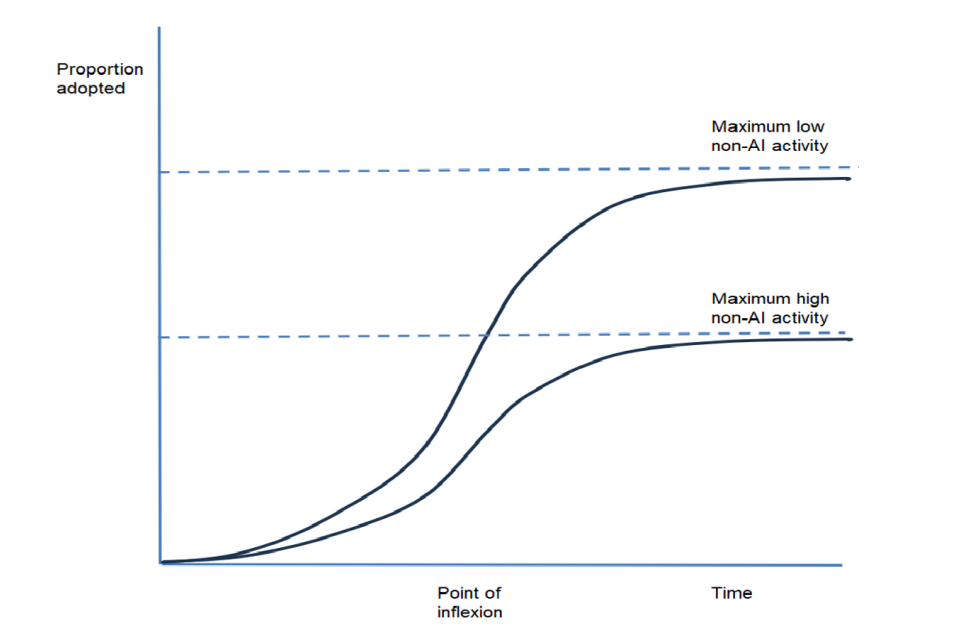
One such issue involves the use of AI penetration rates. Imagine two sectors, one non-technical in nature which, prior to the appearance of AI had activities that were not patentable and thereby a low patenting area (e.g. education) and the other one technical in nature, with activities that have always been patentable and is a high-patenting area (say telecommunications). When AI, which is patentable, appears on the scene the same amount of AI activity in both sectors will give a higher penetration rate in the low patenting area (education) than the high patenting area (telecommunications). Therefore, low AI penetration rates cannot simply be assumed to reflect low levels or slow growth in AI activity.
This suggests that high penetration rates in sectors with significant non-AI activity differ meaningfully from high penetration rates in sectors with less non-AI activity. This shows in a very clear way in the data. For example, when AI-inventions began to appear and were recognised as patentable, then patents relating to education began to emerge and AI formed a high proportion of the total patenting activity. By 2023, AI patents in education formed a third of all patents.
Figure 7.3: Impact of trends in non-AI technologies on penetration rates
While potentially an important aspect of the development of new technologies, it is not something that, as far as we know, has been considered in the context of the diffusion of new products and services on the market. The question is whether it is something that needs to be accounted for here? If the present work was developing a technology scenario for Working Futures that began from the baseline scenario, the answer would be yes, but as the latest Working Futures results contain a “technology scenario”, then the answer is no. The Technological opportunity scenario itself contains adjustment for non-AI activities, but not for AI itself (with the exception perhaps of robotics).
7.5. Adjusting the working futures projections
Practical issues in identifying the role of AI
It is important to note that the nature of the two-digit sectors may mean that the same technology and, hence, the same patent class may be relevant to more than one two-digit sector. Thus, on occasion the allocation of a single patent class is made to two or more sectors if the technology involved is relevant to those two different parts of the classification. The two sectors involved almost invariably occur within the same single-digit Section of the sectoral classification. A case in mind is Human health and social work activities (Section Q at the one-digit level), where Healthcare informatics (G16H of the CPC) is relevant to more than one two-digit sector. For this reason, the sum of two-digit patents within a given one-digit sector can exceed the patent numbers at this more aggregate level because some patents appear more than once.
A related problem – but distinct problem – is that, by searching on patent classes for the purposes of allocating them to two-digit sectors, a given patent might be allocated to more than one class (e.g. a patent might be allocated to Diagnosis; surgery; identification, A61B, and Manipulators; chambers provided with manipulation devices, B25J). Thus, the same patent may be allocated to the health sector (because it contains A61B), but also to mechanical manipulators of some type (because it contains B25J). There is nothing inherently wrong with this, but in future work it may be possible to weight the primary patent class more heavily than the secondary class.
Rate of diffusion of new technologies
Table 7.1 Diffusion into usage
| WF projections | Adoption lag - 5 years | Adoption lag - 7 years | Adoption lag - 9 years |
|---|---|---|---|
| 2013 | not relevant | not relevant | not relevant |
| 2014 | not relevant | not relevant | not relevant |
| 2015 | not relevant | not relevant | not relevant |
| 2016 | not relevant | not relevant | not relevant |
| 2017 | not relevant | not relevant | not relevant |
| 2018 | 2013 | not relevant | not relevant |
| 2019 | 2014 | not relevant | not relevant |
| 2020 | 2015 | 2013 | not relevant |
| 2021 | 2016 | 2014 | not relevant |
| 2022 | 2017 | 2015 | 2013 |
| 2023 | 2018 | 2016 | 2014 |
| 2024 | 2019 | 2017 | 2015 |
| 2025 | 2020 | 2018 | 2016 |
| 2026 | 2021 | 2019 | 2017 |
| 2027 | 2022 | 2020 | 2018 |
| 2028 | 2023 | 2021 | 2019 |
| 2029 | 2024 | 2022 | 2020 |
| 2030 | 2025 | 2023 | 2021 |
| 2031 | 2026 | 2024 | 2022 |
| 2032 | 2027 | 2025 | 2023 |
| 2033 | 2028 | 2026 | 2024 |
| 2034 | 2029 | 2027 | 2025 |
| 2035 | 2030 | 2028 | 2026 |
Note: bolded values are projected
While the patent data can yield a considerable amount of information about the levels and changes in AI activity over time, little is known about the rates at which these new and novel ideas will be translated into practical applications within the economy. At this point in time, the most realistic approach is to assume that the diffusion of new technologies will follow broadly the same pattern as the production of these new technologies, but with a lag. Again, how long that lag might be and how it differs between sectors is unknown. For the present, exploratory exercise, therefore, three scenarios are produced with lags of five, seven and nine years, but in the absence of information about how the lags differ between sectors, it is assumed that all sectors exhibit the same lag, whether this is 5, 7 or 9 years.
Table 7.1 shows how this pans out – the bordered cells show the key years of interest, where four by two-digit Working Futures occupation by sector matrices are available. The shaded areas related to projected values of either the Working Futures forecasts or the technology projections. An initial lag of five years is adopted because of the general lack of knowledge about AI during its earliest years amongst potential adopters. The five-year lag forms the first scenario in the adjustments to the Working Futures projections, followed by two further scenarios involving 7- and 9-year lags. [footnote 14] The longer the lag, the longer it has taken the AI-diffusion process to begin and the earlier the part of the diffusion curve that is relevant within the calculation. At this point in time, there is no empirical evidence as to the actual values of these lags, but this will form a part of our future work in linking patent and employment data.
Estimating rates of diffusion empirically
The methodology outlined in Figure 7.2 yields up to three main empirical estimates of functions that describe the diffusion process in the historical period for each of the two-digit sectors. Given the natural shape of diffusion processes, the preference was for an order three polynomial function[footnote 15], followed by a combined polynomial-linear function, with the least preferred option a simple linear function – the first two of these, broadly speaking, had the ability to represent the ‘S-shape’ of the diffusion process.
Which of these functions was chosen in the final analysis was determined by both the fit of the function within the historical period and the ability of the resulting function to produce acceptable projections into the future. Finally, vacancy data was used for two purposes. First, as previously mentioned, it provides insight into the occupational groups related to AI. Second, the results of the vacancy analysis were used to estimate the potential employment at the four-digit level in 2024 for jobs already involving AI activities. These results were then combined with the functions identified in the patent data to project employment trends from 2024 to 2035.
8. Appendix B: detailed results
Table 8.1: Employment levels for AI-related occupations 2024 - 2035
| All AI-related occupations | BS | AS | TS | HS | ||||||||
|---|---|---|---|---|---|---|---|---|---|---|---|---|
| Levels (000s) | 2024 | 2030 | 2035 | 2024 | 2030 | 2035 | 2024 | 2030 | 2035 | 2024 | 2030 | 2035 |
| 1121 Production managers and directors in manufacturing | 268 | 283 | 296 | 263 | 268 | 271 | 268 | 279 | 287 | 268 | 278 | 286 |
| 1131 Financial managers and directors | 344 | 364 | 381 | 339 | 344 | 348 | 345 | 359 | 370 | 344 | 357 | 368 |
| 1132 Marketing, sales and advertising directors | 278 | 294 | 307 | 273 | 278 | 281 | 278 | 289 | 298 | 278 | 288 | 297 |
| 1133 Public relations and communications directors | 14 | 15 | 16 | 14 | 14 | 15 | 14 | 15 | 15 | 14 | 15 | 15 |
| 1136 Human resource managers and directors | 247 | 261 | 273 | 243 | 247 | 250 | 247 | 257 | 265 | 247 | 256 | 264 |
| 1137 Information technology directors | 194 | 205 | 215 | 191 | 194 | 197 | 195 | 202 | 209 | 194 | 202 | 208 |
| 1150 Managers and directors in retail and wholesale | 304 | 322 | 337 | 299 | 305 | 308 | 305 | 317 | 327 | 304 | 316 | 325 |
| 1163 Senior officers in fire, ambulance, prison and related services | 15 | 16 | 17 | 15 | 15 | 16 | 16 | 16 | 17 | 15 | 16 | 17 |
| 1171 Health services and public health managers and directors | 58 | 61 | 64 | 57 | 58 | 58 | 58 | 60 | 62 | 58 | 60 | 61 |
| 1259 Managers and proprietors in other services n.e.c. | 153 | 167 | 180 | 151 | 160 | 167 | 154 | 167 | 178 | 154 | 166 | 176 |
| 2112 Biological scientists | 30 | 32 | 33 | 31 | 34 | 37 | 31 | 35 | 38 | 31 | 35 | 39 |
| 2114 Physical scientists | 30 | 32 | 34 | 31 | 35 | 38 | 32 | 36 | 39 | 32 | 36 | 40 |
| 2115 Social and humanities scientists | 42 | 45 | 47 | 43 | 48 | 52 | 44 | 49 | 54 | 44 | 50 | 55 |
| 2121 Civil engineers | 121 | 129 | 136 | 125 | 140 | 151 | 126 | 143 | 157 | 127 | 145 | 159 |
| 2122 Mechanical engineers | 77 | 82 | 86 | 79 | 89 | 96 | 80 | 91 | 100 | 81 | 92 | 101 |
| 2123 Electrical engineers | 34 | 36 | 38 | 35 | 39 | 42 | 35 | 40 | 44 | 36 | 41 | 45 |
| 2124 Electronics engineers | 39 | 42 | 44 | 41 | 45 | 49 | 41 | 47 | 51 | 41 | 47 | 52 |
| 2125 Production and process engineers | 39 | 42 | 44 | 41 | 45 | 49 | 41 | 47 | 51 | 41 | 47 | 52 |
| 2126 Aerospace engineers | 25 | 26 | 28 | 26 | 29 | 31 | 26 | 29 | 32 | 26 | 30 | 33 |
| 2131 IT project managers | 120 | 128 | 135 | 124 | 138 | 150 | 125 | 142 | 155 | 126 | 143 | 158 |
| 2132 IT managers | 209 | 223 | 235 | 216 | 241 | 261 | 218 | 247 | 271 | 219 | 250 | 275 |
| 2133 IT business analysts, architects and systems designers | 147 | 157 | 165 | 152 | 170 | 184 | 154 | 174 | 191 | 154 | 176 | 194 |
| 2134 Programmers and software development professionals | 491 | 523 | 551 | 506 | 566 | 613 | 512 | 580 | 636 | 514 | 586 | 646 |
| 2135 Cyber security professionals | 36 | 38 | 40 | 37 | 41 | 44 | 37 | 42 | 46 | 37 | 43 | 47 |
| 2136 IT quality and testing professionals | 34 | 36 | 38 | 35 | 39 | 42 | 35 | 40 | 44 | 36 | 40 | 45 |
| 2137 IT network professionals | 35 | 37 | 39 | 36 | 40 | 43 | 36 | 41 | 45 | 36 | 41 | 45 |
| 2141 Web design professionals | 34 | 36 | 38 | 35 | 39 | 42 | 35 | 40 | 44 | 35 | 40 | 44 |
| 2142 Graphic and multimedia designers | 107 | 114 | 120 | 110 | 123 | 134 | 112 | 127 | 139 | 112 | 128 | 141 |
| 2161 Research and development (R&D) managers | 101 | 108 | 114 | 104 | 117 | 126 | 106 | 120 | 131 | 106 | 121 | 133 |
| 2162 Other researchers, unspecified discipline | 60 | 64 | 68 | 62 | 69 | 75 | 63 | 71 | 78 | 63 | 72 | 79 |
| 2226 Other psychologists | 34 | 36 | 38 | 34 | 36 | 38 | 35 | 38 | 40 | 35 | 38 | 40 |
| 2311 Higher education teaching professionals | 261 | 276 | 288 | 262 | 275 | 286 | 266 | 284 | 300 | 266 | 285 | 301 |
| 2313 Secondary education teaching professionals | 524 | 553 | 577 | 525 | 552 | 574 | 534 | 571 | 602 | 534 | 572 | 604 |
| 2319 Teaching professionals n.e.c. | 140 | 147 | 154 | 140 | 147 | 153 | 142 | 152 | 160 | 142 | 152 | 161 |
| 2322 Education managers | 75 | 79 | 83 | 75 | 79 | 82 | 76 | 82 | 86 | 76 | 82 | 86 |
| 2412 Solicitors and lawyers | 211 | 226 | 239 | 207 | 213 | 217 | 210 | 221 | 230 | 210 | 221 | 230 |
| 2421 Chartered and certified accountants | 219 | 235 | 249 | 215 | 221 | 226 | 219 | 230 | 239 | 219 | 230 | 239 |
| 2422 Finance and investment analysts and advisers | 310 | 332 | 352 | 304 | 313 | 319 | 309 | 325 | 338 | 309 | 325 | 338 |
| 2431 Management consultants and business analysts | 197 | 212 | 224 | 194 | 199 | 203 | 197 | 207 | 215 | 197 | 207 | 215 |
| 2432 Marketing and commercial managers | 111 | 119 | 126 | 109 | 112 | 114 | 110 | 116 | 121 | 110 | 116 | 121 |
| 2433 Actuaries, economists and statisticians | 92 | 99 | 105 | 91 | 93 | 95 | 92 | 97 | 101 | 92 | 97 | 101 |
| 2434 Business and related research professionals | 72 | 77 | 81 | 70 | 72 | 74 | 71 | 75 | 78 | 71 | 75 | 78 |
| 2439 Business, research and administrative professionals n.e.c. | 91 | 97 | 103 | 89 | 92 | 94 | 91 | 95 | 99 | 91 | 95 | 99 |
| 2440 Business and financial project management professionals | 268 | 287 | 304 | 263 | 270 | 276 | 267 | 281 | 292 | 267 | 281 | 292 |
| 2481 Quality control and planning engineers | 47 | 51 | 53 | 46 | 48 | 49 | 47 | 49 | 51 | 47 | 49 | 51 |
| 2482 Quality assurance and regulatory professionals | 122 | 131 | 139 | 120 | 124 | 126 | 122 | 128 | 133 | 122 | 128 | 134 |
| 3113 Engineering technicians | 48 | 50 | 52 | 51 | 57 | 63 | 52 | 62 | 70 | 51 | 59 | 66 |
| 3119 Science, engineering and production technicians n.e.c. | 42 | 44 | 46 | 44 | 51 | 55 | 46 | 55 | 62 | 45 | 52 | 58 |
| 3120 CAD, drawing and architectural technicians | 77 | 80 | 83 | 81 | 92 | 100 | 83 | 99 | 112 | 82 | 95 | 106 |
| 3131 IT operations technicians | 119 | 124 | 129 | 126 | 143 | 156 | 130 | 154 | 175 | 128 | 148 | 165 |
| 3132 IT user support technicians | 100 | 105 | 108 | 106 | 120 | 132 | 109 | 130 | 147 | 107 | 124 | 139 |
| 3133 Database administrators and web content technicians | 75 | 78 | 81 | 79 | 90 | 99 | 82 | 97 | 110 | 80 | 93 | 104 |
| 3213 Medical and dental technicians | 33 | 35 | 37 | 34 | 37 | 39 | 34 | 38 | 42 | 34 | 38 | 42 |
| 3412 Authors, writers and translators | 123 | 132 | 139 | 121 | 122 | 123 | 123 | 127 | 130 | 123 | 127 | 130 |
| 3413 Actors, entertainers and presenters | 43 | 46 | 48 | 42 | 43 | 43 | 43 | 44 | 46 | 43 | 44 | 45 |
| 3429 Design occupations n.e.c. | 25 | 27 | 28 | 25 | 25 | 25 | 25 | 26 | 27 | 25 | 26 | 27 |
| 3534 Financial accounts managers | 143 | 147 | 150 | 139 | 136 | 132 | 142 | 141 | 140 | 142 | 141 | 140 |
| 3543 Project support officers | 42 | 43 | 44 | 41 | 40 | 39 | 42 | 41 | 41 | 42 | 41 | 41 |
| 3544 Data analysts | 123 | 127 | 129 | 120 | 117 | 114 | 122 | 122 | 121 | 122 | 122 | 121 |
| 3551 Buyers and procurement officers | 81 | 83 | 85 | 79 | 77 | 75 | 81 | 80 | 80 | 81 | 80 | 80 |
| 3552 Business sales executives | 139 | 143 | 146 | 135 | 132 | 128 | 138 | 137 | 136 | 138 | 137 | 136 |
| 3554 Marketing associate professionals | 158 | 162 | 166 | 154 | 150 | 146 | 157 | 156 | 155 | 157 | 156 | 155 |
| 3556 Sales accounts and business development managers | 268 | 275 | 282 | 262 | 255 | 248 | 266 | 265 | 263 | 266 | 265 | 263 |
| 3571 Human resources and industrial relations officers | 167 | 171 | 175 | 163 | 158 | 155 | 166 | 165 | 163 | 166 | 165 | 163 |
| 3574 Other vocational and industrial trainers | 183 | 188 | 192 | 179 | 174 | 169 | 182 | 181 | 179 | 182 | 181 | 179 |
| 5244 Computer system and equipment installers and servicers | 53 | 51 | 50 | 52 | 48 | 44 | 53 | 50 | 47 | 53 | 49 | 46 |
| Total | 8,499 | 8,988 | 9,407 | 8,488 | 8,881 | 9,184 | 8,633 | 9,223 | 9,705 | 8,628 | 9,213 | 9,695 |
Table 8.2: Total requirements by AI-related occupation compared across scenarios, 2024-2035
| All AI-related occupations | BS | AS | TS | HS | ||||
|---|---|---|---|---|---|---|---|---|
| Levels (000s) | Net Change | Replacement Demand level | Net Change | Replacement Demand level | Net Change | Replacement Demand level | Net Change | Replacement Demand level |
| 1121 Production managers and directors in manufacturing | 29 | 110 | 8 | 104 | 19 | 108 | 18 | 108 |
| 1131 Financial managers and directors | 37 | 141 | 10 | 134 | 25 | 139 | 24 | 139 |
| 1132 Marketing, sales and advertising directors | 30 | 114 | 8 | 108 | 20 | 112 | 19 | 112 |
| 1133 Public relations and communications directors | 2 | 6 | 0 | 6 | 1 | 6 | 1 | 6 |
| 1136 Human resource managers and directors | 26 | 101 | 7 | 96 | 18 | 100 | 17 | 99 |
| 1137 Information technology directors | 21 | 80 | 5 | 75 | 14 | 78 | 13 | 78 |
| 1150 Managers and directors in retail and wholesale | 33 | 125 | 9 | 118 | 22 | 123 | 21 | 123 |
| 1163 Senior officers in fire, ambulance, prison and related services | 2 | 6 | 0 | 6 | 1 | 6 | 1 | 6 |
| 1171 Health services and public health managers and directors | 6 | 24 | 2 | 22 | 4 | 23 | 4 | 23 |
| 1259 Managers and proprietors in other services n.e.c. | 27 | 71 | 16 | 68 | 24 | 71 | 22 | 70 |
| 2112 Biological scientists | 4 | 9 | 6 | 10 | 8 | 10 | 8 | 10 |
| 2114 Physical scientists | 4 | 9 | 7 | 10 | 8 | 10 | 8 | 10 |
| 2115 Social and humanities scientists | 5 | 13 | 9 | 14 | 11 | 14 | 11 | 14 |
| 2121 Civil engineers | 15 | 37 | 26 | 40 | 31 | 41 | 33 | 41 |
| 2122 Mechanical engineers | 10 | 23 | 17 | 25 | 19 | 26 | 21 | 26 |
| 2123 Electrical engineers | 4 | 10 | 7 | 11 | 9 | 11 | 9 | 12 |
| 2124 Electronics engineers | 5 | 12 | 9 | 13 | 10 | 13 | 11 | 13 |
| 2125 Production and process engineers | 5 | 12 | 9 | 13 | 10 | 13 | 11 | 13 |
| 2126 Aerospace engineers | 3 | 7 | 5 | 8 | 6 | 8 | 7 | 8 |
| 2131 IT project managers | 15 | 36 | 26 | 39 | 30 | 40 | 32 | 41 |
| 2132 IT managers | 26 | 63 | 45 | 68 | 53 | 70 | 56 | 71 |
| 2133 IT business analysts, architects and systems designers | 18 | 44 | 32 | 48 | 37 | 49 | 40 | 50 |
| 2134 Programmers and software development professionals | 61 | 148 | 106 | 160 | 124 | 164 | 132 | 166 |
| 2135 Cyber security professionals | 4 | 11 | 8 | 12 | 9 | 12 | 10 | 12 |
| 2136 IT quality and testing professionals | 4 | 10 | 7 | 11 | 9 | 11 | 9 | 11 |
| 2137 IT network professionals | 4 | 10 | 7 | 11 | 9 | 12 | 9 | 12 |
| 2141 Web design professionals | 4 | 10 | 7 | 11 | 8 | 11 | 9 | 11 |
| 2142 Graphic and multimedia designers | 13 | 32 | 23 | 35 | 27 | 36 | 29 | 36 |
| 2161 Research and development (R&D) managers | 13 | 31 | 22 | 33 | 26 | 34 | 27 | 34 |
| 2162 Other researchers, unspecified discipline | 7 | 18 | 13 | 20 | 15 | 20 | 16 | 20 |
| 2226 Other psychologists | 4 | 15 | 3 | 14 | 5 | 15 | 5 | 15 |
| 2311 Higher education teaching professionals | 26 | 105 | 24 | 105 | 34 | 109 | 35 | 109 |
| 2313 Secondary education teaching professionals | 53 | 211 | 48 | 211 | 68 | 218 | 70 | 219 |
| 2319 Teaching professionals n.e.c. | 14 | 56 | 13 | 56 | 18 | 58 | 19 | 58 |
| 2322 Education managers | 8 | 30 | 7 | 30 | 10 | 31 | 10 | 31 |
| 2412 Solicitors and lawyers | 29 | 81 | 10 | 77 | 19 | 79 | 19 | 79 |
| 2421 Chartered and certified accountants | 30 | 84 | 11 | 80 | 20 | 83 | 20 | 83 |
| 2422 Finance and investment analysts and advisers | 42 | 119 | 15 | 113 | 28 | 117 | 28 | 117 |
| 2431 Management consultants and business analysts | 27 | 76 | 10 | 72 | 18 | 74 | 18 | 74 |
| 2432 Marketing and commercial managers | 15 | 43 | 6 | 40 | 10 | 42 | 10 | 42 |
| 2433 Actuaries, economists and statisticians | 13 | 36 | 5 | 34 | 8 | 35 | 8 | 35 |
| 2434 Business and related research professionals | 10 | 28 | 4 | 26 | 7 | 27 | 7 | 27 |
| 2439 Business, research and administrative professionals n.e.c. | 12 | 35 | 5 | 33 | 8 | 34 | 8 | 34 |
| 2440 Business and financial project management professionals | 37 | 103 | 13 | 97 | 24 | 101 | 25 | 101 |
| 2481 Quality control and planning engineers | 6 | 18 | 2 | 17 | 4 | 18 | 4 | 18 |
| 2482 Quality assurance and regulatory professionals | 17 | 47 | 6 | 45 | 11 | 46 | 11 | 46 |
| 3113 Engineering technicians | 4 | 16 | 12 | 18 | 18 | 19 | 15 | 18 |
| 3119 Science, engineering and production technicians n.e.c. | 3 | 14 | 11 | 16 | 16 | 17 | 13 | 16 |
| 3120 CAD, drawing and architectural technicians | 6 | 25 | 20 | 28 | 29 | 31 | 24 | 29 |
| 3131 IT operations technicians | 10 | 39 | 31 | 44 | 45 | 48 | 37 | 46 |
| 3132 IT user support technicians | 8 | 33 | 26 | 37 | 38 | 40 | 31 | 38 |
| 3133 Database administrators and web content technicians | 6 | 24 | 19 | 28 | 29 | 30 | 24 | 29 |
| 3213 Medical and dental technicians | 4 | 15 | 6 | 16 | 8 | 16 | 7 | 16 |
| 3412 Authors, writers and translators | 15 | 46 | 2 | 43 | 7 | 45 | 7 | 45 |
| 3413 Actors, entertainers and presenters | 5 | 16 | 1 | 15 | 3 | 16 | 3 | 16 |
| 3429 Design occupations n.e.c. | 3 | 10 | 0 | 9 | 2 | 9 | 1 | 9 |
| 3534 Financial accounts managers | 7 | 51 | -7 | 47 | -2 | 49 | -2 | 49 |
| 3543 Project support officers | 2 | 15 | -2 | 14 | -1 | 14 | -1 | 14 |
| 3544 Data analysts | 6 | 44 | -6 | 41 | -2 | 42 | -2 | 42 |
| 3551 Buyers and procurement officers | 4 | 29 | -4 | 27 | -1 | 28 | -1 | 28 |
| 3552 Business sales executives | 7 | 50 | -7 | 46 | -2 | 48 | -2 | 48 |
| 3554 Marketing associate professionals | 8 | 57 | -8 | 52 | -2 | 54 | -2 | 54 |
| 3556 Sales accounts and business development managers | 14 | 96 | -13 | 89 | -3 | 92 | -3 | 92 |
| 3571 Human resources and industrial relations officers | 9 | 60 | -8 | 55 | -2 | 57 | -2 | 58 |
| 3574 Other vocational and industrial trainers | 10 | 66 | -9 | 61 | -2 | 63 | -2 | 63 |
| 5244 Computer system and equipment installers and servicers | -3 | 15 | -8 | 14 | -6 | 14 | -6 | 14 |
| Total | 908 | 3,129 | 696 | 3,077 | 1,072 | 3,193 | 1,067 | 3,193 |
Table 8.3: Employment levels for AI-related occupations 2024 - 2035 (experimental approach)
| All AI-related occupations | TS (unadjusted) | TS (adjusted) | ||||
|---|---|---|---|---|---|---|
| Levels (000s) | 2024 | 2030 | 2035 | 2024 | 2030 | 2035 |
| 1121 Production managers and directors in manufacturing | 268 | 279 | 287 | 2.6 | 58.8 | 73.9 |
| 1131 Financial managers and directors | 345 | 359 | 370 | 2.0 | 67.6 | 82.7 |
| 1132 Marketing, sales and advertising directors | 278 | 289 | 298 | 1.7 | 53.9 | 65.7 |
| 1133 Public relations and communications directors | 14 | 15 | 15 | 0.1 | 3.8 | 5.2 |
| 1136 Human resource managers and directors | 247 | 257 | 265 | 1.0 | 52.4 | 65.3 |
| 1137 Information technology directors | 195 | 202 | 209 | 2.6 | 86.8 | 148.4 |
| 1150 Managers and directors in retail and wholesale | 305 | 317 | 327 | 0.4 | 60.8 | 74.7 |
| 1163 Senior officers in fire, ambulance, prison and related services | 16 | 16 | 17 | 0.3 | 2.7 | 3.2 |
| 1171 Health services and public health managers and directors | 58 | 60 | 62 | 0.0 | 17.4 | 24.2 |
| 1259 Managers and proprietors in other services n.e.c. | 154 | 167 | 178 | 0.7 | 30.6 | 36.9 |
| 2112 Biological scientists | 31 | 35 | 38 | 0.1 | 10.7 | 14.8 |
| 2114 Physical scientists | 32 | 36 | 39 | 0.1 | 11.3 | 16.0 |
| 2115 Social and humanities scientists | 44 | 49 | 54 | 0.1 | 10.8 | 13.5 |
| 2121 Civil engineers | 126 | 143 | 157 | 0.4 | 50.2 | 73.8 |
| 2122 Mechanical engineers | 80 | 91 | 100 | 0.8 | 34.6 | 53.0 |
| 2123 Electrical engineers | 35 | 40 | 44 | 0.2 | 15.6 | 24.2 |
| 2124 Electronics engineers | 41 | 47 | 51 | 0.7 | 18.3 | 28.6 |
| 2125 Production and process engineers | 41 | 47 | 51 | 0.3 | 17.4 | 26.5 |
| 2126 Aerospace engineers | 26 | 29 | 32 | 0.0 | 11.6 | 18.2 |
| 2131 IT project managers | 125 | 142 | 155 | 2.1 | 63.8 | 108.5 |
| 2132 IT managers | 218 | 247 | 271 | 3.1 | 116.1 | 203.3 |
| 2133 IT business analysts, architects and systems designers | 154 | 174 | 191 | 4.7 | 83.1 | 147.1 |
| 2134 Programmers and software development professionals | 512 | 580 | 636 | 17.0 | 301.3 | 572.4 |
| 2135 Cyber security professionals | 37 | 42 | 46 | 0.4 | 21.7 | 40.9 |
| 2136 IT quality and testing professionals | 35 | 40 | 44 | 0.4 | 19.7 | 35.6 |
| 2137 IT network professionals | 36 | 41 | 45 | 0.4 | 19.4 | 34.2 |
| 2141 Web design professionals | 35 | 40 | 44 | 0.7 | 17.0 | 27.7 |
| 2142 Graphic and multimedia designers | 112 | 127 | 139 | 0.8 | 52.7 | 84.8 |
| 2161 Research and development (R&D) managers | 106 | 120 | 131 | 1.4 | 49.1 | 78.6 |
| 2162 Other researchers, unspecified discipline | 63 | 71 | 78 | 3.8 | 23.8 | 34.3 |
| 2226 Other psychologists | 35 | 38 | 40 | 0.0 | 6.7 | 8.0 |
| 2311 Higher education teaching professionals | 266 | 284 | 300 | 4.9 | 48.1 | 57.2 |
| 2313 Secondary education teaching professionals | 534 | 571 | 602 | 1.7 | 100.3 | 120.4 |
| 2319 Teaching professionals n.e.c. | 142 | 152 | 160 | 0.7 | 20.9 | 24.0 |
| 2322 Education managers | 76 | 82 | 86 | 0.3 | 14.9 | 18.1 |
| 2412 Solicitors and lawyers | 210 | 221 | 230 | 0.7 | 33.0 | 38.6 |
| 2421 Chartered and certified accountants | 219 | 230 | 239 | 2.8 | 51.3 | 65.3 |
| 2422 Finance and investment analysts and advisers | 309 | 325 | 338 | 4.8 | 91.2 | 124.9 |
| 2431 Management consultants and business analysts | 197 | 207 | 215 | 1.0 | 49.6 | 64.5 |
| 2432 Marketing and commercial managers | 110 | 116 | 121 | 5.1 | 23.0 | 28.4 |
| 2433 Actuaries, economists and statisticians | 92 | 97 | 101 | 3.6 | 28.7 | 40.1 |
| 2434 Business and related research professionals | 71 | 75 | 78 | 2.2 | 15.5 | 19.3 |
| 2439 Business, research and administrative professionals n.e.c. | 91 | 95 | 99 | 0.8 | 22.1 | 28.4 |
| 2440 Business and financial project management professionals | 267 | 281 | 292 | 8.2 | 55.6 | 68.7 |
| 2481 Quality control and planning engineers | 47 | 49 | 51 | 0.2 | 13.9 | 19.2 |
| 2482 Quality assurance and regulatory professionals | 122 | 128 | 133 | 0.4 | 22.2 | 26.6 |
| 3113 Engineering technicians | 52 | 62 | 70 | 0.2 | 20.0 | 28.0 |
| 3119 Science, engineering and production technicians n.e.c. | 46 | 55 | 62 | 0.1 | 20.9 | 31.6 |
| 3120 CAD, drawing and architectural technicians | 83 | 99 | 112 | 0.0 | 37.8 | 57.1 |
| 3131 IT operations technicians | 130 | 154 | 175 | 1.7 | 72.7 | 124.3 |
| 3132 IT user support technicians | 109 | 130 | 147 | 0.7 | 55.7 | 89.7 |
| 3133 Database administrators and web content technicians | 82 | 97 | 110 | 3.4 | 42.1 | 68.2 |
| 3213 Medical and dental technicians | 34 | 38 | 42 | 0.0 | 11.8 | 16.4 |
| 3412 Authors, writers and translators | 123 | 127 | 130 | 0.8 | 20.8 | 24.7 |
| 3413 Actors, entertainers and presenters | 43 | 44 | 46 | 0.0 | 5.3 | 6.0 |
| 3429 Design occupations n.e.c. | 25 | 26 | 27 | 0.0 | 8.9 | 13.2 |
| 3534 Financial accounts managers | 142 | 141 | 140 | 0.3 | 40.7 | 57.4 |
| 3543 Project support officers | 42 | 41 | 41 | 0.2 | 10.8 | 14.6 |
| 3544 Data analysts | 122 | 122 | 121 | 54.9 | 85.9 | 100.4 |
| 3551 Buyers and procurement officers | 81 | 80 | 80 | 0.2 | 18.9 | 24.8 |
| 3552 Business sales executives | 138 | 137 | 136 | 2.3 | 22.7 | 27.2 |
| 3554 Marketing associate professionals | 157 | 156 | 155 | 1.3 | 38.5 | 51.2 |
| 3556 Sales accounts and business development managers | 266 | 265 | 263 | 2.4 | 45.6 | 55.2 |
| 3571 Human resources and industrial relations officers | 166 | 165 | 163 | 0.5 | 38.6 | 50.5 |
| 3574 Other vocational and industrial trainers | 182 | 181 | 179 | 1.0 | 41.3 | 53.7 |
| 5244 Computer system and equipment installers and servicers | 53 | 50 | 47 | 2.2 | 16.1 | 24.4 |
| Total | 8,633 | 9,223 | 9,705 | 158 | 2,635 | 3,886 |
Table 8.4: Total requirements by AI-related occupation in TS adjusted scenario, 2024-2035
| All AI-related occupations | TS (adjusted) |
|---|---|
| Levels (000s) | Net Change* |
| 1121 Production managers and directors in manufacturing | 71 |
| 1131 Financial managers and directors | 81 |
| 1132 Marketing, sales and advertising directors | 64 |
| 1133 Public relations and communications directors | 5 |
| 1136 Human resource managers and directors | 64 |
| 1137 Information technology directors | 146 |
| 1150 Managers and directors in retail and wholesale | 74 |
| 1163 Senior officers in fire, ambulance, prison and related services | 3 |
| 1171 Health services and public health managers and directors | 24 |
| 1259 Managers and proprietors in other services n.e.c. | 36 |
| 2112 Biological scientists | 15 |
| 2114 Physical scientists | 16 |
| 2115 Social and humanities scientists | 13 |
| 2121 Civil engineers | 73 |
| 2122 Mechanical engineers | 52 |
| 2123 Electrical engineers | 24 |
| 2124 Electronics engineers | 28 |
| 2125 Production and process engineers | 26 |
| 2126 Aerospace engineers | 18 |
| 2131 IT project managers | 106 |
| 2132 IT managers | 200 |
| 2133 IT business analysts, architects and systems designers | 142 |
| 2134 Programmers and software development professionals | 555 |
| 2135 Cyber security professionals | 41 |
| 2136 IT quality and testing professionals | 35 |
| 2137 IT network professionals | 34 |
| 2141 Web design professionals | 27 |
| 2142 Graphic and multimedia designers | 84 |
| 2161 Research and development (R&D) managers | 77 |
| 2162 Other researchers, unspecified discipline | 31 |
| 2226 Other psychologists | 8 |
| 2311 Higher education teaching professionals | 52 |
| 2313 Secondary education teaching professionals | 119 |
| 2319 Teaching professionals n.e.c. | 23 |
| 2322 Education managers | 18 |
| 2412 Solicitors and lawyers | 38 |
| 2421 Chartered and certified accountants | 62 |
| 2422 Finance and investment analysts and advisers | 120 |
| 2431 Management consultants and business analysts | 63 |
| 2432 Marketing and commercial managers | 23 |
| 2433 Actuaries, economists and statisticians | 36 |
| 2434 Business and related research professionals | 17 |
| 2439 Business, research and administrative professionals n.e.c. | 28 |
| 2440 Business and financial project management professionals | 60 |
| 2481 Quality control and planning engineers | 19 |
| 2482 Quality assurance and regulatory professionals | 26 |
| 3113 Engineering technicians | 28 |
| 3119 Science, engineering and production technicians n.e.c. | 32 |
| 3120 CAD, drawing and architectural technicians | 57 |
| 3131 IT operations technicians | 123 |
| 3132 IT user support technicians | 89 |
| 3133 Database administrators and web content technicians | 65 |
| 3213 Medical and dental technicians | 16 |
| 3412 Authors, writers and translators | 24 |
| 3413 Actors, entertainers and presenters | 6 |
| 3429 Design occupations n.e.c. | 13 |
| 3534 Financial accounts managers | 57 |
| 3543 Project support officers | 14 |
| 3544 Data analysts | 46 |
| 3551 Buyers and procurement officers | 25 |
| 3552 Business sales executives | 25 |
| 3554 Marketing associate professionals | 50 |
| 3556 Sales accounts and business development managers | 53 |
| 3571 Human resources and industrial relations officers | 50 |
| 3574 Other vocational and industrial trainers | 53 |
| 5244 Computer system and equipment installers and servicers | 22 |
| Total | 3,728 |
Table 8.5: Two-digit sectors
| Section | Industries |
|---|---|
| Section A | Agriculture |
| 01 | Crop and animal production, hunting and related service activities |
| 02 | Forestry and logging |
| 03 | Fishing and aquaculture |
| Section B | Mining and Quarrying |
| 05 | Mining of coal and lignite |
| 06 | Extraction of crude petroleum and natural gas |
| 07 | Mining of metal ores |
| 08 | Other mining and quarrying |
| 09 | Mining support service activities (G06Q 50/02 only (systems for mining*) |
| (used mining key words to assign to mining) | |
| Section C | Manufacturing |
| 10 | Manufacture of food products |
| 11 | Manufacture of beverages |
| 12 | Manufacture of tobacco products |
| 13 | Manufacture of textiles |
| 14 | Manufacture of wearing apparel |
| 15 | Manufacture of leather and related products |
| 16 | Manufacture of wood and of products of wood and cork, except furniture; manufacture of articles of straw and plaiting materials |
| 17 | Manufacture of paper and paper products |
| 18 | Printing and reproduction of recorded media |
| 19 | Manufacture of coke and refined petroleum products |
| 20 | Manufacture of chemicals and chemical products |
| 21 | Manufacture of basic pharmaceutical products and pharmaceutical preparations |
| 22 | Manufacture of rubber and plastic products |
| 23 | Manufacture of other non-metallic mineral products |
| 24 | Manufacture of basic metals |
| 25 | Manufacture of fabricated metal products, except machinery and equipment |
| 26 | Manufacture of computer, electronic and optical products |
| 27 | Manufacture of electrical equipment |
| 28 | Manufacture of machinery and equipment n.e.c. |
| 29 | Manufacture of motor vehicles, trailers and semi-trailers |
| 30 | Manufacture of other transport equipment |
| 31 | Manufacture of furniture |
| 32 | Other manufacturing |
| 33 | Repair and installation of machinery and equipment |
| Section D | ELECTRICITY, GAS, STEAM AND AIR CONDITIONING SUPPLY |
| 35 | Electricity, gas, steam and air conditioning supply |
| Section E | WATER SUPPLY; SEWERAGE, WASTE MANAGEMENT AND REMEDIATION ACTIVITIES |
| 36 and 37 | Water collection, treatment and supply and Sewerage |
| 38 and 39 | Waste collection, treatment and disposal activities; materials recovery and Remediation activities and other waste management services |
| Section F | CONSTRUCTION |
| 41 | Construction of buildings |
| 42 | Civil engineering |
| 43 | Specialised construction activities |
| Section G | WHOLESALE AND RETAIL TRADE; REPAIR OF MOTOR VEHICLES, MOTORCYCLES |
| 45 | Wholesale and retail trade and repair of motor vehicles and motorcycles |
| 46 | Wholesale trade, except of motor vehicles and motorcycles |
| 47 | Retail trade, except of motor vehicles and motorcycles |
| Section H | TRANSPORTATION AND STORAGE |
| 49 | Land transport and transport via pipelines |
| 50 | Water transport |
| 51 | Air transport |
| 52 | Warehousing and support activities for transportation |
| 53 | Postal and courier activities |
| Section I | ACCOMMODATION AND FOOD SERVICE ACTIVITIES |
| 55 | Accommodation |
| 56 | Food and beverage service activities |
| Section J | INFORMATION AND COMMUNICATION |
| 58 | Publishing activities |
| 59 | Motion picture, video and television programme production, sound recording and music publishing activities |
| 60 | Programming and broadcasting activities |
| 61 | Telecommunications |
| 62 | Computer programming, consultancy and related activities |
| 63 | Information service activities |
| Section K | FINANCIAL AND INSURANCE ACTIVITIES |
| 64 | Financial service activities, except insurance and pension funding |
| 65 | Insurance, reinsurance and pension funding, except compulsory Social security |
| 66 | Activities auxiliary to financial services and insurance activities |
| Section L | REAL ESTATE ACTIVITIES |
| 68 | Real estate activities |
| Section M | PROFESSIONAL, SCIENTIFIC AND TECHNICAL ACTIVITIES |
| 69 | Legal and accounting activities |
| 70 | Activities of head offices; management consultancy activities |
| 71 | Architectural and engineering activities; technical testing and analysis |
| 72 | Scientific research and development |
| 73 | Advertising and market research |
| 74 | Other professional, scientific and technical activities |
| 75 | Veterinary activities |
| Section N | ADMINISTRATIVE AND SUPPORT SERVICE ACTIVITIES |
| 76 | Rental and leasing activities |
| 77 | Employment activities |
| 78 | Travel agency, tour operator and other reservation service and related activities |
| 79 | Security and investigation activities |
| 80 | Services to buildings and landscape activities |
| 81 | Office administrative, office support and other business support activities |
| Section O | PUBLIC ADMINISTRATION AND DEFENCE; COMPULSORY SOCIAL SECURITY |
| 84 | Public administration and defence; compulsory social security |
| Section P | EDUCATION |
| 85 | Education |
| Section Q | HUMAN HEALTH AND SOCIAL WORK ACTIVITIES |
| 86 | Human health activities |
| 87 | Residential care activities |
| 88 | Social work activities without accommodation |
| Section R | ARTS, ENTERTAINMENT AND RECREATION |
| 90 | Creative, arts and entertainment activities |
| 91 | Libraries, archives, museums and other cultural activities |
| 92 | Gambling and betting activities |
| 93 | Sports activities and amusement and recreation activities |
| Section S | OTHER SERVICE ACTIVITIES |
| 94 | Activities of membership organisations |
| 95 | Repair of computers and personal and household goods |
| 96 | Other personal service activities |
| Section T | ACTIVITIES OF HOUSEHOLDS AS EMPLOYERS; UNDIFFERENTIATED GOODS-AND SERVICES-PRODUCING ACTIVITIES OF HOUSEHOLDS FOR OWN USE |
| 97 | Activities of households as employers of domestic personnel |
| 98 | Undifferentiated goods/services-producing activities of private households for own use |
| Section U | ACTIVITIES OF EXTRATERRITORIAL ORGANISATIONS AND BODIES |
| 99 | Activities of extraterritorial organisations and bodies |
Table 8.6: Sectoral results: penetration rates (% AI)
| Section | 2013 | 2014 | 2015 | 2016 | 2017 | 2018 | 2019 | 2020 | 2021 | 2022 | 2023 |
|---|---|---|---|---|---|---|---|---|---|---|---|
| Section A | 0.20 | 0.30 | 0.35 | 0.34 | 0.60 | 0.75 | 1.23 | 2.06 | 2.38 | 3.61 | 4.30 |
| 01 | 0.19 | 0.30 | 0.36 | 0.38 | 0.64 | 0.74 | 1.32 | 2.11 | 2.45 | 3.88 | 4.41 |
| 02 | 0.00 | 3.17 | 0.00 | 0.00 | 0.00 | 0.00 | 0.00 | 1.69 | 7.14 | 3.33 | 20.41 |
| 03 | 0.30 | 0.00 | 0.34 | 0.00 | 0.35 | 0.90 | 0.60 | 1.63 | 1.33 | 1.07 | 2.03 |
| Section B | 1.00 | 0.75 | 0.71 | 0.83 | 0.72 | 1.21 | 1.47 | 2.50 | 3.99 | 5.69 | 8.17 |
| 05 | 2.00 | 1.15 | 1.38 | 1.16 | 1.37 | 1.67 | 2.55 | 2.54 | 4.89 | 6.63 | 4.73 |
| 06 | 0.95 | 1.01 | 1.09 | 1.01 | 1.19 | 1.19 | 2.02 | 3.04 | 5.37 | 7.32 | 7.53 |
| 07 | 0.93 | 0.68 | 1.42 | 2.22 | 0.00 | 0.85 | 3.20 | 2.50 | 6.77 | 1.28 | 5.13 |
| 08 | 0.93 | 1.08 | 0.75 | 0.89 | 1.18 | 1.10 | 1.78 | 2.79 | 4.57 | 5.84 | 7.80 |
| 09 | 0.00 | 0.00 | 4.00 | 3.23 | 5.00 | 19.35 | 12.90 | 16.00 | 22.73 | 33.33 | 40.46 |
| Section C | 0.41 | 0.51 | 0.57 | 0.76 | 0.93 | 1.36 | 2.08 | 3.10 | 4.08 | 5.21 | 6.30 |
| 10 | 0.00 | 0.03 | 0.05 | 0.02 | 0.08 | 0.39 | 0.45 | 0.89 | 0.95 | 0.82 | 1.91 |
| 11 | 0.00 | 0.56 | 0.00 | 0.00 | 0.00 | 0.00 | 0.00 | 0.75 | 0.43 | 0.45 | 0.98 |
| 12 | 0.54 | 0.35 | 0.51 | 0.24 | 0.20 | 0.27 | 0.09 | 0.68 | 0.81 | 0.99 | 0.58 |
| 13 | 0.00 | 0.07 | 0.03 | 0.07 | 0.10 | 0.21 | 0.50 | 1.55 | 1.24 | 1.79 | 1.49 |
| 14 | 0.07 | 0.25 | 0.17 | 0.16 | 0.47 | 0.52 | 1.25 | 1.44 | 1.69 | 1.69 | 1.36 |
| 15 | 0.23 | 0.29 | 0.38 | 0.52 | 0.34 | 0.59 | 0.97 | 1.07 | 1.19 | 1.72 | 1.38 |
| 16 | 0.00 | 0.00 | 0.00 | 0.00 | 0.00 | 0.00 | 0.39 | 1.03 | 1.19 | 0.63 | 1.51 |
| 17 | 0.00 | 0.00 | 0.00 | 0.00 | 0.09 | 0.00 | 0.00 | 0.00 | 0.36 | 0.54 | 0.61 |
| 18 | 1.53 | 2.35 | 1.71 | 1.96 | 2.83 | 4.46 | 8.20 | 12.12 | 15.12 | 17.98 | 20.25 |
| 19 | 0.04 | 0.00 | 0.04 | 0.09 | 0.09 | 0.05 | 0.05 | 0.16 | 0.35 | 1.05 | 0.97 |
| 20 | 0.02 | 0.04 | 0.04 | 0.02 | 0.04 | 0.08 | 0.08 | 0.10 | 0.15 | 0.30 | 0.41 |
| 21 | 0.08 | 0.06 | 0.07 | 0.06 | 0.09 | 0.12 | 0.18 | 0.27 | 0.39 | 0.41 | 0.55 |
| 22 | 1.70 | 0.14 | 0.15 | 0.48 | 0.15 | 0.34 | 0.37 | 0.68 | 0.77 | 1.35 | 1.51 |
| 23 | 0.03 | 0.03 | 0.06 | 0.00 | 0.03 | 0.16 | 0.11 | 0.08 | 0.36 | 0.65 | 0.55 |
| 24 | 0.00 | 0.03 | 0.06 | 0.08 | 0.10 | 0.06 | 0.16 | 0.21 | 0.31 | 0.77 | 1.06 |
| 25 | 1.61 | 0.22 | 0.28 | 1.04 | 0.54 | 0.68 | 0.74 | 1.30 | 1.48 | 1.87 | 1.99 |
| 26 | 0.34 | 0.34 | 0.38 | 0.66 | 0.73 | 1.15 | 1.60 | 2.27 | 3.06 | 3.84 | 4.58 |
| 27 | 0.96 | 1.06 | 1.28 | 1.72 | 1.96 | 2.77 | 3.99 | 5.56 | 7.06 | 9.51 | 11.81 |
| 28 | 0.14 | 0.19 | 0.03 | 0.24 | 0.31 | 0.58 | 0.89 | 1.35 | 1.85 | 2.10 | 2.60 |
| 29 | 0.57 | 0.73 | 0.35 | 0.75 | 0.85 | 1.36 | 2.26 | 3.59 | 4.52 | 4.96 | 5.97 |
| 30 | 0.14 | 0.14 | 0.22 | 0.61 | 0.64 | 1.06 | 1.72 | 2.25 | 2.59 | 3.10 | 3.34 |
| 31 | 0.12 | 0.18 | 0.14 | 0.20 | 0.23 | 0.69 | 1.02 | 1.87 | 2.45 | 2.18 | 2.57 |
| 32 | 0.53 | 1.01 | 0.85 | 0.97 | 1.09 | 1.44 | 1.70 | 2.55 | 3.95 | 4.57 | 5.32 |
| 33 | |||||||||||
| Section D | 0.25 | 0.38 | 0.27 | 0.69 | 0.65 | 1.00 | 1.54 | 2.01 | 1.86 | 2.47 | 3.26 |
| 35 | 0.25 | 0.38 | 0.27 | 0.69 | 0.65 | 1.00 | 1.54 | 2.01 | 1.86 | 2.47 | 3.26 |
| Section E | 0.04 | 0.17 | 0.04 | 0.28 | 0.46 | 0.24 | 0.61 | 0.77 | 1.65 | 2.10 | 1.94 |
| 36 and 37 | 0.00 | 0.15 | 0.00 | 0.31 | 0.20 | 0.30 | 0.48 | 0.44 | 1.18 | 2.04 | 1.94 |
| 38 and 39 | 0.08 | 0.35 | 0.08 | 0.46 | 0.88 | 0.22 | 0.76 | 1.15 | 2.11 | 2.17 | 2.27 |
| Section F | 0.07 | 0.16 | 0.16 | 0.13 | 0.20 | 0.45 | 0.67 | 0.85 | 1.13 | 1.21 | 1.31 |
| 41 | 0.11 | 0.06 | 0.10 | 0.07 | 0.27 | 0.63 | 0.86 | 0.70 | 0.91 | 0.71 | 0.93 |
| 42 | 0.06 | 0.25 | 0.21 | 0.25 | 0.19 | 0.38 | 0.65 | 0.65 | 1.00 | 1.13 | 1.67 |
| 43 | 0.00 | 0.17 | 0.17 | 0.20 | 0.12 | 0.95 | 0.60 | 1.24 | 1.74 | 2.28 | 1.53 |
| Section G | 3.24 | 10.42 | 5.30 | 7.49 | 7.84 | 9.21 | 14.83 | 20.08 | 23.11 | 21.01 | 26.06 |
| 45 | |||||||||||
| 46 | |||||||||||
| Section H | 0.13 | 0.14 | 0.21 | 0.60 | 0.63 | 1.09 | 1.69 | 2.23 | 2.60 | 3.09 | 3.33 |
| 49 | 0.00 | 0.08 | 0.15 | 1.98 | 0.73 | 1.85 | 1.84 | 1.47 | 4.41 | 5.13 | 5.56 |
| 50 | 0.10 | 0.42 | 0.22 | 0.37 | 0.45 | 1.14 | 1.73 | 2.35 | 2.56 | 3.37 | 2.99 |
| 51 | 0.45 | 0.41 | 0.97 | 1.98 | 2.12 | 2.69 | 3.07 | 3.77 | 4.65 | 6.06 | 5.72 |
| 52 | 0.09 | 0.08 | 0.05 | 0.27 | 0.17 | 0.60 | 1.26 | 1.75 | 1.80 | 1.92 | 2.37 |
| 53 | |||||||||||
| Section I | 2.17 | 1.05 | 4.15 | 5.26 | 6.07 | 6.80 | 6.59 | 12.03 | 17.33 | 17.71 | 22.96 |
| 55 | |||||||||||
| 56 | |||||||||||
| Section J | 1.57 | 1.72 | 1.79 | 2.05 | 2.38 | 3.19 | 4.70 | 6.72 | 8.94 | 11.29 | 13.54 |
| 58 | 2.23 | 2.37 | 2.44 | 2.64 | 2.96 | 4.01 | 6.02 | 8.70 | 11.57 | 14.09 | 16.42 |
| 59 | 1.35 | 1.49 | 1.72 | 1.88 | 2.14 | 2.85 | 4.35 | 6.56 | 9.14 | 11.52 | 13.53 |
| 60 | 3.00 | 3.77 | 3.72 | 3.92 | 5.28 | 7.67 | 11.89 | 16.43 | 20.80 | 23.77 | 25.23 |
| 61 | 1.31 | 1.46 | 1.64 | 1.90 | 2.32 | 3.13 | 4.53 | 6.47 | 8.66 | 10.81 | 12.04 |
| 62 | 2.25 | 2.39 | 2.46 | 2.71 | 3.04 | 4.11 | 6.13 | 8.84 | 12.33 | 13.95 | 16.16 |
| 63 | |||||||||||
| Section K | 4.46 | 5.98 | 2.68 | 4.32 | 5.00 | 8.16 | 9.56 | 20.67 | 19.55 | 21.03 | 25.13 |
| 64 | |||||||||||
| 65 | |||||||||||
| 66 | |||||||||||
| Section L | 0.56 | 4.15 | 3.55 | 1.26 | 4.50 | 6.34 | 14.29 | 15.79 | 22.35 | 20.93 | 25.57 |
| 68 | 0.56 | 4.15 | 3.55 | 1.26 | 4.50 | 6.34 | 14.29 | 15.79 | 22.35 | 20.93 | 25.57 |
| Section M | 3.24 | 3.71 | 3.55 | 3.89 | 4.34 | 6.97 | 10.75 | 14.21 | 17.25 | 19.67 | 21.91 |
| 69 | 4.01 | 3.72 | 4.18 | 4.04 | 3.70 | 9.11 | 12.48 | 26.99 | 20.68 | 24.06 | 26.68 |
| 70 | 3.32 | 4.07 | 3.87 | 4.41 | 4.83 | 8.13 | 12.07 | 16.22 | 18.22 | 21.18 | 23.45 |
| 71 | 1.49 | 1.34 | 1.88 | 1.76 | 2.54 | 4.40 | 8.92 | 12.70 | 15.12 | 17.09 | 19.13 |
| 72 | |||||||||||
| 73 | 4.18 | 4.91 | 4.14 | 4.60 | 5.15 | 7.48 | 13.34 | 16.11 | 19.12 | 21.93 | 25.10 |
| 74 | |||||||||||
| 75 | 0.00 | 1.44 | 0.00 | 0.00 | 0.00 | 0.00 | 0.00 | 2.65 | 2.87 | 1.42 | 2.78 |
| Section N | 2.97 | 3.51 | 3.47 | 3.91 | 4.14 | 6.95 | 10.01 | 13.48 | 15.52 | 17.73 | 20.29 |
| 76 | 0.00 | 51.39 | 3.61 | 18.85 | 11.03 | 2.33 | 7.57 | 9.18 | 11.20 | 14.73 | 17.28 |
| 77 | |||||||||||
| 78 | 0.00 | 0.00 | 8.75 | 1.74 | 7.63 | 9.42 | 11.36 | 13.64 | 17.39 | 17.20 | 25.32 |
| 79 | 2.12 | 4.07 | 2.81 | 3.57 | 3.24 | 4.91 | 6.19 | 8.30 | 10.25 | 10.44 | 13.65 |
| 80 | |||||||||||
| 81 | 3.32 | 4.07 | 3.87 | 4.41 | 4.83 | 8.13 | 11.90 | 16.22 | 18.22 | 21.18 | 23.20 |
| 82 | |||||||||||
| Section O | 1.93 | 4.98 | 7.42 | 6.99 | 6.27 | 8.75 | 16.43 | 21.54 | 22.58 | 22.56 | 26.79 |
| 84 | |||||||||||
| Section P | 2.02 | 3.92 | 7.74 | 8.39 | 8.15 | 8.50 | 20.69 | 24.04 | 24.34 | 36.61 | 33.33 |
| 85 | 2.02 | 3.92 | 7.74 | 8.39 | 8.15 | 8.50 | 20.69 | 24.04 | 24.34 | 36.61 | 33.33 |
| Section Q | 1.38 | 1.72 | 1.35 | 1.62 | 1.80 | 2.23 | 3.72 | 5.04 | 7.30 | 9.65 | 11.46 |
| 86 | 0.48 | 0.70 | 0.66 | 0.74 | 0.85 | 1.16 | 1.82 | 2.53 | 3.46 | 4.39 | 5.26 |
| 87 | 0.20 | 0.28 | 0.32 | 0.66 | 0.63 | 0.60 | 0.84 | 1.19 | 1.94 | 3.41 | 2.79 |
| 88 | 6.73 | 5.74 | 5.49 | 6.36 | 4.27 | 5.34 | 17.90 | 10.82 | 18.10 | 33.33 | 25.52 |
| Section R | 1.38 | 1.72 | 1.35 | 1.62 | 1.80 | 2.23 | 3.72 | 5.04 | 7.30 | 9.65 | 11.46 |
| 90 | |||||||||||
| 91 | 3.89 | 6.37 | 4.99 | 5.07 | 5.50 | 7.41 | 8.69 | 12.74 | 15.29 | 15.49 | 17.50 |
| 92 | 1.75 | 1.45 | 0.00 | 4.05 | 25.76 | 17.91 | 15.09 | 13.24 | 19.62 | 21.08 | 27.06 |
| 93 | 0.39 | 0.79 | 0.42 | 1.55 | 1.21 | 1.52 | 1.89 | 3.10 | 4.87 | 6.76 | 7.48 |
| Section S | |||||||||||
| 94 | |||||||||||
| 95 | |||||||||||
| 96 | |||||||||||
| Section T | |||||||||||
| 97 | |||||||||||
| 98 | |||||||||||
| Section U |
-
Warwick Institute for Employment Research: Working Futures: ↩
-
Census 2021: Labour market overview, UK: November 2024 ↩
-
In the context of Working Futures, scenarios are narrative-driven frameworks used to explore and predict possible futures of work and employment based on various social, technological, economic, and environmental trends. Scenarios are developed to illustrate different outcomes that could unfold depending on how specific factors evolve. ↩
-
However, the replacement demand estimates developed here focus on permanent or semi-permanent withdrawals from the economically active workforce such as old age retirement, family formation and mortality rather than more general turnover. ↩
-
It is important to note that the categories overlap. Occupations in one group (e.g., Experts) could also be part of another category (e.g., Specialists). ↩
-
The “Total AI-related occupations” is the sum of the unique occupational groups in the subcategories of Experts, Specialists, and Implementers. ↩
-
As noted in the previous section, the 2024 figures may underestimate the number of jobs involving AI activities, as they are based primarily on the average number of job postings mentioning AI-related terms from 2021 to 2023. ↩
-
It is important to emphasise that the figures at the four-digit level are intended to reflect the most probable trajectory of job numbers requiring AI activities, based on the current sources of information available. ↩
-
Estimates for replacement demand could not be determined using this approach for the following reasons. First, the estimated number of people working in AI activities in 2024 is relatively small, resulting in a correspondingly low replacement demand estimate. Second, the age distribution of individuals working in AI is unknown and likely biased towards a younger demographic. As a result, it is not possible to estimate the potential rate of workers leaving the labour market due to retirement or death. ↩
-
Of course, surgical instruments may be used elsewhere – such as veterinary practices – which would fall in a different sector. ↩
-
36/37 relate to Water collection and treatment, while 38/39 concern Waste collection and treatment. ↩
-
G relates to Wholesale and retail; I denotes Accommodation and food services; K is Financial and insurance activities; and O is Public administration and defence. In all of these cases, while it is generally possible to say whether a patent belongs to the Sector, it is not possible to separate them at the one-digit level. ↩
-
These are Other services (S), Household production activities, and Extra-territorial organisations. ↩
-
A further implicit assumption made is that each year of AI inventions supersedes the previous year’s advances. This is clearly unlikely to be the case, with a more accurate representation being that new inventions only partly make older inventions obsolete. ↩
-
Where only the earliest part of the diffusion curve is represented in the data (e.g. up to point a in Figure 7.2), a quadratic equation (e.g. polynomial of order 2) was used to replace the order 3 function. ↩