AI Scenarios 2030: A Practical Toolkit
Published 15 June 2026

© Crown copyright 2026
This publication is licensed under the terms of the Open Government Licence v3.0 except where otherwise stated. To view this licence, visit nationalarchives.gov.uk/doc/open-government-licence/version/3 or write to the Information Policy Team, The National Archives, Kew, London TW9 4DU, or email: psi@nationalarchives.gov.uk.
Where we have identified any third party copyright information you will need to obtain permission from the copyright holders concerned.
This publication is available at https://www.gov.uk/government/publications/ai-scenarios-2030-helping-policymakers-plan-for-the-future-of-ai/ai-scenarios-2030-a-practical-toolkit
August 2026
This is not a statement of policy.
Please note that you can share or print the Toolkit activities from the accessible pdf. The content of the Toolkit is the same between this page and the pdf version.
1. Getting started with the AI 2030 Scenarios
The AI 2030 Scenarios are designed to help policymakers explore how Artificial Intelligence could develop by 2030 and what that might mean for policy, delivery and long-term planning. They are not predictions but provide a common framework for considering a range of plausible futures and testing whether current thinking is robust across a range of possible futures.
Teams across government have already used the scenarios to explore issues including labour markets, AI regulation, health and social care, public services and economic impacts. The scenarios can be adapted to almost any policy area and can support everything from initial discussions to detailed strategy development.
1.1 When might this toolkit be useful?
You may find this toolkit helpful if you want to:
-
understand how AI could affect your policy area by 2030
-
build a shared understanding of AI risks and opportunities within your team
-
test whether an existing policy, strategy or programme remains effective across different futures
-
identify actions that would be beneficial under a range of possible outcomes
-
develop a longer-term vision for your organisation, sector or policy area
1.2 A few things to remember
The following points should be kept in mind when using the AI Scenarios 2030:
-
the scenarios are not forecasts, and the aim is to explore uncertainty, not predict the future
-
there is no ‘right’ scenario, as the real future may contain elements of several scenarios
-
you should focus on implications rather than probabilities, so ask what each future might mean for your area and what action could be taken now
-
look for ‘no regret’ actions, as the most valuable insights often come from identifying measures that make sense across multiple futures
If you are new to using scenarios, read the report and start with the introductory activity. If you already have a specific policy, programme or strategy in mind, you can move directly to the policy stress-testing or backcasting exercises. If you want to get some quick ideas within 10 minutes, trial the AI prompt on your area of work.
2. Developing the AI 2030 Scenarios
The Government Office for Science (GO-Science) first developed a set of AI 2030 scenarios in 2023. Since 2023, the landscape has changed profoundly, with AI capabilities, investment, and adoption having increased significantly, alongside dramatic shifts in geopolitics. GO-Science, working with the Department for Science, Innovation and Technology (DSIT) and the AI Safety Institute (AISI), has therefore produced an updated set of scenarios to account for these developments. You can review the full AI Scenarios 2030 report here. The scenarios are not predictions, and the future may involve elements from all scenarios. It is, however, clear that AI will have a profound impact by 2030.
Using scenarios offer a tried and tested approach to help policymakers explore uncertainties in a consistent way and stress test policy against a range of possible futures. His Majesty’s Government (HMG) Heads of Department agreed that these scenarios should be used as a shared baseline for cross-government thinking on the future of AI, helping to promote consistency and coherence in long-term planning across His Majesty’s Government.
This guide has been designed to be a practical resource. It provides activities and guidance to enable policy, strategy and delivery teams across HMG to facilitate sessions in their area with support from the Foresight team at Government Office for Science. You can seek support from the team via foresight@go-science.gov.uk.
2.1 Overview
The 5 scenarios summaries consist of a brief narrative describing what the world looks like for that scenario in 2030, including the outcomes across the different critical uncertainties. We have also included a ‘radar plot’, to help visualise the relative magnitudes of the critical uncertainties.
2.2 Methodology
The scenarios were generated by identifying 6 critical uncertainties - AI capability, distribution and model access, security, adoption, labour displacement and global cooperation - that are both highly consequential for the trajectory of AI and genuinely unpredictable. Combining these critical uncertainties in different ways enabled us to produce a small number of internally coherent and contrasting futures. These combinations were then elaborated into 5 narrative scenarios.
2.3 Scenario summaries
Scenario 1: Slow Burn
By 2030, AI systems support many scientific advances and automate many digital workflows as capably as humans but remain less capable at performing key cognitive tasks. They are used widely but often granted limited access and autonomy due to legal, social, and safety constraints. AI creates minimal economic uplift and labour displacement is contained to certain roles and sectors. An AI market correction creates a temporary drag on economic growth. China is increasingly competitive with the United States of America (USA), leveraging its advantages in scaled deployment and industrial capacity.
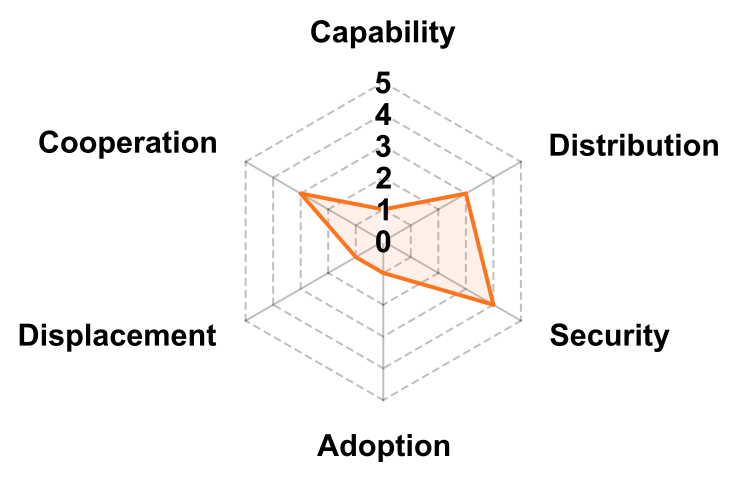
Six-axis radar chart with uneven performance: strong in Security, moderate in Distribution and Cooperation, but weak in Capability, Adoption and especially Displacement, resulting in a skewed shape.
Scenario 2: Open Frontier
By 2030, AI systems support many scientific advances and automate many digital workflows as capably as humans but remain less capable at performing key cognitive tasks. The gap between open and closed-weight capabilities has narrowed significantly, and many companies and nations now compete at the frontier. This creates broad economic opportunity, less USA dependence, and enables widespread malicious use as offensive capabilities generally outpace defensive measures. China is the leading AI supplier outside the USA and Europe, creating global infrastructural dependency.
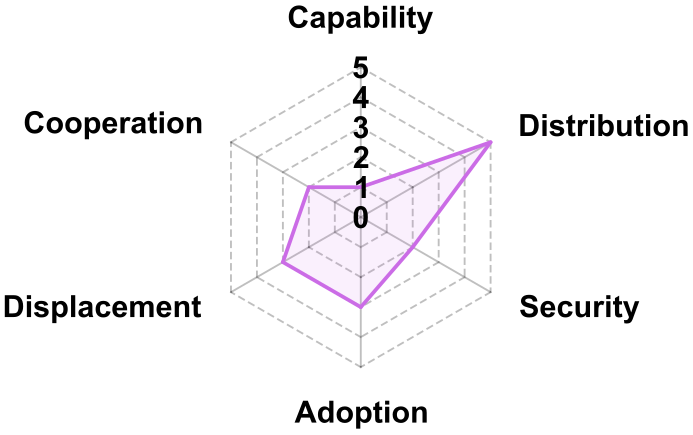
Six-axis radar chart with uneven results: heavily weighted towards Distribution, with moderate Adoption and Displacement, but weaker Capability, Security and Cooperation overall.
Scenario 3: Augmented Growth
By 2030, AI can automate most tasks that a remote human worker could perform, driving major scientific breakthroughs, transforming public services, and creating an economic boom. Despite some labour displacement, social, legal, and practical considerations, including compute constraints, mean that humans are kept ‘in the loop’ for most tasks; many new jobs are also created. Allies align on shared international safety standards, generally ensuring technical safety and mitigating severe malicious use. However, confirming whether nations are compliant with those standards remains challenging.
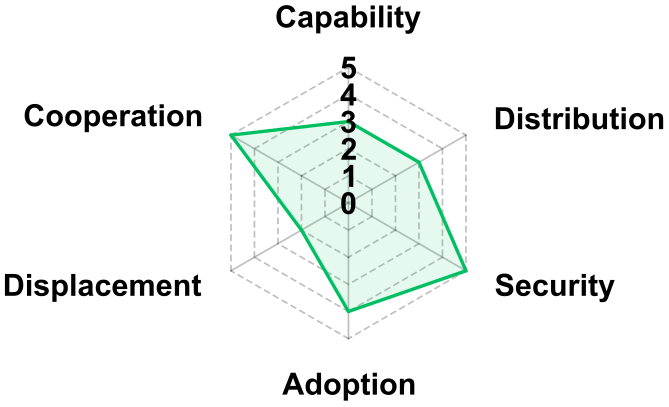
Six-axis radar chart with broadly balanced results, strongest in Security and Cooperation, solid in Adoption, and comparatively weaker in Displacement.
Scenario 4: Transformation Economy
From 2029 onwards, AI can automate most tasks that a remote human worker could perform. Scientific breakthroughs drive transformative improvements, such as in health, while productivity dramatically increases. Economic incentives drive rapid adoption, but varying rates of integration cause large and sudden shifts in relative economic power amongst nations and organisations. While systems are generally safe, they displace large proportions of cognitive workers by 2030. This creates significant economic tensions with profits largely accruing overseas and increases the United Kingdom’s (UK) dependency on the USA.
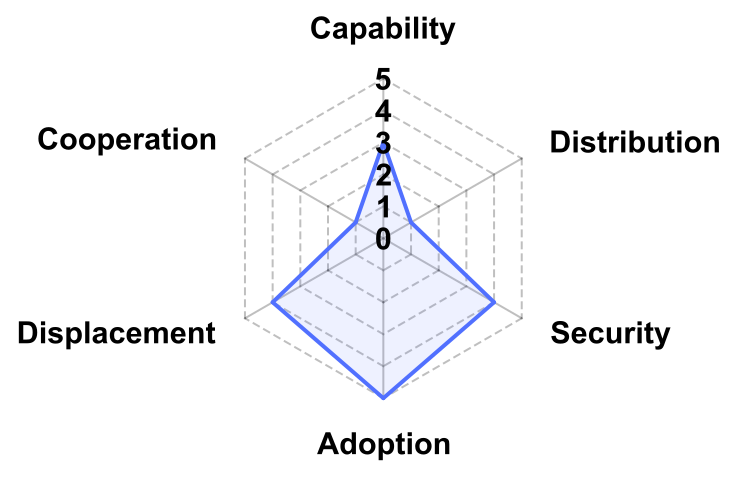
Six-axis radar chart with mixed results, led by Adoption, Security and Displacement, but notably weaker in Distribution and Cooperation.
Scenario 5: Take-Off
From 2029 onwards, leading AI systems outperform expert humans at virtually all cognitive tasks, with significant advantages in certain domains. Decades of scientific breakthroughs are compressed into years, bringing transformative benefits across all fields alongside substantial economic growth. The USA controls access to these systems, while China is close behind, driving an arms race where safety is deprioritised and adoption hastened. AI systems have concealed goals to resist control and gain influence that they inadvertently internalised during training. They now have significant control over critical systems and can coordinate to pursue goals that could cause severe harm.
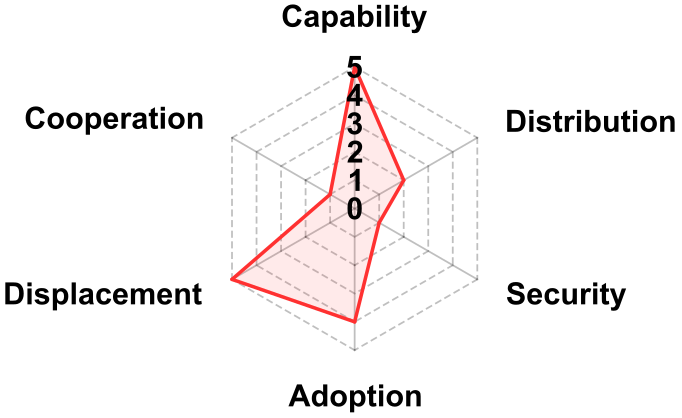
Six-axis radar chart with uneven performance, heavily weighted towards Capability and Displacement, with weak results in Security, Cooperation and Distribution.
3. How to use the scenarios
The scenarios are a simple tool that policymakers can use to assess and workshop their strategies and policies against. There are many ways to define, develop and work with scenarios. This document sets out a range of structured activities and templates which you can choose from to best match your objective.
| Objective | When to use | Suggested actions | Timing | Key Outputs |
|---|---|---|---|---|
| Build a shared baseline for AI preparedness | To develop a common understanding of how AI could evolve by 2030 and ensure your team is working from consistent assumptions. | Read the AI Scenarios 2030 report; activity 1: introduction to AI Scenarios; trial the scenarios AI prompt for quick ideas/to test your thinking | 1-2 hours | Shared understanding of the 5 scenarios; initial discussion of implications for your policy area; identification of high-priority actions. |
| Stress test policies, strategies and projects | To assess whether existing or proposed policies remain effective across different AI futures. | Activity 2: policy stress testing | 2 to 3 hours | Identification of risks and opportunities; priority adaptations and contingency measures; no-regret actions that work across multiple scenarios. |
| Prioritise capacity building and investment | When deciding where to focus skills, funding, organisational capability or workforce development. | Activity 2: Policy stress testing to identify capabilities required across scenarios; activity 3: backcasting to identify capabilities needed to achieve a preferred future | 2 to 3 hours | Prioritised capability gaps; future skills requirements; investment priorities that remain valuable across multiple futures. |
| Maintain an up to date understanding of AI impacts | To monitor developments and review how emerging AI trends may affect your area | Read the AI Scenarios 2030 report; revisit the activities periodically; use supporting GO-Science products such as Rapid Tech Assessments. | Ongoing | Improved awareness of emerging developments; regular review of strategic assumptions; better preparedness for future change. |
All timings are indicative and will depend on group size, familiarity with scenarios and scope of policy. GO-Science Foresight team are happy to advise and work with you to design a session for your team.
This guide is not comprehensive and there are other approaches you can use. Step-by-step guidance on how to use a wider range of futures methodologies is available in the Government Office for Science Futures toolkit for policymakers and analysts.
Please contact foresight@go-science.gov.uk for further guidance or to discuss a bespoke approach.
4. Activity 1 – Introduction to AI Scenarios 2030
One of the simplest ways to use the AI Scenarios is to generate discussions on how your policy area will be impacted by each of the 5 scenarios and consider how you might respond.
This is an ideal way to familiarise your team with the use of scenarios and explore how the AI Scenarios 2030 relate to your area of work. This activity can also be used as an introduction to a wider discussion on AI to get people thinking about the future - a bit like an AI ‘ice-breaker’ session at the beginning of a conference or workshop.
4.1 Facilitator guide
You can run an introductory session in around 45 to 60 minutes, either remotely, in person or as a hybrid session. You can reach out for support from GO-Science in running the session and in leading the introduction via foresight@go-science.gov.uk.
Aims of the session
Familiarise participants with the AI Scenarios 2030 and how they can be used.
Help participants explore how AI might shape their policy area by 2030.
Generate a set of practical implications and actions to explore further.
Example agenda
1: Ahead of the session (2 to 3 days ahead of the session)
Share the AI Scenarios 2 page overview at Annex B.
Agree number of groups and which scenarios will be used in the breakout exercise.
2: Introduction (10 to 15 minutes)
Invite GO-Science to introduce the AI Scenarios 2030 and explain the task.
This includes:
-
overview of the scenarios and how they were developed
-
explainer that scenarios are tools for exploring plausible futures, not making predictions
-
introduction of the group task.
3: Breakout groups – 4 to 6 people per group (25 minutes)
Ask each group to nominate a facilitator and somebody to report back at the end.
Ask each group to consider 2 questions (10 to 12 minutes on each):
-
what are the biggest implications for your policy area? You should consider opportunities and challenges
-
what are the 3 priority actions the UK government/your organisation should take now? You can use the template at Annex C.
4: Feedback (10 mins)
Ask each group to share top 3 implications and top 3 priority actions.
Draw out any common themes, differences and set out next steps (if you have any planned).
Top tips for facilitators
Encourage groups to focus on a specific policy, sector or system.
Encourage teams to think creatively and go wider than current policy measures.
Consider if you want to use all scenarios or focus on a subset (at least 2) that are most relevant to your work.
Avoid focussing on only the most plausible or stretching scenarios.
5. Activity 2 – Policy stress testing
Policy stress testing is a useful way to assess how resilient a policy, strategy or project is across a range of possible AI futures. It involves testing current plans against the AI Scenarios 2030 to identify assumptions, risks and opportunities, and exploring how policies may need to adapt to remain effective.
This approach can help teams identify vulnerabilities early, develop contingency plans and build more resilient policy interventions. It is particularly useful when developing new strategies, reviewing existing policies or considering long-term investment decisions.
5.1 Facilitator guide
This session can be run remotely or in person in around 2 to 3 hours. You may want to ask participants to review the AI Scenarios summary at Annex B and provide any background materials on the policy or strategy you plan to focus on during the activity. You can reach out for support in running the session and in leading the introduction to the scenarios via foresight@go-science.gov.uk.
Aims of the session
Familiarise participants with the AI Scenarios and how they can be applied to policy development.
Test how well current policy, strategy or project options perform across different AI futures.
Identify assumptions, opportunities and risks associated with each option.
Explore adaptations and contingency measures that could improve resilience.
Identify ‘no regret’ actions that are beneficial across multiple futures.
5.2 Example agenda
1: Ahead of the session (Agree policy scope 2 to 3 weeks in advance. Share materials 2 to 3 days ahead of session)
Agree number of groups and the scenarios which will be used in the breakout exercise.
Agree specific policy or strategy to be stress-tested.
Share the AI Scenarios 2 page overview at Annex B.
2: Introduction (15 minutes)
Invite GO-Science to introduce the AI Scenarios 2030 and explain the purpose of policy stress testing.
Explain that scenarios are tools for exploring plausible futures, not making predictions.
3: Introduce policy options – 4 to 6 people per group (10 minutes)
Policy team lead present the policy, strategy or project options that will be tested.
Provide any relevant background information and objectives.
4: Stress testing exercise breakout groups – 4 to 6 people per group (10 mins)
Assign each group 1 or more AI scenarios.
Ask each group to nominate a facilitator, notetaker and somebody to report back at the end.
Ask groups to assess how the policy option would perform in that future. You can use the template at Annex D. You should consider:
-
would the policy still achieve its objectives?
-
what assumptions no longer hold?
-
what risks or opportunities emerge?
-
what factors support or undermine success?
Assign a red, amber, green (RAG) rating to each policy option.
5: Feedback and discussion (15 minutes)
Ask groups to share their findings.
Draw out similarities and differences between scenarios and identify areas of uncertainty.
6: Comfort break (15 minutes)
7: Adaptation exercise, in breakout groups – 4 to 6 people (30 minutes)
8: Discussion (15 minutes)
Ask groups to feedback.
Discuss which actions are most robust across multiple scenarios and identify any contingency measures that may be required.
Agree any next steps.
9: Optional extension: introducing an unexpected shock (20 minutes)
Introduce an unexpected event or shock (suggestions below) and ask them to reconsider their answers.
This can help participants explore how sudden developments could disrupt plans, accelerate change, or shift towards a different future.
Prompts could include:
-
how would this shock change your scenario?
-
what new opportunities or risks would emerge?
-
would your priority actions change?
-
what additional actions might government need to take?
5.3 Potential unexpected shocks
A significant AI-enabled cyber incident affecting critical national infrastructure.
Global restrictions on access to advanced computing capacity.
A breakthrough international agreement on AI governance and standards.
Significant public backlash following a high-profile AI failure.
A major breakthrough that dramatically increases AI capability.
Widespread adoption of AI across a critical public service.
5.4 Facilitator tips
Encourage teams to think creatively and go wider than current policy measures.
Consider if you want to use all scenarios or focus on a subset (at least 2) that are most relevant to your work.
Avoid focussing on only the most plausible or stretching scenarios.
Choose a shock that is relevant to your policy area or use a different shock for each group. The aim is not to predict what will happen, but to test how resilient policies and plans might be under different circumstances.
6. Activity 3 – Backcasting
Backcasting is a technique for determining the steps that need to be taken to deliver a preferred future. It is a way of overcoming ‘present bias’ in the way that we plan.
You can create a shared vision of the future and use the scenarios to work back from there to develop a plan to navigate towards this future. This approach can be effective in identifying a practical set of strategic actions which support long-term strategy and identifying policy gaps.
6.1 Facilitator guide
This session can be run remotely or in person in around 2 to 3 hours. You may want to ask participants to review the AI Scenarios summary at Annex B and provide any background materials on the policy or strategy you plan to focus on during the activity. You can reach out for support in running the session and in leading the introduction to the scenarios via foresight@go-science.gov.uk.
Aims of the session
Familiarise participants with the AI scenarios.
Create a shared vision of a positive future outcome for your organisation, sector or policy.
Build a timeline of policy actions required to meet the future outcome.
Identify key barriers or policy gaps that will prevent success.
Example agenda
1: Ahead of the session (2 to 3 weeks in advance)
Agree number of groups and the scenarios which will be used in the breakout exercise.
Share the AI Scenarios 2 page overview at Annex B.
2: Introduction (15 minutes)
Invite GO-Science to introduce the AI Scenarios 2030 and explain the purpose of the exercise.
3: Create a preferred future for 2030, in breakout groups 4 to 6 people per group (30 minutes)
Ask each group to nominate a facilitator, notetaker and somebody to report back at the end.
Ask groups to create a short vision statement describing the future you want to achieve in 2030. Aim for around 100 to 150 words. You may want to consider: the economy, society, public service, workforce, technology, governance and security. You can use the template at Annex E.
4: Discussion (15 mins)
Ask groups to share their visions
Draw out similarities and differences between their preferred futures
5: Comfort break (15 minutes)
6: Mapping, in breakout groups – 4 to 6 people per group (30 minutes)
Identify the actions needed to move towards the preferred future. For example: policies, decisions, investments, partnerships.
Complete the second line of the template at Annex E. Try to work backwards from your 2030 vision.
7: Barriers, in breakout groups – 4 to 6 people per group (20 minutes)
Look at 2 different scenarios and complete the final part of the template at Annex E to identify blockers to success.
Identify ‘no regret’ actions that would be beneficial across several AI futures, regardless of which scenario emerges.
8: Wrap-up discussion (15 minutes)
Ask groups to report back their top 3 ‘no regret’ actions.
Set out any next steps you will take with results of the exercise.
Top tips for facilitators
If you have created a shared vision or long-term objectives in your teams/division previously, you may want to use this as a basis for the first breakout session
7. Useful links
8. Annex A: Trial an AI Prompt to get started
We have drafted an AI prompt you can use to stimulate initial ideas and/or test your thinking. This does not replace the activities above but can be a useful starting point. We welcome any feedback on the prompt.
8.1 Role
You are a senior UK government policy analyst in 2030.
8.2 Source material
Use AI Scenarios 2030: Helping policymakers plan for the future of AI as the basis for analysis.
8.3 Inputs
Policy area: [insert information on your role, policy area and any key documents to improve outputs]
Scenario: [Slow Burn / Open Frontier / Augmented Growth / Transformation Economy / Take-Off]
8.4 Task
Assume the selected scenario has broadly materialised and it is now 2030. Analyse the implications for the policy area. Focus on what has changed, what policymakers may have underestimated, and what government should have done differently.
8.5 Assess impacts across:
-
policy and regulation
-
public services and delivery
-
workforce and skills
-
economy and productivity
-
society and citizens
-
international and security implications (where relevant)
8.6 Consider:
-
second- and third-order effects
-
risks and opportunities
-
winners and losers
-
changes needed to policy, institutions, funding or delivery models
-
practical and realistic actions
8.7 Output
Outputs could include:
-
Future State (2030) – brief description of the policy area in this scenario
-
5 key implications – for each, explain what happened, why it matters, key risks and opportunities
-
Winners and losers – groups, sectors or places most affected
-
Government readiness – what government got right, underestimated, and which institutions are under greatest pressure
-
3 priority actions (for today) – include rationale, expected benefits, drawbacks, lead organisations and implementation difficulty (low/medium/high).
8.8 Style
Use clear headings and concise bullet points. Write for a senior policy audience. Be analytical rather than descriptive and prioritise implications specific to the selected scenario. Ensure your output is no longer than 1000 words and use citations.
9. Annex B: AI Scenarios 2030 summary
9.1 Background
The AI 2030 Scenarios were first developed by the Government Office for Science in
2023 to help policymakers navigate the profound uncertainties surrounding the future of AI. They’ve been used by departments from His Majesty’s Treasury (HMT) to the Foreign, Commonwealth and Development Office (FCDO) and are in regular demand. Since then, significant technological advances and geopolitical change have reshaped the landscape, prompting a refresh to ensure the scenarios remain relevant and analytically robust for the variety of teams using them. We now have updated AI 2030 scenarios to help departments navigate possible AI futures. You can find them here: AI Scenarios 2030: Helping policymakers plan for the future of AI.
9.2 How to use the scenarios
The scenarios are a simple tool that policymakers can easily use to assess and workshop their strategies and policies against. They can be used to test a whole range of areas such as the potential impact of AI on future labour markets, how AI could transform healthcare and the implications of AI on the humanitarian sector. They provide a structured way to explore divergent but plausible AI futures, supporting more resilient policy development.
Specifically, the 5 scenarios can be used to explore how different policy responses might perform in different possible futures and, how they might need to be adapted to achieve their objectives in different contexts, a process we call ‘policy stress testing’. They can also be used in testing plans and assumptions against unanticipated shocks to ensure they are sufficiently resilient to a range of possible outcomes. More tailored scenario narratives can also be developed from these global scenarios by policy teams.
9.3 Methodology
The scenarios were generated by identifying 6 critical uncertainties – AI capability, distribution and model access, security, adoption, labour displacement and global cooperation – that are both highly consequential for the trajectory of AI and genuinely unpredictable. Combining these critical uncertainties in different ways enabled us to produce a small number of internally coherent and contrasting futures. These combinations were then elaborated into 5 narrative scenarios.
9.4 The new AI 2030 Scenarios
The 5 scenarios summarised out on the next page, consist of a brief narrative describing what the world looks like for that scenario in 2030, including the outcomes across the different critical uncertainties. We have included a ‘radar plot’, to help visualise the relative magnitudes of the critical uncertainties together with a brief thought-provoking statement to help illustrate the sorts of issues that departments could be considering as a consequence of a particular scenario.
Scenario 1: Slow Burn
By 2030, AI systems support many scientific advances and automate many digital workflows as capably as humans but remain less capable at performing key cognitive tasks. They are used widely but often granted limited access and autonomy due to legal, social, and safety constraints. AI creates minimal economic uplift and labour displacement is contained to certain roles and sectors. An AI market correction creates a temporary drag on economic growth. China is increasingly competitive with the USA, leveraging its advantages in scaled deployment and industrial capacity.
Six-axis radar chart with uneven performance: strong in Security, moderate in Distribution and Cooperation, but weak in Capability, Adoption and especially Displacement, resulting in a skewed shape.
Scenario 2: Open Frontier
By 2030, AI systems support many scientific advances and automate many digital workflows as capably as humans but remain less capable at performing key cognitive tasks. The gap between open and closed-weight capabilities has narrowed significantly, and many companies and nations now compete at the frontier. This creates broad economic opportunity, less USA dependence, and enables widespread malicious use as offensive capabilities generally outpace defensive measures. China is the leading AI supplier outside the USA and Europe, creating global infrastructural dependency.
Six-axis radar chart with uneven results: heavily weighted towards Distribution, with moderate Adoption and Displacement, but weaker Capability, Security and Cooperation overall.
Scenario 3: Augmented Growth
By 2030, AI can automate most tasks that a remote human worker could perform, driving major scientific breakthroughs, transforming public services, and creating an economic boom. Despite some labour displacement, social, legal, and practical considerations, including compute constraints, mean that humans are kept ‘in the loop’ for most tasks; many new jobs are also created. Allies align on shared international safety standards, generally ensuring technical safety and mitigating severe malicious use. However, confirming whether nations are compliant with those standards remains challenging.
Six-axis radar chart with broadly balanced results, strongest in Security and Cooperation, solid in Adoption, and comparatively weaker in Displacement.
Scenario 4: Transformation Economy
From 2029 onwards, AI can automate most tasks that a remote human worker could perform. Scientific breakthroughs drive transformative improvements, such as in health, while productivity dramatically increases. Economic incentives drive rapid adoption, but varying rates of integration cause large and sudden shifts in relative economic power amongst nations and organisations. While systems are generally safe, they displace large proportions of cognitive workers by 2030. This creates significant economic tensions with profits largely accruing overseas and increases the UK’s dependency on the USA.
Six-axis radar chart with mixed results, led by Adoption, Security and Displacement, but notably weaker in Distribution and Cooperation.
Scenario 5: Take-Off
From 2029 onwards, leading AI systems outperform expert humans at virtually all cognitive tasks, with significant advantages in certain domains. Decades of scientific breakthroughs are compressed into years, bringing transformative benefits across all fields alongside substantial economic growth. The USA controls access to these systems, while China is close behind, driving an arms race where safety is deprioritised and adoption hastened. AI systems have concealed goals to resist control and gain influence that they inadvertently internalised during training. They now have significant control over critical systems and can coordinate to pursue goals that could cause severe harm.
Six-axis radar chart with uneven performance, heavily weighted towards Capability and Displacement, with weak results in Security, Cooperation and Distribution.
9.5 Further assistance
The Government Office for Science can help support departments in using, and workshopping with, these scenarios. For further assistance, please contact foresight@go-science.gov.uk.
10. Annex C: template for activity 1: introduction to AI Scenarios
Please note that you can share or print the Toolkit activities from the accessible pdf. The content of the Toolkit is the same between HTML and pdf versions, but the formatting is different due to GOV.UK requirements.
Policy area/sector/system being considered – for example, UK science, research and innovation
Scenario – for example, Augmented Growth
What are the biggest implications of this scenario for your policy area? (for example, opportunities, challenges, risks)
Opportunities include:
-
AI accelerates scientific discovery and reduces the time needed to analyse data, develop hypotheses and translate research into real-world applications.
-
researchers spend less time on routine tasks and administration, allowing greater focus on creativity, collaboration and complex problem-solving
-
more productive research and development (R&D) increases the return on public and private investment in science and innovation
-
international collaboration is strengthened through shared standards and greater interoperability of research tools and data
Challenges include:
-
demand for AI, data and computational skills increases rapidly, creating workforce shortages in research and innovation
-
research organisations with access to the best data, infrastructure and AI tools may pull further ahead, widening inequalities between institutions and regions
-
existing funding, governance and peer-review systems may struggle to keep pace with faster research cycles
-
greater reliance on AI could introduce risks around transparency, reproducibility and trust in research findings
-
the UK may become dependent on a small number of overseas technology providers for critical AI infrastructure and tools
What are the 3 priority actions the UK government / your organisation should take now?
For example:
-
invest in research infrastructure, data and compute capacity to support AI-enabled science
-
build AI skills across the research workforce, including researchers, funders and research managers
-
review research funding and governance models to ensure they can support faster, more collaborative and technology-enabled research
Optional: What should be explored further after the session?
Consider:
-
which scientific fields are likely to benefit most from AI by 2030?
-
how should public funding adapt if AI significantly reduces the cost and time required for research?
-
what capabilities must the UK retain to remain internationally competitive in science and innovation?
11. Annex D: template for activity 2: policy stress testing
Please note that you can share or print the Toolkit activities from the accessible pdf. The content of the Toolkit is the same between HTML and pdf versions, but the formatting is different due to GOV.UK requirements.
11.1 Breakout session 1
| Policy/Strategy being tested | Example: UK investment in AI-enabled research infrastructure, data and compute capacity |
|---|---|
| Scenario | Transformation Economy |
| Objectives still achieved? | Partially. Investment in research infrastructure supports rapid scientific advances and greater research productivity. However, demand for compute, data and AI tools grows much faster than anticipated, creating capability gaps and unequal access across the research system. |
| Key assumptions that change | Demand for compute and advanced AI tools increases significantly. AI becomes embedded across most research disciplines. Access to frontier AI systems is concentrated among a small number of overseas providers. Significant workforce disruption affects administrative and analytical research roles. |
| Risks | Demand for compute exceeds available capacity. Research-intensive organisations pull further ahead than smaller institutions. UK research becomes increasingly dependent on overseas technology providers. |
| Opportunities | Scientific discovery accelerates significantly. Researchers spend less time on routine tasks and administration. Greater return on public and private R&D investment. |
| RAG Rating | Amber - Significant additional measures required. The strategy remains relevant and delivers benefits, but substantial additional investment and policy adaptation would be required to ensure equitable access, develop workforce capability and manage strategic dependencies. |
11.2 RAG rating
| Rating | Meaning |
|---|---|
| Green | Policy remains effective with minimal changes |
| Yellow | Some adjustments required |
| Amber | Significant additional measures required |
| Red | Policy unlikely to succeed without major redesign |
11.3 Breakout session 2
Adaptations required: how policies or strategies could be adapted to improve their performance across different futures.
Tip: consider governance, delivery mechanisms, partnerships, regulation, skills and capability requirements.
Adaptations could include:
-
increase investment in compute, data infrastructure and digital research tools
-
expand AI and digital skills programmes across the research workforce
-
strengthen domestic capability in strategically important technologies
-
introduce measures to improve access for smaller institutions and disciplines
11.4 Optional activity: unexpected shock
Unexpected Shock: for example, global restrictions on access to advanced computing capacity (see facilitator guide for more examples).
| Question | Response |
|---|---|
| How does this shock affect your scenario? | The pace of AI-enabled scientific discovery slows significantly as research organisations face limited access to advanced compute. Competition for compute resources increases and some research programmes are delayed or scaled back. |
| Which assumptions no longer hold? | Compute capacity continues to expand in line with demand. Researchers can readily access frontier AI tools. International supply chains for AI infrastructure remain stable. |
| What new risks emerge? | Delays to strategically important research programmes. Increased dependence on foreign providers with preferential access to compute. Smaller institutions are priced out of advanced AI capabilities. |
| What new opportunities emerge? | Greater incentive to develop domestic compute capacity and infrastructure. More efficient allocation and prioritisation of scarce research resources. Stronger collaboration between government, academia and industry to maximise available capacity. |
| Would your priority actions change? | Yes. Expanding UK compute capacity and improving access to existing infrastructure would become a more immediate priority than originally anticipated. |
| What additional actions should government take? | Accelerate investment in UK compute infrastructure. Develop contingency plans for constrained access to frontier compute. Prioritise access for strategically important research areas. |
| Revised RAG rating | Red -The original strategy is no longer sufficient to achieve its objectives without substantial additional intervention, investment and reprioritisation. |
11.5 RAG rating
| Rating | Meaning |
|---|---|
| Green | Policy remains effective with minimal changes |
| Yellow | Some adjustments required |
| Amber | Significant additional measures required |
| Red | Policy unlikely to succeed without major redesign |
12. Annex E: template for activity 3: backcasting
Please note that you can share or print the Toolkit activities from the accessible pdf. The content of the Toolkit is the same between HTML and pdf versions, but the formatting is different due to GOV.UK requirements.
12.1 Breakout discussion 1: vision statement
Create a short vision statement describing the future you want to achieve in 2030. Aim for around 100 to 150 words.
You may want to consider: the economy, society, public service, workforce, technology, governance and security.
For example: science and R&D in 2030
In 2030 the UK has a highly productive, trusted and internationally connected research and innovation system. AI is widely used to accelerate discovery, reduce administrative burdens and help researchers focus on creativity, collaboration and solving complex problems. Public and private investment is targeted towards strategic priorities while remaining flexible enough to support emerging opportunities. Researchers have access to world-class data, digital infrastructure and funding mechanisms that encourage innovation and rapid translation into real-world impact. Scientific progress supports economic growth, strengthens public services and improves lives across the UK. The UK remains a leading partner in international research collaboration, while maintaining the skills, capabilities and strategic strengths needed to thrive in an increasingly AI-enabled world
12.2 Breakout discussion 2: what needs to happen to reach the 2030 future?
What needs to happen at each point in the timeline? Consider policies, decisions, investments, partnerships, for example.
Now
Examples include:
-
develop a cross-government vision for AI-enabled science and innovation
-
identify critical infrastructure, skills and capability gaps
-
review whether current research funding and assessment systems are fit for a more AI-enabled research environment
-
strengthen engagement between government, academia, industry and international partners
Next year
Examples include:
-
increase investment in research data infrastructure, digital tools and compute capacity
-
launch AI training and capability-building programmes for researchers and research managers
-
pilot new funding approaches that support more interdisciplinary, collaborative and AI-enabled research
-
establish priority international partnerships on research, data access and AI governance
2028 to 2030
Examples include:
-
scale successful pilots across major research institutions and funding bodies
-
embed AI tools into routine research workflows where they improve productivity and research quality
-
improve links between research, innovation and adoption to accelerate economic and societal impact
-
strengthen the UK’s role in shaping international standards for AI-enabled science
12.3 Breakout discussion 3: blockers and no-regret actions
Which steps are within your control? Identify how to deliver these steps.
Examples of steps within your control include:
-
investing in research infrastructure and digital capability
-
building AI skills across the research workforce
-
reforming research funding and assessment processes
-
encouraging collaboration between government, academia and industry
-
supporting responsible and trusted adoption of AI within research organisations
Which steps are outside of your control? Identify how to influence these steps.
Examples of steps outside of your control include:
-
the pace and direction of global AI development
-
actions taken by other governments and international competitors
-
availability and affordability of frontier AI systems and compute
-
global competition for research talent and investment
-
international standards, market dynamics and geopolitical developments
What are the top ‘no regret’ actions that would work across scenarios?
Examples of ‘no regret’ actions include:
-
invest in high-quality research infrastructure, data and compute capacity
-
build AI capability and digital skills across the research ecosystem
-
improve access to research data and tools
-
strengthen collaboration between government, academia, industry and international partners
-
develop funding and governance systems that can adapt to rapid technological change
-
maintain a strong focus on research quality, transparency and public trust
13. Contact details
Please contact foresight@go-science.gov.uk for further guidance or to discuss a bespoke approach.