AI Adoption Plan: Advanced Manufacturing
Published 8 June 2026

© Crown copyright 2026
This publication is licensed under the terms of the Open Government Licence v3.0 except where otherwise stated. To view this licence, visit nationalarchives.gov.uk/doc/open-government-licence/version/3 or write to the Information Policy Team, The National Archives, Kew, London TW9 4DU, or email: psi@nationalarchives.gov.uk.
Where we have identified any third party copyright information you will need to obtain permission from the copyright holders concerned.
This publication is available at https://www.gov.uk/government/publications/ai-champions-ai-adoption-plans/ai-adoption-plan-advanced-manufacturing
A report by Chris Dungey, AI Champion for the Advance Manufacturing sector.
From Pilot to Production
A practical UK plan to scale industrial AI deployment in advanced manufacturing
The UK has world-class strengths in manufacturing, engineering and artificial intelligence (AI). Manufacturing contributes around £234 billion annually to the UK economy, supports 2.5 million jobs and drives almost half of private sector R&D investment. Industrial AI can raise productivity, strengthen resilience, improve quality and cut energy use. It can help firms predict equipment failures, improve quality control, optimise supply chains and run production systems more responsively, while enhancing safety and skills. There is also a clear link between use of AI and the adoption of robotics and automation.
Yet while AI capability is advancing rapidly, adoption across UK manufacturing remains uneven and slow, particularly in high value application areas such as operation technology. Too many businesses still struggle to move from experimentation to sustained, operational deployment.
Our international competitors are moving quickly. Countries including Germany, the United States, Japan and China are focusing not just on AI innovation, but on deployment at scale across businesses and supply chains. The question for the UK is no longer whether the technology exists, but whether it can be adopted confidently, safely and at pace.
This is now a competitiveness challenge. If the UK moves too slowly, it risks weaker productivity growth, slower adoption by SMEs and supply chains and falling behind countries that are already converting AI capability into industrial advantage.
The challenge: moving from AI innovation to industrial deployment
The UK does not lack AI capability. It lacks a clear pathway to deploy and scale industrial AI across manufacturing
Many manufacturers, particularly SMEs, face common barriers to deploying AI including:
- legacy and often capital-intensive operational systems and fragmented industrial data
- uncertainty and delay around return on investment
- limited access to trusted test environments
- workforce capability and confidence gaps
- difficulty navigating support and funding routes
- concerns around integration, safety, assurance and operational risk.
As a result, too many promising AI projects remain trapped in pilot phases rather than delivering sustained impact across factories and supply chains.
Industrial AI is harder to roll out than many other forms of AI. Manufacturing environments are complex, highly engineered and often safety-critical. AI must work in real factories, alongside machines, people and live production processes. Systems must operate reliably day after day, integrate with existing equipment, deliver clear value for money, and earn the confidence of manufacturers and workers. It is not enough to perform well in a lab or a one-off demonstration.
Because failures can affect product quality, productivity and safety, firms require stronger evidence before scaling. This helps explain why adoption has so often stalled at the pilot stage, and why the UK must address these practical barriers if it is to keep pace with its competitors.
Done well, this creates a clear pro-worker opportunity. Industrial AI can make work safer, reduce routine problems, support better decisions and strengthen higher-value roles across manufacturing.
The UK already has many of the necessary ingredients – strong manufacturing sectors, world-class AI research and established innovation infrastructure. It lacks a clearer national pathway that connects innovation, workforce capability and deployment at scale. This is not a technology issue, it is an industrial transformation challenge that requires rapid action.
A practical pathway for industrial AI adoption at scale
This plan proposes a simple, phased approach to help manufacturers move from interest to industrial AI deployments at scale. At its core is a simple national pathway i.e., “Scan-Pilot-Scale”, to help manufacturers adopt AI with greater confidence and at greater pace, underpinned by workforce skills, leadership and a culture of practical adoption.
Programmes such as Made Smarter have already shown that practical support for industrial technology adoption can deliver measurable gains in productivity, quality and energy efficiency. This plan builds on those foundations to enable industrial AI adoption at scale. It draws on existing UK strengths and delivery infrastructure, including Made Smarter, Innovate UK, BridgeAI, Make UK, HVM Catapult capability and regional innovation networks, rather than creating new institutions:
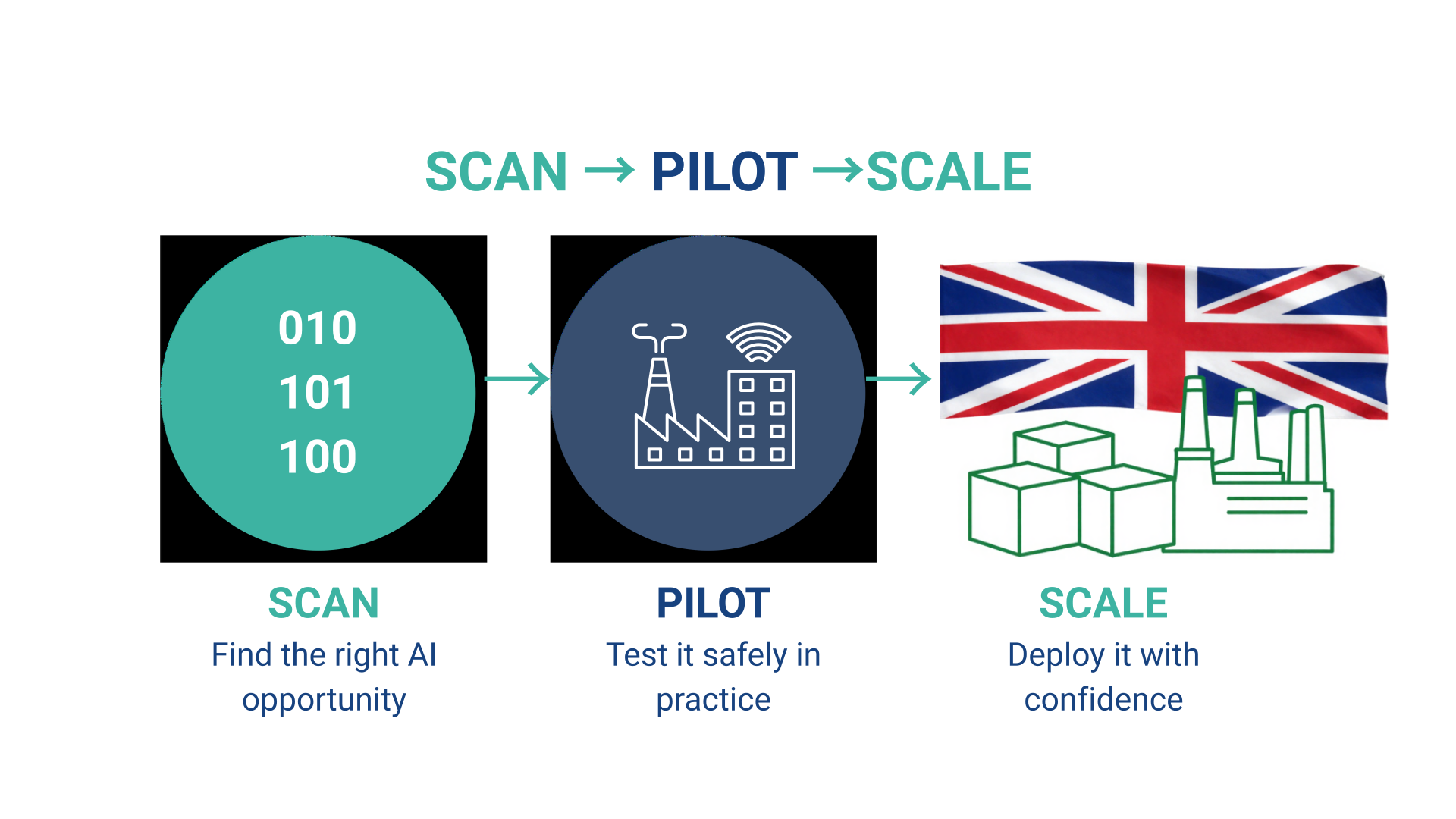
Scan
A national AI “front door” helping manufacturers identify high-value opportunities, assess readiness and access practical support, peer learning and adoption guidance. It also begins to build leadership confidence, workforce understanding and organisational readiness for deployment.
Pilot
Regional industrial AI co-creation testbeds and co-funded programmes enable businesses to trial and de-risk AI in realistic operational environments. This stage develops practical workforce skills, leadership capability and a culture of continuous learning.
Scale
Wider deployment across factories and supply chains is supported by 2 key interventions. These are SME fast-track programmes, aimed at accelerating AI adoption for operational technology applications via trusted, standards compliant solutions, to boost productivity and efficiency. The second intervention uses AI lighthouse sites, which are designated manufacturing sites that demonstrate real-world, factory-validated industrial AI deployments at enterprise scale across production operations, supported by stronger workforce capability and proven delivery. This approach would create repeatable pathways and models of good practice that other SMEs and supply chains could follow. It would also embed the leadership and organisational culture needed to sustain adoption at scale and turn isolated AI innovation into repeatable industrial capability at a national level.
Five priority interventions
The proposed plan focuses on a small number of practical, scalable interventions. Each is designed to tackle the barriers set out above, including routes to support, uncertain returns on investment, access to test environments, workforce capability gaps and trusted deployment.
1. AI front door
A clear national entry point helping manufacturers identify high-value opportunities, assess AI readiness, build an initial business case and access practical industrial AI support, funding routes and peer learning.
2. AI workforce capability and adoption
Supporting leaders, engineers, operators and managers to adopt AI confidently and effectively within day-to-day industrial operations, building the skills, leadership and workplace confidence needed for sustained deployment.
3. Industrial AI validation and trusted data
Strengthening confidence in industrial AI deployment through testing, assurance and trusted operational data environments, helping firms de-risk adoption in safety-critical and data-fragmented manufacturing settings.
4. SME fast-track industrial AI adoption
Helping SMEs adopt proven industrial AI solutions more quickly, safely and affordably through standardised pathways, practical deployment support and reusable models that reduce cost, complexity and risk.
5. AI lighthouse manufacturing deployments
Working with leading manufacturers and their supply chains to demonstrate industrial AI deployment at scale in live production environments, generating robust shareable evidence of value, practical lessons and repeatable models that can accelerate wider diffusion across sectors.
Together, these interventions would create a clearer national pathway from exploration to adoption by addressing the main barriers to industrial AI deployment: access, capability, confidence, validation, value for money and diffusion at scale.
A pro-worker approach to industrial AI
Successful adoption depends as much on people as on technology. The goal is not simply to introduce new tools, but to help manufacturers redesign workflows alongside AI to improve performance and build long-term capability. The plan will provide a coherent pathway to help manufacturers to access the best support available to upskill its workforce.
It takes a clear pro-worker approach by:
- building workforce confidence and practical skills
- helping people work more safely and productively alongside AI
- embedding learning in day-to-day operations
- strengthening leadership capability and organisational readiness
- enabling inclusive adoption across the workforce
- supporting high-quality, high-value industrial jobs.
Skills are key. We will focus on mobilising and coordinating existing AI support from HMG, education providers, and specialist organisations such as HVM Catapult and Made Smarter. This should include AI Skills Boost, foundation benchmarks, Levy flexibilities, and new apprenticeships, alongside Innovate UK’s BridgeAI and AI Skills Hub, with a particular emphasis in advanced manufacturing on aligning these national programmes to sector-specific needs.
A phased, co-investment approach
The approach is designed to be phased, practical and evidence led, so that the UK can move quickly while building confidence in what works.
An initial pilot phase co-funded by government and industry would establish and test the core foundations for industrial AI adoption rather than attempt full national rollout from the outset. It would support the early build-out of the AI front door, a limited number of regional and sector-based deployment pilots, targeted workforce capability activity and a small number of lighthouse and validation projects in real manufacturing environments. The aim of this first phase would be to generate robust evidence on demand, delivery models, return on investment, workforce impact and operational benefit, while refining approaches that can later be replicated across sectors and regions.
Subject to clear evidence of success, industry demand and measurable operational impact, the programme could progress into a second scale-up phase. This would expand the most effective deployment pathways, extend lighthouse manufacturing activity, broaden SME/supply chain adoption support across frontier industries and strengthen the regional delivery network needed to move from isolated pilots to repeatable deployment.
A third phase would focus on embedding industrial AI adoption at national scale, including stronger validation capability, more developed trusted industrial data environments and wider deployment across UK manufacturing ecosystems. By this stage, the emphasis would shift from proving the model to making industrial AI adoption more systematic, accessible and durable across sectors, regions and supply chains.
The approach emphasises co-investment between industry and government throughout, so that public funding acts as a catalyst rather than a substitute for business commitment. Progression between phases should be stage-gated and informed by clear evidence of productivity gains, workforce impact, operational value, industry co-investment and the ability to replicate successful models more widely. This would create a practical pathway to scale, grounded in measurable outcomes.
A window for UK industrial leadership
The UK has the ingredients required to lead in industrial AI:
- advanced manufacturing capability
- world-class AI research and engineering
- strong regional innovation infrastructure
- emerging industrial AI strengths
- and a globally competitive manufacturing sector.
This plan is not about inventing new AI. It is about helping British manufacturers use proven AI at scale.
Government and industry should act swiftly to build confidence in the benefits of industrial AI as part of the modern industrial strategy. With co-ordinated action, the UK can accelerate adoption across factories, supply chains and regions in ways that strengthen productivity, resilience and long-term competitiveness.