Addressing water scarcity and wastewater capacity in Greater Cambridge: progress report
Published 20 November 2026
Applies to England

© Crown copyright 2026
This publication is licensed under the terms of the Open Government Licence v3.0 except where otherwise stated. To view this licence, visit nationalarchives.gov.uk/doc/open-government-licence/version/3 or write to the Information Policy Team, The National Archives, Kew, London TW9 4DU, or email: psi@nationalarchives.gov.uk.
Where we have identified any third party copyright information you will need to obtain permission from the copyright holders concerned.
This publication is available at https://www.gov.uk/government/publications/addressing-water-scarcity-in-greater-cambridge-progress-report/addressing-water-scarcity-and-wastewater-capacity-in-greater-cambridge-progress-report
This report was prepared with contributions from:
- Anglia Ruskin University
- Anglian Water
- Cambridge Water
- Cambridge Water Scarcity Group
- Environment Agency
- Greater Cambridge Development Corporation
- Greater Cambridge Shared Planning Service
- Market Operator Services Limited (MOSL)
- Ofwat
- University of Cambridge
- Water Resources East
Ministerial foreword
Greater Cambridge, encompassing the historic city of Cambridge and the surrounding district of South Cambridgeshire, is one of the UK’s most important engines of growth. It is a world leader in innovation, research and development, a centre of influence for global technology and a critical hub for skilled employment. The government is determined to ensure it realises its full potential.
Local institutions, including councils, universities and businesses, have adapted positively and worked hard to support Greater Cambridge’s rapid growth over many years. However, despite strong local efforts, numerous long-standing barriers to further growth are preventing it from realising its true potential. They include water supply and wastewater treatment capacity.
Since 2022, increased pressure on water and wastewater systems has posed a significant challenge for Greater Cambridge, delaying planned development and creating uncertainty for local communities and businesses. This has highlighted the need for better planning, funding and regulatory processes to support growth while ensuring that the rivers and chalk streams loved by so many are maintained for future generations to enjoy.
In response, we have brought together water companies, regulators, local authorities and other partners around a shared ambition: to support growth, safeguard the environment and deliver long-term water resilience.
This collaboration is unlocking solutions and delivering results. Greater Cambridge is now leading the way in tackling water scarcity. The action being taken and approaches being tested are showing how growth and environmental protection can be pursued together. As other parts of the country face similar pressures, Cambridge is demonstrating what can be achieved when ambition, bold action and local collaboration come together behind a shared goal.
These actions have begun to lay the foundations for a long-term shift in how we manage one of our most precious resources. The challenge now is to turn this progress into lasting change by demonstrating water savings, progressing infrastructure projects and embedding the coordination between growth, infrastructure planning and environmental protection.
The drought conditions experienced this year highlight just how important this work is. The actions set out in this report will drive new evidence, innovation and practical solutions to water scarcity, helping to build the resilient local water systems that communities will rely on for years to come.
Long-term success will depend on sustaining new partnerships and working with local leadership. The Greater Cambridge Development Corporation offers an opportunity to play an important role in driving this collaboration forward, working closely with the water sector to deliver a shared long-term vision for a thriving, sustainable Greater Cambridge that we can all be proud of.
The Rt Hon Matthew Pennycook MP, Minister of State for Housing and Planning
Emma Hardy MP, Minister of State for Water and Planning
Water Scarcity Group Chair foreword
Growth in Greater Cambridge requires a continuing focus on addressing water supply and wastewater treatment challenges. A combination of low rainfall, high temperatures, population increases, economic growth and environmental requirements places a strain on water resources including the area’s internationally important chalk streams. This, together with challenges associated with wastewater treatment capacity, has delayed some developments.
The Cambridge Water Scarcity Group, since its formation in 2023, has played an important role in supporting the government’s ambition to work with local partners to facilitate the growth of Greater Cambridge in a way that is environmentally sustainable, maximises the area’s economic potential, and enhances the quality of life for the local community.
Ensuring an environmentally sustainable future for the area’s rivers, streams, aquifers and reservoirs and its natural environment in a way that can accommodate projected growth requires collaboration from a range of stakeholders.
The Group includes representatives from the water companies, local government, national agencies, regulators and government departments to drive forward the implementation of measures to address water resource and wastewater capacity issues.
This report outlines the significant progress that partners have made over the past 2 and a half years. I have been impressed by the collaboration, energy and enthusiasm demonstrated by partners. Together, we have developed our understanding of the challenges and identified solutions to address the short- and medium-term problems, including wastewater treatment capacity and long-term water supply issues.
It is important that the approaches and solutions for Greater Cambridge are seen within the context of the wider area. Solutions to address water resource constraints often require a regional or national approach. Water Resources East is leading on this strategic regional-scale water planning, with stakeholders working closely together to identify the most effective combination of efficiency measures, demand and leakage reduction, new supply and reuse options, and environmental improvements. This will ensure that supply options and environmental constraints are aligned with future growth. There are also exciting opportunities for Greater Cambridge to be a test bed for innovative solutions that could be applied across the country.
Much has been achieved, but there is still much to do to ensure an environmentally sustainable water future for Greater Cambridge. Growth must be factored into water and drainage planning processes, including national and local government growth ambitions and new towns which are currently not included within local plans. There needs to be an agreed set of growth assumptions on which all plans are based, including when such growth will happen. Other water needs which sit outside the local plan process, and therefore outside the traditional water resource planning process, must also be factored in. This requires a way of incorporating these additional water needs within water company business plan periods.
I am grateful to all members of the Water Scarcity Group and the many organisations who have contributed to this work. Together, we can ensure that Cambridge continues to grow in a way that protects and enhances the environment.
Dr Paul Leinster CBE
Chair, Cambridge Water Scarcity Group
Executive summary
Greater Cambridge’s continued success depends on ensuring sufficient water supply and infrastructure to support growth and protect the environment. In 2024, the government set out a coordinated approach to address this challenge, working closely with the advisory Water Scarcity Group. Action is now underway to address short-term challenges and drive forward long-term solutions. This report provides an update on progress since 2024.
Short-term action to reduce water demand and unlock growth. The government’s water efficiency programme has supplemented Cambridge Water’s existing demand-management programme. It is expected to reduce water demand and create capacity for new growth. Updated analysis on water demand and supply has provided confidence that growth in the emerging Greater Cambridge Local Plan can be accommodated using available water resources, with mechanisms in place to monitor and manage risks over time.
Local collaboration to test new ways of improving water resilience. The government is funding pilots for water reuse and recycling, nature-based solutions and new agricultural methods to improve water storage and management. This will build an evidence base for these new approaches that the water sector can take forward to support long-term water supply and resilience.
Supporting growth through planned water supply infrastructure. Water companies are progressing major schemes, including the Grafham pipeline transfer and the Fens Reservoir, through design and planning stages to provide additional capacity in the 2030s, subject to planning permission. Engagement via Defra’s ministerial Water Delivery Taskforce has supported greater transparency of the risks to delivery, enabling quick government and regulator action. Work has also started on longer-term planning at a regional scale, recognising that Cambridge’s future water supply will depend on a wider, interconnected system.
Progress to resolve wastewater capacity issues. Wastewater infrastructure in parts of Greater Cambridge is operating close to, or over, capacity -posing risks to growth plans and the environment. In response, the government, regulators and Anglian Water have worked together to identify solutions and accelerate investment. Operational improvements and investment are being taken forward by Anglian Water to increase capacity at the Cambridge (Milton) Waste Water Treatment Works (WWTW), alongside longer-term planning to ensure that wastewater infrastructure can support future development.
Taken together, these actions have addressed immediate water resource and wastewater challenges and put in place arrangements to support sustainable growth in Greater Cambridge.
Introduction
The Environment Agency forecasts that by 2055 England could face a shortfall of around 5 billion litres of public water supply per day if urgent action is not taken. Greater Cambridge is already experiencing these pressures. Emerging water resource and wastewater challenges resulted in delays to development and highlighted the need for stronger coordination across planning, regulatory and water systems.
In 2024, the government set out how it would respond to this challenge through the policy paper Addressing Water Scarcity in Greater Cambridge and a Joint Statement with key partners. These presented a package of measures to address the specific water resource challenges affecting planned development in the adopted Cambridge City and South Cambridgeshire local plans. They also set out steps to progress planning for new infrastructure solutions to support sustainable long-term growth.
This report provides an update on progress since 2024. Across Greater Cambridge, action is underway to reduce water demand, test new approaches, address wastewater challenges and deliver the infrastructure needed to support future growth.
This work is underpinned by closer collaboration between government, regulators, water companies and local partners. A renewed focus on longer-term planning is also helping to better align preparation for new growth with our water systems. The Greater Cambridge Development Corporation will support this work through an infrastructure-led approach to planning and development.
While many of the actions in this report are being delivered locally, Greater Cambridge’s long-term water future will be shaped by developments across a much wider water system. Securing sufficient local supply will depend on regional planning that brings together infrastructure investment with water resource management across the whole East of England and the wider region.
It will also be supported by ambitious government reforms to the water sector, which are enabling the interventions in Greater Cambridge, including:
- transforming the water sector to be delivered through the forthcoming Water Bill that will create a single, powerful regulator, strengthen long-term planning, support regional planning, improve resilience and secure future water supplies
- the updated National Planning Policy Framework ensures local plans account for water supply, wastewater capacity and drainage from the outset, while supporting infrastructure delivery and cross-boundary planning, alongside reforms to tighten water efficiency standards and reduce per capita consumption
The report is structured around 3 delivery priorities:
- short-term action to manage and reduce water demand, reduce leakage and promote reuse - unlocking planned development and reducing pressure on the water supply.
- supporting innovative approaches to improve long-term water resilience, including nature-based solutions and agricultural water management.
- delivering the water supply and wastewater infrastructure needed to support sustainable growth over the long-term.
Reducing water demand
A coordinated package of measures is being implemented across Greater Cambridge to reduce water demand, pilot water reuse, and implement new approaches to monitor water availability and emerging water supply risks.
Delivery is underway and on track to generate water savings, which will be verified by the Environment Agency. Together, this approach has strengthened confidence that planned growth in the developing Greater Cambridge Local Plan can proceed while reducing long-term pressure on water resources.
In 2024, we set out a clear commitment to reduce, reuse and offset water demand in Greater Cambridge to support sustainable growth while protecting the environment.
Reducing water demand and supporting sustainable growth
From 2022, the Environment Agency raised objections to over 9,000 homes and 500,000sqm of commercial space because of concerns about the sustainability of water supplies and risks to local water bodies.
In response, the government’s package supplements existing water company activity by providing additional targeted measures to reduce, reuse and offset water demand. The aim was to ensure that blocked development could proceed sustainably, in advance of the delivery of new, large-scale water supply infrastructure projects.
Water companies have a statutory duty to plan for secure and sustainable water supply through Water Resources Management Plans (WRMPs). Cambridge Water’s updated WRMP, published in March 2025, committed to accelerating smart metering and measures to prevent harm to vulnerable water bodies. Combined with the announcement of the government’s package, this provided the assurance needed for the Environment Agency to withdraw its objections and unblock stalled development.
As of November 2026, no planned development in Greater Cambridge is stalled in the planning system due to sustainable water supply concerns.
Strengthening the evidence base
The government has also worked with Cambridge local authorities, water companies, regulators, and consultants AtkinsRéalis to improve understanding of water availability and forecast growth in Greater Cambridge.
The analysis shows that growth set out in the emerging Greater Cambridge Local Plan can be accommodated within Cambridge Water’s updated WRMP, subject to the continued delivery of water company commitments to agreed timelines.
This means that Greater Cambridge can continue to grow, with the government’s package providing additional water savings to support new development and help manage future water scarcity risks.
A key output of this work is a new water supply-demand dashboard for the Cambridge Water Resource Zone. This brings together information on water supply, demand and growth into one place. It will enable water companies and partners to track water availability as development comes forward and monitor risks in near real time, enabling them to take early action where needed by adjusting the Cambridge WRMP.
This is a significant improvement in how water and growth are overseen in Cambridge – supporting proactive and coordinated planning and an approach that other areas can build on.
The Cambridge Water Efficiency Programme
At the centre of the package is the Water Efficiency Programme, established in 2024 to reduce water use across existing homes, businesses and buildings in Greater Cambridge, by using a range of water savings technologies. Alongside reducing water use, the programme is helping participants save energy and lower bills.
Delivery partners are working closely with the Environment Agency to verify and measure savings over time. Work underway as part of the programme is expected to deliver up to 0.89Ml/d in water savings, the equivalent of 3,180 new homes.
Phase 1 – homes, public buildings and schools
Phase 1 focuses on social housing and public sector assets:
- as of November 2026, 2,048 social homes across South Cambridgeshire District Council and Cambridge City Council have been retrofitted, with further homes to be retrofitted in coming months. In total, social housing retrofits could save up to 0.18Ml/d, the equivalent of 648 new homes. One estimate suggests that retrofits completed to date are already saving households over £580,000 a year on utility bills
- water recycling systems are being installed at 3 swimming pools in Cambridge City from Autumn 2026 – this is expected to save up to 90% of the water used for cleaning filters, which is normally wasted, equating to savings of 8.6Ml/year
Cambridgeshire County Council will launch a programme to install water-saving devices in approximately 100 schools. By combining practical measures to reduce water consumption with encouragement for pupils to develop water-saving habits, the programme aims to promote more efficient water use.
Phase 2 – non-household sector
Phase 2 targets businesses and large institutional users, where there are significant opportunities for water savings.
Through the Water Efficiency Cambridgeshire (weCB) Fund, administered by MOSL, the government is supporting organisations in the Cambridge Water Resource Zone to trial innovative approaches to water efficiency, water reuse and demand reduction. The first round of the fund was over-subscribed, demonstrating strong interest in testing water efficiency approaches in Cambridge. Through the first round:
Twenty projects have been awarded between £500 and £100,000 to trial innovative solutions, including rainwater harvesting, water audits, water recycling and more. Together, these could save up to 0.63Ml/d of water, the equivalent of 2,248 new homes.
Plans are being developed for a second round of the weCB, with further details to be announced in due course.
Government funding is also supporting universities in Cambridge to pioneer innovative approaches to water efficiency and water management.
- Anglia Ruskin University has installed over 3,000 water sensors across 36 buildings, alongside sub-metering and pipework improvements to support behaviour change and better water management.
- The University of Cambridge has explored innovative approaches including leak detection and the use of alternative water sources for cooling in science labs.
Water Company demand management
The government’s Water Efficiency Programme supplements Cambridge Water’s wider demand-management activity, which is delivered through its statutory Water Resources Management Plan.
Cambridge Water’s demand management deliverables:
- 1,740 smart-capable meters were installed in 2025/26
- over 14,500 further meters planned by 2030
- over 90% of properties expected to be metered
- around 16Ml/d demand reduction expected by 2032
Going further: piloting water reuse
The government is supporting work to enable water reuse and recycling to be utilised in our homes and businesses, recognising the important role non-potable water sources play in improving long-term water resilience by reducing demand for drinking water supplies.
In the Water White Paper, the government committed to help drive reuse and rainwater system uptake and to explore opportunities for wider uses of alternative water sources such as cooling for data centres.
As part of this commitment, the government is reviewing the regulatory framework for dual-pipe water reuse systems using rainwater and greywater, with the aim of enabling the safe use of non-potable water for certain lower-risk purposes, such as toilet flushing, washing machines and irrigation, while maintaining appropriate public health protections.
This work is intended to address barriers that currently limit the operation of development-scale water reuse schemes and support greater adoption of water-efficient infrastructure in new developments.
The Eddington development provides an important example of the water supply headroom that could be unlocked through recycling and reusing our water supplies day to day. The site has an installed dual-pipe network intended to reduce demand for wholesome water supplies, but it is not currently operational.
The government is working closely with the Drinking Water Inspectorate (DWI), water companies and local partners throughout this process to ensure that any future approach is supported by robust regulation, appropriate safeguards and consumer confidence.
Summary of the Water Reuse System at Eddington:
- a dual-pipe water reuse network is already installed
- designed to support water consumption of around 80 litres per person per day
- non-potable water is intended for toilet flushing, washing machines and irrigation uses
- the development provides a nationally significant example of the opportunities presented by dual-pipe systems and water reuse
- government, regulators, water companies and local partners continue to work together on the future enablement of dual-pipe systems
Water credits scheme
In 2024, the government committed to pilot a water credits scheme to help unblock development, using developer payments to fund water savings to offset the additional demand from new development. Since then, the government has funded water-saving measures directly through the Water Efficiency Programme. Progress in delivering these savings, alongside updated analysis of water supply and demand, has given the Water Scarcity Group confidence that there is currently sufficient water available to support planned growth. A separate water credits market is therefore not currently needed to secure the water savings required to support this growth.
Water availability will continue to be monitored. Work is continuing with the Greater Cambridge Development Corporation to ensure an offsetting mechanism could be introduced should new water scarcity risks arise. This includes exploring delivery through existing mechanisms for securing developer contributions, rather than establishing a separate water credits market, with the aim of enabling an offsetting mechanism to be put in place quickly if needed.
Next steps
Significant progress has been made since 2024. Planned development has been unlocked and continued delivery of measures to reduce water demand will create water savings for new growth and deliver lasting benefits by making Cambridge’s homes, businesses, and public buildings more water efficient. This is supported by a strengthened shared understanding of water availability in the area to enable earlier identification of challenges and more proactive management of water resources.
The lessons learned from this work will help shape water company investment and approaches to water efficiency to support Cambridge and other areas facing similar pressures.
Supporting innovative approaches
Some of the solutions needed to support water management in Cambridge are not yet part of standard water company planning, due to higher levels of uncertainty and delivery risk. Building on the 2024 commitment, the government is working with regulators, water companies and local partners to test and de-risk these approaches, including through targeted pilots and funding.
This is helping to build the evidence needed to scale these options over time and embed them into future water sector planning, supporting more sustainable and resilient growth.
Nature-based solutions
In our 2024 update, we highlighted the government’s commitment to test how nature-based solutions could improve water resilience in Cambridge.
The government is now exploring how nature-based solutions (NbS) could support sustainable water use.
In the Upper Cam catchment, Water Resources East is working with technical and research partners to test small ‘leaky dam’ structures - known as Runoff Attenuation and Infiltration Features - that slow the flow of water through existing streams and drainage routes.
This pilot, backed by £1.3 million of government funding, is assessing how much of this water soaks into the ground and whether it replenishes underground water reserves.
The programme is moving into its second phase, with Water Resources East planning to publish a final report after all 3 phases are complete. The report will build a stronger evidence base on how NbS can improve catchment resilience and long-term water availability, to support future water company planning and water management in Cambridge and beyond.
Phase 1: delivery and monitoring
Work started by modelling water flows, studying potential sites, and speaking with landowners to identify suitable locations. Small trials were then built at 3 sites. Early results suggest the ‘leaky dams’ are helping slow water flow and increasing ground infiltration.
Phase 2: scaling and refinement
Work is underway to find more locations across the catchment and improve how results are measured and analysed, such as through new research partnerships. This will teach us where NbS work best and how much impact they could have on a larger scale.
Phase 3: planning and integration
Phase 3 will take learnings from the pilot to consider how to strengthen long-term water resilience by building NbS into local and regional planning.
Agricultural pilots and programmes
In 2024, the government recognised the high water demand across the agricultural sector and highlighted the opportunity to support farmers to use water more efficiently. This is now being taken forward through targeted pilots and local planning.
Farming is central to Greater Cambridge’s economy, communities and environment. But a common challenge is that crops require the most water during the driest periods, meaning demand for irrigation often coincides with peak pressure on rivers and groundwater.
Greater Cambridge, however, is a trailblazer in how it is responding to this challenge. Government-backed pilots are bringing local partners together to demonstrate how farming and environmental outcomes can be strengthened through more sustainable water management.
Agricultural Water Resources Management Plans
For the first time, traditional water resources planning is being applied to agriculture.
Analysis across 3 catchments in Cambridge shows that often water abstraction is licensed, but not all of it can be used due to environmental limits and a lack of storage.
Increasing storage would allow surplus winter water to be captured for use during drier periods, improving resilience while reducing pressure on the environment. The findings are informing intervention priorities and regional planning through Water Resources East.
Local Resource Option screening studies
Backed by £630,000 of government funding, 6 Local Resource Option screening studies have identified local solutions to improve water resilience and support farming.
Two projects are now being taken forward: a reservoir in the Thet catchment and the South Levels water resource option. The government is supporting delivery partners and the water sector to develop these schemes and move them towards implementation.
South Levels water resource option
The South Levels is a low-lying farming area in the Fens, made up of drainage channels that help manage water for farming, reducing flood risk and supporting wildlife. Water Resources East and the Greater Cambridge Development Corporation are working with farmers and others to explore whether excess water from winter could be effectively captured and stored for use later in the year.
Early findings suggest that, over time, this could provide a significant amount of water - potentially enough to supply around 100,000 homes.
Further work is needed to test whether this is practical, including looking at water quality and how stored water could be connected to existing systems. Any future scheme would need further testing, consultation and approval before it could go ahead.
Smart agri-abstraction
Supported by £400,000 of government funding, a pilot in the Upper Cam catchment is bringing together real-time data across farms and river systems into a single dashboard. This gives farmers a shared view of water availability, helping them see when water can be taken sustainably and make better decisions about storage and sharing. Further work is exploring how this model could be scaled up to support more sustainable water use.
Agricultural Water Resources fund
A new fund backed by over £1.3 million of government funding is supporting farmers, growers, nurseries and other businesses to deliver new agricultural water management solutions in Cambridgeshire.
This includes rainwater harvesting, on-farm storage and improved irrigation systems.
The fund is being delivered by Cambridgeshire County Council with Water Resources East and opened for applications in July 2026.
Next steps
Collectively, this work is demonstrating how new approaches to water management can be translated from concept into delivery.
The evidence and partnerships being developed in Greater Cambridge will provide a blueprint for water companies, farmers, regulators and regional planning bodies to build on, helping to accelerate the adoption of practical solutions that improve water resilience while protecting the environment.
Building new infrastructure
New water supply infrastructure remains critical to supporting sustainable growth in Greater Cambridge. Water companies are progressing the delivery of major schemes, scoping alternative options, and planning for the next generation of infrastructure needed to meet future growth and regional water demand.
Our 2024 update set out the need for new major water and wastewater infrastructure to support Cambridge’s growth. Over the past 2 years, Cambridge Water, Anglian Water and other water companies have progressed key schemes while planning for additional long-term solutions.
Medium-term supply options
Medium-term infrastructure to support Cambridge’s growth is now firmly on track.
The Grafham to Cambridge pipeline transfer will play a central role, providing up to 26Ml/d from 2032 and creating capacity to support planned and new development across the 2030s.
Good progress has been made. A preferred route has been identified, environmental scoping completed and design work is well advanced. Cambridge Water is expected to commence construction in 2028 with completion in 2030.
Supporting schemes to free up water for the Grafham pipeline at Minworth and the Grand Union Canal have progressed through statutory consultation and planning applications are due for submission in 2027, with environmental permit applications being prepared.
Alongside this, the Fens Reservoir is being developed as a key strategic resource, with an expected maximum supply of 87Ml/d.
If a Development Consent Order is granted through the consenting process, this will enable the reduction of existing abstraction from the chalk aquifers in the area and support local housing and growth needs from the late 2030s.
Defra and water regulators continue to oversee the delivery of major schemes, using Defra’s Water Delivery Taskforce as a forum to raise risks and identify where government can help solve problems.
Reducing nutrients and chemicals in the Grafham Water Reservoir
Pesticides and nutrients mainly from agricultural activity are putting the River Great Ouse and Grafham Water at increasing risk, including through algal growth.
Large-scale treatment to remove these pollutants would be complex and costly, so Anglian Water is working with the Environment Agency and farmers to reduce nutrients and chemicals at source.
This is essential to maintain water quality for the Grafham to Cambridge pipeline and to manage nitrate levels in the water used to fill the proposed Fens Reservoir, where further modelling will inform any treatment requirements.
Small-scale supply options
Alongside medium-term infrastructure, the government has worked with consultants to identify small-scale supply options that could increase resilience and provide early water supply benefits. Several are now being explored by water companies and water regulators, including:
-
bringing abstraction sites back into use, including the Croydon borehole which will be brought online in 2027 and provide an additional 1.4Ml/d
-
considering potential winter storage which would be for use as a direct supply after treatment
Planning for the long-term
The Grafham pipeline and Fens Reservoir may not be sufficient in themselves to support growth in Cambridge beyond the 2030s. Planning is therefore underway to ensure sufficient water supply and infrastructure for planned development and additional growth in the long-term.
Cambridge Water and Anglian Water are already developing the next generation of supply options to inform the next round of Water Resources Management Plans, due in 2029. This reflects a more ambitious approach, testing how different combinations of supply and demand measures can meet future needs under a range of growth, climate and environmental scenarios.
The Regulators’ Alliance for Progressing Infrastructure Development (RAPID) is supporting this by facilitating the identification of new options, including:
- strategic transfers including expanded use of existing schemes such as Grafham and exploration of longer-distance options (e.g. River Trent)
- new water storage, including reservoirs and smaller-scale local options
- alternative and innovative sources including reuse, water sharing and flexible abstraction and system optimisation
- use of existing infrastructure and assets, including opportunities linked to networks such as the Canal & River Trust and assets managed by bodies such as the Mining Remediation Authority
The regional picture
Currently, almost all water used in Cambridgeshire is supplied by sources within the county. However, Cambridge’s long-term water supply increasingly depends on the wider national water system with over 50% of supply expected to come from outside the local area by 2040.
At the same time, demand on water resources across the wider region is expected to increase – driven by climate change, population growth, water quality challenges and growth across the Oxford–Cambridge Growth Corridor, including potential new towns and major developments such as Tempsford.
Water planning must therefore take place at a regional scale, to ensure that the environment is protected and that there is sufficient water across the region.
Work is already underway to support this. Water Resources East is bringing together partners from across the East of England to prepare a single plan which will identify the most effective combination of demand reduction, new supply and environmental improvements. The plan will be continuously refined as water companies develop updated WRMPs to ensure supply options and environmental targets are aligned with future growth.
Planning Water Resources at Catchment Level
Alongside this, work at the catchment level is improving our understanding of how water flows through the wider system and where pressures are most acute. The Great Ouse catchment - from which water is sourced to supply Cambridge, Milton Keynes, Bedford and surrounding growth areas - is being assessed in detail to understand future risks under a range of growth, climate and environmental scenarios.
This work is identifying where water is available, where challenges will emerge, and what interventions are needed, such as additional storage, transfers and demand reduction, to close the gap between supply and demand.
For Cambridge, this provides a stronger evidence base for the water sector to plan for growth with confidence - ensuring that future water supply reflects both local needs and the realities of the wider system, while protecting the environment over the long-term.
Oxford-Cambridge Growth Corridor
In January 2025, the government unveiled new plans to deliver the Oxford-Cambridge Growth Corridor, which has the potential to boost the UK economy by up to £78 billion by 2035:
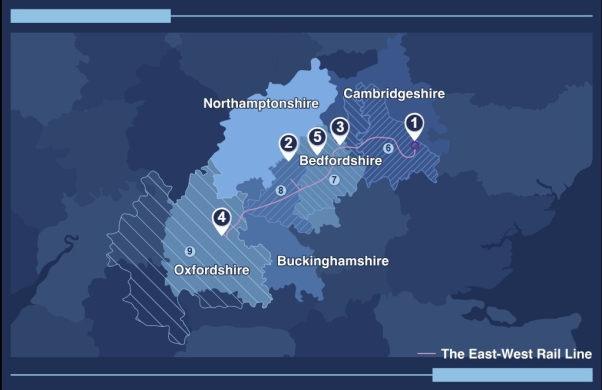
Map of the Oxford-Cambridge Growth Corridor
1. Cambridge
In July 2026, the government established the Greater Cambridge Development Corporation to address barriers to growth and unlock Greater Cambridge’s full potential.
2. Milton Keynes
In March 2026, the government consulted on its Draft New Towns Programme, which includes a proposed “Renewed Town” in Milton Keynes, with potential for over 40,000 new homes.
3. Tempsford
The Draft New Towns Programme also includes a proposed new settlement at Tempsford with potential for over 40,000 homes.
4. Oxford
In March 2026, the government announced plans to consult on a development corporation for Greater Oxford to help deliver nationally significant growth.
5. Universal Studios, Bedford
£1.3bn investment has been agreed between the government and Comcast NBCUniversal to build the Universal United Kingdom Resort in Bedfordshire.
6. Cambridge Water Resource Zone.
7. Ruthamford South Water Resource Zone.
8. Ruthamford Central Water Resource Zone.
9. Swindon and Oxfordshire Water Resource Zone.
Increasing wastewater capacity
Wastewater capacity has been identified as a key challenge for growth in Greater Cambridge, with treatment works and the sewer networks operating close to their limits, increasing the likelihood of pollution incidents and putting new development at risk.
Anglian Water and Water Scarcity Group members are taking action to manage immediate pressures and plan for future capacity, to ensure wastewater infrastructure keeps pace with growth.
Our 2024 update focused on strengthening water efficiency, which in turn reduces pressure on wastewater systems. Building on this, work is now underway to address wastewater capacity directly to support growth in Cambridge.
Wastewater capacity, unlike water supply, is highly localised - each treatment works serves a defined area and discharges into specific catchments. This means it must be planned in parallel with growth.
Analysis undertaken by Water Scarcity Group members identified that several treatment works, including the Cambridge (Milton) Waste Water Treatment Works (WWTW), and surrounding sewer networks were already operating close to, or over, their limits, due to a lack of investment and upgrades. In 2025, Anglian Water raised objections to parts of the Greater Cambridge Local Plan because of the risk that additional growth could exceed their system’s capacity.
Action to address immediate issues
The government has acted quickly to address systemic wastewater issues in Cambridge.
In response to Anglian Water’s objections, Defra’s Ministerial Water Delivery Taskforce commissioned Anglian Water to tackle immediate wastewater issues in Cambridge, working closely with regulators and the government to establish a clear programme of work.
Urgent work led by Anglian Water is now underway, including cleaning and maintenance activities to improve operations at the Cambridge (Milton) WWTW. This is supported by ongoing engagement with the government and regulators.
Further investment is planned through to 2028, focusing on key parts of the treatment process such as sludge management, settlement tanks and aeration systems.
As part of this, Anglian Water is working closely with the Environment Agency to ensure that new development is delivered in a way that protects the environment and maintains compliance with regulatory standards.
Planning for the long-term
At the same time, Anglian Water has started planning for the long-term, to make sure wastewater infrastructure can support future growth.
In August 2025, due to a large escalation in cost, the government withdrew grant funding under the Housing Infrastructure Fund Programme to relocate the Cambridge (Milton) WWTW, which had been provided with the sole objective of unlocking land for new housing.
Since then, Anglian Water has worked closely with Defra’s Ministerial Water Delivery Taskforce and the Greater Cambridge Development Corporation to undertake feasibility studies at the Cambridge (Milton) WWTW, concluding that the site can accommodate planned growth and future projections to support the government’s long-term aim.
Anglian Water is now progressing planning to expand the site, with construction to upgrade the works expected to commence in early 2028. To support new works at the Cambridge (Milton) WWTW site, the Competition and Markets Authority has approved initial funding to support continued design work. Further funding will be requested via Ofwat’s large-gated scheme and cost change processes, which will be reliant on meeting any requirements set out. Through the Drainage and Wastewater Management Plan and Price Review process, wider investment needs for future growth in Greater Cambridge will be considered.
Combined, the government’s coordination and action taken by Anglian Water have created a clearer and more positive approach for Greater Cambridge, with wastewater solutions planned alongside growth rather than acting as a barrier.
The Greater Cambridge Development Corporation
The Development Corporation will embed an infrastructure-first approach to delivery, bringing together planning, investment and delivery to ensure that critical infrastructure - including water supply and wastewater capacity - is in place to support growth at the right time and scale.
In July 2026, the government officially established the Greater Cambridge Development Corporation (GCDC) – a centrally-led urban development corporation with the powers, focus and resources to support ambitious, high-quality and sustainable growth across Greater Cambridge.
The government and GCDC are progressing a phased transition plan for the Corporation to take on a greater role in coordinating water-related work across Greater Cambridge. This will bring growth planning, infrastructure delivery and water-risk management together, building on the partnerships and evidence developed through the Water Scarcity Group. GCDC’s key areas of focus are set out below.
Integrating growth and infrastructure planning
Opportunity: ensure housing, water supply and wastewater infrastructure are planned together from the outset, alongside environmental targets.
In practice: the Development Corporation will work with Defra, the water sector, and local partners to align development plans with infrastructure requirements and investment. This will help to identify and address potential constraints earlier, so infrastructure can be delivered in step with development.
Accelerating and supporting infrastructure delivery
Opportunity: provide additional capacity to deliver and enable site-level and strategic infrastructure.
In practice: using its planning, land assembly, funding and commercial capabilities, the Development Corporation will work with partners to plan, coordinate and where necessary support and accelerate water supply and wastewater infrastructure that may otherwise delay economic growth.
Driving water efficiency and integrated water management
Opportunity: establish Greater Cambridge as a model for water-efficient and climate-resilient growth.
In practice: the Development Corporation will work with local partners and developers to embed ambitious water efficiency standards, integrated water management and sustainable drainage across priority growth locations, while monitoring pressures on the system and supporting coordinated action where risks emerge.
Managing risks and promoting nature recovery
Opportunity: provide cross-cutting oversight for growth-related water risks and environmental outcomes.
In practice: the Development Corporation will work with partners to monitor water supply and wastewater risks, using tools such as the water supply-demand dashboard to identify emerging pressures and coordinate action. It will also help ensure that growth, infrastructure delivery, climate resilience and nature recovery objectives are considered together, supporting a more strategic and proactive approach to long-term water management.
Working with partners
The Development Corporation will complement and work with existing governance structures, including the Water Scarcity Group and Defra’s Water Delivery Taskforce, to drive forward its objectives. Further updates on specific arrangements will be provided in due course.
Next steps
Since 2024, the government, water companies, regulators, local authorities and other experts have worked together to address immediate water resource and wastewater challenges while putting arrangements in place for sustainable long-term growth. Significant progress has been made, with action underway to reduce water demand, improve resilience and progress the infrastructure needed to support future growth.
The lessons emerging from Greater Cambridge have relevance beyond the city. The partnerships, evidence and approaches developed through this package of measures - including demand reduction, monitoring water availability, innovative approaches to water management, early long-term planning, and regional water resource planning - can help inform sustainable growth and regeneration in other places facing similar challenges.
The Ministry of Housing, Communities and Local Government will provide ongoing short-term support to oversee the package of measures, working with regulators, water companies and local partners. As longer-term governance arrangements mature, including through the Greater Cambridge Development Corporation, Defra will continue to focus on strategic leadership - ensuring policy, regulation and water resource planning support sustainable growth, and helping to address strategic risks where intervention is required.
Milestones to look out for
Key developments to look out for over the next 6 months include:
Delivery of programmes
Updates on the delivery of the package, including how much water is being saved through social housing retrofits, the Water Efficiency Cambridgeshire Fund (WeCB) and other measures - to keep up to date, go to the Water Resources East website.
Information on how government funding – announced in October 2025 – will be used to support the expansion of the Water Efficiency Programme.
News and updates on our innovative new approaches in Cambridge, such as at the Eddington campus and other new developments where we are showcasing practical examples of water-efficient design.
Updates on further work to test the feasibility of the South Levels water resource option.
National policy and reform
Progress on national reforms that will affect how water is planned and delivered in Cambridge, including the introduction of the Water Bill.
Regional work
- Look out for updates from Defra and the Environment Agency on progress – via the OxCam Integrated Water Management (IWM) programme – to identify and deliver pilots across the Oxford-Cambridge Growth Corridor to support a more holistic approach to water management and nature.
Staying engaged
The advisory Water Scarcity Group will continue to provide joined‑up oversight of delivery, bringing together partners every 6 weeks to monitor progress across water efficiency programmes, infrastructure delivery and regulatory action, and to advise on strategic risks and mitigations. This collaborative approach will be critical as delivery continues to progress from planning to delivery, construction, and long‑term system change.
Minutes from Water Scarcity Group meetings and the Terms of Reference for the Group are published on the Water Resources East and Greater Cambridge Development Corporation websites.