AI in chemical risk assessment: SWOT analysis report
Published 4 September 2026

© Crown copyright 2026
This publication is licensed under the terms of the Open Government Licence v3.0 except where otherwise stated. To view this licence, visit nationalarchives.gov.uk/doc/open-government-licence/version/3 or write to the Information Policy Team, The National Archives, Kew, London TW9 4DU, or email: psi@nationalarchives.gov.uk.
Where we have identified any third party copyright information you will need to obtain permission from the copyright holders concerned.
This publication is available at https://www.gov.uk/government/publications/8th-september-2026-committee-on-toxicity-meeting/ai-in-chemical-risk-assessment-swot-analysis-report
This is a paper for discussion. This does not represent the views of the Committee and should not be cited.
-
The Secretariat presented a scoping paper on Artificial Intelligence (AI) in Chemical Risk Assessment (CRA) at the October 2025 meeting of the Committee on the Toxicity of Chemicals in Food, Consumer Products and the Environment (COT) (COT Meeting: 21st October 2025 Committee on Toxicity) which has now been turned into a Science and Research Special Topics Report and has been presented to the Committee as (Annex A) (COT Meeting: 31st March 2026 Committee on Toxicity). This document was developed to provide Committee Members with relevant background information to inform discussions at the AI in Chemical Risk Assessment workshop held in October 2025.
-
The report set out a brief history of AI, the different AI spaces and AI application in chemical risk assessment (CRA). It reviewed the state-of-the-art AI tools, discussed the opportunities and challenges of harnessing these technologies. Furthermore, the paper explored the complexity of data ecosystems required for AI integration in chemical risk assessment in the regulatory setting.
-
Members suggested that a Strengths, Weaknesses, Opportunities and Threats (SWOT) analysis should be carried out to assess the COT’s position following the Workshop. SWOT analysis is one of the oldest (previously called SOFT the Satisfactory; opening Opportunities; fixing Faults; or thwarting Threats approach) and most widely adopted strategy tools. It was designed as a tool in one of the earliest strategic planning frameworks, named the System of Plans (Stewart, 1963). This will help the Committee and Government with long-term organizational planning.
-
Therefore, COT Members were invited to carry out a SWOT analysis (Figure 1) on AI in chemical risk assessment.
-
Members were reminded that internal factors may include human resources, physical resources, financial, systems and reputation. External factors may include future trends in the organization’s field or society at large, the economy, funding sources, physical environment and legislation.
-
Annex A is the SWOT report capturing the discussions in the meeting with a final report at the end.
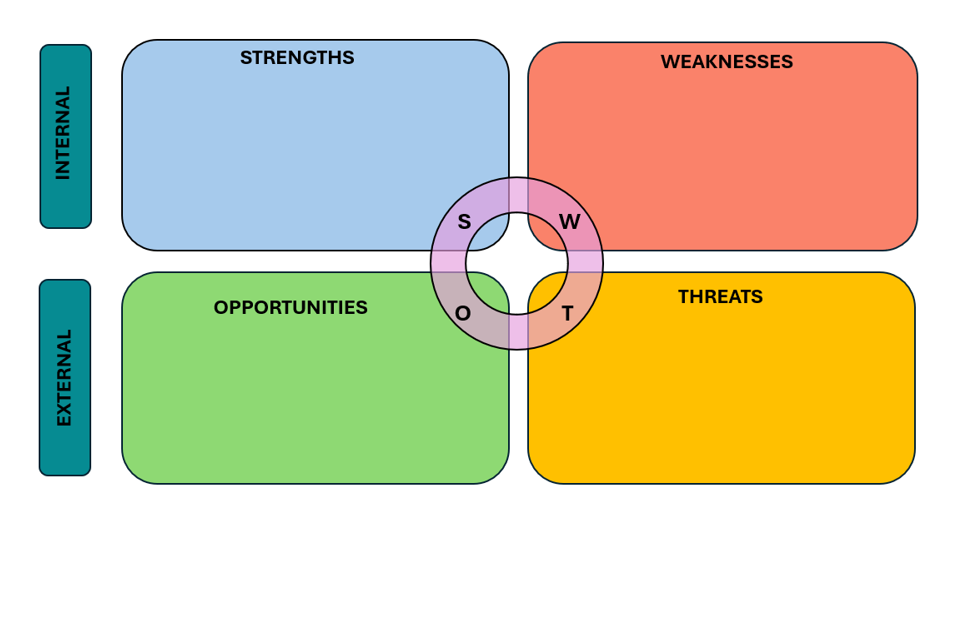
This figure shows the structure of a SWOT analysis .
Figure 1. The matrix structure diagram of a Strengths, Weaknesses, Opportunities and Threats (SWOT) analysis.
Questions to the Committee
i) Does the Report capture the discussions?
ii) Do Members have any additional comments or suggestions?
iii) Are Members content with the format?
iv) Do Members agree with the top Strengths, Weaknesses, Opportunities and Threats (SWOT) conclusions at the end of the report?
v) Do Members have any other comments?
Secretariat
August 2026
Annex A
SWOT report capturing the discussions as listed bullet points with a final snapshot report at the end.
Strengths
- Increase speed of chemical risk assessments by faster processing of chemical information
- Improved efficiency: AI models can swiftly analyse vast libraries of chemical structures and biological assays, prioritizing chemicals of concern long before expensive laboratory tests are needed.
- AI can handle large datasets (Big Data) and complex datasets.
- Facilitate safe and sustainable by design principles in chemical assessments.
- Enable and enhance cross-sector collaboration (pharma, cosmetics, agrochemical) through federated learning e.g., data sharing without exposing confidential raw data.
- Pattern recognition: AI tools can identify patterns, correlations and associations across large and complex datasets. This can signal risk or flag areas of emerging concern across conventional categories that traditional, manual methods might overlook
- AI can support interdisciplinary analysis as it can link across epidemiology, toxicology and environmental science.
- AI builds on existing computational tools (e.g. Quantitative Structure-Activity Relationship (QSAR) models) rather than starting from zero each time.
- Investment in AI tools gives a strong foundation for economic development.
- Increased mechanistic understanding through linking different methodologies.
- Cost considerations versus animal methods.
- AI champions the 3 Rs: Refine, Reduce, Replace in animal testing.
- Enhanced hazard identification and classification: Can provide a thorough structured rigorous, standardized framework by extracting and using data sheets to systematically identify chemical properties of chemicals.
- Advanced and improved predictive capabilities: Algorithms accurately predict toxicity, carcinogenicity, and environmental impacts (e.g., aquatic toxicity) by recognizing complex, non-linear relationships in data that evade traditional statistical methods.
- Real-time monitoring: Allows for continual updates on alert to be considered in real time. Scope for continuous learning, updating and improvement
- Forecast trends: By analysing historical data and external variables, AI can run predictive analytics and scenario simulations.
- Generate the documentation required by regulatory bodies.
- AI has the ability to integrate many types of data into a risk assessment.
- Can be more precise/accurate than a human observer by being less biased in some cases.
Weakness
- Limited by available data; gaps still require new data generation.
- Prompt-dependency embeds reproducibility issues.
- Limited ability to contextualise data and manage ambiguity.
- Requirement to understand applicability domains.
- Requires human oversight and interpretation (impacts speed).
- Concerns over governance, legal responsibility, data ownership, and ethics.
- AI systems rely on the quality and completeness of the data they are built on. When datasets are limited, incomplete, or difficult to access, this can reduce how reliable the models are.
- Challenging to clearly define a model’s applicability domain making it hard to judge whether a particular chemical is within the range the model was designed for.
- Risk of hallucinations.
- Putting AI into practice requires substantial investment, not just in technology and infrastructure, but also in skilled staff.
- Cybersecurity is a concern particularly for sensitive proprietary data.
- AI systems need ongoing updates and maintenance, which raises further questions around governance and how databases are managed over time.
- Environmental considerations, such as the carbon footprint of data centres, were acknowledged, although they fall outside the COT’s remit.
- Potential loss of mechanistic information in the modelling.
- Black box predictions: potentially difficult to understand how the predictions have been made.
- Difficult to access the right data. Currently very limited in the publicly available datasets (see opportunity in federated learning). We need broad access to data.
- Loss of human intervention in the predictions.
- Potential for external ownership of the models.
- The area needs investment from public money.
- Complexity of the models will require interpretation. Lack of adequately trained operators to understand and interpret the processes as well as the models.
- Resource intensive and an expertise demand to conduct thorough assessments which is time-consuming and expensive. Poor understanding can lead to incorrect or outdated assessments.
- Data dependency: Toxicity and dose-response data are often scarce for complex mixtures, requiring heavy reliance on expert judgment and assumptions.
- Animal data reliance: Traditional methods frequently require extensive laboratory animal testing, which carries ethical concerns and varying degrees of human relevance.
- Investment in technology: High initial investment and continual high maintenance costs.
- Model bias: AI models rely on historical toxicological data, which is often derived from a narrow set of “over-studied” chemical classes and can be flawed.
- Limited availability of skilled personnel: The deficit of professionals possessing the skills required to support this technology (requires a highly specialized, interdisciplinary skill set that bridges chemistry, toxicology, and data science) creates several operational vulnerabilities in expert judgement.
- Ethical concerns: including bias, accountability, and transparency, further complicate AI deployment and may undermine stakeholder trust.
- Vulnerability: regarding data privacy and non-compliance to the legal framework.
- Requires expert oversight and human verification.
- If it generates documentation for regulatory purposes that is not correct it could lead to significant legal and safety issues.
- Output is only as good as the data that goes in.
- Some outputs not comprehensible to humans so there will be a need for “explainable AI”.
- Risk if method development is outsourced externally so access, cost and safeguarding.
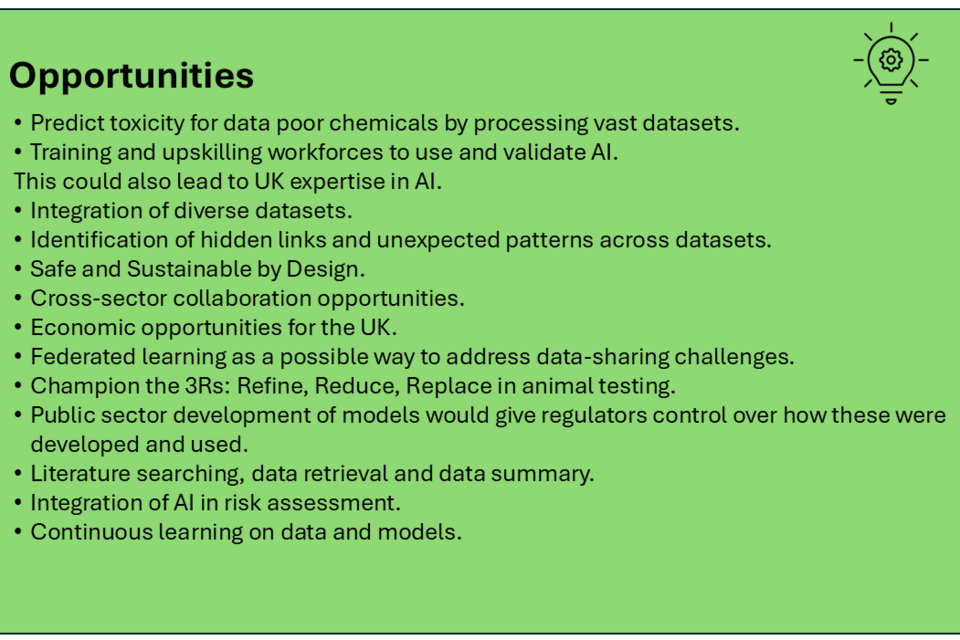
Opportunities
- Predict toxicity for data poor chemicals by processing vast datasets.
- Supporting predictive toxicology.
- Enhanced mixture assessments.
- Outsourcing and development of agentic platforms (in-house or third party).
- Training and upskilling workforces to use and validate AI. This would also lead to UK expertise in AI.
- Integration of diverse datasets (e.g. omics, Benchmark Dose Modelling, in vivo). AI systems can bring together different types of data across toxicology, epidemiology and environmental science.
- Identification of hidden links and unexpected patterns across datasets.
- Development of fit-for-purpose models
- Improved understanding of model accountability.
- Reduction in animal testing through predictive models and read across.
- Cost reductions compared to animal testing.
- Safe and Sustainable by Design (SSbD): Integrating assessment methods early in the product development stage allows industries to engineer safer chemicals that reach the market.
- AI can potentially increase mechanistic understanding.
- Cross-sector collaboration opportunities such as pharmaceuticals, agrochemicals and cosmetics, where there is currently limited sharing of data and approaches.
- Economic opportunities and potential contributions to GDP, especially if AI methods are developed within the UK as that can attract companies and innovation. UK focussed model development could drive growth in both the private and public sector (Universities, Small Medium Enterprises etc).
- Improved efficiency as AI can process and summarise large volumes of information far more quickly than traditional approaches, which could reduce the time required for assessments.
- Use in predictive toxicology, particularly in areas that are currently difficult to address, such as mixture toxicity and aggregate exposure, which are challenging to assess using traditional approaches.
- Federated learning as a possible way to address data-sharing challenges as models across different organisations can be shared without the need to share the underlying datasets.
-
It was also discussed areas of AI would have best opportunities short, medium and long term.
o Short term: literature searching, data retrieval and data summary.
o Medium term: coding and developments of prompts.
o Long term: integration of AI in risk assessment.
-
UK could be a leader in this area.
-
Public sector development of models would give regulators control over how these were developed and used. This would make their models and outputs safer, easier and more streamlined in acceptance and integration.
- Deeper understanding of the drivers of toxicity. Explainable AI is an opportunity in this domain.
- Expand data sharing between public and private sectors through a federated learning domain. This enables model builders to share the parameters of the models to enhance the training of AI models. In turn, this expands the chemical domain without the need to share the underlying data
- Championing the phasing out of animal testing.
- Next Generation Risk Assessment (NGRA): Advances in NGRA and New Approach Methodologies (NAMs) utilize human-relevant, hypothesis-driven data and models to predict toxicity without relying on animal models.
- Digital integration: The use of smart software and databases improves data accuracy, enabling automated mapping of chemical inventories and dynamic updates.
- Cross-industry application allows models trained in one sector (such as pharmaceutical drug discovery) to be applied to different disciplines, including occupational safety, consumer products, and environmental toxicology.
- Proactive collaborations and interventions: Allows models trained in one sector (such as pharmaceutical drug discovery) to be applied to different disciplines, including occupational safety, consumer products, and environmental toxicology.
- Continuous learning: Unlike static tools, ML algorithms refine their predictions as new toxicological data and research become available.
- Technology integration across the sectors: Combines diverse technologies such as sensor networks, Natural Language Processing (NLP), and high-throughput screening into a centralized platform.
- Well thought through cross-government approach could put UK on international stage.
- Scope for better and more consistent decision-making including across jurisdictions
- Could be strengthened with rigorous validation.
- Scope for quantification of uncertainty.
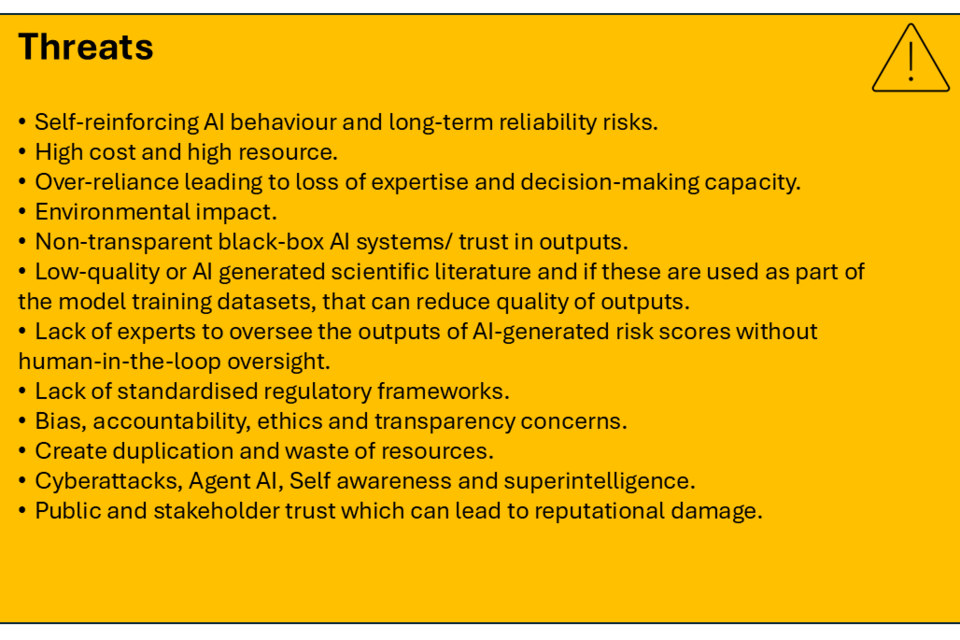
Threats
- High cost.
- High resource requirement.
- Risk of outdated, poorly understood, or misapplied outputs as AI is a fast-moving field.
- Increased error risk from complex data integration.
- Black-box nature reducing transparency and trust.
- Misuse by non-experts and cybersecurity/data risks.
- Over-reliance leading to loss of expertise and decision-making capacity.
- Increased AI expertise is required to understand the predictions. The lack of training for regulators could be a severe limitation to acceptance.
- Self-reinforcing AI behaviour and long-term reliability risks.
- Environmental carbon footprint considerations.
- The use of non-transparent black-box AI systems raised questions as to whether outputs can be trusted, especially in regulatory context.
- Misuse of AI tools by non-experts can lead to misinterpretation of outputs or inappropriate application.
- Public and stakeholder trust must be maintained, and it should be made clear that AI supports and does not replace expert judgement.
- The possibility that over-reliance on AI can lead to a loss of expertise over time.
- There is increasing volume of low-quality or AI generated scientific literature and if these are used as part of the model training data sets, that can reduce quality of outputs.
- Data privacy and intellectual property issues remain a concern, particularly when using externally developed tools.
- Uncertainty about accountability in cases where decisions are influenced by AI outputs
- Lack of standardised regulatory frameworks, including how AI aligns with Good Laboratory Practice (GLP).
- Lack of funding: currently non-animal research funding is focussed on animal replacement
- Outsourced AI; we run the risk of overseas companies owning the models and dictating how they are developed.
- Lack of acceptance by regulators: there will be challenges of getting a read-across prediction accepted versus an animal test.
- Lack of data sharing between public and private sectors; this would lead to limited models.
- Public trust in an AI prediction and decision: how do we explain uncertainty in a prediction and that we will get it wrong sometimes (the same is true of animal data, but we assume this is always correct and the gold standard)
- Bias in datasets: but this is also an opportunity if we can expand datasets access through federated learning
- Environmental impact: consuming vast amounts of electricity and freshwater, generating electronic waste, and driving mineral mining.
- Job losses.
- Skynet…(Self-awareness and superintelligence)
- Rapid chemical innovation: the sheer volume and speed of newly synthesized chemicals outpace the development of specific toxicological testing and regulatory frameworks.
- Vulnerabilities in global supply chains: Dispersed manufacturing and poor information flow can result in obscured chemical ingredients and a lack of hazard awareness among handlers.
- Stringent data privacy legislation will require strict adherence and may lead to operational shutdown if AI systems mishandle sensitive or personal information akin to GDPR legislation.
- Lack of experts to oversee the outputs of AI-generated risk scores without human-in-the-loop oversight which could lead to catastrophic failures if the model hallucinates or glitches.
- Reputational damage if public and stakeholder trust is lost.
- Bias, ethical, accountability, and transparency concerns.
- Vulnerability regarding data privacy and non-compliance to the legal framework.
- Regulatory pushback: Overcoming institutional risk aversion is difficult; regulatory agencies require high levels of technical and “beyond-technical” transparency before accepting AI-based assessments for compliance.
- Safety failure modes: AI systems remain susceptible to adversarial manipulation or edge-case failures, necessitating continued human oversight.
- Adversarial AI Attacks: Threaten chemical risk assessment by manipulating AI models to misclassify molecular toxicity or exposure risks.
- Capacity and costs of data storage and management
- Loss of existing data/knowledge due to changes in computer infrastructure and processes
- Data security and commercial ownership of data.
- Legislation (in areas such as governance and regulatory compliance) will not be able to keep up with developments in AI.
- Widening divide between rich and well-resourced nations / populations / institutions / companies and the rest.
- Lack of joined-up thinking could create duplication and waste of resources.
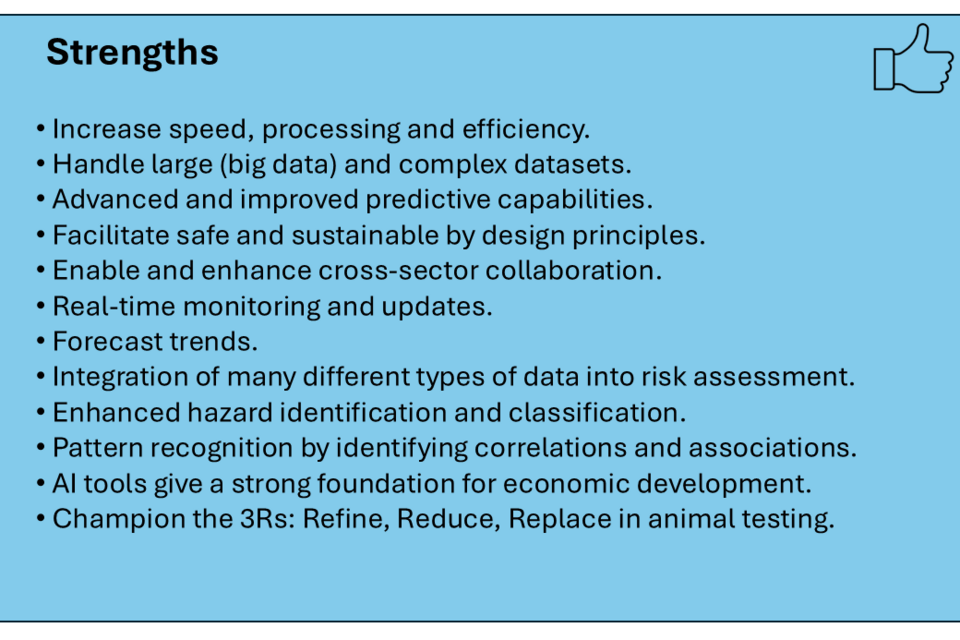
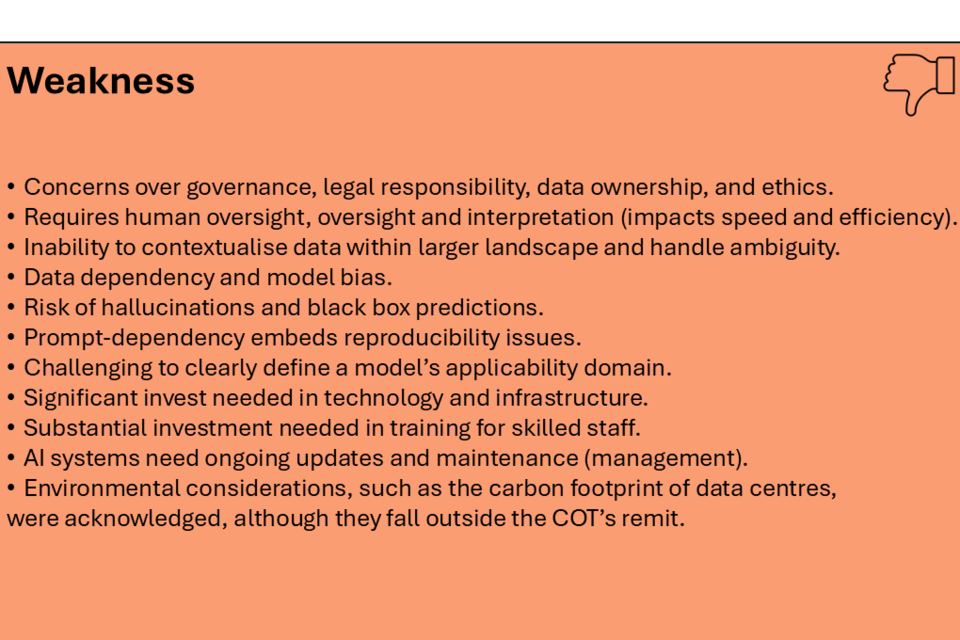
Concluding Thoughts and Report
Technical Terms
| Term | Definition |
|---|---|
| Black box | An artificial intelligence system where users can see the inputs and outputs, but the internal reasoning and decision-making process remain hidden. |
| Hallucinations | A response from an artificial intelligence system that sounds plausible and factual, but is actually incorrect, distorted, or completely fabricated. |
| Explainable AI | Explainable AI is a field of research that explores methods that provide humans with the ability of intellectual oversight over AI algorithms. |
| Federated Learning | Federated learning is a decentralized machine learning technique involving decentralized data, local training, and model aggregation. It lets multiple devices or servers train a shared AI model without moving or sharing any raw private data. |
| Safe and sustainable by design | Pre-market innovation framework that integrates safety and sustainability criteria into the earliest stages of designing and developing chemicals, materials, and products. |
Abbreviations
| Abbreviation | Definition |
|---|---|
| AI | Artificial Intelligence |
| GLP | Good Laboratory Practice |
| ML | Machine Learning |
| NLP | Natural Language Processing |
| NGRA | Next Generation Risk Assessment Advances in NGRA |
| NAMs | New Approach Methodologies |
| SSbD | Safe and Sustainable by Design |
| QSAR | Quantitative Structure-Activity Relationship |
References
Committee on Toxicity of Chemicals in Food, Consumer Products and the Environment (COT) October Meeting 2025 COT Meeting: 21st October 2025 Committee on Toxicity
Committee on Toxicity of Chemicals in Food, Consumer Products and the Environment (COT) March Meeting 2026 COT Meeting: 31st March 2026 Committee on Toxicity
Gant, T.W., Boxall, A., Burgwinkel, D., Zare Jeddi, M., Djidrovski, I., Friedrichs, S., Hardy, B., Hartung, T., Holland, D., Karwath, A. and Kienhuis, A., 2026. Building trust in the integration of artificial intelligence into chemical risk assessment: findings from the 2024 ECETOC workshop. Archives of toxicology, 100(5), pp.2149-2167.
Hartung, T., 2023. Artificial intelligence as the new frontier in chemical risk assessment. Frontiers in Artificial Intelligence, 6, p.1269932.
National Cyber Security Centre. (2026) Understanding adversarial attacks against machine learning and AI: Introducing a common language to improve awareness, threat modelling, and collaboration on AI security. Available at: NCSC Paper (Accessed 4th June 2026).
Serrano, D.R., Luciano, F.C., Anaya, B.J., Ongoren, B., Kara, A., Molina, G., Ramirez, B.I., Sánchez-Guirales, S.A., Simon, J.A., Tomietto, G. and Rapti, C., 2024. Artificial intelligence (AI) applications in drug discovery and drug delivery: revolutionizing personalized medicine. Pharmaceutics, 16(10), p.1328.
Stewart, R.F., 1963. A framework for business planning (Report No. 162). Long Range Planning Service, Stanford Research Institute, Menlo Park, CA.
Singh, A.V., Bhardwaj, P., Laux, P., Pradeep, P., Busse, M., Luch, A., Hirose, A., Osgood, C.J. and Stacey, M.W., 2024. AI and ML-based risk assessment of chemicals: predicting carcinogenic risk from chemical-induced genomic instability. Frontiers in toxicology, 6, p.1461587.
Thacharodi, A., Singh, P., Meenatchi, R., Tawfeeq Ahmed, Z.H., Kumar, R.R., V, N., Kavish, S., Maqbool, M. and Hassan, S., 2024. Revolutionizing healthcare and medicine: The impact of modern technologies for a healthier future—A comprehensive review. Health care science, 3(5), pp.329-349.
Wang Z (2024) ICBAR ‘24: Proceedings of the 2024 4th International Conference on Big Data, Artificial Intelligence and Risk Management Pages 1157-1161 https://doi.org/10.1145/3718751.371894
Wassenaar, P.N., Minnema, J., Vriend, J., Peijnenburg, W.J., Pennings, J.L. and Kienhuis, A., 2024. The role of trust in the use of artificial intelligence for chemical risk assessment. Regulatory Toxicology and Pharmacology, 148, p.105589.
Wittwehr, C., Blomstedt, P., Gosling, J., Peltola, T., Raffael, B., Richarz, A., Sienkiewicz, M., Whaley, P., Worth, A. and Whelan, M., Artificial Intelligence for Chemical Risk Assessment, Computational Toxicology, 2020, ISSN 2468-1113 (print), 13 (100114), p. 1-7, JRC117552.