Annual updates from the PhD student and the FSA fellow - Presentations from the FSA Fellow and PhD Student
Published 25 June 2026

© Crown copyright 2026
This publication is licensed under the terms of the Open Government Licence v3.0 except where otherwise stated. To view this licence, visit nationalarchives.gov.uk/doc/open-government-licence/version/3 or write to the Information Policy Team, The National Archives, Kew, London TW9 4DU, or email: psi@nationalarchives.gov.uk.
Where we have identified any third party copyright information you will need to obtain permission from the copyright holders concerned.
This publication is available at https://www.gov.uk/government/publications/19th-may-2026-committee-on-toxicity-meeting/tox202619-annual-updates-from-the-phd-student-and-the-fsa-fellow-presentations-from-the-fsa-fellow-and-phd-student
This is a paper for discussion. It does not represent the views of the Committee and should not be cited.
1. The FSA and COT have been reviewing New Approach Methodologies (NAMs) to scope the best scientific methodologies available to be used in risk assessment of chemicals in foods and the environment, and to understand how these can be incorporated and accepted in a regulatory context.
2. In 2021, the FSA started funding a 4-year computational toxicology postdoctoral fellow Dr Arthur de Carvalho e Silva at the University of Birmingham and a three-year PhD Student Mr Alexander Kalian (London Interdisciplinary Doctoral Program-LIDo-TOX AI) at King’s College London.
3. The fellow and PhD student have been working alongside other government departments to understand how NAMs will improve indicative levels of safety in chemical risk assessment.
4. In addition, these new partnerships have helped with networking, research collaboration, training opportunities and furthering our knowledge in this area. The fellowship and studentship also compliment the work set out in the COT FSA UK NAMs Roadmap towards using new approach methodologies in chemical risk assessment.
5. The Fellow and the PhD student have prepared their final review as outlined below and will present their progress to date to the COT Members.
Secretariat
May 2026
Postdoctoral Fellow Update Advancing in silico methods of assessing toxicological risk
Why and how are you associated with the FSA?
1. The FSA and COT have been reviewing new approach methodologies (NAMs) and developing a UK NAMs roadmap towards the integration and acceptance of NAMs for chemical risk assessment. One of the activities defined in this roadmap was to actively work on advancing in silico methods for assessing toxicological risk, specifically focused on food-related chemicals, but remaining open to work on other classes of chemicals relevant to the FSA’s risk assessments. In this context, I was recruited as a computational toxicology fellow and awarded a 4-year fellowship funded by the FSA, whilst supervised by a team of academic and applied NAM experts. A 3-year fellowship was awarded to me last September 2025 to progress case studies for priority-setting and safety assessment of tropane alkaloids and other plant toxins as potential food contaminants. The supervisory team is composed of Prof. Mark Viant and Prof. John Colbourne (University of Birmingham) and Dr. Olivia Osborne and Ms. Claire Potter (FSA).
Broad overview of the FSA fellowship and its aims
2 . The programme of work of the first fellowship consisted of (i) scoping the FSA’s problem space in chemical risk assessment and mapping this to our computational NAMs solution space, thereby aiding the FSA to develop a strategy for the utilisation of NAMs; (ii) ensuring that the FSA is trained in the use of computational NAMs by delivering training courses, including an introduction to existing and emerging NAM technologies, and topics selected from the FSA’s NAM strategy; (iii) developing and evaluating confidence in a new hazard assessment workflow that integrates in vitro omics toxicity data, benchmark dose modelling and PBPK modelling to serve as the basis for quantitative risk assessment for human health, i.e. towards generating human health-based safety thresholds for the FSA and other regulators; and (iv) developing and delivering a second case study that fortifies the community-wide acceptance of 21st century methods in risk assessments, to accelerate the successful application of NAMs within the FSA. The programme of work of the second fellowship consists of developing each tier of the proposed tiered approach to investigate tropane alkaloids and other plant toxins as potential food contaminants (Figure 1).
Progress with case studies
3. The latest case study launched is focusing on plant alkaloids of three large classes: tropane alkaloids (TAs), pyrrolizidine alkaloids (PAs), and glycoalkaloids (GAs). The supervisory team decided to start with TAs. In terms of food safety, the first objective of this case study is to support the UK FSA’s policy need to determine which TAs are the most potent (neuro)toxicants to prioritise specific substances and inform decisions on the UK’s monitoring of these alkaloids in foods. An integral part of this aim is to confirm that neurotoxicity is the primary mode of action of these alkaloids. This aim will be achieved using a tiered-testing strategy of in silico, in vitro and ‘omics NAMs. The second objective of this case study is to derive a HBGV for human exposure for the top priority, i.e. most potent substance within the class of TAs. This will utilise physiologically based pharmacokinetics (PBPK) modelling and quantitative in vitro to in vivo extrapolation (QIVIVE). From a methodological perspective, a broader third objective of the case study is to evaluate and attempt to build confidence within the FSA in the application of a series of relevant NAMs that have been integrated in a manner to address policy needs. These NAMs are tiered and incorporate existing human in vivo data as well as new testing on human in vitro cell lines, to maximise the relevance and accuracy to human food safety.
A tiered approach was proposed to achieve the objectives of this case study and is depicted in Figure 1.
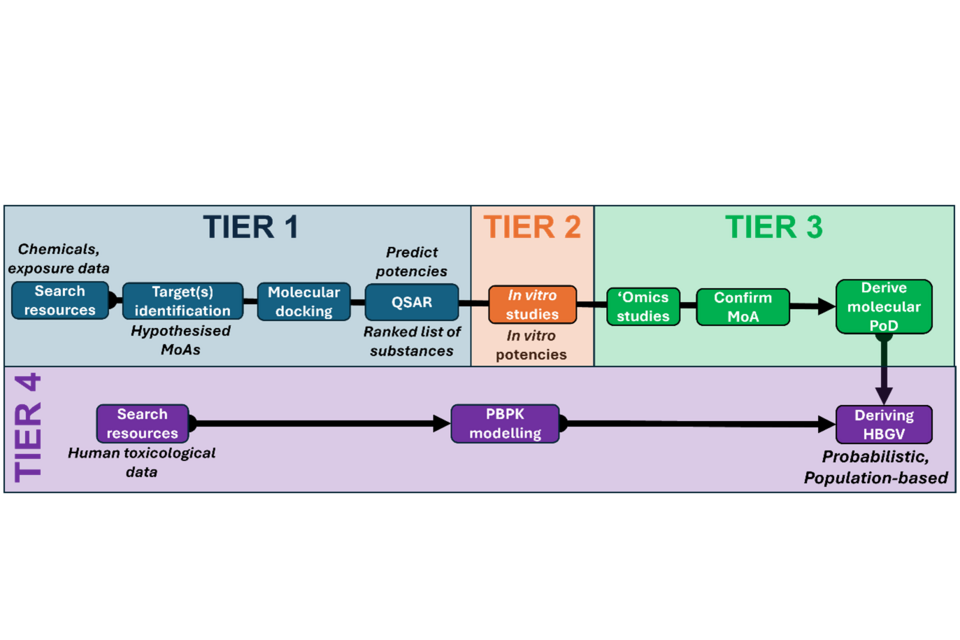
Diagram showing the 4 tiers of a master workflow for assessing plant toxins. Tier 1 uses computational methods, including search resources, target identification, molecular docking and QSAR, to predict potencies and produce a ranked list of substances. Tier 2 uses in vitro studies to refine potency estimates. Tier 3 uses omics studies to confirm mechanisms of action and derive molecular points of departure. Tier 4 integrates human toxicological data through PBPK modelling to derive probabilistic, population-based health guidance values.
4. The collaborative nature of this case study escalated to international level, especially after it was presented in the last Accelerating the Pace of Chemical Risk Assessment (APCRA) meeting (Ottawa, CA, 2024) where several potential partners demonstrated interest and willingness to collaborate. Meetings and scientific discussions with colleagues from the US Food and Drug Administration (FDA) are already happening as well as collaborations on Tiers 1 and 2 for the TAs.
5. The systematic integration of various data generation and modelling approaches has required a broad range of expertise, with Tier 1-3 predominantly guided by the University of Birmingham team and Tier 4 by Dr George Loizou and Dr Kevin McNally. Tier 2 involved the initial in vitro assessment of the chemicals of interest and will require specific expertise according to the class of alkaloid being investigated. For instance, our partners at LEITAT, led by Dr Ana Maria Candalija Iserte and Dr Cristina Fabregas (neuroscience/neurotoxicology experts), conducted in vitro tests to assess TAs effects on a neuroblastoma cell line (SH-SY5Y) with competitive calcium flux assays, which is relevant to the hypothesised mechanisms of action of these alkaloids.
Progress with papers and conferences
6. Our recent work on Perfluorooctanoic acid (PFOA) is published (1) and was presented on several occasions. To list a few, PARC Science Day (poster presentation), NURA Dynamic Discussions (oral presentation, online), HSE’s workshop (oral presentation, online), EFSA’s workshop (oral presentation, online), EUROTOX 2023 (poster presentation), ASPIS Open Symposium 2023 (poster presentation), BTS Annual Meeting (2024, oral presentation) and briefly presented at HESI Global Webinar on Benchmark Dose (BMD) modelling (online, 2026). PFOA case study was submitted as a nomination to the Lush Prize under the Young Researcher category and has been one of the five projects awarded in 2022. Besides, PFOA case study was used in training sessions delivered to the UK HSA (2024) and to the students of the new MSc course (Human and Environmental Toxicology with Law) at the University of Birmingham (2024).
7. The tropane alkaloids case study was also presented in several opportunities, To name a few, it was showcased at the APCRA meeting (Ottawa, CA, 2024) and formally accepted as a case study by its internal committee in the beginning of 2025; tier 1 results were submitted to EUROTOX 2025 annual meeting (Athens, and shortlisted to Alfonso Lostia prize for food safety research; tiers 1 and 2 results were presented at the annual SOT meeting (San Diego, USA, 2026). Other scientific outputs are listed below.
References
Corradi, Marie; Djidrovski, Ivo; Ladeira, Luiz; Staumont, Bernard; Verhoeven, Anouk; Sanz Serrano, Julen; Rougny, Adrien; Vaez, Ahmad; Hemedan, Ahmed; Mazein, Alexander; Niarakis, Anna; Silva, Arthur C.; Auffray, Charles; Wilighagen, Egon; Kuchovska, Eliska; Schreiber, Falk; Balaur, Irina; Calzone, Laurence; Matthews, Lisa; Veschini, Lorenzo; Gillespie, Marc E; Kutmon, Martina; König, Matthias; van Welzen, Matti; Hiroi, Noriko; Lopata, Oxana; Klemmer, Pierre; Overall, Rupert; Hofer, Tim; Satagopam, Venkata; Schneider, Reinhard; Teunis, Marc; Geris, Liesbet; Ostaszewski, Marek. 2026. User-driven development and evaluation of an agentic framework for analysis of large pathway diagrams. bioRxiv: 2026.03.10.710813.
Kalian, Alexander D., Arthur C. Silva, Jaewook Lee, Jean-Lou C. M. Dorne, Claire Potter, Emilio Benfenati, Olivia J. Osborne, Miao Guo, and Christer Hogstrand. 2025. Predicting Organ-Specific Toxicity of Selective Androgen Receptor Modulators, using Transfer Learning on Graph Convolutional Networks. bioRxiv: 2025.08.27.672581.
Maertens, A., B. Kincaid, E. Bridgeford, C. Brochot, A. C. Silva, J. C. M. Dorne, L. Geris, T. Husoy, N. Kleinstreuer, L. C. M. Ladeira, A. Middleton, J. Reynolds, B. Rodriguez, E. L. Roggen, G. Russo, K. Thayer, and T. Hartung. 2025. From cellular perturbation to probabilistic risk assessments. ALTEX.
Silva, A. C, G. D. Loizou, K. McNally, O. Osborne, C. Potter, D. Gott, J. K. Colbourne, and M. R. Viant. 2024. A novel method to derive a human safety limit for PFOA by gene expression profiling and modelling. Frontiers in Toxicology, 6: 1368320.
Complete list of scientific outputs (conferences, posters, published papers and awards)
Presentations in scientific conferences
Oral presentations delivered by Dr. Arthur de Carvalho e Silva
HESI Global Webinar on Benchmark Dose (BMD) modelling (online, 2026) – Reviewing the utility of Benchmark Dose Modelling as a chemical risk assessment tool.
Exploring the Future of Artificial Intelligence (AI) in Risk Assessment (London, 2025) – Proof of concept case studies: challenges and opportunities.
COT meetings (London, Postdoctoral Fellow Update Committee on Toxicity) – The fellow presented his annual review of progress every year since the beginning of the fellowship.
21st International workshop on QSAR in Environmental and Health Sciences (Italy, 2025) – QSAR models to predict potency of tropane alkaloids against human muscarinic receptors.
Eighth APCRA Workshop (Ottawa, 2024) – Utilising in silico, in vitro and ‘omics NAMs towards the prioritisation and safety assessment of plant alkaloids as potential food contaminants.
COT meetings (London, Advancing in silico methods of assessing toxicological risk Committee on Toxicity) – The fellow presented his annual review of progress every year since the beginning of the fellowship.
BTS Congress (Liverpool, 2024) – Risk assessment of PFOA using NAMs.
Workshop on Biological Perturbations to Probabilistic Hazard Assessment (Italy, 2023) – a peer-reviewed article was published to report the discussions and conclusions after this conference and can be accessed following this link: From cellular perturbation to probabilistic risk assessments - PubMed.
EFSA Workshop (online, 2023) – Deriving a human health-based guidance value for perfluorooctanoic acid: a NAM-based approach.
NURA DyNAMic Discussions Webinar on PFAS (2023) – A human health-based guidance value for perfluorooctanoic acid: a NAM-based approach.
Speed talk presentation at Biosciences Annual Conference (University of Birmingham, 2023) – Integrating new approach methods to risk assess food-related chemicals.
COT meetings (London, COT Meeting: 25th October 2022 Committee on Toxicity) – The fellow presented his annual review of progress every year since the beginning of the fellowship.
3rd In silico Toxicology Conference (2022, British Toxicology Society, online) – An in silico workflow integrating physiologically based pharmacokinetic modelling and in vitro transcriptomics data to derive a health-based guidance value for perfluorooctanoic acid.
Speed talk to FSA’s Chief Scientific Officer (2022, online) – Pilot study to test a computational workflow integrating PBPK and in vitro data to derive a health-based guidance value for the plasticiser di-2-ethylhexyl terephthalate.
Posters delivered by Dr. Arthur de Carvalho e Silva
SOT 2026 (San Diego, USA) – In silico and in vitro approaches to risk assess tropane alkaloids as food contaminants.
EUROTOX 2025 (Athens, Greece) – Utilising in silico, in vitro and ‘omics New Approach Methodologies for priority-setting and safety assessment of tropane alkaloids as potential food contaminants (shortlisted to Alfonso Lostia Poster Prize for food safety research).
PARC Science Day (2023, London) and EUROTOX 2023 (Ljubljana, Slovenia) – Integrating physiologically-based pharmacokinetic modelling and ‘omics data to derive a health-based guidance value for perfluorooctanoic acid.
Awards
LUSH Prize 2022 to Dr. Arthur de Carvalho e Silva
Young Researcher Lush Prize 2022 – Integrating physiologically based pharmacokinetic modelling and ‘omics data to derive health-based guidance values for perfluorinated chemicals. This prize leveraged £10,000 to be used for research purposes and has allowed the research group to generate more metabolomics data after analysing media samples where liver spheroids were exposed to perfluorinated chemicals. The project is progressing and will feed more data into the computational workflow developed and tested during case study 1, first fellowship. A few public mentions to the prize awarded can be found at the University of Birmingham website and cosmetics Business website: 3D printed human tissue project among Lush Prize winners for animal testing alternatives.
PhD Student Update
TOX-AI: Geometric deep learning applied to toxicology, for developing next-generation tools and databases for aiding chemical risk assessment of molecules found in food and drink
Why and how are you associated with the FSA?
1. The Food Standards Agency (FSA) jointly funded this PhD project alongside the Biotechnology and Biological Sciences Research Council (BBSRC), as an iCASE industrial CASE project under the London Interdisciplinary Doctoral Programme (LIDo) consortium. The PhD project was based at King’s College London, while the FSA was named as the industrial partner.
2. Dr Olivia Osborne, Dr David Gott (now retired), and Ms Claire Potter, of the FSA, were formally named as part of the supervisory team, in addition to Prof Christer Hogstrand, Dr Miao Guo, Prof Emilio Benfenati and Dr Jean-Lou C.M. Dorne.
3. The FSA’s focus in supporting this project was to increase the scope, quality and availability of next-generation Artificial Intelligence (AI)-driven Quantitative Structure-Activity Relationship (QSAR) models, relevant to regulatory toxicology of molecules found in food and drink. The project therefore contributed to FSA interests in developing New Approach Methodologies (NAMs) for chemical risk assessment, especially in silico methods that may support improved consumer safety while reducing reliance on animal testing.
4. It was intended that the project would produce open-source models, software tools, high-quality prediction datasets and publications relevant to regulatory toxicology, with particular emphasis on molecular endpoints and chemical classes of interest to food safety.
Broad overview of the PhD
5. The primary aim of the TOX-AI PhD project was to develop next-generation AI-QSAR models for predictive toxicology of small drug-like molecules, with a particular focus on molecules and endpoints relevant to food and drink chemical risk assessment. The project focused especially on geometric deep learning, including Graph Neural Networks (GNNs), while also challenging common modelling assumptions around molecular representation, feature engineering, architecture choice, transfer learning, hyperparameter optimisation, explainability and Applicability Domain (AD) definition.
6. The project began with QSAR modelling of Ames mutagenicity, using relatively simple deep learning models applied to classical molecular representations, including similarity coefficient and fragment-based feature spaces. This work explored whether feed-forward neural networks, supported by dimensionality reduction techniques, could produce useful predictive models of mutagenicity. Six dimensionality reduction techniques were explored, and both similarity-based and fragment-based representations were found to support comparably accurate QSAR models.
7. This early work then developed into GNN-based prediction of Ames mutagenicity, using molecular graphs as direct inputs. In this stage, trained GNNs were combined with Explainable AI (XAI) approaches to identify structural alerts associated with mutagenicity. This work was presented to a UK Government Committee on Mutagenicity (COM) meeting, supporting discussion around the interpretability and regulatory relevance of AI-QSAR models. Performance was also compared against classical machine learning models, transformer models, and transformer models enriched with quantum mechanical descriptors, as part of an international collaborative research project with a South Korea based team.
8. The project then expanded into targeted case studies on chemical classes of regulatory or toxicological interest. One case study focused on Brominated Flame Retardants (BFRs), using Graph Attention Networks (GATs) over knowledge graphs of molecules connected by shared substructures of interest. This work predicted in-vivo neurotoxicity, developmental toxicity and reproductive toxicity reference points relevant to chemical risk assessment and was published in conference proceedings.
9. A further case study focused on Selective Androgen Receptor Modulators (SARMs), using Graph Convolutional Networks (GCNs) and transfer learning to predict Drug-Induced Liver Injury (DILI), Drug-Induced Renal Injury (DIRI), and Drug-Induced Cardiotoxicity (DICT). The study applied trained models to 25 SARMs and identified hepatotoxicity and nephrotoxicity as endpoints of concern, with the majority of SARMs (21/25) predicted as either DILI-positive, DIRI-positive, or both (with only 1/25 predicted as DICT-positive).
10. Collaborative work was also carried out with Dr Arthur de Carvalho e Silva, the FSA-funded postdoctoral researcher at the University of Birmingham, on Tropane Alkaloids (TAs). This included AI-QSAR modelling relevant to Blood Brain Barrier Penetration (BBBP), contributing to the wider priority-setting and safety assessment of TAs as potential food contaminants.
11. Following the BFRs study, the final phase of the PhD broadened into a more ambitious set of exploratory and frontier AI studies. This included a systematic comparison of optimised GNN architectures across varying toxicological assay data environments, comparing GCNs, GATs and Graph Isomorphism Networks (GINs). This study found that GCNs generally underperformed relative to GATs and GINs, while GINs appeared strongest in more data-abundant settings and GATs appeared especially useful in more data-scarce settings.
12. The final phase also included later unpublished or pending work on protein-ligand binding models, including hybrid transformer-GNN approaches for regression of half maximal inhibitory concentration (IC50) values across arbitrary protein-molecule pairs. This was intended to support prediction of Molecular Initiating Events (MIEs) and achieved state-of-the-art performance. Further exploratory studies also investigated AI approaches to protein-ligand binding that consider the full folded protein structure, including the complex three-dimensional internal and external geometry of protein-ligand systems.
13. The PhD finale further included exploratory work in generative AI for expanding chemical space. This included graph generative models, such as graph variational autoencoders, as well as deterministic approaches for systematically generating molecular graphs to investigate the structure of chemical space itself. These studies explored not only how AI may predict toxicological properties, but also how AI and graph-theoretic methods may help map, expand and interrogate chemical space more broadly.
Main work completed across the PhD
Wider regulatory toxicology and chemical risk assessment:
The project contributed to collaborative work on combined exposure to multiple chemicals at the European Food Safety Authority, helping situate the project within the broader scientific and regulatory context of food safety, mixtures, cumulative risk assessment and future challenges in chemical risk assessment.
Ames mutagenicity modelling using classical representations and neural networks:
The project developed QSAR models of Ames mutagenicity using neural networks, similarity-based molecular representations, fragment-based representations and dimensionality reduction techniques. This work explored how different molecular representations and supporting algorithms affect deep learning-driven QSAR performance.
GNN-XAI modelling of Ames mutagenicity:
The project developed GNN-based models of Ames mutagenicity, followed by XAI analysis to identify structural alerts from trained models. This work directly addressed the interpretability challenge associated with AI-QSAR models, and was presented to the UK Government Committee on Mutagenicity. Model performance was also compared against classical models, transformer-based models and transformer models enriched with quantum mechanical descriptors, as part of an international collaboration with a South Korea based team.
Brominated Flame Retardants case study:
The project developed GAT-based knowledge graph models for predicting in vivo toxicological points of departure for BFRs. This work focused on neurotoxicity, developmental toxicity and reproductive toxicity, using molecular knowledge graphs in which molecules were connected according to shared substructures of toxicological interest.
Selective Androgen Receptor Modulators case study:
The project developed GCN-based models for predicting organ-specific toxicity of SARMs, including DILI, DIRI and DICT. Transfer learning was explored as a possible method for improving performance in data-scarce toxicological modelling settings, and the final trained models were applied to a curated set of SARMs.
Tropane Alkaloids collaboration:
The project contributed to collaborative work on TAs with Dr Arthur de Carvalho e Silva, including AI-QSAR modelling of BBBP. This formed part of wider FSA-relevant work on priority-setting and safety assessment of TAs as potential food contaminants.
Comparison of optimised GNN architectures:
The project systematically compared optimised GNN architectures across different toxicological assay environments. GCNs, GATs and GINs were compared using Bayesian optimisation, generating practical insight into which GNN architectures may be most suitable under different toxicological data conditions.
Protein-ligand binding and MIE modelling:
Later-stage work explored protein-ligand binding prediction for MIE modelling. This included hybrid transformer-GNN approaches for half maximal inhibitory concentration (IC50) regression across arbitrary protein-molecule pairs, as well as more exploratory work using AI to consider the complex three-dimensional internal and external structure of folded proteins.
Generative AI and chemical space expansion:
The final exploratory phase included generative AI and graph-theoretic approaches to chemical space expansion. This included graph variational autoencoders and deterministic molecular graph generation approaches, with the broader goal of exploring chemical space structure and identifying routes to generate or discover molecules beyond existing datasets.
Papers and/or conferences completed or in progress
-
Cattaneo, I., Kalian, A.D., Di Nicola, M.R., Dujardin, B., Levorato, S., Mohimont, L., et al. 2023. Risk assessment of combined exposure to multiple chemicals at the European Food Safety Authority: principles, guidance documents, applications and future challenges. Toxins, 15(1), 40.
-
Kalian, A.D., Benfenati, E., Osborne, O.J., Gott, D., Potter, C., Dorne, J.L.C.M., et al. 2023. Exploring dimensionality reduction techniques for deep learning driven QSAR models of mutagenicity. Toxics, 11(7), 572.
-
Kalian, A., Osborne, O.J., Dorne, J.L.C., Gott, D., Potter, C., Guo, M. and Hogstrand, C. 2023. Improving accuracy scores of neural network driven QSAR models of mutagenicity. Computer Aided Chemical Engineering, 52, pp.2717-2722.
-
Kalian, A.D., Benfenati, E., Gott, D., Potter, C., Dorne, J.L.C., Osborne, O.J., et al. 2024. P05-37 Graph attention networks using knowledge graphs, for predicting novel points of departure for brominated flame retardants. Toxicology Letters, 399, pp.S146-S147.
-
Kalian, A.D., Otte, L., Lee, J., Benfenati, E., Dorne, J.L., Potter, C., Osborne, O.J., et al. 2025. Comparison of Optimised Geometric Deep Learning Architectures, over Varying Toxicological Assay Data Environments. arXiv preprint arXiv:2507.17775.
-
Kalian, A.D., Silva, A.C., Lee, J., Dorne, J.L.C.M., Potter, C., Benfenati, E., Osborne, O.J., et al. 2025. Predicting Organ-Specific Toxicity of Selective Androgen Receptor Modulators, using Transfer Learning on Graph Convolutional Networks. bioRxiv.
-
Silva, A., Loizou, G., McNally, K., McDonald, D., He, S., Kalian, A., Osborne, O., et al. 2025. Utilising in silico, in vitro and omics New Approach Methodologies (NAMs) for priority-setting and safety assessment of tropane alkaloids as potential food contaminants. Toxicology Letters, 411.
-
Silva, A.C.E., Loizou, G., McNally, K., McDonald, D., He, S., Kalian, A., Osborne, O., et al. 2025. P12-06 Utilising in silico, in vitro and omics New Approach Methodologies (NAMs) for priority-setting and safety assessment of tropane alkaloids as potential food contaminants. Toxicology Letters, 411, S138.
-
Kalian, A.D., Lee, J., Johannesson, S.P., Otte, L., Hogstrand, C. and Guo, M. 2025. From LLMs to sustainable proteins: fine-tuning and prompt engineering for multi-agent AI in waste carbon-utilising microbial protein production. Carbon Capture Science & Technology.
-
Kalian, A.D., Lee, J., Johannesson, S.P., Otte, L., Hogstrand, C. and Guo, M. 2025. Fine-Tuning and Prompt Engineering of LLMs, for the Creation of Multi-Agent AI for Addressing Sustainable Protein Production Challenges. arXiv preprint arXiv:2506.20598.
Additional work pending publication includes research on hybrid transformer-GNN models for protein-ligand binding and MIE prediction and research on graph generative approaches for chemical space expansion.
Conferences and presentations
-
UK Government Committee on Toxicity (COT) Meeting, Oct 2022 (oral presentation).
-
London Interdisciplinary Biosciences Programme (LIDo) iCASE Gala 2022.
-
33rd European Symposium on Computer-Aided Process Engineering (ESCAPE-33), 2023 (oral presentation).
-
12th World Congress on Alternatives and Animal Use in the Life Sciences (WC12), 2023 (poster presentation).
-
UK Government Committee on Toxicity (COT) Meeting, Oct 2023 (oral presentation).
-
EUROTOX 2024, 2024 (poster presentation).
-
UK Government Committee on Mutagenicity (COM) Meeting, Jun 2024 (oral presentation).
-
ELRIG Drug Discovery 2024, 2024 (attendee).
-
London Interdisciplinary Biosciences Consortium (LIDo) Collaborative Research Gala, 2024 (oral presentation; awarded best presentation).
-
Society of Toxicology 64th Annual Meeting and ToxExpo, 2025 (poster presentation).
-
UK Government Committee on Toxicity (COT) Meeting, Mar 2025 (oral presentation).
-
21st International Workshop on Quantitative Structure-Activity Relationships in Environmental and Health Sciences (QSAR 2025), 2025 (oral presentation).
-
UK Government Committee on Toxicity (COT) Meeting, Oct 2025 (oral presentation).
Awards and recognition
In February 2024, I received the Toxics 2024 Travel Award, issued by the MDPI journal Toxics, to support a junior scientist in presenting toxicology research at an international conference.
In December 2024, I received the LIDo Gala 2024 Best Presentation Award, issued by the London Interdisciplinary Biosciences Consortium, for the best presentation summarising my PhD research at the LIDo Collaborative Research Gala 2024.
In December 2025, I passed my PhD viva with minor corrections and received formal confirmation of the full PhD award (Doctor of Philosophy in Applied Artificial Intelligence) on 1st May 2026.