Playground Fund: guidance for recipient local authorities
Published 18 June 2026
Applies to England

© Crown copyright 2026
This publication is licensed under the terms of the Open Government Licence v3.0 except where otherwise stated. To view this licence, visit nationalarchives.gov.uk/doc/open-government-licence/version/3 or write to the Information Policy Team, The National Archives, Kew, London TW9 4DU, or email: psi@nationalarchives.gov.uk.
Where we have identified any third party copyright information you will need to obtain permission from the copyright holders concerned.
This publication is available at https://www.gov.uk/government/publications/18-million-playground-fund/playground-fund-guidance-for-recipient-local-authorities
Summary
Purpose
Create new playgrounds, or improve or enhance existing playgrounds, in the areas of greatest need.
Type of fund
Non-competitive grant funding.
Eligibility
66 local authorities in England only.
Funding available
£270,000 per local authority across financial years 2026 to 2027 and 2027 to 2028.
Funding objectives at programme level
To improve children and young people’s access to high-quality, accessible and inclusive playgrounds by:
1. increasing or improving playground provision in selected areas of greatest need.
2. targeting places with higher levels of income deprivation affecting children and weaker existing playground provision, assessed through existing data on:
a. Income Deprivation Affecting Children Index
b. number of children per playground
c. playground size
d. children’s travel distance to playgrounds
3. supporting meaningful engagement with children, families and communities in site selection and design.
4. improving the quality, accessibility, inclusivity and long-term sustainability of local playgrounds.
Ministerial foreword
Play is fundamental to childhood. It supports children’s physical health, confidence and social development, and it helps build friendships, resilience and a sense of belonging. Playgrounds also bring wider benefits for families and communities, creating places to meet, spend time outdoors, and feel connected to the neighbourhoods we call home.
This government is investing in the everyday infrastructure that helps children thrive, building on the strengths already present in local communities. Neighbourhoods already offer a strong foundation of spaces, relationships and local knowledge that support children’s opportunities to play, with playgrounds a vital part of this wider infrastructure.
While many areas have strong play provision, this is not yet consistent everywhere. This programme enables local authorities to work with their communities to strengthen and enhance existing spaces, addressing gaps where they exist. We want every child, whatever their background and wherever they live, to have access to high quality, welcoming places to play.
This funding is aligned with our Pride in Place Strategy to support the practical improvements that people can see and feel in their day-to-day lives. Well-designed playgrounds contribute to pride in place by improving the look and feel of neighbourhoods, strengthening community cohesion and creating welcoming public spaces that reflect local identity. By focusing on places most in need, and by backing local leadership and local knowledge, we are helping communities shape playgrounds that work for children, families and local residents.
I am grateful to local authorities and partners for the work they will do to deliver this programme, including meaningful engagement with children, families and communities. I look forward to seeing projects that are ambitious in quality, inclusive in design, and sustainable in the long term, creating spaces where all children can play and where parents and caregivers can connect in their communities.
Nesil Caliskan MP
Parliamentary Under Secretary of State for Devolution, Faith and Communities
Introduction
This guidance is for the 66 local authorities selected to receive £18 million Playground Fund. The following chapters explain the purpose of the fund, who is eligible, what it can be used for, and how authorities should deliver their projects.
Playgrounds are part of the government’s focus on everyday social infrastructure and place-based renewal. At the Autumn Budget the Chancellor announced £18 million over 2 years to create, improve or enhance up to 200 playgrounds across England.
The fund targets communities with higher child income deprivation and weaker playground provision, to improve access to high-quality, accessible and inclusive play.
Authorities should show how projects contribute to wider play sufficiency, are shaped by children and families, and include clear plans for accessibility, inclusion and long-term maintenance.
Delivery objectives
The playground funding has 3 core delivery objectives. The Ministry of Housing, Communities and Local Government (MHCLG) would expect all selected local authorities to deliver activity against each of the objectives set out below:
- create, improve or enhance 3 playgrounds that are inclusive, free to access for children, families and caregivers, and the wider community
- undertake proportionate, meaningful engagement with children, young people, families and caregivers, local residents and relevant local stakeholders throughout site selection, design and delivery
- participate in monitoring and evaluation to help assess whether the fund has improved access to high-quality, accessible and inclusive playgrounds, and contributed to wider outcomes in your local area
Evidence
When local authorities consider where and how to invest the funding, they may wish to consider the following sources in addition to local evidence. The 2024 Children’s People and Nature Survey for England links playground access to children going outside, with benefits for health, connection and wellbeing.
University of Sheffield analysis shows uneven provision and a “double disadvantage” in more deprived areas. Play England’s It All Starts with Play! calls for restoring children’s time, space and freedom to play.
Inclusive play remains a gap. Scope highlights barriers for disabled children and promotes practical steps for councils; accessibility and inclusion should be designed in from the start.
The Raising the Nation Play Commission argues play should be treated as essential to neighbourhood design and public services, reinforcing links to health, wellbeing and children’s rights.
The MHCLG Parks Working Group highlighted barriers including unsafe routes, maintenance pressures and risk aversion, and notes gaps for teenagers and girls (Safer Parks for Women and Girls Guidance). It emphasises community involvement, evidence-led targeting and planning for renewals.
Supplementary guidance
We recommend that you review the supplementary guidance for additional information on the following topics:
- good practice for community consultation
- inclusive and accessible design
- playground design principles
- project preparation, inspection and maintenance
- environmental considerations
- inclusivity for women and girls
- safety
- procurement frameworks with Public Sector Buying Organisations
Planning and design policy context
Playgrounds sit within the planning framework for open space, sport and recreation. The National Planning Policy Framework (NPPF) recognises their role in health and wellbeing, nature and climate goals.
The NPPF expects robust assessments of need and protects existing open and formal play space from development unless it is no longer needed, equivalent or better provision is secured, or benefits clearly outweigh the loss.
The department consulted on NPPF changes between 16 December 2025 and 10 March 2026, including proposals on play space. We will publish our response in due course.
Branding
Local authorities receiving funding through the £18 million Playground Fund should follow the publicity and branding requirements set out in the Funded by UK Government Branding Manual. This will help beneficiaries demonstrate the impact of UK government funds under and ensure citizens see the tangible benefits that government support is making in local areas.
We ask that local authorities apply these requirements to communications, publicity materials and on-site signage relating to projects funded through this programme, in line with the terms set out in the Memoranda of Understanding.
Pride in Place Strategy
The £18 million Playground Fund complements the government’s Pride in Place Programme by providing targeted investment so children in 66 selected communities can access high-quality, safe, accessible and inclusive playgrounds.
It complements longer-term neighbourhood investment by improving everyday public spaces, supporting community connection and helping children feel they belong.
Eligible local authorities
BUAs in 66 local authorities in England have been selected to receive funding through this fund via the published methodology note. The metrics used for selection included:
- Income Deprivation Affecting Children Index
- number of children per playground
- playground size
- children’s travel distance to playgrounds
The following list includes eligible local authorities for the Playground Fund ordered alphabetically.
Eligible local authorities in England
The following local authorities are eligible for this playground funding:
| Eligible local authorities | Built-up area | Region |
|---|---|---|
| Ashfield | Hucknall | East Midlands |
| Barnsley | Barnsley | Yorkshire and The Humber |
| Bassetlaw | Worksop | East Midlands |
| Blackburn with Darwen | Blackburn (Blackburn with Darwen) | North West |
| Blackpool | Blackpool | North West |
| Bolton | Farnworth | North West |
| Bradford | Keighley | Yorkshire and The Humber |
| Bury | Prestwich | North West |
| Calderdale | Halifax | Yorkshire and The Humber |
| Canterbury | Herne Bay | South East |
| Castle Point | Canvey Island | East of England |
| Cheshire East | Crewe | North West |
| County Durham | Consett | North East |
| Darlington | Darlington | North East |
| Doncaster | Doncaster | Yorkshire and The Humber |
| Dover | Dover | South East |
| Dudley | Dudley | West Midlands |
| East Lindsey | Louth | East Midlands |
| Eastbourne | Eastbourne | South East |
| Fenland | Wisbech | East of England |
| Halton | Widnes | North West |
| Hartlepool | Hartlepool | North East |
| Hastings | Hastings | South East |
| Havant | Havant | South East |
| Hyndburn | Accrington | North West |
| Isle of Wight | Ryde | South East |
| Kirklees | Dewsbury | Yorkshire and The Humber |
| Knowsley | Huyton with Roby | North West |
| Lincoln | Lincoln | East Midlands |
| Manchester | Wythenshawe | North West |
| Mansfield | Mansfield | East Midlands |
| Medway | Chatham | South East |
| Middlesbrough | Middlesbrough | North East |
| North East Lincolnshire | Grimsby | Yorkshire and The Humber |
| North Northamptonshire | Wellingborough | East Midlands |
| North Tyneside | Wallsend | North East |
| Northumberland | Ashington (Northumberland) | North East |
| Nuneaton and Bedworth | Bedworth | West Midlands |
| Oldham | Failsworth | North West |
| Pendle | Nelson | North West |
| Preston | Preston | North West |
| Redcar and Cleveland | Eston | North East |
| Rochdale | Heywood | North West |
| Rotherham | Rotherham | Yorkshire and The Humber |
| Salford | Little Hulton | North West |
| Sandwell | Tipton | West Midlands |
| Sefton | Bootle | North West |
| South Tyneside | Jarrow | North East |
| Southend-on-Sea | Southend-on-Sea | East of England |
| St. Helens | St Helens | North West |
| Stockport | Reddish | North West |
| Stockton-on-Tees | Thornaby-on-Tees | North East |
| Sunderland | Sunderland | North East |
| Tameside | Ashton-under-Lyne | North West |
| Tendring | Clacton-on-Sea | East of England |
| Thanet | Margate | South East |
| Torbay | Torquay | South West |
| Trafford | Old Trafford | North West |
| Wakefield | Wakefield | Yorkshire and The Humber |
| Walsall | Bloxwich | West Midlands |
| West Lancashire | Skelmersdale | North West |
| Wigan | Leigh | North West |
| Wirral | Birkenhead | North West |
| Wolverhampton | Bilston (Wolverhampton) | West Midlands |
| Wychavon | Droitwich Spa | West Midlands |
| Wyre | Fleetwood | North West |
How to identify your built-up area boundaries
A built-up area (BUA) as defined by the Office for National Statistics (ONS) is based on the physical extent of an urban area (for example, a town or city) rather than administrative boundaries. If you would like to identify the specific geographic boundaries of the BUA within your local authority you should follow the below steps:
1. Search for Planning and Housing Data.
2. Under the ‘dataset’ drop-down menu, select the ‘built-up area’ option.
3. Under the ‘location’ drop-down menu, select your local authority (for example, Ashfield District Council).
4. Click ‘Search’. This should generate a list of BUAs within your local authority boundaries, where you should find the specific boundaries of the BUA listed above (for example, the BUA of Hucknall in Ashfield).
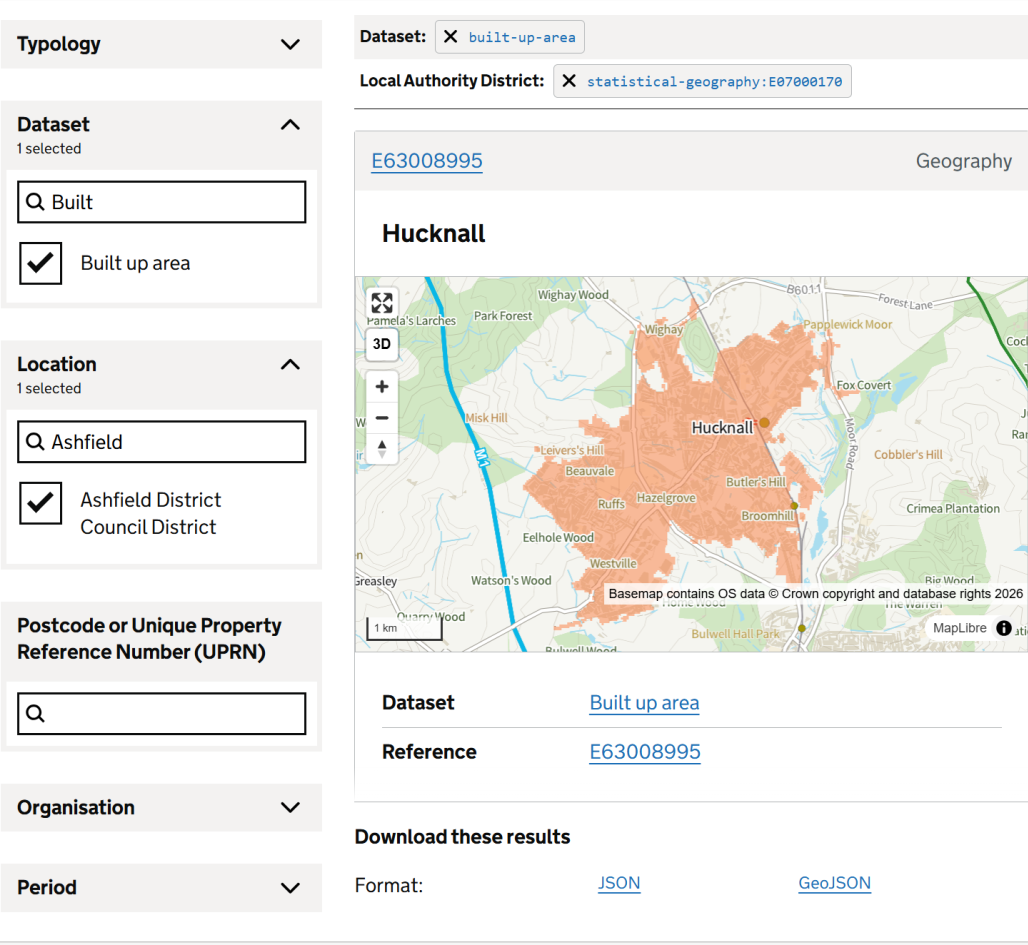
Screenshot of the Planning and Housing Data search page showing the ‘built-up area’ dataset selected, a local authority chosen in the location field, and search results listing built-up area boundaries.
Funding allocation
Each local authority who has their submission accepted will receive £270,000 across financial years 2026 to 2027 and 2027 to 2028 with the following capital and revenue financial profile:
| Grant type | 2026 to 2027 | 2027 to 2028 |
|---|---|---|
| Capital funding | £120,000 | £120,000 |
| Revenue funding | £15,000 | £15,000 |
| Total | £135,000 | £135,000 |
Eligible capital and eligible revenue expenditure
This fund includes both capital funding and revenue funding. The examples below are illustrative rather than exhaustive and are intended to provide clarity on the types of costs normally considered eligible under each funding stream for this programme.
Eligible capital expenditure
Capital funding should be used for the creation, improvement or enhancement of physical playground assets, where the expenditure results in an enduring asset or improvement to an existing asset.
Eligible capital expenditure may include, for example:
- purchase and installation of fixed playground equipment and structures
- surfacing and associated groundworks (including safety surfacing, drainage and foundations)
- construction, refurbishment or improvement of playground areas
- design and professional fees that are directly attributable to creating or enhancing the physical asset, where these are capitalised in line with local authority accounting practice (for example, design or landscape architecture fees, site investigation fees, planning fees, etc)
Capital funding should not be used for ongoing operational or service costs, routine maintenance unrelated to the funded works, or activity that does not directly contribute to the creation or improvement of a physical playground asset.
Eligible revenue expenditure
Revenue funding is intended to support proportionate programme delivery and early implementation activity linked directly to the funded playground projects. It is time‑limited and should not be used to fund ongoing service provision or recurring operational costs beyond delivery of the programme.
Eligible revenue expenditure may include, for example:
- consultation and engagement with children, families and communities
- project development and preparation costs (such as feasibility work, options appraisal or site assessments that are not capitalised)
- specialist advice relating to accessibility, inclusion, safety, play value or community engagement
- staff time or external support directly related to programme delivery and management
- training relevant to delivery, inspection, risk‑benefit assessment or management of the funded playgrounds
- monitoring, evaluation and reporting activity required by the programme
- opening or launch events linked to completion of funded projects
- post-completion inspection
Funding flexibility
Local authorities are expected to have spent or fully committed all the funding by 31 March 2028. Committed in this circumstance means local authorities have identified how each element of their playground investment will be spent through a fully costed plan, MHCLG will assess this via light-touch monitoring arrangements with local authorities.
Subsidy control
All accountable bodies must comply with the Subsidy Control Act 2022 when administering public money under this programme. Accountable bodies should familiarise themselves with the act and the statutory guidance, which is updated periodically.
Delivery
How the Playground Fund delivery process works
The Playground Fund will use a proportionate assurance process to review delivery arrangements before funding is confirmed. This process is non-competitive and is designed to provide assurance that funding can be delivered in line with programme requirements.
Submission form
The submission form window will open on Thursday 18 June 2026 and close on Monday 17 August 2026. Submissions will be processed on a rolling basis during this period and are welcomed as soon as they are ready. This form is designed to provide assurance that the authority can deliver the funded activity in line with programme aims. The submission form will ask local authorities:
- for details of their main contact
- how they’ve done their community engagement and who was involved in it
- if the 3 playgrounds are being newly built or refurbished
- for details regarding the location of the 3 playgrounds – including the name, postcode and reasons why they’ve chosen sites outside of the BUAs outlined, if applicable
- for estimated total capital and revenue spend on each playground
- if they’re using any match funding to do the works to the playgrounds and the source of the funding
While this is not a competitive assessment, MHCLG may ask for clarification or further information where needed to confirm that proposals meet the programme requirements. If local authorities do not complete this stage by the deadline, MHCLG will contact them with a final deadline and inform them of intention to deliver funding to the next most eligible local authority should they not engage with this process.
Memorandum of Understanding
Submission forms will be validated by MHCLG on a rolling basis as they are completed after submission window opens. A Memorandum of Understanding (MoU) will be agreed subsequently, and funding will be released by MHCLG. The MoU will outline agreement between the local authority and MHCLG, detailing the playground locations, aims of the projects and responsible parties.
Timeline
Here are the key dates your projects will follow.
| 18 June 2026 | Submission form window opens. The form will be shared by email with council Chief Executives. |
| 17 August 2026 | Closing date for your submission form information |
| August 2026 onwards | First tranche of funding released |
| April 2027 | Second and final tranche of funding released |
| 31 March 2028 | Final deadline for all funding to be spent or committed |
Monitoring and evaluation
We want to understand whether the fund has improved children’s and caregivers’ / families’ access to high-quality, accessible and inclusive playgrounds in the selected areas and whether projects have met the fund’s aims.
Evaluation will help MHCLG understand how different factors affect project impact, which may include focus on the scale of investment, size and condition of the site, location, playground features, accessibility, inclusion, play value, community engagement, maintenance arrangements, safety and local context.
We would like to work with recipient authorities on a combination of monitoring and evaluation activities. Monitoring questions will be proportionate to the scale of the project and cover a range of topics pertaining to the rollout of the funding. Monitoring questions may include:
- how the projects will support quality and play value, including a range of play opportunities for different ages, abilities and ways of playing
- how the authority has managed risk-benefit, safety, inspection and maintenance
- demonstrate how funded playgrounds will improve quality, accessibility and inclusion, taking account of local need and the different ways children play
- set out how each playground will be maintained and managed after completion, including inspection, repair and longer-term stewardship arrangements
MHCLG may work with specialist partners to support programme learning, monitoring and evaluation. Where this involves sharing personal data, this will be done in accordance with the privacy notice and relevant data protection requirements. We will contact recipient authorities with more detail in due course.
Privacy notice
Our privacy notice is applicable to local authorities eligible to receive grants under the Playground Fund. This notice is to explain your rights and give you the information you are entitled to under UK data protection legislation.
Checklist
This checklist is intended to support local authorities in preparing their Playground Fund submission by clearly setting out the key requirements and expectations of the programme.
It should be used as a practical tool to help authorities ensure they have completed necessary steps, gathered the required information, and considered the main factors relevant to delivering high-quality, accessible, and sustainable playground projects.
| ☐ | Provide the main contact for the fund. |
| ☐ | Your plans meet the fund purpose (create / improve / enhance playgrounds in areas of greatest need) and delivery objectives. |
| ☐ | Confirm whether the 3 playgrounds are being newly built or refurbished. |
| ☐ | Confirm the location, name and the postcode of each of the 3 playgrounds. |
| ☐ | Confirm that £270,000 will be allocated to the delivery of 3 playgrounds. |
| ☐ | The estimated capital and revenue spend on each playground is provided. |
| ☐ | Confirm that the 3 playground sites are within the target BUA. |
| ☐ | If one or more sites are not within the target BUA, provide the rationale for selecting a BUA outside the target area. |
| ☐ | If match funding is being used, provide the source of it. |
| ☐ | Demonstrate that community engagement has been undertaken, including who has been engaged and how they have been engaged. |
Glossary of terms
Accessible: Accessible means children and caregivers can physically get to, enter, move through and use the playground and its equipment. This can include step-free access, appropriate gradients and surfacing, clear routes, layouts that allow people to move around the space, and equipment and design choices that reduce physical, sensory and cognitive barriers.
Built-up area (BUA): A built-up area, as defined by the Office for National Statistics (ONS), based on the physical extent of an urban area (for example, a town or city) rather than administrative boundaries.
Capital funding: Funding used to pay for buying, building or improving physical assets. For this programme, this includes creating new playgrounds or refurbishing existing playgrounds.
Capital Departmental Expenditure Limit: The part of a department’s budget that covers capital spending.
Inclusive: Inclusive means children can participate meaningfully, feel welcome and play together. This includes a range of play opportunities across physical, social, imaginative, sensory and quieter forms of play; environments that work for different ages, abilities and ways of playing; and design that avoids separating or stigmatising children.
Income Deprivation Affecting Children Index: A measure of the proportion of children aged 0 to 15 who live in income-deprived families.
Index of Multiple Deprivation: A measure that ranks small areas in England by relative deprivation, using a range of data such as income, employment, education and health.
Integrated: Connected to the wider neighbourhood, public realm and community infrastructure, including routes to the playground, nearby homes, schools, parks, streets, community facilities and green infrastructure.
Memorandum of Understanding (MoU): A written agreement setting out the roles, responsibilities and expectations between MHCLG and a local authority for delivering the programme.
Play sufficiency: A principle concerned with whether children have sufficient time, space, opportunity and freedom to play in their daily lives. For this fund, local authorities should consider how playground investment contributes to wider local play sufficiency, while recognising that the funding is specific to playgrounds.
Revenue funding: Revenue funding that can be used for eligible non-capital costs, such as project development, engagement, training, monitoring, evaluation and other delivery activity consistent with the grant conditions.
Resource Departmental Expenditure Limit (RDEL): The part of a department’s budget that covers day-to-day spending (revenue spending).
Section 31 grant: A grant paid under section 31 of the Local Government Act 2003, used by government to make payments to local authorities for specific purposes.
Submission: A form local authorities complete to confirm participation in the programme and provide information about their proposed project.