Yorkshire Water fined £733k after polluting country park stream
Yorkshire Water is sentenced for polluting Pools Brook Country Park stream three times in less than a year.
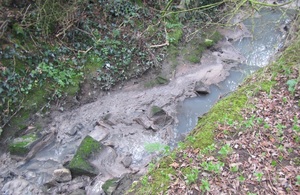
Pollution from the incident on 27 February 2019
Yorkshire Water has today been fined £733,333, plus costs and victim surcharges for polluting a Chesterfield country park stream three times in less than a year.
Following an investigation by the Environment Agency, the company appeared at Derby Crown Court for sentencing for three separate sewage spills at Pools Brook Country Park in Staveley.
It had previously pleaded guilty to all three offences in January 2024.
Chair of the Environment Agency, Alan Lovell said:
Polluting the same stream three times in less than a year is unacceptable and we’re pleased Yorkshire Water has now been dealt with by the courts following our investigation.
We expect full compliance and are committed to taking robust enforcement action where we see serious breaches.
This year we are on track to complete 10,000 inspections of water company assets, and with more staff, better data and increased powers, we are determined to hold water companies to account.
Environment Secretary Emma Reynolds said:
This repeated sewage pollution by Yorkshire Water is appalling and the £733k fine handed out today sends a clear message that polluters will pay.
Our water reforms will clean up our rivers, lakes and seas, we have already banned unfair bonuses for water bosses and introduced tough new penalties to crack down on pollution.
And we’re not stopping there. We are creating a new stronger regulator for the industry, with powers to do MOT-style checks on water assets, preventing failures before they happen.
The first pollution incident happened on 1 October 2018, when a rising main sewer pipe from Pools Brook sewage pumping station burst.
This caused untreated sewage to spill from a manhole into the stream that runs through the country park. This stream runs through a pond and into the River Doe Lea.
Various fish in the country park pond were killed – including tench, pike and roach – along with dead river insects. The impact on water quality stretched for over 600 metres.
The failure of the rising main was due to severe corrosion.
The second pollution incident, on 27 February 2019, was caused by a blockage in the plastic foul sewer pipe leading to a pressure build up in a joint of the pipe.
This foul sewer pipe was suspended on chains inside a surface water sewer pipe, which would normally only contain rainwater and runs into the Pools Brook stream.
The blockage – mainly wet wipes – eventually caused a leak of sewage into the surface water pipe, which entered the stream.
While there was no evidence of fish being affected, the impact on water quality was evident over 700 metres.
The third pollution incident, which happened on 7 August 2019, was caused by a failure of a joint coupling in the same plastic foul sewer pipe to the previous incident, but in a different location.
Again, this led to sewage spilling into the surface water pipe and entering the Pools Brook stream. There was no evidence of fish affected, but water quality was impacted for over 600 metres.
Yorkshire Water would not attend an interview for any of the three incidents.
The sentencing comes as the Environment Agency continues to clean up rivers, lakes and seas. Assembling its largest ever enforcement team tackling water pollution and increasing its workforce almost fivefold to 195 officers by March 2026, backed by a record ?153 million budget.
This year alone, over 8,000 water company inspections have been completed, resulting in thousands of improvement actions including repairing sewage works and upgrading infrastructure.
If members of the public see any signs of pollution, they should report it to the environment Agency’s incident hotline on 0800 807060.
Notes to readers
- Since 2015 the Environment Agency has concluded 69 prosecutions against water and sewerage companies securing fines of over £153 million.
- The Environment Agency has assembled its largest ever team of investigators, enforcement officers and lawyers tackling water pollution, significantly strengthening its enforcement capability as part of a drive to build a tougher regulatory culture.
- The regulator has increased its water enforcement workforce almost fivefold – from 41 roles in 2023 to 195 by March 2026, with a further increase planned later in 2026. This expansion is being backed by the largest budget for water enforcement and compliance ever - with a record £153 million this financial year to enable this increase.
- The EA has already delivered significant results, with over 8,000 of the 10,000 planned water company inspections for the 2025/26 financial year now complete, resulting in over 4,700 individual improvement actions for water companies, including repairing sewage works and upgrading infrastructure. Water enforcement last year resulted in over £6.9 million in enforcement undertakings being paid by water companies after breaking environmental law and redirected into cleaning up our waterways.
Full charges
- On 1 October 2018 Yorkshire Water Services Limited caused a water discharge activity, namely the discharge of sewage into inland freshwaters known as Pools Brook otherwise than in accordance with or to the extent authorised by an environmental permit.
Contrary to regulation 12(1)(b) and 38(1)(a) of the Environmental Permitting (England and Wales) Regulations 2016
- On 27 February 2019 Yorkshire Water Services Limited caused a water discharge activity, namely the discharge of sewage into inland freshwaters known as Pools Brook otherwise than in accordance with or to the extent authorised by an environmental permit.
Contrary to regulation 12(1)(b) and 38(1)(a) of the Environmental Permitting (England and Wales) Regulations 2016
- On 7 August 2019 Yorkshire Water Services Limited caused a water discharge activity, namely the discharge of sewage into inland freshwaters known as Pools Brook otherwise than in accordance with or to the extent authorised by an environmental permit.
Contrary to regulation 12(1)(b) and 38(1)(a) of the Environmental Permitting (England and Wales) Regulations 2016