Wrong side failure near Welshpool
Preliminary examination into a wrong side failure of the European Train Control System (ETCS), near Welshpool, 15 September 2026.
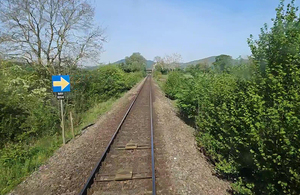
The block marker involved (courtesy of Network Rail).
At around 23:52 on 15 September 2026, a wrong side failure of the European Train Control System (ETCS) occurred near Welshpool, Powys.
RAIB’s preliminary examination into this incident found that an infrastructure monitoring train operating under Level 2 ETCS supervision stopped at the block marker which should have signified the end of its movement authority. However, despite having reached the block marker, the signalling equipment on the train indicated to the driver that there remained 610 metres further to travel before the end of the movement authority was reached. This error was attributed to the on-board ETCS equipment using incorrect wheel diameter information to calculate the train’s position.
Post-incident examination identified a component part of the on-board ETCS equipment had prevented the correct wheel diameter from being stored following routine maintenance to the train. An independent speed measurement system on the train is intended to supplement the distances generated by the wheel diameter to achieve the necessary accuracy. Track-mounted balises are also intended to reset the distance on the train, should inaccuracies occur. However, neither of these systems proved effective at correcting the inaccurate distance which was generated in this instance.
RAIB has previously investigated issues with the integrity of the ETCS system on the Cambrian lines, including an investigation into the loss of safety‑critical data (RAIB report 17/2019). In that instance, RAIB identified that a support system had caused a failure of the higher integrity signalling system and that appropriate protection against foreseeable failures had not been provided.
A wrong side signalling failure which did not result in an accident or near miss would normally be investigated by the rail industry, not RAIB. After a review of the preliminary examination, RAIB has concluded it will not be conducting a full investigation into this incident. However, the preliminary examination findings indicate potential weaknesses in the protection arrangements within the on-board ETCS equipment which, in the view of RAIB, would merit further consideration by Network Rail during its investigation. RAIB has, therefore, written to Network Rail to highlight the circumstances of this incident and draw its attention to these issues.
We have sent copies of this letter to the Office of Rail and Road, the health and safety regulator for the mainline railway, and to the operator of the infrastructure monitoring train, so that they are aware of the contents.