UK Forces protect NATO with aircraft carrier operations in High North
NATO air policing conducted by F-35 jets from European aircraft carrier for first time in boost to High North security.
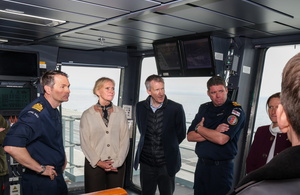
Defence Secretary Dan Jarvis MBE MP, accompanied by Icelandic Foreign Minister Þorgerður Katrín Gunnarsdóttir, visited UK forces onboard the Royal Navy’s flagship HMS Prince of Wales which is deployed off Iceland under NATO command.
Britain’s Carrier Strike Group, led by HMS Prince of Wales, is helping to defend Europe and the North Atlantic, with F-35 jets conducting NATO air policing operations from the deck for the first time.
Defence Secretary Dan Jarvis MBE MP, accompanied by Icelandic Foreign Minister Þorgerður Katrín Gunnarsdóttir, visited UK forces onboard the Royal Navy’s flagship HMS Prince of Wales which is deployed off Iceland under NATO command.
Iceland provides vital support to allied forces operating from its territory, with this close cooperation boosting security in the North Atlantic.
UK F-35 jets are patrolling the skies above Iceland and the High North from HMS Prince of Wales to help protect NATO allies against increasing Russian threats. This is the first time NATO has conducted air policing operations from a European aircraft carrier.
Over 1,500 British personnel on the carrier, Type 45 destroyer HMS Duncan, and RFA Tidespring, are deployed as part the Carrier Strike Group (CSG) to the North Atlantic.
The visit by the Defence Secretary comes as elite British troops are taking command of the Alliance’s high readiness special operations force for the first time.
The UK’s Special Operations Forces assumed leadership of the Special Operations Component Command within NATO’s Allied Reaction Force (ARF) on 1 July. The force is the spearhead of the ARF, able to deploy anywhere in the world within days.
At the same time, the UK also assumed command of the maritime component of the ARF with Rear Admiral Mark Anderson and his battle staff taking up the post. HMS Queen Elizabeth, having recently completed a refit in Rosyth, is preparing to serve as the floating headquarters for the force later this year.
Defence Secretary Dan Jarvis MBE MP said:
It was an honour to visit our deployed personnel who are conducting operations that help keep our nation and our allies safe.
We live in an increasingly dangerous and uncertain time, and it’s deployments like this, supported by allies and partners including Iceland, that improve our deterrence and defence as part of NATO.
We are investing £298 billion over the next four years to strengthen readiness and ensure our people have the kit and technology they need.
I’m proud of our people and proud of the commitments we’re making to the alliance and to European security.
Icelandic Foreign Minister Þorgerður Katrín Gunnarsdóttir said:
The visit of the UK Carrier Strike Group is a clear demonstration of NATO’s enhanced presence in this strategically important region, and one that Iceland is proud to support and contribute to.
NATO continues to strengthen its deterrence and defence, demonstrating Allied unity and resolve in the challenging environment of the North Atlantic and the Arctic. Activities such as Arctic Sentry reflect this shared commitment.
The Carrier Strike Group work on NATO operations comes as the Defence Investment Plan confirmed that £240 million is being invested in the development of new drones to build a Hybrid Carrier Air Wing, including jet-powered drones to work alongside F-35 fighter jets.
British forces are playing a vital role to deter and defend, increasing NATO’s resilience, readiness, and unity.
There are over 1,000 British personnel across NATO command posts, while the UK also leads the Allied Rapid Reaction Corps (ARRC) from its HQ in Gloucestershire with more than 400 permanent staff from 20 NATO allies.
UK forces also remain on the frontline of defending NATO – from the 800-strong UK battlegroup in Estonia, to the Typhoon jets defending the skies over Romania, and the RAF P-8 Poseidon and Rivet Joint surveillance aircraft patrolling the Baltic Sea.
The UK is the only European NATO member to commit its nuclear deterrent in full to the Alliance and as confirmed in the Defence Investment Plan, will join NATO’s Dual Capable Aircraft nuclear mission with F-35A jets.
Supporting the UK’s leadership of NATO’s Forward Land Forces in Estonia is the British Army’s 4th Brigade Combat Team, which is held at high readiness in the UK, able to rapidly deploy thousands of troops to Estonia at short notice
The RAF’s UK-based Quick Reaction Alert squadrons – ready 24/7 to respond to threats to UK airspace – are integrated into NATO’s air defence system and help guard NATO’s northern air policing area.