Rogue waste gangs exposed as heat maps reveal England's illegal dumping hotspots
New Environment Agency heat maps show where suspected waste crime is being reported, helping identify hotspots and target enforcement activity.
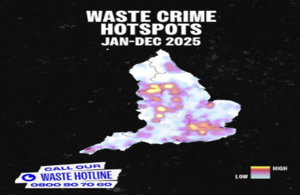
A photo of England and its waste crime hotspots
Organised crime gangs behind England’s hidden illegal waste sites are exposed through the Environment Agency’s heatmaps published today (2 September 2026).
Informed by the public the heat maps show where suspected waste crime – from carrying, dumping or burning - is being reported across England. Published for the first time last year, these annual reports are part of the Environment Agency’s 10-point plan to combat waste crime, and the maps help build the intelligence picture used to identify hotspots, target enforcement activity and disrupt criminal operations.
In 2025, the Environment Agency received 10,238 reports of suspected waste crime, with the West Midlands (1,542) followed by Yorkshire (1,068) receiving the largest number of public reports. In response to the scale of the problem in Yorkshire, work is starting to clean up one of the worst waste sites in the region in Bradford, and the Mayor of West Yorkshire will be one of the first taking the new region-led approach to tackling waste crime.
Under the Prime Minister’s crackdown on waste crime, the government and Environment Agency are working together to ensure waste criminals have nowhere to hide, with more Environment Agency officers being placed on the front line to tackle the issue nationally.
Greater use of drones, a bigger role for Mayors and the police, and a dramatic rise in fines will deter and punish those who dump illegally. Alongside this, a new Waste Crime Crackdown Group, chaired by Environment Secretary Dame Angela Eagle, will bring regulators and law enforcement together to dismantle criminal operations and deliver results.
Philip Duffy, Chief Executive of the Environment Agency, said:
With more officers on the frontline and strengthened enforcement, we are disrupting criminal gangs and supporting legitimate operators. But intelligence from the public remains vital.
If you see something suspicious – you must report it. Every piece of information helps us build the picture we need to act faster, intervene earlier and shut down criminal operations before they cause more harm to communities and the environment.
Environment Secretary Dame Angela Eagle said:
For too long waste crime has blighted our towns, cities and countryside.
These heatmaps shine a light on the scale of the problem and how it has been left to fester. That’s why we are cracking down on the criminals behind it and giving the Environment Agency the tools it needs to go further and faster.
Those who pollute our land, poison our waterways and line their pockets at the expense of local communities will face the full force of the law.
Intelligence from the public is critical to helping the Environment Agency identify offending so that exploitative criminal gangs can be blocked from operating. Statistics show only an estimated 27% of waste crimes are ever reported.
This comes as the government is giving the Environment Agency stronger powers to tackle waste crime. Rogue actors who dump waste illegally or fail to treat it correctly are set to face fines of up to £5,000, up from the current maximum of £300. Those responsible for serious offences can already face much tougher sanctions, including prosecution and imprisonment.
Strong enforcement action is vital. As part of our crackdown, the Environment Agency’s capacity to hunt down and confiscate the cash, cars, houses, and other assets bought with the proceeds of waste crime will grow, and new powers in the Crime and Policing Act 2026 will be used to speed up enforcement of confiscation orders.
From October 2026, a new digital waste tracking service will also make it easier to follow the movement of waste and identify illegal handling. From 2027, reforms to the waste carriers, brokers and dealers regime will see a move from a registration to a permitted system which will require waste carriers to meet stricter rules.
Regional case studies
Midland Road in Bradford
The waste site on Midland Road in Bradford was first reported to the Environment Agency in July 2026 by a member of the public, allowing officers to attend the site and an investigation to be launched to find those responsible and hold them to account.
Last month, the government announced that this site would be cleaned up, subject to feasibility assessments.
Cave’s Inn Pits in Leicestershire
After receiving reports of odour from the public, a well-concealed illegal dump at the Cave’s Inn Pits SSSI in Leicestershire was visited by Environment Agency and Natural England officers. A major investigation has since been launched into the 30,000 tonnes of waste dumped, and so far, one arrest has been made.
Wingerworth in Chesterfield.
In May, the Environment Agency intervened at a former industrial site in Wingerworth following reports from the public about illegal waste dumping.
Officers found around 100 tonnes of household waste had been dumped on the site, with our visits ensuring activity had ceased and no further dumping took place.
The landowner has now removed the waste, and our teams are carrying out a criminal investigation to track down those responsible.
How to tackle and report waste crime
Members of the public are encouraged to take three simple steps in the fight against waste crime:
- Dispose of your household waste correctly to stop it falling into the hands of criminals: Dispose of household waste - GOV.UK
- Check your waste carrier is registered before using a skip hire company or private waste collection service: Waste Carriers, Brokers and Dealers
- Report known or suspected illegal waste activity anonymously to Crimestoppers at Giving information anonymously or by calling 0800 555 111, or contact the Environment Agency’s 24-hour incident hotline on 0800 80 70 60.