Report 09/2025: Buffer stop collision at London Bridge station
RAIB has today released its report into a buffer stop collision at London Bridge station, 13 December 2024.
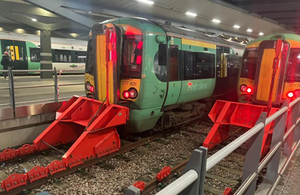
The train and buffer stops (shown on the left of the picture) after the collision (courtesy of Network Rail).
Summary
At around 15:45 on Friday 13 December 2024, a passenger train operated by Southern Railway struck the buffer stop on arrival in platform 12 at London Bridge station at a speed of around 2.3 mph (3.7 km/h). There were no reported injuries to the driver or to the passengers on the train and there was very minor damage caused to the train and railway infrastructure.
The train had been travelling at 13.3 mph (21.4 km/h) when it entered the platform and its speed gradually reduced as it progressed towards the buffer stop. When the train was around 3.5 metres from the buffer stop and travelling at a speed of 6.8 mph (10.9 km/h) the driver made an emergency brake application. Despite this, there was insufficient distance remaining to prevent the collision.
The accident occurred because the driver of the train did not apply the brakes in time on approach to the buffer stops, almost certainly because they experienced a microsleep, due to fatigue. There are several factors that may have contributed to the driver’s fatigue. Two probable causal factors in the accident were that the base duty roster was constructed in a way that increased the risk of fatigue and that the driver had also worked many of their rostered rest days in the period up to the accident, further increasing the risk of fatigue. A possible causal factor was that the driver had less than their normal amount of sleep the night before the accident.
A further causal factor was that none of the engineered protection systems fitted to the train intervened to prevent the collision. The Train Protection and Warning System fitted on approach to the buffer stops did not automatically apply the train’s brakes because the train was travelling below the set intervention speed. Other safety systems fitted on board the train could not detect the short loss of driver alertness that occurred.
A probable underlying factor to the accident was that the management of fatigue risk by Govia Thameslink Railway, the company operating the Southern Railway franchise, was not sufficiently effective and that it had not adopted some elements of industry good practice in fatigue risk management. A second underlying factor was that there are no safety systems currently fitted to mainline trains which can detect and mitigate short losses in driver alertness.
As part of its investigation, RAIB observed that the actual hours that staff work were not considered in the management of Govia Thameslink Railway safety-critical staff with medical conditions when external advice was being sought as to their fitness for work.
Recommendations
RAIB has made two recommendations as a result of this investigation, one addressed to Govia Thameslink Railway to improve its fatigue management process and to follow industry best practice. The other is addressed to the Rail Safety and Standards Board, in consultation with the rail industry, to provide guidance when seeking external advice about medical conditions and working hours that may increase the risk of fatigue in safety-critical staff.
Notes to editors
-
The sole purpose of RAIB investigations is to prevent future accidents and incidents and improve railway safety. RAIB does not establish blame, liability or carry out prosecutions.
-
RAIB operates, as far as possible, in an open and transparent manner. While our investigations are completely independent of the railway industry, we do maintain close liaison with railway companies and if we discover matters that may affect the safety of the railway, we make sure that information about them is circulated to the right people as soon as possible, and certainly long before publication of our final report.
-
For media enquiries, please call 01932 440015.