Report 05/2026: Pedestrian struck by a train at Pewsey footpath crossing
RAIB has today released its report into a pedestrian struck by a train at Pewsey footpath crossing, Pewsey, Wiltshire, 26 February 2025.
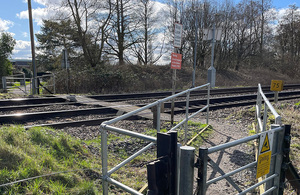
Pewsey footpath crossing.
Summary
At around 13:56 on 26 February 2025, a pedestrian was struck and fatally injured by a passenger train at Pewsey footpath crossing, in Pewsey, Wiltshire. The train was travelling at about 93 mph (154 km/h) at the time of the accident. Whistle boards were provided to warn pedestrians of trains approaching the crossing. Data from the train showed that the driver sounded the train’s warning horn near the whistle board and, upon sighting the pedestrian on the crossing, repeatedly sounded the horn to give an urgent warning.
The accident happened because the pedestrian, who had hearing loss, was probably unaware that the train was approaching when they made the decision to enter the crossing. Evidence suggests that the pedestrian may not have heard the train’s warning horn when making this decision because it was not clearly audible to them. This was based on the likely effects of the pedestrian’s hearing loss, the reduction in sound level of the warning horn over the distance between the whistle board and the crossing, which was longer than permitted by Network Rail’s guidance, and the level of environmental noise near the crossing.
After entering the crossing, and then becoming aware of the immediately approaching train, the pedestrian continued to cross into the train’s path. Although it is not possible to say why the pedestrian continued to cross, previous accidents and academic research show that having a limited time to assess the developing situation may have resulted in the pedestrian being unable to decide whether it was safer to continue to cross, to remain stationary, or attempt to move back the way they had come.
RAIB also found that Network Rail had temporarily closed access to an alternative route, normally used by the pedestrian, which would have avoided them having to use the level crossing.
A probable underlying factor was that Network Rail’s control framework for footpath crossings fitted with whistle boards did not sufficiently control the risks associated with their use. Other underlying factors were that Network Rail’s processes did not effectively mitigate the risks at footpath crossings fitted with whistle boards to users with hearing loss, or who are deaf, and that Network Rail’s risk management and assurance processes for footpath crossings with whistle boards did not effectively manage the risk to the wider public using Pewsey crossing.
Recommendations
As a result of this accident, RAIB has made six recommendations to Network Rail. These recommendations are intended to ensure that appropriate risk mitigation measures are identified and implemented where whistle boards may be an unsuitable control measure, that risks to users with hearing loss, or who are deaf, are effectively controlled in the short term, and that the continued use of whistle boards at footpath crossings is reviewed to confirm that their application remains appropriate. Recommendations also seek to ensure that Network Rail aligns its approach to level crossing standards with its wider standards and control management framework, aligns its management assurance of crossing risk assessments with its other assurance activities, and ensures it considers the wider safety impact of closing public rights of way when making decisions around managing its assets.
RAIB has identified three learning points. The first relates to staff responsible for assessing and reviewing risk at level crossings understanding and applying relevant standards and guidance. The second concerns the importance of communicating the nature of incidents to staff responsible for the post-accident testing of rail vehicles and of such tests complying with industry standards. The third relates to ensuring that opportunities are taken to achieve compliance with relevant Network Rail standards when infrastructure modifications are carried out.
Notes to editors
-
The sole purpose of RAIB investigations is to prevent future accidents and incidents and improve railway safety. RAIB does not establish blame, liability or carry out prosecutions.
-
RAIB operates, as far as possible, in an open and transparent manner. While our investigations are completely independent of the railway industry, we do maintain close liaison with railway companies and if we discover matters that may affect the safety of the railway, we make sure that information about them is circulated to the right people as soon as possible, and certainly long before publication of our final report.
-
For media enquiries, please call 01932 440015.