Merry FISHmas Stockings!
More than 53,000 juvenile fish stocked into South East waters this winter. Fishing-licence income funds habitat improvements across the region.
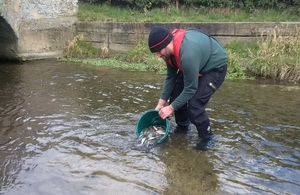
Dace being introduced to the Broodstock.
This year alone, 53,150 juvenile fish, including chub, dace, barbel, roach, tench, bream, rudd and native crucian carp are being introduced into South East rivers, still waters and local clubs, funded by fishing licence income. (Full details of releases in notes to editors).
Re-introducing fish supports the creation of healthy, balanced ecosystems that benefit both anglers and local wildlife. Restocking in winter minimises stress on fish, giving them the best survival rates and allowing them to acclimatise before spring spawning.
Ian Hirst, a fisheries team leader at the Environment Agency, said:
Releasing more than 53,000 fish across our South East rivers and still waters provides an amazing opportunity to help boost our local fish numbers. Through our breeding programme, we are enhancing fishing by boosting stocks and providing more opportunities for anglers.
We work closely with our partners to protect and enhance our fish populations by responding to pollution incidents, improving habitats, water quality and removing barriers to fish migration. Without fishing licences this vital work would not be possible.
As temperatures drop and winter fishing gets into full swing, the Environment Agency is also reminding anglers to ensure they have a valid fishing licence before heading to their favourite waterside spots this festive season. Whether you are treating yourself or looking for the perfect present for the fishing enthusiast in your life, a fishing licence could also make an ideal Christmas gift.
With prices starting from just £7.30 for a day licence, it’s an affordable way to enjoy the tranquillity of local waters whilst supporting the protection and improvement of local fisheries.
Income from fishing licences funds the Environment Agency’s vital work to protect and enhance river and still water habitats across the region. Now we are in winter, this includes fish restocking.
These fish are all bred and raised at the Environment Agency’s Calverton Fish Farm, near Nottingham. The fish farm is a crucial part of the Environment Agency’s toolkit for improving fisheries around the country. Specialist fisheries experts spend the year breeding and growing quality, pure-bred, disease-free fish which are used to stock our rivers in the run up to Christmas.
This Christmas, give yourself or a loved one the gift of angling – it’s good for wellbeing, connects you with nature, and supports the future of fishing for generations to come.
For more information and to buy your fishing licence, visit www.gov.uk/get-a-fishing-licence.
Background:
-
Numbers of fish restocked by Environment Agency area:
- Cambridgeshire and Bedfordshire – 12,350
- Norfolk - 5,500
- Hertfordshire and North London - 1,900
- Kent, South London and East Sussex - 1,500
-
Thames - 31,900
-
Last year, £316,000 of fishing licence income was invested into 90 local angling projects across the South East:
- East Anglia (Cambridgeshire, Bedfordshire, and Norfolk) - £100,000 invested into 34 projects
- South East - £216,000 invested into 56 projects, comprising:
- Hertfordshire and North London - 18 projects - £62,000
- Kent, South London and East Sussex - 18 projects - £57,000
-
Thames - 20 projects - £97,000
-
Fishing licences are required for anyone aged 13 or over, fishing for salmon, trout, freshwater fish, smelt or eel in England and Wales.
- Visit www.gov.uk/get-a-fishing-licence to buy online. Your licence will typically arrive within an hour by e-mail or text, meaning you could be fishing the same day.
- Children aged between 13 and 16 need a junior licence, which are free.
- Children under 13 do not need a licence.
-
Fishing without a valid licence can result in a fine of up to £2,500.
-
All fishing licence income is reinvested to protect and improve fish stocks and fisheries.
-
Whilst many still waters and canals remain open for coarse fishing all-year-round, always check local byelaws and obtain permission from the fishery owner before fishing.
- If members of the public see fish in distress or other environmental concerns, they should report it to the Environment Agency’s 24-hour incident hotline: 0800 80 70 60
Contact us - journalists only:
Media enquiries: 0800 141 2743 or communications_se@environment-agency.gov.uk.