Environment Agency to host community drop in for odour in Calne
Residents will have the opportunity to ask questions following the release of the UKHSA public health risk assessment this week
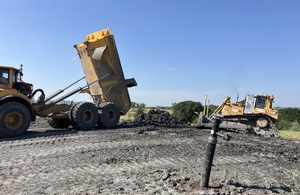
Progress continues with the capping works at the Lower Compton landfill site
The Environment Agency is set to host a multi-agency community drop in event at Calne Town Hall on Tuesday 21 July from 4pm to 7pm, alongside partners from the UK Health Security Agency (UKHSA) and Wiltshire Council.
The UKHSA has now completed and published a public health risk assessment using data collected by the Environment Agency’s mobile monitoring facility in the Calne community.
Residents will have the opportunity to discuss the findings of the UKHSA public health risk assessment with representatives from the agencies involved in responding to the odour issues in Calne.
The ambient air monitoring data produced by the Environment Agency, and analysed in this public health risk assessment, shows that there is a source of hydrogen sulphide and methane in the direction of the Lower Compton Landfill Site.
This confirms the findings of our inspections and off-site odour assessments, and supports the Environment Agency’s regulatory decisions, including telling the operator Hills to bring capping works forward and change the ways they manage odour.
Ben Shayler of the Environment Agency said:
This drop-in event will give residents the opportunity to understand the work we are doing to regulate Hills, and ask questions of the agencies involved.
We have taken extensive action to require Hills to address the source of the odour, and these works are now nearing completion.
We will continue to regulate the site closely and monitor to ensure the works have been effective.
Lucy McCann, consultant in health protection at UKHSA, said:
UKHSA has reviewed the Environment Agency’s report and provided an independent public health risk assessment. While there is no evidence of a toxicological risk, there is strong evidence of odour annoyance.
Individuals can react differently to hydrogen sulphide (H2S) odour, and some people may be more sensitive to it than others.
People living near the site may experience temporary symptoms including headaches, nausea, dizziness, watery eyes, a stuffy nose, an irritated throat and coughing. Those with pre-existing respiratory conditions may be particularly affected, and some residents may also experience sleep disruption and stress.
If you have concerns about your individual circumstances and require health advice, please contact your GP.
Our action
The Environment Agency is responsible for regulating the landfill site and ensuring compliance with the conditions of its environmental permit.
As the environmental regulator, the Environment Agency has taken extensive action to require Hills Waste Solutions to address the source of the odour affecting the Calne community. These improvement works are now nearing completion.
The Environment Agency will continue to regulate the site closely and will take further enforcement action where necessary to ensure permit compliance and minimise environmental impacts.
Responsibility for investigating odour nuisance and leading on public health matters sits with Wiltshire Council, supported by advice from the UKHSA, and the Environment Agency will continue to work closely with both organisations.
Community event
The event will be attended by representatives from the Environment Agency, UKHSA, Wiltshire Council and Hills.
The Environment Agency will be able to respond to questions on air quality monitoring, monitoring methodology and site regulation.
UKHSA will be able to advise on the technical findings of the UKHSA assessment.
Wiltshire Council will attend the event and respond to relevant questions and concerns.
A representative from Hills Waste Solutions will also be present to answer questions about the changes they are making.
Background
The full UKHSA public health risk assessment, together with an executive summary, can be accessed from our Engagement HQ website.
The agencies have also prepared a Questions and Answers (Q&A) document to help explain the findings and address some of the questions residents may have when reading the public health risk assessment.