AAIB Report: Boeing 747-433, G-ONEE
Boeing 747-433 (G-ONEE), water ingress leading to loss of two AC buses, and ice leading to unreliable airspeed, after departure from London Heathrow Airport, 8 February 2024
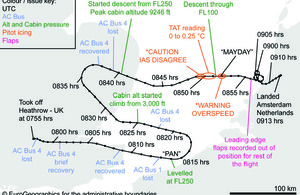
Plan view of the flight
The flight involved a freighter variant of the Boeing 747-400 that was due to fly from London Heathrow Airport to Hong Kong International Airport. The aircraft suffered numerous electrical issues which began during the takeoff roll and worsened during the climb. These were caused by the loss of AC electrical buses 1 and 4, which resulted in multiple failure messages for the flight crew to manage as well as the loss of all pitot tube heating. The flight crew carried out numerous, concurrent checklists to deal with the system failures, declared a PAN and started to divert to Amsterdam Schiphol Airport. When a pressurisation issue caused the crew to initiate a descent, the aircraft entered icing conditions and the pitot tubes froze, resulting in all three airspeed indicators indicating an erroneously low airspeed. The autopilot remained engaged and pitched the aircraft nose-down to regain indicated airspeed. The pitch reached 7.6° nose-down with an associated 6,240 ft/min descent rate, before the aircraft exited icing conditions, correct airspeed was regained and the autopilot pitched up. The descent had resulted in an 18 kt overspeed. The flight crew declared a MAYDAY, dealt successfully with a flap issue and landed safely at Schiphol Airport.
The loss of power to the two AC buses was the result of water ingress into Generator Control Units (GCUs) 1 and 4, located in the E1/E2 rack in the Main Equipment Centre beneath the cargo deck floor. The water led to the GCUs commanding contactors to open, which isolated AC Bus 1 and 4. Water had entered the main cargo deck prior to departure because the L1 door had been left open during rain. The investigation was unable to determine the exact path that water took from the cargo deck floor to the GCUs, but a number of weaknesses in the water ingress protection measures were found that could have caused or contributed to the water ingress.
There have been previous events of water ingress into GCUs and other events of water contamination of the electrical/electronic units in the E1/E2 rack on the 747-400, which can lead to the loss of flight critical systems. This has led to Service Bulletins and Airworthiness Directives to introduce measures such as installing a fibreglass reinforcing overcoat on the drip shield above the E1/E2 rack, but there was no requirement for a repetitive inspection of the drip shield. There was also no maintenance requirement to repetitively inspect in detail the condition of the floor panel seals, waterproof tape, power drive units and L1 door floor mat in the area above and near the Main Equipment Centre. Therefore, the AAIB has made four safety recommendations to address these maintenance concerns.