Proposed update to the management of healthcare workers living with HIV in the UKAP guidance
Published 14 October 2026

© Crown copyright 2026
This publication is licensed under the terms of the Open Government Licence v3.0 except where otherwise stated. To view this licence, visit nationalarchives.gov.uk/doc/open-government-licence/version/3 or write to the Information Policy Team, The National Archives, Kew, London TW9 4DU, or email: psi@nationalarchives.gov.uk.
Where we have identified any third party copyright information you will need to obtain permission from the copyright holders concerned.
This publication is available at https://www.gov.uk/government/consultations/ukap-guidance-update-for-healthcare-workers-living-with-hiv/proposed-update-to-the-management-of-healthcare-workers-living-with-hiv-in-the-ukap-guidance
1. Introduction
In mid-2025, the UK Advisory Panel for Healthcare Workers Living with Bloodborne Viruses (UKAP) formed a working group to review its guidance for managing healthcare workers living with human immunodeficiency virus (HCW-LWHIV) who perform exposure prone procedures (EPPs). The guidance is located in Chapter 6.6 and Chapter 7.4 of the UKAP integrated guidance. The current guidance was written in 2014. Prior to this HCW-LWHIV were completely restricted from performing EPPs. The 2014 guidelines allowed HCW-LWHIV to undertake EPPs if they had 2 clearance HIV ribonucleic acid (RNA) viral load (VL) test results of <200 copies per millilitre (copies/mL). HCW-LWHIV who were cleared were also subject to 12 weekly monitoring to check their HIV RNA VL remained <200 copies/mL.
The review of the current guidance was prompted by requests from stakeholders, citing updated evidence and changes in clinical practice for managing the health of people living with human immunodeficiency virus (PLWHIV).
The working group reviewed available published and unpublished evidence on transmission risk, HIV natural history on anti-retroviral therapy (ART), and the implications of different testing frequencies. They also considered UK and international clinical and occupational health (OH) guidance, where relevant and available. Note in this document HIV refers to HIV type 1 (HIV-1).
2. Proposed updated wording to UKAP integrated guidance for HCW-LWHIV
2.1 Who this guidance applies to
This guidance only applies to HCWs living with HIV who wish to perform EPPs. They must be under a UK-based consultant with responsibility for their HIV care. This being a HIV, genitourinary medicine (GUM), or infectious disease (ID) consultant and an accredited specialist in occupational health. HCW-LWHIV should be advised that, where their HIV care relates to their occupation, the consultant responsible for their HIV care and accredited specialist in occupational medicine may work jointly and share information where clinically necessary. For the full clearance and monitoring algorithm, see Appendix.
In order to be cleared and monitored to perform EPPs, HCW-LWHIV must have been assessed as being stable on cART this being, per os (PO) or 2-monthly injectable cabotegravir and rilpivirine (CAB/RPV) or be an elite controller (defined as people living with HIV, who have never received antiretroviral therapy and have maintained their HIV RNA VL <20 copies/mL for at least 12 months, based on at least 3 separate HIV RNA VL measurements). See ‘Advice for specific scenarios‘ for guidance for elite controllers.
People who are newly diagnosed, not stable on combined anti-retroviral therapy (cART), or use long acting oral or experimental ART are not eligible to be cleared to perform EPPs. Note that guidance will be kept under review and may be updated as more evidence becomes available.
3. Clearance
3.1 Clearance for HIV positive HCWs who intend to perform EPPs
Clearance to perform EPPs requires a HCW to be assessed as being stable on effective combination anti-retroviral therapy (cART), this includes daily oral cART or 2-monthly injectable CAB/RPV by their UK-based consultant who is responsible for their HIV care. Stable in this context is defined as adherent to an effective cART regime that has resulted in full viral suppression for at least 6 months. Full viral suppression is currently defined as <50 HIV RNA copies per mL plasma (<50 copies/mL).
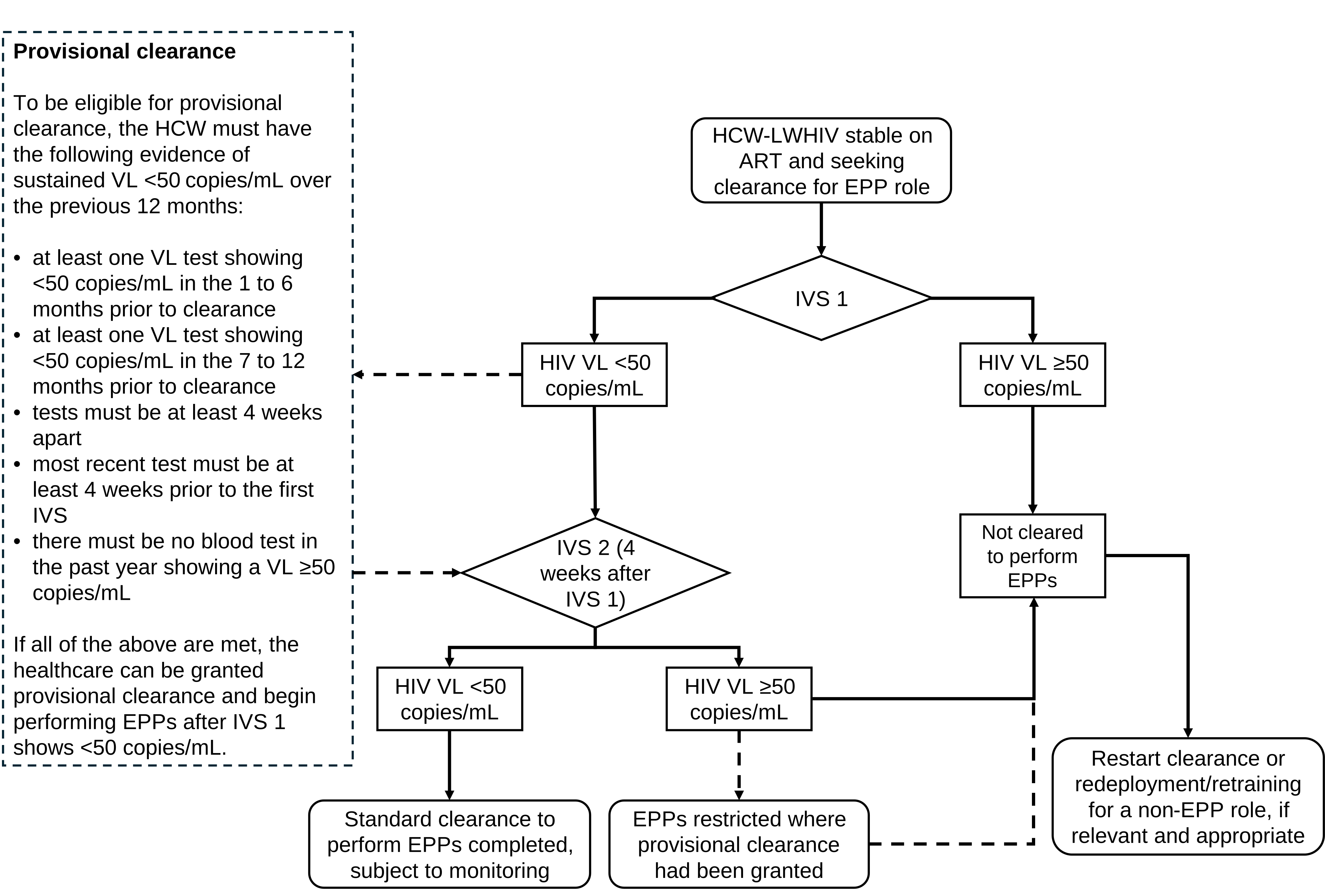
All HCW-LWHIV must undergo standard clearance. HCW-LWHIV who have the required evidence of suppressed viral load may be eligible for provisional clearance while awaiting standard clearance, which allows them to begin performing EPPs sooner. Both pathways require the HCW to be stable on ART. Further details on both pathways are outlined in the sections below and in Figure 1.
3.2 Standard clearance (for any HCW-LWHIV wishing to be cleared to perform EPP)
Clearance requires a healthcare worker (HCW) to have 2 identified and validated sample (IVS) test results taken 4 weeks apart with both demonstrating a HIV RNA VL <50 copies/mL. For the purposes of initial health clearance, 4 weeks apart is defined as between 3 and 5 complete calendar weeks. The decision to clear individual HCWs to undertake EPPs is the responsibility of the accredited specialist in occupational medicine. UKAP may be consulted on the application of the policy, as needed.
3.3 Provisional clearance (expedited clearance for EPP for HCW-LWHIV who meet certain criteria)
Provisional clearance means that a HCW can be allowed to perform EPPs if their first IVS shows a HIV RNA VL <50 copies/mL and there is documented evidence of sustained viral suppression <50 copies/mL as defined below:
-
The HCW must provide occupational health with documented evidence of all (minimum of 2) HIV RNA VL tests (which need not be IVS) done in the previous 12 months. The HCW is required to make all HIV RNA VLs results from the past 12 months available to occupational health for review and all need to show a HIV RNA VL <50 copies/mL for provisional clearance to be granted.
-
Of the HIV RNA VLs provided as evidence, at least one must be between 4 and 26 weeks prior to the first clearance IVS sampling date and at least one must be between 26 and 52 weeks prior to the first clearance IVS sampling date. These 2 tests must be more than 4 weeks apart.
-
HIV RNA VLs used to evidence eligibility for provisional clearance should be available as lab results on the occupational health’s electronic patient record (EPR) or through a signed letter from the HCW’s UK-based consultant responsible for their HIV care. This letter must outline all HIV RNA VLs over the previous year and include direct contact details for the responsible clinician if additional clarifications are needed. The results and/or letter must come directly from the lab and/or consultant, rather than provided by the HCW attempting clearance. The HIV RNA VL results used as evidence to allow provisional clearance must have been performed by a UK-based UK Accreditation Service (UKAS) International Organisation for Standardisation (ISO) 15189 accredited medical laboratory.
-
If there is any doubt about the validity of the HIV RNA VLs presented as evidence for provisional clearance, then it should not be granted and the standard clearance process must be followed.
Even if provisional clearance is granted, the HCW must still return for their second clearance IVS 4 weeks after their first clearance IVS. A second IVS after 4 weeks showing HIV RNA VL <50 copies/mL will provide standard clearance. A HCW who has been granted provisional clearance is able to undertake EPPs during this period between the first and second clearance IVS results. Provisional clearance should be revoked if the HCW has not returned for their second clearance IVS by the end of 5 calendar weeks from their first clearance IVS.
Provisional clearance should also be revoked if the second IVS returns a HIV RNA VL of ≥50 copies/mL.
Where provisional clearance is revoked, the HCW must cease performing EPPs. In order to restart EPPs, the HCW must complete the standard clearance process.
3.4 Unexpected results during clearance
Any unexpected results during clearance (for example a HIV RNA VL >200 copies/mL in a HCW with previously sustained history of HIV RNA VL <50 copies/mL) should be escalated to the HCW’s usual consultant with responsibility for their HIV care and clearance paused while this is investigated.
Figure 1. Clearance flowchart showing standard clearance with optional provisional clearance processes (dashed box)
4. Monitoring
Once standard clearance has been attained, HCW-LWHIV must remain on cART and maintain HIV RNA VL<50 copies/mL. Monitoring of HCW-LWHIV taking daily oral cART is described in the sections below. HCW-LWHIV who are elite controllers or taking 2-monthly CAB/RPV have different monitoring requirements which are described in the section ‘Advice for specific scenarios’.
4.1 Monitoring of HCW-LWHIV taking daily oral cART
HCW-LWHIV on daily oral cART are subject to HIV RNA VL testing every 26 weeks (range 24 to 28) for occupational health monitoring purposes if their HIV RNA VL remains <50 copies/mL. The 26-week period should be taken from the date the previous IVS was drawn and not from the date the result was received.
If the HIV RNA VL rises to ≥50 copies/mL during a monitoring test, even if it returns to <50 copies/mL on a repeat at 10 days (between 7 to 14 days), enhanced monitoring will be required for their next monitoring test. That is, their next monitoring IVS must be taken sooner, at 12 weeks (between 10 and 14 weeks) after their last monitoring test, rather than 26 weeks. If the enhanced monitoring test HIV RNA VL is <50 copies/mL then they can return to 26-weekly monitoring.
Any unexpected HIV RNA VLs (for example, a high HIV RNA VL after a HIV RNA VL <50 copies/mL) during monitoring should be escalated by the accredited specialist in occupational medicine to the HCW’s usual HIV consultant. Further advice can also be sought from a local virologist or UKAP secretariat if required.
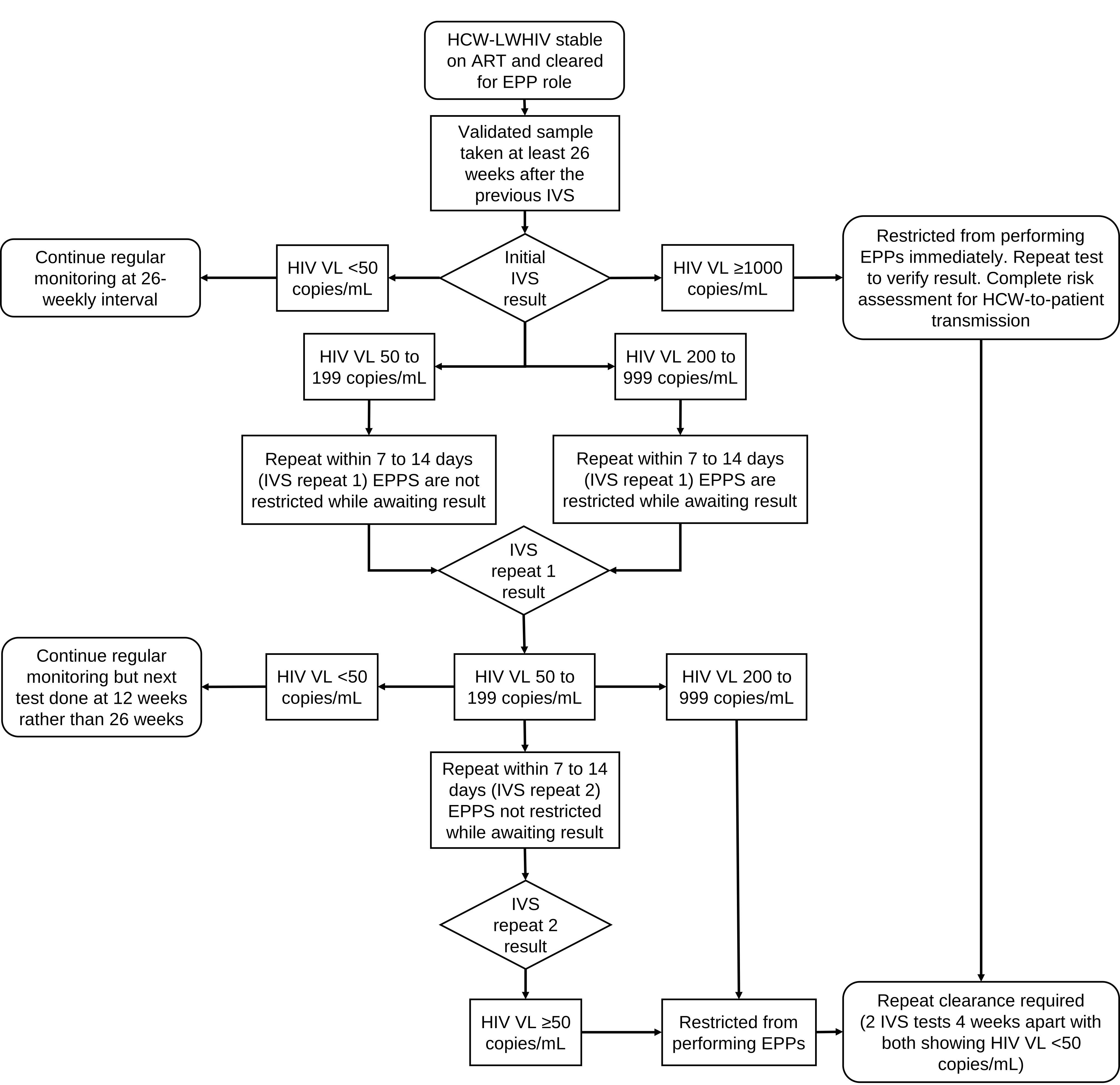
Figure 2 and the ‘Monitoring viral load result and action’ section below set out the expected course of action for HIV RNA VL test results below and above the threshold for EPP clearance, after the HCW has satisfied the criteria for standard clearance.
Figure 2. Flowchart outlining the process for monitoring of HCW-LWHIV who perform EPPs specifying the actions required in response to the viral load result
4.2 Monitoring viral load result and action
4.2.1 <50 copies/mL
No action. Retest in 26 weeks.
4.2.2 ≥50 but <200 copies/mL
HCW is not restricted from performing EPPs but HIV RNA VL should be retested on a new blood sample at 10 days (between 7 to 14 days) (IVS repeat 1).
IVS repeat 1:
- if the HIV RNA VL returns to <50 copies/mL on IVS repeat 1 then the HCW can perform EPPs but with enhanced monitoring
- if HIV RNA VL on the IVS repeat 1 is 50 to199 copies/mL repeat testing on a new blood sample at 10 days (between 7 to 14 days) (IVS repeat 2) is advised
- if the HIV RNA VL is ≥200 copies/mL on repeat 1 then EPPs should be ceased and standard clearance is required
IVS repeat 2:
- if the HIV RNA VL returns to <50 copies/mL on IVS repeat 2 then the HCW can perform EPPs but with enhanced monitoring
- if the HIV RNA VL has not returned to <50 copies/mL by IVS repeat 2, then the HCW should be restricted from performing EPPs and undergo standard clearance
The accredited specialist in occupational medicine has the discretion to adjust the above guidance where a monitoring test result is implausible or thought to be an error (for example performing additional repeat IVS tests) and the reason for this decision should be clearly documented.
4.2.3 ≥200 copies/mL but <1,000 copies/mL
HCW should be restricted from performing EPPs and HIV RNA VL should be retested on a new blood sample at 10 days (between 7 to 14 days) (IVS repeat 1).
IVS repeat 1:
- if the HIV RNA VL returns to <50 copies/mL on IVS repeat 1 then the HCW can perform EPPs but with enhanced monitoring
- if HIV RNA VL on the IVS repeat 1 is 50 to 199 copies/mL repeat testing on a new blood sample at 10 days (between 7 to 14 days) (IVS repeat 2) is advised
- HCW can restart EPPs while awaiting the results of IVS repeat 2
- if the HIV RNA VL is ≥200 copies/mL on repeat 1 then EPPs should be ceased and clearance is required (2 IVS tests <50 copies/mL taken 4 weeks apart with EPPs not performed in between)
IVS repeat 2:
- if the HIV RNA VL returns to <50 copies/mL on IVS repeat 2 then the HCW can perform EPPs but with enhanced monitoring
- if the HIV RNA VL has not returned to <50 copies/mL by IVS repeat 2, then the HCW should be restricted from performing EPPs and requires clearance (as described above)
The accredited specialist in occupational medicine has the discretion to adjust the above guidance where a monitoring test result is implausible or thought to be an error (for example performing additional repeat IVS tests) and the reason for this decision should be clearly documented.
4.2.4 ≥1,000 copies/mL
The HCW should cease conducting EPPs immediately. The HCW must undergo standard clearance if they wish to continue performing EPPs after a single HIV RNA VL of ≥1,000 copies/mL.
A second test must be done on a new blood sample at 10 days (between 7 to 14 days) to verify the HIV RNA VL. In cases where this repeat sample returns an unexpected result (for example, <50 copies/mL after a result >1,000 copies/mL) the significance of this should be jointly assessed by occupational medicine and the consultant responsible for the HCW’s HIV care, with input from virology or microbiology, as required.
A full risk assessment should be triggered to determine the risk of HCW to patient transmission in accordance with Chapter 9 of the integrated UKAP guidance. The need for further public health investigation and action (for example, patient notification) will be determined by a risk assessment on a case-by-case basis in discussion with UKAP.
5. Advice for specific scenarios
5.1 HCW-LWHIV moving from abroad
To be cleared to perform EPPs, HCW-LWHIV must have 2 IVS samples taken 4 weeks apart, with both showing a HIV RNA VL of <50 copies/mL. These IVS samples must have been taken and analysed in a UK-based UKAS (ISO 15189) accredited laboratory.
HCWs must be under a UK-based consultant who is responsible for their HIV care, stable on daily oral cART or 2-monthly CAB/RPV, and adherent to their medication by the time of their first clearance IVS.
Acceptable evidence to assess eligibility for provisional clearance is HIV RNA VL tests performed in UK-based UKAS accredited laboratories. These HIV RNA VL results must be approved by the UK-based occupational health department, who would then use them to assess whether provisional clearance is appropriate after a first clearance IVS <50 copies/mL.
5.2 HCW-LWHIV with persistent low level viraemia above 50 copies/mL
If a HCW has persistent low level viraemia between 50 and 199 copies/mL that has been reviewed by the consultant responsible for their HIV care and where treatment has been optimised, as clinically appropriate, then their eligibility for clearance and monitoring can be discussed with UKAP on a case-by-case basis. HCWs with HIV RNA VLs consistently ≥200 copies/mL should be restricted from performing EPPs.
5.3 Delays in attending IVS appointments
If a HCW does not attend for their monitoring appointment within the specified timeframe, then they should cease conducting EPPs. Twenty-six-weekly monitoring can be performed no later than 28 complete calendar weeks (a total of 196 days) after the preceding IVS specimen taken for occupational health monitoring purposes. Enhanced monitoring at 12 weeks can be performed no later than 14 (a total of 98 days) weeks of their last IVS specimen.
If a HCW has ceased EPP because of non-attendance at monitoring appointments within the relevant timeframe (for whatever reason), to resume EPP they should complete the clearance process. This clearance process should include a discussion regarding the reason for non-attendance and explore any potential issues with cART adherence. Provisional clearance can be considered, if appropriate, if the requirements are met (for example, the HCW continued with their regular non-IVS clinical monitoring during the period of non-attendance at OH appointments).
HCWs living with HIV who take a career break of more than 28 weeks from performing EPPs may wish to continue 26-weekly monitoring during this period to facilitate a return to EPPs. Individuals with a break in their monitoring record must meet the criteria for clearance (including provisional clearance, where appropriate) before returning to EPP activities.
Where a HCW’s monitoring test returns a HIV RNA VL >50 copies/mL, they are required to return for a repeat IVS at 10 days (between 7 to 14 days) after the date of the initial IVS. The acceptable window for this repeat test is 7 to 14 days, although may be extended on the discretion of the OH department where there is a valid reason (for example, a HCW cannot attend within the 7 to 14 day timeframe due to pre-arranged annual leave). EPPs must be ceased if the HCW has not attended for a repeat IVS within 7 to 14 days without a valid reason. In such circumstances, the HCW must complete standard clearance to be able to restart EPPs.
5.4 Treatment issues
HCWs should be advised by their treating consultant of the importance of notifying them and the specialist in occupational medicine of missed doses, starting a new drug which may have interactions with their cART, illnesses or other factors that might influence their HIV RNA VL, as soon as is practicable.
If there is any suggestion that HIV is no longer fully suppressed by antiretroviral treatment, the treating consultant and accredited specialist in occupational medicine overseeing the HCW’s care should discuss the next steps, including testing HIV RNA VL sooner than the next scheduled monitoring test and cessation of EPPs. Advice on the management of suspected treatment failure or suboptimal response should be sought from the appropriate specialist team.
HIV RNA VL testing for the purposes of occupational health clearance and monitoring is not intended to replace that which is required for clinical care. However, HIV RNA VL taken as part of clinical care can be used for occupational health monitoring where this is most efficient and convenient. In such cases, for these tests to be accepted for monitoring for occupational health purposes, these tests must follow the requirements for IVS as outlined in the Appendix.
5.5 Elite controllers
Elite controllers comprise a small proportion of all people living with HIV. For the purposes of occupational health monitoring, elite controllers are defined as individual who are not receiving (and have never received, with the exception of during pregnancy) antiretroviral therapy and have maintained their HIV RNA VL <20 copies/mL for at least 12 months, based on at least 3 separate HIV RNA VL measurements. Where a HCW-LWHIV’s local medical laboratory does not have the capabilities to perform HIV RNA VL monitoring to the required sensitivity, the HCW-LWHIV’s sample should be sent to a laboratory that is able to measure to <20 copies/mL.
A HCW who meets the above definition can be cleared to perform EPPs without being on treatment as long as they are subject to 12-weekly HIV RNA VL monitoring (10 to 14 complete calendar weeks since the date the previous IVS for monitoring purposes was drawn). Any such cases should be referred to UKAP for advice on a case-by-case basis. Twelve-weekly monitoring is required to ensure they maintain their HIV RNA VL <20 copies/mL and to identify any rebound promptly. A HIV RNA VL of ≥20 copies/mL would mean that HCW would no longer be defined as an elite controller and would need to cease EPPs. They would be required to be virally suppressed on cART to be able to restart EPPs.
Where a person who is, or has previously been defined as, an elite controller starts cART they will be eligible for the clearance and monitoring process outlined in the relevant sections above. HCWs who are, or previously were, elite controllers should strongly consider discussing their options for treatment with the clinician responsible for their HIV care.
The guidance for elite controllers who perform EPPs may be reviewed and updated.
5.6 Pregnancy
People living with HIV on fully suppressive cART therapy usually maintain this during pregnancy and therefore should be allowed to be cleared and/or monitored to perform EPPs provided that they have been able to maintain regular medication. Gestational nausea and vomiting can usually be managed by attention to the timing of therapy, however hyperemesis gravidarum may result in viral rebound.
Pregnant HCW-LWHIV will be monitored frequently as part of their routine clinical antenatal HIV care. Early discussion between HIV, GUM and or ID consultant and the accredited OH specialist is required. Instances of detectable viral load during clinical investigations should be reported to the HCW’s accredited OH specialist, as should any concerns about adherence or factors affecting absorption of cART. Additional monitoring may be considered on a case-by-case basis in discussion with UKAP.
5.7 Use of long-acting injectables and longer acting oral ART
HCW-LWHIV who are stably suppressed on cART for at least 6 months and use injectable 2-monthly CAP/RPV can be cleared to perform EPPs as described in the guidance (standard clearance, with optional provisional clearance, if eligible). HCW-LWHIV taking 2-monthly CAP/RPV are subject to IVS VL monitoring every 8 weeks (7 to 9 weeks), IVS monitoring samples taken when the HCW attends for their injection). For HCWs taking CAB/RPV, actions for HIV RNA VL results of 50 to 199 copies/mL, 200 to 999 copies/mL, and 1000 copies/mL should follow those outlined in the ‘Monitoring viral load result and action’ section (although noting that there is no enhanced monitoring option where a blip occurs for people on CAB/RPV). Any viral load ≥50 copies/mL should prompt discussion between the clinician responsible for the HCW’s HIV care and the accredited OH specialist.
At present, HCWs using other forms of long-acting injectable cART or longer acting (non-daily) oral cART cannot be cleared to perform EPPs. This is due to a lack of evidence about HIV RNA VL while using these medications over a sufficiently long term. This guidance will be reviewed regularly.
6. Appendix
6.1 Laboratory testing arrangements for health clearance and monitoring
This section relates to the relevant paragraph from page 48 in the current UKAP integrated guidance.
All IVS tests for clearance and monitoring must be conducted by a UKAS accredited laboratory in the UK. Tests conducted outside the UK cannot be accepted for these purposes. Where non-IVS tests are accepted (for example, as evidence to support provisional clearance for HCW-LWHIV), these must have been performed in a UKAS accredited medical laboratory.
For this reason, HCW-LWHIV who move into the UK from abroad will need to wait 4 weeks while both clearance IVS tests are completed before they can commence EPP work, unless they have HIV RNA VL results from a UK-based UKAS-accredited laboratory that make them eligible for provisional clearance.
6.2 Implementation guidance
6.2.1 Implementation phase
After publication of the final guidance, there will be an implementation phase of 3 months. During this period, the monitoring of HCWs who are already cleared and monitored should switch to the updated guidance. The process for switching HCW-LWHIV to the updated monitoring guidance is outlined below. This implementation phase will allow for additional time for occupational health and clinical reviews (where appropriate). During the 3-month implementation phase, any HCW-LWHIV who wishes to be newly cleared to perform EPPs should undergo the updated clearance process (standard clearance, with optional provisional clearance, if eligible).
6.2.2 HCW-LWHIV who were cleared and monitored under the previous guidelines (April 2024)
HCWs who are already cleared and under regular monitoring at implementation of the updated guidance should be managed according to their last monitoring IVS HIV RNA VL. HCWs whose most recent IVS was <50 copies/mL do not require any additional action. Their next IVS should be 26 weeks after their last IVS sampling date.
Where a HCW’s most recent monitoring IVS was ≥50 copies/mL but <200 copies/mL, they should have their next monitoring test as soon as possible and this should be considered IVS repeat 1. This result should be interpreted as per IVS repeat 1 outlined in Figure 1.
Where a HCW’s most recent monitoring IVS >200 copies/mL, this should have automatically been repeated under the previous guidance. That immediate repeat would be considered IVS repeat 1. If that repeat was <50 copies/mL then their next monitoring test should be in 12 weeks. If that repeat was ≥50 copies/mL but <200 copies/mL then a further repeat blood test should be taken and considered as IVS repeat 2. The process outlined in Figure 1 and the section ‘Monitoring viral load and result and action’ should then be followed for the result of this IVS repeat 2.