Smart Secure Electricity Systems (SSES) Programme: first phase energy smart appliances regulations - consultation document (accessible webpage)
Updated 17 September 2026
Applies to England, Scotland and Wales

© Crown copyright 2026
This publication is licensed under the terms of the Open Government Licence v3.0 except where otherwise stated. To view this licence, visit nationalarchives.gov.uk/doc/open-government-licence/version/3 or write to the Information Policy Team, The National Archives, Kew, London TW9 4DU, or email: psi@nationalarchives.gov.uk.
Where we have identified any third party copyright information you will need to obtain permission from the copyright holders concerned.
This publication is available at https://www.gov.uk/government/consultations/smart-secure-electricity-systems-sses-programme-first-phase-energy-smart-appliances-regulations/smart-secure-electricity-systems-sses-programme-first-phase-energy-smart-appliances-regulations-consultation-document-accessible-webpage
Introduction
The government is spearheading a transformation of the electricity system through the Clean Energy Superpower Mission, to deliver cleaner, cheaper, and more secure power.
The Clean Power 2030 Action Plan highlights the critical need for a substantial increase in flexibility to achieve our clean energy goals [footnote 1]. The Clean Flexibility Roadmap, developed in partnership with Ofgem and the National Energy System Operator (NESO), sets out a clear delivery path to 2030 and beyond [footnote 2]. The Roadmap highlights the critical role of flexibility in integrating renewable energy, reducing reliance on fossil fuels, and managing rising electricity demand. NESO projections in the Roadmap indicate a potential eight-fold increase in clean flexibility capacity by 2050, and it envisions a future where consumers are central to a smart, secure, and decarbonised energy system.
At the heart of this transformation is Consumer-Led Flexibility (CLF), which gives households and businesses the choice to use automation to shift more of their electricity use to off-peak times – when power is cheaper – through smart technologies like electric vehicle smart charge points (EVSCPs), heat pumps and other electric heating appliances (EHAs), and battery storage. Greater participation in CLF will not only reduce energy bills for everyone – and in particular those participating – but will also support a more resilient and cost-effective electricity grid.
Households that do not generally use electricity at peak times (e.g., from 4pm to 7pm) could save over £200 a year by switching from the price cap to a tariff that changes through the day based on market rates [footnote 3]. Households with heat pumps could save more than £250 annually by shifting to a smart tariff and using their heat pump flexibly [footnote 4]. And EV drivers when charging at home can typically save around £330 through smart charging [footnote 5].
The Smart Secure Electricity Systems (SSES) Programme is creating the technical and regulatory frameworks to help consumers across Great Britain access this cheaper electricity through CLF.
The draft first phase ESA regulations reflect the policy positions in government’s detailed consultation response in April 2025 [footnote 6] and provide a firm regulatory foundation for the growth of the ESA market; the detailed scope of the regulations is set out in the list below. The regulations, which will apply in Great Britain, form part of an interlinked set of SSES Programme policies including load control licensing, technical specifications, tariff interoperability [footnote 7] and industry-led enduring governance [footnote 8]. The draft regulations, in conjunction with this wider suite of SSES policies, will provide a regulatory basis for the British ESA market to grow and innovate and to protect the interests of British consumers.
Specifically, the draft regulations:
- establish a smart mandate for electric heating products in scope, requiring that they are placed on the market with smart functionality (consumers will always retain the option to use their devices in non-smart mode);
- incorporate, with some planned amendments, The Electric Vehicles (Smart Charge Points) (EVSCP) Regulations 2021, thereby creating a single, coherent set of regulations for all ESAs;
- contain a set of minimum requirements in relation to smart functionality, cyber security and grid stability for the smart electric heating appliances in scope, EVSCPs and smart domestic-scale battery energy storage systems (BESS). The regulations will require compliance with provisions of the ETSI EN 303 645 standard for Internet of Things (IoT) cyber security, and require devices to be configured to deliver in aggregate a randomised delay up to 10 minutes where there is a risk of herding, and;
- require that all relevant ESAs have a Measuring Instruments Regulations (MIR) compliant Class B active electrical energy meter.
Enforcement of the regulations will be conducted by the Office for Product Safety and Standards (OPSS) and will be undertaken using a similar approach to that established in the EVSCP regulations 2021. We will also provide for the application of the Consumer Rights Act (CRA) 2015 Schedule 5 investigatory powers, to further safeguard consumer interests.
This consultation seeks stakeholder input on the proposed regulatory framework and the extent to which it achieves government’s policy objectives. This consultation does not, except where explicitly specified, reopen policy decisions made during previous SSES consultation cycles.
The structure of this consultation document mirrors that of the draft regulations, and is designed to be read alongside the draft regulations. The intended audience for this consultation is predominantly manufacturers and importers of ESAs, though we welcome responses from all market participants and actors, as well as the public.
We will take forward a second phase of legislation later in this Parliament. This second phase will further protect consumers who choose to participate in CLF by giving them the confidence that the ESAs they purchase can be used with different Flexibility Service Providers (FSPs), should they decide to switch. The framework will require (as a minimum) ESAs to comply with an interoperability standard, and FSPs to integrate with this standard, thus ensuring a base level of interoperability. We will balance consumer protection and market incentives for CLF services, including by establishing a Technical Governance Group (which includes consumer interest advocates and industry representatives), to advise government and regulators as part of SSES enduring governance arrangements [footnote 9].
We intend to lay the first phase regulations before Parliament in Q1/2 2026; we will simultaneously also publish a government response to this consultation. Subject to Parliamentary approval and after the regulations are made, an industry implementation period will begin, ending on 31 December 2027. The regulatory requirements which exclusively apply to EVSCPs will come into force six months after the regulations are made. Non-statutory guidance for these regulations will be published by OPSS prior to the regulations coming into force.
General information
Why we are consulting
We have a statutory duty, under s.244 of the Energy Act 2023, to consult before making regulations which introduce definitions of appliances under s.239 of that Act for appliances subject to the regulations. These regulations make definitions for Electric Vehicle Smart Charge Points, Electrical Heating Appliances in scope and Battery Energy Storage Systems. Furthermore, we committed to consult on the draft regulations in our April 2025 government response to the 2024 consultation. This consultation sets out what the draft Energy Smart Appliances regulations aim to achieve and seeks stakeholder views on the extent to which the draft regulations achieve the policy intent set out in the April 2025 government response.
Following this consultation, we will consider stakeholder feedback and revise the regulations where necessary before laying them in Parliament in 2026. A draft Impact Assessment has been published alongside this consultation. We will prepare a final Impact Assessment which will be published alongside the final regulations.
Consultation details
Issued: 1 December 2025
Respond by: 5 February 2026
Enquiries to:
Smart Secure Electricity Systems Team
Department for Energy Security and Net Zero
7th Floor 3-8 Whitehall Place
London
SW1A 2AW
Email: SSESConsultation@energysecurity.gov.uk
Consultation reference: Smart Secure Electricity Systems (SSES) Programme: First Phase Energy Smart Appliances Regulations
Audiences:
The government primarily seeks views from manufacturers and importers of Energy Smart Appliances. Views from energy suppliers, energy market participants, businesses involved in Consumer-Led Flexibility, trade bodies, consumer groups, public policy and academic institutions, and all other parties with an interest in Energy Smart Appliance regulation are welcome.
Territorial extent:
Great Britain
How to respond
Responses are encouraged to be provided via the CitizenSpace page or via the response form that can be found on the GOV.UK consultation page.
This response form can be sent via email to ssesconsultation@energysecurity.gov.uk or our postal address.
When responding, please state whether you are responding as an individual or representing the views of an organisation. Your response will be most useful if it is framed in direct response to the questions posed, though further comments and evidence are also welcome. If you need a version of this document in a more accessible format, please email alt.formats@energysecurity.gov.uk. Please tell us what format you need. It will help us if you say what assistive technology you use.
Respond online at: energygovuk.citizenspace.com/energy-security/sses-first-phase-esa-regulations/
or
Email to: SSESconsultation@energysecurity.gov.uk
Write to:
Smart Secure Electricity Systems Team
Department for Energy Security and Net Zero
7th Floor 3-8 Whitehall Place
London
SW1A 2AW
When responding, please state whether you are responding as an individual or representing the views of an organisation.
Your response will be most useful if it is framed in direct response to the questions posed, though further comments and evidence are also welcome.
Confidentiality and data protection
Information you provide in response to this consultation, including personal information, may be disclosed in accordance with UK legislation (the Freedom of Information Act 2000, the Data Protection Act 2018 and the Environmental Information Regulations 2004).
If you want the information that you provide to be treated as confidential please tell us, but be aware that we cannot guarantee confidentiality in all circumstances. An automatic confidentiality disclaimer generated by your IT system will not be regarded by us as a confidentiality request.
We will process your personal data in accordance with all applicable data protection laws. See our privacy policy.
We will summarise all responses and publish this summary on GOV.UK. The summary will include a list of names or organisations that responded, but not people’s personal names, addresses or other contact details.
Quality assurance
This consultation has been carried out in accordance with the government’s consultation principles.
If you have any complaints about the way this consultation has been conducted, please email: bru@energysecurity.gov.uk.
Overview of Draft Statutory Instrument (SI)
We have published the draft SI for the first phase of our Energy Smart Appliances regulations, informed by stakeholder feedback over the 2024 and 2025 SSES Programme consultation cycle.
This SI is Phase 1 of our plan to regulate ESAs. This draft SI includes regulations that:
- Introduce minimum smart functionality, safety, grid stability requirements, and cyber and physical security requirements for all relevant ESAs;
- Make several incremental amendments to EVSCP requirements which will form part of the ESA regulations, thereby creating a single regulatory framework for smart appliances;
- Introduce a smart mandate for certain electrical heating appliances;
- Introduce a definition of battery energy storage systems (BESS) used in domestic and small non-domestic settings.
We will take forward a second phase of legislation later in this Parliament. This second phase will further protect consumers who choose to participate in CLF by ensuring a base level of interoperability, giving consumers the confidence that the ESAs they purchase can be used with different FSPs, should they decide to switch service providers.
We currently plan to lay Phase 2 regulations in Parliament in 2027. These regulations will also be subject to public consultation.
Part 1: Introduction
Implementation Period
Following the 2024 consultation, we responded to stakeholder calls for a longer implementation period by proposing an approximately 20-month implementation period that will both allow industry to update production cycles before the enforcement of the regulatory requirements and ensure that minimum cyber security standards are in effect by the beginning of 2028. A majority of consultation respondents were in favour of these timeframes.
As policy has developed and timelines have shifted, there is now negligible difference between enforcement after a 20-month implementation period and enforcement from 31 December 2027. To provide clarity for industry the requirements in the regulations (other than those exclusively applicable to EVSCPs – see Table 1) will come into force from 31 December 2027.
Government has consulted extensively on both the principle and detail of our regulatory plans since 2022 and have considered stakeholder representations on the feasibility of implementation throughout this period. We consider, as set out in the April 2025 government consultation response, that the need to ensure that sufficient protections are in place to mitigate rising cyber security risks, which are expected to increase significantly between now and 2028, rules out an implementation date later in 2028.
We will revoke the EVSCP regulations 2021 and apply the Phase 1 ESA regulations relevant to EVSCPs six months after the regulations are made. We believe a shorter implementation period is appropriate for the minor and incremental changes the regulations make to the EVSCP regime, given that the EVSCP market is comparatively mature and has an existing regulatory regime. It is expected that these minor and incremental changes will come into force in Q4 2026, depending on Parliamentary timelines. Where more significant changes are being made to EVSCP regulations, then a 31 December 2027 enforcement date will apply.
Enforcement undertakings accepted by OPSS under the EVSCP regulations that are in effect when the ESA regulations come into force will remain in effect, by virtue of section 16 of the Interpretation Act 1978, until their end date or until a Completion Certificate is issued (whichever is earlier).
A charge point that is provided as a replacement for a faulty charge point does not have to comply with all updated requirements until two years post full implementation of these changes.
Further details on specific timings are set out in Table 1.
Table 1 - Overview of requirements for ESAs in scope of the Phase 1 Energy Smart Appliances regulations
| Electric Vehicle Smart Charge Points | Electric Heating Appliances | Battery Energy Storage Systems | |
|---|---|---|---|
| Smart Mandate [footnote 10] | Yes (applicable since 30 June 2022) | Yes (from 31 December 2027) | No |
| Cyber Security Requirements | Yes (minor change to existing requirements from 31 December 2027) | Yes (from 31 December 2027) | Yes (from 31 December 2027) |
| Accuracy requirement (MIR Compliant Class B for active electrical energy meters) | Yes (from 31 December 2027) | Yes (from 31 December 2027) | Yes (from 31 December 2027) |
| Other device-specific requirements | Yes (minor changes to existing requirements applied six months after regulations made) | Yes (from 31 December 2027) | Yes (from 31 December 2027) |
Definitions
Other than the definitions set out below, the definitions listed in the interpretation section of the regulations reflect established policy positions or legal requirements.
Electric Vehicle Smart Charge Points
Regulation 3(1) sets out the meaning of a relevant charge point, and for clarity 3(2) sets out where regulations do not apply. This replicates exclusions previously set out in the EVSCP regulations 2021.
The Energy Act 2023 aligns the definition of charge points with the Automated and Electric Vehicles Act 2018 s.9. This defines a charge point as ‘a device intended for charging a vehicle that is capable of being propelled by electrical power derived from a storage battery (or for discharging electricity stored in such a vehicle)’. A smart charge point must be ‘capable of adjusting the immediate or future flow of electricity into or out of itself or another appliance in response to a load control signal; and includes any software or other systems which enable or facilitate the adjustment to be made in response to the signal’ (the energy smart function).
Through the Process evaluation of the EVSCP regulations [footnote 11], stakeholders indicated that clarity or alignment of several definitions within regulations were needed. As part of the merging of EVSCP regulations with wider ESA regulations, government is seeking to resolve these matters:
‘Non-smart’ cable – ESA regulations will define a ‘non-smart’ cable as ‘an electrical cable which is a charge point which is not able to send and receive information independently to or from a communications network or the electricity grid’. This clarifies the position in the EVSCP regulations by specifying that a non-smart cable can send and receive information from the charge point to the car but cannot send information independently to a network.
Public charge points – Regulations will now align the definition of public charge points with that which is set out in regulation 3 of the Public Charge Point Regulations [footnote 12].
Workplace Charge Points – Regulations will now align the definition of a workplace charge point with that which is set out in regulation 3 of the Public Charge Point Regulations [footnote 13].
1. Do you agree with the changes to the definitions for EVSCPs set out in regulation 2: Interpretation? Please provide further information to support your answer.
Electric Heating Appliances
In the 2025 SSES consultation response, government confirmed the EHAs in scope of the smart mandate as those with up to 45kW-rated thermal capacity. This includes heat pumps, hybrid heat pumps, heat batteries, storage heaters, standalone direct electric hot water cylinders, and hot water heat pumps. These appliances are included because they have the greatest potential to be used flexibly to provide CLF (that is, the greatest ability to shift demand for electricity). The smart mandate and the detailed smart functionality requirements for the relevant EHAs are set out in chapters 2 and 4 of Part 2 of the draft ESA regulations.
In this consultation we are seeking views on proposed definitions for relevant EHAs in scope of the smart mandate. These definitions will be introduced under the ESA regulations.
For consistency and where appropriate, we will continue to align our proposed definitions with terminology used in existing and emerging legislation on heating appliances. This includes those discussed in the recently closed ‘Raising product standards for space heating’ consultation (the “ecodesign consultation”), which sought stakeholder views on introducing or amending definitions of several of the appliances in scope for the purposes of appliance efficiency and energy labelling legislation [footnote 14]. We therefore propose introducing the following definitions of EHAs, as set out in Regulation 4(5) of the draft SI.
Heat pumps
Heat pumps are a key low-carbon technology in the UK’s strategy to decarbonise heating. Their high efficiency, compatibility with a cleaner electricity grid, and potential to reduce reliance on fossil fuels make them critical to achieving Net Zero and enhancing energy security. Deployment is growing steadily, supported by government investment and increasing consumer uptake. Their smart control capability also enables them to play a vital role in enhancing the flexibility of the electricity system, helping to balance demand, reduce peak loads, and support a cleaner, more resilient grid.
The current heat pump definition in ecodesign legislation is as follows:
heat pump space heater’ means a space heater using ambient heat from an air source, water source or ground source, and/or waste heat for heat generation; a heat pump space heater may be equipped with one or more supplementary heaters using the Joule effect in electric resistance heating elements or the combustion of fossil and/or biomass fuels. [footnote 15]
Our proposed heat pump definition is set out below. As proposed in the 2024 ecodesign consultation [footnote 16], it omits the reference to combustion of fossil fuels or biomass. This will ensure that there will be no overlap between the heat pump and hybrid definitions as any heat pump with these types of supplementary heater will instead be captured by the hybrid definition (as described in the below section).
The proposed definition for use in the ESA regulations is as follows:
- ““Heat pump” means an appliance that−
- uses ambient heat from an air source, water source or ground source or waste heat for heat generation, and
- may be equipped with one or more supplementary heaters using the Joule effect in electric resistance heating elements.”
2. Do you agree with the proposed definition for a heat pump for the purposes of the ESA regulations? If not, what elements of the definition do you recommend should be changed and why? Please provide evidence or reasoning to support your answer.
Hybrid heat pumps
Government committed to extending the smart mandate to include hybrid heat pumps – heating systems comprised of a heat pump, fuel boiler and a master controller [footnote 17]. The regulations will not apply to the fuel boiler element specifically.
Our proposed hybrid definition is set out below. As with the definition proposed in the 2024 ecodesign consultation, we have proposed limiting the non-heat pump component to a ‘fuel boiler’. We have not proposed allowing the scope to capture other electric heaters within the hybrid definition as these component appliances will be captured individually by the regulations, and this might otherwise cause unhelpful overlap with the heat pump definition (for example, if the non-heat pump component was not specifically defined as a ‘fuel boiler’, a heat pump with an electric supplementary heater might also meet the hybrid definition).
The hybrid definition will apply when the product is first placed on the market. It will therefore capture hybrids which are integrated in a single unit or in separate units which are placed on the market as a hybrid. It will not capture retrofit hybrids or those where the individual component appliances are indistinguishable from those that will be installed as a standalone product when first placed on the market. In such instances, the heat pump component will still be subject to the ESA regulations.
We have also proposed adding the same definition of a ‘fuel boiler’ as in current ecodesign regulations [footnote 18] as this is necessary to underpin the hybrid definition.
The proposed definitions for use in the ESA regulations are as follows:
- “Hybrid heat pump system” means a system that contains at least the following components (each a “necessary HHPS component”)−
a)A heat pump,
b) A fuel boiler, and
c) A master controller which determines, based on operating conditions, the heat output of each of the heaters.
- “Hybrid heat pump” means−
a) A package containing all the necessary HHPS components, or
b) All of the necessary HHPS components integrated in a unit,
c) whether or not the package, or unit, contains any other device.
- “Fuel boiler” means an appliance or a component of an appliance that−
a) generates heat by burning fossil fuels or biomass fuels or both, and
b) may be equipped with one or more additional heat generators using the Joule effect in electric resistance heating elements.
3. Do you agree with the proposed definitions for a hybrid heat pump and hybrid heat pump system for the purposes of the ESA regulations? If not, what elements of the definitions do you recommend should be changed and why? Please provide evidence or reasoning to support your answer.
4. Do you agree with the proposed definitions for a fuel boiler for the purposes of the ESA regulations? If not, what elements of the definition do you recommend should be changed and why? Please provide evidence or reasoning to support your answer.
Air-to-air heat pumps
As confirmed in the government response to the SSES 2024 consultation, air-to-air heat pumps will be excluded from the scope of the ESA regulations. We recognise that the costs associated with meeting the smart mandate requirements may not be proportionate for some appliances, including air-to-air heat pumps, with expected lower uptake or lower CLF potential.
To further clarify the scope of the regulations, we have proposed adopting a definition for air-to-air heat pumps consistent with that used in the ecodesign framework [footnote 19]. This approach will ensure that air-to-air heat pumps remain out of scope of the ESA regulations, with the exclusion applying across both the heat pump and hybrid heat pump definitions.
The proposed definitions for use in the ESA regulations are as follows:
- “air-to-air heat pump” means a heat pump whose−
a) heat generator uses a vapour compression cycle driven by an electric motor or internal combustion engine, and
b) evaporator which transfers heat from ambient air to an air-based heating system.
- “air-based heating system” means either or both of equipment or components necessary for the supply of heated air by means of a device for moving air, either through ducting or directly into the heated space, where the purpose of the system is to attain and maintain the desired indoor temperature of an enclosed space in any part of a building, for the thermal comfort of human beings.
5. Do you agree with the proposed definitions for an air-to-air heat pump and air-based heating system for the purposes of the ESA regulations? If not, what elements of the definitions do you recommend should be changed and why? Please provide evidence or reasoning to support your answer.
Thermal Storage
A thermal energy storage system stores heat generated from electricity, often during cheaper off-peak periods and times of low demand, and releases it at a later time to provide space heating or hot water as needed by a consumer. This enables consumers to use energy more flexibly, shifting demand away from peak times and reducing costs.
Storage heater
The proposed definition for use in the ESA regulations is as follows:
- “Storage heater” means a non-hydronic heater which−
a) stores thermal energy converted from electricity in an internal accumulating core for subsequent release, and
b) is designed to operate as one of a number of distributed units within a premises.
Heat battery
The Microgeneration Certification Scheme (MCS) will soon publish a design and installation standard for Thermal Energy Storage Systems (TESS), which contains a list of definitions. We have used proposals from the MCS TESS working group as a basis for the proposed definition of a heat battery.
As confirmed in the government response to the SSES 2024 consultation, indirect heat batteries will be excluded from the scope of the regulations. This decision reflects our intention to maintain consistency across technologies, as indirect heat batteries are expected to operate in a manner similar to indirect electric hot water cylinders, which are also out of scope.
In addition to avoiding duplicate smart functionality where a centralised heating appliance is present, government recognises that this is still an emerging technology and does not want to impede growth of this nascent market by introducing additional requirements and costs.
The proposed definition for use in the ESA regulations is as follows:
- “relevant heat battery” means an appliance that−
a) consists of a fixed storage medium that retains thermal energy and a mechanism to transfer that energy to a separate working fluid during discharge, and
b) can be charged directly from the grid.
6. Do you agree with the proposed definition for a storage heater for the purposes of the ESA regulations? If not, what elements of the definition do you recommend should be changed and why? Please provide evidence or reasoning to support your answer.
7. Do you agree with the proposed definition for a heat battery for the purposes of the ESA regulations? If not, what elements of the definition do you recommend should be changed and why? Please provide evidence or reasoning to support your answer.
Hot water storage and generation
Hot water storage and generation appliances have inherent flexibility from their storage capabilities that can be shifted and utilised with time of use tariffs (TOUTs).
Standalone direct electric hot water cylinder
As confirmed within the 2025 SSES government response, we will exclude indirect electric hot water cylinders from the scope of the ESA regulations (i.e., a water cylinder connected to an external heat source, such as a heat pump, that has system control to heat stored water for use in a central or hot water system). This will minimise costs for both manufacturers and consumers and prevents any unnecessary duplication of smart functionality where indirect cylinders are used alongside a smart heat pump, and do not need additional smart capabilities. To ensure this exclusion is applied effectively, it is necessary to clearly define what constitutes a standalone direct electric hot water cylinder.
The proposed definition for use in the ESA regulations is as follows:
- “Standalone direct electric hot water cylinder” means a water cylinder that−
a) Is not connected to a centralised space heating device, and
b) heats water directly using the Joule effect in electric resistance heating elements only.
- “Centralised space heating device” means a device designed to provide space heating to multiple rooms or zones within a building via a central distribution system.
Hot water heat pump
The proposed definition for use in the ESA regulations is as follows:
- “Hot water heat pump” means a water cylinder integrated with a heat pump which uses electricity to transfer ambient heat from the air to heat water.
8. Do you agree with the proposed definition for a standalone direct electric hot water cylinder for the purposes of the ESA regulations? If not, what elements of the definition do you recommend should be changed and why? Please provide evidence or reasoning to support your answer.
9. Do you agree with the proposed definition for a centralised space heating device for the purposes of the ESA regulations? If not, what elements of the definition do you recommend should be changed and why? Please provide evidence or reasoning to support your answer.
10. Do you agree with the proposed definition for a hot water heat pump for the purposes of the ESA regulations? If not, what elements of the definition do you recommend should be changed and why? Please provide evidence or reasoning to support your answer.
Battery Energy Storage Systems
In the 2025 SSES government response, we confirmed that we will apply requirements on functionality, grid stability and cyber security to BESS that are sold with smart functionality. The draft regulations define smart BESS and apply these requirements to smart BESS, effective from 31 December 2027.
We also confirmed in the government response that, when Parliamentary time allows, we will pursue a primary legislative power to establish a smart mandate for BESS, as with heating appliances and EVSCPs, and make use of this power should the market not evolve towards widespread smart capability at sufficient pace. We will continue to monitor the development of the BESS market in the medium term and will consider further evidence before legislating to give effect to a smart mandate for BESS.
In this consultation we are seeking views on the proposed definition for smart BESS used in domestic and small-scale non-domestic settings. Grid-scale BESS used in industrial and commercial settings are not in scope of these regulations.
The regulations will place requirements (set out in chapters 2 and 5 of part 2 of the regulations) on BESS that are used in domestic and small-scale non-domestic settings and are sold with smart capability, therefore incorporating smart BESS as ESAs under the terms of the Energy Act 2023, and in scope of the draft ESA regulations.
The draft regulations define smart BESS as a device that:
- Has a battery pack – this refers to a set of rechargeable battery cells that are encapsulated within an outer casing to form a complete unit;
- Has a capacity size level equal to or greater than 1kWh – this value has been selected as it is higher than the majority of current expendable/reusable consumer batteries used in domestic appliances;
- Has a minimum level of maximum power output equal to or greater than 1kW;
- Is wired into the consumer side of a meter used by a holder of a licence under section 6(1)(d) of the Electricity Act 1989 for billing purposes;
- Has a bi-directional power conversion subsystem;
- Has an auxiliary subsystem; and
- Has smart functionality.
The smart functionality element of the definition is consistent with the definition for an ESA as per the Energy Act 2023 s.238(2) – it is an appliance capable of adjusting the immediate or future flow of electricity into or out of itself or another appliance in response to a load control signal; and includes any software or other systems which enable or facilitate the adjustment to be made in response to the signal.
A device must meet all the criteria set out above to be considered a BESS for the purposes of these draft regulations.
11. Do you agree with the proposed definition for BESS for the purposes of the ESA regulations? If not, what elements of the definitions do you recommend should be changed and why? Please provide evidence or reasoning to support your answer.
Placing a relevant appliance on the market
The EVSCP regulations 2021 apply to the sale of a private smart charge points intended for charging an electric vehicle.
However, it has been found through the EVSCP regulations process evaluation that the regulations, as drafted, do not distinguish between the obligations of different types of sales or sellers. This has resulted in obligations applying equally to all economic actors in scope of the regulations, irrespective of their role. This was not the original policy intent.
The ESA regulations seek to rectify this issue by limiting their application only to manufacturers or importers who place an ESA (including a relevant charge point) on the market for the first time. This means that only those who are placing a relevant ESA on the GB market for a consumer (or another actor in the supply chain) to purchase for the first time, will be required to adhere to ESA regulations. When defining “placing on the market”, this also includes offering and advertising an ESA, for example via online marketplaces.
12. Do you agree that the Phase 1 ESA regulations should only apply to those manufacturers or importers who are placing a relevant ESA on the GB market as set out in regulation 6?
Duty to take action in respect of non-compliant energy smart appliance placed on the market
The policy intent of this regulation is to require manufacturers or importers to take corrective action where non-compliance with these ESA regulations has been identified. This remedy obligation seeks to ensure that manufacturers or importers address non-compliance prior to the necessary involvement of the enforcement authority. They should, nonetheless, inform the enforcement authority where they identify the need for corrective action as well as informing the first person to whom the ESA was supplied. The information should include detail of the non-compliance as well as the remedial action taken, which should include either taking necessary steps to bring the product into compliance, product withdrawal from the market; and/or product recall.
13. Do you agree with the duty to take corrective action in respect of non-compliant ESAs placed on the market (regulation 7)? Please provide further information to support your answer.
Part 2: Requirements in relation to relevant energy smart appliances and obligations on manufacturers and importers
Communication
The intent of the communication regulation is to ensure that ESAs can communicate with a communications network.
User interface
The policy intent of the user interface regulation is to ensure that ESAs must have a user interface. In the case of EHAs and BESS, this must be a separate digital interface.
14. Do you agree with the proposal to require that relevant BESS must have a digital user interface as per regulation 10(3), as is the case for EHAs?
Primary function
The policy intent of the primary function regulation is to state how ESAs must behave to ensure reliability and user awareness. It requires that appliances must continue to perform their core function even if they lose connection to a communications network. Additionally, if the appliance fails to perform its primary function, the user must be notified of this failure.
The regulation sets out what constitutes the primary function for different types of smart appliances. For smart charge points, it is the charging of electric vehicles. For smart heating appliances, it is heating indoor spaces or hot water. For smart BESS, it includes charging, storing electricity for later use, and discharging electricity either for the user’s consumption or for export to the grid. Stakeholders are welcome to provide comments if they wish to highlight potential unintended consequences, implementation challenges, or areas requiring clarification.
Electricity supplier interoperability
The policy intent of the Electricity supplier interoperability regulation is to require that ESAs remain functional and retain their smart capabilities regardless of which electricity supplier the end-user chooses. It prohibits manufacturers from manufacturing or configuring appliances that would lose either their smart functionality or their ability to perform their primary function, as per the above section, if the user switches suppliers.
Safety
The policy intent of the safety regulation is to require that appliances be manufactured or configured to override any signal or user input that would pose a risk to people or property. For smart EHAs, the regulation mandates that they must not carry out any user input if doing so would risk damaging the appliance itself.
15. Do you have any comments regarding how regulations 9 to 13 are drafted? Please provide further information to support your answer.
Measuring System
As set out in the 2025 consultation response, we intend to require that from 31 December 2027 all ESAs in scope must have an active electrical energy device meter that can accurately measure electricity consumption.
The draft regulations require manufacturers and importers of relevant ESAs to meet all the requirements imposed on Class B active electrical energy meters by the Measuring Instruments Regulations 2016 (MIR) [footnote 20]. This means that all relevant ESAs must have MIR compliant meters which can measure consumption to a ±2% level of accuracy at typical ambient temperatures. All relevant ESAs in scope of the Phase 1 regulations must be manufactured with a Class B active electrical energy meter which complies with all MIR requirements for such meters. The meter will need to be conformity assessed and be conformity marked under MIR, with manufacturers and importers preparing all relevant technical documentation.
The draft regulations will impose these requirements by directly referencing all relevant requirements in MIR 2016 (regulations 46-52B and Schedules 1A, 1B, 1E and 1K). The draft regulations will require manufacturers and importers of all relevant ESAs in scope of the Phase 1 regulations to ensure their devices have a MIR compliant Class B [footnote 21] active electrical energy meter from 31 December 2027 and, will need to comply with requirements relating to the preparation of technical documentation and conformity assessment and conformity marking of products.
The policy intent of this requirement is to deliver better value for consumers by ensuring that they can use their ESAs to participate in the highest value forms of CLF, which typically require ESAs to have meters that measure electricity consumption to a high degree of accuracy. It also provides certainty for manufacturers by setting clear direction on ESA-level metering requirements from 31 December 2027, making sure that all ESAs are made to the same high standards and providing consistency across the market. The Department for Business and Trade (DBT) recently consulted on reform of MIR display requirements in relation to ESAs [footnote 22] and is currently analysing consultation responses. In their consultation, DBT proposed to allow for a remote-only display option for ESAs with device meters, given evolving technology and consumer behaviour. DBT expect to publish a government response to this consultation by the end of 2025. We will continue to work with DBT as they prepare their government response in due course and when drafting legislation, if necessary, to ensure that any legislative changes made in relation to ESAs are aligned with the SSES Programme regulatory framework.
We will avoid placing disproportionate burden on business. We are therefore willing to consider other means of meeting metering policy objectives, such as only requiring that ESAs have device meters that can measure electricity consumption to a ±2% level of accuracy, without reference to MIR. Alternatively, MIR itself could be amended to make all ESAs a ‘regulated measuring instrument’ in scope of all MIR requirements, which would place relevant obligations on manufacturers, importers, and distributors. We particularly welcome stakeholder feedback in relation to alternative means of achieving this policy objective.
16. Do you support the requirement in regulation 14 that manufacturers and importers must ensure relevant ESAs have device meters that are fully compliant with the obligations that MIR places on Class B active electrical energy meters, including conformity assessment (as per regulations 46-52B and Schedules 1A, 1B, 1E and 1K of MIR 2016)? Please give reasons for your answer.
17. If you are a manufacturer or importer, do you currently produce or import ESAs that include a device meter? If so, is this device meter MIR Class B compliant?
18. If you disagree with Question 16, do you support achieving the metering policy objective by alternative means? Which approach would be preferable? What issues may arise? Please give reasons for your answers and include further approaches as appropriate.
EVSCP Consumption
We welcome views on whether electricity consumption measured by EVSCP device meters should exclude the electricity consumed by the charge point itself when in use, therefore only measuring the energy used to charge the vehicle. This would be in line with metering reforms proposed by the EU [footnote 23].
19. For EVSCPs, would you recommend that measured consumption excludes the electricity consumed by the charge point itself when in use? Is this in line with current practice?
Randomised delay
Randomised delay was put in place through the EVSCP regulations 2021 to prevent large synchronous load events from a large number of EVs charging in response to external signals or incentives. As set out in the 2024 SSES consultation and the subsequent April 2025 government response, this concern equally applies to the ‘herding’ of other ESAs in scope of these draft regulations, and government committed to implementing a similar device-level randomised delay in these regulations.
However, we also recognise that there is an opportunity to provide clarity and improve the drafting of the regulations, following industry feedback on the EVSCP regulations.
Global Override
The EVSCP regulations allowed for a user to override the application of randomised delay when charging their EV. The intent was that this override could in theory be activated for each new charging session. However, we have identified that some in industry have interpreted the ‘override’ as providing a user of a charge point the ability to disable randomised delay permanently. This has resulted in what can be termed as a ‘global override’, and it does not address the risks posed to grid stability by device herding.
Given this, government will clarify within the ESA regulations that users of a relevant ESA may only be able to override the randomised delay for an individual event, not on a permanent basis. Once a particular charging session with such a user override has ended, the ESA will revert back to applying randomised delay.
20. Do you support this clarification regarding global override? If not, please explain your answer.
Application of Randomised Delay
We have determined through industry engagement that the EVSCP regulations are not clear enough in setting out when randomised delay should and should not be applied. Therefore, in the ESA regulations we seek to clarify that randomised delay must occur except for the following situations:
- The randomised delay is over-ridden on a per event basis by the consumer, e.g., for an EV charge point, in the event a driver plugs in a vehicle and requires it to start charging immediately, and;
- When the device is responding to instructions from a load controller.
Adjusting the length of a randomised delay
The EVSCP regulations included provision that a device should be sold with a randomised delay of up to 10 minutes, but that this should be capable of being remotely adjusted to up to 30 minutes.
The draft ESA regulations provide further clarity and detail on this, making clear that a load controller should be able to adjust the duration of the randomised delay. The intention of this is to enable load controllers to manage the delay across their range of controlled appliances more effectively. Requirements in the proposed load control licence (on which government intends to consult shortly), will include licence conditions for load controllers to ensure that they do this in a way that does not compromise grid stability.
21. Do you agree with the clarifications to the randomised delay considerations set out in the draft regulations? If not, please explain your answer.
Behaviour on interruption to Supply or Communications
Members of our Grid Stability Working Group (GSWG), which consists of representatives from Government, NESO and DNOs, have raised concerns relating to the herding risks that follow large-scale power and communication outages. Our proposal to mitigate this risk is to introduce strong recommendations as to how the ESA should behave in the event of a power or communications interruption. This is to ensure ESAs behave in a predictable way that supports maintenance of grid stability by grid operators.
Following discussions with the GSWG and technical experts, we have identified a range of mitigations which are summarised in Table 2 and we are now seeking views on these from industry. Subject to consultation, we propose publishing these as ‘good practice’ recommendations in the implementation guidance that will accompany the Phase 1 ESA regulations. At this stage, these recommendations are not regulatory requirements and will not be legally binding or enforceable.
Subject to further work, we intend to introduce these regulations as functional requirements for ESAs as part of our Phase 2 ESA regulations, alongside other interoperability requirements, with a view to them taking legal effect from 2029. This should also be in line with PAS 1878 amendments that are currently in process and expected to be published in 2026. At present, we do not believe there are specific grid stability risks or concerns arising from power or communications interruptions where an ESA is being locally optimised (e.g., an ESA consuming locally generated / stored energy).
Table 2 - Behaviour on interruption to Supply or Communications
| Pre- Trigger ESA State | Trigger | Post-Trigger ESA State (proposed ESA response) |
|---|---|---|
| Any | Power Loss | N/A – ESA has lost power and/or connection with grid. |
| Any | Power Restoration | If an ESA has an FSP service, the ESA should cancel all previous scheduled load control and send notice of cancellation to FSP when communications are back and wait for further instructions. Apply randomisation to any continued load until communication is established. If an ESA does not have an FSP service, the ESA should apply randomisation to any continued load resumed from pre-power loss. If the consumer manually switches on load after power restoration – this is not a herding risk – do not apply randomisation. |
| Any | Communications Loss | The ESA should continue operating as it was prior to the communications loss. |
| Any | Communications Restoration | Continue to operate as-is. |
22. Do you support the introduction of the proposed requirements for ESAs in response to interruption to supply or communications as set out in Table 2? If not, please provide a rationale and options for improvement.
23. Do you agree that the proposed recommendations should be introduced on a voluntary basis alongside Phase 1 regulations and become legal requirements with the introduction of Phase 2 ESA regulations? Please explain your answer.
Compliance with ETSI EN 303 645
In our April 2025 consultation response, we confirmed that we will require manufacturers to comply with the European Standard on Cyber Security for Consumer Internet of Things: Baseline Requirements [footnote 24] (ETSI EN 303 645) cyber security standard in the Phase 1 regulations, to establish foundational cyber security requirements for ESAs. Our approach to these regulations slightly differs from the current EVSCP regulations, insofar as we propose referring to the latest version of ETSI EN 303 645 directly, rather than detailing each individual provision within the regulatory text. The draft regulations provide manufacturers a 20-month implementation period to implement any changes into their appliances after any future revised version of ETSI EN 303 645 is released. Given the evolving nature of cyber threats, this approach is designed to enhance ESA security over time, ensuring that products entering the market remain resilient against emerging risks. We will also be considering in due course other standards equivalent to ETSI EN 303 645 such as EN18031 and whether they could be used as a route to demonstrate compliance.
24. Do you agree with our proposed approach in regulation 16 to implement the ETSI 303 645 requirements? Please give reasons for your answer.
EVSCP Cyber Security
EVSCP regulations set out security requirements, including cyber security requirements that must be met in Schedule 1 of the EVSCP regulations. However, as part of the ESA regulations transition, we will be seeking to repeal these requirements and seek that relevant charge points comply with wider cyber security requirements as set out in ESA regulations.
Government have reviewed Schedule 1 of the EVSCP regulations and ETSI EN 303 645 requirements and have concluded that there are some minor differences in their requirements (see Table 3). Therefore, government is seeking to align charge points with wider ESAs where cyber security is concerned. Government is aware that this may result in additional work needing to be undertaken by manufacturers and accordingly, as set out in Table 1, these requirements will not come into force until 31 December 2027.
Table 3 - Summary of differences between cyber security requirements between EVSCP regulations 2021 and ETSI EN 303 645
| EVSCP Schedule 1 | ETSI EN 303 645 requirement |
|---|---|
|
Software (3) A relevant charge point must be configured so that— (a) it checks, when it is first set up by the owner, and periodically thereafter, whether there are security updates available for it; 4(b) if an unauthorised change to the software is detected, it notifies the owner and does not connect to a communications network other than for the purposes of this notification. |
5.3 Keep Software Updated 5.3-5 The consumer IoT device or an associated service should check after initialization whether security updates are available. |
|
Protection against attack 9. A relevant charge point must be configured so that— (a) if there is an attempt (whether or not successful) to breach the tamper-protection boundary, it notifies the owner; |
5.6 Minimize exposed attack surfaces 5.6-1 All unused network interfaces and all unused logical interfaces that are accessible through a network interface shall be disabled. 5.6-2 In the initialized state, the network interfaces of the consumer IoT device shall minimize the unauthenticated disclosure of security-relevant information. 5.6-3 Consumer IoT device hardware should not unnecessarily expose physical interfaces to attack. 5.6-4A Debug interfaces shall be disabled or protected via a best practice authentication or access control mechanism. 5.6-4B Debug interfaces that are physical ports should be physically protected by the device. 5.6-5 The manufacturer should only enable software services that are used or required for the intended use or operation of the consumer IoT device. 5.6-6 Code should be minimized to the functionality necessary for the consumer IoT device to operate. 5.6-7 Software should run with least necessary privileges, taking account of both security and functionality. 5.6-8 The consumer IoT device should include a hardware-level access control mechanism for memory. 5.6-9 The manufacturer should follow secure development processes for software deployed on the consumer IoT device. |
25. Do you support the alignment of EVSCP requirements with the ETSI EN 303 645 cyber requirements? Do you have any concerns with this approach?
Protection against physical damage and unauthorised access
In addition to cyber security requirements, Schedule 1, clauses 8 and 9 of the EVSCP regulations set out requirements relevant charge points must meet, regarding protection against attack.
However, we understand from previous consultations and discussions with industry that ambiguity within the existing regulations has resulted in various interpretations by different stakeholders in the industry.
Therefore, ESA regulations will seek that all relevant ESAs will be required to have a tamper-protection seal or sticker on its casing, and a tamper protection sensor to detect if there has been an attempt to access its internal components.
26. Do you agree with our proposal to clarify the tamper protection requirements as set out in regulation 17? Please explain your answer.
Proposed changes to the existing requirements on EVSCPs
Government carried out a process evaluation [footnote 25] of the EVSCP regulations, designed to understand how the regulations have been implemented and how industry and consumers have responded to the regulations.
As a result of this and wider industry engagement, government is seeking to make several minor and technical changes as part of the transition from EVSCP regulations to wider ESA regulations. As shown below, some amendments will come into force after six months of the regulations being made - alongside other retained provisions as per Part 2, regulations 8 to 13, 15, 18, 19, 27 and 28, Part 3 and Part 4 - while others will take effect from 31 December 2027. The planned changes to the existing EVSCP requirements and their implementation dates are as follows:
Implementation six months after the regulations are made in Parliament
- Randomised delay – Clarification on when randomised delay should and should not be applied to a device.
- Electric Vehicle Smart Charge Points definitions – Alteration or alignment of charge point specific definitions.
- Placing a relevant appliance on the market – Alteration of the point at which regulations apply to a relevant device.
- Assurance – Altering who the technical file of a device should be made available to and altering requirements regarding the production and provision of a statement of compliance.
- Register of relevant ESAs placed on the market – Aligning the requirement for keeping a register of sales with wider point of sale changes made under ESA regulations.
- Civil penalties – Alteration of the penalty charge being made per device to align with the unlimited penalty charge to align with The Ecodesign for Energy-Related Products Regulations 2010
- Amendment of the Consumer Rights Act 2015 – Alteration of the investigatory powers to align with other product regulation investigatory powers by applying the Consumer Rights Act Schedule 5.
Implementation from 31 December 2027
- Measuring System – require that EVSCPs within the remit of ESA regulations be compliant with MIR Class B active electrical energy meter accuracy requirements including conformity assessment and being conformity marked.
- Compliance with ETSI EN 303 645 – Minor alteration of cyber security requirements so that relevant devices must comply with ETSI EN 303 645 requirements.
- Protection against physical damage and unauthorised access – Clarifying what is required regarding protection against physical attack in electric vehicle smart charge points.
- Flexibility guidance pack – requiring manufacturers of ESAs to provide a flexibility guidance pack that includes information relating to how the consumer can operate their device in smart mode.
Requirements in relation to charge points
Off-peak usage
The policy intent of the charge point off-peak usage regulation (as per existing EV smart charge point regulations) is to require that smart charge points must be designed to support energy flexibility while preserving user control. It requires that, unless part of a formal flexibility agreement, smart charge points must include default operational hours that fall outside peak electricity demand. When the device is first used, users must be prompted to either accept, remove, or customise these default hours. Users must also be able to change or remove them at any time thereafter.
If the charge point is supplied under a flexibility agreement and configured accordingly, these default hour requirements do not apply. Regardless of configuration, the device must operate during any default hours unless the user overrides them, and users must retain the ability to opt out of receiving flexibility services. This ensures that while smart charge points support grid efficiency, users maintain full control over their charging schedules.
27. Do you have any comments regarding how regulation 19: Off-peak usage for charge points is drafted? Please provide further information to support your answer.
Requirements in relation to electrical heating appliances
Energy smart function
The policy intent of the EHA energy smart function regulation is to require that all relevant EHAs be equipped with an energy smart function. This functionality can be built directly into the appliance, added via a separate module, or delivered through a combination of both. The regulation also stipulates that if the appliance loses its energy smart capability, it must notify the end-user.
28. Do you have any comments regarding how regulation 20: Energy smart function for EHAs is drafted? Please provide further information to support your answer.
‘Add-on’ module
As confirmed in the 2025 government response, the regulatory framework will require appliance manufacturers to ensure that ESA functionality is available, either embedded within the device boundary or provided via connectivity to an add-on module.
This functionality can be delivered through hardware, software, or cloud-based solutions. For example, it could be integrated directly into the appliance or enabled through an external component, such as a smart thermostat connected via a compatible communication protocol, or a control unit physically attached to the appliance. Manufacturers can partner with third parties to provide this functionality however the manufacturer will remain responsible for ensuring compliance with the regulations.
The proposed definition for use in the ESA regulations is as follows:
- “Add-on module” means either or both of the following −
a) a separate piece of hardware physically attached to the appliance or connected to an appliance remotely;
b) capabilities delivered remotely through internet connectivity.
29. Do you agree with the proposed definition for an add-on module for the purposes of the ESA regulations? If not, what elements of the definition do you recommend should be changed and why? Please provide evidence or reasoning to support your answer.
Off-peak usage
The policy intent of the EHA off-peak usage regulation is to require that smart EHAs must be designed to support energy flexibility while preserving user control. It requires that, unless part of a formal flexibility agreement, smart EHAs must include default operational hours that fall outside peak electricity demand. When the device is first used, users must be prompted to either accept, remove, or customise these default hours. Users must also be able to change or remove them at any time thereafter.
If the EHA is supplied under a flexibility agreement and configured accordingly, these default hour requirements do not apply. Regardless of configuration, the device must operate during any default hours unless the user overrides them, and users must retain the ability to opt out of receiving flexibility services. This ensures that while smart EHAs support grid efficiency, users maintain full control over their charging schedules.
Responsiveness Status
The policy intent of the EHA responsiveness status regulation is to require that smart EHAs must be able to communicate their operational status. When such an appliance receives a signal from a communications network, it must send a return signal indicating whether it is responding to that network.
30. Do you have any comments regarding how regulations 21 and 22 relating to off-peak usage and responsiveness status for EHAs are drafted? Please provide further information to support your answer.
Requirements in relation to smart battery energy storage systems
Smart Functionality Requirements
Part 2 of the draft regulations sets out the smart functionality requirements that all in-scope ESAs must adhere to. These include, alongside obligations on named parties, the following:
- Communication
- User Interface
- Primary function
- Electricity supplier interoperability
- Safety
- Measuring system
- Randomised delay
- Off-peak usage
- Compliance with ETSI EN 303 645
- Protection against physical damage and unauthorized access
As set out in the SSES 2025 government response, the requirements will address concerns regarding cyber security and grid stability and will ensure ESA users can participate in the highest value forms of CLF.
31. Do you agree with the proposal to apply the smart functionality requirements set out in Chapter 2 of Part 2 of the regulations to any relevant BESS sold as smart?
Off-peak usage
The policy intent of a smart BESS off-peak usage regulation is to require that smart BESS must be designed to support energy flexibility while preserving user control. It requires that, unless part of a formal flexibility agreement, smart BESS must include default operational hours that fall outside peak electricity demand. When the device is first used, users must be prompted to either accept, remove, or customise these default hours. Users must also be able to change or remove them at any time thereafter.
If the charge point is supplied under a flexibility agreement and configured accordingly, these default hour requirements do not apply. Regardless of configuration, the device must operate during any default hours unless the user overrides them, and users must retain the ability to opt out of receiving flexibility services. This ensures that while smart BESS support grid efficiency, users maintain full control over their charging schedules.
32. Do you agree with the Off-peak usage requirement for BESS as set out within regulation 24? Please provide further information to support your answer.
Other obligations on manufacturers and importers
Provision of information regarding security
This regulation sets out the information that must be provided with any ESA to ensure transparency, security, and user control. Manufacturers or importers must supply: contact details for reporting security issues, including vulnerabilities to cyber-attacks; the defined support period during which security updates will be available; guidance on setting up the appliance securely; instructions for erasing personal data from both the appliance and any associated cloud storage; and any information required under the applicable version of the ETSI EN 303 645 standard.
33. Do you agree with the requirement for ESAs as set out within regulation 25: Provision of information regarding security? Please provide further information to support your answer.
Flexibility guidance pack
Manufacturers of ESAs must provide a flexibility guidance pack that includes information relating to how the consumer can operate their device in smart mode and ensure that their ESA(s) can engage in CLF activities. This supports wider consumer engagement with CLF opportunities. Specifically, manufacturers will need to provide a flexibility guidance pack that includes information on how to find information on consumer led flexibility and Time of use tariffs compatible with the appliance.
The 2025 SSES government response set out that a guidance pack will be mandatory for manufacturers and importers of EHAs. For consistency, we propose that the requirement apply to all ESAs in scope of these regulations.
To ensure the flexibility guidance pack reaches the end-user we propose that it must accompany the appliance throughout the supply chain and remain accessible at point of use. The flexibility guidance pack must be clear and easy to understand for the intended user, appliance-specific, and made available online. While the manufacturer is responsible for producing the flexibility guidance pack, the entity placing the appliance on the market (manufacturer or importer) must ensure that the pack is supplied and remains with the appliance when it is placed on the market.
34. Do you agree that the flexibility guidance pack requirement in regulation 26 should also apply to EVSCPs and BESS?
35. Do you agree that the manufacturer should be responsible for producing the flexibility guidance pack, and that the entity placing the appliance on the market (manufacturer or importer) should ensure it is supplied with the appliance?
Assurance
The policy intent of the assurance regulation is to set out the documentation requirements for ESAs. Each ESA must be accompanied by a statement of compliance prepared and signed by the manufacturer (or a certified copy), identifying the model or type, confirming adherence to the regulations, and providing the manufacturer’s name and address. Responsibility for ensuring this documentation is provided lies with the manufacturer if they place the appliance on the market, or with the importer in other cases. In addition, the manufacturer must prepare a technical file that enables assessment of the ESA’s compliance.
This file must include:
- manufacturing and configuration details;
- a general description and operating manual;
- plain English explanations of how the appliance meets the requirements of regulations 9 to 17, 19, 21 and 24;
- supporting diagrams and test reports; and
- the software version in use at the time of market entry.
All documentation must be current at the time of placement on the market.
As with the flexibility guidance pack or statement of compliance, the manufacturer or importer must make this file available to the enforcement authority upon request. There is, however, no requirement for the technical file to accompany an ESA when placed on the market. This is based on learning from the existing EVSCP regulations where manufacturers had expressed concern that wider sharing of the technical file was limiting the level of detail being provided to protect their own commercial interests.
36. Do you agree with the Assurance requirement for ESAs as set out within regulation 27? Please provide further information to support your answer.
37. Do you agree with the different documentation required (flexibility guidance pack, statement of compliance and technical file) as part of regulations 26 and 27? Please provide further information to support your answer.
Register of relevant ESAs placed on the market
The policy intent of the register of relevant ESAs placed on the market regulation is to ensure traceability, accountability, and regulatory oversight of ESAs placed on the market. Manufacturers or importers must maintain a register containing key details about each appliance, including the date of market entry, model number, variant, quantity, location, and the duration of security update support.
Where an appliance has been subject to corrective measures under regulation 7(1), the register must also record the nature and timing of those actions, the affected models and variants, the number of units involved, and any steps taken to restore compliance. If a withdrawn or recalled appliance is reintroduced to the market, the date of re-entry must be noted. All information must be retained for ten years from the relevant date, supporting long-term monitoring and enforcement. The EVSCP regulations required that “a person” keep a register, but under the Phase 1 regulations, this will be updated to clarify that it applies to manufacturers and importers.
38. Do you agree with clarification of the register requirements? Please provide further information to support your answer.
Part 3: Enforcement and Civil Sanctions
The draft regulations include a robust and proportionate enforcement regime. This is key to giving consumers the confidence that from 2028 the ESAs they buy will have full smart functionality and will be secure from cyber-attack, and that manufacturers and importers failing to meet the requirements will be held accountable.
Enforcement will be undertaken using a similar approach to that established in the EVSCP regulations 2021. We have worked with OPSS, who will be the enforcement authority for these regulations – as they are for the EVSCP regulations – to update the EVSCP regulations enforcement model, as the regulations will apply it to all ESAs, to both better align with best practice across product regulation and to protect consumer interests in a proportionate manner.
The enforcement model, as subject to certain incremental changes from the EVSCP regulations, consists of investigatory powers, notice procedures for addressing non-compliance, as well as provisions for both civil and criminal penalties. Investigatory provisions set out how the enforcement authority may gather information pertaining to compliance with the ESA regulations. This includes notices requesting information or documents, the ability to inspect premises relating to the manufacture of in-scope ESAs and the support that should be afforded to the enforcement authority in carrying out these activities.
Compliance notices can be issued where the enforcement authority deems, on the balance of probabilities, that a manufacturer or importer has breached the regulatory requirements, and such notices will seek to bring products into compliance or ensure they are withdrawn from the market or recalled from end-users where appropriate. The enforcement model includes further measures for the enforcement authority to impose civil penalties.
Service
The policy intent of the service regulation is to ensure that formal communications under the ESA regulations are delivered in a reliable and common manner. It sets out acceptable methods for serving documents - by post to an individual’s last known address, to a company’s registered office or principal place of business, or via electronic means. For companies, corporations, or partnerships, service may also be directed to a senior individual either by post or electronically. The regulation also defines when service is deemed to have occurred depending on the method used.
Compliance notice
The policy intent of the compliance notice regulation is to provide the enforcement authority with a formal mechanism to address breaches of regulatory requirements by manufacturers or importers of ESAs. Where the enforcement authority determines that a breach has occurred, they may issue a compliance notice requiring the responsible party to take corrective action.
Such a notice may instruct the manufacturer or importer to bring the relevant ESAs into compliance, withdraw them from the market, recall non-compliant appliances, fulfil outstanding obligations, and/or provide a copy of the product register to the enforcement authorities. The enforcement authority retains discretion to amend or withdraw a notice if circumstances change.
In instances of non-compliance with a compliance notice, the draft regulations provide the enforcement authority with the ability to issue civil penalties (see below). The draft regulations do not provide for non-compliance with a compliance notice to be made a criminal offence. This is in line with our approach of following, where appropriate, the EVSCP regulations enforcement model.
The introduction of a criminal offence for non-compliance with a compliance notice could be made under the Energy Act s.242(3)(a) in relation to ‘contraventions (by act or omission) of requirements imposed by enforcement authorities’ [footnote 26]. If a criminal offence for non-compliance with a compliance notice was introduced, the requirements in s.242(4) and s.242(5) [footnote 27] of the Energy Act would be met.
The introduction of a criminal offence will only be considered where there is clear evidence that the current enforcement powers are insufficient for tackling instances of non-compliance with breaches of the ESA regulations requirements.
39. Do you have any comments regarding how regulations 30 and 31 on Service and Compliance Notice are drafted? Please provide further information to support your answer.
40. Do you agree that the current powers are sufficient to address non-compliance? Please provide further information to support your answer.
41. If you do not consider that the current civil penalties are sufficient, do you support the creation of criminal offences as set out in section 242(3)(a) of the Energy Act? Please provide further information to support your answer.
Civil penalties
The policy intent of the civil penalties regulation is to provide the enforcement authority with a mechanism to deter and address non-compliance. If a manufacturer or importer fails to comply with a previously issued compliance notice, or is found to have breached requirements, the enforcement authority may impose a financial penalty.
A penalty may be issued even without a prior compliance notice if deemed appropriate. The enforcement authority may also require reasonable information to determine the amount of the penalty. Any civil penalty collected is payable into the Consolidated Fund.
The EVSCP regulations allowed for a calculation of the penalty cap to be made per device. However, we are not proposing to replicate this approach for the ESA regulations as it proved to be an unwieldy mechanism, and ascertaining the relevant numbers of devices to calculate the penalty cap proved difficult.
The draft ESA regulations adopt an approach (see reg 32) similar to The Ecodesign for Energy-Related Products Regulations 2010 [footnote 28]. The enforcement authority may make an unlimited penalty charge in instances of non-compliance with the regulatory requirements. This will be accompanied, in guidance, by a set of criteria which OPSS will use, in line with its Enforcement Policy (see section 8) [footnote 29], to determine a proportionate penalty amount in a particular case of non-compliance.
Adopting the Ecodesign approach will ensure that the penalty calculation mechanism, while fair and reasonable, remains appropriate in the longer-term and acts as a deterrent against placing non-compliant ESAs on the market.
42. Do you agree with the proposal to align the civil penalty calculation with the Ecodesign for Energy Related Products Regulations 2010?
Notice of intent
The policy intent of the notice of intent regulation is to establish a clear process for when a compliance notice or civil penalty is imposed on a manufacturer or importer. Where enforcement authorities propose to issue a civil penalty or other sanction, they must first serve a written notice of intent outlining the grounds for the proposed action, the specific requirements or penalty amount, and the recipient’s right to respond.
Recipients have 28 days from receipt to submit written representations or objections. However, a notice of intent is not required if the proposed sanction is a compliance notice and the authorities reasonably believe that immediate action is necessary due to risks to the electricity system or public health and safety.
Final notice
The policy intent of the final notice regulation is to establish a clear process for when a final notice has been served to a manufacturer or importer. Where this has happened, enforcement authorities must, after considering any representations, decide whether to proceed with the proposed requirements. If they do, a final notice must be issued in writing, dated, and must specify whether the requirements are being imposed as originally proposed or with modifications, including the grounds for any changes.
Final notices must also include detailed information depending on the type of sanction. For compliance notices, this includes the grounds for action, required steps, deadlines (not less than 28 days), appeal rights, and consequences of non-compliance. For civil penalties, the notice must state the grounds, the amount payable, payment instructions, the payment period (also not less than 28 days), appeal rights, and consequences of failure to pay. In cases where no notice of intent is required due to urgency, a final notice must still be issued with the same formal requirements.
43. Do you agree that the enforcement notices – compliance notice, notice of intent and final notice – follow a clear and logical set of processes and procedures (regulations 31, 33 and 34)? Please provide further information to support your answer.
Appeals against final notices
The policy intent of the appeals regulation is to provide manufacturers and importers with a formal route to challenge enforcement decisions. If a final notice is issued, the recipient may appeal to the First-tier Tribunal within 28 days of receiving the notice.
Grounds for appeal include errors of fact or law, unfair or unreasonable requirements, or disproportionate penalty amounts. During the appeals process, any compliance notice is suspended. The Tribunal has broad powers to confirm, vary, withdraw, or remit decisions, and may rehear the case with new information not previously considered by enforcement authorities.
Enforcement of civil penalty
The policy intent of the enforcement of civil penalty regulation sets out that financial penalties imposed under these ESA regulations are legally enforceable and recoverable. Where a civil penalty is payable, it may be pursued through established legal channels depending on the jurisdiction.
In England and Wales, the penalty is treated as if it were payable under a county court order, allowing for standard enforcement procedures. In Scotland, it may be enforced in the same manner as a registered decree arbitral with a warrant of execution issued by the sheriff court. Additionally, in England and Wales, such penalties are treated as county court judgments for the purposes of the public register under section 98 of the Courts Act 2003.
44. Do you have any comments regarding how regulations 33 on Notice of Intent, 34 Final Notice, 35 Appeals against final notices and 36 Enforcement of a civil penalty are drafted? Please provide further information to support your answer.
Enforcement Undertaking
A manufacturer or importer may, in the form of a written enforcement undertaking, agree with the enforcement authority to take necessary action in relation to non-compliance with regulation 6 or 7.
Contents of an enforcement undertaking
An enforcement undertaking sets out the commitment made by a manufacturer or importer to address a suspected breach. The content must be clear, actionable, and enforceable. The undertaking must specify the steps to prevent recurrence, restore the situation as far as possible to its original state, and/or compensate any affected parties, including through financial means. It must also set out the timeframe for completing these actions.
Additionally, the undertaking must include a formal statement that it is made under the relevant part of the regulations, the full terms of the commitment, and details on how and when the undertaking will be considered fulfilled. The terms or deadlines may be varied if both parties agree in writing.
Acceptance of an enforcement undertaking
The policy intent of the acceptance of an enforcement undertaking regulation is to encourage compliance by providing manufacturers and importers with an opportunity to resolve suspected breaches without immediate penalties. If enforcement authorities accept a written undertaking and the manufacturer or importer fulfils it within the agreed timeframe, no civil sanction may be imposed in relation to the act or omission covered by the undertaking.
Discharge of an enforcement undertaking
The policy intent of the discharge of an enforcement undertaking regulation is to provide a process for confirming when a manufacturer or importer has fulfilled the terms of an undertaking accepted by enforcement authorities. Once the authorities are satisfied that the undertaking has been complied with, they must issue a certificate to that effect.
To make this determination, authorities may request sufficient information from the manufacturer or importer. The party that gave the undertaking may also apply for a certificate at any time, and the enforcement authorities must respond with a written decision within 14 days of the application.
Appeals relating to the discharge of enforcement undertaking
The policy intent of the appeals relating to the discharge of enforcement undertaking regulation is to provide manufacturers and importers with a formal mechanism to challenge a decision by enforcement authorities not to issue a certificate confirming compliance with an enforcement undertaking. If such a decision is made, the affected party may appeal to the First-tier Tribunal within 28 days of receiving written notice.
Grounds for appeal include errors of fact or law, or that the decision was unfair, unreasonable, or otherwise flawed. The Tribunal may confirm, vary, or remit the decision back to the enforcement authorities.
Inaccurate, incomplete or misleading information
The policy intent of the inaccurate, incomplete or misleading information regulation sets out that if a manufacturer or importer provides information that is inaccurate, misleading, or incomplete in relation to an undertaking, they are deemed not to have complied with it.
In such cases, enforcement authorities may revoke any certificate of compliance previously issued, provided that certificate was granted based on the flawed information.
Non-compliance with enforcement undertaking
The policy intent of the non-compliance with an enforcement undertaking regulation is to ensure that manufacturers and importers are held accountable if they fail to fulfil a commitment accepted by enforcement authorities. Where a breach of regulations 6 and 7 occurs and the undertaking is not complied with, authorities may impose a civil sanction. If the undertaking has been only partially fulfilled, that partial compliance must be taken into account when determining the nature or severity of the sanction.
45. Do you have any comments regarding how regulations 37 on Enforcement undertaking, 38 on Contents of an enforcement undertaking, 39 on Acceptance of an enforcement undertaking, 40 on Discharge of an enforcement undertaking, 41 on Appeals relating to the discharge of an enforcement undertaking, 42 on Inaccurate, incomplete or misleading information and 43 on Non-compliance with enforcement undertaking are drafted? Please provide further information to support your answer.
Publication of cases of civil sanctions and enforcement undertakings
The policy intent of the publication of cases of civil sanctions and enforcement undertakings regulation is to promote transparency and accountability in the enforcement of these regulations. Enforcement authorities are required to publish details of cases where civil sanctions have been imposed and where enforcement undertakings have been accepted. However, publication is not required if a sanction has been overturned on appeal or if the authorities consider publication to be inappropriate in a particular case.
46. Do you have any comments regarding how regulation 44 on Publication of cases of civil sanctions and enforcement undertakings is drafted? Please provide further information to support your answer.
Amendment of the Consumer Rights Act 2015
The policy intent of the amendment of the Consumer Rights Act (CRA) 2015 regulation is to ensure the relevant enforcement powers in existing consumer protection legislation also apply to ESAs. By taking this step to align with other product regulation investigatory powers, government is simplifying its processes whilst maintaining consumer protection as its key principle.
Where the EVSCP regulations included a bespoke set of investigatory powers, the ESA regulations will provide for use of the CRA Schedule 5 investigatory powers. Use of CRA powers will ensure alignment with other product regulation by giving OPSS the necessary investigatory tools to safeguard consumer interests. The CRA Schedule 5 powers are a standard set of enforcement provisions for investigatory powers and include all of the investigatory powers as provided for in the EVSCP regulations while also providing the enforcement authority with more precise and targeted tools to address non-compliance with information notices or obstruction of the enforcement authority.
Paragraph 10 of Schedule 5 lists specific regulations that fall within scope for civil enforcement. By inserting regulation 29 of the Energy Smart Appliances Regulations 2026 into this paragraph, the amendment ensures that breaches of the regulations can be investigated using the enforcement tools provided under Schedule 5 of the CRA.
47. Do you agree with the application of the Consumer Rights Act Schedule 5 as set out in regulation 45: Amendment of the Consumer Rights Act 2015? Please provide further information to support your answer.
Part 4: Revocation of the EVSCP regulations
This section of the regulations refers to the revocation of the existing EVSCP regulations, given their provisions are incorporated into the Phase 1 ESA regulations.
Amendment of the Product Security and Telecommunications Infrastructure (Security Requirements for Relevant Connectable Products) Regulations 2023
The policy intent of the amendment of the Product Security and Telecommunications Infrastructure (Security Requirements for Relevant Connectable Products) Regulations 2023 is to clarify the regulatory scope by excluding ESAs from overlapping security obligations.
Specifically, exempting devices covered by the Energy Smart Appliances Regulations 2026 ensures that relevant ESAs placed on the GB market are governed solely under the ESA regulations, avoiding duplication and regulatory conflict.
Transitional Provision
The policy intent of the transitional Provision regulation is to ensure continuity and legal clarity during the shift from the EVSCP regulations to the ESA regulations.
Regulation 9(4)(a) of the EVSCP regulations will continue to apply to any relevant charge point until regulation 14(2) of the ESA regulations becomes applicable to that device. Additionally, Schedule 1 of the EVSCP regulations will remain in force for any charge point that was subject to those regulations on or before 31 December 2027.
This transitional arrangement ensures that existing charge points remain governed by the EVSCP framework until the newer regulatory provisions take effect, avoiding gaps in compliance and enforcement.
Savings
The policy intent of the savings regulation is to preserve the legal effect of the EVSCP regulations for certain charge points during the transition to the ESA regulations. It ensures that any charge point supplied before the new regulations come into force remains subject to the EVSCP framework. This also applies to any replacement of such predecessor charge points.
Enforcement undertakings accepted under the EVSCP regulations and still in effect at the point of transition will continue to apply as per section 16 of the Interpretation Act 1978 [footnote 30], unless a certificate confirming non-compliance has been issued and upheld. Such enforcement undertakings are treated as a “liability acquired, accrued or incurred under that enactment”.
48. Do you have any comments regarding how the regulations (46-49) in Part 4 are drafted? Please provide further information to support your answer.
Part 5: Review
The policy intent of the review regulation is to set out the mechanism for reviewing the ESA regulations. It requires the Secretary of State to periodically review the regulatory provisions and publish a report outlining the findings of that review.
The first report must be published within five years of Part 1 of the ESA regulations coming into force, with subsequent reports issued at intervals not exceeding five years.
Analysis
Government has carried out an indicative cost appraisal of the requirements of the Phase 1 ESA regulations for EHAs, BESS, and EVSCPs. This analysis is detailed in full in the Initial Impact Assessment [footnote 31]. The most relevant sections of this analysis are presented below.
Business costs
Table 4 below sets out the number of businesses in scope of the Phase 1 ESA regulations we have assumed for the appraisal. The ‘high’ assumption is derived by doubling this ‘central’ assumption to reflect the uncertainty on the estimate of the number of firms in the future.
Table 4 - Number of businesses in scope of the Phase 1 regulations
| Appliance | Number of firms affected (central) | Number of firms affected (high) | Source |
|---|---|---|---|
| Hydronic Heat Pumps | 30 | 60 | BSRIA [footnote 32]: 30 firms for 95% to 99% of the market |
| Storage heaters(space) | 10 | 20 | Element Energy Report |
| Standalone electric storage water heaters | 8 | 16 | BSRIA: 8 firms for 98% of the market |
| Standalone Heat Pumps for DHW | 8 | 16 | BSRIA: 8 firms for 95% to 99% of the market |
| Hybrid Heat Pumps | 10 | 20 | Indicative business estimate |
Cost assumptions
The cost assumptions detailed below in Table 5 use the estimates in The Electric Vehicles (Smart Charge Points) Regulations 2021, adjusted based on feedback from the 2024 SSES consultation.
Table 5 - Cost assumptions for businesses (nominal)
| Cost | Occurrence | Central assumption | High assumption |
|---|---|---|---|
| Smart development costs | One-off | £100,000 | £1,000,000 |
| Personalised defaults | One-off | £20,000 | £30,000 |
| Cyber and data security | One-off | £25,000 | £100,000 |
| Randomised delay | One-off | £20,000 | £20,000 |
| Familiarisation | One-off | £20,000 | £80,000 |
| Assurance | Annual | £50,000 | £60,000 |
| Cyber and data security | Annual | £12,500 | £50,000 |
| App support | Annual | £35,000 | £35,000 |
| Cloud storage and computing | Annual, Per device | £1.50 | £1.50 |
| Additional smart hardware [footnote 33] | One-off, Per new device | £30 | £60 |
Relevant ESA Deployment
For the purposes of this cost analysis, we have used data from LCPDelta for UK EHA installations from 2022 to 2024, and FES24 Electric Engagement and LCPDelta Reference scenario forecasts of installations out to 2040 and 2035 respectfully.
As LCPDelta forecasts end in 2035, we have extrapolated the rate of change in annual installations to project out to 2040 to encompass the entire appraisal period of 10 years.
From the FES24 Electric Engagement pathway, we use data for the following EHAs: Hydronic Heat Pumps, Low-Carbon Hybrid Heat Pumps.
From the LCPDelta Reference scenario, we use data for the following EHAs: Storage Heaters, Standalone Direct Electric Hot Water Cylinders, Hot Water Heat Pumps, High-Carbon Hybrid Heat Pumps.
Figure 1: Electric Heating Appliance annual uptake forecasts. Based upon data from FES24 EE, and data and projections from LCPDelta Ref.
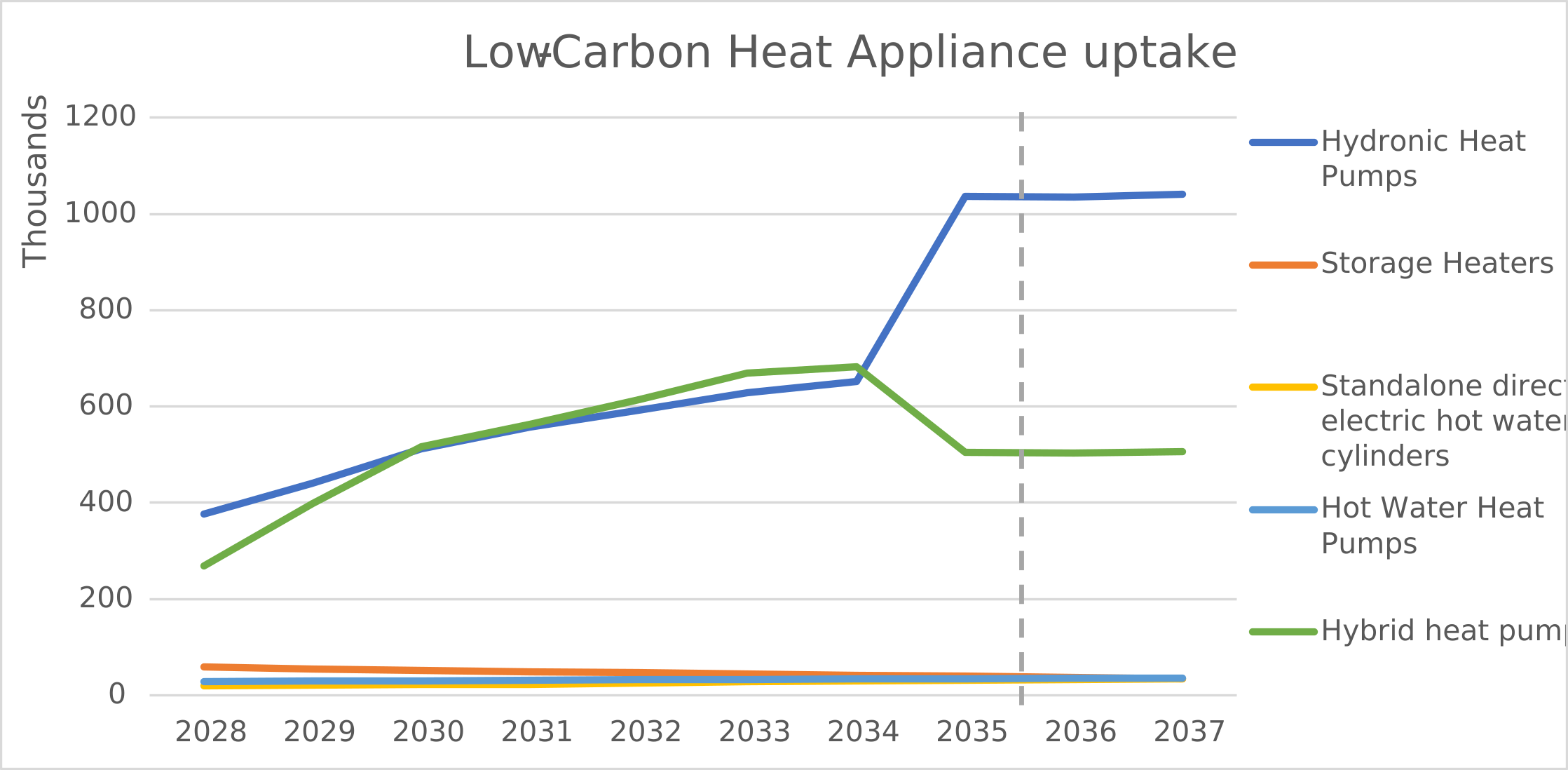
Figure 2: Electric Heating Appliance cumulative annual uptake forecasts. Based upon data from FES24 EE, and data and projections from LCPDelta Ref.
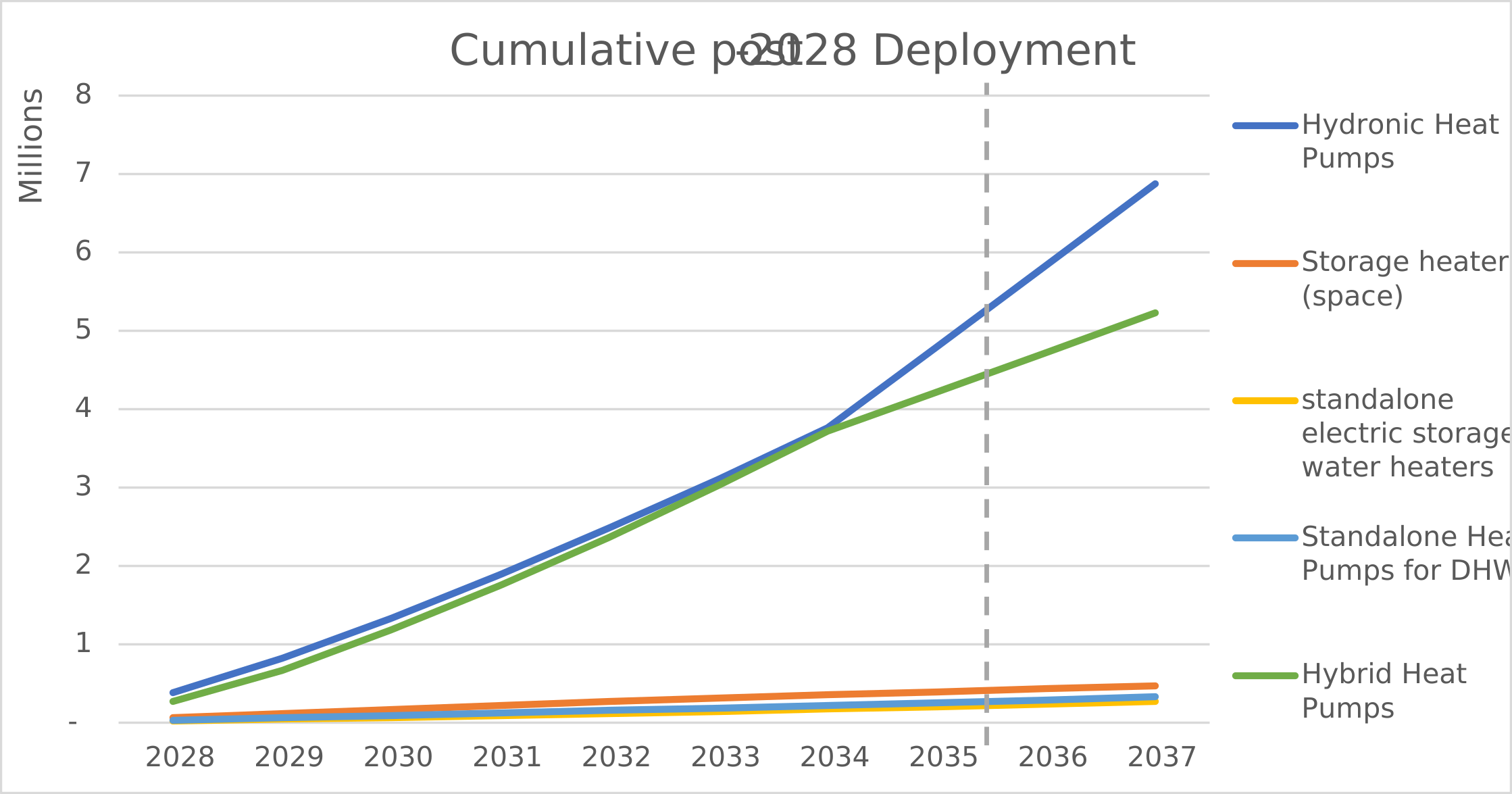
In the counterfactual scenario we assumed that a proportion of the devices in Figure 1 and Figure 2 would be smart without regulation. For modelling purposes, we have made the conservative assumption that the following proportions of the current market sales have energy smart functionality, see Table 6. This assumption is likely to be conversative as the market share of smart heat pumps is expected to grow.
Table 6 - Assumptions of the current proportion of appliances that are already smart
| Appliance | % smart compliant | Comment |
|---|---|---|
| Hydronic Heat Pumps | 50% | Based on interviews with manufacturers |
| Storage heaters (space) | 0% | Based on interviews with manufacturers |
| Standalone electric storage water heaters | 33% | BSRIA Report [footnote 32] |
| Standalone Heat Pumps for DHW | 0% | Could not identify any reliable sources so therefore for the purposes of this analysis we assume no compliance and therefore the maximum costs. |
| Hybrid Heat Pumps | 50% | Assume same as hydronic heat pumps |
We are seeking stakeholder input to validate or else improve these assumptions before publishing the final impact assessment. We also welcome views on the distributional impacts of the Phase 1 regulations.
49. Please comment on these data, assumptions, and methodology used in the Initial Impact Assessment. Please also provide further views on distributional impacts, and potential Equality Act considerations.
Consultation questions
- Do you agree with the changes to the definitions for EVSCPs set out in regulation 2: Interpretation? Please provide further information to support your answer.
- Do you agree with the proposed definition for a heat pump for the purposes of the ESA regulations? If not, what elements of the definition do you recommend should be changed and why? Please provide evidence or reasoning to support your answer.
- Do you agree with the proposed definitions for a hybrid heat pump and hybrid heat pump system for the purposes of the ESA regulations? If not, what elements of the definitions do you recommend should be changed and why? Please provide evidence or reasoning to support your answer.
- Do you agree with the proposed definitions for a fuel boiler for the purposes of the ESA regulations? If not, what elements of the definition do you recommend should be changed and why? Please provide evidence or reasoning to support your answer.
- Do you agree with the proposed definitions for an air-to-air heat pump and air-based heating system for the purposes of the ESA regulations? If not, what elements of the definitions do you recommend should be changed and why? Please provide evidence or reasoning to support your answer.
- Do you agree with the proposed definition for a storage heater for the purposes of the ESA regulations? If not, what elements of the definition do you recommend should be changed and why? Please provide evidence or reasoning to support your answer.
- Do you agree with the proposed definition for a heat battery for the purposes of the ESA regulations? If not, what elements of the definition do you recommend should be changed and why? Please provide evidence or reasoning to support your answer.
- Do you agree with the proposed definition for a standalone direct electric hot water cylinder for the purposes of the ESA regulations? If not, what elements of the definition do you recommend should be changed and why? Please provide evidence or reasoning to support your answer.
- Do you agree with the proposed definition for a centralised space heating device for the purposes of the ESA regulations? If not, what elements of the definition do you recommend should be changed and why? Please provide evidence or reasoning to support your answer.
- Do you agree with the proposed definition for a hot water heat pump for the purposes of the ESA regulations? If not, what elements of the definition do you recommend should be changed and why? Please provide evidence or reasoning to support your answer.
- Do you agree with the proposed definition for BESS for the purposes of the ESA regulations? If not, what elements of the definitions do you recommend should be changed and why? Please provide evidence or reasoning to support your answer.
- Do you agree that the Phase 1 ESA regulations should only apply to those manufacturers or importers who are placing a relevant ESA on the GB market as set out in regulation 6?
- Do you agree with the duty to take corrective action in respect of non-compliant ESAs placed on the market (regulation 7)? Please provide further information to support your answer.
- Do you agree with the proposal to require that relevant BESS must have a digital user interface as per regulation 10(3), as is the case for EHAs?
- Do you have any comments regarding how regulations 9 to 13 are drafted? Please provide further information to support your answer.
- Do you support the requirement in regulation 14 that manufacturers and importers must ensure relevant ESAs have device meters that are fully compliant with the obligations that MIR places on Class B active electrical energy meters, including conformity assessment (as per regulations 46-52B and Schedules 1A, 1B, 1E and 1K of MIR 2016)? Please give reasons for your answer.
- If you are a manufacturer or importer, do you currently produce or import ESAs that include a device meter? If so, is this device meter MIR Class B compliant?
- If you disagree with Question 16, do you support achieving the metering policy objective by alternative means? Which approach would be preferable? What issues may arise? Please give reasons for your answers and include further approaches as appropriate.
- For EVSCPs, would you recommend that measured consumption excludes the electricity consumed by the charge point itself when in use? Is this in line with current practice?
- Do you support this clarification regarding global override? If not, please explain your answer.
- Do you agree with the clarifications to the randomised delay considerations set out in the draft regulations? If not, please explain your answer.
- Do you support the introduction of the proposed requirements for ESAs in response to interruption to supply or communications as set out in Table 2? If not, please provide a rationale and options for improvement.
- Do you agree that the proposed recommendations should be introduced on a voluntary basis alongside Phase 1 regulations and become legal requirements with the introduction of Phase 2 ESA regulations? Please explain your answer.
- Do you agree with our proposed approach in regulation 16 to implement the ETSI 303 645 requirements? Please give reasons for your answer.
- Do you support the alignment of EVSCP requirements with the ETSI EN 303 645 cyber requirements? Do you have any concerns with this approach?
- Do you agree with our proposal to clarify the tamper protection requirements as set out in regulation 17? Please explain your answer.
- Do you have any comments regarding how regulation 19: Off-peak usage for charge points is drafted? Please provide further information to support your answer.
- Do you have any comments regarding how regulation 20: Energy smart function for EHAs is drafted? Please provide further information to support your answer.
- Do you agree with the proposed definition for an ‘add-on’ module for the purposes of the ESA regulations? If not, what elements of the definition do you recommend should be changed and why? Please provide evidence or reasoning to support your answer.
- Do you have any comments regarding how regulations 21 and 22 relating to off-peak usage and responsiveness status for EHAs are drafted? Please provide further information to support your answer.
- Do you agree with the proposal to apply the smart functionality requirements set out in Chapter 2 of Part 2 of the regulations to any relevant BESS sold as smart?
- Do you agree with the Off-peak usage requirement for BESS as set out within regulation 24? Please provide further information to support your answer.
- Do you agree with the requirement for ESAs as set out within regulation 25: Provision of information regarding security? Please provide further information to support your answer.
- Do you agree that the flexibility guidance pack requirement in regulation 26 should also apply to EVSCPs and BESS?
- Do you agree that the manufacturer should be responsible for producing the flexibility guidance pack, and that the entity placing the appliance on the market (manufacturer or importer) should ensure it is supplied with the appliance?
- Do you agree with the Assurance requirement for ESAs as set out within regulation 27? Please provide further information to support your answer.
- Do you agree with the different documentation required (flexibility guidance pack, statement of compliance and technical file) as part of regulations 26 and 27? Please provide further information to support your answer.
- Do you agree with clarification of the register requirements? Please provide further information to support your answer.
- Do you have any comments regarding how regulations 30 and 31 on Service and Compliance Notice are drafted? Please provide further information to support your answer.
- Do you agree that the current powers are sufficient to address non-compliance? Please provide further information to support your answer.
- If you do not consider that the current civil penalties are sufficient, do you support the creation of criminal offences as set out in section 242(3)(a) of the Energy Act? Please provide further information to support your answer.
- Do you agree with the proposal to align the civil penalty calculation with the Ecodesign for Energy Related Products Regulations 2010?
- Do you agree that the enforcement notices – compliance notice, notice of intent and final notice – follow a clear and logical set of processes and procedures (regulations 31, 33 and 34)? Please provide further information to support your answer.
- Do you have any comments regarding how regulations 33 on Notice of Intent, 34 Final Notice, 35 Appeals against final notices and 36 Enforcement of a civil penalty are drafted? Please provide further information to support your answer.
- Do you have any comments regarding how regulations 37 on Enforcement undertaking, 38 on Contents of an enforcement undertaking, 39 on Acceptance of an enforcement undertaking, 40 on Discharge of an enforcement undertaking, 41 on Appeals relating to the discharge of an enforcement undertaking, 42 on Inaccurate, incomplete or misleading information and 43 on Non-compliance with enforcement undertaking are drafted? Please provide further information to support your answer.
- Do you have any comments regarding how regulation 44 on Publication of cases of civil sanctions and enforcement undertakings is drafted? Please provide further information to support your answer.
- Do you agree with the application of the Consumer Rights Act Schedule 5 as set out in regulation 45: Amendment of the Consumer Rights Act 2015? Please provide further information to support your answer.
- Do you have any comments regarding how the regulations (46-49) in Part 4 are drafted? Please provide further information to support your answer.
- Please comment on these data, assumptions, and methodology used in the Initial Impact Assessment. Please also provide further views on distributional impacts, and potential Equality Act considerations.
Next steps
Following the conclusion of this consultation on 5 February 2026 government will analyse all responses received.
We will, following this analysis and if necessary, amend the draft regulations to reflect consultation feedback. Our aim will be to produce as clear and coherent a set of regulations as practicable, which are workable for industry while creating a technical and regulatory framework that helps reduce peak electricity usage, reduces consumer bills and protects the grid.
We expect to be ready to lay these regulations in Parliament in Q2 2026, allowing approximately six weeks for the affirmative procedure that the regulations will be subject to before they are made and become law (subject to Parliamentary timelines). When laying the final regulations in Parliament we will also publish a short response document which will include an analysis of responses.
Glossary
| Term | Definition |
|---|---|
| Consumer-Led Flexibility (CLF) (formerly Demand Side Response) | CLF entails changing electricity demand to help meet the needs of the energy system, typically to benefit the transmission network, distribution network, or another third party. CLF will also give households and businesses who choose to participate greater control over their energy usage, and the opportunity to save money. |
| European Telecommunications Standards Institute (ETSI EN 303 645) | A European Standard which includes a series of provisions for good cyber security practice. |
| Flexibility Service Provider (FSP) – formally Demand Side Response Service Provider (DSRSP) | An organisation entering into arrangements with a consumer for load control. |
| Distribution Network Operator (DNO) | Owns the local networks and feeds low voltage electricity through to homes or business property. |
| Distribution System Operator (DSO) | Has the role of monitoring, controlling and actively managing the power flows on the distribution system to maintain a safe, secure, and reliable electricity supply. |
| Energy Smart Appliance (ESA) | A device which is communications-enabled and capable of responding automatically to price and/or other signals by shifting or modulating its electricity consumption and/or production. |
| Electric Vehicle (EV) | Vehicle that uses one or more electric motors for propulsion. Unlike traditional internal-combustion engine (ICE) vehicles that rely on gasoline or diesel fuel, EVs operate using rechargeable electric batteries and an electric motor. |
| Interoperability | The ability of a product or system to operate in conjunction with other products and systems. For the SSES programme, interoperability in reference to ESAs, specifically refers to the ability of the ESA to change its FSP without the need for a visit to the premises and whilst maintaining the ability to provide consumer-led flexibility. |
| Load Control | The activity of adjusting the immediate or future flow of electricity into or out of an energy smart appliance. |
| Load Controller | Controlling or configuring an energy smart appliance through a load control signal, for the purpose of causing or otherwise facilitating an adjustment to the immediate or future flow of electricity into or out of an ESA. |
| Measuring Instruments Regulations 2016 (MIR) | MIR sets out the requirements that must be met before measuring instruments can be placed on the UK market. It covers a variety of measuring instruments and meters, such as gas and electricity meters. |
| National Energy System Operator (NESO) | Established in October 2024, NESO is an operationally independent and impartial body with responsibilities across both the electricity and gas systems for driving progress towards net zero while maintaining energy security and minimising costs for consumers. |
| Office for Product Safety and Standards (OPSS) | The UK’s national product regulator, within the Department for Business and Trade, and the enforcement authority for the first phase ESA regulations. |
| Publicly Available Specification (PAS) 1878 | A technical standard that sets out requirements for CLF-enabled ESAs. It was developed through an industry-led, BSI-facilitated process that was funded by government. |
| Second Phase ESA regulations | We will take forward a second phase of legislation later in this Parliament. This second phase will further protect consumers who choose to participate in CLF by giving them the confidence that the ESAs they purchase can be used with different FSPs, should they decide to switch. The framework will require (as a minimum) ESAs to comply with an interoperability standard and FSPs to integrate with this standard, thus ensuring a base level of interoperability. |
| Smart | Means, in relation to a device, the ability of the device to respond in real time to remote communication signals, using digital technologies, to deliver a service. |
| Smart Secure Electricity Systems Programme (SSES) | A DESNZ programme with the primary objective of unlocking the benefits of a smart and flexible electricity system for domestic and small non-domestic consumers, whilst protecting consumers and the grid. |
| Tariff | The charges applied to a consumer for their energy supply (and the associated contract terms). |
| Time-Of-Use Tariff (TOUT) | An electricity Tariff under which the unit price for electricity varies throughout the day. |
-
£233 annual saving for an average household with energy consumption of 3,149kWh of electricity and 12,193kWh of gas using Octopus’ Agile tariff compared to electricity price cap unit rates between July 2023 and July 2024. ↩
-
DESNZ analysis: based on Octopus’ Cosy tariff compared to the electricity price cap unit rates between July 2023 and July 2024. For flexibility behaviour the heat pump is assumed not to operate at peak times. ↩
-
Process evaluation of the Electric Vehicles (Smart Charge Points) Regulations 2021. ↩
-
Smart Secure Electricity Systems Programme (SSES): enduring governance. ↩
-
Smart Secure Electricity Systems Programme (SSES): enduring governance. ↩
-
A smart mandate means a requirement for devices to be able to respond in real time to remote communication signals, using digital technologies. ↩
-
Process evaluation of the Electric Vehicles (Smart Charge Points) Regulations 2021. ↩
-
Subsection 17, Commission Regulation (EU) No 813/2013. ↩
-
See the 2025 SSES government response, available here: Delivering a smart and secure electricity system: implementation. ↩
-
Proposal for a Directive of the European Parliament and of the Council amending Directive 2014/32/EU as regards electric vehicle supply equipment, compressed gas dispensers, and electricity, gas and thermal energy meters. ↩
-
Process evaluation of the Electric Vehicles (Smart Charge Points) Regulations 2021. ↩
-
s.242: Sanctions, offences and recovery of costs.
(4) Regulations which create an offence must provide for the offence to be triable only summarily.
(5) Regulations may not provide for an offence to be punishable with imprisonment.
(6) Regulations may provide for enforcement authorities to recover costs. ↩ -
The Ecodesign for Energy-Related Products Regulations 2010. ↩
-
Initial Impact Assessment available from consultation page. ↩
-
Building Services Research and Intelligence Association (BSRIA). ↩ ↩2
-
These 2024 figures have a learning rate applied for every year in the appraisal period. This is detailed in the Initial Impact Assessment. ↩