SEND reform: putting children and young people first (HTML version)
Updated 27 April 2026
Applies to England

© Crown copyright 2026
This publication is licensed under the terms of the Open Government Licence v3.0 except where otherwise stated. To view this licence, visit nationalarchives.gov.uk/doc/open-government-licence/version/3 or write to the Information Policy Team, The National Archives, Kew, London TW9 4DU, or email: psi@nationalarchives.gov.uk.
Where we have identified any third party copyright information you will need to obtain permission from the copyright holders concerned.
This publication is available at https://www.gov.uk/government/consultations/send-reform-putting-children-and-young-people-first/send-reform-putting-children-and-young-people-first-html-version
Corrections
- Footnote 24 previously read ‘Båtevik and Myklebust (2006) & Myklebust and Båtevik (2005) as cited by Kefallinou et al. (2020)’ but should read ‘Newton Europe, Delivering Better Value Programme Phase 1 Insight Summary (2024). Based on 1,650 case reviews in 48 out of 54 areas selected onto the programme’
- Footnote 25 has moved from appearing after ‘similar pupils in special classes’ to after ‘This finding is consistent across more than a decade of data (2011-2024).’
- Footnote 26 was updated to include a second reference: Båtevik and Myklebust (2006) & Myklebust and Båtevik (2005) as cited by Kefallinou et al. (2020)
- Footnote 26 previously read ‘The notional 6k was set in 2009.’ and should read ‘Institute for Fiscal Studies, Support for children with disabilities and special educational needs (2025).
- The final paragraph in the ‘We did’ section of ‘Multi-agency collaboration and access to specialist services need to be improved.’ previously read ‘We are formally integrating education into new multi-agency teams, establishing schools as the fourth safeguarding partner alongside LA, police and health services.’ and should read ‘We are further integrating our schools into child safeguarding with education as a strategic partner in multi-agency safeguarding arrangements and by including education in new multi-agency child protection teams.’
- In Figure 11, the dark green box on the right previously read ‘Specialist provision packages’ instead of ‘Inclusive mainstream practices’.
- In the ‘Education setting accountability’ section, ‘#BeeWell’ previously read ‘Bewell’.
Glossary
In alphabetical order.
Alternative Provision (AP): settings that provide education for children and young people who, by reason of illness, exclusion from school or otherwise, may not for any period receive suitable education.
The SEND Code of Practice (the Code): statutory guidance for organisations that support children and young people who have special educational needs or disabilities. The Code covers 0-25 years.
Early years/early years settings: early education provision for children aged 0–5, including childminders, maintained nursery schools, school-based nurseries and private, voluntary and independent (PVI) nurseries. In this document, maintained nursery schools and school-based nurseries are grouped with early years settings. Mentions of mainstream schools refer only to primary and secondary schools unless otherwise specified.
Education, Health and Care Plan (EHCP): legal document outlining the education, health and social care support that is to be provided to a child or young person who has special educational needs (SEN) or a disability.
Experts at Hand: a new offer of expert advice and services from education and health professionals into mainstream education settings.
Graduated approach: a continuous four-stage cycle (Assess, Plan, Do, Review) used in education to provide support to children as their strengths and needs develop and change.
Inclusion: Our approach to inclusion is guided by the definition set by the UN Convention on the Rights of Persons with Disabilities, which focusses on breaking down barriers. Children’s needs are not fixed. They may change over time, and many will face barriers to learning at different stages of their lives – whether due to poverty, bereavement, caring responsibility or other life circumstances. All staff in truly inclusive settings are able to recognise and respond to a wide range of additional needs, not as a response to specific diagnoses, but as a proactive approach towards creating environments where all children can access learning, feel valued and safe, and succeed.
Inclusion Bases: We will replace the current terms SEN unit, resourced provision, and pupil support unit (sometimes referred to by settings as ‘internal alternative provision’) to make it easier for parents to understand the support available for their child. Instead, we will collectively describe this provision as ‘Inclusion Bases’ (as these will sit in mainstream settings) – underpinned by two models:
- ‘Support Bases’ – commissioned and funded by individual settings and multi-academy trusts to deliver targeted support; and
- ‘Specialist Bases’ – commissioned and funded by the local authority to deliver specialist support.
Independent special schools (ISS): privately funded schools that specialise in educating children with special educational needs.
Individual Support Plan (ISP): a record of a child or young person’s barriers to learning and of the provision in place to overcome those barriers. These will be for all children and young people with SEND.
Integrated Care Board (ICB): National Health Service (NHS) organisations responsible for planning health services for their local population.[footnote 1]
Intersectionality: refers to the interconnected nature of social categorisations such as race, class, gender, and disability as they apply to a given individual or group, regarded as creating overlapping and interdependent systems of discrimination or disadvantage.
Layers of support: three layers of support, above the Universal offer. These are called Targeted, Targeted Plus and Specialist.
Mainstream: schools or settings that provide education for all children, including those with SEND.
Ordinarily Available Provision (OAP): Ordinarily Available Provision is the everyday support and adaptive teaching that all mainstream settings are expected to provide from their own resources for children and young people, including those with SEND, before specialist help is considered.
Outcomes: specific goals or achievements set out for a child or young person to measure progress and success.
Post-16 settings: institutions in the further education sector (including sixth forms, further education colleges, specialist post-16 institutions, 16-19 academies).
SEN: special educational needs.
SENCO: special educational needs co-ordinator – a professional responsible for overseeing SEND provision within a school or setting.
SEND: special educational needs and disabilities – a broader term than SEN.
Settings: the different types of educational environments where children and young people receive learning and support. This includes early years provision (including childminders, maintained nursery schools, school-based nurseries, and private, voluntary and independent (PVI) nurseries), schools (mainstream and special), and colleges or other post-16 education providers.
Special schools: schools designed to meet the needs of children with SEND.
Transitions: the process of moving between stages of education or settings, such as from early years to primary school, or from school to further education.
Foreword
The education and experiences, beliefs and values we share with our children and young people today will shape our society for tomorrow.
When children grow up together, attend their local school and feel they belong to their local community, our society is stronger. When we emphasise what children can do, and not what they can’t, we build confidence and capability for the future.
Yet today, children with special educational needs and disabilities (SEND) are increasingly being educated away from their friends and neighbours, travelling hours each day away from home simply to go to school. Frontline staff in our nurseries to our colleges tell us they feel ill-equipped to support children’s needs. Increasingly, families feel or even are told that their local schools cannot support their child, and some feel forced to withdraw their children from our education system altogether. Early help and support for children with SEND has too often not been present, pushing families into lengthy, adversarial and bureaucratic processes to get even basic support, with an emphasis on what children can’t do, rather than what they can. The result is many young adults leaving full-time education ready neither for life nor work, their time at school sidelining them, focusing on deficits, and failing to set them up for rich, full adult lives lived as independently as possible.
Successive governments have tried to improve outcomes for children and young people with SEND, but it is clear that for too many children and for too many families our system is failing.
None of this is necessary. It is not inevitable that children with SEND miss out on the support they need at school. It is not predestined that parents must invest so much time, money and emotion into proving what their children can’t do, in order to get help. It is not necessary for that help to so often to involve delay, separation and growing difference rather than inclusion and positive focus on capability. We cannot and must not accept that a proportion of each generation are simply being written off.
Today we call time on a system that has let children and their families down for far too long. Today we take responsibility for changing the system – for enabling and empowering not just some but all of our children.
We will invest upfront in providing support early, both through our brilliant Best Start Family Hubs and early education providers, and empowering schools and colleges to deliver higher quality and more timely support, where and when children need it. We will make it easier to get support without needing to go through processes, and protect and enhance Education Health and Care Plans for children with the most complex needs, bringing in new National Inclusion Standards and expectations for quality and evidence.
Families should not have to fight to access help, and our education workforce should not feel that it is down to them to support every need. The proposals set out in this consultation work hand-in-hand with our ambitious 10 Year Health Plan, reinforcing our commitment to delivering early intervention to stop needs escalating and ensuring that children and young people can access the healthcare support they need for happy, fulfilling childhoods and successful transitions into adult life. We will join services up, wrapping health and care around our nurseries, schools and colleges so children can access the therapies and interventions they need without drawn-out bureaucracy but with experts at hand.
This consultation therefore is about the realisation of children’s rights. The right to attend and be included in their local schools. The right to well-evidenced, fair support which enables them to grow, learn and develop as individuals and as part of our communities. The right to high expectations for their achievements and their futures whatever their starting point, as we have for all our children.
We make these changes because we have a moral mission to do our very best by each and every child in our country.
We are grateful to the contributions that children, young people and their families, educators, health and care professionals, charities and others have made to shaping our National Conversation so far. We now look forward to hearing your thoughts on the proposals in this consultation: we welcome your support and your challenge, because it is a shared responsibility to ensure children and young people with SEND can dream as big as any child and achieve all of which they are capable.
The Rt Hon Bridget Phillipson MP
Secretary of State for Education
The Rt Hon Wes Streeting MP
Secretary of State for Health and Social Care
Executive summary
Our Vision
Excellent education transforms lives. Every child has a right to an education that is academically challenging, rich in opportunity, and built on strong relationships. We have a clear objective: children and young people who can achieve and thrive in mainstream education will be supported to do so; and children and young people who need specialist support will receive it promptly and with dignity, clarity and care.
We will build an education system where inclusion and high standards are two sides of the same coin. And in doing so we want to raise attainment for all. Every child deserves high-quality, inclusive education close to home, where they can learn, make friends, and participate in their community. To make that happen, we want to take the best of the SEND system and make it part of the mainstream, so that we have one education system, not two parallel ones.
We welcome definitions of inclusion which can help guide actions that meet all children’s needs, including: ‘Inclusion is all staff supporting the learning, wellbeing and safety needs of all children, so that they belong, achieve, and thrive’.[footnote 2] Within this, it is crucial we go further to deliver inclusion for children with SEND. In doing so, we will be guided by the UN Convention on the Rights of Persons with Disabilities. To achieve an inclusive education system, we will:
- strengthen the law to ensure evidence-based support for children and young people is provided early in mainstream settings so they can stay in education, achieve and thrive alongside their peers;
- integrate support across health, care, and family services, ensuring children’s needs are identified and addressed as soon as they emerge; and
- increase upfront investment so support is readily available for classes and communities of children, rather than locked behind lengthy and bureaucratic individual assessment processes.
The evidence is compelling: children and young people learning alongside their peers has proven academic and social benefits for all children.[footnote 3] Pupils with SEND who are educated in inclusive mainstream schools are twice as likely to find employment and live independent lives compared to those with similar needs in special classes.[footnote 4] Learning in their local community gives all children the confidence, resilience, and independence they need to lead fulfilling lives. For children and young people with the most complex needs, special schools provide the right environment to make meaningful progress and build independence, but these schools should also be connected to the wider system and communities.
Our Plan
Our plan starts with strengthening the ability of every education setting to meet the varying needs of children and young people. That means investing in building the evidence on how we meet children’s needs and engage them in education, investing in staff training and in professional time and capacity to spend providing targeted support which enables children to learn and thrive, from working in smaller groups, to accessing speech and language therapies.
To deliver these reforms, we are putting more money into the education system, with £7 billion more being spent on SEND support compared to 2025-26. Department for Education (DfE) budgets will increase above previously planned funding at Autumn Budget 2025 by £3.5 billion in 2028-29 to support investment in the SEND system. In every year of this parliament, core funding for schools and SEND is expected to increase, subject to future Spending Reviews (SR). As we invest in the system, we will update the SEND Code of Practice and legal requirements for support to be provided in all mainstream education settings from early years to post-16, thereby strengthening the law to make sure children and young people receive the help and support they need.
Our plan starts by giving every child the best start in life, and making sure families can access help and support early and locally. Early years providers, working alongside Best Start Family Hubs, play a vital role in identifying needs and intervening swiftly with evidence-based support. We know this works. Evidence shows that children with access to Sure Start Children’s Centres were more likely to have their needs recognised at age 5 and less likely to require SEND support between ages 7 and 16.[footnote 5] We have already committed to £700 million of investment in Best Start Family Hubs and the Healthy Babies programme over the next three years, in partnership with the Department for Health and Social Care (DHSC), and we will invest over £200 million more for the same period to strengthen the SEND offer in Best Start Family Hubs. The SEND offer will be led by a named professional in every Hub.
Identifying children’s needs early leads to better outcomes. We will introduce a new Universal offer, ensuring children receive the right support in mainstream schools, colleges and early years settings. Education staff often report meeting the needs of pupils with SEND is the hardest part of their role,[footnote 6] yet they make the biggest difference to children and young people’s outcomes. We will back our workforce with more than £200 million of investment over three years in a new national SEND training programme. All staff in schools, colleges, and early years settings will benefit from new training by the end of the parliament. Training will apply to the entire 0–25 system, with requirements set out in the Code of Practice.
Over the next three years we will invest £1.6 billion to make the mainstream system more inclusive, building on the latest evidence and practice. We will ensure settings spend this money to improve their inclusion offer, and will place conditions on this funding so that they do so. As the system improves, we will direct more money into mainstream budgets. We will fund new research into what works, building on the progress made through greater adoption of evidence-based practice in education. By 2028, we will have invested up to £15 million to build the evidence base for, and then provide, National Inclusion Standards. These will set out, for the first time, support that should be available in every mainstream setting. We will also refresh areas of need, update guidance on reasonable adjustments, and revise the SEND Code of Practice.
For children and young people who need additional support beyond the Universal offer, families are currently forced to battle complex legal and funding systems. We will introduce a new Targeted offer in mainstream settings that gives access to expertise like speech and language therapists, small group provision or adaptations to the curriculum, without the need for lengthy assessments. Children and young people will not need to apply for a statutory plan to benefit from the Targeted and Targeted Plus layers of support, but the help and support they are entitled to receive will be written into the law. They will receive a new, digital ‘Individual Support Plan’ (ISP), which will be provided by their school, college or early years setting and developed in partnership with parents. ISPs will be digital, accessible and evolve with the child, because we know needs and circumstances change over time.
The education system cannot do this alone. It is a joint effort, bringing together public services including health, care and local government. We will invest £1.8 billion over the next three years to create a new national offer called ‘Experts at Hand’, wrapping professionals such as educational psychologists, speech and language therapists, and occupational therapists around mainstream settings. This means the proportion of pupils receiving multiagency support (through the Targeted Plus layer and the specialist system) will be higher than the proportion with an EHCP at present. This will be supported by £200 million to build capacity, including for local authority (LA) SEND services, to help deliver this reform.
We will invest £3.7 billion from now until 2030 to create buildings accessible, create new special school places, and tens of thousands of new places in Inclusion Bases in mainstream settings, make buildings accessible and create new special school places. Combined with investment to increase the number of education and health professionals like educational psychologists, we will create more specialist places in mainstream schools so that it is quicker and easier to get specialist support. To promote shared responsibility for children’s outcomes, we will work with the system, so schools come together in a local group.[footnote 7] These groups will pool some funding, share resources and work together to improve and expand the help and support available to children.
We will place a duty on schools to produce an Inclusion Strategy, setting out what they will provide across the Universal offer, and Targeted, and including Targeted Plus layers of support. This means that, for the first time, we are creating a duty on schools to set out how they will deliver evidence-based support to children and young people with SEND. We are introducing new duties on settings to create Individual Support Plans and, for the first time, setting out a requirement to use evidence-based resources and interventions to identify and meet need. Through this approach, we are strengthening the legal framework for children and young people with SEND. Under our reforms there will be new layers of support, delivered in their setting, without a fight.
There is currently variation in the level of support for children with complex needs, with no clear or consistent approach to identifying and meeting needs, and too much support is poorly evidenced. To turn this around, we will introduce new Specialist Provision Packages. Working with experts and shaped through testing with parents, these Packages will be nationally defined, evidence-based and set out exactly what interventions, resources, and standards are required. Each Package will offer a full range of support – covering curriculum adaptations, extra services, therapies, and resources – and will guide what is included in an EHCP. The Department for Education (DfE) will appoint an independent expert panel to develop and review these Packages. We will bring forward legislation at the earliest opportunity to introduce these changes, and Packages will form the basis for future EHCPs, in both mainstream and specialist settings.
As reforms become embedded, we expect the number of children and young people needing a Specialist Provision Package, and hence an EHCP to access support, will return to around today’s level by 2035. This will be above long-term historical trends, as we know needs have increased worldwide, in part through better identification. We will manage the transition to a new system carefully. That is why our investments start now, before forthcoming legislation, and the transition will be staggered. Whilst assessments for the new system will start in September 2029, there will be no changes to the support received via EHCPs before at least September 2030. As pupils move to the new system when they reach the end of a phase of education, those who do not need an EHCP will be supported through the flexible layers of support, which can be drawn on from day one. If needed, they will also receive a digital Individual Support Plan.
The specialist sector, including maintained special schools, Alternative Provision settings, and special post-16 institutions, will have a clearer focus on outreach. This will involve supporting mainstream settings and delivering holistic, high-quality support for children with the most complex needs, ensuring positive educational outcomes and strong long-term trajectories. We will also update the law for independent special schools to ensure children receive suitable, high-quality placements and that local authorities pay fair, reasonable costs for them.
Children and families have been let down by the current system. These reforms will be introduced gradually, over time and we ask that families work with us to build an education system that works for all our children. This will be built on the best practice that we see in schools, colleges and early years settings. However, we have heard clearly that these settings have not always had the right support, incentives, and evidence base. Already, we have changed accountability rules to set clear expectations, encourage improvements and spread excellence through collaboration. For the first time, Ofsted’s new inspection framework will assess all settings for inclusion and, in due course, we will consult on changes to the Area SEND inspection framework. We will also update school performance measures to promote high standards for all pupils and to recognise inclusive mainstream schools which are supporting the progress of the children and young people who face the greatest barriers to learning. Through these reforms, we will make sure all public services have clear roles and responsibilities. We will update the Ofsted and Care Quality Commission (CQC) Area SEND inspection framework to align to the clarified statutory roles that local authorities and integrated care boards (ICBs) will have in relation to children and young people with SEND.
We want the Tribunal to be a genuine last resort and so we will invest to improve mediation and school complaints processes. We will also explore how we can strengthen independent scrutiny of school complaints data and identify patterns that might show poor performance. In addition, parents and young people can continue to seek resolution via mediation or through appealing to the Tribunal. We will appoint an independent expert panel to oversee the development of the National Inclusion Standards, covering both Specialist Provision Packages and inclusive mainstream practices. We will also create a new remit for the Children’s Commissioner to provide independent oversight and scrutiny of SEND reform.
This is a decade-long reform programme, but we will begin to see improvements from the very start. We have begun the biggest National Conversation on SEND to date, and we will continue in that spirit as we move into the formal consultation. Through these conversations, we have heard concerns and responded with the proposals in this document. Only by restoring trust in the system, and everyone working together can we change children’s lives for the better. With every step, and in every part of the country, we will work together, in partnerships and with trust.
The result will be an education system, together with all local services, that removes barriers, raises aspirations, and achieves better outcomes, with far more children supported to achieve and thrive in their local mainstream school, college or early years setting, and high-quality specialist provision available for children who need it. This is not a short-term fix; it is a sustained commitment to inclusion, excellence, and opportunity for every child.
Case for change
The current SEND system is failing to deliver mainstream inclusion for the 1 in 3 children who have SEN at some point in their schooling. Over half (51.6%) of those who do not meet key stage 2 expectations in reading, writing and maths have been identified with SEN at or up to the end of key stage 2.[footnote 8] It is not leading to better educational or life outcomes;[footnote 9] it leaves too many families fighting for support (often with financial implications with over a quarter reducing their working hours);[footnote 10] and too many education and health professionals having to spend their time on bureaucracy rather than on supporting children and young people.[footnote 11] Disabled children and their families are being failed. And this has all happened against a backdrop of cuts to support services, such as Sure Start Children’s Centres, despite their benefits for young children with SEN.[footnote 12]
Figure 1: The percentage of children with and without SEN sustaining a post-16 destination[footnote 13]
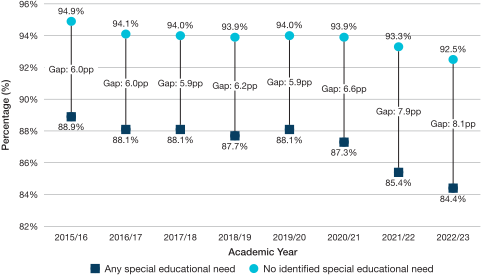
Outcomes for children and young people with SEND remain low despite an 87% rise in high needs funding over the last 6 years.[footnote 14] The gap between their GCSE results compared to their peers without SEND has not meaningfully narrowed,[footnote 15] nor has their likelihood of sustaining education, employment, or training after age 16 (Figure 1). Too many miss out on high-quality teaching and support because they have unsuitable provision,[footnote 16] which limits progress, confidence, independence, and future life chances. Too often support arrives late and inconsistently,[footnote 17] forcing families to fight for help rather than access the right support. Children with SEND are disproportionately likely to be suspended, excluded, or persistently absent, and the gaps with their peers are growing.[footnote 18] We know SEN identification varies by ethnic group and free school meal eligibility as well.[footnote 19]
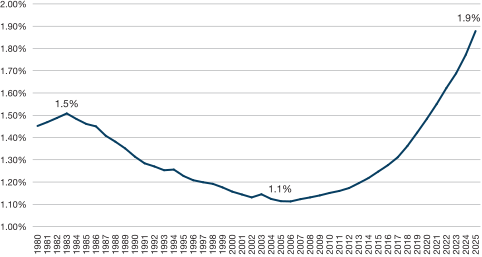
The system’s failure to deliver mainstream inclusion in a consistent and widespread way means that fewer children are attending their local school and many travel long distances from their families and communities.[footnote 20] A greater proportion of the school population is now educated in special schools than at any time in the past half century (see Figure 2), more than reversing the progress towards inclusion we saw from the early 1980s, following the seminal Warnock Report. This includes rapidly rising placements in independent special schools, which do not always provide a good quality education, and, as the Education Select Committee has noted: “raises serious questions about […] the extent to which profit motives align with the best interests of children and families”.[footnote 21] This growth in special school places is despite international research finding that inclusion[footnote 22] can have positive academic and social outcomes for children and young people with SEND, and slightly positive, or at least neutral impacts for those without SEND.[footnote 23]
Analysis we have published shows pupils with SEN taking GCSEs in mainstream schools achieve around half a grade higher in English and Maths than similar pupils in special schools. This finding is consistent across more than a decade of data (2011-2024) [footnote 25]. Other evidence suggests more children and young people with SEN could have their needs met in mainstream with the right support.[footnote 24] International evidence highlights that children and young people educated in inclusive settings were almost twice as likely to secure economic independence than similar pupils in special classes. And there is evidence increased social inclusion for all children and young people has ongoing positive impacts on life after school, including employment prospects for children and young people with SEND.[footnote 26]
Figure 2: State funded special school population as a % of the total school population[footnote 27]
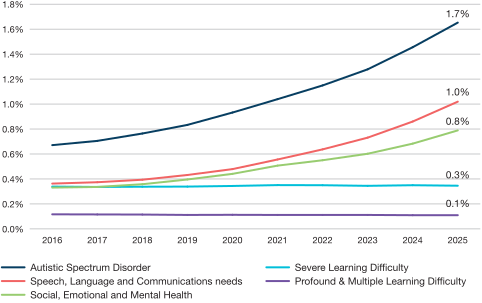
Since the 2014 reforms, the number of children receiving Education, Health, and Care Plans (EHCPs) has doubled (including a 30% increase in children under 5 since 2023),[footnote 28] after almost two decades of stability.[footnote 29] This rise is mostly due to three types of primary need: Autism Spectrum Disorders; Social, Emotional and Mental Health; and Speech, Language and Communication Needs. The number of children and young people with Profound and Multiple Learning Difficulties and Severe Learning Difficulties – the two needs which are most likely to require a special school place – has remained unchanged (see Figure 3). International evidence shows EHCP growth in England has outpaced many comparable European countries.[footnote 30] Comparisons with Wales, where increases were roughly half those in England, suggest that around half of the rise reflects wider societal factors, and half reflects features specific to England, such as how the SEND system operates.[footnote 31]
Figure 3: Pupils with EHCPs by primary type of need as a percentage of all pupils[footnote 32]
The inability to secure reliable high-quality SEN Support in mainstream has pushed families towards seeking EHCPs as the only mechanism to access support. This has further shifted the system away from making support available early and providing a strong Universal offer, including ordinarily available provision or early access to multi agency support.[footnote 33] EHCPs were originally designed for the most complex needs but are now used for a broader range of more commonly occurring needs children and young people may face. This is also partly because the effective financial threshold for an EHCP[footnote 34] for school-aged children, often referred to colloquially as the notional £6k, has been frozen in cash terms since 2013 (a Figure itself based on 2009 costs,[footnote 35] resulting in a more than 50% decrease in real terms[footnote 36]) as mainstream school funding became increasingly squeezed. This means some children whose needs were previously met from mainstream school budgets alone are now being partly being met via EHCPs and funded by LAs.
This shift in how support is provided contradicts international evidence suggesting SEND systems that prioritise broader services for a wide group of children rather than funding at individual level tend to be more inclusive and less adversarial.[footnote 37] Inconsistent approaches to identifying and meeting needs lead to widespread variations across settings and communities.[footnote 38] The support provided by EHCPs is inflexible, making it hard for settings to adapt as needs change over time, which leaves too many children and young people with provision that is not necessarily suitable.[footnote 39] Through the National Conversation over recent months, teachers have consistently told us of their frustration at the current EHCP model not enabling them to deliver the support a child really needs, including because EHCPs do not keep up with needs as they change over time.
Overall, the current SEND system is ineffective and inefficient. High needs spending has risen very significantly in recent years whilst failing to meaningfully improve outcomes or reduce waiting times to access support from services such as speech and language therapists.[footnote 40] It has also created unsustainable pressure from SEND deficits on local authority budgets. The system will remain unable to meet needs early or effectively unless it changes. Our reforms aim to ensure more children and young people can achieve and thrive in their local mainstream setting.
Co creation
Over the past 18 months, we have heard and spoken to thousands of children, young people, parents, families, professionals and local authorities. As part of our National Conversation, launched in December 2025, we reached over 8,000 people. More than 6,000 joined our online conversations, over 1,800 shared their views through our online platform, and more than 500 people took part in 9 regional events held in partnership with the Council for Disabled Children.
Alongside this engagement, we have worked closely with experts across the SEND sector. We have also considered recommendations from independent bodies such as Education Select Committee and the Children’s Commissioner’s Office, alongside non-profit and policy or research organisations, campaign groups and MPs. We are grateful to everyone who has contributed to this conversation and helped shape these proposals.
We have revised our reform principles following the National Conversation, which sit at the heart of our proposals.
Our Reform Principles
1. Early. Children and families should receive the support they need as soon as possible, with a quick response to changing needs. This will start to break the cycle of needs going unmet and getting worse. Instead, we will intervene swiftly and proactively, focusing on providing support earlier in children’s lives when this can have the greatest impact.
2. Local. Children and young people with SEND should be able to learn at an education setting close to their home, alongside their peers, rather than travelling long distances from their family and community. Specialist settings should continue to play a vital role supporting those with the most complex needs.
3. Fair. Every education setting should be resourced and able to meet common and predictable needs, including as they change over time, without parents having to fight to get support for their children. Where specialist provision is needed for children and young people, we will ensure it is there, whether that be a mainstream, specialist or Alternative Provision setting, with clear legal requirements and safeguards for children and parents.
4. Effective. Reforms should be grounded in evidence, ensuring all education settings know where to go to find effective practice that has excellent long-term outcomes for children and young people.
5. Shared. Education, health and care services should work in partnership with one another, Best Start Family Hubs, local government, families, teachers, educators, experts, the voluntary sector and representative bodies to deliver better experiences and outcomes for all our children and young people. The voices of children should be at the heart of decision making.
What we heard
Through this engagement process we have heard a clear and consistent message from families, professionals and children and young people themselves: the current system is not working. It is failing children, failing parents, failing schools and failing LAs. Parents have told us they often do not feel listened to and want to be recognised as experts on their own children. They have also told us stronger accountability will be essential to putting the system right. Teachers have emphasised the need for appropriate training and access to support – including funding, resources and access to health professionals. Children and young people have highlighted the importance of communication and consistent support at every stage of the system. Across all groups, we have heard how vital early support is – without long bureaucratic waits, alongside the need for effective multi-agency collaboration and a strong focus on children’s rights.
At the same time, we have also seen examples of outstanding practice: dedicated practitioners providing inclusive, high-quality support that is transforming the lives of the children and young people they work with. Our ambition is to create a system that builds on and spreads this best practice, ensuring all children and young people have the support and opportunities they need to achieve and thrive.
Through our reforms, we are acting on each of these issues:
You said
Identifying needs early on – and not waiting for a formal diagnosis – is critical. Currently, there are too many missed opportunities to provide early support.
“Support should be put in place as soon as concerns are raised. Immediate, flexible support plans — reviewed regularly — would protect children’s mental health and prevent the long-term emotional damage caused by being left unsupported while waiting for assessments that may take many years.”
– Parent, National Conversation online portal, December 2025
We did
Families will be supported from children’s earliest days through Best Start Family Hubs and inclusive early years settings, without needing to wait for a diagnosis or an EHCP.
Every Hub will have a dedicated offer for children with additional needs, led by a trained professional.
Early years settings will benefit from the inclusive mainstream fund and national training offer for staff to ensure they can meet more children’s needs.
You said
A well supported and equipped workforce is key – all staff need evidence-based and practical training to meet children’s diverse needs. SENCOs need the time, authority and resources to lead SEND provision effectively.
“Staff require sufficient time, training, and resources to build their knowledge and understanding of neurodivergence.”
DfE Independent Neurodivergence Task and Finish Group, February 2026
We did
All early years, school, and college staff will be able to access national, evidence-based training on SEND and inclusion.
We will work with the sector, including Improving Education Together, to create inclusive workforce models that make the most of SENCO expertise.
You said
Multi-agency collaboration and access to specialist services need to be improved. Services are fragmented and waiting lists are too long. There needs to be better co-ordination between education, health and social care and faster access to educational psychologists, speech and language therapists and mental health services.
“When services truly work together, children receive help earlier, transitions are smoother, and families feel supported rather than left to coordinate everything alone.” – Parent, National Conversation Online Portal, December 2025
We did
We will improve access to experts such as educational psychologists and speech and language services through a £1.8 billion investment, ensuring they are working with children, not tied up in bureaucratic processes.
We are training over 200 more educational psychologists each year from 2026.
Mental health support teams will roll out to all schools by and colleges 2030, reaching 6 in 10 settings this year.
We are further integrating our schools into child safeguarding with education as a strategic partner in multi-agency safeguarding arrangements and by including education in new multi-agency child protection teams.
You said
Mainstream settings need to be more inclusive. Stronger inclusive practice should be readily available in every setting supported by clear inclusive leadership, including on areas such as behaviour, reasonable adjustments, curriculum and transition planning. Ensuring consistent high-quality best practice across Inclusion Bases is vital.
“Every school should routinely offer a baseline level of inclusive support that allows children with SEND to access education safely and meaningfully.” – Parent, National Conversation Online Portal, December 2025
We did
We will create new National Inclusion Standards for the first time, based on evidence, to inform best practice in identifying barriers and meeting needs. We will have evidence-led resources to support curriculum adaptation and provide new guidance on reasonable adjustments to help support settings in understanding children’s needs.
We will have Individual Support Plans for children and young people with key information on their needs and support, that stay with them through each phase of their education.
You said
Children’s rights are key. EHCPs are an important guarantee of rights but the current EHCP process is slow, bureaucratic and inconsistent. Plans are also not followed once in place.
“For children and young people with complex needs requiring provision beyond what inclusive mainstream practice can offer, a clear legal assessment and specification of need and provision remains essential. However, the current EHCP process needs urgent reform to make it fit for purpose.”
– SEND practitioner and parent, National Conversation online portal, December 2025
We did
EHCPs are a key part of the system for children with complex needs, but we will improve the quality of these Plans and ensure they’re delivered.
New nationally defined ‘Specialist Provision Packages’ designed by experts and tested with parents will outline packages of provision, based on evidence, to support children with the most complex needs. In the future, only children and young people who need the overall package of support detailed in a Specialist Provision Package will be entitled to an Education, Health and Care Plan (EHCP).
Working with the NHS, we will introduce a fast track for a Specialist Provision Package and EHCP for children under 5 who have been identified as having complex needs.
You said
Children’s voices at the heart of decision making.
“Nothing about young people without us”
“See us as individuals”
– Children and young people, National Conversation roundtable, January 2026
We did
We will introduce a new Pupil Engagement Framework this summer to help us better understand children and young people’s day-to-day experiences.
You said
Parents and carers need to be recognised as experts on their children and treated as partners in the SEND process.
“Parents should be treated as equal partners and experts in their child, not as obstacles to manage.”
Parent, National Conversation online portal, January 2026
We did
Individual Support Plans will be co-designed with families.
We will ensure that the parent voice is represented in local decision making and ensure they are heard. We will strengthen the framework for Parent Carer Forums through consistent standards, training and sustainable funding.
We will work with families and schools to establish minimum expectations for home-to-school partnerships.
You said
More funding is crucial to ensure schools are supported to adequately train and equip staff, have access to the right resources and specialist support.
“Schools need the flexibility and incentives to adapt environments, curricula, and assessment processes so that inclusion is embedded by design.”
DfE Independent Neurodivergence Task and Finish Group, February 2026
We did
Mainstream funding reforms to support early intervention and more flexible support, with settings receiving more money upfront including:
- £1.6 billion for the Inclusive Mainstream Fund over the next three years.
- £1.8 billion investment over three years as part of our Experts at Hand offer.
In the long term, schools will pool some funding to support inclusion.
You said
Accountability needs to be stronger to help improve quality and reduce variation. Parents need to be confident that statutory duties will be complied with.
We did
Schools will be required to publish an Inclusion Strategy setting out how resources are used to benefit children with SEND.
Ofsted and Care Quality Commission (CQC) will check how local services work together for children and young people, and set clear standards and hold them accountable.
We will ask the Children’s Commissioner for England to monitor the progress and effectiveness of SEND reforms for all children with SEND, focusing on the most vulnerable groups.
Next stage of the National Conversation
We are grateful to everyone who contributed to shaping these proposals. We know that access to advice, support and meaningful influence over SEND policy for children, young people and their parents must improve, and we are committed to working with you to achieve this.
We will consult widely, including through the next phase of the National Conversation’s engagement events, and invite views from across the system – each section contains relevant consultation questions and there is a full list of these in Appendix C. Where questions ask for free text responses, there is a limit of 1500 characters.
Q1. We want children, young people and their families to be involved in making better, evidence‑based decisions about SEND, both in their local area and across the country.
How can we make sure children, young people and their families have a genuine say in these decisions?
Q2. How can we make sure that high-quality evidence and best practice inform decisions about SEND? Please share examples.
What does SEND reform mean for children and families?
We are building a system which means that every child and young person can learn, play and thrive in their own community, with support available early and without a battle. These reforms will ensure an inclusive education for all children, backed by clear expectations, stronger accountability and major new investment.
Inclusive education for every child
Every setting will become an inclusive setting.
- A £1.6 billion Inclusive Mainstream Fund over three years will give schools, colleges and early years settings funding to deliver an improved inclusion offer.
- All staff will benefit from national SEND training, backed by over £200 million over three years.
- Early years settings, schools and colleges can benefit from £3.7 billion of capital investment from this year to 2030 to create tens of thousands of new places in Inclusion Bases in mainstream settings, make buildings accessible and create new special school places.
- New National Inclusion Standards and early identification tools will support earlier, more consistent help.
- Every school will publish a legal Inclusion Strategy, setting out how they will remove barriers to learning to support inclusion.
- Inclusion will be embedded in Ofsted inspections and national data.
Targeted and Targeted Plus layers of support, available sooner
- New Targeted and Targeted Plus layers of support will ensure children get the right help in mainstream settings.
- £1.8 billion over three years will bring education and health professionals directly into mainstream settings.
- Every child receiving Targeted or Specialist support will have a digital Individual Support Plan (ISP).
Better, faster support for children with the most complex needs
Children and young people with complex needs will receive support quickly and fairly.
- If families want a mainstream setting for their child, their preference will be upheld.
- Children under five with complex needs will have a fast-track route to support.
- Education, Health and Care Plans (EHCPs) will continue for those who need them, based on national, evidence-based guidelines.
- Multidisciplinary teams will work together to deliver swift, joined up plans.
- New accountability for Integrated Care Boards and strengthened oversight of local authorities will drive improvements.
- Mediation will be used more, to resolve disputes more quickly, with the Tribunal as a backstop.
Children and families at the centre
Children and families will be actively involved in decisions.
- Children, young people and their families will be engaged in the development of their ISPs.
- The voices of children and parents will be included in decision-making.
- We will strengthen the voices of children, young people and parents within local partnership arrangements.
- Investment in information and support will help families navigate the system.
A clear, staged transition to the new system
We are investing upfront, before any legislative changes, so the system is prepared for reform.
- Over the next four years, £7 billion of investment and new National Inclusion Standards will build the foundations of the reformed system.
- After September 2029, reviews at transition points (end of primary, secondary and Post-16) will determine whether children and young people move to a new specialist EHCP or an ISP.
- All existing EHCPs and protections will remain in place until September 2030.
- No child will be asked to leave a special school.
- The Children’s Commissioner will oversee the transition and implementation.
Every family will benefit from a system that works with you, not against you – where your voice matters at every stage.
Part one: putting children and young people first
The Universal Offer
I want my son to get the support he needs to access education on the same par as others in the room. I don’t want to wait for a diagnosis to secure this support – ParentKind and Changing Realities DfE roundtable attendee, January 2026
- We want one inclusive education system for all children and young people, including those with SEND – not separate systems where some are sidelined.
- This starts with a Universal offer of high-quality teaching and support for all.
The Universal offer will set a new baseline for mainstream education settings for children and young people aged 0-25. This places inclusion at the heart of everyday practice. It will raise standards for all - building on what many great settings are already doing well, but representing a significant shift in approach from others. This shift will improve outcomes for all children by ensuring every child and young person receives high-quality, adaptive teaching, early help when they need it, and support that is proven to work. Settings will use data and insights to understand children and their individual strengths and respond consistently to commonly occurring needs, whilst acknowledging that differences in how children develop and learn are common, expected, and change over time.
The Universal offer will include:
- ambitious leadership and governance that embed inclusion in planning;
- evidence-based support prioritising early intervention;
- high-quality teaching with curriculum designed for all learners;
- accessible and enriching provision beyond the classroom;
- a safe and respectful culture fostering belonging and attendance;
- strong partnerships with families and wider services; and
- inclusive environments with continuous improvements to accessibility.
Skilled teachers and educators will be trained to meet these expectations, working closely with other education leaders, Special Educational Needs Co-ordinators (SENCOs), and families so that communication is clear and support well-coordinated. In early years, this means access to high-quality education focused on communication and language, with timely identification of needs leading to effective early support. Schools and colleges will focus on providing calm environments, a rich and broad curriculum for all children and young people, and engaging enrichment opportunities.
Schools will be required to proactively plan the support they provide through a new duty to produce an Inclusion Strategy, which will replace the current duty to produce SEN Information Reports. They will also be legally required to publish this Inclusion Strategy annually, so parents and local partners can understand how inclusion is being delivered. Effective support for individual children and young people should sit within a clear whole-school approach to inclusion. We will set out more information on how we want schools to go further and remove barriers to learning for all pupils in an evidence-informed way, linked to the National Inclusion Standards, to become inclusive by design. Through their inspection framework, Ofsted will assess how leaders ensure the Inclusion Strategy is embedded in practice, and how staff are equipped to deliver it. This Inclusion Strategy will also show how schools intend to use their funding to support inclusion. We will work with the early years and post-16 sectors to develop appropriate and proportionate approaches to an Inclusion Strategy for these cohorts.
To enable settings to meet these duties, in addition to existing mainstream funding we will invest £1.6 billion in an Inclusive Mainstream Fund over three years from 2026-27 to help schools, colleges and early years settings become inclusive. Early years settings will receive more upfront funding, and, for schools and colleges, more funding will go directly to mainstream budgets allowing leaders to meet needs more effectively, rather than being routed inefficiently through high needs budgets. With these additional funds, early years settings, schools and colleges will be held accountable for delivering high-quality inclusive practice.
We will publish inclusive design guidance to help local authorities and settings use their estate to support inclusion. This guidance will sit alongside the Education Estates Strategy, which sets out how we will help settings meet the needs of children and young people with SEND and ensure inclusion is built in from the start. Our guidance will focus on how settings can improve accessibility for children with neurodivergence, disabilities, or other types of SEN. It will include practical advice on creating calm, everyday spaces like breakout rooms or sensory rooms – that can be used flexibly across the Universal and Targeted layers of support.
Case study 1: Inclusive early years education
Rowland Hill Maintained Nursery School and Children’s Centre in Haringey, London, focuses on providing inclusive support at the earliest stage of a child’s life.
Ofsted’s most recent report states that children with SEND achieve exceptionally well there, noting how leaders ensure that their curriculum is adapted if needed so that children are able to access the same opportunities as their peers.[footnote 41] Staff also visit other settings regularly to share their skills and expertise, helping to improve practice across the sector.
Rowland Hill is highly valued in the local community, and they work closely with wider services through their Children’s Centre. This provides a broad range of support for families with children aged 0–5 including pregnancy advice, new parent groups, and health visitor checks.
Q3. How can we ensure that children are best supported by the Universal offer?
Three layers of support: Targeted, Targeted Plus and Specialist
- On top of the Universal offer, there will be three flexible layers of support for those that need it, with clear routes back to mainstream where appropriate. These layers of support are called:
- Targeted;
- Targeted Plus; and
- Specialist.
- Children and young people will move between layers of support as their needs change over time.
- From 2029/30, when the full breadth of support from the Targeted, Targeted Plus, and Specialist layers will be in place, we expect these layers will provide support for at least as many children and young people as receive special needs support now, in addition to the improved Universal offer.
Early intervention, using evidence-based approaches, can help children and young people with SEND achieve better outcomes and reduce the gap in attainment with their peers.[footnote 42]
We expect most children and young people will have their needs met through the Universal offer. For children and young people with additional needs, beyond that which can be met through the Universal offer of support, there will be three interlocking layers of support: Targeted, Targeted Plus and Specialist. These are flexible layers of support which can be drawn on from day one, when a child needs them. For example, a child with additional needs may start off by accessing the Targeted, Targeted Plus or Specialist layer of support but then return to the Universal offer once they are thriving in a mainstream setting. Alternatively, a child may start off being supported by the Universal offer alone but draw on the three layers of support as their needs change over time. We want to ensure that settings are able to provide the right support without delay, bottlenecks, or the need for a lengthy escalation process.
Figure 4: Layers of Support
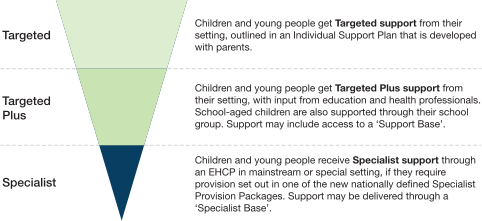
These layers will be guided by the National Inclusion Standards, which will set clear, evidence-based guidance for the Universal offer, as well as what Targeted, Targeted Plus and Specialist layers of support should look like across the 0-25 system. Updates to the SEND Code of Practice (the Code) will be essential to ensure that it reflects the wider reforms. The Code underpins the whole system and shapes how duties are understood and carried out in practice. It remains the key document outlining what settings must do to meet their legal responsibilities – and what children, young people and their families should expect from high-quality, inclusive provision. These changes will be supported by stronger accountability across all partners – local authorities, health and education settings – to ensure each layer of support is delivered effectively.
Case study 2: Inclusive secondary education
Tanfield School in County Durham prides itself on its inclusive and personalised approach to learning. They focus on strong transition support from primary to secondary school (starting as early as Year 4), particularly for children with SEND. The school SENCO offers support such as information evenings, transition days, summer school, access to an online hub and additional visits from years 4 – 6. The school works closely with primary schools to understand a child’s needs and put support in place from the start – including group interventions for literacy and numeracy.
Tanfield School also has Year Managers that offer pastoral support to make the move to secondary school as smooth as possible, like giving advice on uniform, homework or managing wellbeing. High-quality, inclusive teaching is accessible to all through adaptations made according to individual needs, such as changes to teaching strategies, curriculum adjustments, or access to group support.
Academic outcomes at Tanfield School are well above the national and local averages, with 72.2% of pupils achieving Grade 5 or above in English & maths GCSEs in Summer 2025, compared to the England average of 45.2% in the same period.
1. Targeted support
For children and young people who have ongoing and commonly occurring needs which cannot typically be met by the Universal offer, mainstream settings will provide ‘Targeted support’ in mainstream settings, in consultation with parents.
Barriers to learning will be identified and understood through evidence-based approaches, enabling professionals to determine practical and appropriate support. Settings will also benefit from new research from UK Research and Innovation (UKRI) into the identification of special educational needs, with a specific emphasis on early intervention and strengths and needs assessments, further strengthening the precision and effectiveness of Targeted support.
Targeted support may include small group interventions to develop language skills, or pre-teaching key vocabulary to help access the curriculum. Each child or young person will also have their needs and provision captured in a digital ‘Individual Support Plan’ (ISP), reviewed regularly with them and their parents or carers to ensure that Targeted support removes the specific barriers to learning that persist despite the strong Universal offer.
Q4. How can we ensure that children in the Targeted layer are best supported?
2. Targeted Plus support
This offer will be available for children and young people who need more specialist support to thrive in inclusive mainstream education. With strong partnership working at its core, the ‘Experts at Hand’ offer will be available to ensure settings can access high-quality support from education and health professionals and outreach from AP or specialist settings. Groups of schools working together will help deliver Targeted Plus support where it is hard for one school to do so alone.
Each child or young person receiving ‘Targeted Plus support’ will also have an Individual Support Plan (ISP) outlining their specific needs and expectations for ongoing support. They will have access to an ‘Inclusion Base’, where required, within their mainstream setting to provide bespoke learning environments, equipment and expertise to meet their needs. Targeted Plus support may involve time-limited support in an Alternative Provision (AP) or a specialist setting, which will allow pupils a short time placement for their needs to be assessed and addressed, before reintegrating back into a mainstream setting.
Q5. How can we ensure that children in the Targeted Plus layer are best supported?
Case study 3: Inclusive primary education
Mount Pleasant Primary School in Darlington places inclusion at the heart of its ethos to ensure every pupil is recognised, valued, and supported. Its primary resourced provision is Local Authority funded, offering 22 places and providing a safe, structured environment where learners can access education and achieve their potential. Support is carefully tailored to each pupil. All learners benefit from visual timetables, differentiated planning, and staff trained in supporting Autism, ADHD, and Speech & Language development. Pupils who need additional support access individual timetables, and bespoke social skills support.
Those with higher-level needs receive intensive, evidence-based interventions delivered collaboratively by health professionals, staff, and families, ensuring consistent progress academically, socially, and emotionally. The curriculum is adapted to developmental stages, from sensory engagement and early communication in the early years foundation stage and Key Stage 1, to semi-formal and formal subject learning in Key Stage 2. Life skills, independence, communication, and social-emotional development are embedded alongside academic subjects. As a result of Mount Pleasant’s differentiated teaching, multi‑level support and culture of empathy and collaboration, pupils are supported to build the skills, independence, and resilience needed for lifelong learning and success beyond school.
3. Specialist support
By sharing expertise and resources, mainstream and specialist settings will work in close partnership to provide ‘Specialist support’ to children and young people with the most complex needs. New nationally defined ‘Specialist Provision Packages’ designed by experts and tested with parents will outline packages of provision, based on evidence, to support children with the most complex needs. In the future, only children and young people who need the overall package of support detailed in a Specialist Provision Package will be entitled to an Education, Health and Care Plan (EHCP).
Specialist Provision Packages will support teachers, educators, SENCOs and other professionals when identifying whether they think a child or young person requires provision beyond that which the setting can provide via the Targeted support offer. As in the Targeted layer, an ISP will set out educational support needed for the child or young person, such as the requirement for weekly interventions with a speech and language therapist. Access to ‘Inclusion Bases’, in particular ‘Specialist Bases’, will be available, where required.
Q6. How can we ensure that children in the Specialist layer are best supported?
Updating the SEND Code of Practice
- The SEND Code of Practice is statutory guidance which sets out the legal framework for supporting children and young people with SEND.
- We will update the Code of Practice:
- to clarify responsibilities for education settings and local partners;
- with refreshed ‘areas of development’ replacing the current ‘areas of need’; and
- to make the guidance easier to use and navigate.
- We will undertake a separate, full public consultation on the proposed changes to the Code, which will launch after the response to this consultation.
The SEND Code of Practice (the Code) is statutory guidance introduced under the Children and Families Act 2014. It sets out the legal framework for how education, health and social care partners must identify, assess and support children and young people aged 0–25 with SEND in England. Amending and updating the Code will be essential to ensuring it reflects changes across the wider SEND system, as the Code underpins the system and shapes how duties are understood and applied in practice. It remains the central document setting out what organisations must do to meet their legal responsibilities, and what children, young people and their families should expect from high-quality, inclusive support.
Therefore, we will update the Code to reflect these reforms and respond directly to the findings of recent independent scrutiny. The National Audit Office highlighted the financial instability of the SEND system and the need for whole-system reform.[footnote 43] Similarly, the Public Accounts Committee found that the SEND system was at crisis point and recommended that government set out what support children should be able to expect in mainstream settings, alongside strengthening early identification.[footnote 44] The Education Select Committee urged government to strengthen accountability and mandate SEND training for teachers.[footnote 45] Updating the Code will ensure these recommendations are reflected in a clearer, more consistent and more accountable framework for supporting children and young people with SEND.
In this update of the Code, we will clarify the responsibilities of education settings and local partners, with a stronger emphasis on an evidence-based support-first approach as part of a whole-setting approach to inclusion. Additional professional development and guidance will be made available to educators so that they can better understand common barriers to learning and apply universal strategies to mitigate these in their practice. This will allow them to recognise and respond to a wider range of needs than under the current Code with greater agency and confidence.
We will also update the Code with refreshed areas of development. The Code currently references four broad areas of need that settings should proactively plan for when designing support for children and young people. These areas of need often face criticism for being poorly defined, with some pointing to underlying needs, while others rely on diagnosis. We have heard in our discussions with teachers and other professionals that the areas of need aren’t useful as currently framed, as they don’t easily bridge into evidence-based strategies for responding to needs in the classroom. There are also classification errors – such as framing attention deficit/hyperactivity disorder (ADHD) as primarily a social, emotional and mental health (SEMH) need, even though many of the child or young person’s needs may relate more closely to cognition and learning.
We will refresh the areas of need set out in the Code to better reflect key areas of child development – renaming them ‘areas of development’. In considering how best to do so we have worked closely with our experts. These areas must move us away from the categorisation of children and an increasing reliance on diagnosis, which may hide nuance and individual difference in barriers to learning and participation. Instead, the areas of development will support early and dynamic needs-led provision, enabling educators to recognise and respond to the educational needs that are likely to present in a classroom or setting, described in terms that they know and understand. They should provide an organising framework around which educators can structure and build their knowledge of actions that they can take in the classroom or setting to support a child to progress. Through resources provided in the National Inclusion Standards, and effective continual professional development, educators will understand more about the areas of development and will be able to use their knowledge to identify barriers to learning or participation when they notice that a child or young person is struggling to participate or make progress. The National Inclusion Standards will help them decide on high-quality strategies to support them.
We propose that the new areas of development should be: Executive Function; Motor and Physical; Sensory; Speech, Language and Communication; Social and Emotional. An initial summary definition for each area has been included in Appendix D, and we will continue to work with experts to refine the definitions of each of the areas, to be included in the updated Code of Practice and underpinning the National Inclusion Standards. In particular, we will explore and clarify how educators can support the areas of development in the classroom and setting, linking to the evidence-based approaches that will be set out in the National Inclusion Standards, and the broader measures to promote belonging and inclusion set out in the Schools White Paper.
Figure 5: Proposed areas of development
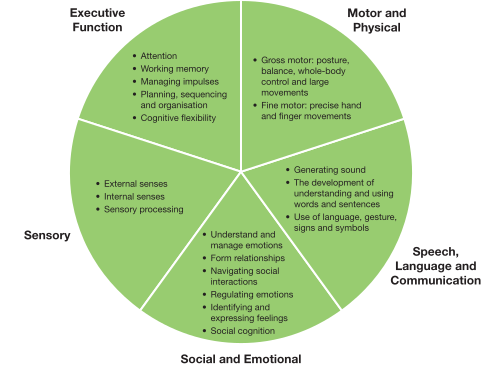
As part of this work, we will clarify what settings should do to effectively support social and emotional development and mental wellbeing. Many children in mainstream schools, at some point in their education, will need mental health support. Therefore, we think there is merit in clearly setting out what all settings should do to support a child or young person with mental health needs, whether or not they also have identified SEND. Settings will concentrate on creating calm, inclusive environments, building belonging, and making reasonable adjustments. For some children, their mental health need will be their only additional need. For others, setting-led support for their social and emotional needs may need to be delivered alongside clinical mental health interventions, which should be led by health professionals.
The proposed change to the labelling of this area will bring social, emotional and mental health in line with the other areas of development which do not lend themselves to specific clinical intervention. It will bring clarity, supporting effective collaboration and appropriate boundaries between what educators should lead and respond to, and where support should be led by health professionals with the collaboration of schools, as with other medical and clinical issues such as epilepsy or diabetes. Clinical mental health interventions, which should remain with health professionals, are likely to play a significant role in some of the Specialist Provision Packages and we expect that the independent expert panel will consider the mental health input required in each of these Packages.
We remain clear that schools and colleges continue to have an ongoing, important role to play in early support and prevention of poor mental health. Government is providing access to specialist mental health professionals in every school and college by expanding Mental Health Support Teams (MHSTs), so every child and young person has access to early support to address problems before they escalate. The Department for Education also provides a range of guidance and practical resources on promoting and supporting pupils’ mental health and wellbeing and updated the Relationships, Sex, Health and Education (RSHE) curriculum in July 2025 to include more content to support pupils to recognise and understand their emotions. Government has also committed to publish a Pupil Engagement Framework helping schools to measure indicators of pupil experience that are critical (and preventative) for children’s engagement and wellbeing, and to take appropriate action.
Alongside these changes, we will improve the structure and accessibility of the SEND Code of Practice, making it easier to navigate and use in everyday practice. Our aim is to ensure the Code is clearer, more practical, and better supports professionals in delivering inclusive, high-quality provision. The updated Code will be the main platform to communicate the duties and standards for how settings are expected to be inclusive in their approach to meeting the needs of children and young people.
To ensure the revised Code is robust and fully reflects the needs of the sector, we will undertake a separate, full public consultation on the proposed changes, which will launch after the publication of the response to this consultation. This will ensure that children and young people, parents and carers, education professionals, local authorities and health partners and representative organisations are properly consulted, and we will take time to ensure the sector is meaningfully engaged throughout the process. The updated Code will be implemented in line with the wider new system, following consultation, feedback and refinement, so that all stakeholders can prepare effectively for the changes.
Q7. How do you think early years settings, schools and colleges can best support the mental health and wellbeing of children and young people?
Q8. Do you agree that the refreshed ‘areas of development’ will support educators to understand and address barriers to learning and participation? Please explain your answer.
Data and technology
- We are building a safe, evidence-based digital and data driven approach to support SEND, which includes digital Individual Support Plans.
- We are piloting Assistive Technology lending libraries with local authorities, reaching up to 3,800 mainstream settings.
- We are also providing free national online training to help teachers and educators use this assistive technology effectively.
“Assistive technology should be standard.” – National Conversation online portal, 2025
Effective use of technology and data, including Artificial Intelligence (AI), can make a real difference in improving educational outcomes. Safety is critical – any digital tools that we use must be backed by strong evidence and work in real situations to improve the education of all children and young people. AI is moving fast, and some settings are already showing how it can help – not through crude uses that make things easier at the expense of children developing essential cognitive skills, but by using good educational understanding to improve learning for every child and young person, reduce teacher workload, and make systems run more efficiently.
In the future, we want to create a digital, data-driven system that actively supports children and young people with SEND and their families, making education more inclusive. To support this approach, we have already started carrying out user-centred research with education settings, local authorities, parents and professionals, to increase our understanding of how information on SEND is currently recorded and shared. This has highlighted particular challenges with tracking early concerns and use of disparate systems that information cannot be shared easily between, which is especially problematic at transition points. As we develop this digital approach, we will learn from settings, families and practitioners and design tools that strengthen practice where it already works well, add value where it is most needed, and avoid introducing unnecessary bureaucracy.
We will use these insights to develop digital solutions, including Individual Support Plans, that address these challenges and build on best practice. At the same time, we will also enable innovation and ensure that any technology works hand in hand with education to help every child achieve and thrive. To support this, we will invest in research and development to improve tools for early identification, ensuring they are accurate, ethical, actionable, and integrated with our wider digital offer. We are also aware of a proliferation of tools marketed to schools that claim to support the identification of needs or to ‘screen’ for certain conditions. Where teachers and educators use additional tools, these must be robustly evaluated, evidence-based and lead to proven interventions.
Evidence also suggests that assistive technology, when implemented well, can support children and young people with SEND to access learning and develop independence, particularly those with sensory and physical needs.[footnote 46] Excellent teachers and educators are already embedding these tools within their inclusive professional practice, building on what works with evidence-based strategies rather than replacing them at the first sign of additional need.[footnote 47] There is also strong evidence for the benefits of communication devices that help non-verbal children and young people express themselves.[footnote 48] However, the impact of assistive technology varies by context and type of need, and effective use depends on staff confidence and training. That is why we are investing in practical support to help settings make informed decisions and use technology effectively.
Case study 4: Effective assessment and monitoring tools
The Nuffield Early Language Intervention (NELI) is a 20-week programme that supports children’s vocabulary and listening skills through small group and individual sessions. It also helps educators spot early language difficulties.
NELI uses LanguageScreen, a digital assessment tool that helps teachers and educators choose children who would benefit the most from the programme and track their progress. In the Education Endowment Foundation (EEF) trial of NELI effectiveness, children who took part made the equivalent of four additional months’ progress in language skills on average, compared to children who did not take part.[footnote 49]
At Yewstock School a special school in rural Dorset, both NELI and LanguageScreen have shown strong positive impacts. NELI sessions are delivered outside the classroom in small groups or individually and can be run by trained teaching assistants. Yewstock has reported outstanding pupil progress, particularly in pupils’ confidence, with higher engagement in lessons and group activities. LanguageScreen has also helped the school and speech and language therapists to monitor pupils’ needs and identify where additional support is required.
We are already piloting Assistive Technology Lending Libraries with local authorities, enabling up to 3,800 mainstream settings in participating areas to borrow and trial assistive technology on a temporary basis. Backed by £1.6 million of funding this year, this pilot will allow settings to make informed decisions and identify products that could make an impact for children and young people with more specific needs.
This year, we will also make high-quality online training content available nationally to help teachers and educators use assistive technology effectively to support children and young people with SEND. These evidence-based support materials will be free to access for all educators, helping settings make the most of assistive technology. Taken together, these initiatives will build staff confidence in choosing and using technology, so children and young people with SEND can access the curriculum more fully, develop independence, and thrive in mainstream education.
Support for children and families in the earliest years of life
- Early years settings will be equipped to provide earlier, higher‑quality SEND support for children and their families.
- We are investing over £200 million over three years to deliver a dedicated SEND offer in Best Start Family Hubs, with a SEND practitioner providing direct support for parents in every Hub.
“We shouldn’t wait for a crisis to act – support should be the default, not the exception.” – National Conversation engagement event participant.
Families need access to education, health and care support that is coordinated, timely, and rooted in their local community. For far too long, the early years have been regarded as an optional add-on rather than an integral part of the education system. In the Schools White Paper and our SEND reforms, we are clear that the early years are fundamental to securing positive long-term outcomes for all children, and especially those with SEND.
There is strong evidence that early identification and support for children’s developmental needs lead to better developmental, educational and social outcomes. The earliest years of a child’s life are crucial: this is when cognitive development is at its most rapid, and when the right support can make the greatest and most lasting difference. Acting early prevents learning gaps from becoming entrenched and reduces the need for later intensive SEND provision. Evidence from the Institute for Fiscal Studies shows that children with access to Sure Start Children’s Centres were more likely to have their needs recognised at age 5 and less likely to require SEND support between ages 7 and 16.[footnote 50] Wider evidence reinforces the importance of early identification; timely recognition of needs helps ensure children receive the right interventions and can support positive outcomes.[footnote 51]
Early identification and timely intervention improve developmental and educational outcomes across a wide range of SEND. Evidence shows that early intervention is more effective than later intervention for some needs[footnote 52] – including the fastest-growing areas of need amongst reception-age children[footnote 53] – Speech, Language and Communication Needs (SLCN), Autistic Spectrum Disorder and Social, Emotional and Mental Health needs. Early intervention for SLCN capitalises on the rapid cognitive development occurring during children’s early years, and there is strong evidence that early support for emotional regulation, social communication and behaviour reduces escalation into more complex needs.[footnote 54]
To truly reform our SEND system and ensure children receive help early and effectively, support must reach families in their child’s earliest years in ways that are joined up, local and responsive. Best Start Family Hubs and early years settings sit at the heart of this approach. Best Start Family Hubs, childminders, maintained nursery schools, school-based nurseries, and private, voluntary and independent providers will all work with families, health professionals and education experts to understand and meet children’s needs from the earliest point, supporting them to thrive. Early years educators across all settings will be able to access high-quality professional development through the national training programme, building the skills and confidence to support children effectively. All early years settings and Best Start Family Hubs will have access to evidence-based identification and intervention tools through the National Inclusion Standards. This builds on the commitment we made in our Giving Every Child the Best Start in Life strategy to double the number of Early Years Stronger Practice Hubs from 18 to 36, enabling more early years settings to access free, evidence-based resources and training. Furthermore, all settings will be able to draw on education and health professionals through the new Experts at Hand offer, addressing the inconsistent and limited access many settings experience today. We will work with the sector to determine how the offer should operate, including exploring the role of Best Start Family Hubs.
We are making it easier and more affordable for families to access high-quality early education sooner. In 2025, we expanded the 30 funded hours per week childcare entitlements, raised the Early Years Pupil Premium to its highest level ever, and, in our Giving Every Child the Best Start in Life strategy, committed to investing close to £1.5 billion over the next three years to raise quality, close gaps, and break down barriers to opportunity for every child. In the 2026 to 2027 financial year, we expect to provide over £9.5 billion for the early years entitlements – more than doubling annual public investment in the early years sector compared to 2023 to 2024. Early years children can also benefit from our £3.7 billion high needs capital investment between 2025 and 2030. We are investing over £400 million over the next four years to expand our School-Based Nurseries programme across England, including nurseries on a school site and maintained nursery schools, which tend to have a greater proportion of children with SEND.[footnote 55]
Early years providers will receive the new Inclusive Early Years Fund from the 2026 to 2027 financial year and we will go further by consulting later this year on improving how funding flows through the early years system, ensuring support reaches the children who benefit most. We will work with local authorities to strengthen their sufficiency planning for children with SEND, including reviewing whether statutory requirements are clear enough and exploring how to improve data on the availability of suitable places, including for those needing specialist support. This will help strengthen local accountability and give parents greater confidence that their children can access the early education and childcare to which they are entitled.
We are strengthening support for children and families as they start school. We are funding new partnerships to strengthen transitions between early years settings and schools, and sharing best practice from schools that effectively manage children’s transition into reception. We are also improving the quality of teaching in the reception year, including through the new RISE Reception Networks, new training for reception classroom teachers, and continued funding for the Nuffield Early Language Intervention (NELI) programme.
Best Start Family Hubs will act as a single front door for families, making it easier to access the right help at the right time. We recognise the pressure on parents, the strain of having to navigate multiple services and the impact on their wellbeing when they encounter barriers to getting support for their children with SEND. Best Start Family Hubs will offer advice, practical help and evidence-based interventions for children and parents and carers at the earliest stage, before school entry and ahead of any formal diagnosis or escalation of need. This direct support will help families build confidence and capacity, and ensure access to integrated services tailored to their needs. Best Start Family Hubs will also support early years settings and strengthen connections between childminders, nurseries, schools, and health, SEND and family support services, helping to build a system that supports children and families earlier and more consistently.
We are investing over £200 million over three years to ensure every Best Start Family Hub has a dedicated offer for children with additional needs and their families, and a SEND practitioner to offer direct support to children and families. This is on top of the over £700 million already committed to Best Start Family Hubs and the Healthy Babies programme in Giving Every Child the Best Start in Life, in partnership with the Department for Health and Social Care.
The national rollout of Best Start Family Hubs also gives us a real opportunity to make developmental checks – the early years foundation stage (EYFS) two-year old progress check and the Healthy Child Programme development review – more effective points for early identification and intervention. By bringing health and education professionals together, Best Start Family Hubs will support better information sharing and a more coordinated offer for families. We heard through our engagement that the effectiveness of developmental checks depends on whether they are consistently happening, the quality of the checks, and how well information is shared between health and education professionals. Integrated reviews, which combine these developmental checks, are widely recognised as best practice, with strong delivery already evident in a number of local areas. Where the two checks are not integrated, clear and consistent arrangements for sharing information between health and early years services remain essential to minimise gaps, reduce duplication, and ensure concerns are identified at the earliest opportunity. For children under 5 who have been identified as having complex needs, we will work with the Department of Health and Social Care and NHS England to introduce a fast track for a Specialist Provision Package and EHCP.
By embedding inclusion in all settings from the start, enabling early support for families through Best Start Family Hubs, and improving partnerships between LAs, health professionals, early years settings, schools, Best Start Family Hubs and Stronger Practice Hubs, we will create a system where every child – whatever their needs – can thrive with timely, coordinated help.
Q9. What arrangements would best support effective joint working between early years providers, Best Start Family Hubs, health and local authorities and parents for children with SEND in the early years?
Q10. How can the early years foundation stage (EYFS) two-year old progress check and the Healthy Child Programme development review be improved so that children’s needs are identified and supported more quickly? Please share examples.
Case study 5: Driving Early Years Inclusion and outreach
Dingley’s Promise, a leading SEND charity, transforms early years inclusion by combining specialist provision with nationwide outreach and training for mainstream settings.
It runs specialist centres for children under 5 with SEND, though its impact extends far beyond these centres. Through its Early Years Inclusion Programme, the charity partners with local authorities to upskill practitioners through ten flexible courses, which provide practical strategies and information to support an inclusive approach. These courses cover topics such as inclusive practice, transitions, communication strategies, and behaviour support, to equip early years professionals with the skills to meet diverse needs in mainstream settings.
The charity also runs the Early Years Inclusion Project, a 5-year initiative supported by Comic Relief. This is focused on increasing the skills and confidence in the early years workforce, increasing the number of young children with SEND accessing early years places, and promoting partnership working between LAs, providers, and families.
National Inclusion Standards
- We will support settings to deliver high-quality teaching and support through building the evidence base for National Inclusion Standards by 2028.
- UK Research and Innovation (UKRI) is leading a £4 million project to improve identification of special educational needs.
For too long, we have had a postcode lottery of provision across mainstream settings, with poor identification tools that are not supported by strong evidence and do not remove barriers to learning. In our current SEND system, children and young people often go through clinical diagnostic processes in order to have their needs recognised and met. Whilst we recognise the value of diagnosis, educational support should not be dependent on it – and this was never the intent of the 2014 Children and Families Act. Without clarity on what good inclusive practice looks like for children with additional needs, support is inconsistent across settings and regions. To change this, we must empower education professionals with clear, evidence-based guidance and practical tools, so that they can adopt inclusive whole-setting approaches and strategies and recognise and respond to barriers to learning and participation early.
By 2028, we will have invested up to £15 million to build the evidence base for, and then provide, National Inclusion Standards. These will include a digital library of high-quality identification tools and provision across the 0-25 system covering all layers of support and making clear what good ordinarily provision should be in every setting. It will be the go-to place for educators to understand the latest evidence-based approaches to universal, whole-setting strategies, Targeted interventions, and identifying and responding to barriers to learning.
We will ensure the National Inclusion Standards are informed by evidence, with close multi-agency work with experts, as well as children, young people and their families. The government is funding new research, led by UK Research and Innovation (UKRI) in partnership with the DfE, to improve identification of SEND. Backed by £4 million, this project will develop and roll out approaches for early identification, strengths and needs assessment, and support that can be used in education settings by 2028. We will also engage with children and young people and their families to ensure the Standards reflect how they experience the learning environment. The National Inclusion Standards will provide a shared, nationally consistent understanding of the best evidence to support children and young people with SEND, equipping early years settings, schools and colleges to intervene early and effectively.
The refreshed areas of development will provide an organising principle for structuring the evidence within the National Inclusion Standards.
Q11. What should the top three priority areas be for building and sharing evidence within the National Inclusion Standards?
Reasonable adjustments
- Under the Equality Act 2010, settings have a duty to make reasonable adjustments for disabled children and young people.
- We will support inclusion in mainstream settings by strengthening the use of the available guidance on reasonable adjustments.
- We will ask the Equality and Human Rights Commission (EHRC) to ensure the important role of reasonable adjustments is reflected in their Technical Guidance for Schools.
Our approach to inclusion is guided by the definition set out by the UN Convention on the Rights of Persons with Disabilities, focussed on breaking down barriers. Children’s needs are not fixed. They may change over time, and many will face barriers to learning at different stages of their lives – whether due to poverty, bereavement, caring responsibility or other life circumstances. Truly inclusive settings are able to recognise and respond to a wide range of additional needs, not as a response to specific diagnoses, but as a proactive approach towards creating environments where all children can access learning, feel valued and safe, build capability and independence, and succeed.
Many children and young people with SEND will have a disability under the definition set out in the Equality Act 2010.[footnote 56] This definition does not require a formal diagnosis, only that “a physical or mental impairment has a ‘substantial’ and ‘long-term’ negative effect” on the ability to do normal daily activities. This offers statutory protection, requiring settings to make reasonable adjustments so that disabled children and young people do not face substantial disadvantage. Settings should therefore consider reasonable adjustments based on any needs a child or person may have that meet this definition of disability.
What are reasonable adjustments:
Under the Equality Act 2010, settings have a legal duty to make reasonable adjustments for disabled children and young people, so that they are not placed at a substantial disadvantage compared to their peers. This duty is anticipatory, and settings must plan ahead for the needs of disabled children and young people generally, as well as respond to individual circumstances.
There is no definitive or statutory list of reasonable adjustments because needs vary widely. What is considered ‘reasonable’ depends on the circumstances and is assessed case by case, considering factors such as cost, practicability and the impact on the child or young person.
Reasonable adjustments are vital in education because they ensure disabled children and young people can access education equally. Without these, barriers can limit their participation, achievement and wellbeing, leading to inequality and discrimination. By planning ahead and responding to individual needs, settings create inclusive environments that support academic and social success, fulfilling legal duties and promoting fairness and positive outcomes for all.
We will produce practical guidance on reasonable adjustments, which will contain real examples and simple, actionable tools to embed inclusive practice confidently and consistently. There is already a range of guidance for settings to help them think in advance about what adjustments might need to be made for disabled children and young people, and how to make adjustments in individual circumstances. Our new guidance will make clear that children do not need a diagnosis to receive reasonable adjustments, and help settings consider how some disabilities can be addressed at a universal level – both through high-quality teaching, and through wider aspects of school or setting policy such as uniform, behaviour and classroom management. We will also consult the Equality and Human Rights Commission (EHRC) and education partners in producing this guidance, and ask the EHRC to ensure the important role of reasonable adjustments for children with disabilities in schools and other educational settings is reflected in their Technical Guidance for Schools. Together, this will help strengthen practice on the ground, provide reassurance to parents, and support clarity about what we expect settings to be able to deliver under our reformed system.
Examples of reasonable adjustments
- Early Access to the Dinner Hall – Allowing a child or young person to enter the dinner hall before others to reduce sensory overload. This helps children and young people with sensory processing difficulties manage noise and crowds, enabling them to eat comfortably and safely.
- Adaptive Learning Materials – A child or young person with a visual impairment cannot read standard-sized handouts. It would be reasonable for the setting to provide text in a larger font.
- Uniform-related – A child or young person with eczema or sensory processing difficulties may find standard polyester blazers or shirts uncomfortable or painful. It would be reasonable to allow cotton alternatives or softer fabrics.
National training
- From September 2026, a new training package of over £200 million over three years will be available to all staff working across early years, schools and Post‑16 settings to support staff to build inclusive learning environments.
- We will also review the role of the school Special Educational Needs Coordinator (SENCO) to ensure they can use their expertise more strategically.
“Training should be practical, not just theory – we need strategies we can use tomorrow.” – National Conversation engagement event participant.
High-quality teaching is the biggest factor in helping every child achieve and thrive.[footnote 57] We know that strong teaching from the start of children’s education can boost their learning, social skills and future opportunities.[footnote 58] We want all children and young people to access a high-quality curriculum and be well taught by their teachers. However, too many teachers and educators say they do not feel confident teaching children with SEND, or that they do not have the right knowledge and skills[footnote 59] or expertise.[footnote 60] This can make it challenging for families to find early years places for children with SEND, and for children to get the support that they deserve. As is made clear by the Institute of Fiscal Studies[footnote 61] and others, to build an inclusive system, we need to equip teachers and educators from early years through to post-16 with the right tools and training to meet a broad range of needs in the classroom.
To address this, we are launching a new landmark training package on inclusion, with an investment of over £200 million over three years. This means that from September 2026, all staff nationwide will benefit from new training across early years, schools, and colleges, supported by government backed training materials developed with experts. At every phase, staff will be supported to engage with parents and develop skills in building inclusive learning environments and spotting needs early so that children receive timely support. For early years educators, training will also focus on inclusive pedagogy, child development, and practical strategies for supporting all children, building on the commitments made in the Giving Every Child the Best Start in Life strategy and ensuring every setting feels confident in welcoming children with SEND. For staff in schools, training will focus on adaptive teaching and creating calm classrooms to provide the best support for their pupils. Specific training for teaching assistants will also help support inclusive practice. In Further Education, teachers will build on best practice to ensure learning is accessible for all, supporting our wider ambitions to establish a coherent, career-long professional development package, as set out in the Post-16 Education and Skills White Paper.
This new inclusion training offer builds on improvements to existing programmes, such as the new Initial Teacher Training and Early Career Framework, which contains significantly more content on adaptive teaching and supporting children and young people with SEND. We have also strengthened requirements on providers to ensure materials for early career teachers contain clear guidance on SEND and will review this again in 2027 to ensure they continue to reflect the latest evidence. Alongside this, a review of our National Professional Qualifications is underway to consider how we can further improve leadership of SEND and inclusion across the frameworks. We have also committed to review the Early Career Teacher Entitlement in 2027, with a focus on teaching children and young people with SEND, building on the improved offer that began in September 2025. We will consult with the early years sector on teacher training routes and course content; this will inform training in inclusive practice for early years teachers. We plan to expand access to this training route, more than doubling the number of early years initial teacher training places by 2028. Together, these measures will ensure all new teachers and future leaders have access to high-quality development opportunities with a strong focus on inclusive education.
In the meantime, we are extending the Universal SEND Services training programme in schools and post-16 for a further year, which provides free training and resources to help strengthen inclusive practice. This will ensure that settings can continue to upskill and transition towards greater inclusion, in advance of the new training becoming available. Specific material from this programme will then be available to access alongside further best practice and evidence.
There will be a new requirement set out in the SEND Code of Practice for all settings to ensure that staff receive training on SEND and inclusion, and to clearly signpost government funded training. By embedding this expectation across early years, schools and colleges, we will upskill staff and promote inclusive practice. Leaders will retain flexibility to select training that fits their context, while guidance and signposting will support quality and consistency.
Finally, we will help settings create inclusive workforce models that use SENCO expertise effectively and build a culture where every child can achieve and thrive. We recognise the challenges that the SENCO role currently involves, including excessive bureaucracy and administrative burdens.[footnote 62] Responsibility for inclusive practice and understanding how to support children with SEND should not be the responsibility of just one person – it should be the responsibility of all staff. We will build on the work of the Improving Education Together Group, in collaboration with the sector and school leaders, to redefine roles and responsibilities across the system to drive inclusive practice. For school SENCOs, we anticipate the role becoming more strategic and less administrative. Digital processes, clearer expectations for all and improved access to specialist support will reduce routine administration, enabling the SENCO to focus on strategic leadership and supporting the development of high-quality practice. Where necessary, we will revise legislation and consider the experience and training needed to ensure that SENCOs and other professionals are equipped for their evolving roles. Any changes to the school SENCO role will also apply to maintained nursery schools, school-based nurseries and school sixth forms. We will work with the wider early years and post-16 sectors to understand the implications for these settings.
Q12. What are the most important issues for national training to cover, to help support children and young people with SEND?
Q13. What practical actions can help teachers, educators and leaders manage workload whilst implementing these changes?
Q14. How should the Special Educational Needs Coordinator (SENCO) role evolve to better meet the needs of children and young people with SEND?
Part two: new Targeted and Targeted Plus support that is written into law
As outlined in Part One, we expect that the majority of children and young people will have their needs met by a strong Universal offer. However, children with SEND may at times require additional support, on top of the Universal offer. Children and young people will be able to access this support from day one and will have the flexibility to move between the Universal offer and layers of support as their needs change over time.
This chapter is split into Targeted support (set out below) and Targeted Plus support. The key difference is that Targeted support covers commonly occurring needs that every mainstream setting should be familiar with and able to reasonably respond to; Targeted Plus support covers less commonly occurring needs, that require mainstream settings to work together with local government and health partners to draw on the expertise of education and health professionals.
Targeted support
Targeted support provides structured interventions within mainstream settings. This is predominantly in the classroom but where appropriate in the school’s Support Base. It could include small-group work or personalised materials. This support will be recorded in an Individual Support Plan (ISP) that develops with the child or young person.
Individual Support Plans (ISPs)
- Settings will have a statutory duty to record and monitor special educational needs and provision in an Individual Support Plan (ISP) for children and young people with SEND.
- ISPs will be digital documents that evolve as a child’s needs change.
- ISPs will be tailored in line with the layers of support, with guidance provided to help settings ensure they are high-quality.
“There should be a national format for recording needs and support, so children are not treated differently depending on their postcode.” – Parent, National Conversation online portal, 2025.
Good communication is a vital part of reforming the SEND system. Families, settings, and professionals need to share a clear understanding of what high-quality evidence-based support for different needs looks like, and when and how it will be delivered, across each phase of education. Many settings already keep records of the needs and provision required by their children or young people with SEND. However, often these records are spread across different places or repeated in several systems, which makes it harder to keep everything accurate and current, and sometimes means more time is spent managing paperwork than focusing on children’s needs. It also prevents effective sharing of information at key transition points – such as when children move from an early years setting to a school, or from a school to a college – which can lead to a gap in support. A consistent, responsive, and digital way of recording special educational needs and provision will make sure help is provided quickly and effectively and is able to keep up with a child or young person’s development, preventing challenges from escalating and reducing the risk of disengaging from learning.
We will place a duty on schools (including maintained nursery schools and school-based nurseries) and colleges to produce an ISP for any child or young person with SEND. We will work with private, voluntary and independent early years providers to understand how ISPs could work in their settings. The ISP will be tailored in line with the layers of support, with guidance to support settings in creating high-quality plans. We will set out the information that the ISP must include, such as the child or young person’s identified barriers to learning, their provision, any reasonable adjustments, and intended outcomes, and clarify that this should be developed with parents. ISPs will be standardised across settings to facilitate transitions. For children receiving Targeted support, ISPs should include evidence-based interventions from the National Inclusion Standards. They will then be used to communicate provision to parents and to document actions taken between parents and educators, supporting the relationship between home and the setting. This will help parents to work collaboratively with settings and enable them to take an active role in supporting their child’s educational progress.
ISPs will be interactive, accessible, and available in a digital format, supporting consistency across the system. This work sits alongside the approach outlined in the ‘Data and Technology’ section, bringing together a digital system which is both data driven, and actively supports children and young people with SEND and their families. We recognise that any digital approach must integrate with wider services. A child or young person’s ISP will therefore be a living product, updated to reflect changes in a child or young person’s barriers to learning or the provision put in place for them. This approach will help provision to remain responsive and effective throughout a child’s education, as well as facilitating transitions between early years, schools and post-16 providers, and reassuring parents that their child’s needs will be recognised, recorded and supported. This digital approach will be primarily designed for children and young people with SEND, though its use and functionality could be expanded in future.
The duty to produce an ISP will come into effect following changes to legislation. We will set a requirement for ISPs to be reviewed annually at a minimum, and settings will work with parents and young people to develop their ISP from the start. The use and quality of ISPs will be assessed through Ofsted’s inspections and assessment of SEND provision at a setting level. Where there are concerns about provision, parents and young people will be able to resolve this directly with the setting, including making use of the improved schools complaints process. We recognise that SEN support has not always worked well for children and young people, and parents feel their knowledge or concerns about their children have not been listened to. We will work with parent groups, sector experts and the workforce to explore how experts within the system can provide assurance around the creation and delivery of ISPs. We will ensure ISPs are high-quality and that support is effectively delivered, especially during the transition period. This could include options for peer review of ISPs at group level, expert recommendations for appropriate content from the National Inclusion Standards at Targeted Plus, or a role for sector delivery experts to audit and assure the delivery of Targeted support in mainstream settings.
Q15. What would provide assurance for families that an Individual Support Plan will be high-quality and contain the essential information?
Q16: How can we ensure Individual Support Plans are clear, concise and practical for professionals to use?
Effective curriculum delivery and adaptations
- We are creating a new, world-leading school curriculum that raises standards and supports aspirations for all children.
- We will develop new evidence based teaching resources to support effective curriculum adaptation for children and young people.
- We will work with experts to look at the curriculum in special schools, and further adaptions and flexibility for the mainstream curriculum.
“Schools need flexibility and incentives to adapt environments, curricula, and assessment processes so that inclusion is embedded by design.” – DfE’s Independent Neurodivergence Task and Finish Group report, February 2026.
As set out in the Schools White Paper (see chapter 2: “Narrow to Broad”), we are creating a new, world-leading school curriculum that raises standards and supports aspirations for all children – whether they are from socioeconomically disadvantaged backgrounds, have SEND, or require additional challenge. This follows recommendations for reform set out in the Curriculum and Assessment Review. The Post-16 Education and Skills White Paper also sets out our commitment to ensure that every learner has access to high-quality pathways to employment or further study. This will include new pathways at level 2, new English and maths stepping-stone qualifications at level 1 to provide a gradual route for learners with low prior attainment before resitting GCSEs where appropriate, and reformed vocational qualifications at level 3 (V levels). We will also ensure disability is taught in the curriculum, so that all children and young people have a positive and informed understanding of disability.
We also support the recommendation in the Curriculum and Assessment Review[footnote 63] to develop evidence-led resources to support curriculum adaptation for all children and young people, including those with SEND. We will work in collaboration with experts and school leaders to create new Curriculum in Practice resources: a flexible suite of adaptive teaching strategies, case studies, and real-world examples tailored to different phases of education. In addition, Oak National Academy will continue to design digital resources that are easily adaptable by teachers to meet the specific needs of their pupils, including those with SEND. For special schools and Alternative Provision, we recognise that there is an important role for these schools in providing an appropriate curriculum for their children, and we will continue to explore this with them.
We will work with experts to look at the curriculum in special schools, and further adaptions and flexibility for the mainstream curriculum. Throughout the National Conversation, school leaders made clear that they wanted more support and to learn from best practice at special schools. Special schools also said they would welcome national best practice and guidelines, where they are currently developing their own curriculum. This approach will ensure that children are taught a high-quality curriculum offer, whichever setting they attend. We will set out how pupils with an Individual Support Plan receiving Targeted Plus support or in the Specialist layer of support with an Education, Health and Care Plan can benefit from more flexibility and adaptations in the teaching of the national curriculum.
Transitions between early years, schools and colleges
- Individual Support Plans will help ensure key information transfers smoothly to a child or young person’s next setting.
- Partnerships between early years and primary schools will help strengthen transitions, supported by the National Inclusion Standards.
- Schools, colleges and local authorities will co‑design tailored transition packages for students with SEND.
- Additional pathways including Supported Internships, apprenticeships and improved links to Higher Education will help young people with SEND move into employment, independent living and adult life.
“Shared documentation would also support smoother transitions between early years, school and college.” – Parent, National Conversation online portal, 2026.
Transitions between stages of education can be challenging for all children and young people, but especially for those with SEND and their families. These moments of change often bring uncertainty, and without the right support, they can affect progress and confidence. We are committed to making these transitions smoother and more supportive, so every child and young person, whatever support they require, feels prepared and able to thrive as they move into the next phase of learning or into employment.
An Individual Support Plan will help ensure that key information about a child or young person’s needs is available for their next setting. This will enable staff to put timely, appropriate support in place from the beginning, therefore minimising the risk of known challenges resurfacing as the child or young person progresses.
From Early Years to School
In Giving Every Child the Best Start in Life, we committed to funding new partnerships to strengthen transitions between early years settings and schools, with a particular focus on children with SEND and additional needs. These partnerships will allow staff to learn from one another and share effective practice, supported by the National Inclusion Standards, which will provide consistent, evidence-based guidance on what works. They will also help parents and children build relationships with schools and help teachers prepare to meet individual needs so that children feel settled and confident when they start school. We will publish and share best practice from schools that effectively support children’s transition into reception. This will complement wider initiatives to boost quality in the reception year, including new Reception Networks, new training for reception classroom teachers, and continued funding for Targeted programmes, such as the Nuffield Early Language Intervention programme.
From School to College
We will work with schools, colleges and local authorities to design and implement a clear approach to support transition from school to college. In terms of post-16 destinations, the gap between those with SEN compared to those without has risen over the past 4 years, to 8.1 percentage points (84.4% vs 92.5%)[footnote 64] but we also know that young people with SEND are 80% more likely to be not in education, employment or training (NEET) than their peers’ average.[footnote 65] To reduce the risk of young people with SEND becoming NEET, planning for transition needs to begin at least 12 months in advance. This will allow post-16 providers, in partnership with schools and local authorities, to create bespoke or cohort-based transition packages for students with SEND. In doing so, they will ensure young people can choose a suitable study programme and are supported from day one through to further education.
Case study 6: Successful transitions from school to college
Derby College in Derbyshire designed an 8-step package that supports students moving between school and post-16 education, from an initial assessment to enrolment. This forms part of their standard admissions process.
In one example, a student applied to Derby College and the SEND and learning support team invited the student for an initial assessment to develop a personalised 10-month transition package. This was designed to facilitate regular communication with the student and offer an insight into college life. The student attended site tours and met with student support services before developing a support plan with the learning support team and attending two curriculum taster days. The student successfully enrolled and progressed from a level 2 to a level 3 course in the following academic year.
Feedback from the student was positive, noting:
“The college transition days were very helpful, as they helped me to feel at ease at the college before I started.’
“My weekly 1:1 out of class sessions with the learning support trainer are a great help. If I have any issues, we are able to sort them out”.
Transitions into post-16 education
We will work to embed best practice on transition planning across all schools and colleges and hold them to account for this. Our commitment in the Post-16 Education and Skills White Paper to improve careers guidance and deliver 2 weeks’ worth of work experience for all young people during their secondary schooling will help ensure that young people with SEND receive the support they need to navigate their options and progress into further education and/or employment. This builds on commitments in the Post-16 Education and Skills White Paper to reduce the number of young people becoming NEET, through better identification of risk, improved data sharing, and ensuring each young person has a planned destination before they leave school. We will strengthen the focus on supporting children and young people with SEND to prepare for adult life, and help them to go on to achieve the best outcomes in employment, independent living, health and play an active and meaningful role in community life.
Transitions into adulthood
We are working across government to ensure that transition to higher education (HE), training or employment is as smooth as possible for young people with SEND. For example, a Test, Learn and Grow programme will focus on transitions into adulthood for young people with SEND in Sandwell and Nottingham (and their combined authorities), and the Youth Guarantee Trailblazers are trialling interventions to strengthen transitions for young people at risk of becoming NEET. We recognise that some young people, including those without EHCPs, need more time to complete their studies. The 16–19 funding system already enables all students who need to continue studying at age 18 to do so, including those starting 2year courses, and those with EHCPs will continue to be supported where needed up to the age of 25. We will also consider whether further support is needed for young people with SEND who do not have an EHCP under the new system after the age of 18. We also welcome the work being done by The Rt Hon Alan Milburn into Young People and Work, which will make recommendations aimed at increasing opportunities for young people who are NEET.
Apprenticeships will continue to offer a valuable route into employment, with additional support available to help employers take on young people with SEND, alongside new opportunities through Foundation Apprenticeships. Supported Internships will remain a proven pathway to employment for young people furthest from the labour market, with thousands of high-quality opportunities now available across the country with a range of employers, following significant investment. We have also seen positive outcomes from our pilot extending Supported Internships to young people without EHCPs, and we intend to continue this pilot for at least a further year. Young people can also benefit from wider Department for Work and Pensions support, including programmes such as Connect to Work, which provides specialist job support. We will continue to consider how schools and colleges can best share information with future destinations so that support is not lost as a young person becomes an adult – building on tools like the Adjustments Planner, which helps students identify and plan the adjustments they may need when studying or moving into employment.[footnote 66]
Supporting young people with SEND as they move into Higher Education (HE) is essential to ensuring they can settle well and thrive at university or in other HE settings. Although the 0–25 SEND system does not formally extend into HE, providers have clear duties under the Equality Act 2010 to eliminate discrimination, advance equality of opportunity, and support disabled students effectively. The Disabled Students’ Commission, established and funded by the Office for Students, offers important guidance and insights to help HE providers understand their responsibilities, share best practice, and put in place strong, inclusive support. In addition, the Disabled Students Allowance provides funding for reasonable adjustments, ensuring students can access the support they need to succeed. We will continue to explore ways to improve how information about a young person’s journey and the support they have received is shared with HE providers, helping to make the transition as seamless and supportive as possible.
Colleges and Special Post-16 Institutions offer courses and support which nurture independence and life skills, making the transition from children’s social care to adult services easier. We will explore how post-16 settings can further support this crucial step in a young person’s journey to greater independence in adulthood. We will work with local authorities to support the successful planning of transitions from children’s to adult services so that all young people are able to play an active and meaningful role in community life into adulthood.
Q17: How can we best support transition for young people with SEND, so that they are well supported into post-16 provision, including further education, higher education, training or employment?
Targeted Plus Support
Targeted plus support provides help through the offer of support from Experts at Hand, improving access to professionals like speech and language therapists. It may also include accessing Inclusion Bases within mainstream settings.
Inclusion Bases
- Tens of thousands of high-quality places will be created in bases within mainstream settings for children who need specialist support.
- ‘Inclusion Bases’ will replace the current terms SEN unit, resourced provision and pupil support unit, and instead comprise of:
- Support Bases (setting/MAT funded, providing Targeted Support)
- Specialist Bases (LA funded, providing specialist support)
- Inclusion Bases will therefore combine access to the mainstream curriculum and activities – adapted where required – alongside bespoke specialist teaching and support.
“Local should mean local – not 2 hours on a bus.” – National Conversation engagement event participant.
Our £3.7 billion high needs capital investment between 2025 and 2030, aims to improve the accessibility of buildings, create new special school places, and create tens of thousands of new places in Inclusion Bases in mainstream settings. We want early years settings, schools and colleges to be able to develop strong specialist support, expanding on good practice in SEN units, resourced provision, and pupil support units. This means we will create tens of thousands of places in mainstream settings, delivering the right support for children and young people that need it. This expansion is reflected in the Education Estates Strategy, supporting an estate that is suitable to meet the needs of children and young people with SEND, increase local capacity, and allow significantly more children to benefit from this provision. Many settings will already have a space where they deliver additional support, catch-up interventions, and small group work. These spaces will still exist and are an essential part of a setting’s day-to-day approach to flexibly supporting children with additional needs.
We will replace the current terms SEN unit, resourced provision, and pupil support unit (sometimes referred to by settings as ‘internal Alternative Provision’) to make it easier for parents to understand the support available for their child. Instead, we will collectively describe this provision as ‘Inclusion Bases’ (as these will sit in mainstream settings) – underpinned by two models:
- ‘Support Bases’ – commissioned and funded by individual settings, SEND schools and multi-academy trusts to deliver Targeted support; and
- ‘Specialist Bases’ – commissioned and funded by the local authority to deliver specialist support (see Part 4)
Inclusion Bases offering greater levels of specialist expertise will become a core part of the local education offer, delivering high-quality teaching and support to children with more complex needs who would benefit from provision that bridges the current gap between mainstream and specialist.
In time, we expect every secondary school will have an Inclusion Base, with an equivalent number of places in local primary schools. For many settings, where high-quality support is already being provided, it will be a continuation of best practice we see across the country. For some, this will be using the provision they have in a different way; and where there is a need to create new places, including by repurposing and improving existing space, this can be supported by our capital investment. This will allow children to continue to access the provision that’s right for them as they transition. Embedded within mainstream settings, bases will offer bespoke learning environments and flexible access to specialist education or health support where needed, helping children thrive academically, socially, and emotionally. This will allow children with more complex needs to receive the specialist support they need whilst remaining in their local communities, close to their families and friends and reducing often lengthy and expensive travel journeys to get their educational needs met.[footnote 67] These bases will have specialisms, providing tailored and expert teaching and support for specific groups of children and young people – such as those with complex SEND or those at high risk of exclusion or low attendance – as well as cascading their specialist expertise more widely.
These bases will strengthen high-quality inclusive practice and enable children who need additional help to access mainstream education. Support bases will ensure that children who require more structured or specialist-informed support remain connected to the Universal offer and gain the benefits of accessing a local mainstream school, for example attending the same school as their siblings, going on school trips, or playing with their friends at break time. Specialist knowledge flows outwards from these bases into all classrooms. They will be a source of expertise for teachers, educators and leaders – a place informed by specialist insight and where practice is strengthened. For some children, this support will enable them to gradually transition to full participation in mainstream classes. For others, ongoing support from the base will help them access mainstream learning, education and their wider community in a way that works for them.
We will ensure that all bases are underpinned by evidence-based inclusive practices and deliver consistently high-quality provision. Informed by co-creation with stakeholders, for the first time we will publish national guidance, setting out the principles and standards of high-quality practice. This guidance will apply to the full range of provision including SEN units, resourced provision, and pupil support units. This will form a benchmark when Ofsted inspect settings. New data collection measures will record which settings are operating a base and the children and young people accessing it, to provide additional oversight. We will continue to roll out peer networks of best practice which schools will be able to access as part of the universal Regional Improvement for Standards and Excellence (RISE) Inclusive Mainstream programme, and expanding the evidence base so that settings know what works.
Q18. How can we make sure that every area can meet the full range of the needs of children and young people through Inclusion Bases?
Q19. How can we make sure that Inclusion Bases help children and young people succeed in mainstream settings?
Case study 7: Andrea’s* experience of a Support Base – an example day in the life
Andrea enjoys school but can struggle with social interactions, busy environments, and managing her time. The transition to a secondary school was challenging for Andrea, which led to a period of high anxiety and low attendance.
Andrea’s mainstream school opened a Support Base when she was in year 8, this is an in-school offer for 12 pupils who need support with communication and interaction that combines mainstream classes with additional support and facilities. Andrea is now in year 10 and has an Individual Support Plan which outlines her needs as part of the Targeted support layer.
Below is an example of what a Tuesday at school would look like for Andrea:
- Registration: Andrea goes to her mainstream form.
- Period 1 – Maths: Andrea loves maths and is a talented mathematician. She always attends her mainstream lesson and has a target GCSE grade of 9. She also takes part in a Maths group for pupil premium pupils on Thursday mornings before school.
- Period 2 – English: Andrea attends her mainstream English lesson with her peers. Her teacher has used adaptive teaching strategies – such as visual supports – that have helped her make good progress. Sometimes a member of the Support Base team will support the class teacher and check in on her progress
- Break: Andrea goes to the Support Base to benefit from the calm environment and catch up with friends.
- Period 3 – Intervention: Andrea has one fewer GCSE subject on her timetable and has a small group or individual session on a Tuesday during period 3. This approach has the full support of Andrea’s parents. Today, Andrea has a small group session on social interaction, delivered by the Support Base team who were trained by the visiting Occupational Therapist.
- Period 4 – Music: Andrea joins her mainstream lesson.
- Lunch – Andrea often has lunch with her friends in the area outside the Support Base – which other pupils across the school who want a quiet safe space can also use. Today, she goes to board game club.
- Period 5 – Physics: Andrea now always goes to her mainstream lesson after lunch. She has successfully worked up to this with the help of the base over the last 2 years.
- After school: Andrea goes to the Support Base to avoid the busiest part of the day as the other pupils leave. She likes to go through her timetable for the next day with a member of the Support Base team, with whom she has a strong relationship. Andrea’s mum picks her up at 3.40.
*This is an illustrative example
Experts at Hand
- We will bring more expert advice and services from education and health professionals (such as education psychologists or speech and language therapists) into mainstream education settings.
- This year, we will provide delivery guidance and examples of good practice to support this offer.
“Schools should have on-site access to specialist professionals, such as Speech and Language Therapists, Occupational Therapists, and Educational Psychologists, who can provide expert advice and collaborate with staff to design and implement strategies.” – SEND practitioner, National Conversation online portal, 2025.
Teachers, educators and leaders consistently tell us that better access to advice and support from experts including health professionals – such as speech and language therapists – is one of the most effective ways to help them meet the needs of children and young people.[footnote 68] This should be a process collaboratively involving parents in the decision making. We want more opportunities for education and health professionals to work with teachers, educators, children and young people, and parents rather than undertaking statutory individualised assessments.[footnote 69] This includes ensuring appropriate intervention and resources to remove barriers to learning, such as support from a Qualified Teacher of the Deaf or Teacher of the Visually Impaired, or other habilitation support where relevant. We also want to ensure they can work directly with education staff and children, upskilling the mainstream workforce to support children and young people with commonly occurring needs. Ultimately, we want settings to have a readily available source of expert advice and support – which can be accessed quickly and flexibly.
To achieve this, we will make a landmark £1.8 billion investment over the next three years in access to professionals for early years settings, mainstream schools and colleges and will ensure local authorities spend this money on this purpose. It will, of course, take time to reorientate the system, but we anticipate that by the end of the 2028 to 2029 financial year, this funding would mean a typical setting could benefit from additional annual support which is equivalent to 40 days per average primary school, and 160 days per average secondary school. We would also expect local areas to ensure that colleges get fair access and the majority of early years settings benefit from this support. Working with the Department of Health and Social Care and NHS England, this funding will support local authorities (LAs) and Integrated Care Boards (ICBs) to work together to establish an Experts at Hand offer. This will require strong partnership working and development in collaboration with local settings, health partners and families. Local areas will define the exact offer and distribution of resources, according to local circumstances, but we expect that support will primarily come from expert education and health services and from expert outreach from specialist settings, including Alternative Provision (AP).
We expect £1 billion of this funding will support LAs and ICBs to commission expert professionals[footnote 70] to work directly with mainstream settings. This will give settings easier and earlier access to expert advice without a child or young person requiring an assessment or referral, improving early support for more children through group-based approaches. Practitioners will share effective strategies and interventions for commonly occurring needs and offer tailored guidance as needs change. This builds on the emerging evidence from Early Language Support for Every Child and Partnerships for Inclusion of Neurodiversity in Schools, which show the benefits of embedding health and other specialist professionals in mainstream settings to de-escalate needs.[footnote 71] We will strengthen our evidence base on individual group and whole-setting approaches in line with our new areas of development. To support this shift, we expect to recruit professionals in the coming years from a wide range of sources (for example private practice or returners to the profession) and to make better use of support workers or trainee workforces – a service model supported by the Royal Colleges.
We expect £800 million of this funding will be for LAs to support high-quality specialist settings to build the capacity of mainstream settings. This will include expanding outreach from AP, special schools, and special post-16 institutions, enabling teachers with specialist expertise to provide advice and share effective approaches. Mainstream schools will also have access to time limited placements in specialist settings, such as AP and special schools for children and young people who need additional expert support to address individual needs and develop the skills and strategies to return to, and thrive in, mainstream classrooms. In addition to this, we will continue to encourage local authorities to adopt the Alternative Provision Specialist Task Forces (APST) model that co-locates multi-disciplinary specialist teams (including youth workers, family workers, speech and language therapists) within AP settings, building on the successful £36 million pilots that delivered ‘rapid, integrated and comprehensive support and improved safeguarding.’[footnote 72] We will also continue to expand Mental Health Support Teams (MHSTs) to ensure every school and college has access to specialist mental health professionals, and by April 2026 we expect these teams will cover 60% of pupils in schools and learners in Further Education in England, and all schools and colleges by the 2029 to 2030 academic year.[footnote 73]
From this year, we will provide delivery guidance and examples of good practice of Experts at Hand. Scaling up will take time, so each local area should start establishing clear partnership governance to support delivery and fair allocation of expertise and resources. Initially, we expect the focus to be on upskilling of education staff to raise baseline knowledge across mainstream settings. Over time, as system capacity grows and reliance on statutory assessment reduces, we expect more expert time will shift to bespoke advice and group-level support for children and young people, with education staff increasingly able to deliver interventions themselves.
We will work across the early years, school and post-16 sectors to ensure this offer becomes an established part of the local education system from 0-25. While the core principles remain consistent across sectors, we recognise that the unique and distinctive needs of each sector mean a tailored approach may be necessary. For early years, we will explore whether the Best Start Family Services infrastructure could provide a route for delivering the offer of support from Experts at Hand. An alternative model may be more appropriate for colleges and localised post-16 providers given that their size and therefore commissioning capability is varied and often spread across multiple local authorities.
Q20. Through the Experts at Hand offer, we want to ensure that mainstream settings can get quick specialist support for children and young people.
What arrangements are needed between local area partners (education, health, social care) to deliver this Experts at Hand offer effectively?
Case study 8: Experts at Hand* – an example day in the life
A primary school is facing challenges in understanding and meeting the needs of neurodivergent pupils. They have identified that the school sensory environment is overwhelming for some neurodivergent children, which is presenting a barrier meaning some children are reluctant to attend school or are struggling with engaging in lessons. The school staff are not confident in how best to address this, and so they draw on support from their local offer of support from ‘Experts at Hand’.
This includes a sensory or environmental audit from a health professional.
- An occupational therapist and/or speech and language therapist visits the school and, in collaboration with the SENCO and/or headteacher, completes a ‘walk around’ audit of the school building and outside space.
- The school receives a written report setting out the school’s strengths as well as suggestions for improvement.
- With this information, the school develops a staged action plan with steps they will take to make improvements to their environment. This includes immediate, cost-neutral actions that the school can take, such as introducing sensory circuits to calm children, and lunchtime calm clubs for children who find the playground to be too noisy and overwhelming. It also sets out some wider actions, including introducing a calm colour scheme in classrooms, simplifying display boards or introducing window blinds to screen bright lighting.
This gives the school leadership the tools and the confidence to introduce changes to the environment which will make the school a more inclusive space where all children can thrive, including those who are neurodivergent.
Following these changes, children who had previously struggled are better able to concentrate in lessons, leading to improvements in behaviour and overall engagement.
*This is an illustrative example. Local areas will have the flexibility to develop an offer for settings that best meets local need, and so the types of support available will vary.
Educational Psychologists and Speech and Language therapists
- We will grow the workforce of educational psychologists and speech and language therapists for children and young people to access support sooner.
- This will be backed by an investment of over £40 million over three years, which includes training over 200 more educational psychologists per year from 2026 and investing in the Speech and Language therapy workforce over the next three years.
We have heard that too often children and young people with SEND wait far too long to receive support from specialist health and education professionals, such as educational psychologists and speech and language therapists (SaLTs). Speech, language and communication needs are the most prevalent primary need for children and young people with SEND,[footnote 74] and these skills are a key indicator of school readiness and future life outcomes. Despite this, speech and language therapy has the second highest waiting lists in children’s community services. As of November 2025, NHS England’s community waiting time‑time data shows that more than 64,000 children and young people were waiting to see a SaLT.[footnote 75] Similar shortages affect educational psychology: 88% of local authority principal educational psychologists reported difficulties in recruiting staff,[footnote 76] and 19% of teachers who needed support from an educational psychologist said they were never able to access it.[footnote 77]
We are therefore investing £40 million over three years to boost the educational psychology and speech and language therapy workforce. We will grow the educational psychologist workforce by investing in training over 200 more educational psychologists per year from 2026 and 2027, with further investment to train more over the following three years. This builds on the £31 million the government has already invested to train 600 additional educational psychologists since 2023. By strengthening the workforce and streamlining the statutory assessment process (Part 4), we aim to reduce the amount of professional time spent on paperwork. Research estimates that educational psychologists spend an average of 17 hours on one Education, Health and Care Plan[footnote 78] and report limited capacity because statutory assessments take up so much of their time.[footnote 79] Our reforms will enable them instead to focus on early identification, intervention, and direct support for children and young people, aligning with findings from the Workforce Insights report, which shows that educational psychologists are unable to use the full range of their skills due to high volumes of statutory assessments.[footnote 80]
DfE, in partnership with the Department of Health and Social Care (DHSC) and NHS England, will work to ensure that there is a new SaLT advanced practitioner in every Integrated Care Board (ICB) area. These practitioners will work with schools, colleges and early years settings to get more SaLTs and support workers working with children and young people. In addition to this, we will invest in upskilling speech and language support workers who provide essential support to children and young people, such as through the Early Language Support for Every Child (ESLEC) programme. We will also promote the Level 6 Speech and Language Therapist apprenticeship programme, which provides an alternative to the traditional degree training route and has doubled its intake from 2023/24 to 100 apprentices in 2024/25. This investment in key professionals, backed by £15 million, will improve the specialist input which settings receive as part of the Experts at Hand offer.
Part three: specialist support for those with complex needs
Our overall package of reforms will ensure that a greater number of children and young people will have their needs met in mainstream settings through the universal and Targeted layers. There will always be a choice for children and young people to attend a local mainstream school. However, we recognise that for those with the most complex needs, highly specialised provision is required, beyond that which can be delivered in the universal and Targeted layers. The Specialist layer will provide this support, in both specialist and mainstream settings, based on nationally defined Specialist Provision Packages. These Packages will form the basis of an EHCP, which will outline the evidence-based educational support required by the child or young person.
In this document, we refer to children and young people who need the Specialist layer of support as having ‘complex needs’. We have not provided a singular definition of this term and recognise that this language can be interpreted in different ways. We have outlined below our proposal for setting out the support to be made available via the Specialist Provision Packages, and we intend for each of these to include a description of the need profile it is designed to support. We are committed to engaging with parents and families, as well as wider sector experts and the independent chair of our expert review panel to ensure that we capture all of the children and young people who will need such support within the overall range of Specialist Provision Packages. These descriptions will collectively define ‘complex needs’ going forward.
As outlined in Part One, we propose moving to a continuum of support. This model means support ranges from the Universal offer, including, for example, high-quality adaptive teaching, to the Targeted layer of support, such as small group provision, and Targeted Plus support such as interventions from a speech and language therapist. This provision will largely be small interventions which will be in addition to the standard education offer.
For children with the most complex needs, a more distinct offer, which is substantially different from the usual curriculum model and approach delivered in mainstream settings, will provide comprehensive packages of support in the Specialist layer. These Specialist Provision Packages will cover the full offer the child or young person requires, including core educational provision where this is different from the norm, and the range of additional services, intervention and resources that are needed to remove their barriers to learning, such as access to physiotherapy and augmentative communication devices. These packages of support will be known as Specialist Provision Packages and will underpin the provision set out in an EHCP.
Specialist Provision Packages
- Specialist Provision Packages will provide comprehensive, evidence-based packages of support for children and young people with the most complex needs.
- These Packages will be developed and reviewed by experts, tested with parents, overseen by an independent chair and panel of experts. There will also continue to be multi-agency working to develop Packages.
- The provision offer set out in the Specialist Provision Packages will underpin the entitlements in an EHCP, and we propose that only those children and young people who need a Specialist Provision Package will have an EHCP in future.
At present, there is a lack of clarity, consistency and, in some cases, quality in the provision made for children and young people with similar complex needs. This lack of consistency and agreement in how needs should be identified and met contributes to widespread variations across settings,[footnote 81] making it harder for them to promptly adapt as needs change over time, and leaving too many children and young people with provision that does not always reflect their current needs.[footnote 82] Variation at the setting level is compounded by differences in how local authorities assess children and young people for an EHCP, and what provision is included within each individual plan. It also prevents local authorities (LAs) from planning placements and support proactively and at a strategic level.
Therefore, working in development with a national panel of experts, and overseen by an independent chair, we propose introducing new Specialist Provision Packages. These Packages will be nationally defined and based on evidence setting out the interventions, resources and standards required to support children and young people with the most complex needs. EHCPs will guarantee statutory entitlements to the educational provision from the Specialist Provision Package that each child and young person needs, and their expected outcomes, alongside care provision and statutory entitlements to health provision. Detailed day-to-day educational provision will be set out in Individual Support Plans (ISP) developed at setting level. These changes will ensure that high-quality, evidence-based offers of support are provided consistently across the country for those with the most complex needs, whilst allowing for schools and other education settings to adapt day-to-day provision as needs change over time.
We anticipate approximately seven Packages, some of which will map onto familiar descriptions of complex SEND but others which will support a group of children and young people with different, or no, diagnoses but requiring similar support. Children and young people with underlying needs linked to a condition which presents on a spectrum (such as autism) may not necessarily be supported by the same Specialist Provision Package; this is because the most appropriate Specialist Provision Package will be determined by the provision offer best suited to each individual’s presenting need. We intend for the packages to be designed in such a way that they will be broad and comprehensive enough that any child or young person’s needs could be met by a single package, but the feasibility of this is something we are keen to test with the sector, parents, families and other professionals.
Every child or young person that needs to be on a Specialist Provision Package will be. As reforms become embedded, we expect the number of children and young people needing a Specialist Provision Package, and hence an EHCP to access support, will return to around today’s level by 2035.[footnote 83]
We also want to make sure that children with complex needs who can access a mainstream setting with the right support in place, get help from education and health professionals to thrive in this environment. Specialist Provision Packages will therefore also be developed for this cohort. Only those children and young people who need the support set out in a Specialist Provision Package will have their provision set out in an EHCP in future.
Specialist Provision Packages will:
- Be developed by experts, tested with parents and organisations that advocate for disabled children. Packages will be reviewed by an independent, national expert panel that will publish recommendations on how the Packages can be updated. DfE will be required to publish responses to these recommendations and be clear about what changes will be made. These roles will be defined in law.
- Outline the support required by children and young people with similar needs, including their characteristics, expected outcomes, special educational provision and necessary adaptations (e.g. to the environment of the setting), and the resources required (including staffing, training, equipment) to deliver the Package.
- Reflect the best available evidence from both research and practice as to the most effective interventions and approaches for each cohort of children and young people with complex needs.
- Be linked to a nationally set costing framework based on the provision outlined in the Package, to ensure consistency of provision across the country.
- Be matched to children and young people by a new LA-led statutory needs assessment process which will determine whether they need the support set out in a Package. The process will consider the views of the family, current setting and other relevant professionals who know and have worked with the child or young person.
We expect Specialist Provision Packages to support a range of recognised profiles of need, reflecting how children and young people experience learning, communication, regulation and participation within their environments. Packages will be developed with a wider group of experts before they are implemented and will be reviewed and updated over time to reflect the latest research and best practice. We will keep developing all of our Specialist Provision Packages so that every child or young person who needs specialist support can access the right Package to get the provision that they need.
These changes will ensure that high-quality, evidence-based offers of support are provided consistently across the country for those with the most complex needs, whilst allowing providers to adapt day-to-day provision as needs change over time, via ISPs. Specialist Provision Packages will also help focus parents, teachers, SENCOs and other professionals on the particular types of help and support needed for a child or young person and will allow local authorities to proactively commission specialist placements based on their assessment of need within their population.
We also recognise that, for a small number of children and young people who have very low incidence, high complexity needs, regional variations in commissioning and the location of settings and services can make accessing the appropriate support more difficult. In some local authorities this may involve one or two children or young people requiring this level of support, while others may have none. We therefore want a better way of supporting these children and young people and will explore options for moving to regional commissioning and regional budgets. This will help us to improve collaboration and secure more consistent provision and easier, more timely access to high-quality, better value placements. Our ambition is that the small number of children and young people who require this level of provision receive a suitable placement quickly, fairly, and without being affected by regional variations.
Q21. What needs to be in place so that children and young people with low incidence, highly complex needs can always access the right specialist placement?
Q22. How can Specialist Provision Packages be designed to effectively support the main types of need we currently recognise?
Education, Health and Care Plans
- New, improved EHCPs will guarantee statutory entitlements to the educational provision from the Specialist Provision Package that children and young people need and outline their expected outcomes.
- The detailed day-to-day educational provision will be set out in Individual Support Plans (ISP), allowing flexibility to meet each child or young person’s needs effectively.
- If a child or young person is assessed as not requiring an EHCP, then the local authority will be expected to work with the setting to ensure appropriate support is put in place.
- We will introduce a fast track for a Specialist Provision Package and EHCP for children under 5 who have been identified as having complex needs.
We want to ensure that children and young people with the most complex needs are supported in a flexible, responsive and well-evidenced way. We have heard that too often EHCPs do not accurately reflect the support a child requires,[footnote 84] and when a child’s needs change, EHCPs must be rewritten through a lengthy and burdensome process.[footnote 85] Parents and practitioners have also told us that, partly due to a lack of confidence in what settings can provide, EHCPs tend to focus heavily on inputs and less on outcomes.[footnote 86]
We propose that, in future, EHCPs guarantee the provision from the Specialist Provision Packages for children and young people with the most complex needs and clearly articulate the outcomes they should expect to achieve. EHCPs must also offer greater flexibility for settings and families – working in partnership – to adapt how support is delivered. This will enable a rapid response when needs change and ensure that approaches reflect the latest evidence on what works, ensuring children and young people get the support they need, and this does not rely on a parent’s ability to navigate the system, including by paying for private assessments.[footnote 87] We will also work to ensure the overall time it takes to agree an EHCP is reduced. Therefore, we propose the following changes:
- EHCPs will be developed with the setting, and in consultation with parents, after the Specialist Provision Package and placement decisions have been made, rather than beforehand, as happens now. They will include the educational offer based on the relevant Package, as well as health and care provision agreed during the assessment process.
- The setting will have the legal duty to deliver the educational offer in an EHCP.
- ISPs will set out the individually tailored day-to-day provision, and progress towards outcomes, which each child or young person will receive.
- Local authorities (LAs) will retain overall ownership of an EHCP and their duties to provide sufficient placements and resources will be strengthened. If a child or young person is assessed as not requiring an EHCP, the LA will be expected to work with the setting to ensure appropriate support is put in place.
- We will strengthen the needs assessment process so it is clearer, simpler and reflects the voice of parents/carers and the child or young person. The LA will coordinate the assessment process, which will include input from any experts who have supported the child or young person to date, and the responsible health commissioner will be required to identify and secure the relevant health provision required by the child or young person.
- We will look to introduce a standardised and digitised EHCP template, transferable across settings and LAs, to improve quality and consistency and be complemented by the NHS move towards digital-first service delivery.
- An improved review process, so day-to-day provision in an ISP is reviewed regularly by the setting and the EHCP is reviewed at the end of key stages by LAs, who will ensure they bring in the right expertise and knowledge from experts. We propose retaining annual reviews by LAs for early years and post-16 EHCPs.
We will introduce primary legislation to establish that only those who require a Specialist Provision Package will need an EHCP. This means that where needs are less complex and do not require a Specialist Provision Package, the norm will be that the setting makes the provision required, and there is no need for a statutory assessment. This will reflect our reorientation of the system towards mainstream inclusion with early intervention, flexible provider-led support and the embedding of education and health professionals within mainstream settings. Given these reforms, we anticipate over time that more children and young people will be supported in the Universal offer or Targeted layer in mainstream. The proportion of school children with an EHCP is currently 5.3%, and has risen sharply. We expect that EHCP numbers will increase but at a slower rate through to 2029/30 as we begin to invest in the new system and equip mainstream early years settings, schools and colleges to meet needs earlier. As reforms become embedded, we expect the number of children and young people needing a Specialist Provision Package, and hence an EHCP to access support, will return to around today’s level by 2035, with many more children having their needs met through an ISP in mainstream.[footnote 88]
We will introduce a fast track for a Specialist Provision Package and EHCP for children under the age of 5 whose needs are complex and identified at an early stage. To achieve this, DfE and DHSC will work with NHS England to enable better information sharing between health professionals and local authorities. This will speed up the process of matching children to the right Specialist Provision Package and create a more direct route to specialist provision for those with the most complex needs at the earliest stage.
We will improve access to multi-agency support and the quality of social care input into EHCPs. This will include encouraging the role of the designated social care officer, as we know better join-up can improve outcomes,[footnote 89] and ensuring that families are aware of the local offer and universal services of support, including Targeted help. We will ensure that these reforms work in parallel to the Law Commission’s report on Disabled Children’s Social Care to simplify and streamline the processes of integrating social care support for children and young people who also hold an EHCP.[footnote 90]
Figure 6: An improved EHC needs assessment process
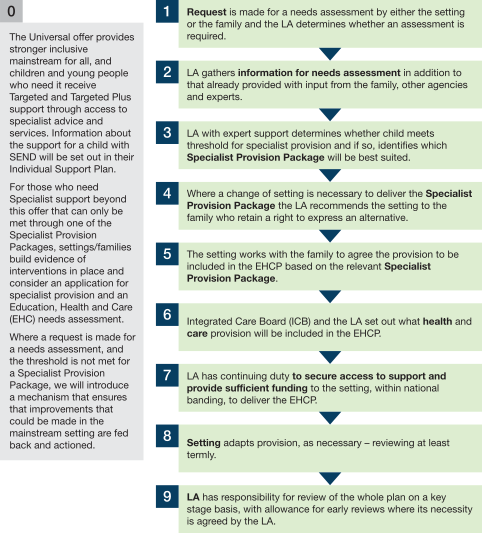
Figure 7: How Specialist Provision Packages will interact with EHCPs
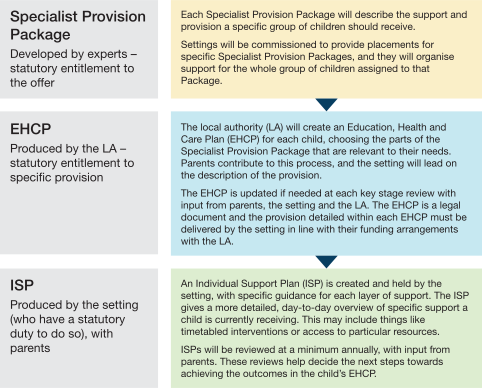
Q23. We propose that EHCPs will guarantee educational provision set out in a Specialist Provision Package, with day-to-day provision captured in Individual Support Plans.
What is needed to make these proposals work effectively?
Q24. We propose creating a more direct route to Specialist Provision Packages and EHCP assessments for children under 5 with complex needs.
How can we make sure this works in practice?
Q25. What would you expect to be considered as part of the needs assessment, for example evidence and expert or professional input?
Parental Preference
- We will maintain the legal principle known as ‘presumption to mainstream’, so that where a young person or parent with an EHCP indicates a preference for a mainstream setting, there will be strong legal duties on local authorities (LAs) to make this happen.
- LAs will provide parents and young people with a list of settings able to provide the Specialist Provision Package.
- Parents and young people will have the right to choose any of these settings or express a preference for an alternative.
- Decisions will be made based on this preference as well as evidence of effectiveness, good value, and the needs of other children.
We want to enable every child and young person to access to a high-quality, local, mainstream education if it is, or can be made, suitable for them. For those who need specialist support it is important that young people and parents retain a strong right to indicate a preference for a particular placement, and we want them to receive greater support and information to make this decision. We also believe that the law needs to allow LAs to make decisions on placements with greater consideration of good value and the needs of all children and young people in their area.
Therefore, we will:
- Maintain the legal principle known as ‘presumption to mainstream’, so that where a parent or young person indicates a preference for a mainstream setting, as part of the EHC needs assessment process, there will be strong legal duties on LAs to make this happen. This will be subject to the existing legal exceptions, for example when such a placement would be incompatible with the efficient education of others.
- Amend the law so that LAs are required to provide young people and parents with a list of recommended settings which are able to deliver the appropriate Specialist Provision Package for their child, from which to choose. Parents and young people will retain the right to request an alternative setting which can deliver the relevant Package.
- Amend the current legal exception related to incompatibility with the ‘provision of efficient education for others’ so that LAs are not required to name a school or setting in an EHCP where it is already full[footnote 91] or where this would have a seriously detrimental effect on children or young people already in the setting.
- Amend the current legal exception related to incompatibility with ‘the efficient use of resources’ to make it clear that weight must be put on the evidence of the effectiveness of the provision, value for money, and fairness in future decisions about placements. This might include requiring the LA to consider overall value for money and the impact of making a single higher cost placement, for example in an Independent Special School (ISS), on the ability to meet the needs of all children and young people in the area.
As outlined above, there will be Specialist Provision Packages designed to set out the specific additional support required by children and young people who can access a mainstream curriculum offer but whose needs mean they require additional specialist support. Children and young people assessed as requiring one of these Packages will have an EHCP but their parents will only be able to express a preference for a mainstream setting. In all other respects the rights and entitlements will be the same as for children and young people matched to other Specialist Provision Packages.
The law on SEND in England places a strong emphasis on parental preference, particularly where this is for a mainstream setting, and it will continue to do so. Parents will also continue to be able to appeal to the Tribunal if they disagree with an LA’s placement decision. However, placement decisions will be made in a much more consistent and fair way, with preferences made less in isolation and more holistically, with a better focus on quality and a suitable placement close to home.
Q26. What factors should LAs take into account in proposing to parents and young people a list of potential settings to name on a plan?
Q27. What information and support do parents need in making a decision about which setting will be best for the child?
Transition to the new system
- This will be a decade long reform programme and new legislation is not expected to come into effect until September 2029. Until then the current system – with its existing duties, rights, and funding routes – will remain in place.
- Following new legislation, children and young people who have an EHCP will have their needs assessed at transition points and either move onto a Specialist Provision Package or be supported through Individual Support Plans and the Experts at Hand service.
- No child or young person will leave a special school or college placement as a result of these changes, unless they choose to do so.
This is a decade-long reform programme that seeks to fundamentally improve support for children and young people with SEND by focusing on early support in mainstream early years settings, schools and colleges. That is why our investments and reforms begin now, before legislative changes, to enable early years settings, schools and colleges to prepare and build capacity for reform, such as through staff training. It is also crucial that we manage the transition to the new system carefully for those already receiving statutory support.
From now until the commencement of legislation, the current system – with its existing duties, rights, and funding routes – will continue and we will take steps to ensure these duties are met. Following legislation and the wider changes set out in this consultation, many more needs will be met through the Universal offer and Targeted layer including through Experts at Hand, without an EHCP. Any child with an EHCP (or any who has been assessed as needing one) in a mainstream setting as of the legislation’s commencement date will retain their EHCP and associated provision until they finish their current phase of education (primary, secondary, post-16) or until they choose to move to the new system. Children with an EHCP in the early years will retain their EHCP and associated provision until they finish the primary phase, when it will be reviewed.
As outlined previously in this document, we are investing upfront, before any legislative changes, so the system is prepared for reform. We will provide £1.6 billion for the Inclusive Mainstream Fund so schools, colleges and early years settings can deliver an improved inclusion offer, £3.7 billion of capital investment, £1.8 billion for Experts at Hand, and a £200 million SEND training programme. The Children’s Commissioner will also oversee the transition and implementation.
When new legislation comes into effect, children and young people with an EHCP in mainstream settings will have a needs assessment when they near the end of a phase of education. The LA will assess, under the new legislation, whether they need a Specialist Provision Package, and thus an EHCP. If they do need a Specialist Provision Package, a new EHCP will be developed based on the Package(s) they need. Sitting alongside their EHCP, their secondary school or college will produce an ISP detailing the day-to-day educational support they will receive. If they do not, then the LA and setting will work together to move their support to an ISP in a mainstream setting, and for them to access provision in the universal and Targeted layers once their EHCP has ceased.
The first cohort of children and young people to transition will be those at the end of primary, secondary and Post-16 in 2029/30. They will be assessed from September 2029 and will move to the new system in September 2030. If, after they have been assessed, a child or young person is due to move to an ISP rather than a Specialist Provision Package and a new EHCP, they will still keep their current EHCP until the end of the 2029/30 academic year. In addition, all children and young people who move from an EHCP to an ISP will retain the ability to request a placement at a mainstream setting of their choice. All children and young people who have a special school place in September 2029 will be able to stay in special school until the end of their education, unless they choose to move to a mainstream setting. Their EHCP and support will continue to be reviewed annually.
The Specialist Sector
- We will ensure there is a consistent high-quality, evidence-based offer, including outreach to mainstream settings, across the country.
- Ofsted inspections will hold settings to account so children and young people with the most complex needs receive expert, high-quality education.
“How can we tap into the incredible wealth of expertise in the specialist sector to support the increase in inclusion in mainstream – is there a plan for this?” – National Conversation online event, January 2026.
The specialist sector comprises a wide range of settings including maintained special schools, non-maintained special schools, independent special schools (ISS), special academies, Alternative Provision (AP) schools, special post-16 institutions. The vision in this section applies to all these settings but there are some reforms specific to ISS and AP settings that are included in the two subsequent sections.
In the early years, specialist provision looks different because of the nature of children’s needs and the diversity of settings. Specialist provision can be delivered in a range of settings, including specialist early years settings which play an important role in the early years SEND system. Children in the early years will have access to Specialist Provision Packages, as there is no separate statutory early years specialist sector. Not all reforms set out in this chapter apply in the same way, and much of how these settings operate, the cohorts they support, and how provision is arranged, will continue to be determined locally.
These reforms represent a fundamental reset for the specialist sector, clarifying its key role supporting children and young people with the most complex needs with a consistent and evidence-led offer. By 2035 we expect that the proportion of school children in a specialist placement will be higher than it is now, but that more of them – around a quarter – will be in commissioned Specialist Bases in mainstream schools. This rise in numbers of children in Specialist Bases will mean that the proportion placed in special schools will return to around today’s levels by 2035. For the first time, specialist provision will be underpinned by clear evidence-based Specialist Provision Packages, and expertise will be harnessed not only for those in specialist settings but shared across the whole education system. This is a shift towards greater integration: specialist settings will become centres of excellence, driving inclusive practice through outreach and partnership with mainstream settings. With stable, predictable funding and stronger accountability, the sector will have the confidence to innovate and invest in high-quality provision, while families gain clarity and trust that support will be consistent, fair, and focused on outcomes. These changes will elevate the role of specialist settings, so they are a vital, collaborative force at the heart of an inclusive education system.
A key part of reform will therefore be to strengthen the quality, capability, and evidence base of the provision within these settings, including ensuring that specialist pedagogy, therapeutic approaches and partnership working are grounded in the best available research. We want all children and young people to have access to a curriculum that supports their aspirations and raises standards, including children and young people with more complex needs, who should be supported to access as much of the curriculum as possible. Therefore, working with experts, we will conduct a review of good curriculum practice in special schools, with a view to spreading best practice and improving standards.
Case study 9: Outreach and partnerships with mainstream settings
Sunningdale Specialist School in Sunderland is a specialist school for children aged 2–11 with severe, profound, and multiple learning difficulties (SLD/ PMLD) and autism.
Sunningdale established the SENhub (over 10 years ago) as a dedicated centre for training, support, and outreach. Through SENhub, the school delivers effective evidence-based programmes for teachers, early years practitioners, and parents across both specialist and mainstream settings. The offer is multi-faceted including school-to-school support, parent and family support and a range of online and in-person training, development and information sharing events. Its outreach offer focuses on sharing the school’s exemplary internal practice by modelling inclusive strategies, advising on sensory and communication needs and facilitating smooth transitions for children with SEND.
They offer a wide range of workshops and bespoke sessions on curriculum design and engagement for pupils with severe, complex and profound learning difficulties. SENhub offers support and advice regarding the development and practice of additional resource bases. The SENhub partners with the University of Northumbria to deliver a unique Initial Teacher Training programme for those pursuing careers in specialist education, ensuring that inclusive practice is embedded from the start of teacher development. Regionally, Sunningdale School delivers a SEND focussed version of Early Career Framework. Sunningdale School serves as an effective model for the role of specialist provisions in supporting Children and Young People with SEND in being able to attend their local school and have their needs effectively met.
Ofsted’s renewed education inspection framework will ensure that inspection of specialist provision is rigorous, with the sector held to high standards. The Ofsted Academy has improved the specialist training inspectors receive and has helped to recruit inspectors from the SEND and AP sector. This aims to make sure no inspector goes into a mainstream school, special school, special post-16 institution or AP setting without a deep understanding of what good SEND provision looks like and that most inspections will have at least one inspector with previous experience working in a similar type of provision.
Specialist Provision Packages will ensure that support provided to every child – including those in mainstream settings – and be underpinned by a clear and consistent provision offer which is grounded in best practice and informed by evidence, and we will set out the principles on which to base curriculum design and delivery. Where a child or young person would benefit from the expertise of a specialist setting to support continued engagement in their mainstream placement, we will create the conditions for more high-quality outreach to mainstream settings and will explore greater use of part-time or short-term placements.
Case study 10: Co-located specialist support
West Thames College in London has built an exceptionally inclusive environment for young people with SEND.
In 2017, it collaborated with Ambitious about Autism, welcoming Ambitious College as a co-located specialist provider. This partnership enables 48 students with autism to access bespoke programmes while benefiting from mainstream opportunities at West Thames. The collaboration allows students to gain access to a broader curriculum than standalone specialist settings could offer, develop social and life skills, and participate fully in college life.
Their most recent Ofsted report highlights that learners with SEND receive excellent support from staff, including opportunities to develop their independence, such as through working in the second-hand shop based in the college. As a result, learners with SEND achieve well and most take part in a range of meaningful, individualised work experience placements.
Spreading high-quality practice across the sector will not only improve outcomes for the children and young people directly served by it, but will also enhance the reach, robustness and potential impact of education and health professionals across the wider system. Just as specialist settings have much to offer their mainstream partners, they also have much to learn from them. For instance, we know specialist Post-16 Institutions often work closely with FE colleges, individually and through Natspec’s work as a national Centre for Excellence which is funded by government to share expertise from within the specialist college sector with mainstream FE and skills providers. Collaborations mean college staff can access specialist CPD and exchange effective practice, while students can benefit from another college’s facilities, experience smoother transitions, including to adulthood and independence, and have improved access to specialist health input. Overall, a more coherent and inclusive system should foster a culture of shared improvement and mutual learning, where insight and innovation move in all directions across the continuum.
In future, we will therefore expect all special schools, Alternative Provision (AP) and special post-16 institutions to:
- provide high-quality support and specialist education for children and young people with the most complex needs;
- work in partnership with LA Commissioners to ensure parental engagement and the ongoing appropriateness of a placement for a child or young person;
- act as catalysts for improvement by sharing expertise, coaching colleagues and contributing to joint professional development across the local authority area;
- strengthen the overall system by demonstrating how education, health and care can work together around the needs of the child or young person;
- provide outreach and short-time placements for some children and young people enrolled in mainstream settings.
Case study 11: Sharing of research and expertise from a specialist setting
Meath School, a non-maintained special school in Surrey run by the charity Speech and Language UK, provides education and residential provision for children with the most complex speech and language needs, using an integrated ‘Total Communication’ approach that combines teaching, therapy and augmentative communication. The school runs an active outreach programme, hosting professional visits and supporting mainstream and specialist settings to strengthen identification, communication strategies and inclusive practice.
Meath also has a strong research culture, working with partners such as the University of Sheffield and City St George’s University of London to develop evidence-based tools. This commitment to evidence generation has informed the development of specialist tools and resources, funded through philanthropic funding, including Pre-phonics Boost, a digital resource. This is now being used by mainstream and special schools across England to support children’s phonological awareness, one of the foundation skills needed to access a phonics programme. This combination of high-quality specialist provision, strong research and evaluation practice and both local and national system level outreach demonstrates how a non-maintained special school can contribute directly to improved equity, capability and consistency across the SEND system.
Alternative Provision (AP)
- Alternative Provision (AP) will offer three levels of support – outreach to mainstream schools, short-term placements for assessment and reintegration, and longer-term placements when needed.
We recognise that many pupils who need to access AP on an ongoing basis have current or historic unmet SEN. For those whose needs may present in disruptive or unsafe behaviour, AP schools, which are inspected by Ofsted, can offer specialist support to address children’s needs, close gaps in learning and prepare them for success in their next step. AP schools, including those which are hospital schools, can also provide expert support for pupils with a range of medical needs including mental health needs, which may mean they are unable to attend their usual mainstream school. We want to build on the expertise of this broad sector so it is a key part of the spectrum of provision available for children fully integrated alongside mainstream settings, and ensure that children receive a quality, evidenced based offer that keeps them safe, addresses gaps in learning and prepares them for their next stage.
This will build on models we have tested in our SEND Change Programme to encourage all registered AP schools to provide a three-tiered model of support:
- Outreach into mainstream schools for specialist teachers and leaders in AP schools and to offer preventative support.
- Time limited placements, that will offer pupils a short time in an AP school or special school for social and emotional special educational needs for their needs to be assessed and addressed, which we expect will then allow them to return to their mainstream school.
- Longer term placements, where a child has been assessed as needing one of the Specialist Provision Packages commissioned in the AP school. Such placements will focus on supporting pupils into a more sustainable educational placement, with a particular emphasis on ensuring progression to appropriate post-16 provision and employment.
We will further strengthen the AP sector’s offer by:
- Developing Specialist Provision Packages to provide consistent high-quality and evidence-based offers for those children and young people whose social and emotional development needs require ongoing support via a specialist placement, so they can achieve, thrive and secure a positive post-16 destination.
- Working with the sector on a more stable funding model for AP schools, recognising their role in providing both short and longer-term placements and for outreach.
- Ensuring the system supports AP schools to improve pupil transitions out of AP, via either a reintegration or transition plan or, where it is apparent that the child’s needs require ongoing, more specialist support, by triggering an assessment to access a Specialist Provision Package after a defined time period. This will ensure that placements in AP schools remain purposeful and outcomes focused.
- Legislating to correct the anomaly that some hospital schools and hospital education services cannot currently be funded for post-16 students.
As well as AP schools, a range of non-school (unregistered) Alternative Provision settings offer targeted interventions. Where these settings are high-quality, they can play a valuable role in re‑engaging children in education and supporting improved attendance as part of a planned approach. These settings are not currently regulated. We will strengthen safeguards so that pupils remain on a school roll, and local authorities will be responsible for quality assuring non-school Alternative Provision against new national standards.
This will mean that the AP sector has a clearer purpose and role within the education system, providing tiered support focused on preparing children for their next steps, supported by a more stable funding model, and improved standards, oversight, and processes. In particular, we anticipate AP schools will have a far greater role supporting vulnerable children to stay and thrive in their mainstream school, either via outreach or time limited placements with a clear focus on a child’s future trajectory.
Case study 12: Tailored support that keeps pupils engaged
Olive Academies, an Alternative Provision trust, is based across numerous sites in East London, Essex, Cambridgeshire, Kent and Suffolk.
The trust delivers inclusive, tailored programmes that prevent exclusions and re-engage pupils struggling in mainstream education, with bespoke support for students at risk of disengagement, focusing on wellbeing, resilience, and academic progress. Its early intervention programmes are highly valued by schools, with impressive outcomes: 98% of students attending Olive offsite programmes see an improvement in their attendance, and none have been excluded. These programmes include offsite provision and on-site placements at Olive academies, enabling staff to work closely with pupils and families to identify barriers to learning and implement strategies (from the range of approaches deployed in the Olive academies) tailored to addressing each pupil’s specific needs. Impact data shows significant improvements in attitudes to learning, evidenced by reductions in detentions and suspensions. The trust also collaborates with mainstream primary schools to support vulnerable pupils during the critical transition to secondary education. This comprehensive transition programme prioritises relationship-building and communication, ensuring pupils feel supported as they move into Year 7.
Q28. What do you think is the right maximum length of time for a temporary placement in Alternative Provision (AP) schools? Please explain your rationale.
Independent special schools (ISS)
- The duties on Independent special schools (ISS) will be aligned with other special schools to ensure fair admissions, high-quality SEND support, financial transparency, and better value for money, so that children get the right placements without unnecessary costs.
- We will also bring forward legislation at the earliest opportunity to ensure LAs can pay a reasonable price for placements in ISSs.
The ISS sector[footnote 92] plays a key role in supporting children and young people with SEND, often catering for complex, low incidence needs and providing useful flexibility in the supply of placements. However, we are concerned that some placements in the sector are contributing to unsustainable financial pressures on local authorities without clear evidence they are leading to better quality support, outcomes and value for money,[footnote 93] and the Independent School Standards do not work as well as they could for these schools. The admissions duties on most of the ISS sector are also not aligned with that for other special schools, creating, in effect, a two-tier system which allows providers to make decisions over which children and young people to admit and what provision to offer and which local authorities (LAs) must then fund.
A number of ISSs are owned by private companies, including private equity firms, with considerable overlap with providers of children’s social care placements.[footnote 94] Placements in the ISS sector are almost entirely state-funded and far more expensive than in state special schools (average unit costs per year in ISSs in 2024-25 were £62k vs £24k in state special),[footnote 95] and we are concerned about evidence of some unreasonably high fees and the involvement of private companies seeking to make excessive profits.[footnote 96] To address this, we will bring forward legislation at the earliest opportunity to ensure LAs can pay a reasonable price for placements in ISS. To ensure equity for all and effective use of public money we will ensure flexibility in the approach according to different levels of need. We expect, after a period of engagement and evidence gathering, that the average fee LAs will be able to pay will be lower in cash terms from 2028-29.
To ensure the role played by such settings is effective, we will also legislate to bring the duties and oversight of ISSs into line with other special schools by:
- Creating a statutory definition and, via a separate consultation, standards for ISS.
- Aligning their admission duties with that of other specialist settings.
- Requiring them to offer placements based on Specialist Provision Packages and in accordance with national funding bands, and to adhere to the Code of Practice.
- Increasing the financial transparency of the sector by requiring ISS to report on costs to the commissioning local authorities.
- Giving the Secretary of State the power to refuse the expansion or opening of new ISS where there is limited evidence of demand from commissioning LAs.
Any ISS which does not meet these new standards and duties will not be able to register as an ISS, provide specialist placements commissioned by local authorities or receive state funding. These changes will enable more children to access appropriate placements, with a consistent, high-quality, evidence-based offer. It will also ensure more effective oversight and regulation of the sector, ensuring it is more attuned to local sufficiency needs and provides better value for money. We are considering what changes would be required to ensure special post-16 institutions are treated in a similar way, recognising that this sector will continue to play a vital role.
Q29. We have set out our plans to regulate Independent Special Schools (ISS) sector.
Do you agree that these proposed changes will lead to suitable placements being available at a fair cost? Please explain why.
Part four: reforming the system to reward inclusion
We are replacing a bureaucratic system that only acts at crisis point with one that is proactive, fair and sustainable. Funding will flow earlier, directly to schools and colleges and through local authorities for early years settings.[footnote 97] This will be backed by significant additional funding across the 0-25 system: over £200 million for Best Start Family Hubs, £1.6 billion for inclusion funding over the next three years, £1.8 billion for Experts at Hand and £3.7 billion capital funding to create tens of thousands of new places in Inclusion Bases in mainstream settings, make buildings accessible and create new special school places in Inclusion Bases in mainstream settings, make buildings accessible and create new special school places.
As the impact of this investment takes effect, with more children and young people being supported effectively at a cohort level, we will start to rebalance funding so that mainstream settings receive more funding in their core budgets. This will allow them to deliver more flexible, direct and timely support, and to further incentivise early intervention and inclusive practice. A new system of pooled funding and local SEND groups of schools will support collaboration between schools, with collective resource used to deliver inclusive provision across the local area. We will explore how similar pooling arrangements could benefit early years settings, including the nursery provision attached to schools, and post-16 settings. Specialist funding will also be reformed for stability and value for money, and new accountability will hold every setting and local area to high standards. Taken together, these changes will create a simpler, fairer and more collaborative system focused on outcomes – replacing bureaucracy with clarity and trust.
Funding reform
- Mainstream funding reforms will support early intervention and more flexible support, with early years, schools and colleges receiving more money upfront, including:
- £1.6 billion for the Inclusive Mainstream Fund over the next three years
- £1.8 billion investment over three years as part of our Experts at Hand offer, so that children get help earlier without lengthy processes.
At the moment, funding for SEND is confusing and too tightly linked to bureaucratic processes. This incentivises more resources on litigation, bureaucracy and diagnostic procedures, rather than inclusive practice or improved core educational provision. It can be unpredictable, with processes inaccessible for parents and prescriptive for providers and so limits opportunities for evidence-based deployment of staff and group support models, the sharing best practice and the pooling of resources. This current system results in many children’s and young people’s needs escalating over time, leading to worse outcomes, fewer resources for early intervention, and higher administrative costs due to bureaucratic processes.
Prioritising early intervention for children and young with people SEND is an essential part of preventing escalation of need and ensuring support is both effective and efficient. Moving to a system in which more support is commissioned by cohort for groups of children and young people will enable more flexible, responsive provision that meets needs earlier and more effectively, particularly for commonly occurring needs. With more children and young people identified as having additional needs, it is increasingly likely that some children in every class, and in every setting, will have particular kinds of commonly occurring need. Planning to meet these needs ahead of time, and funding on the basis that that will be needed, on a cohort basis, means that funding – and children’s needs – don’t have to wait for individual assessments, or for needs to escalate to a certain point before being met. Our new funding model seeks to empower settings and families to work together, focussing on what children need when they need it, rather than on diagnosis to secure additional funding.[footnote 98]
We are therefore committed to reversing the trend of deprioritising early intervention and are first making a major increase in investment – with £4 billion over the three years of the spending review. This investment includes over £200 million for Best Start Family Hubs, £1.6 billion for the Inclusive Mainstream Fund, £1.8 billion for Experts at Hand, and over £200 million for a national training package. As our reforms take effect and earlier intervention is improved, it will allow us to begin to rebalance more funding towards mainstream provision.
This section will set out the short-term and long-term funding reforms, and how we will reform funding across the 0–25 system in a way that reflects the differences between sectors. Some reforms, such as the new Inclusive Mainstream Fund, will apply across early years, schools, and post-16 settings, while others will apply only to schools or to schools and colleges. Early years funding operates differently from school and college funding because of the wide range of setting types, and the distinct role local authorities play in overseeing provision and ensuring sufficiency. Details on what funding reforms mean for the early years sector are set out in the ‘accountability’ seection.
Rebalance funding towards mainstream settings
- For schools and colleges, we will rebalance funding, by moving a portion of funding currently distributed through local authorities from high needs budgets directly into mainstream core budgets, to support earlier intervention and a more proactive approach to meeting needs.
Mainstream settings already receive a significant level of funding for SEND in their core budgets. Since the 2018 to 2019 financial year, the national funding formula (NFF) has been used to allocate funding for high needs, using factors such as low prior attainment and disadvantage. Currently, the schools NFF allocates £2.9 billion – 5.8% through the low prior attainment and £5.6 billion – through the deprivation formula factors, which are used as a proxy for SEND need in mainstream settings.[footnote 99] Funding from these factors as well as the basic amounts for all pupils are combined into an identifiable “notional SEND” funding allocation – over £5 billion in 2026 to 27. The 16-19 funding formula similarly allocates part of the funding using low prior attainment and disadvantage measured using student postcodes in order to get more funding to those providers whose students have greater needs.
The way the SEND system is currently funded has led to a greater reliance on ‘top-up’ funding in mainstream settings, with support increasingly bespoke to individual pupils. Local authorities can spend their high needs budget on support in mainstream schools, but this support is inconsistent and declining.[footnote 100] Increasingly, settings have applied for extra funding (known as ‘top-up’ funding) to support children with commonly occurring needs. This ‘top-up’ funding for mainstream schools, which is tied to an Education, Health and Care Plan (EHCP), has risen and is rising much faster than core funding,[footnote 101] meaning a larger share of funding is tied to statutory assessments, which is delaying support and diverting staff time into bureaucracy. Settings need to plan effective and high-quality provision that invests in the teaching and support for the whole cohort of children with similar needs, and securing this funding is more effective through the core budget rather individual funding packages.
Over time, we aim to move to re-balance funding, directing more funding into core budgets for schools and colleges, while maintaining strong support for those with the most complex needs. Settings can be better equipped for meeting a wider range of commonly occurring needs, enabled by a funding route that allows for more proactive planning of the support their pupils may require and allows them to deliver tailored support more flexibly. With greater certainty about levels and sources of funding, settings will be able to decide on the best way to meet needs from within their core offer, including teaching strategies first and foremost, and incentivising earlier action that reduces escalation of need.
We plan to do this by directing a portion of the high needs budget into the core budgets of schools and colleges. At the moment, this money is currently allocated to education settings through EHCP ‘top-ups’, but in future, more of it will go straight into schools’ and colleges’ core budgets so they can respond to children and young people’s needs more quickly and flexibly. Early years settings will also receive more of this funding upfront through local authorities. Schools, colleges and early years settings will be responsible for how they use this funding, along with their wider SEND budgets.
Mainstream settings will have confidence in more consistent funding for SEND. Our planning assumption is that the funding mainstream settings receive directly to support children with SEND will increase at least in real terms per pupil in each year once reforms are implemented, subject to decisions on funding made as part of future spending reviews. Funding for SEN will remain in mainstream budgets, rebalanced to be part of core mainstream funding to be spent on supporting children and young people with SEND in a responsive and adaptive way. From 2027, we will consider transitional arrangements that local areas can take to further increase the amount of funding that mainstream schools receive to provide SEND support directly, in advance of statutory changes. Building on the approach taken in some local authorities, we will consult on ways to allow local authorities to pass more of their high needs funding directly to local mainstream schools and thus increase schools’ and colleges’ notional SEN budgets. This will enable improved inclusive provision by putting more funding for SEND into schools’ and colleges’ core budgets – with settings meeting a greater proportion of SEND costs out of their budgets and to ensure top-up funding is only for higher cost provision.
Streamlined funding allocations
- Schools and colleges will receive clear funding for inclusion to support them to meet their new mainstream expectations and to provide a high-quality Universal offer.
As we rebalance funding, schools and colleges will receive more funding for SEND in their core budgets . This means funding for meeting needs, especially in mainstream, aligns with our revised expectations outlined in part one for mainstream settings to provide an inclusive, high-quality Universal offer. The funding that settings receive will be used to deliver the Universal offer and ‘Targeted’ or ‘Targeted Plus’, in line with new duties to plan for the needs of their overall cohort. Alongside this, mainstream settings will continue to receive high needs funding from local authorities which covers the costs of delivery of a Specialist Provision Package for those with the most complex needs, including through specialist bases.
We will review how best to target this rebalanced SEND funding to schools and colleges. As more funding flows to schools and colleges through mainstream funding, rather than the high needs funding system, we will seek to improve the allocation. We will also consult on both how we can best target funding at schools and colleges with SEND need most effectively, and how best to identify the share of funding to support education providers in delivery of SEND provision and distribution of the funding rebalanced from the high needs budget. This work will align with the current review of the 16-19 funding formula, as well as the government’s consultation on local authority funding reform focused on improvements to economic deprivation data to ensure local authority funding is allocated fairly and based on local need.
We propose to continue using proxies which correlate with SEND in the national funding formula (NFF), rather than funding identified SEND need directly. This is because the identification of SEND varies significantly between settings and local areas, meaning it does not reliably reflect actual levels of need or the costs required to meet them. The use of providers’ own assessments would also create perverse incentives to focus on diagnosis of children rather than providing high-quality support.[footnote 102] There is also evidence from the Sutton Trust that shows that how likely a child is to be identified as having SEND depends significantly on which school they attend.[footnote 103]
We will streamline the current school funding landscape by clearly identifying each school’s share of their core funding for inclusion. For each school there will be a transparent share of core funding to meet the new mainstream expectations. This is part of the wider drive towards simpler and more consistent funding as we move to a direct NFF. This funding share for inclusion will include the funding schools already receive for SEND within their current core allocations (replacing the current “notional SEND” in core budgets).
We recognise that formulaic allocations will not always fully reflect the actual level of needs that providers have and that in many cases it may not be effective for a provider to meet the needs of its pupils solely from its own budget. Our approach to pooled funding below outlines how we can help smooth out variation of support for commonly occurring needs, enabling fair resource sharing across providers.
Inclusive Mainstream Fund
- To support the development of a more inclusive mainstream system, additional funding through an Inclusive Mainstream Fund will be provided to early years, schools and colleges to boost the existing core funding for SEND, with over £500 million per year over the next three years, and we will ensure settings spend funding on this purpose.
In advance of re-balancing funding and to boost mainstream provision we will provide £1.6 billion in additional funding over 3 years to supplement the existing core funding for SEND, with over £500 million per year over the next 3 years going to mainstream schools, early years, and post-16 settings. This will support settings in investing in a more inclusive mainstream system and build confidence that children and young people receive the right support as early as possible, as set out in Giving Every Child the Best Start in Life, before legislation.
We expect settings to start using this inclusion funding to build a core offer for children and young people with SEND, and going forward, use this funding to help identify commonly occurring needs and take meaningful steps to improve everyday support. Settings will also be able to spend the funding to develop targeted support, such as transition support or specific group interventions without formal assessments or diagnoses. Many settings are already leading the way with this approach under the current system, and we want to build on their successes, allowing more to do the same.
From this year, we propose holding settings and trusts to account on the use of their inclusion funding: initially on the new Inclusive Mainstream Fund, and later on their total inclusion funding which will include the rebalanced funding and, in the case of schools, funding within the National Funding Formula. We will ensure settings spend this money on delivering an improved inclusion offer and will place conditions on this funding to make sure they do. For schools, this will include publishing an Inclusion Strategy Report that covers how they are deploying their resources for SEND, including using existing resource and the additional Inclusive Mainstream Fund. We intend for Inclusion Strategy Reports to allow for greater oversight and accountability, including from governors, in how schools are improving the quality and breadth of their inclusion offer. This will help Ofsted assess the extent to which inclusion is implemented and embedded across a school and in alignment with local partnership plans. The Inclusion Strategy will also play a role in peer support, scrutiny and review, boosting transparency, and accountability. DfE will work with the sector, Ofsted and parents to ensure they are achieving this aim, and to develop a peer review process to promote learning and improvements on inclusion. Post-16 colleges will be required to demonstrate how they will use their inclusion funding in their accountability agreements. In the early years, LAs will play a key role in monitoring and ensuring that education providers use inclusion funding effectively.
Q30. How should settings be held accountable for how they spend their Inclusive Mainstream funding?
Q31. Do you agree that more SEND funding should sit directly within mainstream budgets? Please explain why.
Pooled funding in schools for SEND
- To improve inclusive practice and access to support, we will strengthen strategic SEND partnerships and propose that every school becomes part of a local SEND group.
- In the long term, schools will pool some funding from their inclusive mainstream funding for a more collaborative, efficient system to meet needs across their group and allow for better sharing of expertise and resources across an area.
“Robust models should be developed to enable strategic, integrated commissioning and planning across councils, educational settings, and health bodies.” – DfE’s independent Neurodivergence Task and Finish Group report, February 2026.
We will strengthen existing local strategic SEND partnerships and strategic planning across the country as part of our reforms, working with schools, trusts and LA partners. These partnerships should foster a sense of collective responsibility for outcomes of children and young people across a local area and should give all schools, multi-academy trusts (MATs) and other education providers influence to deliver better shared services. This is vital to ensure that strategic planning of resources such as health and education professionals (speech and language therapists, occupational therapists and educational psychologists), and commissioning of Specialist Bases can be done fairly and effectively.
In addition to improved collaboration across a local area, we want schools to work together to drive up the quality and scale of inclusive provision. Working collaboratively will help school set consistent standards and ensure that all schools contribute to and have access to shared resources to best support their cohort of children and young people. Some schools already work in groups – in MATs and other local groupings – to improve inclusion across their area for pupils with SEND[footnote 104] and for those in Alternative Provision.[footnote 105]
We propose that every school should be part of a local group to work together on SEND. All of these school groups will need to be actively engaged with the local authority and the Integrated Care Board (ICB). We see this being predominantly through a local SEND and Alternative Provision (AP) partnership structure described above. As the landscape of schools varies locally, we will test and evolve different models for how this works best. We would like to work with school and local authority partners to learn together while we move in the long term to a system where all schools are part of strong groups. We also want to explore how groups of schools and local SEND and AP partnerships might work together, as well as mechanisms for conditionality and oversight between school groups and local SEND partnerships to ensure that the functions school groups deliver align clearly with the wider local plan for the SEND system.
Case study 13: Collaborative working in Wakefield
Wakefield’s local partnership has developed a strong and coherent approach to supporting children and young people with SEND. This is particularly important due to a rising demand for Education, Health and Care Plans (EHCPs) in the area, and a high proportion of pupils with plans educated in mainstream settings.
Wakefield has a tiered SEND model which works to provide clear, escalating levels of support, and to enable schools to assess and respond to needs early and consistently. Tailored guidance for primary, secondary, special schools and Alternative Provision helps staff deliver timely, effective interventions. Central to Wakefield’s success is also culture of collaboration that connects schools with specialist teams, including educational psychologists, the Inclusion SEND Support Service, and sensory and physical difficulties teams. This multi-agency working ensures children receive coordinated, specialist-informed support. Partnership leaders are ambitious and innovative, using shared data systems and regular quality assurance to identify needs, shape provision, and address gaps across education, health and social care. A culture of mutual respect and constructive challenge also underpins the partnership, ensuring that new services are designed collaboratively with education, health, social care and the Parent Carer Forum.
Need is not evenly or predictably distributed, and there are higher costs associated with less-common need. We propose in the long term all schools will be required to pool a minimum level of funding within a local SEND group for inclusion, to support needs fairly across a group of schools. This pooled funding will be used collectively to meet the needs of children with SEND including through sharing expertise, resourcing, staffing, support bases and commissioning of shared resources, such as specialist teachers.
We expect these groups may need to allocate exceptional funding from the inclusion share across their schools to account for uneven levels of need not captured by national funding formula allocations. This will mean children benefit from a greater pool of local expertise, and schools benefit from early intervention, timely access to additional support, as well as a more efficient and collaborative way to use resources based on local needs. Groups can also be a positive forum for collaboration between schools, providing a structure for peer review, support, and challenge to improve inclusion across areas, as well as early intervention via cohort commissioning. Working collaboratively will help schools to set consistent standards and ensure that all schools contribute to, and have access to, shared resources to best support their cohort of children and young people. We will consult on the composition of school groups, including MATs which are able to deliver the key functions to be a group in and of themselves.
We believe that the following principles should guide our expansion of such collaborative models:
-
There should be clear connection across the local SEND system, facilitated by collaborative working and close alignment of school plans with other local plans.
-
There should be a culture of collective responsibility and accountability for all pupils with SEND in the local area.
-
Schools know their pupils, so should have greater autonomy and influence over commissioning of shared services and support for pupils with SEND.
-
That pooling some of their funding will enable schools to be more efficient in maximising support, and broadening access to resources and expertise, from within their core budgets.
-
Schools within a group can engage well with each other, and the group is large enough to smooth out the setting-level variation in commonly occurring needs to provide services effectively.
We will look to local authorities and their partners to shape the formation of groups in their areas and have an oversight role for the local authority groups. Over the next three years we will encourage all schools to join group structures and agree operating principles, including peer support and challenge. They will work together with their local authority and Integrated Care Boards to scope the offer and develop a strategic plan for SEND. We will also encourage local authorities to devolve some of their funding to group of schools to test the model on a voluntary basis, in the years before legislation comes into effect.
Following this transitional period, we propose using legislation to require all schools to join and form a Local SEND and to pool a proportion of their funding. Local SEND groups would need to report on how the funding is being used and its impact on pupil outcomes.
Figure 8: School Groups and Local Strategic SEND Partnerships
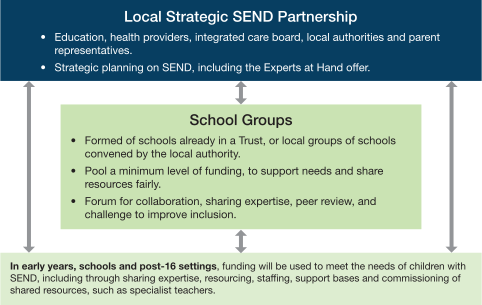
Schools Forums will play a central role in strengthening local governance, transparency and collective responsibility for SEND funding and provision. As statutory bodies bringing together maintained schools, academies, early years, post-16 providers and local authorities, Schools Forums are well placed to support the local groupings of settings proposed in this consultation, ensuring that collaboration is underpinned by clear oversight and fair decision-making. We will expect local authorities to work with their Schools Forum so that pooled and delegated SEND funding is being used consistently, effectively and in line with the National Inclusion Standards, with a particular focus on equity across settings and the needs of the most vulnerable children and young people. To support this, we will consult further on how Schools Forums can best work to support local decisions on the distribution of use of SEND funding.
We will consider carefully whether and how pooling might support delivery within the post-16 sector. Schools with sixth forms are likely to use the same grouping arrangements for their post-16 provision as their pre-16 provision. Many further education colleges are already of significant size such that pooling is unlikely to be necessary, but there are many smaller independent and local authority providers who may benefit from arrangements to consider their SEND provision together and pool resources. This could take a variety of forms: some smaller providers could work with the large college provider in their area, or they could form a group with the local authority. We expect local authorities to work with their providers to establish models that would be beneficial and work in the local context.
Given the size and number of early years settings, pooling resources at local authority level is likely to be the most effective way to maximise impact and ensure support reaches all children, with maintained nursery schools and school-based nurseries included in this approach. We will consider carefully whether and how pooling might support delivery within the early years sector, particularly for nursery provision that is attached to primary schools where there may be benefits to using the same grouping arrangements as the school.
Figure 9: Funding routes for reform
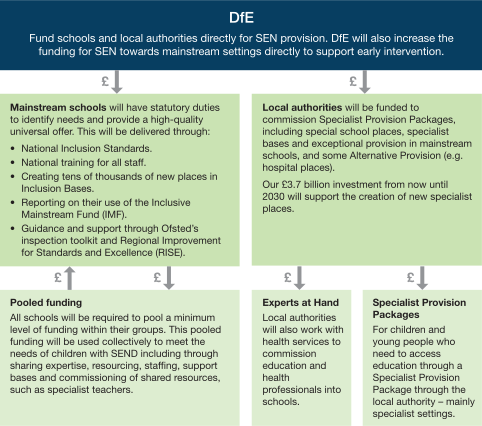
Q32: In relation to pooled funding, we propose that every school becomes part of a local SEND group.
Do you agree that this proposal aligns with our aim for all schools to be part of high-quality, community-based trusts?
Q33: How should disagreements about membership, provision, or funding in groups of schools for SEND be resolved?
Specialist funding reform
- Specialist funding will be reformed to create a fair, transparent system. It will give providers stable, predictable funding to deliver high-quality education and integrated support for children with the most complex needs. We will move towards block funding for cohorts instead of individual top-ups.
We want to establish a fairer, more predictable and cohort-based funding model for Specialist Provision Packages. This approach will give specialist settings greater stability, so that suitably qualified staff can be recruited and retained, and children and young people provided with the excellent education they deserve. This will reduce the current local variation in specialist funding and help ensure that specialist placements can deliver a consistent, high-quality offer, integrate care and health provision and give children and young people access to learning, enrichment and community engagement opportunities. More consistent funding can provide each school and college with funding that reflects the challenges they face and allows them to plan for the future with confidence and provide better value for money to the taxpayer. We will consider the best way to approach cohort-based funding for early years children, given the wide range of providers and the smaller number of children requiring specialist provision.
We will review the formula for how high needs revenue funding is allocated to local authorities, including through a separate consultation with stakeholders. Local authorities will continue to be allocated funding through a reformed high needs block to cover the costs of complex SEND. Following our reforms, this funding will primarily support specialist provision. Future funding for local authorities will aim to appropriately cover SEND costs, so that where local authorities are managing their system effectively, they will not need to use general funds. The government has also recently announced plans to deal with historic and accruing deficits in the local government finance settlement.[footnote 106]
Early years funding
- Alongside our additional investment of over £200m over the next three years in Best Start Family Hubs, local authorities will receive new funding for inclusion to distribute to early years providers, which will allow settings to better plan and support commonly occurring needs.
We are committed to ensuring that children receive support at the earliest stage, when it has the greatest impact on their development and long‑term outcomes. Through the expansion of the childcare entitlements and the investments announced in our Giving Every Child the Best Start in Life strategy, we have strengthened early education and childcare for all children, including those with SEND. Building on this wider investment, we are boosting the support available to children with SEND and their families through Best Start Family Hubs and, later in the year, we will consult on funding arrangements to empower early years settings to act when needs emerge. This section explains how our SEND funding reforms will apply in the early years.
The current funding system creates significant barriers for early years settings. Multiple funding streams, such as SEN Inclusion Funding (SENIF), the Disability Access Fund (DAF), and support for children with more complex needs, operate with different rules and vary across local areas. This complexity makes it difficult for parents and providers to understand what support is available, and accessing funding is often administratively burdensome. Providers also lack clear guidance on the most effective interventions and how to track impact, which leads to variation and inconsistent support. As a result, families experience an uneven system where settings play a vital role in identifying additional needs but are hindered by bureaucratic processes that delay timely help and frustrate providers.
The early years sector is highly localised, with thousands of small private, voluntary, and independent providers, including childminders, operating alongside maintained nursery schools and school-based nurseries. While many providers play a vital role in supporting inclusion, some are more reluctant to take children with additional needs, which creates gaps in access. Funding reforms must therefore recognise the vital role of local authorities in the flow of funding and be supported by strong local coordination to ensure consistency and impact.
From 2026 to 2027, local authorities will receive new inclusive early years funding to distribute to early years providers. This marks the first step towards upfront, cohort-based funding, enabling settings to plan and deliver proactive support for commonly occurring needs. Local authorities will have a crucial role in cohort planning, ensuring settings have what they need to support the most commonly occurring needs across their populations. As outlined in Giving Every Child the Best Start in Life, existing funding streams such as SENIF and DAF will continue for now, but we will consult this year on simplifying and consolidating funding streams and reducing bureaucracy.[footnote 107] We recognise current systems make it too difficult for parents and providers to access funding, and through the early years funding consultation we will take their views into account.
Local authorities will play a key role in distributing inclusion funding, supporting cohort planning, and monitoring inclusive practice. We will develop clear guidance on how providers can use funding effectively, including recommended interventions and proportionate approaches to tracking impact.
From 2029 to 2030, we will begin rebalancing high needs funding so that a greater share is available to early years settings upfront. We will work with local authorities and providers to design the approach, ensuring it supports earlier intervention while maintaining strong provision for children with the most complex needs. This will reduce reliance on individual assessments, encourage earlier action, and give providers greater certainty, while maintaining strong support for children with the most complex needs. These funding reforms will sit alongside our over £200 million investment in Best Start Family Hubs, which will play a particularly important role in the early years sector, providing integrated support for families alongside education and health services.
Through the funding consultation planned for 2026, we will consult on wider reforms to simplify early years funding streams from 2027 to 2028 onwards, making them easier to understand and use. This consultation will set out options for consolidation and simplification of funding streams to deliver a clearer, more coherent system for providers and families.
Accountability
- We will require settings to demonstrate that they are inclusive and show how they support children and young people with SEND.
- Ofsted and CQC will check how local services work together for children and young people with SEND, set clear standards, and hold them accountable.
We want every child and young person to thrive in an inclusive education system, and that means holding ourselves to high standards, with a robust and fair accountability system which enables settings to improve inclusivity and outcomes. As recommended by the Institute for Public Policy Research,[footnote 108] inclusion will sit at the heart of our accountability plans. Clear accountability will extend beyond education settings and into broader partnership work across services, so that children get the support they need wherever they are.
Accountability for individual support
We will bring consistency to SEND provision by, for the first time, creating clear statutory duties for schools (including maintained nursery schools and school-based nurseries) and colleges to ensure every child and young person receives timely, high-quality and effective support. We will also consider, through future consultation, how equivalent duties could be extended to private, voluntary and independent early years providers. The Children and Families Act 2014 is key to ensuring that special educational provision is made for children and young people with identified SEND. Through legislation, we will clarify that we expect settings to identify and meet needs as early as possible and ensure that they monitor children and young people’s progress to ensure timely and effective interventions. We will introduce new requirements that settings use the National Inclusion Standards to plan appropriate support for their cohorts.
For children and young people receiving Targeted, Targeted Plus or Specialist support their school (including mainstream nursery schools and school-based nurseries) or college will have a legal duty to produce a digital Individual Support Plan (ISP). Through the introduction of ISPs, settings will be accountable and responsible for delivering educational provision and supporting the child or young person to learn, rather than this being the responsibility of the local authority. This change seeks to address the concern that educational provision is often determined by people who have never met the child rather than professionals working with them every day in partnership with their parents. This will also allow settings more flexibility to respond quickly and to update plans in response to children and young people’s changing needs, rather than the current bureaucratic process. Therefore, where parents have concerns about delivery of their child’s education provision, they should raise this with the setting rather than with the local authority.
As detailed in the Individual Support Plan section, we will place a duty on settings to produce a digital ISP for any child or young person receiving Targeted or Specialist support. We will set out the information that the ISP must include, such as the child or young person’s identified barriers to learning, their provision, any reasonable adjustments and intended outcomes, including that this must be developed with parents. We will set a requirement for ISPs to be reviewed annually at a minimum, and discussed with parents and young people, and the use and quality of ISPs will be assessed through Ofsted’s inspections and assessment of SEND provision at a setting level.
Education setting accountability
We want every child’s education to be academically challenging, rich in opportunity and built on strong relationships. To support schools to better understand and monitor the experiences of children in more consistent way, a new pupil engagement framework will be launched in summer 2026. This will be informed by insights from children, parents and carers, school leaders, and experts, and will highlight a range of good practice examples. It will allow schools to measure factors such as school belonging and safety, inclusion and relationships with teachers and peers, and how much children and young people value school. Many schools already do this well and we will learn from initiatives such as #BeeWell to provide more consistent support to schools, ensuring all are measuring their pupils’ engagement by the end of the parliament.
Children only feel included when their contributions and achievements are valued by their school and by our schools’ system as a whole. Therefore, we will update performance measures to recognise the schools which are securing good progress for all young people. Progress 8 sets an important expectation that pupils should enter at least 8 GCSEs or equivalent qualifications, with a broad mix of subjects and strong academic core. For most pupils this is the right approach, but there are 15% of pupils in the system who do not fill all 8 slots within Attainment 8 or Pogress 8. Any progress these children make is not as well recognised, and this results in not enough attention being given to whether the children entered for fewer than 8 qualifications are making the progress that they should, as well as the risk that some children may be entered for qualifications in which they will not succeed. We will therefore consult on a new performance measure, in addition to Progress 8, focused on the progress made by pupils who enter secondary school behind their peers, to better recognise schools which are successful in enabling and supporting the progress of all pupils. This will ensure every child has their progress counted at the end of secondary school.
Under their new framework, for the first time, Ofsted now assesses all settings for inclusion. This evaluates how leaders set high expectations for all children and young people, including those with SEND, and put the right support in place to meet their needs. We will work with Ofsted to ensure that settings operating high-quality Specialist and Support Bases, and specialist provision in mainstream settings, are recognised and celebrated, while also being held to account for delivering inclusive provision. Under the reformed system, we expect every secondary school to have an Inclusion Base, with an equivalent number of places in local primary schools, building on and strengthening the inclusive support already in place.
Ofsted inspectors have received significant additional training focused on their renewed approach to inclusion, as part of both an underpinning skills programme and face-to-face inspector training across all remits. Further specialist training has been provided to those inspectors working in specialist settings, including significant input from external stakeholders and additional training for inspectors relating to special schools, Alternative Provision, hospital schools and independent special schools. We will also work with Ofsted to develop early insights on how mainstream settings are successfully improving inclusion, including a thematic review of the use of Inclusion Bases in schools.
We will also strengthen the role of governing bodies and academy trust boards. The expectation on settings to proactively plan and deliver provision to meet need at cohort level is a significant shift in our system. Governing bodies and trust boards play a critical role in ensuring settings meet children and young people’s needs. To provide effective scrutiny and challenge, we expect governing bodies and trust boards to interrogate Inclusion Strategies. This includes ensuring the provision children and young people receive is high-quality, improves outcomes and drives inclusive culture and practice. We expect governors will sample Individual Support Plans. We will update relevant guidance for governors and trust boards to provide further information, including the data that governors and trustees should see on a regular basis to enable them to effectively monitor the effectiveness of provision such as: pupil movement, exclusions and pupil progress. We will also provide training to governors on how to most effectively fulfil their oversight role on SEND.
We will strengthen transparency and accountability for the movement of individual pupils across the education system by introducing an annual review process, monitoring the use of off-site direction, managed moves, and identifying any off-rolling practices. As set out in the Schools White Paper, a current lack of visibility means that vulnerable children, including those with SEND, can miss out on education or end up with support that does not meet their needs. We will therefore strengthen scrutiny of all pupil movement, including unacceptable off-rolling practice by developing a new, internal dashboard that identifies trends in how children move through the education system. This will strengthen protections for children in non-school (unregistered) Alternative Provision, including introducing national standards that set clear expectations for safeguarding, education quality and oversight.
At post-16, we will continue to use published achievement data and destinations data to hold providers to account for how well their students achieve and progress successfully into further learning and employment. The focus on progress will ensure that the effort providers put into progressing students from all starting points is valued and recognised.
We will explore ways to strengthen accountability across the early years sector to promote inclusive practice, including considering a greater role for local authorities in supporting providers. We will consider accountability as part of the early years funding consultation, to ensure that resources are deployed effectively to deliver better outcomes for children with SEND.
Local area accountability
Our SEND reforms intend to build a system with clearer roles and responsibilities for all partners and more collective responsibility for the outcomes of children and young people with SEND in a local area. Local partnership working between local authorities, Integrated Care Boards, health providers, education settings and parents is a foundational building block of successful delivery of SEND services, as has been demonstrated regularly in Area SEND inspections.
We will strengthen the local authority role to support providers. This approach will build on current monitoring processes and ensure funding delivers real impact for children with SEND. Local government will be critical in championing and delivering an approach that demonstrates collaboration and true partnership working with early years settings, schools, post-16 settings, health providers, communities, parents and families.
In the early years, while many local authorities work proactively to identify and plan provision, we have heard that there are still challenges in securing sufficient and appropriate places for children with SEND. We will work with local authorities to strengthen their sufficiency planning for children with SEND, including reviewing whether statutory requirements are clear enough and exploring how to improve data on the availability of suitable places, including for those needing specialist support. This will help strengthen local accountability and give parents greater confidence that their children can access the early education and childcare they are entitled to.
To ensure all local authorities have the capacity to undertake meaningful transformation planning and delivery while maintaining current SEND services, we will provide £200 million in support for the transformation of local authority SEND services. This funding will be provided to local authorities in a single payment alongside funding for Experts at Hand, with a proportion allocated to transformation which includes a focus on strategic planning in local SEND reform plans, commissioning, leadership capacity and engaging with the education sector.
We recognise the current delivery and capacity challenges for local authorities and aim through system reform to enable them and other partners to engage in more consistent partnership working. The role of local authority SEND leadership and local Area SEND partnerships is critical, and we want to ensure we have the right governance structures and leadership in place at the local level to support delivery of reforms.
To achieve this, we will:
-
Update the SEND Code of Practice and publish partnerships guidance to provide clearer expectations of the local SEND partnership; the collective responsibility for outcomes and the respective role of the local authority and local area partners in transforming the SEND system.
-
Use transformation funding to support an increased focus on capacity building to engage and deliver transformation of the SEND system. This £200 million investment will enable the transformation of local authority SEND services to build capacity to deliver this reform.
-
Increase investment both locally and nationally for accessible support and practical advice to families, improving the quality of what’s available. We will also increase funding for parent carer forums and give parents further influence in local SEND systems and continue to work with and expand parent carers in strategic partnership roles to support system-wide improvements.
We will also update the Ofsted and Care Quality Commission (CQC) Area SEND inspection framework to align to the clarified statutory roles that local authorities and Integrated Care Boards (ICBs) will have in relation to children and young people with SEND. Ofsted and CQC will continue to inspect the role of education, health and social care partners responsible for the planning, commissioning and delivery of arrangements for children and young people with SEND in the local area. DfE and DHSC will publish joint guidance confirming how healthcare professionals can delegate the delivery of healthcare tasks to staff in schools, colleges and early years settings. It will seek to confirm the responsibility and accountability for the delivery of healthcare tasks where delegated to staff in schools. Ofsted and CQC will also explore the introduction of a report card for Area SEND inspection to help the inspectorates report on inclusion and other evaluation areas relating to SEND across an area, to provide a consistent approach across local area partnerships.
There will be a full consultation on proposed changes to the Area SEND inspection framework following the publication of the response to this consultation. This will look at changes needed to Area SEND inspection as a result of changes to statutory duties of local area partners. In their review of Area SEND inspections, Ofsted/CQC committed to, where appropriate, specifying more clearly which member of the partnership should take forward areas for improvement, to strengthen accountability for individual partners within a partnership. Any changes to Area SEND inspection will not come into effect until legislative reforms have been implemented, anticipated as September 2029, with intention for all areas to be inspected under the current framework by the end of 2027. We will continue to work with local authorities in our support and intervention approach, including through any periods of reform and transition.
DfE and DHSC will also work closely with NHS England as part of the improvement and intervention approach following Area SEND inspections, by offering targeted support and challenge to local areas. For the first time, the NHS medium term planning framework has an explicit reference to the ICB role in delivering SEND provision, which highlights the continued importance of SEND.[footnote 109] DfE and DHSC will work to ensure there are robust and appropriate SEND metrics across the system to help hold local area partnerships, ICBs, local authorities and providers to account.
We will continue to support and intervene when local authorities and ICBs do not meet the expected standards, and where local decision making is poor. We will ensure that inspections hold each partner to account independently for their role in the delivery of SEND duties, as well as how they work in partnership with others. There are clear consequences for local areas that do not meet high standards and outcomes for children and young people with SEND, and all partners understand what they will have to do to improve their provision. We offer a range of Universal, Targeted, and Specialist support and challenge through expert improvement advisers, commissioners, and DfE managed programmes including tailored, peer-to-peer support from our sector led improvement partners. We will make use of intervention powers, including consideration of installing a trust to take over the local authority’s responsibilities, where they fail.
Over the next few years, there is also substantial ICB and local government reform taking place. These ICB reforms around structure and responsibilities will result in changes to their overarching accountability frameworks. Therefore, DfE and DHSC will work closely together and with areas to ensure that these changes do not disrupt or deprioritise the fulfilment of their statutory duties around SEND, and will look for further opportunities to strengthen accountability for local area partners to improve outcomes for families and children and young people with SEND.
We will ensure that health, care and wider support for children with complex needs is joined up and happens in a timely way. Through the National Conversation we have heard examples of how this can work in practice – where strong governance and a commitment to joint working are improving support for children with complex education, health and social care needs. We want to build our new system on what works. As part of our reforms, we will strengthen local governance and partnership working. We will also explore how health, local authority and education partners can improve their ways of working together and develop more effective ways to deliver services.
Q34: How can we ensure the most effective use of these local partnership groups?
Q35. Which stakeholders are important for the success of local partnership groups, and why?
Q36: How can we build stronger collaboration and a culture of improvement through local SEND strategic plans?
Q37. What information, advice and guidance can best support children, young people and families to ensure greater fairness across the system?
Resolution and legal framework
- We will improve complaints and mediation processes, so disagreements are resolved faster and more collaboratively, reducing the need for an appeal to the SEND Tribunal (the Tribunal).
- Families will retain the right to appeal to the Tribunal.
“Special Educational Needs and Disability Information, Advice and Support (SENDIASS) do a good job of supporting parents who do not have the means of supporting themselves. Having agencies like this within organisations is really helpful as they are impartial and advocate for those who need help.” – Teacher and parent of SEND child, National Conversation online portal.
Our reform principles of ‘fair’ and ‘early’ are not just about accessing provision at the earliest possible time, but also about ensuring the new system supports families to resolve any disagreements as early and collaboratively as possible, so children and young people can access the right provision quickly.
Resolving concerns about the Universal offer and Targeted layer of support
The investments in mainstream inclusion outlined in this document are designed to ensure needs are met earlier, reducing the requirement for families to engage in lengthy bureaucratic or adversarial processes to secure support, including through appeals to the Tribunal. Where disputes do arise, we want to ensure there is faster decision making, alongside a less escalatory and more collaborative system for resolving them to ensure a child or young person’s needs are met quickly and effectively.
We recognise the dedication of early years settings, schools, colleges, in supporting children and young people each and every day. At the same time, the National Conversation highlighted that there are real concerns from parents that some settings do not do the right thing by all their children and young people, or meet the needs of all children and young people consistently, and we want to work with the sector to address these concerns.
Early years providers must have a written complaints procedure in place, investigate concerns, and inform complainants of outcomes within 28 days. Parents can raise ongoing concerns about an Ofsted-registered early years setting directly with Ofsted.
We will work with school and college leaders, parents and the sector to strengthen the mainstream school and college complaints processes. This will include setting clear expectations and timeframes, improving guidance and support for schools and colleges, and strengthening the independence of complaint panels. Subject to user-testing with families and the sector, we will create a new digital solution for handling complaints that will aim to simplify the process and improve coordination between multiple bodies.
All schools are required to have a complaints procedure. This should be used where parents have a complaint relating to SEND provision or support. When initial stages of that procedure have not achieved resolution, the complaint should be considered by a panel, none of whom should have had prior involvement with the complaint. We propose, when a school complaint relates to SEND provision, as set out in the Code of Practice, the complaints panel must include a SEND specialist, such as a Special Educational Needs Coordinator (SENCO), inclusion lead or senior school leader with SEND experience, who is independent of the school and, if relevant, trust. We will encourage more families to use local authority-commissioned disagreement resolution services for any disagreements that cannot be resolved using a setting or local authority complaints process.
As is currently the case, families will be able to appeal to the Tribunal about disability discrimination against a child or young person in a school, including whether reasonable adjustments should have been made. Parents can appeal to the Tribunal in relation to disability discrimination claims in schools, nurseries and pupil referral units maintained by a local authority, independent schools and academies. Disability discrimination appeals in relation to private nurseries and further education colleges would go to the County Court.
Strengthening the scrutiny of complaints data
We also heard that the time between Ofsted inspections is a concern for parents who have complaints about a setting’s SEND provision for their child, and we will therefore explore options for strengthening independent scrutiny over school complaints data and identify patterns that might show a setting is not meeting its responsibilities. We will consider options to bring together parents, experts in resolution, as well as practitioner experts in education, health and care to recognise areas where numbers of upheld complaints are unusually high and how patterns might initiate further interrogation of practice. We will explore how this process could support leaders and settings where complaints are coordinated and settings are struggling to resolve a single issue with parents. As set out in the Schools White Paper, we will also improve engagement between schools and families through establishing minimum expectations that support the creation of meaningful home-to-school partnerships, with clear principles on what families can expect from schools, and what schools will expect of families in return.
We will ensure that parent voice is a key part of the local partnership board, and that the board have access to sufficient data on inclusion to support oversight and overall system improvement.
Resolving concerns about specialist provision
The changes to school, college and early years complaints outlined above will also apply in the specialist sector. In addition, parents and young people can continue to seek resolution via mediation or through appealing to the Tribunal.
We will seek to strengthen LA-commissioned but independent mediation services for decisions about specialist provision. We will work with key mediation bodies to embed professional standards for mediation providers, and with the Council for Disabled Children (CDC) and local authorities to promote new guidance and share best practice. Parents and young people don’t have to take part in mediation, but they will need to consider it before appealing to the Tribunal about an Education, Health and Care Plan (EHCP), including prior to placement appeals. Local authorities will continue to provide support to families, which we will strengthen with additional funding for parent carer forums and SENDIASS, so that they can provide families with high-quality, easily accessible and independent information and guidance to help them navigate the new system and to build parents trust in the system.
We expect the vast majority of disagreements to be resolved via these routes. However, we will continue to ensure there is a backstop where mediation does not resolve disputes. If parents still have a complaint about a local authority’s decision not to carry out a needs assessment, they will be able to appeal to the Tribunal for a ruling, in the same way as happens now. We will set a clearer threshold for an assessment and strengthen and improve the needs assessment process so it is clearer, simpler and reflects the voice of parents/carers and the child or young person.
The Tribunal will also hear appeals against local authority decisions about whether a child meets the new threshold for specialist provision (Figure 10):
-
Parents and young people will be able to appeal to the Tribunal against a decision that the child or young person has not met the threshold for one of the new Specialist Provision Packages, and therefore an EHCP.
-
Similarly, parents and young people will be able to appeal against a local authority decision that a child no longer needs the support set out in a package and that an EHCP should cease.
-
Parents and young people will also be able to appeal for a decision from the Tribunal if they believe that the package identified for the child or young person would not provide sufficient or suitable support and that they should have a different package.
In these cases, the Tribunal will make a binding decision on whether the child or young person should be on one of the packages and if so which one, and whether the EHCP should continue or cease.
Parents will be provided with improved information about settings that could provide the relevant Specialist Provision Package and meet their child’s needs. Local authorities will give parents a list of settings, following a national framework, and parents will be able to choose from one of these or express a preference for an alternative. If parents do not agree with the local authority’s decision about the setting, they will be able to appeal to the Tribunal. The Tribunal will consider whether the local authority’s decision is reasonable; if they find against the local authority, they can quash the original decision and order the local authority to reconsider. However, the Tribunal will not name the placement for the child.
Information about a child or young person’s special educational needs (SEN) or special educational provision (SEP) will be considered as part of appeals about Specialist Provision Packages or placements as appropriate, rather than being separate. We want the Tribunal to focus on the key questions of the child or young person’s package or placement, recognising that SEN and SEP will frequently be a central part of the evidence for these appeals. For example, the local authority will need to consider the child or young person’s SEN when deciding whether he or she meets the threshold for a package, so a child’s SEN is likely to form part of the parent or young person’s evidence when appealing about this decision to the Tribunal. Similarly, information about a child or young person’s SEN or SEP is expected to form part of the evidence for a placement appeal as appropriate. At present, the great majority of appeals relating to SEN or SEP are combined with an appeal about the child or young person’s placement.[footnote 110] Moreover, detailed information about the child or young person’s specific SEP will in future be included in new setting-led Individual Support Plans that are developed following a child being placed on a package and worked-up with the teachers and staff working with the child day-to-day, so are not part of the EHCP. For these reasons, we think it is better for SEN and SEP to be included in other appeals to the Tribunal rather than kept separate.
We want to improve parental confidence that local authorities will act on Tribunal judgments and ensure improvements are made to local authorities’ future decision-making. We will therefore publish an annual SEND Tribunals outcomes dashboard, providing anonymised information on the outcomes of SEND Tribunals by local authority. In addition, after each judgment, local authorities will be required to write to parents explaining the action they will take and by when. They will also need to publish regular updates that summarise any judgements against them and set out how they will remedy any wider systemic issues. We will also consider how best to support local authorities where there remain issues with decision-making.
Figure 10: Specialist resolution overview – SEND Tribunal Appeals
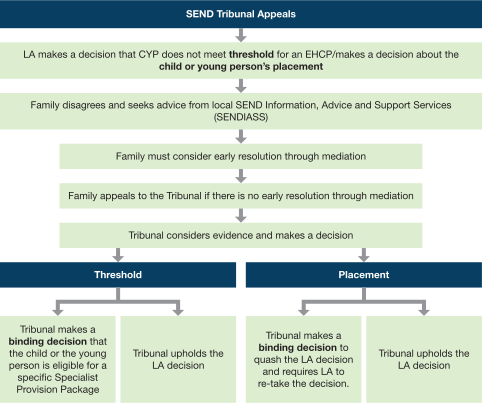
Q38. Do you agree that a SEND specialist (e.g. a SENCO) should sit on the school complaint panel, when the complaint relates to SEND support and provision? Please explain why.
Information, advice and guidance for parents and independent oversight of the system
- We will improve access to support both nationally and locally, with increasing investment in the national helpline and parent carer forums.
- We will appoint an expert panel with an independent chair, who will be responsible for improving the quality of SEND evidence, as well as developing the new Specialist Provision Packages which will underpin the specialist system, and the National Inclusion Standards.
- We will also ask the Children’s Commissioner for England to take on a new remit to oversee and provide scrutiny of SEND reform implementation.
- As evidence develops, the National Inclusion Standards and Specialist Provision Packages will be reviewed regularly.
Plans for improved family support and engagement
We will make it easier for children, young people, and parent carers to access clear advice and practical support from government, both locally and nationally. We want families’ voices and experiences to shape SEND policy and local delivery, ensuring that families can influence decision-making around the support that they receive including in local partnerships, and in the development of the policy that drives those decisions.
Nationally, we will improve access to services by increasing investment in the national helpline. We will also continue to work with and expand parent carers in strategic partnership roles to support system-wide improvements. We know local services are critical, and so we want to help local services to support families better, particularly through the reform implementation period. Alongside the family-centred approach within Best Start Family Hubs, we will increase investment to local information, advice and support services, ensuring the quality of support is improved through enhanced training, including additional capacity for advocacy as was the case for the 2014 reforms with the creation of around 1,200 Independent Supporters across England. These trained individuals provided support to families to help them understand the impact of changes to the SEND system particularly in relation to Education, Health and Care Plans. We will couple this with bringing forward measures such as training and considering accreditation to ensure local services can support the reform implementation period.
We will strengthen the framework within which parent carer forums operate with consistent standards, training and sustainable funding. We will also increase funding for local parent carer forums to enhance their peer support, and have further influence in local SEND systems, working with local partnership boards, Integrated Care Board (ICBs) and Best Start Family Hubs as we implement Experts at Hand. We will look forward to hearing more about what is needed nationally and locally through the consultation and use this as the basis for future support to families.
Independent oversight
There will need to be a robust governance processes in place for developing and reviewing the National Inclusion Standards, so that both the Inclusive Mainstream Practices and Specialist Provision Packages reflect the best available evidence on SEND and build the confidence of the sector and families.
DfE will appoint an expert panel(s), with an independent chair, who will be responsible for developing and reviewing the National Inclusion Standards and Specialist Provision Packages, improving the quality of evidence across the across the SEND system and ensuring alignment between the layers of support. We will make sure the voices of children, families and disabled organisations are heard. We will also work with a mixture of experts, academics, education leaders, the Education Endowment Foundation, health professionals, UK Research and Innovation (UKRI) and scientific advisors. The Chair’s role will include promoting high-quality, evidence-based practice, bringing system actors together to share feedback, engaging with children, young people and their families, and commissioning new research to inform future reviews.
There will also be a new remit for the Children’s Commissioner to provide oversight and scrutiny of SEND reform implementation. We have heard through our engagement the importance of independent scrutiny and challenge, particularly through the implementation period. We will ask the Children’s Commissioner in England to monitor the progress and effectiveness of SEND reforms for all children. This will include a particular focus on children in care, children in need, children not in school, including those who have been excluded, intersectionality and those facing multiple disadvantages. The Children’s Commissioner will use their existing statutory powers on data and entry to report publicly at regular intervals on progress, including identifying gaps, risks, and unintended consequences as well as areas of strength or good practice that we should build on. As is already the case, the Children’s Commissioner may raise concerns or questions with Ofsted or the Department for Education directly.
The National Inclusion Standards will need to be reviewed on a regular basis, to ensure the latest evidence, research and best practice in relation to SEN are reflected. We intend for there to be a review of the evidence included in the Standards for the Universal offer and Targeted layer every two years, to ensure the evidence base stays current as the research and evidence-base into effective provision grows. Specialist Provision Packages will be reviewed by the independent panel every 5 years. The panel may recommend a review of specific aspects of the Standards and Packages outside of these scheduled reviews if significant new research evidence emerges.
DfE will retain overall ownership of the Standards and Packages content, and we intend for the role of the expert panel and the Chair to be set out in law. To support transparency, we will publish review findings, and DfE will be required to explain any decisions not to implement recommendations.
Figure 11: Oversight and review process for National Inclusion Standards and Specialist Provision Packages
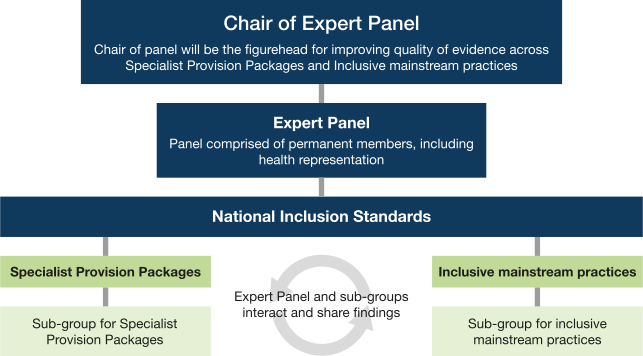
Q39. This consultation outlines a series of measures intended to reform the SEND system. Some of these measures have already been finalised, and this is clearly indicated within the document.
With this in mind, is there anything further you would like to contribute to help inform the remaining proposals that are still under consideration?
Part five: building an inclusive system together
The consultation sets out an ambitious programme for change. Like all major public service reforms, some elements will take time to deliver, but the benefits of new investment will show this year. Children, teachers, educators and parents will start to see real improvements. Crucially, unlike past attempts to reform the SEND system, we are investing before introducing new requirements, so that early years providers, schools and colleges are prepared and supported to make changes. We will also introduce a new Pupil Engagement Framework this summer to help us better understand children and young people’s day-to-day experiences.
Successful delivery of these reforms will require a collective effort. Government cannot achieve this alone. Every part of the system has a role to play. Parents know their child’s needs and experiences better than anyone, and their partnership is essential to the success of these reforms. We recognise their confidence in the system has been eroded over time. Rebuilding trust is fundamental. By investing early, setting clear expectations, and continuing to listen to children, young people and families, we will ensure that reforms are grounded in the lived experiences of those they are designed to support. Through the National Conversation on SEND—the largest engagement of its kind—we have already heard from thousands of parents, practitioners and professionals, and we will continue this dialogue as implementation progresses.
Across the country, there are many excellent early years providers, schools and colleges that provide inclusive, evidence-based support. Some of these examples are included throughout this document, but there are many more demonstrating what is possible when the system works well. Our reforms build on what works: high-quality teaching, early identification, strong relationships with families, and well-trained professionals. While everyone will need to adapt to elements of the reforms, we ask the best providers to share their expertise and experience with others. Where others have further to go, we ask them to meet the challenge. For everyone we will set clear expectations and hold the system to high standards. To support the whole education system, we are:
- investing more money and changing the way we distribute funds to provide more freedom, which comes with the expectation that money is spent where it is more beneficial and settings are held accountable for their expenditure.
- supporting the system with changes through new guidance, working with independent expert panels, local services and with parents, as well as changing the law to make the system easier to operate and more financially sustainable.
- carefully phasing reforms, so that we invest in an inclusive education system, whilst providing certainty for those who benefit from support in the statutory system, before making improvements through national Specialist Provision Packages in consultation with experts and parents.
Phase one: 2026 to 2028
Investing in mainstream inclusion
- We will invest at least £3 billion between the 2026/27 and 2029/30 financial years to create new special school places and tens of thousands of new places in Inclusion Bases. This builds on £740 million committed in 2025 to create new specialist places in mainstream schools.
- We will introduce a new £1.6 billion Inclusive Mainstream Fund over three years from the 2026/27 financial year, worth over £500 million per year, for three years. Funding will help the mainstream system to be more inclusive, guided by the new National Inclusion Standards.
- We will invest £1.8 billion over three years in “Experts at Hand” to improve access to specialist interventions when they need them, reducing delays.
- We will continue to expand Mental Health Support Teams (MHSTs) so that every school and college can access specialist mental health support. By April 2026, MHSTs are expected to cover 60% of pupils and learners in Further Education in England.
Backing the workforce
- We have announced a £200 million national training programme to help all staff. From September 2026, all staff in early years, schools, and colleges will be entitled to receive new, high-quality training, which is government backed and developed with experts.
- We will strengthen requirements so early career teacher training materials include clear guidance on SEND. We will review these requirements again in 2027 to ensure they reflect current evidence.
- We will expand the educational psychologist workforce, by investing in training over 200 new educational psychologists per year from 2026 and 2027.
Phasing reforms
- We will bring forward legislation at the earliest opportunity to introduce the new Specialist Provision Packages. We will publish new guidance, so settings can plan ahead and start delivering new routes to specialist support.
- We will introduce new Individual Support Plans for children with identified SEND. These expectations will be set out in an updated SEND Code of Practice, helping ensure clear, consistent support for families.
- We will hold the whole system to account for making sure that all children and young people receive timely and effective support, reinforcing consistent standards across the system.
- We will publish new guidance on reasonable adjustments, helping settings make practical, proportionate changes that remove barriers to learning for children and young people with SEND.
- Schools will be supported through our Regional Improvement for Standards and Excellence (RISE) inclusion offer, with a particular focus on Reception year. RISE advisers will provide signposting to high-quality, evidence-based support and guidance, enable peer-to-peer collaboration, and promote a culture of continuous improvement.
- We will also host a series of regional conferences on mainstream inclusion, working directly with the sector to embed best practice from the outset.
- Further Education (FE) providers will receive parallel support through the FE Commissioner team and the FE Regional Improvement teams, ensuring a coherent approach across the whole education system.
Using the best evidence
- We will update the SEND Code of Practice after legislation, so it reflects the new system. As part of this process, we will consult widely on proposed changes to ensure they align with best practice and the views of parents, practitioners, and stakeholders. The updated Code will clarify responsibilities; place a stronger emphasis on evidence-based support; and promote inclusion. We will also review and update related guidance to make the Code easier to navigate and use for education settings, local authorities, and health bodies.
- By 2028, we will invest up to £15 million to strengthen the evidence base for the National Inclusion Standards, so support is effective for all types of need.
- We will undertake a full consultation on proposed changes to the Area SEND inspection framework.
High standards for the specialist system
- We will bring forward legislation at the earliest opportunity to ensure a reasonable price is paid for independent special school (ISS) placements, supporting value for money and sustainability.
- We will legislate to bring the duties and oversight of ISSs into line with other special schools, so they play an effective, transparent role within the SEND system.
Phase two: 2028 to 2029
Supporting families through the transition and protecting existing support
- We will provide independent support and advocacy for parents, helping families understand the changes and navigate the transition confidently.
- There will be no changes to support received through EHCPs before at least September 2030, ensuring stability for children and families. The transition to the new system will be phased, reflecting individual needs and circumstances.
- Until new legislation comes into force, the current system will remain in place, including all existing duties, rights, and funding routes. We will take steps to ensure these legal responsibilities continue to be met throughout the transition period.
- Children and young people who have a special school place in September 2029 will be able to stay in special school until the end of their education, unless they choose to move to a mainstream setting.
Meeting needs through the mainstream instead of EHCPs
- Once legislation is in place and reforms are embedded, many more needs will be met earlier through the Universal offer and Targeted layer, reducing the need for an EHCP. Where a child needs support that can only be provided through a Specialist Provision Package and specialist placement, the local authority will assess this carefully.
- Children with existing EHCPs who do not need a Specialist Provision Package will be able to either keep their plan and current provision; or do so until they finish their current phase of education or choose to move to the new system.
Rebalancing funding
- From the 2029/30 financial year, we will begin rebalancing High Needs funding, so a greater share is available upfront to settings. This supports earlier intervention, helping children get the right support sooner.
- We anticipate that, by the end of the 2028/29 financial year, this funding would mean a typical setting could benefit from additional annual support which is equivalent to 40 days per average primary school, 160 days per average secondary school.
Keeping the system evidence led
- Both the National Inclusion Standards and Specialist Provision Packages will be reviewed regularly as the evidence base develops. We plan an initial review after reforms have been in place for two years (around September 2031).
- By 2028, we will invest up to £15 million to strengthen the evidence base for the National Inclusion Standards. The Standards will set out what good, ordinarily available provision looks like. It will help educators to use inclusive strategies, identify barriers to learning, and deliver targeted interventions using the graduated response (assess, plan, do, review).
Phase three: 2029 onwards
- The introduction of Specialist Provision Packages from September 2029 will ensure evidence-based provision to support those with the most complex needs. EHCPs, in their improved form, will remain in place for those who do not meet the new threshold until they either move setting or finish their current phase of education, for example, at the point of transition from primary to secondary or secondary to post-16 education.
- Children and young people will keep their EHCP and associated provision until they finish their current phase of education (primary, secondary, post-16) or choose to move to the new system. As we implement the new system, children and young people will start to transition as they reach the point of changing provision.
- All children and young people who have a special school place in September 2029 will be able to stay in special school until the end of their education, unless they choose to move to a mainstream setting.
Timeline of reforms
What will the government be doing?
Building inclusion 2026/27 and 2027/28
Workforce training programmes open for all staff.
Local authorities (LAs) and Integrated Care Boards (ICBs) begin to establish a multi-agency support offer for children, parents, and settings.
Introducing local area plans (LA and ICB) to prepare for implementation.
Phased changes
New funding and accountability system established in law.
Multi-agency support offer fully established using groups of schools.
Specialist Provision Packages introduced and used for new Education, Health and Care Plans (EHCPs); redress changes introduced.
No changes to support received through Education, Health and Care Plans (EHCPs) before at least September 2030.
Future system by 2035
Schools trusted and held to account to meet the need of their cohorts through core funding.
Funding shifted to early intervention and specialist teachers and support staff.
Specialist settings and EHCPs in mainstream meet most complex needs. LAs and ICBs better able to plan specialist provision/cohort commission. System trends are closely monitored.
When will I see results?
Building inclusion 2026/27 and 2027/28
Children and young people both with and without EHCPs receive support from local inclusion services.
Schools are given additional funding to prepare for reform.
Increased use of Inclusion Bases will allow for more children to receive specialist support closer to home.
Phased changes
Children and young people in mainstream with EHCPs will feel no immediate disruption.
Children and young people in specialist placements have their placement protected until the end of their education.
Parents and children and young people engage with the new Specialist Provision Packages and EHCP process and redress.
Rebalanced funding will support earlier intervention, and investment in acute crisis support will enable more children to remain in mainstream via the Experts at Hand offer.
Future system by 2035
Inclusive practice embedded within mainstream schools, with specialist provision/ EHCPs for children with the most complex needs.
Early intervention and family support helps parents and children before more needs escalate.
Crisis support remains available for those who need it.
Appendices
Appendix A: Table and infographics and case studies
Tables and infographics
Figure 1: The percentage of children with and without SEN sustaining a post-16 destination
Figure 2: State funded special school population as a % of the total school population
Figure 3: Pupils with EHCPs by primary type of need as a percentage of all pupils
Figure 4: Layers of Support
Figure 5: Proposed areas of development
Figure 6: An improved EHC needs assessment process
Figure 7: How Specialist Provision Packages will interact with EHCPs
Figure 8: School Groups and Local Strategic SEND Partnerships
Figure 9: Funding routes for reform
Figure 10: Specialist resolution overview – SEND Tribunal Appeals
Figure 11: Oversight and review process for National Inclusion Standards and Specialist Provision Packages
Case Studies
Case study 1: Inclusive early years education
Case study 2: Inclusive secondary education
Case study 3: Inclusive primary education
Case study 4: Effective assessment and monitoring tools
Case study 5: Driving Early Years Inclusion and outreach
Case study 6: Successful transitions from school to college
Case study 7: Andrea’s* experience of a Support Base – an example day in the life
Case study 8: Experts at Hand* – an example day in the life
Case study 9: Outreach and partnerships with mainstream settings
Case study 10: Co-located specialist support
Case study 11: Sharing of research and expertise from a specialist setting
Case study 12: Tailored support that keeps pupils engaged
Case study 13: Collaborative working in Wakefield
Appendix B: Consultation
Our consultation approach reflects the importance of these reforms encompassing the whole 0-25 system, early years, schools, further education, health bodies, and local government. These detailed proposals on how we intend to deliver reform, guided by our principles for SEND reform, are subject to this public consultation. Through these proposals, together with the broader schools reforms set out in the Schools White Paper, we will build a truly inclusive education system.
To get these proposals right, we will continue to work with young people, parents, teachers, leaders and educators, health representatives, local authorities, and charities as our partners. Parents are at the heart of a child’s education – they teach them their first words, they read them their first stories, they wait at the school gates, they support with homework, and they are often the first to notice when something is not quite right. Whether supporting everyday learning or advocating through the SEND system, parents know their children best. Parental insight is essential. Over the coming months, we will work in deep partnership with voices from across the system through:
- A SEND development steering group comprised of broad membership including parents, teachers, educators, health representatives, local authorities and representative organisations. Ministers are committed to hearing directly from those in the system to develop and strengthen our proposals. We will also do this through visits and a full suite of engagement events.
- In-person consultation events and engagement sessions led by experts in the SEND system and delivered in your local communities, focused on the consultation questions set out in this paper. We will work in partnership with local authorities and key stakeholders to run these sessions, creating space for shared learning, challenge, and testing.
- Targeted roundtables and bilateral conversations with parents, children, and professionals – bringing together those with lived experience to test ideas, surface practical solutions, and ensure reforms reflect the realities that families face.
We recognise that these reforms may have an impact on the Devolved Administrations of Scotland, Wales and Northern Ireland and are committed to consulting with them throughout the process.
Appendix C: Summary of consultation questions
PART A – About You
1. What is your name?
2. What is your email address?
Please note: It is helpful to have your email address if we want to contact you about your answers to the questions in this consultation. You do not have to give your email address, and your views will be considered whether or not you give your email address.
3. Are you happy to be contacted directly about your response?
(Options: Yes; No)
Please note: The Department may wish to contact you directly about your responses to help our understanding of the issues. If we do, we will use the email address you have given above.
4. Are you responding as an individual or on behalf of an organisation?
(Options: Individual; Organisation)
If you are responding as an individual, we will consider the views within your response to this consultation to be your personal views. If you are responding on behalf of an organisation, we will consider the views within your response to this consultation to be those of your organisation and not necessarily your personal views.
5. If you are responding as an individual, how would you describe yourself?
(Options: student, pupil or learner; parent or carer; teacher, tutor or lecturer; researcher, academic or education expert; governor; health, education or childcare professional; other member of the public)
If more than one applies, please select the one that you think is most important to understanding your consultation response.
6. If you are responding on behalf of an organisation, which of the following best describes who/which part of the sector your organisation represents?
(Options: maintained primary school; primary academy; maintained secondary school or sixth form; secondary academy; 16-19 academy; maintained special school or Alternative Provision; special or Alternative Provision academy; other maintained school – e.g. middle school or boarding school; other academy school; independent school; academy trust; sixth form college; general further education colleges (including designated institutions); special post-16 institutions; local authority provider; independent training provider; childminding business; maintained nursery school; private, voluntary or independent early years group setting; representative organisation or trade association; local authority; government organisation/agency; other (please specify))
If more than one applies, please select the one that you think is most important to understanding your consultation response.
7. What is the name of your organisation?
(Free text 250 word limit)
8. What is your role within the organisation?
(Free text 250 word limit)
9. Would you like us to keep your name and/or organisation confidential?
9a. Name: (Options Yes; No)
9b. Organisation: (Options: Yes; No)
10. Would you like us to keep your responses confidential? (Options: Yes; No)
If yes, please explain why you consider it to be confidential.
(Free text 250 word limit)
PART B – Consultation questions
Q1. We want children, young people and their families to be involved in making better, evidence‑based decisions about SEND, both in their local area and across the country.
How can we make sure children, young people and their families have a genuine say in these decisions?
Q2. How can we make sure that high-quality evidence and best practice inform decisions about SEND? Please share examples.
Q3. How can we ensure that children are best supported by the Universal offer?
Q4. How can we ensure that children in the Targeted layer, are best supported?
Q5. How can we ensure that children in the Targeted Plus layer, are best supported?
Q6. How can we ensure that children in the Specialist layer are best supported?
Q7. How do you think early years settings, schools, and college can best support the mental health and wellbeing of children and young people?
Q8. Do you agree that the refreshed ‘areas of development’ will support educators to understand and address barriers to learning and participation? Please explain your answer.
Q9. What arrangements would best support effective joint working between early years providers, Best Start Family Hubs, health, local authorities, and parents for children with SEND in the early years?
Q10. How can the early years foundation stage (EYFS) two-year old progress check and the Healthy Child Programme development review be improved so that children’s needs are identified and supported more quickly? Please share examples.
Q11. What should the top three priority areas be for building and sharing evidence within the National Inclusion Standards?
Q12. What are the most important issues for national training to cover, to help support children and young people with SEND?
Q13. What practical actions can help teachers, educators and leaders manage workload whilst implementing these changes?
Q14. How should the Special Educational Needs Coordinator (SENCO) role evolve to better meet the needs of children and young people with SEND?
Q15. What would provide assurance for families that an Individual Support Plan (ISP) is high-quality and contains the essential information?
Q16: How can we ensure Individual Support Plans are clear, concise and practical for professionals to use?
Q17: How can we best support transition for young people with SEND, so that they are well supported into post-16 provision and further education, training or employment?
Q18. How can we make sure that every area can meet the full range of the needs of children and young people through Inclusion Bases?
Q19. How can we make sure that Inclusion Bases help children and young people succeed in mainstream settings?
Q20. Through the Experts at Hand offer, we want to ensure that mainstream settings can get quick specialist support for children and young people.
What arrangements are needed between local area partners (education, health, social care) to deliver this Experts at Hand offer effectively?
Q21. What needs to be in place so that children and young people with low incidence, highly complex needs can always access the right specialist placement?
Q22. How can Specialist Provision Packages be designed to effectively support the main types of need we currently recognise?
Q23. We propose that EHCPs will guarantee educational provision set out in a Specialist Provision Package, with day-to-day provision captured in Individual Support Plans.
What is needed to make these proposals work effectively?
Q24. We propose creating a more direct route to Specialist Provision Packages and EHCP assessments for children under 5 with complex needs.
How can we make sure this works in practice?
Q25. What would you expect to be considered as part of the needs assessment, for example evidence and expert or professional input?
Q26. What factors should LAs take into account in proposing to parents and young people a list of potential settings to name on a plan?
Q27. What information and support do parents need to make a decision about which setting will be best for their child?
Q28. What do you think is the right maximum length of time for a temporary placement in Alternative Provision (AP) schools? Please explain your rationale.
Q29. We have set out our plans to regulate Independent Special Schools (ISS) sector.
Do you agree that these proposed changes will lead to suitable placements being available at a fair cost? Please explain why.
Q30. How should settings be held accountable for how they spend their Inclusive Mainstream funding?
Q31. Do you agree that more SEND funding should sit directly within mainstream budgets? Please explain why.
Q32: In relation to pooled funding, we propose that every school becomes part of a local SEND group.
Do you agree that this proposal aligns with our aim for all schools to be part of high-quality, community-based trusts?
Q33: How should disagreements about membership, provision, or funding in groups of schools for SEND be resolved?
Q34: How can we ensure the most effective use of these local partnership groups?
Q35. Which stakeholders are important for the success of local partnership groups, and why?
Q36: How can we build stronger collaboration and a culture of improvement through local SEND strategic plans?
Q37. What information, advice and guidance can best support children, young people and their families to ensure greater fairness across the system?
Q38. Do you agree that a SEND specialist (e.g. a SENCO) should sit on the school complaint panel, when the complaint relates to SEND support and provision? Please explain why.
Q39. This consultation outlines a series of measures intended to reform the SEND system. Some of these measures have already been finalised, and this is clearly indicated within the document.
With this in mind, is there anything further you would like to contribute to help inform the remaining proposals that are still under consideration?
Confidentiality
Information provided in response to this consultation, including personal data, may be subject to publication or disclosure under the Freedom of Information Act 2000, the Data Protection Act 2018, or the Environmental Information Regulations 2004.
If you want all, or any part, of a response to be treated as confidential please explain why you consider it to be confidential. If a request for disclosure of the information you have provided is received, your explanation about why you consider it confidential will be taken into account, but no assurance can be given that confidentiality can be maintained. An automatic confidentiality disclaimer generated by your IT system will not, of itself, be regarded as binding on the Department for Education.
Privacy Notice
The personal data (name and address and any other identifying material) that you provide in response to this consultation is processed by the Department for Education as a data controller in accordance with the UK General Data Protection Regulation (UK GDPR) and Data Protection Act 2018, and your personal information will only be used for the purposes of this consultation.
The Department for Education relies upon the lawful basis of article 6(1)(e) of the UK GDPR to process this personal data as necessary for the conduct of this consultation, which is a task carried out in the public interest. Your information will not be shared with third parties unless the law allows or requires it. The personal information will be retained for a period of 12 months following the closure of the consultation period, after which it will be securely destroyed.
You can read more about what the Department for Education does when we ask for and hold your personal information in our personal information charter, which can be found here: Personal information charter – Department for Education – GOV.UK (www.gov.uk).
Statement on Use of AI in Consultation Analysis
We will be using Artificial Intelligence (AI) tools to assist in analysing responses to this consultation. The purpose of using AI is to identify themes, trends, and insights more efficiently and accurately, ensuring that all feedback is considered in a structured and transparent way. AI will not make decisions; it will support our analysis process, which will be reviewed and validated by our team to maintain fairness and integrity.
Appendix D: Summary of proposed areas of development
Area of development: Executive function
What this area includes:
- Attention
- Working memory
- Managing impulses
- Planning and sequencing and organisation
- Cognitive flexibility
Area of development: Motor and physical
What this area includes:
- Gross motor: posture, balance, whole-body control and large movements
- Fine motor: precise hand and finger movements
- Interaction of fine and gross motor to produce purposeful movement
Area of development: Sensory development
What this area includes:
- External senses: vision, hearing, touch, taste, smell
- Internal senses: proprioception, interoception and the vestibular sense
- Sensory processing
Area of development: Social and emotional
What this area includes:
- Understand and manage emotions
- Form relationships
- Navigating social interactions
- Regulating emotions
- Identifying and expressing feelings
- Social cognition
Area of development: Speech, language and communication
What this area includes:
- Speech: generating sounds which make up spoken words
- Language: the development of understanding and using words and sentences with increasing complexity for a range of purposes
- Communication: a range of ways in which children communicate, including language, gesture, signs and symbols
Introduction to the five areas of development
This section describes five core areas that support learning:
- Executive function
- Motor and physical
- Sensory development
- Social and emotional
- Speech, language and communication
Children and young people use these areas in different combinations to help them take part, engage and learn in every phase and type of education.
They give us a shared language structure for:
- Universal provision which is underpinned by an inclusive approach to curriculum design;
- targeted adjustments and interventions; and
- specialist assessment and provision.
Using the same terms at the Universal offer, and across Targeted, Targeted Plus and Specialist layers of support helps to ensure that:
- we take more a consistent approach by using the areas of development to identify where children need extra help, to plan that help, and to deliver it through interventions;
- teachers, teaching assistants, leaders and other education and heath professionals share the same understanding and language; and
- children can move more smoothly between levels of support, without being seen through different or conflicting models of need.
The five areas are interconnected: progress or difficulty in one area can influence outcomes in others. For example, developing communication can strengthen social and emotional development. Progress may be uneven over time, and development in each area can go forward, pause or feel uncertain. This is normal.
All humans have a unique and dynamic profile across these areas. For some children and young people environmental and contextual factors may introduce temporary barriers to learning that can be fully addressed through timely identification and action. For some pupils on-going factors, such as a disability, mean long-term support and adaptation is required. Teachers and leaders should remain curious about children and young people experiencing barriers to learning and have proactive processes for noticing and responding to them and reviewing effectiveness.
Research shows that the early years and first years of primary school are a sensitive phase for developing these skills. For example, many four-year olds will still be learning to focus and sustain their attention.
These skills continue to grow over time. Building strong foundations in the early years matters, and children keep developing and consolidating them throughout their education and into adult life.
Below, we provide a short summary definition for each area for quick reference.
Executive Function
Summary:
Children use executive functions to organise their thinking, behaviour and emotions. These skills can be strengthened through well-designed teaching and routines.
Executive functions are the mental processes that help us:
- focus attention
- hold and use information in our mind
- manage impulses
- plan and organise what we do next
Executive functions help children to make goal-directed decisions and take an active part in learning. As these skills develop, children depend less on automatic reflexes and simple habits, and more on thoughtful, flexible decision-making.
These capacities develop throughout childhood and adolescence, shaped by experience, environment and relationships.
Understanding the core components of executive functioning helps teachers choose approaches that better support children’s learning and make their teaching more effective.
Motor and Physical
Children think and learn through their bodies. Motor skills underpin learning as thinking and conceptual development are rooted in perception and action.
Motor or physical development spans:
- gross motor: posture, balance, whole-body control and large movements
- fine motor: precise hand and finger movements
- how these elements interact to produce purposeful movement
Motor skills involve the planning, control and coordination of the body’s muscles to perform tasks—from early functional movement patterns to more refined, goal-directed actions. This includes developing and consolidating fundamental movement skills such as rolling, reaching, grasping, sitting balance and coordinated weight transfer, as well as the refinement of gross and fine motor control.
Knowing about these components helps teachers understand how motor skills can impact on learning. This knowledge enables teachers to identify barriers to children’s learning which can arise, to avoid conflating motivation with motor/postural limits, and to help children to overcome those barriers with thoughtful adaptions.
Sensory
Children experience and make sense of the world through their senses.
Every child’s sensory profile is unique across five external and three internal senses:
- External: vision, hearing, touch, taste, smell. These deal with sensations from the outside of our body
- Internal: proprioception, interoception and the vestibular sense. These deal with sensory information received from inside the body
- They combine to shape how children explore, engage and learn.
Sensory processing is dynamic, not fixed. The way a child responds to sensory input can fluctuate with context, wellbeing and emotion.
Health issues such as glue ear can affect the senses, and some children and young people will have long-term sensory disabilities, for example vision impairment or deafness that require ongoing special equipment and teaching.
Knowing about these components can help teachers to create an environment invites curiosity, comfort and calm, supporting participation, creativity and concentration.
Social and Emotional
Children participate in the life of the school as social beings and learning is mostly shaped by social contexts, although it is not exclusively social. Children also have emotional responses to the expectations the learning environment places upon them, and their mental wellbeing is integral to these experiences.
Social and emotional development includes how children:
- understand and manage emotions, form relationships, and navigate social situations and learning at school
- regulate emotions, identify and express feelings, and social cognition, such as recognising that others think and feel differently
- recognise social rights and responsibilities, such as valuing dignity, respect, and safety; and understand each person’s role in upholding them
Understanding these components helps teachers to create productive learning environments that promote social and emotional development and support wellbeing. Wellbeing underpins engagement and learning; recognising its role helps the teacher to be curious about the reasons behind a child’s behaviour, to notice patterns and respond to underlying social and emotional needs.
Speech, Language and Communication
Children make sense of the world and connect with others through speech, language and communication.
Each aspect of communication works together to form foundation skills for learning and social development.
- Speech: this is the system of sounds which make up spoken words, speech sounds are acquired in a developmental order which most children acquire by the age of 5 years
- Language: is the development of understanding and using words and sentences with increasing complexity
- Communication: is a broader concept and includes a range of ways in which children communicate, including language, gesture, signs and symbols
Understanding speech, language and communication development supports teachers to notice how each child communicates and helps them to adapt their own communication behaviour as well as create environments that build on these strengths.
-
IPPR and The Difference: Who Is Losing Learning. March, 2025. Who is losing learning March 25 ↩
-
European Agency for Special Needs and Inclusive Education, Evidence: A Review of the Literature (2018) ↩
-
Båtevik and Myklebust (2006) & Myklebust and Båtevik (2005) as cited by Kefallinou et al. (2020). Defined as “economic independence”. ↩
-
IFS, The Short- and Medium-Term Effect of Sure Start on Children’s Outcomes. May, 2025. IFS Report The short- and medium-term effects of Sure Start on children’s outcomes ↩
-
High-quality teaching; IFF and Institute of Education, UCL Working lives of teachers and leaders: wave 3 (2025) ↩
-
In this document, we have used the term ‘schools’ to refer to primary and secondary schools. For the purposes of this document, maintained nursery schools and schoolbased nurseries are grouped with early years settings rather than schools, unless stated‑based nurseries are grouped with early years settings rather than schools, unless stated otherwise. ↩
-
DfE analysis of National Pupil Database – see Every Child Achieving and Thriving White Paper (Analytical Annex) ↩
-
See analysis in ISOS, Towards an effective and financially sustainable approach to SEND (2024); ↩
-
DfE, Educational psychology services: workforce insights and school perspectives on impact (2023) ↩
-
Institute for Fiscal Studies, The short- and medium-term effects of Sure Start on children’s outcomes (2025) ↩
-
‘16-18 study leavers national level destinations’ from ‘16-18 destination measures’; see also National Centre for Social Research, Risk factors for being NEET among young people (2023); IfS, Support for children with disabilities and SEN (2025); Resolution Foundation, False Starts (2025) ↩
-
Funding figures are taken from 2019/20 and 2025/26, made up from other grants as well as the DSG. Dedicated schools grant (DSG): 2025 to 2026 – GOV.UK; [Withdrawn] Dedicated schools grant (DSG): 2019 to 2020 – GOV.UK. Core schools budget grant (CSBG) 2025 to 2026 for special schools, special post-16 institutions and [Withdrawn] Teachers’ pay grant: allocations for 2019 to 2020 financial year – GOV.UK Teachers’ pension grant: 2019 to 2020 allocations – GOV.UK ↩
-
‘All state-funded pupil characteristics and geography data’ from ‘Key stage 4 performance’ ↩
-
Ofsted, Supporting SEND (2021) and Area SEND framework: findings from the first 2 years (2025) ↩
-
Education Select Committee, Solving the SEND Crisis (2025) ↩
-
‘Absence by pupil characteristics’; ‘Suspensions and permanent exclusions - by characteristic’ ↩
-
Special educational needs in England, Academic year 2024/25 ↩
-
The 2025 School Census shows that pupils with EHCPs are likely to travel further than pupils travelling to mainstream schools; 17% of pupils at mainstream secondary schools and 28% of pupils with EHCPs (across all school types) live three or more miles from their school National Audit Office, Home to school transport (2025) ↩
-
Education Select Committee, Solving the SEND Crisis (2025) ↩
-
Broadly defined as children with SEND being educated in mainstream classrooms or settings ↩
-
Kefallinou, A., Symeonidou, S. & Meijer, C.J.W. Understanding the value of inclusive education and its implementation: A review of the literature. Prospects 49, 135–152 (2020). Understanding the value of inclusive education and its implementation: A review of the literature N.B. definitions of inclusion vary across countries. ↩
-
DfE, Educational Outcomes for SEND Pupils: Comparing Outcomes at Mainstream and Special School Settings Across Policy Reforms (2026). ↩
-
Newton Europe, Delivering Better Value Programme Phase 1 Insight Summary (2024) Based on 1,650 case reviews in 48 out of 54 areas selected onto the programme. ↩
-
European Agency for Special Needs and Inclusive Education, Evidence: A Review of the Literature (2018) and Båtevik and Myklebust (2006) & Myklebust and Båtevik (2005) as cited by Kefallinou et al. (2020) ↩
-
1980-1999: Statistics of Education: Schools in England 2000 [pdf]; 2000-2002: Schools, Pupils and their Characteristics Statistical First Release (provisional), January 2010 [pdf]; 2003-2019: Schools, Pupils and their Characteristics 2019 Accompanying Tables [xlsx] (See Table 1a); 2020-2025: ‘Pupils in all schools, by type of SEN provision - 2016 to 2025’ from ‘Special educational needs in England’, Permanent data table - Explore education statistics - GOV.UK ↩
-
Department for Education, Education, health and care plans: England 2025 – GOV.UK (2025). Comparison is with Statements of SEN which were replaced with EHCPs over time by the 2014 reforms. This graph includes state funded and non-maintained special schools 1980-1999. ↩
-
Institute for Fiscal Studies, Spending on special educational needs in England (2024) ↩
-
ISOS, Towards an effective and financially sustainable approach to SEND (2024) ↩
-
DfE analysis of National Pupil Database – see Every Child Achieving and Thriving White Paper (Analytical Annex) ↩
-
High needs funding has increased in real terms five times faster than mainstream school funding between 19-20 and 25-26. Calculated based on published school funding numbers for the high needs block and schools. ↩
-
CB v Birmingham City Council [2018] UKUT 13 (AAC) ↩
-
For years 2009/10 to 2017/18 school cost inflation is based on weighted proportions of teacher pay awards, increases in national minimum and living wage, and consumer price index inflation adjusted for academic years. These proportions are from the school costs technical note. For years 2018/19 to 2024/25 school cost inflation numbers are from the school costs technical notes. STCPD 2009. STPCD 2010. STPCD 2011. STPCD 2012. STPCD 2013. STPCD 2014. STPCD 2015. STPCD 2016. STPCD 2017. Schools’ costs 2018-2020. Schools’ costs 2020-21. Schools’ costs 2021-22. Schools’ costs 2022-24. Schools’ costs 2023-25. CPI 2009-2025. NMW 2009-2025. ↩
-
Institute for Fiscal Studies, Support for children with disabilities and special educational needs (2025). ↩
-
Cor Meijer / European Agency, Financing of Special Needs Education (1999); ISOS, Research on funding for children and young people with SEN (2015); Peter Gray, Written Evidence to Education Select Committee inquiry into SEND (2024); Castro-Kemp et al (2025), Scope SEND ↩
-
According to respondents to the consultation on the SEND Review Green Paper, Independent analysis of the consultation responses to the SEND review: right support, right place, right time; Ofsted, Area SEND framework: findings from the first 2 years of inspections – GOV.UK (2025); Office of the Children’s Commissioner, An inconsistent approach to SEND, findings from analysis of Education Health and Care Plans (EHCP) from two local authorities in England (2022) ↩
-
Ofsted inspection of Rowland Hill Nursery School, 2022, 50198760 ↩
-
Support for children and young people with special educational needs ↩
-
Support for children and young people with special educational needs ↩
-
Special Education Needs in Mainstream Schools guidance report - Education Endowment Foundation ↩
-
EEF blog: Moving from ‘differentiation’ to ‘adaptive teaching’ - EEF ↩
-
Identifying and supporting children and young people with sensory and/or physical needs: a rapid evidence review ↩
-
Nuffield Early Language Intervention Scale Up Impact Evaluation - EEF ↩
-
Institute for Fiscal Studies, The short- and medium-term effects of Sure Start on children’s outcomes (2025) ↩
-
Identifying and supporting the needs of children with SEND in mainstream settings – GOV.UK ↩
-
Identifying and supporting the needs of children with SEND in mainstream settings – GOV.UK ↩
-
Early years foundation stage profile results, Academic year 2024/25 – Explore education statistics – GOV.UK ↩
-
Identifying and supporting the needs of children with SEND in mainstream settings – GOV.UK ↩
-
Childcare and early years provider survey, Reporting year 2025 – Explore education statistics – GOV.UK ↩
-
Nearly a quarter of teachers in mainstream primary and secondary schools reported that they do not have the confidence to meet the needs of pupils with SEND, and a sixth reported that they do not feel they have the sufficient knowledge and skills. School and college voice: January 2025 - GOV.UK ↩
-
31% of teachers say they don’t have the right expertise. School and College Panel Survey (June 2023) ↩
-
IfS, England’s SEND crisis: costs, challenges and the case for reform (2025) ↩
-
Fewer than 40% of SENCOs considering the role to be manageable for one person and 78% of secondary school SENCOs also holding teaching responsibilities. Bath Spa & Nasen (2018) The impact of SENCO workload on the professional and the school ↩
-
P53, Curriculum and Assessment Review final report: Building a world-class curriculum for all ↩
-
Impetus Youth Jobs Gap – Exploring compound disadvantage, page 18 ↩
-
National Audit Office, Home to school (2025) ↩
-
Children’s Commissioner, The Children’s Plan: The Children’s Commissioner’s School Census and School and college voice: January 2025 – GOV.UK ↩
-
DfE, Educational psychology services: workforce insights and school perspectives on impact (2023) ↩
-
Here we mean expert professionals such as Educational Psychologists, Speech and Language Therapists, and Occupational Therapists, as well as related support workers, (e.g. speech and language therapists support workers) and specialist teachers. ↩
-
Early language support for every child: interim evaluation report – GOV.UK, Partnerships for Inclusion of Neurodiversity in Schools (PINS): interim evaluation report – GOV.UK ↩
-
Evaluation of APST, p. 73 ↩
-
Transforming children and young people’s mental health provision – GOV.UK ↩
-
Education, health and care plans, Reporting year 2025 – Explore education statistics – GOV.UK ↩
-
DfE, Educational psychology services: workforce insights and school perspectives on impact ↩
-
Time spent on process for new Education, Health and Care Plans by local authority professionals; Recent research has estimated that the average professional hours educational psychologists spent on an EHCP is 17.4, of which 12.8 hours were on the Education, Health and Care Needs assessment. For principal educational psychologists these estimates were 17.4 and 12.5 hours, respectively. ↩
-
Educational psychology services: workforce insights and school perspectives on impact ↩
-
Educational psychology services: workforce insights and school perspectives on impact ↩
-
EPI, Identifying SEND (2025) ↩
-
According to respondents to the consultation on the SEND Review Green Paper, as reported in Independent analysis of the consultation responses to the SEND review: right support, right place, right time (2023); Ofsted, Area SEND framework: findings from the first 2 years of inspections – GOV.UK (2025); Office of the Children’s Commissioner, An inconsistent approach to SEND, findings from analysis of Education Health and Care Plans (EHCP) 2022) ↩
-
Further background on projections published separately. ↩
-
Ofsted, Area SEND framework: findings from the first 2 years of inspections (2025); ↩
-
Her Majesty’s Government, SEND Review – right support, right place, right time (2022) ↩
-
Office of the Children’s Commissioner, An inconsistent approach to SEND, findings from analysis of Education Health and Care Plans (EHCP) from two local authorities in England (2022); Castro et al, Evaluating the quality of outcomes defined for children with Education Health and Care plans in England: A local picture with global implications (2019); Castro-Kemp at all, et al, Status Quo and Inequalities of the Statutory Provision for Young Children in England, 40 Years on From Warnock (2019) ↩
-
See accompanying annex for background on projections. ↩
-
Data now reported in the School Capacity data collection suggests around two-thirds of special schools are at or over capacity School capacity, Academic year 2023/24 – Explore education statistics – GOV.UK. ↩
-
Settings which are regulated as Non-Maintained Special Schools (NMSS) fall outside the scope of these measures. NMSS are not profit making and whilst some placements are expensive, this reflects the highly specialist offers they provide for the most complex needs. We will work with the sector to ensure that there are appropriate Specialist Provision Packages to capture these offers and adopt an aligned approach to commissioning and funding these placements. ↩
-
Education Select Committee, Solving the SEND Crisis (2025); The growth in expenditure on independent and non-maintained special schools – a total spending Figure now above £2.6 billion a year – accounts for nearly a quarter of the total rise in high-needs spending since 2018-19. This is despite growth in placements at these schools making up just 7% of the growth in EHCPs since 2019, see IfS, England’s SEND crisis: costs, challenges and the case for reform (2025) ↩
-
LGA and Revolution Consulting, Profit Making and Risk in Independent Children’s Social Care Placement Providers (2021) ↩
-
Support for children and young people with special educational needs ↩
-
Education Select Committee, Solving the SEND Crisis (2025); LGA and Revolution Consulting, Profit Making and Risk in Independent Children’s Social Care Placement Providers (2021) ↩
-
For 2026-27, funding for maintained nursery schools and school-based nurseries will be distributed through local authorities. ↩
-
In countries where the finance system is characterised by a direct input model, the most negative voices are heard. These countries point at the different forms of strategic behaviour within the educational field (by parents, teachers and other actors). These forms of strategic behaviour may result in costs. Much money is spent on such non-educational matters as litigation, diagnostic procedures and so on (Meijer 1999). ↩
-
The national funding formula for schools and high needs 26-27, p.10 ↩
-
LA and school expenditure, Financial year 2024-25 – Explore education statistics – GOV.UK ↩
-
LA and school expenditure, Financial year 2024-25 – Explore education statistics – GOV.UK ↩
-
Oxford (2019) After Warnock: The Effects of Perverse Incentives in Policies in England for Students With Special Educational Needs ↩
-
The Sutton Trust, Double Disadvantage (2025) ↩
-
Peter Gray, Written Evidence to Education Select Committee inquiry into SEND (2024) ↩
-
ISOS, Alternative provision market analysis (2018) ↩
-
Final Local Government Finance Settlement: England, 2026-2027 to 2028-2029 ↩
-
Institute for Public Policy Research, Breaking the Cycle: A Blueprint for SEND reform, 2025 ↩
-
Medium Term Planning Framework – delivering change together 2026/27 to 2028/29 ↩
-
Tribunals statistics quarterly: July to September 2025 - GOV.UK ↩