Scheme design for bill discounts for transmission network infrastructure: government response (accessible webpage)
Updated 24 March 2026

© Crown copyright 2026
This publication is licensed under the terms of the Open Government Licence v3.0 except where otherwise stated. To view this licence, visit nationalarchives.gov.uk/doc/open-government-licence/version/3 or write to the Information Policy Team, The National Archives, Kew, London TW9 4DU, or email: psi@nationalarchives.gov.uk.
Where we have identified any third party copyright information you will need to obtain permission from the copyright holders concerned.
This publication is available at https://www.gov.uk/government/consultations/scheme-design-for-bill-discounts-for-new-transmission-network-infrastructure/outcome/scheme-design-for-bill-discounts-for-transmission-network-infrastructure-government-response-accessible-webpage
Introduction
This document details the UK government’s response to a consultation on the proposed scheme design for bill discounts for households living near new or significantly upgraded electricity network transmission infrastructure, published on 8 August 2025.
Overview
Building more electricity transmission infrastructure is key to achieving the government’s missions of making Great Britain a clean energy superpower, boosting our energy independence and reducing electricity bills.
The electricity transmission network is required to move electricity from where it is generated to where it is needed. To meet future electricity demand, around twice as much new transmission network infrastructure will be needed in the UK’s grid by 2030 as has been built in the past decade. The government is delivering the biggest upgrade in Great Britain’s electricity network in decades, which will minimise constraint costs and meet the capacity needed to deliver clean power by 2030. This critical need to upgrade the transmission network means that more communities across the country will be living close to electricity transmission network infrastructure, which can raise concerns about local impacts, it is only right that these communities directly benefit from hosting this infrastructure. In March 2025, the government announced its intention to establish a bill discount scheme, enabled through the Planning and Infrastructure Act. The government intends for this scheme to cover households living near certain new or significantly upgraded electricity network transmission infrastructure, offering electricity bill discounts of up to £250 a year for 10 years for households living within 500m of new or significantly upgraded electricity transmission network infrastructure. The bill discount scheme, as part of a wider community benefit package which includes community funds, will ensure those who host new clean electricity transmission infrastructure will directly benefit from this. In addition, we are working with the electricity networks sector as part of the development of a Sector Growth Plan to ensure that investment in our network infrastructure supports growth in the domestic supply chain and skills needed. The Electricity Networks Sector Growth Plan interim report, published in December 2025, revealed that tens of thousands of jobs are set to be generated across electricity transmission and distribution network operators, their supply chain and contractors.[footnote 1]
Reducing delays to network infrastructure projects is critical to reducing constraint costs. Analysis by the National Energy System Operator (NESO) indicates that if critical transmission network projects are not brought forward and delays to wider network projects persist, annual constraint costs could rise from the already high level of around £1.7bn in 2024 to a peak of £8bn in 2030.[footnote 2] Through its Reformed National Pricing package of reforms, the government is also considering ways to further reduce constraint costs, through market reforms including through the implementation of strategic spatial planning and improving system efficiencies.
The bill discount scheme will be funded by an obligation on electricity suppliers. Suppliers are expected to recoup costs by passing these onto their customers through a small increase to customer bills. However, delays to network infrastructure construction could increase consumer bills to a greater extent, as a result of network constraint costs.
In March 2025, the government announced its intention to establish a bill discount scheme, established through the Planning and Infrastructure Act. The government intends for this scheme to cover households living near certain new or significantly upgraded electricity network transmission infrastructure. The scheme will apply to Transmission Owner (TO)-built onshore, above-ground electricity transmission infrastructure, (provided that construction began on or after 10 March 2025,) such as overhead transmission lines, pylons, substations, convertors, switching stations and sealing-end compounds. As this is a novel scheme, the government intends to launch the scheme with only TO-built projects in scope, with a view to expanding the scope to other transmission projects in future where possible. Infrastructure that starts main construction works after the end of 2040 will not be in scope of the scheme, regardless of whether it meets the eligibility criteria. The government intends to review this date between 2035-2040 to mitigate risk of excluding key infrastructure projects that are delayed. The eligibility zone around qualifying infrastructure projects will be 500 metres, with households within this zone receiving a discount of up to £250 a year, for up to 10 years.
For the majority of eligible households, the discount will be paid automatically via their electricity supplier. Suppliers will also be responsible for delivering scheme benefits to their eligible pre-payment meter customers. This centralised approach will minimise the administrative burden and will make the scheme easier for suppliers, TOs and eligible households. A minority of households eligible for the scheme will not have a standard domestic electricity supply contract, for example if their property is served by a commercial electricity supply. These households will be able to opt-in to the scheme. To facilitate the delivery of the scheme to these residents, the scheme administrator will manage opt-in applications, payments, and a customer service function.
On 8 August 2025, we published a consultation outlining provisional design for the bill discount scheme. The consultation covered the following areas:
- Infrastructure in scope of the scheme
- Eligibility to be able to receive the bill discount
- Roles of the scheme administrator; and
- Delivery of the scheme
We requested feedback from stakeholders on the above to help inform the government on how to ensure scheme design best met the needs of recipients, as well as stakeholders involved in scheme delivery. The following section provides an overview of the responses received, key decisions being taken forward by government for the scheme, and a more detailed response to each question. We have also used this consultation response as an opportunity to provide further clarity to stakeholders on other functions of the scheme. The responses we received to this consultation have been considered as part of finalising the design for the scheme. The government is now progressing with the delivery of the scheme, with further details provided in the Next Steps section.
Consultation responses
The consultation received a total of 243 responses from a range of stakeholders, including the Office of Gas and Electricity Markets (Ofgem), TOs, electricity suppliers, park home associations, care home providers, community groups, charities, trade associations, individuals and a campaign group.
In addition to seeking views through publication of this consultation document, we engaged regularly with stakeholders, including energy suppliers and TOs. We also hosted further external forums with groups to answer questions about the scheme.
Within the responses, stakeholders agreed there was a need to recognise the role that host communities play in delivering the electricity network infrastructure. However, stakeholders also recognised the need to balance the benefits delivered to host communities with the potential impact on billpayers. The government agrees with this view, and we are working to ensure this balance is struck. For more information, please see the Impact Assessment for the scheme, which has been published alongside this government response.
Overall, there were positive views towards the scope of the infrastructure included within the scheme, such as the decision not to include underground cabling, and the decision to align with existing government guidance where possible. Respondents also expressed positive views towards the inclusion of certain types of capacity upgrades to existing infrastructure. However, we did receive challenge from the proposed scheme administrator on the complexity on including some project types without a clear framework for data acquisition.
Many respondents agreed with the proposed functions of the scheme administrator. Questions were also raised regarding who would conduct the functions of the scheme administrator The government has been working closely with Ofgem since conception of the scheme and is discussion with Ofgem about the possibility of them taking on the Scheme Administrator role.
There was support for the inclusion of households without a standard domestic electricity supply through provision of an opt-in scheme, and for the use of banker’s automated clearing system (BACS) payments as the primary delivery method for opt-in scheme recipients. Taking on board consultation responses and further assessments, we have made the decision not to include multiple occupancy buildings in scope of the scheme (such as care homes or student accommodation), due to the disproportionate levels of administrative complexity to deliver to this group. HMO eligibility remains unaffected by this decision. Further information can be found in the government response to question 9.
We also noted that using Meter Point Administration Number (MPAN) and Unique Property Reference Number (UPRN) data to map eligible properties received negative responses, with some respondents expressing concern that there is a cliff-edge of eligibility, or that the eligibility zone is too small. We received responses suggesting that second homes should be excluded from the scheme, and suggestions that certain businesses such as tourism and hospitality should be able to benefit. Further responses to these areas can be found in questions 3 and 4.
The consultation received many responses as part of a campaign response from communities in East Anglia. These campaign responses stated their objections to new, above ground, transmission network infrastructure. Respondents from this campaign also outlined their preference for TOs to offer a discretionary property purchase scheme instead. Further detail on the government’s response to this are highlighted in question 1.
The purpose of this consultation was to seek views on the design of the scheme. This included intentions for project and household eligibility, scheme administration, payment methods, communications, and scheme funding. Whilst in most areas we are intending to continue with our consultation proposals, following analysis of responses we are making changes to whether multiple occupancy households are eligible for the scheme, and the eligibility of ‘edge-cases’ for households on the boundary of the eligibility zone.
The next section details a summary of the responses we received to the consultation, and the government’s response to each. The government has considered all responses received on this consultation. However, as this is a summary it will not detail all responses but instead will outline common themes and areas of note. This summary of responses uses the following guidance:
- ‘Most respondents’ indicates the clear view of more than 75% of respondents
- ‘Many respondents’ indicates the view of 50%-75% of respondents
- ‘Some respondents’ refers to the range between 25% and 50% of respondents; and
- ‘A few respondents’ refers to the range between 0% and 25% of respondents
Detail of consultation responses
Q1. Do you have any views on infrastructure eligibility for the scheme?
Of the 22 respondents who had views on our proposals for the types of infrastructure that should be in scope of the scheme, many agreed with the recommendations. These respondents acknowledged the role that communities play in hosting this infrastructure and agreed with the decision to align with the government’s guidance on community funds for electricity transmission infrastructure where possible. They also agreed that underground cables should be excluded, as they are already seen as a form of mitigation and are substantially more costly than overhead lines. A few respondents asked for clarity on the inclusion of 132 kV overhead transmission lines in Scotland, as transmission lines are 275 kV or 400 kV in England and Wales but also include 132 kV in Scotland.
A few respondents requested that the scope of the bill discount scheme be extended to cover other types of electricity infrastructure, such as underground cables and distribution infrastructure, as they commented that this infrastructure will affect the host communities. A few respondents also noted their objection to the construction of new electricity transmission infrastructure more broadly due to its visual impact on the countryside; a couple of respondents suggested that all new electricity transmission infrastructure should be undergrounded.
One respondent noted the complexity of including a broad variety of different transmission projects and queried whether such an expansive scope would be deliverable in practice.
Government response:
For the context of this scheme, we have categorised transmission infrastructure works into the following categories:
- Wider works: Strategically planned transmission infrastructure built by TOs
- Enabling works: Transmission infrastructure built by TOs to facilitate connections to the grid
- User self-build: A subset of enabling works facilitating connections to the grid built by developers
For the scheme administrator to correctly map the eligibility zone of a project (see question 4), they will need to have detail on the pipeline of eligible projects coming forward, and specific geospatial data of each project. Following further analysis and stakeholder feedback, it is apparent that there are different challenges in obtaining this data for the different categories of transmission works.
In recognition of the scheme being novel and the first of its kind in requiring this geospatial data, and that we wish to progress delivery of the scheme, we have decided to include only those projects where this data acquisition, at the point of construction, is currently certain. This means the scheme’s scope will currently be limited to TO-built transmission projects (meaning TO-built wider works and TO-built enabling works). This will capture the majority of households close to proposed transmission network. This approach ensures that bill discounts can be delivered as soon as possible for the majority of projects being delivered for 2030.
However, we acknowledge that communities also host transmission infrastructure not built by TOs (such as onshore substations of interconnectors or offshore windfarms), and that they should be recognised for this role. Communities hosting these projects will continue to benefit from our voluntary community funds guidance[footnote 3]. With respect to bill discounts, we intend to explore ways to expand the scheme to include these types of transmission network infrastructure wherever possible, and we will keep investigating viable routes to secure the data needed to include user self-build transmission projects in future.
Noting the above criteria, the government is maintaining the position that the scheme will apply to new onshore, overhead transmission lines (usually 275 kW or 400 kV, but also 132 kV in Scotland), the associated electricity transmission infrastructure (for example, substations, convertors, switching stations and sealing-end compounds). Infrastructure that meets these criteria, is built by TOs, and starts main construction works from 10 March 2025 (the date the scheme was announced) will be in scope.
TO-built 132 kV transmission infrastructure in Scotland will be in scope of the scheme. This is because it forms part of the transmission network that will help achieve the government’s mission and the scheme aims to acknowledge the role communities play in hosting this new infrastructure.
The following significant TO-built upgrades of existing electricity transmission infrastructure will also be in scope:
- sections of existing transmission routes that require voltage uprating[footnote 4] and are screened as requiring an Environmental Impact Assessment[footnote 5]
- sections of existing transmission routes that require a capacity upgrade, are screened as requiring an Environmental Impact Assessment and which involve upgrading from poles to steel lattice pylons
- substation extension projects that increase the footprint of an existing substation beyond the original boundary by at least one hectare
Other energy infrastructure: The scheme will only apply to infrastructure that is carrying out the regulated activity of transmission that has been built by TOs, therefore other types of infrastructure (such as distribution infrastructure) will not be in scope. This is because electricity transmission infrastructure is the largest scale of network infrastructure and will have the most impact on supporting the delivery of clean, renewable electricity from where it is generated to where it is needed. It is therefore right that these projects provide clear benefits for the communities who host this infrastructure.
While this scheme focuses solely on electricity transmission infrastructure, the Clean Power Action Plan makes clear that communities who host other clean energy infrastructure will benefit from it. Separate proposals were set out in a government working paper on community benefits and shared ownership of low carbon energy infrastructure[footnote 6] (published on 21 May 2025). The working paper proposed that energy infrastructure developers would be required to contribute to community benefit funds to support families, businesses and local community groups who live near new low carbon energy infrastructure, such as solar and onshore wind projects.
Underground transmission infrastructure: We are also maintaining our position that underground cables will not be in scope of the scheme. The government’s position is that overhead lines should be the strong starting presumption, with undergrounding costing an estimated 4 and a half times more than overhead lines, according to a study published by the Institution of Engineering and Technology (IET) in April 2025.[footnote 7] The cost of building this infrastructure is borne by electricity bill payers, and we expect the costs of the bill discount scheme to be borne by bill payers, so it is paramount we keep costs down. In addition, overhead lines are much quicker and easier to build, cause less environmental damage, are much easier to maintain and repair and are easier to interconnect with existing circuits. Underground cables are generally seen as a mitigation for communities, so bill discounts could be seen as a ‘double benefit.’
Scheme end: Infrastructure that starts main construction works after the end of 2040 will not be in scope of the scheme, regardless of whether it meets the eligibility criteria, although the government intends to build in a review of this date from 2035-2040 to mitigate any risk of excluding key infrastructure projects that are delayed.
We are conscious that this is a novel scheme; we plan to hold 2 review points within the first 5 years of delivery to gain a detailed understanding of the scheme’s roll-out, which will be informed by monitoring and evaluation activity. These review points will provide opportunity for early learnings, improvements, course correction or even to close the scheme earlier than intended, to mitigate against any unintended or negative effects of the scheme.
Q2. Do you have any views on including certain types of capacity upgrades to existing electricity transmission infrastructure?
Regarding the proposal to include certain types of capacity upgrades (sections of existing transmission routes that require a capacity upgrade, are screened as requiring an Environmental Impact Assessment and which involve upgrading from poles to steel lattice pylons), most respondents who provided views on this agreed.
One respondent suggested that the case for including these projects is generally weaker than for new infrastructure, as most affected residents would have moved into their property with electricity transmission infrastructure already present. They recommended considering a higher eligibility threshold for upgrade projects, with decisions taken on a case-by-case basis.
Government response:
Regarding upgrades to existing transmission network infrastructure, the bill discount scheme will align with the guidance on community funds for electricity transmission infrastructure[footnote 8] for TO projects.
The capacity upgrades in scope of the scheme will be sections of existing transmission routes that are screened as requiring an Environmental Impact Assessment and which involve upgrading from wooden poles to steel lattice pylons.
The government intends to maintain the position set out in the consultation that the following upgrades will also be in scope, noting this applies to only TO projects:
- sections of existing transmission routes that require voltage uprating[footnote 9] and are screened as requiring an Environmental Impact Assessment[footnote 10]
- substation extension projects that increase the footprint of an existing substation beyond the original boundary by at least one hectare
We acknowledge that one respondent recommended considering a higher eligibility threshold for upgrade projects and taking decisions on a case-by-case basis. However, this approach could lead to inconsistencies with how bill discounts are paid and we want to ensure communities have the same experience of the scheme. We have worked with TOs to carefully consider which upgrades will be in scope of the scheme and set out clear criteria to ensure consistency. Those mentioned above are deemed to be significant enough to be included.
Q3. Do you agree to the approach to determining eligibility for the scheme?
The consultation outlined our proposals for eligibility for the scheme, with eligibility to be tied to a property existing within the eligibility zone of an eligible infrastructure project, regardless of if the property was vacant, a second home, or a holiday let. The consultation also established that a property is defined as an ‘immoveable or static structure located on a permanent, authorised site’, and that businesses on non-domestic contracts would be excluded from the scheme.
Many of the responses to this question agreed with the recommended approach to determining property eligibility for the scheme. For example, some respondents agreed that including properties that exist at the point of timestamping provides clarity and ensures the scheme is deliverable; that the scheme administrator (rather than suppliers) should be responsible for determining property eligibility; and that identifying and excluding vacant properties and second homes would be too administratively complex.
A few respondents suggested including businesses on non-domestic contracts and new builds to acknowledge the impact of the infrastructure on them and excluding second homes to maximise scheme acceptability amongst permanent residents.
Finally, one respondent asked for clarity on the government’s position on whether payments will continue in the case of projects where construction starts but is not completed.
Government response:
The government has considered views and intends to maintain the positions set out in the consultation on eligibility, including positions on businesses, new builds, second homes, vacant properties and all-inclusive bill arrangements.
Businesses: For businesses, although a few respondents suggested it would be fairer to include businesses on non-domestic contracts, or to include certain types of businesses (for example, those in the tourism or hospitality industries), many agreed with our proposals to exclude them. We intend to maintain our position of excluding businesses on non-domestic contracts from the scheme because including them would increase scheme costs. Moreover, only including certain types of businesses would increase the scheme’s complexity of delivery.
The bill discount scheme aims to recognise those living closest to certain new transmission network infrastructure, but all electricity consumers could stand to benefit if this policy supports the broader government objective of reduced network delays and associated constraint costs. All communities near new electricity transmission infrastructure will be eligible for community funds, which will be developed with these communities and tailored to their needs[footnote 11].
New build properties: Regarding new build properties, we intend that infrastructure (or significant upgrade) should be new in relation to a property and its MPAN, for the property to be in scope of the scheme. Subject to deliverability, any properties that are built or assigned an MPAN after a project has been timestamped will not be eligible for the scheme. MPANs are typically assigned early in the construction process, meaning a property in development when construction on eligible electricity transmission infrastructure begins will likely be in scope of the scheme. If a new build has been assigned an MPAN before the eligibility zone is timestamped but the property remains unsold, the property may be considered vacant (see section on ‘vacant properties’ below). If there is a live electricity contract in place, whoever is responsible for paying the electricity bills until the property is sold will receive the bill discount for that period. If using MPAN data proves to be impractical to identify to determine whether a property existed before construction starts, we may use the date of UPRN assignment as an alternative, subject to further digital discovery.
Incomplete projects: If construction starts on an eligible infrastructure project but is not completed and the TO will not recommence, the government’s position is that bill discounts should cease to be made once construction ends, as communities will no longer be living near electricity transmission network infrastructure, which is the focus of the scheme. In these cases, the final payment should be made in the next payment period after construction stops.
Second and vacant homes: For second and vacant homes on standard domestic meters, a few respondents suggested that these properties should be excluded given the scheme aims to benefit those living in eligible properties. We intend to maintain our position to include these properties in the scheme, as our current view is that it would be too administratively complex to exclude them. Data on which properties are used as second homes is not held by suppliers, and there is no complete register across Great Britain of second or vacant homes which can be used to identify these properties. It is unclear whether it is feasible to exclude these properties with available data, and it would not be possible to introduce such a process in time for scheme launch. However, we intend to continue exploring the feasibility of developing and introducing an exclusion once the scheme has launched.
Vacant properties will be excluded by default if the electricity supply has been disconnected, as no electricity bill will be paid in this instance, therefore there is no automatic route for delivering bill discounts. If a household is living at a property without a connected electricity supply (for example, they are off-grid) then they may be eligible and can apply through the opt-in scheme.
All-inclusive bill arrangements: For arrangements where an intermediary, such as a landlord, is paying for electricity bills and charging eligible households on an all-inclusive basis, the position remains that the property residents remain eligible for the scheme, and that the intermediary will be subject to a legal pass-through requirement. Further details can be found in the government response question for question 9.
Q4. Do you have any views on the method of mapping the eligibility zone and identifying eligible properties?
Of the 19 respondents who provided views on the method of mapping the eligibility zone and identifying eligible properties, some respondents agreed with our proposals.
Although many respondents agreed with our proposals to designate a fixed eligibility zone based on distance as this provides a clear, objective basis for identifying eligible recipients, a few suggested a 500m zone would lead to a strict cut off to the eligibility zone and that there should be a sliding scale of payment based on distance from the infrastructure, or that payments should be based on visual impact.
The consultation stated that “the method for mapping the exact location of a project’s eligibility zone is under development and will likely be based on distance using a project’s limit of deviation (LoD)”[footnote 12]. A few respondents noted that if we were to measure the eligibility zone from the centre of the LoD this could be unfair if infrastructure is not built right in the middle of the LoD, as some properties within 500m of the infrastructure could miss out on bill discounts. One respondent suggested waiting until construction finishes to start paying bill discounts so that the zone can be measured from the infrastructure’s final location.
Many respondents agreed with our proposals for timestamping, but a few outlined the potential difficulty of timestamping due to the practical challenges of identifying when construction begins. One respondent suggested that timestamping should instead be linked to the consenting process.
While respondents were generally supportive of wanting to ensure that properties on the edge of the eligibility zone were included, we received feedback that our approach of letting edge cases apply via the opt-in scheme would be unfair and would put the onus on households to correct an administrative oversight.
Many respondents were supportive of using UPRNs and MPANs to identify properties within the eligibility zone; however, there were some responses that flagged some of the issues of using these, and an MPAN database such as the Electricity Central Online Enquire Service (ECOES), as the principal tools for property identification.
Government response:
Measuring the eligibility zone: The eligibility zone will be 500m from the edge of the LoD for TO-built projects to ensure all residents within 500m of the infrastructure’s final location are eligible for the scheme. This mapping will be undertaken by the scheme administrator who will map this based on geospatial data provided by the TOs. The 500m distance was determined to provide balance between ensuring communities are recognised for hosting certain new electricity transmission network infrastructure and overall costs to billpayers. Should some types of User self-build projects be included in future, we may determine a different approach for measuring the eligibility zone for these projects.
Basing eligibility on distance provides a clear, objective rationale for who receives bill discounts. Attempting to base eligibility on impact of infrastructure creates a subjective element to eligibility, which is far harder to deliver, and is likely to increase the number of appeals and objections from those not included, increasing the administrative and financial burden of the scheme.
We acknowledge the responses received about how measuring from the centre of a project’s limit of deviation (LoD) could create perceived unfairness for some recipients. Our view is that measuring from the edge of a project’s LoD would be the best option to ensure that those living within 500m of the infrastructure benefit, with minimal administrative burden.
Property identification: Having considered the responses received, we believe that the scheme administrator using UPRNs and MPANs to identify properties in the eligibility zone is still the best approach to property identification. The scheme administrator will consider any properties that have part of their physical boundary within the eligibility zone as eligible. The scheme administrator will then use the linked UPRN of these properties to determine their address and then use their address to determine their MPAN and associated supplier. We will work to ensure that the process is as efficient as possible, mitigate against potential flaws in the datasets and endeavour to ensure that as many eligible properties as possible are correctly identified during the mapping process.
Following feedback on the government’s proposal to ask that those in properties on the edge of the eligibility zone apply via the opt-in scheme, we intend that any properties which are partially within the zone will be identified automatically, removing the need for these properties to apply via the opt-in scheme. We understand that this is likely to decrease administrative burden as the scheme administrator will not need to verify these opt-in applications and should reduce operational costs. Please see the Impact Assessment for the scheme, which has been published alongside this response.
If a single household has multiple MPANs, then we intend that only the first MPAN which was registered receives payment. If a separate household is associated with an excluded MPAN, they will need to apply via the opt-in route and prove that they are a separate household. If a single MPAN has multiple households, then we intend that the household which is registered to a supplier receives a discount. Any subsequent households sharing the MPAN will then need to apply via the opt-in route and prove that they are a separate household.
Timestamping the eligibility zone: We can confirm that the eligibility zone will be timestamped by the scheme administrator based on project data received from TOs when main construction work starts on the eligible infrastructure, in line with wider community funds for electricity transmission infrastructure guidance.
We are defining ‘main construction work’ as the point at which work has started on site for the full main works contract (for example, when main works commence, as set out in the planning application, and all pre-commencement conditions have been completed). For an overhead line this would typically be commencing construction of access roads to provide access for overhead line build and for a substation this would typically be commencement of earthworks and service diversions. This does not include any initial public access or scoping work (for example, site preparation works that take place prior to work under the main construction contract, such as Ground Investigation, setting up temporary office accommodation, upgrading existing public roads or using specialist equipment to access the construction site).
In order for the scheme administrator to accurately timestamp and map each eligibility zone, the transmission licence holder must provide the following data to the scheme administrator:
- geospatial vector data in shapefile format identifying the limits of deviation of the project (to be shared as soon as possible after the project receives development consent)
- the anticipated construction commencement date (to be shared as soon as possible after the project receives planning consent, then confirmed as soon as possible after the start of main construction)
One respondent suggested that the timestamping date should be linked to the consenting process, such as to the granting of planning permission or authorisation of a Development Consent Order (DCO). However, this would mean that any new MPANs assigned between consenting and main infrastructure construction starting would be excluded from the scheme, whereas timestamping at main construction means these MPANs would be included in the scheme because they would already exist at the point of timestamping. Timestamping at construction start would include these properties, and we want to ensure that properties that exist when main infrastructure works begin are eligible for the scheme. Furthermore, we want to avoid a situation where payments are made for projects which later significantly change or do not go ahead, as we expect the cost of the scheme to be passed onto electricity billpayers.
Q5. Are there any functions you think we should ensure the scheme administrator can deliver?
Many of the responses to this question suggested functions that they deemed necessary for the scheme administrator to fulfil, either agreeing with all proposed functions and/or highlighting specific functions they believed should be fulfilled, such as identification of households (particularly opt-in) and having a role in comms/queries/complaints.
In responding to this question, several other notable themes or specific functions were raised. A few respondents noted that the scheme administrator must be properly resourced and adaptable to any changes (for example, as different levels of network are built that may be in scope of the scheme), and a few also noted there must be appropriate governance arrangements in place for the scheme administrator. With respect to eligible recipients, a few respondents noted that the scheme administrator should identify opt-in households, and one respondent also noted the importance of the scheme administrator issuing eligible MPANs to suppliers. A few respondents noted that domestic recipients on non-domestic contracts should be managed by the scheme administrator.
Furthermore, a few respondents noted that the administrator must be involved in communications (for example one respondent proposed an online resource managed by the scheme administrator containing FAQs/scheme information and one respondent noted about direct communication with opt-in households), and a few noted that customer complaints/queries must be managed by the scheme administrator (for example, on eligibility).
Government response:
DESNZ will set out the policy and specific design of the scheme, setting out details within secondary legislation. DESNZ will also ensure that the scheme administrator has sufficient resource to fulfil the role, including by setting up appropriate governance.
The government intends that the scheme administrator should fulfil the following functions outlined in the consultation, including mapping of the eligibility zone using project data provided by TOs, identification of eligible recipients, management of the opt-in process (discussed in questions 8, 10 and 11), conducting the reconciliation process (discussed in question 14), scheme monitoring and reporting (discussed below), and a role in scheme communications (see question 7). The scheme administrator will also be responsible for conducting the mutualisation process (see question 15) and setting the de minimis threshold (see question 16). They will also have appropriate compliance and enforcement powers (see below).
With respect to identification of properties within the eligibility zone, the scheme administrator will also identify edge case properties automatically, avoiding the need for them to opt-in. The scheme administrator will identify eligible MPANs to the relevant supplier, from which the supplier can identify their customer.
Scheme reporting: The scheme administrator will be required to provide DESNZ with data and statistics of the scheme (for example the number of households receiving the scheme benefit and the number of opt-in applications); they will also be required to publish relevant information on the scheme costs and timings, including reconciliation timings. DESNZ will monitor and evaluate the scheme’s delivery and early impact on communities across the country, utilising a combination of operational data and insights from scheme participants and wider stakeholders.
Opt-in: The scheme administrator will manage the opt-in process, including processing applications, managing the digital application portal, paying eligible households and providing a customer service function. This includes eligible households on commercial electricity supplies, who will remain as opt-in households and be paid by the scheme administrator. Although the scheme administrator will attempt wherever reasonably practicable to identify and contact eligible opt-in households, they may not always be unable to identify all such households due to incomplete or missing data.
The government will use targeted communications to help make opt-in households aware of the scheme. Question 7 has more information regarding communications strategy for the scheme including the role of the scheme administrator.
Compliance and enforcement: The scheme administrator will be responsible for managing and enforcing the scheme to ensure that scheme obligations are fulfilled and that non-compliance (including fraud) is handled appropriately. The government intends to implement a compliance process which aims to both deter and handle failure to meet scheme obligations and yet remains proportionate. Enforcement actions on a regulated licenced party may involve actions such as imposing financial penalties or making consumer redress orders, amongst others.
Scheme monitoring: The scheme administrator will be responsible for monitoring non-compliance and fraud via audit, compliance, counter-fraud and potentially enforcement controls. To monitor the scheme effectively, we will ensure that the scheme administrator will have appropriate auditing and compliance functions and processes, including legal powers to carry out desk-based audits, request and review information from scheme participants and delivery partners, carrying out investigations and taking compliance action if appropriate. This will help maintain scheme oversight and allow monitoring of scheme delivery in the automatic and opt-in scheme; for example, verifying supplier data used in the reconciliation process, verifying applicant details submitted in the opt-in application process and ensuring payment to eligible recipients. We are still considering the specific details of how these auditing processes will look and operate.
Compliance process for scheme participants: This section sets out further details on the compliance process for scheme participants. In this context, ‘scheme participants’ means anyone who is receiving scheme benefits, whether that is through automatic bill discounts or via the opt-in scheme.
For successful applicants for the opt-in scheme, by signing up to receive scheme benefits they will be agreeing to adhere to some scheme rules. Failure to do so, or misconduct, may result in compliance action. Obligations will include providing information when requested by the Administrator, provide and providing updates when changes of circumstances mean an opt-in household is no longer eligible for the scheme (for example, they have moved out of an eligible property).
For intermediaries subject to the pass-through requirement, as set out in the response to Question 9, obligated intermediaries must pass scheme benefits to eligible households. If a tenant or other resident whose bills are paid for by an intermediary suspects non-compliance, they can flag this to the administrator who will assess whether the issue should be investigated.
The scheme administrator will be given the following powers to assist with compliance investigations:
- pause and recover payments
- request information from scheme participants
- permanently banning/removing non-compliant scheme participants from the scheme
- allow data relating to compliance cases (including any associated personal data) to be shared with law enforcement and other government departments as needed
These powers will be enabled via scheme regulations, and full details will be set out in scheme guidance in due course.
The consultation mentioned, subject to final scheme design, including powers to allow the scheme administrator to issue civil penalties against scheme participants for failure to meet scheme obligations, including the pass-through requirement. We do not intend to include provisions to allow the administrator to issue civil penalties against scheme participants, due to the expected disproportionate costs to deliver such a function.
Q6. Do you agree with the proposed approach to considering eligibility for the opt-in scheme? Are there any other household living arrangements we should consider? Please provide any reasoning to support your response.
Most respondents agreed with the proposed approach to eligibility for the opt-in scheme, including the proposed exclusions of property types which are not authorised for permanent residence in a single area.
Those who disagreed did so because they felt the 500m distance was too large, or they disagreed with the scheme as a whole and the impact on consumer bills. One respondent disagreed with the opt-in scheme due to the administrative complexity. The opt-in scheme would include requirements such as a digital portal, bespoke verification processes and communications and legal compliance and enforcement mechanisms. It was felt this may be disproportionate to the scale of benefit being delivered.
Of those who agreed with the eligibility proposals, several respondents raised concerns over the higher administrative costs of the opt-in scheme, noting that a balance should be struck between opt in eligibility and disproportionate costs to bill payers. Other points raised by single respondents were that students in purpose built student accommodation should be excluded due to being shorter-term residents, that businesses should be allowed to opt in if they felt affected by new infrastructure such as the hospitality industry, that households with limited digital access should be supported, that consideration should be given to fraud prevention, and that the eligibility list should remain iterative and that rural communities should be engaged with.
Government response:
The government notes the feedback from respondents on the opt-in scheme. Having considered responses, the government broadly plans to continue with the proposed approach to opt-in scheme eligibility, except in relation to eligibility of Multiple Occupancy Buildings, such as care home residents, students in purpose-built student accommodation and residents of religious communities. This is explained in the government response section for question 9.
We appreciate that administration costs for the opt-in scheme will be proportionately higher compared with cost to deliver the automatic scheme. However, the government maintains that inclusion of the opt-in scheme is an important priority to ensure those without a direct relationship with their electricity supplier are not disadvantaged.
The designed approach for the opt-in scheme, including decisions to set robust evidence requirements (see question 11) and excluding multiple occupancy buildings see question 9), aims to ensure scheme costs do not end up being disproportionate to the benefit we are aiming to deliver, whilst still ensuring a fair amount of accessibility to the scheme. Further information can be found in the Impact Assessment for this scheme, which has been published alongside this response.
Q7. Do you have any views on how we can maximise reach to communities with scheme communications, particularly those who will need to opt in to benefit?
From the 25 responses received on this question, many felt that the best way to reach communities with scheme communications, particularly opt-in households, is through collaborating with representative groups and/or local authorities who can circulate materials within their networks.
Some respondents held views that sharing scheme communications should be done centrally, either through the government, or through the scheme administrator. Suggestions of how the government or scheme administrator could achieve this varied across responses.
A few respondents set out that TOs could play a key role in communicating scheme information to communities impacted by the projects, and that this could be done alongside the Community Funds scheme.
A few responses highlighted the importance of non-digital communications, for reasons such as reaching those who are less digitally-literate, or for those who do not have access to the internet. Examples of non-digital communications listed include letters, leaflets, and information on notice boards.
A few respondents highlighted the importance of communications setting out clear rationale behind scheme characteristics such as justification for the further cost on consumer bills, and the reasoning behind 500m being the chosen distance a household should be within to receive a discount. A few respondents stated that clear guidance for what each stakeholder is responsible for should be shared within scheme communications.
Other responses include the need for an FAQ resource to reduce customer queries, to utilise the lessons learned from the Energy Bills Support Scheme, and for Welsh translation to be considered.
Government response:
In developing the communications strategy for the scheme, we are taking all consultation responses on board and reviewing lessons learned from other schemes such as the Energy Bills Support Scheme and Warm Home Discount. We also welcome the continued engagement with key stakeholders.
We agree that both the government and scheme administrator should hold roles in scheme communications. We also expect suppliers and TOs to hold roles. The currently expected roles of these parties are set out below.
Scheme administrator: As the scheme administrator will be responsible for processing opt-in applications and managing the digital opt-in application portal, they will have communications roles related to informing opt-in households on the outcome of their application to the scheme (eligible/ ineligible), as well as sending letters to potential opt-in households where possible (noting it is unlikely the administrator will be able to identify all opt-in households upfront).
Additionally, we expect the scheme administrator to have a role in responding to scheme enquiries.
Licensed electricity suppliers: As suppliers have existing relationships with their customers and have access to customer contact details, they will have communications roles related to informing automatic scheme and pre-payment meter households of their eligibility and responding to enquiries from customers where they are best placed to do so.
Transmission Owners: The government expects TOs to support delivery of the scheme by informing communities about the bill discount scheme as a package alongside Community Funds engagement. We will continue to work with TOs on this, so they have the resources and information needed to inform communities effectively.
The government: The government will publish important scheme information in press releases.
Local authorities and stakeholder groups: The government is also proposing to target opt-in households through local authorities and trusted stakeholder representative groups who can cascade scheme messaging and materials through their existing channels.
Q8. Do you agree that direct BACS payment should be the primary deliver method for successful opt-in households, and that we should continue to explore alternative delivery options for exceptional cases?
We received 22 responses to this consultation question. Of these responses, most respondents agreed that direct BACS payments should be the primary delivery method for successful opt-in households.
A few respondents highlighted the advantages of direct BACS payments in terms of minimising the administrative burden for either the scheme administrator, customers or both parties. A few respondents also noted the reduced risk of fraud, theft, and misuse compared to cash or physical vouchers. Where physical vouchers or cash are used, a few respondents highlighted the need for strict controls and identity check to protect the integrity of the scheme.
A few respondents highlighted that while payment directly to electricity bills should the preferred option, direct BACS payment would be the most efficient alternative. One respondent outlined that energy vouchers should replace cash as the preferred option. Another respondent highlighted that for those living in rural areas, having a bank account is not universal. The respondent said that rural customers, alternative options such as the use of the Post Office should be considered, to maximise ease of access for all eligible recipients, including in rural areas which may not be serviced by bank branches. A few respondents indicated that while they supported the use of BACS payments, options such as cash or energy vouchers should remain available to ensure that the scheme is inclusive.
Of those respondents who disagreed with the use of BACS payments, a few expressed their fundamental opposition to the scheme. Another respondent (who supported the use of BACS payments), also suggested that an investment in a battery or solar installation could be a suitable alternative option - the government is working to support consumers access free energy saving improvements to their homes through the Warm Homes Plan.[footnote 13]
Government response:
The government has considered the views received in response to the consultation and from further in-depth engagement with stakeholders. Most respondents have agreed with the government’s conclusion that BACS payments should be the primary delivery method for successful opt-in households.
We acknowledge that some of the views shared in response to the consultation opposed the use of BACS payment. However, we remain of the view that direct BACS payments are the most secure and efficient delivery method for eligible opt-in households. Administering payments using this method is comparatively simple and cost-effective compared with other methods. We also remain of the view that having alternative delivery routes available will be important to ensure the scheme is accessible. Therefore, as alternative methods we intend to allow the administrator to provide cash vouchers. Due to associated fraud risks, cheques will be excluded as a delivery method.
Q9. Do you agree we should include multiple occupancy buildings[footnote 14] in the scope of the bill discount scheme? If yes, do you agree that delivery should be via an intermediary receiving the benefit and being mandated to pass the £250 to residents in equal shares? If not, do you have a view as to which option strikes the best balance between ensuring they benefit, without compromising deliverability or adding disproportionate cost and complexity?
Of the 29 responses to this question, most agreed that multiple occupancy buildings should be in scope of the scheme. Those who disagreed did so due to the administrative and cost burden that would be placed on intermediaries and the scheme administrator, to deliver the discount to multiple occupancy building recipients effectively. This is due to the scheme’s impact on consumer bills, and disagreement with the scheme as a whole.
Many of the respondents who agreed with inclusion of multiple occupancy buildings agreed that delivery should be via an intermediary, with the remaining respondents disagreeing or not expressing a view. Those who agreed with inclusion but were opposed to intermediary delivery cited the complexities and challenges involved. Many responded that passing through an equal share of the discount to all residents of a building would only provide a very small discount per resident. Many respondents opposing inclusion felt that the administrative and cost burden for intermediaries was too high. Another reason given was that the Scheme Administrator would have to carry out compliance and enforcement, evidence collection, audit processes and a dispute resolution pathway for residents. This was felt to be disproportionate to the very small sum of money paid to each resident.
A few respondents supported the intermediary being able to spend the money on a shared benefit for residents instead of having to pass the money through, but it was raised that there would have to be agreement and clear regulations on what constitutes a ‘shared benefit’.
A few respondents agreed that HMOs on domestic meters should receive the discount, but one respondent commented on the challenges around who should benefit within the HMO.
Government response:
Delivery to multiple-occupancy buildings on commercial meters: The government has considered the views in response to the consultation and from in-depth stakeholder engagement. Concerns have been raised about the complexity and heavy administrative burden of including larger multiple occupancy buildings on commercial meters, for specialist use (such as care homes and student accommodation). We have assessed alternative delivery options, all of which involve a disproportionate administrative burden, and consequently a higher overall scheme cost.
The government does not believe that the relatively small benefit which would be made available to residents in multiple occupancy buildings, would warrant the administrative burden that it would place on intermediaries, such as student accommodation and care home providers.
The government has therefore decided that no delivery route to multiple occupancy buildings on commercial meters is feasible, and therefore they will be excluded from the scope of the bill discount scheme.
Pass-through requirement for intermediaries receiving automatic bill discounts: Some eligible properties will have arrangements where someone other than the billpayer is entitled to scheme benefits. A common example is where electricity bills for a House of Multiple Occupancy (HMO) are being managed by a landlord, estate agent or management company, but it also includes more informal arrangements such as family members paying bills on behalf of residents, or a tenant paying bills on behalf of other tenants in a house share.
Our position remains that we intend for property residents to benefit from the scheme. This means, if a landlord or another third-party – an ‘intermediary’ - is paying for bills on behalf of an eligible property’s residents and is therefore receiving automatic bill discounts, we expect the intermediary to pass scheme benefits to residents.
We intend to make the pass-through requirement a legal obligation. We will set further information out on this process, including clarifying the instances in which the legal requirement will apply, in due course.
Obligated intermediaries will be required to keep records and evidence that they have passed the scheme benefits to eligible residents. The scheme administrator will be given powers to request this information as part of ongoing compliance investigations.
We intend to use clear communications and scheme guidance to ensure intermediaries who are subject to this requirement are aware of their obligations and ensure residents living in eligible properties are aware that they should be receiving scheme benefits.
Q10. Do you agree that all other household types who are eligible but will not receive automatic bill discounts (for example, eligible households on commercial meters) should apply for the scheme individually?
We received 26 responses to this question. Many of the respondents agreed with the proposal that eligible households who will not receive automatic bill discounts should apply for the scheme individually.
Of those who agreed, a few respondents noted that there should still be additional support for more vulnerable households. One respondent highlighted that many households in rural areas experience poor digital connectivity so may struggle to access online portals. Some respondents also highlighted that while they supported individual applications to the scheme, these applications should be administered end to end by the scheme administrator.
Government response:
Having considered responses, the government maintains the view that eligible households who will not be able to receive automatic bill discounts should be able to apply to the scheme administrator to receive their payments. We note the concerns around an increased administrative burden on opt-in households and want to ensure that the application process is inclusive. Unfortunately, automatic scheme delivery is not feasible for these customers. We therefore believe that an opt-in approach is the optimal delivery route for households who are eligible for the scheme but in properties with alternate electricity supply, such as commercial meters.
We will continue working to ensure that appropriate support is provided for households without digital capabilities, and for more vulnerable households. The government intends to communicate awareness of the scheme across communities and particularly to eligible households who can to opt-in to receive their payments. We will continue to work with stakeholders such as local authorities, representative groups and the scheme administrator to raise awareness of the scheme, understand how best to reach different household types, including vulnerable households and those with poor digital connectivity or digital skills. We also intend to include a telephone application option as part of the scheme’s customer service function, which will allow households to apply with support from a member of the customer service team. Further details on how this will work are outlined in the response to Question 7.
Q11. Do you agree with principles for verifying applicant eligibility for the scheme? Do you have any suggestions for how we can balance the need to verify eligibility and reduce burden on both the scheme administrator and households?
Most respondents agreed with the principles for verifying applicant eligibility.
Some respondents highlighted the need to balance administrative complexity against the elevated risk of fraud associated with application-based schemes, including suggesting minimising the need for data-sharing agreements. One respondent commented that a single annual declaration combined with randomised or targeted checks may create an appropriate balance between fraud risk and administrative complexity for the application process.
A few respondents commented on the complexity of a fixed application window across all projects given each will have different start dates.
For the respondents who disagreed with the principles for verifying eligibility, the reasons given included opposition to the scheme in general and the view that all payments should be automatic and not require consumers to opt-in.
Government response:
The government is grateful for suggestions on designing the application process and will continue to work with the scheme administrator and digital partners on its development.
Given the majority support for the proposed principles of verifying applicant eligibility, the government plans to continue with this approach, while agreeing with suggestions to strike a balance between administrative complexity and fraud risk. Opt-in applicants will be required to submit evidence as part of their application and to complete an annual declaration to confirm their ongoing eligibility for the scheme. The scheme administrator will be responsible for verifying applicant details and evidence during application processing and for facilitating the annual declaration process, including conducting periodic reverification of applicant eligibility, as part of the scheme administrator’s audit function discussed in the government response to question 5.
As detailed in the government response to question 18, the application window and opt-in payments will occur annually to balance the administrative complexity of delivery with the relatively small scale of the opt-in scheme.
Q12. Do you agree that electricity suppliers should deliver the scheme to their eligible traditional pre-payment meter (PPM) customers by offering vouchers, with no redemption-related requirements?
Of the 24 respondents to this question, half agreed with the overall proposals for delivery to traditional PPM customers. Most respondents agreed with the proposal to minimise burden on suppliers by not including any redemption-related requirements, although one respondent suggested this may lead to a lower uptake amongst PPM customers.
Of those who disagreed, many highlighted that the burden and cost of delivering vouchers to traditional PPM customers should not be underestimated, and that PPM-related costs should be recoverable via the reconciliation process.
Some respondents suggested removing the requirement for suppliers to communicate options to their customers, and to remove the requirement for customers to opt in to receive vouchers. These respondents suggested suppliers should send vouchers immediately to customers instead without the need for opt-in.
One respondent suggested use of Special Action Messages (SAMs) instead of vouchers as the delivery method for traditional PPM customers. Another respondent suggested taking learnings from the Energy Bill Support Scheme in terms of issues with high unredeemed and expired voucher rates, including looking at other alternative mechanisms (including SAMs).
A few respondents commented on the importance of scheme communications to ensure that traditional PPM customers know to expect information from their supplier about the scheme. A few also flagged the risk of scheme comms being mistaken for a scam. On voucher frequency, one respondent expressed a preference for twice annual voucher delivery in line with the main scheme discount timings, rather than quarterly delivery, to avoid over-complicating the reconciliation process.
Q13. Are there any considerations we should take into account when assessing options to deliver the scheme to eligible pre-payment meter customers?
There were 14 responses to this question.
Some respondents suggested that for smart PPM delivery, credit should be added to the meter rather than the electricity account.
Some respondents said that voucher expiration dates need to be considered, whilst some also said that voucher redemption periods should be fixed. One respondent highlighted lessons learned from the Energy Bill Support Scheme when finalising the expiry and timings.
Government response for Questions 12 and 13:
Due to overlaps in both question themes, and recipient responses, we have grouped together the government response to questions 12 and 13.
The government has considered responses and has decided to continue with the position that suppliers will be required to deliver scheme benefits to their eligible traditional PPM customers, with some adjustments in response to feedback received.
Whilst we expect energy vouchers to be the primary alternative delivery route for eligible traditional PPM customers, suppliers will have flexibility in delivery methods depending on individual customer and supplier arrangements; for example, enabling bank transfers instead of vouchers.
Suppliers will be required to make reasonable efforts to deliver the benefit to the eligible traditional PPM customer who is living at the address at the time of the automatic scheme’s qualifying date.
Suppliers will be required to report to the scheme administrator the number and value of redeemed vouchers, credit and payments they have made to eligible recipients to ensure the reimbursement amount reflects actual expenditure. The government will continue to work with suppliers and the scheme administrator to determine the appropriate timing and frequency of reporting, as well as the timing of the voucher issuance, redemption and supplier recovery from the reconciliation process minimises burden and cost.
To clarify, only domestic suppliers will be required to give their eligible traditional PPM customers bill discount vouchers. Any eligible PPM customers with non-domestic supply will need to apply for the opt-in scheme.
In terms of voucher redemption, we are continuing to work with suppliers to look at expiration dates that both work within reconciliation timeframes and give recipients as long as possible to redeem their vouchers.
For delivery to smart PPM customers, the government will continue with the automatic option, where suppliers deliver the bill discount as a credit onto the eligible customers’ meter.
Q14. Do you agree with the proposed distribution of costs across suppliers to fund the scheme? Please provide evidence to support your answer wherever possible.
Responses to this question were mixed, with some supporting the proposed distribution of costs, some not supporting the distribution and a few responses not being clear either way.
A number of the main themes identified for this question are indicated below. Response totals for these themes include responses made specifically as an answer to this question, as well as additional information provided by respondents.
Some respondents indicated that passing of costs onto consumers was a key concern. Some respondents also noted the concern of cumulative impact of multiple new costs from a number of different schemes being added onto bills. Some respondents believe that the scheme would be better to be funded via an alternative route, such as network charges or general taxation.
Some respondents specifically commented on particular features of the proposed funding mechanism, including a few respondents who noted that they did not believe that non-domestic suppliers should contribute to the cost of the scheme due to either the impact on businesses, or because businesses cannot benefit from the scheme. Conversely, a few specified that they agreed that domestic and non-domestic suppliers should fund the scheme.
A few respondents commented that exemption of energy intensive industries (EIIs) was unfair or needed more consideration. Conversely, one respondent specifically commented they agreed with the exemption.
One respondent suggested distributing costs between domestic and non-domestic suppliers and then basing contributions to scheme cost on customer numbers. However, a few specifically commented that they agreed with the distribution of costs across suppliers based on the volume of electricity supplied to the GB market. One respondent noted the risk of recovering costs from unit rate.
A few respondents also specifically noted that suppliers were best placed to deliver the funds. One respondent commented that it was unfair if a low-income household was funding the bill discounts for a high-income household.
We also had some responses to the consultation (across multiple questions and in the non-standard response format) that were concerned with the cost recovery aspect of the scheme for suppliers. Specifically, they were concerned that there was insufficient time to allow suppliers to be able to recoup costs from billpayers (particularly those on fixed or longer-term contracts) between the scheme going live (end 2026) and first payments to eligible customers being due (early 2027). Responses indicated that this would mean that suppliers would need to pay some or all scheme costs upfront, potentially putting them at risk.
Government response:
The bill discount scheme will be funded by an obligation on electricity suppliers. They are expected to recoup their costs by passing them onto their customers through their bills. The government does not decide how suppliers charge their customers. We are engaging with Ofgem as the regulator to consider how the bill discount scheme will be incorporated into the price cap.
We determined that suppliers are in the best position to be the main route for delivery of bill discounts due to their existing customer relationships with the majority of eligible households. It is also a much simpler route than funding the scheme via TOs, this is because TOs do not have a direct relationship with the vast majority of eligible households. If TOs were to fund bill discounts, it is also expected that the costs would still ultimately end up being paid for by billpayers via network charges. Placing the burden on TOs would increase the scheme complexity and associated scheme cost.
The government is aware of the additional obligations that will be placed on electricity suppliers in delivering this scheme. The government will continue working closely with electricity suppliers to ensure the bill discount scheme is as simple as possible for suppliers to pass on to eligible customers. We also acknowledge the concerns raised in consultation responses about the risk to supplier cost recovery. We will continue to work with key stakeholders, including through our supplier working group, to understand the details of this issue further and any potential ways we could help reduce the impact on suppliers. We also hope that the publication of the Impact Assessment, which has been published alongside this response, provides suppliers with additional information about anticipated scheme costs.
Energy Intensive Industries: It is assumed that suppliers pass the cost of the bill discount scheme directly onto their billpayers, meaning that, without an exemption, Energy Intensive Industries (EIIs)[footnote 15] would fund the scheme through their bills. As outlined in the government’s Modern Industrial Strategy[footnote 16], industrial electricity prices in the UK are significantly higher than comparable countries, creating a competitive disadvantage for EIIs. High electricity prices and grid connection delays are a barrier to electrification in our EIIs. This is why the government announced measures in the Modern Industrial Strategy[footnote 17] to reduce industrial electricity prices for EIIs, and it will continue to ensure these critical industries are shielded from further price rises. Therefore, we propose maintaining our position to exempt EIIs from contributing to the costs of the bill discount scheme through their bills. This is in line with similar schemes[footnote 18], including the British Industry Supercharger and the nuclear RAB levy exemption[footnote 19].
For the exemption to apply, the volume of electricity a supplier supplies to their EII customers would be deducted from their total supply volume from which scheme cost contributions are calculated. This means the supplier would receive the benefits of the exemption in the first instance, however, as with other comparable EII exemptions, we expect these savings to be passed directly to the EII customer by their supplier.
Non-domestic suppliers: Although the government acknowledges the arguments provided for non-domestic suppliers not funding the scheme, with reasonings for exclusion of businesses from the scheme outlined in question 3, we are still proposing that both domestic and non-domestic licenced electricity suppliers should fund the scheme. This is primarily because of the impact on domestic billpayers: as we are assuming all costs on suppliers are passed directly to their billpayers, the impact on domestic billpayers would be higher if only domestic suppliers funded the scheme.
Calculating scheme cost contribution: We intend to maintain our position that scheme costs should be distributed volumetrically as this reflects a fairer distribution of costs according to usage. Basing cost distribution on a supplier’s customer number could result in a disproportionate impact on domestic households, particularly as domestic billpayers are a larger proportion of the customer base but consume a much smaller share of electricity. The exact method of calculating these contributions is still being finalised, and we will continue to engage relevant stakeholders on the process.
Electricity consumption is broadly positively correlated with household income in GB. We would expect that, in general, higher income households would face higher costs to fund this scheme due to their higher consumption. This impact is expected to be small; however, please refer to the Impact Assessment, which has been published alongside this response.
Reconciliation: A reconciliation process will be carried out by the scheme administrator that will ‘balance the books’ between what a supplier should pay (based on their share of supply to the GB market) versus what they actually pay (that is discounts to customers and any allowable administration costs, see question 17) towards the total cost of the scheme, whereby the total cost of the scheme includes discounts to automatic households, payments to opt-in households scheme and the scheme administrator’s allowable administration costs.
There will be an obligation on suppliers to provide information (for example, number of discounts paid out during the reconciliation period) to the scheme administrator to allow them to conduct the reconciliation process. The scheme administrator will use this information, as well as other data sources (for example, number of opt in applications, GB electricity supply electricity volumes), to calculate total scheme cost and the contribution of each supplier to those costs. Suppliers who have paid out less than their calculated share (including those that have not provided any bill discounts) will need to pay into the reconciliation process. Suppliers who have paid more than their calculated share will receive payment as part of the reconciliation process.
The reconciliation process will also allow for the scheme administrator to collect money to pay scheme benefits to eligible opt-in households and any allowable administration costs.
The figures below provide an overview of the scheme funding model and reconciliation process.
Figure 1: Overview of the scheme funding mechanism
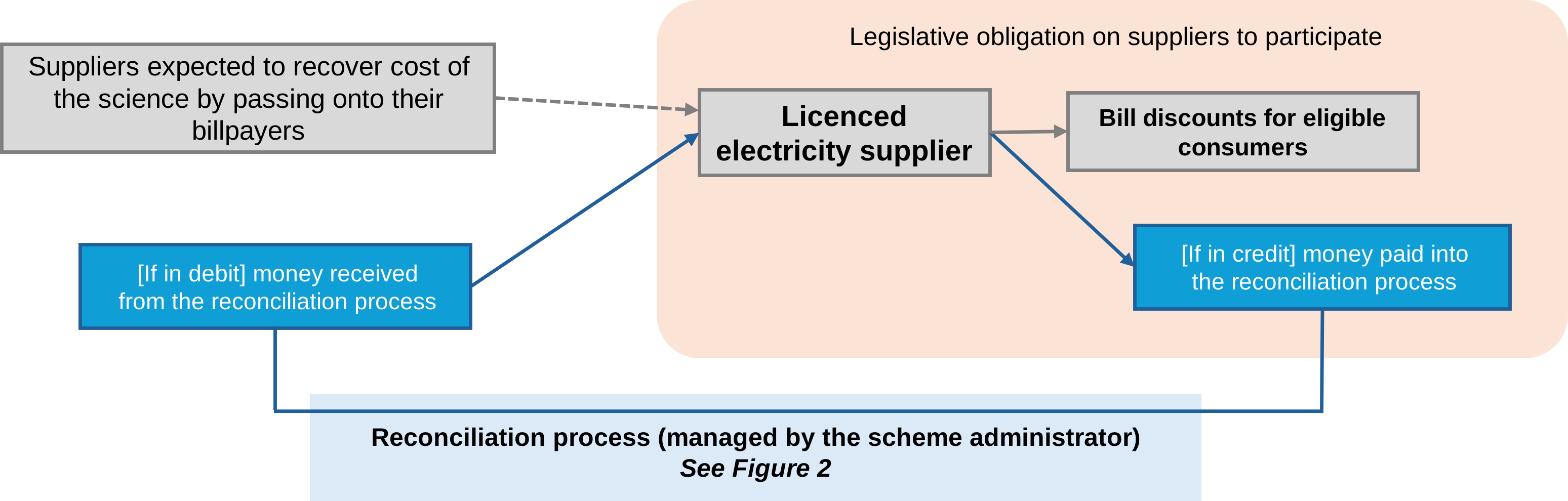
Description of Figure 1: A flow chart showing the scheme funding mechanism. Suppliers recover the cost of the scheme by passing their costs onto billpayers. The supplier pays the bill discount to eligible consumers. If the supplier has paid less than the reconciliation process says they should have, they pay into the reconciliation process, if they have paid more then they receive the extra they have paid from the reconciliation process.
Figure 2: The reconciliation process

* The method for determining the contribution that a supplier should pay towards the cost of the scheme is detailed in figure 3.
Description of Figure 2: A diagram showing how the reconciliation process works in 3 stages.
-
What a supplier should pay*: This is the contribution the supplier should pay towards the total cost of the scheme, which includes administration costs, and all discounts to eligible automatic and opt-in recipients.
-
What a supplier actually pays: The total value of the discounts a supplier pays out to their own eligible customers and any allowable administration costs.
-
A supplier’s reconciliation payment - If this value is positive, then the supplier should have paid more than they actually have, so must pay into the reconciliation process.
If this value is negative, the supplier has paid more than they should and so will receive payment from the process.
* The method for determining the contribution that a supplier should pay towards the cost of the scheme is detailed in figure 3.
Figure 3: calculation to determine the contribution of a supplier to the total scheme costs

Description of Figure 3: The formula for calculating what a supplier should contribute towards the scheme: ‘A divided by B times C equals D’.
- Whereby,
- A: Volume of electricity supplied to GB by a supplier during the reconciliation period, less their supply to allowable exemptions (EII customers).
- B: Total volume of electricity supplied to GB by all suppliers during the reconciliation period, less the total supply to allowable exemptions (EII customers).
- C: The total cost of the scheme during the reconciliation period (accounting for allowable administration costs, discounts to automatic households and payments to opt-in households)
- D: What a supplier should be paying towards the cost of the scheme for a reconciliation period.
A reconciliation period is currently proposed to be 6 months, see question 18. However, an initial reconciliation may be required to allow administrative cost recovery of the scheme administrator that was incurred during scheme set up and the early stages of the scheme. This initial reconciliation period is intended to occur between operational scheme launch and ahead of first payments to eligible recipients.
Additionally, we are considering if an annual reconciliation may be required to rectify any issues from using not fully settled supply data in the 6-monthly reconciliation, but we recognise that this is dependent on the separate ongoing market half hourly settlement work addressing settlement rates[footnote 20].
Q15. Do you agree with the outlined proposals for supplier failure?
The consultation outlined our proposal that, in the event of supplier failure, missed reconciliation payments will be covered via a mutualisation process, where obligated suppliers make up the shortfall based on their calculated contributions to the scheme. Additionally, missed payments to customers would be picked up by the new supplier of the customer.
Of the respondents that responded to this question, most agreed with the outlined proposals for supplier failure. One respondent commented that supplier failure may not be the only reason to trigger a mutualisation process, and it should apply to any situation that results in a supplier not paying.
A few respondents commented on sharing of information related to a failed supplier’s scheme obligations as part of the Supplier of Last Resort (SoLR) process.
Government response:
The government intends to incorporate a mutualisation process for the bill discount scheme. This is in line with similar government schemes, such as Green Gas Levy, Feed-In Tariff and the Renewables Obligation.
The mutualisation process would cover reconciliation payments that a supplier(s) has failed to pay (the ‘defaulting supplier’). Remaining obligated suppliers would make up the shortfall through mutualisation payments, with a supplier’s mutualisation payment/contribution calculated in a similar method as outlined in question 14.
There will be a mutualisation threshold, whereby if the amount ‘missing’ exceeds this level then mutualisation is triggered. Below this limit, it is deemed too burdensome to conduct mutualisation and instead any missing payments will be absorbed within reconciliation.
The mutualisation process would be managed by the scheme administrator (including utilising appropriate compliance methods to engage with a defaulting supplier). As is the case for similar schemes, we intend that the mutualisation threshold will be set by DESNZ. We are not proposing to define a required frequency to update the threshold to allow flexibility for updating as is required.
As noted by one respondent, we agree that supplier failure may not be the only reason for a defaulting supplier failing to pay their reconciliation amount, and mutualisation should be triggered if the mutualisation threshold is reached irrespective of the reasons a supplier may fail to pay.
Supplier of Last Resort: The Supplier of Last Resort (SoLR) mechanism is a regulatory framework established by Ofgem to ensure continuity of electricity and gas supply to customers in the event of an energy supplier’s failure. The SoLR process is managed by Ofgem, whose authority to appoint a SoLR arises when it is entitled to revoke the supply licence of a failing supplier, typically due to insolvency.
As the new supplier would take over the failed supplier’s customer base, it would therefore take on any bill discount scheme obligations associated with the eligible customer base. We therefore think that it is appropriate that relevant information about a failed supplier’s scheme obligations (such as the number of eligible customers) should be made known to any potential new supplier ahead of the SoLR bidding process.
Q16. Do you agree with introducing a de minimis threshold for the bill discount scheme? Please provide evidence to support your answer wherever possible.
Many of the respondents that responded to this question agreed with the principle of introducing a de minimis threshold. Some respondents commented that further information and/or discussion is required about the value of threshold level.
One respondent commented that the scheme administrator should be responsible for setting the threshold level and that the threshold should be able to be updated once the scheme is live to allow for scheme adaptation. A few respondents were concerned the de minimis would be applied to the discount itself however setting a de minimis threshold would not affect the value of the bill discount scheme.
Government response:
The government agrees with introducing a de minimis threshold for the bill discount scheme, whereby charges that fall under the threshold would not be payable. We believe that this will help reduce administrative burden associated with making payments for negligible amounts of money as part of scheme operation.
The de minimis threshold will only apply to administrative and operational payments (including reconciliation and mutualisation payments) that are required for scheme operation. The de minimis threshold will not apply to household’s discount payments, meaning that if a household were owed less than the de minimis amount, they would still receive payment.
The party responsible for setting the de minimis threshold is intended to be the scheme administrator because they will have the most accurate oversight of scheme costings and will be able to best assess the optimum threshold. To maintain flexibility and ensure cost effectiveness of the scheme, the government agrees that the threshold should be allowed to be updated as required. We are not proposing to enforce the frequency of updating this threshold. This is because if we set a limit that is too frequent it could result in unnecessary administrative burden; conversely if a review is set not frequent enough, then the threshold may become inappropriate for the scheme.
The government also believes that a maximum threshold should be set that would provide an upper limit to what the scheme administrator could set the de minimis threshold at. This maximum threshold is to avoid larger administrative payments being omitted, which could impact overall scheme costings. We intend that DESNZ sets this maximum limit, and as for the de minimis threshold we are not proposing to dictate the frequency of how often this should be updated.
Q17. Do you consider that licensed electricity suppliers should be allowed to recover costs from the scheme to contribute to the costs they incur for their role in delivering the scheme? Please provide clear evidence in your answer (for example evidence of administration costs used to fund other schemes).
Of those that responded to this question, some agreed that suppliers should be allowed to recover administrative costs, and a few were unclear in their response. Some respondents disagreed with the proposal, with the most often cited reason being due to the cost to billpayers.
Some of the main themes identified for this question are indicated below. Response totals for these themes include responses made specifically as an answer to this question, as well as information provided by respondents that did not follow the standard Q&A format:
- some respondents indicated concern over the cost to billpayers
- a few respondents did not agree that suppliers should provide an ‘opt-out’ option for customers due to the additional complexity/administrative burden this would add
- one respondent recommended a fixed administration cost for suppliers
Finally, although not provided directly in answer to question 17, one respondent requested clarity about if the discount will be able to be used against customer debt.
Government response:
Due to the obligations placed on suppliers in delivering the scheme, such as delivering payments to automatic scheme customers and vouchers to traditional pre-payment meter customers, the government believes it is reasonable that suppliers should be allowed to recover their administration costs from the scheme. The government also has this view because suppliers will likely have differing numbers of customers who are eligible for the scheme, so we want to ensure those with more eligible customers are not unfairly affected.
Allowing suppliers to recover administration costs is in line with other government schemes, such as the Feed-In-Tariff.
However, we are keen to manage the impact on billpayers, and so we believe that it is appropriate that a maximum limit should be set for what administration costs a supplier can recover. The exact details of this limit are still under consideration.
Opt-out option: We acknowledge the concerns raised in providing an opt-out option in the automatic scheme and have decided to prohibit opt-out to ease administrative burden. This means customers who receive the discount automatically from their supplier will not be able to opt-out of receiving the bill discount. For those not receiving the discount automatically (meaning those on the manual opt-in scheme), they can choose not to apply if they do not wish to receive this benefit.
Customer debt: With regards to being used against customer debt, the bill discount will not be ringfenced. It will be added to the customer’s account unless it is being paid in an alternative way, such as a BACs payment in situations where adding it to a customer’s energy account is not possible. Therefore, it would be used towards the recipient’s total running balance which would include any existing debt. It would be extremely complex and likely isn’t possible to ringfence the money separately as it is being added to consumer energy accounts.
We are aware that, although not ringfenced in practice, the aim of EBSS was that the payment should not to be used against customer debt; however, the bill discount scheme is not an affordability scheme to support consumers with current high prices, therefore there is no reason it can’t be used to pay off existing debt on a customer’s account.
Scheme administrator administration costs: The scheme administrator will be able to recover costs incurred for administering the scheme from the scheme itself as part of the reconciliation process. Their administration costs will be incorporated as part of the total scheme cost, meaning each supplier (and thus billpayers, as costs are expected to be passed on by suppliers) will contribute towards them. DESNZ intend to monitor costs to ensure they are proportionate and inform broader evaluation of the scheme.
The scheme administrator will also recover costs from the reconciliation process to pay scheme benefits to eligible opt-in households (see question 14).
Q18. Do you agree with the proposed payment and reconciliation timings, including for an initial reconciliation payment? Please provide evidence wherever possible to support your response.
Many respondents agreed with the proposed payment and reconciliation timings, noting they will balance deliverability, administrative costs and the risk of households having to wait a long time for their first payment. Most respondents who disagreed had concerns about supplier timings. We have responded to this under question 14.
Of those who disagreed with the proposed payment timings, one respondent suggested households should be able to request one, upfront lump sum payment, and another respondent suggested that payments should be monthly to aid household budgeting and smooth supplier cash flow.
Separately, one respondent also noted the need for government to provide the auditing requirements expected of suppliers, noting the risk of over burdening suppliers; for example, how suppliers should demonstrate that the correct customers have been paid and how efficient scheme delivery is evidenced.
Government response:
Following conversations with suppliers and other stakeholders, we intend that households that are part of the automatic scheme are paid every 6 months to balance deliverability, administrative costs and reduce time households wait before receiving their payments.
A reconciliation process will happen every 6 months and a supplier will be required to pay their eligible customers ahead of each reconciliation process. A supplier will not be required to determine customer eligibility, instead the supplier will be informed of eligible customer MPANs by the scheme administrator.
To allow for flexibility in different customer billing types, we intend that suppliers will be provided with a payment window in which they are required to pay their customers. At the start of this payment window, the scheme administrator will finalise the list of eligible MPANs and their associated supplier. We intend for this to be the qualifying date, whereby a household that lives in an eligible property on the qualifying date will receive a payment from their supplier. We intend that the supplier a customer is with on the qualifying date should be responsible for payment, even if the customer switches during the payment window.
Figure 4: Overview of regular schedule of the automatic scheme, with 6 monthly reconciliation, qualifying dates and payment of eligible customers. Please note timings in this diagram are not to scale. Opt-in timings are not shown
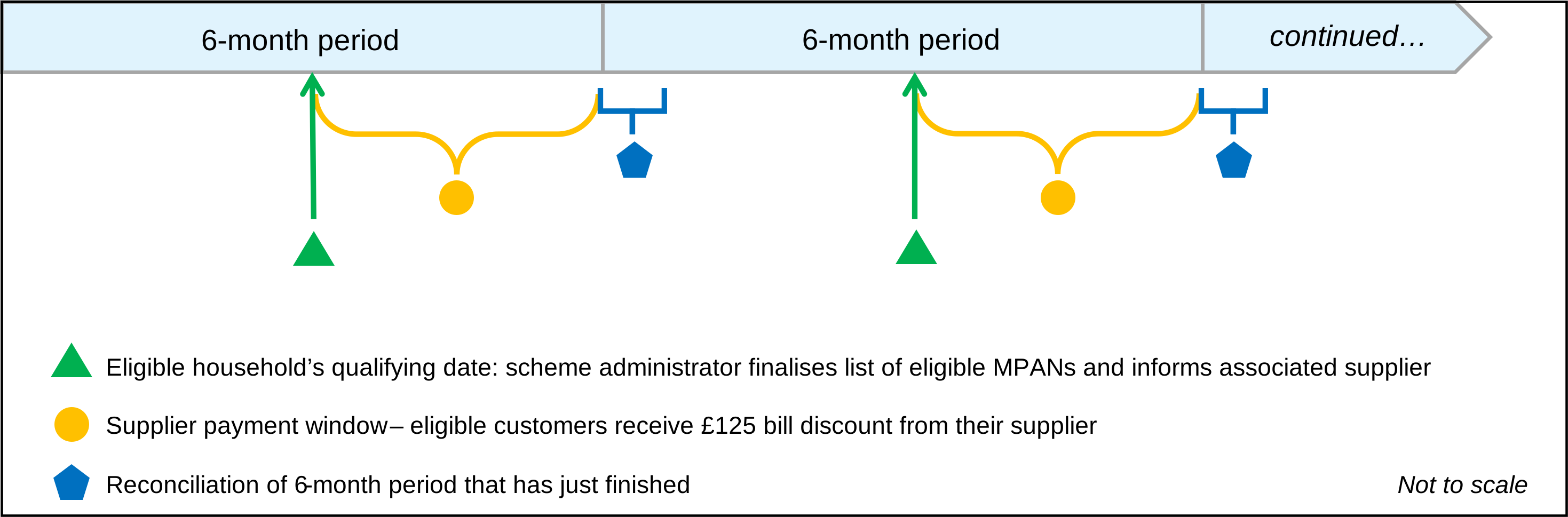
Description of Figure 4: A diagram showing an illustrative schedule of the automatic scheme.
Around 3 months: Eligible household’s qualifying date: scheme administrator finalises list of eligible MPANs and informs associated supplier
From 3 months to 6 months: Supplier payment window – eligible customers receive £125 bill discount from their supplier
From 6 months to the start of the next period: Reconciliation of 6-month period that has just finished
For opt-in households, we propose a single annual payment of £250 to balance the administrative complexity of delivery with the relatively small scale of the opt-in scheme. The exact payment dates will differ between the automatic and opt-in schemes, with payments to opt-in households likely taking place after the first automatic payment each scheme year. We do not recommend monthly payments, as this would increase the administrative burden of the scheme on suppliers (for the automatic scheme) and the scheme administrator (for the opt-in scheme), thus increasing the administration costs associated with the scheme, which would most likely be passed onto electricity bill payers.
We are not pursuing one, upfront payment of £2,500, as the resident of that property could move out soon after the payment date and the following resident would not receive any bill discounts for the remaining period. Furthermore, pre-payment customers face limits to how much credit can be on their meter, so they would not be able to receive a payment of this size.
Only the resident living in the property on the eligibility date will be eligible for the payment; partial payments will not be provided if someone lives in an eligible property for a few months but then moves out before the eligibility date. Each payment will be made to the resident who is living in an eligible property on the defined eligibility date, by the registered supplier at that time.
The exact dates and timings for the scheme cycle is still under consideration and will be finalised through discussion with stakeholders, ensuring that it is deliverable and effective.
With respect to the comment about auditing, as noted in question 5 above, we will ensure that the scheme administrator has appropriate auditing processes in place. We acknowledge that suppliers will need a clear understanding on how these auditing processes will operate and that the burden should be minimised wherever possible.
Analytical Annex Questions
Q19. Do you agree with the rationale for intervention and the market failures we have identified? Are there any points we have missed?
Most respondents to this question agreed with the rationale of the bill discount scheme, recognising the role that communities play in hosting electricity transmission network infrastructure. Of these responses, many specifically emphasised the importance of accelerating network infrastructure build for renewable energy deployment and noted the potential risks to consumer bills of delayed network buildout through increased network constraint costs.
A few respondents agreed with the policy objectives but disagreed with aspects of the policy design, stating that the proposal was not the most effective way of improving community acceptability of electricity transmission infrastructure. Alternative ways of providing benefits to communities included through local employment opportunities and supply chain investment associated with transmission network infrastructure, as well as the voluntary provision of community funds already offered by Transmission Owners.
A few respondents highlighted the importance of ongoing monitoring and evaluation of the scheme, including its delivery of value for money for billpayers.
Government response:
The aim of the bill discount scheme is to recognise the role of people who live near to electricity transmission network infrastructure. It is also one of several government actions that support a wider programme objective of reducing delays to transmission network build and therefore constraint costs.
We will carry out robust monitoring and evaluation of the bill discount scheme including process and impact evaluations which will focus on aspects of scheme delivery, value for money delivered by the scheme and any changes in community attitudes.
Q20. Do you agree with the impacts that have been identified? If not, explain why with supporting evidence.
Many respondents to this question agreed with the impacts that have been identified but a few respondents stated that more detailed analysis of the potential impacts on billpayers was needed. A few respondents requested that DESNZ publish additional analysis into monetised impacts or an updated impact assessment, which has been published alongside this response.
In particular, a few stated that a more detailed assessment of the operational and cost burden on electricity suppliers was required to help suppliers forecast their costs more accurately. One respondent raised concerns that suppliers could face an initial cost to fund the scheme which they would not be able to recover for a sustained period. This was identified as a potential risk for supplier failure.
A few respondents also highlighted the need for close monitoring of the scheme. This would evaluate how well the scheme is meeting its core objectives and delivering value for money.
Q21. Do you think there are other impacts that have not been identified? If yes, what other impacts are there that have not been included? Please provide supporting evidence.
Some respondents to this question stated that there were additional impacts that had not been identified in the analysis that accompanied the consultation. A few respondents stated that more analysis into the impacts on suppliers was needed and highlighted that the cost to billpayers of funding the scheme would not be the same for every consumer, as the costs faced would vary with the amount of electricity consumed.
A few respondents also noted the potential environmental impact of electricity transmission infrastructure more widely, such as on water supplies, productive agricultural land or local biodiversity.
Government response:
Due to overlaps in both question themes, and recipient responses, we have grouped together the government response to questions 20 and 21.
Updated analysis can be found in our Impact Assessment.
This Impact Assessment includes more detailed distributional analysis into the bill impacts for different consumers under a volumetric charging model. Since electricity consumption has a broad positive correlation with household income, higher income households would likely face higher costs to fund the scheme, although this additional impact is expected to be small.
We acknowledge the additional burden on electricity suppliers and we will continue to work with electricity suppliers and other stakeholders to understand and monitor the costs incurred by electricity suppliers to mitigate the potential risks highlighted.
We note the concerns about the environmental impact of electricity transmission infrastructure. These impacts are evaluated by the relevant planning authorities during the consenting process for new infrastructure. As such, they are outside the scope of this policy.
A description of the monitoring and evaluation for the bill discount scheme is included in the response to question 19 and a detailed plan will be included in the impact assessment.
Q22. Please provide any data and evidence on whether this policy is likely to reduce delays to transmission network build.
Many respondents expressed doubt about the effectiveness of the policy in reducing delays to transmission network build. A few respondents highlighted the importance of early and continuous monitoring of the scheme, evaluating its impact on transmission network delays and value for money for electricity consumers.
Identified risks included the scheme potentially being perceived as unfair to residents who are just outside the eligibility zone and therefore receive no benefit. Some respondents suggested that this perceived unfairness could result in unintended consequences, such as reducing community acceptance of electricity transmission infrastructure projects.
One respondent stated that objections to infrastructure are often brought by people who host infrastructure on their land. These landowners may not be eligible to receive a bill discount as their house may not fall within the eligibility zone or may not meet the criteria for a domestic residence.
A few responses stated that the scheme should be redesigned to achieve the same policy aim while better prioritising simpler delivery mechanisms, more flexibility for communities and less risk of perceived unfairness.
One respondent stated that a consistent theme in their research was that people would support increased renewable energy deployment if they received cheaper electricity bills from the projects.
Government response:
We acknowledge the concerns raised by some respondents about the effectiveness of this policy in reducing delays to network build.
The bill discount scheme is one part of a wider programme of interventions aiming to support the broader objective of reducing delays to transmission network build. One example of these additional interventions is the voluntary provision of funds for communities near transmission network infrastructure. These community funds will be delivered by the Transmission Owners making use of the existing knowledge and relationships between network companies and communities hosting network infrastructure. The framework for these funds, as set out in government guidance, is designed to give communities an active role in determining how the fund is spent, to best suit their specific circumstances and needs. The area in which these funds will be spent is deliberately not prescribed. We expect that people who may narrowly miss out on a bill discount will benefit from the local community funds.
The bill discount scheme has been designed to recognise the role of permanent residents in communities hosting certain transmission network infrastructure, therefore eligibility is determined on the basis of proximity of residential dwellings to qualifying works, rather than landownership. There are existing processes in place for landowners who host network infrastructure to receive payments from network operators through contractual agreements for either a wayleave, easement or compulsory purchase order to compensate them for use of their land.
We will monitor and evaluate the bill discount scheme’s delivery and its impact on communities across the country, alongside the implementation of the community funds guidance, to understand the effect community benefits may have on building community acceptance for local infrastructure and reducing delays to transmission network build. The monitoring and evaluation approach will utilise operational data alongside insights from scheme participants and wider stakeholders to understand how effectively the scheme is being delivered, provide early learnings to improve the scheme’s delivery, and understand the impact of the scheme on communities across the country. We are conscious that this is a novel scheme and will hold 2 review points within the first 5 years of its delivery to gain a detailed understanding the scheme’s roll-out, and provide opportunity for early learnings, improvements, course correction or close the scheme earlier than intended, to mitigate against any unintended or negative effects of the scheme.
Q23. Are there any groups you expect would be uniquely impacted by these proposals, such as small and micro businesses or people from protected characteristics? If yes, which groups do you expect would be uniquely impacted? Please provide supporting evidence.
Some responses to this question identified a specific group who would be particularly impacted by these proposals.
Of these, some respondents specifically highlighted the importance of the scheme being inclusive and accessible to all groups, including people with reduced digital literacy or poor access to banking. A few respondents also mentioned households which are not on a traditional domestic electricity contract, such as those on traditional pre-payment meters, residents of caravan sites or people living in multi – occupancy buildings. It was noted that people in these groups may be less aware of their eligibility, and so clear and inclusive scheme communication was highlighted as important.
A few respondents noted that residents of rural areas are more likely to be eligible for the bill discount scheme, due to the location of electricity transmission infrastructure. This was described as a benefit, particularly to rural households which may be in fuel poverty. It was also noted by a few respondents that the average age in rural communities is higher than in the general population. As such it is important to ensure that the scheme is accessible to elderly residents.
A few responses also stated that non – domestic electricity consumers could be adversely affected by the additional costs of the scheme. It was noted that non – domestic properties are not eligible to receive a bill discount through the scheme but will still contribute to the costs through their electricity bill, and it would be fairer if only domestic suppliers were required to fund the scheme.
Government response:
The government has considered the impact on different groups highlighted in these responses. Most households eligible for the payment will automatically receive a bill discount through their supplier which will reduce the burden for individuals. Where households will need to opt into the scheme, we are working to ensure that appropriate support is provided for households with limited digital literacy, and for households with more vulnerable residents.
The government communication strategy for the scheme will include eligible households who will need to opt-in to receive their payments and households on traditional pre – payment meters. We will also continue to work with stakeholders such as local authorities, representative groups and the scheme administrator to raise awareness. This will help us understand how best to reach different household types, including vulnerable households and those with poor digital capability or access to online banking. We will also include a telephone application option as part of the scheme’s customer service function, which will allow households to apply with support from a member of the customer service team.
Non–domestic properties (without any domestic residents) will not be eligible to receive bill discounts as the scheme aims to recognise those living closest to certain new electricity transmission infrastructure. However, all electricity consumers have potential to benefit should this policy contribute to a reduction in network build delays. Energy Intensive Industries will not be required to fund the scheme, in line with the government’s stated aim of removing policy levies on energy bills for these industries.
Next steps
We aim to lay regulations to implement the scheme in Summer 2026, with first payments being in early 2027. We will continue to provide further information and communications on the scheme ahead of this, engaging with eligible communities and stakeholders who are involved in the delivery of the scheme.
-
ENA (2025) ‘Energy network operators and manufacturers set out collaborative plan to shape a blueprint for national growth’ ↩
-
NESO (2024) ‘Clean Power 2030’ ↩
-
DESNZ (2025) ‘Electricity transmission network infrastructure: Community funds’ ↩
-
Increasing the capacity and improving the performance of existing transmission lines and infrastructure. ↩
-
In the planning process, an Environmental Impact Assessment ensures that a local planning authority is fully aware of the potential environmental effects of a proposal and is able to take this into account as part of their decision-making process. ↩
-
DESNZ (2025) ‘Community Benefits and Shared Ownership for Low Carbon Energy Infrastructure: working paper’ ↩
-
IET (2025) ‘A comparison of electricity transmission technologies: Costs and characteristics’ ↩
-
DESNZ (2025) ‘Community funds for transmission infrastructure’ ↩
-
Increasing the capacity and improving the performance of existing transmission lines and infrastructure. ↩
-
In the planning process, an Environmental Impact Assessment ensures that a local planning authority is fully aware of the potential environmental effects of a proposal and is able to take this into account as part of their decision-making process. ↩
-
DESNZ (2025) ‘Community funds for transmission infrastructure’ ↩
-
Limit of Deviation (LoD): A project’s LoD is confirmed when the route is consented and sets out a mapped geographical area where a project may be constructed. For new transmission projects, the eligibility zone will be determined as the area within 500m from the edge of a project’s LoD. Households within this zone, and who meet the eligibility criteria, will be eligible to receive a bill discount. The eligibility zone of upgraded transmission projects should also be measured from the edge of the LoD, if available, or if there is no LoD, it should be measured from the edge of the existing infrastructure. ↩
-
Apply for the Warm Homes: Local Grant to improve a home - GOV.UK ↩
-
The term multiple occupancy building (MOB) has been used to describe situations where there are multiple distinct households living in the same building. This includes purpose-built student accommodation, care homes and religious communities, but excludes Houses of Multiple Occupancy (HMOs). Intended treatment of HMOs is covered in the pass-through requirement section below. ↩
-
Energy Intensive Industries (EIIs) are those industries that hold a valid EII certificate issued by the Department of Business and Trade, and whom are recipients of the EII Exemption Scheme. Whereby, ‘EII certificate’ has the meaning given by regulation 8(1) of the Electricity Supplier Obligations (Amendment & Excluded Electricity) Regulations 2015. ↩
-
DBT (2025) ‘The UK’s Modern Industrial Strategy’ ↩
-
DBT (2025) ‘The UK’s Modern Industrial Strategy’ ↩
-
DESNZ (2026) ‘Energy Intensive Industries (EIIs): Guidance for applicants seeking a certificate for an exemption’ ↩
-
CMA (2024) ‘Referral of the proposed Energy Intensive Industry (EII) Businesses Exemption from Nuclear Regulated Asset Base (RAB) Policy Costs subsidy scheme by the Department for Energy Security and Net Zero (DESNZ) and the Department for Business and Trade (DBT)’ ↩