Consultation Document: Draft Merchant Shipping (Safety of Navigation) Regulations 2027
Updated 2 September 2026

© Crown copyright 2026
This publication is licensed under the terms of the Open Government Licence v3.0 except where otherwise stated. To view this licence, visit nationalarchives.gov.uk/doc/open-government-licence/version/3 or write to the Information Policy Team, The National Archives, Kew, London TW9 4DU, or email: psi@nationalarchives.gov.uk.
Where we have identified any third party copyright information you will need to obtain permission from the copyright holders concerned.
This publication is available at https://www.gov.uk/government/consultations/proposed-merchant-shipping-safety-of-navigation-regulations-2027/consultation-document-draft-merchant-shipping-safety-of-navigation-regulations-2027
Consultation Document:
Draft Merchant Shipping (Safety of Navigation) Regulations 2027
Section 1: Overview of this consultation
Aim
1.1. This consultation seeks your views on changes to UK secondary legislation affecting the safety of navigation. A new Statutory Instrument is proposed: the Merchant Shipping (Safety of Navigation) Regulations 2027 (“the proposed Regulations”). The proposed Regulations will revoke and replace the Merchant Shipping (Safety of Navigation) Regulations 2020 (“the 2020 Regulations”).
Views sought
1.2. Your views are sought in the following areas:
- The regulatory proposals and;
- The clarity and effectiveness of the draft documents to implement the changes introduced by the proposed Regulations.
1.3. A full list of consultation questions is contained in Section 5 of this consultation.
Deadline for responses
1.4. Responses are welcomed from 02/09/2026 until 30/09/2026
1.5 Following the conclusion of this consultation and consideration of the feedback, it is intended to finalise the proposed new Regulations and associated documents in this package, including any revisions made as a result of the consultation.
Section 2: Areas for consideration
Background
2.1 The International Convention for the Safety of Life at Sea, 1974 (“SOLAS” or “the Convention”) is an international maritime treaty that establishes minimum safety standards for ships operating internationally and to which the United Kingdom is a party. SOLAS Chapter V contains provision governing the safety of navigation of ships and is one of the core components of the SOLAS Convention. It contains measures which improve safety of navigation, and to reduce the risk of accidents occurring at sea, specifically in the areas of the carriage and use of equipment to assist in safe navigation, the receipt of vital safety information and communications, including emergency communications and signals and applies to almost all ships operating both internationally and domestically.
2.2 The proposed Regulations revoke and replace the 2020 Regulations, which implemented Chapter V in SOLAS, relating to the safety of navigation of ships, into United Kingdom law. The key objectives of the Regulations are to implement recent updates to the requirements of regulations 31 and 32 in SOLAS Chapter V to report the loss of freight containers at sea and the information to be provided, to increase the threshold for bridge visibility requirements for certain domestic passenger ships, and to bring the majority of seagoing domestic passenger ships into scope of the proposed Regulations rather than maintain a parallel regime for safety of navigation requirements.
2.3 As a member state of the IMO and a party to the SOLAS Convention, the UK is obliged to transpose the internationally agreed requirements under SOLAS into domestic legislation so that they both enter into force on the same date, where feasible. In this case, Government action or intervention is necessary to fulfil the UK’s obligations as a party to the Convention by bringing UK legislation in line with the amendments to SOLAS Chapter V. The changes are required to ensure that relevant United Kingdom ships are complying with SOLAS. If the government does not intervene by way of new or updated legislation, the new requirements will not be transposed into UK law, and the United Kingdom will contravene its international obligations.
2.4 The 2020 Regulations contain an ambulatory reference provision, the purpose of which was to allow the future, internationally agreed amendments to the provisions of Chapter V which were cross-referenced in the 2020 Regulations to be automatically incorporated into those Regulations without the need for secondary legislation. This approach is designed to allow amendments to mandatory international requirements to be enforceable domestically as soon as they are in force internationally without the need for secondary legislation. Cross-referencing and ambulatory reference used together means that shipowners and other interested parties can simply rely on the updated international text to understand the relevant ship requirements.
2.5 However, ambulatory reference only works in relation to updates to international provision which is directly referenced in secondary legislation; where updates occur to provision, which is not referenced in the legislation, there will be no automatic incorporation of the update. This is the case with respect to the new requirements in regulations 31 and 32 of Chapter V relating to danger messages, which have not been automatically incorporated into the 2020 Regulations; instead they must be separately implemented by way of the proposed Regulations.
2.6 In order to ensure that all domestic passenger ships to which the Merchant Shipping (Passenger Ships on Domestic Voyages) Regulations 2000 (S.I. 2000/2687) (“the 2000 Regulations”) apply are subject to all applicable requirements of SOLAS Chapter V, these are brought into scope of the proposed Regulations.
2.7 A legislative gap currently exists between the bridge visibility standards for small passenger ships under 45 metres registered length (RL) and those set out in regulation 22 of SOLAS Chapter V, which apply to ships of 55 metres length overall (LOA) and above; the proposed amendments address this gap and bring the legislation up to date. The opportunity has also been taken to amend the Merchant Shipping (Official Log Books) Regulations 1981 and the Merchant Shipping (Official Log Books) (Fishing Vessels) Regulations 1981 to remove outdated references to pilot hoists, which are no longer permitted under SOLAS. In addition, revisions are made to certain provisions of the 2020 Regulations to improve clarity, in line with recommendations from the post-implementation review.
2.8 Chapter V affords the Administration discretion to exclude certain ships operating in its internal waters from the requirements of Chapter V. The UK has taken decisions in relation to certain ships, which are reflected in the proposed Regulations, and these decisions are set out in Annex B.
2.9 Chapter V also affords the Administration discretion to take decisions in relation to the application of regulations 15 - 28, on requirements associated with navigational equipment and arrangements to certain ships, including smaller vessels and fishing vessels. Further information is provided in Annex B on the UK’s decisions in this regard.
Proposed Changes
2.10 The 2020 Regulations were amended in 2025 to clarify requirements for Class IV passenger ships (operating in categorised waters). There is now a further need to amend the current legislation as amendments to Chapter V were adopted by IMO Resolution MSC.550(108) and came into force internationally on 1 January 2026. These important amendments relate to the loss of freight containers at sea and are not captured by the ambulatory reference provision in the 2020 Regulations, and therefore need to be transposed. The amendments contain new requirements in regulation 31 in SOLAS Chapter V (danger messages) to report the loss, or the observation, of these containers and the content of the relevant danger messages in regulation 32.
2.11 Passenger ships in scope of the 2000 Regulations are currently excluded from the application of the 2020 Regulations. The 2000 Regulations incorporate the safety requirements of Directive 2009/45/EC, which includes the requirements of SOLAS Chapter V. Because the Directive was referenced in the 2000 Regulations, under principles of EU law which applied at the time, those references were ambulatory. However, once EU law ceased to apply to the UK, on IP (Implementation Period) completion day (31 December 2020), the reference to Directive 2009/45/EC in the 2000 Regulations became static. This means that passenger ships to which the 2000 Regulations apply are only obliged to comply with SOLAS Chapter V as it existed on 31 December 2020 and not with any subsequent updates to Chapter V. If the proposed Regulations carry over this exclusion, it would mean that the UK would not be fully implementing the updates to SOLAS Chapter V. Therefore, it is considered appropriate to bring domestic passenger ships that are in scope of the 2000 Regulations into scope of the proposed replacement Regulations in order to ensure that the UK is up to date with its international obligations. There is just one exception to this, which is to retain the requirements for bridge visibility for EU classed domestic passenger ships under 55 metres in length overall as they would not be caught by the bridge visibility amendments proposed below.
2.12 Amendments have also been proposed to close a gap in legislation between the bridge visibility standard for small passenger ships, which applies to such ships under 45 metres registered length (RL), and the bridge visibility standards in regulation 22 of Chapter V, which applies from 55 metres length overall (LOA) (for all ships to which Chapter V applies). Regulation 3(1) of the Merchant Shipping (Bridge Visibility) (Small Passenger Ships) Regulations 2005 applies some of the SOLAS standards which were driven by the MARCHIONESS recommendations to specified classes of domestic passenger ship (Classes IV, V, VI and VI(A)) of less than 45 metres in length. The Merchant Shipping (Safety of Navigation) Regulations 2020 apply the bridge visibility requirements of SOLAS Chapter V to all ships of 55 metres or more LOA. The original SOLAS Chapter V threshold had been 45 metres but this was increased to 55 metres in 2006 by amendments to Chapter V adopted by resolution MSC.142(77), which applied the new threshold to ships constructed on or after 01 July 1998. The new 55 metre threshold was implemented by the 2020 Regulations, creating a gap in UK legislation. As the difference between “registered length” and “length overall” can be significant, it is also proposed to amend the definition of “length” in the 2005 Regulations to “length overall” to dovetail with SOLAS.
2.13 The proposed Regulations will remove references to pilot hoists in the Merchant Shipping (Official Log Books) Regulations 1981 and the Merchant Shipping (Official Log Books) (Fishing Vessels) Regulations 1981 as pilot hoists are no longer permitted under SOLAS.
2.14 The proposed Regulations also incorporate some drafting changes to ensure that the Regulations follow more closely the legislative structure of SOLAS Chapter V. A Marine Guidance Note has been prepared to accompany the Regulations (Annex B).
2.15 In addition to the above, in June 2025 at the 110th meeting of the IMO Maritime Safety Committee (“MSC”), amendments to regulation 23 of SOLAS Chapter V (pilot transfer arrangements), including revised performance standards, were adopted by Resolution MSC.576(110)), which will come into force on 1 January 2028. Marine pilots undertake high risk transfers, usually from smaller vessels to large ships, sometimes in adverse conditions, and inferior equipment or inadequate training can result in serious accidents and incidents. The changes seek to improve the safety of pilot transfers by introducing mandatory performance standards for both equipment and protocol. As the reference to existing regulation 23 is ambulatory, and that ambulatory reference provision is to be carried over from the 2020 Regulations to the proposed Regulations, it will continue to have the same effect. The amendments, the date of entry into force for which has been stipulated by the relevant SOLAS amendment, will therefore be implemented through the proposed Regulations on 1 January 2028, aligning with their international entry into force.
2.16 IMO Circular, MSC.1/Circ.1690 encourages parties to implement the revised regulation 23 early (i.e. ahead of the international in-force date of 1 January 2028) for ships under their own flag. The UK position is not to implement early in legislation but instead to recommend early compliance by owners (which will be done in MGN 610 (M+F) Amendment 2). This is considered to be the best option as making the new requirements mandatory for UK flagged vessels alone without requiring non-UK flagged vessels to comply could be problematic and potentially discriminatory. Early implementation would involve compliance with a higher standard so it can be treated as equivalent to the existing requirements.
2.17 The proposed Regulations make a number of minor changes to the provisions set out in the 2020 Regulations in relation to substantive requirements, liability, and penalties. Paragraph (1) of regulation V/6 (failure to use the Ice Patrol service while transiting the North Atlantic during the ice season) introduces a new requirement. This provision imposes an obligation on the Master, breach of which is subject to a penalty of a fine only. Regulation V/16 (maintenance of equipment) also introduces a new requirement. It places obligations on both the Master and the owner to ensure that adequate arrangements are in place for the proper maintenance and performance of equipment. Breach of this provision is likewise subject to a fine only. In addition, the Regulations extend liability to the company in certain provisions. The company is included as a liable entity in regulation 7 (search and rescue plans for passenger ships), regulation 14 (ships’ manning), regulation 31 (danger messages), and regulation 34-1 (master’s discretion), reflecting the fact that the company is responsible for fulfilling specific obligations set out in those regulations.
2.18 Additionally, the new Regulations re-instate an exception from the requirement to carry AIS in the Merchant Shipping (Safety of Navigation) Regulations 2002 for Class VI passenger vessels under 300GT. Therefore, Class VI passenger vessels under 300GT will not be required to carry AIS. Based on our current understanding, as this is less onerous than the position under the 2020 Regulations, and because no ships have been required to fit AIS as a result of the 2020 Regulations, there will be no impact on industry.
2.19 To avoid duplication of legislative requirements, regulation 8 of the Merchant Shipping (Vessel Traffic Monitoring and Reporting Requirements) Regulations 2004 (SI 2004/2110) (“the 2004 Regulations”), which makes provision for AIS carriage requirements, will be revoked. This ensures that all relevant AIS requirements (other than those for fishing vessels – see paragraph 2.21) are consolidated in the proposed Regulations. This will also have no impact on operators as there are no new obligations.
2.20 AIS requirements for fishing vessels of more than 15 metres are currently contained in regulation 8A of the 2004 Regulations. It is proposed to revoke regulation 8A on the basis that the Merchant Shipping (Codes of Practice) Regulations 2017 (SI 2017/943) already require fishing vessels of 15 metres or more in length overall to be fitted with AIS and for it to be operational at all times, thereby reflecting the AIS requirements in regulation V/19.4. The only difference is that the requirements for AIS only apply to fishing vessels of 15 metres or more in length and not over 15 metres. The difference is considered to be de minimis and otherwise the measure has no impact on operators.
2.21 Finally, with the new (non-mandatory) IMO Code for Maritime Autonomous Surface Ships (the MASS Code) taking effect on 1 July 2026, the MCA is reviewing all merchant shipping legislation in order to determine the extent to which a remote operator of a MASS may properly assume responsibility for actions taken under such legislation. With respect to safety of navigation specifically, areas where some responsibility may fall on the remote operator include reporting requirements, routeing measures, ice patrol requirements, weather reporting and the transmission of danger messages. The MCA welcomes the views of consultees on this issue. In relation to compliance with safety of navigation requirements, the proposed Regulations include specific provision enabling a MASS to be exempted from a requirement where, by reason of its inherent characteristics, it is not possible for the MASS to comply with that requirement.
Summary of Options and Recommendations
2.22 Do Nothing is the baseline against which Options 1, 2 and 3 are assessed. The UK is required to action the changes to SOLAS Chapter V by the IMO; unactioned changes will result in the UK failing to meet its international commitments under SOLAS and the amendments adopted by Resolution MSC.550(108) will not enter into UK law. This is therefore not a realistic option.
Option 1- publish a Marine Guidance Note or other advice to industry (non-regulatory). This would involve issuing guidance in relation to the changes made to SOLAS Chapter V. This option would not achieve the necessary legislative outcome of updating UK law in line with SOLAS, which is the UK’s international obligation as a party to SOLAS and is also highly desirable for maritime safety purposes. Therefore, this is not an appropriate option.
Option 2- amend the 2020 Regulations to address the changes made to SOLAS Chapter V and implement other desired changes. This is not a preferred option as revocation and replacement will bring greater clarity.
Option 3- revoke and replace the 2020 Regulations with new Regulations which would make the essential changes required by SOLAS Chapter V and also provide a suitable legislative vehicle to simultaneously make other desirable improvements.
The preferred option is Option 3 because this option allows for effective implementation of the international measures and, at the same time, provides an opportunity to make other important regulatory changes and legislative improvements.
Supporting Information
2.23 The proposed Regulations are set out in Annex A.
2.24 As a result of changes to legislation, consequential amendments will need to be made to the accompanying Marine Guidance Note MGN 610 (M+F) Amendment 2 and a proposed Amendment 2 to the MGN is set out in Annex B.
2.25 As the costs and impacts are expected to be low, no formal Impact Assessment has been carried out; instead, a De Minimis Options Assessment (DMOA) has been completed and is included at Annex C. This has been agreed to as the most appropriate assessment process given that the DMA threshold of +/- £10m Equivalent Annual Net Direct Cost to Business (EANDCB) is not expected to be exceeded.
2.26 The new requirements are subject to offences and penalties but otherwise, there has been no significant change to the criminal sanctions framework. A table of offences contained of both the 2020 Regulations and the proposed Regulations is contained in Annex D.
Section 3: Responding to this consultation
3.1. There are specific questions highlighted in section 5 of this document and information on how to respond to this consultation document.
Consultees
3.2. Anyone may respond to this consultation and consideration will be given to all responses.
Duration
3.3. This consultation is open for 4 weeks from 02 September 2026. The deadline for responses is 30 September 2026.
Submitting your response
3.4. The preference is for consultation responses to be emailed to nautical@mcga.gov.uk. Any questions should also be sent to this email address. You can also send in your response by post.
3.5. When responding, representative groups are asked to give a summary of the people and organisations they represent, and where relevant who else they have consulted in reaching their conclusions.
Freedom of Information
3.6. Information provided in response to this consultation, including personal information, may be subject to publication or disclosure in accordance with the Freedom of Information Act 2000 (FOIA) or the Environmental Information Regulations 2004.
3.7. If you want the information that you provide to be treated as confidential, please be aware that, under the FOIA, there is a statutory Code of Practice with which public authorities must comply and which deals, amongst other things, with obligations of confidence.
3.8. In view of this it would be helpful if you could explain to us why you regard the information you have provided as confidential. If we receive a request for disclosure of the information, we will take full account of your explanation, but we cannot give an assurance that confidentiality can be maintained in all circumstances. An automatic confidentiality disclaimer generated by your IT system will not, of itself, be regarded as binding on the Department/MCA.
3.9. The MCA will process your personal data in accordance with the data protection framework and, in the majority of circumstances, this will mean that your personal data will not be disclosed to third parties.
Data Protection
3.10. The MCA is carrying out this consultation to gather evidence to inform the development and implementation of policy and legislation under the enabling provisions of the Merchant Shipping Act 1995 Part IV Section(s)85, Section 86, Section 302 and Section 306A. This consultation and the processing of personal data that it entails is necessary for the exercise of our functions as a government department. If your answers contain information that allows you to be identified, under data protection law, the MCA, as an Executive Agency of the Department for Transport, will be the Controller for this information.
3.11. The MCA will use your contact details to send you information about the consultation, for example if we need to ask follow-up questions. You do not have to give us this personal information but if you do choose to provide it, it will not be used for any other purpose without your permission.
3.12. Details about how the MCA looks after personal data, your rights, how to complain, and how to contact our Data Protection Manager can be found on gov.uk at:
3.13. Your information will be kept securely on the MCA’s IT system, and any written responses will be held in a secure file and cabinet and kept for up to five years.
3.14. If you do not wish to remain on this list, please let us know at nautical@mcga.gov.uk.
Section 4: Outline of plans beyond this consultation
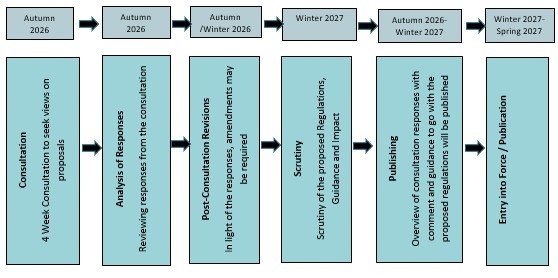
4.1. Once this consultation closes, we will review all responses. In considering the responses we will apply appropriate weight to those from organisations and individuals with specialist knowledge of the subject area.
4.2. We will be analysing the responses during the autumn of 2026. Our aim is to publish an overview of the responses and the MCA’s comments within at most 3 months, which will be available on www.gov.uk along with the consultation.
4.3. Where appropriate the draft Regulations/Guidance, accompanying guidance and impact assessment will be revised to take into consideration the consultation responses.
4.4. Our aim is for the proposed Regulations to come into force during 2027. The Regulations will be published on www.legislation.gov.uk
4.5. An overview timetable is below for reference:
Section 5: Response form
Please find the consultation response form here: Consultation Response Form
Section 6: Conduct of this consultation
6.1. This consultation has been conducted in accordance with the Cabinet Office Consultation Principles.
Consultation principles
6.2. The Cabinet Office Consultation Principles can be found at Consultation Principles 2018
Feedback on conduct of consultation
6.3. If you have any comments regarding the conduct of this consultation, please contact the Consultation Co-ordinator at consultation.coordinator@mcga.gov.uk.
6.4. We are continually trying to improve the way in which we conduct consultations and appreciate your views. We would be grateful if you could complete and return the attached feedback form. These should be submitted to the Consultation Co-ordinator and are not affected by the deadline for this consultation.
6.5 If you require this consultation in an alternative format, please contact either the Consultation Co-ordinator or the named official conducting this consultation.
Please find the Consultation feedback form here: Feedback Form