Consumer Price Index (CPI) and the Police Pension Scheme 2015: Career average revalued earnings
Updated 5 August 2026
Applies to England and Wales

© Crown copyright 2026
This publication is licensed under the terms of the Open Government Licence v3.0 except where otherwise stated. To view this licence, visit nationalarchives.gov.uk/doc/open-government-licence/version/3 or write to the Information Policy Team, The National Archives, Kew, London TW9 4DU, or email: psi@nationalarchives.gov.uk.
Where we have identified any third party copyright information you will need to obtain permission from the copyright holders concerned.
This publication is available at https://www.gov.uk/government/consultations/police-pension-scheme-2015-cpi-revaluation/consumer-price-index-cpi-and-the-police-pension-scheme-2015-career-average-revalued-earnings
About this consultation
This consultation begins on 19 January 2026 and ends on 16 March 2026.
This consultation is open to the public. We are particularly interested to hear from serving police officers and other members of the policing sector.
Government response
A response to this consultation will be published on GOV.UK.
Representative groups
Representative groups are asked to give a summary of the people and organisations they represent when they respond.
Confidentiality
Information provided in response to this consultation, including personal information, may be published or disclosed in accordance with the access to information regimes (these are primarily the Freedom of Information Act 2000 (FOIA), the Data Protection Act 2018 (DPA), the General Data Protection Regulation (GDPR) and the Environmental Information Regulations 2004).
If you want the information that you provide to be treated as confidential, please be aware that, under the FOIA, there is a statutory Code of Practice with which public authorities must comply and which deals, amongst other things, with obligations of confidence. In view of this it would be helpful if you could explain to us why you regard the information you have provided as confidential. If we receive a request for disclosure of the information we will take full account of your explanation, but we cannot give an assurance that confidentiality can be maintained in all circumstances. An automatic confidentiality disclaimer generated by your IT system will not, of itself, be regarded as binding on the Home Office.
The Home Office will process your personal data in accordance with the DPA and in the majority of circumstances, this will mean that your personal data will not be disclosed to third parties.
Consultation principles
The principles that government departments and other public bodies should adopt for engaging stakeholders when developing policy and legislation are set out in the consultation principles.
How to respond
Please send your response by 16 March 2026 to: PolicePensionConsultations@homeoffice.gov.uk
Alternatively, you can respond using the online survey.
If you are unable to use the online system, for example, because you use specialist accessibility software that is not compatible with the system, you may download a word document version of the form and email or post this to:
CPI consultation
Police Workforce and Professionalism Unit
Home Office
6th Floor
Fry Building
2 Marsham Street
London
SW1P 4DF
Contact us
Enquiries, including requests for the consultation paper in an alternative format, can be sent to:
CPI consultation
Police Workforce and Professionalism Unit
Home Office
6th Floor
Fry Building
2 Marsham Street
London
SW1P 4DF
Complaints or comments about the consultation process can also be sent to the above address.
Foreword
This government deeply values the professionalism, dedication and sacrifice shown by police officers. The police strive to keep us and our families safe, taking risks so we can live peacefully.
When a member of the police pension scheme reaches their retirement age, they receive one of the most valuable pensions available in the United Kingdom. This reflects the unique nature of the police service and the responsibilities that society expects of police officers during their careers.
The police pension scheme was reformed to become a Career Average Revalued Earnings (CARE) scheme from 1 April 2015 (2015 CARE scheme). Part of the mechanism of a CARE scheme is revaluing the accrued pension each year, so it maintains value over time. Many schemes base such revaluation on the Consumer Price Index (CPI). For the 2015 CARE scheme, the revaluation is CPI + 1.25%. This does not apply to either the 1987 or 2006 legacy Police Pension Schemes.
Currently, the revaluation date for the pensions accrued in the 2015 CARE scheme is 1 April every year while the tax (annual assessment) year begins on 6 April. HM Revenue and Customs (HMRC) uses the tax year (6 April to 5 April) for calculations used to determine any tax due on annual allowance excess. This misalignment in dates can result in members being taxed on artificial pension growth in their annual allowance calculations, particularly during periods of high inflation volatility.
This consultation invites views on the extent to which respondents agree or disagree with the proposal to align the 2015 CARE scheme revaluation date (currently 1 April) with the start of the tax year (6 April); views on whether there are any unintended consequences of aligning these; and views on whether this is worthwhile to do so.
While the change to align the 2015 CARE scheme revaluation date with the start of the tax year, is not actuarially necessary for the integrity of the scheme and may advantage or disadvantage members differently over time. Nevertheless, it is being considered in response to strong member feedback and stakeholder advocacy.
I would like to thank respondents in advance for contributing their views on this matter.
Sarah Jones MP
Minister of State for Policing and Crime
Executive summary
This consultation focuses on aligning the 2015 CARE scheme revaluation date of 1 April, with the start of the tax year (6 April) for the purposes of revaluing active members pensions, inviting views on:
- To what extent do you agree or disagree with proposal to align the 2015 CARE scheme revaluation date with the start of the tax year?
- Whether there are any unintended consequences in aligning the 2015 CARE scheme revaluation date with the start of the tax year?
- Whether it is worthwhile to align the 2015 CARE scheme revaluation date with the start of the tax year?
This consultation will be open from 19 January 2026 to 16 March 2026.
Introduction
The police pension scheme is designed to offer significant value in retirement for people who have chosen to dedicate part, or all, of their careers to serving the public as a police officer.
There are currently three police pension schemes:
- Legacy (closed): Police Pension Scheme 1987 (PPS 87)
- Legacy (closed): New Police Pension Scheme 2006 (PPS 06)
- Reformed: Police Pension Scheme 2015 (Career Average Revalued Earnings or ‘CARE’ or 2015 CARE scheme)
Eligible members of the police workforce belong to one of these pension schemes. The final salary defined scheme, or legacy schemes, consist of the PPS 87 and PPS 06 schemes, which were closed to future accruals on 31 March 2022. All new police officers joined the 2015 CARE scheme in April 2015 and existing serving officers moved to the 2015 CARE scheme.
From 1 April 2015, the police pension scheme was reformed to a CARE scheme. Part of the mechanism of a CARE scheme is revaluing the accrued pension each year, so it maintains value overtime. Many schemes base such revaluation on the Consumer Price Index (CPI). For the police, this only applies to the 2015 CARE pension scheme, and not either of the legacy schemes.
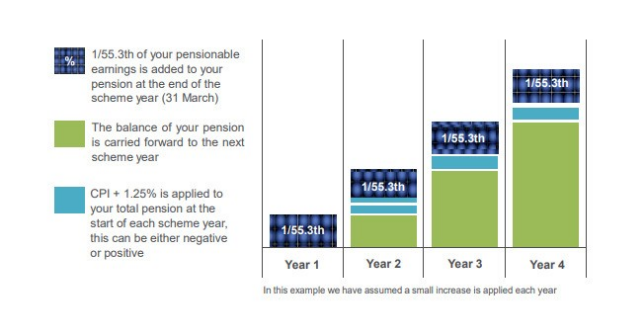
Each year as an active member of the 2015 CARE scheme, an officer earns a pension equal to 1/55.3 of their Pensionable Earnings for that year. This pension builds up annually and, whilst active, the pension grows using the Consumer Prices Index (CPI) + 1.25%. After leaving pensionable service, revaluation is CPI only. At retirement, the police pension is based on the total accrued amount.
Example of pension growth
Purpose of the consultation paper
This paper sets out the proposal to align the dates for the calculation for increasing and valuing pension benefits, in accordance with the pension scheme and tax rules within the 2015 CARE scheme, from 1 April to align with the start of the financial tax year on 6 April.
The technical nature of pension accrual, revaluation, and the various scheme rules can create complexity - especially where tax regulations intersect with pension growth.
One area of complexity arises from the fact that the 2015 CARE scheme’s revaluation date (1 April) does not currently align with the financial tax year (6 April).
This misalignment can lead to inconsistencies in how pension growth is measured for tax purposes, potentially affecting the annual allowance calculations for some members. Significant fluctuations in inflation rates can amplify these effects, sometimes resulting in unexpected tax charges, while in other cases, members might find themselves in a more favourable position.
Addressing this is essential for ensuring fairness and clarity in the pension system, and to support members in making informed decisions about their retirement planning.
To commit to this policy change, there would need to be legislative change to move the revaluation date from 1 April to 6 April.
Copies of the consultation paper will be sent to:
- National Police Chiefs’ Council
- Association of Police and Crime Commissioners
- College of Policing
- Police Federation of England and Wales
- Police Superintendents’ Association
- Chief Police Officers’ Staff Association
- National Association of Retired Police Officers
- public service pension schemes
- police pension administrators
This list is not exhaustive or exclusive and responses are welcomed from any member of the public with an interest in or views on the subject covered by this paper.
Changes to the pension rules regarding inflation
This section sets out the matter on which the Home Office is consulting.
In early 2023, the date for applying the Public Service Pensions Revaluation Order to both the Local Government Pension Scheme (LGPS) and NHS Pension Scheme (NHSPS) changed from 1 April to 6 April.
This aimed to lessen the impact of inflation volatility on annual allowance calculations for the 2022/23 tax year and beyond. Currently the 2015 CARE scheme revaluation date and the tax year remain ‘mismatched’ by 5 days. This 5-day misalignment means that different CPI figures are used to calculate the opening and closing values of a member’s pension for the same tax year.
‘CPI mismatch’ in the 2015 CARE scheme
Inflation protection
The 2015 CARE scheme uses full inflation proofing, based on CPI changes, for benefits in payment and deferment, and for active members with CPI + 1.25% annual revaluation. Increases are applied each April using inflation figures from the previous September. However, environments of high inflation volatility can affect pension tax outcomes.
Annual allowance
The annual allowance sets an annual cap on tax-relieved pension savings by assessing benefit growth above inflation. This was increased from £40,000 to £60,000 a year in April 2023, and any amount above this is subject to taxation.
Pension input amount (PIA)
PIA is a statutory measure of pension savings growth used to determine whether the annual allowance has been exceeded.
Impact on pension tax
Recent inflation volatility has created technical inconsistencies - referred to as ‘CPI mismatch’ - as different CPI figures are used for various purposes within pension calculations. This is particularly relevant for Career Average Revalued Earnings (CARE) schemes, which all active police pension scheme members have participated in since 1 April 2022.
The annual allowance is calculated using the pension input amount (equation below). If the CPI used for the opening value is lower than the CPI used for the closing value, it can artificially inflate the pension input amount, giving the impression that the pension has grown more than it actually has.
Pension input amount = (Closing value – Opening value increased by CPI) x 16
The impact of the CPI mismatch and associated annual allowance tax charges mainly affects police officers with significant pension accruals under the 2015 CARE scheme. For most members, annual pension growth remains comfortably within the annual allowance limit, so additional tax charges are unlikely. However, those who are in the minority with larger CARE pension pots are more likely to exceed the annual allowance threshold which means they are especially affected by how pension growth is calculated when the revaluation date does not match the tax year.
An example member is shown below in two scenarios, the first one where the CARE pot revalues on 1 April and the other where it revalues on 6 April. These are shown to illustrate the impact of the change in the revaluation date on annual allowance calculation.
Example of the CPI mismatch
| Date | CPI |
|---|---|
| September 2021 | 3.1% [footnote 1] |
| September 2022 | 10.1% [footnote 2] |
| September 2023 | 6.7% [footnote 3] |
Example 1a
This is an example member who has a salary of £80,000 and a CARE pot of £27,000 on 1 April 2022. The example in 1a below shows the pension input amount when the scheme revaluation date for CARE pension is on 1 April. [footnote 4]
The annual allowance threshold applicable for the 2022/23 tax year was used in the following calculations, as this period saw particularly high CPI volatility, making it a relevant example for illustrating the potential impact of changing the revaluation date. The annual allowance threshold was subsequently increased to £60,000 from 6 April 2023.
| Item | Value / Calculation |
|---|---|
| Salary | £80,000 |
| Pension at start of year | £27,000 |
| CPI for opening value | 3.10% |
| CPI for closing value | 10.1% |
| Closing value breakdown | Value / Calculation |
|---|---|
| Opening value | £27,000 |
| Salary accrual | £80,000 × 1/55.3 = £1,447 |
| Revaluation of pot (CPI for closing value + 1.25%) | (£27,000 + £1,447) × 11.35% = £3,229 |
| Total closing value | £27,000 + £1,447 + £3,229 = £31,676 |
| Adjusted opening value | £27,000 + £837 (£27,000 x 3.1%) = £27,837 |
| Pension input amount (PIA) | (Closing value − Adjusted opening value) × 16 £31,676 − £27,837) x 16 = £61,424 |
| Annual allowance threshold | £40,000 |
| Excess subject to tax | £21,424 |
In this example, the member may pay tax on the excess amount of £21,424. For the purposes of illustration, we have ignored any carry forward of unused annual allowance.
This mismatch means that in periods of high inflation volatility, police officers may face unintended tax charges due to inflated pension growth.
Larger CARE pensions tend to amplify this effect, particularly as all member benefits are now under the CARE Scheme. Conversely, in periods of falling inflation, the measure used for CARE pensions may lag behind that for opening values. Individual outcomes will vary, with some members advantaged or disadvantaged by these differences.
Proposed changes to the 2015 Regulations
The Home Office is proposing to move the date that the yearly in-service revaluation is applied to 2015 CARE Scheme earned pension from 1 April to 6 April.
This consultation will be used to inform decisions as to whether this should be changed and when this change should be implemented.
Benefits of changing the scheme rules regarding inflation
Changing the revaluation date by 5 days, from 1 April to 6 April, aligns the rate of CPI used for revaluation in the 2015 CARE scheme with that in pension input amount calculations, for annual allowance purposes. This adjustment ensures that the annual allowance operates as intended in relation to police pensions, and any future high inflation volatility will reduce the likelihood of higher tax charges for officers on the pension earned this year.
For members unaffected by the annual allowance, the proposed change will have no effect on the amount of police pension benefits they are entitled to on retirement.
Example where CPI value used is the same
Using the same member example above, the below scenario shows the impact on the annual allowance calculation if the revaluation date was changed from 1 April to 6 April.
| Date | CPI |
|---|---|
| September 2021 | 3.1% [footnote 5] |
| September 2022 | 10.1% [footnote 6] |
| September 2023 | 6.7% [footnote 7] |
Example 1b
Below, is the same member as was described in example 1a who has a salary of £80,000 and a CARE pot of £27,000 (£25,874 before revaluation) on the same date, 1 April 2022. The example in 1b below shows the pension input amount if the scheme revaluation date for CARE pension was changed to 6 April. [footnote 8]
| Item | Value / Calculation |
|---|---|
| Salary | £80,000 |
| Pension at start of year | £25,874 |
| CPI for opening value | 3.10% |
| CPI for closing value | 3.10% |
| Closing value breakdown | Value / Calculation |
|---|---|
| Opening value | £25,874 |
| Salary accrual | £80,000 × 1/55.3 = £1,447 |
| Revaluation of pot (CPI for closing value + 1.25%) | (£25,874 × 4.35%) = £1,126 |
| Total closing value | £25,874 + £1,447 + £1,126 = £28,447 |
| Adjusted opening value | £25,874 + £802 (£25,874 x 3.1%) = £26,676 |
| Pension Input Amount (PIA) | (Closing value − Adjusted opening value) × 16 (£28,447 − £26,676) x 16 = £28,336 |
| Annual allowance threshold | £40,000 |
| Excess subject to tax | None (PIA is below threshold) |
In this example, the member does not have an allowance charge. In practice, this will depend on the member’s individual circumstances.
Changing the revaluation date from 1 April to 6 April ensures that the same CPI figure is used for both the opening and closing values of a pension. By aligning the CPI values, the pension input amount calculation accurately reflects genuine pension growth, rather than inflation-driven distortions. This alignment ensures that officers are taxed only on real increases in pension value, rather than on artificial growth caused by mismatched CPI figures. As demonstrated in the worked examples, changing the revaluation date reduces the likelihood of pension input amounts being over the annual allowance threshold. This approach promotes fairness and transparency in pension taxation and helps mitigate unintended tax burdens during periods of inflation volatility.
Public Sector Equality Duty
The Public Sector Equality Duty is set out in section 149 of the Equality Act 2010 and requires public authorities, in the exercise of their functions, to have due regard to the need to:
- eliminate unlawful discrimination, harassment and victimisation and other conduct prohibited by the 2010 Act
- advance equality of opportunity between people who share a relevant protected characteristic and those who do not
- foster good relations between people who share a relevant protected characteristic and those who do not
This involves having due regard, in particular, to the need to:
- remove or minimise disadvantages suffered by people due to their protected characteristics
- take steps to meet the needs of people from protected groups where these are different from the needs of other people
The equality duty covers the 9 protected characteristics: age, disability, gender reassignment, marriage and civil partnership, pregnancy and maternity, race, religion or belief, sex (gender) and sexual orientation.
The proposed changes are technical amendments to fix the CPI mismatch affecting pension input calculations and CARE revaluation in current 2015 scheme and the earlier 1987 and 2006 schemes.
The Home Office has considered the impact of the proposed changes and concluded they do not directly engage with any of the protected characteristics. Keeping the current rules could unfairly increase tax charges for older members with longer service, or officers in more senior ranks with a larger salary, especially during periods of high inflation.
However, a further equality impact assessment may be considered following evaluation of the consultation responses, prior to implementation of any changes.
Glossary of terms
Annual allowance: The maximum amount of tax-relieved pension savings an individual can make in a year. If pension growth exceeds this limit, a tax charge may apply. The allowance increased from £40,000 to £60,000 in April 2023.
Career Average Revalued Earnings (CARE) Scheme: A type of pension where benefits are based on average earnings over a career, revalued each year to keep pace with inflation.
Closing value : The value of a pension at the end of the pension input period, including accrual for the year and revaluation.
Consumer Price Index (CPI): A measure of inflation used to adjust pension values. It reflects changes in the cost of living by tracking the price of a basket of goods and services.
CPI mismatch: This is a term used to describe a discrepancy caused by using different CPI figures for the opening and closing values of PIA calculations, due to the misalignment between the date that CARE pension revalues and the start of the tax year. This can distort pension growth calculations and lead to unintended tax charges.
Pension input amount (PIA): The calculated growth in a member’s pension over a year, used to assess whether the annual allowance has been exceeded.
Revaluation: The process of increasing pension benefits each year to maintain their value, typically using CPI or CPI + a fixed percentage.
Salary accrual: The portion of pension earned during a year based on pensionable salary, calculated using the scheme’s accrual rate (e.g. 1/55.3 of pensionable earnings).
Scheme year: The operational year of the pension scheme, currently running from 1 April to 31 March.
Tax year: The financial year used by HMRC for assessing income and tax liabilities, running from 6 April to 5 April the following year.
Crown copyright 2026
This publication is licensed under the terms of the Open Government Licence v3.0 except where otherwise stated.
Where we have identified any third party copyright information you will need to obtain permission from the copyright holders concerned.
Any enquiries regarding this publication should be sent to us at public.enquiries@homeoffice.gov.uk
Footnotes
-
These examples are intended to illustrate the potential impact on annual allowance calculations if the revaluation date were changed from 1 April to 6 April. They are based on our high-level understanding of current administrative practices. These illustrations do not supersede the scheme rules or relevant pension legislation. ↩
-
These examples are intended to illustrate the potential impact on annual allowance calculations if the revaluation date were changed from 1 April to 6 April. They are based on our high-level understanding of current administrative practices. These illustrations do not supersede the scheme rules or relevant pension legislation. ↩