Permitted development rights for onshore wind turbines in England: consultation document (accessible webpage)
Published 18 March 2026
Applies to England

© Crown copyright 2026
This publication is licensed under the terms of the Open Government Licence v3.0 except where otherwise stated. To view this licence, visit nationalarchives.gov.uk/doc/open-government-licence/version/3 or write to the Information Policy Team, The National Archives, Kew, London TW9 4DU, or email: psi@nationalarchives.gov.uk.
Where we have identified any third party copyright information you will need to obtain permission from the copyright holders concerned.
This publication is available at https://www.gov.uk/government/consultations/permitted-development-rights-for-onshore-wind-turbines-in-england/permitted-development-rights-for-onshore-wind-turbines-in-england-consultation-document-accessible-webpage
Introduction
The government is committed to delivering a clean, secure and affordable energy system by 2030. The Clean Power 2030 Action Plan, published in December 2024, set out a clear pathway to achieving this ambition. Delivering our clean power mission will help boost Britain’s energy independence, protect bill-payers, support high-skilled jobs, and tackle the climate crisis.
Under the Clean Power 2030 Action Plan, the government identified onshore wind as a key technology that is mature, efficient, and cost-effective. Onshore wind has a vital role to play in decarbonising our electricity system, enhancing our energy security, and supporting economic growth. Having more low-cost renewables like onshore wind on the system reduces Great Britain’s exposure to volatile global fossil fuel prices, protecting consumer electricity bills against future price shocks.
To accelerate onshore wind deployment, government published an Onshore Wind Taskforce Strategy in July 2025, which focused on actions for government and industry to remove barriers and help reach our 2030 Clean Power target. In the Strategy, government committed to launching a consultation on permitted development rights for onshore wind, to support deployment of small-scale onshore wind.
Permitted development rights allow certain types of development to proceed without the need to submit a planning application, subject to limitations and conditions to control impacts.[footnote 1] Permitted development rights are typically used for small-scale developments, making them suitable for a more streamlined planning process. For example, in England, installing solar panels on rooftops would be considered permitted development, under certain conditions.
Currently, permitted development rights in England allow for the installation of a single turbine on domestic premises, either placed on a detached house or as a standalone unit within the boundary of a home or block of flats. There are height restrictions of 11.1m for standalone turbines and 15m (including building, hub and blade) for building mounted turbines, as well as other restrictions based on swept area and distance from blade to ground. Current permitted development rights do not extend to installing turbines on non-domestic premises.
These rules were introduced in 2011 and have not been updated since. Therefore, government has reviewed these rules and considered whether existing permitted development rights are fit for purpose and whether there is a case for new permitted development rights in other contexts, such as non-domestic premises, repowering projects, and community-owned onshore wind. As such, in this consultation the government is proposing:
- Not making changes to existing domestic permitted development rights for onshore wind in England. This is due to limited uptake of domestic turbines to date, and because increasing height restrictions on domestic premises may lead to inappropriate developments. In addition, larger turbines are likely to produce much more energy than the average household would require, so may not represent good value for money for households.
- Not introducing a new permitted development right for larger onshore wind developments, such as repowering or community energy projects. Repowering projects often use larger, modern turbines that can have more significant or complex impacts on the environment or surrounding local area, requiring careful consideration. Similarly, community energy projects often require larger turbines to provide a better return on investment for the local community, which is likely to come with greater impacts. Therefore, government considers that these developments are more appropriately dealt with through the planning system.
- Introducing a new permitted development right for small-scale, non-domestic wind turbines in England. Small-scale, in this context, refers to a maximum tip height of 30m and a rotor swept area smaller than or equal to 200 square metres (m2). This would allow for a turbine with a capacity of up to 50 kilowatts (kW), which falls under the definition of microgeneration[footnote 2]. This proposal is intended to enable non-domestic users such as businesses, farms, and public sector organisations to install a single wind turbine more easily. A turbine of this size could make a significant contribution to a business’ energy needs, potentially helping to reduce their energy bills, electrify and decarbonise operations, and improve their energy resilience.
Through this consultation, government is seeking views on these proposals. In particular, we are inviting feedback on the scope and design of the proposed new permitted development right for non-domestic premises, including eligibility criteria, siting and size restrictions, limitations and conditions, and the role of local planning authorities. We are also seeking views on related issues such as the interaction with Environmental Impact Assessment requirements, and whether there are other contexts in which a permitted development right for onshore wind would be appropriate.
We welcome responses from all interested parties, including individuals, businesses, local authorities, statutory consultees, environmental bodies, charities, turbine manufacturers and installers, those in the wider onshore wind supply chain, trade bodies, and those with experience of the planning system. Responses will help ensure that any changes to planning rules are proportionate, effective, and informed by a wide range of perspectives.
General information
Why we are consulting
The government is seeking views on proposed changes to permitted development rights (PDRs) for onshore wind in England, to support small-scale onshore wind deployment.
Specifically, we are consulting on a new PDR that would allow small-scale, non-domestic wind turbines to be installed without the need for a planning application, subject to a set of conditions and limitations. By providing planning flexibilities for low-impact, small-scale installations, the proposed PDR aims to support a range of non-domestic settings including businesses, farms, and public sector organisations to reduce their bills, become more energy independent and decarbonise their operations.
Through this consultation, we are seeking feedback on the scope and design of the proposed PDR. The consultation focuses on the types of sites a PDR should apply to, proposed limitations and conditions to control impacts, and the role of local planning authorities. We want to ensure that any changes are proportionate and effective, enabling appropriate development while managing potential risks and impacts.
The government is proposing not to change existing domestic PDRs that apply to households, nor introduce a new PDR for repowering or community energy projects. However, we are seeking views and feedback on this, and any further changes that could support these types of development.
Consultation details
Issued: 18th March 2026
Respond by: 10th June 2026
Enquiries to: onshorewind@energysecurity.gov.uk
Consultation reference: www.gov.uk/government/consultations/permitted-development-rights-for-onshore-wind-turbines-in-england
Audiences: We welcome responses from all interested parties, including individuals, businesses, local authorities, statutory consultees, environmental bodies, charities, turbine manufacturers and installers, those in the wider onshore wind supply chain, trade bodies, and those with experience of the planning system. Responses will help ensure that any changes to planning rules are proportionate, effective, and informed by a wide range of perspectives.
Territorial extent: The proposals in this consultation relate to England only, and will therefore not apply to Scotland, Wales or Northern Ireland.
How to respond
We are inviting responses to this consultation via the online e-consultation platform, Citizen Space.
When responding, please state whether you are responding as an individual or representing the views of an organisation. Your response will be most useful if it is framed in direct response to the questions posed, though further comments and evidence are also welcome. Wherever possible, please use data and evidence to support your answers.
Using the online service greatly assists our analysis of the responses, enabling more efficient and effective consideration of the issues raised. Therefore, we strongly encourage responses via Citizen Space. Please contact us if you intend to respond using an alternative method.
We advise that you do not send responses by post to the department at this time, as we may not be able to access them.
Respond online at: https://energygovuk.citizenspace.com/energy-security/permitted-development-rights-onshore-wind-turbines
or
Email to: onshorewind@energysecurity.gov.uk
Confidentiality and data protection
Information you provide in response to this consultation, including personal information, may be disclosed in accordance with UK legislation (the Freedom of Information Act 2000, the Data Protection Act 2018 and the Environmental Information Regulations 2004).
If you want the information that you provide to be treated as confidential, please tell us, but be aware that we cannot guarantee confidentiality in all circumstances. An automatic confidentiality disclaimer generated by your IT system will not be regarded by us as a confidentiality request.
We will process your personal data in accordance with all applicable data protection laws. See our privacy policy.
We may share responses (but not personal information) with the Ministry of Housing, Communities and Local Government and other departments who have an interest in this consultation. Please also be aware that Artificial Intelligence (AI) may be used during data processing.
We will summarise all responses and publish this summary on GOV.UK. The summary may include a list of names of organisations that responded, but not people’s personal names, addresses or other contact details.
Quality assurance
This consultation has been carried out in accordance with the government’s consultation principles.
If you have any complaints about the way this consultation has been conducted, please email: bru@energysecurity.gov.uk.
The proposals
Summary of proposals and rationale
This consultation seeks views on proposals to introduce a new permitted development right (PDR) for small-scale, non-domestic onshore wind turbines in England. The aim of the proposed PDR is to support the deployment of low-impact, small-scale renewable energy infrastructure by increasing planning flexibilities for non-domestic contexts, such as businesses, farms, and public sector organisations, while ensuring appropriate safeguards are in place to manage potential impacts. Key elements of the proposal and relevant consultation questions are outlined in Table 1 below (Questions 1-12). In addition to this proposal, this consultation explores the interaction between the proposed PDR and Environmental Impact Assessments[footnote 3] (Question 13).
The government is not proposing changes to the existing PDRs for turbines in homes and gardens due to concerns over their effectiveness in domestic settings and the potential for inappropriate developments. However, we would welcome views on whether improvements could be made (Question 14).
We have also considered whether PDRs could be applied in other settings such as for repowering or community energy projects. We are not proposing to introduce a new PDR in these contexts due to higher potential impacts and limited suitability to these types of developments. However, we welcome views on whether changes to the planning system could further support these projects (Questions 15, 16 and 17).
The final questions provide a space to add any further comments about the proposal or to provide further evidence on small-scale wind turbines and their impacts (Questions 18, 19 and 20).
New PDR proposal: installations in non-domestic settings
This section sets out the proposed conditions for a new PDR for small-scale wind turbine installations in non-domestic settings such as farming, industry and public sector organisations. Table 1 provides a short summary of each proposed condition, along with brief rationale and the relevant consultation questions. A full list of the conditions can be found in Table 2 on page 18.
Table 1. Summary of the conditions and rationale of the proposed new PDR
| Proposed condition | Description | Brief Rationale | Question |
|---|---|---|---|
| Eligible contexts | The new PDR would apply only to non-domestic contexts. | This PDR is focused on supporting energy independence and decarbonisation of businesses, but will not apply to homes and gardens, which are already covered under domestic PDRs. | 1a, 1b |
| Number of turbines | The new PDR would apply only to single standalone turbines. | Limiting to a single turbine will mitigate against cumulative impacts. | 2a, 2b |
| Size limits | Turbines would be limited to a maximum 30m tip height and 200m2 swept area. | This size limit enables sufficient electricity generation and is consistent with other definitions of small-scale wind. | 3a, 3b, 3c, 3d |
| Additional or larger turbines | Asks for views on allowing more than one turbine, or larger turbines, in certain contexts. | There may be circumstances where a larger installation, or an installation with multiple turbines, can still be considered low-risk and suitable for a PDR. | 4a, 4b, 4c, 4d, 4e, 4f, 4g, 4h |
| Excluded sites | Installations would not be sited on safeguarded land, or specific designated sites. | This is designed to protect sensitive habitats and landscapes from inappropriate development. | 5a, 5b |
| Additional siting conditions | Further conditions could be introduced to restrict siting near heritage assets, certain types of designated habitat sites, and radar sites. | These sites may be more sensitive to nearby wind turbine installations and could benefit from further protections. | 6a, 6b, 6c, 6d, 6e, 6f |
| Buffer distances | The installation would need to be a minimum buffer distance away from the boundary of the curtilage, and the curtilage of any neighbouring protected buildings. | This is designed to promote safe and considerate siting, mitigating shadow flicker and noise impact on neighbouring homes. | 7a, 7b, 7c, 7d |
| Separation distance | The new PDR could include a mandatory separation distance between turbines. | This condition could mitigate against clustering. | 8a, 8b |
| Certification standards | The installation would need to be certified to MCS or an equivalent standard. | Certification is designed to ensure the safety and efficiency of turbines installed under the PDR. | 9a, 9b, 9c, 9d, 9e |
| Visual and environmental considerations | The installation would be subject to additional limitations and conditions. | These conditions aim to limit visual and amenity impacts of the turbine on the local area. | 10a, 10b, 10c, 10d |
| Prior approval | The installation would require prior approval from local planning authority. | Prior approval allows for local planning authority oversight ahead of installations, to avoid inappropriate siting. | 11a, 11b |
New PDR proposal: setting and size
This section covers the proposed parameters for a new PDR for small-scale, non-domestic onshore wind turbines to support microgeneration. It focuses on the types of settings eligible for the PDR, the number of turbines permitted, and the proposed size limits for installations.
Eligible contexts
The proposed PDR would apply to non-domestic contexts only. Government is not minded to restrict which types of non-domestic settings could install a turbine under this PDR. For example, this could include agricultural holdings, small businesses, commercial premises, and public buildings. This PDR would not apply to homes and domestic gardens. The intention of this proposal is to support small-scale electricity generation that can help businesses improve their energy independence, reduce carbon emissions and support electrification where appropriate. For example, installing a small turbine under this PDR could help a farm or rural business meet its own energy needs.
Q1a: Do you agree that a new PDR should be introduced for a wind turbine in non-domestic settings?
Q1b: Please explain your answer.
Number of turbines
Under the proposed PDR, development would be limited to a single standalone turbine and its associated infrastructure (such as foundations or electrical cabling). This would apply only to the first turbine installed within the boundary of the curtilage in a non-domestic context, or its replacement. The replacement wind turbine would need to meet the conditions and limitations as set out in the PDR and it would not allow for a new turbine where there is an existing turbine on the same site, regardless of whether it has been delivered through PDR or a planning application.
This restriction is intended to minimise cumulative impacts and avoid clustering of turbines on individual sites, which could otherwise lead to greater impacts on amenity, noise, or sensitive landscapes.
Q2a: Do you agree that this PDR should be limited to a single turbine within the boundary of the curtilage?
Q2b: Please explain your answer.
Size limits
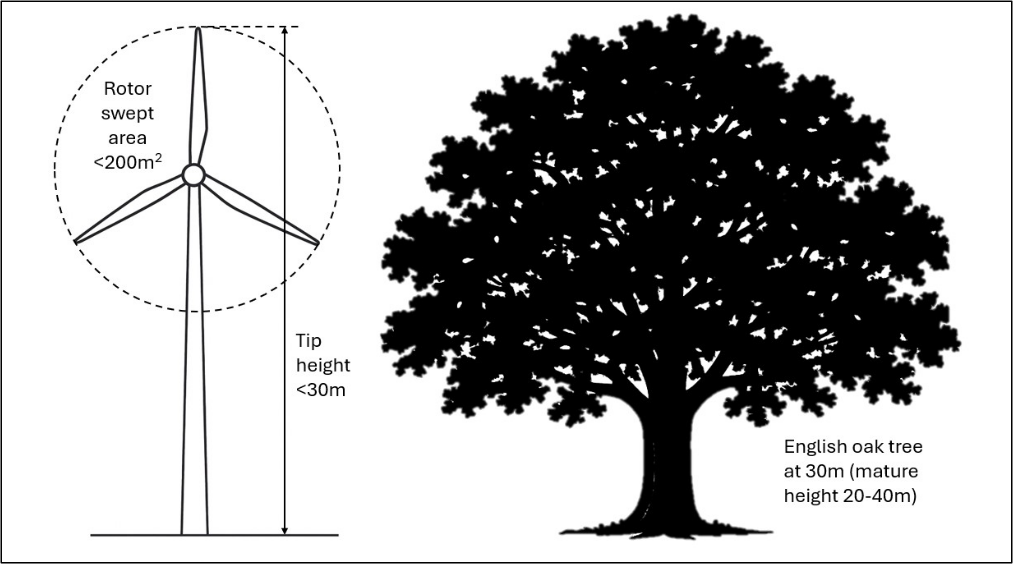
The proposed PDR would apply to turbines with a maximum tip height of 30 metres and a swept area of no more than 200 square metres[footnote 4]. These thresholds are consistent with other definitions of small-scale wind used in the UK and internationally, including the International Electrotechnical Commission’s 61400-2 standard definition for a small turbine[footnote 5], which is replicated in the Microgeneration Certification Scheme (MCS) definition[footnote 6].
At this scale, turbines are likely to have a capacity of up to 50 kilowatts (kW), which is sufficient to make a meaningful contribution to the energy needs of small businesses or public facilities. For example, a 50kW onshore wind could meet 100% of the energy demand for some medium-sized farming enterprises such as milking parlours or poultry units or 33% of the demand of arable farms with electrical components[footnote 7]. We consider that this will be appropriate development in many locations, particularly in rural or semi-rural settings where turbines of this scale can be sited near farm buildings or trees without dominating the landscape; a 30m tall turbine would be the same height as telecommunication masts (excluding any antenna) installed under a similar PDR outside of protected areas[footnote 8], and comparable to a mature oak tree (which reach heights of 20m–40m)[footnote 9].
Q3a: Do you agree with a maximum 30 metre tip height for the non-domestic wind turbine?
Q3b: Please explain your answer.
Q3c: Do you agree with a maximum rotor swept area of 200m2?
Q3d: Please explain your answer.
Figure 1. Diagram and size comparison of the proposed PDR
Additional or larger turbines
While the government is proposing to introduce a new PDR for the installation of a single turbine on non-domestic premises, we are also welcoming views on whether a PDR could support installations of larger turbines, or more than one small turbine. While a single small turbine is likely to provide a meaningful contribution to the energy needs of small to medium enterprises, there may be instances where a user with higher energy needs could benefit from installing additional wind generation, involving larger turbines or more than one small turbine. We are keen to understand whether this policy could be the right vehicle to facilitate such installations, while managing potential impacts. For example, where a business owner has a large area of land available, it may be appropriate to allow more than one turbine on a proportional basis. If the policy were to permit one turbine per 100 hectares of land, then a business with 250 hectares could be eligible to install up to two turbines, provided all other criteria and impact mitigation conditions are met. An approach like this could give flexibility to higher energy use businesses operating on larger sites, while still ensuring that turbine numbers remain proportionate to land area and that cumulative impacts can be effectively managed. We welcome all views on whether we should consider including this, or other flexible approaches, in the proposed PDR.
Q4a: Do you think that a PDR should facilitate the installation of larger turbines on a site?
Q4b: Please explain your answer, including any evidence, examples or case studies that inform your view.
Q4c: What types of impacts (positive or negative) might arise from allowing larger turbines to be installed under a PDR?
Q4d: Do you think that a PDR should facilitate the installation of multiple turbines on a site?
Q4e: Please explain your answer, including any evidence, examples or case studies that inform your view.
Q4f: What types of impacts (positive or negative) might arise from allowing multiple turbines to be installed under a PDR?
Q4g: If you answered ‘yes’ to Q4a or Q4d, are there specific criteria the policy could introduce to help determine when more than one turbine or larger turbines may be appropriate?
Q4h: If you answered ‘yes’ to Q4a or Q4d, what criteria, safeguards, additional requirements or approaches should apply to ensure that the impacts of allowing more than one turbine or larger turbines could be effectively managed?
New PDR proposal: siting restrictions
This section sets out the proposed siting restrictions for small-scale wind turbines under the new PDR. These restrictions are intended to ensure that turbines are located in appropriate settings, while minimising impact on sensitive sites, neighbouring properties, and the wider landscape.
Excluded sites
To avoid inappropriate development in sensitive areas, the proposed PDR would not apply to:
- Article 2(3) land (which includes conservation areas, National Parks, the Broads, National Landscapes (formerly known as Areas of Outstanding Natural Beauty), World Heritage Sites, and areas specified by the Secretary of State for the purposes of section 41(3) of the Wildlife and Countryside Act 1981.
- Designated habitat sites (including Sites of Special Scientific Interest (SSSIs), Special Areas of Conservation (SACs), Special Protection Areas (SPAs), Ramsar sites, and Irreplaceable Habitats;
- Scheduled Monuments, Registered Parks and Gardens, and Registered Battlefields
- Land within the curtilage of a listed building; and
- Safeguarded land[footnote 10].
These exclusions are designed to protect areas of sensitive sites and landscapes from potential adverse impacts associated with turbine development.
Q5a: Do you agree with the proposed list of areas where the PDR will not apply?
Q5b: What, if anything, would you change about the proposed list of excluded areas?
Additional siting conditions
Some sites which are excluded from this PDR may be more sensitive to nearby turbine installations, and so it may be appropriate to include extra protections for them in this PDR. We welcome evidence and views on the additional protections outlined below.
Heritage sites
To protect heritage assets and important landscapes, the proposal includes a condition that where development may be visible from a heritage site or important landscape, the visual impact of the turbine should also be minimised so far as practicable, taking into account the nature and purpose of the site.
Designated habitat sites
Some designated habitat sites could be affected by a turbine installation on nearby land. For example, LPAs have a duty to take reasonable steps to further the conservation and enhancement of the flora, fauna or geographical or physiological features by reason of which a SSSI is of special scientific interest[footnote 11]. This includes accounting for impacts that could occur from adjacent land. The proposed condition for prior approval from LPAs for installations under this PDR with regards to siting (see page 19, ‘New PDR proposal: prior approvals’) could ensure that appropriate consideration is given to impacts from permitted development on land near to a designated site. However, we are also seeking views on whether further conditions are necessary, such as an additional buffer zone around a particular type of designated site (e.g. SSSIs), or a further exclusion for sites adjacent to a particular type of designated site.
Radar
In addition, we are considering whether it is necessary to include an extra condition to mitigate interference with radars, such as air traffic control and air defence radars, or navigations aids. This is because wind turbines can cause interference with radar and navigation systems, and we need to ensure that they can continue to operate safely and effectively after any changes to PDRs. We are currently exploring what this condition could look like, and how far the exclusion of safeguarded land is likely to mitigate any potential interference. We welcome comments and evidence on additional conditions to avoid radar interference.
Q6a: Do you agree with the proposed additional condition to minimise visual impact on nearby heritage sites and important landscapes?
Q6b: Please explain your answer.
Q6c: Do you think the proposed conditions are sufficient to prevent impacts from turbines installed on land nearby or adjacent to designated habitat sites?
Q6d: Please explain your answer and provide any evidence you have.
Q6e: Do you think additional conditions are necessary to mitigate radar interference from nearby turbines?
Q6f: Please explain your answer and provide any evidence you have.
Buffer distances
To reduce the risk of adverse effects on neighbouring properties, the proposal includes two buffer distances:
- The turbine must be sited at a distance from the boundary of the curtilage that is no less than the tip height + 10% (for example, a turbine with a tip height of 30m would need to be sited at least 33m away from the boundary of the curtilage of the property installing it);
- The turbine must be separated from the curtilage of any neighbouring protected building by no less than ten times the rotor diameter. A “protected building” means any permanent building which is normally occupied by people or would be so occupied, if it were in use for purposes for which it is designed (such as homes, hostels and HMOs). Domestic buildings within the wider non-domestic unit where a turbine is being installed would not be considered a ‘protected building’. For example, a turbine with a 15m rotor diameter would need to be sited at least 150m away from the property boundary of a neighbouring home; if the turbine was being installed on a non-domestic property which also included a home, such as on a farm with its own farmhouse, the 150m buffer distance would not apply to that farmhouse.
These buffer distances are intended to mitigate potential impacts such as noise and shadow flicker. While we expect noise to be minimal from turbines of this size, this approach allows for proportionality based on turbine size and supports safe and considerate siting. The relevant MCS standard also includes a robust noise assessment.
Q7a: Do you agree with requiring a buffer distance of the tip height + 10% from the boundary of the curtilage?
Q7b: Please explain your answer.
Q7c: Do you agree with requiring a buffer distance of ten times the rotor diameter from the curtilage of protected buildings?
Q7d: Please explain your answer.
Separation distance
As part of this proposal, we are exploring whether to include a separation distance - a requirement that turbines be sited a minimum distance from one another. This could help avoid excessive clustering and cumulative impacts, particularly in areas where eligible neighbouring landowners are located in close proximity to each other. A density restriction could also help to maintain the character of the surrounding area and reduce the likelihood of overlapping visual or acoustic effects.
However, we also recognise that such a restriction could limit deployment opportunities, especially in rural areas where several landowners may wish to install turbines independently.
At this stage, we are not proposing a specific threshold, but welcome views on whether a separation distance is necessary, and if so, how it should be defined.
Q8a: Do you think this PDR should include a separation distance between turbines?
Q8b: Please explain your answer. If you have said yes, please also provide views on what you consider to be an appropriate separation distance in metres.
New PDR proposal: further conditions
In addition to siting and size restrictions, we are proposing further conditions to help ensure that small-scale wind turbine installations under this PDR are safe, visually appropriate, and environmentally responsible. These conditions are intended to limit potential impacts and provide clarity for developers, landowners, and local authorities.
Certification standards
To ensure safety and performance, turbines installed under this PDR would need to comply with the Microgeneration Certification Scheme (MCS) or an equivalent standard. Certification to a robust technical standard helps to ensure that equipment is reliable, efficient, correctly installed, and suitable for deployment in a range of settings. MCS is an independent United Kingdom Accreditation Service (UKAS)-accredited quality assurance scheme for microgeneration, and the relevant MCS standards[footnote 12] align with international IEC 61400 standards for small wind turbines. Government is also minded to allow installations that are of an equivalent, high-quality certified standard to provide for flexibility and innovation in the market.
We welcome views on whether MCS is the appropriate benchmark, and whether other standards should be considered.
Q9a: Do you agree that non-domestic wind turbine installations should be certified to the relevant MCS standards?
Q9b: Please explain your answer.
Q9c: Do you agree that turbines meeting an equivalent standard should be allowed to be installed under this PDR?
Q9d: Please explain your answer.
Q9e: What schemes or standards, if any, would you consider as equivalent certification to MCS?
Visual and environmental considerations
To minimise visual and environmental impacts, we propose the following additional conditions:
- Use of non-reflective materials on blades: this helps to reduce glint and glare and visual intrusion.
- Removal of turbine and associated infrastructure as soon as practicable when no longer needed: when the wind turbine is no longer in use, the site should be returned to its previous condition. Responsibility for removal would rest with the landowner.
These conditions are designed to support responsible development and avoid unnecessary impacts on the surrounding environment.
Q10a: Do you agree with the proposed condition on use of non-reflective materials on blades?
Q10b: Please explain your answer.
Q10c: Do you agree with the proposed condition on removal of the turbine and associated infrastructure when no longer needed?
Q10d: Please explain your answer.
New PDR proposal: prior approval
We are proposing the new PDR should allow for local consideration of specified planning matters through the prior approval process. Under this process, a developer would be required to seek approval from the local planning authority (LPA) before development can commence. The aim of introducing prior approval is to provide a proportionate level of oversight for development. Under this approach, developers would submit certain details of the proposed installation to the LPA for consideration, along with the relevant fee, before development can commence.
The LPA can only consider specified matters when determining a prior approval application. LPAs have a time-limited opportunity, usually 8 weeks, to consider the specified matters and decide whether the installation can proceed. Government is proposing the PDR should be subject to the prior approval of the LPA in respect of the siting, impact of the development on the amenity of the area, and contamination risks, to minimise local adverse impacts. For example, if turbines are installed on contaminated land, the piling for their foundations can mobilise pollutants and create new pathways for contamination to migrate. This risk is more significant in water source protection zones, principal aquifers and drinking-water protection zones.
Q11a: Do you agree with including prior approval in respect of siting, impact of the development on the amenity of the area, and land contamination risks?
Q11b: Please explain your answer.
New PDR proposal: Full list of proposed conditions
The following table is the full list of proposed conditions for the non-domestic PDR that has been discussed in the preceding pages.
Table 2. Full list of proposed conditions for the non-domestic PDR
| Condition | Proposal |
|---|---|
| Eligible contexts | Non-domestic contexts only (e.g. agricultural, commercial, industry, public sector estate) |
| Number of turbines | Single standalone turbine within the boundary of the curtilage |
| Size limits | Up to 30m tip height and a maximum 200m2 swept area |
| Additional or larger turbines | No specific proposal included, we are seeking views through this consultation |
| Excluded sites | Article 2(3) land (which includes conservation areas, National Parks, the Broads, National Landscapes (formerly known as Areas of Outstanding Natural Beauty), World Heritage Sites, and areas specified by the Secretary of State for the purposes of section 41(3) of the Wildlife and Countryside Act 1981. Designated habitat sites (including Sites of Special Scientific Interest (SSSIs), Special Areas of Conservation (SACs), Special Protection Areas (SPAs), Ramsar sites, and Irreplaceable Habitats Scheduled Monuments, Registered Parks and Gardens, and Registered Battlefields Land within the curtilage of a listed building Safeguarded land |
| Additional siting conditions | Where development may be visible from a heritage site or important landscape, the visual impact of the turbine should also be minimised so far as practicable, taking into account the nature and purpose of the site We are seeking views through this consultation on whether further conditions could be necessary to avoid impacts on designated habitats sites and radar sites |
| Buffer distances | Distance from boundary of the curtilage is no less than the tip height + 10% The turbine must be separated from the curtilage of any protected building by no less than ten times the rotor diameter |
| Separation distance between turbines | No proposal included, we are seeking views through this consultation |
| Certification standards | Compliance with MCS or equivalent |
| Visual and environmental considerations | Non-reflective materials on blades Removal of turbine and associated infrastructure as soon as practicable when no longer needed |
| Prior approval | Prior approval process required for the siting, impact of the development on the amenity of the area, and land contamination risks. |
Other considerations
Q12: Are there any other matters or likely impacts that should be considered if a new PDR is introduced for non-domestic wind turbines?
Environmental Impact Assessment (EIA)
Under current legislation[footnote 13], certain types of development require an Environmental Impact Assessment (EIA) to identify, assess, and mitigate potential environmental effects. For wind turbines, the relevant thresholds are based on the number of turbines and their height. Installations with more than two turbines, or where the hub height of any turbine or height of any other structure exceeds 15 metres, will trigger the need for EIA screening by the LPA to determine whether a full EIA and planning application is necessary. Development of any size that is proposed in, or partly in, a ‘sensitive area’ (as defined by the legislation) will also trigger the need for EIA screening.
Hub height refers to the height of the turbine, measured from the ground to the middle of its rotor, whereas tip height is the height of the turbine measured from the ground to the highest point of the blade when it is pointing straight upwards. The difference between hub height and tip height will depend on the size of the blades.
Figure 2. Illustration of two turbines, showing the difference between hub height and tip height
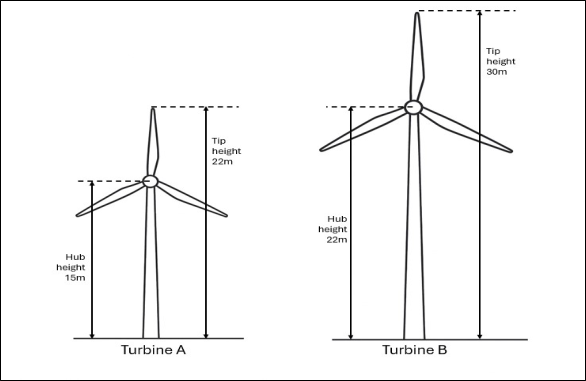
Turbine A in Figure 2 would not trigger an EIA screening request because the hub height does not exceed 15m (assuming that it is also not proposed in a ‘sensitive area’). If it met the other PDR conditions, Turbine A could be installed under the proposed PDR without EIA screening. However, as Turbine B shows, an installation with a tip height of 30m could have a higher hub height – in this case, 22m. This means that Turbine B would require an EIA screening request. If the LPA decides that an EIA is necessary, then Turbine B would not be considered permitted development, and a planning application would be required.
It should also be noted that the government has committed to moving towards a new system of Environmental Outcomes Reports (EORs), which will aim to streamline the process of EIAs and place a greater focus on achieving environmental ambitions. We will publish a roadmap setting out the timelines for introducing this new system in due course.
Q13: Do you have any comments on the relationship between EIAs and PDRs for small-scale, non-domestic wind turbine installations?
Existing PDRs
This consultation focuses on introducing a new PDR for small-scale, non-domestic wind turbines. However, there are existing PDRs that allow for small-scale wind turbines to be installed on residential properties, such as on rooftops (building-mounted) or in gardens (standalone), subject to conditions and limitations. These include limits on size, siting, and proximity to boundaries, designed to proportionally control impacts in domestic settings.
The existing PDR for domestic building-mounted turbines (Class H, Part 14 of the General Permitted Development Order) applies only to installations on detached houses and other detached buildings within the boundaries of a house or block of flats. Some conditions of this PDR are that the building-mounted turbine should not protrude more than three metres above the highest part of the roof (excluding the chimney) or exceed an overall height of 15 metres, and the swept area must not exceed 3.8 square metres. In addition, the building-mounted turbine must comply with the MCS Planning Standards or equivalent, must not be sited in certain protected areas, and must not be co-located with an air source heat pump or additional turbine.
The existing PDR for domestic standalone wind turbines (Class I, Part 14 of the General Permitted Development Order) applies within the boundaries of a house or block of flats. Some conditions of this PDR are that the highest part of the turbine must not exceed 11.1 metres, with a swept area of no more than 3.8 square metres and with a distance between ground level and the lowest part of the blade of no less than 5 metres. In addition, the turbine must be sited a distance away from the boundary of the curtilage, which is no less than the tip height + 10%. As with roof-mounted turbines, the turbine must comply with the MCS Planning Standards or equivalent, must not be sited in certain protected areas, and must not be co-located with an air source heat pump or additional turbine.
Please see legislation.gov.uk for more information on Class H and Class I of Part 14 of the General Permitted Development Order, including a full list of the limitations and conditions.
Evidence to date suggests that uptake of domestic wind turbines under PDRs has been limited, with only 31 MCS-certified domestic installations in England since January 2009[footnote 14]. This may be due to a combination of factors, such as technical constraints, costs and the availability of suitable products on the market. In particular, urban and semi-urban areas see lower wind speeds and turbulence from surrounding structures that can significantly affect performance.
Given these considerations, we are not currently proposing changes to the existing rooftop or standalone domestic PDRs. For example, increasing the height limits to allow for larger turbines may lead to inappropriate deployment in residential settings and is likely to produce significantly more generation than required to meet average household electricity usage[footnote 15], leading to concerns over cost-effectiveness. However, we welcome views on whether there are aspects of the current framework that could be improved, or whether further support or guidance would help unlock appropriate deployment.
Q14a: Do you think government should make changes to existing PDRs for small-scale turbines in domestic settings?
Q14b: Please explain your answer. If you have said yes, please include changes you think government should make.
Repowering and community energy projects
In the Onshore Wind Taskforce Strategy, government also committed to explore if PDRs could support other types of deployment such as repowering or community energy projects.
This consultation does not propose extending PDRs to cover the repowering of existing wind farms. Repowering typically involves replacing older turbines with newer, often larger models that can result in greater or different impacts compared to the existing turbines. These may include changes to visual impact, noise levels, ecological effects, and interactions with surrounding land uses.
Given the scale and potential sensitivity of repowering projects, government does not consider that introducing a PDR would be appropriate. However, we recognise that repowering is an important part of the UK’s clean energy transition, and that planning and consenting processes must remain proportionate and responsive. Government has committed in the Onshore Wind Taskforce Strategy to delivering planning policy guidance in England to support the repowering and lifetime extension of existing sites and government is working with stakeholders through the Onshore Wind Council to consider further interventions.
In addition, the proposed PDR does not make specific provision for community energy projects, as many will require a turbine larger than 30m to improve the financial viability and business case of the site, and to make a more meaningful contribution to local energy needs. Where this is the case, there may be greater impacts that are more appropriate to be considered through a planning application.
The government has recently consulted on changes to the National Planning Policy Framework, including a new decision-making policy that gives substantial weight to the benefits associated with low carbon and energy developments, including the benefits of utilising established sites in the case of applications for re-powering and life extension. This policy also recognises the contribution that small-scale and community-led projects can make to reducing emissions. The details of the consultation can be found at https://www.gov.uk/government/consultations/national-planning-policy-framework-proposed-reforms-and-other-changes-to-the-planning-system. The government is now considering the responses received and these will inform the publication of a revised Framework. However, the government would welcome wider views on how the planning system in England could be improved more generally for repowering and community energy projects beyond changes to the NPPF.
Q15a: Do you think government should introduce a new PDR for repowering projects?
Q15b: Please explain your answer.
Q15c: Do you have views on how the planning system in England could be improved for repowering (or life extension) projects, beyond changes to the NPPF?
Q16a: Do you think government should introduce a new PDR for community energy projects?
Q16b: Please explain your answer.
Q16c: Do you have views on how the planning system in England could be improved for community energy projects, beyond changes to the NPPF?
Q17: Do you have suggestions for any other circumstances where a PDR could be used for onshore wind installations?
General questions and evidence gathering
Q18: Do you have any further comments on the proposals in this consultation?
Government is also seeking further evidence to inform further, in-depth analysis on the impacts of this policy.
Q19: Do you have any further evidence or data to share?
This could be in relation to:
- Predicted load factors for small-scale wind turbines;
- Forecasts on additional installations as a consequence of this policy;
- Potential wider impacts of this policy on the market, businesses, individuals, or the environment;
- Other barriers to installing small-scale wind turbines in non-domestic contexts.
Public Sector Equality Duty
We are required to assess these proposals by reference to the Public Sector Equality Duty contained in the Equality Act 2010. An updated Public Sector Equality Duty Assessment will be prepared reflecting the detail of the changes prior to any secondary legislation being laid, subject to the outcome of the consultation.
We would welcome your comments as part of this consultation on whether any of the proposed changes could give rise to any impacts on people who share a protected characteristic (Age; Disability; Gender Reassignment; Marriage or Civil Partnership; Pregnancy and Maternity; Race; Religion or Belief; Sex; and Sexual Orientation).
In providing comments, please make it clear which chapter or condition of this consultation your comment relates to.
Q20a: Do you think that the changes proposed in this consultation could give rise to any impacts on people who share a protected characteristic (Age; Disability; Gender Reassignment; Marriage or Civil Partnership; Pregnancy and Maternity; Race; Religion or Belief; Sex; and Sexual Orientation)?
Q20b: Please explain your answer.
Consultation questions
Eligible contexts
1a. Do you agree that a new PDR should be introduced for a wind turbine in non-domestic settings?
1b. Please explain your answer.
Number of turbines
2a. Do you agree that this PDR should be limited to a single turbine within the boundary of the curtilage?
2b. Please explain your answer.
Size limits
3a. Do you agree with a maximum 30 metre tip height for the non-domestic wind turbine?
3b. Please explain your answer.
3c. Do you agree with a maximum rotor swept area of 200m2?
3d. Please explain your answer.
Additional or larger turbines
4a. Do you think that a PDR should facilitate the installation of larger turbines on a site?
4b. Please explain your answer, including any evidence, examples or case studies that inform your view.
4c. What types of impacts (positive or negative) might arise from allowing larger turbines to be installed under a PDR?
4d. Do you think that a PDR should facilitate the installation of multiple turbines on a site?
4e. Please explain your answer, including any evidence, examples or case studies that inform your view.
4f. What types of impacts (positive or negative) might arise from allowing multiple turbines to be installed under a PDR?
4g. If you answered ‘yes’ to Q4a or Q4d, are there specific criteria the policy could introduce to help determine when more than one turbine or larger turbines may be appropriate?
4h. If you answered ‘yes’ to Q4a or Q4d, what criteria, safeguards, additional requirements or approaches should apply to ensure that the impacts of allowing more than one turbine or larger turbines could be effectively managed?
Excluded sites
5a. Do you agree with the proposed list of areas where the PDR will not apply?
5b. What, if anything, would you change about the proposed list of excluded areas?
Additional siting conditions
6a. Do you agree with the proposed additional condition to minimise visual impact on nearby heritage sites and important landscapes?
6b. Please explain your answer.
6c. Do you think the proposed conditions are sufficient to prevent impacts from turbines installed on land nearby or adjacent to designated habitat sites?
6d. Please explain your answer and provide any evidence you have.
6e. Do you think additional conditions are necessary to mitigate radar interference from nearby turbines?
6f. Please explain your answer and provide any evidence you have.
Buffer distances
7a. Do you agree with requiring a buffer distance of the tip height + 10% from the boundary of the curtilage?
7b. Please explain your answer.
7c. Do you agree with requiring a buffer distance of ten times the rotor diameter from the curtilage of protected buildings?
7d. Please explain your answer.
Separation distance
8a. Do you think this PDR should include a separation distance between turbines?
8b. Please explain your answer. If you have said yes, please also provide views on what you consider to be an appropriate separation distance in metres.
Certification standards
9a. Do you agree that non-domestic wind turbine installations should be certified to the relevant MCS standards?
9b. Please explain your answer.
9c. Do you agree that turbines meeting an equivalent standard should be allowed to be installed under this PDR?
9d. Please explain your answer.
9e. What schemes or standards, if any, would you consider as equivalent certification to MCS?
Visual and environmental considerations
10a. Do you agree with the proposed condition on use of non-reflective materials on blades?
10b. Please explain your answer.
10c. Do you agree with the proposed condition on removal of the turbine and associated infrastructure when no longer needed?
10d. Please explain your answer.
Prior approval
11a. Do you agree with including prior approval in respect of siting, impact of the development on the amenity of the area, and land contamination risks?
11b. Please explain your answer.
Other considerations
12. Are there any other matters or likely impacts that should be considered if a new PDR is introduced for non-domestic wind turbines?
Environmental Impact Assessment
13. Do you have any comments on the relationship between EIAs and PDRs for small-scale, non-domestic wind turbine installations?
Existing permitted development rights
14a. Do you think government should make changes to existing PDRs for small-scale turbines in domestic settings?
14b. Please explain your answer. If you have said yes, please include changes you think government should make.
Repowering and community energy projects
15a. Do you think government should introduce a new PDR for repowering projects?
15b. Please explain your answer.
15c. Do you have views on how the planning system in England could be improved for repowering (or life extension) projects, beyond changes to the NPPF?
16a. Do you think government should introduce a new PDR for community energy projects?
16b. Please explain your answer.
16c. Do you have views on how the planning system in England could be improved for community energy projects, beyond changes to the NPPF?
17. Do you have suggestions for any other circumstances where a PDR could be used for onshore wind installations?
General questions and evidence gathering
18. Do you have any further comments on the proposals in this consultation?
19. Do you have any further evidence or data to share?
Public Sector Equality Duty
20a. Do you think that the changes proposed in this consultation could give rise to any impacts on people who share a protected characteristic (Age; Disability; Gender Reassignment; Marriage or Civil Partnership; Pregnancy and Maternity; Race; Religion or Belief; Sex; and Sexual Orientation)?
20b. Please explain your answer.
Next steps
This consultation will run for 12 weeks and remain open until 10th June 2026. All responses will be analysed by the Department for Energy Security and Net Zero. Some responses may be shared with the Ministry of Housing, Communities and Local Government or other government departments who also have an interest in this consultation.
Government will aim to publish a response to this consultation in Autumn 2026, within 12 weeks of the consultation closing.
-
Permitted development rights are set out in the Town and Country Planning (General Permitted Development) (England) Order 2015, as amended (“the General Permitted Development Order”). ↩
-
“Microgeneration” has the same meaning as in section 82(6) of the Energy Act 2004. ↩
-
Requirements under the Town and Country Planning (Environmental Impact Assessment) Regulations 2017. ↩
-
Tip height refers to the height of the turbine measured from the base of the tower to the tip of a blade pointing straight upwards (i.e. the maximum possible height the turbine could reach). The swept area refers to the area of the circle created by the blades as they sweep through the air. ↩
-
IEC 61400-2 (2013): “[The small wind turbine standard] applies to wind turbines with a rotor swept area smaller than or equal to 200 m2.” ↩
-
MCS defines a small wind turbine in the MCS 006 Product Standard as one which has “a rated electrical power output of up to 50kW (measured at a wind speed of 11.0 metres per second (m/s) [and] a rotor swept area of smaller than or equal to 200m²”, as well as a voltage limit. ↩
-
If assuming a load factor of 20% (the percentage of expected generation compared to its maximum theoretical output), a 50kW turbine would generate an estimated 88,000 kilowatt hours (kWh) per year. Estimates provided by the National Farmers Union (NFU), suggest that some medium-sized enterprises such as milking parlours and poultry units may use 44,000-88,000 kWh per year and arable farms with electrical components could use 263,000 kWh. ↩
-
Class A, Part 16, The Town and Country Planning (General Permitted Development) (England) Order 2015 ↩
-
Woodland Trust: English Oak (Quercus robur) factsheet ↩
-
“Safeguarded land” means land which— (a) is necessary to be safeguarded for aviation or defence purposes; and (b) has been notified as such, in writing, to the Secretary of State by an aerodrome operator, an air traffic services licence holder or the Secretary of State for Defence. ↩
-
Under section 28I of the Wildlife and Countryside Act 1981. ↩
-
MCS 020b lays out requirements for noise calculations. This also requires compliance with MCS 006 for the product standard and MIS 3003 for installation. These can also be found in the MCS Standards and Tools Library. ↩
-
The Town and Country Planning (Environmental Impact Assessment) Regulations 2017 ↩
-
MCS Data Dashboard: Installation insights, as of December 2025. ↩
-
Ofgem estimate an average 2–3-bedroom home typically uses 2700 kWh of electricity per year. See Ofgem average household gas and electricity use. ↩