Oversight and funding of youth justice services: consultation document
Updated 31 July 2026
Applies to England and Wales

© Crown copyright 2026
This publication is licensed under the terms of the Open Government Licence v3.0 except where otherwise stated. To view this licence, visit nationalarchives.gov.uk/doc/open-government-licence/version/3 or write to the Information Policy Team, The National Archives, Kew, London TW9 4DU, or email: psi@nationalarchives.gov.uk.
Where we have identified any third party copyright information you will need to obtain permission from the copyright holders concerned.
This publication is available at https://www.gov.uk/government/consultations/oversight-and-funding-of-youth-justice-services/oversight-and-funding-of-youth-justice-services-consultation-document
Executive summary
The case for change
Youth justice services play a unique and indispensable role in the youth justice system, acting as the core multi-agency vehicle for preventing offending and reoffending by children. Over the past two decades, they have helped drive significant reductions in the number of children in the youth justice system, improving their long-term outcomes and keeping our communities safer. This progress has been driven in large part by the commitment and generally strong performance of youth justice services and the multi-agency partnerships that underpin effective local delivery. Although fewer children are entering the youth justice system, a greater proportion of those entering have complex needs, requiring more coordinated support across multiple agencies. Reoffending rates also remain persistently high, with around a third of children going on to reoffend. At the same time, increasing pressures across public services have affected the ability of statutory partners to contribute consistently to youth justice delivery.
The current national approach to youth justice system oversight has not kept pace with these changes. Oversight arrangements are fragmented, expectations are not always aligned with the realities of current practice, and it is not clear which outcomes are used to assess individual service-level performance versus those which are more indicative of effective partnership performance or overall system health. In addition, reporting requirements to central government are too high, taking professionals’ time away from delivering for children, victims and communities – and some in the sector have expressed a perception that the information gathered does not always serve a clear purpose.
Funding arrangements for youth justice services also require reform. The current method used for allocating funding relies on outdated data and does not consistently reflect local need, the increasing complexity of cases or the shift in practice towards early intervention and prevention. Partner contributions are inconsistent in both scale and reliability, creating a postcode lottery in levels of funding.
As set out in ‘Cutting Youth Crime. Changing Young Lives’[footnote 1] the government has decided that responsibility for national oversight, monitoring performance and administration of the youth justice core grant will transfer to the Ministry of Justice (MOJ), with the role of the Youth Justice Board (YJB) reformed into a continuous improvement body, focused on providing expert insight and promoting best practice. As functions transfer, we want to reform and reshape the system to address these challenges.
Our approach
We propose undertaking reforms in two phases:
- from April 2027: introducing a new national performance and oversight framework
- from April 2029: reforming the approach to how youth justice services are funded
Part A: A new performance and oversight framework (from April 2027)
We want to maintain a locally delivered system, underpinned by stronger national expectations, clearer escalation routes to central government for partnership issues, and a more effective approach to supporting learning and improvement across youth justice services.
In keeping with the new partnership between central government and youth justice services first articulated in the February 2026 youth justice policy statement ‘A Modern Youth Justice System: Foundations Fit for the Future’[footnote 2] and expanded upon in ‘Cutting Youth Crime. Changing Young Lives’, this approach will be underpinned by a trust in local leaders to design and deliver services that meet the needs of their communities. In return for this, the MOJ will set clear expectations around the minimum standards that are expected as a condition of funding, with an escalation route to central government where action is needed to improve partner engagement or where system-level issues are identified. The MOJ will also develop central guidance to define high-quality practice, while the reformed YJB will continue to support local youth justice services through learning, improvement and the sharing of effective practice. This consultation seeks views on a number of areas to inform development of the MOJ’s approach to national oversight:
- updated National Standards – the ‘floor’ that we expect to be in place as a condition of central government funding. We are seeking views on two potential ways in which new standards could be updated and structured – either by keeping the current structure (based around different ‘phases’ of the youth justice system) and updating the content, or by moving to a new structure based on thematic areas
- a new Quality Performance Framework to complement National Standards, which will define what high-quality practice looks like on the ground. Rooted in evidence, the framework would support self-assessment at a local level, supporting continuous improvement and driving more consistent quality across the sector
- a clearer articulation for assessing performance, distinguishing between youth justice service level performance measures and those that indicate performance at a partnership or system level, with an escalation route to central government where partnership engagement is impacting youth justice outcomes. This responds to feedback from youth justice services that they often feel held accountable for outcomes that sit outside their immediate control
- more streamlined reporting requirements focused on the information needed to assess performance and support improvement at a service, partnership and system level. We are seeking views on amending requirements around youth justice annual plans, serious incident notifications and proportionate approaches to gathering qualitative information on local performance
Part B: Reform of funding (from April 2029)
We recognise that any effective performance framework must be underpinned by sustainable funding that is transparently and fairly allocated according to need. Multi-year funding for the core grant and Turnaround has been confirmed until April 2029, offering more dependable funding arrangements for the next three years, although arrangements will differ in Greater Manchester and Wales, where elements of funding have been devolved. In the longer term, we are proposing to move towards a more transparent and needs-based approach to funding by updating the national formula used to allocate grant funding to youth justice services, ensuring that resources better reflect local demand and complexity. We are also seeking views on how the MOJ can support youth justice services to secure more consistent contributions from statutory partners.
Working with the sector
We will work closely with youth justice services, partners and stakeholders to develop the detail of these proposals before implementation. This consultation is the first step in that process.
We recognise that these reforms will require careful design and implementation and they will need to interact with the continuous improvement offer developed by the YJB. The UK Government is also working with the Welsh Government to agree an expanded and clearly defined role for the Welsh Government with regard to youth justice service oversight in Wales.
Introduction
This consultation sets out proposals to reform the oversight and funding of youth justice services. It seeks views on changes to the national performance and oversight framework, to be introduced from April 2027, and the future direction of funding reform from April 2029.
The consultation is aimed at youth justice services, youth justice management boards, local authorities, statutory partners, voluntary and community sector organisations, and others working with children in the youth justice system in England and Wales.
Welsh youth justice services should consider the proposals within their local and legislative context and respond to the questions accordingly. A Welsh language version and other alternative formats of the consultation paper are available on request.
Copies of the consultation paper are being sent to:
- Association of Directors of Children’s Services
- All Wales Heads of Children’s Services
- Local Government Association
- Welsh Local Government Association
- Youth Justice Board for England and Wales
- Association of Youth Offending Team Managers
- Youth Offending Team Managers Cymru
- His Majesty’s Inspectorate of Probation
- Children’s Commissioners for England and Wales
- National Police Chiefs’ Council
- Association of Police and Crime Commissioners
However, this list is not intended to be exhaustive or exclusive, and we welcome responses from anyone with an interest in, or views on, the subject covered by this paper.
Principles, vision and objectives
Our vision
We want a youth justice system that prevents offending, protects communities and gives children the best chance of changing their lives for the better. This requires strong local services, effective multi-agency partnerships and a national framework that supports improvement, while recognising that local leaders are best placed to understand and respond to the needs of their communities.
The reforms set out in this consultation are intended to create a system in which expectations are clear, accountability is shared appropriately across partners, resources are aligned with need, and national oversight supports learning and improvement rather than unnecessary bureaucracy.
Principles underpinning reform
The proposals in this consultation are guided by five core principles:
Partnership responsibility
Youth justice outcomes are achieved through collective action. Youth justice services cannot deliver these outcomes alone. Effective oversight and accountability arrangements should recognise the shared responsibilities of statutory partners and support stronger multi-agency collaboration.
Locally led, nationally aligned
Local leaders should have the flexibility to design and deliver services that meet local needs. National government should set clear expectations, establish minimum standards and provide support where needed, while avoiding unnecessary central prescription.
Improvement over compliance
The primary purpose of oversight should be to support learning, self-assessment and continuous improvement. Information should be collected because it helps improve outcomes, supports accountability or identifies areas where support or action is needed, not simply for compliance purposes.
Reducing disparities
Youth justice services, partners and national government should work together to understand and reduce disparities in children’s experiences and outcomes and promote a fair and equitable system for all children.
Funding aligned to need
Resources should be distributed transparently and fairly, reflecting the differing levels of need, complexity and demand faced by local areas, while supporting effective service delivery.
Our objectives
Through these reforms we aim to:
- create a more coherent and integrated approach to national oversight
- strengthen multi-agency partnership working and shared accountability
- give youth justice services greater clarity about what is expected and how performance is assessed
- empower local leaders and partnerships to deliver for their local areas
- reduce unnecessary administrative burdens and focus reporting on what drives improvement
- support continuous improvement and high-quality practice across the youth justice system through evidence, learning and self-assessment
- reduce persistent disparities by ensuring needs are identified, understood and actively addressed through local practice, partnership working and national oversight
- ensure funding arrangements are sustainable, transparent and aligned with need
Part A – Youth Justice Service Performance and Oversight
Current arrangements
While youth justice services are governed and delivered locally, under current arrangements, responsibility for national oversight of the overall youth justice system and individual service level performance is shared between the Ministry of Justice (MOJ), the Youth Justice Board (YJB) and HM Inspectorate of Probation (HMI Probation).
| Layer | Main Body | Main Function |
|---|---|---|
| Central government accountability | MOJ | Policy, funding, ministerial accountability for the youth justice system, and responsibility for performance oversight of some programmes. |
| National oversight of youth justice services | YJB | Monitoring the operation of the youth justice system and provision of youth justice services. Promoting good practice. Distribution of MOJ funding (until April 2026). |
| Independent inspection | HMI Probation | Inspection scrutiny and public grading. |
| Local governance | Local Youth Justice management boards | Strategic local leadership of youth justice services. Operational and partnership accountability. |
The fragmentation of performance and funding oversight arrangements means that in practice this is delivered through several different frameworks, processes and requirements, which often overlap. These include:
- National Standards – set by the Secretary of State for Justice on the advice of the YJB, which establish minimum expectations for service delivery
- YJB’s Youth Justice Oversight framework – which sets out the YJB’s approach to oversight, assurance and compliance, including how data and local intelligence is brought together to assess how services are performing and how system aims are being achieved
- key performance indicators (KPIs) – designed by the MOJ in consultation with the YJB and currently used by the YJB to monitor performance
- Terms and Conditions of the Youth Justice core grant – through which the YJB [footnote 3] has set requirements linked to funding, including compliance with national standards, submission of data, financial assurance, and engagement with oversight and improvement activity
- Terms and Conditions of the Turnaround core grant – through which the MOJ sets requirements linked to funding of the Turnaround early intervention and prevention programme
- statutory requirement to produce annual youth justice plans – which must set out how local areas will deliver and fund services and be submitted to the YJB by a specific deadline each year
- ongoing data reporting – gathered by the YJB and used to inform system and service level performance oversight, identify national trends and barriers to system aims
- scrutiny and inspection by HMI Probation – typically undertaken on a 4–4.5 year cycle using the youth justice inspection framework to assess organisational effectiveness and the quality of work with children and victims
- YJB-led improvement activity – including targeted support where there are concerns about performance
The wider landscape
For Welsh youth justice services, oversight arrangements are distinctly complex, with many youth justice partner services devolved to the Welsh Government, including local government, health, education and children’s social care.
Youth justice services are also operating within a wider landscape of public service reform, including changes to policing, probation, health, children’s social care and local government structures. These reforms are reshaping the organisations and partnerships that youth justice services rely on, contributing to an increasingly complex operating environment.
The Case for Change
Fragmented oversight
While the existing elements of oversight are intended to be complementary, they have developed separately over time. Youth justice services have told us that current arrangements do not always operate as a coherent system, making it difficult for services and partners to understand how different requirements interrelate or how overall performance is assessed and action taken. At a national level, the lack of alignment also makes it harder for relevant bodies to identify emerging risks and take timely action, or to identify clear best practice to share. The relationship between National Standards, inspection frameworks and performance measures is not clearly aligned, contributing to duplication and inconsistency across the system. Both the YJB and HMI Probation have identified limitations in using National Standards for delivering their critical roles.
Out of step with the realities of current practice
Centrally-set expectations such as National Standards have not kept pace with changes in how youth justice services are delivered on the ground. The shift in the system towards more upstream working on early intervention and prevention, the time services spend directly working with victims and the increasing proportion of children who have complex needs entering the justice system – meaning that their journey through the “phases” of the system is increasingly overlapping and non-linear – are not fully reflected. Youth justice services and wider stakeholders have also been clear on the importance of addressing disproportionality clearly throughout expectations.
A lack of clarity on partnership accountability
We have also heard that the current system expectations, in particular National Standards and key performance indicators, do not consistently reflect the shared responsibilities of statutory partners and therefore offer a partial or inaccurate picture of performance. This can result in youth justice services feeling that they are held accountable for outcomes beyond their direct control and without a clear route to escalate issues with partnership working. Stakeholders have also told us that the oversight framework should do more to incentivise effective partnership working and promote collective ownership of outcomes across the youth justice system.
A focus on reporting and compliance at the expense of improvement
Finally, youth justice services have told us that the impact of the oversight system is further limited by how it is applied in practice. Reporting requirements can feel duplicative and create administrative burdens that take leaders away from activity that will genuinely drive improvement, including work directly supporting children and victims, without necessarily offering a clear picture of performance so that action can be taken locally. We also recognise that national reporting requirements sit alongside a range of local reporting, governance and assurance requirements contributing to a complex reporting landscape for youth justice services. Current self-assessment against the National Standards is seen as a compliance exercise rather than a tool for continuous improvement. Although the National Standards were designed to set a consistent baseline for delivery across the system, there is broad agreement that they are often process-driven and offer limited clarity on what “good” looks like in practice. This makes it harder for services and partners to assess whether interventions are effective or to use them as a meaningful tool for improvement.
Proposals
Guided by the vision, principles and objectives set out in the previous chapter, this consultation seeks views on proposals to bring together oversight processes into a more coherent framework, set clear expectations around minimum standards and high-quality practice, clarify where accountability sits at a youth justice service, partnership level or system level and to streamline reporting arrangements to central government.
These proposals are not a response to widespread service failure. Youth justice services are generally performing well, delivering effective services and achieving positive outcomes for children, victims and communities. However, national oversight arrangements have not kept pace with the changing context in which services now operate.
Consistent with our principles of local leadership, national alignment and improvement over compliance, the purpose of the national framework is not to increase central control but to provide assurance that minimum standards are met, public funding is used effectively, and children, victims and communities receive high-quality services.
Local leaders and partnerships are best placed to understand and respond to the needs of their communities. The role of central government is to set clear expectations on behalf of taxpayers and to play a genuinely helpful role in supporting local services. This includes identifying where some areas would benefit from greater practical support, sharing best practice, and responding to emerging trends and challenges that require national action. To achieve this, we are proposing a new integrated oversight framework based on three core components: clear expectations, clear accountability and proportionate reporting requirements.
An Integrated Oversight Framework
- Clear and consistent expectations – a set of updated National Standards, alongside a new Quality Performance Framework, which together will define both the minimum expectations for services and partners and what high-quality practice looks like. These will reflect the realities of current delivery and the respective roles of youth justice services and wider partnerships.
- Clarity on partnership accountability – a clearer articulation of where outcomes are used to assess individual youth justice service delivery or where they are indicative of partnership effectiveness or overall system performance. These “tiers of accountability” will underpin the MOJ’s approach to oversight and provide clear escalation routes for issues around partnership working or for system level trends that require national action.
- A proportionate approach to reporting and compliance – by streamlining reporting requirements and reducing duplication, the framework will enable services to focus more on delivery and outcomes. Information required by central government will clearly contribute to performance oversight and system monitoring. Services will be encouraged to reflect on their own performance through self-assessments.
As set out above, these proposals are intended to support a shift towards greater local ownership, self-assessment and a culture of continuous improvement.
We recognise that these proposals come at a time when youth justice services are already operating within a wider landscape of public service reform and navigating significant change across policing, probation, health, children’s social care and local government. We have heard clearly from the sector that any reforms to oversight arrangements should reflect this context by improving coherence and reducing duplication rather than creating additional burden. As we develop the detailed design of the framework, the MOJ will continue to work closely with departments across government to ensure alignment with wider reforms.
We will take account of feedback, alongside findings from HMI Probation’s planned thematic inspection of strategic arrangements in youth justice services, as we develop the final framework.
The UK Government will also work closely with the Welsh Government and relevant Mayoral and Combined Authorities to ensure the final performance framework sits effectively alongside devolved and local arrangements for oversight of youth justice service performance.
Clear and consistent expectations: National Standards and a Quality Performance Framework
A high-performing youth justice system requires clear expectations about both the minimum standards that should be in place and the characteristics of high-quality practice. We therefore propose a framework that combines updated National Standards with a new Quality Performance Framework.
National Standards
We propose that updated National Standards remain the foundation of the national oversight framework but that they are updated to reflect the realities of current practice. They will continue to set out the statutory duties, minimum expectations and safeguarding and public protection requirements for youth justice services and their partners (the “floor”). Compliance with National Standards will continue to be a requirement in grant funding agreements and a key consideration in oversight, assurance and improvement activity, with increased scrutiny and escalation where services are unable to demonstrate compliance.
However, the current National Standards published in 2019 [footnote 4], require significant revision. We want them to:
- better reflect contemporary youth justice practice, including the shift towards early intervention and prevention (e.g., the Turnaround programme)
- place greater focus on the impact of outcomes rather than prescribed inputs
- be clearer on expectations around addressing disproportionality (in terms of the treatment of children in care, or of different ethnicities, for example) in the system
- reflect the complexity and non-linear nature of children’s ‘journeys’ through the youth justice system
- provide greater clarity on the roles, responsibilities and accountability of partners and recognise the multi-agency nature of youth justice delivery
Previous versions of the National Standards were more prescriptive, with (for example) specific requirements about the number of working days for finalising signed programme plans or undertaking full assessments of each young person admitted to custody. We do not think that returning to highly prescriptive National Standards is consistent with our aim of reducing administrative burdens and supporting greater local ownership.
Detailed work to develop the content of the National Standards will be undertaken with sector expert advisory groups later this year, with updated Standards intended for introduction from April 2027. At this stage, we are seeking views on:
- whether the National Standards should continue to be structured around phases of the youth justice system or be reorganised around thematic areas
- the high-level changes needed to ensure the Standards reflect contemporary youth justice practice
Option 1: Keep the current structure but refine the content to reflect current practice
Under this approach, National Standards would retain their current phase-based structure, with separate standards covering different stages of the youth justice system (for example, out-of-court disposals (now referred to as out-of-court resolutions), court and community delivery). While all standards would be reviewed and updated to reflect current practice, we think the particular refinements should include:
- the development of a new standard for the ‘Early Intervention and Prevention’ phase of the system, framed in a way that reflects a multi-agency approach and more clearly sets out the responsibility of partners
- the development of a new ‘Victims’ standard to reflect the MOJ and HMI Probation’s focus on improving the experience of victims in the criminal justice system
- the development of clearer expectations on addressing disproportionality (including ethnicity, neurodiversity and care experience), either included as an individual standard or integrated throughout
- updating out-of-court resolutions (OOCR) to reflect contemporary good practice
For the purposes of this consultation, we have included illustrative examples of how Standards on victims, early intervention and prevention, and disproportionality could be incorporated into a phase-based structure. These are high-level examples only and will be developed further with the sector and wider partners.
Example Victims Standard
Victims of crime committed by children are supported through a high-quality, individualised service that prioritises safety, wellbeing, participation and restorative opportunities where appropriate.
Youth Justice Services: The youth justice service actively seeks to understand victims’ individual needs, experiences and preferences and uses this to shape responsive support and intervention.
Management board and partners: The management board ensure that victim services are monitored and evaluated and continuously improve.
Example Early Intervention and Prevention Standard
Early intervention and prevention activity is delivered through a coordinated, whole-system approach that embeds diversion, clarifies partnership responsibilities, and promotes shared accountability for improving outcomes for children.
Youth Justice Service: Screening, triage and assessment processes support early identification of need and vulnerability, including safeguarding, trauma, SEND/ALN and contextual risk factors.
Management board and partners: There is a clearly defined local prevention and diversion offer, consistent with national guidance (and in Wales, the Welsh prevention framework principles).
Example Disproportionality Standard
Practice identifies and reduces disproportionality by responding to locally identified diverse needs such as care experience and race.
Youth Justice Services: Interventions are evidence-based and reflect the youth justice service’s strategic understanding of local disproportionality.
Management board and partners: There is a clear disproportionality strategy underpinned by robust local data, setting out measurable objectives for the youth justice service and partners.
Option 2: Restructure National Standards around thematic areas and refine the content to reflect current practice
Under this approach, National Standards would be restructured around a set of core thematic areas rather than phases of the youth justice system, reflecting the complex needs of children and the often non-linear nature of their journeys through the system.
A set of cross-cutting principles would also be developed to underpin all thematic areas. Below are example excerpts.
Example of National Standard thematic areas and descriptions
Leadership and Governance: The youth justice management board provides effective leadership and holds partners to account for improving outcomes. Effective and coordinated multi-agency activity ensures children receive adequate support.
Partnership Accountability: Statutory partners meet their responsibilities and are accountable for their contribution to improving outcomes for children in the youth justice system. Children have timely access to the universal, targeted and specialist services based on their assessed needs and partners ensure there are effective referral pathways that reduce barriers to access and support continuity of care.
Service Capabilities and Management: The youth justice service operates as a coordinated, effective and sustainable system with appropriate funding, resources and a skilled workforce to achieve improved and equitable outcomes for children, victims and communities.
Evidence-based Practice: The youth justice service understands and follows evidence‑based best practice (as set out, for example, in the Youth Endowment Fund Violence Prevention Toolkit) when designing intervention plans for children and uses data and evidence to inform its operational delivery and strategic planning.
Victims: The youth justice service provides victim support that is high-quality, personalised and responsive, improving outcomes and enhancing victim safety.
Learning and Continuous Improvement: The youth justice service uses data, evidence and feedback to continuously improve performance and develop the workforce.
Example of cross-cutting principles and descriptions
Child’s Voice: Children’s views, strengths and lived experiences shape all aspects of practice, service design and decision-making.
Safeguarding and Public Protection: Risks to children and others are identified, managed and reviewed effectively across practice and partnerships.
Disproportionality: Disparities are identified, understood, and actively addressed across delivery and the monitoring of outcomes.
Question 1
Which of the following options best describes the structure for National Standards?
- Option 1: remain structured around system phases
- Option 2: be re-structured into thematic areas with cross-cutting principles
- Undecided
- [Free text]
Question 2
If National Standards remain as phases of youth justice (Option 1), do you agree with our proposals to develop new standards on Victims, Early Intervention and Prevention, and to update OOCRs to reflect contemporary good practice? What other changes or additions would you expect to see to National Standard phases to ensure they reflect the realities of current practice?
New standard for Victims - Yes - No
New standard for Early intervention and Prevention - Yes - No
Update OOCR to reflect contemporary good practice - Yes - No - [Free text]
Question 3
If National Standards are restructured around thematic areas (Option 2), to what extent do you agree with the proposed example thematic areas and cross-cutting principles? What additions or changes would you suggest to reflect the realities of current practice?
- Strongly agree
- Agree
- Undecided
- Disagree
- Strongly disagree
- [Free text]
Question 4
Should disproportionality be included as an individual standard/thematic area or integrated throughout the National Standards? You may wish to give reasons in the text box.
- Keep as an individual standard/thematic area
- Integrate into other standards/thematic areas
- [Free text]
Quality Performance Framework
While National Standards will continue to set minimum expectations, which is essential for assurance and accountability, we also want to articulate what high-quality practice (the ‘ceiling’) looks like in delivery.
To address this, we propose developing a new Quality Performance Framework that complements National Standards by defining the key characteristics and approaches associated with high-quality youth justice practice.
The Quality Performance Framework will:
- support a shared understanding of what high-quality practice looks like for the youth justice system
- be rooted in evidence and focus on quality indicators and practice
- provide a structured and proportionate basis for self-assessment, peer review and improvement planning and learning
- support partnership and multi-agency working
- help to create a clearer ‘golden thread’ between expectations, performance and improvement activity.
The Quality Performance Framework is intended as a tool to support local improvement. We would not expect services to routinely report against the Framework. Rather, it would provide a common benchmark for local reflection, self-assessment and improvement planning. We would, however, expect services to be able to demonstrate how they are using the Framework to support continuous improvement, including through the self‑assessment and annual update processes outlined later in this consultation.
As with National Standards, detailed work to develop the content of the Quality Performance Framework will be undertaken with sector expert advisory groups later this year. At this stage, we are seeking views on the proposed introduction of a Quality Performance Framework, the areas of practice it should cover, and any risks, challenges or unintended consequences that should be considered in its design and implementation.
Question 5
To what extent do you agree with the introduction of a Quality Performance Framework to define high-quality practice and support continuous improvement? Please explain your answer, including if there are any key risks or challenges you foresee and how these could be mitigated.
- Strongly agree
- Agree
- Undecided
- Disagree
- Strongly disagree
- [Free text]
Question 6
What areas or aspects of youth justice practice should the framework cover to be most useful to your local area?
- [Free text]
Clarity on partnership accountability: a tiered approach
Feedback from the sector has highlighted that the current performance framework can leave youth justice services feeling held accountable for outcomes that are not wholly within their direct control. Existing indicators do not always sufficiently reflect the shared nature of youth justice service delivery with partners or distinguish clearly between the roles of youth justice services, management boards, statutory partners and the wider system. Stakeholders have also highlighted that reporting on 14 KPIs is burdensome.
We recognise that performance information serves different purposes: supporting service improvement, informing local governance and accountability, and helping government understand how well the youth justice system is performing overall. The current framework does not always distinguish between these purposes, making it harder to identify where responsibility for improvement sits and where action will have the greatest impact.
To address these issues and achieve our objectives of strengthening partnership accountability, we think performance information should be considered at the level where it is most useful and where accountability sits.
A tiered approach to performance information
We therefore propose a three-tier approach to organising performance information, including KPIs, to provide clarity about how information should be used and for what purpose.
| Tier | What it tells us | How it will be used |
|---|---|---|
| Tier 1: Youth justice services | How effectively an individual youth justice service is delivering for children and victims. | To identify areas for improvement, target support and, where necessary, increase scrutiny. |
| Tier 2: Management boards and partners | How effectively local partners are working together and exercising leadership and governance. | To engage management boards and partners in addressing barriers and improving collective delivery. |
| Tier 3: System health | How well the youth justice system is performing overall, including outcomes, disparities and national trends. | To inform national policy, cross-government action and wider system reform. |
This approach is intended to support local leadership by ensuring organisations are held accountable for those outcomes they are best placed to influence, while providing clearer routes for escalation where wider partnership or system challenges are identified.
As part of developing future oversight arrangements, we will identify the quantitative and qualitative information that should be used within each tier. We currently collect data on 14 national KPIs and are interested in views on which measures are most useful, whether additional measures are needed, and at which tier different measures should sit.
The reformed YJB will continue to play an important role within the wider youth justice system as a continuous improvement body. Intelligence from performance oversight, inspection activity and wider system monitoring will help inform improvement priorities and support activity, helping to ensure that learning, support and best practice are targeted where they can have the greatest impact.
Embedding lived experience
Effective national oversight should be informed not only by performance data and inspection findings, but also by the experiences of those who interact with the youth justice system. We are interested in views on how the perspectives of children, victims and families should inform national oversight arrangements.
Question 7
To what extent do you agree that performance information should be organised and used across three tiers:
- Youth justice service
- Management boards and partners
- System health
Please explain your answer, including any risks, benefits or implementation challenges.
- Strongly agree
- Agree
- Undecided
- Disagree
- Strongly disagree
- [Free text]
Question 8
We currently collect 14 national KPIs and a range of other performance information. As we develop future oversight arrangements:
- Which measures are most useful for understanding the performance of an individual youth justice service?
- Which measures are most useful for understanding the effectiveness of local partnership arrangements?
- Which measures are most useful for understanding the health of the youth justice system overall?
- Are there any measures that should be moved, removed or added?
Please provide reasons for your answer. - [Free text]
Question 9
To what extent do you agree that the voices of children, victims and families should form part of local and national performance oversight arrangements? Please explain your answer, including how these perspectives could be captured in a meaningful and proportionate way.
- Strongly agree
- Agree
- Undecided
- Disagree
- Strongly disagree
- [Free text]
Question 10
To what extent do the proposed arrangements reflect the oversight and accountability requirements of youth justice in Wales, and what additional considerations are needed?
- To a great extent
- To some extent
- To a limited extent
- Not at all
- No view/Not applicable
- [Free text]
A proportionate approach to reporting and compliance
A central objective of these reforms is to reduce unnecessary administrative burdens and create a more proportionate approach to oversight. We want to give local services and partnerships the tools and flexibility to understand their own performance, identify priorities and drive improvement.
We have heard feedback that current requirements can be duplicative and time-consuming, taking leaders and practitioners away from service delivery and improvement activity. We therefore want to ensure information is collected only where it serves a clear purpose, supports accountability, or helps improve outcomes for children, victims and communities.
As part of this consultation, we are seeking views on three areas: introducing self-assessment; streamlining arrangements for annual youth justice plans; and reforming the approach to Serious Incident Notifications.
Self-assessment and continuous improvement
We propose introducing structured self-assessment as a key component of the oversight framework. Using the Quality Performance Framework as a common benchmark, youth justice services and management boards would assess the quality and effectiveness of their practice, drawing on performance information, inspection findings and local intelligence to identify strengths, areas for development and improvement priorities.
The primary purpose of self-assessment would be to support learning and continuous improvement, rather than demonstrate compliance with national requirements. It would be a tool for local leadership, not a reporting requirement to central government, although services would be expected to demonstrate how self-assessment informs improvement activity and strategic decision-making.
The reformed YJB will continue to support learning and improvement across the youth justice sector. As future arrangements are developed, we will seek to ensure that improvement activity is informed by evidence, insight and shared learning from across the system.
Question 11
What factors should be considered when designing local self-assessment arrangements to ensure they are meaningful, proportionate and support improvement in practice? Please include any risks, challenges or unintended consequences that should be avoided.
- [Free text]
Annual youth justice plans
A clear youth justice plan is essential for effective local delivery and accountability. We believe local authorities should continue to develop and approve plans through their existing governance arrangements.
The information contained within youth justice plans is essential for supporting strategic local planning and decision-making. However, it is not always necessary for central government to collect all of this information to provide effective national oversight and assurance.
Current arrangements [footnote 5] partly recognise this by allowing services with multi-year plans to submit a shorter annual update, reflecting the fact that strategic priorities and delivery arrangements often remain broadly unchanged over the lifetime of a plan.
However, we have heard clear feedback that the distinction between a youth justice plan and an annual update can feel unclear in practice, with a perception that annual updates often require a similar level of detail and effort. The requirement to submit plans to the YJB by a specific deadline, also contributes to the workload for heads of service.
The Crime and Disorder Act 1998 currently requires local authorities to produce an annual youth justice plan and submit it to the YJB. While removing this requirement is likely to require primary legislation, we want to take steps now to reduce burdens on services within the existing statutory framework.
We therefore propose retaining an annual update but streamlining its content so that it focuses on the information most relevant to national oversight and assurance, rather than requiring local authorities to submit their full youth justice plans. This would continue to meet existing statutory requirements while supporting greater local flexibility and reducing unnecessary reporting.
We therefore propose:
- giving local authorities greater flexibility over the format, content and duration of youth justice plans, enabling them to align planning more effectively with local governance and planning cycles
- removing the requirement for youth justice plans to be submitted to the YJB by a specific date (current guidance stipulates they need to be submitted by 30 June).
- retaining a streamlined annual update for the MOJ and YJB that focuses only on the information needed for national oversight and assurance
- rather than submitting a full youth justice plan to MOJ, services would provide an annual update covering:
- confirmation of locally approved youth justice plan: this will provide MOJ with assurance that robust local governance is in place rather than MOJ reviewing plans that have already been agreed locally
- strategic priorities: clearly defined priorities and how these comply with statutory duties and national standards
- performance summary: including local context, data, qualitative evidence and key improvement priorities
- key risks: to risks and other factors affecting service delivery so central government can respond to emerging issues and identify where support may be required
- staffing and resources: to support grant assurance processes
In the longer term we intend to pursue legislative change to remove the requirement for youth justice plans to be submitted to the YJB.
Question 12
To what extent do you agree with the proposed approach to youth justice plans and annual updates? Please explain if there are any risks or unintended consequences you foresee with this approach.
- Strongly agree
- Agree
- Undecided
- Disagree
- Strongly disagree
- [Free text]
Question 13
The proposed annual update would cover:
- confirmation of a locally approved youth justice plan
- strategic priorities
- a performance summary
- key risks
- staffing and resources
Are there any areas that should be added, removed or amended? Please explain your answer. - [Free text]
Serious Incident Notifications
Youth justice Serious Incident Notifications (SINs) were introduced in 2021 by the YJB to support national oversight by providing visibility of serious incidents and public protection incidents across the youth justice system, helping to identify emerging risks, understand national trends and share learning. In 2022, reporting on SINs became mandatory and included as a condition of grant funding.
However, we have heard concerns that the current process is not always the most effective or proportionate way of achieving these aims. In particular, the requirement to notify incidents within 24 hours can place additional demands on services at a time when their priority should be responding to the incident. We have also heard that the information collected through SINs does not always support learning and service improvement as effectively as it could.
We therefore propose removing the requirement for youth justice services to submit a SIN within 24 hours. Instead, services would continue to record serious incidents locally and undertake appropriate reviews in line with local safeguarding procedures and statutory responsibilities. [footnote 6] Once those processes have been completed, services would report key findings and learning to the MOJ and the YJB at regular intervals, for example through quarterly reporting or existing annual reporting arrangements.
The aim of this approach is to place greater emphasis on learning and improvement, rather than immediate notification. It would allow services to focus on managing incidents and supporting those affected, while ensuring that information is shared once the facts have been established and any local review has been completed.
As part of this process, youth justice services would be expected to reflect on:
- key learning arising from the incident
- changes made to local policy, practice or procedures
- learning that could be shared across the youth justice sector
- issues or themes where national action, guidance or support may be beneficial
This information would help the MOJ and YJB identify emerging themes and opportunities to improve policy, guidance and support across the sector, while reducing the administrative burden associated with immediate notification requirements.
This proposal would not affect the ability of services to seek advice or support from the YJB following a serious incident. We will also work with other government departments to align reporting arrangements with existing national safeguarding frameworks, including the Department for Education’s newly proposed Child Protection Authority. This will help streamline reporting requirements and minimise duplication for youth justice services.
Question 14
To what extent do you agree with the proposal to remove the requirement for youth justice services to submit Serious Incident Notifications within 24 hours and instead report learning from serious incidents at regular intervals?
Please explain your answer, including any benefits, risks or unintended consequences you foresee.
- Strongly agree
- Agree
- Undecided
- Disagree
- Strongly disagree
- [Free text]
Question 15
As we develop a more proportionate approach to reporting and compliance, are there any other requirements that you think could be streamlined, simplified or removed? Please provide details. - [Free text]
Bringing it together – an integrated performance framework
The proposals set out in Part A are designed to create a more coherent approach to youth justice service oversight – creating a clearer ‘golden thread’ across expectations, performance measures and inspection, ensuring greater alignment and a shared understanding of what high-quality looks like across the system.
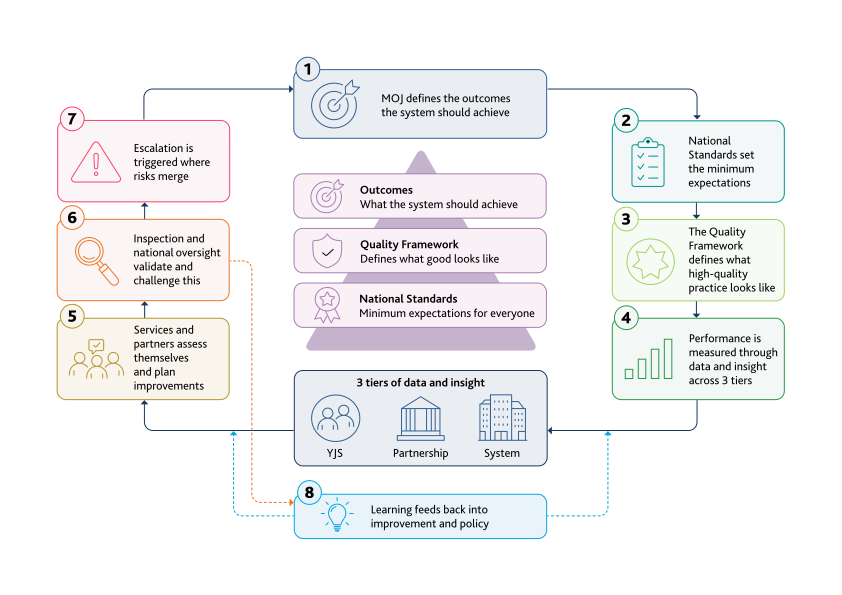
Infographic illustrating how the different elements of the proposed framework fit together
Part B – Stable and sustainable funding
In Cutting Youth Crime, Changing Young Lives, the government committed to providing greater funding certainty for youth justice services and reviewing how funding is distributed to better reflect local need. The majority of youth justice services now have multi-year funding settlements in place until 2028/29, providing greater stability for local planning and delivery. Different arrangements apply in Wales and Greater Manchester, where some funding has been devolved (including Turnaround and remand funding) and where future funding arrangements continue to be explored with devolved partners.
We are now seeking views on proposals for longer-term funding reform, including the introduction of a more needs-based approach to funding and options for strengthening partner contributions.
These proposals represent an evolution rather than a wholesale redesign of the current funding system. They are intended to support the wider reforms set out in this consultation by ensuring funding better supports effective local delivery of youth justice services. Any changes to the funding formula would be introduced from April 2029.
Current funding arrangements
The MOJ has committed over £100m per year for youth justice services from 2026/27 – 2028/29, including £15.4m per year for the Turnaround programme. Additional funding streams for remand and community alternatives are allocated separately and are outside the scope of this consultation.
Funding for youth justice services reflects their multi-agency nature and is provided through a combination of:
- MOJ grant funding (previously known as the Youth Justice Core Grant that was administered by the YJB). This accounts for around one-third of total funding for youth justice services (c. £90m per annum), although this proportion varies significantly between local authorities (from 9% to 64%)
- statutory partner contributions which make up most of the remaining funding, with local authorities as the largest contributor alongside police, probation and health partners (and the Welsh Government in Wales).
- locally determined resources, including in‑kind contributions e.g. staff, resources or interventions

Figure 1. Youth Justice Service funding by partner contributions in 2024/25.7 Total funding = £308.5m (does not include Turnaround funding)
The Case for Change
There are several inherent challenges to the current funding arrangements:
- the methodology used to distribute core grant and Turnaround funding has developed incrementally over time and is no longer based on an up-to-date projection of need. It remains based largely on population and deprivation data from 2009, and on decisions taken in 2011/12 to merge several previously ringfenced grants as a temporary, transitional measure
- the complex nature of youth justice has led to the development of multiple funding streams, often with separate reporting and compliance requirements. While ringfenced funds help to protect the delivery of important work, they can also create administrative burdens for services and limit local flexibility
- the system relies on discretionary partner contributions but there are no clear expectations on the scale or nature of this funding or resourcing. The Crime and Disorder Act 1998, provides statutory partners with a ‘power’, not a requirement, to contribute funding, which has led to variation between areas in both financial and in‑kind support. Gaps in probation and health provision have been identified as areas of concern that may affect service delivery [footnote 7]. In particular, workforce pressures within the Probation Service have made it more difficult for youth justice services to secure consistent probation input. This has contributed to variation in the level and continuity of probation support available to youth justice services, resulting in inconsistencies in service provision across England and Wales
Taken together, these factors mean that current funding arrangements do not consistently reflect local need, service complexity or current policy priorities.
We therefore propose reforms to create a more transparent, sustainable and needs-based funding system. The proposals in this section focus on:
- developing a more needs-based approach to MOJ funding allocations
- improving the stability and transparency of funding arrangements
- strengthening expectations and accountability around partnership contributions
Previous work to review current funding arrangements
In 2022, to respond to some of the challenges outlined above, the YJB commissioned Economics by Design, an economics consultancy, to undertake a comprehensive review of the current core grant funding formula.
The review concluded that the current distribution method is based on outdated data and historic decisions, is insufficiently aligned to drivers of demand, and results in significant variation in funding per child across areas, that cannot be explained by differences in need. It also found that the existing formula lacks a clear and up‑to‑date evidence base for the factors used to allocate funding, which makes it difficult to demonstrate that funding is being distributed fairly.
Economics by Design’s proposed formula
As part of its review, Economics by Design proposed a new formula designed to:
- allocate funding based on population (children aged 10–17)
- apply adjustments for relative need
- use objective and publicly available data
- avoid perverse incentives by excluding factors within services’ control
The proposed formula allocates funding in two main stages:
- population baseline: funding is initially distributed based on the number of children aged 10 to 17 in each area
- adjustment for relative need: the population baseline is then adjusted to reflect variations in need across areas
Economics by Design assessed a range of potential drivers of relative need for youth justice services (see Chapter 7 of the Economics by Design: Review of Youth Justice Service grant funding formula) and, using regression analysis identified three key indicators of need:
- child population size (baseline driver)
- child poverty, measured using the Income Deprivation Affecting Children Index (IDACI)
- housing overcrowding
Other measures (such as unemployment and low income) met the data criteria but were not identified as key drivers.
Economics by Design’s funding formula creates a needs‑adjusted population, which reflects both the size of the youth population and the relative level of need. Funding would then be allocated according to each area’s share of the total needs‑adjusted population.
For more detail you can read the full Economics by Design: Review of Youth Justice Service grant funding formula.
Developing proposals for reform
In light of these findings, the government considered a range of options for future funding arrangements.
Independent of the work conducted by Economics by Design, we also explored an alternative flat-rate model under which funding would be allocated based on a fixed amount per child using a service’s average caseload. Our assessment is that this is not suitable for youth justice services. Funding supports a wide range of statutory and preventative services tailored to individual needs. As support varies in intensity and is delivered flexibly across services, the cost per child is less predictable than in more standardised models.
We therefore propose moving towards a needs-based approach to allocating MOJ funding. This would mean:
- funding is distributed based on a combination of population size and relative levels of need for youth justice services, using objective and transparent data
- funding is allocated more fairly and transparently, ensuring resources better reflect differences in demand across areas
- factors within the direct control of services (for example the number of children entering the system) are excluded, to minimise the risk of perverse incentives influencing practice or funding outcomes
While no formula will fully capture the complexity of demand, moving to a needs-based model represents a significant improvement on the current system by providing a more evidence-based foundation for funding decisions, and supporting a fairer distribution of funding per child across services. Adopting a needs-based approach also aligns with wider government practice in children’s services, such as the National Funding Formula for schools and funding for children’s social care, which both use population and deprivation-based measures, rather than relying on historic allocations.
Learning from previous work
In 2025, we shared Economics by Design’s proposed needs-based funding model with sector stakeholders with a view to introducing a new allocation method from 2026/27. While there was strong agreement that the current formula should be reformed, concerns were raised about:
- how well the model reflects service complexity
- whether it accounts for unavoidable business costs
- the potential impact of funding redistribution on service delivery
- the pace of implementation
- whether prevention and diversion activity was sufficiently reflected in the assessment of need
As a result, we did not implement a new funding formula during the current spending review period. However, we committed to consulting with the youth justice sector and funding partners to develop proposals for longer-term reform.
Reflecting unavoidable business costs
Stakeholders have also raised concerns about whether a needs-based funding formula would adequately reflect the unavoidable business costs faced by all youth justice services. While levels of demand and complexity vary between areas, services also incur a range of fixed operating costs that do not vary significantly with caseload. The impact of these costs may be particularly significant for smaller services, which often face similar fixed operating costs to larger services despite supervising lower numbers of children.
As we develop a future funding formula, one option would be to provide all youth justice services with a standard allocation towards core business costs, with the remaining MOJ funding distributed according to relative need.
Principles for reform
We are now consulting on the government’s intention to introduce a new funding formula from April 2029, guided by the following principles:
- a distribution of funding across England and Wales according to need
- a clear, transparent and evidence-based methodology for identifying drivers of need
- use of current, credible and publicly available data at the appropriate geographical level, comparable across England and Wales
- recognition of the importance of early intervention, prevention and diversion activity alongside the statutory caseload when assessing need – where suitable data is available
- consideration of regional cost variation to reflect differences in labour and travel costs, based on the best available data at the point of design
- periodic review to consider updating of the formula and its underlying data
As the current allocation method is significantly out-of-date and has been in place for over a decade, introducing any new formula will result in a redistribution of funding across areas. Some services would receive a larger share of funding, while others would receive a smaller share. Those areas where MOJ grant funding constitutes the largest share of their overall budget will be most affected by any change.
Changes to the funding formula would not be introduced before April 2029 and we plan to consult again on detailed formula design ahead of the next spending review period.
Question 16
Do you agree that we should reform the funding formula, recognising that it is likely to result in a significant redistribution of funding across services in England and Wales?
- Agree
- Disagree
- [Free text]
Question 17
Do you agree that the principles outlined above are the right ones to guide the design of a new funding formula?
- Agree
- Disagree
- [Free text]
Question 18
Do you agree that allocating MOJ funding to youth justice services across England and Wales based on relative levels of need is the most appropriate approach? Please explain your response.
- Agree
- Disagree
- [Free text]
Question 19
Stakeholders have highlighted the limitations of using first time entrant data as a proxy for demand and need. Aside from diversion data currently collected by the YJB, what alternative or supplementary datasets could be considered to provide a comprehensive measure of need in your local area? When providing alternative or supplementary datasets please ensure that any proposed data meets the following criteria:
- available across England and Wales
- can be disaggregated to local levels
- published data
- recent / up-to-date
- likely to be updated regularly in the future
- not directly influenced by youth justice services to avoid perverse incentives
- [Free text]
Question 20
To what extent do you support providing all youth justice services with a standard allocation towards core business costs before the remaining funding is distributed through the funding formula? You may wish to give reasons in the text box.
- Support
- Neutral
- Oppose
- [Free text]
Managing the impact of change
If a new funding formula is introduced, we also need to consider how any changes are managed in practice.
We know that local leaders and partnerships need sufficient stability to plan services, manage workforces and deliver long-term improvement. Any transition to a new funding model will therefore need to balance fairness, stability and the ability of local areas to adapt effectively to change.
Subject to the outcome of the next Spending Review, we will consider how best to manage the impact of change. Where additional funding is not available to support transitional protections (such as funding floors or buffer funding), changes may need to be phased in over several years.
There is therefore an inherent trade-off between implementing changes more quickly – reaching a fairer national funding allocation sooner – and phasing in changes more gradually – supporting stability but delaying the transition.
We will also need to consider how often the underlying data should be updated to ensure the formula continues to reflect changing levels of need, and how these review cycles would interact with the implementation of the formula.
Question 21
If a new funding formula is introduced, which approach to managing the transition would you prefer?
Option A: Faster implementation, for example over 3 years – services would reach their target allocations sooner and national funding would be distributed in line with local need – but the sharper pace of change could create instability for some services, particularly where funding levels would need to adjust more quickly to align with the formula.
Option B: Gradual implementation, for example over 6 years – changes would be phased over a longer timeframe, providing greater stability for services, but delaying the move to a fully needs-based distribution.
Please explain your answer, including any practical examples of how different rates of change would affect your service’s ability to plan, manage resources and deliver services effectively.
- Option A
- Option B
- [Free text]
Existing ringfences for youth justice funding
As above, we know that previous arrangements for awarding grant funding to youth justice service – with the YJB distributing the core grant and the MOJ distributing Turnaround funding – have meant separate reporting and grant assurance processes, potentially leading to unnecessary administrative burdens. With the transfer of responsibility for funding distribution to the MOJ, we want to explore whether core grant and Turnaround funding processes could be simplified to reduce administrative burden and improve flexibility.
As funding arrangements differ in Wales and Greater Manchester, where Turnaround and remand funding has been devolved and future arrangements remain under discussion with devolved partners, the section below applies primarily to services that will continue to receive both core grant and Turnaround funding directly from the MOJ.
Consolidating the youth justice core grant and Turnaround grant
The allocation of Turnaround funding to services is predominately based on the same funding formula used for the core grant. However, it is provided through a separate grant agreement, with specific conditions and reporting requirements associated with the programme.
One of the primary reasons for establishing the Turnaround programme in 2022 was to prevent risks amongst children from escalating. Having separate grant agreements ensures that targeted resources for prevention and early intervention activity are protected and not reprioritised. However, in considering future grant arrangements, we are seeking to balance the protection of Turnaround activity with greater local flexibility and reduced administrative burdens.
We are therefore seeking views on three possible options to consolidate Turnaround funding and core grant funding into one funding stream.
Question 22
Which of the following future grant arrangements would best support effective delivery of youth justice services in your local area?
Option A: Maintain the current arrangement (separate agreements for the core grant and Turnaround funding).
Option B: Merge core grant and Turnaround funding to form one grant agreement but maintain a ringfence for the delivery of early intervention activity (currently delivered through the Turnaround programme).
Option C: Merge Turnaround funding into the core grant, with no ringfencing for early intervention and give local authorities the flexibility to manage this locally.
Please explain your answer, including any potential benefits or risks. If you select Option C, please comment on the potential impact on prevention and early intervention activity if funding was no longer ringfenced.
- Option A
- Option B
- Option C
- [Free text]
Question 23
Current grant arrangements for the core grant and Turnaround funding are in place until March 2029. However, if Option B (merge core grant and Turnaround funding to form one grant agreement) were implemented, when should this change take effect? Please explain your answer, including any potential benefits or risks.
Option A: as soon as possible (making adjustments to the current grant arrangements)
Option B: after the current spending review period (no earlier than April 2029)
- Option A
- Option B
- [Free text]
Strengthening Partnership contributions
A central objective of these reforms is to strengthen partnership working and shared accountability for youth justice outcomes. Effective delivery depends on the coordinated contribution of statutory partners, and funding arrangements play an important role in shaping how those contributions are secured and sustained.
Under current arrangements, statutory partners have a duty to work together to prevent offending and reoffending, but there is no clear expectation regarding the level or nature of their financial or resource contributions. As a result, there is significant variation between areas in both funding and in-kind support.
Inspection evidence and sector feedback suggest that gaps or inconsistencies in partner contributions can directly affect service delivery, including access to key services such as health provision, education support and effective transitions to adult services.
The proposals in Part A of this consultation are intended to strengthen expectations and accountability across the partnership. However, we recognise that setting clear expectations alone may not be sufficient to secure consistent contributions in practice. We believe there is a case for strengthening how partnership contributions (finance and resourcing) are understood, agreed and monitored at management board level.
We are therefore seeking views on how financial and resource contributions from partners could be made more transparent and consistent. One option would be to increase the visibility of partner contributions, but we are also interested in whether other mechanisms could help secure more consistent and sustainable partner contributions.
Question 24
To what extent do you agree that greater public visibility of partner contributions (including how they vary between areas) would strengthen accountability, support management boards to hold partners to account, and drive partners to meet expected levels of engagement and funding contributions? You may wish to give reasons in the text box.
- Strongly agree
- Agree
- Undecided
- Disagree
- Strongly disagree
- [Free text]
Question 25
What additional measures would most help strengthen partner contributions in your area?
- [Free text]
Annex A: Economics By Design – Grant Funding Formula Summary
In 2022, the Youth Justice Board commissioned an external contractor, Economics by Design, to develop a new evidence-based formula for the core grant after the Minister responsible at the time requested a review into how funds are allocated.
Economics by Design proposed formula
As part of their commission, the Youth Justice Board specified that a new formula should be based on the following principles:
- Fairness First: The formula should not include any factors that youth justice services could directly influence themselves to prevent any temptation on services to change their behaviour to impact funding, also known as “perverse incentives”
- Transparency and Trust: All data used should be solid (reliable) and publicly available, so the whole process is open and understandable
- Cost Differences: The formula should account for variation in certain costs (such as staff wages) across different locations. However, at the time of design, it was not possible to include this factor due to the absence of a reliable, consistent way of measuring cost differences across youth justice services in both England and Wales
The goal of the formula designed by Economics by Design was to apply an evidence-based approach to inform the allocation of the core grant, ensuring that each youth justice service in England and Wales received funding that reflected relative need based on the data available.
Formula design
Step 1: Start with the number of children
The starting point for funding allocated to each service is the number of children aged 10 to 17 (using population figures from the Office for National Statistics (ONS)). If all services had the same needs, funding would be shared out equally based on this.
Step 2: Adjust for ‘need’
But we know that different services have different levels of need. Some places have more children entering the justice system than others. So, it was agreed a “needs-adjusted” population was used instead of a straight headcount.
However, there is no official measure of youth justice need across England and Wales.
Step 3: Using FTE as a proxy
To identify what drives youth justice need in services, Economics by Design needed data that met the key principles of fairness and transparency, and was:
- Consistently collected across all youth justice services
- Regularly published by the MOJ
- Transparent and comparable
This led Economics by Design to use the number of First Time Entrants (FTEs) to the youth justice system as a substitute or ‘proxy’ measure for youth justice need. FTE data shows how many children aged 10 to 17 are entering the system for the first time, and meets the criteria listed above.
As a proxy, FTE was not used to allocate funding directly, but was used to identify objective factors that would influence how funding was distributed.
Step 4: Selecting the real drivers of ‘need’
Economics by Design conducted a focused review of research to identify key factors most closely linked to the number of children entering the justice system (see Chapter 7 of the Economics by Design: Review of Youth Justice Service grant funding formula).
They used a statistical method called regression analysis to find what factors had the strongest relationship with FTE trends. This helped to pinpoint objective factors that could fairly inform allocations.
They checked that data for these factors was:
- Available across England and Wales
- Could be broken down by local area (youth justice service or smaller)
- Recent or up-to-date
- Likely to be updated regularly in the future
As a result, two key indicators were chosen because they were found to have a significant relationship with the number of children entering the justice system and met all the above criteria:
- Income Deprivation Affecting Children Index (IDACI): A government measure showing how many children in an area are growing up in low-income households
- Housing Overcrowding: This shows how many families live in homes that are too small for the number of people living in them
Step 5: Creating a ‘Needs Weight’
To decide how much funding each service should get, Economics by Design looked at the two key factors identified above that influence FTEs to calculate a ‘needs weight’ for each area that reflected how much support each service was likely to need.
Step 6: Creating a ‘Needs Index’
The “needs weight” was then compared to the national average across all services to create a “needs index” – a way of seeing whether a youth justice service needs more (or less) support than the average.
Step 7: Adjusting for Local Populations
The number of 10 to 17-year-olds in each youth justice service area was multiplied by that needs index. This created a “needs-adjusted population” – a better reflection of how many children might need support in that area.
The proportion of the total grant that each youth justice service was allocated was based on how its needs-adjusted population compared to the total across all areas.
Questionnaire
We would welcome responses to the following questions set out in this consultation paper.
Part A: Youth justice service performance and oversight
Question 1: Which of the following options best describes the structure for National Standards?
- Option 1: remain structured around system phases
- Option 2: be re-structured into thematic areas with cross-cutting principles
You may wish to give reasons in the text box.
Question 2: If National Standards remain as phases of youth justice (Option 1), do you agree with our proposals to develop new standards on Victims, Early Intervention and Prevention, and to update OOCRs to reflect contemporary good practice? What other changes or additions would you expect to see to National Standard phases to ensure they reflect the realities of current practice?
Question 3: If National Standards are restructured around thematic areas (Option 2), to what extent do you agree with the proposed example thematic areas and cross-cutting principles? What additions or changes would you suggest to reflect the realities of current practice?
Question 4: Should disproportionality be included as an individual standard/thematic area or integrated throughout the National Standards? You may wish to give reasons in the text box.
Question 5: To what extent do you agree with the introduction of a Quality Performance Framework to define high-quality practice and support continuous improvement? Please explain your answer, including if there are any key risks or challenges you foresee and how these could be mitigated.
Question 6: What areas or aspects of youth justice practice should the framework cover to be most useful to your local area?
Question 7: To what extent do you agree that performance information should be organised and used across three tiers:
- Youth justice service
- Management boards and partners
- System health
Please explain your answer, including any risks, benefits or implementation challenges.
Question 8: We currently collect 14 national KPIs and a range of other performance information. As we develop future oversight arrangements:
- Which measures are most useful for understanding the performance of an individual youth justice service?
- Which measures are most useful for understanding the effectiveness of local partnership arrangements?
- Which measures are most useful for understanding the health of the youth justice system overall?
- Are there any measures that should be moved, removed or added?
Question 9: To what extent do you agree that the voices of children, victims and families should form part of local and national performance oversight arrangements? Please explain your answer, including how these perspectives could be captured in a meaningful and proportionate way.
Question 10: To what extent do the proposed arrangements reflect the oversight and accountability requirements of youth justice in Wales, and what additional considerations are needed?
Question 11: What factors should be considered when designing local self-assessment arrangements to ensure they are meaningful, proportionate and support improvement in practice? Please include any risks, challenges or unintended consequences that should be avoided.
Question 12: To what extent do you agree with the proposed approach to youth justice plans and annual updates? Please explain if there are any risks or unintended consequences you foresee with this approach.
Question 13: The proposed annual update would cover:
- confirmation of a locally approved youth justice plan
- strategic priorities
- a performance summary
- key risks
- staffing and resources
Are there any areas that should be added, removed or amended? Please explain your answer.
Question 14: To what extent do you agree with the proposal to remove the requirement for youth justice services to submit Serious Incident Notifications within 24 hours and instead report learning from serious incidents at regular intervals? Please explain your answer, including any benefits, risks or unintended consequences you foresee.
Question 15: As we develop a more proportionate approach to reporting and compliance, are there any other requirements that you think could be streamlined, simplified or removed? Please provide details.
Part B: Stable and sustainable funding
Question 16: Do you agree that we should reform the funding formula, recognising that it is likely to result in a significant redistribution of funding across services in England and Wales?
Question 17: Do you agree that the principles outlined above are the right ones to guide the design of a new funding formula?
Question 18: Do you agree that allocating MOJ funding to youth justice services across England and Wales based on relative levels of need is the most appropriate approach? Please explain your response.
Question 19: Stakeholders have highlighted the limitations of using first time entrant data as a proxy for demand and need. Aside from diversion data currently collected by the YJB, what alternative or supplementary datasets could be considered to provide a comprehensive measure of need in your local area? When providing alternative or supplementary datasets please ensure that any proposed data meets the following criteria:
- available across England and Wales
- can be disaggregated to local levels
- published data
- recent / up-to-date
- likely to be updated regularly in the future
- not directly influenced by youth justice services to avoid perverse incentives
Question 20: To what extent do you support providing all youth justice services with a standard allocation towards core business costs before the remaining funding is distributed through the funding formula? You may wish to give reasons in the text box.
Question 21: If a new funding formula is introduced, which approach to managing the transition would you prefer?
- Option A: Faster implementation, for example over 3 years – services would reach their target allocations sooner and national funding would be distributed in line with local need – but the sharper pace of change could create instability for some services, particularly where funding levels would need to adjust more quickly to align with the formula.
- Option B: Gradual implementation, for example over 6 years – changes would be phased over a longer timeframe, providing greater stability for services, but delaying the move to a fully needs-based distribution.
Please explain your answer, including any practical examples of how different rates of change would affect your service’s ability to plan, manage resources and deliver services effectively.
Question 22: Which of the following future grant arrangements would best support effective delivery of youth justice services in your local area?
- Option A: Maintain the current arrangement (separate agreements for the core grant and Turnaround funding).
- Option B: Merge core grant and Turnaround funding to form one grant agreement but maintain a ringfence for the delivery of early intervention activity (currently delivered through the Turnaround programme).
- Option C: Merge Turnaround funding into the core grant, with no ringfencing for early intervention and give local authorities the flexibility to manage this locally.
Please explain your answer, including any potential benefits or risks. If you select Option C, please comment on the potential impact on prevention and early intervention activity if funding was no longer ringfenced.
Question 23: Current grant arrangements for the core grant and Turnaround funding are in place until March 2029. However, if Option B (merge core grant and Turnaround funding to form one grant agreement) were implemented, when should this change take effect? Please explain your answer, including any potential benefits or risks.
- Option A: as soon as possible (making adjustments to the current grant arrangements)
- Option B: after the current spending review period (no earlier than April 2029)
Question 24: To what extent do you agree that greater public visibility of partner contributions (including how they vary between areas) would strengthen accountability, support management boards to hold partners to account, and drive partners to meet expected levels of engagement and funding contributions? You may wish to give reasons in the text box.
Question 25: What additional measures would most help strengthen partner contributions in your area?
About you
- Full name
- Job title or capacity in which you are responding to this consultation exercise (e.g. member of the public etc.)
- Company name/organisation (if applicable)
- If you are a representative of a group, please tell us the name of the group and give a summary of the people or organisations that you represent.
Contact details/How to respond
Please send your response by 11 September via Consult Justice: https://consult.justice.gov.uk/youth-justice-policy/funding-youth-justice-services
Complaints or comments
If you have any complaints or comments about the consultation process, you should contact the Ministry of Justice at the above address.
Extra copies
Further paper copies of this consultation can be obtained from this address
Youth Justice Policy Team
Ministry of Justice
102 Petty France
London SW1H 9AJ
and it is also available on-line at https://consult.justice.gov.uk/.
Alternative format versions of this publication can be requested also.
Publication of response
A paper summarising the responses to this consultation will be published in three months’ time of the closing day of the consultation. The response will be available on-line at: https://consult.justice.gov.uk/.
Representative groups
Representative groups are asked to give a summary of the people and organisations they represent when they respond.
Confidentiality
Information provided in response to this consultation, including personal information, may be published or disclosed in accordance with the access to information regimes (these are primarily the Freedom of Information Act 2000 (FOIA), the Data Protection Act 2018 (DPA), the General Data Protection Regulation (UK GDPR) and the Environmental Information Regulations 2004).
If you want the information that you provide to be treated as confidential, please be aware that, under the FOIA, there is a statutory Code of Practice with which public authorities must comply and which deals, amongst other things, with obligations of confidence. In view of this it would be helpful if you could explain to us why you regard the information you have provided as confidential. If we receive a request for disclosure of the information we will take full account of your explanation, but we cannot give an assurance that confidentiality can be maintained in all circumstances. An automatic confidentiality disclaimer generated by your IT system will not, of itself, be regarded as binding on the Ministry.
The Ministry will process your personal data in accordance with the DPA and in the majority of circumstances, this will mean that your personal data will not be disclosed to third parties.
Equalities Statement
Equalities
Section 149 of the Equality Act 2010 places a duty on Ministers and the Department, when exercising their functions, to have “due regard” to the need to:
- Eliminate unlawful discrimination, harassment and victimisation and other prohibited conduct under the Equality Act;
- Advance equality of opportunity between people who share a protected characteristic and those who do not; and
- Foster good relations between people who share a protected characteristic and those who do not.
Paying “due regard” needs to be considered against the nine protected characteristics under the Equality Act. The nine protected characteristics are race, sex, disability, sexual orientation, religion and belief, age, marriage and civil partnership, gender reassignment, and pregnancy and maternity.
The consultation document outlines some of the available data in relation to disability and race of children in the youth justice system and builds on the previous Equalities Statement within the Government’s Youth Justice White Paper: ‘Cutting Youth Crime. Changing Young Lives’.
Consultation principles
The principles that Government departments and other public bodies should adopt for engaging stakeholders when developing policy and legislation are set out in the Cabinet Office Consultation Principles 2018 that can be found here.
-
A Modern Youth Justice Service: Foundations Fit for The Future – GOV.UK ↩
-
Responsibility for this transferred to the MOJ from April 2026. Ahead of seeking views through this consultation, the MOJ decided to reform the role and remit of the YJB so that it is focussed on continuous improvement of youth justice services and transfer relevant functions, including the distribution of the youth justice core grant, to the MOJ. ↩
-
Standards for children in the youth justice system – GOV.UK ↩
-
Current YJB guidance allows local partnerships to produce a youth justice plan over multiple years. Partnerships that choose to produce a multi-year plan are also required to submit an annual update to satisfy statutory requirements. ↩
-
Under the Crime and Disorder Act 1998 and Children Act 2004, youth justice services are responsible for ensuring appropriate adult provision for children in police custody, safeguarding and promoting children’s welfare in the delivery of their functions. Services must also have due regard to statutory guidance such as Working Together to Safeguard Children 2026 (England) and Working Together to Safeguard People: Code of Safeguarding Practice 2022 (Wales). ↩
-
HMIP 2023 Annual Report: inspections of youth justice services ↩