Improving standards for industrial fans: consultation (HTML)
Published 16 October 2026
Applies to England, Scotland and Wales

© Crown copyright 2026
This publication is licensed under the terms of the Open Government Licence v3.0 except where otherwise stated. To view this licence, visit nationalarchives.gov.uk/doc/open-government-licence/version/3 or write to the Information Policy Team, The National Archives, Kew, London TW9 4DU, or email: psi@nationalarchives.gov.uk.
Where we have identified any third party copyright information you will need to obtain permission from the copyright holders concerned.
This publication is available at https://www.gov.uk/government/consultations/improving-standards-for-industrial-fans/improving-standards-for-industrial-fans-consultation-html
Introduction
Ecodesign legislation enables the government to set minimum energy performance standards (MEPS) to remove the least efficient products from the market. These standards help ensure users are not exposed to the highest‑cost, worst‑performing technologies, while driving manufacturers to deliver more energy efficient and innovative products.
Improved MEPS reduce energy demand, lower operational costs, and contribute to the UK’s energy security. Ecodesign policies have already delivered substantial reductions in electricity consumption and carbon emissions across multiple product sectors, supporting progress towards net zero while imposing minimal burdens on consumers and businesses.
Industrial fans are electrically driven fans used in industrial and commercial settings with an input power of between 125W and 500KW. They play a critical role in both industrial and commercial applications, supporting ventilation, cooling, and process operations across the UK economy. Improving their energy efficiency can deliver significant electricity savings, reduce system operating costs for businesses, and support the UK’s broader net zero and energy security objectives.
In Great Britain (GB), the existing ecodesign regulations for fans is Commission Regulation (EU) 327/2011.
We are consulting now on proposals to improve the ecodesign standards for industrial fans in GB as our analysis shows it would deliver significant benefits, including 0.07 MtCO2e traded carbon savings and 5990 GWh electricity savings between 2026 and 2050. The policy results in an overall net benefit with a discounted Net Present Value of +£128.7m over the same period, driven by electricity bill savings by the industrial and commercial end-users making use of the more efficient fans. Industry may be making business-critical decisions now about their next replacement and installation cycles; with the decade-long lifespans of industrial fans, the purchasing choices made by industry in the coming years will influence the pace of decarbonisation in GB.
The proposals will also support our transition to a circular economy by improving standards regarding resource efficiency. Repairability, durability and end‑of‑life treatment requirements are being proposed to prevent premature replacement, material use and waste. Overall, we think that this could reduce the carbon and material footprint of manufacturing.
The EU has adopted Regulation (EU) 2024/1834, which was amended in 2025 by Regulation (EU) 2025/2481. The new requirements applies in the EU and in Northern Ireland (NI) from 24 July 2026, repealing and replacing Commission Regulation (EU) 327/2011.The proposed ecodesign requirements detailed in this document would align GB with the EU and NI, providing equivalent standards to those set out in Regulation (EU) 2024/1834 as amended. We believe that an aligned regulatory environment will reduce the compliance burden for manufacturers and improve product access for consumers.
The proposals for improving ecodesign standards for industrial fans in GB would:
- increase MEPS
- revise definitions of industrial fans in scope of the regulations
- improve product information requirements to ensure informed consumer choice
- update resource efficiency requirements
This consultation therefore seeks views on proposals to update GB ecodesign requirements for industrial fans by aligning with the EU’s latest regulations. Feedback is sought from manufacturers, importers, authorised representatives, trade bodies, retailers industry professionals, environmental organisations, and other interested stakeholders.
We welcome your views on the proposals set out in this document, as well as on the accompanying draft statutory instrument (SI) and options assessment. A government Response will be published after the consultation closes and responses have been analysed.
General information
Why we are consulting
Further to the EU’s adoption of Regulation (EU) 2024/1834 as amended, we are consulting industry stakeholders to gather feedback on whether regulatory alignment with these regulations would be beneficial for GB businesses and manufacturers and end-users. Our proposed option is to align GB with the EU to prevent barriers to trade and ensure businesses have access to the most efficient industrial fans technology in GB and could reduce the risk of the GB market becoming a destination for less efficient products that do not meet the more stringent EU regulatory requirements. Improving product standards can save end-users money by lowering energy consumption and reducing their bills, whilst cutting carbon emissions and increasing energy security.
Consultation details
Issued:
16 October 2026
Respond by:
24 December 2026 (11.59pm)
Enquiries to:
Energy-Related Products Team
Department for Energy Security and Net Zero
3-8 Whitehall Place
London
SW1A 2EG
Consultation reference:
Improving Standards for Industrial Fans
Audiences:
Manufacturers and/or their authorised representatives, importers, retailers, trade bodies, consumer groups, environmental organisations and other civil society organisations with an interest in industrial fans.
Territorial extent:
The proposed updates to the ecodesign requirements for industrial fans that are set out in this consultation would apply to GB only.
Regulation (EU) 2024/1834, as amended, automatically applies in NI from 24 July 2026 in accordance with the Windsor Framework. Northern Ireland businesses have unfettered access to the GB market and would continue to do so, in line with existing arrangements, under our proposals.
How to respond
We strongly encourage responses via the online survey. Using the online survey greatly assists our analysis of the responses, enabling more efficient and effective consideration of the issues raised. If it is not possible for you to use the online survey, you can respond through email or a written response.
Or
Email to:
efficientproducts@energysecurity.gov.uk
Write to:
Energy-Related Products Team
Department for Energy Security and Net Zero
3-8 Whitehall Place
London
SW1A 2EG
When responding, please state whether you are responding as an individual or representing the views of an organisation.
Your response will be most useful if it is framed in direct response to the questions posed, though further comments and evidence are also welcome.
Confidentiality and data protection
Information you provide in response to this consultation, including personal information, may be disclosed in accordance with UK legislation (the Freedom of Information Act 2000, the Data Protection Act 2018 and the Environmental Information Regulations 2004).
If you want the information that you provide to be treated as confidential, please tell us, but be aware that we cannot guarantee confidentiality in all circumstances. An automatic confidentiality disclaimer generated by your IT system will not be regarded by us as a confidentiality request.
We will process your personal data in accordance with all applicable data protection laws. See our privacy policy.
We will summarise all responses and publish this summary on GOV.UK. The summary will include a list of names or organisations that responded, but not people’s personal names, addresses or other contact details.
Quality assurance
This consultation has been carried out in accordance with the government’s consultation principles.
If you have any complaints about the way this consultation has been conducted, please email: bru@energysecurity.gov.uk.
Proposed changes
Enhance efficiency
We propose to update GB Minimum Energy Performance Standards (MEPS) for industrial fans by aligning with the EU’s revised MEPS requirements set out in Regulation (EU) 2024/1834, as amended. The proposed changes include tightening the minimum efficiency thresholds applied at the Best Efficiency Point (BEP), ensuring that the worst performing fan models are phased out of the GB market.
To support clearer and more consistent application of MEPS, we also propose adopting the revised and simplified fan type categorisations used in the EU regulation, including the updated definitions for centrifugal fan types and the addition of jet fans to the regulation’s scope. This ensures that requirements more accurately reflect modern product designs and performance characteristics.
In addition, we propose introducing updated testing methods and verification procedures in line with the EU framework. This includes adopting the new Method E for testing jet fans, applying updated market-surveillance tolerances, and incorporating the revised allowances for specific fan configurations such as reversible fans, low-noise models, and DC fans with voltage inputs below 100V.
Together, these changes would ensure that only the best performing fan products can continue to be placed on the GB market. This will support reductions in energy consumption, help businesses lower operational costs, and contribute to wider net zero and energy security objectives.
Product information
We propose adopting updated product information requirements to ensure that installers, system designers and end users have access to consistent and high-quality performance data. This includes aligning with the EU’s expanded product information provisions, requiring manufacturers to provide full BEP performance details, efficiency grades, fan speeds, and—where applicable—specific speed and specific ratio data.
From July 2027, we propose also requiring part load performance information, in line with the EU regulation. This would provide performance curves at multiple inherent fan speeds to support more effective system design, commissioning, and optimisation. Provision of such information will help specifiers and operators select appropriately sized fans and ensure their real-world performance aligns with declared efficiency levels.
Manufacturers would also be required to ensure that technical documentation, datasheets, and performance curves remain accessible for 20 years via digital formats such as online platforms or QR codes. We also propose aligning GB rating-plate requirements with those used in the EU to support clear identification and verification of regulated products.
These measures will enhance transparency, support informed purchasing decisions, and provide system designers and operators with the data needed to achieve energy efficient outcomes in real world applications.
Support a circular economy
We propose adopting resource-efficiency and repairability requirements aligned with the EU regulation to increase durability, reduce premature replacement, and support the development of a more circular economy. This includes requiring manufacturers to make a core set of spare parts available for at least 10 years after the final unit of a model is placed on the market. This spare parts list includes motors below 10 kW, bearings, impellers, variable speed drives, sensors, joints and fixtures, and other critical components.
To support repairability, manufacturers would be required to provide professional repairers with access to repair and maintenance information, including disassembly guidance, configuration instructions, and error code explanations. Software and firmware updates would also need to remain available free of charge for 10 years after the last unit is sold.
We also propose adopting design-for-disassembly requirements to ensure industrial fans can be dismantled using commonly accessible tools, enabling safe and efficient repair and end-of-life treatment. Clear end-of-life instructions would also need to be provided to support recyclability and material recovery.
Together, these measures would help extend product lifetimes, reduce material use and waste, improve repair access, and support cost savings for organisations that rely on large or complex ventilation and air-movement systems.
Internal market and trade considerations
We propose aligning GB regulations for industrial fans with the EU requirements to reduce barriers to trade, minimise administrative burdens for manufacturers, and maintain competitiveness in the GB market. Alignment would also support smooth trade flow between GB and NI, helping to support market access within the UK internal market, as well as with the EU Single Market.
Aligned requirements across these markets will also help manufacturers reduce compliance costs by avoiding the need to manufacture GB specific fan models. This approach is expected to support the availability of efficient products for GB customers and help businesses avoid regulatory divergence that could complicate supply chains.
We are proposing to align GB requirements with the EU as soon as possible. Please see section 4.1 for more details on the transitional provisions.
1. Enhance efficiency
Part 1 sets out proposals to enhance the energy efficiency of industrial fans placed on the GB market by updating ecodesign requirements. The proposals seek to fully align GB with the EU’s revised requirements set out in Commission Regulation (EU) 2024/1834, as amended, which applies in the EU from 24 July 2026.
The proposals include:
- clarifying and simplifying fan scope and categorisation, including the addition of jet fans
- increasing the Minimum Energy Performance Standards at the Best Efficiency Point
- updating testing, verification tolerances and allowances
- and expanding product information requirements, including for part‑load performance
Together, these changes aim to ensure that only the best performing fan products are placed on the GB market, while maintaining functionality and safety in specialist applications.
1.1 Scope and categorisation of products
The only change to the scope of products covered is the explicit inclusion of jet fans within scope. Jet fans are newly added to reflect their growing use in applications such as car parks, tunnels and smoke control systems. A dedicated test method (Method E) has been introduced for this fan type to ensure appropriate and consistent measurement.
In addition, the proposals introduce simplified and revised categorisation of centrifugal fan types. Under current regulations, centrifugal fans are divided into multiple categories based on blade shape and housing configuration. The proposed revised approach consolidates these into 2 clearer groupings:
- Forward curved <5 kW and backward inclined centrifugal fans (fan blade angle > 50°)
- Other centrifugal fans, including forward curved ≥ 5 kW and backward curved fans with fan blade angle <50
| Current centrifugal fan categories | Proposed centrifugal fan categories |
|---|---|
| Centrifugal forward curved fans and centrifugal radial bladed fans | Forward curved < 5 kW and backward inclined centrifugal fans (fan blade angle > 50°) |
| Centrifugal backward curved fans without housing (all fan blade angles) | Other centrifugal fans (including forward curved ≥ 5 kW and backward curved fans with fan blade angle < 50°) |
| Centrifugal backward curved fans with housing (all fan blade angles) | Other centrifugal fans (including forward curved ≥ 5 kW and backward curved fans with fan blade angle < 50°) |
For the proposed definitions of the above categories of industrial fans, see Regulation 2 of the draft SI.
We are also proposing to introduce 3 new exemptions in line with the EU’s new Regulations, which cover fans:
- with a best efficiency point ≥ 8000 revolutions per minute
- which are intended to be used for handling gases containing biohazardous substances
- with a compressibility factor > 1.00
See Regulation 3 of the draft SI.
1. Do you agree with the proposed changes definitions of the categories of industrial fans? Could there be any unintended consequences as a result of the proposed changes?
Yes / No / Don’t know. Please provide evidence to support your answer.
2. Do you agree with aligning the GB definition of industrial fan types with the updated EU categories (e.g., forward curved <5 kW, backward inclined >50°, other centrifugal fans)?
Yes / No / Don’t know. Please provide evidence to support your answer.
3. Do you agree with adopting the EU’s revised exemptions (e.g., BEP ≥ 8000 rpm, hazardous gas conditions, compressibility factor >1.00)?
Yes / No / Don’t know. Please provide evidence to support your answer.
4. Are there any GB‑specific exemptions that should be considered?
Yes / No / Don’t know. Please provide evidence to support your answer.
1.2 Minimum Energy Performance Standards (MEPS)
Across fan categories, our analysis of the market shows that the majority of products exceed the MEPS set out by the new EU regulation. We are therefore proposing to raise MEPS for industrial fans in GB to ensure our standards are keeping in step with the technological progress in energy efficiency seen across the market, thereby protecting GB businesses from the worst-performing products. We believe raising MEPS would encourage manufacturers to innovate and design more efficient products and help prevent any potential regression in efficiency.
Table 2: summarising the changes by fan type, measurement method and efficiency grade (‘N’)
| Proposed fan categories | Measurement Category | Proposed new N | Current fan categories | Current N |
|---|---|---|---|---|
| Axial fan | A, C | 50 | Axial fan | 40 |
| Axial fan | B, D | 64 | Axial fan | 58 |
| Forward curved < 5 kW and backward inclined centrifugal fans (fan blade angle > 50°) | A, C | 52 | Centrifugal forward curved fan and centrifugal radial bladed fan | 44 |
| Forward curved < 5 kW and backward inclined centrifugal fans (fan blade angle > 50°) | B, D | 57 | Centrifugal forward curved fan and centrifugal radial bladed fan | 49 |
| Forward curved < 5 kW and backward inclined centrifugal fans (fan blade angle > 50°) | A, C | - | Centrifugal backward curved fan without housing (all fan blade angles) | 62 |
| Other centrifugal fans (including forward curved ≥ 5 kW and backward curved fans with fan blade angle < 50°) | A, C | 64 | Centrifugal backward curved fan with housing (all fan blade angles) | 61 |
| Other centrifugal fans (including forward curved ≥ 5 kW and backward curved fans with fan blade angle < 50°) | B, D | 67 | Centrifugal backward curved fan with housing (all fan blade angles) | 64 |
| Mixed flow fan | A, C | 57 + 7 × (α − 45) / 25 | Mixed flow fan | 50 |
| Mixed flow fan | B, D | 67 | Mixed flow fan | 62 |
| Cross flow fan | B, D | 21 (flat) | Cross flow fan | 21 |
| Jet fan | E | 50 | Not previously regulated | N/A |
The category of fan is defined by the fan flow angle (α) and, for centrifugal fans, the centrifugal blade angle (β2) – see Points 7 and 8 to Schedule 2. Each fan category has a corresponding measurement category which defines the operating conditions under which testing occurs, and is defined in paragraphs 1-6 in Annex I. We are proposing a new measurement category Method E for jet fans. Existing test methods for other fan types would remain unchanged. The efficiency grade (N) is the parameter used in the calculation of the minimum fan efficiency – see point 1 to Schedule 1 for its definition and point 2 to Schedule 1 which sets out how N is used to calculate minimum fan efficiency. The higher MEPS we are proposing for fans is driven by our proposal to raise N for each fan category.
5. Do you support the proposal to raise MEPS levels for industrial fans?
Yes / No / Don’t know. Please provide evidence to support your answer.
6. Do you anticipate any costs or operational impacts from compliance with the revised MEPS?
Please provide evidence where possible.
7. Should GB retain BEP‑only MEPS, in line with the EU approach, rather than introducing mandatory part‑load MEPS?
Yes / No / Don’t know. Please provide evidence to support your answer.
8. Without the introduction of updated MEPS, would you expect an annual improvement in baseline fan efficiency?
Yes / No / Don’t know. Please provide evidence to support your answer.
9. Do you support adopting the new measurement category E for jet fans?
Yes / No / Don’t know. Please provide evidence to support your answer.
10. Which product category do you use/manufacture and what is the application? Is this within a commercial or industrial setting?
1.3 Testing, verification tolerances and allowances
The proposals include updates to testing and compliance provisions to support consistent application and enforcement of MEPS.
Compliance testing
Current regulations:
Under Regulation (EU) No 327/2011, the energy efficiency of an industrial fan is tested at a fan’s optimum efficiency point (OEP). The OEP is the operating conditions under which an industrial fan achieves maximum efficiency for the applicable measurement category. The current regulation does not itself prescribe the operating conditions under which the optimum energy efficiency point is identified by the manufacturer.
This applies straightforwardly to fans which operate at one fixed speed. However, it is less clearly defined for fans which can operate at different speeds, such as variable-speed drive (VSD) fans or fans with a multi-speed motor. As Regulation (EU) No 327/2011 does not prescribe a reference speed to be used for a VSD or multi-speed motor fan, the manufacturer has a choice over the operating conditions under which the energy efficiency is declared. Two units of the same VSD or multi-speed motor fan model could therefore be tested at different speeds and have different energy efficiency values declared.
This creates consumer information challenges for end-users as the efficiency of industrial products are not easily comparable. Additionally, it allows for suppliers to choose operating conditions which produce more favourable energy efficiency results during compliance testing, even if those operating conditions under test are not in line with the intended use of the fan.
Proposals:
- We are therefore proposing to address this issue by introducing inherent speed as a concept. Inherent speed is the reference rotational speed of the fan impeller used for the purposes of determining compliance. Inherent speed would be defined as:
- (a) in the case of fans with a variable speed drive or intended to be used with a variable speed drive—
- (i) the maximum speed achieved by the fan, or
- (ii) the speed at which the efficiency is declared by the manufacturer, provided that the speed is in line with safe operation and the intended use of the fan;
- (b) where the motor is a multiple speed motor, the highest speed made available to the customer;
- (c) in any other case, the rotation speed of the fan impeller when the fan is operated at its nominal voltage and frequency;
- (a) in the case of fans with a variable speed drive or intended to be used with a variable speed drive—
We propose to replace the OEP with the Best Efficiency Point (BEP). This is defined as the best energy efficiency point for fan operation, determined at inherent speed. The inherent speed provides a defined reference point for determining the BEP that’s used for compliance testing, preventing manufacturers from using unrealistic rotational speeds that do not match how the fan is designed to be operated. It ensures that fans capable of operating across multiple speeds are assessed on a consistent basis.
The inherent speed of a fan would also serve as a reference point for our proposed updates to the product information requirements of fans at part load (see Section 2.2).
Jet fans: For the purposes of assessing compliance with the proposed requirements, if the fan is a jet fan with an impeller diameter above 1 metre or is not a jet fan with an impeller diameter above 0.5 metres, the manufacturer, under our proposal, may:
- conduct tests with a scale model of the fan and calculate the results for the real size fan
- conduct tests at a customer’s site or the manufacturer’s site
The proposals would introduce explicit market surveillance verification tolerances of:
- 90% for the first product tested; and
- 93% where 3 products are tested
These tolerances are not specified under the current GB framework. The proposal would ensure that enforcement practices by the Office for Product Safety and Standards for jet fans would be consistent with those of EU market surveillance authorities.
Updates to allowances: The proposals also include updated allowances for specific fan characteristics, including:
- reversible fans
- low‑noise fans; and
- DC fans operating below 100 V
These changes are intended to ensure requirements are proportionate for specialist designs while preserving the overall energy efficiency ambition.
See regulation 5 and Schedules 2 and 3 to the draft SI.
11. Do you agree with the proposed definition of inherent speed?
Yes / No / Don’t know. Please provide evidence to support your answer.
12. Do you agree with the proposed definition of the best efficiency point?
Yes / No / Don’t know. Please provide evidence to support your answer.
13. When testing fans with a variable speed drive, what factors do you consider in deciding which impeller speed to declare as its inherent speed?
14. Do you agree with our proposed allowances for conducting compliance tests for jet fans with an impeller diameter above 1 metre and non-jet fans with an impeller diameter above 0.5 metres?
Yes / No / Don’t know. Please provide evidence to support your answer.
15. Where are compliance tests conducted for fans below the size thresholds for our proposed allowances?
16. Do you agree with adopting the updated allowances (e.g., reversible fans, low‑noise fans, DC <100V correction)?
Yes / No / Don’t know. Please provide evidence to support your answer.
17. Are the proposed 90%/93% market surveillance verification tolerances appropriate for GB?
Yes / No / Don’t know. Please provide evidence to support your answer.
18. Will alignment with new test procedures impose burdens or help streamline compliance?
Yes / No / Don’t know. Please provide evidence to support your answer.
Circumvention
We are also proposing provisions to prevent circumvention of the regulations, ensuring that fans placed on the market deliver the energy performance declared by manufacturers in real-world operation, and that compliance is demonstrated through genuine product performance rather than optimisation for testing conditions.
Under our proposals, manufacturers, importers and authorised representatives must not:
- Place on the market fans that are designed to recognise when they are undergoing regulatory testing and alter their operation to obtain more favourable efficiency or performance results.
- Place on the market fans that automatically switch to a different operating mode or configuration during testing in order to improve declared values.
- Prescribe testing procedures, settings or operating instructions that artificially improve measured performance compared with normal end-user operation.
- Require manual adjustments to a fan before testing where those adjustments would not be used under normal operating conditions and would result in more favourable test results.
- Place on the market fans that are designed to perform in accordance with declared values during testing or initial use, but whose performance subsequently deteriorates in a way that worsens those declared values after being put into service.
- Software or firmware updates shall not lead to the worsening of product performance. No change to the product performance shall occur if the consumer chooses reject any software or firmware update.
Please see regulation 8 of the draft SI.
Point 2 to Annex IV of Regulation (EU) 2024/1834, as amended, states that where a model is not in conformity with the requirements laid down in Article 40 of Regulation (EU) 2024/1781, that model and all equivalent models are considered to be non-compliant with the EU’s industrial fans requirements. This replaces a reference to Article 6 of Regulation (EU) 2024/1834. Article 6 was omitted when Regulation (EU)2024/1834 was amended. The text we have proposed in Regulation 8 of our draft SI is intended to have the same legal effect.as the requirements set out in Article 40 of Regulation (EU) 2024/1781.
Software and firmware updates:
Article 40(5) of Regulation (EU) 2024/1781 introduces anti-circumvention requirements relating to software and firmware updates that were not included in Article 6 of Regulation (EU) 2024/1834. Under this provision, unless a consumer provides consent, software or firmware updates must not worsen product performance in relation to regulated parameters, must not adversely affect the functional performance of the product from the perspective of the user, and must not cause a product to become non-compliant with the relevant ecodesign requirements. It also provides that rejecting an update must not result in a change in product performance.
We are seeking your views on how these provisions should be reflected in our proposal for GB. The industrial fan requirements proposed in this consultation regulate product parameters such as energy efficiency. However, it is less clear how the concept of “functional performance from the perspective of the user” should be understood in the context of industrial fans, which aspects of fan operation would fall into the category of functional performance, and how functional performance would be assessed and verified by market surveillance authorities.
19. Do you agree with the proposed circumvention requirements?
Yes / No / Don’t know. Please provide evidence to support your answer.
20. Do you agree that the drafting of the circumvention prevention provisions in Regulation 8 of the draft SI achieves the same effect as the requirements set out in Article 40 of Regulation (EU) 2024/1781?
Yes / No / Don’t know. Please provide evidence to support your answer.
21. Do industrial fans utilise software or firmware that can be updated after the product has been placed on the market or put into service? If so, what types of software and firmware is used and what functionality does it offer to end-users?
22. Do you consider the concept of “functional performance from the perspective of the user” to be relevant to industrial fans?
If yes, we would like your views on:
- which aspects of an industrial fan’s operation you consider to fall within the category of ‘functional performance’
- how a software or firmware update could affect such functionality
- what test method would be used to measure functional performance, or any deteriorations in functional performance
23. Article 40(5) of Regulation (EU) 2024/1781 states that updates should not worsen product performance beyond ‘acceptable margins’. How should this be interpreted in the context of the industrial fans requirements we have proposed?
24. Article 40(5) of Regulation (EU) 2024/1781 permits a software or firmware update to worsen performance where the customer has explicitly consented to the deterioration. Do you have views on how such consent should operate in practice for industrial fans?
In particular, we would like your views on:
- when consent should be obtained
- whether the same approach should apply to both regulated product performance parameters and functional performance from the perspective of the user
- how compliance with any consent requirement could be demonstrated and verified
2. Product information
We propose adopting updated product information requirements to ensure that installers, system designers and end users have access to consistent and high quality performance data for industrial fans. This includes aligning with the EU’s expanded information provisions, requiring manufacturers to provide full performance details at BEP, efficiency grades, fan speeds, and, where applicable, specific speed and specific ratio data.
From 1 July 2027, we also propose requiring the provision of part load performance information, as set out in the EU regulation. This would support better system design, commissioning and optimisation, helping ensure that real‑world fan performance aligns with expected efficiency outcomes.
These measures are intended to enhance transparency, support informed purchasing decisions, and enable energy efficient operation over the lifetime of fan installations.
2.1 Product information requirements
The proposed revised requirements would require manufacturers to provide a comprehensive set of product performance and efficiency information for industrial fans.
We propose that the following information must be provided for all fans within scope, via the technical datasheet or user manual supplied with the fan, or via an internet link or QR code to a freely accessible website. This information would have to remain available for 20 years after the last unit is placed on the market.
The proposed required product information includes:
- Fan type
- Fan efficiency
- Whether the calculation of fan efficiency assumes use of a variable speed drive (VSD), and whether the VSD is integrated or must be installed with the fan
- Measurement category used to determine fan efficiency (A–E)
- Efficiency category (static or total), except for jet fans
- Efficiency grade (N) at BEP, or measured thrust (Tm) for jet fans
- Electric input power, volume flow rate and pressure difference at BEP or Tm
- Special characteristics (for example, dual-use fan, reversible fan, low-noise fan)
- Use of DC voltage lower than 100 V (yes/no)
- List of all significant elements supplied with the fan
- Specific speed (where applicable)
- Fan speed at BEP or Tm
- Specific ratio
In addition, product information must clearly state:
- the manufacturer’s name and address; and
- a model identifier (unique model number) that allows the product to be unequivocally identified
The first 5 items listed above, together with the year of manufacture, must appear on the product’s rating plate.
See regulation 4(2) and paragraph 3 of Schedule 1 to the draft SI.
25. Do you support adopting the expanded EU requirements for providing detailed fan performance and efficiency information?
Yes / No / Don’t know. Please provide evidence to support your answer.
26. Are there challenges in supplying complete BEP performance data, efficiency grade information, specific speed, or assumptions relating to VSD use?
Yes / No / Don’t know. Please provide details.
2.2 Part‑load performance information
The proposed revised regulation would introduce new requirements to provide part‑load performance information in order to better reflect real‑world fan operation.
From 24 July 2027, manufacturers would be required to provide part‑load performance information for fans, except for:
- Custom fans
- Jet fans; and
- Fans with multiple‑speed motors
For applicable fans, part‑load performance would have to be described using at least 3 performance curves, covering:
- 40–50% of the product’s inherent speed
- 100% of the product’s inherent speed; and
- a speed mid‑way between these 2 points
Under our proposal, this information may be provided in digital form, such as fan selection software or an online catalogue.
For custom fans, performance data at the specified operating point(s) or operating range would have to be provided in the commercial offer, technical datasheet, user manual, or a freely accessible online source, and included in the technical documentation supporting conformity assessment.
For jet fans, similar part‑load information requirements would apply, including (where applicable) performance data at:
- 30% and 50% of inherent speed; or
- each fixed operating speed
Jet fan performance data would have to include thrust, electric input power, rotational speed and efficiency at each point.
See paragraph 4 of Schedule 1 to the draft SI.
27. Should GB adopt the EU requirement to provide part‑load performance information from July 2027?
Yes / No / Don’t know. Please provide evidence to support your answer.
28. Are there challenges in providing part‑load performance information for custom fans, jet fans, or multi‑speed fans?
Yes / No / Don’t know. Please provide details.
2.3 Availability, digital access and rating plates
Under our proposal, to support long term use, maintenance and compliance, manufacturers would be required to ensure that technical documentation and performance information remain digitally accessible for 20 years after the last unit is placed on the market, for example via online platforms or QR codes.
We also propose aligning GB rating plate requirements with those used in the EU, to support consistent identification and verification of regulated products.
These measures are intended to improve transparency, reduce information loss over product lifetimes, and support installers, operators and market surveillance authorities. See paragraph 4 of Schedule 1 to the draft SI.
29. Should product documentation and performance information be required to remain digitally available for 20 years?
Yes / No / Don’t know. Please provide evidence to support your answer.
30. Would these information requirements impose significant burdens on manufacturers, or improve transparency and support long‑term maintenance and compliance?
Please explain your answer.
31. Do you agree with adopting the updated EU rating plate requirements (including fan type, efficiency, measurement category and year of manufacture)?
Yes / No / Don’t know. Please provide evidence to support your answer.
3. Support a circular economy
Industrial fans are durable, long‑lived products that often operate in critical systems such as ventilation, air handling and smoke control. Improving their repairability, durability and end‑of‑life treatment can significantly reduce premature replacement, material use and waste, while lowering whole‑life costs for businesses and public sector organisations.
Part 3 of this consultation sets out proposals to support a more circular economy for industrial fans by adopting resource efficiency and repairability requirements aligned with the revised EU ecodesign regulation. These measures are intended to extend product lifetimes, improve access to repairs, and support reuse and recycling, while ensuring safety and performance are not compromised.
3.1 Spare part availability
We propose requiring manufacturers, importers or authorised representatives of industrial fans to make a core set of spare parts available to professional repairers. These requirements would apply to industrial fans within scope, except for custom fans and fans integrated into products covered by other ecodesign regulations that already include spare parts requirements.
The required spare parts would include:
- Motors with a rated power below 10 kW
- Motor brushes
- Impellers
- Stator elements
- Mechanical drive components
- Variable speed drives
- Sensors
- Wearing parts (sacrificial elements)
- Joints and fixtures required to install spare parts
- Fan bearings
- Motor bearings where the fan is integrated with a motor above 1 kW
Spare parts would be required to:
- be made available within 2 years of first placing a model on the market; and
- remain available for at least 10 years after the last unit of that model is placed on the market
- supplied within 6 weeks, unless otherwise specified in the contract between the end user and manufacturer or in publicly available product information
See paragraph 5 of Schedule 1 to the draft SI.
32. Do you agree with the proposed requirements to make a core set of spare parts available for industrial fans?
Yes / No / Don’t know. Please provide evidence to support your answer.
33. Are the timelines proposed for spare part availability (up to 10 years after last placing on the market) appropriate for the GB market?
Yes / No / Don’t know. Please provide evidence to support your answer.
34. Are there practical or cost challenges associated with supplying spare parts within 6 weeks?
Yes / No / Don’t know. Please provide details.
3.2 Repair information and software support
To support effective repair and maintenance, we propose requiring manufacturers, importers or authorised representatives to provide professional repairers with access to repair and maintenance information over a similar period to spare part availability. Repair information would include all documentation necessary to:
- disassemble the fan
- repair or replace components; and
- recommission the fan following repair
A fee may be charged for access to repair information.
In addition, any software and firmware updates required for repair, maintenance or continued operation would need to remain available free of charge for 10 years after the last unit of a model is placed on the market.
User manuals would also need to be made available via freely accessible websites and include:
- installation, use and maintenance instructions
- explanations of error codes
- how to access professional repair services
- how to order spare parts; and
- details of any proprietary tools required for repair or maintenance
User manuals would also have to state:
- how long spare parts will be available
- the minimum product guarantee period; and
- the implications of self-repair or non-professional repair on guarantees and safety
See paragraphs 5(8) and 6 of Schedule 1 to the draft SI.
35. Do you agree with the proposal to require access to repair and maintenance information for professional repairers?
Yes / No / Don’t know. Please provide evidence to support your answer.
36. Are there challenges in providing software and firmware updates free of charge for 10 years after the last unit is sold?
Yes / No / Don’t know. Please provide details.
37. Do the proposed user manual requirements strike the right balance between transparency, safety and manufacturer burden?
Yes / No / Don’t know. Please provide evidence.
3.3 Design for disassembly and end‑of‑life treatment
To support reuse, recycling and material recovery, we propose adopting design for disassembly requirements.
Manufacturers would be required to ensure that industrial fans are designed so they can be:
- easily dismantled at end of life
- disassembled using commonly accessible tools; and
- safely treated to enable recovery of materials and components
Clear end‑of‑life instructions would also need to be provided to support appropriate dismantling, recycling and disposal processes.
These proposed measures are intended to reduce waste, improve recyclability, and support more sustainable treatment of industrial fans when they reach the end of their operational life.
See paragraph 7 of Schedule 1 to the draft SI.
38. Do you agree with introducing design for disassembly requirements for industrial fans?
Yes / No / Don’t know. Please provide evidence to support your answer.
39. Are there technical or cost barriers to enabling dismantling using commonly accessible tools?
Yes / No / Don’t know. Please provide details.
40. What is the expected lifetime of Industrial fans and does this change between the different categories assessed?
Yes / No / Don’t know. Please provide evidence to support your answer.
41. What are the operational behaviours of Industrial fans, between the different categories assessed? For example, will the fan always be on, what would its daily operating hours be?
Yes / No / Don’t know. Please provide evidence to support your answer.
3.4 Spare parts not meeting new performance requirements
In some cases, replacement fans or fan components may not meet new efficiency requirements where no compliant alternative exists.
We propose requiring that, where spare parts or replacement fans do not meet the new performance requirements, this must be clearly stated:
- on the product or its packaging
- in the technical datasheet or user manual; and
- in online product information and catalogues
This information would also have to include a statement that the product or component must only be used to replace an existing fan, because no compliant fan is suitable for use as a replacement.
This proposed requirement is intended to balance repair and continuity of service with the integrity of efficiency standards.
See regulation 10(3)– (8) of the draft SI.
Our proposed circular economy requirements are intended to encourage iterative improvements of products and systems being used in industrial or commercial settings. However, we understand that safety-critical and bespoke industrial fan systems are often dependent on preserving the original system design to function. In this context, maintaining operations and ensuring safety may necessitate like‑for‑like replacement of components, rather than the introduction of more efficient designs. We would welcome your views on how these proposed requirements may impact fan systems which are currently operational.
42. Do you agree with the proposed requirements for spare parts or replacement fans which do not meet the new performance requirements?
Yes / No / Don’t know. Please provide evidence to support your answer.
43. Do you expect any positive or negative impacts of the proposed circular economy provisions existing industrial fan systems?
Yes / No / Don’t know. Please provide evidence to support your answer.
4. Internal market and trade considerations
Parts 1 to 3 of this consultation set out proposals to update ecodesign requirements for industrial fans placed on the GB market, including changes to scope, minimum energy performance standards, testing and verification requirements, product information, and resource efficiency provisions.
This part of the consultation explains how the proposed changes would maintain consistency with Commission Regulation (EU) 2024/1834, as amended, which applies in the EU from 24 July 2026.
Overall, alignment with the EU ecodesign regulations for industrial fans is expected to deliver benefits for manufacturers, installers and end users, while supporting the effective functioning of the UK internal market. Aligned requirements across GB, NI and the EU would help reduce unnecessary barriers to trade, minimise administrative and compliance costs for businesses operating across multiple markets, and support the continued availability of efficient industrial fan products in GB. It would also reduce the risk of the GB market becoming a destination for inefficient industrial fans that cannot meet the more stringent ecodesign requirements in the EU.
We are also seeking views on whether the proposed transition period will allow businesses sufficient time to adapt to updated requirements, as well as on the wider economic, environmental and trade impacts of alignment.
4.1 Internal market alignment and transitional arrangements
The UK government is committed to ensuring that ecodesign requirements for energy‑related products remain robust, proportionate and up to date. The EU has recently introduced revised ecodesign requirements for industrial fans through Commission Regulation (EU) 2024/1834, which replaces Regulation (EU) No 327/2011 on 24 July 2026.
The proposed draft SI would ensure that GB ecodesign requirements align with the new EU ecodesign requirements, reflecting feedback from initial engagement with industry indicating strong support for alignment. In particular, manufacturers highlighted the costs and complexity of maintaining separate product designs, testing regimes and technical documentation for GB and EU markets, as well as concerns about increased exposure to lower cost, worst performing imports under a non‑aligned regime.
Alignment is also important for ensuring regulatory consistency within the UK internal market, given that EU ecodesign requirements apply in Northern Ireland further to the Windsor Framework. Aligned rules across GB and NI would help facilitate smooth trade within the UK and support continued access to the EU market for businesses operating across both jurisdictions, as well as in the EU.
To facilitate a smooth transition to the updated ecodesign requirements, our proposed draft SI includes a transitional period. This approach ensures that we give manufacturers and retailers time to adapt to the updated ecodesign requirements for industrial fans.
Our obligations under the WTO’s Technical Barriers to Trade Agreement (TBT) also necessitate the implementation of a transitional period. The transitional period allows for a phased approach, minimising disruption and ensuring compliance with the new standards.
Transitional period by fan type
The date at which the proposed ecodesign requirements would apply for fans placed on the GB market depends on the type of fan. For some integrated fans it would also depend on the date at which the first unit of the model of the fan was placed on the GB market. Finally, for spare fans, it would also depend on the date at which the first unit of the model of the fan being replaced was placed on the GB market.
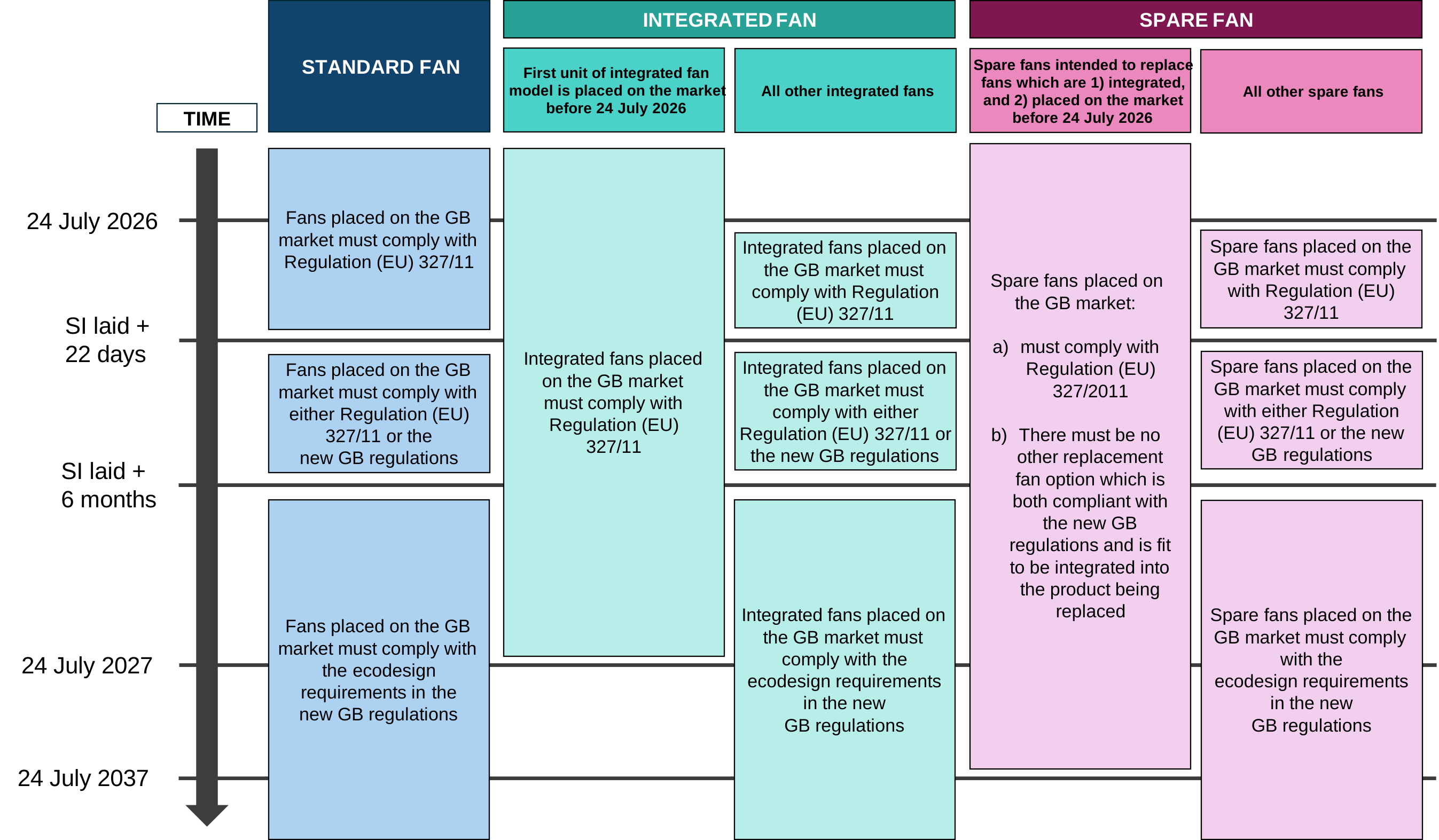
Description of figure: A timeline showing the transitional period by fan type.
Standard fan:
- 24 July 2026 to SI laid + 22 days: Fans placed on the GB market must comply with Regulation (EU) 327/2011.
- SI laid + 22 days to SI laid + 6 months: Fans placed on the GB market must comply with either Regulation (EU) 327/2011 or the new GB regulations.
- From SI laid + 6 months: Fans placed on the GB market must comply with the ecodesign requirements in the new GB regulations.
Integrated fan:
- First unit of integrated fan model is placed on the market before 24 July 2026 -
- 24 July 2026 to 24 July 2027: Integrated fans placed on the GB market must comply with Regulation (EU) 327/2011
- All other integrated fans -
- 24 July 2026 to SI laid + 22 days: Integrated fans placed on the GB market must comply with Regulation (EU) 327/2011
- SI laid + 22 days to SI laid + 6 months: Integrated fans placed on the GB market must comply with either Regulation (EU) 327/2011 or the new GB regulations
- From SI laid + 6 months: Integrated fans placed on the GB market must comply with the ecodesign requirements in the new GB regulations
Spare fan:
- Spare fans intended to replace fans which are 1) integrated, and 2) placed on the market before 24 July 2026 -
- 24 July 2026 to 24 July 2037: Spare fans placed on the GB market: a) must comply with Regulation (EU) 327/2011; b) there must be no other replacement fan option which is both compliant with the new GB regulations and is fit to be integrated into the product being replaced
- All other spare fans -
- 24 July 2026 to SI laid + 22 days: Spare fans placed on the GB market must comply with Regulation (EU) 327/2011
- SI laid + 22 days to SI laid + 6 months: Spare fans placed on the GB market must comply with either Regulation (EU) 327/2011 or the new GB regulations
- From SI laid + 6 months: Spare fans placed on the GB market must comply with the ecodesign requirements in the new GB regulations
-
A) Standard industrial fans
- Present:
- – Fans placed on the GB market must comply with Regulation (EU) 327/2011
- From 22 days after the SI is laid:
- – Fans placed on the GB market would have to comply with either the proposed new ecodesign requirements OR Regulation (EU) 327/2011.
- From 6 months after the SI is laid:
*– Fans placed on the GB market would have to comply with the proposed new ecodesign requirements
- Present:
-
B) Integrated fans
-
i) If the first unit of the integrated fan model was placed on the GB market before 24 July 2026:
- From 22 days after the SI is laid
- – Integrated fans in this category placed on the GB market would have to comply with Regulation (EU) 327/2011 only.
- From 24 July 2027
- – Integrated fans in this category which comply with Regulation (EU) 327/2011 could no longer be placed on the GB market.
- From 22 days after the SI is laid
-
ii) All other integrated fans:
- From 22 days after the SI is laid
- – Integrated fans in this category placed on the GB market would have to comply with either the proposed new ecodesign requirements OR Regulation (EU) 327/2011.
- From 6 months after the SI is laid:
- – Integrated fans in this category would have to comply with the proposed new ecodesign requirements to be placed on the GB market.
- – Integrated fans in this category would have to comply with the proposed new ecodesign requirements to be placed on the GB market.
- From 22 days after the SI is laid
-
i) If the first unit of the integrated fan model was placed on the GB market before 24 July 2026:
-
C) Spare fans
-
i) Spare fans intended to replace fans which are 1) integrated into another product and 2) were placed on the market before 24 July 2026
- From 22 days after the SI is laid
- – Spare fans in this category could be placed on the GB market if it met the following conditions:
- – Must comply with the requirements in Regulation (EU) No 327/2011 that were applicable at the date of placing on the market of the fan it is intended to replace.
- – There is no replacement fan which is both: a) compliant with the proposed new standards offered by the manufacturer, importer or authorised representative, and b) is fit to be integrated into the product in question.
- – Product information is clearly displayed stating that the spare fan can only be used to replace an existing fan placed on the market before 24 July 2026 because no compliant fan is fit to be used as a replacement.
- – Spare fans in this category could be placed on the GB market if it met the following conditions:
- From 24 July 2037
- – New units of spare fans in this category could no longer be placed on the GB market.
- From 22 days after the SI is laid
-
ii) All other spare fans
- From 22 days after the SI is laid
- – Spare fans in this category placed on the GB market would have to comply with either the proposed new ecodesign requirements OR Regulation (EU) 327/2011.
- From 6 months after the SI is laid:
- – Spare fans in this category must comply with the proposed new ecodesign requirements to be placed on the GB market.
- From 22 days after the SI is laid
-
i) Spare fans intended to replace fans which are 1) integrated into another product and 2) were placed on the market before 24 July 2026
44. Do you support aligning GB regulations with Commission Regulation (EU) 2024/1834, as amended by Commission Regulation (EU) 2025/2481?
Yes / No / Don’t know. Please explain your answer.
45. Would divergence from EU requirements introduce additional costs or create complexity for UK manufacturers or importers?
Please provide evidence where possible.
46. In the absence of further regulation, is there an increased risk of competition from cheaper, less efficient products, or other negative market consequences?
Yes / No / Don’t know. Please provide evidence to support your answer.
47. How would alignment with EU requirements impact trade between Great Britain, Northern Ireland and the EU?
Please provide evidence where possible.
48. Do the proposed transitional periods provide sufficient time to adapt to the new standards? If not, what challenges or impacts do you foresee? We would like to hear, in particular, from small- and medium-sized enterprises.
Yes / No / Don’t know. Please provide evidence to support your answer.
49. Do you agree with the transitional period for standard fans?
Yes / No / Don’t know. Please provide evidence to support your answer.
50. Do you agree with the transitional period for integrated fans?
Yes / No / Don’t know. Please provide evidence to support your answer.
51. Do you agree with the transitional period for spare fans?
Yes / No / Don’t know. Please provide evidence to support your answer.
52. How might non‑alignment with EU regulations affect the availability, quality and diversity of industrial fan products for GB customers?
Please provide evidence where possible, including impacts on competition, imports, exports, or manufacturing costs.
5. General
5.1 International standards
We are proposing to use international standards where these can provide recognised technical definitions or symbols that support the operation of our proposed requirements. We are seeking views on whether these standards are appropriate for use in GB and any barriers that this may pose on industry where access to the relevant standards requires purchase.
Correction factor for guard compensation – EN ISO 13857:2019
The guard correction factor is used in calculations for efficiency of fans equipped with permanently fitted protective guards that cannot be removed without making the fan inoperable. Fitted guards can reduce measured efficiency. The correction factor provides a standardised means of compensating for this effect, ensuring that the calculated fan efficiency is comparable across products.
We propose that the appropriate correction factor for fans equipped with a permanent protective guard is determined by the dimensions of the opening of the protective guard, as it is defined in section 4.2.4.1 of EN ISO 13857:2019. See Schedule 2 paragraph 9 of the draft SI.
Referencing this international standard will provide a method for measuring the opening size of fans with protective guards that is recognised widely by industry and is verifiable by market surveillance authorities. This proposal would ensure that the guard correction factor is applied consistently during compliance testing.
53. Do you agree that the definition of e in the standard EN ISO 13857:2019 should be used in determining the appropriate correction factor for fans with permanently fitted guards, despite the fact that the standard would be behind a paywall?
Yes / No / Don’t know. Please provide evidence to support your answer.
Digital product information requirements – ISO 7000:2019 reference n°1641
Our proposal permits detailed product information to be provided electronically via a website link or QR code, provided that a pictogram corresponding to ISO 7000:2019 reference n°1641 is displayed alongside it. See Schedule 1 paragraph 3(3)(b) and 5(a).
We have proposed ISO 7000:2019 as it is an internationally recognised symbol which alerts users that relevant product information and instructions are available through the linked resource. It would be a consistent, language-independent way of directing users to the product information that suppliers provide electronically.
54. Do you agree that the pictogram specified in ISO 7000:2019 reference n°1641 should be used alongside website links or QR codes to indicate that product information and operating instructions are available electronically, despite the fact that the standard would be behind a paywall?
Yes / No / Don’t know. Please provide evidence to support your answer.
5.2 Public Sector Equality Duty
Under the Public Sector Equality Duty, the government must take steps to understand how policies will affect different groups in society in different ways, with a particular focus on removing or minimising disadvantages suffered by people due to the following protected characteristics: age; gender reassignment; being married or in a civil partnership; being pregnant or on maternity leave; disability; race including colour, nationality, ethnic or national origin; religion or belief; sex; and sexual orientation.
We have not identified any disproportionate impacts on those with protected characteristics that would arise due to this policy, because the regulations focus on fans which are only used in industrial and commercial applications. The proposals do not differentiate between groups or individuals.
55. Do you have views on the extent to which this policy may affect people with protected characteristics under the 2010 Equality Act?
Yes/No/Don’t know. Please provide evidence or reasoning to support your answer.
5.3 Post-implementation review
Should the proposals in the consultation be implemented, we will ensure that their impact is reviewed. This would include assessment of the benefits and impact to industry across the UK, and whether the scope of products included should be modified. We would also assess whether the standards remain suitable for the GB market, with reference to technological developments. To allow sufficient time for policy impact review, we are proposing to publish a Post‑implementation review no later than 5 years after the regulations come into force.
56. Do you have views on the proposed date for review of our proposed industrial fans regulations?
Yes/No/Don’t know. Please provide evidence or reasoning to support your answer.
Annex A: Questions list
1. Do you agree with the proposed changes definitions of the categories of industrial fans? Could there be any unintended consequences as a result of the proposed changes?
2. Do you agree with aligning the GB definition of industrial fan types with the updated EU categories (e.g., forward curved <5 kW, backward inclined >50°, other centrifugal fans)?
3. Do you agree with adopting the EU’s revised exemptions (e.g., BEP ≥ 8000 rpm, hazardous gas conditions, compressibility factor >1.00)?
4. Are there any GB‑specific exemptions that should be considered?
5. Do you support the proposal to raise MEPS levels for industrial fans?
6. Do you anticipate any costs or operational impacts from compliance with the revised MEPS?
7. Should GB retain BEP‑only MEPS, in line with the EU approach, rather than introducing mandatory part‑load MEPS?
8. Without the introduction of updated MEPS, would you expect an annual improvement in baseline fan efficiency?
9. Do you support adopting the new measurement category E for jet fans?
10. Which product category do you use/manufacture and what is the application? Is this within a commercial or industrial setting?
11. Do you agree with the proposed definition of inherent speed?
12. Do you agree with the proposed definition of the best efficiency point?
13. When testing fans with a variable speed drive, what factors do you consider in deciding which impeller speed to declare as its inherent speed?
14. Do you agree with our proposed allowances for conducting compliance tests for jet fans with an impeller diameter above 1 metre and non-jet fans with an impeller diameter above 0.5 metres?
15. Where are compliance tests conducted for fans below the size thresholds for our proposed allowances?
16. Do you agree with adopting the updated allowances (e.g., reversible fans, low‑noise fans, DC <100V correction)?
17. Are the proposed 90%/93% market surveillance verification tolerances appropriate for GB?
18. Will alignment with new test procedures impose burdens or help streamline compliance?
19. Do you agree with the proposed circumvention requirements?
20. Do you agree that the drafting of the circumvention prevention provisions in Regulation 8 of the draft SI achieves the same effect as the requirements set out in Article 40 of Regulation (EU) 2024/1781?
21. Do industrial fans utilise software or firmware that can be updated after the product has been placed on the market or put into service? If so, what types of software and firmware is used and what functionality does it offer to end-users?
22. Do you consider the concept of “functional performance from the perspective of the user” to be relevant to industrial fans? If yes, we would like your views on:
- which aspects of an industrial fan’s operation you consider to fall within the category of ‘functional performance’
- how a software or firmware update could affect such functionality
- what test method would be used to measure functional performance, or any deteriorations in functional performance
23. Article 40(5) of Regulation (EU) 2024/1781 states that updates should not worsen product performance beyond ‘acceptable margins’. How should this be interpreted in the context of the industrial fans requirements we have proposed?
24. Article 40(5) of Regulation (EU) 2024/1781 permits a software or firmware update to worsen performance where the customer has explicitly consented to the deterioration. Do you have views on how such consent should operate in practice for industrial fans? In particular, we would like your views on:
- when consent should be obtained
- whether the same approach should apply to both regulated product performance parameters and functional performance from the perspective of the user
- how compliance with any consent requirement could be demonstrated and verified
25. Do you support adopting the expanded EU requirements for providing detailed fan performance and efficiency information?
26. Are there challenges in supplying complete BEP performance data, efficiency grade information, specific speed, or assumptions relating to VSD use?
27. Should GB adopt the EU requirement to provide part‑load performance information from July 2027?
28. Are there challenges in providing part‑load performance information for custom fans, jet fans, or multi‑speed fans?
29. Should product documentation and performance information be required to remain digitally available for 20 years?
30. Would these information requirements impose significant burdens on manufacturers, or improve transparency and support long‑term maintenance and compliance?
31. Do you agree with adopting the updated EU rating plate requirements (including fan type, efficiency, measurement category and year of manufacture)?
32. Do you agree with the proposed requirements to make a core set of spare parts available for industrial fans?
33. Are the timelines proposed for spare part availability (up to 10 years after last placing on the market) appropriate for the GB market?
34. Are there practical or cost challenges associated with supplying spare parts within 6 weeks?
35. Do you agree with the proposal to require access to repair and maintenance information for professional repairers?
36. Are there challenges in providing software and firmware updates free of charge for 10 years after the last unit is sold?
37. Do the proposed user manual requirements strike the right balance between transparency, safety and manufacturer burden?
38. Do you agree with introducing design for disassembly requirements for industrial fans?
39. Are there technical or cost barriers to enabling dismantling using commonly accessible tools?
40. What is the expected lifetime of Industrial fans and does this change between the different categories assessed?
41. What are the operational behaviours of Industrial fans, between the different categories assessed? For example, will the fan always be on, what would its daily operating hours be?
42. Do you agree with the proposed requirements for spare parts or replacement fans which do not meet the new performance requirements?
43. Do you expect any positive or negative impacts of the proposed circular economy provisions existing industrial fan systems?
44. Do you support aligning GB regulations with Commission Regulation (EU) 2024/1834, as amended by Commission Regulation (EU) 2025/2481?
45. Would divergence from EU requirements introduce additional costs or create complexity for UK manufacturers or importers?
46. In the absence of further regulation, is there an increased risk of competition from cheaper, less efficient products, or other negative market consequences?
47. How would alignment with EU requirements impact trade between Great Britain, Northern Ireland and the EU?
48. Do the proposed transitional periods provide sufficient time to adapt to the new standards? If not, what challenges or impacts do you foresee? We would like to hear, in particular, from small- and medium-sized enterprises.
49. Do you agree with the transitional period for standard fans?
50. Do you agree with the transitional period for integrated fans?
51. Do you agree with the transitional period for spare fans?
52. How might non‑alignment with EU regulations affect the availability, quality and diversity of industrial fan products for GB customers?
53. Do you agree that the definition of e in the standard EN ISO 13857:2019 should be used in determining the appropriate correction factor for fans with permanently fitted guards, despite the fact that the standard would be behind a paywall?
54. Do you agree that the pictogram specified in ISO 7000:2019 reference n°1641 should be used alongside website links or QR codes to indicate that product information and operating instructions are available electronically, despite the fact that the standard would be behind a paywall?
55. Do you have views on the extent to which this policy may affect people with protected characteristics under the 2010 Equality Act?
56. Do you have views on the proposed date for review of our proposed industrial fans regulations?