Guided retirement policy consultation
Published 3 November 2026

© Crown copyright 2026
This publication is licensed under the terms of the Open Government Licence v3.0 except where otherwise stated. To view this licence, visit nationalarchives.gov.uk/doc/open-government-licence/version/3 or write to the Information Policy Team, The National Archives, Kew, London TW9 4DU, or email: psi@nationalarchives.gov.uk.
Where we have identified any third party copyright information you will need to obtain permission from the copyright holders concerned.
This publication is available at https://www.gov.uk/government/consultations/guided-retirement-policy-consultation/guided-retirement-policy-consultation
Introduction
This consultation is intended to seek views on initial policy proposals for the implementation of guided retirement for both contract-based and trust-based schemes.
The government has also published draft regulations for Retirement Collective Pension Schemes for consultation. Interested stakeholders are encouraged to consider these alongside the proposals set out in this guided retirement consultation.
About this consultation
Purpose of this consultation
The purpose of this consultation (a discussion paper for the Financial Conduct Authority (FCA)) is to seek views on initial policy proposals for the implementation of guided retirement across both contract-based and trust-based pension providers. The proposals aim to support a broadly consistent approach across workplace pension schemes, while recognising the distinct legal and regulatory frameworks that apply to contract-based and trust-based arrangements. This document therefore brings together proposals relevant to both regimes.
The government is committed to introducing provisions to ensure that individuals saving into a defined contribution workplace pension no longer have to make complex decisions about how to access their pension benefits. This consultation represents initial policy thinking on requirements to be set out in:
- secondary legislation under the guided retirement provisions (Part 2, Chapter 6) of the Pension Schemes Act 2026
- in FCA rules which aim to, so far as is possible, achieve the same outcomes
The consultation seeks views on the effectiveness, feasibility and practical implementation of these proposals.
The policy proposals within this consultation have been developed in close collaboration between the Department for Work and Pensions (DWP), HM Treasury, the FCA, and The Pensions Regulator (TPR).
Who this consultation is aimed at
We would particularly welcome responses from:
- pension scheme trustees and managers
- providers of workplace pension schemes
- pension scheme service providers, other industry bodies, and professionals
- employers who sponsor an occupational pension scheme
- individuals with pension savings and consumer representative groups
Scope of consultation
DWP is responsible for legislation relating to occupational pension schemes in Great Britain. In Northern Ireland occupational pensions are a transferred (devolved) matter with decisions regarding policy and delivery the responsibility of the Northern Ireland Executive. DWP is working closely with counterparts in Northern Ireland at the Department for Communities in relation to the matters set out in this consultation as historically, the Department for Communities has maintained parity with DWP in matters of pensions. Therefore, the consultation is of relevance to stakeholders in Great Britain and in Northern Ireland.
The FCA regulates pension providers across the United Kingdom and therefore this consultation extends to the whole of the United Kingdom in relation to proposed FCA rules.
Duration of the consultation
The consultation period begins on 3 November 2026 and runs until 22 December 2026.
How to respond to this consultation
Please send your consultation responses using the response form.
Alternatively, you can send your responses to the DWP guided retirement policy team using this email address: consultation.guidedretirement@dwp.gov.uk.
All consultation responses will be shared with the FCA and TPR. Where relevant, we also expect to share responses with HM Treasury, HMRC, the Prudential Regulation Authority, the Money and Pensions Service, the Financial Ombudsman Service, The Pensions Ombudsman, the Financial Services Compensation Scheme, the Financial Reporting Council, and the Information Commissioner’s Office.
Government response
We will aim to publish the government response to the consultation on GOV.UK.
In the interests of efficiency, we expect to publish the government’s consultation response alongside a further technical consultation on draft regulations and a consultation on FCA rules. Given the technical nature of drafting statutory instruments, we expect this process to take longer than 12 weeks envisioned in the government’s consultation principles. The report will summarise the policy consultation responses and outline how we have considered the feedback in the drafting of the regulations. The expected timing of the consultation on draft regulations and FCA rules is set out in the roadmap for workplace pensions.
How we consult
Consultation principles
This consultation is being conducted in line with the revised Cabinet Office consultation principles published in January 2016. These principles give clear guidance to government departments on conducting consultations.
Feedback on the consultation process
We value your feedback on how well we consult. If you have any comments about the consultation process (as opposed to comments about the issues which are the subject of the consultation), please email them to the DWP consultation coordinator. These could include if you feel that the consultation does not adhere to the values expressed in the consultation principles or that the process could be improved.
DWP Consultation Coordinator
2nd Floor
Caxton House
Tothill Street
London
SW1H 9NA
Email: caxtonhouse.legislation@dwp.gov.uk
Freedom of information
The information you send us will be shared with the FCA and TPR for joint analysis and may need to be passed to HM Treasury, as well as other colleagues within DWP. We may also share responses with other relevant bodies where appropriate, including HMRC, the Prudential Regulation Authority, the Money and Pensions Service, the Financial Ombudsman Service, The Pensions Ombudsman, the Financial Services Compensation Scheme, the Financial Reporting Council, and the Information Commissioner’s Office. Information provided may also be published in a summary of responses received and referred to in the published consultation report.
All information contained in your response, including personal information, may be subject to publication or disclosure if requested under the Freedom of Information Act 2000. By providing personal information for the purposes of the public consultation exercise, it is understood that you consent to its disclosure and publication. If this is not the case, you should limit any personal information provided, or remove it completely. If you want the information in your response to the consultation to be kept confidential, you should explain why as part of your response, although we cannot guarantee to do this.
To find out more about the general principles of Freedom of Information and how it is applied within DWP, please contact the Central Freedom of Information Team at freedom-of-information-request@dwp.gov.uk.
The Central Freedom of Information team cannot advise on specific consultation exercises, only on Freedom of Information issues. Read more information about the Freedom of Information Act.
Ministerial foreword
Comfortable retirements matter, so accessing a pension is one of the most important financial moments in most of our lives. For some, it coincides exactly with retirement. For others, it may come while they continue working and gradually transition. Whatever their circumstances, it is often a moment of excitement, but increasingly it is also one of uncertainty. And with good reason. Changes to our pension system have shifted responsibility for managing longevity and investment risk from employers to the individual.
Through automatic enrolment, we rely on inertia – people not acting – to great success to encourage people to save. But once someone with a DC pension reaches retirement, we suddenly expect them to become an actuary, an investment manager, and a fortune teller to anticipate how much they can afford to spend and how long they can expect to live.
Currently we have a system that effectively encourages many people to save, but it is creating savings pots not a true pension system. Too many people reach retirement with no clear plan for turning their savings into a reliable income that will last for life. Evidence also shows people consistently underestimate how long they can expect to live.
The status quo would therefore condemn far too many to seeing comfortable retirements turning into uncomfortable ones as pension savings run dry, with others left unsupported to make the best use of the money they have saved for retirement.
We will ensure Britain has, not just savings pots, but a pensions system. Guided retirement will require pension schemes to provide default pensions. This will help people get more from their pension savings: by harnessing economies of scale in administration and purchasing power, and collective risk-sharing, default pensions can deliver better retirement outcomes. Rather than leaving individuals to navigate the market alone, pension providers will be positioned to secure longevity protection for their savers on better terms, supporting higher and more sustainable retirement incomes without the need for individuals to make complex decisions.
Individuals will have the ability to make other choices. But default pensions will ensure everyone has a route to a decent pension income that is sustainable for the rest of their lives. In short, they will make pensions, pensions again.
Torsten Bell MP, Minister for Pensions
1. Background and the case for change
Terminology used
1.1. This consultation uses some standard terms.
Pension provider means providers of DC workplace pensions, including FCA-regulated firms and trustees or managers of occupational pension schemes (including of master trusts, single employer trusts, and public service pension schemes). Where relevant, we have specified if something is only relevant for trust-based or contract-based schemes.
Default pension means a method of taking pension benefits which is presented to an individual as a pre-selected option when they contact their pension provider to access their DC pension pot. A default pension may be provided within an individual’s existing provider, or by means of a transfer with consent to another provider (for example, the term is used here to refer to both “default pension benefit solutions” and “qualifying pension benefit solutions” in Chapter 6 of the Act).
Building on the success of automatic enrolment
1.2. Since its introduction, automatic enrolment has transformed how people save for retirement. Participation in defined contribution (DC) pensions has increased significantly, bringing millions more individuals into pension saving and establishing a simple and effective framework: regular contributions, invested over time to build a retirement pot.
1.3. However, while the system has been successful in supporting people to save, the broader longer-term shift from defined benefit (DB) pensions to DC savings pots places much greater responsibility on individuals at the point of retirement. Unlike traditional DB pension arrangements, which provide a regular income for life, most DC schemes now deliver outcomes in the form of an accumulated pot of savings. Individuals are then expected to convert that pot into a sustainable income, often over a retirement that may last several decades.
1.4. This shift exposes individuals to a range of complex risks and decisions. They must determine how quickly to access their savings, how to balance flexibility with income security, how to manage investment risk in retirement, and how to ensure their income lasts throughout later life. These decisions are inherently difficult. They require judgments about longevity, investment performance, and changing personal circumstances. Leaving individuals to arrange retirement income themselves also means they are unlikely to benefit from the purchasing power, risk pooling, risk transfer and governance available through institutional pension provision.
1.5. This can lead to uncertain and, in some cases, poor outcomes. Some individuals may draw down their savings too quickly, risking running out of income later in life, particularly as evidence shows that on average people underestimate how long they can expect to live.[footnote 1] Others may be overly cautious, excessively limiting their standard of living in retirement. More broadly, the current system does not consistently provide the simplicity and predictability that many people associate with a pension – namely, the expectation that saving over a working life leads to a regular and reliable income in retirement.
1.6. The evidence shows there is a clear need for reform:
- People are unprepared: while a majority of DC pension holders (53%) say they want a guaranteed income for life, the majority (77%) of DC pension holders yet to access their pension did not have a clear plan for how to do this. One in five (21%) were not even aware they had to make a choice. In addition, 41% of 40 to 75-year-olds have no idea how much retirement income they will need.[footnote 2]
- Engagement is low: only 24% of those currently contributing to a DC pension have high levels of engagement with their DC pension. [footnote 3]
- Access is uneven: around two-fifths (about 40%) of DC occupational pension schemes offer no decumulation products. [footnote 4]
1.7. The Pensions Commission’s interim report reinforces the well-evidenced case for improving outcomes delivered through default pensions.
1.8. It is in this context the Pension Schemes Act 2026 (“the Act”) introduced the core requirements for trustees or managers of occupational pension schemes to provide default pensions which are designed to provide a regular income in retirement. The FCA is also required to introduce rules for the purpose of ensuring default pensions are made available by relevant FCA-regulated pension schemes, and in doing so they must aim to ensure, so far as possible, that these rules achieve corresponding outcomes.
What guided retirement seeks to achieve
1.9. Guided retirement is intended to build on the success of automatic enrolment by providing a clear, high-quality route into retirement for the mass market. It will help to improve retirement outcomes through default pensions that harness economies of scale and longevity protection. Additionally, reflecting evidence that behavioural biases and limited engagement can make retirement decisions difficult for many people, guided retirement will remove the need for individuals to make complex decisions.
1.10. This joint consultation therefore considers how the introduction of default pensions will operate in practice, and how it can be implemented across the market in a way that works for individuals and pension providers.
1.11. The government and the FCA recognise that while well-designed default pensions will help deliver good outcomes, some people will want to choose to do something different. The purpose of the framework is to require pension providers to design or identify default pensions that are appropriate for the needs and interests of the cohort they are intended to serve (they will not be individualised), while leaving individuals the ability to make different choices. Pension providers will be responsible for ensuring default pensions are supported by robust design, governance, communications and ongoing review processes, so that they remain appropriate over time and updated for future cohorts as necessary. In this consultation, we have generally referred to the need for default pensions to be appropriate for members. In places we have also referred to suitability, as default pensions will also need to be suitable for the cohorts they are designed for.
1.12. Individuals approach retirement with differing circumstances, preferences, and levels of financial resilience. Default pensions will sit within a broader ecosystem of support designed to ensure that individuals that want to do something different can make choices that are appropriate to their own needs and objectives.
1.13. Alongside introducing default pensions, we are committed to ensuring that individuals can get the right support with their pension choices, including through high-quality financial advice, Pension Wise, and the introduction of targeted support, where it is made available.
1.14. Guided retirement will provide default pensions, which is the government’s core retirement policy, and will available for the vast majority of people. In designing guided retirement, we have learned from the development and introduction of targeted support. Guided retirement will therefore incorporate some of the mechanics or steps of the existing targeted support regime, for example, pre-defining the solution, segmenting, and communicating the solution. In some instances, where there are multiple cohorts, in guided retirement, as in targeted support, questions would be asked to stream people into a pre-designed default pension. Although targeted support and guided retirement have similarities, in the guided retirement regime, a default pension must normally include built-in longevity protection (unless the individual’s pots held by a provider are below a specified threshold – more information is set out in Chapter 3), and allocation of individuals to such a solution if they don’t engage but do want to draw an income.
1.15. If an individual indicates they do not wish to proceed with their allocated default pension, the government’s initial view is that all providers will be able to consider whether an alternative would be suitable, where another option is available, again incorporating elements of targeted support. Further proposals on alternative default pensions are set out in Chapter 3. However, until an individual has chosen to proceed with a different option, they will remain nominally allocated to a default, ensuring for most that they will get a pension. Crucially, whether an individual answers questions asked during this process or not, payment of an individual’s default pension will only be made once this has been requested by the individual and they have confirmed their bank details.
1.16. Taken together, these services are intended to ensure that individuals have access to different forms of support as needed. Well-designed default pensions will ensure that the vast majority of individuals receive higher quality pensions than they might otherwise do today under the status quo and are protected from the possibility of experiencing declining standards of living in later life, irrespective of levels of engagement, pension wealth and demographics.
1.17. Under our proposals, default pensions will be the core offer for eligible members at retirement, with targeted support, where it is available, supporting people in other situations throughout their pensions journey (for example, if under-saving for retirement).
Guided retirement principles
1.18. In July 2026, the government published the key principles which articulate the intended outcomes for default pensions under guided retirement.[footnote 5]
1.19. These principles take account of consistent evidence that individuals currently face complex and high‑stakes decisions at the point of retirement, often without the engagement or support required to make them effectively. In response, the principles emphasise an outcomes‑focused approach in which schemes take greater responsibility for delivering sustainable retirement income, reducing the burden on individuals, while preserving scope for choice. In summary, the government’s key principles are:
- there should be no requirement for complex decision making by individuals
- default pensions should provide protection against longevity risk
- individuals should continue to have freedom of choice
- there should be a single point of consent to move into a default pension
1.20. The government intends for these principles to inform the detailed framework for guided retirement as it is developed through secondary legislation. This consultation should therefore be read in conjunction with the policy principles.
1.21. They will also inform the FCA’s approach to rulemaking as it seeks to achieve corresponding outcomes. Guided retirement will see appropriate default pensions delivered to individuals based on limited information, and the steps providers would need to take are similar to what FCA conduct rules require for targeted support. The FCA will therefore seek to build on the targeted support conduct rules, where possible, and adapt these where necessary for the purpose of setting conduct rules for guided retirement for contract-based providers.
Developing consultation proposals through engagement
1.22. This policy development has been informed by extensive engagement with stakeholders across the pensions sector. Alongside our ongoing discussions with industry and consumer representatives, we established an Industry Delivery Group and a Member Interests Group. These groups have brought together a range of perspectives from across the pensions landscape, including organisations with experience of scheme design, administration, governance, consumer protection and member representation which has helped to inform and develop this set of initial proposals.
Previous consultation
1.23. This consultation builds on previous work undertaken by DWP to explore the role of pension scheme trustees in helping their members to achieve good outcomes in retirement. In the 2023 consultation response, Helping savers understand their pension choices, DWP found broad support for trustees and managers having responsibility for determining the decumulation solutions available to members.[footnote 6] Three-quarters of respondents agreed that trustees were best placed to select the suite of products offered to members at retirement, and DWP concluded that trustees are best placed to understand their members and design decumulation solutions accordingly. The response emphasised that decumulation offers and default solutions should be based on the profile and needs of a scheme’s membership, supported by trustees’ fiduciary duties and member-focused design.
Equality and diversity considerations
1.24. The Impact Assessment published alongside the Pension Schemes Act 2026 considered the potential equalities impacts of guided retirement, including whether the proposals could have differential impacts on groups with protected characteristics. DWP concluded that it did not consider that the introduction of default pensions would materially impact any of the groups with protected characteristics under the Equality Act 2010. We welcome further evidence through this consultation on any differential impacts that should be considered as the policy is developed.
Alignment across pensions regulatory framework
1.25. Individuals should not experience different pension outcomes or levels of support solely because of the regulatory regime their workplace pension scheme sits within, so DWP, HM Treasury, the FCA, and TPR are working closely together to support a coherent experience for individuals across trust and contract-based workplace pensions.
1.26. In some chapters of this consultation there are particular considerations for trust or contract-based schemes, and we have tried to make this clear.
1.27.For trust-based schemes, the guided retirement reforms sit alongside the government’s wider work on trusteeship and governance. The government recognises that, as schemes become larger and more complex, trustee boards will need strong collective capability and the right balance of individual skills, experience and perspectives. The government will respond to the trusteeship and governance consultation shortly.
2. Scope and eligibility
2.1. This chapter sets out the types of pension provider that would be in scope and individuals that would be eligible to be provided with a default pension under the guided retirement framework, and those that would be excluded. In designing these proposals, we have sought to focus guided retirement on arrangements where individuals are building up, holding, or beginning to access DC pension savings, and where there is the greatest potential for a more structured retirement income journey to improve outcomes.
Occupational pension schemes in scope
2.2. The government proposes that guided retirement should apply to occupational pension schemes with members who are primarily DC savers. If the scheme has members who are primarily DC savers (for the purposes of their retirement choices made under that scheme), they stand to benefit from the support, structure and protections that guided retirement is intended to provide. For hybrid schemes that offer a combination of DC and DB/collective pension benefits, the framework would apply only in relation to those individuals whose benefits are solely DC in nature, rather than to individuals whose retirement outcomes are primarily delivered through DB or collective pension rights. If a scheme offers hybrid benefits which combine cash balance and DC benefits, we propose they should remain in scope in relation to members entitled to DC benefits.
2.3. Further detail about our proposals relating to hybrid schemes and benefits are set out in the below sections on occupational pension schemes out of scope and ineligible individuals.
Contract-based schemes in scope
2.4. Guided retirement will apply across the whole of the market. This includes FCA-regulated pension schemes that are automatic enrolment (AE) schemes and workplace personal pension schemes which are not used for AE. This means that it will apply to group personal pensions, group stakeholder pensions and group self-invested personal pensions (SIPPs) where they operate as workplace schemes.
Eligible Individuals
2.5. We propose that active members, deferred members, pension credit members, and pensioner members holding flexible benefits who are not already in a default pension should be eligible to access default pensions in respect of their money purchase benefits (other than collective benefits). We propose that individuals who are entitled to hybrid benefits which include a DC benefit (other than a collective benefit) and a cash balance benefit should be eligible to receive a default pension in respect of those DC benefits. For individuals within hybrid schemes that offer a mix of DC and DB/collective pension benefits, pension providers will only be required to provide a default pension if their benefits are solely DC in nature (excluding any collective pension benefits). Pension providers should, however, consider whether it would be beneficial to provide default pensions (outside of a statutory obligation) if they consider it would be in the interests of the membership to do so, such as where there is a high proportion of DC savings.
2.6. Individuals in each of these groups may need to decide how to access their DC savings and therefore would benefit from the guided retirement framework. Pensioner members who have taken a PCLS and/or are currently in drawdown are included because they may still have substantive decisions to make about their remaining pension savings or wish to revisit a previous decision.
2.7. We also intend to keep all pensioner members in scope for the purposes of providing communications. Further details are set out in Chapter 5. We set out our considerations on the minimum threshold at which defaults should provide longevity protection in Chapter 3.
2.8. While guided retirement will, in particular, benefit non-advised individuals, we propose that default pensions should be made available to individuals who receive regulated financial advice or targeted support. Where advisers contact providers on behalf of their clients, we would not propose that providers should have to undertake the allocation process (as set out in Chapter 3) but could instead provide information about the default pensions which could be made available to the client.
2.9. The FCA is considering whether it would be appropriate to set expectations that, where an individual is receiving financial advice on retirement income or decumulation, that advice should consider the default pension available to that individual as part of a suitability assessment.
Question 1
Should the FCA set expectations that where an individual is receiving financial advice on retirement income or decumulation, that advice should consider the default pension available to the individual as part of the suitability assessment? Or should this be a requirement?
Guaranteed annuity rates
2.10. There are different ways of providing guaranteed annuity rates (GARs). We consider that some individuals with GARs will be in scope of guided retirement because the GAR would meet the definition of a money purchase benefit. This will depend on the nature of the guarantee and, for example, whether the promise is made in scheme rules or by a third party. Where a GAR meets the definition of a money purchase benefit, we propose individuals should remain eligible to receive a default pension. Guidance is available on GOV.UK which provides further details about how to determine if a GAR is a money purchase benefit.[footnote 7]
2.11. Our initial engagement with stakeholders suggests that GARs can present complex and time-sensitive decisions, as access to the guaranteed rate is often contingent on taking benefits at a specified age or within a defined window. Additionally, the value of GARs will depend on market conditions, available rates at the time, and the terms of the GAR, meaning that individuals may still benefit from support in assessing whether exercising the guarantee provides the best outcome in their individual circumstances. Including these individuals within scope ensures they can access structured support at the point such decisions arise. Pension providers may wish to treat individuals with GARs as a distinct cohort within guided retirement, including by designing default pensions which assume use of the GAR where this is likely to deliver better outcomes.
2.12. Our understanding is that GAR contracts are usually organised at a scheme level for trust-based schemes and therefore we expect an assessment of GARs could be carried out at a scheme or cohort level without needing to assess this on an individual basis. We welcome feedback on this assumption.
Question 2
Do you agree with our proposed approach to individuals with guaranteed annuity rates (GARs)? In particular, do you agree that:
- individuals with GARs which are money purchase benefits should remain within the scope of guided retirement; and
- pension providers should be able to assess the suitability of a GAR at a scheme or cohort level. Are there differences in how this would work in trust and contract-based schemes?
Please provide reasons and supporting evidence, where possible.
Question 3
Are there other types of pension benefits which should be treated differently under guided retirement?
Occupational pension schemes out of scope
2.13. The government proposes that the following schemes be excluded from guided retirement:
- DB schemes with a DC section for additional voluntary contributions (AVC): In such cases, the core pension entitlement is DB in nature, and the DC element is typically supplementary rather than the primary basis on which retirement income is provided. However, as set out under paragraph 2.5, pension providers should consider whether individuals could still benefit from default pensions, without there being a statutory obligation to provide them.
- Relevant small schemes[footnote 8]– small self-administered schemes (SSASs): These arrangements are typically established for a narrower and more bespoke membership base where all members are also trustees of the scheme. It would not be logical to require trustees of these types of schemes to design default pensions for themselves.
- Executive pension schemes: members in these types of schemes typically already have access to more tailored support or governance arrangements that differ significantly from the mass-market context in which guided retirement is intended to operate.
2.14. The government considers the following schemes to also be excluded from guided retirement:
- Whole life Collective Money Purchase Schemes/Collective Defined Contribution Schemes (Collective Pension schemes): Individuals within these schemes will automatically receive a regular income in retirement which includes protection against longevity risk and so would not stand to benefit from inclusion under the policy. Retirement collective pension schemes are being developed for use as a default pension for eligible individuals.
- Cash balance schemes: Although cash balance arrangements share some features with DC provision, they are not considered money purchase benefits in legislation, as there is a promised benefit at retirement.
SIPPs and non-workplace pensions
SIPPs used in workplace arrangements
2.15. The scope of guided retirement includes workplace SIPPs. Therefore, this would otherwise include ‘accidental’ workplace SIPP arrangements, which arise where at least 2 relevant employees or ex-employees have made an active choice to ‘set up’ a SIPP and all relevant employees and ex-employees have selected some or all of their investments in the same arrangement. We propose to exclude these ‘accidental’ workplace SIPP arrangements on the basis that these do not operate, in practice, as workplace pensions. We welcome feedback on this proposal.
2.16. The scope would also capture smaller, often ‘bespoke’ workplace SIPP arrangements, which can provide individuals with more flexibility in their pension arrangements and access to non-mainstream or illiquid assets. In some cases, individuals in these types of workplace arrangements have access to other forms of support or advice. Currently, it is unclear whether or how some of these more bespoke workplace SIPP arrangements offer decumulation options within the existing wrapper, or how they support on decumulation decisions. We are also aware that not all workplace SIPP providers offer a default in accumulation or qualify as AE schemes currently. Therefore, we are interested in hearing from providers of workplace SIPP arrangements on these aspects, and whether the proposals for guided retirement present any operational or practical challenges.
Question 4
For workplace SIPP providers, what operational or practical challenges would you face when implementing the guided retirement proposals? Please provide feedback on any current practice for offering decumulation options and/or support to individuals in workplace SIPPs, particularly where these are more bespoke arrangements.
Non-workplace pensions
2.17. We could choose to extend guided retirement to individual SIPPs and other non-workplace pensions. While we are not currently proposing this, we are interested in views on whether we should.
2.18. Extending guided retirement to non-workplace pensions would increase regulatory obligations on contract-based schemes, and it would be important to further explore whether the same harms around retirement decision-making exist across workplace and non-workplace pensions. The costs could be weighed against the benefits of ensuring individuals who have never been members of a workplace scheme, such as some self-employed individuals, have access to the support offered by default pensions. This could also ensure that individuals consolidating workplace pensions into non-workplace pensions do not lose access to a default pension.
Question 5
Should we extend the requirement to provide default pensions to non-workplace pensions, now or in future? Please explain your response, and whether there are distinct considerations to applying default pensions to non-workplace pensions.
Ineligible Individuals
2.19. Where a scheme may otherwise be in scope, we propose to exclude individuals with hybrid benefits which include a DB or collective pension element.
2.20. We also propose that pension providers should not have to offer default pensions to individuals in certain circumstances, even where they belong to an otherwise in-scope pension provider. We propose to exclude deferred members with a pot worth £1,000 or less which meets the small pot consolidation eligibility rules. We propose this figure should remain aligned with deferred small pots consolidation legislation, so this threshold could change in the future. We do not consider it proportionate to apply guided retirement to small, deferred pots, particularly as policy is already aimed at consolidating these pots and reducing fragmentation across the pensions system. Through small pots consolidation policy, we would expect these pots to be automatically transferred into another scheme. Chapter 3 considers individuals who remain in scope, but whose pot may still be insufficient to provide a regular retirement income.
High value pots
2.21. Guided retirement is intended primarily to support the mass market, where individuals may be less likely to access financial advice and may face greater challenges in managing retirement income decisions. We are not currently proposing to introduce an exemption for high value pots, but we would be interested in stakeholder views on whether or not it would be beneficial to introduce such an exemption and if so, the pot value above which such an exemption should be applied.
Question 6
Do you agree individuals with very large pots should be in scope for guided retirement? If not, what upper threshold do you believe should apply to make them ineligible?
Question 7
Do you agree with the proposed approach to scope and eligibility? Are there any other types of pension provider you consider should be out of scope or any other categories of individuals who should be ineligible?
3. Design and delivery of default pensions
3.1. We want a framework which ensures default pensions are designed to consistent high standards, deliver good outcomes for all, and allow for innovation as default pensions and the DC pensions landscape evolve over time. Below, we set out an example high-level member journey from the point of access, including what the application of the existing Stronger Nudge requirements could resemble (see Chapter 5). Please note, this is a simplified member journey for illustrative purposes. This example does not cover instances where an individual would need to transfer for their default pension (see Chapter 4) and does not capture all the existing or new communication requirements. It also assumes a pension provider would not choose to allocate an individual at the point where they solely take their PCLS (see ‘Identifying nature of access’ section), and that individuals are eligible for guided retirement and are not in receipt of financial advice.
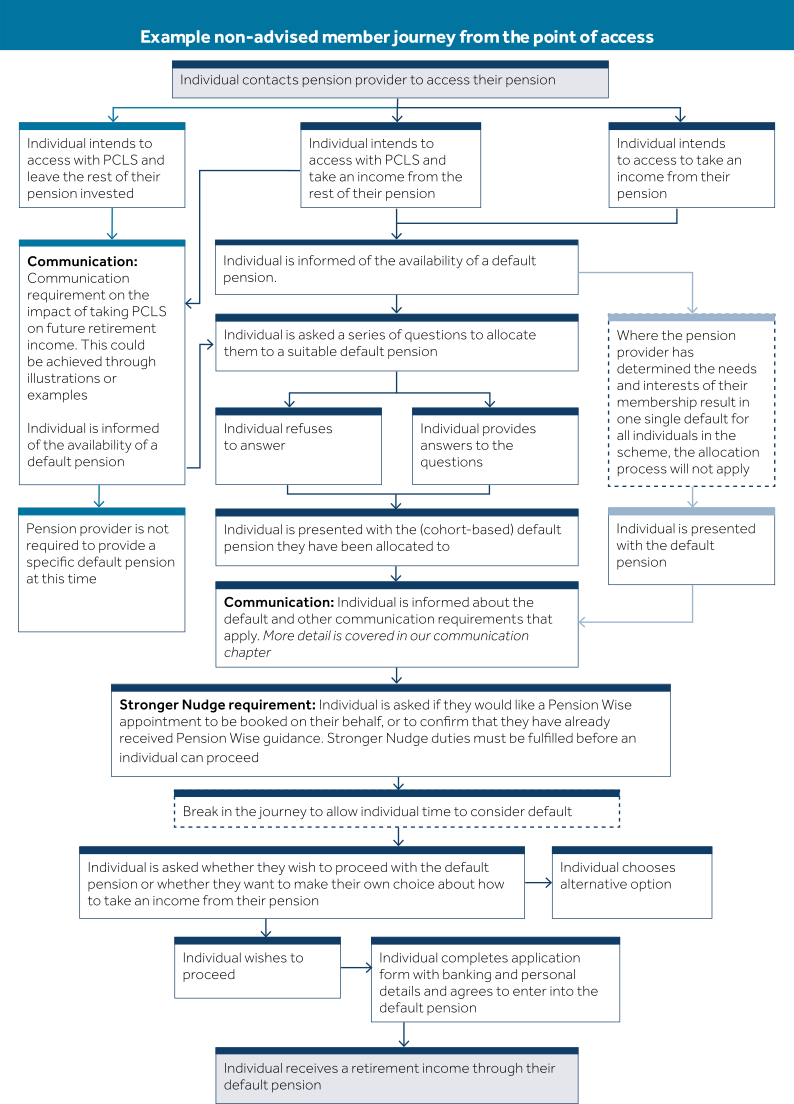
An accessible version of this flowchart is available on the guided retirement consultation landing page.
Design requirements
3.2. In order for defaults to be provided to a consistent standard, we are setting out the design requirements pension providers would need to deliver against under our proposals. These build on the principles for guided retirement (see Chapter 1). There will also be design considerations which are not mandatory features. We set these proposals out in the ‘Design considerations’ section.
3.3. We have summarised the proposed design requirements and considerations in the following table:
Table 1: Summary of proposed design requirements and considerations
| Design requirements (required features of default pensions) | Design considerations (pension providers must take account of these factors when determining, or in the case of a transfer, identifying what default pension(s) to make available) |
|---|---|
| Protection against longevity risk (on pots above £10,000) Single point of consent Cooling-off periods Pre-designing parameters |
Protection against inflation risk Flexibility Protections for default pensions with irreversible elements Making effective use of pensions Valuable benefits Spousal or dependant protection Retirement Collective Pensions |
3.4. Pension providers will need to design their defaults in advance of delivery to individuals, in accordance with the requirements below.
Pension pots and wider pension savings
3.5. The government’s aim is that we expect to move to a system over the longer term where pension pots are consolidated prior to retirement, enabling default pensions to be based on amalgamated pension pots to maximise incomes in retirement and support financial security. In the near term, we recognise that individuals approaching retirement may have multiple pots (including with the same provider) and as such providers should design defaults based on the evidence they gather about their members now.
3.6. The introduction of pensions dashboards in the future is expected to make it easier for engaged individuals to identify their pension savings held across different providers, which may increase pension consolidation ahead of retirement and reduce the extent to which retirement decisions are taken in relation to individual pots in isolation. We expect pension providers to provide, through communications, impartial guidance to support individuals to determine whether to consolidate their pot prior to accessing their default pensions and have set out our proposals on consolidation communications in Chapter 5.
3.7. The consolidation of the market, consistent with the scale provisions under the Pension Schemes Act 2026, is also expected to reduce the number of multiple pots held in different arrangements, in addition to the small pot consolidation measures. The government will explore mechanisms, including possible legislation, for greater consolidation to help savers make the most of the totality of their savings in retirement, mindful any solutions should be considered in the context of the future market of a small number of large schemes. We intend that this will include exploring what trustees can do within current rules to help people consolidate pots in respect of which a default pension can then be arranged. We will continue to engage with stakeholders on these matters in due course.
Protection against longevity risk
3.8. Protection against longevity risk is a core principle of guided retirement and an integral feature of default pensions. Evidence suggests that many individuals do not adequately plan for retirement, including how much income they will need and how long their savings will need to last. As they approach retirement, many face complex decisions and may make choices that result in their pension savings being depleted more quickly than intended. Conversely, concern about running out of money in later life may lead some individuals to spend their pension savings too cautiously, resulting in a lower standard of living during retirement.
3.9. Therefore, the government is requiring default pensions to be designed to protect against longevity risk. This means that pension providers cannot set an upper life expectancy or target date at which the longevity protection would expire in their default pension design.
3.10. The government’s intention is that pension providers will need to design default pensions which will provide protection against longevity risk without individuals needing to make further choices, as we consider this would require the individual to make a complex decision. This means that it is the government’s view that default pensions cannot be designed in a way that would require an individual to purchase their own individual annuity, including through annuity brokerages. We propose that pension providers will be expected to manage any drawdown withdrawal rates where they are used as part of a default pension, and particularly where a drawdown pot would be expected to last until a fixed income element would take effect. It is the government’s view that a straightforward drawdown as a default pension is unlikely to secure the required longevity protection, but we welcome thoughts on this. However, this would not preclude the individual from making one-off additional withdrawals using an alternative payment method, where permitted within the parameters of the default pension, or pension providers including a separate pot for flexible access as part of their default pension (see ‘Setting parameters in default pensions’ section below).
Threshold for protection against longevity risk
3.11. We recognise the importance of providing members with a regular income in retirement. We are considering introducing a threshold, below which pension providers would not be required to provide a regular income and protection against longevity risk. This recognises that providing a lifelong income from smaller pots may not always be practical or proportionate. However, this would not prevent providers from offering a regular income, including protection against longevity risk, below the threshold. Indeed, providers should be doing so where this would be in the best interests of their membership.
3.12. The government’s proposed threshold is initially £10,000 net of any pension commencement lump sum (PCLS) withdrawals. We propose that pension providers should apply the threshold to the combined value of all relevant DC pots held by an individual within the same provider, rather than to each pot separately. This would mean that, where an individual’s pots within the scheme collectively exceed £10,000, the requirement to provide protection against longevity risk would apply, even if each pot is individually below the threshold. We welcome views on the feasibility of applying the threshold in this way. This threshold could be reviewed in the future to reflect changes in inflation or other changes to the DC pension landscape.
3.13. We have heard from customer representative groups and the pensions industry about various options for a threshold with some providers indicating that £10,000 would be viable to operate, whilst others have suggested £30,000. Our analysis suggests that compared with a £10,000 threshold, a £30,000 threshold could exclude around an additional 290,000 DC pension pots held by individuals aged 60 to 65 from longevity protection[footnote 9].
Figure 1. Number and proportion of individuals whose smallest non-zero DC pot falls below different potential thresholds for longevity protection.
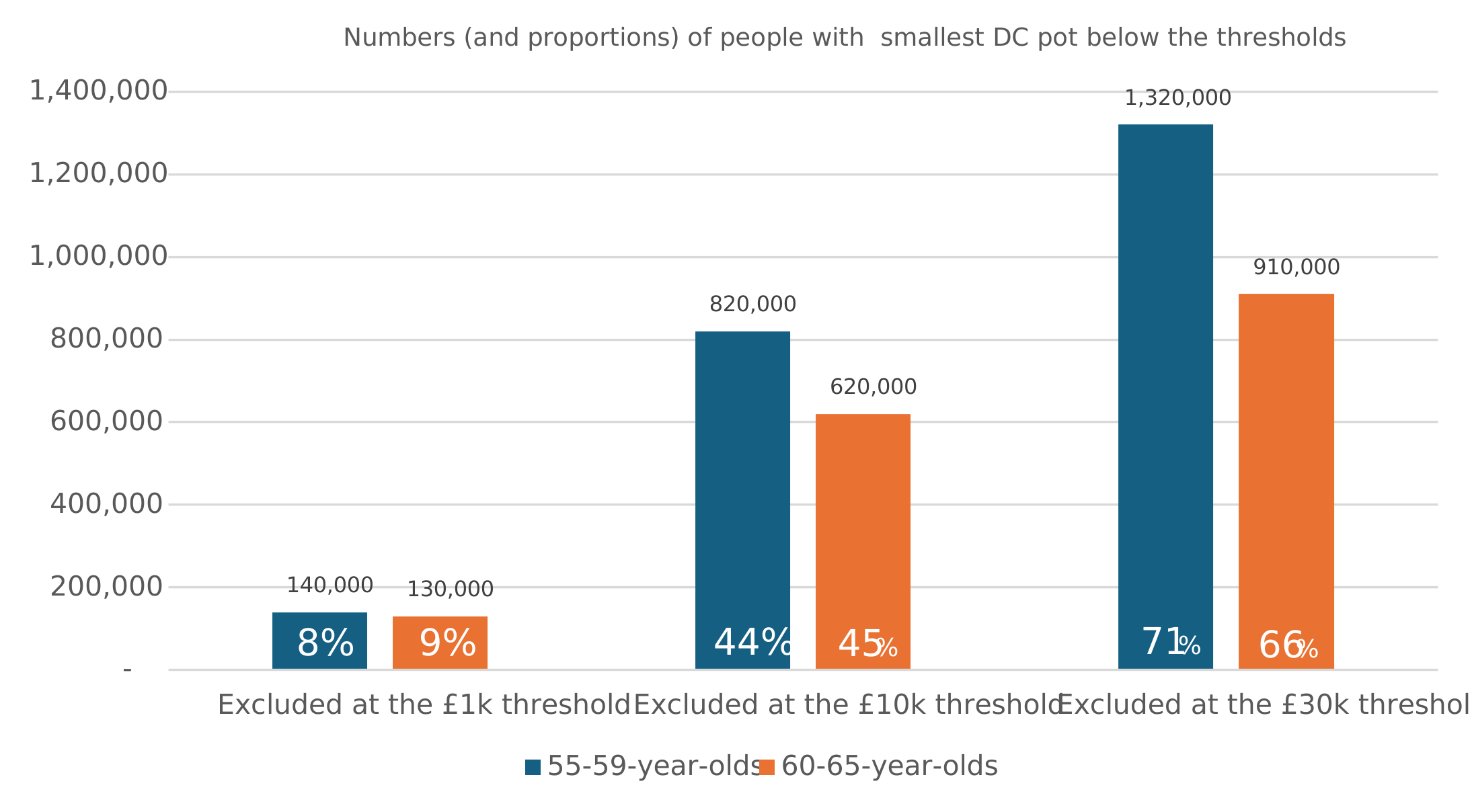
Alternative text: Bar chart compares numbers and proportions of people with smallest defined-contribution pension pots below £1k, £10k, and £30k thresholds by age group.
Blue bars represent ages 55 to 59 (140,000 or 8% excluded at the £1k threshold; 820,000 or 44% excluded at the £10k threshold; 1,320,000 or 71% excluded at the £30k threshold), while orange bars represent ages 60 to 65 (130,000 or 9% excluded at the £1k threshold; 620,000 or 45% at the £10k threshold; 910,000 or 66% excluded at the £30k threshold).
3.14. The FCA’s data show that for pots between £10,000 and £30,000, 48% of pots accessed for the first time (2025 to 2026) were fully withdrawn, compared to 34% first accessed by drawdown. 66% of pots over £30,000 were accessed for the first time via drawdown. [footnote 10]
Figure 2: Pots accessed for the first time 2025/26 by pot size
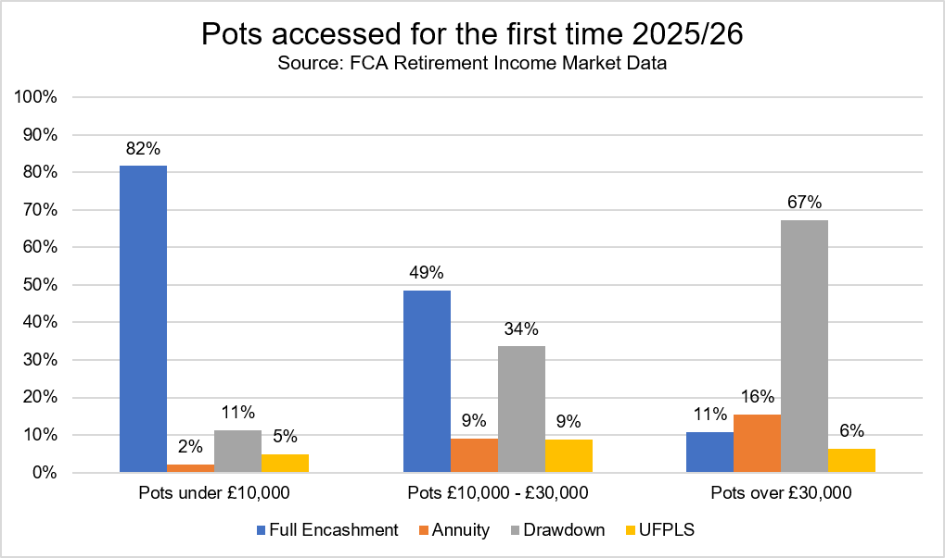
Alternative text: Clustered bar chart shows pots accessed for first time during 2025/26, using FCA Retirement Income Market Data to compare withdrawal choices across pot sizes.
Blue full-encashment bars shows pots under £10,000 at 82%; pots worth between £10,000–£30,000 at 49%, and pots over £30,000 at 11%.
Orange annuity bars shows pots under £10,000 at 2%; pots worth between £10,000-£30,000 at 9%; and pots over £30,000 at 16%.
Grey drawdown bars shows pots under £10,000 at 11%; pots worth between £10,000–£30,000 at 34%, and pots over £30,000 at 67%.
Yellow UFPLS bars shows pots under £10,000 at 5%; pots worth between £10,000–£30,000 at 9%, and pots over £30,000 at 6%.
3.15. As more people benefit from automatic enrolment, we expect an extra 130,000 pots each year will be accessed [footnote 11] The FCA’s data also show that the number of DC pension pots first accessed each year continues to increase, exceeding one million in 2025 to 2026. [footnote 12] In the same period, nearly half (46%) of DC pots accessed for the first time were taken as full cash withdrawals. Most small pots were fully encashed, with around two-thirds (67%) of fully encashed pots worth less than £10,000. However, pension wealth is expected to grow over time as individuals contribute for longer and benefit from future investment returns. As a result, the government considers there is a risk that a higher pot-size threshold could increasingly exclude individuals approaching retirement who may still benefit from a default pension with longevity protection, even where their smallest pension pot remains relatively modest.
Figure 3: Number of pension pots first accessed, by method, 2015/16 to 2025/26 (FCA Retirement Income Market Data)
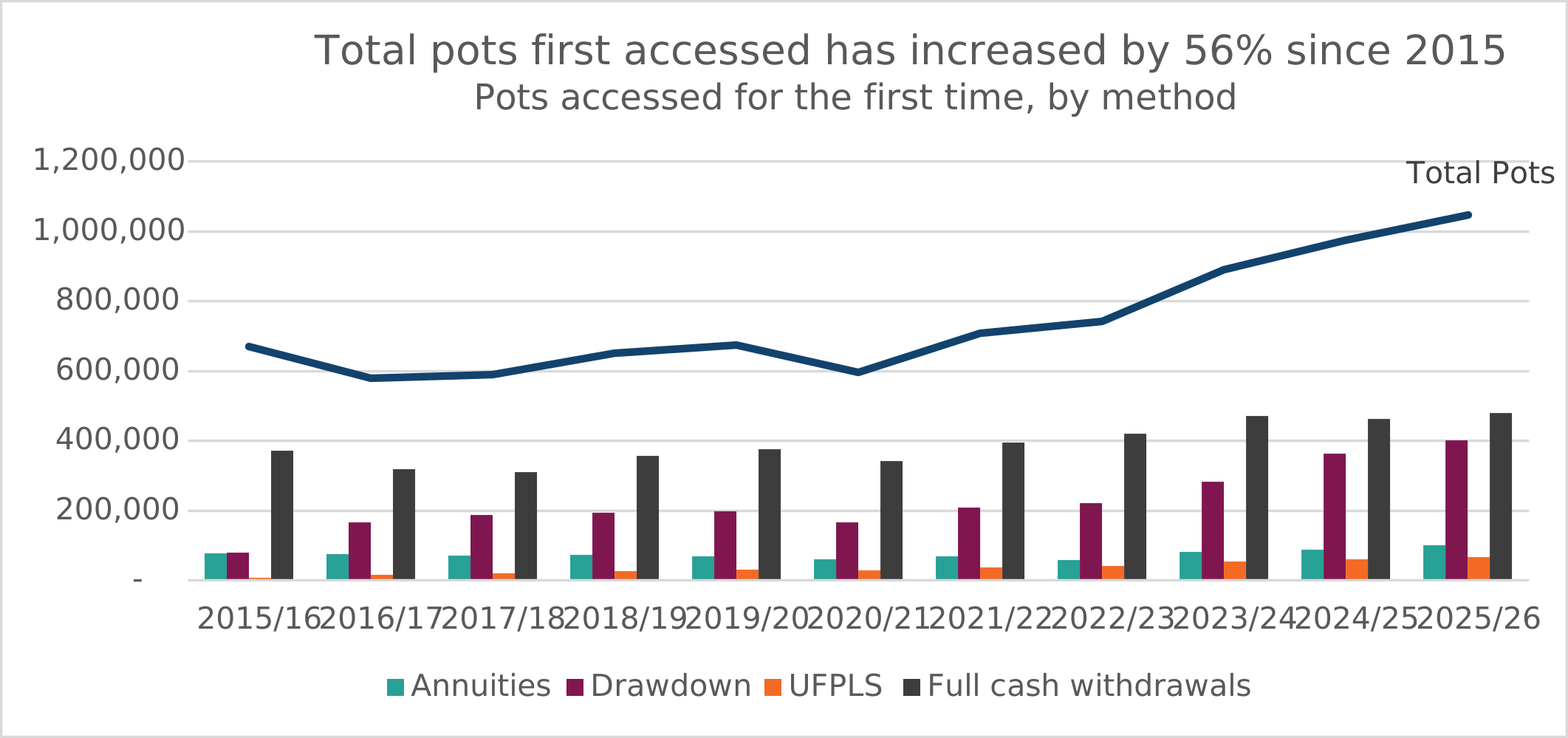
Alternative text: Combined bar and line chart of pension pots first accessed from 2015/16 to 2025/26, by access method. Total first-time accesses rise by 56%, from around 670,000 to 1.04 million. Full cash withdrawals remain the largest access method, increasing from about 370,000 to 480,000. Drawdown more than quadruples from around 80,000 to 400,000, while annuities remain relatively stable and UFPLS increases gradually.
3.16. For illustrative purposes, a £10,000 pot would currently enable someone aged 65 who was a non-smoker and otherwise in good health to purchase an annuity that paid around £600-£750 per year.[footnote 13]
3.17. Where individuals have pots below the threshold for longevity protection, pension providers should consider offering a regular income, even where this would not last indefinitely. This could include regular withdrawals or a series of lump sums overtime. Providers should consider the needs and interests of their membership when determining the appropriate default pension.
3.18. However, the government view is that for many, even a relatively small pension pot can provide a useful regular income in retirement, particularly when combined with provision through the State Pension. For an individual whose combined DC benefits held by the provider are below £10,000, the threshold could still leave them facing complex decisions. We therefore expect pension providers to consider providing a default pension with protection against longevity risk, outside the statutory requirement, where they have identified that those benefits represent the individual’s only pension wealth. We are interested in feedback on the feasibility of this proposal and the lowest pot value for which it is commercially viable to provide protection against longevity risk.
Question 8
Do you agree a £10,000 threshold is the appropriate level to require longevity protection to be provided?
Question 9
What is the lowest pot value under which it would be commercially viable to provide protection against longevity risk?
Question 10
For pension providers, what proportion of pots accessed for the first time would this have excluded in the past year?
Question 11
Do you foresee any practical or operational issues arising from setting a prescribed threshold for i) longevity protection and ii) deferred small pots out of scope (Chapter 2)? In particular, how should pension providers manage situations where an individual’s pot size fluctuates around either threshold, before or during the delivery of a default pension?
Protection against longevity risk in practice
3.19. As part of our early engagement with industry stakeholders, we have heard a variety of approaches to deliver protection against longevity risk. We explore some of these below.
Collective Pension Schemes
3.20. Longevity protection is a key feature of Retirement Collective Pension Schemes, which provide a trustee-managed pension with a target income which aims to at least keep pace with inflation. They are being developed specifically for use as a default pension. The consultation on draft regulations to enable these new scheme types is open for views until 15 December 2026. We are interested in understanding whether trust-based and contract-based providers are exploring this approach for default pensions.
Drawdown
3.21. Some pension providers have indicated that they would rely on a form of managed drawdown to deliver longevity protection. This includes both during the flex phase of a flex then fix solution (for example, managed drawdown combined with an annuity, or similar, to protect later life payments) and as part of a flex and fix approach which would provide a longevity protection for a portion of a pot simultaneously/alongside a lifetime managed drawdown. As we set out above, pension providers must ensure that default pensions are designed to provide a lifetime income indefinitely. Therefore, the government has determined that a drawdown strategy alone cannot deliver this.
Bulk annuities and bulk deferred annuities
3.22. We have heard some trust-based schemes are exploring the use of bulk purchase annuities, including bulk deferred annuities, which would be delivered to individuals as a benefit payable under the scheme, so there is no individual annuity contract between a trust-based member and the annuity provider. These types of bulk purchase are similar to DB buy-ins. We have often heard this feedback as part of a flex then fix approach, where managed drawdown is provided in the earlier part of retirement, before receiving a fixed income in later life. Equally, we understand that annuities could work as part of a flex and fix approach.
3.23. Purchasing or providing longevity protection on behalf of a group of members will allow pension providers to benefit from economies of scale and greater purchasing power. This could enable them to secure more favourable pricing or terms than individuals might obtain when approaching the retail annuity market separately, helping to increase the sustainable income available to individuals.
3.24. There may nevertheless be trade-offs. Bulk annuities delivered this way will be less personalised than individual annuities. This means that bulk annuities cannot be individually medically underwritten and may generally have more ‘basic’ features available. However, these could differ by cohort such as a cohort whose needs and interests mean they would want an inflation-linked income to protect against inflation risk.
3.25. Bulk annuities delivered as a benefit payable under trust-based schemes operate as an insurance contract between the trustees of the scheme and a third-party insurer who provides the bulk annuity. We are interested in understanding what practical challenges contract-based providers, especially insurers, have identified for delivering similar solutions in contract-based schemes.
Individual annuities
3.26. We have engaged with a range of contract-based schemes as part of the policy development for this consultation. Many, in particular insurers, are exploring whether annuities, potentially as part of ‘flex then fix’ or ‘flex and fix’ strategies, can provide viable default pensions. We have also heard concerns about providing individual annuities to individuals in cohorts, given the group-based nature of cohorts versus the typically individualised approach taken for individual annuity sales, especially where these contracts are individually medically underwritten.
3.27. We are interested in receiving feedback on how individual annuities could form the basis for (part of) a default pension and how this can be done without introducing undue complexity to the member journey. This includes whether ‘basic’, non-underwritten annuities could be provided to individuals as part of their default pension. We are also interested in feedback from non-insurer contract-based schemes and what products/strategies they are exploring to provide longevity protection.
3.28. Individual annuity sales are also subject to the FCA’s annuity comparison rules (COBS 19.9). These were introduced to prompt individuals to shop around for annuity rates and required annuity providers to provide information about the market leading quote where theirs was not the highest, given that historically, individuals did not shop around to get the best rate. We recognise the interaction between these existing requirements and the proposals for guided retirement and invite further feedback on the existing annuity requirements in Chapter 5.
Other forms of insurance
3.29. In addition to insurance products such as annuities, we encourage pension providers to explore new and innovative approaches that could provide longevity protection. This could include other forms of insurance alongside managed drawdown approaches, such as the use of regular premiums which are cancellable without paying a penalty, rather than a single purchase point (as has traditionally been the case with annuities). We are interested in understanding if any pension providers, whether they are insurers or not, are considering this approach.
Feedback on wider impacts
3.30. When pension providers design solutions which protect against longevity risk, they may want or need to partner with other providers in order to deliver the examples we set out above, such as for annuities or collective retirement pension schemes. We also acknowledge that the introduction of default pensions, the requirement to provide longevity protection, and wider tax changes which may impact pensions, are likely to impact the annuity market. We are interested in hearing from stakeholders about the potential impact this may have, including on competition. The FCA also welcome views on whether existing rules for annuity sales, or other requirements, present challenges for delivering longevity protection and what changes could be needed.
3.31. We are interested in feedback on the prudential implications for providers. For all providers, this includes any additional capital needed arising from the design and operation of default pensions (including to meet potential redress). For non-insurers, they may need to consider how much of design and/or operation is provided by third parties including, for example, where insurers or Retirement Collective Pension Scheme providers supply longevity protection components. For insurers, this may also include implications from increases in annuity (or deferred annuity) writing, for their capital and for the assets (including potentially re-insurance) needed to back them.
Question 12
How do pension providers expect to deliver longevity protection in practice? Which approaches are they most likely to adopt, and what factors are influencing those decisions? If there are elements that are deferred to later life, such as an annuity, at what age or point in retirement would providers expect it to begin, and why? How would these arrangements be constructed, including the contractual relationships between the provider, the individual and any insurer / other provider? Which party would bear the longevity risk, and which party would be liable to pay the individual’s income?
Question 13
Where providers are not considering some of the approaches outlined above, what are the key barriers or constraints?
Question 14
What other feedback do you have on the proposals for longevity protection? Where applicable, please include any feedback on the future changes to the annuity market, new or emerging products such as Retirement Collective Pension Schemes, existing FCA rules, and prudential implications.
Single point of consent
3.32. The point at which individuals request payment from their pension is an opportune time to maximise engagement to fully explain the default pension and that there are other options available. At this point, an individual will need to agree to start receiving payment via the default pension. We propose that this should be the single key consent moment.
3.33. In the example member journey, we set out that, in our proposals, an individual would first contact their pension provider to access their pension – this means that the provision of a specific default pension would always be initiated by the individual. Where a scheme offers more than one default, they would then go through the pension provider’s pre-designed steps and questions so that they can be allocated to a specific cohort. Once the individual has been presented with their default pension and the provider has undertaken any additional steps required, they would agree to start receiving payment via the default pension or not agree and choose to do something different. If the individual makes no further contact, their funds would remain invested.
3.34. If a default pension includes different phases (such as a flex then fix approach), we propose that individuals must be informed at the point of access and throughout their pensions journey about when their ability to take a different choice would become restricted. However, it is the government’s intention that the framework for guided retirement will prevent pension providers from building journeys which require explicit consent more than once, consistent with the published principles.
3.35. Pension providers will be expected to engage individuals throughout their retirement, although they will be prevented from requiring additional consent to move an individual into another phase of their default pension. Where a default pension involves an irreversible product or strategy (such as an annuity), we propose that pension providers must use their best endeavours to engage the individual before a payment is taken for any irreversible element. This means that individuals would have the opportunity to update their personal circumstances and notify the pension provider if they wish to opt-out of their default pension prior to any transition to irreversible elements.
Question 15:
What practical steps would pension providers take when using best endeavours to engage an individual before a payment is taken for any irreversible element? Does the best endeavours standard we propose reflect the steps pension providers would take in practice?
Cooling-off periods
3.36. The FCA’s existing cancellation rights rules would also currently apply for individual annuities which occur at any point in a default pension. Cooling-off periods allow a period of time between consenting to the default pension and payment being made. This provides a safeguard to the individual if they change their mind and decide to choose something else. We are inviting feedback on whether we should mandate a longer cooling-off period than 30 days. As we set out in the design considerations section (paragraph 3.40), pension providers will be expected to consider other approaches to provide flexibility and mitigants relating to irreversible elements as part of the design of their default pensions.
Question 16
Do you agree with our proposal to require a minimum 30-day cooling-off period for default pensions?
Setting parameters in default pensions
3.37. We propose that pension providers must set out parameters for the default pensions they design. This should include aspects such as how much flexibility an individual can have within a default pension, whether any additional withdrawals are permitted, and whether the pension provider would allow the use of any discretionary spending pots. We propose that pension providers would be permitted to set parameters which restrict an individual from making withdrawals over and above the rate set by the provider, similar to DB pensions where individuals cannot elect to receive a higher pension than that provided under the scheme rules. The parameters, including any limitations, must be clearly communicated to individuals.
3.38. These parameters would be an explicit requirement as part of the governance of the default pension which would need to be documented in the Pension Benefits Strategy (for trust-based schemes). We welcome feedback on these proposals.
3.39. In Chapter 5, we set out the communication obligations for pension providers where individuals request additional withdrawals.
Question 17
Do you agree with our proposal that pension providers should set out and communicate parameters for default pensions?
Design considerations
3.40. Under our proposals, all default pensions would have to meet the mandatory requirements set out above, but beyond that, a number of factors would need to be considered to ensure the default pension meets the needs of the membership or cohorts of members (akin to the needs of a target market in FCA rules for contract-based providers). Pension providers have flexibility to consider other factors. But at a minimum, pension providers will be expected to demonstrate they have considered the factors below in determining what default pensions to make available:
-
Protection against inflation risk: Pension providers would need to consider how their default pensions will manage the impact of inflation over the course of retirement. While it may not be practical or appropriate to provide guaranteed inflation protection in all cases (for example, through inflation-linked annuities), providers should consider how an individual’s purchasing power is likely to change throughout retirement, rather than focusing solely on the level of income provided when benefits first come into payment. Inflation risk may be managed in different ways and pension providers should consider the approach that is most appropriate based on the information they have gathered.
- Flexibility: pension providers would need to consider the extent to which flexibility should be incorporated into the design of their default pension(s). This includes the extent to which individuals can exit the default pension if their circumstances or preferences change, and therefore the timing of any irreversible elements where they are used. This may be particularly relevant in earlier stages of retirement, when individuals may place greater value on retaining flexibility to change their retirement income strategy, perhaps due to partial retirement. Pension providers would also need to consider whether their membership would value discretionary spending pots where the overall pot size can accommodate this. It may be more challenging for pension providers to incorporate flexibility into smaller pot sizes. The appropriate level of flexibility will depend on the information providers obtain when determining the design of the default pension.
- Protections for default pensions with irreversible elements: some default pension designs may include irreversible elements, particularly where longevity protection is delivered through annuities, retirement collective pensions, or similar arrangements. Pension providers should consider whether their membership would value features which help mitigate this risk, such as deferring irreversible elements, guaranteed periods, or surrender values. This will need to be balanced against the importance of giving individuals clarity about their future pension income.
- Making effective use of pension savings: pension providers should seek to help maximise the sustainable income available to individuals while maintaining protection against longevity risk. This is relevant where other features, such as protection against inflation risk, could reduce the income available earlier in retirement. This should also include a consideration of whether the structure of withdrawals and benefit payments makes effective use of the tax treatment available to the individual. We expect this could include approaches such as phased crystallisation or uncrystallised funds pension lump sum (UFPLS) arrangements (where appropriate). These approaches may make more effective use of the individual’s pension savings by allowing a greater proportion of the fund to remain invested for longer, potentially increasing the retirement income available over time.
- Valuable benefits: individuals may have features embedded into their scheme which could provide valuable benefits in retirement. Pension providers should consider whether these benefits can satisfy the requirements of guided retirement, and whether they are likely to meet the needs and interests of the membership. Pension providers should consider whether their default pensions should incorporate, preserve or facilitate access to those benefits.
- Spousal or dependant protection: some individuals may wish for part of their retirement income to continue to a spouse or dependant after their death. Pension providers should consider the extent to which this is likely to be valued by their membership when gathering the evidence to support their default design and whether default pensions should incorporate features to provide such protection. Where these needs and interests are identified, pension providers would be expected to design default pensions that cater for this.
- Retirement Collective Pensions: pension providers would be required to carry out a broad market assessment of options, which must include consideration of whether a Retirement Collective Pension would be an appropriate default pension for their membership (or cohorts). This is to ensure that innovative retirement options are considered alongside more established approaches.
Question 18
Do you agree with our proposed design considerations? Are there any missing from this list?
Design phase for pension providers
3.41. In practice, to design appropriate default pensions, pension providers will need to undertake a series of internal design processes when determining their default pensions, before they are delivered to individuals (product governance in FCA terminology). For trust-based schemes, the Act sets out the key duties underpinning this process, supplemented by the proposals outlined below.
3.42. Guided retirement is the government’s core retirement policy and this will be made available to the vast majority of people. In designing guided retirement, we have learned from the development and introduction of Targeted Support and many of the elements of targeted support are incorporated into guided retirement. Therefore, in this section, we draw on relevant aspects of the FCA’s targeted support framework when setting out our proposals for how guided retirement would operate.
1: Collecting information about the generality of members
3.43. To be able to design appropriate defaults, pension providers will likely need to collect additional information about the generality of their scheme’s membership beyond that already held by the scheme. Pension providers will have flexibility in how they do this, for example, it could be achieved through surveys, analysis of existing member data and testing. The data needs to be sufficient to allow the provider to take account of the design considerations set out above and will need to be refreshed over time, given that the needs and interests of the membership is likely to change as DC pensions evolve.
2: Determining needs and interests
3.44. Once they have this data, pension providers must use the data to determine the needs and interests of their membership for retirement. This should include an assessment of the design considerations we set out above. Steps 1 and 2 may be undertaken simultaneously.
3: Identifying distinct cohorts
3.45. Following this, pension providers must determine whether there are distinct cohorts of people, based on shared needs and interests. Over time, as DC pots increase and the demographics of those accessing their pension assets change, the information gathered may well result in multiple cohorts with distinct shared needs and interests. This process corresponds to pre-defining consumer segments in the targeted support framework, with shared financial support needs or objectives and, where relevant, common characteristics.
3.46. Pension providers may need to make assumptions about cohorts, for example actuarial assumptions to influence how and when longevity protection elements are delivered. They may also engage actuaries or other experts to assist with these assumptions. We would not expect complex information such as actuarial calculations to be communicated to individuals. However, pension providers should not make assumptions in a way which could lead to default pensions being unsuitable as default pensions must be suitable for the cohort they have been designed for.
4: Determining default pensions
3.47. After pension providers have identified distinct cohorts, they will need to determine how to design their default pensions to match the shared needs, interests and characteristics of the cohorts. We will expect pension providers to undertake a broad assessment of the decumulation options available in the market and not restrict their analysis to in-house options, particularly where they do not offer certain products/schemes (for example, annuities or retirement collective pensions). Under the targeted support framework, this corresponds to pre-defining the ready-made suggestion for the relevant consumer segment.
3.48. The default pensions designed or identified must fulfil the design requirements and be designed having regard to the design considerations. In designing default pensions, providers will need to determine how they intend to structure the payments to members, including the managed withdrawal rate, the parameters for this, whether lump sum payments should be made, the point where any different phases come into effect (for example, fixed income stages) and whether provision should be made for discretionary spending pots.
5: Identifying data needs and pre-designing questions
3.49. Where a scheme provides more than one default pension, pension providers will need to allocate individuals to cohorts when they access their pension. To do this, we propose that pension providers will need to pre-design a number of questions relevant to the characteristics of cohorts. After asking individuals the questions (this corresponds to aligning a consumer with a consumer segment in targeted support), they will allocate individuals to cohorts. How pension providers do this will be up to them (for example, decision-trees, standardised questions) but they will need to ensure that they are simple, easy to understand, relevant to identification of the appropriate cohort, and would not require individuals to make complex decisions in answering the questions. We do not propose to restrict the type of questions that could be asked, but providers must only ask questions relevant to the identification of the appropriate cohort.
Design standards for cohorts
3.50. We anticipate that relatively few individuals would refuse to engage with questions asked for the purpose of allocating them to a default pension. Questions will highly likely be incorporated into the process of accessing pension benefits, giving individuals a practical incentive to respond, and pension providers would be expected to make clear why the information is required and how it will inform the default pension offered. However, all eligible individuals must be offered a specific default pension, even if they are not willing to answer questions. Therefore, if a pension provider has more than one default pension, it will need to ensure that there is a cohort to which any member can be allocated, although this need not be a single cohort and may vary, for example, according to pot size.
3.51. Individuals must, in the first instance, be allocated to one default only. Consequently, providers must design their cohorts and questionnaires so they are mutually exclusive and only match an individual to one specific cohort. For each cohort, pension providers would need to establish the information needed to allocate an individual (this corresponds to the concept of including and excluding characteristics in targeted support).
3.52. Pension providers will have flexibility to determine how many cohorts they identify. The cohorts need to be designed in a way that ensures that the default pensions take into account the needs and interests of the cohorts identified, but providers are not expected to do this in a way that would lead to a comprehensive consideration of all aspects of an individual’s circumstances (this is the same standard that exists in targeted support). Pension providers will need to ensure that the cohorts they define, and the questions they ask individuals to allocate them, are relevant to the cohorts they have available. We would expect pension providers to consider aspects such as individuals’ other sources of pension wealth.
3.53. In some instances, pension providers may identify that their membership’s needs and interests are relatively homogenous, or vary, but are still addressed collectively, resulting in one or a small number of broader cohorts. Pension providers will need to ensure that where broader cohort(s) are identified that they still adequately take into account the needs and interests of individuals within them. A single cohort covering the entirety of a membership would still be classified as a cohort for the purposes of our framework.
3.54. Default pensions must be suitable for the cohorts for which they are designed. For example, under the FCA’s Principle 9, a firm must take reasonable care to ensure the suitability of its advice and discretionary decisions for any customer who is entitled to rely on its judgement. Similarly, trustees are subject to trust law duties to act in beneficiaries’ best interests and, under the Act, must understand the needs of their membership and take those needs into account when designing or selecting default pensions.
3.55. We expect most individuals will engage with their provider as they approach retirement so that their pension can be put into payment. As individuals will need to provide information, including bank details, before they can receive pension payments, they will have a practical incentive to engage with their provider and provide the information needed to support allocation. Where an individual nevertheless does not provide the information requested, the provider must still allocate them to a default pension that is suitable for the cohort to which they are allocated. However, we recognise that where no response is received, allocation may need to be based on a broader set of needs and interests or less information. As we set out in paragraph 3.62, where no response is received, the pension provider would likely only be able to allocate an individual to a cohort based on factual information such as age and pot size, which may result in a less suitable default than if they had obtained that additional information.
3.56. Pension providers will need to document their decision-making process and how they have complied with the design requirements. We set out more details about governance and the Pension Benefits Strategy in Chapter 6.
Question 19
Do you agree with our proposals for the design phase and the standards that providers would need to meet?
Question 20
In particular, do you agree with our proposal that cohorts need to be designed in a way that ensures that the default pensions take into account the needs and interests of the cohorts identified, and in a way that does not result in a comprehensive consideration of an individual’s circumstances?
Delivering default pensions
3.57. A default pension needs to be presented to the individual at the point in time when they want to generate income from their pension. However, whether this is what the individual is seeking may not be immediately evident when an individual contacts their provider. We have therefore set out the following steps we propose a provider would be expected to undertake to determine whether a default pension needs to be offered at this particular contact. We set out the specific communication proposals for each of these stages in Chapter 5.
1: Identifying the nature of access
3.58. When an individual indicates that they wish to access their pension savings, providers would generally be required to present a default pension. However, we propose that this requirement would not apply where the individual indicates that they wish only to take a PCLS and leave the remainder of their pension savings invested. Providers may therefore wish to ask screening questions to determine the nature of access, but there would be no requirement to do so. The requirement to present a default pension would still apply on the next occasion the individual requests access to their pension benefits after they have taken a PCLS. Providers would remain free to allocate such individuals to a cohort at the point they request a PCLS if they wished to do so. For example, we are aware that where an individual would later be allocated to a Retirement Collective Pension Scheme (RCPS) default (where there is no drawdown facility), the PCLS must be taken from the RCPS. This would be to prevent it from being considered an unauthorised payment under HMRC’s rules.
3.59. A default pension should also be presented to individuals who make contact after receiving a transitional communication (see paragraph 5.68). We have set out proposals in Chapter 5 for additional communication requirements where an individual only wishes to access a PCLS to provide warnings about how this could impact their future retirement income. As we have set out in the section above in relation to design considerations, default pensions could also make effective use of pension savings by incorporating access to tax free cash as part of their default pensions.
2: Collecting information to allocate to a cohort
3.60. Where an individual is not solely accessing to take a PCLS, providers will likely need to collect the information required to allocate the individual to one of the cohorts identified during the design phase, unless they have identified one single default pension for their membership. At this stage, the provider should explain to the individual how the information collected will be used to allocate them to the most relevant default pension, and that the allocation process is cohort-based.
3: Allocating individuals to a cohort
3.61. Using the information collected or already held, providers will allocate the individual to the cohort which the provider considers to be most appropriate. These should directly correspond to the pre-defined cohorts, based on the responses provided by the individual. Individuals should only be allocated to a single cohort. This corresponds to the process of aligning a consumer with a consumer segment under the targeted support framework.
3.62. Pension providers should communicate the benefits of providing the answers to the questions asked where they have multiple default pensions. However, where an individual refuses to or cannot answer the pre-designed questions, the individual must still be allocated to a default pension. In practice, in these scenarios, pension providers should only use factual data held about the individual, such as age and pot size. Pension providers should not rely on information they cannot verify is up to date when allocating to a default (such as, spousal status). Providers may develop distinct cohorts which are designed to operate without any engagement from individuals to cater for this scenario.
4: Presenting a default pension
3.63. Once an individual has been allocated to a cohort, pension providers should present the corresponding default pension, including the characteristics of the cohort that the default pension matches. This corresponds to the disclosure of a ready-made suggestion and common characteristics under the targeted support framework. We set out further proposals for the specific communication requirements at this point in Chapter 5.
3.64. Under the current legislative framework, a non-advised individual accessing their pension would also be subject to the Stronger Nudge requirements and have the opportunity to attend a Pension Wise appointment. In Chapter 5, we consider how these requirements might operate alongside guided retirement and seek views on whether the current approach remains appropriate.
3.65. The government’s initial view is that if an individual indicates that they do not wish to proceed with the default pension to which they have been allocated, pension providers should be able (without being required) to consider whether one of their other pension options would be suitable. This may, for example, occur if the individual explains to the provider why they do not want the default they were initially allocated to. Any alternative offered through this process would still need to be suitable.
Question 21
How could a process for allocating an individual to an alternative pension work in practice where they do not wish to proceed with the default pension they were initially allocated to? As providers may have different methods of delivery, please consider how a provider could become aware of reasons why the individual would not want the default they were initially allocated as well as any consumer protection, regulatory and operational implications.
5: Agreement to a default pension
3.66. If an individual does not choose to do something different, the pension provider should obtain the information necessary to commence the default pension, such as bank details, and we propose to require a provider to secure the individual’s agreement to enter it. This is already a requirement for transferrable members under section 51 of the Act.
6: Providing a default pension
3.67. Once an individual has entered a default pension, pension providers should operate the arrangement in accordance with the design parameters established during the design phase.
3.68. This will include managing withdrawals, implementing pre-determined transitions between different phases of the default pension and may include adjusting retirement income where this is consistent with the parameters of the default pension.
7: Ongoing engagement
3.69. Pension providers should continue to engage with individuals throughout retirement and provide information at key points within the default pension journey (see Chapter 5). We cover specific considerations for transitions to different phases and additional withdrawals below.
Methods of delivery
3.70 We are not prescribing how pension providers should interact with individuals when providing default pensions. Providers may use different approaches, including online services, telephone support or other forms of communication. Our framework is intended to work across these different approaches, but providers will need to consider how individuals’ needs may differ depending on how they engage with them. For example, individuals may have different needs when discussing their options over the phone compared to using an online service. We discuss specific considerations relating to information volunteered by individuals in less structured interactions below.
Additional information
3.71. In the course of delivering/allocating a default pension, providers may become aware of, or already hold, additional information from an individual which could call into question whether the default is suitable for the individual.
3.72. One example is individuals with a significant illness, who may not benefit from the protection against longevity risk required by the majority of default pensions. Other examples such as significant debt or complex personal circumstances may also arise.
3.73. We propose that, as far as possible, pensions providers must account for these circumstances when considering the needs and interests of their members and designing appropriate default pensions to meet those needs. We welcome feedback on whether pension providers consider they can pre-design default pensions which can cater for these sorts of circumstances. More broadly, we expect providers to provide appropriate support to vulnerable customers in the course of designing and delivering default pensions.
Question 22
Do you agree with our proposals about additional information and designing default pensions that can cater for some complex circumstances?
Changes in circumstances
3.74. We propose that in circumstances where individuals are not in an irreversible pension, they should be encouraged to keep their pension provider up to date if their circumstances change, irrespective of whether the default pension has different phases or not.
3.75. Where a pension provider is directly informed by an individual that their circumstances have changed so that they materially no longer meet the characteristics of the cohort they were originally assigned to, the pension provider should seek to reallocate them to an alternative default that is more appropriate which continues to provide a retirement income. The individual should be provided with a communication which explains the alternative default pension together with guidance which explains the circumstances in which it would be appropriate.
Question 23
Do you agree with our proposals for where a provider is made aware that an individual’s circumstances have changed?
Self-selection into an alternative pension option
3.76. The introduction of default pensions will result in the development of new approaches to take a retirement income from a pension. We think this expanded range of options will be positive. Whilst individuals will need to be offered a default pension, it is not the government’s intention to take away choice. In Chapter 5, we set out that individuals should be made aware of the alternative options available.
3.77. We are also proposing that pension providers should make individuals aware of the other default pensions (such as those which an individual has not been allocated to) and other options made available by the provider and give individuals the option to self-select one of these.[footnote 14] Pension providers will need to determine which of their default pensions would be appropriate for individuals to self-select. For example, pension providers would not be expected to make default pensions designed for certain characteristics such as impaired health available to all individuals.
3.78. Where an individual chooses an alternative default option, we would expect the provider’s responsibility for suitability to be more limited (depending on the circumstances) than where they have matched that individual to a specific cohort based on responses to questions by the individual. However, pension providers must ensure the communications provided about the alternative default option set out the characteristics and circumstances of the cohort (or common characteristics in the FCA’s targeted support terminology) for which it was designed for. This would enable individuals to compare their individual needs, characteristics and circumstances with those of the relevant cohort.
3.79. An individual choosing to select an alternative default option would not affect the provider’s responsibility for the design, governance or ongoing operation of that default. The same design standards and governance requirements would continue to apply, and pension providers would also remain responsible for the ongoing monitoring, withdrawal rate management and longevity protection features built into its design.
Interaction with the Consumer Duty
Contract-based schemes which are regulated by the FCA will be subject to the Consumer Duty as part of delivering default pensions. The Duty applies to products and services offered to retail customers, and to all firms meeting the Duty’s application provisions (such as carrying out regulated or ancillary activities and determining or having a material influence over customer outcomes). This can include where FCA-authorised firms provide products and services to the trustees of their own master trust, as this may have a material influence over the outcomes for scheme members. The FCA has heard from some contract-based pension providers the worry that providing longevity protection with a single point of consent, particularly using flex then fix strategies, could present challenges with the Duty.
The FCA, together with the government, have sought to develop proposals which balance the need to provide all eligible individuals with default pensions which simplify decision-making, with the need to ensure good outcomes for consumers.
Key to this are proposals around timely communications for different phases of a default pension, prompting individuals to notify providers if their circumstances change, and making reasonable efforts to engage individuals before any irreversible phases.
With these safeguards, we consider that contract-based schemes can meet their obligations under the Consumer Duty. However, we are interested in receiving feedback on how firms can apply the Consumer Duty to default pensions.
Interaction with Targeted Support
3.80. Under our proposals, default pensions will be the core offer for eligible individuals at retirement. As we set out above, as both guided retirement and targeted support are about delivering solutions designed for groups of individuals we are proposing to apply common standards, where relevant, and we want to ensure that individuals experience a seamless service. Guided retirement will incorporate some of the mechanics or steps of targeted support, for example, pre-defining the solution, segmenting and communicating the solution.
3.81. Individuals should still have access to a range of options, including default pensions, guidance, targeted support where it is available, and high-quality financial advice for those who need it and take it up.
3.82. Targeted support, where available, can also support individuals in other stages of their pensions journey, including in the accumulation phase or where an individual indicates (after being allocated a default pension) that they do not want protection against longevity risk. Firms may also be able to leverage their guided retirement cohorts when considering how to segment consumers for the provision of targeted support. While pension providers may facilitate support to help individuals choose another option, the requirement to provide a default pension will continue to apply and take precedence unless the individual actively chooses another option.
3.83. Given we are proposing to apply common standards (where relevant) for both guided retirement and targeted support, the FCA will seek to build on the targeted support conduct framework in COBS 9B and adapt these rules where necessary for the purpose of setting conduct rules for guided retirement for contract-based providers.
3.84. There are some important differences which we will need to reflect in the proposed guided retirement framework. Firstly, it will be mandatory for pension providers in scope to make available default pensions. They will also need to be available for every eligible individual and will need to provide longevity protection. Therefore, while we will leverage the targeted support rules where possible, we do not propose to replicate the restriction on suggesting a particular annuity (and contract-based schemes would also be able to provide an RCPS as a default pension if they chose to). The government’s position on providing longevity protection and requiring a single point of consent is underpinned by the government’s policy aims of ensuring most people benefit from a pension in retirement and FCA will consider the wider implications of this for the targeted support framework.
Consistency of support across regulatory regimes
3.85. The government wants individuals to have access to appropriate support regardless of whether they save through a trust-based or contract-based pension scheme. And where it is available, targeted support should form part of an integrated service, so individuals have a coherent experience. Under the proposed guided retirement framework, pension providers will be required to understand the needs and interests of their members, identify cohorts, allocate individuals to appropriate default pensions and provide support based on limited information, activities which will operate in the same way as targeted support.
3.86. We expect to seek additional changes where needed to enable targeted support (or services akin to targeted support) to operate within trust-based schemes and support individuals who wish to consider alternative retirement options. We welcome views from stakeholders on whether any further changes would be beneficial and, if so, how they should operate in practice.
Question 24
Do you agree with the proposed interaction between guided retirement and targeted support, including the FCA’s proposal to build on the targeted support conduct rules for the purpose of setting conduct rules for guided retirement for contract-based schemes? How could firms use targeted support alongside the provision of default pensions?
Question 25
Are there any areas of the retirement journey where members of trust-based schemes would face limitations in the support available to them compared with members of contract-based schemes with targeted support permissions? Please provide examples and explain the potential impact on member outcomes.
Interaction with the Regulated Activities Order
3.87. The Regulated Activities Order (RAO) sets out the activities that are regulated by the Financial Services and Markets Act 2000, together with the investments to which those activities apply. Where a person carries on a regulated activity in relation to a specified investment by way of business, they must generally be authorised by the FCA (or otherwise exempt).
3.88. We are exploring how guided retirement interacts with the FCA perimeter established by the RAO. We set out above that guided retirement will incorporate some of the mechanics or steps of targeted support. Depending on the circumstances, when delivering default pensions some pension providers would therefore meet the current definition of ‘providing targeted support’ (or alternatively ‘advising on investments’, if the relevant disclosures are not provided) in the RAO.
3.89. The activities of ‘arranging deals in investments’ and ‘managing investments’ may also be relevant. In addition, where a pension provider itself undertakes to pay individuals an income for life, it may be effecting and carrying out contracts of insurance and may therefore need the relevant permissions (including from the Prudential Regulation Authority). Providers without those permissions would need to consider how best to deliver longevity protection. This may mean products being included within the default pension that are provided by third parties, for example by an insurer or a Retirement Collective Pension Scheme.
3.90. While it is likely that some providers would meet the definition of ‘providing targeted support’ in the RAO, we understand that some trust-based schemes intend to deliver default pensions fully ‘in-scheme’, such as through the purchase of annuities on behalf of members which would be held as an asset of the scheme and used to underpin payments. Members’ rights under an occupational pension scheme are not treated as FCA-regulated specified investments for the purposes of most of the activities in the RAO (which would otherwise require a scheme to be FCA-authorised to carry out).
3.91. We note that trust-based schemes can provide advice (or support akin to targeted support) solely in relation to in-scheme benefits without undertaking advising on investments or targeted support regulated activities and thereby requiring the relevant FCA permissions. We would like to understand whether trust-based schemes think they can provide default pensions – including the longevity protection – in a way that does not cross the current FCA perimeter. We will use these insights to inform our further considerations on the perimeter for trust- and contract-based schemes.
3.92. Under the current framework, if pension providers were to cross the FCA perimeter when delivering default pensions, they would need to be authorised by the FCA for the regulated activities they undertake. It may also be possible for third parties that do have relevant permissions (such as for targeted support) to provide those activities on behalf of a pension provider. We are interested in understanding the implications of a regime where trust-based schemes are potentially able to deliver default pensions in-scheme without crossing the FCA’s perimeter, whereas other contract-based schemes will be carrying out regulated activities within the FCA perimeter.
Question 26
Do you have any comments on the proposed interaction between guided retirement and the RAO?
Question 27
Do trust-based schemes consider that it should be possible to provide default pensions fully in-scheme, in a way that does not cross into the FCA perimeter established by the RAO?
Question 28
Do you think it will be possible for contract-based schemes with targeted support permissions to carry out the regulated activities on behalf of other providers, in order to deliver default pensions to members?
Question 29
Do you have any additional comments on our proposals for the design and delivery of default pensions?
4. Transfers at the point of access
4.1. The Act gives trust-based schemes the ability to transfer all or part of their membership to another pension provider to receive their default pension. The purpose of the transfer framework is to ensure that individuals eligible for guided retirement can receive a default pension that is suited to their needs. We consider this important for all schemes in the market and FCA rules will provide for transfers from contract-based schemes. As such, proposals in this chapter should be considered as applying across the market unless otherwise stated.
4.2. We want the same core standards to apply whether a member’s default is provided in-house or through a transfer. This chapter sets out how we propose to achieve these outcomes in both trust-based and contract-based schemes.
4.3. This chapter applies to transfers that take place at the point of access where a pension provider has identified a default pension designed by another scheme that meets its members’ needs. Where a pension provider designs its own default pension, it may incorporate products or services from a third party. We consider that our wider governance requirements should provide the relevant protections where third-party products and services form part of a default pension (see Chapter 6, including the “Responsibility and oversight of third parties” section).
Qualifying Schemes and Qualifying Default Pensions
4.4. For a transfer to take place under the framework set out in the Act, the receiving scheme must be a “qualifying scheme”. We will refer to this as the “receiving scheme” throughout the chapter. It must also provide a “qualifying pension benefit solution”, which we will refer to as a “qualifying default pension” in this chapter. While these terms originate from the Act in the context of trust-based schemes, we use them in this consultation in the context of both trust-based and contract-based schemes. Qualifying default pensions will need to meet the requirements on regular income and any other relevant prescribed conditions set out in Chapter 3. Under the Act, a receiving scheme must be an occupational pension scheme or a personal pension scheme registered with HMRC.
4.5. We propose that, where the receiving scheme is an occupational pension scheme, it must be authorised by TPR under an existing authorisation regime. Where it is a personal pension scheme, that scheme must be operated by an FCA authorised firm. This would rely on the existing TPR and FCA authorisation regimes rather than introduce a separate authorisation process under the guided retirement framework. In practice, single-employer pension schemes that are registered with, but not authorised by, TPR would not be able to act as receiving schemes. Initial feedback from TPR suggests that such schemes are unlikely to seek to provide qualifying default pensions on behalf of other schemes.
Conditions for transfers in trust-based schemes
4.6. The Act sets out that one of two conditions must be met in relation to eligible members of a scheme for a transfer to take place in respect of those members (instead of the trustees or managers of the scheme being required to comply with the requirements of section 50 of the Act). The first is where it is not reasonably practicable for a scheme to provide a default pension in-house, for example because doing so would be disproportionately costly or operationally challenging. This recognises that some smaller pension schemes may offer value for money in accumulation but may lack the resource or capability to provide high-quality default pensions.
4.7. The second is where trustees or managers conclude that members are likely to achieve better outcomes in another scheme. This may be because another scheme offers a default pension that is better suited to the needs and interests of those members (such as Retirement Collective Pensions). Members who meet either condition are referred to in the Act as transferable members.
4.8. The “better outcomes” condition does not require pension providers to undertake an exhaustive market-wide comparison or identify the best possible option. Instead, pension providers must determine whether a qualifying default pension in another scheme would provide a better outcome for transferable members than a default pension they could provide themselves.
4.9. While DWP has the power to prescribe further detail on when these conditions are satisfied, the government’s view is that taking an overly prescriptive approach could limit the circumstances in which transfers can take place. We therefore do not propose to prescribe further detail in regulations. Schemes would be required to evidence these assessments as part of their Pension Benefits Strategy, as set out in Chapter 6.
4.10. The FCA considers that its rules can achieve corresponding outcomes for contract-based schemes without setting identical conditions. The FCA proposes that its rules should allow contract-based schemes to transfer members to receive their default pension where they deem it appropriate. Importantly, they must make available a default pension that is suited to the needs and interests of their members and meets the requirements set out in chapter 3, whether that is provided in-house or via a transfer. They will also be subject to wider existing requirements, including the Consumer Duty and its requirement to act to deliver good outcomes for retail customers. When applied to guided retirement, the FCA considers this requirement provides a corresponding outcome to the “better outcomes” condition.
Question 30
What factors should trustees or managers consider when assessing whether the conditions for transfer are satisfied in trust-based schemes?
Question 31
Do you agree that corresponding outcomes can be achieved for contract-based schemes without requiring them to meet the conditions specified for trust-based schemes?
Establishing a Transfer Agreement
4.11. Under the Act, once a trust-based principal scheme has determined that either of the transfer conditions has been met, it must identify a qualifying scheme that is able to and agrees to receive a transfer of the transferable members’ pension benefits and make a qualifying default pension available to them. The principal scheme will therefore need to enter into agreement with the receiving scheme. This section sets out our proposals for establishing transfer agreements and the matters they may cover. Under these proposals, contract-based schemes that decide to transfer members to a receiving scheme will also need to establish transfer agreements.
4.12. When identifying a receiving scheme, the principal scheme must have regard to the needs and interests of its members and their circumstances. Therefore, the principal scheme is responsible for identifying and understanding its members’ needs and interests and selecting an appropriate qualifying default pension for them.
4.13. A principal scheme may enter into transfer agreements with more than one receiving scheme. It may enter into an agreement with one receiving scheme in respect of all its transferable members, or into separate agreements with different receiving schemes in respect of different cohorts. This would allow the principal scheme to select the qualifying default pension it considers suitable for each cohort.
4.14. To help ensure that the selection of a receiving scheme is driven by members’ needs and interests rather than existing commercial relationships, we propose to require principal schemes to consider a range of suitable receiving schemes before identifying an appropriate qualifying default pension.
4.15. We consider that transfer agreements may cover a range of matters. We are seeking views on whether any matters should be prescribed in regulations and rules or left to providers to determine.
4.16. Transfer agreements may cover:
- roles and responsibilities - including arrangements for data sharing, service level agreements, and sharing information to inform the principal scheme’s ongoing monitoring and review of the qualifying default pension
- governance and conflict management - including the declaration and management of existing relationships, process for resolving disputes, and the arrangements for terminating or exiting the transfer arrangement
- operational processes - how the transfer process will work, including the default pension(s) to be provided and any processes for allocating individuals to specific cohorts before a transfer
- notification and change management - including how changes to the default pension, or other wider circumstances would be communicated
- costs and charges - including the costs associated with the default pension provided
Question 32
Which, if any, of the following should regulations and rules require transfer agreements to cover?
- roles and responsibilities
- governance and conflict management
- operational processes
- notification and change management
- costs and charges
Should regulations and rules require transfer agreements to cover any other matters? Please explain your answer.
Consent for Transfer
4.17. The Act sets out that individuals can only be transferred to another pension provider with their consent. We propose that consent to transfer should be obtained at the point of access, when an individual agrees to start receiving payments from their default pension. This would ensure that consent to transfer forms part of the single point of consent, rather than requiring a separate consent process for transferable members.
4.18. We propose that before consent is obtained individuals should be informed where accessing their default pension will involve a transfer to another pension provider. This would form part of the information provided about their default pension at the point of access. Further proposals on member communications are set out in Chapter 5.
4.19. Where an individual does not consent to the transfer, they should be supported to understand and choose from alternative options available to them. If they don’t consent to the transfer or choose an alternative option, their benefits would remain in the principal scheme and remain invested in accordance with the scheme’s investment strategy.
What happens once the individual consents
4.20. The principal scheme will need to enter into arrangements with the receiving scheme with a view to carrying out the transfer of the relevant individuals’ pension benefits, once a member has consented. The Act refers to these as transfer arrangements.
4.21. This will include transferring the individual’s pension benefits and providing the receiving scheme with information about the individual. We propose to require the principal scheme to obtain the individual’s payment instructions and pass them securely to the receiving scheme under the transfer arrangements. The receiving scheme will then validate that information and enrol the individual and make the payments under its default pension.
4.22. The Act provides a power to prescribe the times or circumstances in which transfer arrangements must be entered into. We want the transfer process to operate effectively once a member has consented. It should support prompt and accurate transfers at scale to ensure members can access the default pension without delay. The government does not propose to use this power at this stage. We will however keep implementation under review and determine if further requirements are needed.
4.23. Following a transfer, the receiving scheme will be responsible for providing the qualifying default pension and for monitoring and reviewing it. It will also be responsible for sharing relevant information from this monitoring and review with the principal scheme, and transfer agreements should support effective information sharing between schemes. The principal scheme will remain responsible for reviewing the suitability of each qualifying default pension it has selected, to ensure they continue to be appropriate for future cohorts of transferable members. Information shared by the receiving scheme should support this aim. The Act provides for regulations to prescribe the circumstances, time or intervals at which these reviews must be carried out. Chapter 6 sets out our proposals for monitoring and review, as well as wider governance requirements.
Question 33
Do you agree that we should not prescribe the times or circumstances in which transfer arrangements must be entered into? Please explain your answer.
Question 34
Which scheme should be responsible for obtaining the information needed to make payments to the individual, and at what point in the transfer process should this take place? Please explain your answer.
Schemes of last resort
4.24. The Act provides the government with the power to make regulations requiring pension schemes of a prescribed description to agree to receive a transfer where the principal scheme has been unable, having used reasonable endeavours, to identify a receiving scheme that is able and willing to do so. This requirement may only be imposed on master trusts or consolidator schemes. Consolidator schemes are authorised schemes established to consolidate small dormant pension pots (as set out in Chapter 2 of the Act).
4.25. This power is intended to provide a backstop where the transfer market does not operate as expected. Our intention is that the market should operate effectively, with sufficient capacity and willingness among receiving schemes to accept transfers on terms that are financially sustainable, while enabling transferable members to access appropriate default pensions that deliver good outcomes at a reasonable cost.
4.26. Feedback from our engagement with industry suggests that the market is likely to operate on this basis. At this stage, the government therefore does not intend to use this power unless evidence emerges that the market is not doing so.
4.27. In line with the government’s published evaluation strategy, we will monitor the implementation and outcomes of guided retirement. The following questions seek views on the circumstances in which the backstop power may be needed. Responses will inform the principles governing when and how it would be used.
Question 35
Do you agree with our assessment that schemes of last resort are unlikely to be necessary because the market will have sufficient capacity and willingness to accept transfers on terms that are financially sustainable for receiving schemes? Please provide supporting evidence or examples where possible.
Question 36
What factors should the government consider when assessing whether the transfer market is not operating effectively and whether the backstop power may be needed, including the quality and cost of default pensions available to transferable members and the operational and financial impact on schemes that may be required to accept transfer. Please explain your answer.
Transfer fees
4.28. We propose to prohibit administration charges being imposed directly on individuals as a result of a transfer. We consider that transfer costs should not be borne by the individual and no extra charges should result from a transfer.
Transfers between regulatory regimes
4.29. We are considering whether to allow transfers between trust and contract-based schemes. We want pension providers to be able to choose the provider that is most appropriate to deliver the default pension they have identified for their members, whether it operates in the trust-based or contract-based market. This would avoid unnecessarily restricting the range of default options available to members.
4.30. We recognise that allowing transfers between regulatory regimes could have implications for competition between trust-based and contract-based providers. We are seeking views on the practical and regulatory implications of allowing these transfers.
Question 37
What practical, regulatory or competition issues should we consider in facilitating transfers between trust-based and contract-based schemes?
Preserving pension tax protections on transfers
4.31. Some individuals have a protected pension age below age 55 or scheme specific lump sum protection. We want to ensure that these members do not lose their existing protections simply because they transfer to another scheme to receive their default pension benefits. As announced at Budget 2026 legislation under a future Finance Bill will amend the conditions in which an individual may keep their pension age or lump sum protection following a transfer of their pension rights between pension schemes. Protection may continue if a member transfers all their DC pension rights from a pension scheme to another registered pension scheme to enable benefit payment and within three months of the transfer the member crystallises all their pension rights under that scheme.
5. Member’s journey and communications
Proposed communications objectives
5.1. We propose that the guided retirement communications framework should:
- reinforce individuals’ understanding that a pension should provide an income in retirement
- ensure individuals are aware of default pensions and understand how they will operate
- help individuals understand how their default pension is intended to make effective use of their savings
- promote individual understanding of the default pension and the relevant cohort to which the individual has been allocated and protect against individuals entering a default pension without understanding key implications and limitations
- enable individuals to make other informed choices if they wish, by ensuring they have sufficient time and information, including signposting to guidance services including MoneyHelper and Pension Wise, and advice including targeted support, where available
- build confidence in default pensions while making clear they are not fully personalised
5.2. Our preference is to build on existing requirements where they already deliver the intended outcomes or provide an appropriate mechanism for providing information. Across both the contract-based and trust-based markets, there are established governance frameworks that ensure providers design good communications that support individuals in making informed retirement decisions. Where possible, we have taken a consistent approach to align additional requirements or amendments across the two markets to achieve consistent outcome for individuals.
5.3. For contract-based schemes, the Consumer Duty obligations set out in PRIN 2A.5 will be particularly important. These include requirements for firms to ensure communications equip retail customers to make decisions that are effective, timely and properly informed, and regularly monitor the impact of communications. Communications to retail customers must also be fair, clear and not misleading.
5.4. In the trust-based market, trustees are already subject to duties to act in members’ best interests and to existing governance, disclosure and communication requirements that support member engagement and decision-making. This operates within the wider context of ongoing reforms to strengthen trustee capability, governance standards and the role of member voice in decision-making. This is set out in chapter 6. For the introduction of default pensions, we expect schemes to consider whether their existing arrangements remain effective in this context and, where necessary, take appropriate steps to ensure members receive timely, clear and accessible information.
5.5. We recognise that individuals may hold pots across both contract-based and trust-based schemes and may therefore receive a default pension from each. We are working to ensure communication requirements are as consistent and streamlined as possible, delivering similar member outcomes, where appropriate, while recognising the different regulatory frameworks that apply.
Default pensions communications journey
5.6. Individuals should receive communications that are appropriate based on how close they are to accessing their pension, with greater focus on the details of default pensions as they get closer to the point of access. We have identified existing, and new communication phases for trust-based schemes, from joining a pension provider through to being in pension phase (decumulation). We propose to require pension providers to provide a defined level of core information and support at each stage, much of which they do today. We recognise that any additional requirements should not be overly prescriptive. We propose to deliver the framework through existing communications where we can, prescribing new rules and regulations only where necessary.
5.7. The proposals are not intended to prescribe the content of every communication in detail, but rather to establish a clear framework setting out the minimum information and support that individuals should receive. Pension providers have flexibility in how they present this information. We welcome views on whether this strikes the right balance between supporting consistent outcomes for individuals and providing pension providers with flexibility to tailor the delivery of communications to their target market.
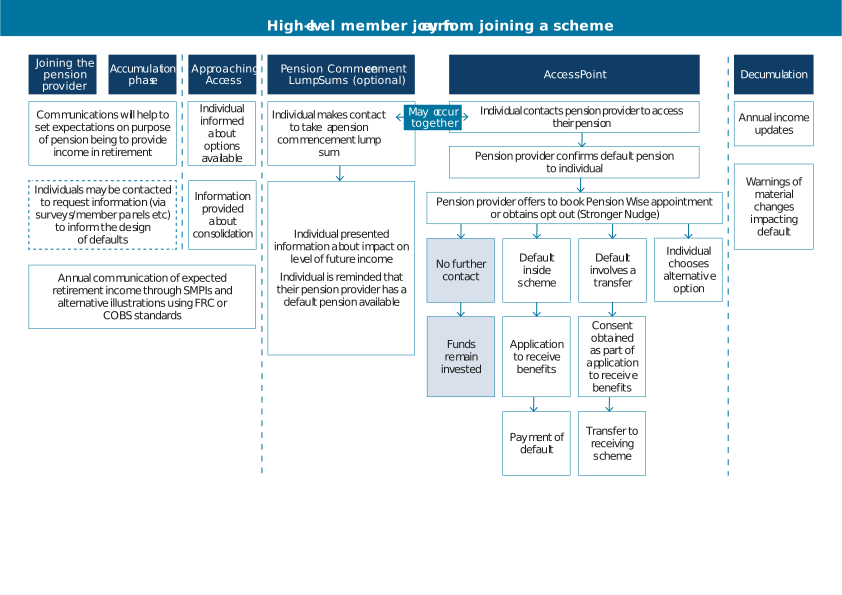
An accessible version of the high-level member journey flowchart is available on the landing page.
Joining a pension provider and the accumulation phase
Joining a scheme
5.8. We propose that pension providers should make individuals aware of the existence of default pensions when they join a pension provider. In addition to existing communications at the point of joining a pension provider, we propose that they should:
- explain that pension savings has both a paying in phase (accumulation) and a paying out phase (pension)
- explain that one or more default pensions will normally be available when benefits are accessed
- make clear that individuals remain free to choose alternative retirement options
- raise awareness of pensions dashboards so individuals can see their total pensions and consider opportunity to consolidate their pensions
5.9. For contract-based schemes, we propose that this information should be included within the key features document (KFD) provided when an individual takes out a new pension product. For trust-based schemes, it would form part of the joining communications.
Existing members
5.10. We propose that, when pension providers first become subject to the new requirements and begin offering default pensions, existing members should receive a high-level one-off communication. This should explain the availability and purpose of the default pension, when it may become relevant, where further information can be found, including how to access MoneyHelper and other support such as financial advice and, where available, targeted support.
Accumulation phase
5.11. We propose that existing annual benefit statements and other regular communications should be used to reinforce that pension saving is intended to provide an income throughout retirement. We intend to review whether changes will be needed to these communications. These annual communications should build and maintain awareness that a default pension will be available (subject to exclusions), signpost relevant guidance and support, and help individuals understand their retirement position where appropriate.
5.12. We would also see a role for these communications to provide information about consolidation.
Question 38
Do you agree that individuals should be made aware of default pensions early in their retirement journey, including when they first join a scheme? Do you also agree that existing members should receive a one-off, high-level communication about default pensions? Please provide details of any practical challenges associated with facilitating this.
Projections, illustrations and digital tools
5.13. The Financial Reporting Council’s (FRC) Actuarial Standard TM1 (AS TM1) specifies the actuarial assumptions and methods to be used in the calculation of Statutory Money Purchase Illustrations (SMPIs) provided to individuals in their annual benefit statements. The FRC is considering whether changes are necessary to AS TM1 following the introduction of guided retirement through their Call for Feedback, particularly whether SMPIs continue to be on a single standardised basis or should instead illustrate the default (where known).
5.14. The FRC is also developing standards to support consistency in the assumptions and methods used for illustrations across different retirement options and is seeking input to their policy through their discussion paper. We propose that these alternative illustrations of other decumulation options should accompany the annual benefit statement so that consumers receive consistent communications. Providers would not be prevented from providing projections outside of the annual benefit cycle, including for decumulation options, on request. Contract-based schemes would remain free to issue these using COBS 13 standards which prescribe how future pension benefits must be calculated and presented using a standardised deterministic projection methodology. Trust-based schemes should continue to use the actuarial assumptions and methods as set by the FRC.
5.15. Separately from the annual benefit statement, pension providers may provide digital tools to help individuals understand how their pension may translate into retirement income, although the government does not intend to legislate to require this. Following the FCA’s Handbook Notice 144, contract-based pension providers have greater flexibility in how they offer interactive digital pension simulations. The FCA will continue to work closely with Government and the FRC to understand the impact of changes to pensions illustrations and how these interact with the requirements in COBS 13.
Approaching access and wake-up communications
5.16. As individuals approach the point at which they may access their pension savings, they should receive more information about default pensions, while continuing to receive information about alternative decumulation options, the benefits of shopping around, and the availability of guidance and advice.
5.17. We propose to require:#
- trust-based schemes to adapt retirement-focused wake-up communications for default pensions, including both the content of those communications and the frequency with which they are provided
- contract-based schemes to adapt existing wake-up communications to provide additional information about default pensions
Timing and frequency
5.18. FCA rules already require contract-based schemes to provide Open Market Options Statements and associated material from age 50, and at five-yearly intervals thereafter until benefits are fully crystallised, as well as 4 to 6 months before an individual’s intended retirement date.[footnote 15] The statement is the core personalised communication which sets out the value of an individual’s pot and retirement options. Accompanying material sets out broader guidance and risk warnings. We propose that these communications should be updated to reflect the introduction of default pensions. We are also interested in how they may evolve more broadly, including the staggering of information provided (see paragraph 5.26).
5.19. We propose that trust-based schemes must provide retirement-focused communications from five years before an individual reaches their Normal Minimum Pension Age (NMPA), with further communications at 5 year intervals thereafter until benefits are accessed. This would be in addition to existing requirements to provide wake-up communications at 4 months before pension access.
5.20. We propose using NMPA for trust-based schemes rather than a fixed age as the trigger point. This approach would automatically adapt to changes in pension access ages, if that were to happen, and align communications more closely with the period when retirement decisions become relevant. However, this would differ from FCA’s current approach, which uses age-50 as the trigger. The age-50 trigger aligns with the point at which Pension Wise guidance generally becomes available and provides consumers with more time to understand their retirement options before accessing benefits.
5.21. We are therefore interested in views on whether retirement-focused communications should be triggered by NMPA or continue to follow an age-50 approach. The FCA also welcomes views as to whether the existing age-50 communications remain appropriate given government’s proposals to align to NMPA. We are working towards establishing a more consistent retirement communication journey across trust-based and contract-based arrangements, while building on existing requirements.
Question 39
Do you agree that trust-based schemes should be required to provide retirement-focused wake-up communications starting five years before a member reaches their Normal Minimum Pension Age (NMPA), and at five-year intervals thereafter, in addition to existing requirements to provide communications shortly before retirement? Should a similar approach be adopted for contract-based schemes?
Question 40
For trust-based schemes where we propose using NMPA as the trigger point what practical challenges, costs or implementation issues would this approach present?
Content and delivery
5.22. Wake-up communications should be clear and proportionate. They should increase awareness of default pensions without requiring members to engage with the full detail of a particular default pension before allocation has occurred.
5.23. We propose that retirement-focused wake-up communications should include, or be adapted to include where not already covered:
- an explanation that one or more default pensions are available and are intended to provide a regular income in retirement
- prominent but balanced information about default pensions with neutral information about the range of retirement options, and the retirement risk warnings, main features and benefits relevant to those options (either directly or by providing the relevant information from MoneyHelper)
- signposting to Pension Wise, MoneyHelper, regulated financial advice and targeted support where relevant
- information about how to find and review pension savings, including through pensions dashboards (and a specific signpost to the MoneyHelper Pensions Dashboard) when available
- neutral communications to consider whether they have additional pension savings and if consolidation may be relevant, with appropriate caveats about the potential risks of consolidation (see paragraph 5.27 onwards)
- an explanation that more detailed information about the individual’s specific default pension will be provided at the point of access
5.24. We propose that information about default pensions should be incorporated into existing wake-up communications and associated materials, with appropriate adjustments to their timing, frequency and content. This would build on existing communications that individuals already receive and help ensure that information about default pensions is considered alongside and complements other retirement options, guidance and risk warnings.[footnote 16]
5.25.We recognise an alternative approach would be to require a separate retirement communication focused specifically on default pensions, issued alongside existing wake-up communications. This could give greater prominence to the pre-determined retirement option but may involve additional costs and could increase the volume of information members receive at a single point in time. We therefore welcome views on whether there are circumstances in which a separate communication would be preferable.
Question 41
What changes, if any, should be made to the content and delivery of wake-up communications to support the introduction of default pensions? Should information about default pensions be provided within existing communications or through a separate communication? Please explain why.
Future development
5.26. Guided retirement provides an opportunity to consider whether current retirement-focused communications strike the right balance between providing sufficient information and supporting consumer understanding. In particular, we welcome views on the content, proposed timing (with communications either beginning at NMPA or age-50) and delivery of wake-up communications, whether all information should continue to be provided at the same point, or whether certain information would be more effective if delivered on a staggered basis throughout the lead-up to default pensions phase.
Question 42
Do you consider the information currently required in wake-up communications, together with any additional information about default pensions, is appropriate and strikes the right balance between providing sufficient information and supporting member understanding? How should these communications evolve in future?
Consolidation messaging
5.27. Default pensions will be provided on an individual pot basis. We recognise that many people accumulate multiple pension pots over the course of their working lives. As a result, an individual may have several pension pots across different schemes and could receive different default pension suggestions in relation to each pot.
5.28. Having pension savings spread across multiple pension pots and pension providers may make it difficult for some individuals to understand how their pension savings could work together to support their retirement income.
5.29.To support informed decision-making, we are proposing pension providers must include factual and neutral consolidation messaging with a guidance journey within wake-up packs (like when an individual is in the ‘approaching access’ phase). This is not to encourage consolidation or imply that it is appropriate in all circumstances. Rather, it will help encourage individuals to consider their overall pension position before making retirement decisions. This will be supported by the introduction of pensions dashboards.
5.30. We propose that these communications should set out that:
- consolidating pensions could give an individual a single default pension plan which may be more straightforward to manage and understand than holding multiple pots with separate default arrangements
- consolidating pensions is an important decision with long-term financial implications
- not all pensions are the same, and valuable benefits or features may be lost upon consolidation
- consumers should carefully consider the costs, charges, investment options and retirement income features of different schemes before deciding to consolidate
5.31. Pension providers will also be expected to explain that default pensions are offered on a single-pot basis. If the individual does choose to consolidate their pension following this suite of information, the provider into which the pension is consolidated would be responsible for providing the default pension.
Question 43
What practical or operational considerations should be taken into account when pension providers are required to provide factual and neutral consolidation communications? At what stage(s) of the retirement journey should these communications be provided?
Pension commencement lump sums
Timing of information
5.32. We recognise that many individuals choose to access some of their pension savings through a PCLS. This can be a key engagement moment for individuals who may not yet be ready to start receiving a regular retirement income, but who are taking an action that may materially affect their future income. The Pensions Commission’s interim report found that maximising tax-free cash lump sums is increasingly viewed as a normal course of action.[footnote 17] Since 2015, most individuals (84%) accessing a DC pension have taken a lump sum from at least one pension.[footnote 18] In savers’ minds, the decision to take tax-free cash has become decoupled from the wider decisions about how their pension savings will support them through retirement.
5.33. Where an individual takes a PCLS but does not want to proceed to take a regular income, we propose that pension providers must inform the individual of the availability of a default pension but would not be required to go into specific details of the default pension at this stage. The requirement to provide a specific default pension would still apply when the individual subsequently requests to access pension benefits.
5.34. However, pension providers would remain free to allocate individuals to a default at an earlier stage where they wish to do so. For example, we are aware that where the individual would later be allocated to a Retirement Collective Pension Scheme (RCPS) default (where there is no drawdown facility), the PCLS must be taken from the RCPS. As such, pension providers will need to present the default pension at the point the member requests a PCLS, as the PCLS will need to be paid out of the RCPS to prevent this being an unauthorised payment.
5.35. As default pensions are expected to be the primary route into RCPS, we will continue to consider how the member journey and associated rules and regulations interact with the communication and disclosure requirements proposed in the RCPS Regulations Consultation.
Information about the effect of taking PCLS on future income
5.36. Evidence suggests that many people understand they can take a PCLS but have a less clear understanding of the consequences this may have on their future retirement income.[footnote 19] We are concerned that some individuals may access their pension savings without fully understanding how doing so could materially reduce the income available to them in retirement, particularly where the focus is on immediate access to cash rather than longer term retirement needs. This risk may be particularly acute for individuals with smaller pension pots, who may have less capacity to absorb reductions in future retirement income.
5.37. We are therefore proposing a new requirement that pension providers must explain the potential impact of taking a PCLS. The aim would not necessarily be to discourage a withdrawal, but to make the trade-off clear that money taken as a lump sum may reduce the income available later in retirement or, where relevant, take them below the threshold for protection against longevity risk in their default pension. This could be achieved through illustrations or examples. We propose to require these illustrations for trust-based schemes to be calculated using actuarial assumptions and methods as set out by the FRC. We propose that contract-based schemes calculate these impacts using COBS 13 rules for illustrations, acknowledging this may require amendments to the rules.
Question 44
What challenges or practical considerations would pension providers face in implementing the proposed communications for members taking a PCLS, including information about the availability of a default pension and the impact that taking a PCLS may have on future retirement income?
Communications at the point of access: presenting the default pension
5.38. We propose that eligible individuals should be presented with a default pension as the pre-selected retirement option when they access their pension benefits, except where they are making a standalone decision to take PCLS (as above). Individuals would retain the ability to choose an alternative decumulation option and to access other forms of support such as advice, or targeted support where relevant, which may lead to a different decision. This would take place after any information gathering of any additional information to allocate the individual to their respective default. Information about the default pension should be provided in a format that individuals can retain and refer to if needed in the future.
5.39. At the point of access, individuals would be presented with the default they have been assigned to, including information to help them understand the income they will receive throughout retirement (to the extent that it can). For contract-based schemes, we would expect to leverage the Consumer Duty to underpin these requirements, although firms may choose to meet them in practice through existing disclosures such as the KFD and key features illustration (KFI). For trust-based schemes, we would expect trustees’ fiduciary duties and existing governance framework to play an equivalent role to the Consumer Duty in underpinning these requirements. We will consider whether existing disclosure, communication and risk-warning requirements can be used or adapted to deliver them in practice.
5.40. For trust-based schemes, such a presentation would differ from illustrations prepared on a standardised basis set by the FRC. The existing legislation allows for the requirement to provide annual SMPIs to stop 2 years from the normal retirement age, though if providers choose to provide illustrations within 2 years of normal retirement age, they are required to follow the FRC standards.
5.41. Where an individual indicates that they do not wish to proceed with their initially allocated default pension, and the provider subsequently allocates them to an alternative pension in accordance with the process proposed in Chapter 3, the provider should explain the alternative in the same way as the initial default, including the characteristics and circumstances of the cohort for which it has been designed.
Communicating the default pension
5.42. Individuals should receive sufficient information to understand the default pension they have been allocated to and decide whether they wish to proceed. However, providers should also seek to avoid overwhelming individuals with excessive information and should carefully consider how to balance these considerations when designing their communications. Consumer testing undertaken for targeted support assessed the impact of providing key information to individuals alongside a suggested course of action. This included explaining that the suggestion was not personalised and setting out the data used to segment consumers. The findings showed that this improved consumers’ overall understanding, recall of information and confidence in their decision-making, including in decumulation scenarios.[footnote 20]
5.43. We propose that pension providers should clearly explain:
- how the default operates, including:
- the underlying products, strategies or different phases, and whether the default includes irreversible features relating to longevity protected income and what they are
- where the default pension includes a transition to a fixed-income phase, the value of committing to that phase in advance, including the greater certainty it can provide about income in later life and protection against the risk of pension savings running out
- the principal benefits the provider expects the default pension to deliver, such as any benefits arising from collective risk sharing, scheme-level purchasing or economies of scale
- the expected initial income or payment the individual would receive, where a quotation can be provided, and how that income may change
- the pre-designed parameters of the pension (see Chapter 3)
- where applicable, if the receipt of the default is contingent on the member providing consent to a transfer to another scheme
- relevant cancellation rights, cooling-off periods and potential tax implications
- who it is designed for, including:
- the characteristics, or circumstances, or both, of the cohort for which it is designed. This applies irrespective of whether the consumer is allocated to a single default pension or assigned to one of multiple default pensions. The characteristics and/or circumstances of the cohort (or ‘common characteristics’ in FCA terminology) should be communicated at a group-level rather than playing back an individual’s response to any allocation question.
- that the default is not specific to the individual
- that the default is not based on a comprehensive consideration of the individual’s characteristics or circumstances
- that the default pension is provided on a single pot basis
- where the default pension may not be right for some individuals, for example where an individual has reduced life expectancy or complex wider circumstances, unless it is designed for a cohort with these characteristics
- reaffirm that the individual has the freedom to do something different, including:
- the alternative options made available by the provider and an explanation that other options may be available elsewhere
- signposting to relevant guidance (such as through MoneyHelper) and to regulated financial advice, including informing them that information about the types of support that may be available can be accessed on the Money Helper website
- explain the nature and purpose of Pension Wise and to offer to book a Pension Wise appointment for a non-advised individual
5.44. The requirements, and specific disclosures regarding who the default is designed for, largely replicate the disclosure requirements used for targeted support.
5.45. Existing disclosures and retirement risk warnings could be used to deliver much of the additional information. For contract-based schemes, we propose many of the additional requirements set out above, aside from the specific presentation of the allocated default pension, could be delivered through enhancements to KFD, KFI and retirement risk warnings.
5.46. There is a limitation of the existing KFD framework as a mechanism for providing this information. Where individuals do not enter a new product but instead move into a different phase of their existing pension, such as drawdown, there is generally no requirement to provide a KFD. As a result, the FCA is proposing to extend the circumstances in which a KFD must be provided to include entry into a default pension arrangement at the point benefits are accessed, where a KFD would otherwise not be required. This would help ensure the relevant information is provided to individuals with appropriate prominence at the point a decision is made. For trust-based schemes, equivalent disclosure and risk-warning requirements may need to be adapted.
5.47. An overly prescriptive approach could limit providers’ ability to communicate in a way that best supports consumer understanding. We therefore propose to prescribe only the core information that must be disclosed at the point of access (see paragraph 5.43), while allowing flexibility in how that information is presented. This approach ensures consistency of information while allowing providers freedom to produce engaging, consumer-centric communications that best support consumer understanding based on their knowledge of their clients. Providers would remain free to provide additional information outside of these documents where they consider it would support member understanding. This would align the disclosure requirements with the flexible approach being taken across other FCA retail investment reforms, where research has found that most consumers find standardised, templated documents like the Key Information Document unengaging.[footnote 21]
5.48. The core information reflects what we consider consumers may need at the point of access to make an informed decision. However, we welcome views on whether these disclosures strike the right balance between supporting informed decision-making and avoiding information overload. We recognise that too much information at a key decision point may reduce engagement or make it harder for individuals to identify the most relevant risk factors. We are therefore interested in respondents’ views on whether any of the proposed disclosures are unnecessary or could be simplified.
5.49. We propose that information about the default pension is provided in a format that can be referred back to, such as a letter, email or PDF that can be stored and accessed in a permanent form (a ‘durable medium’ in FCA terminology). This approach helps to ensure the individual can review and consider the information at a time and pace that suits their needs.
Testing disclosures
5.50. We will also expect pension providers to test key disclosures to ensure that they support member understanding, particularly at the point of access and at other key points, for example when members move to irreversible phases within a default pension. This testing would be similar to the FCA’s requirement under the targeted support framework for pension providers to test disclosures for consumer understanding.
Question 45
Do you agree with the information, caveats and risk warnings that pension providers will be required to provide at the point of access before a member proceeds with a default pension? Do they strike the right balance between supporting informed decision-making and avoiding information overload? Please identify any disclosures that could be simplified or removed.
Question 46
What practical considerations should be taken into account when designing and delivering retirement-focused communications? In your view, which communication methods and channels are most likely to engage members effectively, and what metrics or measures could be used to assess whether these communications are achieving their intended objectives?
FCA retirement risk warnings and annuity prompt rules
The FCA is considering how default pensions should operate in line with other communication requirements in COBS 19, including retirement risk warnings and annuity prompt rules.
We believe risk warnings will continue to be important for default pensions and may need to be adapted to reflect the specific features and risks of these arrangements. This is because there is already overlap between risk warnings and the matters relevant to default pensions, such as whether the consumer has shopped around or taken consideration of their health. We recognise that retirement risk warnings should strike an appropriate balance between highlighting relevant risks and preserving the role of the default pension as a retirement solution which is generally appropriate for cohorts of individuals.
Under the current COBS 19.7 rules, firms need to identify the risk factors relevant to default pensions, prepare questions for individuals, and provide the relevant retirement risk warnings based on the answers to those questions. Under the targeted support framework, firms can use the answers to these questions for the purpose of aligning an individual with a consumer segment. We are interested in views on how these rules can align with default pensions.
The FCA annuity comparison rules in COBS 19.9 may be harder to integrate into default pensions. These rules require firms to provide consumers with information comparing annuity quotes with market leading quotes. Firms also need to take reasonable steps to determine whether the client is eligible for an enhanced annuity. While these provide important consumer protections and encourage shopping around to get the best deal, we recognise the inconsistency with the aim of simplified decision making under guided retirement. Rather than providing this information in relation to annuities included within a default pension, it may be more appropriate to put the onus on providers to ensure that their solutions offer fair value. We are interested in views on whether elements of our annuity comparison rules can be used in the context of default pensions.
Question 47
For contract-based schemes, do you have any views on the interaction between guided retirement and other retirement-related requirements in our rules, including annual statements following pension access (COBS 16.6), retirement risk warnings and annuity prompt rules? More generally, are there any areas of FCA rules in relation to the retirement journey that could be streamlined or simplified?
Interaction with existing requirements - Stronger Nudge and Pension Wise
5.51. Guided retirement is intended to build on existing member communication and consumer protection requirements. We recognise, however, that the introduction of a default pension raises questions about how the Stronger Nudge to Pension Wise Guidance regulations should operate alongside a journey designed to provide individuals with a straightforward route into a suitable retirement income solution.
Sequencing the Stronger Nudge for a non-advised journey
5.52. Under the current framework, when a non-advised individual decides to access their pension savings, a pension provider must give a Stronger Nudge to Pension Wise guidance and offer to book a Pension Wise appointment.
5.53. Utilising the current requirements, pension providers would explain the individual’s allocated default pension following any allocation exercise and provide information about that default pension in a format that can be retained for future reference before delivering the Stronger Nudge and offering a Pension Wise appointment. This means an individual would only be able to proceed with accessing their pension savings once they had either received Pension Wise or opted out in accordance with the current relevant legislative requirements. For trust-based schemes, this includes the requirement in regulation 18C of the Occupational and Personal Pension Schemes (Disclosure of Information) Regulations 2013 for the opt-out to be given in a communication made solely for the purpose of opting out of receiving appropriate pensions guidance, commonly known as the ‘enhanced opt-out’.
5.54. Applying the current Stronger Nudge framework in this way could help ensure that individuals who choose to take up a Pension Wise appointment receive guidance after they have been given information about the default pension available to them, enabling them to reflect on that option before proceeding. Pension Wise guidance would not determine whether a specific default pension is appropriate for a particular individual, or provide granular product advice, but could help individuals better understand their options and what is right for them before proceeding. This approach would recognise that individuals will still have the option to make other choices and could give individuals greater confidence in their allocated default pension.
5.55. This may be particularly valuable where an individual has multiple pension pots and is presented with different default pension options by different providers. Pension Wise could help such individuals understand the key features of those options and consider the pros and cons of consolidating their pension savings into a particular provider before taking benefits. We recognise that this would require updates to Pension Wise guidance to support these discussions and consumer testing.
5.56. However, guided retirement is intended to provide a straightforward route into a default pension for individuals who do not wish to make complex decisions themselves. Requiring individuals to complete the existing Stronger Nudge process before entering a default pension could introduce additional friction into the journey which may not fully align with the objective of creating a simpler and more streamlined route into receiving a default pension. Altering the role of Stronger Nudge, however, may reduce the impact that Pension Wise guidance currently plays in helping people understand their options under Pension Freedoms, before an individual begins taking their pension benefits.
5.57. We are interested in and welcome stakeholder views on how the Stronger Nudge requirements should operate in the context of guided retirement.
Question 48
Are you content with how the existing Stronger Nudge to Pension Guidance requirements would apply within a guided retirement journey? Can you identify possible issues if the current regime continued to operate in the same way alongside the default pensions regime? Would you suggest alternative approaches?
Investment pathways
The FCA is considering the interaction between Investment Pathways and guided retirement. Investment Pathways were introduced following the FCA’s Retirement Outcomes Review, which found that many consumers accessing pension savings were moving into drawdown after accessing a PCLS and not engaging with subsequent investment decisions – often remaining in cash or cash-like assets. Investment Pathways were designed to provide non-advised consumers with a ready-made investment solution aligned to a broad retirement objective over a 5 year time horizon.
We want the member journey to work well for individuals with the introduction of guided retirement, which will be the core offer for eligible individuals at retirement. The requirement to present a specific default pension applies at the time when an individual wants to take a regular income, although providers can offer it from the point of taking a PCLS. We want to ensure that situations where individuals inadvertently ‘sit’ in cash or invest in cash-like assets are minimised. Therefore, we are interested in feedback on the utility of retaining Investment Pathways, or they could be replaced by the introduction of default pensions for workplace contract-based schemes. We are interested in understanding how pension providers would manage investment decisions on behalf of individuals when they approach this stage of the journey, as part of their default pension offering.
Investment Pathways will continue to play an important role for individuals that are not eligible for default pensions and individuals in contract-based schemes out of scope of guided retirement, as well as where individuals choose to do something different to their default pension. Beyond the specific considerations for guided retirement above, we are interested in whether the current Investment Pathways rules, including the restriction of investment strategies to four pathway options and the presentation requirements, are working as intended and whether there are any changes that could lead to better outcomes for individuals.
COBS 16 requirements after an individual takes a PCLS
The FCA is also considering whether the requirements for annual statements after accessing a pension (COBS 16.6) should better reflect the circumstances of different groups. For example, individuals who have taken a PCLS and designated funds to drawdown, but have not yet started regular withdrawals, may require different information from those already withdrawing an income. Where an individual is not withdrawing a regular income, a simpler communication may better support their understanding, for example if it focused on remaining fund value, investment performance, reference to the availability of the default pension, and signposting to support when making future retirement income decisions.
Question 49
Do Investment Pathways still have a role to play given the introduction of default pensions for workplace contract-based schemes? How do pension providers expect to manage investment decisions on behalf of individuals after they take a PCLS?
Question 50
Are there wider changes to Investment Pathways and/or COBS 16 which would improve outcomes for individuals?
Communications during pension phase
5.58. Communications should continue after an individual has started receiving their pension payments. An individual’s circumstances, needs and preferences may change over the course of retirement, relevant products could evolve with new innovations, and ongoing information can help them assess whether the default remains appropriate for their situation. Contract-based schemes are also subject to existing obligations under the Consumer Duty and PROD. Regular communications can support individuals in understanding how their retirement solution is operating and any changes that may affect their income.
Ongoing pension phase communications
5.59. We propose that pension providers should provide ongoing communications to individuals within a default pension. These communications should explain:
- a reminder of the characteristics or circumstances, or both, of the cohort they have been allocated to
- income they are receiving and how it may change over time
- the remaining funds where relevant, including where different funds have been established for different purposes (such as flex and/then fix or discretionary spending)
- any change that would affect the default pension, such as a reduction in income level, a change in risk profile or a significant change in investment strategy
- the implications of acting outside the parameters of the default pension
- what guidance or advice is available if they are considering a change
5.60. Individuals with an annuity or an RCPS will already be informed of their income each year, and they will not be required to undertake any further decision making.
5.61. For contract-based schemes, we propose that these ongoing communications can be set out in the annual statement (COBS 16.6), with much of this information already required. These communications already prompt consumers to review their withdrawal decisions and assess whether their circumstances or retirement objectives have changed. We consider many of these requirements equally relevant to individuals within a default pension and that some changes may be needed to reflect a regime intended to provide a sustainable long-term retirement income.
Additional withdrawals
5.62. We propose that default pensions will have pre-designed parameters which determine how much flexibility an individual has within a default pension (see Chapter 3). We anticipate that some default pensions may have discretionary spending pots built into their design, and others may use managed drawdown, where the member can only make additional withdrawals within the parameters set by the provider, for part of the retirement income.
5.63. Where an individual makes significant additional withdrawals within the parameters set by the default pension, which is not from a separate discretionary spending pot, we propose that they receive a specific communication about the potential impact this could have on their retirement income in the future. Pension providers will need to provide this before the withdrawal is paid out.
5.64. Where an individual requests to make an additional withdrawal which would take them outside of the parameters, we propose that before the withdrawal can take place, the pension provider must provide a warning to the individual that this will take them out of the default pension they are currently allocated to. Pension providers would be expected to seek to reallocate individuals where possible (with their consent), using the same pre-designed allocation process (see Chapter 3). We recognise that this may not be possible where individuals have depleted their pot beyond the threshold level. In such circumstances, we would expect pension providers to signpost individuals to other relevant support. We welcome feedback on this proposal.
Question 51
Do you agree that individuals will require ongoing communications during the pension phase, both regular and event driven? In what other scenarios might warnings be needed?
Different phases in default pensions
5.65. Some default pensions, such as flex then fix approaches, will include different phases, including moving to different underlying products or being transferred to a retirement collective pension section within the overall default pension package. As we set out in Chapter 3, individuals would consent to the entire default pension at the point they enter into it. This means they have already provided their consent to move into any future phases later in retirement. However, we think it is important that individuals can review their circumstances and, if they wish, choose another option (where possible). Therefore, we propose that pension providers should, on a best endeavours basis, provide specific communications in a timely manner before any transition to different phases in a default pension.
5.66. We propose these communications must:
- explain any expected changes to the individual’s income
- explain the nature of the irreversible or restricted phase, including any applicable cooling-off period
- outline the alternative retirement options available
- restate the characteristics or circumstances of the cohort for which the default was assessed as being appropriate for and provide individuals an opportunity to consider whether circumstances have changed since allocation
- prompt the individual to notify them if their circumstances have changed prior to the transition
- signpost to relevant guidance (like MoneyHelper), including Pension Wise and to regulated financial advice, and targeted support where relevant
- where relevant, explain that the individual could obtain a better annuity rate on the open market, and how they could shop around for this
5.67. As set out in Chapter 3, pension providers cannot rely on engagement from individuals in later life to provide protection against longevity risk and discharge their obligations (for example, journeys could not require individuals to be referred to an annuity brokerage or purchase their own annuity). However, where additional information could improve outcomes for individuals, for example by enabling access to enhanced annuity rates, pension providers should continue to try to engage individuals about those opportunities before they move into an irreversible phase.
Question 52
Should any additional communications, beyond what is set out in the consultation, be required for individuals moving into an irreversible phase of a default pension?
Transitional communications for members already in drawdown
5.68. We propose that schemes introducing default pensions must provide transitional communications for members who are already in drawdown or otherwise outside the new default pension framework.
5.69. These communications would make members aware that new approaches to decumulation are being developed by the scheme, signpost where further information can be found, and explain how they may be able to move into a default pension.
Question 53
What challenges and practical considerations would pension providers face when communicating with individuals who are already in drawdown or otherwise outside a new default pension?
Annual statements and sustainability warnings in retirement
5.70. Contract-based schemes already issue annual statements in decumulation that allow individuals to review decumulation decisions.
5.71. We are considering whether to introduce a requirement for trust-based schemes to provide annual statements in the pensions phase (decumulation). Such statements could help individuals understand their current pension income, remaining fund value where relevant, and the sustainability of their pension arrangements. The intention would be to improve individual understanding while preserving freedom of choice.
5.72. Individuals in a RCPS will already receive an annual communication informing members of their income and benefit adjustment for the coming year.[footnote 22]
5.73. The government wants schemes to do more to help members inside and outside default pensions understand their likely future income levels, and we think there could be value to all pensioner members receiving illustrations of future income.
5.74. The government proposes to require trust-based schemes to provide statements to all members in drawdown (whether they are in a default pension or not), including individuals that have only taken a PCLS and not making regular withdrawals. We propose illustrations of sustainability, or of how income in decumulation may vary, to be calculated using the actuarial method and assumptions set out by the FRC for trust-based schemes.
5.75. The government also intends to require pension providers to provide sustainability warnings where withdrawals appear unsustainable or where savings may be depleted more quickly than expected. These warnings could be provided alongside annual benefit statements or, where appropriate, through separate communications. The government is interested in views on the practical implementation of these requirements.
5.76. The government will continue to consider the FCA’s existing annual drawdown statement requirements and the standard which the FRC is developing for trust-based schemes. The FRC is seeking input to their policy through their discussion paper.
Question 54
Should annual benefit statements be mandatory in decumulation for all trust-based schemes, in addition to requirements to provide sustainability warnings, and should these measures apply wider than members in default pensions?
Question 55
Taking the member journey as a whole what practical challenges, costs or implementation issues could arise when introducing the proposed pension communication journey (joining a pension scheme, accumulation, approaching access, accessing a PCLS, the point of access, and the decumulation phase)?
Interaction with Privacy and Electronic Communications Regulations (PECR) and direct marketing rules
5.77. The government have engaged with the ICO to understand how guided retirement will interact with direct marketing rules, and we do not expect direct marketing rules to materially prevent the delivery of guided retirement communications. As per ICO guidance[footnote 23], a message that is neutral in tone and does not contain active promotion or encouragement for an individual to take a particular action is unlikely to be direct marketing. A message that actively promotes an initiative by highlighting its benefits and encouraging an individual to participate or take a particular course of action is likely to be direct marketing.
5.78. We understand that some industry groups and providers have raised concerns in this area, we welcome views on any practical difficulties or areas of uncertainty on whether this approach is workable in practice and any circumstances where a required guided retirement communication could be regarded as direct marketing. We will continue to engage with the ICO as we progress this work.
Question 56
Do you agree with the government’s initial position that guided retirement communications can be constructed so they do not constitute direct marketing for PECR purposes? If not, please provide examples of communications that would be difficult to deliver on that basis.
Question 57
Are there existing disclosure or communication requirements which should be simplified, aligned or consolidated alongside the introduction of guided retirement?
Summary of guided retirement communication requirements
| Stage of the Journey | Comms information | Trust-based | Contract-based |
|---|---|---|---|
| Joining a Pension Scheme Existing members |
Providers should inform individuals of the existence of default pensions upon joining a pension provider and that there is a paying out phase Existing members should receive a high-level one-off communication. This should explain the availability and purpose of the default pension |
Existing – Form part of joining communications New – One-off high-level communication |
Existing – Form part of the KFD on taking out a new product New – One-off high-level communication |
| Accumulation | Existing ABS and regular comms should be used to emphasise that pension saving is intended to provide an income, and a default pension will be available | Existing – Included within ABS alongside SMPI projections Additional/alternative illustrations to be based on actuarial and method assumptions as outlined by the FRC |
Existing – Included within ABS alongside SMPI projections Alternative illustrations within the ABS cycle to be based on actuarial and method assumptions as outlined by the FRC Additional illustrations to be based on COBS 13 requirements |
| Approaching Access | Upon approaching access, consumers should receive further information about default pensions while continuing to receive information about alternative decumulation options | New – Introduce more frequent and comprehensive wake-up packs which cover default pensions | Existing – Adapt existing wake-up packs to include default pensions |
| Pension Commencement Lump Sums | Pension providers must explain the potential impact of taking a PCLS. Not to discourage consumers but to highlight the clear trade off when withdrawing the lump sum amount | New – Illustrations required to be calculated using actuarial and method assumptions as outlined by the FRC. | New – Illustrations or guidance in line with COBS 13 requirements |
| Point of Access | Individuals would be presented with the default they have been assigned, including how the default operates, who it is designed for and alternative options | New/Existing – New default presentation, amend existing disclosures | New/Existing – New default presentation, amend KFD, KFI and retirement risk warnings |
| Pension (Decumulation) | Schemes must provide annual income updates, with sustainability indicators in respect of the remaining funds, guidance on the implications associated with deviating from default parameters and guidance on how to adjust or opt out of said default scheme | New – Introduce annual statements in decumulation that allow individuals to review decumulation decisions, using FRC illustrations. New communications during different phases, or additional withdrawals | Existing/New – Amend annual income statements under COBS 16. New communications during different phases, or additional withdrawals |
6. Governance
6.1. Governance requirements (including conduct and product governance standards in the context of FCA rules) should support the development and oversight of high-quality default pensions that take into account the needs and interests of the membership and deliver good outcomes for members. They should ensure transparency and accountability for decisions made by pension providers and that default pensions continue to be appropriate for members.
6.2. We want to build on existing governance frameworks in trust and contract-based schemes. We recognise that guided retirement represents a significant step change in the role of pension providers at retirement. It will involve providers taking more responsibility for designing, identifying and overseeing retirement solutions for members. This will place greater demands on governance, oversight and decision-making. For trust-based schemes, a key additional requirement is the Pension Benefits Strategy which will provide a framework for trustees to set out how they have approached these responsibilities. Our aim is to avoid being overly prescriptive and to give schemes sufficient flexibility to meet these requirements.
6.3. We want to achieve corresponding governance outcomes across the trust and contract-based markets, while recognising that the frameworks for achieving these outcomes will differ. This chapter sets out our proposals for how our governance aims could be delivered within the trust-based and contract-based markets respectively. In discussing the contract-based market, we may use terminology drawn directly from FCA rules, which may differ from language used elsewhere in the consultation.
6.4. The new responsibilities introduced through guided retirement will sit within the wider framework of trustee governance. The government will respond shortly to the trusteeship and governance consultation, which considers how governance arrangements can be strengthened as the pensions landscape evolves. This includes the skills and capabilities trustee boards need to support effective and independent decision-making.
Designing or identifying default pensions
6.5. Pension providers will be required to understand the needs and interests of their membership and design or identify default pensions that take account of those needs and interests. They must also meet the requirements and design considerations set out in Chapter 3.
6.6. To support this, pension providers should be able to evidence the basis for their decisions and demonstrate how the default pensions they have designed or identified reflect the needs and interests of their membership. This includes being able to evidence that any assumptions made, for example about life expectancy, are reasonable and data/information sources used are appropriate. The framework for doing this will differ between trust and contract-based schemes due to the difference in existing requirements across the market.
6.7. Where the design of a default pension relies on economies of scale, collective risk sharing or scheme-level purchasing to improve member outcomes, pension providers should be able to evidence the expected benefit and monitor whether it is being reflected in the income, value and outcomes experienced by members.
Trust-based Schemes: Requirement to produce a Pension Benefits Strategy
6.8. Trustees will continue to make decisions about default pensions within their existing fiduciary duties and governance requirements. These are wide ranging and are set out across trust law, pensions legislation, individual scheme rules and TPR’s General Code of Practice.
6.9. As pension schemes become larger, more complex and increasingly systemically important, trustee boards will need to have the right balance of skills, experience and perspectives to support effective decision-making. This includes the knowledge and understanding needed alongside independence, challenge and sound judgement. These will be important when trustees make decisions about default pensions.
6.10. The Pension Benefits Strategy provides a mechanism for trustees or managers to document the evidence underpinning their decisions and the rationale for them and for this to be disclosed to TPR. This will help trustees demonstrate how they have applied their existing duties and the requirements of guided retirement when making decisions about default pensions, and support TPR’s monitoring of compliance. DWP and TPR will consider how lessons learned from the FCA conduct approach can influence the oversight of the Pension Benefits Strategies going forward.
Proposals for the Pension Benefits Strategy
6.11. The Act requires trustees or managers to determine, review and revise a Pension Benefits Strategy. The strategy must set out how they will:
- identify and carry out the steps needed to understand the needs of eligible members
- design or identify default pensions that take account of those needs
- communicate effectively with eligible members about their default pension
6.12. We propose to require trustees or managers to publish alongside the Pension Benefits Strategy evidence as to how they have taken account of the design considerations for their default pension(s) set out in Chapter 3.
6.13. We also propose that trustees or managers should publish alongside the Pension Benefits Strategy evidence about their membership and explain how this has informed the design or identification of their default pension(s), and why they consider the default pension(s) appropriate for their members.
6.14. Where trustees or managers identify different cohorts within their membership, we propose to require them to publish alongside the Pension Benefits Strategy material explaining how those cohorts were identified and how their needs informed the design or identification of the relevant default pension(s).
Format
6.15. The Act provides powers to determine the format in which the Pensions Benefit Strategy must be set out, and for this function to be delegated to TPR. We propose to delegate this function to TPR. Delegating this function to TPR would allow it to consider whether a specified format is needed for consistency and comparability. This would also enable TPR to make updates, if needed, based on experience of how schemes implement guided retirement.
How the Pension Benefits Strategy will be used
6.16. The Pension Benefits Strategy will support TPR’s monitoring of trust-based schemes’ compliance with guided retirement requirements. The information in the Pension Benefits Strategy may also support the evaluation of guided retirement, including its impact on member outcomes.
6.17. Published strategies may help providers compare default pensions when identifying suitable transfer arrangements.
TPR guidance
6.18. We propose to require trust-based schemes to take account of guidance issued by TPR when determining or revising their Pension Benefits Strategy.
6.19. Any such guidance may provide further detail on the types of evidence trustees or managers could use to evidence the decisions they have made when designing or identifying default(s). It may also provide further detail on how TPR’s existing governance expectations apply to guided retirement.
6.20. As default pensions are implemented and our understanding of what is important to members, pension providers and other interested parties grows we will look to keep the requirements under review and amend accordingly.
Publishing the Pension Benefits Strategy
6.21. The Act requires trustees or managers to publish their Pension Benefits Strategy and provide a copy on request to TPR or any member.
6.22.The Pension Benefits Strategy is not intended to be the main source of information for members about their default pension. However, members who want to engage with the strategy should be able to understand it.
6.23. We therefore propose to require trust-based schemes to produce a summary of the Pension Benefits Strategy as part of the full strategy document. Existing expectations for member communications will be relevant to how schemes produce the summary, including expectations that communications are clear, concise, relevant and in plain English and are regularly reviewed taking account of member feedback.
Question 58
Do you agree with our proposal to not prescribe the format or level of detail of the Pension Benefits Strategy for trust-based schemes?
Question 59
What information should be included in the summary of the Pension Benefits Strategy to help members understand the default pension(s) available within their scheme?
Contract-based schemes: Product governance rules
6.24. While the Pension Benefits Strategy will be a public-facing governance document evidencing how trust-based schemes have designed or identified appropriate default pensions, the FCA is proposing to leverage its well-established product governance framework to achieve corresponding outcomes, recognising that contract-based schemes are not generally required to publish their product governance records.
6.25. Default pensions are likely to consist of a combination of products and services that work together to support members throughout retirement. Under the FCA’s existing rules, there are extensive requirements for firms that manufacture products and services. These include, but are not limited to, identifying a target market, designing products and services to meet the needs, characteristics and objectives of that target market, and maintaining, operating, and reviewing an approval process for all new products and services. In the context of guided retirement, the FCA considers that these requirements should apply both to the individual products and services that form part of the default pension and to the design and operation of the default pension as a whole.
6.26. Firms are also required to maintain appropriate records of their product governance processes. This includes any key decisions taken in relation to product design, monitoring and distribution. As such, firms should be able to demonstrate the rationale behind their default pension(s), as they are required to do under the Pension Benefits Strategy. Where a default pension involves a transfer, and the firm is not the manufacturer of the product or service provided as part of the default pension, the principal scheme should still be able to demonstrate the rationale and how members’ needs and interests are met.
6.27. We recognise that the FCA governance framework differs in form from the Pension Benefits Strategy. But the FCA considers that there is a strong case for leveraging the existing PROD and Consumer Duty framework as the primary governance framework for guided retirement in contract-based schemes, rather than introducing additional requirements specifying a Pension Benefits Strategy equivalent for contract-based schemes.
6.28. While relying on existing FCA rules would not require firms to publish any internal governance documents, they do not prohibit firms from doing so. Therefore, if a firm wanted to publish information about its product governance, for example for the purposes of marketing their default pension(s) to pension providers exploring transfer options, it may do so.
6.29. As set out above, the government has proposed to require trust-based schemes to produce a summary of their Pension Benefits Strategy for the purposes of giving individuals the opportunity to understand more about the steps pension providers have taken when designing or identifying their default pensions. The FCA will consider introducing an equivalent requirement for contract-based schemes, summarising how default pensions have been designed or identified for the purpose of consumer understanding. Any additional requirements would sit alongside existing rules on consumer understanding, such as PRIN 2A.5 of the Consumer Duty.
Question 60
Do you agree that the FCA’s existing product governance rules can be leveraged to achieve corresponding outcomes to the Pension Benefits Strategy for contract-based schemes? Should the FCA require firms to publish a consumer-facing document summarising how default pensions have been designed or identified?
Monitoring and review of default pensions
6.30. It is important that pension providers monitor and regularly review their default pension and the evidence on which its design or identification is based, to ensure it continues to meet the needs of members. Pension providers should keep this evidence up to date and take account of changes in their membership or wider circumstances.
6.31. To support effective monitoring, pension providers should have appropriate oversight of the operation and performance of their default pensions. Providers should also monitor the outcomes being experienced by members and be able to identify where they differ from those expected.
6.32. Where evidence gathered through monitoring indicates that members’ needs, interests, or outcomes have changed, or there are market developments or innovations that increase the default options available to members, we propose that pension providers should review whether the default pension remains appropriate for the pre-defined cohort. Where monitoring does not indicate a relevant change, pension providers should continue to review their default pension regularly. Reviews should consider the scheme’s membership or the relevant cohorts, rather than assessing suitability for individual members. These requirements will be forward-looking rather than retrospective, ensuring the default pension remains suitable for members at the point of allocation, rather than requiring an ongoing suitability assessment of individuals that are already receiving the default pension. This is separate to our proposed requirement in paragraphs 3.74-3.75 where a pension provider is directly informed by an individual that their circumstances have changed.
Where a default is provided through a transfer, the principal scheme remains responsible for ensuring that the qualifying default pension continues to be appropriate for future cohorts of transferable members (consistent with Chapter 4). The receiving scheme will be responsible for monitoring and reviewing the default pension it provides and for sharing information with the principal scheme to support its review of the qualifying default pension.
Trust-based schemes
6.33. For trust-based schemes this ongoing oversight will sit within the existing governance framework. TPR’s General Code provides that systems of governance should provide governing bodies with oversight of the day-to-day operations of the scheme, including delegated activities for which they remain accountable. The Code also sets expectations for systems and arrangements for monitoring the administration and management of the scheme.
6.34. The review requirements set out below are intended to sit alongside rather than replace this ongoing oversight. They provide for a periodic strategic review of the default pensions being offered, alongside the ongoing monitoring of their operation and performance.
6.35. The government proposes to set a maximum period of six years for the review of the Pension Benefits Strategy and default pensions. The six-year review period is aligned with two review cycles of the Statement of Investment Principles (every three years). This recognises the relationship between the investment strategy and the continued suitability of the default pension, while avoiding unnecessary duplication of existing review requirements.
6.36. In addition to the statutory review period, the government proposes to prescribe circumstances where a review of a default pension would be required while retaining flexibility for schemes to consider their own circumstances. We propose to require reviews to take place at least in the following circumstances, if there is:
- a significant change in the scheme’s membership or member demographics, or a change in employer participation in the scheme
- a merger, acquisition or consolidation which could materially affect whether the default pension remains appropriate for members
- a significant change in the scheme’s investment strategy
- a change in the default pension provided by a transfer arrangement
- market developments or innovations that increase the range of default options available to members
- a change in the underlying charges for a default pension
- a change in service quality (where a default pension is delivered by another party)
- evidence that membership behaviour or outcomes differ materially from trustees’ expectations
- where a qualifying scheme under section 51 of the Act is no longer able to receive transferrable members
Question 61
Do you agree that six years is an appropriate maximum period for reviewing the Pension Benefits Strategy and default pensions for trust-based schemes? Please explain your answer.
Contract-based schemes
6.37. Existing FCA product governance rules require firms to continuously monitor and regularly review products and services. This includes assessing whether they remain consistent with the target market’s needs, characteristics and objectives, as well as monitoring the outcomes retail customers receive. The FCA considers that applying these existing rules should help achieve corresponding outcomes across the market. It also considers that leveraging additional rules, similar to those in COBS 9B.10 introduced for targeted support, could support this aim by providing additional clarity in a guided retirement context.
6.38. Firms should have comprehensive processes in place to monitor their default pensions, including any products or services within them. Under existing PROD and Consumer Duty requirements, where there is a significant adaptation to a product or service, the manufacturer of that product or service must consider whether that product or service remains appropriate. This consideration includes requiring that the product or service goes through an approval process. In addition to monitoring the default pensions and the products and services within them, pension providers should also monitor the outcomes that cohorts are experiencing from their default pensions to understand whether they are producing the intended outcomes. Where unexpected outcomes are identified, the pension provider should take action to understand why and address any issues. The FCA considers that PRIN 2A.9 in its rules, ‘Monitoring of consumer outcomes’, can be applied to the guided retirement framework to achieve this aim.
6.39. To ensure consistency, the FCA may also add new rules or guidance to ensure that in the circumstances set out above for trust-based schemes, contract-based schemes must also review their default pensions.
6.40. Where a default pension is provided through a transfer, the principal scheme should be responsible for monitoring and reviewing the arrangement to ensure it remains appropriate for the relevant cohort. To support this, the principal and receiving scheme should have processes in place to share relevant information, such as changes to the qualifying default pension and cohort outcomes. The FCA considers that product governance requirements on manufacturers and distributers, including those relating to obtaining and understanding information across a distribution chain (see paragraph 6.47), could support these aims.
Question 62
Do you agree that the FCA’s existing rules on the monitoring and review of products and services can be leveraged for the purposes of guided retirement for contract-based schemes? Should the FCA introduce prescriptive rules around the timing of reviews?
Responsibility and oversight of third parties
6.41. We recognise that third parties may be involved in the design or delivery of default pensions. Advisers and service providers may be appointed to carry out specific tasks and supplement the skills and knowledge that providers have. Default pensions may also incorporate products, services or design features provided by third parties.
6.42. The use of third parties’ products and services is a feature of the pensions market. Existing governance requirements apply where pension providers work with third parties. The involvement of third parties does not change the pensions providers’ responsibility for meeting relevant requirements. Pension providers must ensure that default pensions meet the requirements, regardless of whether aspects of their design or delivery involve a third party.
6.43. The relevant governance frameworks for trust-based and contract-based schemes are set out below.
Trust-based schemes
6.44. Regulatory expectations set out in TPR’s General Code provide a framework for the appointment and management of advisers and service providers. These requirements sit alongside trustees’ wider duties and obligations under trust law and pensions legislation. Where a governing body appoints advisers and service providers it retains ultimate accountability.
6.45. Where a third party’s product or service is involved in the design or delivery of a default pension, trustees should follow the existing requirements for appointing and managing advisers and service providers. Governing bodies should carefully consider any proposed degree of delegation, assess advisers and service providers and undertake appropriate due diligence, and clearly set out roles and responsibilities. They should regularly assess performance against agreed performance indicators and service level agreements.
Contract-based schemes
6.46. The FCA has outsourcing requirements in its SYSC sourcebook, as well as wider obligations, including PRIN 2.1 Principles 2 (Skill, care and diligence) and 3 (Management and control). Where guided retirement providers are dual-regulated, PRA outsourcing and third-party risk management requirements may also apply.
6.47. The FCA also considers that its product governance framework will provide additional protection where a third party’s product or service is involved in the default pension. For example, under PRIN 2A.3 of the Consumer Duty and PROD, there should be a clear allocation of roles and responsibilities between firms involved in the manufacturing and distribution of products and services. There must also be adequate arrangements in place for firms to obtain and understand information on the product or service they are distributing, and distribution must take into account the needs, characteristics and objectives of the product’s target market. The FCA recognises the importance of good governance across the distribution chain and the need for rules to apply proportionately to firms in the chain and recently consulted on changes to clarify firms’ roles and responsibilities under the Consumer Duty (CP26/23).
Costs and charges
6.48. We recognise that costs involved in the design and delivery of default pensions may vary across the market. Pension providers should carefully consider the costs and charges when designing or identifying a default pension for their members. There is an expectation in line with existing requirements that costs charged to members for default pensions will be fair and reasonable. For example, under FCA rules, products must provide fair value, while trustees must act in the beneficiaries’ best interests. The provision of default pensions may also allow pension providers to spread costs across larger groups and negotiate more favourable terms than might otherwise be available to individuals on the open market.
6.49. Conflicts of interest must be properly managed so that commercial incentives do not influence the design of default pensions in a way that undermines value or makes them inappropriate for the membership. Regulators may intervene where concerns arise about how those conflicts have been managed.
6.50. While there are existing protections in place, we recognise that default pensions seek to simplify decision-making and utilise a degree of inertia, so there is a risk that individuals may overlook the costs and charges associated with their default pension which could impact their retirement outcomes.
6.51. Therefore, the government considers it is appropriate to explore whether comparable safeguards to those in accumulation are needed for those receiving a default pension. We also intend to extend the Value for Money framework to decumulation in the future.
6.52. The consultation on draft regulations for Retirement Collective Pension Schemesincludes a draft regulation for the introduction of a charge cap for RCPS schemes, please see chapter 5 of that consultation for more information.
Question 63
Should charge caps apply to arrangements used to provide default pensions, other than Retirement Collective Pension Schemes? If so, how should charge caps operate where a default pension includes an annuity, such as a bulk annuity, or other forms of longevity protection?
Question 64
For pension providers, what types of one-off and ongoing costs do you foresee incurring to implement guided retirement:
- in trust-based schemes?
- in contract-based schemes?
Question 65
For pension providers, what charges currently apply to individuals in decumulation:
- in trust-based schemes?
- in contract-based schemes?
6.53. We recognise that additional risks and safeguards will need to be considered as work on guided retirement progresses and once we have introduced these requirements. This includes exploring risks around promotion and marketing, risk of provider retirement income failure and also extending the VFM framework to pensions in the decumulation phase.
Question 66
Are there additional risks and safeguards that we should consider?
Question 67
Do you consider that the respective governance requirements set out in this chapter will deliver equivalent outcomes across the trust-based and contract-based market?
7. Timelines for implementation
Summary
7.1. The below table summarises the timeline being proposed for implementation of guided retirement. These timings are provided on an indicative basis to help with industry planning. They could change and remain subject to consultation feedback and Parliamentary agreement.
| Type of scheme | Proposed compliance deadline | Projected compliance deadline date |
|---|---|---|
| Master trusts | 12 months after regulations are made and FCA policy statement published | Summer 2029 |
| FCA-regulated schemes | 12 months after regulations are made and FCA policy statement published | Summer 2029 |
| Master trusts offering Retirement Collective Pensions as default pension (may include FCA-regulated schemes within the same group) | Pension Benefits Strategy: 12 months after regulations are made Default pensions: 24 months after regulations are made |
Pension Benefits Strategy: Summer 2029 Default pensions: Summer 2030 |
| Common employer group master trusts | 24 months after regulations are made | Summer 2030 |
| Single Employer Trusts | 24 months after regulations are made | Summer 2030 |
Master trusts and FCA-regulated schemes
7.2. We recognise that schemes will need time to design good quality default pensions. We propose that most master trusts and FCA-regulated schemes should be in a position to comply with all the guided retirement requirements within 12 months of regulations being made and the FCA policy statement being published. We expect this to occur at the same time. Our current estimate is that this would mean compliance would be required by Summer 2029.
7.3. Given the robust authorisation requirements for master trusts and FCA-regulated schemes, we anticipate these schemes should largely be in a strong position to comply with the guided retirement requirements first. Their early compliance will ensure guided retirement starts to benefit large numbers of people quickly.
7.4. Additionally, we understand that master trusts and FCA-regulated group personal pension providers may be particularly well positioned to be able to facilitate inward transfers from other pension schemes. In order for schemes which are seeking to comply with the requirements by facilitating transfers of their members, there will need to be pension options available so that principal schemes can identify appropriate default pensions that meet the needs of their membership and enter into transfer arrangements with receiving schemes. It is therefore logical that those schemes which are more likely to be receiving schemes will need to be prepared to offer default pensions before other types of pension provider.
Interaction with scale requirements and market consolidation
7.5. We recognise that some pension providers may be in the process of applying for approval to operate under scale requirements, or otherwise consolidating or winding up at the time the guided retirement requirements would come into force. In these circumstances, it may not be practical or proportionate for a pension provider to establish new default pensions in house shortly before consolidation takes place.
7.6. There are also other consolidation factors at play. 2029 will be the first year that consequences for the Value for Money framework will be switched on, following assessment reports on a whole year of 2028 data, and we expect contractual override will support consolidation.
7.7. Our proposed approach is to rely on the transfer provisions set out in chapter 4 of this consultation, allowing individuals to be transferred to a receiving scheme to receive a default pension through that arrangement. This could avoid the need for duplicate implementation activity while ensuring that individuals continue to benefit from the protections and support provided by guided retirement.
Question 68
Do you agree that providing qualifying default pensions via transfers for members of schemes expected to wind-up or consolidate is a workable solution for these schemes?
Common-employer group master trusts
7.8. While authorised master trusts are subject to a common regulatory framework, some master trusts with a membership base from a common or closed group of employers (sometimes referred to as “non-commercial” master trusts) share many of the characteristics of single‑employer trusts. Our understanding, based on TPR’s engagement with the sector, is that this type of master trust is more likely to seek to comply with the requirements by transferring members to another qualifying scheme.
7.9. With that in mind, it is important this type of scheme has a fair opportunity to be able to achieve compliance, which may only be possible once there is a market of default pensions being offered by larger master trusts. We therefore propose that master trusts which provide DC benefits to a common or closed group of employers (for example, master trusts not offering automatic enrolment services to a wider market) should be required to comply with the guided retirement requirements 24 months after the regulations are made. Our current estimate is that this would mean compliance would be required by Summer 2030.
Retirement Collective Pensions
7.10. We recognise that where providers choose to establish a Retirement Collective Pension scheme for the purpose of delivering a default pension, they would be required to obtain authorisation before the scheme could accept members and begin operating. This is an additional step that would not be required for providing other types of default pension. Stakeholder feedback following the introduction of legislation to allow Unconnected Multiple Employer schemes (UMES)[footnote 24] indicates that establishing a Retirement Collective Pension scheme is likely to require 12 to 18 months following the commencement of the legislative and regulatory framework. UMES have a maximum of 2 years to become operational following TPR’s receipt of their application for authorisation, reflecting this implementation timescale.
7.11. The projected timelines between Retirement Collective Pension regulations coming into force (expected approximately Autumn 2028) and the point at which master trusts are expected to deliver default pensions is therefore unlikely to be sufficient to obtain authorisation and be ready to provide a Retirement Collective Pension as a default pension. We are therefore proposing to provide a limited, conditional extension/grace period of 12 months for master trusts that clearly intend to develop a Retirement Collective Pension as a default pension for their members. This would be intended to avoid discouraging participation in Retirement Collective Pensions, which trustees otherwise consider to be the best option for their members, due to near-term delivery constraints.
7.12. To qualify for this extension, we propose that the trustees of the master trust would be required to publish a Pension Benefits Strategy which sets out the intention of the scheme to provide a Retirement Collective Pension as a default pension to members of the scheme. The Pension Benefits Strategy would need to be published no later than 12 months after the guided retirement regulations are made and TPR should be notified of the intention to rely on the extension at least three months before the required deadline for publication. Schemes relying on the extension would still be required to comply with the guided retirement requirements at the end of the 12-month period. We therefore propose that schemes must have an alternative default pension available if their Retirement Collective Pension arrangement is not authorised and operational by that point.
7.13. Where master trusts are backed by FCA-regulated firms, the firm may consider providing the same default pensions to members of the master trust as well as any contract-based schemes. If these master trusts are given an extension to develop a Retirement Collective Pension as a default pension for their members, it may not be practical or proportionate to require the FCA-regulated firm to make defaults available to members of contract-based schemes up to 12 months earlier. The FCA is therefore considering whether an equivalent extension should apply to contract-based schemes where the firm-backed master trust has qualified for an extension. However, we would expect the contract-based scheme to have undertaken the necessary product governance steps around the identification and design of default pensions (as set out in Chapter 6) to the extent possible. We recognise that they would need to work with the master trust which would still need to publish its own Pension Benefits Strategy within 12 months of regulations made.
Question 69
Do you have any comments on how the proposed “grace-period” mechanism to allow Retirement Collective Pension schemes to be established would work in practice?
Single Employer Trusts
7.14. Based on feedback received from initial industry engagement, we understand that the vast majority of single employer trusts anticipate relying on the option to transfer members to another qualifying scheme in order to provide default pensions (see Chapter 4). In practice, we anticipate this will largely involve transfers from single employer trusts to master trusts.
7.15. As set out above in relation to Common-employer group master trusts, in order for this type of scheme to have a fair opportunity to comply with the requirements, there will need to be a range of qualifying solutions available for trustees to choose between to match the needs and interests of their members. To facilitate this, we are proposing that the deadline for single employer trusts to be compliant with the guided retirement requirements should be 12 months after master trusts are compliant (for example, within 24 months of the regulations being made).
Question 70
Are any aspects of the proposed timeline for implementation unachievable?
8. Compliance and enforcement
8.1. This chapter sets out our proposals for the compliance and enforcement framework that would support the introduction of guided retirement for occupational pension schemes. It explains the proposed role of TPR in overseeing compliance with the new requirements, the enforcement powers available where obligations are not met, and how these powers would support good governance and positive member outcomes. The chapter also outlines the expected role of TPR guidance and future Codes of Practice in supporting implementation and helping schemes meet their obligations under the guided retirement framework. It also sets out how the FCA intends to approach compliance for contract-based schemes.
Role of The Pensions Regulator
8.2. TPR will have an important role in overseeing how occupational pension schemes implement and comply with the guided retirement requirements. This will include supporting schemes to implement the requirements, setting regulatory expectations, and monitoring compliance and emerging outcomes across the market, using its powers where necessary to protect members.
8.3. DWP will continue to work with TPR, alongside the FCA, as the guided retirement framework is implemented, to help ensure alignment of outcomes for individuals across the DC pensions market.
8.4. Strong trustee governance will be central to effective delivery. Trustees or managers will need to understand their members’ needs, make appropriate decisions about default pensions, be able to evidence the rationale for those decisions, and implement a regular review cycle.
8.5. Guided retirement should be embedded within schemes’ wider governance, systems, controls and risk-management arrangements, rather than treated as a standalone compliance exercise. The way this is achieved may differ depending on the nature, scale and delivery model of the scheme.
8.6. Where poor governance, weak oversight or ineffective delivery puts individuals at risk, the proposed approach will ensure TPR continues to have appropriate powers to act proportionately to secure improvement and protect member outcomes.
Compliance and enforcement powers
8.7. Section 55 of the Act provides the legislative basis to introduce regulations to secure compliance with the guided retirement requirements. This includes provisions to allow TPR to issue compliance notices, third-party compliance notices and penalty notices. Penalties may be imposed for failure to comply with a notice or for direct contravention of guided retirement provisions, subject to a statutory maximum of £10,000 for an individual and £100,000 in any other case (for example, corporate trustees).
8.8. The government proposes to use these powers to ensure the guided retirement regime is enforceable in practice.
8.9. This is important because failures in the delivery of default pensions could affect large groups of members and may only become apparent once members have started to rely on those arrangements. Weaknesses in default design, governance, administration, communications, systems or monitoring could affect outcomes for successive cohorts of members.
8.10. The purpose of granting these new powers to TPR would be to ensure it is capable of addressing both discrete failures, such as failing to produce or publish a required document, and more substantive weaknesses in the design, governance or operation of default pensions. The regulations would preserve TPR’s ability to respond proportionately according to the nature, impact and circumstances of the failure, rather than creating an inflexible escalation process.
8.11. Compliance notices would provide a corrective mechanism, allowing TPR to require steps to remedy a failure or secure compliance. Third-party compliance notices would help address delivery dependencies where trustees rely on providers, administrators, investment managers or other third parties. Penalty notices would provide an enforcement mechanism where a person fails to comply with a notice or directly contravenes a guided retirement requirement.
8.12. Section 55 also extends the use of TPR’s trustee appointment powers so they can be used to secure compliance with the guided retirement requirements. This would be a significant intervention and is expected to operate as a backstop where deficiencies in trustee capability, conduct or governance mean that compliance cannot otherwise be secured.
8.13. These powers should sit alongside TPR’s existing information-gathering, governance, supervision and enforcement powers. The intention is not to create a novel regulatory regime for guided retirement, but to ensure that TPR can apply its wider toolkit coherently to the new requirements together with the proposed new requirements set out above.
TPR guidance and future Code of Practice
8.14. As set out in the roadmap, TPR will be supporting implementation through practical guidance.
8.15. TPR guidance is expected to be consulted on in 2028 and finalised after DWP regulations have been made. This sequencing will allow the guidance to reflect the final regulatory framework and provide support before master trusts are expected to comply in 2029 (unless they are relying on the proposed extension for master trusts planning to offer retirement collective pensions as a default pension) and single-employer DC schemes in 2030.
8.16. The scope and content of TPR guidance will be developed separately by TPR through engagement with industry, schemes and other stakeholders, including formal consultation. DWP and TPR will also consider how best to engage with the market ahead of formal consultation, so that emerging implementation issues can be identified early and schemes have opportunities to inform the development of guidance.
8.17. TPR will continue to work with DWP and the FCA to support a coherent approach across the wider Guided Retirement framework, particularly where trust-based duties interact with FCA-regulated provision, member decision-support and market innovation.
8.18. Taking a guidance approach will allow TPR to respond to emerging practice as schemes implement the regime and evidence of effective practice develops. As the regime matures, TPR intends to formalise regulatory expectations through future updates to its code(s) of practice.
Compliance for contract-based schemes
8.19. The FCA will set new conduct standards for relevant firms to meet when designing and delivering default pensions, and firms will be subject to a wide range of existing requirements, for example to ensure they have appropriate systems and controls in place and they are delivering good outcomes for consumers.
8.20. The FCA will rely on its existing processes to oversee compliance with those rules and requirements. These may include authorisations checks if relevant permissions are required to carry out regulated activities, subject to the FCA’s work with the government on the perimeter. Supervision of firms will be proportionate and, where appropriate, enforcement action may be taken against firms if the FCA believe there is evidence of serious misconduct. The expectation is to work closely with relevant firms in advance of the guided retirement rules coming into force to ensure they are prepared, and further details on intended authorisations and supervisory approaches may be set out as rules are developed.
8.21. Under the FCA’s existing requirements, firms must keep orderly records which enable the FCA to monitor compliance with its rules. The FCA may decide to request data from firms to help it supervise effectively and will also consider whether any of its regular reporting requirements (such as those under REP015 and REP016) need to be amended to allow us to monitor the outcomes of guided retirement.
Role of the Ombudsman Services
8.22. Individuals should have appropriate access to redress where pension providers do not meet their obligations in relation to default pensions. In the first instance, pension providers will have processes for dealing with complaints from individuals about default pensions. We expect the Financial Ombudsman Service and The Pensions Ombudsman will have jurisdiction over the provision of default pensions, in accordance with their respective remits. It is also important that Financial Services Compensation Scheme protection will apply in accordance with its current remit. We recognise that it will be important for individuals and industry to understand how complaints about default pensions will be handled. We will continue to work with the Ombudsman services as we develop our regulations and rules.
Question 71
Do you agree that the proposed compliance and enforcement framework is sufficient to secure compliance and support good member outcomes under guided retirement? If not, what changes would you recommend?
Annex: summary of consultation questions
Question 1: Should the FCA set expectations that where an individual is receiving financial advice on retirement income or decumulation, that advice should consider the default pension available to the individual as part of the suitability assessment? Or should this be a requirement?
Question 2: Do you agree with our proposed approach to individuals with guaranteed annuity rates (GARs)? In particular, do you agree that:
- individuals with GARs which are money purchase benefits should remain within the scope of guided retirement; and
- pension providers should be able to assess the suitability of a GAR at a scheme or cohort level. Are there differences in how this would work in trust and contract-based schemes?
Please provide reasons and supporting evidence, where possible.
Question 3: Are there other types of pension benefits which should be treated differently under guided retirement?
Question 4: For workplace SIPP providers, what operational or practical challenges would you face when implementing the guided retirement proposals? Please provide feedback on any current practice for offering decumulation options and/or support to individuals in workplace SIPPs, particularly where these are more bespoke arrangements.
Question 5: Should we extend the requirement to provide default pensions to non-workplace pensions, now or in future? Please explain your response, and whether there are distinct considerations to applying default pensions to non-workplace pensions.
Question 6: Do you agree individuals with very large pots should be in scope for guided retirement? If not, what upper threshold do you believe should apply to make them ineligible?
Question 7: Do you agree with the proposed approach to scope and eligibility? Are there any other types of pension provider you consider should be out of scope or any other categories of individuals who should be ineligible?
Question 8: Do you agree a £10,000 threshold is the appropriate level to require longevity protection to be provided?
Question 9: What is the lowest pot value under which it would be commercially viable to provide protection against longevity risk?
Question 10: For pension providers, what proportion of pots accessed for the first time would this have excluded in the past year?
Question 11: Do you foresee any practical or operational issues arising from setting a prescribed threshold for i) longevity protection and ii) deferred small pots out of scope (Chapter 2)? In particular, how should pension providers manage situations where an individual’s pot size fluctuates around either threshold, before or during the delivery of a default pension?
Question 12: How do pension providers expect to deliver longevity protection in practice? Which approaches are they most likely to adopt, and what factors are influencing those decisions? If there are elements that are deferred to later life, such as an annuity, at what age or point in retirement would providers expect it to begin, and why? How would these arrangements be constructed, including the contractual relationships between the provider, the individual and any insurer / other provider? Which party would bear the longevity risk, and which party would be liable to pay the individual’s income?
Question 13: Where providers are not considering some of the approaches outlined above, what are the key barriers or constraints?
Question 14: What other feedback do you have on the proposals for longevity protection? Where applicable, please include any feedback on the future changes to the annuity market, new or emerging products such as Retirement Collective Pension Schemes, existing FCA rules, and prudential implications.
Question 15: What practical steps would pension providers take when using best endeavours to engage an individual before a payment is taken for any irreversible element? Does the best endeavours standard we propose reflect the steps pension providers would take in practice?
Question 16: Do you agree with our proposal to require a minimum 30-day cooling-off period for default pensions?
Question 17: Do you agree with our proposal that pension providers should set out and communicate parameters for default pensions?
Question 18: Do you agree with our proposed design considerations? Are there any missing from this list?
Question 19: Do you agree with our proposals for the design phase and the standards that providers would need to meet?
Question 20: In particular, do you agree with our proposal that cohorts need to be designed in a way that ensures that the default pensions take into account the needs and interests of the cohorts identified, and in a way that does not result in a comprehensive consideration of an individual’s circumstances?
Question 21: How could a process for allocating an individual to an alternative pension work in practice where they do not wish to proceed with the default pension they were initially allocated to? As providers may have different methods of delivery, please consider how a provider could become aware of reasons why the individual would not want the default they were initially allocated as well as any consumer protection, regulatory and operational implications.
Question 22: Do you agree with our proposals about additional information and designing default pensions that can cater for some complex circumstances?
Question 23: Do you agree with our proposals for where a provider is made aware that an individual’s circumstances have changed?
Question 24: Do you agree with the proposed interaction between guided retirement and targeted support, including the FCA’s proposal to build on the targeted support conduct rules for the purpose of setting conduct rules for guided retirement for contract-based schemes? How could firms use targeted support alongside the provision of default pensions?
Question 25: Are there any areas of the retirement journey where members of trust-based schemes would face limitations in the support available to them compared with members of contract-based schemes with targeted support permissions? Please provide examples and explain the potential impact on member outcomes.
Question 26: Do you have any comments on the proposed interaction between guided retirement and the RAO?
Question 27: Do trust-based schemes consider that it should be possible to provide default pensions fully in-scheme, in a way that does not cross into the FCA perimeter established by the RAO?
Question 28: Do you think it will be possible for contract-based schemes with targeted support permissions to carry out the regulated activities on behalf of other providers, in order to deliver default pensions to members?
Question 29: Do you have any additional comments on our proposals for the design and delivery of default pensions?
Question 30: What factors should trustees or managers consider when assessing whether the conditions for transfer are satisfied in trust-based schemes?
Question 31: Do you agree that corresponding outcomes can be achieved for contract-based schemes without requiring them to meet the conditions specified for trust-based schemes?
Question 32: Which, if any, of the following should regulations and rules require transfer agreements to cover?
- Roles and responsibilities
- Governance and conflict management
- Operational processes
- Notification and change management
- Costs and charges.
Should regulations and rules require transfer agreements to cover any other matters? Please explain your answer.
Question 33: Do you agree that we should not prescribe the times or circumstances in which transfer arrangements must be entered into? Please explain your answer.
Question 34: Which scheme should be responsible for obtaining the information needed to make payments to the individual, and at what point in the transfer process should this take place? Please explain your answer.
Question 35: Do you agree with our assessment that schemes of last resort are unlikely to be necessary because the market will have sufficient capacity and willingness to accept transfers on terms that are financially sustainable for receiving schemes? Please provide supporting evidence or examples where possible.
Question 36: What factors should the government consider when assessing whether the transfer market is not operating effectively and whether the backstop power may be needed, including the quality and cost of default pensions available to transferable members and the operational and financial impact on schemes that may be required to accept transfer. Please explain your answer.
Question 37: What practical, regulatory or competition issues should we consider in facilitating transfers between trust-based and contract-based schemes?
Question 38: Do you agree that individuals should be made aware of default pensions early in their retirement journey, including when they first join a scheme? Do you also agree that existing members should receive a one-off, high-level communication about default pensions? Please provide details of any practical challenges associated with facilitating this.
Question 39: Do you agree that trust-based schemes should be required to provide retirement-focused wake-up communications starting five years before a member reaches their Normal Minimum Pension Age (NMPA), and at five-year intervals thereafter, in addition to existing requirements to provide communications shortly before retirement? Should a similar approach be adopted for contract-based schemes?
Question 40: For trust-based schemes where we propose using NMPA as the trigger point what practical challenges, costs or implementation issues would this approach present?
Question 41: What changes, if any, should be made to the content and delivery of wake-up communications to support the introduction of default pensions? Should information about default pensions be provided within existing communications or through a separate communication? Please explain why.
Question 42: Do you consider the information currently required in wake-up communications, together with any additional information about default pensions, is appropriate and strikes the right balance between providing sufficient information and supporting member understanding? How should these communications evolve in future?
Question 43: What practical or operational considerations should be taken into account when pension providers are required to provide factual and neutral consolidation communications? At what stage(s) of the retirement journey should these communications be provided?
Question 44: What challenges or practical considerations would pension providers face in implementing the proposed communications for members taking a PCLS, including information about the availability of a default pension and the impact that taking a PCLS may have on future retirement income?
Question 45: Do you agree with the information, caveats and risk warnings that pension providers will be required to provide at the point of access before a member proceeds with a default pension? Do they strike the right balance between supporting informed decision-making and avoiding information overload? Please identify any disclosures that could be simplified or removed.
Question 46: What practical considerations should be taken into account when designing and delivering retirement-focused communications? In your view, which communication methods and channels are most likely to engage members effectively, and what metrics or measures could be used to assess whether these communications are achieving their intended objectives?
Question 47: For contract-based schemes, do you have any views on the interaction between guided retirement and other retirement-related requirements in our rules, including annual statements following pension access (COBS 16.6), retirement risk warnings and annuity prompt rules? More generally, are there any areas of FCA rules in relation to the retirement journey that could be streamlined or simplified?
Question 48: Are you content with how the existing Stronger Nudge to Pension Guidance requirements would apply within a guided retirement journey? Can you identify possible issues if the current regime continued to operate in the same way alongside the default pensions regime? Would you suggest alternative approaches?
Question 49: Do Investment Pathways still have a role to play given the introduction of default pensions for workplace contract-based schemes? How do pension providers expect to manage investment decisions on behalf of individuals after they take a PCLS?
Question 50: Are there wider changes to Investment Pathways and/or COBS 16 which would improve outcomes for individuals?
Question 51: Do you agree that individuals will require ongoing communications during the pension phase, both regular and event driven? In what other scenarios might warnings be needed?
Question 52: Should any additional communications, beyond what is set out in the consultation, be required for individuals moving into an irreversible phase of a default pension?
Question 53: What challenges and practical considerations would pension providers face when communicating with individuals who are already in drawdown or otherwise outside a new default pension?
Question 54: Should annual benefit statements be mandatory in decumulation for all trust-based schemes, in addition to requirements to provide sustainability warnings, and should these measures apply wider than members in default pensions?
Question 55: Taking the member journey as a whole what practical challenges, costs or implementation issues could arise when introducing the proposed pension communication journey (joining a pension scheme, accumulation, approaching access, accessing a PCLS, the point of access, and the decumulation phase)?
Question 56: Do you agree with the government’s initial position that guided retirement communications can be constructed so they do not constitute direct marketing for PECR purposes? If not, please provide examples of communications that would be difficult to deliver on that basis.
Question 57: Are there existing disclosure or communication requirements which should be simplified, aligned or consolidated alongside the introduction of guided retirement?
Question 58: Do you agree with our proposal to not prescribe the format or level of detail of the Pension Benefits Strategy for trust-based schemes?
Question 59: What information should be included in the summary of the Pension Benefits Strategy to help members understand the default pension(s) available within their scheme?
Question 60: Do you agree that the FCA’s existing product governance rules can be leveraged to achieve corresponding outcomes to the Pension Benefits Strategy for contract-based schemes? Should the FCA require firms to publish a consumer-facing document summarising how default pensions have been designed or identified?
Question 61: Do you agree that six years is an appropriate maximum period for reviewing the Pension Benefits Strategy and default pensions for trust-based schemes? Please explain your answer.
Question 62: Do you agree that the FCA’s existing rules on the monitoring and review of products and services can be leveraged for the purposes of guided retirement for contract-based schemes? Should the FCA introduce prescriptive rules around the timing of reviews?
Question 63: Should charge caps apply to arrangements used to provide default pensions, other than Retirement Collective Pension Schemes? If so, how should charge caps operate where a default pension includes an annuity, such as a bulk annuity, or other forms of longevity protection?
Question 64: For pension providers, what types of one-off and ongoing costs do you foresee incurring to implement guided retirement:
- In trust-based schemes?
- In contract-based schemes?
Question 65: For pension providers, what charges currently apply to individuals in decumulation:
- In trust-based schemes?
- In contract-based schemes?
Question 66: Are there additional risks and safeguards that we should consider?
Question 67: Do you consider that the respective governance requirements set out in this chapter will deliver equivalent outcomes across the trust-based and contract-based market?
Question 68: Do you agree that providing qualifying default pensions via transfers for members of schemes expected to wind-up or consolidate is a workable solution for these schemes?
Question 69: Do you have any comments on how the proposed “grace-period” mechanism to allow Retirement Collective Pension schemes to be established would work in practice?
Question 70: Are any aspects of the proposed timeline for implementation unachievable?
Question 71: Do you agree that the proposed compliance and enforcement framework is sufficient to secure compliance and support good member outcomes under guided retirement? If not, what changes would you recommend?
-
See for example: IFS report ↩
-
Wave 2 of DWP’s Planning and Preparing for Later Life survey ↩
-
Financial Lives survey 2024 ↩
-
The Pensions Regulator ‘Use of decumulation products within occupational DC schemes’, 2026 analysis ↩
-
Helping savers understand their pension choices: supporting individuals at the point of access: consultation response - GOV.UK ↩
-
See: Pension benefits with a guarantee and the advice requirement - GOV.UK ↩
-
As defined in regulation 2 of The Occupational Pension Schemes (Charges and Governance) Regulations 2015 ↩
-
For 60 to 65-year-olds with non-zero DC pot, we estimate around 620,000 people would be excluded from the requirement to provide a regular income at the £10,000 threshold and around 910,000 people would be excluded at the £30,000 threshold. These estimates are based on individuals smallest non-zero DC pot and do not account for other DC pots they may hold. [Source: DWP analysis of the Wealth and Assets survey, Round 8 (2020 – 2022)] ↩
-
Source: Retirement income market data 2025/26, FCA. ↩
-
The estimate is based on projecting the number of pension pots accessed for the first time using an assumed annual growth rate of 8% from 2026/27, based on the guided retirement Impact Assessment. The figure of approximately 130,000 represents the average annual increase over the ten years from 2025/26 to 2035/36. ↩
-
Figure 3 source: FCA Retirement income market data 2025/26. Figure 3 methodology: The 56% increase represents a change in the total number of pension pots accessed for the first time, from approximately 671,000 in 2015/16 compared to 1,047,000 in 2025/26. ↩
-
Based on data from the MoneyHelper annuity comparison tool, September 2026 ↩
-
The consultation on draft regulations for Retirement Collective Pension Schemesintends to allow for this via draft regulation 5. Please respond to that consultation with comments on the interaction with guided retirement. ↩
-
Pensions 2050: Evidence and Future Priorities Interim Report ↩
-
DWP, 2025, ‘Planning and Preparing for Later Life 2024’ ↩
-
DWP Planning and Preparing for Later Life (PPLL) survey Wave 2 (2025) ↩
-
Research Note: Reading between the lines: Understanding of targeted support in pensions ↩
-
PS25/20: Supporting informed decision making: Final rules for Consumer Composite Investments ↩
-
Regulation 22A, The Occupational and Personal Pension Schemes (Disclosure of Information) Regulations 2013 ↩
-
The Occupational Pension Schemes (Collective Money Purchase Schemes) (Extension to Unconnected Multiple Employer Schemes and Miscellaneous Provisions) Regulations 2025. ↩