Growing up in the online world: government response (July 2026)
Updated 19 August 2026

© Crown copyright 2026
This publication is licensed under the terms of the Open Government Licence v3.0 except where otherwise stated. To view this licence, visit nationalarchives.gov.uk/doc/open-government-licence/version/3 or write to the Information Policy Team, The National Archives, Kew, London TW9 4DU, or email: psi@nationalarchives.gov.uk.
Where we have identified any third party copyright information you will need to obtain permission from the copyright holders concerned.
This publication is available at https://www.gov.uk/government/consultations/growing-up-in-the-online-world-a-national-consultation/outcome/growing-up-in-the-online-world-government-response-july-2026
Growing up in the online world: government response
Presented to Parliament by the Secretary of State for Science, Innovation and Technology by Command of His Majesty
July 2026
CP 1643
© Crown copyright 2026
This publication is licensed under the terms of the Open Government Licence v3.0 except where otherwise stated. To view this licence, visit nationalarchives.gov.uk/doc/open-government-licence/version/3.
Where we have identified any third party copyright information you will need to obtain permission from the copyright holders concerned.
This publication is available at www.gov.uk/official-documents.
Any enquiries regarding this publication should be sent to us at OSA_consultation@dsit.gov.uk
ISBN 978-1-5286-6739-5
E03646827 07/26
Secretary of State Foreword
Keeping children safe online is my top priority.
On 15 June I took a decisive step towards a safer, healthier life online for our children. I announced that social media companies will no longer be able to offer their services to under-16s. We are going further than any other country, restricting livestreaming and strangers being able to communicate with children on a wider range of services, including gaming, and becoming the first country in the world to ban sexualised AI chatbots for under-18s.
That announcement was the result of a national conversation on a huge scale. More than 116,000 parents, children, teachers, clinicians, charities, campaigners and bereaved families told us what they wanted from government. Nine in ten parents backed a ban. Children told us they want to be safe online and to enjoy the best that technology has to offer. We listened and we acted to give children the best start in life, ensure their safety and wellbeing, and put power back in parents’ hands.
But I have always been clear, there is more to do. The consultation raised issues that go well beyond age limits alone - from AI chatbots and screen use, to mobile phones in schools and the risks of children finding ways around the new rules. Parents told us they want practical support. Children told us they want the skills and confidence to navigate the online world, not just protection from it. We are now confirming further action to address these issues.
We are going further to protect children with new default protections for 16 and 17-year-olds to deal with infinite scroll and time spent on social media overnight, further action on AI chatbots, and measures to reduce circumvention of the new rules. We are backing parents, carers and teachers setting out clearer guidance on screen use, an expanded Kids Online Safety Hub, stronger media literacy, and a new statutory footing for mobile phones in schools.
And we are helping children themselves. We are strengthening digital resilience through changes to the curriculum, working with youth organisations and community groups, and making sure children can find trusted, high-quality content that supports their learning and wellbeing. We are also increasing children’s accessibility to educational and positive experiences, both online and offline. We are expanding access to sport, music, arts, volunteering, clubs and activities that help children explore their interests, build friendships and strengthen their sense of belonging.
We know parents want us to act at pace, so we are. We intend to lay the first regulations, covering social media services offering their services to under-16s, before Parliament by the end of the year, to come into effect in early 2027 and will introduce further regulations at pace too, within a year of this publication. Alongside this, we will roll out support for families, engage directly with children and young people at every stage, and work with Ofcom to prepare for robust enforcement.
There is more still to do, and I will not hesitate to go further where the evidence tells us we need to. This is not the end of the conversation. We will keep listening to children, parents and families, keep testing what works, and keep acting wherever needed to give every child the safe, healthy childhood they deserve.

The Rt Hon Liz Kendall MP
Secretary of State for Science, Innovation and Technology
Chapter 1: Introduction
- On 15 June 2026 we made a landmark announcement: that we will ban social media companies from providing their services to under-16s. We also set out a range of other protections to support children online.
- We are now setting out the next stage of the government’s response to the Growing Up in the Online World consultation. This document explains how we will go further and how we plan to complement these further measures with wider support for children and parents, including a commitment to ongoing engagement with children and young people.
As the next steps, we will:
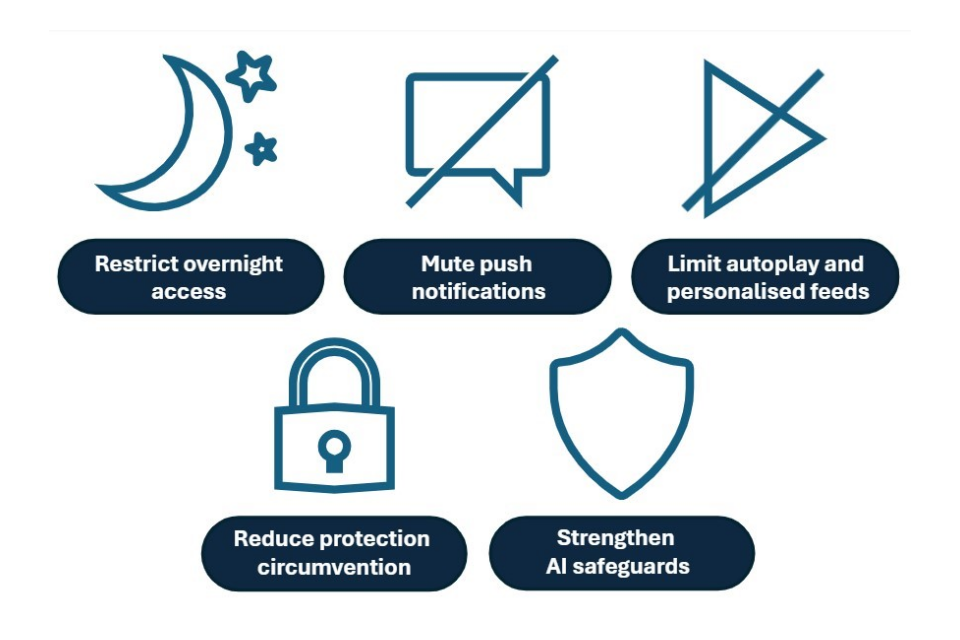
- Introduce default protections for 16 and 17-year-olds on social media: This includes overnight access restrictions between midnight and 6am, muted push notifications overnight, and autoplay and personalised feeds switched off by default, avoiding a cliff-edge in protections at age 16.
- Put in place further protections for children: We will introduce additional safeguards for children, including action on AI chatbots and measures to reduce circumvention of online safety protections.
- Support children to navigate the online world: We will help children develop healthier online habits, strengthen digital resilience and media literacy, and make it easier for children to access positive and enriching online content.
- Support families and caregivers: We will give parents and carers clearer support, expanding practical guidance and resources and strengthening mobile phone policies in schools to create distraction-free learning environments.
Every child should have the chance to grow up safe, confident and ready for the future. Technology is now part of that childhood. It can help children learn, create, find support, stay in touch and explore the world around them. But too many children are encountering risks online that they should not be expected to manage alone and have been left to navigate services which harm their safety or wellbeing. Parents and carers have too often felt they are facing these challenges alone. Schools, charities, and clinicians have seen first-hand the impact that harmful online experiences can have on children and young people.
That is why we undertook the Growing Up in the Online World consultation, which asked children, parents, carers, schools, civil society and industry how government should respond to the growing role of technology in children’s lives - including what more is needed to keep children safe online while preserving the benefits of digital services. More than 116,000 people responded to this consultation and, as a result, on 15 June 2026 the government set out a landmark package of measures to better protect children online.
As part of that progress statement, we announced that social media companies will no longer be able to offer their services to children under 16. To reinforce those protections across the wider online world, we also announced that we will:
- Prevent under-16s from accessing harmful functions on other online services, including gaming services, and require on-by-default restrictions on those functions for 16 and 17-year-olds
- Apply rigorous age checks to enforce these requirements
- Prevent under-18s from accessing AI chatbot services that primarily offer sexualised content. Other AI chatbot services will not be able to offer children features that enable sexually explicit or sexual role-playing content
- Give children access to more educational and positive content and experiences, both online and offline.
Our message was clear: children should be able to grow up with the benefits of technology, without being left exposed to risks that are not right for their age. Parents and caregivers should have better support and greater confidence that the online world their children use is safe and suitable.
We said in June we would return with the next stage of the package. In this response we set out further protections for children and young people and support for parents, caregivers and children. First, new on-by-default protections for 16 and 17-year-olds on social media, including an overnight curfew and autoplay and personalised feeds switched off, avoiding the cliff-edge at 16. Second, further protections against emerging risks such as AI chatbots and circumvention. Third, support for parents, from new screen use advice to increased access to resources on how to support and engage with children on their online lives. And finally, support for children themselves, helping them to build strong media literacy and digital resilience skills, whilst giving them easier access to high-quality online content.
We also commit to keeping children and young people informed and involved in this work as we develop and deliver the new regime. Their input will be critical in helping to shape the protections, support and guidance that will affect their lives.
Figure 1: How we will create new protections for children and young people
1.1 Monitoring and evaluation
We will monitor closely how these new measures are working in practice and the difference they are making to children and families’ online experiences.
Children’s mental health is a focus of our policies, and we are pleased to be working with Wellcome Trust on the impact of the social media restrictions. Wellcome will be funding independent nationwide studies of the impact of the social media ban on youth mental health, with research teams working with tens of thousands of teenagers across the UK. This will give researchers crucial insights into mental health and the digital world.
We will also draw on a range of evidence from surveys (e.g. to understand attitudes to social media and chatbots), media monitoring data (to understand how young people’s time online changes) and law enforcement and health statistics (e.g. on grooming and eating disorders). Insights from parents, young people, platforms and experts will also be critical to understand the impact of these policies. Finally, we will continue to review the latest academic evidence on how children’s engagement with the online world is evolving.
If we need to make changes to make sure the protections remain effective, we will use the powers under the Children’s Wellbeing and Schools Act 2026 to do so.
1.2 Next steps
This response marks the next step in delivering a safer online world for children and young people. We will now move at pace to develop and implement legislation needed to bring the social media restrictions into force, working closely with children, parents, schools, industry and civil society to get the detail right and ensure the new protections work in practice.
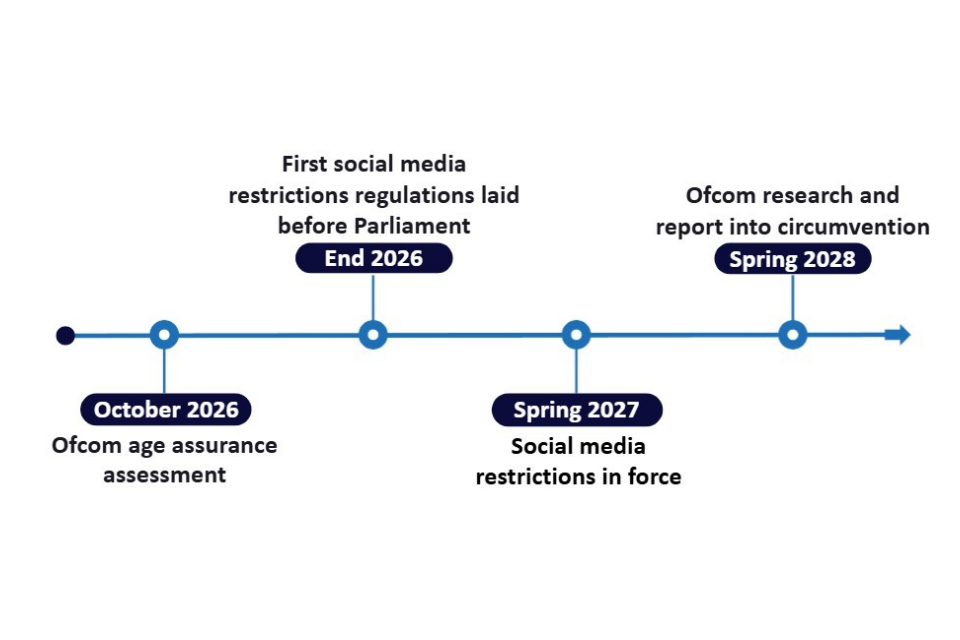
We intend to lay the first set of regulations before Parliament by the end of this year and expect the restrictions on social media services offering their services to under-16s to enter into force in spring 2027. Alongside this, we will roll out support and guidance for families, engage directly with children and young people, and work with Ofcom to prepare for the effective implementation and enforcement of the new regime.
Figure 2: Timeline of next steps
Together with the restrictions on social media companies offering their services to under-16s announced in June, the measures in this response mark the biggest reset of children’s online safety in a generation, but they are not the end of the story. Technology will keep changing and so will the risks children face. That is why we will not stand still: we are already committed to a programme of further work over the coming year and will go further to protect children whenever the evidence tells us more is needed.
Chapter 2: Default protections for 16 and 17-year-olds
What we heard
- Of those who responded to the consultation, many were supportive of restricting persuasive design features. Among respondents to the full-length consultation, 81% thought infinite scroll was particularly persuasive, followed by personalised content recommender algorithms (78%) and autoplay (70%).
- Children agreed, with 81% of consultation responses designating infinite scrolling as persuasive, alongside conversation “streaks” (71%), personalised content recommendations (62%), and autoplay (59%)
Figure 3: Particularly ‘persuasive’ online features
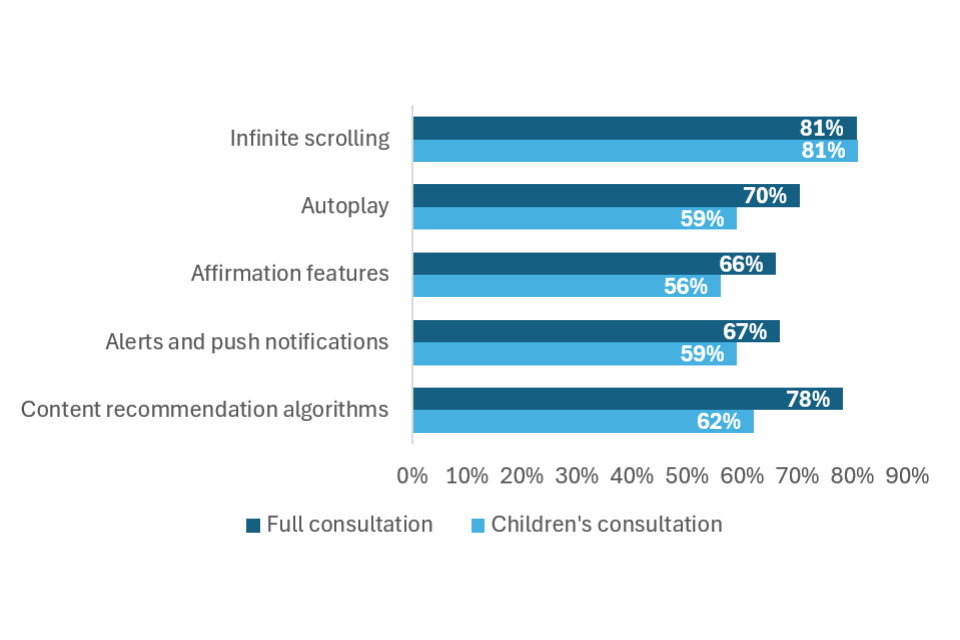
Figure 3: Full consultation (n=21,554), Children’s consultation (n=5,112) Full consultation Q16 - The following design features are sometimes known as ‘persuasive’, meaning they may encourage children to stay online for longer. From the following list, please select the ones you think are particularly ‘persuasive’ to children. Children’s consultation - Q18. Some platforms and websites have features that can make you want to keep using them for longer. Which, if any of the things below do you think make children want to keep using social media.
What will change
- We will help young people develop safer and healthier online habits by introducing default protections for 16 and 17-year-olds on social media.
- Social media services will need to restrict access to their platforms between midnight and 6am and mute push notifications for 16 and 17-year-olds during this time by default.
- Social media services will need to restrict autoplay and personalised feeds for 16 and 17-year-olds at all times (not just overnight) by default.
- 16 and 17-year-olds will be able to change these default settings.
Why we are making this change
In our progress statement on 15 June, we set out our plans to ban social media companies from offering their services to under-16s. This is because their combination of features, including their persuasive design features, pose unique risks to children. As children get older, so does their ability and right to make more autonomous decisions. However, we heard from children of all ages that they were concerned about design features intended to maximise the time they spent on social media. We also heard from some children and families, as well as charities, civil society groups, and industry concerns about creating a “cliff-edge” when children gain access to social media at age 16.
That is why in June we set out our plans to introduce extra measures to help 16 and 17-year-olds adjust gradually and to make it easier for them to make their own, informed choices. This includes turning off some higher risk functions (livestreaming and communicating with strangers) by default. We also said we would come back with our plans on default restrictions on persuasive design features, like infinite scroll, and overnight limits to help 16 and 17-year-olds have more control over their online experiences and provide them with support to manage their time on social media.
Evidence and existing practice
We know that some teenagers currently spend longer on social media than they intend to and that they say they find it hard to control the time they spend online.
For me, the addictive nature of it – especially of [Platform] with its infinite scrolling…I gradually abandoned other hobbies and interests and time with family to just sit on my bed scrolling for as long as possible, sometimes until late
Young Person, Children’s Consultation
[Children are] spending too much time online to the detriment of other pastimes, recreation, socialisation in the real world and sleep
Parent, Parent’s Consultation
Ofcom research finds that on average young people aged 15-17 spend 6 hours 20 minutes online each day, as long as any other age group. The research also indicates that young people spend longer online between 11:00pm and 4:59am, compared to younger counterparts.
We know that spending long periods of time on social media can have a negative impact on teenagers’ sleep and wellbeing. Evidence indicates that higher social media and screen use is consistently associated with poorer sleep outcomes, including shorter duration, later bedtimes and reduced sleep quality, which in turn link to wider negative wellbeing outcomes.[footnote 1]
I definitely say I spend a lot of time on my phone. I’m on it at 3am on a school night.
Girl, 16, Internet Matters Consultation Response
Some social media services already offer settings which help young people to balance their time, including bedtime reminders and guided nighttime meditations. Services have told us that many users find these settings beneficial in helping them balance their time online.
Which persuasive design features?
Infinite scroll, content recommendation algorithms, and autoplay were the top three features that respondents to the consultation think are particularly persuasive to children. Many respondents to the full consultation supported age-restricting these features for certain age groups of children (infinite scroll – 64%, autoplay – 57%, content recommendation algorithms – 64%).
‘Infinite scroll’ continuously loads new content as users scroll down a page, creating an endless stream of content with no distinct end.
‘Autoplay’ means videos start or continue playing automatically without breaks or input from the user.
‘Personalised recommender feeds’ use personal information about the user, such as their age, gender, interests and past activity, and other signals, to predict the content they will be interested in.
These three features work together to create a seamless, immersive scrolling experience from which it may be difficult to disengage.
In response to the full-length consultation, many people told us they think alerts and push notifications and affirmation features are also particularly persuasive (67% and 66% respectively), and just over half considered that they should be age restricted for certain ages of children (55% support restriction in each case). Ofcom’s research and Children’s Register of Risks also identify these as persuasive features that encourage children to spend long periods of time online.[footnote 2]
‘Push notifications’ are a type of notification that alert users, usually with a pop-up message, even when they are not using the service.
‘Affirmations features’ allow users to express approval or react to other users’ content, for example likes and comments.
Pilots To explore different ways to support teenagers manage their time online, we ran short, sharp pilots with young people and their parents. These aimed to better understand how measures can work in real life. For the pilots, over 300 families were asked to try one of three interventions:
- Daily limit (15 minutes per day, per social media app);
- Complete removal of social media apps; and
- An overnight curfew between 9pm and 7am.
Overall, each group trying the interventions reported a range of perceived benefits including improvements in sleep, mood, concentration, study time, and family interaction. The results of this research were published separately on 14 July.
Around 300 teens aged between 13 and 17 were allocated to one of these interventions (or a control group with no intervention) for four weeks. The participants: young people and their parents were interviewed before and after the intervention period to explore their experiences and attitudes toward social media, its effects on their sleep, relationships and offline activities, and the impact of the intervention on their lives.
Generally, teens found that interventions improved their sleep, concentration, family interactions and helped them feel calmer. Parents found that their children were more present during the four weeks, though many noted an adjustment period and some children tried to circumvent or negotiate their way around the restriction. Some young people also felt socially isolated or feared that they were missing out compared to their peers. Curfews had the lowest impact on socialisation and did not change social media use much, during the day, but still gave participants more time to sleep.
Overnight restrictions (“curfews”)
The pilots showed us that of the different interventions we tested, teenagers and parents found overnight curfews to be a balanced and workable approach to managing time spent on social media. For many of those taking part, the overnight curfews quickly become routine (within 1-2 weeks) and made room for increased family time in the evenings.
To make it easier for 16 and 17-year-olds to log off and get a good night’s sleep, we will require social media companies to restrict their access to social media platforms between midnight and 6am by default. Young people will have the power to turn off these default settings if and when they feel they no longer need the extra support to manage their screen use overnight. This is in recognition of the increased autonomy and independence 16 and 17-year-olds have in other areas of their lives.
These default curfews will offer teenagers a way to combat the powerful persuasive design choices made by social media companies, which are intended to keep them scrolling for longer. We could have required curfews to be forced-on for 16 and 17-year-olds, rather than applied by default. However, this would have removed the ability for 16 and 17-year-olds to choose what works for them.
Evidence also suggests that it may be unnecessary and disproportionate to force-on curfews, given the effectiveness of default settings. There is already some evidence that indicates where default settings are applied to children’s accounts, they typically leave these switched on. Recent Ofcom research tested a number of default safety settings with children and adults using a mock social media platform. While behaviour in a simulated environment may not fully reflect behaviour on real-world platforms, 95% of adults, young people aged 16-17 and children aged 13-15 had kept their default settings on by the end of the experiment. This backs up previous Ofcom research on other types of default settings (including on autoplay) that shows default settings are strong drivers of choice.
This evidence suggests that where settings are applied by default, they can effectively counter the persuasive design choices made by companies. This will offer teenagers a meaningful choice about when they want to spend time on social media.
In our pilots, we tested overnight curfews from 9pm to 7am with teenagers aged between 13 and 17. We know that as children grow up they typically have later bedtimes and may need to get up earlier to travel to schools or colleges further from home. That is why, as young people over 16 begin to use social media, we think it is right that these overnight curfews apply from midnight to 6am instead.
Alerts and push notification and affirmation features
We are also requiring social media services to turn off alerts and push notifications by default for 16 and 17-year-olds between midnight and 6am. We think this will help teenagers stick to the overnight restrictions and get a good night’s sleep without worrying about what is happening on social media.
We are not, at this stage, requiring further restrictions for alerts and push notifications and affirmation features. This is because we think the combination of overnight restrictions and restrictions on autoplay and personalised feeds (see below) will give 16 and 17-year-olds much more control over the time they spend on social media. We will, however, keep this under review and revisit this in future if needed.
Infinite scroll, autoplay and personalised feeds
We know that children also spend long periods of time online during the day. We explored ideas for how we could restrict persuasive design features, like infinite scroll or autoplay, for 16 and 17-year-olds, to help them manage their time online.
It keeps you online, it keeps you away from everything else, it keeps you like isolated on your phone…If you look at someone’s screen time, the majority of it isn’t going to be on communication apps. It’ll be just sat there, infinitely scrolling on [Platform]
National Youth Agency response
We think restricting autoplay and personalised feeds for 16 and 17-year-olds by default will best support them to manage their time online. This is because:
-
Restricting autoplay will disrupt the continuous stream of content, requiring users to make an active choice about whether to play the next video.
-
Restricting personalisation in recommender feeds means that teenagers will no longer be able to see personalised content, including adverts, while they scroll through their feeds. This will help to give young people more control over how they spend their time online by reducing the pressure to keep scrolling.
Social media services will be required to apply these restrictions for 16 and 17-year-olds by default to give them more agency and choice over their experiences and the time they spend online, helping them to make healthier choices. These default settings will apply all the time, not just overnight.
What this means in practice
This will mean that when 16 and 17-year-olds first start using social media they will not be able to access the platforms between midnight and 6am and will not receive alerts or push notifications during this time. At all times of day, videos will not start automatically and their feeds will not be personalised.
We know that 16 and 17-year-olds have increasing autonomy and independence in lots of other areas of their lives. We think it is important to recognise this, which is why 16 and 17-year-olds will be able to turn off these restrictions in their settings when they feel they are ready to do so. This will make social media services safer-by-design and empower 16 and 17-year-olds to manage their time on social media in a way that is appropriate for their age and avoids a cliff-edge when they turn 16.
Chapter 3: Further protections for children and circumvention
3.1: AI chatbots
What we heard
- Respondents were clear that AI chatbots offer children a range of benefits, including around education, learning and creativity.
- Respondents raised concerns over the impact of harmful chatbot design features on children. Over half (59%) of young people (16-21) wanted restrictions on chatbots that encouraged longer conversations. Parents and children were concerned about chatbot features that could foster emotional dependency. 80% of respondents to the full consultation and 68% of young people (16–21-year-olds) who responded to the children’s consultation thought that there were particular risks where chatbots mimic friendship.
- Civil society, parents, children and young people reported significant concerns about children turning to chatbots for mental health support. 18% of 16–21-year-olds who responded to the children’s consultation indicated young people see chatbots as a source of emotional or mental health support.
- We also heard that more support was needed for parents to be able to talk to their children about the risks on chatbots.
What will change
-
Chatbots will have to introduce regular breaks for children under-18 to help support healthier habits.
-
We will work with regulators to take action on chatbots that share harmful mental health advice and will consider all options, including banning children from certain chatbots where other regulatory and safety mechanisms are not enough.
-
We will provide more advice and guidance to children and parents on how to use AI critically and how to understand and manage the risks.
Why we are making this change
We announced in June that we will prevent children under-18s from accessing sexualised content on chatbots. But we were clear that we would go further. We have heard the concerns raised about children being exposed to novel harms, such as emotional dependency and encouraged to spend excessive time on a service. Children are also at risk of being exposed to misleading and damaging advice. It is clear AI chatbot services need to do more to manage risks to children.
The majority of chatbots most used by children are already within scope of the Online Safety Act. This requires them to take action on both illegal content and content harmful to children, such as content promoting or providing instructions for eating disorders. However, there are some chatbots not covered by the Act because of the way they function. The government has already committed and taken powers to ensure that all chatbots are required to take action on illegal content. We will act swiftly to ensure that this loophole is closed.
Mandatory breaks
Consultation responses expressed a strong concern that certain chatbot features encourage prolonged and excessive engagement by children, with some at risk of becoming emotionally attached to chatbots.
Chatbots that simulate a human persona can have benefits in some supervised contexts, such as helping children practise a foreign language.
Purpose-built AI tools designed for children, such as educational or accessibility-focused chatbots, can play a valuable role in supporting learning and inclusion.
Centre for Information Policy Leadership
However, children forming friendships with chatbots that appear human can create risks to their social and emotional development.
Children and young people may engage with systems/ AI chatbots that appear authoritative, relational, anthropomorphic or emotionally responsive, which raises particular risks.
Royal College of Psychiatrists
The government recognises the important balance which needs to be struck here. This is a novel harm which needs to be addressed but at the same time, we want to ensure that all children can enjoy the benefits of AI in a way which fosters healthy online habits and guards against the risks of attachment. We will therefore require AI chatbots to introduce mandatory breaks for all children under-18. We will work with experts, including our Expert Panel chaired by Professor Russell Viner, which supports government to assess the scientific evidence related to digital safety, on how frequent and how long breaks should be.
Chatbots and mental health advice
In the June update we reported that respondents felt that, although children may use chatbots to discuss their feelings because they feel safe and free from judgement, there were concerns about the risks posed to children if they use chatbots for medical advice. This includes children receiving harmful or inaccurate medical advice, being discouraged from seeking help, or not being directed to support when discussing such issues.
More and more young people are turning to AI chatbots for emotional support, which does pose risks if this is the primary or only source of support, they are receiving.
National Youth Agency
To address these concerns, we will take stronger action on chatbots that may pose risks to children, through harmful, inaccurate or unverified mental health advice. We will consider a full range of options, including if necessary, banning certain services that present a threat to children where other regulatory and safety mechanisms are insufficient.
We will work in collaboration with the Department of Health and Social Care (DHSC), with NHS England and regulators, including the Medicines and Healthcare products Regulatory Agency (MHRA) ensure the regulatory system for AI medical devices supports children to access trusted, evidence-based support. This will ensure that, where children seek medical advice, children and parents can be sure it meets certain standards and is safe.
The government’s upcoming mental health strategy will set out how the NHS can safely make use of AI. DHSC’s call for evidence asked how AI, including chatbots, can be used safely in mental health settings for adults and children.
The MHRA, which regulates medical devices in the UK and helps ensure mental health technologies are safe and effective, can act where AI products that fall within its remit pose risks to public health – this includes chatbots that claim to diagnose, treat or manage a mental health condition. It is reviewing how AI in healthcare should be regulated and will publish its response to recommendations later this year. We will work with them and DHSC to assess the effectiveness of this regime.
Supporting parents and children
As set out in chapter 4, we are taking steps to support families to have informed conversations about online risks to children. As part of this work, we will add resources on AI chatbots to the Kids Online Safety Hub to support parents and carers. We will also support children directly through reforms to the curriculum. Civil society are also undertaking efforts in this space such as the NSPCC; we will work with these organisations to align efforts and maximise impact.
Keep SMART on AI
Organisations and individuals outside of government are running initiatives designed to help children better identify and protect themselves from the risks on AI services, including chatbots.
‘Keep SMART on AI’ is an initiative started by AI expert and dad, Jonathan Kewley, in collaboration with Sir Anthony Seldon, AI in Education, The Haberdasher’s Company, Haberdashers’ Elstree Schools, Wellington College and the National Society for the Prevention of Cruelty to Children (NSPCC). ‘Keep SMART on AI’ will launch in the Autumn with resources going to schools across the UK. It aims to support children to reflect on how to use AI safely and responsibly, including how to spot when content is AI-generated, how to protect their personal data, and when to speak to a safe adult.
What this means in practice
We want children to have access to the benefits AI chatbots can present while being protected from novel harms. To help achieve this, all children under 18 will have mandatory breaks when using chatbots to support healthier online habits.
Addressing risks from children receiving harmful or inaccurate medical advice from chatbots remains a priority for this government. We will work across government and with regulators to address services that provide dangerous, misleading or unverified mental health advice.
Children and parents will also receive further support and guidance on using AI chatbots.
Chatbots that are typically used in business or customer service settings will be exempt from the measures. The detailed definitions of which chatbots are in scope of these measures will be set out in regulations in due course.
The steps we are taking will ensure children are safer while using AI chatbots.
We believe there is always more that can be done to protect children. We are continuing to look at the evidence and will work with experts on what more is needed. We recognise that there is public appetite to do more on AI chatbots and how children use these, and the government reserves the right to take more action on this.
3.2: Circumvention
What we heard
- Stakeholders across civil society and industry highlighted the legitimate reasons for children to use VPNs, including accessing online education and protecting sensitive communications.
- Many stakeholders raised concerns with age-gating VPNs, including increased data protection risks, users moving to non-compliant and riskier VPN services to avoid age checks, and the potential impact on business.
- Some stressed that restrictions could disproportionately affect vulnerable groups such as LGBT+ youth or those experiencing domestic abuse.
- More education for children was ranked as the top action government should prioritise to reduce circumvention of online safety rules in the UK (38%) in the full-length consultation.
- A small majority (59%) of respondents to the parents’ consultation anticipated that children would try to circumvent age restrictions on social media.
- However, as discussed below, children typically circumvent age assurance with less sophisticated methods rather than with VPNs, using VPNs more for security and privacy.
What will change
- Government has asked Ofcom to conduct research into what additional steps services can take to detect and mitigate circumvention on their platforms, including via VPNs.
- We will be clear that in-scope services must take robust steps to prevent, detect and respond to underage circumvention, and call on VPN providers to engage with government on making their products safer and less accessible to children without parental consent.
- We will produce new practical guidance for parents on how circumvention tools such as VPNs, operate and the risks they present at a household level.
- We will not ban or age-gate VPNs. However, we must ensure that these tools are not misused to undermine child safety protections and we will keep this area under close review. We are prepared to take further action on this, should evidence show that circumvention is not being tackled adequately.
Why are we making this change
Protecting children online also means ensuring the protections we legislate for are effective in practice. We are taking decisive action to make sure children benefit from the full protections of both the new measures we have announced as well as the Online Safety Act and cannot easily bypass them, whether through VPNs or other means.
Much of the public debate on circumvention has focused on the potential use of VPNs but they are only one part of the circumvention picture. Respondents to the consultation identified using the accounts, devices or identities of others and using other technical tools as additional ways children can bypass age checks. Earlier this year, Internet Matters found that while 32% of children admitted to having bypassed age checks, the most common methods children used were entering a fake birthdate (13% of 9-16-year-olds) and borrowing someone else’s account (9%). Our response therefore tackles circumvention in the round, rather than focusing on any single tool.
Highly effective age assurance sits at the heart of this approach and is essential to protecting children of all ages online. In June, the government set out its next steps on age assurance as part of the Growing Up in the Online World: Progress Statement. We wrote to Ofcom asking that they conduct a rapid assessment of what highly effective age assurance looks like for determining whether someone is over 16. This will be published in October.
The consultation also specifically sought views on age-restricting VPNs. Respondents were more likely to favour education-based approaches than restricting children’s access to VPNs – 38% prioritised more education for children, compared with 34% who prioritised restricting children’s access to VPNs. At the same time, polling from Childnet shows that where children do use VPNs it is most commonly to protect their privacy rather than for circumvention reasons.
Our approach reflects that evidence. We are clear that any measures must be effective, workable in practice and avoid creating new harms. Stakeholders raised significant concerns about age-gating VPNs, including: possible risks to user privacy and security; impacts on business and legitimate use; displacement where children start turning to non-compliant; and riskier VPN services. Some also raised civil liberties and data protection as risks.
Requiring everyone to undergo age checks to access a VPN would impose significant compliance costs, affect the privacy of millions of legitimate adult users, and create new security vulnerabilities.
Kape Technologies
Any age-based restriction on VPN use raises significant privacy and civil liberties considerations…Children should not be discouraged from using legitimate security tools where they are not themselves the source of harm.
TechUK
VPNs offer children legitimate benefits, including protecting their personal information and giving them greater control over their online privacy. Banning them would remove these protections without making children meaningfully safer…
NSPCC
This is a complex but important issue for children, adults and businesses alike. But with parents overwhelmingly backing a minimum age of at least 16 for children to access social media, we must ensure children cannot easily bypass these new rules.
What this means in practice
We will make it clear to companies that they must take robust steps to prevent under-16s from circumventing the new rules. We will also engage with VPN providers on the steps they can take to make their products safer and less accessible to children.
Detecting and preventing VPN use is technically challenging, but there are steps that services can take and we are determined to build the evidence base needed to act effectively. We will therefore ask Ofcom to carry out research into what additional steps services can take, to detect and mitigate circumvention, on their platforms to help form a clear set of practical actions. This will include how services can detect VPN traffic and prevent children from using VPNs to bypass safeguards.
The government recognises that many families choose to have VPNs installed at home to provide additional privacy protections for their household. We want parents to feel empowered to make the decisions that are best for their family. To support them, we will produce clear, practical guidance about how these tools operate at household level – including how parents can find out if those tools are installed at home, the impact they may have on children’s online protections, and how to have open and informed conversations with children about their digital lives. In tandem, we will work with VPN providers to improve protections for children on their services to give parents greater confidence that these products will also protect their children.
Strong protections remain firmly in place for children of all ages, and we have also been clear to Ofcom that robust enforcement is a top priority and that we will ensure they have the funding they need to be rigorously enforce the full range of child safety duties, including the social media restrictions. We have also asked Ofcom to submit to Parliament and make publicly available an update on enforcement strategy and outcomes.
We will keep this area under close review and provide a further update within a year of the social media restrictions coming into force, including setting out next steps. If evidence shows that circumvention is becoming a significant problem and is not being adequately tackled by industry, we will take further action.
Chapter 4: Supporting families, caregivers and educators
4.1: Supporting families: guidance, parental controls and screen use
What we heard
- 84% of full consultation responses either strongly agreed or somewhat agreed with the statement, ‘Parents should have control over the online experiences of their children’.
- Many respondents to this question emphasised the importance of graduated, age-appropriate online controls, suggesting that restrictions should be strongest for younger children and relaxed over time.
- 55% of children who responded to the consultation agreed to some extent that parents should have control over which services they are allowed to use.
- Of those who responded to the parents’ survey, in response to the question regarding whether parents or carers ever feel out of control about the amount of time that they personally spend online, 47% answered ‘yes, occasionally’.
What will change
- New screen use guidance alongside wider media literacy support will provide parents and carers with practical advice to help children use technology safely, positively and in a balanced way.
- We will review the use of parental control tools following the new changes to see what further support would be beneficial.
- We will expand and improve the Kids Online Safety Hub as a source of trusted information, advice and support that parents can use alongside their children.
Why we are making this change
Currently, many online services including social media companies offer a range of parental controls to help parents and carers to manage their children’s online experiences. These can be used to set limits on what content their children see, the time they spend online, and the features they can access. We asked for views on what would help parents and carers use these more confidently and effectively, and how parental controls should adapt to meet the needs of children at different ages.
We heard from parents that they are struggling to know how best to manage the time their children spend online, and parents overwhelmingly favoured stronger government intervention.
Parental controls are also offered on a wider range of services, including gaming services, and we have taken further steps to protect children from risks presented by these services by restricting harmful functions, including stranger communication and livestreaming functions.
Our consultation also asked several questions about the amount of time children spend online, on a phone or on social media, and how this can be broken down by age. The government has already provided support for parents and carers through the Kids Online Safety Hub and through wider media literacy activity. However, we believe there is more we can do to ensure families can access trusted information, practical advice and the support they need to help children to navigate the online world safely and confidently.
What this means in practice
We will give parents and carers greater confidence and support to help their children have safe and positive online experiences. Alongside the wider package of support set out in this response, including the Kids Online Safety Hub and media literacy initiatives outlined below, families will have access to practical tools, guidance and advice that is suitable for children of all ages.
We will build on the “You Won’t Know Until You Ask” media literacy campaign and associated Kids Online Safety Hub. Evaluation of the initial campaign found that it increased parental awareness of online harms and enabled improved parent-child discussions about online safety.
We will also ensure that the new screen use guidance being developed by the Department for Education and the Department for Health and Social Care for children aged 5–16 gives parents and carers clear, evidence-based advice to help support their children to use technology in a healthy and balanced way. We will work with these departments to engage with relevant family focused bodies and organisations to incorporate existing government guidance on screen use into their current offers, which will increase the reach of screen use information.
We will continue to support parents through government media literacy campaigns, recognising that keeping children safe online requires not only the right tools and protections, but also open and informed conversations within families. We will build on the success of our media literacy campaign, aiming to double our spend on media literacy campaigns to further support parents and carers.
It is important to understand how banning social media services from offering their services to under 16s might change the way parents and children manage online activities together. This is a significant change, so we want to see how this works in practice and how it affects the role that parental controls play in supporting children online. For children under 16, parents and carers will no longer need to rely on managing parental controls on social media services covered by the ban.
We will continue to keep this situation under close review. If further action on parental controls is needed to help parents keep their children safe online, we will consider additional measures.
4.2: Mobile Phones in Schools
What we heard
- Many (75%) respondents to the full-length consultation supported making the government’s guidance on mobile phones in schools statutory.
- Around half of respondents said this would improve pupil behaviour, wellbeing and learning, particularly by reducing distractions, bullying, safeguarding risks, and excessive screen use.
- Many respondents supported exemptions where mobile phones may be necessary, particularly for travel to and from school (53%), medical needs (52%), SEND requirements (34%), individual safeguarding concerns (33%) and caring responsibilities (32%).
Figure 4: Potential exemptions from school mobile phone restrictions
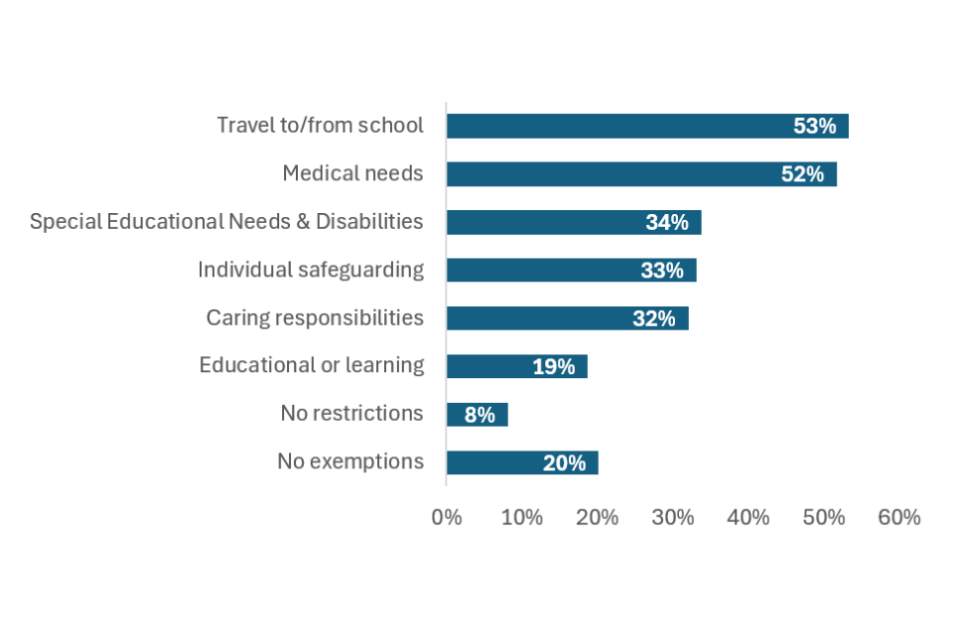
Figure 4: Full consultation, n=21,496, Q43 Are there specific circumstances where you think children should be permitted to have or use a mobile phone during the school day? Exemption titles truncated
What will change
-
We all have the same ambition here: children should not have access to mobile phones at any point in the school day.
-
The government has therefore made its guidance on mobile phones in schools statutory. This creates a clear legal expectation that schools must follow the guidance unless there is a legally justifiable reason not to.
-
The guidance became statutory on 29 June 2026, but schools won’t be expected to follow the guidance until September 2026 to allow time for implementation.
-
School leaders will continue to decide how they want to make their schools mobile phone free, including any exemptions to the policy.
-
To support schools with enforcement of their policies, Ofsted will check school mobile phone policy on every inspection.
Why are we making this change
Calm, consistent, distraction-free classroom environments benefit all children. They create clear expectations around behaviour and they improve children’s outcomes.
Placing the strengthened guidance on a statutory footing is expected to reduce the level of disruption caused by mobile phones to pupils in the classroom. In June 2025, over half (58%) of pupils said that in at least some lessons, pupils used mobile devices when they were not supposed to.
There are early signs of improvement following the publication of the strengthened guidance, with 24% of teachers reporting unauthorised use in May 2026 following the announcement that the guidance would be put on a statutory footing down from 38% in 2024. The policy is also expected to improve pupils’ overall wellbeing by reducing issues such as cyberbullying, with 40% of teachers identifying this as a key benefit of mobile phone‑free schools.
Evidence suggests that more restrictive mobile phone policies do make a difference in reducing classroom disruption and improving behaviour. Data from May 2026 shows that schools which implement the strictest policies (collecting or securing phones in pouches) report lower levels of classroom disruption compared to those with less strict policies (“out of sight” policies), with the highest level of disruption experienced in schools where mobile phones are allowed at breaktimes.
Statutory guidance aligns with an emerging international trend towards restricting mobile phone use in schools. This means that teachers are now operating in a context where parents are better supported to manage safe screen use at home and are encouraged to reinforce school policies, including understanding the risks of mobile phone use and the benefits of a mobile phone-free school day.
What this means in practice
By placing the mobile phones in schools’ guidance on a statutory footing there is now a clear legal expectation that the guidance must be followed unless there is a legally justifiable reason for schools not to do so.
The guidance is clear that all schools should be mobile phone-free environments by default; anything other than this should be by exception only. The Department for Education expects schools to implement a policy whereby pupils do not have access to their mobile phone throughout the school day including during lessons, the time between lessons, breaktimes and lunchtime.
There are a number of ways in which schools can ensure that they are mobile phone-free, and it is for school leaders to decide how best to achieve this within their own unique contexts.
For example, some schools have chosen to use lockers to store mobile phones, ensuring that pupils still have access to a device for safety reasons when travelling to and from school. There are also schools who successfully facilitate pupils handing a mobile phone to staff at the start of the school day.
The guidance is clear that exceptions to a mobile phone policy may be required for children with specific special educational needs, disabilities or medical conditions. This includes users of health tech or assistive technology. Where school leaders need to make additional exceptions or flexibilities to their policies based on a child’s individual needs, we trust them to do so.
4.3: Age of digital consent under Article 8 UK GDPR
What we heard
- There were mixed views on the age of digital consent. 54% of respondents to the full consultation supported increasing the age of digital consent to 16, while 12% supported retaining the current age of 13.
- Those in favour of raising the age of digital consent argued that children under 16 may not be able to meaningfully understand or consent to complex data collection and use, particularly for profiling and behavioural advertising.
- Some respondents interpreted raising the digital age of consent as equivalent to an access restriction or parental-authorisation requirement for children to use online services.
- Opponents argued that raising the age would not directly address online harms, as Article 8 governs consent for data processing rather than access to online services. They also highlighted potential downsides, including the risk of parental consent fatigue, increased compliance burdens for businesses and reduced access to beneficial online services for some children.
What we will do
- We remain open to raising the age for some or all services in future, but will first monitor the impact of the restrictions on social media and harmful. functionalities. We want to understand whether raising the age of consent would add meaningful protection alongside these measures.
Currently, many social media services set their minimum user age at 13, which aligns with the current age at which online services can rely on children’s consent to process their personal data. We asked whether raising this age could give parents and carers more say over how platforms use the data of children over 13. Although some respondents said they would welcome such a change, others said it would not be the most effective way of protecting children on social media, as it would not prevent platforms processing children’s data for behavioural advertising or content recommendations where parents were content to grant authority. Many argued that platforms should take more responsibility to have a default approach to designing their processing activities with children’s privacy in mind.
That is why we have decided to go further: social media companies will not be allowed to offer their services to children under 16, and young people aged 16 and 17 will have personalised recommender feeds disabled by default, including adverts in feeds. This means children of all ages will now be better protected on social media from harms associated with use of their data through recommender systems and behavioural advertising.
We are not proposing to increase the age of consent immediately, so that we can further consider the impacts on businesses, parents and children, alternatives proposed in consultation responses, and the case for exemptions (e.g. for education, health and other beneficial services).
We want to consider how any future changes would interact with the wider measures we have announced to protect children online, including restrictions on social media and harmful functionalities. We want to understand whether raising the age of consent would add meaningful protection alongside these measures, or whether more targeted interventions would be more effective.
What this means in practice
We will not proceed at this stage with a change to the age of consent. Instead, we will keep this under active consideration while assessing whether changes to Article 8 of the UK GDPR would deliver meaningful additional protection for children, and whether they would do so in a proportionate and enforceable way.
Chapter 5: Supporting children
5.1 Engaging with children and young people
Young people’s voices have shaped what we have announced
Young people’s voices have been at the heart of this work from the very beginning, and they have directly shaped the measures and approaches we have announced. Our consultation and dedicated survey for young people received over 116,000 responses, including 14,000 from children and young people themselves. Ministers and officials attended over 100 events and met many hundreds of young people in constituencies right across the country. We also ran seven in-person deliberative youth events in Belfast, Brighton, Caerphilly, Edinburgh, Gloucester, Ipswich and Newcastle, working with the #iWill Movement, UK Youth and Volunteering Matters to hear discussions shaped by young people.
While many young people themselves did not favour restrictions on social media services for under 16s (34% of children’s consultation respondents opposed age restrictions and 47% wanted under-16 access to some platforms), the responses from both children and parents clearly showed that the current system is not delivering for them. We have considered children’s views carefully and we believe that a reset was needed to set expectations about what is suitable for under 16s. Having listened to the views of children themselves, we will also take action on their specific concerns around design features which lead to addiction and compulsive use.
Continuing to hear from young people through development and implementation
This announcement is not the end of the conversation with young people. As we move from policy design into the development of secondary legislation and implementation of the new regime, it is more important than ever that young people continue to feel part of, and meaningfully contribute to, this decision. That means:
- Understanding the “why”. Young people told us clearly that they want to understand the reasons behind the changes affecting their online lives, not simply be told what is happening. We will keep explaining the evidence and what we heard through the consultation, so that young people understand why government is acting, and why we are acting now.
- Clarity on practical changes. As the detail of the regulations is developed and laid before Parliament, young people will rightly want to know exactly what is in and out of scope: which platforms will be affected, what happens to existing accounts, how age assurance and protections for 16 and 17-year-olds will work in practice. We will make sure this information is communicated to young people in a format that is accessible and clear.
- Mythbusting. We know misinformation about what the ban does and does not do spreads quickly online, particularly among young audiences. Continuing to engage with young people gives us the opportunity to address misconceptions head-on. We will be clear children will still be able to use messaging services to stay in touch with family and friends, that they will still be able to access educational, informational and creative online spaces, and that the responsibility for compliance sits with platforms, not with children themselves.
- Ongoing structured involvement. The evidence from our deliberative research was clear that young people want to be involved on an ongoing basis in the decisions that shape their online lives, not just consulted once. We will continue working with the Department for Culture, Media and Sport, the Department for Education and organisations such as the National Youth Agency to embed young people’s voices in the development and implementation of the regulations, so that young people feel part of this decision.
Public communications leading up to the ban
Alongside this response we are publishing a version aimed at young people, explaining the key decisions in this document as well as those in the 15 June progress update. We will continue that work with dedicated communications, developed with input from experts and young people, helping them to understand and prepare for the changes, as well as helping signpost where those who are concerned about what the changes mean for them can access support.
Combined with our media literacy work with parents and carers described in chapter 4, these strands would provide a complementary package of communications and support, helping parents, carers and young people understand the changes, stay informed, and build the knowledge and confidence needed to navigate the online world safely.
5.2: Media and digital literacy support for children
What we heard
- Media literacy is a key part of helping children engage safely and positively online, alongside regulatory protections.
- Respondents to the consultation identified a broad set of priority topics for media literacy support, including privacy, online behaviour (such as bullying and peer pressure), staying safe online, fact-checking, managing screen use and spotting adverts, sponsored posts and AI-generated content.
- Stakeholders across industry and civil society highlighted the growing importance of AI literacy, algorithmic awareness, and recognising misinformation, scams and manipulative online practices.
- Trusted, clear and age-appropriate information was most valued. Schools and childcare settings were seen as the main place to strengthen support.
What will change
- Government will strengthen children’s media literacy, digital resilience and online safety skills under the National Curriculum.
- We will support children and young people beyond the classroom, working with youth organisations, libraries, community groups and civil society partners to build media literacy, critical thinking and online safety skills in trusted settings.
Why are we making this change
The consultation showed that there is already widespread support for our media literacy work and we want to build on these early successes.
As children get older, it is important they have the skills and confidence to use online services safely, including when they gain access to social media at 16. Alongside extra measures to help 16 and 17-year-olds adjust gradually, we are committed to helping children understand how to make safer choices and helping parents and carers to support them.
Respondents consistently recognised the role that media literacy can play in helping children develop the knowledge, resilience and critical thinking skills needed to engage safely and positively online. The response to the consultation shows strong demand for more practical support for children, parents and carers. The government agrees that schools are the best place to reach most children within the UK, so they are at the centre of our media literacy approach. We also agree that parents and carers remain one of the most trusted influences on children’s online behaviour and wellbeing.
The government has already set out its plans through the Media Literacy Action Plan to help children and young people develop the media literacy, critical thinking and digital resilience skills they need to navigate the online world safely and confidently. We will build on this work to strengthen children’s confidence, resilience and ability to make informed choices online.
Media Literacy Action Plan
The Media Literacy Action Plan sets out a whole-of-government commitment to build a safe, informed, media literate society. It outlines the principles underpinning the government’s approach:
- we will support people where they are
- we will share and use what works
- we will help everyone play their part in strengthening media literacy.
Our priority areas for the next three years are:
- build awareness of media literacy and support access to trusted information
- prepare children and young people for a digital future
- boost local initiatives, to support people facing barriers to participation
- ensure a coherent approach across government and support cross-sector coordination.
The Action Plan includes a set of actions the government will deliver to equip all UK citizens with the skills they need.
What this means in practice
The Department for Education will strengthen children’s media literacy and digital resilience through curriculum reform. From September 2026, strengthened Relationships, Sex and Health Education (RSHE) guidance will support children to think critically about emerging technologies including artificial intelligence and AI chatbots. Children will be taught about the prevalence and harms of deepfakes, misinformation and disinformation, supported to identify misogynistic and violent online content, and helped to understand how online content can present a distorted picture of the world and normalise or glamorise behaviours which are unhealthy and wrong.
We are going further through the updated National Curriculum strengthening critical thinking and ensuring pupils can identify and challenge mis- and disinformation. A new curriculum will follow from 2027, with first teaching from September 2028. Media literacy will be embedded across subjects, alongside strengthened English and history content to analyse sources and spot bias, and an enhanced computing curriculum covering AI, data science and technological bias.
Alongside this, we will explore the best ways to reach children of different ages beyond the classroom, for example through youth groups, libraries, or other community initiatives. This will build on wider government action to ensure more children and young people can access enriching activities and positive opportunities outside school. The government’s National Youth Strategy (‘Youth Matters’) is backed by over £500 million over the next 3 years including over £60 million for fun and enriching things to do. The Department for Education’s new Enrichment Framework also supports schools and colleges to broaden access to high-quality opportunities beyond the classroom, while wider government investment will help more children and young people benefit from enrichment activities both in schools and in their communities.
We will also position our Kids Online Safety Hub as the central source of practical support for parents and carers. We will build on this by exploring additional age-appropriate resources for young people and teenagers, alongside tailored information for their parents and carers.
5.3 Supporting children to find high-quality online content
What we heard
- Responses to the full consultation highlighted that educators, developmental experts, child advocacy groups and parents and carers are those most trusted to determine high-quality online content.
- On further action to support positive online spaces for children, those who responded to the full consultation showed strongest support for guidance for children, parents and carers, together with best practice principles for industry.
- On what should be considered when taking further action to support positive online experiences for children, many respondents to the full consultation supported stronger regulation or age restrictions.
Figure 5: Trusted to determine ‘high quality content’
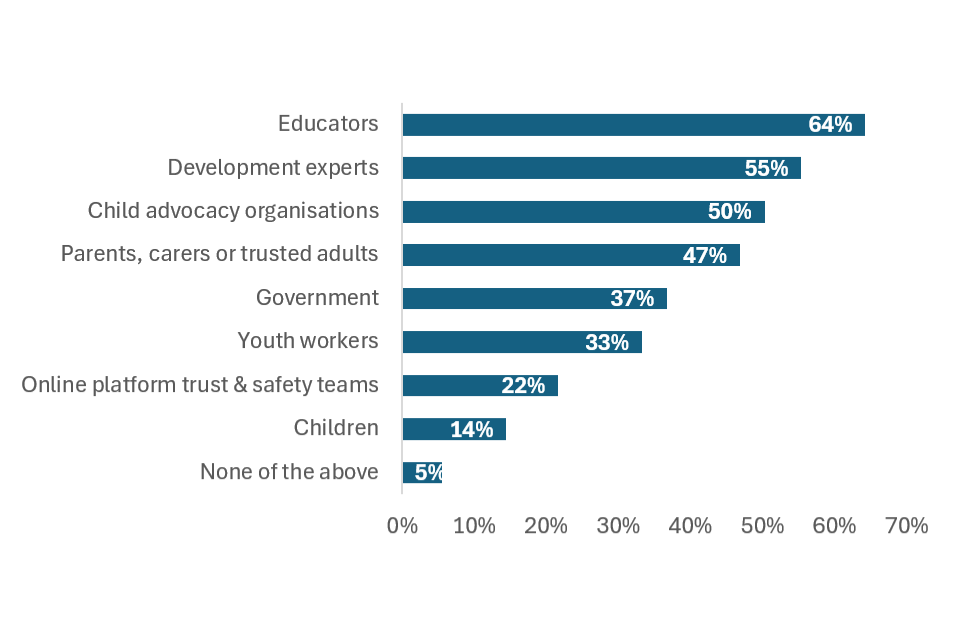
Figure 5: Full consultation, n=20/703. Q43 Who would you trust to determine what is meant by ‘high quality online content’ for children 13-16? (Please select all that apply)
What will change
We will work with children, parents, charities and educators to agree what good quality online content should look like and how to help children find it.
Why we are making this change
We know that more children are watching videos and spending time online. While there is a huge range of content available, many parents worry that valuable educational and age-appropriate content can be difficult to find amongst the volume of videos competing for children’s attention. Research by Ofcom suggests that the government should look at whether more can be done to help children and families discover high-quality content that supports learning, development and wellbeing.
Preventing social media companies from offering their services to under 16s will play a big role in helping children have a healthier relationship with technology. Alongside this, we also want to ensure that children can easily find online content that helps them learn, create, explore their interests and stay connected to the things that matter to them.
Respondents to the consultation wanted children to have safer, more positive online spaces. To do this, many called for stronger rules and age restrictions which we are delivering through the government’s plan to ban social media services for under 16s. They also called for better parental controls and clearer guidance for families.
Through our consultation, we asked what positive online experiences look like for children and what more could be done to support them. We heard strong support for working with industry, charities, educators and families to highlight high-quality content and create online spaces that help children thrive.
We also heard from services that it can be difficult to define what ‘high-quality’ content looks like – and we heard some good examples of platform initiatives like creator reward programmes to incentivise people to make high-quality online content or partnerships with trusted publishers like the BBC.
We want to make sure that the new social media restrictions and other new age limits for harmful functions on other services, including gaming, do not affect children’s ability to find and benefit from high-quality online content.
What this means in practice
As we develop the new rules for online services, we will continue to work with children, parents, educators, charities, academics and regulators to explore how high-quality content can be identified and made easier to find online. We want to understand more about what works in practice, gather a wide range of views and develop approaches that are meaningful and effective for children and families.
We also want to look more closely at what other countries are doing and existing best practice, including what other companies and sectors – such as broadcasting – are doing to support children’s access to positive and enriching content online.
On 23 June, the Department for Culture, Media and Sport launched the Watch this Space: a new strategic direction for UK media consultation. This consultation seeks views on interventions to support a healthy information environment by making trusted news and high-quality television content easy to find, while helping audiences benefit from the wider digital world. This consultation will close on 31 August 2026, and findings will help the government to build on evidence of what works and learn from a range of experiences.
As the new rules come in for online services, we will bring forward new, clear proposals to help children access content that benefits them. This could include guidance for families, best practice principles for industry, voluntary initiatives to increase the visibility of positive content online, and a review of international approaches to identify effective interventions.
-
Hartstein et al (2024) The impact of screen use on sleep health across the lifespan: A National Sleep Foundation consensus statement - Sleep Health: Journal of the National Sleep Foundationhttps://www.sleephealthjournal.org/article/S2352-7218(24)00090-1/fulltext
Lund et al (2021) Electronic media use and sleep in children and adolescents in western countries: a systematic review,
Kelly et al (2018) Social Media Use and Adolescent Mental Health: Findings From the UK Millennium Cohort Study - eClinicalMedicine,
Illingworth et al (2025) Social jetlag and sleep habits in children and adolescents: Associations with autonomy (bedtime setting and electronics curfew) and electronic media use before sleep - PMC. ↩ -
Ofcom (2025) Children’s Register of Risks
Meta (2025) Teen Accounts Expand to Facebook and Messenger with New Protections Meta. ↩