Consultation document (HTML)
Updated 4 August 2026
Applies to England, Scotland and Wales

© Crown copyright 2026
This publication is licensed under the terms of the Open Government Licence v3.0 except where otherwise stated. To view this licence, visit nationalarchives.gov.uk/doc/open-government-licence/version/3 or write to the Information Policy Team, The National Archives, Kew, London TW9 4DU, or email: psi@nationalarchives.gov.uk.
Where we have identified any third party copyright information you will need to obtain permission from the copyright holders concerned.
This publication is available at https://www.gov.uk/government/consultations/equal-pay-and-pay-discrimination/consultation-document-html
Presented to Parliament by the Secretary of State for Education by Command of His Majesty
July 2026
About this consultation and how to respond
Duration: 15 weeks
Enquiries to:
Postal address:
Equality Framework Team
Cabinet Office
1 Horse Guards Road
London
SW1A 2HQ
Email: equalpayconsultation@cabinetoffice.gov.uk
How to respond
We encourage you to respond online if possible.
Please read the consultation document.
Then submit your responses online.
Please email equalpayconsultation@cabinetoffice.gov.uk if:
- you would like to respond via email
- you have any other enquiries specifically relating to this consultation including requests for the document in an alternative format
If you would like to respond by post, please mark your correspondence ‘equal pay consultation response’ and send it to the postal address.
If you are filling out this survey on behalf of another person (for example, to assist someone who requested an alternative format), you must have their explicit consent to do so. You must consult with them directly throughout the process to ensure the answers accurately reflect their views. Please note that for demographic questions (such as sex, age, ethnicity and experience of long-term conditions or illnesses), you must not guess or assume the answers. The person you are assisting must select their own categories, and you should only record the specific options they choose.
If you have any complaints or comments about the consultation process you should contact the Cabinet Office.
Extra copies and alternative formats
Alternative formats of this consultation are available, including:
- HTML
- web-accessible PDF
- large print
The following alternative formats will be published as soon as possible:
- Easy Read
- British Sign Language (BSL)
- Welsh Translation
The duration of this consultation has been extended to 15 weeks to account for these alternative formats being published later.
You can sign up to get emails about this page when these alternative formats are published.
Please contact us for paper copies or alternative formats of this consultation document.
Braille and Audio CD are also available on request.
Requests for alternative formats can be made via post, email or telephone at 0808 175 6420.
Ministerial foreword
The UK’s prosperity and long-term economic growth depend on a national renewal that is grounded in the principles of equality and opportunity. This government is determined to break down the barriers to opportunity so that individuals can thrive regardless of their background. This includes reinforcing our commitment to upholding the fundamental right to equal pay for equal work.
Last year marked a significant anniversary: 50 years since the Sex Discrimination Act 1975 and the implementation of the Equal Pay Act 1970. Trade unionists and women campaigners made crucial efforts to champion these laws and we should celebrate the immense progress made.
However, we must recognise that the current equal pay framework has become excessively complex, costly, and protracted. With tens of thousands of claims stuck in the system and cases taking a decade or more to resolve, workers are trapped in endless litigation and employers face intractable uncertainty. No-one benefits from this.
We know what the problems are – a system that:
- fails to provide the data and tools needed to reliably and efficiently identify discriminatory pay practices
- places too much of the burden for enforcing the law on individuals
- incentivises arguments over minor details of a dispute, multiplying time, stress and expense
- does not do enough to protect those who need it, such as disabled employees, those from ethnic minority groups, and outsourced workers
These are not isolated issues, they are systemic, interconnected failings in the way we promote and enforce pay equality. This lets down both workers and employers, and places huge burdens on our justice system.
That is why we are committed to modernising the pay discrimination framework to ensure it works effectively for everyone. Our Manifesto and Plan to Make Work Pay made 3 commitments on equal pay. However, newly commissioned research and the stakeholder feedback we received from listening to employers, trade unions, and civil society has demonstrated the need for more comprehensive reform. Our proposed strategy focuses on 2 key phases:
- first, improving the current system by streamlining procedures and strengthening transparency and enforcement
- second, once the government is satisfied the system is improved, broadening protections to close gaps in the law
In this context, the consultation seeks views on measures designed to proactively prevent pay discrimination, ensure enforcement agencies are empowered to drive good practice, and simplify the resolution of disputes when they arise. In addition to seeking views on the specific changes proposed, the consultation sets out our plans for reviews of the rules of procedure for pay discrimination claims and the operations of the independent panel of experts. By engaging with employers, trade unions and practitioners, these reviews will identify operational inefficiencies, minimise unintended complexities, and build a streamlined system that works for all parties.
It then seeks views on measures for the second phase, focused on making sure those affected by pay discrimination have equal rights under the law.
These important reforms will provide clearer accountability and greater consistency across the system, supporting our ambition to remove barriers to opportunity and reduce protracted litigation for both employers and claimants. We are committed to collaborating with businesses, civil society, and trade unions to get these changes right and to ensure that our reforms consider the needs and circumstances of all parties. We welcome views from these stakeholders and those affected by pay discrimination in order to ensure reform is efficient and well-targeted.
This consultation represents the next phase of policy development, and it will help us ensure that our proposed changes work for everyone.
Seema Malhotra MP, Minister for Equalities
Rt Hon Sir Stephen Timms MP, Minister for Social Security and Disability
Introduction
Purpose
The government is launching this consultation to seek views on how we can deliver a comprehensive reform of the current equal pay framework so that it works better for workers, businesses, and the justice system. We are seeking views on proposals to fix the areas of the system that are currently falling short. We are also seeking views on how we can address gaps and inconsistencies in the framework currently affecting disabled people, those from ethnic minority groups, and outsourced workers. This will ensure we can fully deliver on our commitment to strengthen equal pay and end pay discrimination. To do this, we know we need to fix the system before we bring more people into it. That’s why we are committed to a phased process and staggered implementation, consulting both employers and employees every step of the way.
The responses to this consultation will be used to inform our next steps.
We are inviting responses from anyone interested in or affected by these issues. We particularly welcome views from those who may be most affected by the different measures relating to pay discrimination policy, including:
- employers
- trade unions
- public sector bodies
- women’s sector, race and disability stakeholders
- legal experts and practitioners, including HR and pay and reward specialists
- individuals with lived experience of pay discrimination
Respondents can provide feedback on all the policy areas outlined in this consultation or on specific topics.
Background
The government is committed to strengthening equal pay and ending pay discrimination. It is clear that the current equal pay system fails to meet the needs of employers and workers. It does not provide the tools or data needed to determine whether pay practices are discriminatory. It places too much of the burden of enforcement on individuals instead of supporting proactive and preventative action. It encourages protracted and adversarial disputes, multiplying the time and expense involved, and does not do enough to protect those who need it, including disabled employees, those from ethnic minority groups, and outsourced workers.
We are not viewing these problems in isolation but are committed to addressing them and improving the system as a whole before broadening protections.
In our manifesto and Plan to Make Work Pay we committed to:
- making the right to equal pay effective for ethnic minority and disabled people
- establishing an equal pay regulatory and enforcement unit with the involvement of trade unions
- ensuring that outsourcing of services can no longer be used by employers to avoid paying equal pay
In April 2025, we launched a call for evidence on equality law which invited feedback on areas of existing equality legislation and possible equality law reform. This included questions on the equal pay commitments outlined above, as well as possible related pay transparency measures. The analysis of the submitted responses relating to pay discrimination is now available.
You can read the [analysis of the submitted responses relating to pay discrimination]. The responses received, as well as government-procured research on the socio-legal and lived experience impacts of the equal pay scheme, demonstrate a need for serious reform of the current system before broadening protections to address inconsistencies in the law.
Building on the call for evidence, we are launching this consultation to seek views on the most effective way to overhaul the pay discrimination framework and make sure it works for businesses, workers, and the tribunal system alike. We also invite views from stakeholders on whether they think there are alternative ways to achieve our objectives.
These proposals represent a chance to:
- address the failings of the current system
- simplify the equal pay regime
- improve the effectiveness of existing legal protections
- make disputes easier to resolve
The feedback from this consultation will help us to ensure that we meet this ambition and fulfill our objectives to:
- make pay discrimination less likely to happen in the first place
- provide effective legal protections against pay discrimination for women, disabled people, those from ethnic minority groups, and outsourced workers
- where a dispute about pay discrimination does arise, make it easier to resolve, reducing the time and expense involved for claimants, employers and the justice system
We are committed to collaborating with businesses, civil society, and trade unions to get the balance right with these reforms, ensuring that they fully account for all parties’ needs and circumstances.
Implementation
It is essential that employers and employees have the time and resources to prepare for any changes. In this consultation we are committing to improving the current system before broadening protections. We will seek an extended implementation period before any measures are commenced. This is to ensure everyone has time to prepare for the change, and to ensure a smooth transition for employers and the tribunal system.
Phase 1: Fixing the system
To address the systemic failures of the current equal pay regime, we are considering measures intended to improve the system in a holistic and comprehensive way. This includes:
- preventing pay discrimination from happening in the first place through targeted preventative measures
- when a complaint does arise, reducing the burden on individuals and employers as well as the system at large by ensuring effective enforcement
Pay transparency
Pay transparency practices, such as requiring employers to publish information about pay and conditions in job adverts, have been shown to be effective in preventing pay discrimination by establishing the facts before the tribunal process kicks in.
We are therefore considering transparency measures where the evidence shows these are most effective to help employers to reduce the likelihood of pay discrimination happening in the first place.
Enforcement
We are also proposing measures to improve enforcement through the Employment Tribunal and the establishment of an Equal Pay Regulatory and Enforcement Unit. The Unit will drive strategic and proactive enforcement to prevent pay discrimination at its source, lifting the heavy burden off individual workers. To support this, a key focus will be on setting clearer guidance to resolve points of contention for both workers and businesses. This will include updating the statutory code of practice for equal pay, which was last revised in 2016.
In addition to seeking views on the specific changes proposed, the consultation sets out our plans for reviews of the rules of procedure for pay discrimination claims and the operations of the independent panel of experts. These will aim to ensure claimants and employers no longer face the prospect of decade-long legal cases, identifying and addressing inefficiencies and perverse incentives. They will include a focus on ‘equal value’ claims and material factor defence litigation, where delays have been most acute.
The government will continue to take broader action to reduce backlogs, support the Employment Tribunal system, and safeguard access to justice. In a separate strand of work, the government intends to introduce a new framework to ensure that litigation funding agreements are fair and transparent. Such agreements have often been used in equal pay cases, and these proposals will introduce measures to ensure transparency and protect claimants from poor behaviour on the part of funders. This will build confidence that third-party litigation funding works fairly for all those involved.
In this consultation we are committing to improving the current system before broadening protections. That’s why preventative pay transparency, robust enforcement, and improving the Tribunal system are the first part of improving the equal pay system. Subject to the consultation outcome, the government intends to broaden protections to close gaps in the law once these systems are working better.
1. Pay transparency
To fulfil our ambition to end pay discrimination, this government is committed to:
- making pay discrimination less likely to occur in the first place
- giving employers, employees and representatives the tools to establish where it has as quickly and reliably as possible
As part of this, we are proposing pay transparency measures to shift the focus from reactive litigation to proactive prevention by encouraging employers to resolve underlying pay discrimination issues proactively, and prevent pay discrimination at its source.
Such an approach can support employers to comply with the law and reduce the number of claims being brought forward. By enabling issues to be identified early, this approach can ease pressure on individuals, employers and the justice system.
We have proposed to take forward pay transparency measures where there is the clearest evidence that this can increase pay equality.
We welcome views on the effectiveness of this approach, as well as any alternative suggestions that could help us meet our objectives.
We propose to:
- introduce a statutory requirement for employers to publish information about pay and conditions in job adverts
- strengthen measures applying to employers found to have committed pay discrimination, or where there is reasonable suspicion of pay discrimination
- reinstate a statutory questionnaire procedure to be used in pay discrimination cases only
We know that many employers already lead the way with strong pay transparency practices. We want to build on this good practice, adopting measures that are proportionate, streamlined, and deliver for both workers and businesses.
Pay transparency in recruitment
Pay transparency practices, such as requiring employers to publish information about pay and conditions in job adverts, can support the government’s objective of preventing pay discrimination in the first place.
Evidence shows that such measures can encourage employers to monitor and improve equal pay practices.[footnote 1] For example, greater pay transparency in job adverts can encourage employers to evaluate job roles before recruiting, encouraging consistency when they are setting pay. This means that disputes about pay are less likely to arise as a result of opaque pay structures.
In addition, the hiring process can often be characterised by disparities in information, with employers holding pay data that candidates lack. This imbalance can enable discriminatory pay practices and unequal outcomes. When pay is opaque, salary decisions can be influenced by stereotypes – such as stereotypes of women, ethnic minorities, or disabled people – rather than actual ability or responsibilities, resulting in lower wages for these groups.
Implementing pay transparency at the point of recruitment can address this disparity and provide benefits for anyone navigating the job market. Knowing the salary information from the start empowers candidates to make informed decisions about where to apply, leading to a fairer, more transparent job-matching process. Internally, this visibility helps to create a more engaged and empowered workforce. For employers, it can improve the recruitment process, saving time and resources by filtering out candidates with misaligned pay expectations before the interview stage.
Therefore, we propose introducing a requirement for all employers to publish pay information in job adverts. In the absence of a job advert, the employer must give the candidate this information in writing before the job interview.
We propose to introduce this requirement through a delegated power, enabling regulations to specify exact requirements. For example, the size of a salary range.
We intend to ensure that the introduction of these requirements involves as little burden as possible for employers, avoiding new reporting requirements. To achieve this, we will carefully assess what pay details or conditions, if any, should be included beyond basic salary, recognising that an expansive scope could be more burdensome for employers. We also note that most employers already publish pay ranges voluntarily, providing a longstanding foundation of best practice to build on. Introducing a statutory requirement would ensure all employers meet this level, bringing a significant positive change to employees, with a low burden on businesses.
Question 1: Do you agree or disagree with the proposal to require employers to publish pay information either in job adverts, or in writing to the candidate before the interview (if there is no job advert)?
Question 2: Please explain your answer.
Question 3: What pay information or conditions would be proportionate for this requirement? Examples might include salary, collective bargaining provisions, annual adjustments, or other financial benefits.
Question 4: What level of pay information should employers be required to publish in job adverts or disclose before an interview? For example, should a pay range, specific salary or benchmark rate be required?
Read more about how to respond.
Job evaluations and pay audits
Job evaluation and equal pay audits can be important tools in advancing pay equality. These are distinct processes with different purposes.
Equal pay audits
Equal pay audits are a systematic process used to identify and address pay disparities between employees, usually men and women, performing the same or equivalent work within an organisation. These are typically conducted either internally by the employer or by specialised external experts and consultants. The Equality and Human Rights Commission (EHRC) has produced guidance providing a step-by-step methodology. In practical terms, the process requires an analytically valid job evaluation scheme to objectively grade and map the relative worth of company roles against pay data. Ultimately, the audit allows employers to identify and remove unfair pay practices.
Job evaluation schemes
A job evaluation scheme is a way for employers to systematically assess the relative value of different jobs. Currently, job evaluation schemes are not mandatory and cannot be ordered by the Employment Tribunal, but are still an important tool for employers to ensure they are acting lawfully. A job evaluation scheme can be used to compare the value of jobs performed by men and those performed by women when establishing whether certain jobs have equal value and are paid fairly. A job evaluation scheme should be non-discriminatory, meaning it recognises the skills of men and women equally and is applied in a consistent and unbiased way.
An initial equal pay breach is often not an isolated incident. It often signals vulnerabilities within an organisation’s pay structure, sometimes including:
- a lack of pay transparency
- opaque or overly complex pay systems
- inadequate record-keeping
A rigorous, organisation-wide audit is therefore an important tool to ensure that no further breaches happen or that existing breaches do not continue.
To foster a more proactive approach to pay equality, we propose to strengthen measures applying to:
- employers who have been found by an Employment Tribunal to have committed an equal pay breach
- cases where the new Equal Pay Regulatory and Enforcement Unit has established reasonable suspicion of pay discrimination (see Chapter 2)
We propose to clarify and reduce the exceptions to the existing requirement that an Employment Tribunal must order an employer to carry out an equal pay audit, where it has found an equal pay breach. This would remove broad and vague exceptions and instead provide clarity that such an order must be made to an employer found to be in breach of the equal pay scheme unless the employer has already completed an audit in the previous 3 years which meets the relevant requirements.
In addition, we propose to require that in such circumstances – if an employer has been found to have committed an equal pay breach – an Employment Tribunal must also order the implementation of a non-discriminatory job evaluation scheme if an up-to-date scheme is not already in place.
Exceptions to the requirement that an Employment Tribunal order an equal pay audit
Equal pay audits are a systematic process used to identify and address pay disparities between employees, usually men and women, performing the same or equivalent work within an organisation. Equal pay audits help organisations to identify the causes of pay inequality and guide corrective action.
Under the Equality Act 2010 and the Equality Act 2010 (Equal Pay Audits) Regulations 2014, Employment Tribunals are required to order equal pay audits after finding an equal pay breach[footnote 2], with some exceptions. The exceptions currently include when a tribunal considers that:
- an audit completed by the respondent in the previous 3 years meets the requirements
- it is clear without an audit whether any action is required to avoid equal pay breaches occurring or continuing
- the breach which the tribunal has found gives no reason to think that there may be other breaches
- the disadvantages of an audit would outweigh its benefits
To date, to our knowledge, only one equal pay audit has been ordered by an Employment Tribunal. All other instances have been subject to the above exceptions.
To promote the use of equal pay audits for employers who have been found to have breached their equal pay obligations, we propose streamlining the current exceptions. We propose removing the following exceptions:
- when a tribunal considers that it is clear without an audit whether any action is required to avoid equal pay breaches occurring or continuing
- when a tribunal considers that the breach which the tribunal has found gives no reason to think that there may be other breaches
- when a tribunal considers that the disadvantages of an audit would outweigh its benefits
The following exception would therefore remain: if “an audit completed by the respondent in the previous 3 years meets the requirements”.
These proposed changes promote the use of equal pay audits while ensuring they remain a targeted measure, applicable only to employers who have breached their equal pay obligations. Once undertaken, the results of an audit will enable the employer to identify any action that needs to be taken to prevent equal pay breaches from continuing or happening again. This will promote greater transparency and consistency in pay systems, bolstering pay equality in the workplace.
We also propose that an Employment Tribunal should be required to order an equal pay audit in the event of a successful pay discrimination claim on the basis of race and disability. Please see ‘Equal pay audits’ (Phase 2) for further details.
Question 5: Do you agree or disagree with the proposal to reduce the list of current exceptions of when an Employment Tribunal must order an equal pay audit after finding an equal pay breach?
Question 6: Please explain your answer
Read more about how to respond.
Mandating that an employment tribunal must order the implementation of a non-discriminatory job evaluation scheme
A job evaluation scheme is a way of systematically assessing the relative value of different jobs. In Great Britain (England, Scotland and Wales), while the Equality Act 2010 requires that an equal pay audit is conducted in certain circumstances (as set out above), it does not require that a job evaluation scheme is put in place.
When comparing the pay of employees performing the same or equivalent work, an audit will often rely on the place of those employees in an employer’s grading structure to confirm whether work is equivalent. In some employers, these job classifications and grading structures are underpinned by a non-discriminatory job evaluation scheme, but many are not.
If a non-discriminatory job evaluation scheme is not in place, an equal pay audit is less likely to be able to reliably identify pay discrimination. This is because the job classifications used will not necessarily reflect a systematic, non-discriminatory assessment of the relative value of those jobs, and therefore it will not be clearly established whether different jobs are of equal value and should be paid the same amount.
To improve the assessment of the relative value of different jobs and ensure effective equal pay audits, we propose mandating that a tribunal must also order the implementation of a non-discriminatory job evaluation scheme on the basis of sex, race or disability, where it has found pay discrimination.
Given the interdependence between job evaluation schemes and effective equal pay audits, this would help ensure that an equal pay audit is not based on a biased scheme. As it would solely target employers found to have breached the equal pay scheme, we anticipate it would affect only a very small number of employers.
Question 7: Do you agree or disagree with the proposal that an Employment Tribunal must also order the implementation of a non-discriminatory job evaluation scheme alongside an equal pay audit, where it has found an equal pay breach?
Question 8: Please explain your answer.
Read more about how to respond.
Standard questionnaire in pay discrimination disputes
At present, equal pay disputes often involve significant bureaucracy and burdens on claimants, employers and the justice system. Time and resources can be wasted on cases which would not have been pursued if a clear picture of the facts was available to everyone involved. Those who have experienced discrimination can also face steep barriers to redress if they do not have the relevant information that would support their claim. This creates unnecessary burdens on individuals, employers and the justice system in addressing these claims. Part of improving the pay discrimination system is giving all parties the tools to establish the facts of a claim as soon as possible before litigation.
Under the Equality Act 2010, a potential discrimination claimant could previously establish the facts relating to a dispute by asking specified questions of the respondent (for example, an employer or service provider). The potential claimant was able to use a prescribed form to ask the respondent questions on relevant matters, either before or after starting proceedings in a court or Employment Tribunal.
The questionnaire was used to reduce bureaucracy and burden in pay discrimination disputes in a number of ways. It helped claimants to identify an appropriate comparator, or get information about components of pay (such as allowances or bonuses) that they may not have had access to. It supported the early resolution of some cases that would otherwise have been brought to the courts or tribunal. It also led to some cases that were brought to be better informed and targeted, reducing the time and resources taken to establish the facts, and thus the burden on the justice system. The questionnaire was previously used in all disputes which fell under the Equality Act 2010, but the relevant statutory provision was repealed in 2013.
To promote early resolution of possible pay discrimination, we propose reinstating the use of a standard questionnaire in pay discrimination disputes only.
The use of the questionnaire would be optional, not mandatory. However, as before, a court or tribunal could draw an inference from a failure to answer a question within a set period of time or an evasive or equivocal answer.
As before, the questionnaire would have a list of standard questions to help claimants obtain information about pay that they may not be able to get elsewhere.
However, we propose adapting the previous questionnaire to make it simpler and more effective. Informed by the findings of this consultation, we will design the questionnaire in partnership with employers, trade unions and other stakeholders to address the concerns that the process was too burdensome. We propose making improvements to ensure that questions are simple and clear and target pay discrimination only, and that the questionnaire is not too long or onerous.
To avoid additional administrative burdens to employers, we also propose developing comprehensive guidance to support employers and to simplify the process. This could include:
- guidance on the purpose of the questionnaires specifically relating to pay discrimination
- advice for employers on how to respond
- examples of evidence which is not relevant and therefore out of scope
- confirmation that there would be no expectation on employers to answer questions where they amounted to abuse of the procedure or would be disproportionate
The reinstatement of the standard questionnaire in pay discrimination disputes may help to identify or rule out potential discrimination in certain cases. By helping issues to be identified at an early stage, it would also seek to reduce the number of spurious claims being brought forward, or brought and then abandoned.
Question 9: Do you agree or disagree with introducing a new statutory questionnaire for pay discrimination claims only?
Question 10: Please explain your answer.
Question 11: What questions do you think should be included in a statutory questionnaire to facilitate the early resolution of cases?
Question 12: What steps would you recommend taking to ensure the questionnaire procedure is as efficient as possible?
Read more about how to respond.
Pay transparency: Impacts and scope
The proposed pay transparency measures in this chapter seek to make pay discrimination less likely to occur in the first place, where there is the clearest evidence that this can increase pay equality. They also seek to take a preventative approach to pay transparency, reducing the burden on employees, employers and the justice system.
Question 13: If the proposals set out in this chapter were implemented, how might employers change how they operate? For example, regarding recruitment practices or pay and conditions.
Question 14: If the proposals set out in this chapter were implemented, what costs do you think employers would face, if any? For example, wage, administrative or legal costs.
Question 15: Are there any proposals set out in this chapter that may take employers more than a year to implement?
Question 16: Please explain your answer, including how long you think any proposal may take to implement?
Question 17: Are there other changes to pay transparency that you would recommend the government considers?
Read more about how to respond.
2. Pay discrimination enforcement
At present, the burden of enforcement rests on the individual claimant. Individual employees seeking legal recourse will generally need to bring their own claims in the Employment Tribunal. This reliance on individual claims and post-hoc enforcement after the event results in a consistently high volume of equal pay cases, typically over 10,000 a year, making it one of the largest areas of complaint in the Employment Tribunal. As these claims are often protracted and take longer to resolve, the burden on the Tribunal is higher still.
This results in slow resolution times, persistent backlogs, and a high volume of cases proceeding simultaneously. Respondents to the sections of our call for evidence relating to pay discrimination overwhelmingly agreed that equal pay litigation is exceptionally complex, lengthy, and expensive.
The government is committed to strengthening enforcement of pay discrimination, including by establishing an Equal Pay Regulatory and Enforcement Unit (‘the Unit’) with the involvement of trade unions, employers and other stakeholders. Robust enforcement is an essential step to improving the system before broadening protections to address inconsistencies in the law.
While the vast majority of enforcement action requires individual complainants to bring their own claims through litigation, EHRC can also enforce equal pay as the body responsible for enforcing the Equality Act 2010.
EHRC has a range of litigation powers which are set out in the Equality Act 2006. These include:
- providing legal assistance (section 28)
- bringing legal proceedings in their own name (section 30)
- intervening in legal proceedings brought by others (section 30)
The Equality Act 2006 also gives EHRC a range of powers that it may use in relation to breaches of the Equality Act 2010 (including breaches relating to equal pay), including:
- investigations (section 20)
- unlawful act notices (section 21)
- action plans (section 22)
- agreements (section 23)
- injunctions (in Scotland, interdicts) (section 24)
While EHRC did undertake an important investigation into unlawful pay discrimination at the BBC in 2019, its enforcement activity in relation to pay discrimination has otherwise been limited.
Reviews of rules of procedure and independent panel of experts
The time taken and costs involved in resolving equal pay claims are notorious, let down all involved, and cannot continue.
This is particularly true of claims involving comparators undertaking work that is argued to be of equal value to the claimant’s work (‘equal value’ claims), where delays have been most acute.
Because many aspects of these claims are complex and highly fact-specific, and group claims can involve very large sums of money, parties to cases are encouraged to litigate disputes over a vast range of different points of contention. The adversarial nature of the process means that such arguments can continue to extreme length and levels of detail.
We also acknowledge concerns about the operation of the independent panel of experts, which advises the Employment Tribunal as to whether the work of claimants and comparators is of equal value.[footnote 3] These include the availability of experts and a wider lack of confidence that the current system makes the best use of their role.
These systemic problems have led to complex, costly and time-consuming litigation. This creates both injustice for those who have been discriminated against and considerable commercial uncertainty for employers.
As part of our commitment to improving the current system before broadening protections to address inconsistencies in the law, we will launch formal reviews into:
- the rules of procedure for pay discrimination claims
- the operations of the independent panel of experts
These reviews will aim to ensure claimants and employers no longer face the prospect of decade-long legal cases, identifying and addressing inefficiencies and perverse incentives. They will include a focus on ‘equal value’ claims and material factor defence litigation, where delays have been most acute.
By bringing together those with the relevant expertise and experience of the existing system, the reviews will be best placed to identify genuinely effective reforms and minimise the risk of unintended consequences. As part of this, we will continue to engage with employers, trade unions, civil society and wider stakeholders to ensure our reviews are carefully designed to build consensus and successfully implement practical changes that reduce inefficiency.
This will also build on the pay discrimination findings of the government’s call for evidence on equality law, held between April and June 2025. Questions relating to the enforcement of equal pay, including the rules of procedure for equal pay claims, were included in the call for evidence. Analysis of the responses to those questions will be considered by the reviews to inform their conclusions.
These reviews will be completed and implemented before any new pay discrimination requirements relating to race, disability or outsourced workers. They will seek to simplify processes, address inefficiencies and restore stakeholder confidence in the system.
Equal Pay Regulatory and Enforcement Unit
The current model for enforcement places a heavy burden on the individual to enforce the law through a reactive and complaint-led process. This leads to high levels of litigation, limits progress toward equality, and drives employers and employees toward an adversarial approach.
The government is committed to reducing the current reliance on this model. By establishing the new Equal Pay Regulatory and Enforcement Unit, we will create a body with the powers and mandate needed to uphold pay equality for all.
The new Unit will seek to improve the enforcement of pay discrimination through the targeted use of its powers and by adopting a preventative approach. This approach will make pay discrimination less likely to happen in the first place, which will reduce the burden on individuals to uphold pay equality.
We recognise that the equal pay framework can be complex. We have heard from stakeholders that there is a need for greater clarity particularly in relation to the ‘material factor defence’. The material factor defence allows an employer to defend a difference in pay by proving it is due to a material factor which is neither directly nor indirectly discriminatory.
To address this, the Unit’s work will include work to improve the tools available to help employers and workers to uphold the law, including clear guidance on points of contention such as what factors may or may not be relied on by employers. Alongside this guidance, we envisage that the statutory code of practice for equal pay, last updated by EHRC in 2016, will need to be replaced to provide further guidance and tools for employers.
The Unit’s remit will apply to pay discrimination under equal pay, direct or indirect discrimination (where relating to sex, disability or race), discrimination arising from disability, or reasonable adjustment provisions.
Question 18: What specific steps or guidance should be taken to improve clarity about when an employer can lawfully pay people differently for equal work, particularly regarding the application of the material factor defence?
Question 19: Please explain your answer, including any specific elements, examples or guidance you think the government should consider.
Read more about how to respond.
Institutional home of the Unit
We are considering options for the best institutional home for the Unit, including housing the Unit within an existing enforcement body or establishing a new, independent body.
An option we are considering is housing the new Unit within EHRC, the body responsible for enforcing the Equality Act 2010.
EHRC is well-suited to hosting the Unit due to its institutional expertise, its understanding of the challenges involved in enforcing equal pay, and its role in overseeing the entire Equality Act 2010. Establishing the Unit within EHRC would also facilitate co-ordination and collaboration across its broader enforcement activities.
To date, EHRC’s approach to equal pay has primarily focused on providing guidance to employers and making strategic interventions in line with their litigation and enforcement policy. A dedicated focus by the new Unit, with requisite funding considered, will allow EHRC to bolster its activities, reinforce a preventative approach to pay discrimination, and provide targeted enforcement of pay discrimination.
We are also giving careful consideration to the remits, functions, expertise and priorities of different enforcement and regulatory bodies compared to the technical nature of enforcement of pay discrimination issues.
For example, we are considering the Fair Work Agency (FWA) as a potential institutional home for the Unit. As an executive agency of the Department for Business and Trade (DBT), the FWA is responsible for enforcing domestic agency rules, the minimum wage, licensing standards for gangmasters, and certain aspects of the Modern Slavery Act 2015. In time, the remit of the agency is expected to expand to include holiday pay and statutory sick pay.
In some respects, the remit of the FWA may suggest a complementary focus on pay infractions. However, although similar areas of the law, the legal framework relating to discrimination is different to FWA’s remit.
We are also exploring the option of establishing a new, independent body. This would have the advantage of a clear, undivided focus on pay discrimination. However, the administrative costs involved in creating a new body would inevitably reduce the resources available to support the Unit’s activities. It would also prevent any potential synergies in relation to wages arising from being co-housed with other regulatory or enforcement functions.
Question 20: Where do you think the Equal Pay Regulatory and Enforcement Unit should be based?
- EHRC
- Fair Work Agency
- Other government agency
- New, independent body
- Other, please specify
Question 21: Please explain your answer.
Read more about how to respond.
New Unit powers to support enforcement activities
It is important the Equal Pay Regulatory and Enforcement Unit has the appropriate powers to prevent pay discrimination and enforce the law in a proportionate way. The Equality Act 2006 already provides some of these powers to EHRC, which would provide the baseline for the Unit’s functions. We are carefully considering if new powers are needed specifically to prevent pay discrimination.
We are looking at how to ensure these powers are as efficient as possible:
- minimising unnecessary bureaucracy
- supporting earlier resolution
- allowing for nimble and proportionate enforcement as opposed to an over-reliance on lengthy and costly Tribunal claims
It is important that any enforcement action is fair to all parties, and any new powers would need to be used in line with established public law principles to ensure rationality and fairness.
We are seeking views on the following 3 measures to create new powers for the Unit.
1. Ability to require the disclosure of evidence before triggering a formal investigation process, including verbal evidence, pay data and information
A major barrier to effective enforcement is that the existing enforcement body, EHRC, cannot require the disclosure of evidence without triggering a formal investigation process or inquiry, which is typically both costly and time-consuming. In practice, EHRC has only conducted one equal pay investigation to date. Granting the new Unit the power to compel evidence before starting a formal investigation or inquiry would:
- significantly enhance its enforcement capabilities
- avoid unnecessary bureaucracy
- bring it into alignment with the powers of other regulators such as the Health and Safety Executive and FWA
For example, it would allow the Unit to have access to pay data and information before deciding whether an investigation was merited (if reasonable suspicion of pay discrimination was established). This could potentially resolve issues early without needing to escalate to a formal investigation.
2. Strengthen investigation powers by enabling the Unit, as part of the investigation process, to require that a job evaluation scheme and/or equal pay audit be undertaken where this would help to establish whether pay discrimination has occurred
Job evaluation and equal pay audits help employers to identify and address pay disparities between employees. When they are not in place, it can sometimes be difficult, if not impossible, to determine whether pay is discriminatory. We would propose to give the new Unit stronger investigation powers by enabling it to require that a job evaluation scheme and/or equal pay audit be undertaken by the employer, as part of the investigation process. The extensive procedural requirements which EHRC must meet in undertaking an investigation will provide strong safeguards for employers against any risk of disproportionate requests. For example, the requirements include:
- establishing reasonable suspicion that an unlawful act of discrimination may have taken place (usually formed by substantive evidence such as reports from third parties or cases ruled on by tribunals)
- giving employers the opportunity to make representations about the investigation’s scope
- providing a mandatory minimum 28-day period to respond to draft reports before any findings are finalised
These safeguards would be mirrored for the Unit. At the same time, the ability to require that a job evaluation scheme and/or equal pay audit be undertaken would ensure these diagnostic tools are available when needed. This would address an important gap in existing enforcement powers, and help to improve pay equality.
3. Ability to require those subject to inquiry recommendations to respond to them and provide updates on implementation
The EHRC currently has the power to undertake an inquiry, which can be understood as a fact-finding exercise to publicise inequalities and generate recommendations. However, the resulting report and recommendations are not binding. The EHRC is therefore unable to require an organisation to implement recommendations made as a result of an inquiry or to demonstrate that any action has been taken. We propose giving the Unit the ability to require a response or updates to their recommendations following an inquiry relating to pay discrimination. This will encourage accountability following recommendations being made and improve transparency for employees.
Question 22: Do you agree or disagree that the Unit should have the ability to require the disclosure of evidence before triggering a formal investigation process? For example, verbal evidence, pay data and information.
Question 23: Please explain your answer.
Question 24: Do you agree or disagree that the existing investigation powers should be strengthened to enable the Unit to require that a job evaluation scheme and/or equal pay audit be undertaken as part of the investigation process, where this would help to establish whether pay discrimination has occurred?
Question 25: Please explain your answer.
Question 26: Do you agree or disagree that the Unit should have the ability to require those subject to inquiry recommendations to respond to them and provide updates on implementation?
Question 27: Please explain your answer.
Question 28: Do you think the Unit should have additional new powers or capabilities to help secure remedies for workers beyond our proposal?
Question 29: Please explain your answer.
Read more about how to respond.
Pay discrimination enforcement: impacts
The proposed measures in this chapter aim to improve enforcement through the Employment Tribunal, EHRC, and the establishment of an Equal Pay Regulatory and Enforcement Unit.
We are seeking your views to strengthen the evidence base to inform our future policy.
Question 30: If the proposals set out in this chapter were implemented, how might employers change how they operate? For example, regarding recruitment practices or pay and conditions.
Question 31: If the proposals set out in this chapter were implemented, what costs do you think employers would face, if any? For example, wage, administrative or legal costs.
Question 32: Are there any proposals set out in this chapter that may take employers more than a year to implement?
Question 33: Please explain your answer, including how long you think any proposal may take to implement.
Question 34: Are there other changes to improve the enforcement of pay discrimination that the government should consider?
Read more about how to respond.
Phase 2: Making the right to equal pay effective for all
While the current system does not work well for those already in scope, it also has gaps which mean that some groups do not benefit equally. It is wrong that individuals who experience pay discrimination on the basis of race or disability, and those who experience it on the basis of sex, do not have the same rights and protections. It is also wrong that the outsourcing of services can be used by employers to avoid paying equal pay.
It is important that we initially focus on improving the current system. But once the necessary reforms have been implemented, we will implement measures to address these gaps and inconsistencies.
We propose to do this by:
- ensuring that pay discrimination on the basis of race and disability is taken as seriously as sex
- requiring employers to take all reasonable steps to uphold pay equality in their contractual arrangements
3. Making the right to equal pay effective for ethnic minority and disabled people
Currently, most sex discrimination claims concerning contractual pay must be pursued as equal pay claims, which follow specific, distinct legal requirements and procedures. This differs from claims involving race or disability discrimination related to contractual pay. In those cases, claims can be brought under the direct or indirect discrimination provisions of the Equality Act 2010. Disability discrimination claims may also use the Act’s provisions for discrimination arising from disability or a failure to make reasonable adjustments.
While these different provisions serve the same broad legislative purpose, their different constructions mean that they do not offer the same protections or remedies. While neither set of provisions is consistently more advantageous to claimants than the other, individuals who experience pay discrimination on the basis of race or disability, and those who experience it on the basis of sex, do not have the same rights and protections.
The government is committed to making equal pay rights effective for disabled people and those from ethnic minority groups, ensuring that changes represent meaningful strengthening of protections against pay discrimination.
Our proposed way forward is to meet this commitment by broadly levelling-up the Equality Act 2010’s protections against pay discrimination on the basis of race and disability, and those it provides under the equal pay scheme against pay discrimination on the basis of sex.
This would ensure that the protection currently provided against pay discrimination on the basis of sex, race and disability will be broadly equivalent across both regimes.
We welcome views on whether this approach is the best way to achieve our objectives, or whether alternative approaches would be more effective.
If we opted for this approach, these 2 regimes would remain distinct:
- equal pay claims would relate only to sex
- pay discrimination relating to race or disability would be brought as discrimination claims under the direct and indirect discrimination provisions of the Equality Act 2010, as well as the discrimination arising from disability and reasonable adjustment provisions (where relevant)
However, each regime will be broadly levelled-up so that the advantages currently available to different claimant groups (sex, disability and race) will be equalised as far as possible.
We are seeking views on this approach following consistent feedback that the current equal pay scheme is not operating as intended and reform is needed to ensure legislation works for all. Across all respondent types in the pay discrimination sections of our call for evidence, there was broad agreement that a straightforward extension of the sex-based equal pay scheme to race and disability without reform could amplify the existing issues, resulting in further complication and delay.
Additionally, by maintaining separate avenues for redress, this approach would allow for reforms that are better tailored to specific claimant experiences of discrimination—whether based on race, disability, or sex—while also minimising disruption and unfamiliarity for employers and legal practitioners.
We are also seeking views on our proposals to improve access to justice by addressing the current issues experienced by equal pay claimants (discussed in Chapter 2).
To improve the adjudication process and reduce inefficiencies in litigation for both employers and claimants, we will review and consider amendments to the rules of procedure relating to pay discrimination claims, and review the operations of the independent panel of experts.
The work of the Equal Pay Regulatory and Enforcement Unit (discussed in Chapter 2), will also play an important role in improving the current system. For example, this will include work to improve the tools available to help employers and workers to uphold the law, including clear guidance on points of contention such as what factors may or may not justify pay differences. We also envisage that the statutory code of practice for equal pay will need to be replaced to provide further guidance and tools for employers.
We recognise that this is an important area of law and that many employers already have robust pay practices. We are committed to ensuring that any changes are workable for everyone and build upon existing practices rather than imposing disproportionate new requirements.
We propose a number of ways to ensure a smooth transition for employers and the tribunal system, including:
- giving an extended implementation period before the measures are commenced
- keeping the existing compensation limitations for equal pay in place, given the impact that removing them could have on the liabilities of employers in cases of sex discrimination in relation to contractual pay
- ensuring comprehensive guidance is in place to support employers and employees
Crucially, the above would only take effect after we have taken the steps necessary to fix the existing system, as outlined in Phase 1.
In terms of how proposed new measures might apply, at this stage we are considering generally following the approach to transitional provision taken for Part 9 (enforcement) of the Equality Act 2010. This would mean that new measures would not apply to pay discrimination occurring wholly before any new legislation comes into force (at the end of the proposed implementation period). This would protect businesses from unforeseen retrospective liabilities for historic practices. Instead, they would apply to:
- continuing pay discrimination which began before and ended after the coming into force date
- pay discrimination occurring wholly after this date
Further consideration will be given to this potential approach.
The government will carefully review all responses to this consultation to ensure the potential impacts are fully understood before making a final decision on implementation.
Question 35: Do you agree or disagree that the Equality Act 2010’s protections against pay discrimination on the basis of race and disability, and those it provides under the equal pay scheme against pay discrimination on the basis of sex, should be broadly levelled-up to provide equal protection as far as possible?
Question 36: Please explain your answer.
Read more about how to respond.
To ensure the schemes are workable for employees and employers, we are seeking views on 5 proposed measures to level-up the protections in the Equality Act 2010 against pay discrimination.
These have been divided into:
- measures to level-up the discrimination provisions relating to race or disability
- measures to level-up the equal pay scheme
Levelling-up direct and indirect discrimination provisions relating to race or disability
Modification of contractual terms
Under the equal pay regime (section 66 of the Equality Act 2010), a sex equality clause is automatically included in a person’s contract if they are doing equal work to that of a comparator of the opposite sex. Equal work is defined under section 65 of the Equality Act 2010 to mean either:
- work that is the same or broadly similar
- work that is rated as equivalent to that of a comparator in a job evaluation study; or
- work that is of equal value
This means that the contract is modified to match that of their comparator within the equal pay scheme if either:
- any term is less favourable than a corresponding term of the comparator; or
- there is a term missing which is included in the comparator’s contract which benefits the comparator.
This is not the case for claims brought under the direct discrimination, indirect discrimination, discrimination arising from disability, or reasonable adjustment provisions.
This means that in race and disability pay discrimination claims, while other remedies are available, the system does not have a direct mechanism for fixing the underlying discriminatory terms. We propose to allow an Employment Tribunal to bring about, by way of remedy, the modification of the terms of a claimant’s contract, where it has been found to be discriminatory, in a claim brought under the direct, indirect (where relating to sex, disability or race), discrimination arising from disability, or reasonable adjustment provisions.
Because this measure would only apply to correcting contractual terms that are already found to be discriminatory, it would allow the tribunal to more efficiently require employers to make contractual changes to eliminate the discrimination, therefore creating an effective remedy.
We envisage this would apply in pay discrimination claims in which the Employment Tribunal was able to identify a comparable term (or where one is missing). This would align as far as possible (given the different legal frameworks) with the concept of contractual modification under the equal pay regime.
There are different ways a tribunal could bring about this remedy. It could:
- make recommendations or declarations, such as specifying the terms required to correct the discrimination
- determine that, as a remedy, the claimant’s contract must be treated as incorporating terms that are equally favourable
Question 37: Do you agree or disagree that Employment Tribunals should be able to require the modification of the terms of a claimant’s contract in successful discrimination claims relating to pay on the grounds of race or disability?
Question 38: Please explain your answer.
Question 39: What limitations or safeguards should be considered for this power, if any?
Read more about how to respond.
Equal pay audits
Current regulations[footnote 4] stipulate that when an Employment Tribunal finds an equal pay breach,[footnote 5] it is required to order the respondent to conduct an equal pay audit, subject to limited exceptions.
The resulting findings from an equal pay audit help to inform the employer’s future pay practices, ensuring compliance with equal pay obligations and preventing further discrimination.
As set out in Chapter 1, we are proposing to strengthen the current requirements, including by requiring that an Employment Tribunal also order a job evaluation scheme in such circumstances.
However, since this requirement is limited to the protected characteristic of sex, a similar requirement does not exist for other protected characteristics.
This represents an important gap in our enforcement toolkit, potentially allowing pay disparities affecting disabled workers and those from ethnic minority groups to remain hidden.
We propose to widen existing requirements so that employers found to have discriminated in terms of pay on the basis of race or disability can be ordered to undertake an equal pay audit. In addition, they would be required to undertake a job evaluation scheme.
For example, if an employer was found to have committed pay discrimination on the basis of disability, they would be required by the Employment Tribunal to conduct an equal pay audit in relation to that protected characteristic, as well as a job evaluation scheme.
Expanding this requirement would help to avoid future pay discrimination relating not only to sex but also race or disability, and promote a consistent approach across the legislation. It would also help facilitate a proactive approach to addressing pay inequality based on race, disability or sex. This would contribute to a more equitable workplace environment and reduce the risk of further litigation for the employer.
We propose guidance will be needed to support employers in undertaking pay audits relating to a range of protected characteristics. This could apply to employers who are undertaking an audit because they have been found to have committed pay discrimination on the basis of sex, or in relation to race and disability, and to those who are taking preventative action.
Question 40: Do you agree or disagree that existing requirements should be widened so that employers found to have discriminated in terms of pay on the basis of race or disability can be required to undertake an equal pay audit and job evaluation scheme?
Question 41: Please explain your answer.
Question 42: To support employers with pay audits covering sex, race and/or disability, what main areas should the guidance cover?
Read more about how to respond.
Equivalence of work
Equal work is the broad term which describes the 3 different ways in which the work of a woman can be equal to that of a male comparator (or vice versa), within the current equal pay scheme.
A person’s work is equal to that of a comparator if it is:
a) Like work: work that is the same or broadly similar. It involves similar tasks which require similar knowledge and skills, and any differences in the work are not of practical importance.
For example, a woman preparing lunches for directors, and a man preparing a larger volume of meals for employees (including breakfast, lunch and tea), has been held to constitute ‘like work’.[footnote 6]
b) Work rated as equivalent: work that is different to that of the comparator, but rated under a valid job evaluation scheme as being of equal value in terms of the demands made on the workers by reference to factors such as effort, skill and decision-making.
For example, the work of an occupational health nurse might be rated as equivalent to that of a production supervisor when components of the job such as effort, skill and decision-making are assessed.
c) Work of equal value: work that is different to that of the comparator, and which has not been rated as equivalent (for example, where no job evaluation scheme has been undertaken), but is of equal value in terms of demands such as effort, skill and decision-making.
For example, the following jobs, as evaluated in their specific cases, have been held to be of equal value:
- clerical assistant equal to a warehouse operative
- canteen workers and cleaners equal to surface mine workers and clerical workers
- school nursery nurse equal to local government architectural technician
This does not necessarily mean that jobs with these job titles or similar will always be of equal value to each other in every organisation that uses the same titles.[footnote 7]
At present, it is highly unlikely that a race or disability discrimination claimant could bring a successful direct or indirect discrimination claim which is comparable to a ‘rated as equivalent’ claim or an ‘equal value’ claim under the equal pay scheme.
This is because under section 23 of the Equality Act 2010, in cases of direct and indirect discrimination, there must be no material difference between the circumstances relating to the claimant and their comparator.
This contrasts with the essence of a ‘rated as equivalent’ or an ‘equal value’ claim, whereby the jobs undertaken by the claimant and their comparator are different. This difference in the law for claimants of race or disability pay discrimination is unfair, impacting on the ability of disabled workers and those from ethnic minority groups to challenge the undervaluation of their work.
We propose to enable claims for pay discrimination where work is not materially similar but is ‘rated as equivalent’ or of ‘equal value’, for race and disability.
This would expand the types of claim available to those who experience pay discrimination on the basis of race or disability, aligning their options with those already available under the existing equal pay framework.
Question 43: Do you agree or disagree with the proposal to allow claims for race and disability pay discrimination where the work is not materially similar but is of equal value?
Question 44: Please explain your answer.
For employers and businesses:
Question 45: Do disabled employees in your organisation mostly work in specific roles? (For example do they work in specific roles within technology and IT).
Question 46: [If yes to question 45] Which roles do disabled employees work in?
Question 47: [If yes to question 45] Approximately how many disabled people are employed in these roles?
Question 48: [If yes to question 45] Do you think any of these roles would require a formal job evaluation to establish if there is equal pay for equal work?
Question 49: Do employees from ethnic minority groups in your organisation mostly work in specific roles?
Question 50: [If yes to question 49] Which roles do employees from ethnic minority groups work in?
Question 51: [If yes to question 49] Approximately how many people from ethnic minority groups are employed in these roles?
Question 52: [If yes to question 49] Do you think any of these roles would require a formal job evaluation to establish if there is equal pay for equal work?
Read more about how to respond.
Levelling up the equal pay scheme
Hypothetical comparators
The current requirement in equal pay claims for an actual comparator can place an unnecessary burden on individual claimants to provide evidence. This is not the case in direct discrimination claims, where the use of hypothetical comparators make it possible to bring a claim if a person believes that they are being treated less favourably but cannot point to an actual ‘flesh and blood’ living comparator.
Claimants are not able to rely on any hypothetical person they choose. In direct discrimination claims, they must be able to demonstrate that, in a scenario in which there were no material differences between their circumstances and that of the comparator, they have been treated less favourably than the hypothetical comparator would have been treated.
In the current equal pay regime, the use of hypothetical comparators is not permitted. An actual comparator must be used. In contrast, direct discrimination provisions can use a hypothetical comparator, and indirect discrimination provisions permit the use of a different hypothetical analysis to establish whether a provision, criterion or practice concerning pay would put people sharing the same protected characteristic at a particular group disadvantage.
Hypothetical comparators and analysis can provide a pathway to legal redress even when an ‘actual’ comparator is unavailable. For example, they can bridge a gap in evidence created by a lack of workplace diversity.
We propose to permit the use of hypothetical comparators under the equal pay scheme in 2 prescribed, limited scenarios. While the legal terminology refers to a ‘hypothetical comparator’, it is important to note that this would be based on a real, actual person in both of our proposed scenarios.
Scenario 1: Where they can be constructed by comparison with the terms of a successor. For example, where a male employee is paid more than his female predecessor (for the same role) who has since moved to another role or job. In this scenario, the claimant could argue that she should have been paid the same as the male successor, when she was in the same role. This would not arise unless the claimant left their employment or transferred to another role.
Scenario 2: An improvement to terms precipitated by the employment of someone who does not share the claimant’s protected characteristic and who receives higher pay for equal work. For example, where an employer hires a man to perform the same role as a woman (who remains in her job) but pays him a higher salary. If the woman’s salary is then increased to match the man’s salary for parity, this would provide her with a basis for claiming (subject to any employer defence) that she was entitled to the higher pay before the man’s hiring, and that sex was a contributing factor in the initial pay discrepancy.
Seeking to expand the scope of protections in this way will enhance legal recourse for equal pay claimants by covering 2 additional scenarios where pay discrimination may be a factor, but the current equal pay legislation is unlikely to cover.
By limiting this change to 2 specific scenarios, this targeted approach seeks to strengthen the law while avoiding the significant complexity and economic burden associated with an unrestricted introduction of hypothetical comparators into the equal pay framework, with no limitations. Such an approach would, in most cases, be impractical because the lack of an objective benchmark would make the exercise too speculative and abstract for an Employment Tribunal to handle. For example, in an equal work claim, the claim is based on a term-by-term comparison. Therefore, the wholesale introduction of hypothetical comparisons would mean that a contractual comparison might be needed for a role and contract that does not exist. This would ultimately increase the complexity and cost of proceedings, undermining public confidence in the equal pay regime’s ability to deliver justice.
Question 53: Do you agree or disagree with the proposal to allow hypothetical comparators in equal pay claims in the 2 prescribed, limited scenarios described above (successor comparisons and improvement in terms)?
Question 54: Please explain your answer.
Question 55: Are there any other scenarios where the use of a hypothetical comparator should be considered?
Question 56: If yes, what are those scenarios?
Read more about how to respond.
Time limits
Under the Equality Act 2010, an Employment Tribunal judge has the discretion to extend the time limit for bringing direct and indirect discrimination claims if it is deemed “just and equitable” to do so. This is particularly relevant in cases where it has taken time for discriminatory acts to come to light or where there has been a delay in bringing a claim.
For instance, the Tribunal may take into account various factors such as the length and rationale for the delay, which could include:
- ongoing negotiations
- grievance procedures
- medical or personal circumstances
- the complexity of the case
This general discretion is not currently available for equal pay claims, where the time limit for bringing a claim to an Employment Tribunal is 6 months from the last day of employment (with limited exceptions). There is no mechanism to extend the time limits.
We propose to provide discretion to the judiciary to extend time limits for equal pay claims ‘on a just and equitable basis’, as is currently available for direct and indirect discrimination claims.
This could improve access to justice for individuals who may have faced barriers in bringing an equal pay claim within the current time limits. It would harmonise the treatment of equal pay claims with other discrimination claims under the Equality Act 2010, ensuring a more consistent and equitable legal framework.
Question 57: Do you agree or disagree with providing discretion to the judiciary to extend time limits for bringing equal pay claims ‘on a just and equitable basis’? [agree / disagree / don’t know]
Question 58: Please explain your answer [Open text]
Read more about how to respond.
Making the right to equal pay effective for ethnic minority and disabled people: Impacts
The proposed measures in this chapter seek to broadly level-up:
- the Equality Act 2010’s protections against pay discrimination on the basis of race and disability
- those it provides under the equal pay scheme against pay discrimination on the basis of sex
We are seeking your views on the implementation of our proposal to strengthen the evidence base to inform our future policy.
Question 59: If the proposals set out in this chapter were implemented, how might employers change how they operate? For example, regarding recruitment practices or pay and conditions.
Question 60: If the proposals set out in this chapter were implemented, what costs do you think employers would face, if any? For example, wage, administrative or legal costs.
Question 61: Are there any proposals set out in this chapter that may take employers more than a year to implement?
Question 62: Please explain your answer, including how long you think any proposal may take to implement.
Question 63: Are there other changes that you think the government should consider?
Read more about how to respond.
4. Promoting pay equality in contractual arrangements
At present, the equal pay scheme cannot prevent the outsourcing of services being used by employers to avoid equal pay obligations that would otherwise apply to their own in-house employees providing those services. This fails to recognise the realities of modern business structures and risks encouraging avoidance behaviour.
The equal pay scheme in the Equality Act 2010 provides that an employee is entitled to contractual terms, including those related to pay, that are as favourable as those of someone of the opposite sex (a ‘comparator’) if they are employed to do equal work.
The Equality Act 2010 requires an actual comparator doing equal work before a sex equality claim can be made. The comparator must be someone who is employed by the same or an ‘associated employer’ and either:
- at the same establishment
- at a different establishment at which ‘common terms’ apply
- a single body is responsible for setting or continuing the contractual terms for both the claimant and comparator, and that body is in a position to ensure they are treated equally under such terms
Associated employers are defined under the Equality Act 2010 as those where there are 2 employers and either:
- one is a company of which the other has control (directly or indirectly)
- both are companies of which a third person has control (directly or indirectly)
This means that someone working for one employer cannot compare their contractual terms with someone working for another unless either:
- one is effectively a subsidiary of the other
- both are subsidiaries of a third company
The existing requirements under the Equality Act 2010 prevent many outsourced workers from comparing their contractual terms with those of ‘in house’ employees and seeking any redress in the event of inequality. This is because they are employed independently. Under the Equality Act 2010, similar limitations would generally also apply to pay discrimination claims on grounds of race or disability because of the requirement to establish that the worker is in a direct employment relationship with the other party.
Outsourcing
For the purposes of this consultation, we use the term ‘outsourced workers’ to include all workers whose labour is obtained by an organisation (‘the principal’) through one or more external intermediaries. A principal is defined as the company or organisation that commissions and receives the work or services.
While not a term defined in UK law, ‘outsourcing’ broadly describes arrangements where a principal contracts with an external service provider (such as an agency, contractor, umbrella company, or labour provider) to supply labour or perform specific work activities.
These arrangements can take many forms and can include subcontracting, meaning that more than one intermediary may be involved and the outsourced worker’s direct employer may not have a direct contractual relationship with the principal.
In such cases, more than one company could be classed as a principal in relation to a particular outsourced worker, as more than one company would be obtaining their labour through direct or indirect contractual relationships with their employer.
They also cover scenarios where workers may have been transferred from the principal to the external provider, as well as those where the workers have never been directly employed by the principal.
Although we know many employers have very high employment standards when it comes to outsourcing, there is evidence that particular instances of outsourcing practices can make inequalities and disadvantages worse, including through the underpayment of staff.
The government is already taking steps to support businesses who rightly do not want to be associated with such practices. The UK Employment Rights Act 2025 is set to reinstate and strengthen the “two-tier code” by October 2026, which seeks to ensure fair and equitable employment conditions between public sector staff who have been transferred under TUPE – Transfer of Undertakings (Protection of Employment) Regulations 2006 – and private sector employees working on the same outsourced public sector service contracts.
In addition, we want to modernise equal pay protections to reflect current employment practices, without hindering the ability of employers to outsource services.
We propose to do this by creating a duty on contracting parties to take all reasonable steps to uphold pay equality in their contractual arrangements.
Through this, we want to make sure that we continue to support employers in preventing unequal pay practices, while ensuring new measures are:
- proportionate
- simplified
- free from unintended consequences for businesses
We welcome your views on how this duty can be best designed to achieve this balance, or whether there are other steps we can take to achieve our objectives.
At this stage, we envisage that such a duty would apply to all parties to contractual arrangements, where they relate to work that is performed by an outsourced worker for a ‘principal’ employer.
Where pay equality in contractual arrangements is achieved, this would mean that no worker performing work for a principal receives less favourable terms than another doing equal work, because of-–or in relation to—their sex, race or disability. This will send a strong signal to employers that they must take their pay obligations to outsourced workers seriously.
We envisage that all companies involved in direct or indirect contractual relationships through which the labour of an outsourced worker is obtained would need to take all reasonable steps to uphold pay equality. This includes:
- principals
- intermediaries
- service providers
A simple contractual arrangement might involve a single principal and outsourced service provider. In that scenario, where the outsourced service provider is the direct employer of the outsourced workers, it would be up to both parties to comply with the duty.
In a more complex outsourcing arrangement, the principal and all intermediaries – including the outsourced worker’s direct employer – would be expected to take all reasonable steps to ensure pay equality.
In some subcontracting cases, there might be more than one principal. This is because more than one company might be obtaining the outsourced worker’s labour through direct or indirect contractual relationships with their employer. The duty would make all companies responsible for ensuring pay equality, regardless of whether they are thought of as a principal or intermediary.
Figure 1: Equal pay in outsourcing – responsibility chain
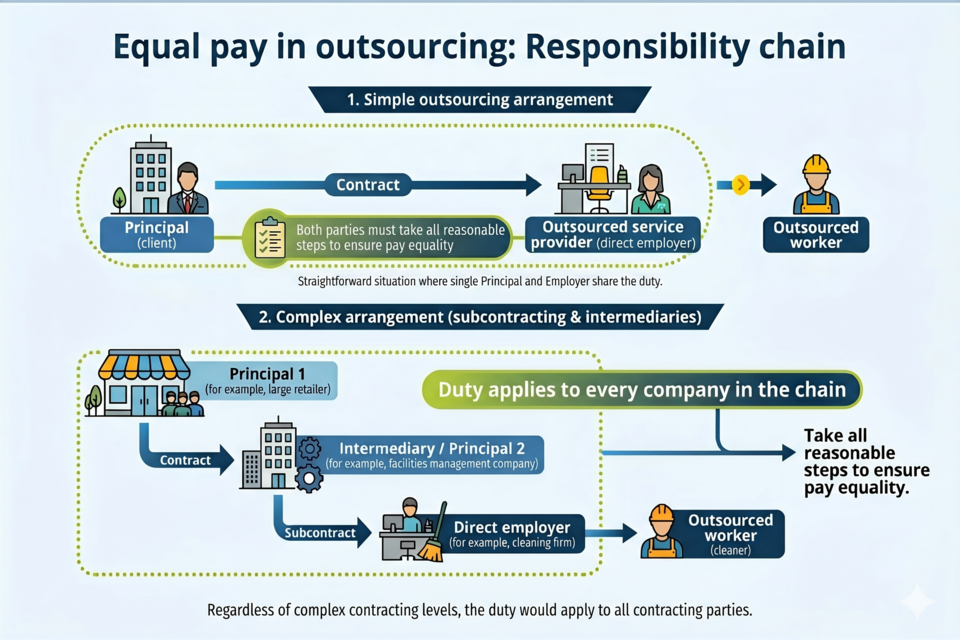
For a contractual arrangement to qualify, we propose that the work in question will need to meet a minimum threshold and be connected to a task that is of more than short-term duration. For example, a one-off task such as providing catering services for a single specific event is unlikely to come within the scope of the duty.
The duty would place a general requirement on contracting parties alongside a power enabling regulations to specify any steps that would be considered reasonable, as well as steps that would not be considered reasonable. To provide certainty to businesses and prevent the risk of lengthy, costly litigation over what constitutes compliance, we intend to use this regulatory power to set out specific steps that would, and would not, be considered reasonable in specific contexts alongside comprehensive guidance.
The reasonable steps contracting parties would be expected to take will depend on their specific circumstances. Relevant considerations would include their size, resources, and whether they are in a position to dictate the terms and conditions of the companies with whom they contract. As such, we envisage the duty’s requirements to be proportionate to the party to which it applies.
This proposed duty is not intended as a rigid or automatic requirement to equalise wages across different employers. Instead, the aim is to establish a flexible, case-specific framework where any reasonable steps are scaled to an individual employer’s circumstances. As a practical example, reasonable steps for a medium-sized employer (with around 100 employees) operating as a principal or intermediary could include requesting pay and demographic data from other parties in the supply chain.
As above, we propose that the duty to take all reasonable steps applies to all parties to the outsourcing arrangement, including:
- the principal(s)
- the outsourced service provider(s)
- intermediaries in more complex chains
This would mean that any or all of the parties involved could be liable for a breach of the duty, as it applies to them. Whether or not a party has breached the duty would depend on what steps are considered reasonable for them to take.
Those found to have breached the duty would not be required to pay compensation to affected workers. But the Employment Tribunal would require whatever steps were considered reasonable for each party to ensure pay equality in their contractual arrangements in the future.
We propose that in the event of a breach of the duty, the Equal Pay Regulatory and Enforcement Unit (see section 2) will be able to bring a claim in the Tribunal or use its other enforcement powers, such as its investigation powers. As the duty is intended to be enforced by the Unit, we do not propose that individual employees are able to bring claims for a breach of this duty themselves.
Guidance will be provided to help employers understand their responsibilities under this new duty. We will also consider strengthening guidance to improve compliance with existing legislation where that could support pay equality in some outsourcing contexts.
For example:
- guidance to improve compliance with the TUPE regulations and the Equality Act 2010 in relation to pay discrimination, ensuring that employers understand their obligations relating to equal pay when transfers occur
- guidance to improve compliance with the Public Sector Equality Duty in relation to outsourced workers and scenarios
Doing so could provide important clarity for both workers and employers.
We know that most businesses rightly do not want to be associated with practices like paying unequal wages for equal work through outsourcing. By creating a positive duty on employers, we will raise standards and stop undercutting. This will allow businesses to compete in a fair ‘race to the top’.
Question 64: Do you agree or disagree with the proposal to introduce a new duty on contracting parties to take all reasonable steps to uphold pay equality in contractual arrangements?
Question 65: Please explain your answer.
Question 66: Do you agree or disagree that the Equal Pay Regulatory and Enforcement Unit should be able to enforce this duty?
Question 67: Please explain your answer.
Question 68: Do you agree or disagree that the duty to take all reasonable steps should apply to all parties involved in the outsourcing arrangement? This would mean that the principal(s), outsourced service provider(s) and intermediaries in more complex chains could be liable for a breach.
Question 69: Please explain your answer.
Question 70: What specific steps do you think would be reasonable and proportionate for either a small, medium or large employer to take to fulfill this duty?
Question 71: Do you agree or disagree that contracting parties should not be required to pay compensation but should be required to take reasonable steps to ensure ongoing pay equality in their contractual arrangements?
Question 72: What remedies do you believe should be available to a claimant when a contracting party is found to be in breach of this duty? Please provide details on the types of remedies or corrective actions you would like to see implemented.
For businesses and employers only:
Question 73: Does your business act as an external service provider that supplies labour or services to another organisation?
Question 74: [If yes to question 73] Do you think your business would need to review the contractual terms of your employees to meet these proposals?
Question 75: Does your business act as a ‘principal’ by commissioning and receiving work or services that are fulfilled by outsourced workers through external providers?
Question 76: [If yes to question 75] Do you think your business would need to review the contractual terms of your employees to meet these proposals?
Read more about how to respond.
Promoting pay equality in contractual arrangements: Impacts
The proposed measures in this chapter aim to ensure employers uphold pay equality in their contractual arrangements.
We are seeking your views to strengthen the evidence base to inform our future policy.
Question 77: If the proposals set out in this chapter were implemented, how might employers change how they operate? For example, regarding recruitment practices or pay and conditions.
Question 78: If the proposals set out in this chapter were implemented, what costs do you think businesses would face, if any? For example, wage, administrative or legal costs.
Question 79: Are there any proposals set out in this chapter that may take businesses more than a year to implement?
Question 80: Please explain your answer including how long you think any proposal may take to implement?
Question 81: Are there other changes aimed at promoting pay equality in contractual arrangements that you think the government should consider?
Read more about how to respond.
Geographical scope
We will establish the geographical scope for the particular measures listed in this consultation through:
- the findings of this consultation
- ongoing discussions with the Scottish and Welsh governments
The Equality Act 2010 broadly applies to England, Wales, and Scotland.
To ensure a consistent approach, we propose replicating this existing geographical scope for the proposed measures, so that it is the same as the existing equal pay and discrimination provisions (that is, direct, indirect, discrimination arising from disability, and reasonable adjustments provisions).
This means the geographical scope of these proposed measures is intended to cover Great Britain (England, Scotland and Wales) only.
Question 82: Do you agree or disagree that the proposed measures should retain the same geographical scope as the discrimination and equal pay provisions of the Equality Act 2010 (applying to England, Wales, and Scotland)?
Read more about how to respond.
Next steps
The responses gathered from this consultation will be used to directly inform the government’s next steps.
Following the conclusion of the consultation, the government will carefully review all of the submitted feedback to ensure that the potential impacts of the proposals are fully understood before making a final decision on implementation. This stage of policy development is intended to refine the proposals so that they are well-targeted and work effectively for businesses, workers, and the tribunal system alike.
The feedback received will help the government fulfill its core objectives of preventing pay discrimination before it happens and providing effective legal protections when it does.
Ultimately, the proposed reforms will shift the focus from reactive litigation to proactive prevention, while significantly improving the adjudication process.
By streamlining the legal framework, such as through the proposed reviews of the rules of procedure and independent panel of experts, we seek to make pay disputes much easier to resolve, saving valuable time, money and resources for all parties.
Glossary of terms
Pay inequalities
Where differences in pay between individuals and/or groups are related to a protected characteristic.
Pay discrimination
Although this term is not used in the Equality Act 2010, it is used in this consultation to describe pay discrimination experienced on the basis of a protected characteristic, such as in a claim brought under the direct, indirect (where relating to sex, disability or race), discrimination arising from disability, or reasonable adjustment provisions, or the equal pay scheme.
Equal Pay
As required by the Equality Act 2010, men and women performing “equal work” must receive equal terms and conditions of employment, including equal pay.
Equal work
Equal work is the broad term which describes the 3 different ways in which the work of a woman can be equal to that of a male comparator (or vice versa) under the equal pay scheme. A person’s work is equal to that of another if it is:
a) “like” the other person’s work
b) “rated as equivalent”, or
c) of “equal value”
“like” the work of a comparator: “Like” work means that the work is “the same or broadly similar” to another person’s work.
“rated as equivalent” to the work of a comparator: “Rated as equivalent” means that a ‘job evaluation study’ or ‘job evaluation scheme’ (JES) has been conducted by the employer, which has given an equal value to the jobs of the claimant and the comparator in terms of the demands made on the workers, by reference to factors such as effort, skill and decision-making.
“of equal value to” the work of a comparator: This means that the work is neither “like”, nor “rated as equivalent” to the comparator’s work, but is nevertheless assessed by the tribunal as equal to the comparator’s work, in terms of the demands made on the claimant by reference to factors such as effort, skill and decision-making.
Direct discrimination
Direct discrimination is when a person is treated less favourably than another because of a protected characteristic.
Indirect discrimination
Indirect discrimination arises if:
there is a provision, criterion or practice that puts or would put the claimant, and persons with whom they share a relevant protected characteristic, at a particular disadvantage when compared with those who do not share the characteristic
the person applying the provision, criterion or practice cannot show that it is a proportionate means of achieving a legitimate aim
In a pay ‘indirect’ discrimination claim, the claimant would need to show that a policy, such as one relating to performance-related pay, adversely affects or would adversely affect the claimant and others who share a particular protected characteristic, such as disability, compared with others with whom the claimant does not share the particular protected characteristic. If they were able to do this, the employer would need to show that the performance-related pay policy was a proportionate means of achieving a legitimate aim.
Outsourcing
The term ‘outsourcing’ is not used in UK law and there is no ready-made model definition that could be used. We know that changing business models and employment practices may mean that any one definition of outsourcing may risk missing practices or arrangements which do not conform to a traditional outsourced service provider model.
Understood broadly, outsourcing could be taken to refer to a range of situations in which there is some kind of intermediation between workers and the organisations that need their work (‘the principal’). This could include the use of traditional outsourcing of services through an external service provider but also the use of arrangements such as subcontracting, umbrella companies, labour providers or employment agencies. This may involve employees working for a principal company being transferred to an external provider to provide a service. It may also involve scenarios where those workers have never been employed by the principal company. In this document, we use the term ‘outsourced workers’ to refer to workers in all such scenarios.
Such practices can lead to the creation of complex labour supply chains. For example, an engineering business (the principal) may award a maintenance contract to another company, which then uses a labour provider to recruit the workers it needs. The labour provider could then use an umbrella company to pay the workers delivering the project. The workers would undertake the maintenance while wearing the uniform and complying with the requirements of the engineering business, while in fact being employed by the umbrella company, several contracts removed.
-
Including Baker and others, Pay Transparency and the Gender Gap, (American Economic Journal: Applied Economics vol. 15, no. 2, April 2023 pp. 157–83 2022), Obloj and Zenger, The influence of pay transparency on (gender) inequity, inequality, and the performance-basis of pay (Nature Human Behaviour, May 2022), Bennedsen and others Gender wage transparency and the gender pay gap: A survey (Journal of Economic Surveys Volume 37, Issue 5, December 2023), Cullen, Is Pay Transparency Good? (The Journal of Economic Perspectives, Vol. 38, No. 1 Winter 2024, pp. 153-180), Gamage and others, Pay transparency intervention and the gender pay gap: Evidence from research-intensive universities in the UK (British Journal of Industrial Relations 2023). ↩
-
An “equal pay breach” is defined uUnder s.139A Equality Act 2010 as, this includes both a breach of an equality clause orand a “contravention in relation to pay of section 39(2), 49(6) or 50(6), so far as relating to sex discrimination”. ↩
-
As part of stage 2, an employment judge will usually refer to a member of the Panel of Independent Experts to prepare a report setting out if the work of the claimant and comparator is of equal value. ↩
-
The Equality Act 2010 (Equal Pay Audits) Regulations 2014 (SI 2014/2559) ↩
-
An “equal pay breach” is defined under s.139A Equality Act 2010 as a breach of an equality clause or a contravention in relation to pay of section 39(2), 49(6) or 50(6), so far as relating to sex discrimination ↩
-
Capper Pass Ltd v Allan [1980] ICR 194 EAT. ↩
-
Equality and Human Rights Commission guidance on ‘equal work’, August 2020. Available at: https://www.equalityhumanrights.com/guidance/equal-pay/equal-work. ↩