Electricity network infrastructure: consents, land access and rights - government response
Updated 27 April 2026

© Crown copyright 2026
This publication is licensed under the terms of the Open Government Licence v3.0 except where otherwise stated. To view this licence, visit nationalarchives.gov.uk/doc/open-government-licence/version/3 or write to the Information Policy Team, The National Archives, Kew, London TW9 4DU, or email: psi@nationalarchives.gov.uk.
Where we have identified any third party copyright information you will need to obtain permission from the copyright holders concerned.
This publication is available at https://www.gov.uk/government/consultations/electricity-network-infrastructure-consents-land-access-and-rights/outcome/electricity-network-infrastructure-consents-land-access-and-rights-government-response
Executive summary
The government has committed to delivering cheaper, cleaner and more secure power by 2030 and achieving net zero by 2050. Our once-in-a-generation expansion of the electricity grid is central to this ambition, enabling the rapid connection of clean power and reducing reliance on gas-driven wholesale prices. An improved planning and consenting environment will help accelerate the expansion and upgrade of transmission and distribution networks; limiting consumer exposure to network constraint costs, which without further mitigating action could rise to around £7bn in 2030/31.[footnote 1]
Upgrading and expanding the electricity network is not optional. It is a national imperative, and we cannot afford delay. Grid expansion is foundational to our Industrial Strategy. After decades of under-investment, we need a significant expansion of our electricity network to enable widespread electrification of the economy and deliver a cleaner, more efficient power system. Electricity demand is forecast to double by 2050[footnote 2]. Analysis from the National Energy System Operator (NESO) suggests that Great Britain will need around twice as much new transmission network by 2030 as was delivered in the past decade[footnote 3] and between 210,000 and 460,000km of additional distribution network cabling by 2050 compared to current levels. This investment is critical for the energy transition and supporting long-term economic growth. We also want to ensure that the investment in our network infrastructure supports growth in the domestic supply chain and skills needed. Therefore, we are working with the electricity networks sector as part of the development of a Sector Growth Plan. The Electricity Networks Sector Growth Plan interim report[footnote 4], published in December 2025, found that tens of thousands of jobs are expected to be created across electricity transmission and distribution network operators, their supply chains and contractors.
The critical expansion of our electricity networks means more requests for consents, land access and rights. The existing framework was not designed to support the pace or scale of infrastructure now required. Delays in securing consents, land access and rights can be costly, diverting resources and creating uncertainty for Network Operators, landowners and, ultimately, billpayers. Through a call for evidence[footnote 5] in 2022, stakeholders were clear that reform was needed to ensure processes could keep pace with future network requirements. Building on this feedback and further engagement with key stakeholders, this government consulted in July 2025 on a package of proposed reforms[footnote 6] to consents, land access and rights. These reforms seek to address 3 key issues:
- Consent is required for too many low-risk cases: current rules require consent for minor upgrades that do not materially increase the impact of the infrastructure or the visual effects on the surrounding area. Obtaining consent for these works diverts time and resource away from more complex applications.
- Certain procedures are not fit for purpose: existing processes for obtaining consents, land access and rights can be inefficient and take too long.
- Some land rights processes lack clarity or long-term certainty, creating risk for network delivery and, ultimately, for security of supply.
We received constructive feedback to the consultation from respondents across the breadth of those who would be affected by the reforms and have assessed what aspects of the original proposals should be adapted, or where further reform is needed. In response, the government reconvened the Land Access and Consents Working Group to discuss opportunities to introduce more ambitious changes. The Land Access and Consents Working Group was established in 2024 by government, following the call for evidence, to act as a forum for generating and appraising ideas to improve consents, land access and land rights processes. The Working Group met 6 times between April 2024 and May 2025. The Working Group included representatives from various affected stakeholder groups, including Network Operators and organisations representing landowners. It also included the Planning Inspectorate, Scottish Government, Welsh Government and other government departments, amongst others.
This government response sets out how we will address these issues through an ambitious package of reforms that will have an impact in supporting the faster delivery of critical electricity infrastructure while continuing to protect the rights of landowners, communities and the environment.
Necessary Wayleaves
Licence Holders must secure a right to install and retain electricity lines on private land. In most cases, these rights are secured through negotiation of a contractual arrangement with the landowner and / or the occupier of the land. However, where agreement cannot be reached, the Licence Holders, who have a public service role to undertake, may rely on compulsory powers, including the grant of ‘Necessary’ (compulsory) Wayleaves under Schedule 4 to the Electricity Act 1989.
Necessary Wayleaves play a critical role in ensuring the timely delivery and ongoing operation of an efficient and economical electricity network and allow Licence Holders to secure land rights required for new connections to the grid. However, long processing times and a sustained rise in applications have highlighted growing inefficiencies in the current process. Without reform, these delays risk impeding the delivery of essential electricity network infrastructure, increasing costs to government and bill payers, and undermining the pace required to support economic growth and the transition to clean power.[footnote 7]
The government will make changes to the existing process for applying for the grant of a Necessary Wayleave (NW) to provide greater clarity for parties and support efficient and timely decision-making by:
- requiring certain information be provided as part of the NW application process, including the reasons why a landowner/occupier is requesting the removal of existing electric lines and associated equipment;
- increasing the temporary continuation of a NW from 3 months to 6 months;
- allowing Licence Holders[footnote 8] to submit a NW application for existing electric lines in certain circumstances without first receiving a request from the landowner/occupier to remove it;
- allowing applications to be heard by officials acting on behalf of the Secretary of State rather than a third party (currently the Planning Inspectorate/Planning and Environment Decisions Wales, and Reporters in Scotland);
- publishing timescales for the determination of NW applications in England and Wales;
- removing the requirement to seek agreement from the parties to follow the written representations procedure for determining a NW application;
- providing Inspectors with discretion to conduct oral hearings virtually where they consider this appropriate in the circumstances of the case;
- introducing a power for the Secretary of State to ‘close’ NW applications that are not being progressed;
- introducing the requirement to consider Alternative Dispute Resolution (ADR) prior to a compensation claim for NW being taken to the Upper Tribunal (Lands Chamber), and allowing the Upper Tribunal to take participation in ADR into account when awarding costs; and
- increasing the standard term for NWs from 15 to 40 years, with the Secretary of State retaining the discretion to grant NWs for a shorter or longer period where appropriate
Tree lopping and felling
The trimming and felling of trees and other vegetation is critical to the resilience of the electricity network. The inability to manage vegetation in a timely manner increases the likelihood of a tree or branches falling and damaging distribution network infrastructure. This can result in network lines being de-energised, which in turn can impact the running arrangements of the network and fault restoration and can lead to outages for customers. Compounding this issue, current legislation places primary responsibility for vegetation management on landowners rather than on Network Operators themselves. This approach is misaligned with the practical realities of operating a live network: Licence Holders and their agents have the specialist expertise, training and safety systems required to work safely around energised equipment. Requiring landowners to undertake vegetation management heightens safety risks and undermines the secure and reliable operation of electricity networks.
Furthermore, under the current legislative framework, where agreement cannot be reached with a landowner on a voluntary basis, Network Operators must rely on formal tree lopping orders; a process that can be protracted and divert resources away from other critical work.
The government will make Licence Holders responsible for undertaking tree lopping and vegetation management works. Landowners can continue to undertake these works in consultation with the Licence Holder where it is deemed safe and expedient to do so.
The government will also expand statutory access rights for Licence Holders so they can enter land to carry out tree lopping as far as is necessary for safety purposes subject to a 21-day notice period. This will replace the existing tree lopping process under Schedule 4 of the Electricity Act 1989. We will update guidance to provide clear safety standards for tree lopping for different types of infrastructure and voltage. The Licence Holder will be required to compensate the landowner for any loss or damage incurred as a result of the works.
Permitted Development Rights for substations
Substations in England that are housed in a chamber of up to 29 cubic metres currently fall within the threshold for permitted development. Licence Holders do not need to submit a planning application for substations within this size if they meet specified conditions. However, this threshold creates a regulatory distinction whereby marginally larger substations are subject to full planning approval. In these instances, the requirement to submit a planning application to the relevant local planning authority can introduce significant additional cost, delay and administrative burden for both Licence Holders and the local authority. As electricity networks are upgraded and extended to meet rising demand and to enable the transition to low-carbon technologies, substations exceeding the 29 cubic metre threshold are expected to become more common. The current threshold therefore risks creating unnecessary delays to the rollout of essential local electricity infrastructure and slowing deployment of electric vehicle charging stations, where most supporting substations exceed 29 cubic metres.
The government will increase the permitted development threshold (under Class B of Part 15 of Schedule 2 of the General Permitted Development Order) for electricity substations in England from 29 cubic metres to 45 cubic metres, in line with regulations in Scotland. This change will enable Network Operators to deliver capacity upgrades more efficiently, support the expansion and reinforcement of the electricity distribution network, and reduce administrative burdens on local planning authorities.
For substations exceeding 29 cubic metres, the permitted development right will only apply where the substation does not exceed 3 metres in height and is not located within 5 metres of a dwelling. In certain protected areas (see the Proposal 7 government response), prior approval from the local planning authority on the siting and appearance of substations will be required to mitigate local impacts. The extended permitted development right (for substations which exceed 29 cubic metres but do not exceed 45 cubic metres) will not apply in Sites of Special Scientific Interest (SSSIs) and European Sites.
Section 37 (of the Electricity Act 1989) consenting for overhead lines
The current consenting regime requires formal approval for a wide range of overhead line works, irrespective of their scale, complexity or impact on landowners and the surrounding landscape. This one-size-fits-all approach means that straightforward, low-impact works are subject to the same procedural requirements as more complex or sensitive works. As electricity demand grows and the network evolves to support low-carbon technologies, this rigidity is placing increasing pressure on the consenting system. The resulting pressure on consenting bodies risks creating avoidable delays, diverting limited resource away from genuinely complex cases or those in designated areas. This slows the delivery of essential network upgrades needed to support growth and the transition to clean power.
The government will reform the section 37 (of the Electricity Act 1989) consenting process for overhead lines to accelerate delivery, minimise delays to essential upgrades and reduce unnecessary administrative burdens on Network Operators and planning authorities, through the reforms set out below:
In non-protected areas only (meaning areas outside National Parks, the Broads, National Landscapes, European Sites and SSSIs), we will:
- exempt upgrades from single-phase to 3-phase overhead lines, up to a voltage of 11 kV, from requiring section 37 consent
- exempt upgrades of the nominal voltage of an existing line up to 11 kV from requiring section 37 consent
- raise the threshold at which consent is required for installing or maintaining an overhead electric line to 33 kV, where the line is intended to serve up to 4 customers
In all areas, except SSSIs and European sites, we will:
- extend the current exemption for ‘minor works’ to National Parks, the Broads and National Landscapes. Minor works includes replacement of like-for-like pole supports and the replacement of open conductors with bundled conductors. Prior approval from LPAs will not be required for these minor works, provided the works meet the specified conditions
We will amend the limitations within existing exemptions by:
- increasing the maximum allowable distance for permanent diversions of a line (provided the voltage remains the same) to 60m for small supports and 100m for large supports
- increasing the allowable increase in pole support height to 20% for all supports
These changes will apply only where exemptions already exist under current regulations, including whether exemptions apply in protected areas. We will continue to engage with the Scottish Government on how the relevant exemptions should apply in Scotland, recognising that separate exemptions apply in Scotland. In addition to the above changes to consent requirements, we will publish timescales for determining section 37 applications in England and Wales.
We will also remove the requirement in England and Wales for the Secretary of State to hold a public inquiry in every case where a planning authority raises an objection to a section 37 application. Instead, the Secretary of State will have the discretion to call a public inquiry, hearing or other process where appropriate.
Private streets
Licence Holders often face slow and complex processes when accessing private streets to carry out routine maintenance or low risk but critical upgrade works. To support the efficient rollout of low carbon technologies and reduce administrative burdens, the government will make changes to ensure that a Licence Holder’s ability to undertake works in private streets is more consistent with other types of public streets or highways, whilst bringing Licence Holder’s rights to carry out works without consent in line with those of other utilities, such as gas.
The reforms will allow Licence Holders to temporarily break up or open private streets for the purpose of installing or upgrading electricity infrastructure without requiring consent from private street authorities. To maintain fairness and certainty, we will ensure that appropriate safeguards are in place for private street owners. These will include statutory notice periods, requirements for the private street or road to be reinstated to its previous condition, and obligations for the Licence Holder to conduct remedial works where reinstatement is insufficient. These requirements are in line with existing arrangements for works in streets and highways and reflect the approach taken by other utilities under the New Roads and Street Works Act 1991. The government will also introduce a formal mechanism for compensation disputes via tribunal where parties are unable to agree on compensation for private streets works. These measures will balance efficient delivery of new and upgraded network infrastructure with the protection of property rights and transparency for those with an interest in private streets.
Following stakeholder feedback, and after engaging with the Scottish Government, the UK government will extend the reforms to private roads in Scotland. This means that the measure will be in force across the entire electricity network in Great Britain.
Nationally Significant Infrastructure Projects threshold
The Planning Act 2008 sets the thresholds at which electricity network overhead line projects are classified as Nationally Significant Infrastructure Projects (NSIPs). Projects falling below these thresholds are typically consented under section 37 of the Electricity Act 1989. The NSIP regime was originally designed to provide a proportionate and streamlined consenting route for the largest, most complex and most strategically important infrastructure projects. It is becoming increasingly clear that the current thresholds are too low, inadvertently capturing electricity overhead line projects that most people would not consider to be nationally significant.
As a result, lower-impact schemes are increasingly being routed through the NSIP process, which can be significantly longer and more costly than other consenting routes. This imposes disproportionate burdens on developers and consenting authorities, introduces avoidable delay to the delivery of essential electricity infrastructure and risks diverting finite planning resources away from projects of genuine national significance.
The government will change the thresholds at which electricity overhead lines projects will be classified as an NSIP. This will allow for a more proportionate, faster and cost-effective consenting regime that will accelerate rollout of critical infrastructure and release capacity within the planning process.
We will remove wooden poles and other design successor poles carrying single circuit 132 kV lines from the NSIP regime (which will instead be consented via section 37 of the Electricity Act 1989) and increase the distance threshold for NSIP classification for overhead line projects from 2km to 15km. We will also clarify the definition of a single continuous overhead line in legislation.
Following consultation feedback, the government will introduce an additional measure through secondary legislation so that projects increasing the voltage of existing lines that cross SSSIs and European Sites will be consented under section 37 of the Electricity Act 1989, rather than through the NSIP process. Collectively, these changes ensure that the NSIP regime focuses only on genuinely ‘nationally significant’ overhead line projects.
Access rights
Access to electricity infrastructure is usually agreed voluntarily between Network Operators and landowners. However, when access is refused, projects can face longer timescales and higher costs to complete line placement, alteration and repair works. In these cases, statutory access powers are an important backstop. We will introduce 4 reforms to clarify and extend statutory access rights (in addition to the extension to tree lopping outlined above). These reforms, set out below, will support the timely and efficient delivery of infrastructure works by reducing delays caused by access issues. The government will:
- clarify that access rights for existing infrastructure apply to all land, insofar as is necessary for the purpose of repairing, altering or placing infrastructure, where there is already a line or plant in place
- extend the statutory powers of access that apply to Distribution Network Operators, to Transmission Owners
- permit certain types of voltage upgrades to take place under statutory access rights
- introduce powers to enable access to third-party land for the purpose of installing new infrastructure
The government will also introduce new protections across all access rights processes. These include strengthened statutory compensation provisions; longer notice periods for works on transmission-scale infrastructure and new infrastructure; requirements for Network Operators to inform landowners of their rights; routes to resolve disputes over compensation; restrictions on the circumstances in which powers can be used; and the development of accompanying government guidance to set out the rights and responsibilities of all parties when access powers are exercised.
To support Network Operators’ ability to exercise their access rights, we will also amend the Rights of Entry (Gas and Electricity Boards) Act 1954 to clarify that warrants can be obtained to access any land, building or structure.
Next steps
The government will make reforms to primary and secondary legislation at the earliest opportunity. We will also update the guidance documents associated with these processes as these legislative changes are made. These reforms will accelerate infrastructure delivery, streamline processes and unblock critical projects to help us reach our target of clean power by 2030. More detail on next steps can be found throughout the document.
Introduction
Our mission is to deliver clean power by 2030, because clean, homegrown energy is key to lowering bills and strengthening Britain’s energy independence.[footnote 9] Achieving Clean Power 2030 will also pave the way for decarbonising the wider economy by 2050, as we electrify heat in buildings, transport, and industry.
The electricity network is central to this transition. It transports clean power from where it is generated to the consumers and businesses who need it. Building the network of the future requires infrastructure to be delivered efficiently – on time, cost effectively and fairly.
As we electrify heat, transport, and industry on our path to net zero, electricity demand is expected to double by 2050.[footnote 10] Meeting this increase in demand will require a step change in infrastructure delivery. Around twice as much new transmission network will be needed by 2030 as was built in the past decade.[footnote 11] In addition, between 210,000 and 460,000km of additional distribution network cabling may be required by 2050.[footnote 12]
Consents, land access and rights
Fair and proportionate consents, land access and rights processes are essential for delivering the country’s network infrastructure. Land rights involve securing permission from landowners or occupiers to access, use or acquire land for building or maintaining network assets. Consenting refers to obtaining permission to build or maintain electricity network infrastructure. Both processes must protect the rights of landowners, local communities and the environment, while enabling the timely delivery of critical infrastructure.
The government recognises that the costs, complexities and delays associated with land access, rights and consenting processes can hinder or even prevent electricity network infrastructure projects from going ahead. Cases involving relatively minor changes to existing infrastructure can divert resource that would be better focused on more complex cases. To ensure the system is fit for purpose, the government has reviewed existing processes to assess whether they support our clean power ambitions, net zero goals, and energy security transformation.
Background on the consultation response
The government ran a consultation entitled ‘Electricity Networks Infrastructure: Consents, Land Access and Rights’ between 8 July and 2 September 2025, which set out a range of reforms aimed at enabling the rapid deployment of future network connections, while ensuring that the rights of landowners are respected.
This document summarises responses to that consultation. As well as setting out the responses to each question, this document explains the government’s position on each proposal, and the next steps for implementation of reforms.
The reforms apply to specific jurisdictions, which are noted under each proposal.
Summary of responses
There were 73 responses to the consultation. The respondents fell into the following categories:
- Individual (17)
- Trade, professional or representative bodies (16)
- Electricity generation owners/developer (8)
- Electricity Network Operator (7)
- Land agent or surveyor (5)
- Independent Distribution Network Operator or independent connection provider (4)
- Local authorities (4)
- National Park or National Landscape representative (3)
- Other utilities (3)
- Other electricity connection customers, including charge point operators and housing developers (2)
- Charity or non-governmental organisation (2)
- Battery storage owners/developer (1)
- Other public bodies (1)
This document does not capture every view each respondent expressed but aims to summarise the main points. The approximate number of respondents who expressed a particular view is defined according to the following descriptors:
- A few – up to 10% of the number of respondents who answered a particular question
- Some – 10-24% of the number of respondents who answered a particular question
- Many – 25-49% of the number of respondents who answered a particular question
- Majority – 50% or more of the number of respondents who answered a particular question
Methodology
All responses have been considered as a part of this consultation. A thematic analysis was conducted of all responses to identify key themes. For the purposes of this analytical summary, the team used a government Artificial Intelligence (AI)-assisted tool, ‘Consult’, to support the identification of key themes. This AI tool assisted in identifying themes and the frequency these themes occurred.
To ensure that this AI tool was robust and reliable it was subject to human evaluation. This evaluation ensured that all themes identified were reviewed and approved by human reviewers, to prevent any themes being missed.
Additional measures
Through careful review of consultation responses and engagement with stakeholders, the government heard constructive feedback that the original proposed reforms did not go far enough to unblock the critical network infrastructure needed for Clean Power 2030 and Net Zero 2050. The government has been clear that the consents, land access and rights regimes must be fit for this purpose.
Further reforms were therefore considered to deliver a more ambitious package. Many of these reforms were suggested by stakeholders in response to the consultation. To inform the development of these proposals, including how reforms might be delivered in practice and impact on different stakeholders, the government reconvened its Land Access and Consents Working Group in January 2026 for 2 extraordinary meetings, and invited further views from members following the meeting. The Working Group included representatives from affected stakeholder groups, including Network Operators and organisations representing landowners as well as the Planning Inspectorate, the Scottish Government, the Welsh Government and other government departments.
Following from this, additional measures are being taken forward. These are set out alongside consultation proposals in the relevant sections of this document. A full list of proposals is set out in Annex A.
Approach to protected areas
Protected areas in Great Britain are designed to conserve and safeguard important ecological, environmental, geological or cultural heritage features. In this response, the term ‘protected areas’ is used to refer to any of the following:
- Sites of Special Scientific Interest (SSSIs): areas protected for habitats, species and geological features under the Wildlife & Countryside Act 1981 and subsequent amending legislation. Natural England, Natural Resources Wales and NatureScot have a legal duty to oversee their protection.
- European Sites: areas designated under EU nature conservation directives, including Special Areas of Conservation (SACs) and Special Protection Areas (SPAs). Directive requirements are retained in UK law via The Conservation of Habitats and Species Regulations 2017 for England and Wales and equivalent regulations in Scotland - The Conservation (Natural Habitats &c.) Regulations 1994.
- National Parks: designated for natural beauty, wildlife, and cultural heritage, and managed to promote public understanding and enjoyment of these qualities. They are governed in England and Wales by the National Parks and Access to the Countryside Act 1949 and the Environment Act 1995, and in Scotland by The National Parks (Scotland) Act 2000.
- National Landscapes: formerly called Areas of Outstanding Natural Beauty (AONBs) and protected under the Countryside and Rights of Way Act 2000. In Scotland, the equivalent designation is National Scenic Areas.
- The Broads: a nationally significant network of rivers and shallow lakes in Norfolk and Suffolk, managed by the Broads Authority under the Norfolk and Suffolk Broads Act 1988 and Broads Authority Act 2009.
- Heritage coasts: areas established to conserve the best stretches of undeveloped coast in England. A heritage coast is defined by agreement between the relevant maritime local authorities and Natural England. Heritage coasts are not designated in legislation.
This document references protected areas under proposals on Permitted Development Rights for substations (proposal 7), section 37 Consenting for overhead lines (proposal 8) and Nationally Significant Infrastructure Project thresholds (proposal 10).
The government’s approach to protected areas varies by proposal to reflect environmental considerations and the different legal frameworks that apply, including the Town and Country Planning Act 1990, Electricity Act 1989, Overhead Lines (Exemption) Regulations 2009, and Planning Act 2008. Details on the approach for each proposal are set out in the relevant ‘government response’ sections.
Necessary Wayleaves
Proposal 1: Introduce a requirement to provide a reason when serving a Notice to Remove and extending the application submission timeframe from 3 to 6 months
Nation(s) proposal applies to: England, Wales and Scotland
Summary of responses
Q3. Do you agree with the proposed changes to the Notice to Remove?
| Response | Number of respondents |
|---|---|
| Agreed | 20 |
| Disagreed | 19 |
| Unsure | 12 |
| Didn’t Answer | 22 |
Q4. Please explain the reasons for your answer
45 written responses were received for this question.
Responses to the question were mixed. Among those who answered this question, 39% responded in agreement, with 37% disagreeing with the proposals and 24% unsure.
Many respondents supported the proposed statutory grounds for a Notice to Remove as a way to reduce terminations of existing wayleaves for financial gain and to focus negotiations on genuine issues, noting that the proposed grounds were reasonable. A few respondents also highlighted that these changes would support net zero targets so only legitimate objections are considered, thus expediting the NW process.
Some respondents raised concerns about the scope and practicality of the proposed statutory grounds. For example, a few felt that the list of grounds was too broad and risked normalising compulsory powers, potentially eroding property rights and trust in the process. Others argued that compensation should be included as one reason within a broader list, with the option to select multiple grounds as reasons for removal. Several respondents stated that they found the proposal contradictory. In particular, they questioned how a Notice to Remove could be valid if it stated there was agreement for the electric line to remain in place. They also questioned how the proposed list of grounds for removal would align with the current legal tests of necessity and expediency.
A few respondents agreed with the principle of providing reasons but expressed uncertainty about the appropriateness of some proposed grounds, particularly health and safety risks. For example, some questioned whether ‘a risk to health and safety’ needed to be included in the list of potential reasons for removal, given the regulated standards for electrical equipment maintenance.
Some respondents wanted the proposals to go further, calling for clearer and more prescriptive legislation and stronger evidential requirements. For example, a few suggested that redevelopment should only be a valid ground for the removal of electrical equipment if there is substantial justification and evidence that the redevelopment is more than just a future hope, for example evidence of a submitted or approved planning application. Others advocated for a presumption of retention of existing electricity apparatus, with removal only permitted on narrowly defined grounds aligned with existing legislation. One respondent proposed that Network Operators should be able to offer retain-and-pay solutions, especially for high-voltage assets, if that best aligns with their licence obligations.
Q5. Do you support the extension of the timeframe in which a Licence Holder is obliged to submit an application for a Necessary Wayleave or otherwise to comply with the Notice to Remove from 3 months to 6 months?
| Response | Number of respondents |
|---|---|
| Agreed | 28 |
| Disagreed | 17 |
| Unsure | 4 |
| Didn’t Answer | 24 |
Q6. Please explain the reasons for your answer. What should the timeframe be and why?
43 responses were received for this question.
Of respondents who answered question 5, a majority (57%) supported this proposal. Many respondents supported the extension from 3 to 6 months, considering it a reasonable change that would provide extra time and flexibility for negotiations, encourage voluntary agreements, and improve the quality of applications. For example, some felt that the longer period would allow more time for engagement with affected parties, enable more thorough preparation of applications, and reduce the number of applications needed by facilitating voluntary settlements and supporting mediation processes. A few respondents highlighted that the extension would be equitable for landowners, giving them more time to present evidence and supporting compromise. Others noted that complex negotiations often take longer than 3 months, and the additional time would help avoid unnecessary appeals and administrative burden.
Some respondents opposed the extension, arguing that it risks prolonged uncertainty for landowners, infringes property rights, and could delay development projects. For example, some felt that the current 3-month period strikes a better balance between allowing space for discussions and timely resolution of any NW application, and that extending this time period would tip the scales in favour of electricity operators. A few respondents expressed concern that longer deadlines may encourage delay rather than genuine engagement, and that the extension could be used tactically by Licence Holders to pressure landowners into accepting poor terms. Others suggested that the issues causing delays lie elsewhere in the planning and consenting process, not in the statutory timeframe itself. One respondent noted that the extension would only be relevant in a minority of cases and that meaningful negotiations should already have taken place before a Notice to Remove is served.
A few respondents suggested an alternative approach, proposing that the 3-month deadline be retained but extended where both parties agree. For example, one respondent recommended that written agreement to delay should be presented to the Secretary of State by both parties, allowing negotiations to continue as long as needed without unnecessary delay to cases where negotiation is not constructive or possible.
Q7. Do you have any further comments about the proposal to amend the Notice to Remove?
21 responses were received for this question.
Many respondents representing developers highlighted the need for a costs award in NW hearings, arguing this would deter unproductive behaviours, such as lack of engagement, and streamline the process. A few respondents called for reforms to Schedule 4 of the Electricity Act 1989, suggesting a streamlined process for new apparatus and the introduction of model notices to clarify and expedite proceedings. Some also advocated for a fast-track process for cases where compensation is the only issue in dispute, allowing such matters to be resolved outside the NW process. One respondent suggested that timescales for relocating assets should be based on voltage, and another called for measures to encourage faster response times from local authorities.
Many stressed that both parties should be required to demonstrate that they have engaged in fair and meaningful negotiations before proceeding with a NW application. For instance, several respondents insisted that compulsory measures should only be used when negotiation, mediation, and fair compensation have been genuinely exhausted, and that independent oversight is needed. Some noted that some Distribution Network Operators (DNOs) will only engage on the landowner’s request for a new agreement when a Notice to Remove is served. These respondents argued that such practices can delay development and create an imbalance of power, undermining trust in the system.
One respondent emphasised the importance of the Rights over Land for Electricity Infrastructure Code of Practice, which provides guidance on the Notice to Terminate/Remove procedure. This perspective highlighted that all stakeholders – not just landowners and their agents – have a role in making the process efficient and in avoiding unnecessary notices being served.
Government response
The government will introduce a requirement for all notices and NW applications to be served and/or submitted on prescribed forms. This is intended to provide greater certainty and clarity around the intentions of all parties to support the negotiating process and ensure that queries by the landowner are not treated by Licence Holders as a formal request to remove the infrastructure. That is, the introduction of prescribed forms will support both Licence Holders and, ultimately, the Department for Energy Security and Net Zero in determining whether Notices and subsequent applications are compliant with the requirements set out in the Electricity Act 1989. It is the government’s intention to proceed with the proposal to require a reason to be provided when serving a Notice to Remove (NTR) as part of the prescribed form and to extend the application timeframe from 3 to 6 months.
This will assist in identifying and reducing the number of precautionary and/or invalid applications early in the process, making the process more efficient for all. Licence Holders will still be able to submit applications as soon as a NTR is received where it is clear that a negotiated voluntary wayleave agreement is unlikely to be reached, though may wish to use the new powers described below.
The government welcomes the feedback provided relating to the reasons that should be permissible when a Notice to Remove is served. It is the government’s intention to work closely with Network Operators and landowner/occupier representatives in the design of the relevant notices and forms before publication, including how the requirement to provide reasons should be reflected in these documents.
Additional measure
Give the Secretary of State the power to enable Licence Holders to initiate the Necessary Wayleave process for existing lines in certain circumstances
Nation(s) proposal applies to: England, Scotland and Wales
-
Current situation: For existing lines, a landowner may serve a NTR seeking the removal of an existing electric line:
- a) When there is no wayleave in place
- b) Where there is a wayleave in place, but it has been terminated in accordance with the terms of that agreement
- Licence Holders may only apply to the Secretary of State for the grant of a NW for an existing line if a NTR has first been served.
Summary of stakeholder feedback: In response to the consultation Network Operators noted that the inability to apply for NW in respect of existing lines in the absence of a NTR could put large scale infrastructure and security of supply at risk where, for example, existing wayleaves are terminated by landowners/occupiers at short notice or land is sold and the existing voluntary agreement is no longer in place. They were therefore broadly in favour of this proposal when it was discussed at the Working Group in January 2026, which would allow for security of supply particularly in instances where land has changed hands.
Landowner representatives consulted as part of the Working Group noted that permanent, successor-binding rights can already be secured voluntarily (such as easements), but were not opposed in principle to the idea of giving Licence Holders the power to apply for a NW in respect of existing lines, provided that the circumstances were limited to cases in which this was necessary.
When this issue was discussed at the Working Group in January 2026, landowner representatives emphasised that Licence Holders should be required to evidence meaningful attempts to contact and negotiate with landowners before applying for a NW for an existing line, and that strong safeguards are needed to prevent misuse, including clear guidance, robust evidential standards, and protections for landowners such as explicit rights to independent professional representation with reasonable costs met by the Licence Holder. Suggestions as to how this change could be implemented also included limiting any new right to infrastructure above a defined voltage threshold.
Details of reform measure: The government will give Licence Holders the right to apply to the Secretary of State for a NW for existing lines, without first having to receive a NTR in certain circumstances – such as, for example, existing lines with a voltage of 132 kV or above. The precise circumstances will be set out in secondary legislation.
Parties will continue to be encouraged in guidance to reach negotiated settlement before any application is made seeking the exercise of compulsory powers such as NW.
Next steps: At the earliest legislative opportunity, the Secretary of State will be given the power to make regulations on when a Licence Holder can trigger the NW process for existing lines.
The government will work with Network Operators and landowner/occupier representatives ahead of the introduction of secondary legislation to test the circumstances in which an application for a NW will be possible for an existing line in the absence of a NTR.
Proposal 2: Removing the requirement to seek consent of the parties for the written representations procedure to apply and Proposal 3: Facilitating the use of virtual hearings where an Inspector considers this to be appropriate
Nation(s) proposal applies to: England and Wales
Summary of responses
Q8. Do you agree that written representations should apply without requiring the consent of the parties?
| Response | Number of respondents |
|---|---|
| Agreed | 35 |
| Disagreed | 10 |
| Unsure | 3 |
| Didn’t Answer | 25 |
Q9. Please explain the reasons for your answer. In what circumstances, if any, should oral hearings be used?
42 written responses were received for this question.
Of respondents who answered question 8, a majority (73%) supported this proposal.
Many respondents supported the proposal to make written representations the default procedure, citing the potential for improved efficiency, cost-effectiveness, and timely decision-making. Some respondents who agreed were also of the view that oral hearings should be available if requested by either party and/or that oral hearings should be granted at the discretion of the Department or Inspector, noting that this was especially important for complex cases or those of strategic national importance. Some respondents also welcomed the flexibility of virtual hearings. A few respondents suggested alternative or additional measures, such as allowing audio or video submissions to bridge the gap between oral and written formats and using AI to transcribe and summarise key points. Overall, the majority view supported the use of oral hearings only in exceptional or complex cases.
Some respondents disagreed or were unsure about the proposed change. Many of these respondents expressed concern that removing the requirement for consent and defaulting to written representations could undermine fairness and procedural justice. They argued that oral hearings are essential when there are significant disputes of fact, serious impacts on landowner rights, or a need to cross-examine evidence – especially regarding the necessity and expedience of retaining infrastructure. A few respondents emphasised the importance of direct engagement with decision-makers and the limitations of written submissions in conveying site-specific impacts. Some respondents raised legal concerns, referencing Article 1 of the First Protocol and Article 6 of the European Convention on Human Rights, which protect property rights and the right to a fair hearing. A few respondents warned that written-only procedures could lead to frustration, disengagement, or judicial review challenges. The overall sentiment among opponents was that fairness and transparency must not be sacrificed for efficiency.
Q10. Do you agree that a request for an oral hearing should be made at submission of evidence stage?
| Response | Number of respondents |
|---|---|
| Agreed | 28 |
| Disagreed | 9 |
| Unsure | 5 |
| Didn’t Answer | 31 |
Q11. Please explain the reasons for your answer. When should such a request be made?
31 written responses were received for this question.
Of respondents who answered question 10, a majority (68%) supported this proposal. Many respondents supported the idea that oral hearings should be requested at the evidence submission stage, citing benefits such as procedural clarity, fairness, and efficiency. Some respondents noted it was the most logical point to assess the need for an oral hearing because it is where the decision-maker would have a full understanding of the case. Some respondents who agreed reasoned that oral hearing requests should be justified with evidence, so that oral hearings only occur where necessary. Early clarity as to the form of hearing would help to minimise unnecessary delays and administrative burden, while still allowing flexibility in exceptional circumstances. A few respondents noted that oral hearings are suitable for strategically significant cases, such as for high-voltage assets, to ensure full understanding of evidence which would strike a balance between facilitating robust examination of complex or strategically significant cases, and maintaining an efficient, cost-effective process for standard matters. There was also support for cost or penalty provisions to discourage unreasonable behaviour, such as failing to attend a scheduled oral hearing.
Of the few that disagreed, respondents were of the view that oral hearing requests should be allowed at various stages to accommodate new facts or submissions. There was concern that rigidly fixing the hearing format early in the process could hinder flexibility and responsiveness to evolving evidence. A few respondents also proposed that oral hearings should be granted in exceptional circumstances where written representations are insufficient, or the need to present certain evidence in-person is absolutely necessary. A few respondents expressed concerns that a permissive approach to oral hearings could enable one party to delay proceedings or increase costs, particularly in contentious negotiations. A few suggested that in circumstances where requests for an oral hearing are rejected, consideration should be given to additional flexibilities around the provision of further written evidence. Others stressed that Inspectors should retain discretion over whether a hearing is needed, and that parties should not be prejudiced if they do not request one at the outset.
Q12. Do you agree with the proposal to hold oral hearings virtually at the discretion of the Inspector?
| Response | Number of respondents |
|---|---|
| Agreed | 29 |
| Disagreed | 15 |
| Unsure | 4 |
| Didn’t Answer | 25 |
Q13. Please explain the reasons for your answer
39 responses were received for this question.
Of respondents who answered question 12, a majority (60%) supported this proposal. Many respondents supported the use of virtual hearings, highlighting significant benefits such as reduced time and cost, greater administrative efficiency, improved accessibility and consistency with other court hearings. Some respondents noted that virtual hearings are especially helpful for landowners who might otherwise have to take significant time off work or travel long distances, with the use of virtual hearings in Wales held in ‘round table’ format cited as an example of where virtual hearings can be used to provide an accessible format, especially for landowners representing themselves. A few respondents suggested that virtual hearings should be the default, with in-person hearings reserved for more complex cases or where a participant would be disadvantaged by a virtual format. Overall, the majority view was that virtual hearings, when managed effectively and with proper safeguards for those with limited digital access, offer a pragmatic and modern approach to oral hearings.
Many respondents disagreed or were unsure about the proposed change. Many of these respondents expressed concerns about making virtual hearings the default or leaving the decision solely to the Inspector’s discretion. Some argued that virtual hearings may disadvantage landowners without reliable digital access or those who require face-to-face dialogue to fully represent their interests. For instance, several respondents emphasized that a physical, in-person site visit should be considered a fundamental part of the decision-making process, as electricity infrastructure often has complex and nuanced impacts on land, which cannot be fully appreciated through photographs, plans, or engineering drawings alone. A few highlighted that parties and witnesses often feel they cannot fully present their case unless physically present, and that either party should be able to object to a proposal of a virtual hearing should they wish. There was also concern that relying exclusively on virtual hearings could tip the balance further against landowners, who were seen as operating within a statutory framework that favours infrastructure retention. The prevailing view among these respondents was that while virtual hearings have a place, in-person hearings must always be available on request to provide fairness, transparency, and equality of access.
Government response
Proposal 2
Proposal 2, to apply the written representations procedure to NW applications without requiring the consent of the parties, will be taken forward as set out in the consultation document. Parties will be able to request an oral hearing as part of the submission of evidence stage, and the Secretary of State will consider this when exercising their discretion as to whether to direct that an application should follow an oral hearing procedure. The government considers that such an approach will provide sufficient flexibility to take account of the particular circumstances of each case, including, but not limited to, any impact that a written representations procedure would have on an individual’s ability to engage effectively with the process. It remains the government’s expectation that oral hearings will only be considered necessary in a small minority of cases and that the majority of applications will be capable of being determined by way of the written representations procedure.
Proposal 3
Proposal 3, to enable oral hearings to be held virtually at the discretion of the Inspector, will be taken forward as set out in the consultation document.
Allowing oral hearings to be conducted virtually has the potential to reduce cost and delay and can, where used appropriately, be an effective management tool. Inspectors already have considerable discretion to determine the procedure of the oral hearing and the government considers that appropriate checks and balances are in place so that parties will not be disadvantaged by the introduction of such procedures and that virtual hearings are used only where it is appropriate in all the circumstances to do so. Updated guidance will be made available to help parties engage effectively with the hearing process, including where hearings are conducted virtually.
The government notes the concerns that certain decisions benefit from an in-person site visit from the Inspector/decision-maker. The introduction of virtual hearings does not preclude the option of site visits.
Proposal 4: Removing the requirement to appoint an external Inspector
Nation(s) proposal applies to: England and Wales
Summary of responses
Q14. Do you agree with the proposal that photographs of the site should be agreed between parties as part of the written representations procedure?
| Response | Number of respondents |
|---|---|
| Agreed | 22 |
| Disagreed | 15 |
| Unsure | 8 |
| Didn’t Answer | 28 |
Q15. Please explain the reasons for your answer
37 written responses were received for this question.
Responses to question 14 were mixed with roughly half (49%) of respondents in agreement compared to those who disagreed (33%) or were unsure (18%).
Many respondents supported the proposal, highlighting that agreed photographs could enhance the efficiency of the process, reduce the need for site inspections, and simplify decision-making. Some viewed it as a reasonable change, especially in cases where the visual impact of the infrastructure is an issue and believed it would promote transparency and reduce disputes. A few noted that dated photography is already an accepted practice in condition schedules for other types of planning applications and could aid interpretation. Some respondents emphasised the importance of landowner input, arguing that requiring agreement of the parties as to the accuracy of photographic evidence provided could help ensure fairness and trust in the process. Additionally, some felt that agreed photographs would provide relevant information for decision-making, potentially reducing costs and time associated with physical inspections. Overall, the majority saw value in agreed photographic evidence, provided safeguards are in place to provide balance and accuracy.
Many respondents opposed the proposal, citing the potential for obstruction if one party deliberately delays or refuses agreement, thereby complicating and elongating the process. A majority of respondents who disagreed or were unsure felt the requirement was unnecessary, arguing that each party should retain autonomy in submitting visual evidence that best supports their case. Some raised concerns about the subjectivity and risk of bias in photographs and the risk of omission of contextually important images. A few emphasised the importance of site visits, asserting that photographs alone cannot convey the full spatial and environmental realities. Others suggested that disputes over photographs could be resolved by independent Inspectors or through an independent photographic report, rather than requiring prior agreement. Overall, the majority of those opposed raised concerns that requiring agreement could introduce delays, risks bias and undermine the Inspector’s role in evaluating evidence.
Q16. Do you agree with the principle of applications being determined directly by officials acting on behalf of the Secretary of State?
| Response | Number of respondents |
|---|---|
| Agreed | 21 |
| Disagreed | 12 |
| Unsure | 18 |
| Didn’t Answer | 22 |
Q17. Please explain the reasons for your answer
44 written responses were received for this question.
Responses to question 16 were mixed with 41% of respondents expressing support for the principle of applications being determined directly by officials acting on behalf of the Secretary of State under certain conditions compared with those who disagreed (24%) or were unsure (35%).
Many respondents supported the proposal, citing its potential to streamline the determination process, reduce costs, and free up Planning Inspectorate resources for more complex infrastructure projects. Some noted that routine applications could be efficiently handled by trained officials, provided there are transparent procedures and appropriate oversight. A few emphasised the benefits for network upgrades and installations, suggesting that quicker determinations would aid in the timely delivery of essential infrastructure.
Many respondents emphasised that such determinations should be limited to routine or procedural applications, and that officials must be suitably qualified, trained, and experienced given the complexity involved in assessing cases involving private land, environmental designations or infrastructure impacts. A few questioned the independence of officials, citing perceived historical bias against landowners. There was widespread agreement on the need for clear criteria to guide decision-making and for a transparent appeals process and oversight mechanisms to maintain fairness. A few respondents suggested that decisions should be published and subject to review in light of the importance of maintaining independence and public confidence, with others citing the need for local communities to have greater involvement in decisions affecting their environment. Given the role that officials already play in decision-making on behalf of the Secretary of State, some questioned what impact the change would have in practice. Overall, while the proposal was seen as a pragmatic step toward improving efficiency, many indicated that its success depends on robust safeguards and adequate resourcing.
Q18. Do you agree that external Inspectors should be appointed and a site visit undertaken for applications relating to new lines; where site photos cannot be agreed and/ or a site visit is requested?
| Response | Number of respondents |
|---|---|
| Agreed | 35 |
| Disagreed | 7 |
| Unsure | 6 |
| Didn’t Answer | 25 |
Q19. Please explain the reasons for your answer. Are there any other circumstances in which an external Inspector should be appointed and a site visit undertaken?
38 written responses were received for this question.
Of respondents who answered question 18, a majority (73%) supported this proposal.
A majority of respondents supported the appointment of external Inspectors and site visits for applications involving new electricity lines, where photographic evidence or land use is disputed and/or where a site visit is requested. Many emphasised that either party should be able to request an Inspector be appointed. Some respondents stressed that Inspectors should be qualified and competent, and that they should have the discretion over whether a site visit is necessary. A few raised concerns about potential misuse or delays if site visits were made mandatory or triggered too easily.
Many highlighted that photographs alone often lack sufficient context, and site visits allow Inspectors to assess the physical environment and potential impacts more accurately. Some noted that disagreements over NW terms warrant Inspector involvement. There was also support for third-party oversight to enhance transparency and stakeholder confidence, with some suggesting that standardising evidence could streamline the process.
In terms of respondents who disagreed, some argued that external Inspectors should only be appointed in limited circumstances, such as for new lines or when a site visit is deemed necessary – not merely when it is requested. A few expressed concern that allowing either party to trigger a site visit could lead to misuse and unnecessary delays. They questioned the practicality of requiring agreed photographs and suggested that officials should determine whether the absence or disagreement on photographic evidence truly impedes decision-making. There was also a view that substantive evidence should be prioritized, and site visits should not be automatic.
Q20. Do you have any further comments in respect of the above proposals (2-4) in respect of Necessary Wayleaves?
21 responses were received for this question.
A majority of respondents expressed concern over the absence of statutory timescales for processing NW applications and the impact this can have on planning and delivering electricity infrastructure. A few respondents suggested a defined end-to-end timeframe, such as a 52-week turnaround, to manage expectations and project timelines effectively.
Many respondents made suggestions about how to address perceived deficiencies in the current NW process. These included amendments to the hearing procedures such as mandatory evidence submission; and the introduction of a discretionary power for cost awards against parties acting unreasonably. It was noted Licence Holders are currently relying on securing electricity assets on a basic, terminable annual agreement, as critical infrastructure can be vulnerable to requests for removal before enduring rights are secured.
A few respondents from the landowner perspective raised concerns about the imbalance in bargaining power between landowners and electricity companies, urging that statutory powers be used only as a last resort and that voluntary agreements be prioritised. Additionally, there were calls for greater use of alternative dispute resolution mechanisms and for updates to guidance to clarify application rights.
It was also suggested that the wayleave process be abolished in favour of easements with compensation provided under Schedule 3 of the Electricity Act 1989.
Government response
The proposal to enable decision-making without the appointment of an external Inspector will be taken forward as outlined in the consultation document, subject to a change in approach to the provision of photographic evidence as set out below.
Removing the requirement for the Secretary of State to appoint an external person(s) to hear the application will enable more effective resource allocation across the Planning Inspectorate and the Department for Energy Security and Net Zero and will lead to faster decision-making times.
Noting the feedback from the consultation, rather than requiring parties to agree and submit photographic evidence as part of the written representations procedure; the provision of photographic evidence will not be mandatory. The guidance will make clear that the provision of photographs from either or both parties are strongly encouraged and that, wherever possible, the submission of photographic evidence that has been agreed by the parties as a fair and accurate representation of the site and the issues at play, is preferred.
As set out in the consultation, it is currently anticipated that external Inspectors will continue to be appointed in certain circumstances. The circumstances where parties can expect external Inspectors will normally be appointed will be set out in guidance and are likely to include:
- applications for new lines
- where a site visit is expressly requested by one of the parties, or where officials determine that a site visit is required based on the evidence provided by the parties
All parties will continue to be provided with a reasoned decision letter setting out the considerations taken into account in making decisions in all cases to provide appropriate levels of transparency and accountability.
The government confirms that all officials determining NW applications will have access to suitable training and accreditation/professional membership programmes.
The government recognises the need to provide greater certainty on decision-making timelines and processes. The government is therefore proposing to take forward several additional measures to address these issues, which are detailed below.
Additional measures
Introducing timescales for determining Necessary Wayleaves in England and Wales
Nation(s) proposal applies to: England, Scotland and Wales
Current situation: There are currently no set timeframes for the determination of a NW application. In the consultation it was noted the actual time taken for determination of a NW can be up to 24 months, not including a period of negotiation between the parties prior to the submission of an application. Feedback to the consultation suggested that this lack of certainty makes it difficult for Licence Holders to plan works effectively.
Summary of stakeholder feedback: Both Licence Holders and landowner groups are in favour of the introduction of greater clarity on decision-making timeframes, for example through the introduction of statutory timescales, as they see them as providing greater certainty for all parties. This was reflected in consultation responses and discussed at the reconvened Working Group meeting in January 2026.
Licence Holders, in particular, noted as part of this consultation that faster decision making and greater certainty around timescales would help them to plan and sequence complex programmes of installation and network upgrade works more effectively.
Details of reform measure: The government will publish timeframes for determining NW applications in England and Wales. It is intended that the publication of timeframes will support the Planning Inspectorate and relevant decision making bodies in allocating Inspector resources more effectively and managing application workloads in addition to providing greater certainty to the parties involved in NW applications.
Next steps: This measure will be taken forward at the earliest appropriate opportunity.
Introduce the ability to close Necessary Wayleave applications that are not being progressed by Licence Holders
Nation(s) proposal applies to: England, Scotland and Wales
Current situation: Under Rule 18 of the Hearing Rules[footnote 13], the Secretary of State may decide to place an application for a NW temporarily on hold or ‘in abeyance’ at any point in the NW process. Usually this is to facilitate ongoing negotiations between the parties to agree a voluntary wayleave.
Under the NW guidance, it is the position of the Secretary of State that cases should not be held in abeyance for longer than 6 months from the date an application is made, unless there are exceptional circumstances.[footnote 14]
In practice, however, many NW applications are submitted and subsequently placed on hold for extended periods, in some cases for several years, while parties continue to negotiate a voluntary wayleave. Currently there are limited mechanisms available to close these applications other than proceeding to a full hearing, which is resource-intensive, costly and against the expressed preferences of the parties.
Summary of stakeholder feedback: This issue was not identified as a primary concern for stakeholders however adopting such an approach would address wider concerns about delays within the NW process by allowing resources to be prioritised appropriately.
Details of reform measure: For reasons of good public policy, transparency and effective records management, the government will introduce powers that enable the Secretary of State to close NW applications that are not being actively progressed. Before an application can be closed, the Secretary of State will be required to give parties to an application at least 30 days’ notice and the opportunity to make representations on whether the application should remain open.
The purpose of this notice period is to allow parties to request that the application remains in abeyance, where there is a clear and justified reason, or to ask for the application to proceed to determination. After considering any representations received, the Secretary of State will decide whether or not to close an application and would notify the parties of that decision.
Next steps: The government will take this measure forward at the earliest appropriate legislative opportunity. This proposal will have a degree of retrospective effect, as it will allow the Secretary of State to close NW applications that were submitted before the power came into force, subject to having consulted with both parties.
Introduce the requirement to consider Alternative Dispute Resolution (ADR) prior to a compensation claim for NW being taken to the Upper Tribunal
Nation(s) proposal applies to: England, Scotland and Wales
Current situation: If a NW is granted and parties cannot agree on compensation, either party may apply to the Upper Tribunal (Lands Chamber) in England and Wales, or the Lands Tribunal for Scotland, for a determination of the appropriate level of compensation to be provided to an affected landowner. This process is provided for under paragraph 7(4) of Schedule 4 to the Electricity Act 1989, with compensation disputes determined in accordance with the Land Compensation Act 1961 or the Land Compensation (Scotland) Act 1963, as applicable.
Current best practice, as set out in the Rights over land for electricity infrastructure – Code of Practice (produced by the CAAV, RICS and ENA)[footnote 15], encourages parties to seek to resolve compensation disputes voluntarily wherever possible. Where agreement cannot be reached, the Code of Practice recommends that ADR methods are considered, including in cases where disputes arise after statutory powers have been granted and before a matter is referred to a Tribunal.
The HM Courts & Tribunals Service provides information on the use of ADR in compulsory purchase and land compensation cases. Further information on different forms of ADR is also available from professional bodies such as the Royal Institution of Chartered Surveyors and the Central Association of Agricultural Valuers, both of which offer dispute resolution services.
Summary of stakeholder feedback: The Electricity Transmission (Compensation) Act 2023 and the subsequent work of the Alternative Dispute Resolution Taskforce recognised that taking compensation cases to the Upper Tribunal can be costly, lengthy and risky, particularly for landowners. The accessibility challenges of the Upper Tribunal and support for ADR were also raised in consultation feedback and the Working Group. In particular, stakeholders in the Working Group highlighted that the costs associated with taking a case to Tribunal can often exceed the value of the compensation that is being contested.
Details of reform measure: The government will introduce a requirement for parties to consider ADR first in NW cases where there is a dispute about compensation and will provide that participation in ADR may be considered by the Upper Land Tribunal when awarding costs. These changes are intended to encourage parties to pursue a negotiated settlement without recourse to the Tribunal wherever possible. This approach will maintain consistency with the approach proposed for access rights and private streets, set out elsewhere in this document.
Next steps: The government will implement this measure at the earliest legislative opportunity and will be accompanied by guidance on the use of ADR.
Proposal 5: Change the standard wayleave term from 15 to 40 years
Nation(s) proposal applies to: England and Wales
Summary of responses
Q21. Do you agree that the standard Necessary Wayleave should be 40 years?
| Response | Number of respondents |
|---|---|
| Agreed | 31 |
| Disagreed | 16 |
| Unsure | 4 |
| Didn’t Answer | 21 |
Q22. Please explain the reasons for your answer. Should another term limit be used?
46 written responses were received for this question.
Of respondents who answered question 21, a majority (61%) supported this proposal. Many respondents, particularly electricity network developers, supported setting the standard Necessary Wayleave (NW) term at 40 years, considering it appropriate for the lifespan of infrastructure assets and beneficial for reducing administrative burdens. For example, several noted that a 40-year term aligns with the operational life of electricity cables and brings consistency with the approach currently taken in Scotland, which is particularly valuable for large transmission infrastructure crossing borders. Some respondents highlighted that the longer 40-year term would reduce the frequency of renewals, lower costs, and provide greater certainty for both developers and landowners. Others pointed out that a 40-year term would promote efficient use of networks and materials, and facilitate more voluntary agreements, as longer terms generally justify higher payments for landowners. A few respondents also emphasised the need for flexibility, suggesting that while 40 years should be the default, shorter or longer terms should remain available by mutual agreement to accommodate specific circumstances.
Some landowners felt that a 40-year term is excessive, arguing that land use can change significantly over such a long period and that a blanket term risks unduly restricting future development or landowner interests. For example, some suggested that a more balanced approach would be to set the standard term between 15 and 40 years, with Inspectors given discretion to determine the appropriate length and include break clauses or change-of-use provisions. Others suggested that regular review or shorter renewable terms (such as 10-15 years) would provide ongoing consent and fairness. One respondent noted that the system in Scotland allows for flexibility on a case-by-case basis, and that such flexibility should be retained to reflect the evolving nature of the UK’s energy infrastructure.
Government response
The government intends to proceed with the proposal to increase the standard NW term granted by the Secretary of State to 40 years to bring it in line with Scotland. This will be set out in guidance at the earliest opportunity.
The government considers that with improvements in the lifespan of relevant energy infrastructure, 40 years now represents an appropriate balance between the need for certainty in the electricity transmission and distribution systems and the interests of landowners and occupiers. The Secretary of State will continue to have discretion when setting the length of the wayleave term and parties will be encouraged through guidance to make a case as to whether a wayleave of a shorter or longer duration may be appropriate in respect on an individual application as part of their exchange of evidence.
Tree lopping and felling
Proposal 6: Change the responsibility for tree maintenance from landowners to License Holders
Nation(s) proposal applies to: England and Wales
Summary of responses
Q23. Do you agree that the Electricity Act 1989 should be altered to give Licence Holders the responsibility to undertake tree maintenance, rather than landowners?
| Response | Number of respondents |
|---|---|
| Agreed | 41 |
| Disagreed | 6 |
| Unsure | 4 |
| Didn’t Answer | 22 |
Q24. Please explain the reasons for your answer
46 written responses were received for this question.
Of respondents who answered question 21, a majority (80%) supported this proposal. Many respondents supported the proposal for Licence Holders to take responsibility for tree maintenance, citing efficiency, expertise, and improved safety. They argued that Licence Holders have the specialised equipment; training and technical capability needed to assess network need, while managing tree maintenance safely in compliance with regulations. It was noted therefore that this change could potentially reduce both costs and health and safety risks for landowners whilst improving network resilience and reducing outages. Some respondents suggested that landowners should still have the option to undertake works themselves where mutually acceptable, but the Licence Holder should be responsible for regulatory compliance.
Some respondents felt that landowners should retain responsibility for tree maintenance for reasons of environmental stewardship or due to concerns about the quality of work by Licence Holders or their contractors. For example, a few respondents argued that landowners are better placed to monitor vegetation growth and schedule maintenance, and that shifting responsibility could introduce delays and reduce network resilience. Others raised concerns about excessive or inappropriate cutting by Licence Holders, which could damage biodiversity, disrupt habitats, and reduce land value.
A few respondents noted that landowners should maintain the ability to undertake the works in some circumstances. For example: where it is expedient to do so, where they may have greater expertise or where they can appoint their own contractors to achieve a higher standard.
A few respondents raised additional considerations, focusing on the need for clear statutory rights and permissions, prior consultation and reasonable notice periods before entry, and compensation for landowners. Others suggested that Licence Holders should be required to make good any damage caused and that disputes should be addressed through arbitration, rather than Tribunal. There were calls for clear guidance on interactions with Tree Preservation Orders and Conservation Areas, and for maintenance protocols to be agreed collaboratively between Licence Holders and landowners.
One respondent noted DNOs already have separate statutory obligations to maintain clearances and that in their view additional legislative requirements were therefore not required.
Q25. Are there any further steps that should be taken to ensure vegetation management is undertaken in a timely way whilst minimising risks to health and safety and protecting security of electricity supply and the interests of the landowner/occupier?
30 written responses were received for this question.
Many respondents requested the removal of the ability for landowners to serve a counter notice, arguing that this would prevent delays and streamline vegetation management. For example, several cited lengthy processes – sometimes taking over a year or even up to 18 months – to resolve urgent safety issues, with consequent risks to network operation and public safety. Some developers advocated for a fast-tracked notice procedure, allowing Licence Holders to complete works within a defined period when vegetation encroaches on safety clearance distances, with reasonable notice and compensation for landowners. A few respondents also recommended expanding statutory access powers and simplifying legal processes to enable swift action, especially in emergencies. One respondent called for clear guidance on what actions to take when landowners cannot be contacted.
Many stressed the importance of contractors respecting reasonable occupier requests regarding access, biosecurity, environmental factors, nesting season, and timing, especially for sensitive sites. For example, some insisted that work should not be done during nesting season, and that statutory or advisory consent processes must be followed for protected species and designated sites. A few respondents highlighted the need for formal processes, clear notice periods, and compensation for any damage or financial losses, referencing best practice from the Royal Institute of Chartered Surveyors Code of Practice and the Electronic Communications Code. Some landowners also called for Licence Holders to obtain all necessary consents and indemnify landowners against enforcement actions, particularly for protected trees. There was a strong emphasis on collaboration, timely communication, and balancing the protection of electrical infrastructure with conservation of natural habitats and cultural value.
A few respondents focussed on the need for improved communication and relationships between Licence Holders, contractors, and landowners to enable timely vegetation management. For example, one respondent suggested better public engagement campaigns and professional approaches for contractors, as well as following established programmes diligently. Another proposed that annual inspections should be undertaken by the parties so vegetation management can be taken proactively.
Government response
The government will take forward proposal 6 to amend Paragraph 9 to Schedule 4 of the Electricity Act 1989 to place responsibility for tree lopping/vegetation management onto Licence Holders in conjunction with wider changes to vegetation management set out below. This will be done at the earliest legislative opportunity.
In addition, the government intends to allow landowners to carry out works where this is agreed with the Licence Holder and provided the Licence Holder determines it is safe to do so.
Additional measure
Enable tree lopping and vegetation management to take place under statutory access rights, without the requirement for a separate tree lopping order
Nation(s) proposal applies to: England, Scotland and Wales
Current situation: Currently, Licence Holders are required to serve notice on a landowner/occupier requiring them to fell or lop trees. Where there is disagreement as to the works, a counter notice may be served by the landowner and the Licence Holder can apply to the Secretary of State for a tree lopping or felling order. Although such applications are prioritised by DESNZ, this process can take a number of months.
Summary of stakeholder feedback: This issue was raised in consultation responses and was subsequently discussed at a reconvened Working Group meeting in January 2026. At the Working Group, both NOs and landowners were open to a new process whereby tree lopping and vegetation management takes place under statutory access rights, as long as appropriate safeguards were put in place. In particular, landowners highlighted concerns that the Licence Holders could use the access rights to cut back vegetation further than is necessary for safety purposes, so that they did not need to return as quickly for maintenance. Landowner representatives wanted reassurance that there would be limitations in statute on this. NOs shared related feedback that the safety standards for tree lopping for different types of infrastructure are currently set out in multiple documents and are not accessible for them or landowners.
Details of reform measure: The government will expand access rights powers to give Licence Holders the power to enter private land for the purpose of conducting tree lopping and other vegetation management. This will replace the existing tree lopping order application process.
Under the new process the Licence Holder will:
- Wherever possible, voluntarily agree access with the landowner/occupier for the Licence Holder to conduct tree lopping. There may be cases where it is safe and expedient for the landowner to conduct the work; the new process will allow scope for this if both parties agree.
- If access cannot be agreed voluntarily, Licence Holders will have recourse to statutory access powers to conduct tree lopping and vegetation management, to the extent that this is required for safety purposes. The Licence Holder will need to give the landowner 21 days’ notice that they intend to enter the land to lop or fell a tree or vegetation (except in case of emergency, where access can be taken immediately and notice given as soon as possible afterwards). If access is refused, the Licence Holder may seek a warrant for entry, in accordance with current practice for exercising existing statutory access rights.
To address the concerns raised by landowners above, the scope of the access rights for tree lopping will only allow for vegetation to be cut back as far as is necessary for safety purposes. If the Licence Holder wants to cut vegetation back beyond this limit, they would need to agree this voluntarily with the landowner. We will update government guidance to bring all the minimum safety standards for tree lopping for different equipment together in one place. The requirement for Licence Holders to carry out lopping in line with good arboriculture practice will continue to apply.
Where the Licence Holder conducts tree lopping under the statutory access right, they will be required to compensate the landowner for any loss or damage incurred. Where it is agreed that the landowner will carry out the work, the Licence Holder will be required to pay their expenses and compensate for any loss.
Next steps: The implementation of the revised process will be taken forward at the earliest legislative opportunity along with updated guidance.
Permitted Development Rights for substations
Proposal 7: Increase the maximum size threshold for substations that can be built via permitted development from 29 to 45 cubic metres
Nation(s) proposal applies to: England only
Summary of responses
Q26. Do you agree that the Permitted Development Right (PDR) threshold should be changed from 29 to 45 cubic meters in England?
| Response | Number of respondents |
|---|---|
| Agreed | 39 |
| Disagreed | 9 |
| Unsure | 2 |
| Didn’t Answer | 23 |
Q27. Please explain the reasons for your answer
42 written responses were received for this question.
Of the respondents who answered question 26, a majority (78%) supported this proposal.
Respondents who agreed with the proposal gave a number of reasons. Many respondents felt it would be sensible to align with similar regulations in Scotland. Some respondents highlighted the benefit of reducing burdens on Local Planning Authorities (LPAs), allowing them to focus on applications for more complex infrastructure, thereby reducing delays in the planning system. Several respondents also stated that the removal of the requirement for a planning application for larger substations would enable substations to be developed more promptly and cost-effectively, accelerating the delivery of infrastructure needed to meet Clean Power 2030 and net zero targets. Some respondents noted that the threshold increase would lead to reduced visual impacts because the current threshold leads to inefficient and unsightly workarounds, whereby Network Operators have installed 2 29 cubic metre substations side by side to achieve necessary capacity. Some responses also highlighted that the change in the volume threshold would support design successors that can accommodate additional auxiliary equipment required for low-carbon technologies (LCTs), including EV charging and connection to renewable energy generation sites.
Of those who opposed the increase in volume threshold, some raised concerns about the loss of planning oversight and community consent. Others highlighted the risk of potential negative impacts on sensitive areas such as National Parks, heritage coasts and conservation areas, arguing that the proposed reform risked undermining legal protections for designated heritage assets and could lead to the cumulative development of larger substations in sensitive areas without proper scrutiny. One response noted that equivalent permitted development rights in Scotland excludes certain designated sites and areas and recommended that the same approach be taken in England. A few responses warned of potential negative environmental impacts, including noise and visual intrusion, especially in rural settings.
Q28. Do you agree that where permitted development rights should apply, if a substation exceeds 29 cubic metres capacity it should not exceed 3m in height?
| Response | Number of respondents |
|---|---|
| Agreed | 25 |
| Disagreed | 9 |
| Unsure | 6 |
| Didn’t Answer | 33 |
Q29. Please explain the reasons for your answer
32 written responses were received for this question.
Of the respondents who answered question 28, a majority (63%) supported this proposal.
Of those who supported the proposal, some argued that it is a reasonable safeguard in facilitating substations to remain visually unobtrusive and that it protects the character of local environments, especially in residential or rural areas. Some also stated that a 3-metre height limit provides a clear and consistent standard and reassures communities and landowners that permitted development won’t result in disproportionate impacts. A few others noted that the height restriction aligns with existing regulations in Scotland.
Of those who disagreed, some respondents suggested that consent from affected landowners and communities should be the primary safeguard instead of a height limit. One respondent suggested a lower limit of 2.75 metres would better limit visual impact, while another argued that a 3-metre restriction would not be sufficient to protect amenity in National Parks or other protected areas.
Of those who were unsure, a few respondents argued that the 3-metre restriction should be increased to 3.5 metres or that the 3-metre rule should exempt telemetry aerials, which are used for network resilience. One respondent raised concerns that a strict 3-metre cap could constrain design flexibility, particularly in urban sites where a taller, narrower structure might be more practical or less visually intrusive.
Q30. Do you agree that where permitted development rights should apply, if a substation exceeds 29 cubic metres capacity, it should not be located within 5m of a dwelling?
| Response | Number of respondents |
|---|---|
| Agreed | 17 |
| Disagreed | 21 |
| Unsure | 6 |
| Didn’t Answer | 29 |
Q31. Please explain the reasons for your answer
35 written responses were received for this question.
Responses to question 30 were mixed. Among those who answered this question, there were more responses in disagreement (48%) than responses in agreement (39%) or unsure (13%).
Of those who disagreed, some felt 5 metres was not a suitable distance, however among these there wasn’t consensus about which distance would be more appropriate. Around half – primarily individuals and landowner groups – suggested that the distance should be greater than 5 metres, with the other half – mainly Network Operators – advocating for a distance below 5 metres. Some responses emphasised the need for context specific considerations rather than a blanket distance rule.
Some respondents argued that a 5-metre buffer is insufficient to mitigate impacts on amenity for dwelling occupiers. A few respondents were concerned about potential impact on property value.
A few respondents suggested that the 5-metre buffer is impractical in constrained development areas, such as urban environments, and could hinder optimal siting.
Some suggested that the suitability of the 5-metre restriction depends on the area, type of dwelling, and substation construction materials. Similarly, some respondents stated that current design standards already mitigate risk, with existing requirements for minimum distances based on fire risk, noise, and vibration. They suggested that safety standards require a minimum clearance of 3 metres from a dwelling if built with non-combustible materials, and as little as 1 metre for brick-built substations if noise and vibration mitigations are met. These respondents argued that a fixed 5-metre rule is therefore unnecessarily rigid and not justified by technical risks.
Conversely, many respondents agreed that restricting substations from being sited within 5 metres of dwellings is reasonable to protect the property rights, health, and wellbeing of occupiers. They suggested that the limit was appropriate to reduce concerns about noise, vibration and fire risk.
Q32. Do you agree that the proposed permitted development threshold of 45 cubic metres should be permitted in National Parks, National Landscapes or Heritage Coasts?
| Response | Number of respondents |
|---|---|
| Agreed | 25 |
| Disagreed | 11 |
| Unsure | 7 |
| Didn’t Answer | 30 |
Q33. Please explain the reasons for your answer
37 written responses were received for this question.
Of the respondents who answered question 32, a majority (58%) supported this proposal.
Many respondents considered the proposed change reasonable, provided that prior approval requirements were in place and LPA approval for siting and appearance is obtained. Some respondents suggested that developments in designated areas should be subject to enhanced scrutiny.
Of those who supported the proposal, some emphasised the importance of infrastructure development in designated areas, noting that residents and businesses in these areas will increasingly need access to modern infrastructure for network resilience and due to increased demand for electrification and rollout of low carbon technologies. They argued that restricting permitted development rights would unfairly penalise these communities and could lead to sub optimal outcomes, such as the requirement for multiple smaller substations instead of a single, larger one. Some respondents also felt that the difference in size between 29 cubic metres and 45 cubic metres would have minimal visual impact, especially if substations are sympathetically designed and subject to continued consultation on siting with LPAs. A few respondents supported the proposal on the basis that Article 4 directions under the Town and Country Planning (General Permitted Development) (England) Order 2015 already provide sufficient challenge in protected areas, and that LPAs can remove permitted development rights if concerns arise.[footnote 16]
Of those who disagreed, some respondents felt that the permitted development right should not extend to protected areas at all. Some pointed out that Scottish regulations do not allow the extended threshold for substations to apply in National Parks and other protected areas and recommended that the same approach is followed in England.
Of those who disagreed, some respondents felt that the permitted development right should not extend to protected areas at all. Some pointed out that Scottish regulations do not allow the extended threshold for substations to apply in National Parks and other protected areas and recommended that the same approach is followed in England.
Q34. Do you agree that, for substations of 30-45 cubic metres in capacity, prior approval of the local planning authority on the siting and appearance of the substation should be required where the installation of the substation takes place in National Parks, National Landscapes or Heritage Coasts?
| Response | Number of respondents |
|---|---|
| Agreed | 28 |
| Disagreed | 10 |
| Unsure | 2 |
| Didn’t Answer | 33 |
Q35. Please explain the reasons for your answer
33 written responses were received for this question.
Of the respondents who answered question 34, a majority (70%) supported this proposal.
Many respondents considered the proposal appropriate for the protection of protected landscapes, citing the fact that prior approval provides LPAs with a chance to comment on developments while avoiding the need for a full planning application. These respondents noted that this approach was a fair compromise that supports more efficient infrastructure delivery whilst considering the special scenic and cultural properties of designated areas. A few responses proposed that the prior approval process itself could be streamlined by agreeing on standardised substation designs, with a few others suggesting that the prior approval process should align with existing telecommunications procedures and include the same fee schedule.
Some respondents felt that prior approval would mean substations can be appropriately sited and optimised within sensitive landscapes, minimising negative environmental and ecological impacts. A few responses suggested that the requirement for prior approval should cover a more comprehensive list of protected areas.
Of those who disagreed, some respondents felt that prior approval is contrary to the purpose of permitted development, suggesting that it would introduce additional complexity and lead to delays. Some respondents argued that developers already undertake consultation with the LPA and that the current process is efficient and adequate. A few respondents believed that all applications in sensitive areas should require a full planning application.
Government response
The government will take forward Proposal 7 to increase the volume threshold for substations that can be built in England under permitted development rights from 29 to 45 cubic metres. The permitted development right for larger substations will require prior approval of the local planning authority on siting and appearance of substations in article 2(3) land under the General Permitted Development Order, being conservation areas, the Broads Authority, National Parks, National Landscapes, World Heritage Sites and an area specified by the Secretary of State for the purposes of section 41(3) of the Wildlife and Countryside Act 1981.[footnote 17] The extended permitted development right (for substations which exceed 29 cubic metres but do not exceed 45 cubic metres) will not apply in Sites of Special Scientific Interest (SSSIs) and European Sites.
In general, responses were supportive of the proposed reform and associated conditions. Increasing the permitted development threshold for substations in England from 29 to 45 cubic metres will reduce the timeframes and costs associated with seeking full planning permission and enable substations to be installed, maintained, and reinforced more readily. We expect this, in turn, to enable developers to deliver capacity upgrades and connections without delay and to reduce the administrative burdens on LPAs. Implementation of this proposal aligns with a recommendation from the National Infrastructure Commission (now the National Infrastructure and Service Transformation Authority (NISTA)) in their report on expanding capacity in distribution networks[footnote 18], and the change will also bring the volume threshold in England in line with the threshold in Scotland. The Welsh Government also consulted in 2025 on a proposal to increase the volume threshold under permitted development from 29 to 45 cubic metres in Wales and has signalled its intention to implement this change.[footnote 19]
In addition, we will introduce a 3-metre height limit for substations developed under permitted development rights which exceed 29 cubic metres but do not exceed 45 cubic metres. The government’s view is that this is an appropriate safeguard which protects visual amenity and provides alignment with the approach in Scotland, and the proposed approach in Wales. The majority of consultation responses supported this view.
The government acknowledges the mixed responses in relation to the proposal that a substation exceeding 29 cubic metres should not be located within 5 metres of a dwelling. We have considered the feedback from all perspectives on whether the proposed distance should be longer or shorter and have concluded that 5 metres provides alignment with existing regulations in Scotland (and proposed regulations in Wales) and, on balance, is a reasonable compromise to protect dwelling amenity.
The government notes the overall support for the application of an expanded permitted development threshold in National Parks, National Landscapes and heritage coasts, and in particular, support for prior approval from the LPA on the siting and design of substations in these settings. We have carefully considered the responses which argue that a full planning application should be required in protected areas, in line with the approach in Scotland, as well as those who conversely argue that prior approval would introduce unnecessary delays.
We have concluded that prior approval on the siting and appearance of the substation strikes an appropriate balance between enabling critical infrastructure delivery and protecting sensitive environments. Given this, and the majority support for this approach, we intend to proceed with applying the increased permitted development threshold in National Parks and National Landscapes subject to prior approval.
We have considered consultation feedback which suggested that for larger substations, prior approval should be required in additional protected areas. We have also considered the approach taken for similar permitted development rights in respect of protected areas. We have concluded that rather than requiring prior approval in National Parks, National Landscapes and heritage coasts, prior approval should be required in all article 2(3) land. As set out above, this includes conservation areas, the Broads Authority, National Parks, National Landscapes and World Heritage Sites. It does not cover heritage coasts as these areas do not have a statutory designation. After consultation with other government departments and Natural England, we have decided not to require prior approval in heritage coasts, which we judge to be proportionate as 90% of heritage coasts are covered by other statutory designations for protected areas (such as National Landscapes). Based on consultation responses, the government will also explore options for introducing a fee schedule for the prior approval process.
The extended permitted development right (for substations which exceed 29 cubic metres but do not exceed 45 cubic metres) will not apply in Sites of Special Scientific Interest (SSSIs) and European Sites. We consider that larger substations could have a greater impact on these designated sites and that it is therefore appropriate to require a full application for planning permission ahead of a proposed development.
Section 37 Consenting for overhead lines
Proposal 8: Revising rules on when section 37 consent is needed
The government intends to bring forward a targeted package of reforms to section 37 of the Electricity Act 1989 to modernise the consenting process for overhead electricity lines. In response to stakeholder feedback, we have amended several of the original proposals to provide a clearer, more streamlined framework. We will also publish timescales for determining section 37 applications in England and Wales and make public inquiries following objections from a local planning authority discretionary. Together, these reforms are designed to accelerate the delivery of distribution and rural network upgrades, reduce administrative burdens on Network Operators and planning authorities, and ensure proportionate regulatory oversight.
A few consultation responses noted potential impacts on gas infrastructure if pipeline operators are not properly consulted and highlighted that electricity network developers should consider proximity to existing utilities, including gas, as part of project development. The United Kingdom Pipeline Operators Association has published guidance on best practice when working in proximity to buried high pressure metallic pipelines.[footnote 20] The government will continue to work with stakeholders to ensure that relevant consultees are aware of proposed changes to electricity network infrastructure.
Proposal 8(a): Upgrading single-phase to 3-phase overhead lines (voltage unchanged)
Nation(s) proposal applies to: England and Wales
Summary of responses
Q36. Do you agree that upgrades from single-phase to 3-phase overhead lines should be exempt from requiring section 37 consent, provided that the voltage remains the same, the line follows the existing route and is outside a SSSI or European site?
| Response | Number of respondents |
|---|---|
| Agreed | 37 |
| Disagreed | 11 |
| Unsure | 1 |
| Didn’t Answer | 24 |
Q37. Please explain the reason for your answer
38 written responses were received for this question.
Of respondents who answered question 36, most (76%) agreed with the proposal.
Many supported exempting single-phase to 3-phase overhead lines from section 37 consent, viewing upgrades as having minimal environmental and visual impact, similar to routine maintenance. Respondents highlighted that landowner consent and compensation would still apply where additional supports are needed. Several welcomed a streamlined process to reduce costs and delays, enabling faster upgrades to meet growing energy demands and support net zero. Benefits for rural communities and low-carbon technology adoption were also noted.
Several electricity network industry respondents argued the exemption should not be limited to cases with no voltage or route change. They considered broader application essential for efficient network deployment at scale, noting that visual intrusion remains minimal.
Concerns focused on maintaining landowner and community consultation and safeguards, as upgrades can still affect rights, land use, or amenity. A few warned of potential disruption and visual impact in sensitive areas and stressed protecting sites of local environmental value.
Q38. Do you agree that this exemption should also apply in National Parks and National Landscapes, so that LPA notification would no longer be required?
| Response | Number of respondents |
|---|---|
| Agreed | 35 |
| Disagreed | 12 |
| Unsure | 2 |
| Didn’t Answer | 24 |
Q39. Please explain the reasons for your answer
40 written responses were received for this question.
Of respondents who answered question 39, the majority (71%) agreed with the proposal.
Many supported extending the exemption to National Parks and National Landscapes, citing minimal visual and environmental impact and comparing works to routine maintenance. They welcomed streamlined processes to reduce delays and costs, noting benefits for communities in protected areas and the need for equal access to upgrades. Some suggested clear limits on exemptions, such as unchanged pole height and materials, and one respondent proposed including the Norfolk and Suffolk Broads alongside National Parks as a protected area.
Others opposed the exemption, stressing the need for heightened protection and oversight in sensitive landscapes. Concerns included loss of LPA notification, property rights, and cumulative impacts. A few suggested compromise approaches, such as simplified notifications or fast-track reviews, to balance efficiency with environmental safeguards.
Government response
The government will take forward proposal 8(a) to exempt upgrades from single-phase to 3-phase overhead lines from requiring section 37 consent. To align with proposal 8(c), which exempts voltage upgrades up to 11 kV, we will remove the original restrictions prohibiting voltage or route changes. Instead, the exemption will apply to upgrades where the voltage does not exceed 11kV. This change will streamline the process and support efficient network reinforcement. This change will require amendments to The Overhead Lines (Exemption) (England and Wales) Regulations 2009 (2009 Exemption Regulations).
In response to consultation feedback, we will not extend this exemption to National Parks, the Broads or to National Landscapes at this time. DNOs must continue to apply for consent where a section of the overhead line crosses these areas.
These measures balance the need for faster, more cost-effective network reinforcement with the protection of property rights, environmental safeguards, and community engagement. The reforms will enable rural communities and low-carbon technologies to benefit from improved electricity infrastructure while maintaining appropriate oversight.
Proposal 8(b): Increasing the height of existing pole supports (at the same voltage)
Nation(s) proposal applies to: England and Wales
Summary of responses
Q40. Do you agree with the proposal to increase the maximum allowable height for small overhead line supports from 10m to 12m, where there is no change in voltage?
| Response | Number of respondents |
|---|---|
| Agreed | 23 |
| Disagreed | 16 |
| Unsure | 5 |
| Didn’t Answer | 29 |
Q41. Please explain the reasons for your answer
33 written responses were received for this question.
Of respondents who answered question 40, a slim majority (52%) agreed with the proposal. Many supported the increase, citing improved ground clearance and minimal visual impact. They noted that modern conductors are heavier and require more clearance to meet safety standards, particularly in rural areas, and argued the change would reduce accidental contact and avoid more intrusive infrastructure. Some said the modest increase would streamline upgrades and improve resilience without significantly affecting land use, while a few highlighted landowner support and benefits for farm machinery. A few also welcomed the proposal’s targeted scope, applying only to small supports and not larger structures, which they viewed as proportionate.
Some respondents opposed limiting the increase to small supports, suggesting instead a flexible 20% allowance for all supports, as in Scotland. While they agreed the current 10% limit is too restrictive, they felt the proposal was too narrow. A few raised technical and safety concerns, such as increased swing in windy conditions, and others flagged potential visual impacts in designated areas like National Parks.
Q42. Do you agree with the proposal to limit the increase in maximum allowable height to small supports only and not extend this increase to larger supports?
| Response | Number of respondents |
|---|---|
| Agreed | 21 |
| Disagreed | 12 |
| Unsure | 8 |
| Didn’t Answer | 32 |
Q43. Please explain the reasons for your answer
29 written responses were received for this question.
Of respondents who answered question 42, a slim majority (51%) agreed with the proposal.
Many respondents supported limiting the height increase to small supports only, citing greater impact and risk of larger supports. They argued that larger structures pose more significant risks to land, communities, and infrastructure, and should not bypass proper planning processes. For example, a few noted that larger supports have greater visual impacts and may require separate scrutiny to protect landscape character. Some respondents argued that limiting the proposed change to small supports only would maintain proportional planning controls, striking a balance between regulatory flexibility and landscape protection. A few respondents also highlighted that limiting the increase to small supports would help to prevent potential misuse and maintain proportionate planning processes for the scale of infrastructure.
Some respondents opposed the restriction, advocating for a uniform height increase for all supports, as is the case in Scotland. They argued that aesthetic impact is often similar across voltage levels and that applying the same tolerances to all wood pole supports would simplify and streamline infrastructure upgrades. A few respondents suggested a voltage-based classification, proposing that supports up to 33 kV be considered ‘small’ to better reflect technical realities. Others raised concerns about definition clarity, noting that the distinction between ‘small’ and ‘larger’ supports is vague and needs clearer technical justification.
Government response
The government will take forward Proposal 8(b) to increase the permitted height of existing pole supports where there is no change in voltage. In response to stakeholder feedback that the original proposal did not sufficiently meet operational needs, we are amending the proposal to allow a height increase of up to 20% for all overhead line supports.
This change alters the scope of the existing exemption by allowing taller pole replacements without requiring section 37 consent, where exemptions already apply. This adjustment aligns regulations in England and Wales with those already in place in Scotland, providing consistency and supporting more efficient network upgrades.
This change will provide greater flexibility for DNOs to meet safety standards under the Electricity Safety, Quality and Continuity Regulations, particularly where heavier conductors are needed to support growing electricity demand. It will also reduce the need for additional infrastructure and streamline routine upgrades. This amendment will require changes to the 2009 Exemption Regulations.
These changes do not affect Sites of Special Scientific Interest (SSSIs) or European Sites, where exemptions are disapplied and consent is always required. In National Parks, the Broads, and National Landscapes, the increased height limit will apply only to works that are already exempt under the updated rules.
Proposal 8(c): Increasing the nominal voltage of existing lines from 6.6 kV to 11 kV
Nation(s) proposal applies to: England and Wales
Summary of responses
Q44. Do you agree that projects involving an increase in the nominal voltage of existing overhead lines from 6.6 kV to 11 kV should be exempt from requiring section 37 consent, provided that no new line routes are introduced; no major structural alterations are made; and no part of the line is within a SSSI or European Site?
| Response | Number of respondents |
|---|---|
| Agreed | 31 |
| Disagreed | 13 |
| Unsure | 2 |
| Didn’t Answer | 27 |
Q45. Please explain the reasons for your answer
35 written responses were received for this question.
Of respondents who answered question 44, a majority (67%) agreed with the proposal.
Many respondents supported the exemption, citing the minimal impact of voltage increases. They noted that upgrades from 6.6 kV to 11 kV typically involve no major structural changes, follow existing routes, and avoid designated sites, resulting in negligible visual and environmental effects. Some compared these works to routine maintenance and supported streamlining low-impact upgrades. Others emphasised the importance of modernising the network, highlighting benefits such as increased efficiency, support for electrification of heat and transport, and alignment with low-carbon energy goals. Some also pointed to reduced regulatory burden, arguing that removing section 37 consent would avoid delays and free up resources for more complex projects.
A few respondents stressed the need for clear guidance, calling for clearer definitions of ‘major structural changes’ and ‘new line routes’, to ensure consistent application. Others expressed conditional support, agreeing with the exemption provided safeguards remain in place to protect sensitive sites and infrastructure. One respondent noted a potential conflict with proposal 8(a), as some lines may require both an upgrade to 3 phase alongside an increase to 11 kV and that this would not be possible under the proposed exemption wording. A few respondents sought clarity on whether proposal 8(d), which increases the nominal voltage threshold to 33 kV for up to 4 customers, would in practice exempted all low voltage projects from requiring section 37 consent, given that most lines at these voltage levels do not tend to serve more than 4 customers. These respondents called for all such upgrades to be exempt to ensure greater consistency and clarity.
A few respondents argued that an impact assessment should be undertaken before any works are approved, stating that even minor voltage upgrades alter the character of infrastructure and that landowners should retain the right to consent or object. They viewed section 37 consent as necessary for transparency and proper consideration of broader impacts, even if the process could be streamlined for low-impact cases.
Q46. Do you agree that upgrades from 6.6 kV to 11 kV should also be allowed in National Parks and National Landscapes without needing to notify the LPA?
| Response | Number of respondents |
|---|---|
| Agreed | 31 |
| Disagreed | 13 |
| Unsure | 3 |
| Didn’t Answer | 25 |
Q47. Please explain the reasons for your answer
36 written responses were received for this question.
Of respondents who answered question 46, a majority (66%) agreed with the proposal.
Many respondents supported the exemption, viewing it as reasonable with minimal visual and environmental impact. They argued that such upgrades are essential for modernising the network and should not be delayed by unnecessary processes, particularly where no new routes or major structural alterations are involved. They also noted that communities in protected areas should not be disadvantaged in the transition to net zero. A few respondents raised process-related concerns, including the need for clarity on what constitutes ‘major structural alterations’ and who determines this. A few also highlighted the importance for low-carbon technology, stating that streamlining upgrades is vital for meeting electrification demands. Overall, the exemption was seen as a practical step that would reduce pressure on under-resourced LPAs while maintaining existing safeguards.
Some respondents disagreed, citing the need for stronger safeguards and local accountability in National Parks and National Landscapes. They argued even minor upgrades could result in noticeable changes and that LPAs should retain oversight to assess potential impacts. Examples included concerns about visual changes, equipment alterations, and bypassing local knowledge. A few respondents supported streamlining in principle but favoured lighter-touch approaches such as simplified notifications or expedited reviews rather than full exemption. They emphasised that notification need not be a barrier but is an important safeguard in sensitive areas. Overall, opposition centred on maintaining transparency, protecting landscape character, and ensuring upgrades remain appropriate for designated environments.
Government response
The government will take forward an amended version of this proposal. While the consultation sought views specifically on exempting upgrades from 6.6.kV to 11 kV, feedback demonstrated support for introducing an exemption for all voltage upgrades up to and including 11kV which the government will now take forward.
Setting the exemption at ‘up to and including 11kV’ means that lower voltage overhead lines can also be upgraded without requiring section 37 consent, where the conditions of the exemption are met. Although most low-voltage lines are expected to fall within the separate exemption being taken forward for lines serving up to 4 customers at up to 33 kV, making clear that this new exemption includes upgrades where the original voltage is below 6.6 kV will avoid any ambiguity.
The government has decided not to retain the proposed limitations on route changes and major structural alterations for this exemption, reflecting stakeholder feedback that upgrades up to 11 kV typically do not involve such changes in practice. This amendment provides consistency across proposals and enables more efficient network reinforcement. This change will require amendments to the 2009 Exemption Regulations.
Following consultation feedback, we will not extend this exemption to protected areas such as National Parks and National Landscapes at this time. Therefore, DNOs must continue to apply for consent where overhead lines cross these areas, ensuring existing safeguards remain in place.
Proposal 8(d): Increase nominal voltage threshold to 33 kV for up to 4 consumers, without section 37 consent
Summary of responses
Nation(s) proposal applies to: England, Scotland and Wales
Q48. Do you agree that overhead lines with a nominal voltage up to 33 kV and up to 4 consumers should be exempt from requiring section 37 consent?
| Response | Number of respondents |
|---|---|
| Agreed | 32 |
| Disagreed | 14 |
| Unsure | 3 |
| Didn’t Answer | 24 |
Q49. Please explain the reasons for your answer
39 written responses were received for this question.
Of respondents who answered question 48, a majority (65%) agreed with the proposal.
A majority of respondents supported the proposal, viewing it as a logical and efficient update that would reduce administrative burdens and facilitate infrastructure rollout. They argued that the difference in impact between a 20 kV and 33 kV line is minimal and that such upgrades are necessary to meet modern network requirements. Similarly, some highlighted the benefits for the deployment of low carbon technology and the importance of supporting the delivery of Clean Power 2030. Some also noted the minimal visual impact, especially where existing infrastructure is reused, and a few pointed out that the proposal would reduce costs and improve viability for rural housing and commercial developments. Overall, respondents viewed the proposal as a practical step that supports modern energy needs and rural development.
A few who supported the proposal raised concerns about whether this proposal would cover all low voltage projects.
Some respondents expressed concerns about the proposal, particularly regarding its impact on local authority oversight and community rights. They argued that removing section 37 consent would reduce opportunities for landowners and local communities to be consulted. A few also raised concerns about the potential visual impact of 33 kV lines, particularly in protected areas like National Parks and the Broads, citing the use of lattice towers and larger wood poles, which they thought could significantly affect land use and property value. These responses reflected a desire to maintain oversight and balance infrastructure development with environmental and community considerations.
Government response
The government will proceed with the proposal set out in the consultation to exempt overhead lines up to 33 kV serving up to 4 customers from requiring section 37 consent. The government no longer considers primary legislation to be the most appropriate means for delivering this reform to the existing exemption (for lines up to 20 kV serving one customer). Instead, the government intends to take a power to set the revised exemption via secondary legislation. While achieving the same policy outcome, this approach will allow the exemption to be developed and considered alongside the wider package of reforms to section 37, ensuring the measures operate coherently as a single package. While the consultation proposal would have applied in Scotland, the revised exemption will be delivered through regulations for England and Wales only. We will continue to engage with the Scottish Government on the appropriate approach in Scotland, recognising that separate exemptions apply there. Taking forward this proposal reflects strong support from respondents for reducing administrative burdens and enabling infrastructure upgrades to support low-carbon technologies and rural development. An amendment has also been made to proposal 8(c) to address concerns around whether all low voltage projects will be covered under this reform.
Consultation responses raised concerns about community engagement and potential impacts on protected landscapes. In light of these concerns, the government will limit the exemption so that it does not apply in protected areas including National Parks and the Broads, and other protected landscapes.
Proposal 8(e): Alteration of conductor type on low voltage networks (at the same voltage)
Nation(s) proposal applies to: England and Wales
Summary of responses
Q50. Do you agree that the need to seek approval from LPAs should be removed for the replacement of open wire conductors with bundled conductors in National Parks and National Landscapes?
| Response | Number of respondents |
|---|---|
| Agreed | 29 |
| Disagreed | 13 |
| Unsure | 3 |
| Didn’t Answer | 28 |
Q51. Please explain the reasons for your answer
34 written responses were received for this question.
Of respondents who answered question 50, a majority (64%) agreed with the proposal.
A majority of respondents supported removing the requirement for local planning authority (LPA) approval when replacing open wire conductors with bundled conductors in National Parks and National Landscapes. Many argued that the environmental and visual impact of these changes is minimal, with bundled conductors often seen as less visually intrusive and more suitable for sensitive locations. Some emphasised the enhanced safety and network resilience benefits of bundled conductors, particularly in extreme weather, stating that, compared to open wire, they reduce the risk of electrical faults caused by wind or contact with tree branches. Some also pointed to administrative efficiency, arguing that LPAs are often under-resourced and that delays penalise rural communities. A few expressed general support, calling the proposal reasonable and aligned with responsible network development. Overall, the proposed change was seen as proportionate, beneficial for safety and delivery, and unlikely to cause significant harm to protected landscapes.
Some respondents raised concerns about removing LPA oversight, particularly in protected areas, arguing that National Parks and National Landscapes require careful management due to landscape sensitivity and potential damage from heavy machinery. A few also raised concerns about the potential material effects on property rights and safety, suggesting that landowners should retain the right to consent to changes that could affect their land or amenity. While bundled conductors may appear similar to open wires, critics argue that the exemption could bypass necessary scrutiny and consultation, especially in areas where visual and environmental impacts are more pronounced. These views reflect a desire to maintain safeguards and that infrastructure upgrades do not compromise local interests or environmental integrity.
Q52. Do you agree with the alternative proposal to amend regulation 3(1)(e) so that minor works such as the alteration of conductor type or replacement of existing poles are exempt from the need to seek approval from LPAs in National Parks and National Landscapes, subject to meeting the required conditions?
| Response | Number of respondents |
|---|---|
| Agreed | 30 |
| Disagreed | 12 |
| Unsure | 3 |
| Didn’t Answer | 28 |
Q53. Please explain the reasons for your answer
32 written responses were received for this question.
Of respondents who answered question 52, a majority (67%) agreed with the proposal.
A majority supported removing the requirement for LPA approval when replacing open wire conductors with bundled conductors in National Parks and National Landscapes. Many argued that the environmental and visual impact of these changes is minimal, with bundled conductors often seen as less visually intrusive and more suitable for sensitive locations. Some emphasised the enhanced safety and network resilience benefits, particularly in extreme weather, and noted that bundled conductors reduce the risk of faults caused by wind or tree contact. Some also pointed to administrative efficiency, arguing that LPAs are often under-resourced and delays penalise rural communities. A few expressed general support, calling the proposal reasonable and aligned with responsible network development.
Some respondents raised concerns about removing LPA oversight, particularly in protected areas, citing landscape sensitivity and potential damage from heavy machinery. A few also raised concerns about property rights and safety, suggesting that landowners should retain the right to consent to changes affecting their land or amenity. Critics also argued that the exemption could bypass necessary scrutiny and consultation, especially in areas where visual and environmental impacts are more pronounced.
Government response
The government will amend the 2009 Exemption Regulations and update guidance to clarify that minor works, such as altering conductor type or replacing existing poles are exempt from requiring approval from LPAs in National Parks and National Landscapes, subject to meeting the required conditions.
This amendment will extend an existing exemption in non-protected areas to National Parks, the Broads and National Landscapes. It differs from other proposals that require prior approval because it applies only to the most minor changes, such as replacing existing poles or switching to bundled conductors on low-voltage lines, where the environmental and visual impact is minimal. These works are typically routine, involve no new infrastructure, and are considered low risk in terms of landscape sensitivity. The change will provide clarity, reduce administrative burdens, and support efficient network reinforcement while maintaining safeguards for sensitive sites. No changes are proposed for SSSIs or European Sites due to their ecological sensitivity.
Proposal 8(f): Permanent diversions of a line (at the same voltage)
Nation(s) proposal applies to: England and Wales
Summary of responses
Q54. Do you agree with the proposal to increase the allowable distance for permanent diversions to 60m for small supports and 100m for larger supports?
| Response | Number of respondents |
|---|---|
| Agreed | 29 |
| Disagreed | 10 |
| Unsure | 6 |
| Didn’t Answer | 27 |
Q55. Please explain the reasons for your answer
35 written responses were received for this question.
Of respondents who answered question 54, a majority (64%) agreed with the proposal.
A majority of respondents supported the proposal to increase the allowable distance for permanent diversions to 60m for small supports and 100m for larger supports. Many viewed this as beneficial for landowners, offering greater flexibility in siting infrastructure and reducing the burden of section 37 applications. Some highlighted potential efficiency gains, stating that the change would reduce unnecessary applications and allow quicker delivery of infrastructure. Some also pointed to improved route planning and design outcomes, especially in environmentally sensitive areas. A few argued that the proposal could help maintain continuity of supply and avoid adverse visual impacts, particularly as society becomes more reliant on low-carbon technologies.
A few respondents emphasised the need to protect irreplaceable habitats such as Ancient Woodland, noting that the proposal lacks safeguards for biodiversity. A few preferred the status quo, arguing that current limits already offer sufficient flexibility and that larger diversions could disrupt farmland, public rights of way, and sensitive landscapes. A few also expressed concerns about impacts on protected landscapes and the lack of clarity around the removal of old lines, suggesting that diverted infrastructure could encroach on designated areas without proper oversight. These views reflect a desire to maintain environmental protections, stakeholder engagement, and accountability in infrastructure planning.
Government response
The government will take forward the proposed change to increase the allowable distance for permanent diversions. For small supports (up to 10m in height), the limit will rise from 30m to 60m, and for larger supports (over 10m), from 60m to 100m.
The change alters the scope of the existing exemption by allowing replacement lines to be installed further from the original location without requiring section 37 consent. It will apply in non-designated areas and in National Parks and National Landscapes but only where exemptions already apply. LPAs will continue be notified and given 6 weeks to determine whether the works would have a significant adverse effect, in which case section 37 consent would be required. Consent will continue to be required for all permanent diversions in SSSIs and European Sites.
Additional measures
Introducing timescales for determining section 37 applications in England and Wales
Nation(s) proposal applies to: England and Wales
Current situation: There are currently no timeframes governing the determination of section 37 applications for England and Wales. Feedback to the consultation indicated that this lack of certainty makes it difficult for Licence Holders to plan works effectively.
In Scotland, regulations making powers to set time limits for actions taken in relation to section 37 applications have been introduced through the Planning and Infrastructure Act 2025.
Summary of stakeholder feedback: Both Network Operators and landowner groups supported introducing statutory timescales viewing them as a means of providing greater certainty for all parties. This view was reflected in consultation responses, particularly in response to Question 20, where a majority of respondents noted that they would welcome timescales for determining cases. This view was also articulated at the reconvened Working Group meetings in January 2026.
Licence Holders, in particular, noted as part of this consultation that faster decision making and greater certainty around timescales would help them to plan and sequence complex programmes of installation and network upgrade works more effectively.
Details of reform measure: The government will publish timeframes for determining section 37 applications in England and Wales. The publication of timeframes is intended to support the Department in allocating resources more effectively, managing application workloads, and providing greater certainty for Network Operators and landowners.
Next steps: This measure will be taken forward at the earliest appropriate opportunity.
Public inquiry trigger
Nation(s) proposal applies to: England and Wales
Current situation: Under current legislation in England and Wales, the Secretary of State must hold a public inquiry where the relevant planning authority submits an objection to a section 37 overhead line application, and it is not withdrawn or resolved through conditions or modifications. This automatic requirement applies to all unresolved planning authority objections, regardless of the scale or nature of the overhead line proposal.
Public inquiries for section 37 applications in England and Wales are rare. This reflects the typically smaller scale, lower‑impact character of most overhead line works that fall under the section 37 regime in England and Wales, where large scale transmission projects are instead consented under the Planning Act 2008. However, the current statutory trigger means that, where it is engaged, a full public inquiry must be held even for comparatively modest works.
In Scotland, the default requirement for a public inquiry has already been removed and replaced with a reporter-led examination process, enabling an informed decision to be made about the procedures to be adopted on a case-by-case basis. This change was implemented via the Planning and Infrastructure Act 2025. The default requirement for a public inquiry has historically resulted in frequent and significant delays in Scotland, where there is no Planning Act 2008 regime and large-scale transmission projects are consented under section 37 of the Electricity Act.
While public inquiries are not currently triggered in practice for section 37 applications in England and Wales, this position could change if the number and nature of applications being considered changes. If public inquiries start to be triggered in the future, we can expect to see similar delays to projects in England and Wales as those previously experienced in Scotland.
Summary of stakeholder feedback: The government tested a proposal to remove the automatic requirement for a public inquiry where a relevant planning authority maintains an objection to a section 37 application with the Land Access and Consents Working Group in January 2026. Stakeholders were generally supportive. It was noted that, although public inquiries are not currently triggered for section 37 applications in England and Wales, this could change if the proposed reforms to the thresholds for Nationally Significant Infrastructure Projects (NSIP) lead to a greater number of overhead line projects being consented under section 37. In that context, stakeholders agreed that this change would support the objectives of the NSIP reforms to provide a more proportionate, faster, and cost-effective consenting process for projects that fall under the NSIP threshold. More detail on the NSIP reforms is provided in the section on the Nationally Significant Infrastructure Projects threshold. Stakeholders also recognised the experience in Scotland.
Network Operators agreed that, while the immediate risk of delay in England and Wales is currently low, it is likely to increase as the volume and scale of section 37 applications grow. They supported acting now to avoid future bottlenecks and considered the proposal a sensible and pragmatic step. Stakeholders also welcomed the intention to retain local planning authority input and to maintain the Secretary of State’s discretion to call a public inquiry where appropriate.
Details of reform measure: The changes to the thresholds for NSIPs that the government plans to implement will mean that some projects that were previously consented under the Planning Act 2008 will, in future, be consented under section 37 of the Electricity Act 1989. This may, in turn, increase the likelihood of public inquiries being triggered and therefore the risk of associated delays. This would be counter to the aim of the NSIP reforms to provide a more proportionate, faster and cost-effective consenting process for projects that fall under the NSIP threshold.
The government will therefore amend Schedule 8 to the Electricity Act 1989 to remove the automatic requirement for the Secretary of State to hold a public inquiry where a relevant planning authority has submitted an objection to a section 37 application and that objection has not been withdrawn or resolved. This change will modernise the procedure for handling planning authority objections and mitigate against possible future risks to infrastructure projects, while maintaining appropriate opportunities for representations to be made.
Under the reformed process, relevant planning authorities will still be able to make representations to the Secretary of State, which would be considered before an application is determined. As is currently the case, the Secretary of State will retain the power to agree to modifications or conditions that give effect to the objection before determining the application.
The Secretary of State will also have the discretion to determine whether a public inquiry, a hearing, or another appropriate opportunity to state objections should be held where any objection is received. This discretionary power will align the treatment of objections from relevant planning authorities with the approach already applied to objections from other persons under paragraph 3(2) of Schedule 8.
Where objections are received, the Secretary of State will be required to consider those objections, alongside all other material considerations, and determine whether a public inquiry, hearing, or alternative process is appropriate. Where the Secretary of State considers it necessary, they will cause the chosen procedure to be held, either in addition to or instead of any other opportunity to state objections. As now, these processes will not apply where objections have been resolved.
Next steps: The government will amend Schedule 8 to the Electricity Act 1989 via primary legislation to remove the automatic requirement for the Secretary of State to hold a public inquiry following a planning authority objection to a section 37 application. This will be done at the earliest legislative opportunity.
Private streets
Proposal 9: Amending schedule 4 to the Electricity Act 1989 to facilitate the installation of cables in private streets
Nation(s) proposal applies to: England and Wales
Summary of responses
Q56. Do you agree that schedule 4 to the Electricity Act 1989 should be amended to align with the Gas Act 1986 to allow DNOs to upgrade and install electricity cables underground without needing consent from property owners in private streets?
| Response | Number of respondents |
|---|---|
| Agreed | 27 |
| Disagreed | 13 |
| Unsure | 7 |
| Didn’t Answer | 26 |
Q57. Please explain the reasons for your answer
39 written responses were received for this question.
Of the respondents who answered question 56, a majority (57%) agreed with the proposal.
Most respondents supported removing the requirement to obtain consent from private street authorities before laying electricity cables in private streets, although many stressed the need for appropriate safeguards. Supporters highlighted that the change would reduce delays and costs, citing evidence that 22% of small connection requests fail due to consent refusal or non-response from private street authorities. Several pointed to similar provisions under the Gas Act 1986 and argued that consistency in regulations across utilities, including water and telecoms would improve efficiency and futureproof the network.
Many respondents stressed that any new powers should be accompanied by clear standards and accountability measures. Suggestions included requiring reinstatement of road surfaces in line with the standards set out in the New Roads and Street Works Act 1991 (NRSWA) guarantees for works on private land, and defined mechanisms for complaints and compensation. Some respondents also highlighted the importance of clear definitions of ‘private streets’ to avoid ambiguity, particularly in distinguishing them from farm tracks and private driveways.
Those who disagreed or were unsure raised concerns about infringement of property rights, lack of engagement between DNOs and private street authorities, and potential damage to unique street surfaces. Several called for compulsory powers to be a last resort, with prior negotiation and consultation between private street authorities and DNOs as the norm. Others suggested a deemed consent model, where consent is assumed after a reasonable notice period, as a compromise for expanded powers to undertake works without consent. Overall, respondents recognised the benefits of streamlining processes but stressed that changes must balance efficiency with fairness and transparency.
Government response
The government will proceed with Proposal 9 to remove the requirement for Licence Holders to obtain consent from private street authorities before breaking up or opening private streets to lay or maintain underground electricity cables. This reform will help reduce project delays, lower costs, support network upgrades and new connections and enable rollout of low carbon technologies such as EV charge points and heat pumps.
In line with consultation feedback, the government will ensure that appropriate safeguards for private street authorities accompany this measure, so that fairness and confidence is maintained during the process. The government expects Licence Holders to seek voluntary agreement with private street authorities in the first instance, using statutory powers as a last resort. Where statutory powers are used, responsibilities for Licence Holders contained within the NRSWA 1991 will apply, as is the case for other types of street works. These include statutory notice periods, requirements to reinstate the street to its previous condition, and obligations to carry out remedial works where reinstatement is insufficient. Further details on the form and content of statutory notices, the responsibilities of Licence Holders and the rights of private streets authorities will be set out in guidance accompanying the legislation.[footnote 21]
Schedule 4 to the Electricity Act 1989 already provides that Licence Holders must compensate for damages when exercising their powers to conduct street works in any street, public or private. The government will introduce a formal mechanism in England and Wales for resolving compensation disputes via the Upper Tribunal (Lands Chamber) where parties are unable to reach agreement. The government recognises that taking a claim to Tribunal can be costly, lengthy and risky to landowners. As a result, we are making provision that parties consider the use of Alternative Dispute Resolution in compensation disputes, where practicable.
Existing arrangements for emergency works will remain unchanged. Licence Holders will remain exempt from the requirement to obtain consent from a private street authority where urgent repairs are needed to maintain safety and supply, with notice provided as soon as reasonably practicable.
In response to concerns raised in consultation responses, the government can clarify that this proposal will not permit works on private land beyond the boundary of the street. Any works outside the street will continue to require an appropriate land rights agreement in the form of a wayleave or easement, unless another existing statutory access power applies. For the purposes of these powers, a ‘street’ will have the meaning given in the NRSWA. This will provide clarity and ensure the measure applies only to streets within scope of the NRSWA framework.
Additional measure
Extend the territorial application of the existing private streets proposal so that the measure also applies to private roads in Scotland
Nation(s) proposal applies to: Scotland
Current situation: The territorial extent of Proposal 9 in the consultation was England and Wales only. The powers for Licence Holders to break open and carry out electricity works in roads in Scotland are set out in Paragraph 2 of Schedule 4 to the Electricity Act 1989. Whilst statutory undertakers have rights to undertake works in publicly maintained roads under existing legislation (as in England and Wales), these rights do not extend to any road not in the public use, meaning a private road.[footnote 22]
The responsibility for maintaining private roads in Scotland falls to those with management control (the ‘road works authority’) and consent must be sought for any works. As is the case in England and Wales, the individuals or groups responsible for road management often vary depending on patterns of road ownership. In practice, these arrangements can often be unclear, and this means that access in some cases must be negotiated with every affected property owner. If one property owner is unresponsive or refuses consent, this can lead to delays and costs to DNOs in Scotland, to the extent that projects can become unviable and are cancelled. This situation mirrors the issues being observed in private streets in England and Wales that Proposal 9 aims to address.
Summary of stakeholder feedback: Since the close of the consultation, the government has considered feedback from stakeholders about the merits of extending the application of this measure so that it applies to private roads in Scotland. The 2 DNOs operating in Scotland have both provided evidence which suggests that existing legislation causes project delays and cancellations. One DNO referenced encountering delays in 120 projects between 2023 and 2025, with 25% of these being cancelled with typical delays of 3-9 months. Another stated that, by comparison, equivalent processes for public roads – where notices can be served on local authorities – typically take one month. DNOs have indicated that they expect the volumes of connections in private roads to increase in future years, particularly with the expansion in demand for EVs and heat pumps. This means that the number of delayed and cancelled projects are likely to increase if no legislative change is brought forward.
This evidence, alongside consultation feedback set out in response to Q57 above (in respect of the proposed application of this measure in England and Wales) has informed the government’s view that there is a strong rationale for extending this proposal to also apply in private roads in Scotland. Following engagement with Scottish Government, we intend to amend the Electricity Act 1989 so that the policy would apply in Scotland, and thus across the whole GB electricity network.
Details of reform measure: To remove barriers to rollout of network infrastructure in Scotland, the government will amend Paragraph 2 of Schedule 4 to the Electricity Act 1989 to remove the requirement for Licence Holders to gain consent from road works authorities to undertake works in private roads. As will be the case in England and Wales, the government’s expectation is that statutory powers would only be used as a last resort in Scotland. In instances where these statutory powers are used by Licence Holders, the same safeguards as in England and Wales – statutory notice periods, reinstatement and remediation obligations – will be in place to protect affected parties in private roads. These requirements for Licence Holders will reflect those contained in the New Roads and Street Works Act 1991 for other types of road works in Scotland. We will also introduce a formal mechanism for resolving compensation disputes via the appropriate court in Scotland, with Alternative Dispute Resolution encouraged where practicable.
Next steps: This measure requires primary legislation. The government plans to introduce this measure at the earliest possible legislative opportunity. The guidance published alongside the legislation will detail specific considerations for the application of the proposal in Scotland.
Nationally Significant Infrastructure Projects threshold
Proposal 10: Remove 132 kV wooden pole lines from the scope of the NSIP regime and increase the distance threshold for NSIP classification from 2km to 10km
Nation(s) proposal applies to: England and Wales
Summary of responses
Q58. Do you agree that overhead line projects using 132 kV wooden poles should no longer be classified as Nationally Significant Infrastructure Projects (NSIPs) and therefore should not be consented under the NSIP regime?
| Response | Number of respondents |
|---|---|
| Agreed | 27 |
| Disagreed | 13 |
| Unsure | 9 |
| Didn’t Answer | 24 |
Q59. Please explain the reasons for your answer
39 written responses were received for this question.
Of the respondents who answered question 58, a majority (55%) supported this proposal.
Many respondents supported the proposal on the basis that wooden poles are less visually intrusive than steel lattice towers. Some responses noted that, in comparison, wooden pole lines have significantly less visual and environmental impact, lower height, and reduced electromagnetic field effects. Some respondents referenced the growing number of connections at 132 kV as a reason to review the status of wooden poles in the NSIP regime. They pointed to increasing connections for renewable electricity generation – predominately solar and wind power – and low carbon technologies such as electric HGV charging. Some responses noted that the section 37 consenting process is faster and less expensive than the NSIP process. A few respondents noted that the 132 kV wooden pole exemption would free up planning resources to focus on larger, more nationally critical infrastructure projects. One response suggested that increased network buildout on wooden poles would offer network flexibility benefits.
Another response highlighted the fact that there are alternative materials and build methods for carrying 132 kV overhead lines and suggested that the exemption should also be applied to other design successors to wooden poles, such as low-profile steel and composite polymer poles.
Of those who disagreed or were unsure, some respondents suggested that while wooden poles are less visually intrusive than steel towers, they can still have significant impacts on landscape character. Some responses stated that removing these projects from the NSIP classification would mean lower public scrutiny and fewer safeguards for communities and the environment. One respondent highlighted the fact that the government has proposed introducing statutory Biodiversity Net Gain for NSIPs from May 2026 as a potential benefit of continuing to consent projects under that regime. One response stated that all 132 kV lines should be removed from NSIP, regardless of the pole or pylon design. A few respondents suggested that there should be optional flexibility to include 132 kV wooden poles under a Development Consent Order (DCO) application.
Q60. Do you agree that the distance threshold for classifying overhead line projects as NSIPs should be increased from 2km to 10km, based on the length of a single continuous line?
| Response | Number of respondents |
|---|---|
| Agreed | 21 |
| Disagreed | 17 |
| Unsure | 8 |
| Didn’t Answer | 27 |
Q61. Please explain the reasons for your answer
35 written responses were received for this question.
Responses to question 60 were mixed, although among those who answered this question, there were more responses in agreement (46%) than responses in disagreement (37%) or unsure (17%).
Many respondents agreed that increasing the threshold to 10km would enable more efficient delivery of network infrastructure. They suggested that the threshold increase would reduce unnecessary administrative burdens and lengthy planning processes for smaller, less complex overhead line projects, and that this would accelerate rollout of critical grid reinforcements needed to meet Clean Power 2030 and net zero targets. Many respondents supported the threshold increase in principle but suggested that it should be increased further to 15km to align with the automatic requirement for an Environmental Impact Assessment (EIA). Some respondents noted that projects below 10km are often local in nature and can be more proportionately consented via the section 37 regime, freeing up planning resources to focus on larger, more complex projects. Some respondents also stated that the current 2km threshold has led to perverse outcomes, such as clustering of projects points to avoid an NSIP application, with larger subsequent impacts on the landscape. One respondent advocated the benefits of aligning changes in regulations with legislation in Wales.
Of those who were unsure, some respondents pointed to potential issues arising from an increased number of overhead line projects being consented via the section 37 process that would currently be routed through the NSIP regime. These responses cited aspects of the NSIP regime which give developers more certainty, including the statutory timescales it contains and the fact that Development Consent Orders can secure multiple land rights more easily. Conversely, they suggested that timescales for achieving consents under section 37 may be uncertain and lead to delays, particularly if projects cross multiple local authority boundaries.
Of those who disagreed, a few respondents raised concerns about reduced oversight and community engagement. They suggested that increasing the distance threshold would reduce public scrutiny via consultation that is a statutory requirement for NSIPs. One respondent suggested that the current 2km threshold is already a reasonable compromise to balance the priorities of developers and affected interests.
One respondent disagreed with the proposed definition in the consultation on the aggregate length of overhead lines. They suggested that definition should refer instead to an ‘overhead line’ to reflect the current methodology used to calculate line length. The response also suggested that a ‘continuous line’ should refer to each stretch of line ‘unbroken by a substation’.
Q62. If you believe that alternative thresholds should apply to electricity network overhead line projects, please specify what these should be
20 written responses were received for this question.
Many respondents proposed raising the distance threshold to 15km. One response suggested that an even higher threshold, such as 20km, would be more appropriate. A few respondents expressed general support for the consultation proposals without specifying alternatives.
One response recommended a shorter distance threshold of 6-8km. A few respondents emphasised the need for more research and data before specifying an optimal threshold. One respondent suggested that alternative thresholds could consider cumulative impact, land rights affected, and community consent rather than distance only.
Q63. Please explain the reasons for your answer
22 written responses were received for this question.
Respondents that proposed raising the distance threshold to 15km argued that it was more efficient to align it with the automatic requirement for Environmental Impact Assessment (EIA). Some respondents noted that most NSIP electricity line projects already exceed 20km, meaning that an increase in the distance threshold would capture some new connection projects but remain at a level which is proportionate. The response that advocated for a 20km distance threshold suggested that it would better reflect the scale of new circuit requirements, which tend to span 20-40km to interconnect arterial circuits.
One response recommended a shorter distance threshold of 6-8km, arguing that the proposed 10km distance is too long and could allow substantial new infrastructure to bypass NSIP scrutiny, potentially impacting many landowners. A few respondents suggested that all electricity lines operating at 132 kV and above should be classified as NSIPs regardless of length, due to their substantial and lasting impacts on land use, landscape, and communities.
Government response
The government will take forward Proposal 10 to remove 132 kV wooden pole lines from the scope of the NSIP regime and increase the distance threshold for NSIP classification, with amendments as set out below.
The government notes the majority of responses in favour of removing 132 kV wooden pole lines from the scope of the NSIP regime. We acknowledge the argument for extending the exemption to other building materials for 132 kV poles, such as composite polymer or low-profile steel poles (see Figure 1). These pole materials have design advantages, including a long operational lifespan (up to 80 years) and do not require large concrete foundations, which helps preserve soil integrity and reduces habitat fragmentation. Polymer poles are also non-conductive, which can reduce the need for earth wires and lower bird collision risks. We believe that it is important that updated NSIP thresholds do not limit future buildout of 132 kV network on materials that can offer lower impacts and higher resilience. Therefore, as well as making amendments to allow 132 kV wooden poles to be consented under section 37 of the Electricity Act, we will also allow 132 kV poles made of other successor build materials to be consented under the section 37 regime. Wooden poles on the electricity network support single circuit overhead lines, which are carried on poles with lower clearance heights and narrower spans than lattice towers, which mostly support double circuits. Therefore, to prevent amended thresholds from increasing visual impacts, we will also specify that only wooden and successor material poles carrying single circuit 132 kV overhead lines can be consented under the section 37 regime.
Figure 1: Types of overhead poles
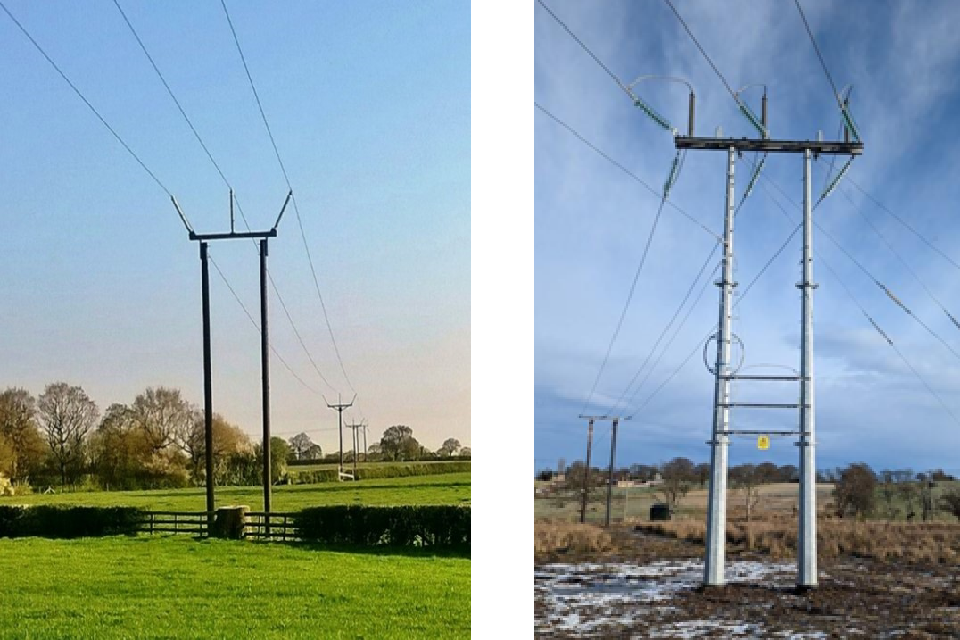
(Left) photo of a 132 kV wooden pole overhead line. (Right) photo of a 132 kV low profile steel pole overhead line. Both carry single circuit lines.
The government notes the majority of responses that are in favour of increasing the NSIP distance threshold from 2km to 10km. We also note that many responses suggested raising the threshold further to 15km and that more than a third of responses disagreed with the proposal on the basis that 10km was an insufficient distance. We have considered the fact that several responses highlighted the benefits of aligning the distance threshold with the automatic threshold for requirement of an Environmental Impact Assessment[footnote 23] and that a higher distance threshold would provide additional flexibility when siting new connections, which can reduce infrastructure clustering. Based on these considerations, we believe that there is merit to raising the distance threshold to 15km and will proceed with increasing the distance threshold for NSIP classification from 2km to 15km.
The government also welcomes feedback on the definition of the aggregate length of overhead lines. We agree that the definition of a continuous overhead line should relate to each stretch of overhead line that is unbroken by a substation. The definition will be incorporated into the updated NSIP thresholds outlined within legislation and the guidance note for the section 37 process.
We acknowledge the concerns of some respondents that the proposal could reduce public scrutiny. The government believes that there is a proportionate accountability mechanism contained within the section 37 process under which affected projects would be consented following planned changes to NSIP thresholds. This process involves consultation with LPAs and gathers views from statutory bodies with responsibilities for environmental and heritage protection. Communities and interested parties may also give their views on project proposals.
We also note requests from some respondents for flexibility in the consenting route for wooden poles or overhead line lengths that fall below the NSIP thresholds to be consented through the NSIP regime. We want to highlight that this flexibility to ‘opt in’ to the NSIP regime is already available under section 35 of the Planning Act 2008. Furthermore, under changes introduced through the Planning and Infrastructure Act 2025, developers will be able to make applications to DESNZ to disapply the requirement for a project to have a Development Consent Order and be consented through an alternative regime (such as via section 37).[footnote 24]
Additional measure
Amending Nationally Significant Infrastructure Project (NSIP) thresholds under the Planning Act 2008 to change the consenting route for projects that increase the voltage of existing lines within Sites of Special Scientific Interest (SSSIs) and European Sites to the section 37 process
Nation(s) proposal applies to: England and Wales
Current situation: Section 16(3A) of the Planning Act 2008 specifies that projects in England and Wales always require a Development Consent Order (DCO) under the NSIP regime for increasing the voltage of an existing overhead line, when that line is in a SSSI or a European Site and exceeds NSIP voltage and distance thresholds (currently 132 kV and above and over 2km in length). Voltage upgrades to overhead lines outside these protected sites are consented via section 37 of the Electricity Act 1989.
The NSIP process is very expensive for developers (often costing hundreds of thousands of pounds) and typically takes a minimum of 18 months to 2 years to complete once the application is received. By comparison, section 37 applications are significantly less costly, and whilst consenting timelines vary depending on the scale of the project, they are typically significantly shorter and can take under one year to complete.
Summary of stakeholder feedback: We received feedback via the consultation that the section 37 process would be more proportionate than the NSIP process to consent voltage uprating projects in SSSIs and European Sites.
This additional proposal was tested at a meeting of the reconvened Working Group in January 2026. It was noted that the current situation – where projects are consented via the NSIP process – can be a lengthy and costly process. Working Group members also indicated that they were reassured that the Environmental Impact Assessment and Habitats Regulation Assessment requirements would not change under the section 37 process. Having considered feedback from the consultation and the Working Group, the government believes that changing the consenting route from NSIP to section 37 for in scope projects is appropriate.
Details of reform measure: The measure would amend the Planning Act 2008 to remove the automatic requirement for a project that increases the voltage of an existing line (that exceeds 132 kV and is 15km or longer, in line with the revised thresholds detailed above) in a SSSI or European Site to be consented via the NSIP process. Voltage uprating projects for existing lines in these protected areas would be consented under section 37 of the Electricity Act 1989 instead.
This change would not result in any reduction of statutory environmental protections, as requirements for Environmental Impact Assessments (EIAs), Habitats Regulation Assessments (HRAs) and engagement with statutory consultees with oversight of protected areas (Natural England and Natural Resources Wales) are robust and equivalent under section 37.[footnote 25] Furthermore, significant works to existing lines in protected areas that exceed conditions in the Planning Act 2008 on height and position of line supports (pylons) would still require an application under the NSIP process.[footnote 26]
Next steps: This change requires secondary legislation. The government will proceed with implementation of this measure alongside other NSIP threshold changes subject to parliamentary time.
Access rights
Proposal 11: Clarify in legislation that access rights apply to adjacent third-party land
Nation(s) proposal applies to: England, Scotland and Wales
Summary of responses
Q64. Do you agree that paragraph 9 of schedule 6 to the Electricity Act 1989 should be amended to clarify that access rights facilitate access over as much land as is necessary, regardless of the number of ownerships?
| Response | Number of respondents |
|---|---|
| Agreed | 31 |
| Disagreed | 11 |
| Unsure | 8 |
| Didn’t Answer | 23 |
Q65. Please explain the reasons for your answer
40 written responses were received for this question.
Of respondents who answered question 64, a majority (62%) supported this proposal.
Respondents who agreed with the proposal gave a number of reasons. Some highlighted that this clarification would remove legislative uncertainty, so that both Network Operators (NOs) and landowners are aware of their rights. Some, particularly developers and NOs, argued that this change would help prevent access being restricted on third-party land (land which does not host the electricity infrastructure, but over which access is required to reach the host land), or large payments being requested by landowners to agree access. Some emphasised that the changes would improve infrastructure delivery, such as facilitating faster access for maintenance, improving service levels, and reducing the environmental impact of works by enabling the least disruptive route to be used.
Two main concerns were raised by respondents who disagreed with the proposal. Firstly, fuel pipeline operators argued that access rights should not apply to land which hosts operational fuel pipelines, as operators need to be informed of any work in advance to give them sufficient time to complete risk assessments, and projects need to ensure pipeline operators can maintain access to the pipeline at all times. Secondly, some respondents raised concerns about keeping access rights limited and proportionate. On this theme, a few respondents argued that the problem was not ambiguity in legislation, but rather poor communication and conduct from NOs entering land without proper discussion and arrangement. A few respondents also raised that the phrasing of ‘as much land as is necessary’ is too imprecise and could lead to misuse by NOs.
Q66. Do you agree that paragraph 10(3) of schedule 6 to the Electricity Act 1989 should be amended to clarify that the provisions relating to making good, or paying compensation for, any damage caused while exercising access rights also apply to the access of adjacent third-party land?
| Response | Number of respondents |
|---|---|
| Agreed | 39 |
| Disagreed | 5 |
| Unsure | 3 |
| Didn’t Answer | 26 |
Q67. Please explain the reasons for your answer
36 written responses were received for this question.
Of respondents who answered question 66, a majority (83%) supported this proposal.
Those who agreed primarily argued that it is fair that all landowners who are affected, whether as the owners of the primary site of works or third-party land needed for access, are treated equitably and are eligible for compensation. Some also stated that setting out these compensation provisions in legislation would provide clarity for both NOs and landowners.
Only a very small number of respondents who disagreed gave a reason. Of those who did, reasons included that it would be preferable for electricity NOs to have the same powers of access and requirements for compensation as the water industry[footnote 27], and a concern that expanding compensation to third-party land could allow NOs to expand their works beyond the agreed boundaries without getting direct consent from landowners.
Q68. Are there any other instances of land access rules and regulations which unnecessarily restrict the activities a developer can undertake?
25 written responses were received for this question.
Some respondents stated that they had not identified any further unnecessary restrictions, or that the existing land rights regime should not be changed further as it already provides adequate powers to NOs and necessary protections for landowners.
Some respondents raised additional issues, either in response to question 68 or within their wider consultation response. All these responses are summarised in this section.
Suggestions on the topic of access rights included: introducing access rights for the purpose of voltage upgrades; securing access to third-party land for the purposes of installing new infrastructure via the Necessary Wayleave process rather than solely through the compulsory purchase process; introducing access rights for the purposes of felling and lopping trees; mirroring the access powers regime used by the water or telecoms industries; giving NOs powers to install apparatus after a notice period; and reforms to access rights for the purpose of conducting surveys.
Where respondents raised additional issues related to broader consents, land access and rights processes, the most common topics were: some stakeholders expressing disappointment that not all of the proposals on consents, land access and rights reform previously considered and discussed with stakeholders at the Working Groups in 2024-25 had been taken forward in the Electricity Networks Infrastructure: Consents, Land Access and Rights consultation; the need for clearer guidance when land ownership cannot be identified; the importance of developers being aware of the Pipeline Safety Regulations in order to prevent damage to fuel pipelines; and the need for statutory timelines for Compulsory Purchase Order (CPO) and other land rights determination processes. Less commonly raised topics included: suggestions to make various parts of the compulsory purchase process more streamlined and efficient; the ability to make small changes to Development Consent Orders after submission and determination; and the need for changes to oversail and overrun rights processes for onshore wind projects.
Government response
Question 67
The government will take forward Proposal 11, to clarify in legislation that access rights apply to third-party land, as set out in the consultation document, with some minor clarifications about the definition of third-party land as set out below.
In general, responses were supportive of the reforms, and where concerns were raised, we believe they can be addressed in the approach set out below. These reforms will clarify rights for all parties and will reduce delays to infrastructure installation, repair and maintenance that can be caused by access issues.
In response to feedback about how third-party land should be defined, we have considered the definition which would best align with the intention of the existing legislation. Paragraph 9 of Schedule 6 to the Electricity Act 1989 permits entry to any premises (which includes land) for the purpose of installing a new electric line or plant where there is an existing line or plant already lawfully installed, or repairs and alterations to an existing line or plant.[footnote 28] We will clarify in legislation that access rights for existing infrastructure apply to all land, insofar as is necessary for that purpose, irrespective of the number of land parcels required, or the location of the land, meaning the land does not have to be adjacent to the land on which the relevant apparatus is located (as was originally specified in the consultation proposal).
In addition, we will provide guidance to the extent needed for parties to understand their rights in relation to access.
We intend to introduce safeguards around the use of this power, and all the other access rights listed in this document. Please see the section below titled ‘Provide comprehensive protections around the use of access powers’ for details.
Question 68
The government welcomes the views shared by stakeholders in highlighting other instances of land access rules and regulations which unnecessarily restrict the activities a developer can undertake. Respondents identified a range of additional barriers, including issues relating to access rights, voltage upgrades, access to third party land and vegetation management.
We have considered this feedback carefully. Where respondents identified restrictions that could be addressed in a proportionate and deliverable way, in particular on access rights, we have taken this forward through the additional measures set out in this consultation response.
We also recognise that respondents raised further issues which go beyond the scope of the reforms being taken forward at this stage, or which would require more fundamental changes to land rights regimes, which we are unable to progress. The government will continue to engage with stakeholders to consider whether further reforms are appropriate in the longer term.
Proposal 12: Expansion of access rights to Transmission Owners
Nation(s) proposal applies to: England, Scotland and Wales
Summary of responses
Q69. Do you agree that the powers of access granted under paragraph 9 of schedule 6 to the Electricity Act 1989 (including any amendments made in relation to proposal 11) should be extend to Transmission Owners?
| Response | Number of respondents |
|---|---|
| Agreed | 22 |
| Disagreed | 11 |
| Unsure | 13 |
| Didn’t Answer | 27 |
Q70. Please explain the reason for your answer
35 written responses were received for this question.
Responses to question 69 were mixed, although among those who answered this question, there were more responses in agreement (48%) than responses in disagreement (24%) or unsure (28%).
The most common reasons given by respondents who supported the extension of access powers to Transmission Owners (TOs) were that it would reduce delays and prevent landowners from blocking access to land for important maintenance work, which would enable the efficient delivery of critical infrastructure projects which are necessary to meet targets for a clean and secure power system. Some held the view that the omission of TOs from the access rights provisions in the Electricity Act 1989 may have been an administrative error which needed to be corrected. Some responses highlighted that statutory access powers could provide a backstop power for TOs if voluntary negotiations fail. Some responses argued that TOs needed statutory rights to address the more complex access issues which transmission infrastructure poses and emergency access to preserve security of supply and public safety.
Of the respondents who disagreed with the proposal, some raised concerns that this would undermine landowners’ rights to control their land and could lead to damage to the land. A few cautioned that granting statutory powers may create a disincentive to pursue voluntary land rights agreements, undermining the principle of negotiated agreements. On a similar theme, a few respondents raised that, instead of extending statutory access rights, the focus should be on encouraging TOs to engage proactively and effectively with landowners under the voluntary system. Finally, a few responses held that refusal of access is rare under the current system, suggesting that the proposal addresses a speculative issue.
Q71. Do you agree that in the case of Transmission Owners only, the notice period prior to entry should be 30 working days?
| Response | Number of respondents |
|---|---|
| Agreed | 8 |
| Disagreed | 21 |
| Unsure | 12 |
| Didn’t Answer | 32 |
Q72. Please explain the reason for your answer
36 written responses were received for this question.
Of respondents who answered question 71, a slim majority (51%) disagreed with this proposal.
Respondents who disagreed with the proposal were fairly evenly split between those who thought that the notice period should be shorter, and those who thought it should be longer. NOs generally argued that the notice period should be 5 working days, as is the case for DNOs. Some of these responses argued that TOs usually engage with landowners well in advance of any works to negotiate voluntary access, and therefore a 30-day notice period for statutory access was unnecessarily long and would cause additional delays. It was also raised that having different notice periods for DNOs and TOs would lead to inconsistency in the treatment of 132 kV lines, which are classified as distribution infrastructure in England and Wales, and transmission infrastructure in Scotland.
Landowner representatives generally argued that 30 working days would still be insufficient, suggesting that a longer period, such as 3 months, would better accommodate landowners’ needs. These responses argued that the complexity and scale of transmission works requires a longer notice period. In particular, some felt that 30 working days may not be sufficient for landowners to review and respond to access requests, or to make logistical changes to accommodate access, such as moving stock and erecting fences.
Respondents who were in favour of the proposal argued that the 30-working day period is reasonable and offers adequate planning time. A few responses suggested that the complexity and scale of transmission works requires a longer notice period than for distribution works, to manage the greater disruption and logistical challenges involved.
A few respondents who answered that they were unsure about the proposal explained that they did not agree that access rights should be extended to TOs, but if they were, they would support a 30-day notice period.
Q73. Do you agree that the provisions outlined under paragraph 10(3) of schedule 6 to the Electricity Act, relating to making good, or paying compensation for, any damage caused while exercising access rights, are sufficient in relation to the changes proposed under proposals 11 and 12?
| Response | Number of respondents |
|---|---|
| Agreed | 18 |
| Disagreed | 14 |
| Unsure | 9 |
| Didn’t Answer | 32 |
Q74. Please explain the reason for your answer
25 written responses were received for this question.
Responses to question 73 were mixed, although there were more responses in agreement (44%) than responses in disagreement (34%) or unsure (22%), from those who answered this question.
Comments on the nature of the compensation provisions for statutory access rights were made across responses to questions 64-75. For clarity, all comments relating to how the compensation system should function overall have been summarised and addressed in this section.
Respondents who agreed with this statement argued that the existing legal framework is fair, providing protection and adequate compensation for landowners. A few also supported the ideas that compensation provisions should follow established compensation code principles, and that guidance is required on how to assess compensation.
On a separate topic, some respondents who agreed also used this opportunity to note that, if access rights were extended to TOs, paragraph 10(2) of Schedule 6 to the Electricity Act 1989 would also need to be expanded, to make clear that any person authorised by an agent of a TO would have access rights.
Where respondents disagreed that compensation provisions were adequate, this was most commonly because they believed that compensation should cover a broader range of damages. Across questions 64-75, suggestions for what compensation should cover included: inconvenience and time spent negotiating; disruption and loss of enjoyment of the land; damages not rectified; losses caused before entry such as delays to cultivating land; damage to crops and damage resulting in being unable to meet crop contracts; damage resulting in being unable to receive farm or environmental subsidies; and professional representatives’ fees. A few responses suggested aligning with other models for compensation provisions, such as the water industry, or Necessary Wayleaves for electricity lines. Across questions 64-75, a few respondents also raised that a clear process needs to be set out in legislation for how to resolve disputes about compensation, either via Tribunal or via a route outside of the courts (such as Alternative Dispute Resolution).
Q75. Are there any other safeguards, beyond extending the notice period and ensuring the provisions regarding compensation are carried over, that should be put in place in relation to the extension of access rights to include Transmission Owners?
29 written responses were received for this question.
Where respondents suggested additional safeguards, the most common suggestion was that where TOs sought warrants for entry under new access powers, they should be required to apply to the County Court or High Court rather than the existing route via the Magistrates’ Court, on account of their larger scale and the complexity of the works. Respondents also stated that warrant requests should be made with sufficient notice to allow landowners to respond and attend the hearing. Other repeated suggestions included: recommendations around compensation (which have been summarised in question 74 and addressed in the section titled ‘Provide comprehensive protections around the use of access powers’ below); making access plans and schedules of condition mandatory for intrusive surveys and physical works to prevent disagreements about damages; and reviewing the implementation of new access rights provisions after 1 to 2 years to check if new safeguards are needed. A few respondents raised other safeguards such as: making a statutory presumption in favour of making voluntary agreements rather than using compulsory powers in the first instance; ensuring that TOs engage fully with landowners to agree access routes and manage replacement of materials and equipment in line with the landowner’s preference; the provision of fact sheets on access rights; adherence to the voluntary guidance ‘Code of practice: Rights over land for electricity infrastructure’; and the introduction of a mandatory code of practice for electricity Licence Holders.
Government response
Questions 69-74
The government will take forward Proposal 12, which expands access rights to Transmission Owners. Taking into account the mixed responses to the consultation questions, we consider that the approach set out below represents the best balance between facilitating the efficient rollout of transmission infrastructure and providing landowners with adequate protections.
The government will amend legislation to extend the powers of access granted under paragraph 9 of schedule 6 to the Electricity Act 1989 (including the amendments made in relation to proposal 11) to TOs. This will support the efficient and timely delivery of transmission projects.
The government will also proceed with the proposal for a 30-working day notice period to exercise access rights for lines over 132 kV. While we have seriously considered consultation feedback from all perspectives on whether the proposed notice period should be shorter or longer, we have concluded that 30 working days strikes the best balance of recognising the differences in scale and duration for transmission-scale works and giving landowners time to prepare for access, while preventing substantial delays in the use of this backstop power. As is currently the case for DNOs, in the event of an emergency fault, the TO would be able to enter without giving notice but should give notice as soon as possible afterwards. In practice, we expect TOs to engage with an affected landowner on a voluntary basis well in advance of serving notice under the statutory powers and we will set this expectation out in guidance. In response to concerns raised in the responses about potential misalignment between England and Wales and Scotland because of differing definitions of transmission infrastructure across the nations, the 30-working day notice period will be applied based on voltage (over 132 kV, or in other words, 275 kV and 400 kV lines) rather than by the type of licence holder exercising the access right (DNO or TO).
We intend to introduce additional safeguards around the use of this power, and all the other access rights listed in this document. This includes compensation. Please see the section below entitled ‘Provide comprehensive protections around the use of access powers’ for details.
Question 75
The government has considered all the proposals raised in response to question 75 in the context of the proposals in the consultation and the additional measures outlined below and we intend to introduce a comprehensive package of protections around the use of access powers (see section titled ‘Provide comprehensive protections around the use of access powers’ below).
On the specific suggestion that warrant applications for transmission-level access should be made to the County Court or High Court rather the Magistrates’ Court, the government does not intend to take this forward. Given that there are no reported issues with the current system for DNOs, and that distribution-level and transmission-level access cases are expected to be of a similar legal complexity, it is government’s view that it would be most appropriate for warrant applications at the transmission level to also go to the Magistrates’ Court (or Justice of the Peace Court in Scotland), in order to maintain consistency.
Many of the other suggestions for safeguards can be addressed through guidance on best practice for interaction between landowners and NOs in the exercise of access rights. We will consider this feedback when creating guidance to sit alongside the legislative changes. The industry-led code of practice, ‘Rights over land for electricity infrastructure’, already sets out best practice for landowner and NOs representatives when negotiating agreements over land for electricity infrastructure.[footnote 29] More information about proposed additional safeguards can be found in the section below entitled ‘Provide comprehensive protections around the use of access powers’.
Additional measures
Enable certain types of voltage upgrades to be carried out under statutory access rights
Nation(s) proposal applies to: England, Scotland and Wales
Current situation: Major line upgrades are required to ensure energy security, meet Clean Power 2030 targets and to deliver early 2030s projects, particularly at transmission level.
Large uprating projects can cover swathes of land under tens or even hundreds of ownerships, with equivalent numbers of accompanying land rights. Some of the land in question will already have land rights in place which allow scope for voltage upgrades. However, this is not always the case. Many historic agreements specify the voltage or conductors permitted for the line on the land, thus prohibiting voltage increases. Some land may not have a land right in place at all, for example due to changes in ownership. In the latter 2 cases, a new land right must be negotiated or acquired before upgrade works can start.
Where voluntary negotiations to secure the land rights for voltage upgrades are protracted or break down, NOs must rely on existing statutory processes, such as Necessary Wayleave or Compulsory Purchase Order (CPO) processes. Such cases can increase delivery timescales and can cause delays and additional costs either to agree the land right or to pursue a statutory route as the last resort.
Land rights processes can be disproportionate for some voltage upgrade projects. For example, projects which require conductors to be replaced, but can use existing towers or poles, may not cause significantly more disruption to the land or material change to the infrastructure than routine maintenance projects, which would be covered under existing land rights agreements or existing access rights. In the changing context of increasing energy demand, Clean Power 2030 and Net Zero 2050 targets and consequent requirements for network upgrades, voltage upgrade projects will become more common and important. The land and access rights regime for voltage upgrades must be appropriate for this new reality.
Summary of stakeholder feedback: Proposals to facilitate voltage upgrades to existing overhead lines were raised in consultation responses and were subsequently discussed at a reconvened Working Group meeting in January 2026. NOs were supportive of measures to facilitate voltage upgrades. Landowner representatives were generally supportive of the proposal to allow voltage upgrades up to 11 kV under access rights, as long as suitable safeguards were put in place. They were not supportive of transmission scale upgrades being permitted under access rights, due to the greater size, duration of works and level of disruption at transmission voltages. Their view was that access for this scale of works should only be permitted via voluntary agreement, a Necessary Wayleave or a CPO.
We have carefully considered this feedback. The government considers that the potential benefits of facilitating voltage upgrades at transmission level are significant enough that this option should be pursued. In response to stakeholder feedback, we have developed multiple protections for landowners, which are detailed in the section below entitled ‘Provide comprehensive protections around the use of access powers’.
Details of reform measure: The government will expand statutory access rights to enable NOs to access all land for the purposes of upgrading the voltage of existing lines, at specific voltages and for specific types of upgrades. Where existing consenting processes or private land agreements are incompatible with these powers, the new statutory access rights will take precedence. Only specific types of upgrades will be permitted, namely:
Voltage upgrades up to and including 11 kV, where:
- the upgrade can be achieved using either the existing line supports, or reinforced or replacement line supports; and
- for small supports (up to and including 10m in height), the location of any replacement supports is within 60m of the existing support they replace; and
- for supports exceeding 10m in height, the location of any replacement support is within 100m of the existing support they replace
- the DNO must give 5 working days’ notice to the landowner before entry is taken
Voltage upgrades from 275 kV to 400 kV, where:
- the upgrade can be achieved using either the existing line supports, or by reinforced or replacement line supports which are no greater in height than, and whose above ground footprint is no larger than, the supports that they replace; and
- the location of the supports is not altered, and the total number of line supports required remains the same
- the TO must give 30 working days’ notice to the landowner before entry is taken
Access rights for voltage upgrades are focused on up to 11 kV and 275 kV to 400 kV for 2 reasons. Firstly, these voltages are the ones where we have received evidence that there are planned upgrades in the pipeline, which if accelerated could support the delivery of Clean Power 2030. In the case of distribution upgrades, we also sought to align with the proposed changes to the section 37 exemptions regulations, which will exempt projects up to 11 kV. Secondly, upgrades at these voltages can more often be achieved using the existing poles and pylons. Indeed, the accompanying restrictions seek to ensure that changes to the existing infrastructure on the ground, and therefore impacts on the land, are limited. In developing these restrictions, we have aimed to broadly align with the types of works that would be carried out and that are permissible under maintenance activities. In the case of upgrades up to and including 11 kV we have aligned with the proposed changes to section 37 exemptions on relocation of supports, and with existing guidance on section 37, which exempts routine refurbishments from requiring new section 37 consent. Upgrades at other voltages will not be included under access rights and will need to follow usual land rights processes.
Next steps: The government will amend Schedule 6 to the Electricity Act 1989 via primary legislation to enable access rights to be used to carry out the specified types of voltage upgrades. This will be done at the earliest legislative opportunity.
Expand statutory access rights to enable access to third-party land for the purpose of installing new infrastructure
Nation(s) proposal applies to: England, Scotland and Wales
Current situation: It is not uncommon for new electricity lines to require apparatus to be installed on land which cannot be accessed (or has limited access) via either a public road or through a track/road on the same registered land title. Statutory access rights under existing legislation do not extend to the installation of new electricity infrastructure where no line or plant is already in place. In these cases, NOs must first seek access through voluntary negotiation. If agreement cannot be reached, statutory routes are required. While a Necessary Wayleave can be used to secure a land right for the land on which infrastructure will be sited, access over third-party land (land not hosting the infrastructure but over which access is required to reach the host land) can currently only be secured through compulsory purchase. In some cases, this can result in multiple Necessary Wayleaves and CPOs being needed for a single scheme, increasing complexity, cost and delay. Pursuing a CPO typically takes up to 24 months. Both the direct costs and costs associated with any project delays arising from the use of the CPO process eventually feed through to consumers, impacting bills. These issues are particularly acute in Scotland, where the more streamlined provisions for obtaining access to third-party land facilitated by the Planning Act 2008 do not apply.
Summary of stakeholder feedback: The issue of statutory routes to permit access to third-party land to install new infrastructure was raised in the consultation responses. The access rights proposal detailed below was subsequently discussed with stakeholders at a reconvened Working Group meeting in January 2026. NOs highlighted that the current regime can be disproportionate and a barrier to timely delivery of new infrastructure, particularly where access is only required temporarily and via existing routes such as private roads or tracks. NOs were supportive of the proposal, and in some cases desired the process to go further and include all cases of third-party access.
Landowner representatives were not supportive of extending access rights to cover new infrastructure. They viewed this as an expansion of powers that were not designed for substantial works and argued that compulsory purchase remains the most appropriate mechanism for third-party access in all new infrastructure cases.
We have carefully considered this feedback. The government considers that the potential benefits of facilitating access for new infrastructure in limited cases are significant enough that this option should be pursued. In response to stakeholder feedback, we have developed multiple protections for landowners, which are detailed in the section below entitled ‘Provide comprehensive protections around the use of access powers’.
Details of reform measure: The government will extend statutory access rights so that NOs can access third-party land for the purpose of installing new electricity infrastructure. As part of this measure, a NO will be required to give an affected landowner 3 months’ notice before exercising this right. This longer notice period is in recognition of the scale of new infrastructure works, and to reflect that landowners may require longer notice periods when access is required through their land for completely new works (rather than for maintenance or upgrade works to existing infrastructure).
The reform will apply only to third-party land and will not remove the requirement for land rights to be secured on the land where the infrastructure will ultimately be placed. Access rights will be limited to cases where the effects on the land are temporary, even if ongoing access is required for several years. Where access would cause permanent impacts, the CPO process will remain the appropriate and necessary route.
The intention is to provide a faster and more proportionate alternative to compulsory purchase where the impacts are limited, while retaining CPO as the route for more complex cases.
Next steps: The government will amend Schedule 6 to the Electricity Act 1989 via primary legislation to expand statutory access rights to enable access to third-party land for the purpose of placing new infrastructure. This will be done at the earliest legislative opportunity.
Provide comprehensive protections around the use of access powers
Nation(s) proposal applies to: England, Scotland and Wales
Current situation: The access rights reforms set out in this government response represent a substantial shift in the access rights regime. They are intended to have a significant impact on the speed and efficiency of the delivery of network infrastructure at both transmission and distribution level, for both new and existing infrastructure. At the same time, these reforms must continue to respect landowners’ rights and needs.
The access rights reforms need to be considered as a whole package. This section considers the protections which we will put in place to ensure all access powers are used responsibly and the impacts on landowners are minimised.
Summary of stakeholder feedback: The protections listed below have been developed from feedback received in the consultation. Questions 73 to 75 above summarise the feedback received about compensation levels and additional safeguards which may be required. These proposals were further developed and tested with the Working Group when it was reconvened in January 2026.
-
Details of reform measure: The measures have been developed in a way that aims to minimise the impact on the land, and to ensure that mitigations are in place to protect landowners. The following protections will apply to all access rights cases (be that transmission level or distribution level, and for maintenance, repairs, upgrades, or installation):
- Compensation for loss and damage: The current provision in paragraph 10(3) of Schedule 6 to the Electricity Act 1989 relating to making good, or paying compensation for, any damage caused while exercising access rights will be expanded. NOs will be required to compensate landowners for loss or damage incurred as a result of works. The statutory right to be compensated for loss would encompass things such as landowner time spent dealing with the NO, losses associated with the movement of stock or the loss of agricultural subsidies due to works. As an additional safeguard, legislation will stipulate that NOs should make every reasonable effort to minimise loss and damage to the premises when exercising their access rights.
- Limiting permanent impact: Statutory access rights should only be used to obtain access where the impact on the land of taking access would be temporary (even if that is for a duration of several years). Access which requires permanent changes to the land should be sought via alternative routes, such as CPO. The intention of this limitation is that, for example, access via existing roads or tracks would be permitted whereas access which requires building new roads would not.
- Government guidance: We intend to publish detailed guidance on access rights alongside legislative changes, which will include the processes to be followed and the rights and responsibilities of all parties. The government’s position remains that statutory land access powers should be used as a last resort, and in the first instance NOs should make all reasonable efforts to reach a voluntary agreement with the landowner(s) in question. We will make this position clear in the guidance. The industry-led code of practice, ‘Rights over land for electricity infrastructure’, which has been endorsed by the government and is supported by NO, landowner and agent representative bodies, already sets out that the parties should aim to make a voluntary agreement wherever possible.[footnote 30]
- Access to justice: Legislation will be amended to introduce a clear process for resolving disputes regarding compensation in relation to access rights. Legislation will establish the Upper Tribunal (Lands Chamber) in England/Wales and the equivalent court in Scotland as the ultimate forums for determining compensation in access rights cases. Recognising the accessibility challenges of the Upper Tribunal raised under the Electricity Transmission (Compensation) Act 2023 and the work of the Alternative Dispute Resolution Taskforce, legislation will require parties to consider alternative dispute resolution (ADR) first in cases where there is a dispute about compensation, and will provide that participation in ADR may be considered by the Upper Land Tribunal when awarding costs. This will be accompanied by guidance on the use of ADR. These changes will provide affected landowners with suitable avenues to challenge compensation where appropriate.
- Enhanced notification: Legislation will be amended to provide a power to the Secretary of State to prescribe a Notice that must be used by NOs when exercising access rights. We anticipate that the prescribed Notice will require NOs to notify a landowner of their intention to use access powers to enter their land, inform a landowner of their rights in relation to compensation and the availability of ADR and Upper Tribunal routes in the event of a dispute, the estimated duration of works, and the NO’s ability to seek a warrant if access is refused.
- Notice periods: NOs must give notice before taking access under statutory powers. We have developed notice periods for each proposal that are proportionate to the scale of the access right. The details and rationale for these are set out under the individual proposals. These notice periods are the minimum notice which must be given before taking access under statutory powers and are not intended to set standard practice for when NOs’ contact with landowners should begin. The government’s position remains that voluntary negotiations should be taking place as far in advance as possible before access is needed. Expectations on this topic will be set out in guidance.
Next steps: The government will amend the relevant sections of the Electricity Act 1989 via primary legislation to enable these changes. This will be done at the earliest legislative opportunity. In parallel, secondary legislation will be developed to set out notification requirements, and government guidance will be developed for the whole access rights package.
Clarify the definition of ‘premises’ under the Rights of Entry (Gas and Electricity Boards) Act 1954
Nation(s) proposal applies to: England, Scotland and Wales
Current situation: The Electricity Act 1989 provides that the Rights of Entry (Gas and Electricity Boards) Act 1954 – which enables entry to a premises under a justice’s warrant – shall apply in relation to access rights powers. This means that a warrant can be sought from a Magistrates’ Court in England and Wales, or a Justice of the Peace Court in Scotland, to gain access to a premises by force to exercise an access right, if a landowner refuses entry.
Under the Electricity Act 1989, ‘premises’ is defined as including “any land, building or structure”. However, under the Rights of Entry (Gas and Electricity Boards) Act 1954, ‘premises’ is defined as a “building or part of a building” and does not explicitly refer to land.
Summary of stakeholder feedback: NOs highlighted the inconsistency in the definition of ‘premises’ during discussions of the access rights proposals with the Working Group. Some NOs said that they are not currently pursuing warrants to exercise access rights in relation to land due to this inconsistency, or that they would not feel comfortable applying for a warrant.
Details of reform measure: To support DNOs’ and TOs’ ability to exercise their access rights, the government will amend the Rights of Entry (Gas and Electricity Boards) Act 1954 to clarify that warrants to exercise a right of entry under Schedule 6 to the Electricity Act 1989 can be obtained to access “any land, building or structure”, to align with the definition of premises under the Electricity Act 1989.
Next steps: The government will amend the Rights of Entry (Gas and Electricity Boards) Act 1954 via primary legislation to clarify the definition of ‘premises’ in relation to warrants to exercise a right of entry under Schedule 6 to the Electricity Act 1989. This will be done at the earliest legislative opportunity.
Next steps
This package of reforms will speed up and facilitate the delivery of clean, homegrown energy and support the government’s mission to become a clean energy superpower. These changes will accelerate infrastructure delivery, streamline processes and unblock critical projects to help us reach our target of clean power by 2030. Reforms to primary and secondary legislation will be made at the earliest opportunity, starting through 2026. Guidance will be updated as these legislative changes are made.
The government will continue to assess the breadth of consents, land access and rights processes and consider whether further reforms are needed to support Clean Power and net zero goals. We continue to welcome evidence and proposals for change as we work to meet these targets.
Annex A – Summary of changes to reform proposals
Necessary Wayleaves
| Reform | Nation(s) proposal applies to | Changes based on Consultation Responses | Delivery Mechanism |
|---|---|---|---|
| Proposal 1: Introduce a requirement to provide a reason when serving a Notice to Remove and extending the application submission timeframe from 3 to 6 months | England, Scotland, Wales | Notices and applications will be required to issued on a prescribed form including reasons. | Primary legislation |
| [Additional]: Give the Secretary of State the power to enable Network Operators to initiate the Necessary Wayleave process for existing lines | England, Scotland, Wales | Licence Holders will be allowed to submit a NW application for existing electric lines in certain circumstances without first receiving a request from the landowner/ occupier to remove it. | Primary legislation, though the circumstances in which Licence Holders would be able to start the process will be set out in secondary legislation. |
| Proposal 2: Remove the requirement to seek consent of the parties for the written representations procedure to apply | England, Wales | No changes | Secondary Legislation |
| Proposal 3: Facilitate the use of virtual hearings where an Inspector considers this to be appropriate | England, Wales | No changes | Secondary Legislation |
| Proposal 4: Remove the requirement to appoint an external Inspector | England, Wales | No changes. The circumstances in which it is expected that Inspector would be appointed will be set out in guidance. | Primary Legislation |
| [Additional]: Introduce timescales for determining Necessary Wayleaves in England, Wales and Scotland | England, Scotland, Wales | A power will be introduced requiring Secretary of State to publish timeframes for determining NW applications. In Scotland, this power would be held concurrently by the Secretary of State and Scottish Ministers in relation to NW applications. |
Primary legislation. |
| [Additional]: Introduce the ability to close Necessary Wayleave applications that are not being progressed by Licence Holders | England, Scotland, Wales | The Secretary of State will be given the discretion to close/ deem NW applications withdrawn that are not being actively progressed. Before an application can be closed, the Secretary of State will be required to give all parties at least 30 days’ notice and the opportunity to make representations on whether the application should remain open. |
Primary Legislation. |
| [Additional]: Introduce the requirement to consider Alternative Dispute Resolution (ADR) prior to a compensation claim for NW being taken to the Upper Tribunal | England, Scotland, Wales | A requirement will be introduced for parties to consider ADR before making an application to the court for the determination of compensation following the grant of a NW. The Upper Tribunal will be allowed to take participation in ADR into account when awarding costs. | Primary Legislation. |
| Proposal 5: Change the standard wayleave term from 15 to 40 years | England, Wales | No changes. As now flexibility in term length will be allowed | Guidance Change |
Tree lopping and felling
| Reform | Nation(s) proposal applies to | Changes based on Consultation Responses | Delivery Mechanism |
|---|---|---|---|
| Proposal 6: Change the responsibility for tree maintenance from landowners to Licence Holders | England, Scotland, Wales | Licence Holders will be able to delegate works to landowners where expedient to do so. | Primary Legislation |
| [Additional]: Enable tree lopping and vegetation management to take place under statutory access rights, without the requirement for a separate tree lopping order | England, Scotland, Wales | If access for vegetation management cannot be agreed voluntarily, Licence Holders will have recourse to statutory access powers to conduct tree lopping and vegetation management, to the extent that this is required for safety purposes. This will replace the current tree lopping order process. | Primary Legislation. Government guidance will be updated to bring all the minimum safety standards for tree lopping for different equipment together in one place. |
Permitted Development
| Reform | Nation(s) proposal applies to | Changes based on Consultation Responses | Delivery Mechanism |
|---|---|---|---|
| Proposal 7: Increase the maximum size threshold for substations that can be built via permitted development from 29 to 45 cubic metres | England | Prior approval on siting and appearance of larger substations will be required from Local Planning Authorities in designated areas covered by Schedule 1, Part 1 – Article 2(3) of the General Permitted Development Order 2015. The extended permitted development right (for substations between 30-45 cubic metres) will not apply in Sites of Special Scientific Interest (SSSIs) and European Sites. |
Secondary Legislation |
Section 37
| Reform | Nation(s) proposal applies to | Changes based on Consultation Responses | Delivery Mechanism |
|---|---|---|---|
| Proposal 8(a): Upgrading single-phase to 3-phase overhead lines (voltage unchanged) will not require section 37 consent | England, Wales | Removing the same route and voltage limitations where the voltage does not exceed 11 kV. This proposal will now apply in non-protected areas only. |
Secondary Legislation |
| Proposal 8(b): Increasing allowable height for small overhead line supports from 10m to 12m will not require section 37 consent | England, Wales | All wooden supports will be able to be increased by 20% | Secondary Legislation |
| Proposal 8(c): Voltage upgrades from 6.6 kV to 11 kV will not require section 37 consent | England, Wales | The limitation of ‘no major structural change’ and no route change will be removed. Upgrades will be exempted ‘up to 11 kV’ from requiring consent. This exemption will apply in non-protected areas only. |
Secondary Legislation |
| Proposal 8(d): Increasing nominal voltage threshold to 33 kV for up to 4 consumers will not require section 37 consent | England, Wales | The extension of this power will be restricted to non-protected areas. | Secondary Legislation although Primary legislation will be required to remove existing 20 kV and 1 customer exemption |
| Proposal 8(e): minor works such as the alteration of conductor type or replacement of existing poles will be exempt from the need to seek approval from LPAs in National Parks and National Landscapes | England, Wales | No change - the alternative option has been selected as the preferred approach. | Secondary Legislation |
| Proposal 8(f): Increase allowable distance for permanent diversions: 60m for small supports, 100m for large. | England, Wales | The extension of this power will be restricted to non-protected areas. | Secondary Legislation |
| [Additional]: Introduce timescales for determining section 37 applications in England and Wales | England, Wales | The Secretary of State will publish timeframes for determining s37 applications in England and Wales. | Primary Legislation |
| [Additional]: Remove the automatic requirement for a public inquiry to be held when the relevant planning authority objects to an overhead line application under section 37 of the Electricity Act 1989. | England, Wales | The automatic requirement for the Secretary of State to hold a public inquiry following an objection from the relevant planning authority will be removed. The Secretary of State will instead have the discretion to determine whether a public inquiry, a hearing, or another appropriate opportunity to state objections should be held where any objection is received. | Primary Legislation |
Private streets
| Reform | Nation(s) proposal applies to | Changes based on Consultation Responses | Delivery Mechanism |
|---|---|---|---|
| Proposal 9: Amend the Electricity Act 1989 to remove the requirement for consent from street owners to break the surface of private streets for the purpose of installing electrical equipment. | England, Wales | Safeguards for private street authorities will be aligned with existing regulations for England and Wales in the New Roads and Street Works Act 1991 to balance removal of consenting requirement. These include statutory notice periods, street reinstatement and remediation. A statutory route for compensation disputes will be introduced. Legislative changes will be accompanied by guidance for electricity works in private streets in England and Wales, including advice on accessing alternative dispute resolution as the primary avenue for resolving compensation disputes. |
Primary Legislation |
| [Additional]: Extend the territorial application of the existing private streets proposal so that the measure also applies to private roads in Scotland | Scotland | The requirement for Licence Holders to gain consent from road works authorities to undertake electricity works in private roads in Scotland will be removed. Additional changes to the measure as applied in England and Wales (see above) will also apply in Scotland |
Primary Legislation |
Nationally Significant Infrastructure Projects threshold
| Reform | Nation(s) proposal applies to | Changes based on Consultation Responses | Delivery Mechanism |
|---|---|---|---|
| Proposal 10: Remove 132 kV wooden pole lines from the scope of the Nationally Significant Infrastructure Projects (NSIP) regime and increase the distance threshold for NSIP classification from 2km to 10km. | England, Wales | The exemption from the NSIP regime for wooden poles will be extended to design successors such as polymer and steel poles by specifying that the exemption applies to poles carrying a single circuit 132 kV line. NSIP distance threshold to be increased to 15km. |
Secondary Legislation |
| [Additional]: Amend NSIP thresholds under the Planning Act 2008 to change the consenting route for projects that increase the voltage of existing lines within Sites of Special Scientific Interest (SSSIs) and European Sites to the section 37 process. | England, Wales | The automatic requirement for a project that increases the voltage of an existing line (that exceeds 132 kV and is 15km or longer, in line with the revised thresholds detailed above) in a SSSI or European Site to be consented via the NSIP process will be removed. Voltage uprating projects for existing lines in these protected areas will be consented under section 37 of the Electricity Act 1989. |
Secondary Legislation |
Land access
| Reform | Nation(s) proposal applies to | Changes based on Consultation Responses | Delivery Mechanism |
|---|---|---|---|
| Proposal 11: Clarify in legislation that access rights for existing infrastructure apply to third-party land | England, Scotland, Wales | We will clarify the definition of third-party land to set out that access rights for existing infrastructure apply to all land, insofar as is necessary for the specified purpose, irrespective of the number of land parcels required, or the location of the land, meaning the land does not have to be adjacent to the land on which the relevant apparatus is located (as was originally specified in the consultation proposal). | Primary Legislation |
| Proposal 12: Expand the access rights currently afforded to Distribution Network Operators to Transmission Owners | England, Scotland, Wales | A statutory notice period of 30 working days will be required for access to all infrastructure over 132 kV (rather than all access by Transmission Owners, as proposed in the consultation). | Primary Legislation |
| [Additional]: Enable certain types of voltage upgrades to be carried out under statutory access rights | England, Scotland, Wales | Statutory access rights will be expanded to enable Network Operators to access all land for the purposes of upgrading the voltage of existing lines, at specific voltages (up to 11 kV and 275 kV to 400 kV) and for specific types of upgrades which require limited changes to existing infrastructure. | Primary legislation |
| [Additional]: Expand statutory access rights to enable access to third-party land for the purpose of installing new infrastructure | England, Scotland, Wales | Statutory access rights will be extended so that NOs can access third-party land (land other than that hosting the infrastructure) for the purpose of installing new electricity infrastructure. The NO must give the landowner 3 months’ notice, and rights will be limited to cases where the effects on the land are temporary, even if those effects last for several years. | Primary legislation |
| [Additional]: Provide comprehensive protections around the use of access powers | England, Scotland, Wales | We will introduce: strengthened statutory compensation provisions; longer notice periods for works on infrastructure over 132 kV and new infrastructure; requirements for Network Operators to inform landowners of their rights; routes to resolve disputes over compensation; restrictions on the circumstances in which powers can be used; and accompanying government guidance to set out the rights and responsibilities of all parties when access powers are exercised. | Primary legislation, secondary legislation, and guidance. |
| [Additional]: Clarify the definition of ‘premises’ under the Rights of Entry (Gas and Electricity Boards) Act 1954 | England, Scotland, Wales | The Rights of Entry (Gas and Electricity Boards) Act 1954 will be amended to clarify that warrants to exercise a right of entry under Schedule 6 to the Electricity Act 1989 can be obtained to access “any land, building or structure”, to align with the definition of premises under the Electricity Act 1989. | Primary legislation |
-
DESNZ internal modelling, 2025 prices. ↩
-
DESNZ (2022), ‘Electricity networks strategic framework: Enabling a secure, net zero energy system’, Figure 2 ↩
-
NESO (2004) ‘Clean Power 2030: Advice on achieving clean power for Great Britain by 2030’ ↩
-
ENA / BEAMA (2025) ‘Energy network operators and manufacturers set out collaborative plan to shape a blueprint for national growth’ ↩
-
BEIS (2022) ‘Land rights and consents for electricity network infrastructure: call for evidence’ ↩
-
DESNZ (2025) ‘Electricity network infrastructure: consents, land access and rights - consultation’ ↩
-
A Licence Holder is a person who is authorised to generate, distribute, transmit, or supply electricity in the UK under the Electricity Act 1989. ↩
-
Northern Ireland operates on a separate electricity market (the Single Electricity Market) and is regulated by the Utility Regulator, which works with Ofgem to protect electricity interests across the jurisdictions. As a result, this consultation focussed on the electricity network in Great Britain (Scotland, England and Wales). ↩
-
DESNZ (2022), ‘Electricity networks strategic framework: Enabling a secure, net zero energy system’, Figure 2 ↩
-
NESO (2004) ‘Clean Power 2030: Advice on achieving clean power for Great Britain by 2030’, p.7., p.31 ↩
-
DESNZ (2022), ‘Electricity networks strategic framework: Enabling a secure, net zero energy system’, Annex 1, Figure 10 ↩
-
The Electricity (Necessary Wayleaves and Felling and Lopping of Trees) (Hearing Procedures) (England and Wales) Rules 2013 ↩
-
DECC (2010) ‘Granting a necessary (compulsory) electricity wayleave: guidance for applicants and landowner and/or occupiers’, Application to the Secretary of State for Energy and Climate Change from 1 October 2013, for the grant of a Necessary (Compulsory) Electricity Wayleave or Felling and Lopping of Trees Order in England and Wales ↩
-
CAAV/ RICS/ ENA (2025) ‘Rights over land for electricity infrastructure - Code of Practice’ ↩
-
An Article 4 Direction is a formal notice issued by a local planning authority or the Secretary of State that withdraws specific permitted development rights in a defined area or for a specific type of development. It does not prohibit development outright but instead requires submission of a full planning application. The direction could be used to protect local character or control environmental impacts. ↩
-
The Town and Country Planning (General Permitted Development) (England) Order 2015, Schedule 1, Part 1 – Article 2(3) land ↩
-
NIC (2025), ‘Electricity distribution networks: Creating capacity for the future’, page 22 ↩
-
Welsh Government (2025), ‘Changes to permitted development rights consultation – Summary of responses’, pp.43-44 ↩
-
UKOPA (2026) ‘Electrical Interaction on Pipelines: Collaboration between Developers and Operators’, Edition 1 ↩
-
Requirements for notice periods relating to street works in England are set out in The Street Works (Registers, Notices, Directions and Designations)(England) Regulations 2007, for Wales in The Street Works (Registers, Notices, Directions and Designations)(Wales)(No2) Regulations 2008 and for Scotland in The Road Works (Scottish Road Works Register, Notices, Directions and Designations)(Scotland) Regulations 2008. ↩
-
Private streets are called ‘private roads’, and private streets authorities are called ‘private road managers’ in Scotland under Paragraph 2, Schedule 4 to the Electricity Act 1989. Both terms have the same meaning under the legislation. ↩
-
The Town and Country Planning (Environmental Impact Assessment) Regulations 2017 Schedule 1 automatically requires an Environmental Impact Assessment for the construction of overhead electrical power lines with a voltage of 220 kV or more and a length of more than 15km. ↩
-
Planning and Infrastructure Act 2025, Section 4(4) ↩
-
Voltage uprating projects undergoing a NSIP application are subject to the Infrastructure Planning (Environmental Impact Assessment) Regulations 2017. Section 37 applications are subject to the Electricity Works (Environmental Impact Assessment) (England and Wales) Regulations 2017. Substantive EIA duties are equivalent. SSSIs are protected under the Wildlife and Countryside Act 1981 under both consenting processes. Natural England or Natural Resources Wales are statutory consultees and may refuse consent if operations cause damage to SSSIs. Projects that affect European Sites must comply with the Conservation of Habitats and Species Regulations 2017 and undergo Habitats Regulations Assessment (HRA), regardless of consenting route. ↩
-
Conditions relating to the height of replacement supports and the distance between any new supports and existing lines are contained in Section 16(3)(ab) of the Planning Act. ↩
-
Under the Water Industry Act 1991, water companies have statutory powers to access land and install infrastructure (without requiring voluntary consent), which are accompanied by comprehensive compensation provisions for affected landowners. ↩
-
Paragraph 9(1) of schedule 6 to the Electricity Act 1989: ‘Any officer or other person authorised by an electricity distributor may at all reasonable times enter any premises for the purpose of— (a)placing a new electric line or any new electrical plant in the place of or in addition to any existing line or plant which has already been lawfully placed; or (b)repairing or altering any such existing line or plant.’ ↩
-
CAAV/ RICS/ ENA (2025) ‘Rights over land for electricity infrastructure - Code of Practice’, p.11 ↩
-
CAAV/ RICS/ ENA (2025) ‘Rights over land for electricity infrastructure - Code of Practice’, p.11 ↩