The introduction of Electric Vehicle Excise Duty (eVED): Consultation Response
Updated 13 July 2026

© Crown copyright 2026
This publication is licensed under the terms of the Open Government Licence v3.0 except where otherwise stated. To view this licence, visit nationalarchives.gov.uk/doc/open-government-licence/version/3 or write to the Information Policy Team, The National Archives, Kew, London TW9 4DU, or email: psi@nationalarchives.gov.uk.
Where we have identified any third party copyright information you will need to obtain permission from the copyright holders concerned.
This publication is available at https://www.gov.uk/government/consultations/consultation-on-the-introduction-of-electric-vehicle-excise-duty-eved/outcome/the-introduction-of-electric-vehicle-excise-duty-eved-consultation-response
Executive Summary
The transition to electric vehicles is central to improving air quality, supporting the UK automotive sector and meeting the government’s net zero goals. As more motorists switch from petrol and diesel vehicles to vehicles with more sustainable power sources, the motoring tax system must evolve to reflect this changing landscape. While drivers of petrol and diesel vehicles contribute to the public finances through fuel duty - a tax based on how much they drive - electric vehicle users do not currently pay an equivalent usage-based tax.
As the transition to electric vehicles accelerates, fuel duty receipts are set to decline to near zero by 2050. At Autumn Budget 2025, the government announced the introduction of electric Vehicle Excise Duty (eVED), a new mileage charge on electric vehicles (EV) and plug-in hybrid vehicles (PHEV), which will take effect from April 2028. Given all cars cause congestion and wear and tear on the roads, eVED has been designed to ensure EV and PHEV drivers make a fair contribution to the public finances as fuel duty revenues decline, while continuing to pay less than the equivalent fuel duty paid by petrol and diesel vehicles.
The government remains firmly committed to the electric vehicle transition and it has carefully considered the potential impacts of eVED on electric vehicle uptake. The favourable tax treatment of electric vehicles relative to equivalent petrol and diesel cars helps to address this. In addition, at Budget 2025, the government put in place a robust package of measures to support both consumers and the automotive sector as they transition to zero-emission vehicles. This package, which brings total investment to over £7.5 billion over the next decade, is underpinned by the reinvestment of around 80 per cent of eVED revenue from the first three years of the tax.
To inform the design of eVED, the government consulted on the delivery of the new tax from 26 November 2025 until 18 March 2026. The consultation received over five thousand responses from a broad range of stakeholders.
There was support for the principle that motorists who drive more should make a greater contribution. The key concerns raised were around the potential impact on electric vehicle uptake and the administrative complexity for motorists, businesses, fleets, leasing companies and MOT garages.
The government has carefully considered the consultation responses and refined the proposed design. In particular, the government will not proceed with the proposed requirement for vehicles under three years old, which are not currently required to have an annual MOT, to have additional mileage checks. The government has also significantly simplified the arrangements for fleets and leasing companies to reflect the way these businesses manage large vehicle fleets. This includes allowing the use of estimated mileage readings, introducing bulk licensing arrangements and providing greater payment flexibility. Together, these changes will make eVED simpler to comply with while ensuring it remains a fair, proportionate and sustainable approach to motoring taxation.
This document provides a summary of the main points raised through the consultation, and the government response to these.
1. Introduction
Background
The UK is undergoing a significant transition to zero-emission vehicles. While drivers of petrol and diesel vehicles contribute to the public finances through fuel duty based on how much they drive, electric vehicle users do not currently pay an equivalent usage-based tax. As the number of electric vehicles on UK roads increases, the government is committed to ensuring that the motoring tax system remains sustainable in the long term and that all motorists make a fair contribution for their road use.
At Autumn Budget 2025, the government announced the introduction of electric Vehicle Excise Duty (eVED); a new mileage charge on electric vehicles (EV) and plug-in hybrid vehicles (PHEV), which will take effect from April 2028. It will be set at 3 pence per mile for electric cars, which is half of the equivalent rate of fuel duty, and 1.5 pence per mile for plug-in hybrid cars. Annex C sets out a summary of the eVED process and examples of scenarios.
At the same time, the government is committed to ensuring that driving an electric vehicle remains an attractive choice for consumers. As set out in the government’s Modern Industrial Strategy, the UK automotive manufacturing sector is an important driver of growth and jobs and is pioneering the technologies of the future. The transition to electric vehicles will improve air quality, create high-skilled jobs and unlock growth in the clean energy economy.
At Budget 2025 the government also announced the immediate rollout of an additional package of support, bringing total investment to over £7.5 billion over the next decade, to help motorists switch to cleaner, greener cars and to support the automotive sector through the transition to EVs, bolstering British industry. This included boosting the Electric Car Grant programme with an additional £1.3bn of funding; increasing the threshold at which motorists with new EVs have to pay the VED Expensive Car Supplement from £40,000 to £50,000; and extending funding for the Drive35 programme, allocating a further £1.5 billion to 2035. As of July 2026, the Electric Car Grant has already supported over 140,000 new electric car sales, helping more drivers make the switch to zero-emission vehicles.
The government launched a consultation: Consultation on the Introduction of Electric Vehicle Excise Duty, which ran from 26 November 2025 until 18 March 2026. This set out further details on how eVED will work and sought views on its design, scope and implementation.
Responses to the consultation
The consultation received 5,133 responses from a broad range of stakeholders. The majority of responses (92%) were submitted by individuals, alongside contributions from businesses, academics, trade and membership bodies, public sector organisations, charities and other interested parties.
In addition, during the consultation period, the government has engaged extensively with the automotive sector and groups representing motorists and will continue to do so throughout the implementation of eVED. The government is grateful to all respondents and stakeholders for their engagement and the evidence provided throughout the consultation process.
To support the analysis of consultation responses, alongside detailed human review, an AI-assisted consultation analysis tool[footnote 1] was used to help identify common themes and patterns across submissions.
Summary of feedback and government response
There was support for the principle that motorists who drive more should make a greater contribution. Respondents also supported a number of aspects of the proposed system design. This included the use of existing processes such as MOT mileage checks and the VED payment system, which means that interaction with the system for many motorists will be once a year and through familiar channels. Many respondents supported the use of technology and automation to make the system easier to comply with, provided this was secure, proportionate and addressed privacy concerns. Respondents also welcomed practical design features such as flexible payment options, the ability to update mileage estimates in-year, and clear guidance to help motorists understand their obligations.
The key issues raised were that eVED could increase the overall tax burden on EV and PHEV drivers, weaken incentives to switch to electric vehicles, and create administrative complexity for motorists, businesses, fleets, leasing companies and MOT garages. Respondents also raised points relating to fraud and odometer tampering, the fairness of charging for non-UK or private-road mileage, the treatment of PHEVs, high-mileage users and vulnerable groups, and the need for proportionate penalties, appeals and dispute processes.
The government has listened to these concerns and has made changes to the proposed design, where doing so is consistent with the objectives of fairness, privacy and minimising administrative burdens. In particular, the government will not proceed with the proposed requirement for vehicles under three years old,[footnote 2] which are not currently required to have an annual MOT, to have additional mileage checks. The system will instead rely on motorists providing accurate mileage estimates, supported by clear guidance and tools, with reconciliation taking place against verified mileage data at the first MOT. The government has also significantly simplified the arrangements for fleets and leasing companies to reflect the way these businesses manage large vehicle fleets. Chapter 7 sets out a package of bespoke arrangements, including allowing the use of estimated mileage readings, introducing bulk licensing arrangements and providing greater payment flexibility.
In addition, the government will continue to keep the operation of eVED under review following implementation and consider opportunities to reduce administrative burdens where appropriate. This includes future support for refunds in further scenarios; the government will update on this by the end of the year.
The government can also confirm that we will begin developing optional additional functionality within eVED, which will allow motorists to choose to make use of their car’s in-built connectivity (i.e. the ability to send/receive information by 4G/5G). Making use of mileage data that cars already report will be optional, but those that do opt in will benefit from a quicker, easier to use, and more flexible system. The government will continue to work closely with representative bodies, garages, manufacturers, fleet and leasing businesses and other stakeholders as this work progresses and will provide a further update by the end of the year on the plan for this opt-in eVED functionality.
The government remains committed to introducing eVED from April 2028. As the transition to electric vehicles accelerates, it is important that the motoring tax system remains sustainable and that all motorists make an appropriate contribution for the miles they drive.
Structure of this document
The consultation sought views on sixteen questions around the scope, design and implementation of eVED (set out in Annex A).
This document provides a summary of the main points raised through the consultation, and the government response to these.
2. Design, Scope and Fairness of eVED
As announced at Budget 2025, all UK-registered EVs and PHEVs will pay eVED from April 2028. The rate of the tax will be 3 pence per mile for fully electric cars and 1.5 pence per mile for PHEVs. Other vehicle types such as vans, buses, coaches and HGVs will be out of scope of the tax upon its introduction as the transition to electric for these vehicles is less advanced than for cars at this stage. Annex B sets out further details on vehicles in scope.
The consultation sought views on aspects of the proposed design and scope of eVED.
Summary of responses
Respondents noted the potential impact of a mileage-based charge on the attractiveness of electric vehicles, arguing that lower running costs remain an important incentive for adoption. Some respondents considered that introducing eVED at this stage of the transition to zero-emission vehicles could slow the uptake of electric vehicles.
Respondents also highlighted the potential administrative burden associated with the proposed regime and the importance of ensuring that reporting requirements are proportionate and straightforward for motorists.
Some respondents commented on the treatment of PHEVs, particularly where vehicles are predominantly used in petrol mode. Respondents argued the proposed approach could result in double taxation as drivers would pay both fuel duty on petrol consumption and eVED on overall mileage. There were wider questions around how different types of EVs, such as range extender vehicles,[footnote 3] would be classed.
Respondents highlighted the potential impacts on groups that are more reliant on private vehicles. Some respondents also highlighted the higher costs associated with public charging infrastructure and questioned the treatment of motorists who purchased vehicles prior to the announcement of eVED.
Suggestions were made for exemptions or alternative treatment for particular vehicle types and user groups, including wheelchair accessible vehicles, community transport services, charitable transport and emergency service vehicles.
Respondents questioned the treatment of non-UK mileage, arguing that it would be unfair for the scheme to apply to miles driven outside the UK.
Government response
The introduction of eVED is intended to support a fair and sustainable motoring tax system. Motoring taxes are a critical source of funding for public services and investment in infrastructure, including upkeep of roads. Drivers of petrol and diesel vehicles contribute their fair share based on how much they drive through fuel duty, but drivers of electric vehicles do not currently pay an equivalent usage-based tax. As the transition to electric vehicles accelerates, fuel duty receipts are set to decline to near zero by 2050. The introduction of eVED is designed to address this but will still mean that electric vehicle drivers continue to pay significantly less tax on the miles they drive.
The government remains firmly committed to the electric vehicle transition. The government recognises the important role of electric vehicles in meeting our net zero goals and driving growth and productivity across the UK, and it has carefully considered the potential impacts of eVED on electric vehicle uptake. The favourable tax treatment of electric vehicles relative to equivalent petrol and diesel cars helps to address this. In addition, at Budget 2025, the government put in place a robust package of measures to support both consumers and the automotive industry as they transition to zero-emission vehicles. This package, which brings total investment to over £7.5 billion over the next decade, is underpinned by the reinvestment of around 80 per cent of eVED revenue from the first three years of the tax. The package increases total Electric Car Grant funding to £2 billion, supporting more motorists to benefit from discounts across a range of models. It also provides £200 million additional funding for EV charging infrastructure, a decade of business rates relief for chargepoints, and increases the threshold at which motorists with new EVs have to pay the VED expensive car supplement from £40,000 to £50,000. According to figures published by the Office for Budget Responsibility (OBR), [footnote 4] this wider package of measures offsets the majority of the impact on EV uptake and EV sales are still forecast to more than triple, from nearly 0.5 million in 2025/26 to 1.6 million in 2030/31.
This approach to eVED was developed following detailed consideration of a range of options and was informed by a review of approaches adopted internationally, as well as continued engagement with the automotive sector. The government considers that the design strikes an appropriate balance between supporting a fair and sustainable motoring tax system and maintaining incentives for the uptake of electric vehicles.
The government also announced a comprehensive review of public EV charging costs at last year’s Budget. This will examine the factors behind price increases and consider measures to make public EV charging accessible, and affordable, for all users. The review is due to report in Autumn this year.
The reduced rate of eVED for PHEVs reflects the fact that these vehicles continue to pay fuel duty on the petrol or diesel they use. The government recognises that driving habits vary and some PHEV drivers may drive more or less than 50 per cent of the time in electric mode. However, alternative approaches would require motorists to report mileage driven in different modes, which would not be a practical or proportionate approach. A reduced rate for PHEVs strikes the right balance between fairness, protecting motorists’ privacy and minimising administrative burdens on motorists.
As set out in the consultation document, the government has ruled out charging tax based on where people drive, to protect motorists’ privacy. This means non-UK mileage driven by UK registered cars will be included within the scope of eVED. As with fuel duty, the government does not consider it proportionate to distinguish between different types of journeys or locations. Since the mileage driven abroad is a very small proportion of total mileage for cars,[footnote 5] it is proportionate to prioritise privacy and simplicity over a system of checks to deduct non-UK mileage.
The government recognises the points raised concerning the impact of eVED on groups with a greater reliance on private vehicles. However, the design of eVED is intended to mirror the contribution made by drivers of petrol and diesel vehicles through fuel duty, for which these groups are not exempt. For example, motorists who drive more miles each year, including many rural motorists and those who rely on their vehicles for essential journeys, already pay more in fuel duty because they consume more fuel. The government therefore considers that applying eVED on a consistent basis is the fairest approach.
Support for disabled motorists continues to be available through existing schemes. Individuals in receipt of the higher rate mobility component of disability benefits, including Personal Independence Payment (PIP), qualify for a VED exemption. A 50 per cent reduction in VED is also available to those in receipt of the standard rate mobility component of disability benefits. More broadly, the government also provides support to disabled drivers through tax reliefs on leasing of vehicles through qualifying schemes, such as Motability.
3. Mileage Estimation
The consultation set out that eVED would operate through the existing VED system. At each VED renewal, registered keepers will be required to provide an up-to-date mileage reading and estimate their mileage for the year ahead so that DVLA can calculate an estimated eVED liability.
The consultation welcomed views on how various technologies could be used on an opt-in basis in future to simplify the system and reduce administrative burdens on motorists and businesses. Protecting motorists’ privacy as part of eVED is a priority for the government, so the intention is for any potential technology-based solutions considered in future to be optional.
Summary of responses
Respondents expressed a range of views on the proposed approach to mileage estimation. A common concern was the difficulty of accurately estimating future vehicle mileage, given that personal circumstances, employment patterns, economic conditions and travel requirements can change significantly over time. Respondents therefore emphasised the importance of ensuring that the estimation process is straightforward, proportionate and accessible.
Many called for clear guidance to support motorists in estimating their mileage, including examples, online tools or calculators, and support tailored to different user groups and circumstances. Respondents also highlighted the importance of providing non-digital routes for those unable or unwilling to use online services. A number of respondents suggested that mileage bands could provide a simpler alternative to more precise mileage estimates.
Technology and vehicle telematics were widely viewed as having the potential to simplify the operation of eVED and reduce administrative burdens on motorists. Many respondents supported an opt-in approach that would allow existing in-vehicle telematics systems to securely automate the reporting of odometer readings. However, respondents emphasised that any such system would need to be accurate, reliable and resilient to cyber security risks.
Privacy was a particularly important consideration, with many respondents arguing that any technological solution should collect only the minimum information required to administer the tax and excluding data such as vehicle location, journey history or driving behaviour.
Government response
As set out in the consultation, the mileage estimation process is designed to provide certainty for motorists around their eVED payments, enabling them to smooth payments over the year and reduce the likelihood of large balancing payments at the end of the period. The government recognises that fleet and leasing operators require different operational arrangements, which are set out in Chapter 7.
To support motorists, the government will publish guidance and tools to help motorists estimate their mileage. These measures are intended to ensure that the process remains straightforward, proportionate and accessible.
As set out in the consultation, the government also recognises that the large majority of modern vehicles, including EVs and PHEVs, have in-built support for connected data systems (i.e. the ability to send/receive information by 4G/5G), which monitor various driving activities and are viewable by drivers, vehicle manufacturers, or permitted third parties in some cases. As set out in the Introduction, the government will begin developing optional additional functionality within eVED, which will allow motorists to choose to make use of their car’s in-built connectivity. Making use of mileage data that cars already report will be optional, but those that do opt in will benefit from a quicker, easier to use, and more flexible system. The government will continue to work closely with representative bodies, garages, manufacturers, fleet and leasing businesses and other stakeholders as this work progresses and will provide a further update by the end of the year on the plan for this opt-in eVED functionality.
The government will work with stakeholders to ensure that any connected vehicle data solution is scalable and secure, to ensure that as many motorists and businesses can benefit as possible. For those that choose to opt in, the government will only seek to collect data that supports with eVED administration, and in line with data protection requirements.
4. Mileage Readings and Verification
The consultation set out that at the end of the VED period, a user-supplied mileage reading will be reconciled against the estimate provided at the start of the VED period and DVLA systems will calculate a balancing payment if needed.
Mileage data from annual MOTs will support verification of this process. The consultation proposed that there would be additional mileage checks for cars under three years old,[footnote 6] which do not have an annual MOT and sought views on whether these checks should be required.
Summary of responses
Many respondents supported using the existing MOT network for mileage checks, viewing it as an established and trusted route for integrating mileage verification into existing vehicle touchpoints, rather than creating a separate standalone process. Respondents considered that the cost of eVED mileage checks should not be passed on to motorists and welcomed the government’s intention to engage with garages to understand the costs of additional checks.
Respondents commented on the capacity of the MOT network and highlighted the need for a phased and well-supported implementation. Respondents emphasised the importance of ensuring that mileage submission systems integrate with existing MOT software and that garages are supported through clear guidance, training and ongoing technical assistance. Some further noted that the role of garages should be clearly defined and limited, with appropriate protection from liability, and that responsibility for public communications should rest with government rather than garage staff.
Many respondents commented on the need for mileage checks before the start of the MOT regime, citing the potential for burdens and costs for motorists, additional pressure on the MOT network, and possible effects on EV uptake. Alternative approaches suggested included exempting vehicles below MOT age from eVED, allowing self-reporting supported by evidence such as time-stamped photographs and audit checks, or making use of onboard telematics data where available on an opt-in basis.
Government response
The government has listened carefully to the points raised by respondents around the potential costs and administrative burdens associated with additional mileage checks. Having considered these views, the government has decided not to proceed with a requirement for vehicles under three years old[footnote 7] to attend separate mileage checks, ensuring that eVED can be administered in a way that is proportionate and minimises the burden on motorists and businesses.
For vehicles under three years old,[footnote 8] at each VED renewal, motorists will be required to provide a mileage reading from their odometer and estimate mileage for the year ahead so that DVLA can calculate an estimated eVED liability. As set out in Chapter 3, the government will publish guidance and tools to help motorists estimate their mileage.
When a vehicle has an MOT, a verified odometer reading will be taken, which can be reconciled with the mileage readings provided by the vehicle keeper.
The government expects motorists and other keepers to provide accurate mileage estimates to minimise the risk of significant balancing payments when mileage is reconciled. These balancing payments will need to be paid at the prevailing rate at the time, with eVED rates uprated in line with CPI inflation. DVLA will have the ability to require an official mileage check outside of the MOT cycle, including for vehicles less than three years old, where there is a reasonable suspicion of fraud or non-compliance, to help deter inaccurate reporting and support the effective operation of the tax (Chapter 8 provides further details on this). The government will monitor compliance following launch of the tax and keep the need for additional mileage checks under consideration.
Mileage verification for vehicles subject to MOT testing will be undertaken through the existing MOT network. It is also expected that the small number of additional ad hoc checks required will be conducted through this network. The government will continue to work closely with the MOT industry to minimise the impact of these changes and ensure that fees or payments for work reflect costs. The government will also work with industry on ensuring that any changes to the MOT process – for example handling of non-functioning odometers – have clear guidance for those conducting the work.
The government recognises that some vehicles are exempt from MOT testing and therefore will be unable to follow the standard mileage verification process. The government envisages that, for police vehicles and those based on small islands, user-supplied mileage readings will be accepted without the need for separate verification checks. The government is continuing to work through the most appropriate approach to official mileage readings for electric and plug-in hybrid taxis and private hire vehicles that are MOT exempt and will provide a further update in due course.
5. Payments and Refunds
This chapter brings together consultation responses relating to payment arrangements, reconciliation, refunds and wider financial implications of eVED. The consultation asked what the government should consider when designing the system for managing under and over payments of eVED. In addition, issues relating to the payment and refund system were raised across several parts of the consultation, including in relation to vehicle lifecycle events (Chapter 6).
Summary of responses
On the system for managing under- and overpayments, respondents highlighted the practical challenges associated with estimating future mileage and the resulting uncertainty around final liabilities. A common theme, as with mileage estimation (Chapter 3), was the importance of ensuring that the system and any supporting guidance is clear, accessible and easy for motorists to navigate. Respondents were supportive of offering flexible payment options to help motorists spread costs more evenly over the year.
Many respondents emphasised the importance of flexibility within the scheme, noting that it should enable in-year adjustments to mileage estimates to reflect changes in circumstances.
Respondents sought further clarity on the basis for reconciling under- and overpayments and the process for in-year adjustments. Respondents wanted to ensure that motorists would not face a financial penalty where underpayments arise. Some considered that, where overpayments occur, motorists should be able to choose between a cash refund or a credit applied to a subsequent period and this should be reconciled promptly.
Some respondents also raised wider financial considerations, including the treatment of VAT where eVED costs are passed through leasing arrangements, whether eVED would be tax deductible for businesses, and how related reimbursement mechanisms should operate for employees and employers.
Government response
The government recognises the importance of ensuring that the payment and reconciliation arrangements are straightforward and easy for motorists and businesses to understand and navigate, supported by clear guidance. There will be a bespoke payment system for fleets (see Chapter 7).
As set out in the consultation, vehicle owners will have the same set of payment options for eVED as are currently available for VED. This means eVED payments will be able to be made monthly, bi-annually or annually. Similarly, the same payment channels used for VED will also be available for eVED, such as the Electronic Vehicle Licensing online service or the Post Office.
The government has designed eVED to provide motorists with appropriate flexibility to reflect changes in their circumstances. The government recognises that circumstances can change over the course of a year and is committed to ensuring the system provides motorists with flexibility to respond to life events, which may result in motorists driving significantly more or less than they estimated at the beginning of their VED period.
Where motorists expect to exceed their original mileage estimate they will be able to top up their eVED mileage balance during the year at the prevailing eVED rate. This is intended to help motorists manage changes in their driving patterns and reduce the likelihood of a large balancing payment at the end of the licensing period.
Where motorists drive fewer miles than estimated, any resulting mileage credit will ordinarily be carried forward into the next licensing period and offset against future eVED liabilities.
Motorists will also be eligible for a refund for an unexpected change in financial circumstances. The eligibility criteria for these refunds will be as follows: i) The refund requested is in excess of £100; ii) the applicant has had an unforeseen change in financial circumstances; and iii) The applicant declares that they are at risk of financial hardship. Applicants will not be required to supply evidence to support their declaration and will simply self-certify that they meet the three criteria via a short online DVLA application form.[footnote 9]
In future, the government will support refunds in further scenarios, including at the point of change of keepership and other vehicle lifecycle events, in order to provide motorists with greater flexibility and further simplify the operation of eVED. Further details on this will be announced by the end of the year.
In terms of the wider tax treatment of eVED, this will be in line with VED. As with VED, those who incur eVED wholly and exclusively for the purposes of business will generally be able to deduct the cost as a business expense. For businesses using simplified expenses, they can continue to use the HMRC simplified mileage rates, which cover eVED. Where eVED costs are passed through leasing arrangements, the existing VAT treatment of lease payments will apply. Businesses that lease cars can normally recover 50% of the VAT charged, with the 50% of VAT that is not recoverable covering the private use of the car.
6. Vehicle Lifecycle Events
This chapter considers the treatment of vehicle lifecycle events within the eVED scheme such as where cars are scrapped, sold or taken off the road. The consultation proposed that: where a vehicle changes ownership, any mileage balance will remain with the vehicle and transfer to the new owner; where a vehicle is declared off road (SORN), generally the paid-for mileage will stay with the vehicle until the next re-licensing period; and when a vehicle is scrapped, a final mileage reading will be used to reconcile the vehicle’s eVED position. The consultation sought views on which changes in circumstances should be considered when enabling flexibility in mileage estimation and which vehicle lifecycle events should be accounted for within eVED design.
Summary of responses
Respondents suggested that motorists should be able to settle eVED liabilities at the point when the lifecycle event occurs, for example when a vehicle is scrapped, rather than waiting until the end of the tax year.
Respondents highlighted the need for special provisions to address exceptional scenarios, including vehicle theft and odometer damage or failure.
Many respondents raised concerns about the potential impact of eVED on the used car market, particularly where liability transfers with the vehicle. This was an issue also raised by fleet and leasing companies (see Chapter 7) who generally dispose of cars via the used car market. A common view was that any outstanding eVED tax credit or liability should be settled by the previous owner at the point of sale, transfer or disposal of the vehicle to provide a ‘clean break’ for the new owner.
Respondents noted that, where liability transfers with the vehicle, transparency would be essential to maintain confidence in the used car market. Responses emphasised that prospective buyers should have access to an easy-to-use and reliable system to check a vehicle’s eVED status and mileage history. They also highlighted the importance of establishing a clear process for resolving any eVED-related disputes that may arise between buyers and sellers.
Government response
The government acknowledges stakeholder views regarding eVED liability transferring with the vehicle. The eVED system will allow motorists to settle outgoing liability through top-up payments, prior to the transfer of ownership of a vehicle. Where there is a pre-paid mileage credit, this will transfer with the vehicle and the government expects the value of the credit to be reflected in the sale price of the vehicle.
DVLA’s Vehicle Enquiry Screen will indicate if a vehicle is eligible to pay eVED and will show how much mileage has been paid. Prospective buyers will be able to compare this with the vehicle’s odometer reading before buying the vehicle. DVLA is undertaking user research to ensure the system is easy to use and provides the information that motorists need.
The government recognises the benefit of more automated arrangements at the point of lifecycle events, including change of keepership and where a car is scrapped or declared SORN. As set out in Chapter 5, motorists can apply for a refund if they have an unexpected change in financial circumstances, where they meet the eligibility criteria.
The new eVED system will not support automatic refunds at launch due to the significant and complex work required to amend the DVLA legacy vehicle systems. However, as set out in Chapter 5, the government will support refunds in further scenarios in future, including at the point of change of keepership and other vehicle lifecycle events. Further details on this will be announced by the end of the year.
The government recognises the need for provisions to address exceptional scenarios, such as where a vehicle is stolen or an odometer is damaged. In such cases, a default pro-rata calculation will be applied to determine any refund due (see worked example in Annex C). The DVLA will retain discretion to consider other evidence where available, including recent official mileage readings from MOT tests.
7. Fleets
The consultation set out that the registered keeper of a vehicle will be legally responsible for providing accurate mileage readings and making payments for eVED. The consultation also recognised that additional considerations arise where vehicles are owned, leased or managed through commercial arrangements given the scale and complexity of these operations. The government acknowledged that fleets, rental and leasing companies may require tailored arrangements and the need to consider options to minimise the administrative burdens associated with mileage estimation and payment for these businesses.
Summary of responses
Many respondents highlighted that the proposed eVED system would create a significant administrative burden for fleet, rental and leasing companies, potentially requiring new processes, software and, in some cases, dedicated staff to manage mileage and associated compliance activity. Respondents noted that these challenges may be particularly acute for multi-driver vehicles and short-term rental, pooled or subscription-based models, where estimating mileage is more complex.
Points were also raised about cash flow impacts where payments are made in advance, uncertainty around liability for the tax, and the implications for existing multi-year contracts agreed prior to the introduction of eVED. Some respondents further highlighted the potential effects on the used EV market and residual values, particularly if eVED liabilities stay with the vehicle rather than being settled by the previous keeper.
Respondents identified a number of ways to reduce administrative burdens for fleet and leasing businesses. A common theme was the need for the system to better reflect commercial operating models. This included support for bulk estimation, reporting and payment processes, rather than requiring these tasks to be carried out on a vehicle-by-vehicle basis. Some respondents also suggested that trusted businesses, such as fleet and leasing companies, should be able to provide mileage data directly to DVLA through an accredited reporting model. Some further argued that new vehicles in fleet below MOT age should be exempt from additional mileage checks and that reconciliation should align more closely with the end of a lease or the disposal of a vehicle (see Chapter 6), rather than taking place through a fixed annual cycle. Respondents also highlighted the potential role of digital and telematics-based solutions in simplifying administration.
Respondents emphasised the importance of clear and consistent rules on liability. Many considered that guidance should reflect the different contractual and operating models used across the sector. Some argued that implementation should be phased and supported by sufficient lead-in time, alongside close engagement with the sector and appropriate treatment for existing lease arrangements.
Government response
The government recognises the potential administrative impacts that eVED could have on leasing and rental businesses. The government has carefully considered the views raised through the consultation and intends to put in place a set of special arrangements that fleets can benefit from. The government will continue to engage with the sector in the lead up to the launch of eVED to work through how these special arrangements will be implemented.
The removal of the requirement for vehicles to attend additional mileage checks in the years before the first MOT (Chapter 4), will significantly reduce the administrative burden associated with eVED for fleet, leasing and rental businesses. For leasing companies, it removes the need to arrange mileage checks for vehicles that are leased out and are not readily accessible. For rental companies, it addresses concerns that vehicles would otherwise need to be taken off the road for several days to attend pre-booked mileage checks.
In addition, fleets will be able to provide estimated mileage readings for their vehicles instead of being required to share actual odometer readings. Where MOT verified mileage readings are available, the fleet may want to update their estimates to reflect these but would not be required to. This feature will allow fleets to manage mileage estimation centrally, removing reliance on the driver, a key ask in consultation responses from stakeholders in the sector. The government would expect the estimated mileage to reflect, in most cases, the contracted mileage allowance for the vehicle, or for rentals the estimated mileage might be the fleet average. The government will engage further with businesses in the leasing and rental sectors on how mileage estimation will work in due course.
When a vehicle leaves a fleet, leasing or rental business, operators will have the opportunity to settle any outstanding eVED liability by making a top-up payment before the vehicle is sold, as set out in Chapter 6. The government recognises a key ask from the sector was for eVED to be fully reconciled at the point of disposal, so that when a vehicle is sold into the private market, any outstanding eVED liability is settled or any overpayment refunded, mirroring the existing approach for VED. As set out in previous chapters, while this functionality will not be available for the launch of eVED in April 2028, the government will support refunds at the point of change of keepership in future. Further details on this and other refund scenarios will be announced by the end of the year.
Fleets will have the ability to bulk license and relicense their vehicles. To best meet user needs it is expected that different approaches will be available – including an application programming interface (API), which may better suit operators with higher volumes of vehicles, and a web interface, which may better suit those with lower volumes. Fleets will also be able to pay in ‘bulk’. Subject to balancing user insight and complexities of delivery, authorised fleet users will be able to pay eVED and VED for their fleet as a whole on a fixed frequency at an aggregate level. Clear guidance will be provided, and testing of the system will take place before launch.
The government will continue to engage with the fleet and leasing sector to explore options for these digital solutions alongside developing optional additional functionality within eVED to make use of mileage data that cars already report. Where fleets opt in, they will be able to use more accurate and timely mileage data; firms will benefit from a quicker, easier to use, and more flexible system. This will reduce the time firms spend on administering eVED and could also generate some cashflow benefits. The government will continue to work closely with representative bodies, garages, manufacturers, fleet and leasing businesses and other stakeholders as this work progresses and will provide a further update by the end of this year on the plan for this opt-in version of eVED.
8. Compliance and Enforcement
The consultation set out that eVED compliance arrangements will place responsibilities on owners of vehicles to report mileage correctly, to ensure their odometer is functioning and ensure MOT results are accurate. At vehicle relicensing, user-submitted mileage readings should be no less than the most recent MOT check. Evidence of mis-declaration of submitted mileage at this stage could trigger compliance processes. In addition, under-declaration will ultimately be identified when a vehicle is scrapped or changes owner. The consultation also acknowledged risks associated with odometer tampering and noted that the government was considering further mitigation options, including engaging with manufacturers, the leasing industry and insurers.
Summary of responses
Many respondents suggested that the introduction of a mileage-based charge could create stronger incentives for odometer tampering and other forms of fraud. Respondents therefore emphasised the importance of a robust compliance framework. Some respondents also highlighted the need for closer working with manufacturers, leasing companies and technical experts to strengthen odometer security and develop practical anti-fraud solutions.
Respondents also emphasised that the overall design of the system should minimise the risk of unintentional non-compliance. Many argued that the eVED system should be simple, intuitive and easy to use, with clear guidance, automated reminders, and processes that align where possible with existing vehicle administration systems. Some suggested that greater automation, including the use of data analytics and risk-based targeting, could help to reduce user error and identify suspicious cases more effectively.
A further theme was the importance of ensuring that the compliance model is workable in practice. Respondents noted challenges associated with vehicle software, limited access to manufacturer data, and inconsistencies in diagnostic tools and pathways, all of which could affect the accuracy and reliability of mileage verification. Some also highlighted the need to take account of the limited availability of suitably qualified EV technicians to investigate disputes and suspected fraud.
Views on penalties emphasised the need for fairness and proportionality. Many respondents argued that penalties should reflect the nature and seriousness of the non-compliance, with a distinction between deliberate evasion and honest mistakes. Respondents commonly supported an approach focused on education and rectification in the early stages, including a soft-landing period after implementation, while reserving stronger sanctions for deliberate fraud or repeated non-compliance.
Finally, respondents emphasised the need for a clear and accessible appeals process. They argued that motorists should be able to challenge penalties easily and should not be penalised for third-party or system errors. Some also suggested that enforcement action should be paused while disputes are resolved.
Government response
As set out in the consultation, the government is committed to ensuring the approach to eVED compliance and enforcement is proportionate, transparent and fair. The approach will align, wherever possible, with existing VED processes to ensure consistency and minimise complexity for motorists. The penalties that will apply for non-payment of eVED will be based on those used for VED, but with a supplementary penalty level added to reflect the additional seriousness of both VED and eVED not being paid for a vehicle.
The government has designed the eVED system to minimise unintentional non-compliance. To reduce the risks of errors and support motorists in estimating and reporting mileage, DVLA will provide clear guidance and reminders ahead of eVED coming into effect in April 2028. As set out in the consultation, motorists will also be able to notify DVLA of an increase in predicted mileage during the VED year and make adjustments, to avoid a large balancing payment at the end of the VED period. If the motorist tops up their mileage they will pay at the prevailing rate at the time. The government has confirmed the rate will be uprated in 2029-30 and in future years in line with CPI inflation, to ensure that the tax maintains its real-terms value.
The government recognises the concerns raised regarding the potential for fraud, including odometer tampering. As part of future eVED legislation, the government plans to introduce a legal requirement for a vehicle to have a functioning odometer, as well as offences for tampering with a vehicle’s odometer and to prohibit the supply or installation of devices that can be used to tamper with an odometer. This will mean some simple checks being made at MOT.
DVSA, DVLA and the police will have the power to direct a registered keeper to take their vehicle to a specified location for an examination where there is reasonable suspicion that offences relating to odometer fraud have been committed. We do not expect this to be frequently used, because of the safeguards in the systems to make compliance the default – such as using MOT readings to check user-supplied readings, and algorithms to check entered readings continue to rise as a car is used.
The government acknowledges the importance of the issues raised by respondents and will continue to engage with the sector to address issues around odometer tampering, dealing with faulty odometers and where there may be reading discrepancies across systems.
9. Next Steps
The government would like to reiterate its thanks to those who contributed to this consultation process and wider engagement.
The government will introduce eVED from April 2028 and will continue to develop the detailed design of the system ahead of implementation. The next phase of work will focus on finalising legislation, building the supporting DVLA systems and ensuring that motorists, businesses and delivery partners have clear guidance and sufficient time to prepare.
Draft legislation is published alongside this response document for technical consultation; the government welcomes comments to ensure the legislation operates as intended.
The next phase of work will include:
- developing clear guidance, tools and a user-friendly system for mileage estimation, payment, mileage verification and refunds;
- continuing to engage with garages on the operation of mileage verification through the MOT network, including guidance, system requirements, costs and the approach to suspected fraud or non-compliance;
- continuing to work with fleet and leasing businesses to minimise administrative burdens, including exploring bulk processes and digital reporting;
- finalising the compliance, penalties, appeals and dispute resolution approach, ensuring it is proportionate and transparent;
- developing support for refunds in further scenarios, including at the point of change of keepership and other vehicle lifecycle events, ahead of a further update by the end of the year; and
- developing optional additional functionality within eVED, which will allow motorists to choose to make use of their car’s in-built connectivity, ahead of a further update by the end of the year.
Annex A: Consultation Questions
Many respondents addressed multiple consultation questions within a single response and raised common themes across different aspects of the proposed system. This document groups consultation questions into seven thematic chapters reflecting the key components of the proposed eVED system. The table below sets out where consultation questions are addressed within this document and the number of responses to each question.
Table 1: Full list of questions and where responses are addressed in this document
| Question | Where responses are addressed | Number of responses to the question | |
| 1 | Do you have any views on the government’s proposal for the design and scope of eVED? | Chapter 2 | 5,078 |
| 2 | What should the government consider when developing guidance that supports motorists to estimate their mileage? | Chapter 3 | 3,549 |
| 3 | How could technology make eVED easier and simpler for businesses and motorists to comply with? | Chapter 3 | 2,893 |
| 4 | Would you support the consideration of technological solutions on an opt-in basis, in future? | Chapter 3 | 3,526 |
| 5 | What should the government consider when designing the system for managing under and over payments of eVED? | Chapter 5 | 3,017 |
| 6 | The government intends to engage with garages on MOT fees and the costs of mileage checks. Are there other steps the government should take to support MOT garages to prepare for eVED? | Chapter 4 | 2,541 |
| 7 | Do you agree that MOT garages are well placed to be accredited providers of mileage checks? | Chapter 4 | 3,593 |
| 8 | Are there alternative approaches for checking mileage in the first three years after a car is registered (pre-MOT age)? | Chapter 4 | 2,974 |
| 9 | What impact will the proposed approach for eVED collection have on fleets and leasing businesses? | Chapter 7 | 2,024 |
| 10 | What should the government consider to minimise administrative burdens and complexity for these businesses? | Chapter 7 | 1,772 |
| 11 | What should the government consider to ensure the overall approach to tax reporting and collection is fair? | Chapter 2 | 2,473 |
| 12 | Which life events and other considerations should the government consider when building flexibility for changes in circumstances into the eVED scheme? | Chapter 6 | 2,007 |
| 13 | Do you agree with the proposed approach for car lifecycle events? | Chapter 6 | 1,705 |
| 14 | Is there anything further the government should consider when designing the arrangements for car lifecycle events? | Chapter 6 | 1,013 |
| 15 | What should the government consider when developing an overall compliance approach to prevent user error, avoidance and fraud? | Chapter 8 | 1,824 |
| 16 | What should the government consider when designing the penalties regime within eVED, to ensure fairness to all motorists? | Chapter 8 | 1,803 |
Annex B: Vehicle Types in Scope
All UK-registered EV and PHEV cars will be in scope of eVED from April 2028, with the exception of M1SP special vehicle purposes, such as hearses and campervans. Other vehicle types such as vans, buses, coaches and HGVs will be out of scope of the tax upon its introduction as the transition to electric for these vehicles is less advanced than for cars at this stage. Internal combustion engine cars that have been converted to electric will also be out of scope of the tax upon its introduction.
The consultation noted that there are also a small number of other car powertrain types, such as hydrogen fuel cell electric cars on roads currently, the treatment of which the government would keep under review. The government can now confirm that:
- Hydrogen Fuel Cell Electric Vehicles (FCEVs) will be in scope for eVED and will be charged at the EV rate (3 pence per mile)
- Range extender vehicles (REEVs) will be in scope for eVED and will be charged at the PHEV rate (1.5 pence per mile)
Annex C: Scenarios and Worked Examples
Box C.1 Summary of the eVED process for motorists
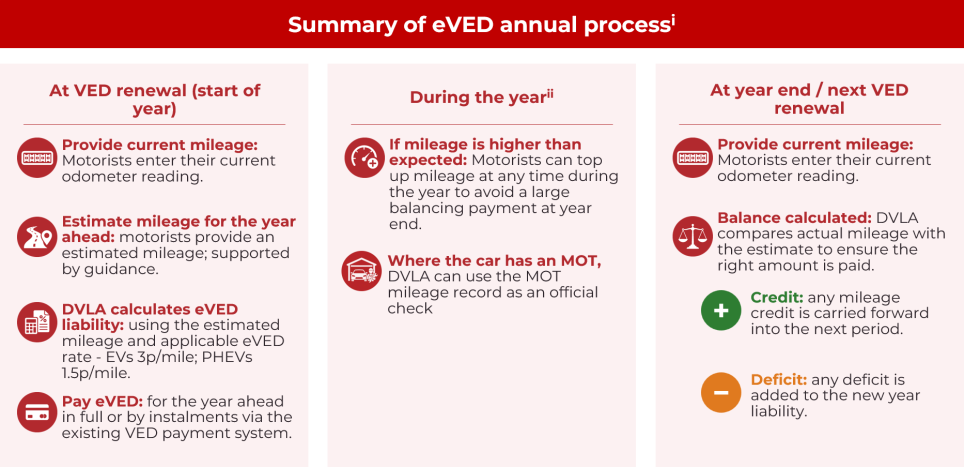
(i) Fleets have different arrangements set out in Chapter 7.
(ii) The treatment of vehicle lifecycle events, such as where a car is sold, are set out in Chapter 6. In addition, motorists may be eligible for a refund if their financial circumstances unexpectedly change during the year (as set out in Chapter 5).
Illustrative worked examples to demonstrate how the eVED process will work in various scenarios:
Example 1: Motorist who pays eVED monthly
Estimated mileage: 5,000 miles
Rate: 3p per mile
Total annual tax liability: 5,000 x 3p = £150
Monthly eVED payment: £12.50[footnote 10]
Example 2: Motorist who makes a top up payment
A motorist initially estimates they will drive 5,000 miles over the licensing period and pays the annual tax of £150 in one payment at the start of the year. After six months, the motorist expects to exceed their original estimate and revises their expected annual miles to 7,000 miles.
Revised estimated mileage: 7,000 miles
Rate: 3p per mile
Revised total annual tax liability: 7,000 x 3p[footnote 11] = £210
Additional liability: £210 - £150 = £60
Top-up payment: £60
Example 3: Motorist with an overpayment (credit carried forward)
A motorist initially estimates annual mileage of 5,000 miles and pays £150 in one payment. At the end of the year when the motorist relicenses, verified mileage data shows actual usage of 4,000 miles.
Revised estimated mileage: 4,000 miles
Difference between revised and initial mileage estimates: 5,000 – 4,000 = 1,000 miles
As the motorist has overpaid for the eVED period, the motorist will receive 1,000 miles’ credit which will be carried forward into the next licensing period. At this point, the rate of eVED has been uprated by CPI.
Estimated mileage for the next licensing period: 4,000 miles
Estimated mileage for the next licensing period – mileage credit: 4,000 – 1,000 = 3,000 miles
Rate: 3.06p[footnote 12] per mile
Total annual tax liability: 3,000 x 3.06p = £91.80
Monthly eVED payment:[footnote 13] £7.65
Example 4: Motorist with an overpayment eligible for a refund for an unexpected change in financial circumstances
Where a motorist has an unexpected change in financial circumstances and meets the eligibility criteria set out in Chapter 5, any mileage credit would be refunded to them rather than be carried forward into the next licensing period.
Estimated mileage: 4,000 miles
Rate: 3p per mile
Total annual tax liability: 4,000 x 3p = £120
Excess miles not driven at the time refund is applied: 2,000 miles
Refund cash credit if criteria for refund for an unexpected change in financial circumstances is met: 2,000 x 3p = £60
For the subsequent licensing period, the motorist would follow the standard process—submitting a mileage estimate and choosing to pay either annually or in monthly instalments.
Example 5: Motorist’s vehicle is stolen
A motorist’s vehicle is stolen three months into the licensing period. The motorist had estimated they would drive 6,000 miles and paid £180 in a single payment at the start of the year. The motorist is entitled to a cash refund for the remaining liability for the licensing period, calculated on a default pro-rata basis.
Estimated miles driven in the three months: (6,000 ÷ 12) x 3 = 1,500 miles
Estimated tax liability for three months: 1,500 x 3p = £45
Difference between annual liability and three-month liability: £180 - £45 = £135
Refund due: £135
This process would also apply where the vehicle’s odometer is damaged beyond repair in an accident.
-
The DfT AI Consultation Analysis Tool (CAT) was used. The evaluation of this tool can be found here ↩
-
In Northern Ireland this is will be for vehicles under four years old, when the first MOT check takes place ↩
-
Range extender vehicles are electric vehicles fitted with a small combustion engine that generates electricity to extend the vehicle’s driving range ↩
-
Based on forecasts published by the OBR in the November 2025 Economic and Fiscal Outlook. New vehicle sales are forecast to increase from nearly 0.5 million in 2025/26 to around 1.6 million in 2030/31, incorporating the estimated overall net impact of eVED and associated Budget measures – around a 2% dampening effect to new EV sales in this period. Since eVED was announced at Budget 2025, EV sales have exceeded the forecast by over 10% (or almost 18,000 sales) in the remainder of 2025/26 alone (26 November 2025 to 31 March 2026). ↩
-
The estimated proportion of mileage driven abroad of total mileage for cars is approximately 2% based on HMT/HMRC analysis using 2024/25 data ↩
-
In Northern Ireland this is will be for vehicles under four years old, when the first MOT check takes place ↩
-
Four years in Northern Ireland ↩
-
Four years in Northern Ireland ↩
-
Refunds will be given at the rate applicable when the mileage was purchased ↩
-
This does not take into account the Direct Debit Surcharge of 5%. Including the Direct Debit Surcharge, the monthly payment would be £13.12 ↩
-
Assumes that the eVED rate has not changed in this period; the latest eVED rate will apply at time of top-up ↩
-
Assumes a CPI of 2% for the purpose of this illustrative example ↩
-
This does not take into account the Direct Debit Surcharge of 5%. Including the Direct Debit Surcharge, the monthly payment amount would be £8.03 ↩