Consultation on the Introduction of Electric Vehicle Excise Duty (eVED)
Updated 25 March 2026

© Crown copyright 2026
This publication is licensed under the terms of the Open Government Licence v3.0 except where otherwise stated. To view this licence, visit nationalarchives.gov.uk/doc/open-government-licence/version/3 or write to the Information Policy Team, The National Archives, Kew, London TW9 4DU, or email: psi@nationalarchives.gov.uk.
Where we have identified any third party copyright information you will need to obtain permission from the copyright holders concerned.
This publication is available at https://www.gov.uk/government/consultations/consultation-on-the-introduction-of-electric-vehicle-excise-duty-eved/consultation-on-the-introduction-of-electric-vehicle-excise-duty-eved
Ministerial Foreword
For too long previous governments have ducked the choices needed to reform our taxation system for the long-term. Not at this Budget. As well as delivering on the British people’s priorities: cutting NHS waiting lists, cutting the cost of living and cutting debt, this Budget is also announcing much needed tax reforms. Where unfairness is growing and the long-term health of the public finances depends on decisive action, this government is taking the right decisions for the long-term.
One of the clearest examples of overdue reform is motoring taxation. Today, drivers of petrol and diesel vehicles pay tax on how much they drive through fuel duty at the pump, while drivers of electric vehicles currently make no equivalent contribution.
If we do nothing, then by 2030 around one in five car drivers are expected to pay no fuel duty at all, while other motorists will continue to contribute an average of £480 a year. Given all cars cause congestion and wear and tear on the roads, this is not a fair outcome.
That’s why the government will introduce electric Vehicle Excise Duty (eVED) from April 2028. It will be set at half of the equivalent rate of fuel duty for electric cars, and half again for plug-in hybrid cars. eVED will ensure all car drivers contribute, but will still maintain important incentives to switch to an electric vehicle. eVED will not require ‘trackers’ in cars, nor will the government ask people to interact with a whole new tax system: car drivers will pay for the miles they drive alongside paying their usual road tax (VED). We are consulting on the details of this scheme here, and we would like to hear from you.
The transition to electric cars will improve our air quality, create high-skilled jobs and support our net zero goals. eVED will ensure this happens fairly and will also protect vital motoring taxation revenues for the long term. Fuel duty revenues are expected to fall to around half - to around £12bn per year in the 2030s.This is equivalent to funding nearly 70% of GP appointments that have taken place in England in the last year. Doing nothing about this would be fiscally irresponsible.
The government remains firmly committed to supporting the transition to electric vehicles. At Budget 2025, we have announced measures worth £3.6bn which will make electric cars and chargepoints more accessible and back our British automotive sector to build the electric vehicle models of the future here in Britain.
The government will continue to take steps to ensure the transition to electric is successful, fair and fiscally sustainable. Through this consultation and wider engagement, the government wants to hear your views on eVED and how best to implement it.
Dan Tomlinson MP
Exchequer Secretary to the Treasury
Executive summary
The taxation of motoring is a critical source of funding for public services and investment in infrastructure, including upkeep of the roads. Motoring taxation is structured around two elements: taxation on the usage of the vehicle (primarily via fuel duty) and taxation on the ownership of the vehicle (primarily via Vehicle Excise Duty or VED). A fair system for taxing motoring is one where people contribute based on both what kind of car they drive and how much they drive.
Drivers of petrol and diesel vehicles are subject to taxation on usage via fuel duty at the pump, whereas drivers of electric vehicles do not currently pay an equivalent. If left unchanged, this would mean that by 2030, around 1 in 5 car drivers will pay no fuel duty equivalent, in contrast to other drivers who currently contribute an average of £480 a year. This outcome is not fair to those who have not switched to an EV.
All drivers should contribute to account for the wear and tear on our roads, and the funds needed to provide major road investments.
Therefore, Autumn Budget 2025 announces the introduction of eVED for electric and plug-in hybrid electric cars, which will come into effect in April 2028. Drivers will estimate and pay for their mileage alongside their existing VED payments; compared to alternatives considered, this model minimises reporting requirements for taxpayers, whilst respecting motorists’ privacy. This reform will ensure a fair transition to electric vehicles.
eVED will also support the public finances in the long-term. As more people switch to cleaner, greener electric cars, fuel duty receipts are forecast to decline to around half current levels (to ~£12bn) by the 2030s. This projected lost revenue is equivalent to funding 265 million GP appointments, almost 70% of GP appointments that have taken place in England in the last year. Introducing eVED will ensure that these revenues do not dry up in the decades to come, forcing either spending cuts or tax rises elsewhere.
While it is fair for EV drivers to contribute for their car usage in the same way as those driving petrol and diesel cars, the government is also committed to ensuring that driving an electric vehicle is an attractive choice for consumers. Therefore, the rate of eVED paid by electric vehicle drivers will be half the fuel duty rate paid by the average petrol/diesel driver, with a reduced rate for plug-in hybrid drivers, and there will be no requirement to report where and when miles are driven, so there is no need for trackers in cars.
The government is firmly committed to supporting a successful transition. This is key to supporting UK automotive manufacturers and to meeting our net zero goals. Therefore, the government will reinvest the majority of the money raised in the early years of the tax into specific measures to help consumers choose EVs and to bolster British industry. eVED will not start until 2028, and support for motorists and the automotive sector will be introduced well in advance:
- An additional £1.3bn of funding for the Electric Car Grant launched in July this year, which will also be extended to run until 2029-30, taking the total funding to £2bn. This will mean more motorists can benefit from discounts of up to £3,750 on eligible cars.
- Raising the threshold at which new EVs pay the VED Expensive Car Supplement from £40,000 to £50,000, saving over a million EV drivers £440 per year.
- Investing an additional £100m into the public chargepoint rollout, building on the £400m of funding announced as part of the Spending Review. This includes funding to support the installation of home and workplace chargepoints, adding to the around a million already installed. The government is also allocating £100m of resource funding for local authorities and public bodies to support the training and deployment of specialist staff, accelerating the rollout of public chargepoints.
- Launching a consultation on permitted development rights for cross-pavement EV charging, which will make gaining access to EV charging quicker and cheaper for households without driveways.
- Introducing a ten-year 100% business rates relief for EV chargepoints and EV-only forecourts, alongside a one-year extension to 100% First Year Allowances for zero emission cars and electric vehicle chargepoint infrastructure.
- Continuing to take action to bring down energy costs for consumers and businesses and reviewing the cost of public electric vehicle charging. The review will start in Q1 2026 and report by Q3. It will look at the impact of energy prices, including wider cost contributors, alongside options for lowering these costs for consumers.
- Delaying changes to benefit-in-kind rules for Employee Car Ownership Schemes until April 2030. For those still in contracts at that time, transitional arrangements will also be put in place to provide additional support.
- Investing a further £1.5bn to 2035 in the Drive35 programme, taking total funding to £4bn over the next 10 years, which will support the development of next-generation, zero-emission technology in the UK.
The revenue generated from eVED will also be critical in enabling the government to continue to invest in maintaining and improving the condition of roads across the country, benefitting all motorists. This Budget announces a doubling in funding over this Parliament for local authorities to repair, renew, and fix potholes on their roads, and the revenue generated from eVED will make it possible to sustain this funding into the future.
This consultation further discusses the motoring tax landscape; the design of eVED; and seeks views on aspects of the tax design and implementation.
In addition to carefully considering responses to this consultation, the government intends to engage extensively with the auto-sector and groups representing motorists during the consultation period and beyond.
1. About this consultation
Subject of this consultation
This consultation outlines proposals and seeks your views on delivery of eVED: a mileage-based tax on battery electric (EV) and plug-in hybrid (PHEV) cars.
HM Treasury will consider responses to this consultation, which will help shape the detailed policy development and delivery of eVED, which will be introduced from 1 April 2028 and administered by the Driver and Vehicle Licensing Agency (DVLA).
Chapter 2 asks questions about you. Chapter 3 covers the motoring tax landscape, what has been announced at Budget 2025 and the context for the announcement. Chapter 5 covers aspects of the detailed design of eVED and Chapter 6 summarises the consultation questions.
Scope of this consultation
The introduction of the eVED from April 2028 was announced at Budget 2025. This consultation sets out detailed proposals for how this new tax will be designed and implemented - and seeks your views on these to inform the final scheme.
Who should read this consultation?
Individuals or organisations who are impacted or interested in the details of how eVED will be designed and implemented.
Duration
This consultation will be open for 16 weeks, starting from 26 November 2025 and concluding on 23:59 on 18 March 2026.
How to respond to this consultation
The government invites respondents to submit responses via the online response form, which can be found at: https://www.smartsurvey.co.uk/s/eVEDconsultation/
After this consultation
The government will consider responses when refining the design of eVED and will publish a formal response to this consultation.
2. About you
All interested parties are welcome to respond to this consultation. To help the government understand the context of your answers and assess the views from different stakeholders, it would be helpful to have some information about you.
Questions
1) What is your name?
2) What is your email address?
3) Which category in the following list best describes you?
a. Business - car manufacturer
b. Business - operating in the auto-sector supply chain
c. Business - fleets and leasing
d. Business – MOT provider
e. Business - other
f. Trade body or association
g. Interest group
h. Academic
i. Individual
j. Other
4) Would you like your response to be confidential?
If you are responding on behalf of a business, please also indicate where your business is located, approximate size and number of employees.
If you are responding on behalf of a trade body, association or interest group, please also indicate how many members you have and how you obtained the views of your members.
3. A fair motoring tax system
The taxation of motoring is a critical source of funding for our vital public services and investment in infrastructure, including upkeep of the roads. The transition to electric vehicles (EVs) will be transformative for our quality of life, energy security and economy. As the motoring landscape evolves, so must motoring taxes – to lay the foundations for a fair transition to electric and protect the long-term sustainability of the public finances.
This chapter provides an overview of the motoring tax landscape, including the transition to electric vehicles, and fiscal sustainability considerations in this evolving context
Current Motoring Tax Landscape
There are two primary motoring taxes in the UK: Vehicle Excise Duty (VED) and fuel duty. VED raised £8.4bn in 2024-25 and is a tax on vehicle ownership, through which the purchase and ownership of certain types of vehicles e.g. those with lower emissions, are encouraged through the tax system. Fuel duty raised £24.4bn in 2024-25 and is payable on petrol, diesel and other fuels.
Fuel duty is charged on a per litre basis and in effect taxes miles driven, because those who drive more pay more in fuel duty. It is paid to HMRC by refiners but is passed on and included in the price motorists pay at the pump. The rates on petrol and diesel for the average car equates to around 6 pence per mile; the average petrol and diesel driver pays around £480 per year in fuel duty.[footnote 1]
VED is sometimes known as ‘road tax’ or ‘car tax’ and is paid by owners of vehicles driven or kept on public roads. There are different rates which apply to cars, vans and motorcycles based on vehicle type and other factors, including age and emissions; EVs and PHEV cars have been subject to VED since April 2025.
Cars registered since 2017 are subject to a standard annual rate after the first year of registration, which is currently £195.[footnote 2] For the first year of registration, rates vary depending on emissions: EVs will continue to enjoy a first-year rate of £10 until at least 2029-30, whereas more polluting cars pay higher first year rates.[footnote 3]
Currently, new cars with a list price of £40,000 or more (£50,000 or more for electric vehicles, as announced at Budget) are also liable for the VED Expensive Car Supplement (ECS). This is an additional charge payable by registered vehicle owners for five years, from years two to six following a car’s first registration. The VED ECS rate is currently £425 per year.[footnote 4]
There are other parts of the tax system which also apply to motoring, including Company Car Tax (CCT) and Salary Sacrifice, where there are incentives to adopt low and zero emission cars. For example, generous CCT rates known as appropriate percentages (APs) for EVs are a key incentive for increasing the number of EVs on the roads.
Transition to electric vehicles
Transport remains the largest emitting sector of greenhouse gas emissions, producing 29% of the UK’s total emissions in 2023. Road transport accounts for 89% of domestic transport greenhouse gas emissions, with cars alone responsible for 54% of those emissions.
The transition to EVs will drive economic growth and make Britain a clean energy superpower, helping the country meet its climate change obligations and improve air quality. One in four new cars sold in October this year were electric, and new electric car sales are up almost 30% compared to October 2024. The UK is now the second largest EV market in Europe.
The government remains committed to phasing out the sale of new cars powered solely by internal combustion engines by 2030, with all new cars and vans being fully zero emission by 2035. In April 2025, the government provided the automotive industry with additional Zero Emission Vehicle (ZEV) Mandate flexibilities, giving companies greater freedom on how to meet the targets.
The government has announced at Budget 2025 the immediate rollout of an additional package of support worth £3.6bn, building on over £4bn already committed through the Spending Review and Industrial Strategy, to help motorists switch to cleaner, greener cars and to support automotive sector through the transition to EVs, bolstering British industry.
Fiscal sustainability in a changing landscape
As the share of electric vehicles rises and overall petrol and diesel consumption falls, the OBR has forecast that fuel duty revenues (~£24bn in 2024-25) will decline to around half current levels (~£12bn per year) by the 2030s. This projected lost revenue is equivalent to funding 265 million GP appointments, almost 70% of GP appointments that have taken place in England in the last year. This decline was identified as a substantial risk to the sustainability of the public finances by the Office for Budget Responsibility in their 2025 Fiscal Risks and Sustainability Report.[footnote 5]
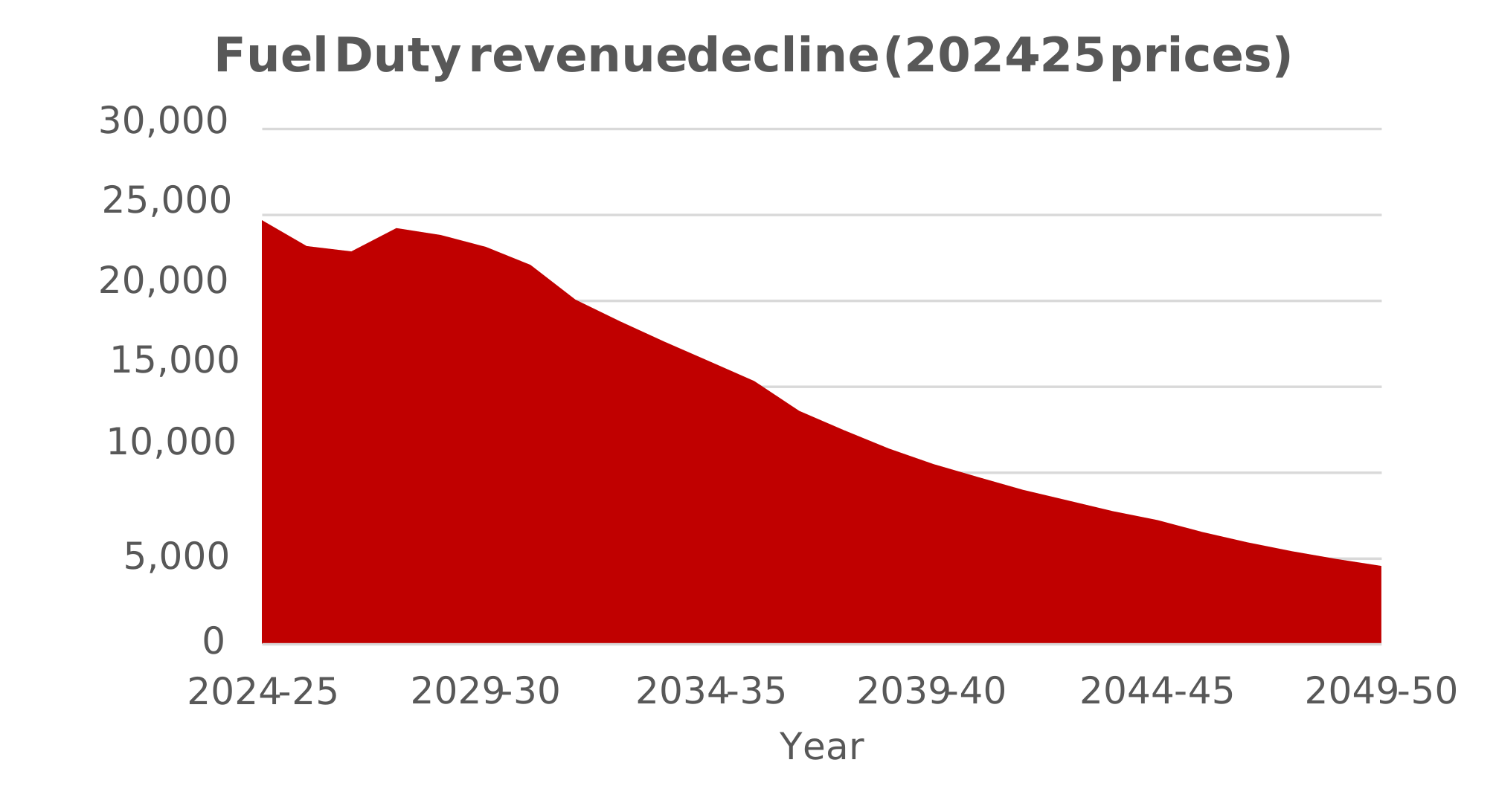
The announcement of eVED lays the foundations for a fair transition, where all motorists will pay based on how much they drive and this declining revenue base is replaced, which will help protect the long-term sustainability of the public finances.
Replacing fuel duty revenue with eVED
The government will implement eVED as an additional mileage-based add-on to VED for EV and PHEV cars, which is designed to replace the fuel duty revenues which will be lost as petrol and diesel vehicles are phased out over time. Other vehicle types, such as vans[footnote 6], buses, motorcycles, coaches and HGVs, will not be in scope of eVED upon its introduction in April 2028.
The government has taken an approach that protects motorists’ privacy; there will be no requirement to report where and when miles are driven or install trackers in cars. User-supplied mileage reporting and payments for eVED will be integrated into existing VED processes, to make complying with the new requirements as simple as possible for motorists.
eVED will be implemented from April 2028 to give motorists sufficient notice and those affected the opportunity to provide views on how it should be implemented.
4. eVED design, liability and collection
This chapter sets out further information on how eVED will work, the rationale for key features of the tax design and seeks your views on aspects of implementation – including how the government can make the tax as simple as possible to comply with, while minimising opportunity for fraud and error.
Overview of tax design
eVED is intended to replace lost fuel duty revenue from cars over the long term so, like fuel duty, the amount motorists pay will vary based on the amount they drive. Through the tax design, the government has sought to ensure the system is fair, respects motorists’ privacy and is as simple as possible to comply with. From 1 April 2028, VED on EV and PHEVs will continue to apply alongside eVED on mileage, from the point of their next VED renewal.
The rate of tax will be 3 pence per mile for fully electric cars; this is around half of the 6 pence per mile the average petrol or diesel driver pays in fuel duty. This means comparatively, EV drivers will continue to pay significantly less tax on the miles they drive. An EV driver[footnote 7] accruing 8000 miles per year will pay around £20 per month (£240 annually) in eVED compared to a petrol and diesel driver[footnote 8], who would pay around £40 per month in fuel duty (£480 annually) for the same mileage. The rate will be uprated in 2029-30 and in future years in line with CPI inflation, to ensure that the tax maintains its real-terms value.
New mileage estimation and reporting requirements, and payments for eVED, will be integrated into the existing VED system, to minimise administrative burdens for motorists. Integration with VED means most motorists will only be required to interact with the system once per year and through familiar channels. VED is administered by DVLA, who will also administer eVED.
Alongside paying their VED each year, under eVED motorists will estimate their mileage for the year ahead, pay an upfront charge based on their estimate or spread their payment across the year, and then submit their actual mileage at the end of the year to trigger a reconciliation. Motorists will have their mileage checked annually, typically during their MOT as is already the case, or for new cars, around their first and second registration anniversary.
Territorial Extent
Rates for both VED and fuel duty are set by the UK government and paid across all parts of the country. The same will apply for eVED, and the government expects the system to operate in broadly the same way across the UK.
This consultation refers to the roles of the executive agencies DVLA (which collects VED) and DVSA (responsible for the MOT regime). The DVSA operates in Great Britain only; the government will work with DVA and NIE on arrangements for how eVED will operate in Northern Ireland and taking into account differences in the MOT regime that apply there.
Scope
All UK-registered EV and PHEV cars will be in scope of eVED from April 2028.[footnote 9]
PHEVs have the capacity to drive in either electric or petrol mode and will continue to pay fuel duty on miles driven in petrol mode. In recognition of this, they will be subject to a reduced eVED rate of 1.5 pence per mile upon its introduction in April 2028 – half the rate that will apply to fully electric cars.
The government recognises that PHEV driving habits vary and that some motorists will drive more or less than 50% in electric mode. However, alternative options would require motorists to report their exact mileage driven in petrol versus electric mode, which is not considered a practical or proportionate approach. A reduced rate for PHEVs strikes the right balance between fairness, protecting motorists’ privacy and minimising administrative burdens on motorists.
EV and PHEV vehicles registered as cars will be in scope of eVED on the basis they can be plugged in to charge, where the electricity input is not subject to a fuel duty equivalent. Other hybrids – which use petrol or diesel as their sole external source of power – will therefore not be included in scope.
There are also a small number of other car powertrain types, such as hydrogen fuel cell electric cars on roads currently, the treatment of which the government will keep under review.
eVED will apply to cars driven by those who are wholly or partially exempt from VED, but where their petrol or diesel equivalents would be subject to fuel duty. This includes those who receive the mobility component of certain disability-related benefits (principally Disability Living Allowance or Personal Independence Payment). These groups will continue to receive the same VED exemptions as they do now but will not be exempt from eVED, as they are not exempt from fuel duty.
Other vehicle types such as vans, buses, coaches, motorcycles and HGVs will be out of scope of eVED upon its introduction in April 2028. At this stage, the transition to electric for these other vehicle types is less advanced than for cars.
There are also certain vehicle types, such as those in the Limited Use tax class[footnote 10], which it may not be appropriate to bring in scope of eVED. DVLA will publish a full list of vehicles subject to eVED in due course.
As with VED, eVED will apply to UK-registered cars. Non-UK vehicles in the UK for six months or more are required to register for VED and eVED.
1) Do you have any views on the government’s proposal for the design and scope of eVED?
Mileage estimation and checks
As outlined above, the eVED reporting and payment processes will be integrated into the existing VED system and administered by DVLA. This section sets out how taxpayers report, estimate, and have their mileage checked at MOT test centres.
For new cars, as with VED, dealerships will have the option to pre-pay and bundle eVED mileage into the on-road price of a car. Alternatively, the vehicle owner will be able to make their own arrangements and estimate their mileage for the remainder of the tax period, for eVED purposes.
For existing cars, at VED renewal each year, motorists will be prompted to enter their vehicle’s mileage reading and then estimate their mileage for the year ahead.[footnote 11] Based on this estimate, an estimated annual eVED liability will be calculated by DVLA, using the applicable rate.
The mileage estimation process is designed to help motorists smooth payments over the year and reduce the likelihood of large balancing payments due at the end of the VED period. The mileage estimation process may feel familiar to motorists who are already required to estimate their annual mileage for the purposes of car insurance. The government will publish guidance to help motorists to estimate their mileage, and how adjustments can be easily made at the end of the VED period.
Example for a motorist who pays eVED monthly:
Estimated mileage: 5,000 miles
Rate: 3p per mile
Total annual tax: 5,000 x 3p = £150
Monthly eVED liability: £12.50
Consistent with their current VED payment choice, motorists can choose between multiple payment options; they can either pay upfront or split into smaller monthly payments via Direct Debit. They will pay for their eVED alongside their VED.[footnote 12]
As noted above, the government has ruled out charging tax based on when or where people drive, to protect motorists’ privacy. This means mileage driven overseas by UK registered cars will fall into scope of eVED, as with fuel duty, which does not vary on basis of where a car is driven. Since the proportion of UK registered cars driving abroad each year is a small proportion of total cars, it is proportionate to prioritise privacy and simplicity over a system of checks to deduct non-UK mileage.
The government recognises that motorists based in Northern Ireland may be more likely than motorists based in Great Britain to drive outside of the UK. There is currently no equivalent mileage charge to eVED on electric or PHEV cars in the Republic of Ireland, however the government will continue to monitor the international tax landscape.
The government recognises that the large majority of EVs and PHEVs have in-built vehicle telematics, which monitor various driving activities and are viewable by drivers, vehicle manufacturers, or permitted third parties in some cases. The government will not mandate use of these telematics for administering eVED; however, it welcomes views on how various types of technologies could be used on an opt-in basis in future to simplify the system and reduce administrative burdens on motorists and businesses. Protecting motorists’ privacy as part of eVED is a priority for the government, so any potential technology-based solutions considered in future will only ever be optional.
2) What should the government consider when developing guidance that supports motorists to estimate their mileage?
3) How could technology make eVED easier and simpler for businesses and motorists to comply with?
4) Would you support the consideration of technological solutions on an opt-in basis, in future?
Mileage readings
At the end of the VED period, a user supplied mileage reading will be reconciled against the estimate provided at the start of the VED period and DVLA systems will calculate a balancing payment.
For motorists who have underestimated their mileage, DVLA intends to provide a facility to make a single balancing payment or to adjust payments in the following year to enable the liability to be spread.
For motorists who have overestimated their mileage, DVLA intend to provide a credit which can be carried forward to be offset against their liability in the following year. DVLA are considering detailed plans for how the system for managing under and over payments will be implemented in practice, including considering interactions with enforcement and compliance activities, and will set out further details in due course.
5) What should the government consider when designing the system for managing under and over payments of eVED?
Mileage checks:
Mileage data from cars is currently collected at annual MOTs and is available to see for a car on GOV.UK. The government intends to use this data to ensure that user-supplied mileage is consistent and up to date, so if a car is already subject to an MOT, there will typically be no additional steps for checks.
Cars under three years old are not currently required to have an annual MOT. The government currently intends for these cars to attend an additional mileage check at an accredited provider around their first and second anniversary, but welcomes views on whether these additional checks should be required. For many motorists, this will be able to be combined with other routine servicing and safety checks that their vehicle will typically require in this period.
The government considers MOT test centres to be well placed to be these accredited providers.[footnote 13] They already have facility to record mileages and are trusted partners of government. There will be no motorist charge for these additional checks, which will be funded by the government. The government will engage with the industry on these arrangements.
The government will consider options to strengthen the approach to capturing mileages at MOT (and for the period prior to the first MOT). This will include considering methods accredited providers could use to more efficiently and reliably extract data from cars, reducing scope for human error from writing down numbers from the vehicle display.
6) The government intends to engage with garages on MOT fees and the costs of mileage checks. Are there other steps the government should take to support MOT garages to prepare for eVED?
7) Do you agree that MOT garages are well placed to be accredited providers of mileage checks?
8) Are there alternative approaches for checking mileage in the first three years after a car is registered (pre-MOT age)?
The registered keeper (generally the owner) of a vehicle is legally responsible for paying VED. As eVED will be integrated into the VED system, the registered keeper will also be responsible for providing an accurate mileage reading and making payments for eVED. This includes taking reasonable steps to ensure that the odometer is functioning correctly and that the data provided is accurate. For example, if an odometer is clearly not recording or showing the mileage, this must be rectified.
In some cases, the owner and the driver of a vehicle are different. For example, car leasing arrangements are typically structured so that the lessor (leasing company) will retain registered ownership of the vehicle. This means the lessor is responsible for taxing the vehicle, rather than the driver. Lessors will likely need to develop new approaches for eVED for drivers to pay the accrued mileage liability.
The government acknowledges that fleets and leasing companies may require special arrangements. DVLA are considering options to minimise the administrative burdens of mileage estimation and payments for these businesses, similar to under VED where bulk licensing options are available. The government will engage with fleets and leasing companies on the design of these special arrangements.
9) What impact will the proposed approach for eVED collection have on fleets and leasing businesses?
10) What should the government consider to minimise administrative burdens and complexity for these businesses?
11) What should the government consider to ensure the overall approach to tax reporting and collection is fair?
Payment methods
Vehicle owners will have the same set of payment options for eVED as are currently available for VED. This means eVED payments will be able to be made monthly, bi-annually or annually. Similarly, the same payment channels used for VED will also be available for eVED, such as the Electronic Vehicle Licensing online service or the Post Office.
Events that lead to drivers’ mileage being lower or higher than they estimated
The government recognises that circumstances can change over the course of a year and is committed to ensuring the system provides motorists with flexibility to respond to life events, which may result in motorists driving significantly more or less than they estimated at the beginning of their VED period.
If motorists become aware of material change in circumstance during the VED period which means their mileage will be substantially lower than estimated, for example, an unexpected illness or change in employment, there will be processes through which they are able to notify DVLA, and adjustments be made.
Motorists will also be able to notify DVLA of an increase in predicted mileage during the VED year and make adjustments, to avoid a large balancing payment at the end of the VED period.
DVLA intend to consider the development of a fully automated system for payment adjustments and refunds in due course.
12) Which life events and other considerations should the government consider when building flexibility for changes in circumstances into the eVED scheme?
Cars scrapped, sold or taken off the road
The government proposes the following eVED treatment for different car lifecycle events:
Vehicle changes ownership: The mileage already paid for will remain with the vehicle. This mileage – which may be either more or less than the actual mileage accrued at that point, as per the vehicle odometer – will be made visible via DVLA online to the new owner (i.e. the buyer). The government expects the eVED status of the vehicle (whether it is sold with pre-paid mileage or a mileage deficit) to be reflected in the sale price of the vehicle.
Vehicle is declared off road (declared SORN): Generally, the paid-for mileage will stay with the car until the next VED/eVED re-licensing and payment, with any credit or deficit carried over into the next licensing period. Some owners may seek a refund from DVLA for unused mileage via the change in circumstances process outlined above.
Vehicle is re-taxed after being declared SORN: A user-supplied mileage reading will determine the opening mileage when the vehicle owner next re-licenses the vehicle for road use. This would generally be expected to be the same as the ‘closing’ mileage pre-SORN unless the vehicle has been used off-road.
Vehicle is scrapped: The vehicle owner will be required to have a mileage reading, to determine the final eVED liability ahead of scrapping the vehicle. The government considers Authorised Treatment Facilities will be well placed to take this reading. Further consideration will be given to circumstances in which a mileage reading is not possible at point of scrappage (such as heavily damaged vehicles).
13) Do you agree with the proposed approach for car lifecycle events?
14) Is there anything further the government should consider when designing the arrangements for car lifecycle events?
Mileage verification and compliance
As outlined above, a blend of user-reported mileage and official mileage readings will be reported to DVLA, who will use this information to identify fraud and error.
To ensure a vehicle is compliant, at its next eVED renewal following its MOT check or official mileage check, the user-submitted mileage would need to be no less than the mileage at the most recent MOT check. Where the official mileage from the MOT (or at the similar checks in the years prior to a vehicle being of MOT age) and the user supplied mileage suggest that a mileage may have been materially mis-declared, the government will have evidence of mis-declaration, and appropriate compliance processes will be put in place by DVLA.
However, the government recognises that the non-alignment of eVED periods and MOTs means that there will be scope for some motorists to declare inaccurate mileage readings without this being immediately apparent. By under-declaring mileage, motorists run the risk of their mileage being subject to an increased rate in future years. Moreover, since the odometer reading will be reflected in the sale price when the vehicle changes ownership, and an official mileage reading is required when a vehicle is scrapped, under-declaration will ultimately always be identified. DVLA are considering options to further mitigate against the potential for delayed declaration and payments.
Mileage readings will be based on in-vehicle odometers, which are simple to read but can be subject to tampering. Estimates have suggested that around 2.3% of UK vehicles may show signs of clocking[footnote 14] and though this practice is uncommon (and already a criminal offence if not declared when a vehicle is sold), the government recognises that the introduction of eVED may increase the likelihood of motorists choosing to clock their vehicles, or allowing the odometer to be inoperative.
eVED compliance arrangements will place responsibilities on owners of vehicles to report mileage correctly, to ensure their odometer is functioning and to ensure MOT results are accurate. Vehicle manufacturers will retain responsibility for ensuring that, as far as possible, odometers cannot be tampered with and for assisting the government where it appears that tampering may be occurring, recognising that odometer information is often held in more than one place in a vehicle. MOT garages will, as now, be responsible for making sure that mileages are recorded accurately.[footnote 15]
The government is considering further options to mitigate against odometer tampering and intends to engage with manufacturers, the leasing industry and insurers to minimise fraud. The government will take necessary legislative, regulatory and technical steps to widen existing law and strengthen enforcement.
Penalties
DVLA utilise a range of enforcement measures for VED which scale from reminder letters in some circumstances, up to penalties, court prosecutions and fines. Action is taken based on evidence from the vehicle record and following sightings of unlicensed vehicles on road by Automatic Number Plate Recognition (ANPR) cameras, Police and local authorities. Further enforcement activities include the use of stickers, wheelclamping, vehicle lifting, and impounding to deter and penalise non-compliance.
The government is committed to ensuring the approach to compliance and enforcement is robust, transparent and fair. DVLA therefore intends to align as far as possible the approaches taken for eVED enforcement with the framework for VED summarised above, alongside considering the additional measures as required.
15) What should the government consider when developing an overall compliance approach to prevent user error, avoidance and fraud?
16) What should the government consider when designing the penalties regime within eVED, to ensure fairness to all motorists?
Alternative tax models
There are other tax models that have been suggested to replace declining revenue from fuel duty. These include a tax on electricity used to charge cars, which would have technical feasibility challenges relating to measurement; models involving trackers in cars such as time-distance-place road pricing, which do not protect motorists’ privacy; increasing VED on EVs and PHEVs, which would not be a fair or representative fuel duty replacement; and a pay as you go mileage charge separate to VED, which would require motorists to interact frequently with a new system. Unlike these suggestions, the proposals under eVED strike the right balance between complexity, privacy and feasibility.
Internationally, there are several countries which have introduced mileage-based taxes on EVs and PHEVs. Iceland and New Zealand introduced pay-per-kilometre taxes for electric vehicles in 2024 followed by Hawaii in 2025, while Switzerland and Australia are currently considering similar schemes. The approach to scope, reporting and time of payment varies; however, all involve manual reporting in the first instance, given feasibility and privacy challenges with technology-based approaches.
5. Summary of questions
1) Do you have any views on the government’s proposal for the design and scope of eVED?
2) What should the government consider when developing guidance that supports motorists to estimate their mileage?
3) How could technology make eVED easier and simpler for businesses and motorists to comply with?
4) Would you support the consideration of technological solutions on an opt-in basis, in future?
5) What should the government consider when designing the system for managing under and over payments of eVED?
6) The government intends to engage with garages on MOT fees and the costs of mileage checks. Are there other steps the government should take to support MOT garages to prepare for eVED?
7) Do you agree that MOT garages are well placed to be accredited providers of mileage checks?
8) Are there alternative approaches for checking mileage in the first three years after a car is registered (pre-MOT age)?
9) What impact will the proposed approach for eVED collection have on fleets and leasing businesses?
10) What should the government consider to minimise administrative burdens and complexity for these businesses?
11) What should the government consider to ensure the overall approach to tax reporting and collection is fair?
12) Which life events and other considerations should the government consider when building flexibility for changes in circumstances into the eVED scheme?
13) Do you agree with the proposed approach for car lifecycle events?
14) Is there anything further the government should consider when designing the arrangements for car lifecycle events?
15) What should the government consider when developing an overall compliance approach to prevent user error, avoidance and fraud?
16) What should the government consider when designing the penalties regime within eVED, to ensure fairness to all motorists?
Processing of personal data
This section sets out how we will use your personal data and explains your relevant rights under the UK General Data Protection Regulation (UK GDPR). For the purposes of the UK GDPR, HM Treasury is the data controller for any personal data you provide in response to this consultation.
Data subjects
The personal data we will collect relates to individuals responding to this consultation. These responses will come from a wide group of stakeholders with knowledge of a particular issue.
The personal data we collect
The personal data will be principally collected through an online form, and are likely to include respondents’ names, email addresses, their job titles and opinions. The digital form is hosted by SmartSurvey, an industry-leading online survey provider with the highest standards of data security. As with other organisations processing personal data, SmartSurvey is subject to data protection compliance requirements. Although SmartSurvey uses an automated system, the responses you give will not lead to any decisions being made about you and they will not have a direct impact upon you. In this context, SmartSurvey acts solely as a data processor under instruction from HMT and will not use your personal data for any purposes other than to provide the service to HMT. For more information on how SmartSurvey handles respondents data, please refer to their privacy policy here - https://www.smartsurvey.co.uk/company/privacy-policy
How we will use the personal data
This personal data will only be processed for the purpose of obtaining opinions about government policies, proposals, or an issue of public interest.
Processing of this personal data is necessary to help us understand who has responded to this consultation and, in some cases, contact respondents to discuss their response.
HM Treasury will not include any personal data when publishing its response to this consultation.
Lawful basis for processing the personal data
Article 6(1)(e) of the UK GDPR; the processing is necessary for the performance of a task we are carrying out in the public interest. This task is consulting on the development of departmental policies or proposals to help us to develop effective government policies.
Who will have access to the personal data
The personal data will only be made available to those with a legitimate business need to see it as part of consultation process.
HM Treasury may share responses with the Department for Transport (DfT), the Driver and Vehicle Licensing Agency (DVLA) and the Drive and Vehicle Standards Agency (DVSA) for analysis purposes, including information entered within the free-text fields of the survey, which may include personal data.
Data may also be shared with other government departments who have policy functions relevant to the consultation topic. Sharing in this context will ordinarily be anonymised unless information about the respondent is necessary to inform policy.
As the personal data is stored on our IT infrastructure, it will be accessible to our IT service providers. They will only process this personal data for our purposes and in fulfilment with the contractual obligations they have with us.
How long we hold the personal data for
We will retain your personal data only for as long as necessary to fulfil the purposes for which it was collected.
For consultations and calls for evidence, personal data will typically be held for the duration of the consultation and review period.
In addition, specific retention periods applicable to your personal data are as follows:
| Type of Processing | Retention period |
|---|---|
| Collection and storage of Smart Survey digital form data | No longer than 1 year from response deadline |
Your data protection rights
Relevant rights, in relation to this activity are to:
- request information about how we process your personal data and request a copy of it
- object to the processing of your personal data
- request that any inaccuracies in your personal data are rectified without delay
- request that your personal data are erased if there is no longer a justification for them to be processed
- complain to the Information Commissioner’s Office if you are unhappy with the way in which we have processed your personal data
How to submit a data subject access request (DSAR)
To request access to your personal data that HM Treasury holds, please email: dsar@hmtreasury.gov.uk
Complaints
If you have concerns about Treasury’s use of your personal data, please contact our Data Protection Officer (DPO) in the first instance at: privacy@hmtreasury.gov.uk
If we are unable to address your concerns to your satisfaction, you can make a complaint to the Information Commissioner at casework@ico.org.uk or via this website: https://ico.org.uk/make-a-complaint.
-
The rate for road use of petrol and diesel is currently 52.95 pence per litre (ppl); at Budget 2025, the government confirmed the temporary 5p cut will be extended to 30 August 2026. Rates will then gradually return to the previous level of 57.95 ppl by March 2027. The equivalent per mile rate is based on 24/25 fuel duty revenue from cars as a proportion of 24/25 car mileage; HMRC and DfT data. ↩
-
At Budget 2025 the 26/27 rate was confirmed as £200. For the first year, the applicable rate for each vehicle is calculated according to a range of factors, such as its date of first registration, weight, and CO2 emissions. Cars registered before 1 March 2001 pay VED based on engine size. Cars registered between 1 March 2001, and 1 April 2017 pay VED based on CO2 emissions. ↩
-
To support take-up of electric vehicles, it was announced at Budget 2024 the first-year rates for zero emission cars will be frozen at £10 until 2029-30. First year rates for cars that emit 1 to 50g/km of CO2 have risen to £110, and rates for cars that emit 51 to 75g/km have increased to £130. All other CO2 band rates have doubled. ↩
-
At Budget 2025, the Chancellor announced the VED Expensive Car Supplement threshold will increase to £50,000 for electric vehicles, from April 2028. ↩
-
CP 1343 – Office for Budget Responsibility – Fiscal risks and sustainability ↩
-
The zero-emission van market is less mature than for cars but improving; last year, nearly 1 in 10 new vans sold were electric. ↩
-
The average EV driver drives around 8,900 miles per year. ↩
-
The average petrol and diesel driver drives around 8,000 miles per year. ↩
-
All vehicle registration and licensing in the UK for mechanically propelled vehicles used or kept on a public road is governed by the Vehicle Excise and Registration Act 1994. ↩
-
Schedule 2, paragraph 20A, of the Vehicle Excise and Registration Act 1994 (c. 22) ↩
-
A car’s mileage reading is from the car’s odometer, displayed in the vehicle; motorists will be required to submit this within a specified period. DVLA will publish guidance to support motorists to estimate their mileage, but this is similar to mileage estimation requirements for insurance purposes. The tax period is typically a year, but motorists could opt for a six-month period for their eVED and VED. ↩
-
Motorists will also be able to pay via the Post Office or via telephone for one-off payments. ↩
-
In Great Britain, the DVSA, an executive agency, is responsible for the MOT regime. In Northern Ireland, this is the responsibility of the DVA, part of the Northern Ireland Executive (NIE). The government expects the system of checks to broadly work in the same way across the UK. The government will work with DVA and NIE on these arrangements in Northern Ireland. ↩
-
CarVertical research, 2024 ↩
-
For modern vehicles with digital odometers, tampering without detection is more difficult compared to analogue odometers in older vehicles. ↩