Aligning the time limits for recovery of NICs with Income Tax
Published 13 July 2026

© Crown copyright 2026
This publication is licensed under the terms of the Open Government Licence v3.0 except where otherwise stated. To view this licence, visit nationalarchives.gov.uk/doc/open-government-licence/version/3 or write to the Information Policy Team, The National Archives, Kew, London TW9 4DU, or email: psi@nationalarchives.gov.uk.
Where we have identified any third party copyright information you will need to obtain permission from the copyright holders concerned.
This publication is available at https://www.gov.uk/government/consultations/aligning-the-time-limits-for-recovery-of-national-insurance-contributions-with-income-tax/aligning-the-time-limits-for-recovery-of-nics-with-income-tax
Subject of this consultation
This consultation is on removing National Insurance contributions (NICs) from the scope of the Limitation Act 1980 and Limitation (Northern Ireland) Order 1989 and aligning recovery and repayment timelines with those of tax.
Scope of this consultation
This consultation is seeking views on the proposal to:
- remove NICs from the scope of the Limitation Act 1980 and Limitation (Northern Ireland) Order 1989
- introduce a statutory Notice of NICs Liability
- align the time limits for recovery of NICs debts with those for tax
- align the time limits for refunds/repayments of NICs with those for tax
Who should read this
Individuals and employers who pay NICs, representative bodies, agents and other stakeholders.
Duration
The consultation will run for 12 weeks from the 13 July.
How to respond or enquire about this consultation
Responses should be sent by 12th October 2026 by email to nics.policy@hmrc.gov.uk or by post to:
Individuals Policy Directorate
Room 3/E01
HM Revenue and Customs
100 Parliament Street
SW1A 2BQ
London
United Kingdom
Additional ways to be involved
We welcome meetings with representative groups to discuss these proposals.
After the consultation
Responses to the consultation will be analysed and we will publish a summary of responses in due course.
Getting to this stage
The government announced at Autumn Statement 2016 that it would remove NICs from the effects of the Limitation Act, following the Office of Tax Simplification report of March 2016. This was re-confirmed by the government at Tax Update Day on the 19 June 2026.
Previous engagement
This reform was recommended by the Office of Tax Simplification in its report in March 2016 following engagement with both external and government stakeholders. This is the first external engagement to be carried out by the government.
1. Executive Summary
This consultation seeks views on proposals to reform the way in which National Insurance contributions (NICs) debts are recovered, by removing NICs from the scope of the Limitation Act 1980 and Limitation (Northern Ireland) Order 1989, and aligning the time limits and processes for NICs more closely with those that apply to income tax assessment.
At present, NICs and income tax are subject to different recovery and repayment frameworks. For income tax, behaviour-based time limits apply to the assessment of liability, with recovery not subject to a fixed time limit once an assessment has been made. In contrast, Class 1 NICs are not subject to assessment in the same way, as NICs are a statutory liability arising at the point that an employee’s earnings are earnt. Additionally, the recovery of NICs is subject to limitation rules, meaning that debts generally become unenforceable after 6 years unless protective action is taken. For repayments for income tax the time frame given in the Taxes Management Act (TMA) is 4 years, whilst for NICs it is 6 years.
This difference creates complexity and administrative burdens for both HMRC and customers, particularly where PAYE income tax and NICs liabilities arise from the same underlying income but are handled through different processes.
This consultation is therefore seeking views on the proposal to:
- remove NICs from the scope of the Limitation Act 1980 and Limitation (Northern Ireland) Order 1989
- introduce a statutory Notice of NICs Liability
- align the time limits for recovery of NICs debts with those for income tax debts
- align the time limits for refunds/repayments of NICs with those given in the TMA
The aim of this is to simplify the system, reduce administrative burdens, and create a more transparent and predictable approach for employers and their advisers. These changes are not expected to affect the amount of NICs paid by employees, and may in some cases improve their contribution records.
2. Introduction
The recovery of NICs in England, Wales, and Northern Ireland is governed by the Limitation Act 1980 and Limitation (Northern Ireland) Order 1989 which place time limits on the recovery of NICs debts. This differs from the position for income tax, which is specifically excluded from these legislative provisions and for which time limits apply to assessment as opposed to recovery, and those time limits are governed by the TMA. In Scotland, limitation is governed by the Prescription and Limitation (Scotland) Act 1973 and the TMA time limits also apply to the assessment of tax.
The time limits applied to recovery of unpaid tax and NICs also differ. In order to comply with statutory time limits for income tax, where appropriate HMRC must issue an assessment within the time limits prescribed by TMA: 4, 6 or 20 years depending on the behaviour giving rise to the tax due, and 12 years for losses arising from offshore matters. Provided that an assessment is made within the statutory time limit, there is no restriction on how long HMRC has to recover the debt.
For NICs, the time limits in which unpaid liabilities can be recovered are dictated by Section 9 of the Limitation Act. This means NICs due are unrecoverable after 6 years from the due date of payment unless protective action is taken. There are equivalent legislative provisions in Northern Ireland, however the provisions in Scotland differ.
To ‘protect’ a NICs debt from becoming unrecoverable, HMRC can lodge a Protective Claim in the County Court. This process, and the associated courts costs creates a significant financial and administrative impact on HMRC.
HMRC also has the option of entering into a standstill agreement with the customer where the parties agree to freeze the statutory time limits for collecting NICs. This has reduced administration costs for HMRC whilst offering reputational protection for employers. However, this still requires an agreement between HMRC and the employer, which is burdensome for both parties, and HMRC continues to need to pursue protective claims in a number of cases every year, particularly cases with a fraud or avoidance element.
As HMRC seeks to simplify the tax system and align processes, the government believes that there is a case to look at resolving this difference between income tax and NICs by removing NICs from the scope of the Limitation Act and Northern Ireland equivalent and aligning the time limits for the recovery and repayment of NICs with those for income tax across the UK. This was previously recommended by the Office for Tax Simplification in 2016, and the government is now consulting on the proposal for how to take this forward.
If taken forward, the intention is for these proposals to apply across the UK. However, the legislative framework governing limitation in Scotland differs from that in the rest of the UK, and further engagement will therefore be required to consider how the proposals should operate in Scotland.
The proposals are focused on how HMRC establishes and recovers NICs liabilities, primarily from employers, and do not seek to affect the amount of NICs paid by employees. Where an unpaid NICs liability affects an employee, the main impact would be on the individual’s National Insurance record rather than a direct payment obligation.
No final policy decisions have been taken at this stage. The purpose of this consultation is to test whether the proposed approach is workable and proportionate in practice and to ensure that any reforms are informed by stakeholder experience and evidence.
3. Current Legislative Position
Background
Establishing a Liability
When a taxpayer appears to have failed to pay the correct tax or NICs due to HMRC, HMRC must establish their liability. To do so, there are different processes for income tax and for NICs.
For income tax, there are differing assessing provisions based on the collection mechanism. The relevant assessment or determination must be issued within the time limits prescribed by statute, but having done so and subject to any appeal, recovery of the tax is not subject to any constraint.
For income tax collected via PAYE, a Regulation 80 (Income Tax (Pay as you Earn) Regulations 2003) determination is used. Regulation 80 determines the amount of unpaid PAYE tax and creates an enforceable tax debt. The time limits for making a Regulation 80 determination are set in the Taxes Management Act 1970 (TMA) at 4, 6, or 20 years dependent on the customers behaviours, with a time limit of 12 years for offshore matters. For income tax collected via Self-Assessment, the same time limits apply, assessment is conducted under Section 28C TMA.
Establishing a NICs liability is less straightforward and differs depending on the class of NICs. Class 4 NICs are payable on profits and follow the income tax assessing and collection route and are payable in the same manner as income tax, via Self-Assessment. However, there are key differences for establishing the liability for Class 1, 1A, and 1B NICs. For these classes of NICs, where HMRC comes to the view that a liability exists (or has not been paid), and an employer or employee disputes that view, an officer of HMRC must give a decision under Section 8 Social Security Contributions (Transfer of Functions, Etc.) Act 1999 (ToFA). Issuing a decision under Section 8 confirms the liability and gives both the employer and the employee the right to appeal against HMRC’s decision. Crucially, this differs to Regulation 80, as the Section 8 decision does not create an enforceable debt, it confirms that the unpaid liability exists and quantifies it.
Recovery
NICs are a civil debt and, except in Scotland, the collection of arrears are normally subject to the 6-year time limit set out in Limitation Act or Northern Ireland equivalent. This time limit means that HMRC has 6 years from the date that the NICs became due to recover the debt and is not affected by HMRC conducting an assessment or issuing a Section 8 decision. In order for the NICs debt to be recoverable after 6 years, HMRC must take protective action by either making a protective claim through the courts, which is administratively burdensome and costly, or entering into a standstill agreement with the customer, which is effective only in compliant cases. This differs to income tax, where there are time limits of 4, 6,12, and 20 years on assessment, but once the liability has been established, there is no time limit on the recovery of the debt. In Scotland, NICs are not subject to the six‑year limitation period that applies in England, Wales and Northern Ireland. Instead, recovery is governed by the Prescription and Limitation (Scotland) Act 1973, although for income tax the time limits of the TMA are applied to assessment.
Appeal rights
There are different appeal rights available for income tax and NICs. For PAYE income tax a determination under Regulation 80 establishes the employer’s PAYE liability and establishes an enforceable debt. The determination is issued to the employer and therefore only the employer has the right of appeal unless recovery of the amount is transferred to the employee.
In contrast, a decision under Section 8 determines whether a NICs liability exists but does not create a new enforceable debt. The liability to pay generally rests with the employer, however a section 8 decision may also have an impact on the employee’s NICs record and so both the employer and the affected employees have appeal rights under the Section 8 framework. This being said, the liability will be the responsibility of the employer in the first instance and the proposed Notice of NICs Liability is not intended to change this for employees.
These differences mean that in some cases the appeals process can involve different parties, even though the unpaid liability arises from the same income. For example, only the employer is involved in the PAYE appeal, whereas both employer and employee could be involved in appeals of the NICs liability under Section 8.
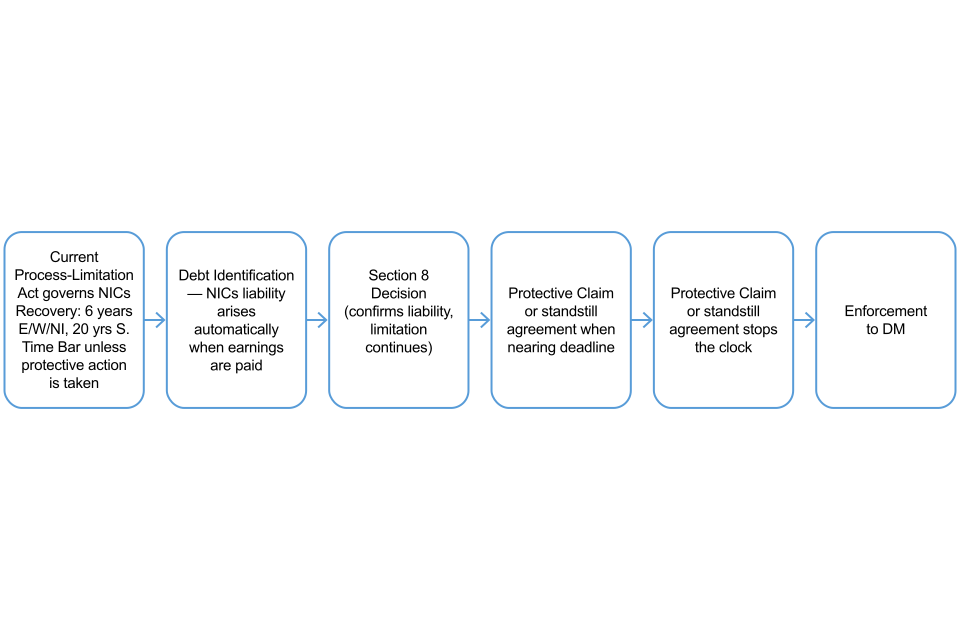
Process map of current NICs recovery process
The diagram below summarises the end-to-end process for recovering a NICs liability under the existing framework.
Repayments
Time limits for refunds/repayments of NICs and income tax are also different. For all NICs refunds (excluding Class 4), the time limit for a repayment of contributions paid in error is set out in regulation 52 Social Security (Contributions) Regulations 2001 (SSCR), which allows a repayment within six years from the end of the tax year in which the NICs were due to be paid. This aligns with the time limit for recovery of debts given in the Limitation Act.
For Class 4 NICs repayments are provided for by Regulation 102 SSCR which allows a repayment where contributions have been overpaid through the Self-Assessment process. This is subject to a time limit from the year of assessment, which is dependent on the specific circumstances of the case.
The TMA provides that a claim for a repayment may be made within 4 years of the end of the relevant tax year. This aligns with the 4 year assessment time limit for customers who have acted with reasonable care.
4. Proposed changes to debt recovery process for NICs
As set out in the previous chapter, recovery of Income Tax and NICs operate on different legislative frameworks, with different time limits and processes for recovery. This mismatch in the time limits for recovery between income tax and NICs is particularly an issue for Class 1 NICs, and PAYE income tax debt. After establishing NICs and PAYE income tax liabilities, recovering the debt requires parallel but separate processes with separate time limits and appeal rights. This results in an administratively burdensome system, creating complexity for HMRC compliance staff and making compliance investigations more challenging for customers and their advisors to navigate.
In the majority of cases where a Class 1 NICs liability arises, there is also a corresponding PAYE income tax liability. Therefore, it makes sense to align the recovery processes, and time limits, to streamline the process and give greater clarity, particularly for employers and their agents. Doing so will also remove the need to protect the debt via standstill agreements or Protective Claims in the Courts which cost HMRC an average of £4m p.a.
This chapter sets out proposed changes to the debt recovery process for NICs. The proposal seeks to achieve the following alignments and objectives:
- aligning the time limits for recovery and repayment of NICs across the UK with those for income tax
- removing NICs from the Limitation Act 1980 and the Limitation (Northern Ireland) Order 1989 to remove the need for court action to protect NICs debt
Removing NICs from the Limitation Act and Northern Ireland equivalent and aligning the recovery position with income tax will make processes simpler and more transparent. We believe our proposals will not change adversely the position for the vast majority of customers who have fulfilled their responsibilities (other than reducing the number of years for which contributions paid in error can be reclaimed) but will streamline the processes.
Question 1: To what extent do you consider that the current differences between NICs and PAYE income tax recovery processes create administrative complexity?
Aligning time limits for recovery
Our proposal is to align the time limits for recovery and repayment of NICs with those for income tax. We propose to do this by removing NICs from the Limitation Act and Northern Ireland equivalent. The effect of removing NICs from these legislative provisions would be that recovery of the debt would not be subject to a 6 year time limit. Instead, the time limits for the recovery of NICs would be set out in NICs legislation, mirroring those in the TMA.
Notice of NICs liability
We propose creating a statutory enforceable notice — a Notice of NICs Liability and linking the issue of the notice to the time limits in TMA: normally 4 years, or if the inaccuracy was careless, 6 years, and if deliberate, 20 years, with a 12 year time limit for offshore matters. Where HMRC believes there to be a NICs liability outstanding, and wishes to enforce the debt, a Notice detailing the amount of the debt would be issued within the prescribed statutory time (4, 6 or 20 years depending on behaviour) from the end of the tax year in which the liability arose. Once the Notice has been issued, recovery of NICs is not subject to any further time limits, unless the liability is challenged. Where there is a disagreement, the employer has 30 days to challenge the Notice of Liability via the Section 8 decision which will suspend enforcement.
Question 2: Do you agree that HMRC should introduce a statutory Notice of NICs Liability and align the time limits for the collection of NICs debts with those for income tax?
Section 8
The Notice would operate alongside a Section 8 NICs decision. Where the liability is disputed, the Section 8 decision would determine the liability as well as deal with the underlying contributions question, and would provide the statutory right of appeal for the employer and affected employees.
Appeals
The Notice of NICs liability would not carry a right of appeal; instead, any challenge would need to be brought via the Section 8 process, which remains the statutory mechanism for determining NICs liability. Following the Notice being issued, the liable person would have 30 days to either pay the debt or request a Section 8 decision. Where a Section 8 decision is appealed, enforcement of the associated Notice would be suspended until the appeal is resolved. Enforcement action would proceed only once liability has been determined by the tribunal or a settlement reached between all parties.
Question 3: Do you anticipate any disadvantages or practical constraints to the route of appeal for the Notice of NICs Liability being to appeal the associated Section 8 decision, rather than a right of appeal being directly linked to the Notice itself?
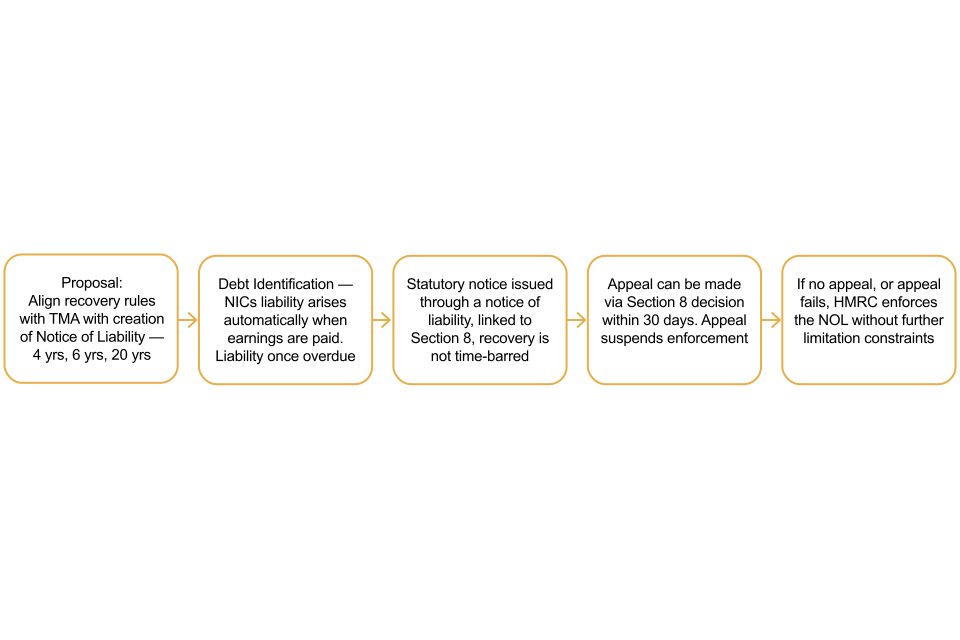
Process map of proposed NICs recovery process
The diagram below illustrates the end-to-end process under the proposal.
Repayment
We also propose to align the time limit for repaying NICs paid in error with the time limits given in the TMA. This means that HMRC will only repay contributions paid in error on application for up to 4 years instead of 6. Whilst this is a reduction of two years, four years is the standard time frame given by the TMA and we believe that this is a sufficient period of time and should not disadvantage people.
Question 4: Do you see any administrative difficulties arising from aligning the time limit for NICs repayments with those given in the TMA?
Question 5: Do these proposals have any specific disadvantages or unintended consequences for taxpayers, aside from the reduced repayment period for NICs paid in error?
Further simplification to the section 8 decision process
As set out in Chapter 3, one key difference between PAYE income tax debt recovery and NICs debt recovery is that PAYE debts are determined at the employer level and a decision is issued to an employer only under Regulation 80. By contrast, for NICs purposes the employers’ NICs debt is determined at an employee level, and therefore a Section 8 decision has to be issued to all parties including both the employer and affected employees. The reason for the difference in approach is in part to protect the employee’s appeal right because as well as determining a NICs debt, a Section 8 decision may have an impact on an individual’s contributory record.
However, this process creates administrative complexity for HMRC and customers as it requires HMRC to engage with multiple parties in relation to the same issue. This can create administrative work for HMRC and employers in determining the affected employees who need to receive a Section 8 decision. Comparatively, Regulation 80 is a much more streamlined process, requiring engagement with only the employer to recover the unpaid PAYE income tax liability.
The government has identified a number of further minor legislative clarifications that could be made to the Section 8 process to make its operation simpler for HMRC and for customers. This includes the introduction of a statutory mechanism to withdraw a Section 8 decision.
Currently, there is no vehicle to withdraw a Section 8 decision. Rather, where HMRC wants to withdraw a Section 8 decision, the decision is varied to nil. This can cause practical issues, for example where litigation is ongoing the original Section 8 decision will remain under appeal until it lapses. Therefore, a statutory mechanism to allow withdrawal of a Section 8 decision would provide a clearer outcome in these cases.
The government would like to explore options which streamline the Section 8 process and would welcome views from stakeholders on any further improvements that could be made to the existing NICs debt recovery processes from your experience of managing debt recovery disputes.
Question 6: Do you agree that the Section 8 process should be simplified, and if so which aspects of the current framework do you find add the most complexity?
Question 7: Are there further improvements the government could make to NICs debt recovery processes?
5. Assessment of impacts
Exchequer impact assessment
| Impacts | Comment |
|---|---|
| Economic impact | The economic impact will be considered fully following consultation. |
| Impact on individuals, households and families | Any impacts arising from subsequent policy proposals, including changes to notification, appeals or administrative processes, will be assessed in detail and set out in further advice following consultation, with input from the Customer Impacts and Equalities team. |
| Environmental impact | This measure relates to tax administration and debt recovery processes and does not fall within the scope of the environmental principles duty under the Environment Act 2021. |
| Equalities impacts | Any equality impacts arising from specific policy options, including impacts on individuals sharing protected characteristics, will be fully considered and assessed following consultation, once the detailed design of the measure is developed. We will work with the Customer Impacts and Equalities team to ensure due regard is given in line with Section 149 of the Equality Act 2010. A full equality impact assessment is not recommended at this stage but will be considered as part of further advice following consultation. |
| Impact on businesses and civil society organisations | The consultation will be used to assess the potential impacts on employers and other affected stakeholders, including any one‑off or ongoing administrative costs or savings arising from changes to NICs debt recovery processes. These impacts will be quantified and assessed in further advice following consultation, with support from KAI analysts. |
| Impact on HMRC or other public sector delivery organisations | Assessment of feasibility and the operational and delivery impacts are currently being considered by HMRC impacting teams and early impacting has not indicated any system or IT changes will be needed. More information will follow the consultation. |
| Devolution | NICs are a reserved matter, and the proposed reforms would apply on a UK‑wide basis. However, different legislative provisions apply in Scotland and Northern Ireland, and the current treatment of NICs under limitation rules already differs in Scotland.In Scotland, NICs are not subject to the six‑year limitation period that applies in England, Wales and Northern Ireland. Instead, recovery is governed by the Prescription and Limitation (Scotland) Act 1973, We will therefore be engaging with the Northern Ireland and Scotland Offices, and the devolved governments on these matters. |
6. Summary of consultation questions
Question 1: To what extent do you consider that the current differences between NICs and PAYE income tax recovery processes create administrative complexity?
Question 2: Do you agree that HMRC should introduce a statutory Notice of NICs Liability and align the time limits for the collection of NICs debts with those for income tax?
Question 3: Do you anticipate any disadvantages to the route of appeal for the Notice of NICs Liability being to appeal the associated Section 8 decision, rather than a right of appeal being directly linked to the Notice itself?
Question 4: Do you see any administrative difficulties arising from aligning the time limit for NICs repayments with those given in the TMA?
Question 5: Do these proposals have any specific disadvantages or unintended consequences for taxpayers, aside from the reduced repayment period for NICs paid in error?
Question 6: Do you agree that the Section 8 process should be simplified, and if so which aspects of the current framework do you find add the most complexity?
Question 7: Are there further improvements the government could make to NICs debt recovery processes?
7. The consultation process
This consultation is being conducted in line with the Tax Consultation Framework. There are 5 stages to tax policy development:
Stage 1 Setting out objectives and identifying options.
Stage 2 Determining the best option and developing a framework for implementation including detailed policy design.
Stage 3 Drafting legislation to effect the proposed change.
Stage 4 Implementing and monitoring the change.
Stage 5 Reviewing and evaluating the change.
This consultation is taking place during stage 2 of the process. The purpose of the consultation is to seek views on the detailed policy design and a framework for implementation of a specific proposal, rather than to seek views on alternative proposals.
How to respond
A summary of the questions in this consultation is included at chapter 6.
Responses should be sent by 12th October 2026 by email to nics.policy@hmrc.gov.uk or by post to:
Individuals Policy Directorate
Room 3/E01
HM Revenue and Customs
100 Parliament Street
SW1A 2BQ
London
United Kingdom
Please do not send consultation responses to the Consultation Coordinator.
Paper copies of this document in Welsh may be obtained free of charge from the above address.
When responding please say if you are a business, individual or representative body. In the case of representative bodies please provide information on the number and nature of people you represent.
Confidentiality
HMRC is committed to protecting the privacy and security of your personal information. This privacy notice describes how we collect and use personal information about you in accordance with data protection law, including the UK General Data Protection Regulation (UK GDPR) and the Data Protection Act (DPA) 2018.
Information provided in response to this consultation, including personal information, may be published or disclosed in accordance with the access to information regimes. These are primarily the Freedom of Information Act 2000 (FOIA), the Data Protection Act 2018, UK General Data Protection Regulation (UK GDPR) and the Environmental Information Regulations 2004.
If you want the information that you provide to be treated as confidential, please be aware that, under the Freedom of Information Act 2000, there is a statutory Code of Practice with which public authorities must comply and which deals with, amongst other things, obligations of confidence. In view of this it would be helpful if you could explain to us why you regard the information you have provided as confidential. If we receive a request for disclosure of the information we will take full account of your explanation, but we cannot give an assurance that confidentiality can be maintained in all circumstances. An automatic confidentiality disclaimer generated by your IT system will not, of itself, be regarded as binding on HM Revenue and Customs.
Consultation privacy notice
This notice sets out how we will use your personal data, and your rights. It is made under Articles 13 and 14 of the UK General Data Protection Regulation.
Your data
The data controller for your personal data is HMRC. We will process the following personal data of individuals responding to this consultation:
Name
Email address
Postal address
Phone number
Job title
Your opinion
Purpose
The purpose(s) for which we are processing your personal data is: Aligning the time limits for recovery of NICs with income tax.
Legal basis of processing
The legal basis for processing your personal data is that the processing is necessary for the performance of a task carried out in the public interest or in the exercise of official authority vested in a government department under Article 6(1)(e) of the UK GDPR.
Recipients
Your personal data will be shared by us with (provide details of recipients of the personal data, if applicable eg HM Treasury).
As the personal data is stored on our IT infrastructure, it will be accessible to our IT service providers. They will only process this personal data for our purposes and in fulfilment with the contractual obligations they have with us.
Retention
Your personal data will be kept by us for 6 years and will then be deleted.
Your rights
You have the right to request information about how your personal data are processed, and to request a copy of that personal data.
You have the right to request that any inaccuracies in your personal data are rectified without delay.
You have the right to request that any incomplete personal data are completed, including by means of a supplementary statement.
You have the right to request that your personal data are erased if there is no longer a justification for them to be processed.
You have the right in certain circumstances (for example, where accuracy is contested) to request that the processing of your personal data is restricted.
Contact HMRC or make a complaint
Please refer to the HMRC Privacy Notice for how to contact us or make a complaint. If you have any questions about this privacy notice or how HMRC handles your personal information, email the Data Protection Officer at: advice.dpa@hmrc.gov.uk
Consultation principles
This call for evidence is being run in accordance with the government’s Consultation Principles
The Consultation Principles are available on the Cabinet Office website: Consultation Principles Guidance
If you have any comments or complaints about the consultation process, please contact the Consultation Coordinator.
Please do not send responses to the consultation to this link.
Annex B: Relevant Government Legislation
The Limitation (Northern Ireland) Order 1989