A new Victims’ Code: consultation document
Published 5 February 2026
Applies to England and Wales

© Crown copyright 2026
This publication is licensed under the terms of the Open Government Licence v3.0 except where otherwise stated. To view this licence, visit nationalarchives.gov.uk/doc/open-government-licence/version/3 or write to the Information Policy Team, The National Archives, Kew, London TW9 4DU, or email: psi@nationalarchives.gov.uk.
Where we have identified any third party copyright information you will need to obtain permission from the copyright holders concerned.
This publication is available at https://www.gov.uk/government/consultations/a-new-victims-code/a-new-victims-code-consultation-document
A new Victims’ Code: A consultation on a new Victims’ Code
Presented to Parliament by the Minister for Victims and Violence against Women and Girls by Command of His Majesty.
CP 1502-I
ISBN 978-1-5286-5463-0
Foreword
This government is taking tough action on crime, driven by our core mission to make this country’s streets safer.
As the Minister for Victims and Violence against Women and Girls, I know how vital it is that victims have confidence in the criminal justice system.
But I also know that, for many, the system can feel complex, overwhelming and deeply stressful – often at the very worst moment of their lives. Victims need clear information and tools to help them navigate the system.
This government is already driving forward a wide programme of reforms to protect victims and improve their experience of the criminal justice system.
I’m proud of our commitment to halve violence against women and girls over the next decade, and of the decisive action we’ve taken to reduce the Crown Court backlog. Yet too many victims are still waiting too long for justice.
Full and fundamental reform is needed. Sir Brian Leveson’s Independent Review of the Criminal Courts set out proposals for once-in-a-generation change. Government has announced its response to the first part of the Review to put victims first. A £550 million investment will be injected into victims’ services over the next three years. This multi-year package – the largest ever provided – will mean charities and support services can offer a vital lifeline to victims as they find the courage needed to hold offenders to account.
Our Sentencing Act 2026 will also strengthen transparency, with a new, comprehensive release framework for greater clarity across sentencing decisions, measures to improve public understanding of sentencing, and to strengthen communication with victims. And our Victims and Courts Bill will reinforce the powers of the Victims’ Commissioner, so that systemic problems can be tackled head-on.
But reform must also start with the basics. The Victims’ Code is the foundation of victims’ rights, setting out what every victim, whatever the crime, can expect from the system. While it already provides a good baseline – we want to make sure that it is as clear, strong, and supportive as possible.
Through this consultation, we are seeking views on:
- New expectations for needs assessments so that agencies effectively assess and deliver for victims;
- A new framework to guide agencies’ direct engagement with child victims to give them more agency and choice;
- Communicating with victims well and in a timely way, including exploring innovative approaches to communicate about information relating to their case; and
- improvements to how and when victims are given opportunities to participate in the justice process.
A clearer code will give victims certainty about what to expect, and it will help us better hold criminal justice agencies to account for the service they provide.
This isn’t just the right thing to do for victims – it is essential for justice itself. When victims are properly supported and informed, we empower them to see their cases through. That means more criminals brought to justice – and safer communities for all.
We want to hear from those with lived experience, those who support them, as well as professionals working in the criminal justice system. Together, we can build a Victims’ Code that delivers for those who need it most.
Alex Davies-Jones MP
Minister for Victims and Violence against Women and Girls
Introduction
The Victims’ Code (the Code) sets out what victims[footnote 1] can expect to receive from criminal justice agencies. It provides an important baseline for how the criminal justice system can support victims to engage with the criminal justice process if they choose to do so.
The Victims and Prisoners Act 2024 (the Act) requires a new Code to be issued by the Secretary of State. The Act requires the Secretary of State to prepare a draft of the new Code and to consult on this ahead of laying the new Code in Parliament (subject to implementation of Sections 2-3 of the Victims and Prisoners Act 2024).
This Code must reflect the four overarching Code principles set out in section 2 of the Victims and Prisoners Act 2024, which are that victims require:
- information to help them understand the criminal justice process
- access to services to support them (including, where appropriate, specialist services)
- the opportunity to make their views heard in the criminal justice process
- the ability to challenge decisions which have a direct impact on them.
This consultation builds on the extensive engagement we have had with Parliamentarians and stakeholders, who have told us that the existing Code’s foundations are broadly right, but that there are areas we can strengthen. We want to make sure the Code sets clear and deliverable minimum standards throughout the criminal justice system so that victims have the support and information they need.
The consultation particularly seeks views on the following areas in the draft Code:
- New principles and training so that agencies effectively assess and deliver what victims need to support them through the criminal justice process.
- A new framework for how and when agencies should directly engage with child victims.
- The right points to communicate with victims about case information during the criminal justice process.
- Improving how and when victims are given opportunities to participate.
We also want to make sure that the Code works in practice, by:
- Making sure that the rights victims can expect to receive under the Code are clear so that agencies can be held to account for delivering them.
- Exploring ways to ensure victims of all ages know about the Code and can understand their rights.
This is an open consultation that seeks to gather information and data about the draft new Code. We will carefully consider and engage with victims, their families, those that support them and other experts. We will also consult criminal justice partners, their agencies, the judiciary, and a range of professionals who work with victims every day.
The areas examined within this consultation document broadly apply to England, or England and Wales only, including some relating to health and care and local authorities that are devolved matters in Wales.
The matters dealt with in this consultation are generally devolved to the Scottish Parliament and Northern Ireland Assembly. The Code, once issued, will not apply in Scotland or Northern Ireland. Nonetheless, responses to this consultation are invited from individuals and organisations throughout the UK.
A Welsh language consultation paper is/will be made available at [XXX].
Following the consultation, we will carefully consider the responses and publish a formal government response. This will inform the new Code that will be laid in Parliament and come into force.
Chapter 1 – Assessing victims’ needs effectively
Overview
‘Needs assessments’ allow criminal justice agencies to identify how a victim may need to be supported to understand and engage in the criminal justice process. They are how agencies identify whether any adjustments to services should be made. However, we know that these assessments are not always conducted and when they are they can lack important details such as a victim’s contact preferences[footnote 2]. This consultation looks to explore when and how victims’ needs are assessed and how that should translate into action by criminal justice agencies to better support victims to engage with the process.
In this chapter, we set out new principles in the Code that provide more clarity over criminal justice agencies’ responsibilities and the purpose of asking about a victim’s needs at each stage. We are asking for views on how to use the Code to set a clear baseline for when and how these assessments are conducted and how the information gathered by them should be used to inform delivery of rights under the Code.
We are also working with the College of Policing who are developing new training for supervisors of frontline police officers and staff. Effective supervision will ensure that consistent standards are being met, and this training will embed the importance of the Code and needs assessment process. The College also maintains national standards for training new police officers and wider learning for how to conduct needs assessments. This includes providing training materials and a digital course for use across forces. We are asking for views on how else we can drive improvements in practice.
New principles for needs assessments
We have included new principles for needs assessments in Right 1 of the Code to make it clear that needs assessments should inform delivery of all the remaining rights under the Code, and have updated the headline Right: ‘to understand and be understood and to have services adjusted to your needs’. This would replace the limited reference to needs assessments in Right 4 (to be referred to services that support victims and have services and support tailored to your needs) in the current Code.
The content under Right 4 now focuses on provision of support services to help victims cope and recover. This is to make it clearer that all victims are eligible for such services, regardless of whether they report the crime, and more accurately reflects how referrals work in practice. This is reflected in the new headline Right 4: ‘to self-refer and/or be referred to services that support victims.
The Victims and Prisoners Act 2024 requires the Secretary of State to consider the needs of victims with protected characteristics when deciding whether the Victims’ Code needs to make different provision for these groups (subject to implementation of Section 2 of the Victims and Prisoners Act 2024).[footnote 3] By making clearer how and when a victim’s needs should be assessed, our intention is to make sure a victim’s protected characteristics (if the victim is willing to share these) are identified and services provided under the Code can be adjusted to meet their needs.
The new principles make it clear that all victims have the right to have their needs assessed at various points throughout their case, but specifically at three stages:
- When a victim first engages with the police, a needs assessment will help the police identify any immediate safeguarding needs, record a victim’s contact preferences and identify if a victim is eligible for Enhanced Rights under the Code at the earliest opportunity. It will also inform the police’s referral to a service that supports victims.
- During the investigation, a needs assessment will support agencies to ensure that any communication, health, and disability needs are met such as providing an interpreter. It also provides them with an opportunity to gather any demographic information, such as protected characteristics, that a victim is willing to share for the purposes of ensuring that they adjust services in the right way.
- Before a victim gives evidence, a needs assessment will inform an application for special measures[footnote 4] and allow agencies to address practical concerns, which may include making a referral to a witness support service.
We will also use this new framework to require that victims are told about their rights under the Victims’ Code at each of these stages (Chapter 5: Helping victims to understand their rights under the Code).
We are interested in your views on whether these expectations for needs assessments are at the appropriate stages of the criminal justice process, and whether they seek the necessary information to inform delivery of the Code. We are also asking for your views on whether a needs assessment should take place at the end of a case, and what this assessment could be used to inform.
We recognise that assessing a victim’s needs should not be a ‘tick-box’ exercise and they should be undertaken in a quality, trauma-informed way. We have therefore not placed a time-bound requirement on the expectations around needs assessments, for example requiring that an assessment must be conducted within 10 working days of reporting the crime. This avoids setting up a perverse incentive to prioritise meeting a deadline rather than ensuring there is a quality assessment. We are interested to hear your views on how needs assessments can be delivered in an effective and quality way, and what role the Code should play in setting appropriate standards.
In addition to avoiding a ‘tick-box’ approach to assessing victims, we also want to make sure Code rights are deliverable and victims can rely on receiving services in accordance with the Code. This is why we have updated the requirement that information about the Code, including where and how to get advice and support, should be provided to all victims as soon as possible and within 5 working days of contact with the victim, rather than the current expectation to do so within 1 working day of reporting a crime for victims with Enhanced Rights (Right 3). In practice, an assessment of whether victims are eligible for Enhanced Rights may not be possible within a day, particularly for crimes which are reported without direct contact between a victim and the police, such as online or through a third-party.
Outcomes of needs assessments
It is important that the Code is clear about our expectations of the services that may be provided to victims as an outcome of a needs assessment, which is why we have updated the Code with information on:
-
Provision of professional interpretation and translation services. We have clarified (a) that support with communication during the criminal justice process must be provided by professionals who are qualified to do so; and (b) the circumstances in which such services should be provided.
-
Applying for special measures to support victims to give their best evidence at court. We have clarified the process of applying for special measures and who is required to support victims to do so as well as signposting to the Crown Prosecution Service’s video guides on special measures, which can be found here: https://victimandwitnessinformation.org.uk/the-court-process/special-measures.
-
Appropriate sharing of needs assessment data between agencies. To avoid victims having to repeat information unnecessarily, the new Code sets out that service providers can share relevant information about a victim and their needs where agreed and appropriate.
Questions
-
Question 1A: Does the new information, in the blue box in Right 1 entitled ‘When and how your needs will be assessed’ help victims to understand how their needs will be assessed?” [Yes/No] Please explain your answer.
-
Question 1B: Do you think needs assessments occur at the right stages of the criminal justice process (those stages are when a victim first engages with the police, during the investigation of the crime, and before giving evidence)? [Yes/No] Please explain your answer.
-
Question 1C: Do you think they cover the right information to inform necessary adjustments to the services provided to victims? [Yes/No] Please explain your answer.
-
Question 1D: Do you think there could be a further needs assessment at the end of a case? [Yes/No] If yes, what information could this cover and how could that information be used?
-
Question 1E: What could agencies do to make sure that needs assessments are undertaken in a quality and trauma-informed way?
-
Question 1F: What role could the Code have in facilitating needs assessments being undertaken in a quality and trauma-informed way?
Chapter 2 – Engaging with child victims
Overview
We know that children have distinct and different needs to adults, and we have worked with sector experts and young people themselves to better understand what is important to child victims within the criminal justice process. We have heard that children do not routinely receive the information, guidance and support they need, which can leave them feeling powerless as they navigate the criminal justice system[footnote 5]. This consultation looks to explore how the needs of children can be better met by criminal justice agencies, paying particular attention to giving children a voice.
In this chapter, we are seeking views on a proposed framework to support criminal justice agencies to directly engage with child victims of all crimes, so that child victims can participate appropriately in the criminal justice process. This includes seeking views on how this can be delivered in practice and how to best reflect the role of those supporting child victims, including parents or guardians (including carers).[footnote 6]
The Code is already clear that suspected perpetrators of a crime who hold parental responsibility would not be entitled to receive communication on behalf of their child who is the victim of that crime. Through the Victims and Courts Bill, the Government has introduced measures that will automatically restrict the exercise of an offender’s parental responsibility for those sentenced for a serious child sex offence. Alongside this the Bill also provides for the restriction of the exercise of parental responsibility when an offender is sentenced for rape and their crime has led to the birth of a child for whom they hold parental responsibility.
Once enacted and implemented, this legislative change will be reflected in the proposed framework to ensure that those who have had their parental responsibility restricted would not receive communication about their child if they are going through the criminal justice process.
We are also asking for views on proposed additional content in the code setting out what child victims can expect from the criminal justice system, such as those provisions set out in established Achieving Best Evidence guidance.[footnote 7]
Framework for engagement with child victims
We know that often children are not directly communicated with about the criminal justice process or given choices for how they can engage.[footnote 8] We have worked closely with experts in the victim support sector and considered approaches in other sectors, such as healthcare, to develop a proposed national framework for how criminal justice agencies should deliver information and communication rights under the code directly to children. These code rights involve the need to understand, consent and provide views.
A child’s ability to understand and consent is complex and will evolve over time, so we have proposed different general approaches based on age brackets. The proposed national framework would require criminal justice agencies to consider whether children have sufficient understanding and maturity to fully appreciate implications for them of certain decisions, known as being ‘Gillick competent’ in a health setting, as part of needs assessments.[footnote 9]
The proposal also therefore covers how communication would take place in parallel with parents or guardians, and where they may receive communication on behalf of their child (noting a clear exception in cases that would fall under the new measure for automatic restriction in the Victims and Courts Bill, where that parent or guardian is a suspect, or if it is not considered to be in the best interests of the child to do so).
We welcome views on whether the following age categories and broad principles would work in a criminal justice setting:
- 0-11 years old: information and communication rights would be provided to the parent or guardian on the child’s behalf. Agencies could facilitate different approaches for children who wish to be involved and clearly demonstrate decision-making competence but would not be required to proactively offer this.
- 12-15 years old: children would be given the opportunity to receive information and communication rights directly (unless there are other needs or vulnerabilities that make this inappropriate), alongside the parent or guardian.
- 16-17 years old: children should receive information and communication rights directly (unless they opt-out or there are other needs or vulnerabilities that make this inappropriate). Parents or guardians would be kept updated throughout, unless the child is living independently.
Where communication is with both the child and parent or guardian, we envisage this would often be done simultaneously in practice, for example one email addressed to both or a meeting or discussion with both present. We recognise that this would change current practice, and that criminal justice agencies may require support and training to deliver this efficiently and effectively. The accompanying Impact Assessment sets out the estimated resource that this framework may involve. We would welcome views on how these changes could be facilitated and embedded in criminal justice agencies’ practice in an efficient and impactful way, minimising any potential duplication of communication activity.
Questions
-
Question 2A: Do you think a framework guiding criminal justice agencies’ engagement with children should be introduced? [Yes/No] Please explain your answer.
-
Question 2B: Do you agree with the proposed framework for how criminal justice agencies could engage with children? [Yes/No] Please explain your answer.
-
Question 2C: Do you think the proposed age categories that are being used to guide criminal justice agencies’ engagement with child victims are the right ones? [Yes/No] Please explain your answer.
-
Question 2D: Do you think the right level of engagement is reflected in each category, for example a presumption of direct engagement with 16- and 17-year-olds? [Yes/No] Please explain your answer.
-
Question 2E: Are there any circumstances in which the proposed framework for how criminal justice agencies engage with children should not apply? [Yes/No] Please explain your answer.
-
Question 2F: Please provide your views on what agencies could do to make sure that direct engagement with children is undertaken in a quality and trauma-informed way.
Distinct provision for child victims
We want to make clear throughout the Code where children’s distinct and different needs mean that the Code entitlements should be delivered in a different way, in order to best support them to engage with the criminal justice system.
We have therefore added specific sections that explain these throughout the Code. These broadly reflect the principles set out in the proposed framework for engaging with children as above and other existing criminal justice guidance. These changes include:
- Information on how processes may be different for children, such as if they disclose a crime at school, and their automatic eligibility for special measures.
- Outlining where a parent or guardian may receive some rights under the Code on behalf of a child. For example, if the child is under the age of 12 their parent or guardian may make a Victim Impact Statement on their behalf or receive contact from the Victim Contact Scheme if eligible.
- Making it clear that children should be directly referred to a support service, while their parent or guardian may otherwise receive information or communication rights under the Code on the child’s behalf. We have clarified that parents or guardians can seek separate support that may be available locally or online.
Our intention is to be clear to both victims and criminal justice agencies what child victims can expect, but we know that the Code must work for a variety of audiences. To ensure that younger children can understand their entitlements, we intend to separately develop materials that are tailored to support children’s understanding, and we ask questions about this later in this consultation (see Chapter 5: Helping victims understand their rights under the Code).
We are asking for your views on whether this information is useful, if it is presented in the right way and whether there are any other provisions that you are aware of that should be included.
Questions
-
Question 2G: Do you think the specific sections detailing what child victims can expect should be included in the Code? (as yellow boxes throughout) [Yes/No] Please explain your answer.
-
Question 2H: In general, do you think that the impact of a crime on victims under the age of 12 should be relayed by a parent or guardian (for example, by making a Victim Impact Statement on the child’s behalf)? [Yes/No] Please explain your answer.
-
Question 2I: Please tell us if there is anything else that could be included in a yellow box in the Code to set out provision specific to child victims.
Chapter 3 – Quality and timeliness of providing case information
Overview
We know from criminal justice inspection reports and feedback from victims and the sector that agencies can take a ‘tick-box’ approach to delivering some information rights under the Code. This can lead to poor quality communication that results in victims feeling left out of the criminal justice system and can ultimately mean they want to disengage from the process. We want agencies to deliver information rights in a way that meets the spirit, and not only the letter, of the Code, so that victims receive information in the right way and at the right time.
We know that what victims need will vary. Some victims will simply want to know basic case updates like details of appointments that have been made, while other victims may need sensitive trauma-informed communication throughout. We know victims can be given lots of information from different agencies, but the impacts of trauma mean that in some cases victims may not be able to process information they are given immediately.
In this chapter, we are asking for views on measures to improve the quality and timeliness of communication with victims; the right points and methods to communicate routine updates and more sensitive updates; and on innovative communication options.
How agencies deliver information to victims
There are good examples of innovative ways that basic information is being made available to victims through digital routes, which gives victims the choice to engage at a time and in a place that works for them.
The police have developed online ‘portals’ in several areas which provide basic information and automated updates to victims of certain crimes such as burglary, robbery and assault during the pre-charge stage of a case. Some portals also provide additional routes for victims to communicate with the police officer in charge of the case.
We are interested in exploring whether a similar offer of a digital service could improve victims’ experiences at later stages of the criminal justice process. We would welcome views on what information would and would not be appropriate to receive in that format.
Digital innovation also has the potential to free up time for professionals to communicate sensitive information to victims in a trauma-informed way. We know there are good examples of dedicated training to support professionals in delivering this. For example, the Crown Prosecution Service has been developing training for staff, including prosecutors, who work with victims of rape and other serious sexual offences so that they have a greater understanding of trauma to inform their engagement with victims.
We want to understand how we can go further to improve the quality of engagement with victims by professionals in criminal justice agencies. As part of this, we have heard that there are some instances where more flexibility about who communicates with victims could improve victims’ experiences so that, where needed, victims can hear directly from the relevant decision-maker. For example, the police are currently responsible for communicating charging decisions regardless of whether a decision is made by the police or the Crown Prosecution Service. Where the decision is made by the Crown Prosecution Service, it may be better communicated by them.
It is right that we continue to innovate, trial and evaluate different ways to provide information to victims. We have therefore added a provision in the Code that allows service providers to outsource or delegate some of their responsibilities to provide information to victims or make referrals to support services, but only where this would improve service delivery, and where appropriate quality monitoring and data protection arrangements are in place (see section: Who is responsible for meeting Rights under this Code?). We are asking you for your views on this approach.
Questions
-
Question 3A. What information would be most valuable for victims going through the criminal justice process including during the investigation and pre-trial to access on a digital service?
-
Question 3B: What information should not be communicated digitally but instead conveyed through personal communication with victims?
-
Question 3C. What other considerations should be integral to the design of any digital victim service?
-
Question 3D: How could a digital victim service help to prepare victims for what to expect at the court?
-
Question 3E: Please provide your views on what agencies could do to make sure that communication with adult victims is undertaken in a quality and trauma-informed way. Please see question 2F for child victims specifically.
-
Question 3F: What role can the Code have in supporting quality and trauma-informed communication processes?
-
Question 3G: Do you think agencies should be able to delegate certain responsibilities such as providing information to victims and making referrals to support services? [Yes/No] Please explain your answer.
Chapter 4 – Improving how opportunities to participate are offered to victims
Overview
It is important that victims feel informed and supported to be able to participate and have their voices heard in a criminal justice process that can often feel alienating to them. However, we know that this is not always the case. For example, the Victim Impact Statement (currently known as a Victim Personal Statement) gives victims a voice in court proceedings by enabling them to describe the impact of the crime on them, which assists the court when they are considering the seriousness of the crime to inform the offender’s sentence. Yet we know that many victims cannot recall being given opportunities to make a Victim Impact Statement[footnote 10]
The Victim Impact Statement is submitted as evidence so it can be taken into account by the court when deciding the sentence, which means it must follow the usual rules of evidence. We have heard from victims and their families that the requirement for the Statement to follow the rules of evidence has not always been explained. This may lead to confusion, especially where victims and their families have been asked to change their Statements to make sure they do not contain material that cannot be put before the court. We believe there is a role for the Code in addressing these issues through increasing victims’ understanding of the Victim Impact Statement and its purpose, and formalising when this should be offered and explained to victims.
We also think providing victims with information at the right time and in a way that is sensitive to their needs can impact on whether a victim chooses to engage in the process. For example, telling Victim Contact Scheme eligible victims about the option of receiving information at key points during the offender’s sentence might be overwhelming if offered to them immediately after sentencing. We consider that this may be improved through providing victims with more than one opportunity to decide whether to receive information and make decisions about how they wish to participate.
In this chapter, we want to understand when and how opportunities (such as the ability to make a Victim Impact Statement or to join the Victim Contact Scheme) should be offered to victims, including where this offer should be made more than once to provide the victim with more opportunities to consider it. We are also asking for your views on when information about offender attendance at sentencing hearings should be provided to victims, and whether and how victims might be able to express their views about an offender’s release when being considered by the Parole Board.
Offering the opportunity to make a Victim Impact Statement
Victim Impact Statements provide victims with an opportunity to describe the impact of a crime on them in their own words, which the court will then use in determining the sentence. However, we know that there are several points where the impact of the crime on the victim should be considered. We also recognise that in cases where a charging decision or a trial takes place a significant length of time after the crime was first reported, victims may want the opportunity to make a further Victim Impact Statement to express the longer-term impact that the crime has had on them.
We have therefore proposed several updates in the Code to better reflect where victims should be offered the opportunity to have their voice heard, and how the impact of the crime on the victim is considered by decision makers at different points in the process.
- Witness statements. In some cases, victims are offered the opportunity to make Victim Impact Statements at the point of giving their witness statement to the police, but we recognise that this might be too soon to be able to fully articulate the impact of the crime. We also want to avoid asking victims to make a statement that might not be used, for example if the suspect is then not charged. We have included new information on how the witness statement will be used to understand the initial impact of the crime, which is considered by the police or the Crown Prosecution Service when making the charging decision (Right 7).
- Victim Impact Statements during proceedings. We have proposed to update the terminology from Victim Personal Statement to Victim Impact Statement to more accurately reflect the purpose and content of the statement. We have then proposed adding two formal offer points for a Victim Impact Statement: (1) when a victim is informed that the suspect has been charged by the police; and (2) when a victim is told about the trial date by the Victim and Witness Care Unit (or when bereaved family members are told about the trial date by their Family Liaison Officer). We have also ensured that it is clearer to victims that the Statement is considered when the judge or magistrate is making the sentencing decision (Right 7).
- Victim Impact Statements after proceedings. We have reflected the new statutory entitlement for certain victims to be able to provide a Victim Impact Statement when a Mental Health Tribunal[footnote 11] is considering the discharge of an offender detained under a hospital order, in a similar way to the existing ability to do so when the Parole Board is considering the release of an offender detained in prison (Right 11).
We consider that being clearer in the new Code about expectations for when a Victim Impact Statement will be formally offered and who will make this offer to victims will allow victims to make an informed choice and enable better monitoring of the delivery of this entitlement.
We have also included more information within the Code itself to support victims to understand how Victim Impact Statements work in practice, including signposting to available guidance[footnote 12] on what to include, and clarifying that if a victim chooses to ask to read their statement aloud then they are eligible to apply for special measures.[footnote 13]
Providing information about sentencing
We know that making a Victim Impact Statement at a sentencing hearing can be an important part of a victim having their voice heard in proceedings, if they choose to do so. The starting expectation is that the offender should be present at the hearing, and there are opportunities for victims to ask for special measures to support them to make a statement where needed. There can be instances where the offender refuses to attend the hearing. We are taking steps through the Victims and Courts Bill to give judges an express statutory power to order offenders to attend their sentencing hearings so that they must face the consequences of their actions.
However, we know that victims’ views and preferences on whether they want the offender to be there are highly individual. The decision on whether to order an offender to attend is one that the judge will make based on the circumstances of that case. They may choose not to do so if there are serious risks that the offender’s behaviour will disrupt the hearing or cause distress or harm to staff and victims, if they are ordered to attend.
We think there is more that could be done to communicate with victims so that they are aware that non-attendance can happen and know what factors judges may consider when deciding whether to order attendance. We would welcome views on the right approach to communicate this information.
The measures recently brought forward in the Sentencing Act 2026 provide an opportunity to ensure a justice system that works for victims, and that they can have confidence in. We are implementing a new, comprehensive release framework that is fit for the future and will bring much greater clarity for victims. This framework, called the Progression Model, will simplify and bring transparency to sentencing, so victims know what to expect from different parts of a sentence, and when their offender will be released from prison – and we will continue to drive up public understanding through exploring the most effective and appropriate communication opportunities to support public understanding of sentencing. We will reflect any changes required to the Code following commencement of measures in the Sentencing Act 2026. As we consider these changes, we are interested in what more can be done to support victims to understand the sentence an offender has received.
Questions
Question 4A: Do you think that the opportunity to make a Victim Impact Statement should be offered to victims once a suspect has been charged and again when a trial is scheduled? [Yes/No] please explain your answer.
Question 4B: How helpful do you think the new information in Right 7 is to ensure victims understand how they can make a Victim Impact Statement?
- Very helpful
- Somewhat helpful
- Neither helpful nor unhelpful
- Somewhat unhelpful
- Very Unhelpful
Question 4C: How helpful do you think the new information in Right 11 is to ensure victims understand when they can make a Victim Impact Statement?
- Very helpful
- Somewhat helpful
- Neither helpful nor unhelpful
- Somewhat unhelpful
- Very Unhelpful
Question 4D: At which point(s) during criminal justice proceedings should victims be told about sentencing hearings and offender attendance?
Question 4E: What information would be useful to help victims understand why the judge may or may not decide to order the offender to attend the hearing?
Question 4F: Do you think that sentencing decisions are well understood by victims? [Yes/No] Please explain your answer.
Question 4G: What materials do you think would be useful for victims to help increase their understanding of sentencing decisions?
When to offer the Victim Contact Scheme to victims
The Victim Contact Scheme is a service proactively offered by Victim Liaison Officers in the Probation Service to eligible victims after the offender has been convicted.[footnote 16] It provides victims with the opportunity to be kept updated at key points in the offender’s sentence and make representations about release or discharge conditions at the relevant points.
We recognise that eligible victims may need to be offered the Scheme more than once as they may be at different stages of readiness to engage with this after being told an offender’s sentence. Currently, if a victim does not decide to engage with the Scheme at this point, attempts to further contact the victim are only considered by the Victim Liaison Officer if there is continued risk to the victim, if the risk to the victim increases or where the case is high profile and likely to generate widespread media reporting.
The new Code provides an email address for victims who think they should have been referred or who have changed their mind about taking up the offer of the Scheme so they can get in touch with Probation. But we are interested in your views about whether there should be further proactive opportunities provided to victims to engage in the Scheme, for example when the offender is being considered for release and victims may wish to make representations or a Victim Impact Statement. We are also asking for your views on whether seeking the victim’s consent to offer the service later would be a suitable way of ensuring that victims are not repeatedly contacted where they do not wish to be.
We are also taking steps through the Victims and Courts Bill to bring victims currently served by different post-conviction communication schemes into the Victim Contact Scheme and provide a new route for other victims to request information via a dedicated helpline. This will give victims confidence about the routes available to receive information about their offenders’ release. We will reflect changes required to the Code once these measures are commenced.
Questions
-
Question 4H: Do you agree that victims should be proactively offered additional opportunities to join the Victim Contact Scheme, where eligible? [Yes/No] Please explain your answer.
-
Question 4I: At what point(s) do you think this offer could be made to victims (outside of the circumstances accounted for where risk has increased to the victim, or where the case is high profile)?
-
Question 4J: Do you agree that the victim should have to consent to being contacted in future if they decline joining the Scheme (outside of the circumstances accounted for where risk has increased to the victim, or where the case is high profile)? [Yes/No] Please explain your answer.
Victims’ voices within parole proceedings
We have updated the Code to reflect the new entitlement for certain victims to ask to observe a parole hearing, which commenced in April 2025.
Currently, victims can participate in these proceedings by making a Victim Impact Statement, as set out above. These allow the Parole Board to understand the impact of the crime, explore the prisoner’s understanding of their actions, and inform licence conditions where there is a decision to release the offender. The Board’s decision on whether to release the offender is based on whether the legal test for release is met, which is whether it is necessary for the protection of the public that the offender remains in custody. This risk assessment will be based on reports from relevant probation staff and in some cases psychologists. That decision cannot take into account the victim’s opinion on whether the offender should be released.
We want to gather views on whether there could be a way for victims to express their views about an offender’s release. Some victims may wish to do so, regardless of whether these can formally be taken into account by the Parole Board. For others, the time and effort that goes into submitting any views may not be worthwhile if they cannot influence the decision.
Questions
-
Question 4K: Do you think that a way for victims to express their views about an offender’s release should be introduced, recognising that this cannot have an impact on the Parole Board’s release decision? [Yes/No] Please explain your answer.
-
Question 4L: Please provide your views on how you think victims could express their views about an offender’s release where it is decided by the Parole Board.
Chapter 5 – Helping victims understand their rights under the Code
Overview
We want to make sure that victims are aware of and can understand their rights under the Code. This is critical to ensuring that victims understand the support available to them and to give them confidence in the criminal justice process. However, we know that Code awareness is low, with the Crime Survey England and Wales showing that only 18% of respondents knew about the Code.[footnote 14] The Code has to work for many different audiences and not all of the Code will be relevant to all victims, so materials or tools outside of the Code are important to help victims to engage with its contents.
In this chapter, we set out steps we have taken to improve awareness and accessibility of the Code so far and are asking for views on what else we could do to promote awareness of the Code and what could make it easier for victims to navigate. This will help inform upcoming guidance for criminal justice agencies who will be under a statutory duty to promote awareness of the Code among the public, victims and those supporting victims (subject to implementation of Section 6 of the Victims and Prisoners Act 2024).
We are seeking views on when victims should be told about the Code and what standardised materials could help promote awareness of the Code. We are also specifically asking for views on the types of materials, content and platforms that would support child victims to increase their understanding of their rights under the Code.
In January 2025, the Government launched the ‘Understand your Rights’ Victims’ Code campaign aiming to increase awareness of the Victims’ Code. The campaign directs people to the Victim and Witness Information website, where victims’ rights are explained clearly.[footnote 15] A second wave of the campaign is due to launch in early 2026, aimed at reaching vulnerable victims at the most impactful time.
We understand that making the Victims’ Code accessible requires it to cater for victims whose first language is not English and for victims with additional needs, such as learning disabilities. The Victims’ Code is therefore available in large print, an easy read format and compatible with screen reading technology. We have also produced a translation of the Victims’ Code into British Sign Language and the 15 most commonly spoken languages in England and Wales.[footnote 16]
We recognise that the Code itself is a long document and that it may be difficult for victims to use to find information that is relevant to them, depending on their circumstances and the progress of the case. The Victim and Witness Information website provides a useful overview of the Code and signposts victims to information under each right and to alternative versions of the Code such as a British Sign Language translation.
When and how victims are told about the Code
The Police give victims information about the Code within 5 days of reporting the crime (right 3). We consider that many victims may not remember this during their first interaction or notice the information where it’s provided over email or via text. We are proposing a new requirement for the police to inform victims about the Code at three further distinct points. This would be done at the same points that the victim has their needs (re)assessed (as set out in Chapter 2). We think this approach will mean victims are told in a considered way rather than a “tick-box” approach, which we have often heard is not effective.
Criminal justice agencies already have some standard materials and ways of communicating about the Code, much of which is done online. We are seeking to place a new requirement on the police to offer victims a standard physical product on the Code where there is in-person communication. We are interested in views on this new requirement and on what the standard product could be. The product(s) could be:
1. A business card with a QR code and link to the Code webpage. Victims could take the physical card or scan the QR code.
2. A digital version of a business card, which could be included in forces digital communications to victims when they report the crime online.
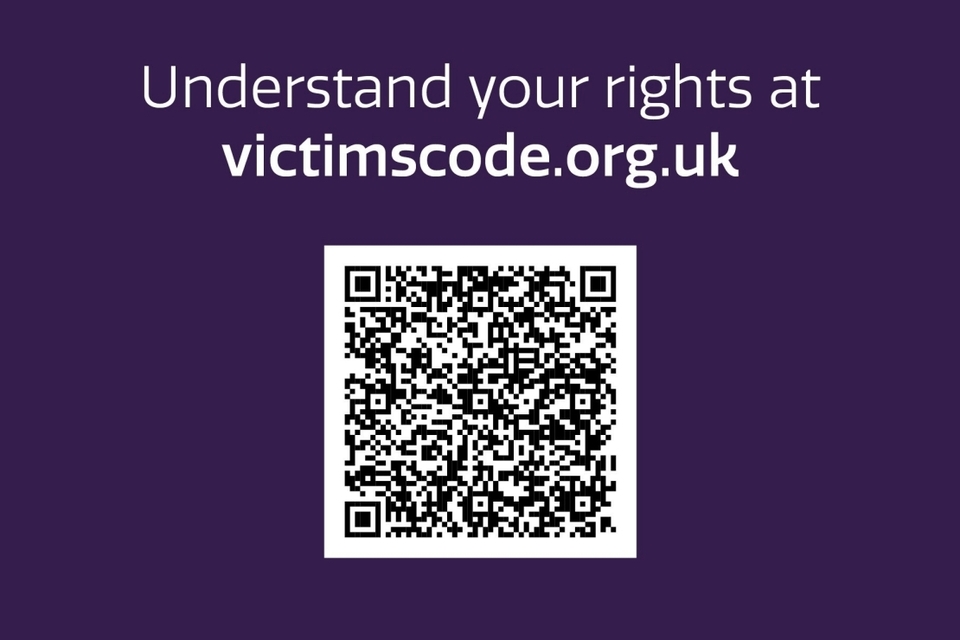
Image description: The images show a business card style graphic with a QR code that links to the Victims’ Code website.
3. An A5 leaflet setting out the headlines of each of the Code rights. This would provide more detail to the victim upfront.
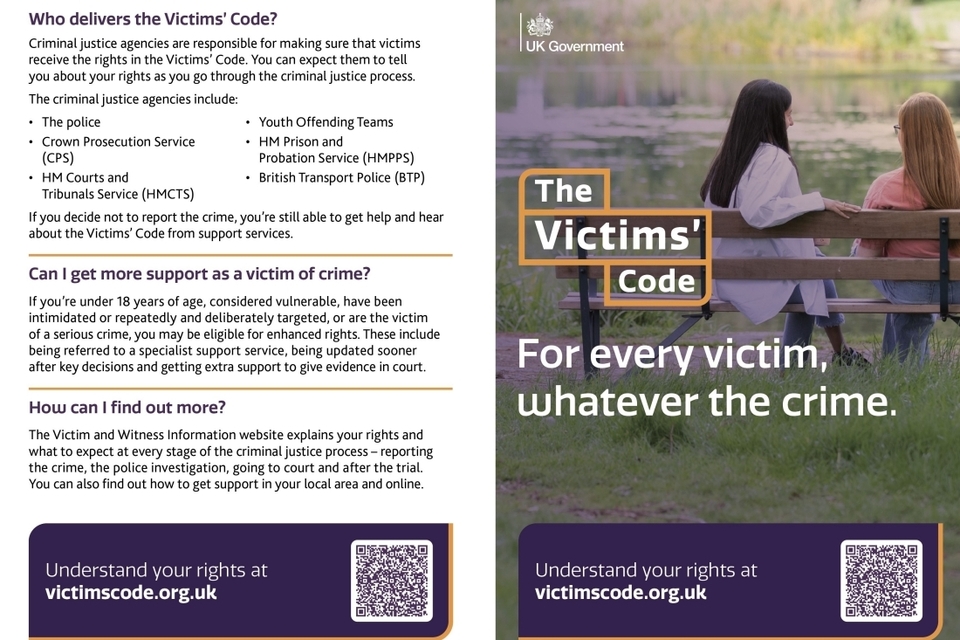
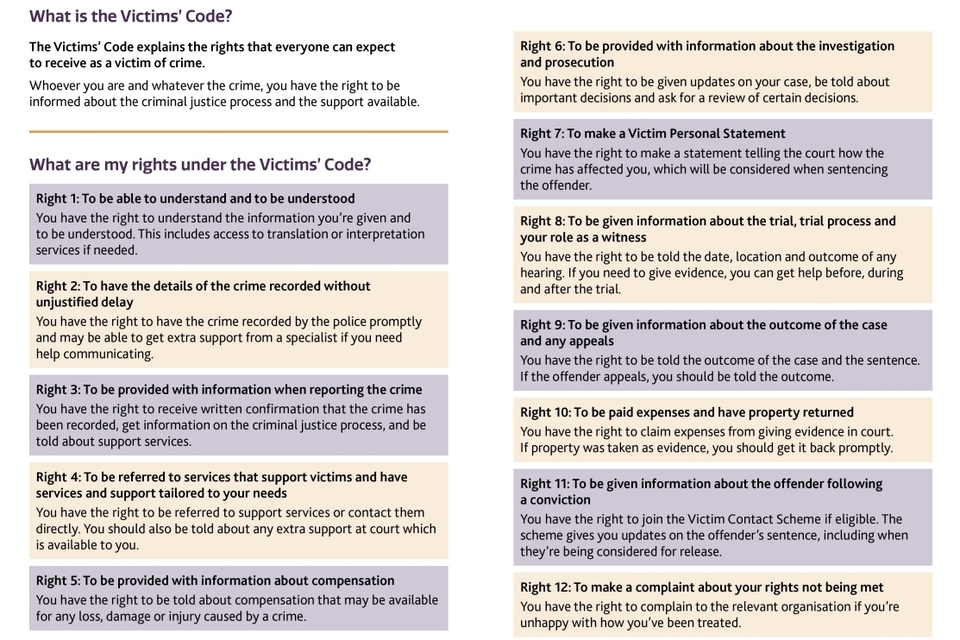
Image description: The images show an A5 leaflet explaining the Victims’ Code. The leaflet lists what the Victims’ Code is and sets out the 12 rights for victims of crime. It also explains who delivers the Victims’ Code, including the police, Crown Prosecution Service, courts, prisons and probation services. The poster includes information on additional support for vulnerable victims and directs people to victimscode.org.uk for more information.
Questions
-
Question 5A: What do you think about requiring that victims be told about the Code when they report the crime, and when they have their needs (re) assessed?
-
Question 5B: What do you think about the new requirement for police to offer victims a standard physical or digital product on the Code?
-
Question 5C: Do you think the proposed materials would help to improve victims’ awareness of the Code?
Awareness and accessibility of the Code for children
We know that the Code must work for a variety of audiences, and we recognise that children will be more engaged by different types of materials, content and platforms to adults. We know that materials that are accessible to children have been produced to explain complex topics to children in other contexts, such as materials explaining general elections.[footnote 17]
We are interested to hear your views on the formats and types of materials that children are most likely to engage with as well as what content should be covered by them. We are open to digital innovation here and would particularly welcome thoughts on where this information should be held to increase engagement from children.
-
Question 5D: What materials do you think would help children engage with the Code (for example, a video)?
-
Question 5E: What information about the criminal justice process could we include to support children to understand the Code?
-
Question 5F: Where could this information for children be held (for example, on www.gov.uk)?
-
Question 5G: What digital tools and innovation could help increase accessibility of the Code for children?
Chapter 6 – Additional information
Overview
There are several areas where the new Code provides additional information, for example reflecting operational updates, new legislation or to make the Code clearer for victims and criminal justice agencies. This includes reordering some of the Code’s content to ensure that it is coherent, and information is set out under relevant rights. In this chapter, we are asking for any feedback you might have on this additional information.
Summary of additional information
Who is a ‘victim’ under this Code? (pages 4-7)
- Updated definition of a victim of crime. We have reflected the definition from Section 1 of the Victims and Prisoners Act 2024. We have set out how the Code rights apply to the different cohorts. We have also been clear that the definition of a victim includes victims of criminal anti-social behaviour and those who have been exploited into committing criminal conduct. These victims are rightly entitled to expect to receive the services within the Code.
- Non-contact offences. We have made clear that where a victim is not aware of the offence at the point it is committed, they are nonetheless a victim for the purpose of the Code as soon as they are made aware of the offence.
Who is responsible for delivering rights under the Code? (page 11-13)
- Clarifying that all service providers should work together to facilitate access to Code rights they are not directly responsible for facilitating and / or delivering. For example, where a victim is serving a prison sentence.
Right 1 (page 15)
- The right to request the sex and gender of interpreters. We have included the right for victims of sexual violence, gender-based violence or domestic abuse to request an interpreter of the sex and gender of their choice. These must be provided for, where reasonably practicable.
Right 2 (page 18)
- The right to request the sex and gender of interviewing police officers. We have amended this to clarify any misunderstanding that victims could not express a preference in relation to the biological sex of their interviewer. We have also clarified instances in which the police may reasonably not meet the request, by including where delays due to availability might impact the proper handling of the case.
Right 5 (pages 25-28)
- Compensation. We have included updates to reflect more information about court-ordered compensation, digital developments within the Criminal Injuries Compensation Scheme, the Victims of Overseas Terrorism Scheme and compensation routes for victims of fraud and financial crime.
Right 6 (pages 32-33)
- Clarifying and providing more information on Victims’ Right to Review Schemes and how they work alongside complaint routes where a decision is not eligible under a Scheme.
Right 7 (pages 34)
- Where it may not be operationally feasible to provide all victims in a case with the opportunity to make a Victim Impact Statement. This may happen in cases where, for example, the Serious Fraud Office is prosecuting large-scale investment frauds with hundreds of victims. We have added a footnote to allow for impact to be assessed through a proportion of victims in such cases. For example, they may ask victims who are providing a witness statement to give a Victim Impact Statement, but not those who are not providing a witness statement.
Right 8 (page 40)
- Pre-trial meetings with the Crown Prosecution Service (CPS). The Code now reflects a new entitlement for adult victims of rape and serious sexual offences to be offered a meeting with a member of the prosecution team before they give evidence. The CPS has also introduced new Victim Liaison Officers[footnote 18] to provide dedicated, single points of contact within the CPS for these victims. We will include information about this measure in a future version of the Code subject to the outcome of independent evaluation of these new roles, which is currently being undertaken.
Right 9 (pages 42 and 43)
- Restorative justice services. We heard that providing victims with information about restorative justice services when reporting a crime to the police may be too early.[footnote 19] We have retained this entitlement as we know that it can be effective at early stages in some cases, but we have added an entitlement to be told about restorative justice and other support services again after an offender has been convicted (Right 9).
- We are using the Victims and Courts Bill to amend the Unduly Lenient Sentence Scheme by amending the timescales for the Attorney General (AG) to make the referral to the Court of Appeal. This only applies when an application is received by the AG within 14 days of the 28-day period. This will be reflected in the Code once commenced.
Right 10 (page 47)
- Expenses. We have clarified that expenses may be available to victims attending a prison for a parole board hearing and that the Crown Prosecution Service can pay allowances and expenses for other people supporting victims at court at their discretion.
Right 12 (page 57)
- We have reflected that complaints about delivery of the Victims’ Code to the Parliamentary and Health Service Ombudsman no longer have to be routed through a Member of Parliament (section 27, Victims and Prisoners Act 2024).
Data privacy and disclosure (pages 58-61)
- We have added a new section to the Code to cover the various statutory duties covering how victims’ data is collected and handled within criminal justice proceedings. This includes:
- Information about the new laws governing non-disclosure agreements (Section 17 of the Victims and Prisoners Act 2024), which will ensure that non-disclosure agreements which purport to prevent victims or witnesses of criminal behaviour, or those who reasonably believe that they are, reporting a crime, cooperating with regulators, or accessing confidential advice and support, cannot be enforced.
- Clarity on the processes for victim information requests, which can include requests for access to deeply personal records such as counselling notes (Sections 28 to 31 of the Victims and Prisoners Act 2024, which relate to these processes, come into effect on 12 January 2026). We understand that these requests have been disproportionately used in some sexual offence cases and these legislative changes will bring welcome scrutiny to the process for requesting such information.
- We have also added information to Right 4 to make it clear to victims that there are no good reasons why victims cannot have therapy or counselling before a criminal trial takes place (sometimes called ‘pre-trial therapy’), to reassure victims not to delay accessing any therapeutic support they may need while they are going through the criminal justice process.
- The right of victims of stalking and harassment to request deletion of certain personal data when they have been subjected to unfounded allegations by their perpetrator (subject to implementation of Section 31 of the Victims and Prisoners Act 2024).
Further information (pages 62-64)
- Victims of anti-social behaviour (ASB). We know that there is a need to better understand the alternative routes to support for those victims of ASB who are not in the remit of the Code, and so we have included new information that points to the ASB case review process, which brings together local agencies to explore alternative solutions.
- Victims of homicide abroad. We have made clear in the new Code where families bereaved by murder or manslaughter abroad can access information about the help available to them and made clear the important entitlement for them to access support here. We are also working on developing additional guidance in collaboration with the National Police Chiefs’ Council (NPCC), the Home Office, the FCDO and the Victims’ Commissioner to make it clearer what support may be available for bereaved families of victims of homicide abroad. This will be published in early 2026. [Insert link when available].
- Information about Domestic Homicide Reviews, now known as Domestic Abuse Related Death Reviews. We have included signposting information about the processes available where a victim has, or appear to have, died as a result of domestic abuse.
- Eligibility for special measures in the family court. We have included clarifying information that victims of domestic abuse are automatically eligible to apply for special measures in the family court, as we know victims may be navigating both court systems.
Questions
-
Question 6A: Please provide any views relating to this additional information in the Code. [Free text box for any feedback]
-
Question 6B: Are there any further views you would like to share as part of this consultation which haven’t been captured via responses to other questions? [Free text box for any feedback].
Equality considerations
Section 149 of the Equality Act 2010 – the public sector equality duty – obliges public authorities to have due regard when exercising their functions to the need to:
- eliminate discrimination, harassment, victimisation and any other conduct that is prohibited by or under the Equality Act 2010
- advance equality of opportunity between persons who share a relevant protected characteristic and persons who do not share it
- foster good relations between persons who share a relevant protected characteristic and persons who do not share it
Proportionate equality analysis should be used to consider likely impacts on people with the protected characteristics of disability, race, sex, gender reassignment, age, religion or belief, sexual orientation, pregnancy and maternity, marriage and civil partnership.
We know that there is more that we can do to make sure that all victims receive quality support from professionals across the system. Our proposals are designed to make it easier for all victims to get the support and information they need to engage with the criminal justice process.
We want to know about the impact of our proposals on people who share protected characteristics. You can read more about the equalities’ considerations of this consultation in the equality statement.
We will provide a full equality impact assessment in response to the consultation and will consider the full impact of policy proposals on victims and other affected groups.
Question
- Question 7: Have we correctly identified the range and extent of the equalities impacts under this consultation in the Equality Statement? Please give reasons and supply evidence of further equalities impacts that are not covered as appropriate. [Free text box for any feedback].
How to respond
You can respond online to the consultation.
Please send your response by 30 April 2026.
Alternatively, you can send your response to:
Victim and Witness Policy and Strategy Team
Ministry of Justice
102 Petty France
London SW1H 9AJ
Email: victims.code@justice.gov.uk
Complaints or comments
If you have any complaints or comments about the consultation process, you should contact the Ministry of Justice at the above address.
Extra copies
Further paper copies of this consultation can be obtained from this address and it is also available online at https://consult.justice.gov.uk/
Alternative format versions of this publication can be requested from victims.code@justice.gov.uk
Publication of response
A paper summarising the responses to this consultation will be published in due course. The response paper will be available online at https://consult.justice.gov.uk/
Representative groups
Representative groups are asked to give a summary of the people and organisations they represent when they respond.
Confidentiality
Information provided in response to this consultation, including personal information, may be published or disclosed in accordance with the access to information regimes. These are primarily the Freedom of Information Act 2000 (FOIA), the Data Protection Act 2018 (DPA), the UK General Data Protection Regulation (GDPR) and the Environmental Information Regulations 2004.
If you want the information that you provide to be treated as confidential, please be aware that, under the FOIA, there is a statutory Code of Practice with which public authorities must comply and which deals, amongst other things, with obligations of confidence. In view of this, it would be helpful if you could explain to us why you regard the information you have provided as confidential. If we receive a request for disclosure of the information, we will take full account of your explanation but we cannot give an assurance that confidentiality can be maintained in all circumstances. An automatic confidentiality disclaimer generated by your IT system will not, of itself, be regarded as binding on the Ministry.
The Ministry will process your personal data in accordance with the DPA and in the majority of circumstances, this will mean that your personal data will not be disclosed to third parties.
Consultation principles
The principles that government departments and other public bodies should adopt for engaging stakeholders when developing policy and legislation are set out in the Cabinet Office Consultation Principles 2018.
-
The term ‘victim’ is used throughout this consultation as this is the same terminology used in the Victims’ Code (https://www.gov.uk/government/publications/the-code-of-practice-for-victims-of-crime), which acknowledges that the terms ‘complainant’ and ‘survivor’ are often used in the criminal justice system. ↩
-
The inadequacy of some needs assessments has been highlighted by the findings of inspectorates. Read more here: https://hmicfrs.justiceinspectorates.gov.uk/publication-html/meeting-the-needs-of-victims-in-the-criminal-justice-system/ ↩
-
Protected characteristics within the meaning of the Equality Act 2010. ↩
-
The Youth Justice and Criminal Evidence Act 1999 introduced a range of measures that can be used to facilitate the gathering and giving of evidence by vulnerable and intimidated witnesses. The measures are collectively known as ‘special measures’. Special measures help to relieve some of the stress associated with giving evidence and apply to prosecution and defence witnesses, but not the defendant. ↩
-
The Domestic Abuse Commissioner’s report on young people’s experience of domestic abuse further demonstrates the material difference that being listened to and being given choice and agency when engaging with the criminal justice process makes. Read more here: https://domesticabusecommissioner.uk/wp-content/uploads/2025/06/dac_bcyp_main-report_V6-DIGITAL.pdf ↩
-
‘Parent’ includes a biological parent, an adoptive parent, a stepparent who has been granted legal parental responsibility and a parent by virtue of the Human Fertilisation and Embryology Act 2008 (for example, a second female parent). ‘Guardian’ means another person who has been granted legal parental responsibility, a person who has been appointed as a guardian by court order or by a will (where the parents are deceased), or a person who, in practice, carries out the day-to-day care of a child, such as a local authority approved kinship or foster carer. ↩
-
https://assets.publishing.service.gov.uk/media/6492e26c103ca6001303a331/achieving-best-evidence-criminal-proceedings-2023.pdf ↩
-
https://assets.childrenscommissioner.gov.uk/wpuploads/2024/06/Childrens-experiences-as-victims-of-crime_final.pdf ↩
-
https://www.nhs.uk/conditions/consent-to-treatment/children/ ↩
-
As shown in the Victims’ Commissioner’s Victim Survey (2023) ↩
-
First-tier Tribunal (Mental Health) in England and the Mental Health Review Tribunal for Wales ↩
-
https://assets.publishing.service.gov.uk/media/5a7cd21040f0b6629523c02e/victims-vps-guidance.pdf ↩
-
The Youth Justice and Criminal Evidence Act 1999 (YJCEA) introduced a range of measures that can be used to facilitate the gathering and giving of evidence by vulnerable and intimidated witnesses. The measures are collectively known as special measures. Special measures help to relieve some of the stress associated with giving evidence and apply to prosecution and defence witnesses, but not the defendant. ↩
-
https://www.ons.gov.uk/peoplepopulationandcommunity/culturalidentity/language/bulletins/languageenglandandwales/census2021 ↩ ↩2
-
https://www.ons.gov.uk/peoplepopulationandcommunity/crimeandjustice/adhocs/2605crimesurveyforenglandandwalescsewperceptionsofthecriminaljusticesystemandawarenessofthecodeofpracticeforvictimsofcrimepeopleaged16andoverenglandandwalesyearendingmarch2009toyearendingmarch2024 ↩
-
https://victimandwitnessinformation.org.uk/your-rights/as-a-victim ↩
-
https://www.childrenscommissioner.gov.uk/resource/what-is-a-general-election-a-resource-for-children-and-young-people/ ↩
-
CPS Victim Liaison Officers are distinct from the Victim Liaison Officers provided by HMPPS as part of the Victim Contact Scheme ↩
-
Restorative justice is a voluntary process that allows victims and offenders to come together and collectively resolve how to deal with the aftermath of a crime. It can take the form of victim-offender mediation either through direct contact or through third parties. ↩