Data for AI in the energy system: call for evidence (accessible webpage)
Published 2 March 2026

© Crown copyright 2026
This publication is licensed under the terms of the Open Government Licence v3.0 except where otherwise stated. To view this licence, visit nationalarchives.gov.uk/doc/open-government-licence/version/3 or write to the Information Policy Team, The National Archives, Kew, London TW9 4DU, or email: psi@nationalarchives.gov.uk.
Where we have identified any third party copyright information you will need to obtain permission from the copyright holders concerned.
This publication is available at https://www.gov.uk/government/calls-for-evidence/energy-datasets-for-artificial-intelligence-applications/data-for-ai-in-the-energy-system-call-for-evidence-accessible-webpage
Introduction
Artificial Intelligence (AI) is advancing at breakneck speed. With its vast potential, AI could become one of the government’s most powerful tools for achieving its 5 missions, driving broad-based economic growth and unlocking new opportunities across the country. [footnote 1] This is especially true for the energy sector, where AI has potential to realise efficiencies and transform how the system operates. Examples of AI in the energy system include supporting operation of the electricity grids, predicting renewable generation to a high degree of accuracy, speeding heat pump installations, and reducing the use of fossil fuels in industrial processes. As well as helping deliver the Clean Energy Superpower mission and ‘Clean Power 2030’, [footnote 2] these applications, and many others, have the potential to reduce overall costs to consumers and strengthen energy security. Finally, early action on AI in the energy sector could also help support start-ups and scale-ups develop here in the UK, creating export potential and boosting growth.
As with all AI development, access to data is critical for developing applications in the energy sector. Without access to the right data, the benefits of AI in the energy system will not be realised. Energy digitalisation creates the pipeline of useable data. The ongoing programme of work on energy digitalisation, as summarised in the ‘Clean Flexibility Roadmap’, [footnote 3] is an essential enabler of AI developments in the energy sector.
In this call for evidence we are interested in understanding which high-impact datasets could unlock the development of key AI applications in the energy sector, and what barriers to accessing these datasets exist. For this call for evidence, we are particularly interested to hear from AI developers and energy companies who can point to specific datasets that are not currently available for AI use, but whose creation or access would facilitate delivery of the government’s Clean Energy Superpower and Growth missions. This work builds on 2 previous calls for evidence that focused on data sharing, [footnote 4], [footnote 5] with this one focusing specifically on AI.
General information
Call for evidence details
Issued:
2 March 2026
Respond by:
24 April 2026
Enquiries to email:
energydatacallforevidence@energysecurity.gov.uk
Consultation reference:
Data for AI in the energy system
Territorial extent:
The United Kingdom
How to respond
We welcome responses from all to:
We are particularly keen to hear from companies developing AI and digital products in the energy sector. Please use the questions to guide your thinking, although you are free to pick and choose those that are most relevant to your perspective. We welcome responses in any form, including PDF, DOCx or ODF.
Wherever possible, avoid including any additional personal data beyond that which has been requested or which you consider it necessary for the Department for Energy Security and Net Zero (DESNZ) to be aware of. You can leave out personal information from your response entirely if you would prefer to do so.
This call for evidence is complementary to other initiatives currently or recently live, including the National Data Library survey on public sector information and the Renaissance Philanthropy AI for Science call for proposals.
Confidentiality and data protection
If you wish any of the information you provide us with to be treated as confidential, please inform us in writing. However, it is important to underline that we cannot guarantee confidentiality in all circumstances and automatic confidentiality disclaimer generated by your IT system will not be regarded by us as a confidentiality request.
We are trialling artificial intelligence (AI) solutions to support the delivery of our functions. Unless made expressly clear to you, we will not use AI to either make or inform decisions about you. We will apply effective data minimisation techniques to all such uses of your data.
Your responses, including any personal data, may be shared with a third-party provider, or other government department or organisation acting on behalf of DESNZ under contract or an equivalent agreement, for the purpose of analysis and summarising responses for us and may use technology, such as AI.
Your response may also be shared with the devolved governments.
An anonymised version of responses may be published, in a list or summary of responses received, and in any subsequent review reports.
We are required to observe and comply with UK legislation including (the Freedom of Information Act 2000, the Data Protection Act 2018 and the Environmental Information Regulations 2004) and there are circumstances where the information you provide in response to this call for evidence, including personal information, may need to be disclosed in accordance with these. These statutory obligations cannot be circumnavigated by way of an agreement.
We will process your personal data in accordance with all applicable data protection laws. See our privacy policy.
Quality assurance
If you have any complaints about the way this call for evidence has been conducted, please email: bru@energysecurity.gov.uk.
Overview
AI has the potential to transform the energy system
For the purposes of this call for evidence, an AI system is a machine-based system that, for explicit or implicit objectives, infers, from the input it receives, how to generate outputs such as predictions, content, recommendations, or decisions that can influence physical or virtual environments. Different AI systems vary in their levels of autonomy and adaptiveness after deployment. [footnote 6] Our intention is to use a broad definition to keep a wide range of processes in scope, ranging from generative AI and machine learning to deep learning and computer vision. With the focus of the call on datasets, this will naturally bias the call towards data-driven techniques, though examples that are based on purely symbolic, or hybrid / neurosymbolic approaches to AI are also welcome.
The energy system is the system of interconnecting components that enables energy (such as electricity, gases and fuels) to be produced and supplied to end users in homes, businesses and industry (see Figure 1). [footnote 7] The key components of the energy system include:
- generation of electricity in power stations and in domestic installations
- extraction, production and refining of fuels
- energy storage, of short and long duration
- transmission and distribution, transferring electricity and gas from national to local level
- retail and energy markets
- the end use of energy in homes, businesses, and industry
Figure 1: Map of the energy system [footnote 8]
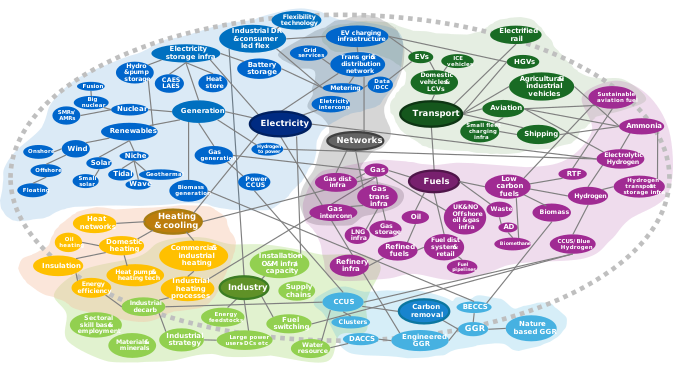
Description of figure 1: Mindmap style diagram showing the energy system, covering electricity, networks, transport, fuels, heating and cooling, industry and carbon removal.
Recent external analysis has highlighted the significant potential that AI has to make the global energy system more efficient, thereby reducing carbon emissions and making it cheaper to operate. A recent paper in ‘Nature’ estimated that globally, AI applications in just the power, food and mobility sectors could result in net savings of 3.2-5.4Gt CO2e annually by 2035. [footnote 9] Similarly, the International Energy Agency’s 2025 Energy and AI report estimates the adoption of existing AI applications in end-use sectors could cut 1.4 Gt CO2e by 2035, with potential for further reductions from the power sector too. [footnote 10] The International Energy Agency considered a range of AI applications in areas including:
- balancing electricity networks that are growing more complex, decentralised and digitalised
- improving the forecasting and integration of variable renewable energy generation, reducing curtailment
- supporting electricity grid operations to enable better fault detection that can help rapidly identify and precisely pinpoint grid faults, reducing outage durations by 30-50%
Many of these benefits could be realised in the UK energy system. The AI for Decarbonisation Virtual Centre of Excellence (ADViCE)[footnote 11] has identified over 90 ‘challenge areas’ where AI could help reduce emissions across the energy, built environment, agriculture and manufacturing sectors. [footnote 12] Progress has been made in deploying these applications in the sector. ADViCE’s recent report ‘State of AI for Decarbonisation 2025’,[footnote 13] published January 2026, highlights key examples including:
- Heat Geek’s AI-driven Zero Disrupt programme, which can make heat pump installations quicker and cheaper
- OpenClimateFix’s deployment of AI driven applications for improving forecasting of solar output, saving costs and emissions
- a Carbon Re project using machine learning to reduce the use of high-carbon clinker in cement production, which produced a 2% reduction in carbon emissions and 4% reduction in fuel costs
Data is a critical enabler
Data is one of the UK’s unrealised growth assets, increasingly underpinning innovation and productivity in all sectors. [footnote 14] Effectively harnessing private and public sector data has the potential to increase productivity growth by 0.5%-1.3% per year, with 85% of the potential being in the private sector, and 15% in the government and third sector. The government aims to enable businesses in the use of high-quality data across the private and public sectors, extend Smart Data initiatives into relevant Industrial Strategy sectors and establish a clear framework to value and license public sector data assets.
The government is also unlocking high-value private and research data through the Creative Content Exchange and the Data (Use and Access) Act 2025. This last provides government with new powers to establish Smart Data schemes, allowing consumers and businesses to share data securely to access better, more tailored products and services. As announced in the Industrial Strategy, we are investing £36 million to support the development of new Smart Data schemes across the economy.
As with all AI development, data is critical for developing AI applications in the energy sector. Data that is not in the training sets of current models or encodes new insights about the world is particularly valuable. The AI Opportunities Action Plan, published in 2025, argued that government should seek to unlock responsibly both public and private data sets to enable innovation by UK startups and researchers, and to attract international talent and capital.
Over the year since the AI Opportunities Action Plan was published, the government has begun to unlock high-impact public datasets for AI use, including the launch of the Health Data Research Service and development of the AI Education Content Store. Isambard-AI in Bristol and the Edinburgh Parallel Computing Centre are projects that pair major datasets directly alongside public compute. There is also Administrative Data Research (ADR) UK, which makes administrative data generated through government operations available for reuse by researchers, and also more recently Smart Data Research (SDR) UK, which aims to do the same but for data generated through devices and digital footprints.
Digitalisation of the energy system
Government and industry already have work underway on energy system digitalisation, which this call for evidence aims to complement. Looking to 2030, electricity systems across the world are becoming more complex, with power generated from a wider and more dispersed range of sources, which entails more complex and decentralised systems of control.
This creates a significant increase in the need for smart appliances and flexible demand. That in turn will require better data exchange and digital tools that can forecast, model, plan, automate, and execute actions much more quickly than today. The efficiency given by digitalisation can enable complexity of a system to increase without driving up its costs.
Digitalisation is a foundational enabler to support giving consumers and businesses greater control and choice, as they navigate an increasingly complex energy system. A digitalised energy system will also support our clean power and net zero goals while ensuring the system remains secure and resilient. It will drive economic growth and innovation by improving the quality, availability and interoperability of energy data and new digital services.
The sector has already made significant progress in recent years, with Ofgem establishing Data Best Practice Guidance, appointing Elexon to create the Data Integration Platform, appointing the Retail Energy Code Company (RECCo) to develop a Consumer Consent Solution, and appointing NESO as the Interim DSI Coordinator to lead the delivery of the Data Sharing Infrastructure (DSI) for the energy sector until the end of 2028.
In July 2025, the Clean Flexibility Roadmap set out government, Ofgem and NESO’s plan for our future flexible electricity system. It included a number of actions to drive a range of digitalisation programmes, including a commitment for DESNZ and Ofgem to publish a digitalisation vision in Q1 2026. This vision will set out the policy and technical framework for a coherent energy data sharing ecosystem that supports best outcomes for consumers.
In 2025, the government also ran calls for evidence on the introduction of an energy smart data scheme and improving the visibility of distributed energy assets, and published responses to them.
Areas of focus for this call for evidence
This call for evidence is intended to gather evidence on the barriers to access data to develop AI applications in the energy system. An illustrative list of some of the main types of energy data that may be considered is included below but is not intended to be definitive. While this list does include datasets that involve sensitive personal data, this information would not be shared without a customer’s permission.
System energy data
- Energy generation: from various sources
- Component energy data: performance of turbines, transformers, cable losses
- Energy consumption: smart and non-smart
- Energy prices: wholesale, retail and tariff availability
- Energy efficiency: EPCs, ECOs, LCT adoption
- Smart meter data coverage, alerts, asset
- Network infrastructure: capacity, constraints, losses, outages, flexibility, structural network information, network mapping in standardised form
- Renewable energy data: capacity, emissions saved, support schemes
- Energy forecasting: predicted demand and FES; weather conditions correlated with supply and demand, grid load and pricing
- Hydrogen data: production and storage facilities, capacity
- Heat data: district heat potential, time to heat data (to raise internal temperature of a property by 1°C)
- Policy and regulation: subsidies, grants, market codes
- Market settlement and imbalances, capacity and balancing services: differences between contracted and delivered electricity
Consumer energy data
- Energy supplier held data: customer type, account, tariff, transactions, comms, meter data
- Traditional meter data: asset data, readings
- Low carbon technologies: EVs, heat pumps, solar
- Energy behaviour data: survey data, app data, usage/appliance usage data
- Consumer profiles: high/low user, efficient, EV owners
Ownership of these datasets varies. DESNZ, NESO, Ofgem, and energy suppliers and Distribution Network Operators own many of those directly related to energy. Many that have indirect importance to energy, such as weather datasets, mapping data and EV data, are owned by other government departments or arm’s-length bodies.
These datasets closely align with those identified in DESNZ’s recent government response to the call for evidence on smart data, which highlighted inconsistent access and variable data quality as barriers to innovation. Both the digitalisation vision and smart data policy development are focused on addressing these barriers through a more coherent, structured approach to energy data sharing. These will strengthen the pipeline of data that is potentially available for AI applications. We acknowledge that sharing government data with private sector developers, with public support for doing so, raises challenges such as commercial sensitivity, privacy risk and fair access. Creating synthetic data, which is modelled data that mirrors real-world behaviour, is one way to share the dataset characteristics without affecting individual privacy.
Opening up access to a dataset does not mean removing all restrictions: access controls can be tailored to the data sensitivity and intended use. Data relating to Critical National Infrastructure, for example, often requires additional safeguards. Portals have been developed that enable sharing of personal data for academic research, such as the ONS Secure Research Service and the SAIL Databank. Personal data is not shared without permission and data access is restricted to accredited users operating in controlled environments.
In addition to understanding data sets that could be highly impactful for developing AI applications in the energy sector, we are also interested in understanding the barriers that may currently exist to doing so. An illustrative list of the types of barriers that may be of interest is set out in Table 1, but this is not intended to be definitive or comprehensive.
Table 1: Illustrative list of barriers to energy data access
| Barriers when seeking access | Description | Examples |
|---|---|---|
| No Barriers (Open Access) | The dataset is freely available, with no restrictions on access or usage. These datasets are often hosted on open data portals or provided by public institutions. | Public domain government data, open research data, data from open-source projects. |
| Insufficient Data | The data sought does not exist, either because it has not been collected, is unavailable at the necessary granularity, or is impractical to obtain. It may also be incomplete either geographically or collection is time-limited or sporadic. | Data on emerging technologies without historical records, niche datasets in highly specialised fields. |
| Fragmented data | The data exists but is distributed across multiple organisations with inconsistent formats, or has become fragmented over time due to system changes. | Network and asset records stored across multiple DNOs and DSOs, operational data archived following system upgrades, data collected under different reporting frameworks. |
| Proprietary Data | Data is owned and controlled by a private entity, with strict restrictions on access. This data is often only available for internal use by the owning organisation or accessible via special agreements. | Customer data owned by a private company, proprietary research data, and exclusive software-generated datasets. |
| Commercially Available Data | Data can be accessed but must be purchased or licensed from the data provider. Access is typically available under commercial terms, often at a significant cost. | Market research reports, proprietary financial or industry data from data providers, and premium third-party analytics. |
| Restricted Access | Data access is limited due to privacy concerns, security risks, or sharing restrictions. These may be hard limits set in legislation, regulation or the terms and conditions under which the data was collected. Or these may be soft limits, based on risk aversion, administrative burden or lack of clear processes. | Personal health data, consumer financial data, and classified or sensitive government data. |
Consultation questions
The specific questions we are interested in responses to are set out below (1 to 7). Each question contains sub-questions that may be useful to consider when preparing a response. Please use the questions to guide your thinking, although you are free to pick and choose those that are most relevant to your perspective. We welcome responses in any format.
1. What energy problem do you want to solve?
Outline a specific problem that forms a bottleneck to achieving the clean energy superpower mission, whether that be decarbonisation, energy security or affordability. The 9 grand challenges outlined on p4 of the ADViCE 2025 State of Decarbonisation report provide some example areas. Explain why this problem is amenable to an AI approach. Also consider:
- Is current data enabling meaningful progress with machine learning?
- Is there research suggesting that a single dataset would enable significant progress?
- Why now?
2. What kind of data is needed?
Explain what data currently exists, in what form, and who owns it. Flag if there are issues with the ways it has been collected, for example, methodology changes over time, that would need to be accounted for. Also consider:
- How comprehensive, accessible, and actively maintained are the current datasets?
3. What work is needed to create or enable a useable dataset, including making sure it can be easily combined with other datasets?
Describe the current barriers to access, including the level of work likely to be needed to make the dataset both available and practical. Possible situations here could include datasets that are publicly available but have issues around AI use, or datasets that will have to remain restricted in their totality but could be anonymised or simulated with synthetic data. Also consider:
- What are the reasons this dataset has not been created already?
- What validation and audit processes exist or are needed, to track and mitigate any changing definitions or biases between regions, technologies or user types?
- What type of resolution/scope would the data need to be for any AI use cases, for example spatial (National / regional / DNO / feeder / household) and temporal (Annual / monthly / daily / half-hourly / real-time) and at what level of granularity?
- Is there a specific format for the dataset that would be easiest for processing?
- If synthetic data is to be used, what equipment and capabilities would be needed to generate it?
4. Who would the users of the dataset be?
Discuss who would be accessing the dataset, whether immediate benefits would be limited or spread, and whether there are risks or unintended consequences that might need to be managed.
5. What scale does the dataset need to be?
Discuss the cost versus utility trade-off of enabling access to the data at scale. If there are compromise solutions, for example a sampled dataset that is nearly as helpful as the full one, outline these. Also consider:
- What ‘proof of concept’ results would be needed to justify increasing the size of the dataset?
6. What would enabling AI use of this dataset unlock?
Describe what the benefits of this AI work would be, both to solving the problem you have outlined above and to the UK in general. Also consider:
- What scientific, technological, or translational impacts would become possible if this dataset were available?
- What new types of models and capabilities could this dataset enable?
- What is the pathway to measurable outcomes such as lower emissions, reduced consumer bills, faster grid connections?
7. What would be the arrangements for ongoing maintenance, governance and curation of the dataset?
Outline whether the dataset can be incorporated into existing accessible databases or if long-term infrastructure would need to be developed around it. Explain who would be responsible for the veracity of the data. Discuss roles for documentation and feedback to the original data owners. Also consider:
- What happens to the data if the funding or regulation changes?
- What happens to a dataset that is deprecated (obsolete)?
- Should users contribute improvements or derived datasets?
- Is latency acceptable for the AI use case in question?
Next steps
Responses to this call for evidence will directly inform development of the upcoming AI for the energy system strategy. This strategy will set out a vision for an AI-enabled energy system, identify priority areas for action, discuss the challenges the sector faces, and set out actions government will take to overcome these challenges.
Ideas generated in response to this call for evidence will be carefully reviewed and we may follow up to discuss further details. Any specific policy commitments developed from this call for evidence will be accompanied by future consultation.
-
DSIT (2025) ‘AI Opportunities Action Plan’ ↩
-
DESNZ (2024) ‘Clean Power 2030 Action Plan’ ↩
-
DESNZ (2025) ‘Clean Flexibility Roadmap’ ↩
-
DESNZ (2025) ‘Developing an energy smart data scheme’ ↩
-
DESNZ (2025) ‘Improving the visibility of distributed energy assets’ ↩
-
OECD (2023) ‘Updates to the OECD’s definition of an AI system explained’ ↩
-
Ofgem (2021) ‘Review of GB energy system operation’ ↩
-
Note that ‘Transport’ refers only to the energy aspects of the transport sector. ↩
-
Nicholas Stern and others (2025) ‘Green and intelligent: the role of AI in the climate transition’ ↩
-
IEA (2025) ‘Energy and AI’ ↩
-
In 2022, DESNZ launched a £3.7m AI for Decarbonisation Innovation Programme via its £1bn Net Zero Innovation Portfolio. The programme includes the establishment of Artificial Intelligence for Decarbonisation’s Virtual Centre of Excellence, also known as ADViCE. The centre is being delivered by a collaborative consortium including Digital Catapult, Energy Systems Catapult, and the Alan Turing Institute. ADViCE aims to bring together stakeholders from various sectors and foster collaboration on the use of AI technologies for energy and decarbonisation applications. ↩
-
ADViCE: AI Carbon Challenge ↩
-
ADViCE.(2025) ‘State of AI for Decarbonisation 2025’ ↩
-
DBT (2025) ‘Industrial Strategy’ ↩