Rybelsus ® (semaglutide tablets): transition to new formulation and risk of medication error
There is a risk of patient harm arising through medication error during a transition period where the original and new formulation of Rybelsus ® tablets, which have different stated mg doses but are bioequivalent, will both be available on the market.
There is a risk of patient harm arising through medication error during a transition period where the original and new formulation of Rybelsus ® tablets, which have different stated mg doses but are bioequivalent, will both be available on the market. Medication error may result in overdose if healthcare professionals prescribe more than one tablet per day of the new formulation to try to match the dose to the old strengths. This could affect disease control and increase the risk of side effects. Healthcare systems are advised that a co-ordinated response is required to manage switching patients to the new formulation. Healthcare professionals should be aware that the original formulation is anticipated to be available until approximately 31st January 2026 however, original formulation stock of imported Rybelsus ® may be within supply chains beyond this date.
Advice for Healthcare Professionals:
- the new formulation of Rybelsus ® has increased bioavailability therefore lower strength tablets achieve the same drug exposure and clinical effect as the previous formulation
- ensure all relevant staff members are familiar with the new dosing range:
| Initial formulation (one oval tablet) | Bioequivalent | New formulation (one round tablet) |
|---|---|---|
| 3 mg (starting dose) | = | 1.5 mg (starting dose) |
| 7 mg (maintenance dose) | = | 4 mg (maintenance dose) |
| 14 mg (maintenance dose) | = | 9 mg (maintenance dose) |
- details of the new formulation can be found in the Direct Healthcare Professional Communication distributed by the Marketing Authorisation Holder in September 2025
- the two formulations will temporarily co-exist on the market until approximately 31st January 2026 however, original formulation stock of imported Rybelsus ® may be within supply chains beyond this date
- Rybelsus ® should always be taken as one tablet per day. Taking more than this will result in overdosing, which affects disease control and increases the risk of adverse events
- prescribe patients starting Rybelsus ® treatment the new formulation once it is available in your prescribing system
- systematically switch patients who are currently on Rybelsus ® to the new formulation once it is available in your prescribing systems
- inform patients about the change in formulation and strength when the new formulation is prescribed or dispensed
- ensure that patients are aware that tablets with the new formulation and lower strengths will have the same effects as the tablets with the initial formulation and higher strengths
- document in the patient’s notes that the change has been undertaken and communicate to other parts of the system where required
- refer patients to the patient transition guide for further information
- report medication errors or near misses via local risk management systems and medication errors resulting in patient harm on the Yellow Card website
Advice for Healthcare Professionals to Provide to Patients:
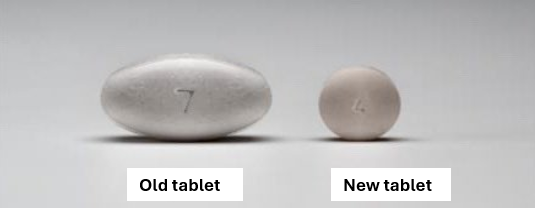
- Rybelsus ® tablets have been modified so that the medicine is more easily absorbed by your body. The new and modified tablets are just as effective as the old tablets, but have a smaller dose. It will work the same as the old tablets even though the dose is different. The tablets will now be smaller and round in shape.
- continue to take one tablet per day
- refer to the patient transition guide for further information
- if you are unsure about what dose you are taking, speak to your pharmacist or prescriber
- report suspected adverse drug reactions via the Yellow Card website
Background
Rybelsus ® is an oral formulation of semaglutide, a Glucagon-like peptide-1 receptor agonist, indicated for use in adults with type 2 diabetes.
In September 2025, the Marketing Authorisation Holder (MAH), Novo Nordisk, launched a new formulation of Rybelsus ® which enhances absorption of the medicine allowing the same treatment effect to be achieved at a lower strength.
Both the original and new formulations are currently available on the market while the transition is in progress and existing stocks are depleted. During this period, caution is advised to avoid confusion which could result in medication errors.
Healthcare systems are advised that a co-ordinated response is required to manage switching patients on to the new formulation.
Once the new formulation is available in your prescribing system, new patients should be started on this. Existing patients should be systematically switched to the new strength of the new formulation that is equivalent to the strength of the old formulation they are currently taking.
| Initial formulation (one oval tablet) | Bioequivalent | New formulation (one round tablet) |
|---|---|---|
| 3 mg (starting dose) | = | 1.5 mg (starting dose) |
| 7 mg (maintenance dose) | = | 4 mg (maintenance dose) |
| 14 mg (maintenance dose) | = | 9 mg (maintenance dose) |
When patients are switched to the new strengths, the dose remains one tablet per day. Exceeding this will result in overdose which increases the risk of side effects. The new formulation is equally as effective as the original formulation.
The MAH estimates that stocks of the original formulation will be depleted by 31st January 2026 however, original formulation stock of imported Rybelsus ® may be within supply chains beyond this date.
Key differences to note during the transition period:
- The new tablets are smaller in size and are round
old new
- The blister packaging and outer packaging are smaller than those of the previous formulation
- New formulation blisters are silver both on the front and back and are smaller compared to blisters with the initial formulation
Roll out of the new formulation within prescribing systems is ongoing. Please familiarise yourself with the new strengths and look out for alerts within your prescribing and dispensing systems that draw attention to the change.
For further information and resources, the MAH has distributed a Direct Healthcare Professional Communication and a patient transition guide. No changes need to be made to a patient’s prescription until the new strengths are available in your systems.
Reporting advice
Healthcare professionals, patients, and caregivers are asked to submit reports using the Yellow Card scheme electronically using:
- the Yellow Card website.
- the Yellow Card app; download from the Apple App Store or Google Play Store
- some clinical IT systems for healthcare professionals (EMIS, SystmOne, Vision, MiDatabank, and Ulysses)
When reporting suspected adverse drug reactions, please provide as much information as possible, including information about medical history, any concomitant medication, onset timing, and treatment dates.
Download document
Additional information
You can sign up to receive email notifications for Drug Safety Updates.
You can sign up to receive our monthly roundup of safety communications.
For any enquiries, please contact info@mhra.gov.uk
References
Stakeholder engagement
- Royal Pharmaceutical Society
- NHS Specialist Pharmacy Service
- Medication Safety Officer Network
- Devolved Administrations
- NHSE National Patient Safety Team
Article citation: MHRA Drug Safety Update volume 19, issue 5: December 2025: 2