Failure of a tow rope and injury to crew on board the tug Svitzer Avon
Location: King Road, River Severn approaches to Royal Portbury Dock, Bristol, England.
Completed preliminary assessment (PA) summary 2/26: Svitzer Avon
Synopsis
At approximately 1954 on 4 February 2025, the UK registered tugs Svitzer Avon and Svitzer Brunel left the lock at Royal Portbury Dock, Bristol, England to meet the car carrier Auto Eco in the King Road approaches to the lock. Auto Eco had a pilot embarked for the entry into port and was to employ both tugs for a ship assist move into the lock and onwards to a berth in the dock.
Following an agreement made before departure Svitzer Avon’s relief master was supervising the mate, who was at the vessel’s controls for the move. The relief master was type qualified for the tug but had little experience on Svitzer Avon.
At 2003, the tug was in position astern of the car carrier. Svitzer Avon’s crew passed the towline, consisting of a tow rope and pennant joined with a cow hitch via a heaving line and messenger rope, to Auto Eco’s mooring deck where it was then made fast to a bollard. Having passed through the tug’s forward staple, the tow rope was held by the tug’s winch brake. Although fitted, a render system was not used.
At 2009, the pilot called Svitzer Brunel and requested the tug to standby on the port bow, followed shortly afterwards by the instruction “25% straight back” to Svitzer Avon.
At around 2011, an overcorrection in handling occurred as Auto Eco was turning to line up for an approach to the lock and Svitzer Avon was manoeuvring to hold position astern, causing Svitzer Avon to shear and heel. The tow rope parted under the increased load experienced during the recovery manoeuvre.
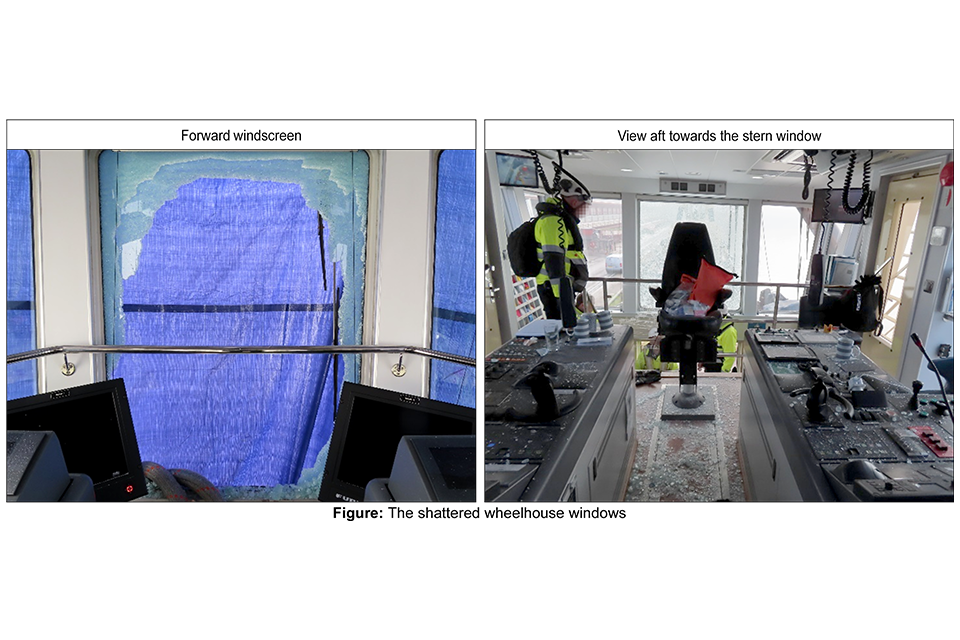
The tow rope recoiled, struck Svitzer Avon’s wheelhouse and shattered the forward windscreen glazing. Debris also caused the stern window to shatter (see figure). Flying glass caused minor injuries to the tug’s master and mate.
After checking each other for serious injury, Svitzer Avon’s crew quickly changed tasking with the bow tug to complete the move. Once Auto Eco was secured at the berth, Svitzer Avon returned alongside and was met by the port’s medical team. The master and mate were transferred to hospital, treated for their minor injuries and later discharged.
Findings
-
The relief master was not authorised to supervise the mate during the move.
-
The towage company’s training regime was not clearly defined or closely monitored.
-
The tow rope had previously parted in July 2024 after 800 tasks and had been changed end-to-end[footnote 1]. The tow rope subsequently parted on its 307th task due to the excessive towline assembly loading experienced during an overcorrection in a shiphandling manoeuvre.
-
The towage company relied on visual inspection and tow rope rotation for towline risk management. The company did not follow best practice nor conduct residual strength testing on parted ropes or as part of its towline risk management system.
-
The wheelhouse glazing met the appropriate standard.
-
The MAIB investigated a similar accident involving Svitzer Mercurius in 2019 (MAIB report 15/2022[footnote 2]), resulting in a recommendation 2022/138 to Svitzer Marine Limited to:
Undertake a fleetwide risk assessment to determine the level of risk associated with towline failure and snapback and the potential for impact by a line recoiling into wheelhouse windows, and, where appropriate, employ appropriate laminated glass or other defences to mitigate against the risk of flying glass injuring its tug crews.
Actions taken
Svitzer Marine Limited has:
-
formalised the designations of training masters and introduced a ‘trainers pathway’ and ‘training groups’ to standardise training practices across UK regions
-
introduced a type rating framework of formalised training requirements for different vessel classes
-
reviewed rope parting incidents and assessed impacts across the business
-
ensured rope selection and usage aligns with operational risk.
The Chief Inspector of Marine Accidents has written to the managing director of Svitzer Marine Limited expressing concern that towline failure has become normalised and that, consequently, the associated risks are not being mitigated. Further, the chief inspector has urged the company to reconsider its actions in response to MAIB Recommendation 2022/138 and implement measures to both minimise towline failures and mitigate the risk of crew injury should a towline part.
In light of some of the actions taken and MAIB Recommendation 2022/138, which remains open, the investigation into this accident has been closed.
| Vessel particulars | |
|---|---|
| Vessel’s name | Svitzer Avon |
| Flag | UK |
| Classification society | American Bureau of Shipping |
| IMO number | 9788162 |
| Type | Tug |
| Registered owner | Svitzer EuroMed B.V. |
| Manager | Svitzer Marine Limited |
| Construction | Steel |
| Year of build | 2017 |
| Length overall | 28.2m |
| Gross tonnage | 461 |
| Minimum safe manning | 3 |
| Voyage particulars | |
|---|---|
| Port of departure | Royal Portbury Dock, Bristol, England |
| Port of arrival | Royal Portbury Dock, Bristol, England |
| Type of voyage | Internal waters |
| Cargo information | Not applicable |
| Manning | 5 |
| Marine casualty information | |
|---|---|
| Date and time | 4 February 2025 at 2011 |
| Type of marine casualty or incident | Serious Marine Casualty |
| Location of incident | Royal Portbury Lock approach 51°30.2’N 002°439’W |
| Place on board | Foredeck/wheelhouse |
| Injuries/fatalities | Minor injuries to 2 crew |
| Damage/environmental impact | Main tow rope failure; 2 wheelhouse windows shattered; superstructure damage |
| Vessel operation | Towing |
| Voyage segment | Arrival |
| External and internal environment | Cloudy, fair conditions; wind south-south-west force 4; slight to moderate sea, 0.5m swell; east-north-east flood tide 3.5kts. |
| Persons on board | 5 |
Photograph credit
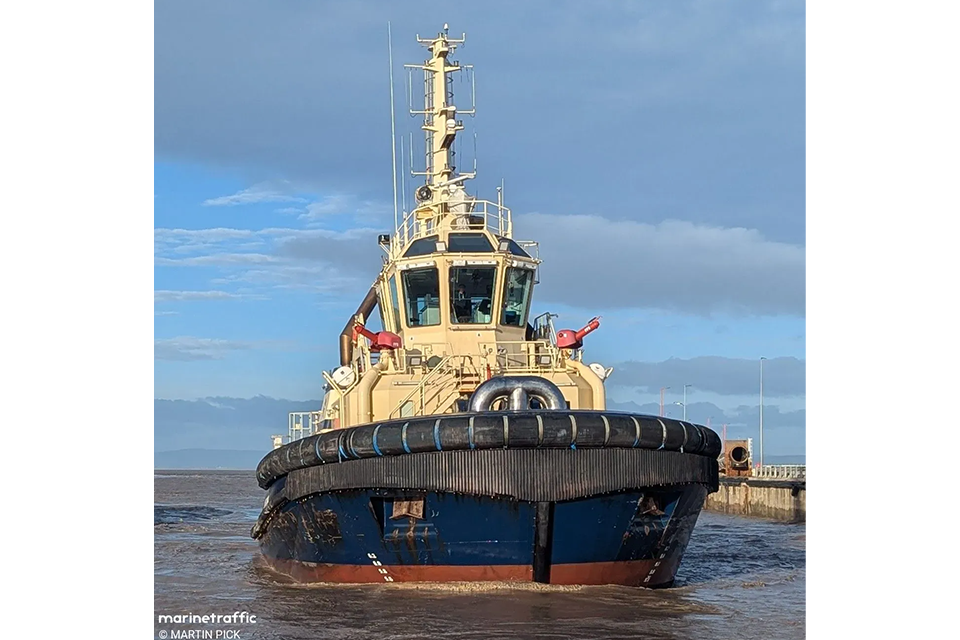
Vessel photo courtesy of Martin Pick (MarineTraffic).
-
The process of changing the tow rope’s working end to even out wear and tear caused by friction and extend the rope’s lifespan. ↩