INTM550086E - Hybrids: introduction: examples of interaction with transfer pricing: imported mismatch
Example analysis
In a scenario where:
- investor 1 sees hybrid payee as transparent
- investor 2 sees hybrid payee as opaque
- all relevant jurisdictions see payee and payer as opaque
- under arm’s length terms, the value of the payment made by payer would be £50
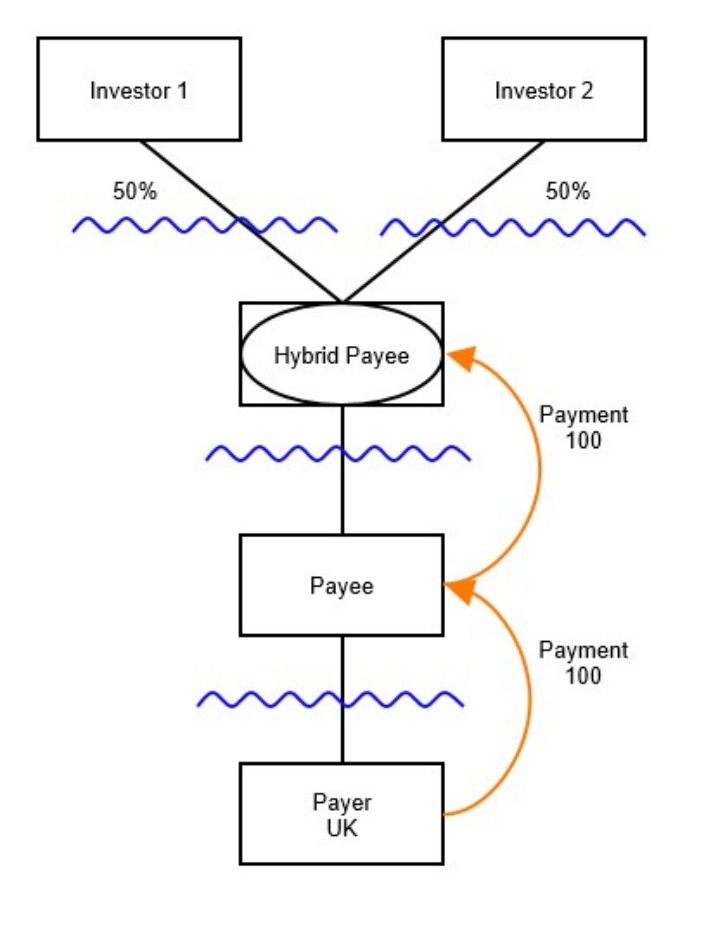
Determine relevant mismatch
The payment of £100 between payee and hybrid payee is the mismatch payment within the meaning of condition D at section 259KA(6). It gives rise to a hybrid payee deduction/non-inclusion mismatch (it would be within the scope of Chapter 7 of Part 6A were payee resident in the United Kingdom (UK).
The relevant deduction in relation to the mismatch payment is £100 (assuming that no transfer pricing adjustment under the law of payee’s jurisdiction of residency falls to be made). The ordinary income of the payees is £50 (again assuming that local transfer pricing rules do not deem this to be a lesser amount). Accordingly, the relevant mismatch is £50.
However, for payments made after 10 June 2021, the amendment in Finance Act 21 at section 259KE instructs us to calculate the relevant mismatch as if the mismatch payment had been reduced in the same proportion as the reduction imposed (via the transfer pricing legislation) on the deduction P (the payer) can claim for the imported mismatch payment (the payment of £100 to payee).
Therefore, given the arm’s length reduction took the deduction available to P from £100 to £50, the mismatch payment should be assumed to be reduced in the same proportion, to £50. In turn this means that the relevant mismatch becomes £25. The relevant mismatch is taken to be the amount it would have been had the arm’s length provision been imposed (£50) instead of the actual provision (£100).
Therefore, under chapter 11, the reduced amount of £50 available as a deduction to P (the payer) in respect of the payment of £100 is further reduced by the amount of the relevant mismatch, £25.
Applying transfer pricing with Part 6A factored in
Step 1: Test outcome of actual provision, disregarding transfer pricing rules
Payer makes payment of £100. This is the relevant deduction for part 6A purposes. Counteraction under chapter 11 would therefore be to reduce the relevant deduction by the amount of the relevant mismatch, so limiting relief to £50.
Step 2: Test outcome of arm’s length provision
Payer makes payment of £50. This is the relevant deduction for part 6A purposes. Counteraction under chapter 11 would therefore be to reduce the relevant deduction by the amount of the relevant mismatch, so limiting relief to £25. The amount of the relevant mismatch is not affected by the substitution of arm’s length pricing at the level of payer.
Step 3: Test if payer is a potentially advantaged person for transfer pricing purposes
Payer’s tax relief under the actual provision would be £50. Under the arm’s length provision, it would be £25. Payer is therefore potentially advantaged.
Step 4: Recompute payer’s tax position as if the arm’s length provision was imposed
Payer is taxed as if it has made a payment of £25. Corresponding adjustments will not be in point as payee is not UK tax resident.
Applying Part 6A (chapter 11) to consider whether a further counteraction is required
Step 1: Identify relevant deduction
Payer makes payment of £100. However, this exceeds the arm’s length amount so transfer pricing would require recomputation of payer’s tax position as if it was paying £50. Relevant deduction is therefore £50.
Step 2: Apply counteraction
The relevant deduction of £50 is reduced by the relevant mismatch of £25. Accordingly, the counteraction reduces the available deduction to £25. Since this amount is not lower than the amount arrived at via applying part 4, part 6A has no further effect.