INTM550086A - Hybrids: introduction: examples of interaction with transfer pricing: hybrid financial instrument
These examples demonstrate how part 6A and the Transfer Pricing rules apply in the case of a hybrid financial instrument. In considering chapter 4 the analysis would be the same in situations analogous to those discussed below. The diagram is the same for all fact patterns.
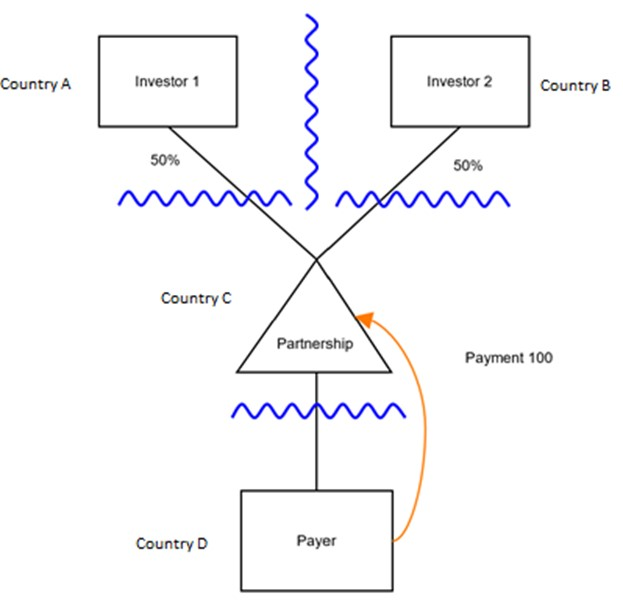
Example 1 analysis
In a scenario where:
- there are no hybrid entities in this structure
- a payment is made from the payer in country D to the partnership in country C
- investor 1 in country A sees the underlying financial instrument as equity, and does not tax the return on it
- investor 2 in country B sees the underlying financial instrument as debt, and does tax the return it receives
- the arm’s length amount of the payment from payer to partnership would be £60
Note it is assumed in the analysis below that the terms of the partnership and the treatment of the partnership according to the governing laws of Investor 1 and Investor 2 result in the two investors each being considered to own an indivisible 50% share in the hybrid security held by the partnership. In the event that this was not the case, and so the correct analysis was that two securities were deemed to be in issue, one held by each investor, the eventual result would be the same (but via a 100% counteraction on one security and no counteraction on the other, rather than via a 50% counteraction on the single security actually in issue).
Applying Transfer Pricing with Part 6A factored in
Step 1: Test outcome of actual provision, disregarding transfer pricing rules
Payer makes payment of £100. This is the relevant deduction for part 6A purposes. Total payee ordinary income is £50. Counteraction under chapter 3 would therefore be reduction of relevant deduction by £50. Total relief available to payer would therefore be £50.
Step 2: Test outcome of arm’s length provision
Payer makes payment of £60. This is the relevant deduction for part 6A purposes. Total payee ordinary income would be £30. Counteraction under chapter 3 would therefore be reduction of relevant deduction by £30. Total relief available to payer would therefore be £30.
Step 3: Test if payer is a potentially advantaged person for transfer pricing purposes
Payer’s tax relief under the actual provision would be £50, but under the arm’s length provision it would be £30. Payer is therefore potentially advantaged.
Step 4: Recompute payer’s tax position as if the arm’s length provision was imposed
Payer is taxed as if it has made a payment of £60. Deductibility of the payment is reduced by £30 due to counteraction under chapter 3. Payer therefore claims deduction of £30.
To the extent relevant, corresponding adjustments would be available under section.174 as if the arm’s length payment of £60 had been made.
Applying Part 6A (Chapter 3) to consider whether a further counteraction is required
Step 1: Identify relevant deduction (relief available disregarding hybrids rules)
Payer makes payment of £100, which absent the hybrids rules would potentially be fully deductible. However, this exceeds the arm’s length amount so transfer pricing would require recomputation of payer’s tax position as if it was paying £60. Relevant deduction is therefore £60.
Step 2: Identify payees’ total ordinary income
Only investor 2 is recognising ordinary income. It receives £50. So, the total ordinary income of all payees is £50.
Step 3: Test if there is a hybrid or otherwise impermissible deduction/non-inclusion mismatch
The relevant deduction is £60, and the total ordinary income of payees is £50. There is therefore a hybrid or otherwise impermissible deduction/non-inclusion mismatch of £10.
Step 4: Apply counteraction
The relevant deduction (of £60) which may be deducted by the payer is reduced by the mismatch amount of £10. The maximum the payer may deduct is therefore £50.
However, since the application of the transfer pricing rules has led to a claimed deduction of only £30, the counteraction has no effect in practice.
Note that if a corresponding adjustment claim was made by investor 2, part 6A would have imposed a counteraction of £30 (as total payee ordinary income would have been reduced to £30), setting a maximum deduction of £30, leading to the same outcome as part 4. Part 6A would therefore have had no effect in its own right.
Example 2 analysis
In a scenario where:
- there are no hybrid entities in this structure
- investor 1 sees the financial instrument as equity and does not tax the return on it
- investor 2 sees the financial instrument as debt and does tax the return it receives
- the arm’s length amount of the payment from payer to partnership would be £40
Note it is assumed in the analysis below that the terms of the partnership and the treatment of the partnership according to the governing laws of investor 1 and investor 2 result in the two investors each being considered to own an indivisible 50% share in the hybrid security held by the partnership. In the event that this was not the case, and so the correct analysis was that two securities were deemed to be in issue, one held by each investor, the eventual result would be the same (but via a 100% counteraction on one security and no counteraction on the other, rather than via a 50% counteraction on the single security actually in issue).
Applying Transfer Pricing with Part 6A factored in
Step 1: Test outcome of actual provision, disregarding transfer pricing rules
Payer makes payment of £100. This is the relevant deduction for part 6A purposes. Total payee ordinary income is £50. Counteraction under chapter 3 would therefore be reduction of relevant deduction by £50. Total relief available to payer would therefore be £50.
Step 2: Test outcome of arm’s length provision
Payer makes payment of £40. This is the relevant deduction for part 6A purposes. Total payee ordinary income would be £20. Counteraction under chapter 3 would therefore be reduction of relevant deduction by £20. Total relief available to payer would therefore be £20.
Step 3: Test if payer is a potentially advantaged person for transfer pricing purposes
Payer’s tax relief under the actual provision would be £50, but under the arm’s length provision it would be £20. Payer is therefore potentially advantaged.
Step 4: Recompute payer’s tax position as if the arm’s length provision was imposed
Payer is taxed as if it has made a payment of £40. Deductibility of the payment is reduced by £20 due to counteraction under chapter 3. Payer therefore claims deduction of £20.
To the extent relevant, corresponding adjustments would be available under section.174 asif the arm’s length payment of £40 had been made.
Applying Part 6A (Chapter 3) to consider whether a further counteraction is required
Step 1: Identify relevant deduction (relief available disregarding hybrids rules)
Payer makes payment of £100, which absent the hybrids rules would potentially be fully deductible. However, this exceeds the arm’s length amount so transfer pricing would require recomputation of payer’s tax position as if it was paying £40. Relevant deduction is therefore £40.
Step 2: Identify payees’ total ordinary income
Only Investor 2 is recognising ordinary income. It receives £50. So, the total ordinary income of all payees is £50.
Step 3: Test if there is a hybrid or otherwise impermissible deduction/non-inclusion mismatch
The relevant deduction is £40, and the total ordinary income of payees is £50. There is therefore no hybrid or otherwise impermissible deduction/non-inclusion mismatch.
Since there is no hybrid payee deduction/non-inclusion mismatch, there is no counteraction. Payer claims deduction of £20 in accordance with the outcome of applying the transfer pricing rules.
Note that if a corresponding adjustment claim was made by investor 2, part 6A would have imposed a counteraction of £20 (as total payee ordinary income would have been reduced to £20), setting a maximum deduction of £20, leading to the same outcome as part 4. Part 6A would therefore have had no effect in its own right.
Example 3 analysis
In a scenario where:
- there are no hybrid entities in this structure
- investor 1 sees the financial instrument as equity and does not tax the return on it
- investor 2 sees the financial instrument as debt and does tax the return it receives
- the arm’s length amount of the payment from payer to partnership would be £60
- arm's length parties would, however, have entered into a vanilla instrument which both Investor 1 and Investor 2 see as debt and tax the returns in full
Note it is assumed in the analysis below that the terms of the partnership and the treatment of the partnership according to the governing laws of Investor 1 and Investor 2 result in the two investors each being considered to own an indivisible 50% share in the hybrid security held by the partnership. In the event that this was not the case, and so the correct analysis was that two securities were deemed to be in issue, one held by each investor, the eventual result would be the same (but via a 100% counteraction on one security and no counteraction on the other, rather than via a 50% counteraction on the single security actually in issue).
Analysis - Applying Transfer Pricing with Part 6A factored in
Step 1: Test outcome of actual provision, disregarding transfer pricing rules
Payer makes payment of £100. This is the relevant deduction for part 6A purposes. Total payee ordinary income is £50. Counteraction under chapter 3 would therefore be reduction of relevant deduction by £50. Total relief available to payer would therefore be £50.
Step 2: Test outcome of arm’s length provision
Payer makes payment of £60. Part 6A has no application, since under the arm’s length provision both investor 1 and investor 2 receive interest which would be taxed as ordinary income.
Step 3: Test if payer is a potentially advantaged person for transfer pricing purposes
Payer’s tax relief under the actual provision would be £50, but under the arm’s length provision it would be £60. Payer is therefore not potentially advantaged. No transfer pricing adjustment falls to be made.
Applying Part 6A (Chapter 3) to consider whether a further counteraction is required
Step 1: Identify relevant deduction (relief available disregarding hybrids rules)
Payer makes payment of £100, which absent the hybrids rules would potentially be fully deductible. However, this exceeds the arm’s length amount so transfer pricing would require recomputation of payer’s tax position as if it was paying £60. Relevant deduction is therefore £60.
Step 2: Identify payees’ total ordinary income
Only Investor 2 is recognising ordinary income. It receives £50. So, the total ordinary income of all payees is £50.
Step 3: Test if there is a hybrid or otherwise impermissible deduction/non-inclusion mismatch
The relevant deduction is £60, and the total ordinary income of payees is £50. There is therefore a hybrid or otherwise impermissible deduction/non-inclusion mismatch of £10.
Step 4: Apply counteraction
The relevant deduction (of £60) which may be deducted by the payer is reduced by the mismatch amount of £10. The maximum the payer may deduct is therefore £50.
No corresponding adjustment is available (at least under United Kingdom (UK) domestic law) as the reduction in relief is affected solely by part 6A (even though a notional transfer pricing exercise was conducted in order to quantify the counteraction under chapter 3).
Example 4 analysis
In a scenario where:
- there are no hybrid entities in this structure
- investor 1 sees the financial instrument as equity and does not tax the return on it
- investor 2 sees the financial instrument as debt and does tax the return it receives
- the arm’s length amount of the payment from payer to partnership would be £40
- arm’s length parties would, however, have entered into a vanilla instrument which both Investor 1 and Investor 2 see as debt and tax the returns in full
Note it is assumed in the analysis below that the terms of the partnership and the treatment of the partnership according to the governing laws of Investor 1 and Investor 2 result in the two investors each being considered to own an indivisible 50% share in the hybrid security held by the partnership. In the event that this was not the case, and so the correct analysis was that two securities were deemed to be in issue, one held by each investor, the eventual result would be the same (but via a 100% counteraction on one security and no counteraction on the other, rather than via a 50% counteraction on the single security actually in issue).
Applying Transfer Pricing with Part 6A factored in
Step 1: Test outcome of actual provision, disregarding transfer pricing rules
Payer makes payment of £100. This is the relevant deduction for Part 6A purposes. Total payee ordinary income is £50. Counteraction under Chapter 3 would therefore be reduction of relevant deduction by £50. Total relief available to payer would therefore be £50.
Step 2: Test outcome of arm’s length provision
Payer makes payment of £40. Part 6A has no application, since under the arm’s length provision both investor 1 and investor 2 receive interest which would be taxed as ordinary income.
Step 3: Test if payer is a potentially advantaged person for transfer pricing purposes
Payer’s tax relief under the actual provision would be £50, but under the arm’s length provision it would be £40. Payer is therefore potentially advantaged.
Step 4: Recompute payer’s tax position as if the arm’s length provision was imposed
Payer is taxed as if it has made a payment of £40, which is not subject to any hybrid counteraction. Payer therefore claims relief of £40.
To the extent relevant, corresponding adjustments would be available under section.174 as if the arm’s length payment of £40 had been made.
Applying Part 6A (Chapter 3) to consider whether a further counteraction is required
Step 1: Identify relevant deduction (i.e. relief available disregarding hybrids rules)
Payer makes payment of £100, which absent the hybrids rules would potentially be fully deductible. However, this exceeds the arm’s length amount so transfer pricing would require recomputation of payer’s tax position as if it was paying £40. Relevant deduction is therefore £40.
Step 2: Identify payees’ total ordinary income
Only Investor 2 is recognising ordinary income. It receives £50. So, the total ordinary income of all payees is £50.
Step 3: Test if there is a hybrid or otherwise impermissible deduction/non-inclusion mismatch
The relevant deduction is £40, and the total ordinary income of payees is £50. There is therefore no hybrid or otherwise impermissible deduction/non-inclusion mismatch of £10. No counteraction therefore falls to be made.
Note that if a corresponding adjustment claim was made by Investor 2, part 6A would have imposed a counteraction of £20 (as total payee ordinary income would have been reduced to £20), setting a maximum deduction of £20, leading to the same outcome as part 4. Part 6A would therefore have had no effect in its own right.