Patent factsheet: Drawings
How to produce drawings for your patent application.
The basis of a UK patent application is a legal document called a specification. Its contents determine whether a patent can be granted. You would be well advised to seek professional assistance when preparing your patent application.
A patent specification includes:
- a full description of your invention, plus any drawings referred to within the description
- one or more claims
This factsheet tells you about the drawings. An example is given below. Other guidance pages in this series tell you how to prepare a description, claims, and an abstract (which is another essential part of an application).
Content
An application should preferably include a set of good quality drawings, which illustrate one or more embodiments of your invention. The drawings may, for example, illustrate different views of your product, or provide a flow chart of the steps taken to perform your method.
The drawings offer valuable support for the invention that is described and claimed in your application. It is therefore important that you illustrate all examples of your invention.
You should consider illustrating the invention from a number of different angles and, if appropriate, use cross-sectional views. You should also include figures of any important features that would be hidden in use.
Style and presentation
Your drawings must consist of black, well defined lines so that good quality photocopies may be made of them (see below for an example). Photographs may be included providing they are black and white, clear and capable of direct reproduction.
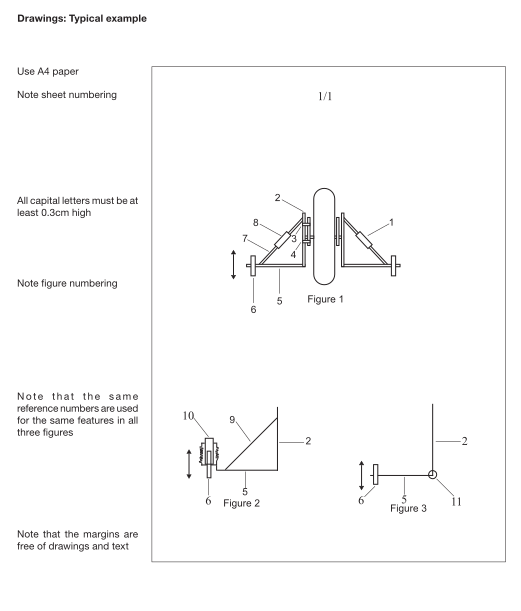
You may have more than one drawing sheet. Each drawing sheet may contain several figures. If you have more than one figure on a page, label each figure clearly as ‘Figure 1’, ‘Figure 2’ and so on.
Number the drawing sheets in order at the top middle (but not in the top margin), preferably also indicating the total number of sheets of drawings. If you have one sheet, number it as ‘1/1’. If you have, for example, three sheets of drawings, then number them as ‘1/3’, ‘2/3’, ‘3/3’.
Specific features are indicated in the drawings using reference numbers or letters, joined to the corresponding feature by means of a clear, continuous line. These references are then used in the description to refer to those features.
The same reference number or letter must refer to the same feature in all figures that show it.
Capital letters used in any drawings must be at least 0.3cm high.
Prepare your drawings on one side only of separate sheets of white A4 paper. Leave margins of at least 2.0cm at the top and left-hand side, and 1.5cm on the right-hand side and 1.0cm at the bottom.
Any essential words (for example ‘plan’, ‘elevation’) must be in English or Welsh. (The office will provide a translation of any material filed in Welsh).
When producing drawings, do not:
- use coloured or lined paper
- use coloured inks or pencil
- draw a frame to indicate the margins
- put anything in the margins or use ‘engineering’ borders
- write descriptive text in the drawings
- use excessive shading which obscures other elements of the drawing
- fold your drawings
- submit ‘engineering’-type drawings showing materials or dimensions. These are not normally suitable for use with patent specifications
Example page of drawings
The image shows an example page of drawings from a patent application. These drawings follow the rules in this factsheet.
Getting help
It’s a good idea to seek professional assistance when preparing your patent application, as you’re more likely to succeed in getting a patent granted if you do.
You can also contact the Intellectual Property Office on 0300 300 2000 (local call rate). We’re keen to help all our customers as much as possible, but regret that we cannot help you find ways to make money from your invention.
This guide is not intended to be comprehensive and necessarily omits details which may be relevant in particular circumstances.