3. Performance influencing factors
Looking into how some factors that can influence the performance of people on board can lead to more accidents as well as how to mitigate or control these factors.
Performance influencing factors (PIFs) describe any condition that influences performance. These can be individual, job or organisation related.
PIFs can make human error more likely, which can lead to errors and incidents. These factors affect the way information is processed (see section 2.1 on information processing) as well as the way decisions are made. By mitigating or controlling these PIFs, you can improve performance and increase safety.
This section will explore a few common PIFs that may affect you and other seafarers. This is not an exhaustive list and there are many other factors that can influence performance.
Fatigue spans the spectrum of individual, job, and organisation related factors. Fatigue refers to extreme mental and physical exhaustion. It’s not the same as tiredness.
Tiredness is a temporary state that you can recover from quickly with rest. Fatigue is an overwhelming sense of tiredness that is prolonged and cannot be recovered from quickly. Many factors can cause fatigue, such as a lack of quality sleep or stress.
Fatigue has several mental and physical effects, many of which can affect your ability to do a job safely.
These effects can be:
- difficulty concentrating
- difficulty making decisions
- lack of motivation
- poor memory, coordination and concentration, and slower reactions
- low mood, irritability or mood swings
- falling asleep suddenly and without meaning to
- reduced amount and quality of communication
Other physical effects that may reduce performance, as well as having long-term health effects include:
- loss of appetite
- headaches
- nausea
- shortness of breath
- muscle pain or weakness
- palpitations
Fatigue can impair performance and decision making, making incidents more likely to happen. Sleep debt can be built if you do not have enough good-quality sleep, even for a short period of time. It can lead to issues with decision making and problem solving, as well as an increase in risk-taking behaviour. Therefore, it needs to be managed and mitigated like any other risk.
Managing fatigue in the workplace
You must abide by the minimum hours of work and rest as outlined in the MLC 2006, MGN 505 (M) Amendment 1: Human element guidance - Part 1: Fatigue and fitness and in the IMO’s guidelines on fatigue, but the risk of fatigue should also be managed on a case-by-case basis.
Manage fatigue onboard:
- ensure rest areas are comfortable – quiet, cool, and dark
- ensure good watch schedule planning, maintenance, and any other work. Consider when your team can have their hours of both rest and sleep
- try to prioritise rest hours, especially if there has been an emergency, problem or situation that has led to your team being fatigued
- when planning training exercises or drills, try to arrange them so there’s little disruption to rest periods
- encourage your team to practise good sleep hygiene and that the causes, effects, and mitigations of fatigue is well understood
- uninterrupted rest periods are important – other staff (including shoreside staff) should facilitate this. If you notice that you or your team are fatigued, work to manage it
- make sure everyone is recording hours of work and rest accurately – working beyond these hours is a “routine violation” (see section 2.3) and cultural change may be needed to address this
To learn more about managing fatigue onboard, read ‘Wellbeing at sea: A pocket guide for seafarers’ by the MCA.
Stress is our reaction to feeling under pressure. It’s usually thought of as being negative but that is not always the case. Some stress and pressure are necessary in our lives to make us feel motivated and to allow us to feel a sense of satisfaction. However, when the pressure becomes more than we can cope with we can feel overwhelmed and burnt out.
Similar to fatigue, stress has an impact on so many things that affect safety. It can affect our performance, our decision making, our interactions with others, to name a few, and can lead to major incidents if not managed properly.
Positive stress is called eustress. Causes of eustress can include receiving a promotion, holidays and retiring. It can be noticed as someone with increased energy, focus, motivation, productivity, and a positive mood.
Negative stress is called distress. Causes of stress can include conflict with your colleagues, excessive demands at work, job insecurity, lack of training for a task, unproductive and time-consuming meetings.
Symptoms of negative stress:
- tiredness and fatigue
- low motivation, energy and focus
- shortness of breath
- nausea
- breathlessness
- palpitations
- mood swings
- poor mental health
- lack of libido
- back pain
To learn more about managing stress onboard, read Wellbeing at sea: A pocket guide for seafarers by the MCA and Health and Safety Executive’s guidance and tools on stress and mental health at work.
If stress seems to be widespread in your workplace, there could be a problem with staffing and management. Speak with your colleagues about the possible causes of fatigue. Report your findings to management.
The World Health Organization states:
Mental health is a state of well-being in which an individual realises his or her own abilities, can cope with the normal stresses of life, can work productively and is able to make a contribution to his or her community.
Some individuals may be more predisposed to certain mental health conditions, and these can be exacerbated by personal issues. It’s important to assess the way their job and the organisation they are working in, impacts on stress and mental health.
We all have mental health, just like we all have physical health. Just like with physical health there are times when our mental health is better or worse. Stress is one mental state that can influence our overall mental health.
Managing mental health
If you feel as though your mental health is being affected, seek help. Speaking up should help you get the support you need at work.
If you’re concerned about a member of your team and want to speak to them about mental health, as a leader, you can:
- choose somewhere quiet where you will not be interrupted by other people to talk
- use open-ended questions such as: “How are you feeling?”
- let them say as much or as little as they want to
- just listen – do not try and diagnose them or guess at what you think they might be feeling
- avoid any judgement or judgemental language
- encourage them to seek help and support them through this. You can signpost them to company or external resources for mental health. You might need to do some research beforehand to know what is available
- if you’re seriously concerned about a colleague’s mental health, contact helplines and speak to a manager
What leaders can do:
- ensure your team understands the mental health policy and resources such as employee assistance program (EAP)
- another resource is the Wellbeing at Sea Tool, which is a digital survey that is completed by seafarers. It provides practical advice on how to manage or improve wellbeing at sea. The anonymised data it collects is sent to managers to help them identify priority areas for improvement and highlight best practice
- ensure staff complete relevant mental health training to eliminate misconceptions
- encourage open conversation about mental wellbeing, which is easier if your staff understand that they will not be penalised for expressing their concerns
- monitor mental wellbeing with satisfaction surveys, productivity, absenteeism etc
- ensure workloads are reasonable and that seafarers are not over or underloaded with tasks
The 5 R’s of mental health support
The 5 ‘R’s’ of mental health support
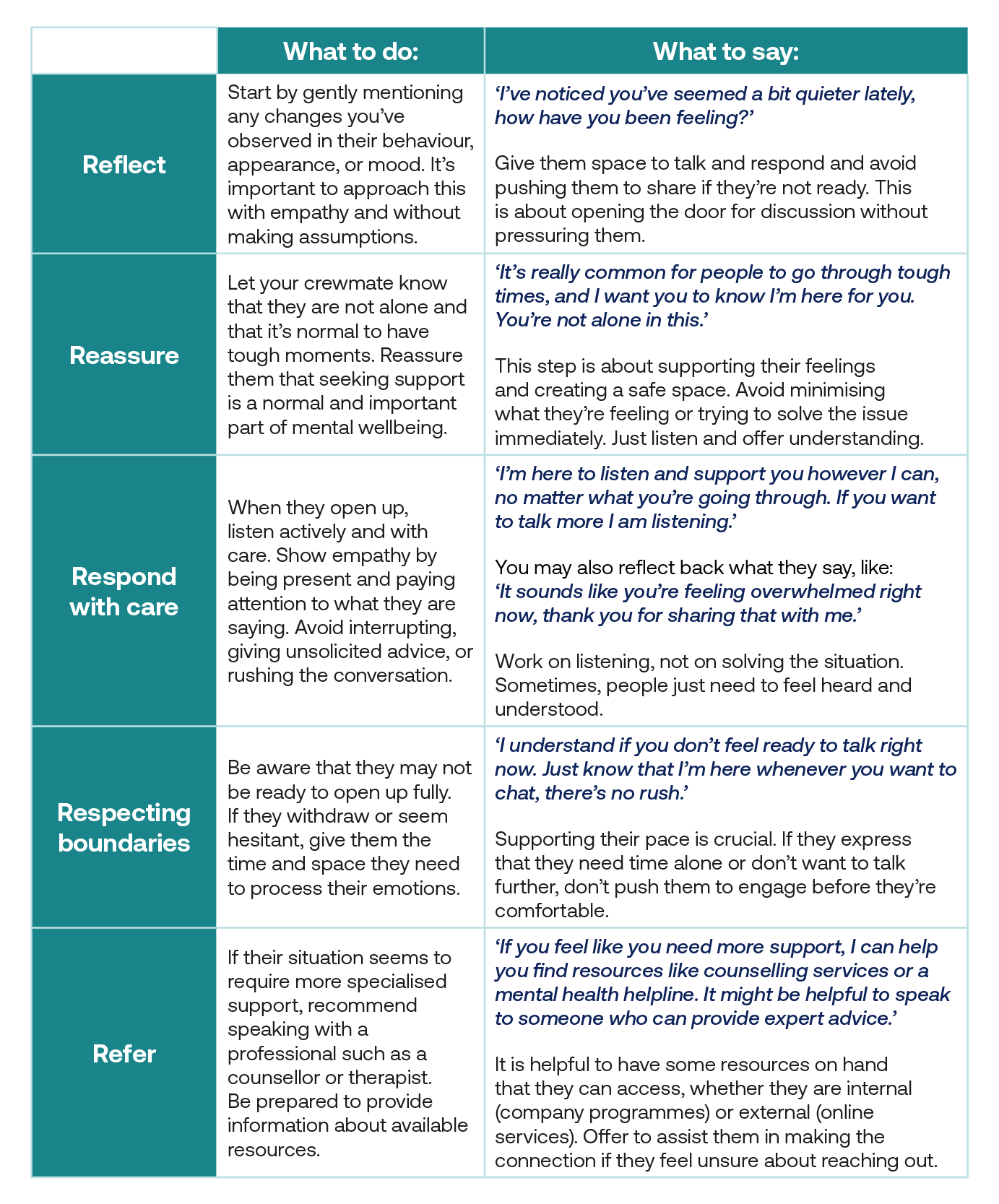
Reflect
What to do:
Start by gently mentioning any changes you’ve observed in their behaviour, appearance, or mood. It’s important to approach this with empathy and without making assumptions.
What to say:
I’ve noticed you’ve seemed a bit quieter lately, how have you been feeling?
Give them space to talk and respond and avoid pushing them to share if they’re not ready. This is about opening the door for discussion without pressuring them.
Reassure
What to do:
Let your crewmate know that they are not alone and that it’s normal to have tough moments. Reassure them that seeking support is a normal and important part of mental wellbeing.
What to say:
It’s really common for people to go through tough times, and I want you to know I’m here for you. You’re not alone in this.
This step is about supporting their feelings and creating a safe space. Avoid minimising what they’re feeling or trying to solve the issue immediately. Just listen and offer understanding.
Respond with care
What to do:
When they open up, listen actively and with care. Show empathy by being present and paying attention to what they are saying. Avoid interrupting, giving unsolicited advice, or rushing the conversation.
What to say:
I’m here to listen and support you however I can, no matter what you’re going through. If you want to talk more I am listening.
You may also reflect back what they say, like:
It sounds like you’re feeling overwhelmed right now, thank you for sharing that with me.
Work on listening, not on solving the situation. Sometimes, people just need to feel heard and understood.
Respecting boundaries
What to do:
Be aware that they may not be ready to open up fully. If they withdraw or seem hesitant, give them the time and space they need to process their emotions.
What to say:
I understand if you don’t feel ready to talk right now. Just know that I’m here whenever you want to chat, there’s no rush.
Supporting their pace is crucial. If they express that they need time alone or don’t want to talk further, don’t push them to engage before they’re comfortable.
Refer
What to do:
If their situation seems to require more specialised support, recommend speaking with a professional such as a counsellor or therapist. Be prepared to provide information about available resources.
What to say:
If you feel like you need more support, I can help you find resources like counselling services or a mental health helpline. It might be helpful to speak to someone who can provide expert advice.
It is helpful to have some resources on hand that they can access, whether they are internal (company programmes) or external (online services). Offer to assist them in making the connection if they feel unsure about reaching out.
Important notice:
If you believe the situation is urgent or your crewmate is in immediate distress, don’t hesitate to contact the medical officer or other appropriate emergency resources.
Creating a culture of health and safety
-
Make sure staff complete relevant health and safety training to eliminate misconceptions
-
Support open conversations about mental wellbeing. Help staff understand that they will not be penalised for raising concerns
-
Check mental wellbeing, for example, using satisfaction surveys, productivity, absenteeism
-
Make sure workloads are reasonable and that seafarers are not over or underloaded
Important notice:
Make sure your team knows about the mental health policy and available resources, such as the employee assistance programme (EAP). Another useful tool is the Wellbeing at Sea Tool, a digital survey for seafarers that gives advice on managing and improving wellbeing at sea. The anonymised data collected helps managers identify priority areas for development and highlight good practices.
Workload refers to the demands of a task.
The mental and physical resources a person has available for any task is limited and can vary between people.
When workload is too high or too low, performance can be negatively affected.
Job-related pressures that increase mental workload include:
- time pressure
- switching between tasks
- task demands
- time on task
- task complexity
Workload can also change over the course of a shift. Underload can be as dangerous as overload and switching between levels of workload can also cause issues.
Certain activities can add excessive pressure on the seafarers (for example, inspections). It’s important to identify these times and to get extra help as necessary.
Individual and job factors such as competence and training can impact a person’s ability to manage workload. So, it’s important to make sure that you and your team have all the necessary training you need before undertaking any work, especially if it’s new, changed in process or equipment used or is unfamiliar.
It’s also important to have open communication with your team to ensure that they can speak up if they feel that they are struggling with any part of their work or feel as if they are being underloaded with tasks. Likewise, it’s also necessary for you to know your team well and look out for any team members to make sure they are not being underloaded or overloaded with tasks.
Many environmental factors can affect performance.
For example, when the temperature in the environment is higher or lower than our core body temperature, we can gain or lose heat. This affects our performance, such as our decision making and critical thinking skills. So, it’s important to assess the effects of climate and mitigate them.
The physical limitations of humans also need to be considered. The majority of sensory information the brain receives is through sight. As such, we tend to rely too much on eyesight, sometimes ignoring other cues that tell us something is wrong because we cannot “see” the danger. This can particularly be the case during duties such as watchkeeping. It’s important to be aware of some of the issues that affect what we see.
Blind spots are gaps in your visual field.
Figure 6: how the eye creates the centre of vision and a blind spot
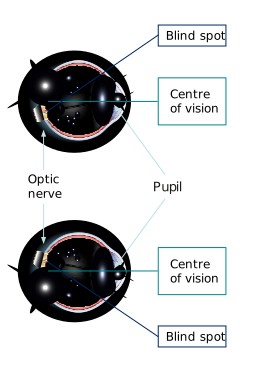
Blind spots are caused by a lack of receptors in the area where blood vessels and the optic nerve leave the eye.
Everyone has a blind spot; you do not usually notice that you have one because your brain fills in the missing information for you based on the surroundings.
When the brain fills in the missing information it makes a “guess” based on what it has seen. Therefore, you can miss something important if it’s in your blind spot. It’s important that you’re aware of your blind spots and move your head while completing scanning tasks.