UK innovation survey 2025: report
Published 4 June 2026

© Crown copyright 2026
This publication is licensed under the terms of the Open Government Licence v3.0 except where otherwise stated. To view this licence, visit nationalarchives.gov.uk/doc/open-government-licence/version/3 or write to the Information Policy Team, The National Archives, Kew, London TW9 4DU, or email: psi@nationalarchives.gov.uk.
Where we have identified any third party copyright information you will need to obtain permission from the copyright holders concerned.
This publication is available at https://www.gov.uk/government/statistics/uk-innovation-survey-2025-report/uk-innovation-survey-2025-report
1. Headline findings
In 2022 to 2024,
34% of UK businesses were innovation active.
This is a decrease compared to 36% in 2020-2022.
Large businesses were more likely to have innovated than small and medium enterprises (SMEs). In 2022-2024, 47% of large businesses were innovation active, compared to 34% of SMEs.
The percentage of innovation active businesses was highest in England (35%) in 2022-2024. In Northern Ireland 30% of businesses in 2022-2024 were innovation active, compared to 29% in Scotland and 28% in Wales.
Figure 1: percentage of businesses which were innovation active, 2008-2010 to 2022-2024

1.1 What you need to know about these statistics
The UK innovation survey (UKIS) is the main data source for business innovation in the UK. It is used widely across government to help improve policy and by the research community for understanding the innovation landscape.
UKIS 2025 sampled 31,150 UK businesses (for the period 2022-2024) with 10 or more employees. It received a response from 14,075 businesses, giving a response rate of 45.2%.
2. Introduction
2.1 Defining innovation
The UK definition of innovation is based on an Organisation for Economic Co-operation and Development (OECD) definition, outlined in the Oslo Manual 2018. This definition includes any of the following activities, if they occurred during the survey period:
-
the introduction of a new or improved product (goods or services);
-
business processes used to produce or supply all goods or services that the business has introduced, regardless of their origin. These innovations may be new to business or new to the market;
-
engagement in innovation projects not yet complete or abandoned;
-
investment activities in areas such as internal research and development, training, acquisition of external knowledge or machinery and equipment linked to innovation activities.
A business that had engaged in any of the activities described in points 1 to 3 is defined as being ‘innovation active’.
A business that had engaged in any of the activities described in points 1 to 4 is defined as a ‘broader innovator’. Most of the detailed contextual analyses later on in this report such as innovation factors, sources of information, cooperation arrangements are based on this definition.
A business that undertakes activity 2 only is described as a ‘business process innovator’. This definition was introduced from UKIS 2023 and is broader than the process innovator definition in previous UKIS surveys and is therefore not comparable. It aligns with OECD’s revised approach in conceptualising ‘innovation’.
2.2 About this release
The UK innovation survey (UKIS) is the main data source for business innovation in the UK. It is used widely across government for information and policy formation and by the research community for understanding the innovation landscape.
These statistics are produced in line with the UK Statistics Authority’s Code of Practice for Statistics and in accordance with internationally agreed statistical guidance and standards. The UK information can be compared internationally with OECD published information. Table 1b in the UKIS 2025 statistical annex compares UKIS 2020-2022 and 2022-2024 information with a subset of industries (industrial divisions) used for reporting by OECD.
UKIS 2025 asked businesses for information on their innovation activities over the 3-year period from 2022 to 2024. If information was not available for calendar years, they were asked that their return covered the nearest financial years.
Comparisons are made with previous UK innovation surveys, covering periods back to 2008-2010, where appropriate. The period covering 2008-10 was the first survey data collected using a sample based on the Standard Industrial Classification 2007 (SIC 2007).
This created a break in the time series, so comparisons to surveys prior to this are not included in this publication. Previous UK innovation survey reports can be viewed on DBT Community Innovation Survey webpage and historic information prior to 2009 is available from the National Archives website.
This report uses weighted data, in order to be representative of the business population. The responses were weighted to the total business population, using the Inter-Departmental Business Register (IDBR). They were not weighted by factors which would give more weight to larger businesses, such as employment or turnover.
Geographic location of businesses are based on businesses’ head office location. For example, a business operating in a particular region or country with a head office located elsewhere, will only be counted as in the head office geographic location.
Accompanying this report is a statistical annex of tables. The ‘accompanying tables’ section outlines changes and improvements made to tables since UKIS 2023 main report.
All percentage point changes in this report are calculated from unrounded figures. [c] denotes disclosive figures in tables that have been suppressed, as they are based on fewer than 10 responses from businesses.
2.3 About this survey
The survey is the 14th UKIS. UKIS has been conducted every 2 years since 2005. The survey was funded and developed by the Department for Business and Trade (DBT) and administered by the Office for National Statistics (ONS) on behalf of DBT.
The survey focusses on business adoption of innovation through new and improved products and services, investments in different types of innovation, and changes in business structures, management, design, and marketing innovations. The survey also asks businesses about the drivers which motivate and barriers to innovation.
Although innovation is a strong predictor of higher productivity, wider research shows that it can be difficult to measure accurately, partly due to the changing nature of economic activity. Innovation value is fluid and travels easily across organisational boundaries so may be hard to recoup at the point of origin.
The sample selection was conducted by the ONS and followed very similar sampling methodology to the previous surveys.
UKIS 2025 sampled 31,150 UK businesses with 10 or more employees. UKIS 2025 was carried out in 2025 and asked businesses about their innovation activities in 2022 to 2024 (2022, 2023 and 2024). The 3-year reporting period is consistent with previous UKIS surveys and is widely used internationally, hence UK can be compared with other OECD countries.
The survey was voluntary and was conducted primarily through an electronic questionnaire. Businesses that did not complete an electronic response were contacted for a telephone interview. We received a response from 14,075 businesses, giving a response rate of 45.2%. This compares to 14,570 responses for UKIS 2023 (covering the 3-year period from 2020 to 2022), which was a response rate of 45.1%.
View the UKIS 2025 questionnaire.
Businesses are self-reporting their innovation activities when responding to this survey. Businesses that have reported certain activities, and therefore are classed as innovators by our definitions, sometimes do not think of themselves as innovators.
2.4 Policy context for innovation
On 23 June 2025 the Department for Business and Trade (DBT) published the Industrial Strategy. The strategy sets out a new economic approach to backing the UK’s strengths, with ambitious plans for 8 high-growth sectors. Driving and supporting innovation is an important component of the strategy. The UK must be at the forefront of innovation if we want to build a high growth, resilient economy that creates quality jobs and improves living standards.
Innovation helps businesses become smarter and more efficient. It creates competitive advantage for first movers who create novel products or are quickest to harness new technologies. In addition it gives the countries that nurture it more agency and leverage on the world stage. We must be a nation of inventors, entrepreneurs and tech adopters.
The Department for Science, Innovation and Technology (DSIT) leads on innovation policy and strategy. But the UKIS 2025 survey was funded and developed by DBT and administered by the Office for National Statistics (ONS) on behalf of DBT.
The UK information can be compared internationally with OECD published information: a subset of industries (industrial divisions) used for reporting by OECD.
UKIS is needed to be able to inform these government wide policies and strategies and for international comparison.
3. Levels and types of innovation
3.1 Introduction
Innovation types and levels vary widely by organisation size and location, while business investment and its purpose can vary according to individual business choices in the context of sector and type of innovation.
3.2 Changes in innovation over time
Innovation and type of activity
Figure 3.2: percentage of businesses engaging in innovation by activity, 2008-2010 to 2022-2024

In 2022-2024, 34% of UK businesses were innovation active. This is a decrease compared to 36% in 2020-2022.
Table 1a in the statistical annex of tables that accompanies this report provides a time series table from 2008-2010 to 2022-2024, with breakdowns of innovation active businesses by size of business, country / region, and industrial sector.
In 2022-2024, 39% of businesses were broader innovators. Businesses were more likely to introduce new business processes than new products. In 2022-2024, 25% of businesses were business process innovators and 19% were product innovators. In 2022-2024, 12% of businesses were both product and business process innovators.
Innovation activity varies by size of business
Large businesses were more likely to have innovated than SMEs. In 2022-2024, 47% of large businesses were innovation active, compared to 34% of SMEs. This trend was true for each type of innovation activity.
Table 3.2: percentage of businesses engaging in innovation by activity and size, 2014-2016 to 2022-2024
| Type of activity | 2014-2016 | 2016-2018 | 2018-2020 | 2020-2022 | 2022-2024 |
|---|---|---|---|---|---|
| SMEs (10-249 employees) | |||||
| Innovation active | 49 | 37 | 44 | 36 | 34 |
| Broader innovator | 50 | 38 | 46 | 38 | 39 |
| Innovation investment activities | 44 | 33 | 42 | 37 | 34 |
| Product innovator | 24 | 18 | 20 | 19 | 19 |
| Abandoned | 4 | 2 | 3 | 3 | 3 |
| Ongoing | 16 | 10 | 9 | 11 | 9 |
| Large businesses (250 plus employees) | |||||
| Innovation active | 63 | 50 | 58 | 50 | 47 |
| Broader innovator | 65 | 52 | 60 | 52 | 52 |
| Innovation investment activities | 58 | 45 | 54 | 50 | 43 |
| Product innovator | 29 | 22 | 27 | 27 | 26 |
| Abandoned | 7 | 2 | 5 | 5 | 5 |
| Ongoing | 28 | 19 | 18 | 19 | 16 |
This pattern of innovation activity being lower in 2022-2024 than 2020-2022 for all businesses and both SMEs and large businesses, was replicated within the panel data. The panel data covers a longitudinal sub-sample of 4,474 businesses that responded to the questionnaire in each of the last 3 UKIS surveys (2021, 2023 and 2025). See statistical annex: table P1 of table 18.
3.3 Change in innovation investment and expenditure over time
Figure 3.3: percentage of businesses investing in the following innovation activities in 2018-2020 to 2022-2024

There were decreases in the percentage of businesses investing in all innovation activities except one between 2020-2022 and 2022-2024. The only exception was in training, which rose marginally. The largest decrease was in the percentage of businesses investing in design activity from 12% to 9%. Investment in computer hardware and software remained as the most common activities.
Computer software investment decreased from 18% to 17% of businesses, and computer hardware investment decreased from 17% to 16% of businesses. The percentage of businesses investing in internal R&D was 13% in 2022-2024 and percentage of businesses investing in machinery and equipment was 12%.
The percentage of businesses investing in machinery and equipment was highest in the Yorkshire and the Humber (16%) and lowest in London (7%). The relatively low percentage in London is likely to reflect the fact that a greater proportion of London businesses are in the service sector. The percentage of businesses investing in computer software and hardware was highest in the West Midlands at 21% each. The percentage of businesses investing in computer software and hardware were lowest in Northern Ireland (see statistical annex – table 2).
Figure 3.4: innovation expenditure by area, as a percentage of total innovation expenditure for all businesses 2020, 2022 and 2024

Expenditure information is only collected for one year of the survey period (for example, the UKIS 2025 survey collects expenditure data for 2024).
In 2024, the percentage of innovation expenditure used for internal R&D was 48%, a 2 percentage point increase since the previous survey. The percentage of innovation expenditure used for acquisition of external R&D was 8% in 2024, a 3 percentage point increase compared to 2022. However, the percentage of innovation expenditure used for acquisition of machinery, equipment and software in 2024 was 29%, a 6 percentage point decrease compared to 35% in 2022.
4. Collaboration, information sources used by businesses, financial support, exports and procurement
4.1 Introduction
Developing innovations of any kind can be a complex process and businesses may decide to work jointly with other businesses or organisations and seek access to sources of advice and information to help the creative process.
This section explores the types of collaborators that businesses work with and where they turn for support (both information sources used and financial support). It also looks at percentages of broader innovators and non-broader innovators that export and apply for procurement contracts.
4.2 Collaboration
Co-operation arrangements
Co-operation occurs when 2 or more participants agree to take responsibility for a task or series of tasks and information is shared between the parties to facilitate the agreement. An innovation-active business co-operates with another business if it procures ideas or inputs from the other business, by providing it with a detailed specification of its needs.
In UKIS 2023 and 2025 the collaboration question was asked slightly differently to previous iterations of the UKIS survey. A filter question was introduced, so that businesses who did not co-operate with other businesses or organisations were no longer asked detailed breakdowns on their collaboration activities. Responses to the questions have been somewhat different and for this reason, the following information is only presented from UKIS 2023 onwards.
Figure 4.2: percentage of businesses with each type of co-operation arrangement (of all broader innovators that co-operated), 2020-2022 and 2022-2024

In 2022-2024, 92% of broader innovators with any co-operation arrangements reported co-operating with their suppliers, 90% with other businesses in their enterprise group, and 85% with clients and customers in the private sector.
Overall, businesses were much more likely to work with private sector organisations than they were with public sector and government organisations. Some 26% reported working with government or public research institutes, and 32% with universities or other higher education institutions.
4.3 Trends in information sources used to support innovation activities
Figure 4.3: percentage of broader innovator businesses rating listed information sources as ‘highly important’ to innovation activities, 2018-2020 to 2022-2024

Note for figure 4.3: * Regulators and / or regulations was a new option introduced in UKIS 2023.
Figure 4.3 shows that the information sourced from within their own business or enterprise group was the most highly rated by broader innovator businesses (at 35%) to support innovation activities. See statistical annex: table 9 for more information.
4.4 Financial support
Around 3% of businesses in the 2025 survey reported receiving financial support from UK central government for innovation activities, compared to 4% receiving support in the 2023 survey. Around 1% of businesses received direct financial support (such as smart or collaborative R&D grants, work with catapult centres, innovation vouchers etc) and 3% received indirect financial support (such as R&D tax credits or coronavirus pandemic support).
Businesses making use of public support, in the form of financial support via tax credits or deductions, grants, subsidised loans and loan guarantees, may benefit from greater capacity to innovate. In turn this could lead to superior performance outcomes, including increased turnover and increased numbers of employees.
Regression analysis which accompanied the UK innovation survey 2017: main report, showed that businesses that received financial support were more likely to experience increases in turnover and employment (see Appendix 1 in UK innovation survey 2017: main report).
The Innovations Impact of R&D Tax Credits in the UK research article published in July 2025 findings show that R&D tax credits are associated with product and process innovation, and also radical innovation of both types. It was also the case that the R&D tax credit effect took time to manifest itself in superior innovation outcomes.
In general, the positive impact of R&D tax credits in the UK on firm-level innovation is most apparent when firms also leverage external advice specifically related to innovation and strategy.
4.5 Exports
Figure 4.5: percentage of businesses that export by employment size, innovation and co-operation, 2024 only

In 2024, 17% of all businesses in UKIS exported. Around 12% of businesses left the survey question unmarked. Percentages of businesses that export are calculated from the total number of businesses (unmarked responses are included in the denominator). This is higher than estimates from other sources which may be due to the exclusion of micro-businesses (those with fewer than 10 employees) from the UKIS sample.
For example, the latest figures available from the ONS release Annual Business Survey exporters and importers for Great Britain in 2023 show that micro-businesses were less likely than larger businesses to export goods and services.
Broader innovators are much more likely to export (28% of businesses), than non-broader innovators (9% of businesses). Co-operating businesses were more likely to export (30% of businesses), than non co-operating businesses (14% of businesses).
Large businesses are much more likely to export and co-operate with other businesses than SMEs.
4.6 Procurement contracts to provide goods and services to public sector organisations
UKIS 2025 asked new questions on procurement contracts to provide goods or services to public sector organisations. See statistical annex: tables 9a to 9d for full breakdowns of responses.
In 2022-2024, 16% of broader innovators applied for any procurement contracts to provide goods or services to public sector organisations. Out of those businesses that applied for one or more contracts, 80% won a procurement contract.
Of businesses that held one or more contract in 2022-2024, 20% innovated and innovation was required as part of the contract. 27% innovated even though innovation was not required as part of the contract.
Regional or local government and education institutions were the most common UK public sector organisations with which contracts were held. National government departments and agencies were the most common overseas or non-domestic public sector organisations with which contracts were held.
5. Innovation by industrial sector
5.1 Introduction
Innovation engagement varies across different types of industrial sector and the type of innovation can vary according to sector, in particular whether businesses are supplying products or services.
5.2 Patterns of innovation behaviour in sectors
Figure 5.2: percentage of innovation active businesses by industrial sector, 2018-2020 to 2022-2024

Note for figure 5.2:
The figures quoted in this chart are based on full weights for 25 sectors but only 15 broad groups are shown for presentation purposes.
Figure 5.2 shows how innovation activity varies across industrial sectors. The percentage of innovation active businesses has decreased in most of the industrial sectors between 2020-2022 and 2022-2024.
Based on the 25 sectors shown in Statistical Annex: table 1a, the 3 industrial sectors with the largest percentage point (ppt) decreases in innovation activities were in:
-
other professional, scientific and technical activities (-13 ppt)
-
post and courier activities (-9 ppt)
-
manufacture of computer, electrical and optical equipments (-9 ppt)
The largest increases were in:
-
transportation (by land, water and air) (10 ppt)
-
warehousing and storage (10 ppt)
-
technical testing and analysis (8 ppt)
Businesses in production industries generally remained more innovative than businesses in distribution and service industries.
Based on the 25 sectors shown in Statistical Annex, in 2022-2024, ‘scientific research and development’ and ‘publishing, computer programming & information service activities/ICT’ had the highest percentages of innovation active businesses (70% and 58% of businesses respectively).
‘Accommodation and food services’ and ‘motion picture, video and tv programme production’ had the lowest percentage of innovation active businesses (17% and 22% of businesses respectively).
The relative order of industries in terms of their innovation activities was similar to the previous survey (see statistical annex: table 1a).
This pattern of decreases in innovation activity across nearly all industries is repeated in the panel survey, with decreases in almost all sectors between panel members who responded in both 2023 and 2025 (see statistical annex: table P4 of table 18).
6. Geography of innovation
6.1 Introduction
This section investigates variations in engagement in innovation at a spatial level over the past 3 waves of the survey.
Geographic location of businesses are based on businesses’ head office location. For example, a business operating in a particular region or country with a head office located elsewhere, will only be counted as in the head office geographic location.
6.2 Spatial distribution of innovative businesses
Country level differences
Figure 6.2: percentage of innovation active businesses by country, 2018-2020 to 2022-2024
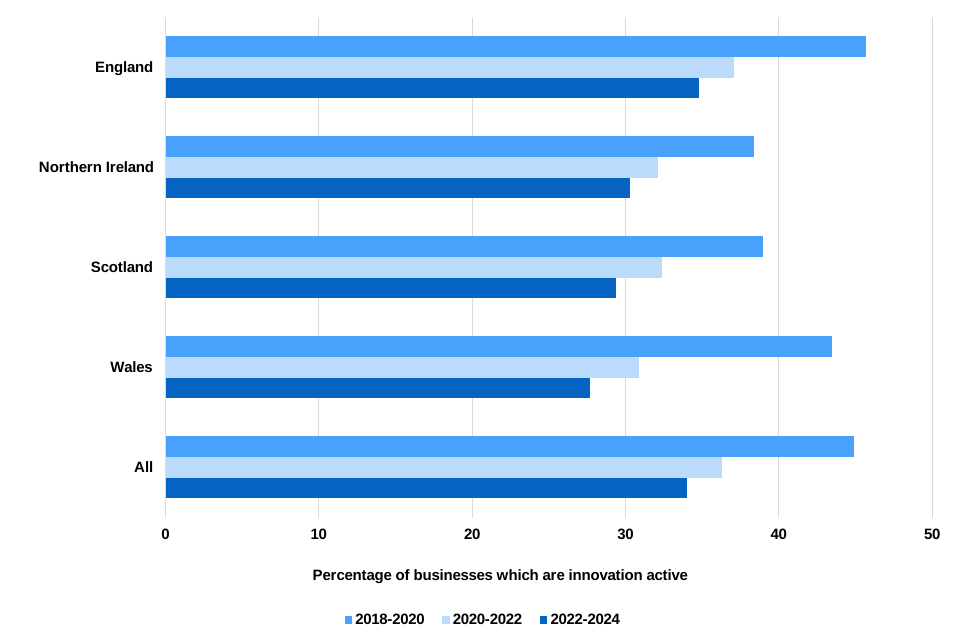
The percentage of innovation active businesses was highest in England (35%) in 2022-2024. In Northern Ireland 30% of businesses in 2022-2024 were innovation active, compared to 29% in Scotland and 28% in Wales.
The percentages of innovation active businesses in all 4 countries were lower in 2022-2024 than 2020-2022. The largest percentage point decreases of 3 percentage points were in Wales and Scotland between 2020-2022 and 2022-2024.
Similar trends were found in the longitudinal panel survey, with decreases in the percentages of businesses who were innovation active in all UK countries, when comparing UKIS 2025 to 2023 for panel respondents (see statistical annex: table P5 of Table 18).
Regional level differences (English Regions only)
Figure 6.3: percentage of innovation active businesses by English region, 2018-2020 to 2022-2024

The East of England and the South East were the English regions with the highest percentage of innovation active businesses in 2022-2024 (39% and 38% respectively). The North West and the South West were the English regions with the lowest percentage of innovation active businesses in 2022-2024 (30% and 32% respectively).
There has been a reported decrease in innovation activity in all English regions, except for the East Midlands, between 2020-2022 and 2022-2024 (see table 1a in the statistical annex). The largest percentage point decreases of 5 percentage points were in the North West and the South West.
Similar trends were found in the longitudinal panel survey, with decreases in percentages of businesses who were innovation active in all English regions, when comparing UKIS 2025 to 2023 for panel respondents (see statistical annex: table P5 of Table 18).
International Territorial Level 2 geographic boundary differences
Figure 6.4: percentage of innovation active businesses by International Territorial Level 2 geographic boundaries, 2022-2024. Official statistics in development

Notes for figure 6.4:
Digital boundary products and reference maps are supplied under the Open Government Licence. Source: Office for National Statistics licensed under the Open Government Licence v.3.0. Contains OS data © Crown copyright and database right [2026]. ITL 2 boundaries were updated in 2025.
Analyses by International Territorial Level 2 (ITL 2) geographic boundary are official statistics in development. The sample was not selected to be representative at this geographic level. ITL 2 information has been calculated by using a separate weighting to the rest of the publication. The weighting is based on ITL boundaries, 3 broad sectors and business size band.
The 3 broad sectors are:
-
production – which covers manufacturing, including electricity and construction,
-
other services – retailing, accommodation etc
-
business Services: R&D, Real Estate and other non-financial services etc
Figure 6.4 and statistical annex: table 6 show the percentage of innovation active businesses by ITL 2 boundary. The 2 ITL 2 areas ‘Berkshire, Buckinghamshire and Oxfordshire’ and ‘Cambridgeshire and Peterborough’ had the highest percentage of innovation active businesses in 2022-2024 – 48% and 46% respectively.
‘Southern Scotland’ (25%), ‘Cumbria’ and ‘Tees Valley’ (both 26%) were the ITL 2 areas with the lowest percentage of innovation active businesses in 2022-2024. More detailed information by further types of innovation activities, by ITL 2 area is available in statistical annex: table 6.
7. Factors driving innovation
7.1 Introduction
Research has shown that innovation significantly boosts productivity growth. There are varying motivations for businesses to engage in broad forms of innovation, which may relate to firms’ business strategies of improving quality, reducing costs, or diversifying their range of products and services. Changes in these motivations can vary over time, reflecting evolution in the external environment and market conditions.
7.2 Trends in factors driving innovation
Figure 7.2 shows trends in motivations for businesses to engage in broad forms of innovation.
Figure 7.2 Innovation factors (percentage of all broader innovators rating factor as of ‘high importance’ to their decision to innovate) 2018-2020 to 2022-2024

Note for figure 7.2: * Energy prices was a new option introduced in UKIS 2023. Meeting regulatory requirements and meeting technical, industry or service standards were asked separately from UKIS 2023.
Businesses cited a number of different factors influencing their decision to innovate. Improving quality of goods or services remained the top-rated factor, being of high importance to 44% of broader innovator businesses in 2022-2024.
The next highest rated reason for innovating was meeting regulatory requirements (38%). Further information on the drivers of innovation and regional / industrial sector variations among these common drivers are shown in statistical annex – table 10.
Improving quality of goods or services along with meeting regulatory requirements were also the most common factors in driving innovation in the 2025 wave of the panel respondents – see statistical annex table P6 of table 18.
The main theme from businesses who gave comments on the UKIS 2025 survey was that they innovated in the online / digital area, with software being the most frequent example given. There were also many comments about how businesses innovated to reduce their environmental impacts and the steps they took to do this.
8. Barriers to innovation
8.1 Introduction
Research has shown perceived barriers to innovation appear to have little relation to business performance, when focusing on highly innovative businesses. It is important to compare and track perceptions of barriers to innovation among innovative businesses and non innovators over time.
8.2 Trends in barriers to innovation
Figure 8.2: broader innovators’ perception of potential barriers to innovation (businesses gave listed factors a rating of ‘high’ importance to constraining innovation activities), 2018-2020 to 2022-2024
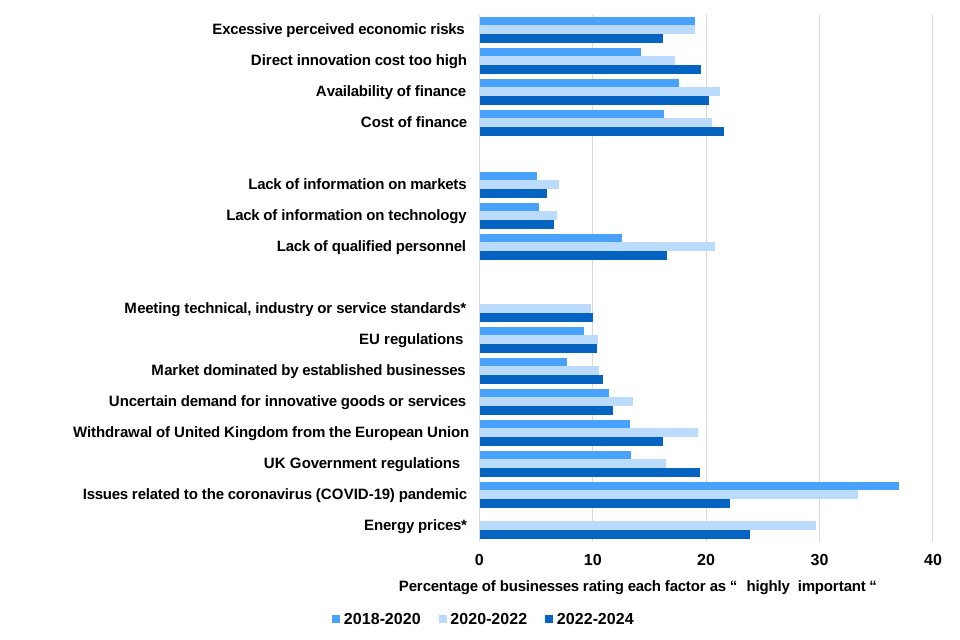
Notes for figure 8.2: * Technical, industry or service standards and energy prices were options introduced in UKIS 2023.
Energy prices were the highest rated barrier to innovation. It was rated as of ‘high’ importance by 24% of broader innovator businesses in 2022-2024. Issues related to the coronavirus (COVID-19) pandemic was rated as the next biggest barrier, of ‘high’ importance to 22% of broad innovator businesses in 2022-2024. Cost factors (including finance availability, direct innovation costs too high and finance costs) had been the biggest barrier in UKIS surveys prior to the coronavirus (COVID-19) pandemic.
The withdrawal of the United Kingdom from the European Union was of ‘high’ importance, as a barrier, to 16% of broader innovators in 2022-2024, compared to 19% in 2020-2022. UK government regulations was of ‘high’ importance, as a barrier, to 20% of broader innovators in 2022-2024 and EU regulations to 10% of broader innovators.
Further information on the barriers to innovation for broader innovators and regional / industrial variations towards these barriers are shown in statistical annex: table 10a.
The main barrier to innovation for non-broader innovators was energy prices. In total, 8% of these non-broader innovator businesses rated this barrier as of ‘high’ importance. Issues related to the coronavirus (COVID-19) pandemic and the cost of finance were the next highest rated barriers for non broader innovators, see statistical annex: table 10b.
Additionally, non-broader innovators were asked to give further information on the reasons ‘why it has not been necessary or possible to innovate?’, which are shown in table 11. No need to innovate due to previous innovations (47% of businesses) and no need due to market conditions (30% of businesses) were the main reasons given for not innovating for these types of businesses.
Main themes from businesses who gave comments on the UKIS 2025 survey were that ongoing issues from the coronavirus (COVID-19) pandemic, the withdrawal of the United Kingdom from the European Union and increases in both energy prices and employer national insurance contributions were the major barriers to investing in innovation.
9. Skills for innovation / technology used by businesses
9.1 Introduction
Workforce skills to create and implement new products, services, practice and processes are essential components to introducing innovations. Previous research has shown that science, technology, engineering, and maths (STEM) graduates make up a greater share of the workforce in highly innovative businesses, than in less innovative organisations.
STEM graduate employment is also associated with greater use of external information, co-operation, and introduction of new products. It is argued that employing STEM graduates increases demand for innovation, through greater use of external collaboration and networking, leading in turn to further demand for these graduates.
9.2 Trends in skills and innovation over time
Figure 9.2: average percentage of employees who held a degree or higher qualification, in 2020 to 2024

Figure 9.2 compares the average proportion of the workforce holding at least a degree level qualification in non-innovators and broader innovator businesses. The average percentage of employees with a degree or higher qualification was higher for broader innovators than for non-innovators.
Amongst broader innovator businesses in 2024, 16% of employees had a science or engineering qualification, and 21% had a qualification in a non-science subject. In 2024, 7% of staff employed by non-innovators had a science or engineering qualification, and 16% had a qualification in a non-science subject.
Overall, in 2024, 12% of employees held a degree in a science or engineering subject, and 18% in all other subjects (see statistical annex: table 13).
Proportions of science or engineering graduates in the workforce of broader innovators was substantially higher in London (28%) and lower in Wales (10%), the West Midlands, Yorkshire and Humber, and the North West (all 11%): see statistical annex: table 13. Proportions of non-science or engineering graduates in the workforce of broader innovators were substantially higher in London (40%) and lowest in the South West (13%).
Regression analysis which accompanied the UK innovation survey 2017: main report showed that businesses which employed an increasing share of either STEM or non-STEM graduates, were more likely to experience improvements in turnover and employment (see Appendix 1 in UK innovation survey 2017: main report).
Figure 9.2a: skills: percentage of businesses employing individuals in-house or obtaining listed skills from external sources, in 2018-2020 to 2022-2024

Figure 9.2a shows that in 2022-2024, 17% of businesses employed individuals in-house with multimedia or web design skills or obtained these skills from external sources. 16% of businesses also employed individuals in-house with graphic arts, layout or advertising skills or obtained these skills from external sources. See statistical annex: table 14 for further details.
9.3 Management technologies and production enhancing technologies used by businesses
UKIS 2025 asked questions on business use of management technologies and production enhancing technologies.
Figure 9.3: management technologies used, by all businesses that used any of the management technologies, 2024

Accountancy software was by far the most used management technology, by 94% of broader innovators and 93% of non-broader innovators who used any of the management technologies. For all other management technologies, the percentage of business who used them was much higher for broader innovators than non-broader innovators.
Payroll software was the second most used management technology (by businesses that used any management technologies), used by 70% of broader innovators and 65% of non-broader innovators.
Figure 9.4: production enhancing technologies used, by all businesses that used any of the production enhancing technologies, 2024

Cloud based computing was by far the most used production enhancing technology, by 84% of broader innovators and 81% of non-broader innovators who used any of the production enhancing technologies. For all other production enhancing technologies the percentage of business who used them was much higher for broader innovators than non-broader innovators.
Cyber security tools were the second most used production enhancing technology (by businesses that used any production enhancing technologies), used by 58% of broader innovators and 46% of non innovators.
10. Environmental innovations
UKIS 2025 asked questions on innovations with environmental benefits (IWEB) obtained within the business and during consumption or use of good or service by the end user.
Figure 10.1: broader innovators that introduced innovations with environmental benefits (IWEB) obtained within the business, 2020-2022 and 2022-2024

Figure 10.2: broader Innovators that introduced innovations with environmental benefits (IWEB) obtained during consumption, 2020-2022 and 2022-2024
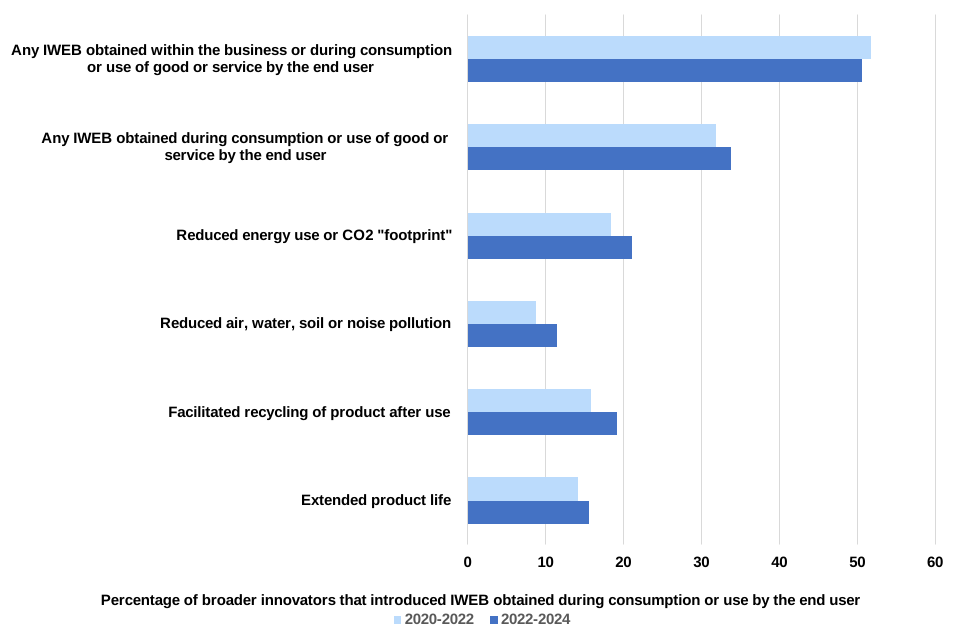
Figures 10.1 and 10.2 show that 51% of broader innovators introduced an innovation with environmental benefits (IWEB). Any IWEB obtained within the business was carried out by 45% of broader innovators and any IWEB obtained during consumption, or use of good or service by the end user, was implemented by 34% of broader innovators.
The most commonly carried out IWEB obtained within the business were reduced energy use or CO2 footprint (by 33% of broader innovators) and recycled waste, water, or materials for own use or sale (by 20% of broader innovators).
The most commonly carried out IWEB obtained during consumption, or use of good or service by the end user, were reduced energy use or CO2 footprint (by 21% of broader innovators) and the IWEB facilitated recycling of product after use (by 19% of broader innovators).
11. Accompanying tables
Accompanying this report is a statistical annex of tables.
Tables 1 to 17 are mainly consistent breakdowns for UKIS 2025 covering the period 2022-2024 or just for 2024 in certain instances.
Table 1a is a time series table from 2008-2010 to 2022-2024 with breakdowns of innovation active businesses by size of business, region and sector.
Table 1b in the UKIS 2025 statistical annex compares UKIS 2020-2022 and 2022-2024 information with a subset of industries (industrial divisions) used for reporting by OECD. OECD publish internationally comparable UK figures in Business innovation statistics and indicators Business innovation statistics and indicators
Table 1c compares business turnover related to innovation, between all UKIS industries sampled and a subset of industries used for OECD reporting, 2022.
New tables on procurement contracts (9a to 9d).
Table 18 is consistent with previously presented panel analysis, with the addition of UKIS 2025 information covering the period 2022-2024. The UKIS 2025 statistical annex includes 8 sub tables to table 18 (P1 to P8), for businesses that responded to the questionnaire in each of the last 3 UKIS surveys (2021, 2023 and 2025).
12. Technical information
This report presents the findings from the UK innovation survey 2025 (UKIS 2025), covering the 3-year period from 2022 to 2024. This is the 14th UKIS and comparisons are made with the previous surveys.
UKIS 2025 sampled 31,150 UK businesses with 10 or more employees. The survey was voluntary and was conducted primarily through an electronic questionnaire. Some businesses that did not complete an electronic response were contacted for a telephone interview. We received a response from 14,075 businesses, giving a response rate of 45.2%.
Further details on UKIS methodology are published in the statistical annex to this report for UKIS 2025. View a copy of the questionnaire.
13. Definitions
The UK definition of innovation is based on an Organisation for Economic Co-operation and Development (OECD) definition, outlined in the Oslo Manual 2018. This definition includes any of the following activities, if they occurred during the survey period:
-
the introduction of a new or improved product (goods or services);
-
business processes used to produce or supply all goods or services that the business has introduced, regardless of their origin. These innovations may be new to business or new to the market;
-
engagement in innovation projects not yet complete or abandoned;
-
investment activities in areas such as internal research and development, training, acquisition of external knowledge or machinery and equipment linked to innovation activities.
A business that had engaged in any of the activities described in points 1 to 3 is defined as being ‘innovation active’.
A business that had engaged in any of the activities described in points 1 to 4 is defined as a ‘broader innovator’.
A business that undertakes activity 2 only is described as a ‘business process innovator’. This definition is broader than the process innovator definition in UKIS surveys prior to 2023 and is therefore not comparable. It aligns with OECD’s revised approach in conceptualising ‘innovation’.
| Term | Description |
|---|---|
| Co-operation arrangements | Co-operation occurs when 2 or more participants agree to take responsibility for a task or series of tasks and information is shared between the parties to facilitate the agreement. An innovation-active business co-operates with another business if it procures ideas or inputs from the other business by providing it with a detailed specification of its needs |
| EU | European Union |
| Innovation investment activities | Business that reported spending in each of the specified main innovation related investments (as described in point 4 above) |
| Innovation-related activities | Categories of innovation directed investment such as: R&D, capital goods and software acquisition, design activity, for implementing current innovations or directed to future product or process changes. |
| Large business | A business with 250 or more employees. |
| New to market | The introduction of a new good or service to the market before competitors. |
| New to this business | Introduction of a new good or service that was essentially the same as a good or service already available from competitors. |
| OECD | Organisation for Economic Co-operation and Development |
| Product innovation | Bringing to the market or into use by business, new and improved products, including both tangible goods and the provision of services. The degree of innovativeness is shown by the distinction between products new just to the business or which are also new to the market |
| R&D | Research and Development |
| Small and medium-sized enterprises (SMEs) | Businesses with 0-249 employees. This survey does not include any businesses with fewer than 10 employees |
14. Further information
14.1 Future updates to these statistics
Detailed microdata will be made available to accredited researchers through the ONS Secure Research Service and the UK Data Service.
A UKIS 2027 report covering the survey period 2024-2026 will be published in spring 2028. A statistical annex with further data will accompany this publication.
14.2 Related statistics
International comparisons
The UKIS data is used for international statistics on innovation.
International comparisons are published by the OECD in Business innovation statistics and Indicators and by the European Commission in the European Innovation Scoreboard, which includes the UK as an other European country European innovation scoreboard 2025 - Research and innovation.
Research and development
The Office for National Statistics (ONS) publishes detailed statistics on research and development. The following links are the most recent data at the time of UKIS 2025 report publication:
- Business enterprise research and development (2024)
- Gross domestic expenditure on research and development (2023)
- Research and development expenditure by the UK government (2024)
Business statistics
For more general business statistics, please see:
- Business population estimates for an estimate of the total number of registered and unregistered businesses in the UK.
- UK business; activity, size and location for UK registered businesses by legal status, industry, region, employment and turnover size bands.
- Longitudinal Small Business Survey for information on survey responses for businesses with employees and businesses with no employees on a range of topics including innovation.
- Business insights and impact on the UK economy - Office for National Statistics (ons.gov.uk) publishes information from the Office for National Statistics Business Insights and Conditions Survey
14.3 Revisions policy
The DBT statistics error policy sets out the revisions policy for these statistics, which has been developed in accordance with the UK Statistics Authority Code of Practice for Statistics.
It is not expected that UKIS data will be revised. Where any minor errors are uncovered the department will update in the next annual publication (see statistics release calendar). Major errors or revisions will be made as soon as possible with reasons provided.
14.4 Uses of these statistics
The UK innovation survey (UKIS) is the main data source for business innovation in the UK. It is used widely across government and by the research community (including the Enterprise Research Centre) for understanding the innovation landscape, drivers of business growth and productivity and to help the government develop, improve, and evaluate policy.
Internationally, it is used by OECD and European Commission for international comparison (see Related statistics section).
14.5 User engagement
Users are encouraged to provide comments and feedback on how these statistics are used and how well they meet user needs. Comments on any issues relating to this statistical release are welcomed and should be sent to: business.statistics@businessandtrade.gov.uk
The DBT statement on statistical public engagement and data standards sets out the department’s commitments on public engagement and data standards as outlined by the Code of Practice for Statistics.
14.6 Official statistics regulation
UKIS statistics are official statistics – they provide a factual basis for assessment and decisions on economic, social and environmental issues at all levels of society.
Our statistical practice is regulated by the Office for Statistics Regulation (OSR).
OSR sets the standards of trustworthiness, quality and value in the Code of Practice for Statistics that all producers of official statistics should adhere to.
You are welcome to contact us directly with any comments about how we meet these standards.
Alternatively, you can contact OSR by emailing regulation@statistics.gov.uk or via the OSR website.
14.7 Pre-release access to statistics
The Code of Practice for Statistics requires that access to official statistics before their public release is limited to certain individuals. This includes those involved in the production of the statistics and the preparation of the release, and those involved for quality assurance and operational purposes. Pre-release access may only be granted in accordance with the rules and principles set out in the Pre-release Access to Official Statistics Order 2008. In addition, the order requires that records are published of those who have access prior to public release.
The list of roles for people who received pre-release access to UK innovation survey 2025 are:
-
DBT Parliamentary Under Secretary of State (Minister for Small Business and Economic Transformation)
-
DBT Director of Analysis
-
DBT Deputy Director, Chief Statistician
-
DSIT Deputy Director, Science, Technology & Innovation Analysis
-
DBT Press Officer
-
DSIT Press Officer
-
DSIT G7 Innovation Policy Analyst
-
Welsh Government, G7 Innovation Statistician
-
Scottish Government, G7 Business and Innovation Statistician
Contact
Responsible statistician: James Achur
Email: business.statistics@businessandtrade.gov.uk
Media enquiries: 020 7215 1000
Public enquiries: 07391 864586
© Crown copyright 2026
This publication is licensed under the terms of the Open Government Licence v3.0 except where otherwise stated. To view this licence, visit nationalarchives.gov.uk/doc/open-government-licence/version/3 or write to the Information Policy Team, The National Archives, Kew, London TW9 4DU, or email: psi@nationalarchives.gov.uk.
Where we have identified any third-party copyright information you will need to obtain permission from the copyright holders concerned.
This publication is available at the UK Innovation Survey collection.
If you need a version of this document in a more accessible format, please email business.statistics@businessandtrade.gov.uk. Please tell us what format you need. It will help us if you say what assistive technology you use.